Category: Politics

  • Slouching towards Gavin

    Slouching towards Gavin

    More through historical accident than anything else, Gavin Newsom has emerged as the de facto leader of the Democratic resistance. His dubious attempt to redistrict California along partisan lines won at the ballot box last month. It was a gamble – an open and explicit attempt at gerrymandering – which voters have rewarded. He is conspicuously modeling his image on Bill Clinton’s and Slick Willie is returning the compliment by letting insiders know that he is hugely impressed by Newsom’s talents.

    Newsom is also audaciously recasting himself as a working-class hero. He has said he spent his childhood “hustling” and that he “raised himself.” That rather downplays his rise as a protégé of the Getty family, which employed his father as its lawyer. In 1991, a young Newsom was photographed with the Getty children as part of a newspaper story titled “The Children of the Rich.” It’s unlikely that the San Francisco elite, who have financed his ruse, are fooled; nor is anyone else for that matter. Yet the act goes on, without a hint of shame.

    In November, his former chief of staff was indicted for wire fraud and falsifying tax returns, using fake contracts to deduct the cost of luxury handbags and private jet travel. Dana Williamson’s defense team say federal investigators had sought her cooperation with an as-yet undisclosed investigation into Newsom himself. His team denies any knowledge of such an investigation – an increasingly common occurrence in the one-party state.

    Whatever the truth of the Williamson case, Newsom’s record as Governor alone ought to be fatal. California has led the globe in culture and technology for more than a century. If the state were a country, it would be the fourth-largest economy in the world, as Newsom endlessly brags. But look under the hood and California has become a disaster for most workers.

    This economic regime is, as former director of the California labor department Michael Bernick puts it, an “upstairs, downstairs” autocracy. Newsom’s state has a phenomenally wealthy class above a large, low-wage underbelly. Of course he rarely discusses the other California; the state has the highest proportion of those living in poverty, tepid job growth and the country’s highest rates of unemployment.

    Among teenagers the unemployment rate tops 21 percent, just short of twice the national average. For Gen Z, unemployment ranks second, just ahead of Mississippi. California is the single worst state at creating jobs that pay above average; it hemorrhaged 1.6 million above-average-paying jobs in the past decade, more than twice as many as any other state. In the past year, the only new jobs created in California were in government-financed healthcare and government itself.

    Yet the Governor likes to bask in California’s glow. He inherited an economy that is home to five of the top ten companies in the world. No other region on the planet comes close. The presence of these firms, and their capital gains, along with a highly inflated property market, do much to propel the state’s GDP. That’s partly why he now dominates the race to be the presidential candidate for 2028, as his long-time rival Kamala Harris fades towards well-deserved obscurity.

    The notion of an enlightened California coming to rescue the nation from Trump also plays well with large sections of Silicon Valley. Despite the tech world’s flirtation with MAGA, loyalties remain decisively on the side of the Democrats. The Republicans haven’t won a statewide race in almost two decades. Partly that’s down to demographics. Young workers are fleeing. Left behind is a rapidly aging population, many rich from real-estate investments, a large coterie of affluent professionals, state-dependent individuals and, most importantly, public-sector workers, whose unions funded Newsom’s successful redistricting drive. Leading Democratic pollster Paul Mitchell told me that, thanks to these demographic changes, the GOP’s chances of recapturing the Governor’s Mansion would be “a one in every 200 years event.”

    Newsom’s agenda is shaped largely by public-employee unions and tech-financed green lobbies. But these same policies have devastated the state’s blue-collar economy. Once a major oil producer, the state now suffers the nation’s highest energy prices and is utterly dependent on foreign imports from South America and Saudi Arabia. California’s regulations have added to the erosion of industrial jobs. Since 1990, one-third of manufacturing jobs – 1.3 million positions – have disappeared. Newsom likes to present himself as a member of the hustling classes and yet, in truth, he has destroyed them, encouraged by the established wealth of unions and tech oligarchs. It’s a story that makes much more sense when you learn of his early years.

    Over the past two decades, four million net domestic migrants have left California – that’s the population of San Francisco, Anaheim and San Diego combined. In the past decade, the four leading destinations for young people were all in the South – Nashville, Austin, San Antonio and Dallas-Fort Worth. Austin’s growth in educated-millennial migration was almost three times that of New York and twice that of San Francisco. This has only accelerated under Newsom.

    Some suggest that California’s tech sector will make up for this decline in jobs. But companies, too, are leaving. Along with energy firms such as Chevron and Occidental, the recent exodus includes Tesla, SpaceX, McKesson, Jacobs Engineering and Oracle. The big winner is California’s arch-rival, Texas. Hollywood is also suffering a major loss of jobs to other states and countries. Tech employment is heading downward, with more than half of all national tech job losses occurring in the Golden State. Texas, Mississippi, Tennessee and South Carolina are projected to enjoy the biggest growth in tech over the next decade.

    Optimists point to artificial intelligence as a new source of growth, but California’s high energy prices make that unlikely. The soaring need for affordable electricity is leading firms such as Nvidia and Samsung to locate centers which fabricate advanced chips and processors in areas with lower prices for electricity. This includes Texas, where a new quantum-computing center is being planned, and energy-rich states such as Pennsylvania, which is seeking AI growth as a way to reanimate its industrial sector.

    To be sure, many AI firms began life in San Francisco. But they are unlikely to create more tech jobs. City economist Ted Egan suggests that layoffs from other companies, largely due to AI replacing workers, have wiped out gains from the new tech. AI will, if anything, accelerate the rewards to the investor class, a handful of entrepreneurs and well-compensated “genius” programmers. What seems to be happening is that a few highly paid executives and developers stay on their campuses, while computing power shifts to places where energy is cheaper. California is becoming the oligarch’s state, led by the oligarch-in-chief.

    Nothing drives the mass departure from America’s most blessed state more than affordability. This of one of issues that excites both the “abundance” advocates and the increasingly socialist-oriented YIMBY movement. Newsom, who bought a new $9 million house last year, claims to be taking bold steps to improve the state’s housing market. But he has overseen laughably poor results. Many Californians will never own a home or find an affordable rental. Despite hundreds of “pro-housing” initiatives, the state’s housing crisis is getting worse. California consistently lags in the construction not just of single-family homes but multifamily homes as well, while the state dominates the list of the nation’s most expensive ZIP codes.

    Home prices in coastal California are nearly 400 percent above the national average, and statewide the median cost of a home is 2.5 times higher than in the rest of the country. Not surprisingly, California has the second-lowest home-ownership rate in the nation, 56 percent (New York’s is lowest, at 54 percent). Nor have Newsom’s policies helped renters. The average cost of a two-bedroom apartment in Los Angeles is just shy of $3,000 a month, according to apartments.com, about $1,000 more than the national average.

    Housing is just one of the many Newsom policies that may not play so well in the vast center of America, where single-family homes are the norm and prices are far lower. Certainly, his long-standing assault on fossil fuels will win over few workers in Texas, Oklahoma, Louisiana, the Dakotas and Pennsylvania, the epicenters of the US’s enormous energy production. Laid-off factory hands in Michigan may not welcome an agenda that includes the wiping out of profitable gasoline-fueled cars. Progressive mantras that play well in California may prove Newsom’s undoing in a 2028 presidential run.

    But it would be foolish to underestimate Newsom. Burdened by dyslexia, he has compensated with extreme discipline and hard work. Never an object of adulation, like his predecessor Ronald Reagan, or of respect like the more cerebral former California governor Jerry Brown, his career trajectory has evolved carefully, along very pragmatic lines, even while Newsom embraces progressive bromides. “He is trying to be the anti-Trump,” notes long-time Democratic consultant Dave Gershwin, “but if he needs to cut ties with the left, he’ll do it.” There is little sign of that yet in his cultural stances, such as his preference for transgender over parental rights or his embrace of climate-change religion, which still resonate with his state’s progressive-dominated media.

    An ability to shift from ideology to practicality has been a hallmark of Newsom’s career. Expect a move right on these questions in the coming months. As mayor of San Francisco, he often sided with business interests against the local radical left. As lieutenant governor under Brown, he resorted to visiting Texas in search of a more viable economic model. Just this year he displayed his skill at shifting with the winds by trying to reach out to conservatives such as the late Charlie Kirk when it seemed MAGA was on the rise.

    When necessary, Newsom is willing to jettison progressive demands. He vetoed a bill that would have legalized “shooting alleys” – so-called safe drug-injection sites. He worked to keep the state’s last nuclear and natural-gas plants in operation to prevent politically unpalatable blackouts. To do otherwise would have been madness: these plants account for half of California’s electricity. Newsom is many things, but mad is not one of them. Facing a dismal fiscal reality, he has been forced to fend off proposals from Sacramento progressives that included a 32-hour work week, raising the state’s income tax – already the nation’s highest – and adding new payroll taxes for universal healthcare.

    To balance practicality with ideology, Newsom uses his media skills – ultra-friendly Politico claims he has “won the internet” – to assert himself. The donor class, which has always liked him, now sees him as the best option at a time when a majority of under-40s embrace socialism. Particularly threatening to Palo Alto is a survey that found that a majority of under-40s now favor restricting incomes, with a large portion seeking limits of less than $1 million annually.

    GOP opponents say that Newsom is the “tier one” to fear in 2028. “He’s really smart,” according to California’s Republican national committeeman Shawn Steel, “besides having great hair.” Even the American Conservative proclaimed him “the big winner” of the 2025 elections, thanks to his gerrymandering initiative.

    Of course, Newsom’s record of failure for working people could provide fodder for a challenger from the left, and in November 2028 from the GOP. But right now, anti-Trumpism overwhelms serious progressive critiques of Newsom’s record. He is no great statesman. But, with his media savvy and good looks, he could well play one on TV, and that may be more than enough against either his party’s socialists or the remnants of a disintegrating MAGA.

    This article was originally published in The Spectator’s December 8, 2025 World edition.

  • The ‘affordability’ delusion

    During last week’s excruciating Oval Office make-nice between an insultingly buddy-buddy American President and a fraudulently obsequious New York City mayor-elect, the contest was over which pol was the more patronizing. At one point Trump graciously granted his petitioner permission to call him a “fascist” while clearly implying the guy’s OTT campaign rhetoric had been embarrassing. Donald Trump sat regally on his throne, patting Zohran Mamdani’s arm while commending “Attaboy!” as if petting a golden retriever that had fetched a ball.

    For his part, Mamdani stood mutely by the Resolute desk with cartoonish humility, hands over crotch. This cowed performance of beta-male submission was meant to disguise who’d got a leg over whom. Pilloried by Trump as “a communist lunatic” for months, Mamdani had requested this encounter in the hopes of neutralizing Trump’s repeated threats to withdraw federal funds from the Big Apple should New Yorkers elect this proudly socialist child star. Improbably, Mamdani seems to have achieved his mission, though were the public privy to the fawning private flattery that no doubt fostered Trump’s climbdown, we’d have lost our lunch.

    Ostensibly, what made these polar political opposites attract was not only mutual concern for New York, but mutual obsession with the buzzword we’ll hear relentlessly approaching the midterms: “affordability.” It’s the latest term for nothing new: the fact that most Americans feel skint. The sensation is intensified by persistent inflation of 3 percent, which may sound meagre but which will halve the buying power of a currency in 24 years. Mamdani is from a wealthy family en route to a literal mayoral “mansion,” and Trump is busy padding his fortune with questionable side hustles; neither is personally worried about the price of milk. That makes pretending to worry on the electorate’s account all the more urgent, so naturally both candidates ran on the promise of bringing down prices.

    Despite his pre-Thanksgiving declarations that thanks to your new President the holiday’s tradition of grotesque overeating is cheaper this year than last – it isn’t – Trump’s approval rating has slumped to the low 40s, in part due to the public’s incredulous sticker shock during every visit to a supermarket.

    Yet barring the disastrous embrace of a Soviet-style command economy, no president is in a position to lower the price of sweet potatoes. Mamdani’s widely derided solution of putting a government-run grocery in each of the five New York boroughs is bound to fail both practically and economically, in the unlikely event that the policy ever gets off the ground.

    Just physically, the prospect of a single supermarket selling reduced-price food to millions of people makes my head spin; customers in the miles-long queues would kill each other before anyone ever reached the cucumbers in aisle two. Economically, even if these shops built on rent-free public land and reaping no profit were to proliferate, they would put privately run shops out of business, tanking the sector and resulting in those notorious “food deserts.” Besides, running supermarkets is hard – no, Kamala, the problem of high food bills isn’t “price gouging”; US groceries operate with a typical profit margin of 1.6 percent – and government pretty much sucks at doing anything, even stuff that should be super easy, such as giving other people’s money away.

    It’s not as if government is helpless to ameliorate popular financial distress. But here’s my theory: politicians continually promise to solve economic problems over which they have no control, while refusing to address economic problems over which they have significant control. Trump’s claiming credit for a reduced price of eggs was absurd. Eggs grew expensive in the first place due not to presidential decree but to bird flu, which slowed over the summer. Both New York City and the White House contend with enough serious problems that neither should be issuing 25-cent-off coupons for tinned tomatoes. Mamdani’s victory speech was wrong: there really are issues too small for government to concern itself with.

    By contrast, the price of housing – on which a third of Americans spend more than 30 percent of their income and in comparison with which a supermarket shop is a mere bagatelle – is very much down to government. In both Britain and the US, the demand problem is directly due to mass immigration, really the sole source of population growth, which neither country has built enough additional residential dwellings to accommodate. Likewise in both countries, the supply problem is overwhelmingly due to an obstructive kludge of over-regulation, often at the local level. Thus Mamdani rightly campaigned on lowering exorbitant housing costs, though his proposal to freeze rents of apartments over which the city exerts control would only make private rents even stiffer. Rather than opt for such a destructive quick fix, he might have vowed to scythe the thicket of rules and mandates that make building anything in New York an arduous, expensive, time-consuming exercise in form-filling compliance. But then the sedulous culling of regulations would be dreary, dragged out, undramatic and difficult. No fun.

    Otherwise, what pains punters in both countries is inflation, with which wages struggle to keep up (and if they do, inflation rises still further). Lavish government overspending directly exacerbates a currency’s loss of value. If Trump really cared about affordability, he’d never pass “big, beautiful” bills, swelling a national debt that just rose an astonishing $1.4 trillion in a single quarter.

    In a free market, the state can’t magically lower the price of cornflakes. It can confiscate more or less of our money. But the economic influence politicians genuinely wield is often painfully incremental – too slow and minimal to win votes. So rather than make household expenses slightly more affordable, they promise to “lower prices” not in their gift, while piling on ever more control freakery that drives bills sky high.

  • Federal judges crave the spotlight

    Federal judges crave the spotlight

    In the great injunction sweepstakes that have followed Donald Trump’s second administration like a shadow, we have seen district court judges with a hankering for executive power attempt to play president in more than a hundred cases from immigration and tariffs to funding various executive branch agencies, so-called trans-rights, DEI and climate change.

    Some of these injunctions and temporary restraining orders are still pending. Many, perhaps most, have been resolved by the Supreme Court in ways that favor the Trump administration, not always categorically but usually by affirming the broad scope of executive power envisioned by Article II of the Constitution. “The executive Power,” quoth that magisterial document, “shall be vested in a president of the United States of America.” “A president,” mind you, a single one. Not a president and hundreds of district court judges.

    The rousing start to Article II of the Constitution is neatly put, isn’t it? But those judges took it as a challenge. Trump is an affront to what every right-thinking, i.e., left-leaning, person believes. He wants to make America more prosperous, freer and more secure than it has become in the hands of Democrats and other disciples of hegemonic bureaucracy.

    He moved quickly to secure the border.  Can you believe it? He is deporting scads of people who are here illegally. Outrageous. He outlawed the racist practice of DEI throughout the federal government and made federal funds contingent upon ending the scam. Horrible. He thinks that the military should be an institution specializing in fighting wars, not promoting “social justice.” Clearly he must be stopped.

    Like many pro-Trump commentators, I have weighed in early and often on this legal-political charade. It is a legal charade because what we have witnessed since Trump took office again in January 2025 has been a mind-boggling misuse and hypertrophy of judicial power. Whoever would have thought that a lowly district court judge (there are some 700 of them) would successfully arrogate to himself the authority to tell the President what executive agencies he should pay for and which he should close?

    It is a political charade, or worse, because what we are witnessing is the triumph of partisan passions uber alles. In case after case, judges ruled to stymie the executive branch for one main reason: because it is overseen by President Trump.

    Nevertheless, until recently, most of the cases brought had a certain weight or specific gravity. It matters, after all, whether the border is sealed, whether DEI is allowed to trump merit, whether criminal aliens are allowed to roam the streets, whether fantasies of a climate emergency are allowed to choke off the robust exploitation of our national energy resources. In many instances, the matters at hand are important. It’s just that judges think that they, having correct (i.e., politically correct) beliefs, are therefore empowered to decide how public policy should proceed. It is they who decide what happens, not this strange bumpkin from Queens who somehow bamboozled the voting public into shoehorning him into the White House.

    Clearly, there is a lot of injunction envy going around official judicial circles these days, especially in the deep blue redoubts that specialize in that species of hubristic bullying. Is there a faster way to get your name and your mug plastered across the news sites? That, anyway, would seem to explain Dabney L. Friedrich, a district court judge for Washington, DC. I try to wheel out Karl Marx’s one certified amusing mot at least once a year. It is time. In The Eighteenth Brumaire of Louis Napoleon (1852), Marx cites Hegel’s observation that great figures and events tend to occur twice. He forgot to add, says Marx, that they appear first as tragedy, then as farce.

    It matters whether we have a secure southern border. It is important that the Department of Government Efficiency be allowed to help curb spending and thereby make a dent in our unsustainable federal debt (currently an eye-watering$37 trillion). But how about power washing, repointing and painting the Eisenhower Executive Office Building, the sprawling excrescence just west of the White House? Mark Twain called the 1888 structure the “ugliest building in America.” Eisenhower didn’t much like the eponymous building either. But it is home to some 1,500 federal worker bees, including the Vice-President.

    The complex, looming building, designed by Alfred B. Mullett in a sort of super-sized Second Empire style, sits like a giant gray toad next to the White House. On November 12, Trump told Fox News presenter Laura Ingraham that he wanted to spruce up the grimy behemoth and paint it white (no, not gold, as some were saying).

    Not so fast, said Judge Friedrich. The preservationist lobby prompted her to enjoin the administration from doing anything in the way of architectural ablutions at least until the end of the year. The administration agreed. But the headlines have been hilarious. “Federal Judge Dabney L. Friedrich has now ordered Trump not to power wash the Eisenhower Executive Office Building.”

    Oh dear. What will they think to prohibit next? “Federal Judge Makeme A. Offer prohibits Trump from playing golf.” “Federal Judge Whack A. Mole orders Trump never to use gold leaf again.” The Entertainment Committee, as Bill Buckley liked to say, never sleeps.

    This article was originally published in The Spectator’s December 8, 2025 World edition.
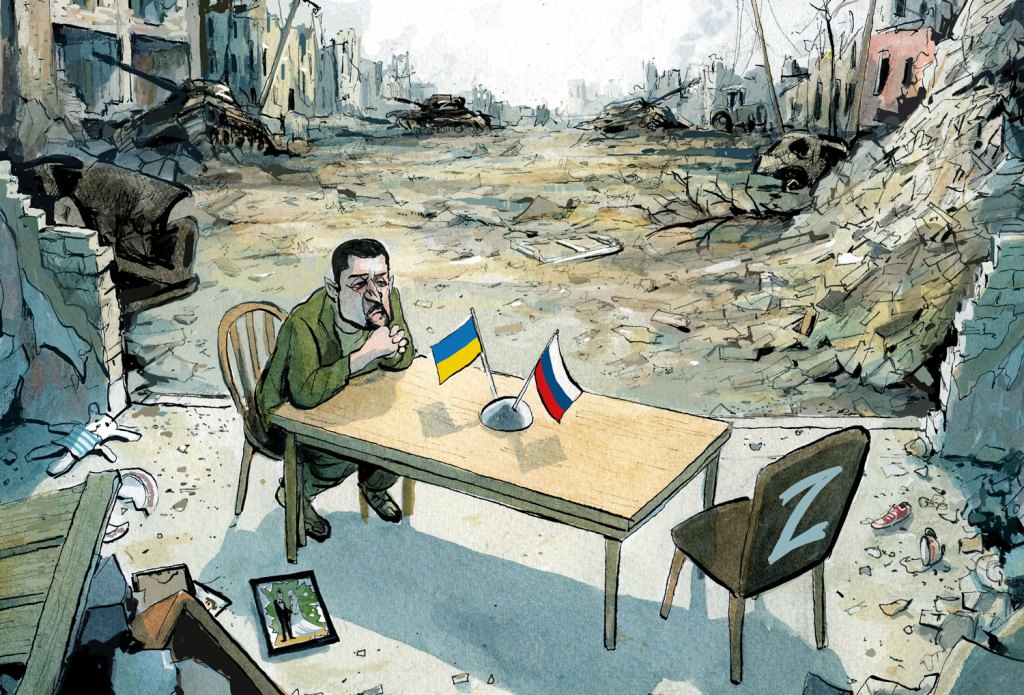
  • Can Zelensky surrender?

    Can Zelensky surrender?

    Kyiv

    The urge to run from danger is only human. It was palpable when air raid sirens sounded as I left the Ukrainian city of Dnipro, which is close to the front line and under relentless attack nightly from Russian drones. Five MiG-31 aircraft were in the air, Telegram channels with access to reliable intelligence reported. The warplanes can be armed with either the Iskander ballistic missile – which travels at up to 5,400mph – or the Kinzhal hypersonic missile, top speed 7,700mph. So fast there wasn’t enough time to find a shelter. We sat in traffic with bated breath, waiting.

    A deep boom resonated through the mini-bus and two colleagues of mine began praying. Was it an intercept or an impact – or a Patriot defense battery firing? We still don’t know. And, more importantly, we wondered where, exactly, the other incoming missiles were heading. As the tension mounted in our stationary vehicle, I glanced out the window: people ambled slowly back from work under yellow streetlights; they smoked, they shopped, they seemed more concerned with the cold than impending death from above.

    For some: flight; for others: fight. Ukrainians succumbing to the understandable desire to run as far away from the war as possible has been a big problem for the country since long before Donald Trump unveiled his plan for a peace deal. Last year, Ukrainian President Volodymyr Zelensky lowered the conscription age from 27 to 25. But nine in every ten conscripts is failing to report for duty, a close advisor of Zelensky told me. It is estimated that the number of fighting-age men who have fled Ukraine is almost equivalent to the size of the 900,000-strong Ukrainian army. Polish border guards have processed 99,000 men aged 18-22 in the past two months alone.

    “If 90 people out of 100 are escaping the army, the nation is not ready to fight anymore,” the advisor said. “The problem with joining the military is that people think it’s forever, until the war is over. So basically you’re going to eventually die on the front line. This is an existential problem for Ukraine now. We have already lost seven million people who have moved out of the country since the war began. If conscription is expanded, it would maybe force out an extra two million. But what’s going to be the future of the country demographically? The best way now is to take the least bad peace deal possible. The Russians still have other moves to go, they can do internal mobilization – they still have reserves.”

    Roman Kostenko, a former military commander and current parliamentary deputy, said “80 percent [of soldiers] are now running away from training centers, and the country is doing nothing to bring them back or create conditions so that they are afraid to run away and do their duty.”

    If the Ukrainian army was twice its current size – as it should be if all who were conscripted had answered the call – perhaps it could have fended off the current Russian advance into the city of Pokrovsk and stopped the Russians pushing forward the front line, thereby bolstering Zelensky’s hand in negotiations with the US.

    Zelensky negotiates from a position of weakness. Battlefield losses are mounting and the front line is moving in the wrong direction. His administration is also engulfed in a corruption scandal centered on the energy industry, which is currently being crippled by Russian attacks. This is his – and his country’s – bleakest moment since the war began in February 2022.

    If Pokrovsk does fall, the next major city in Vladimir Putin’s sights will be Dnipro, 50 miles to the west – which might shortly afterward find itself within shelling distance. Instead of nightly attacks by MiG-31s, Dnipro, which is home to one million Ukrainians, could face 24-hour bombardment. Its resilient residents, swelled already by tens of thousands of people fleeing from the Russian advance, could at that point finally decide to leave en masse.

    Volodymyr Miller, the deputy mayor of Dnipro, called for the conscription age to be lowered even further to help defend his city. “The conscription rules have to change. I would even say that they should have been changed sooner. There are too many people not helping. Either you’re on the front or you’re for the front. And if you don’t have that in society, then the war will be tougher,” he said.

    Some, however, think Ukraine can go it alone and that further conscription is unnecessary. Standing next to the smoldering wreckage of the public broadcaster Suspilne, which was attacked with a barrage of Shahed suicide drones just hours beforehand, Ivanna – a university lecturer in rocket science – said: “We’re not going to stand down. We’ll be here to the very end. I believe in my defenders, I trust they will defend our city.”

    This optimistic assessment of Ukraine’s chances of success prevails across the country. True, this is a view born, perhaps, of necessity while the fighting continues. Failure is not an option: the alternative is death. But to bring the fighting to a close, very few people say they will accept the compromises outlined in Trump’s peace deal – especially ones that involve giving away any land. In a recent poll, 75 percent of Ukrainians said they would reject a plan that forfeited territory, while just 17 percent said they would accept such a deal. Why should they, they argue, when Putin’s aim is to reunite the Russian empire and that a peace deal will, in fact, allow him to regroup before invading again. It has been angrily dismissed by many in the West as a capitulation agreement authored by Russia.

    The counter view to war is fast diminishing in Ukraine. Those who have fled the country in order to avoid being conscripted would, no doubt, account for a big block of those in favor of ending the fighting if Trump’s peace deal is signed. Within 100 days of the deal being agreed, national elections would have to take place, which would effectively act as a referendum on the agreement. However, it is unclear whether these absconding conscripts would be allowed to vote – or if they would even be prepared to put their head above the parapet and give the Ukrainian government their details, for fear of prosecution. The country’s anti-war sentiment is being hollowed out.

    The view from the front line of Trump’s deal – and that of Ukraine’s military and civil leadership – is skeptical. Harry, 27, an American with Ukrainian roots, joined the Ukrainian army almost four years ago. He fought in the infantry, going into Russia as part of a reconnaissance unit, but when his injuries became problematic, he joined a drone team – reasoning that it was better to be the hunter than the hunted.

    “The problem with conscription is a lot of Ukrainians don’t trust the army and I don’t blame them,” he told me. “There have been too many poorly planned missions that lead to unnecessary deaths. You have to ask if this juice is worth the squeeze, as we say in the US. Too many units are trying to be on the offensive and this is 90 percent a defensive war now. We need to be building defenses with pushes here and there to keep the Russians on their toes.

    “With the peace deal that Trump is pushing, there is no incentive for Putin to stop – he’ll just keep going. It’s a Russian wishlist. What’s the point of what we’ve been doing if we give up everything? I don’t see the army accepting it.”

    A fellow serviceman, a drone operator who mounts strike missions deep into Russia, attacking military logistics hubs and fuel depots, believes that further conscription could turn the tide and there is no need to take the US deal. “Russian soldiers are paid much more than our soldiers, but if we paid more than them we could attract a lot of fighters, mercenaries from other countries. With the new sanctions Russia will soon struggle to pay its own troops. We can win if that happens, if we keep our resolve.”

    War is still the most likely outcome of the peace process, not least because Putin hasn’t put his name anywhere near the proposed deal – and may never do so, following reports of a security guarantee that would park NATO troops and warplanes on Poland’s border, ready to be unleashed at a moment’s notice if he steps out of line. The deal is not the point for Putin – the point is the chaos and instability it has uncorked.

    To outsiders, it seems foolhardy to continue a war that is scything down the flower of Ukraine’s youth, especially when the odds of winning oscillate between low and impossible. Since the Ukrainian parliament was frozen in aspic under martial law in 2022, the country has become more militaristic, more steeped in blood, more patriotic. Those who don’t want to fight have left. Peace will be a hard sell. Yet at a time when the majority of young people in the West readily admit they wouldn’t fight for either their country or their way of life, there is something deeply admirable and honorable about the Ukrainians who have stayed to take up arms – and their never-say-die spirit.

  • Meet the e-girls selling European decline to America

    Meet the e-girls selling European decline to America

    Earlier this year, a striking 28-year-old woman, dressed head to toe in a vivid shade of crimson, stepped up to the podium at a conference in Hungary. “Ladies and gentlemen: hello Budapest. I’m so thrilled to be here again,” she began, adjusting the twin microphones and gently swiping a strand of long blonde hair from her forehead. “As some of you might remember, last year I gave here a speech as well, about the ‘great replacement,’” she continued, confidently glancing around the assembled audience. “I wanted the whole world to know that the ‘great replacement theory’ was, in fact, not a theory, but reality. White people are becoming a minority in their own homelands at an exceptionally fast rate.”

    Everything about this woman – her honeyed tresses, the impeccably tailored suit, the precisely arched brows accentuating a dewy, youthful glow and, of course, the words she was actually saying – might have situated her squarely within the heart of the MAGA playbook. Everything, that is, except the lilting accent and occasional grammatical flub betraying her European origins.

    Far from being the latest addition to Donald Trump’s inner circle, Eva Vlaardingerbroek – who was speaking at the Conservative Political Action Conference, known as CPAC – is a Dutch political commentator who has harnessed social media to broadcast her warnings about the “astronomical cost of mass migration” and the “demise of democracy.”

    She has fashioned herself into a warrior against what she sees as the scourge of the left – particularly across her home continent – and in doing so, she has cultivated celebrity status and more than 900,000 followers on Instagram. She has also emerged as something of a figurehead of a new cohort of young, digitally native women denouncing, or at least criticizing, their homelands and exalting the US as a beacon of hope in a world they believe to be broken.

    Their rise is more than cultural curiosity. It may well signal a subtle but real shift in the center of gravity within American conservatism itself. A political movement once dominated by homegrown men – self-styled patriots steeped in the mythology of the heartland – is evolving to become a stage for young women who arrive not from red-state strongholds, but from overseas.

    These telegenic expat firebrands, fluent in the art of digital influence and polished by the cosmopolitan milieus some of them now shun, have begun to redefine the contours of the right. In their eyes, American conservatism – underpinned by an awesome bureaucracy and a canonical constitution – is a refuge: a battlement against the forces they believe have overtaken their own homes.

    Each woman who belongs to this new class of conservative Americophiles shares a fundamental admiration for the principles and values upon which this country is built – or at least their interpretation of those principles and values. Each also has her own reason for doing so, her own story of what brought her here.

    Jade Warwick, a 28-year-old woman who grew up in Wales, in the United Kingdom, started modeling when she was a teenager – a career that took her to Los Angeles, where she fell in love with the US. Today she lives in Washington, DC and has a more than 300,000-strong – and rapidly growing – Instagram following, to whom she broadcasts her thoughts on immigration and her admiration for the First and Second Amendments of the US Constitution. Her content is delivered with a balanced blend of snark, sarcasm, humor and provocation – a mix that makes it exquisitely shareable.

    In late September, Warwick, a self-described “culture warrior” who counts Florida Representative Anna Paulina Luna among her friends, posted a picture of herself on Instagram, from her American citizenship ceremony. “I am proud to be an American, in the home of the brave,” she wrote in the comments. A month later, at a Halloween party, she appeared dressed as Kristi Noem, replete with ICE baseball cap. She chose the outfit, she wrote in a post accompanying a photograph, because “it upsets the libtards,” who she says were dressing up as the assassinated Charlie Kirk.

    When I ask Warwick what she loves about America, she doesn’t hesitate. “Americans are courageous because they are descended from fearless immigrants who worked hard for their families. They were disappointed with their governments [and they were] yearning for freedom,” she says. “They had the guts to leave at a time when you couldn’t just get on a flight. These people are built differently.”

    But her favorite thing about America “is the American spirit.” And she also really admires the Second Amendment – the right to keep and bear arms – and Americans’ determination to defend it. “They don’t want the government to become so powerful that they can’t defend themselves. That’s incredible,” she says. “And as a Brit who did not grow up with guns whatsoever, I love that.”

    In Europe there’s a lot that needs to be fixed, Warwick says. “Treading water is as good as drowning,” she says. “And in the UK we have been complacent and lived in the past. At some point you have to speak up and take action.” Specifically what she means is that Europe needs to take a tougher stance against illegal immigrants.

    “I’m saying, let’s be proud of where we came from and let’s protect our homeland, protect our women and protect our children. I don’t want Middle Eastern and North African people coming over and – I’m sorry – raping and murdering,” she says. “That’s unacceptable. Men used to go to war over that. And now we sit by and allow the police to protect them and allow the governments to pardon them [the immigrants].” Or said differently, yes, Warwick wants to “make Britain great again.”

    Vlaardingerbroek – who in October posted a picture on Instagram of her and her family in front of the White House, captioned “so glad to be back in the land of the free and home of the brave with my boys” – did not respond to my requests to speak to her. Neither did Naomi Seibt, a 25-year-old German right-wing activist who recently applied for political asylum in the US, citing fears for her safety in her home country.

    Seibt, who has more than 460,000 followers on Twitter and has been dubbed the “Anti-Greta” on climate discourse (perhaps for her slight resemblance to the Swedish eco-warrior), is a supporter of the Alternative for Germany party – the AfD – which German authorities have labeled extremist. In October, she met with Luna, the Republican Representative and Warwick’s friend. Luna posted a picture of her and Seibt on her Twitter account. In the caption she wrote that she is “personally assisting” Seibt’s asylum application. “The very same German government that claims to fight Nazism,” she wrote, “is acting like the secret police.” In one of her own Twitter posts, meanwhile, Seibt is seen at what looks to be a Trump rally. Her caption: “I came all the way from Germany and get to witness American patriotism in action. Supporters of Donald Trump, you give me hope for western civilization. Thank you.”

    However successful each of these individual young women is in her pursuit of justice, liberty or perhaps personal fame and recognition, it’s undeniable that they, as a group, have tapped in to something. Their followings are growing by the day. They’re getting through and resonating. What their ascendance ultimately signals is perhaps still unclear. Are they a fleeting social-media phenomenon? Or are they early ambassadors of a deeper realignment?

    When I ask Warwick whether she thinks she’s starting a movement, she hesitates for a few seconds. Then she admits: “Weirdly, I do think I am.” Friends have called her, she says, and told her she should go into government. She can, she says, imagine running for Senate. “There are a lot of people backing me [and] they want to see me save the West. I’m one person so I don’t know how I’m gonna be doing that,” she says. “But teaming up with other aligned women? I do think that would be a very smart idea.”

  • Are America’s women heading for the exit?

    Life is apparently so disagreeable in Donald Trump’s America that 40 percent of women aged between 15 and 44 want to leave. That is four times higher than the 10 percent who wanted to quit the US in 2014. According to Gallup, which conducted the poll, nearly half the nation’s younger women have “lost faith in America’s institutions.” This disenchantment accelerated after the Supreme Court’s 2022 decision to overturn Roe v. Wade, which enshrined the constitutional right to abortion.

    Younger American men are bearing up better. Only 19 percent share women’s distaste for the Donald, a 21 percent differential which is the largest recorded by Gallup since it began asking the question in 2007.

    As they point out, the question is about the “desire” to relocate, so probably only a minority of the 40 percent will leave. Nonetheless, concludes Gallup, “the data indicate that millions of younger American women are increasingly imagining their futures elsewhere.”

    And where might that be? Canada is the first choice (11 percent) while 5 percent dream of a new life in New Zealand, Italy or Japan. Canada has that nice Mark Carney as its Prime Minister but be warned, women of America: our northern neighbor isn’t the same country that it was a decade ago.

    A report last year in the National Post was headlined “Sexual assaults, robberies surging in Canada’s cities.” The Trudeau administration had tried to blame soaring crime on the aftermath of the harsh Covid restrictions, but the Macdonald Laurier Institute’s “urban violent crime report” rubbished that theory.

    Crime of all types had been on the rise since 2016, particularly sexual assault, which had increased by 77 percent between 2013 and 2023. The Canadian media is curiously reticent to examine what is behind this surge, which has coincided with record levels of immigration. A clue perhaps might be found in the response to a parliamentary question asked earlier this year by Canadian Conservative MP Blaine Calkins. Troubled by the 31 percent increase in foreigners incarcerated in Canadian prisons, he wanted to know where they came from and what crimes they’d committed. The majority had been convicted of violent and sexual crimes, and the two countries most represented among felons were Jamaica and India.

    Something else that has increased in Canada in recent years is the growth of the Muslim Brotherhood. A report in June by the Institute for the Study of Global Antisemitism and Policy warned that Canada was facing a “rising national security risk” from the shadowy Islamist organization. Its goal is to establish a global caliphate, and the institute expressed its concern that Canada has allowed the Brotherhood to “grow and spread radical Islamist ideology, often benefiting from federal funding.”

    With this in mind, if some American women find themselves going cold on Canada, what about Japan? In 2023, Japan was ranked 125th out of 146 countries in terms of gender equality (the US was 43rd and Italy 79th). The World Economic Forum report noted the low female representation in Japanese politics and industry.

    Furthermore, cases of sexual harassment on public transport have risen sharply in recent years — what the Japanese call “chikan,” or groping. Most incidents are committed by Japanese men against foreigners.

    So if not Japan, what about the dolce vita of Italy? Unfortunately, Italy is also experiencing a wave of sexual violence. Incidences have increased by 50 percent in the past five years, with crimes peaking in 2024.

    Some 43 percent of men convicted of sexual crimes were foreigners, prompting Italy’s Prime Minister, Giorgia Meloni, to state that, “I will be called a racist, but there is a greater incidence, unfortunately, in cases of sexual violence, by immigrants.” She added that this was particularly true of those “who arrived illegally.”

    There are other options in Europe for American women. What about Paris, the City of Love? The smell of fresh croissants, the sight of Gallic heartthrobs. Oh la la! Alas, the real Paris bears no resemblance to Emily in Paris.

    Earlier this year, a French government report revealed that seven in ten women in the greater Paris region have suffered some form of abuse while traveling on public transport. Recently, an Egyptian man allegedly tried to rape a young woman on a train just outside the French capital and, as a result, a petition has been launched demanding women-only train cars.

    One could always try London, but women there are also demanding greater security on the city’s Tube network. Another phenomenon on the rise in both Britain and France is the segregation of the sexes as the Muslim population grows. In October, a Mosque in London organized a fundraising run that was open to everyone except women and girls over the age of 12. In November, a poll was published in France that revealed that 45 percent of French Muslim men and 57 percent of women under 35 practice some form of segregation, such as the refusal to shake hands or receive medical treatment from a person of the opposite sex, or to visit a mixed-gender swimming pool.

    In December 2015, Trump lamented what had become of Paris, making his remarks a few weeks after Islamist terrorists had slaughtered 130 people during the Bataclan attack. “Look at what happened in Paris, the horrible carnage, and frankly… Paris is no longer the same city it was.”

    He was right. Paris is no longer the city it was, and nor is London or some Italian cities, such as Milan, where, according to city councillor Daniele Nahum, “the antisemitic situation is becoming unmanageable.”

    The 40 percent of American women who dream of starting a new life elsewhere should take note. The grass in Trumpland might actually be greener.

  • Is our education system radicalizing young men?

    Is our education system radicalizing young men?

    My 11-year-old son joined the elementary school band, and so I went to the parents’ orientation night held at a local high-school. As the night went on it became obvious why young men rage against the larger social system and why they might find a character like Nick Fuentes attractive. The classrooms were inundated with DEI messages and trans pride flags. On the walls there were posters, stickers and decorations that all invoked the various totems of diversity. Black Lives Matter messaging, decolonization messaging, LGBTQ+ messaging and basically every sort of race and gender social justice messaging you can imagine was present.

    The advertisements for post-secondary opportunities featured social justice education prominently, including advertising a course on “indigenous ways of knowing” as something grade 12 students should pursue upon graduation. Many of the teachers had “this is a safe space” stickers on their doors. The entire aesthetic which dominated the decoration of classrooms was the progressive, leftist-coded “in this house” and “be kind” variety. As soon as you walked into a classroom there was no doubt as to the political leanings of whichever teacher occupied that room. Progressive social justice activists have colonized the school and marked their territory. A woman in a mask (who was in charge) got up and read a number of land acknowledgements before recognizing the contribution of indigenous people to ways of knowing.

    When it comes to how the teachers behaved, I am going to draw on both that night and the other times I have been at my son’s school to explain it. The boys are treated almost as though they are defective girls. The feminine modes of interaction and socialization are treated as though they are the only legitimate ones and serve as the accepted way to properly interact and navigate the world. Almost all the authority figures at my son’s school are women.

    One day my son found out that the school had hired a single male education assistant, and he came home and told me, in wondrous amazement, that he saw a “boy teacher.” The level of surprise he expressed was as if he had walked into school and seen a triceratops walking the hallways. My son often comes home from school and expresses frustration that his preferred way of communicating, as well as the things that are aligned with his temperament, are treated as though they were somehow inferior.

    As he is 11 (and being assessed for autism) he lacks the correct technical language to describe this, so it generally shows up as him getting in trouble for being insufficiently “gentle” and “kind” in response to various passive-aggressive power plays and instances of bullying carried out by his more socially developed female peers. 

    To say that the parents’ night for the school band was feminine-coded would be an understatement. It would be more accurate to say that feminized modes of behavior and communication were embedded in every single interaction. It was a totally alien environment for anyone who isn’t well versed in navigating the social codes of progressive, leftist institutional spaces. It was like the slogan “the future is female” was taken to be a command delivered from God himself and turned into an education program.

    Now, I want you to imagine what it is like for an 11-year-old boy to be saturated in that environment day after day. He is an alien in his own school who is treated essentially like a ticking time bomb who needs to be managed rather than engaged with and taught, and he knows this is happening. It is hard to overstate the level of hostility towards boys that is floating around in the ambient culture of the school system. It isn’t so much that there is an explicit form of anti-male bigotry – although examples of that exist – it is more that there is an overall attitude of distaste for anything masculine and an utter indifference towards the interests, fortunes and inner lives of young boys. The expectations, norms, rules and standards of behavior cater to the sensibilities of girls and women. This is the entire social system that a young boy goes through from when he is aged six until he graduates from university. 

    It’s an old trope on the right to say “imagine if the roles were reversed,” but that would be to miss the point. I know that many on the left will say that all of this is perfectly acceptable because of historical injustices and the pursuit of social justice. What I want to point out is how absurd the world must appear through the eyes of the average 11-year-old boy. He is basically told he has a host of social advantages (white privilege, male privilege, straight privilege) that he has never experienced and will never benefit from, and this justifies the system which he is immersed in.

    And the worst part is, if young men point any of this out, the very people who are doing it will look them in the eye and deny that any of it ever happened. Making matters worse, these men begin to figure out that the institutions have been used to advance a leftist political agenda that scapegoated their group (young white men), and when they point this out everyone in authority calls them evil bigots. And all this happens during their formative years.

    Now, imagine you are a young white male. You graduate from the school system and are released into the world only to find that the feminine modes of socialization pushed on you are entirely unfit for purpose. That the social skills you were taught fail utterly in both the job markets young men tend towards (construction, engineering, building, landscaping, etc.) and have no purchase in the dating market where highly agentic, masculine, wealthy men have a huge advantage over the passive, docile “nice boy.”

    On top of that, imagine that a great deal of the job listings that you peruse make it clear that preference will be given to women and “diverse” candidates, and that the job interview itself is full of shibboleths, coded statements and trap questions meant to elicit responses that allow the hiring party to exclude anyone who isn’t sufficiently versed in and aligned with the priorities of the DEI/Woke/Social Justice paradigm.

    Then if you do get a job you will exposed to various sensitivity trainings, DEI trainings and intersectionality workshops in which your group (straight white men) are repeatedly scapegoated as the source of all the world’s pathologies. Laid at your feet are patriarchy, colonialism, racism, sexism and a great number of other social evils for which you are taken to be complicit in and have a responsibility for fixing in virtue of being a white male. While all this is going on a series of scandals (Covid, men in women’s sports, trans kids) reveal to you the degree to which the institutions that make up the society you live in have adopted an ideology that is actively hostile to you because you are a straight white male, and have been denying you opportunity while scapegoating you for all societies problems and treating you like you are a defective girl. Once you understand this, the real question is not, “Why are some young men radicalizing?” It’s more,  “Why are there any young men at all who have not been radicalized?”

    I am not claiming for a second that the women who make up the majority of teachers have malicious intent. In fact, most of the women I have met in the school system are genuinely doing their best. However, there remains a clear lack of male teachers and male influence in the public school system which heavily contributes to an imbalance in the way that the social environments of public school are constructed.

    To make matters worse, well meaning teachers have been given a curriculum and a set of teaching tools that were designed by leftist activists with a political axe to grind. Many education colleges train teachers to make Critical Social Justice (aka “wokeness”) central to the teaching mission, and to bring social justice concepts into every area of education. Many of the teachers who are the most politically active are merely doing what they were told they were supposed to do when they were students in education colleges, and the result is a system loaded with teachers who believe social justice is central to education and who therefore do their best to do what they were trained to do: teach elementary school kids using Marxist theories of oppression they learned in college. While this doesn’t absolve them of responsibility, it does help explain the problem.

    None of this is to excuse any of the extremist radicals who are attempting to harness the resentment and anger of young men for their evil purposes. It is more to explain why young men will attach themselves to any voice willing to stridently call for the obliteration of the social system and ideology which lied to them during their formative years and is currently doing things which rob them of opportunities for advancement and success. The institutions have totally blown their credibility with young men who view them in their present state as ideologically corrupt and totally illegitimate.

    I am not saying the situation is hopeless, but unless you engage in a good faith attempt to understand what the school system, universities, non-profits, HR departments and other civic institutions have done to young men, you will never be able to gain their trust enough to lead them away from guys like Nick Fuentes, Andrew Tate and Andrew Torba.

    One of the reasons that Jordan Peterson became so popular in 2016 is that he spoke so clearly to the struggles that young men were being forced to go through and he did it in a way that was healthy. Peterson encouraged young men to take responsibility, to make something of themselves, to avoid bitterness, to put their lives together and, once they had done that, make some contribution to the world. Not only did he tell them to make something of themselves, but he told them that they could make something of themselves.

    He told them that they were not evil, racist oppressors who needed to step aside, but that they were men who could and should make themselves into people who could be trusted to make contributions to the world and to take up places of authority and responsibility… and that this was a good thing to do. In essence, Jordan Peterson became the mentor figure for young men on the political right and in the political center. 

    Over the last few years Dr. Peterson has fallen ill and this has left the space for a mentor figure wide open, which a number of influencers are trying to exploit. Influencers with large followings on social media can gain currency among teenage boys quite quickly, and unlike college-aged men (Peterson’s initial audience) high-school boys are far more likely to gravitate towards crass humor than the university lectures Peterson became famous for.

    In order to prevent young men from falling down the Nick Fuentes rabbit hole, we need to make an honest play for teenage boys, and we need to do it in a way that appeals to them on their own terms. Because Fuentes is already doing that, his strength is only going to grow.

  • Why are we so obsessed with Hitler’s penis?

    We care about Adolf Hitler’s penis, as a society. Quite a lot, it seems. A British documentary claims, finally, to have solved the mystery of the Nazi leader’s schwanz – was it big or was it small? – and to have proven, beyond a shadow of a doubt, that the famous chant of “Hitler’s only got one ball,” a favorite among British soldiers, wasn’t just an idle insult.

    The key evidence is genetic: a blood-stained piece of fabric from the Hitler bunker. The documentary filmmakers tested it against a sample from one of Hitler’s closest living relatives to make sure the blood was his. And it was. That meant his genome could be sequenced and then analyzed for genetic clues about his personality, health and, of course, his manhood.

    A similar venture in 2014 failed when the disgraced historian David Irving sold filmmakers a strand of the Führer’s hair – only for it to turn out to be someone else’s. The documentary puts to bed some persistent myths about Hitler, not least of all the secret Jewish ancestry thing. Hitler was not secretly Jewish. But what about his penis? A missing nucleotide base suggests Hitler had Kallmann Syndrome, a condition that affects the onset and course of puberty and can lead to various forms of genital malformation, as well as lifelong low testosterone. Around10 percent of sufferers will have a micro-penis: a very small penis, typically less than 2.7 inches in length when erect. But none of this proves anything. It doesn’t prove Hitler had a micropenis or any other kind of physical anomaly, not even low testosterone. It just makes these things more probable.

    As we might expect, the documentary relies more on innuendo and supposition than hard fact. There is, at least, a medical report from the early 1920s that says Hitler had an undescended right testicle. Otherwise that’s it. The report was only discovered in 2010, so it can’t have been the basis of the famous chant. The film asks why Hitler would have asked to be cremated. Was he trying to hide something? The answer, actually, is that he made the request late in the war, after he saw the mess Italian partisans made of his old friend Mussolini and his mistress, Clara Petacci. He didn’t want to suffer the same fate. But surely something must have been really bugging Hitler to make him so power-mad? Surely he must have been compensating for something to want to invade Czechoslovakia and then Poland, and then France and then Norway and then, fatefully, the Soviet Union? No normal man with a normal penis would want to do that.

    Here we reach the crux of the matter. I’m not about to launch a defense of Hitler and his virility. But I do think it’s worth asking, quite seriously, why we believe any of this matters. There is a “small penis theory of history,” and its target is always those who might once, before the advent of Leopold von Ranke, have been called “Great Men”: towering figures who, for good or ill, decided the fate of nations and whole epochs. This theory has a wide currency. You’ll hear it at middle-class dinner parties. You’ll read it in tabloid papers and “serious” books, too. Virtually every ruler, especially a ruler of a more dictatorial bent, is accused at some point of having a small penis. In our own time, Vladimir Putin has been; and, of course, Donald Trump, including by former porn star Stormy Daniels.

    Perhaps the most insidious variant of this tendency is something I call the gay interpretation of history. Rather like the Whig view of history, which sees everywhere and at all times a move towards the sunny uplands of “progress,” this degraded vision sees everywhere and at all times a move out of the closet into open homosexuality.

    Julius Caesar, Alexander the Great, Achilles and Patroclus, the Spartans at Thermopylae, cowboys, pirates, soldiers, martial artists – any male figure from history is liable to be branded a repressed homosexual.

    I was on the receiving end of such claims myself when I appeared in the 2022 Tucker Carlson documentary The End of Men, which was about plummeting testosterone levels and some of the things young men are doing to reclaim their masculinity. Those things included lifting weights, cleaning up their diets, doing martial arts, shooting guns and just spending time with other like-minded young men. The trailer for the documentary, which featured a montage of these activities, was greeted with howls of derision in the media. Talking heads and celebrities, everyone from Stephen Colbert and Cenk Uygur to George Takei, announced virtually in unison that The End of Men was a barely concealed gay Nazi fever-dream.

    In his celebrated book The Four Loves, published in 1960, C.S. Lewis offered a withering rebuttal to the claim male friendship harbors a secret – or not-so-secret – sexual core. “Those who cannot conceive of Friendship as a substantive love but only as a disguise or elaboration of Eros betray the fact they have never had a friend,” he said.

    It’s easy to blame Freud, the man who did more than anyone else, perhaps, to place sexuality at the center of our understanding of, well, everything. Yet, as much as I don’t like the Viennese witch-doctor, I’m not sure that’s right. There’s a reductive tendency in western thought that stretches back longer than the early 20th century.

    We can say, though, with some certainty what the effects are. The reaction to The End of Men is a fine illustration: instead of empowering young men to improve their lives, society tells them to distrust their instincts and desires, to retreat from friendship and ambition and, for heaven’s sake, not to make a noise. “We castrate and bid the geldings be fruitful,” said Lewis; we make “men without chests.” Lewis meant that metaphorically, but it’s also true in the most literal sense. Men possess a psychological and emotional depth and a range of needs that can’t be reduced to the heat between their legs. The sooner we appreciate that, the sooner we’ll understand the best – and worst – of what men have to offer. Until then, our conception of men will remain small, shriveled and not much use for anything.

    This article was originally published in The Spectator’s December 8, 2025 World edition.

  • Mamdani hires author of defund the police bible

    Mamdani hires author of defund the police bible

    Mayor-elect Zohran Mamdani has debuted the transition team intended to prepare New York City Hall for its 111th mayor. The team is filled with the types of leftie loonies expected from Mamdani: a trans, anti-zionist rabbi from Brooklyn as well as a gun-control advocate dubiously associated with Nation of Islam-founder Louis Farrakhan. And then there’s Alex Vitale – a professor of sociology at Brooklyn College whose views on policing are not only disproven, they’re downright dangerous.

    Vitale is one of a handful of transition team members tasked with overseeing community safety issues. Public safety, policing and crime reduction have become flashpoints for the new Mayor, who established his political career promising to end law enforcement as we know it. Time after time, Mamdani has committed to “abolishing the police” – a phrase that gained nationwide traction following the death of Eric Garner and the #BlackLivesMatter-led race-reckoning back in 2020.

    In June, Mamdani walked back much of his “defund” rhetoric following a mass office shooting in Midtown Manhattan. “I am not defunding the police; I am not running to defund the police,” Mamdani told reporters at the time. “I’ve been very clear about my view of public safety and the critical role that the police have in creating that public safety.”

    Enter Professor Vitale.

    If there is any doubt Mayor-elect Mamdani remains committed to defunding the police it’s his choice of Vitale for his transition team’s 26-member Committee on Community Safety. Vitale literally wrote the book on the topic, The End of Policing, back in 2017. “The bestselling bible of the movement to defund the police, in an updated edition,” is how Vitale’s publisher describes the book on its homepage. “The problem is policing itself,” writes Vitale in the book itself.

    Mamdani-watchers had been hopeful that his previous anti-law enforcement policies would be blunted by his decision to retain high-profile, tough-on-crime Police Commissioner Jessica Tisch. But the selection of Vitale this week suggests that New York may be picking up, where “defund” disasters in other big cities left off. And the New Yorkers Mamdani campaigned as most championing – the poor, and black and brown – will be hit hardest if the Mamdani-administration embraces the anti-law and order policies he’s espoused for years.

    Look no further than Minneapolis, where Garner was killed by police in June 2020, to witness the failure of defund-the-police firsthand. Even before Garner’s death, progressive city activists had been working hard to reduce law enforcement. As the New York Times reported, activists confronted Minneapolis Mayor Jacob Frey at his home during the height of the post-Garner riots and demanded “We don’t want people with guns toting around in our community.”

    But people “toting guns” is what Minneapolis got as city officials became mired in appeasing the local activist class. Shooting victims surged by 90 percent in the year following Floyd’s death, as arrests dropped by a third. The following year, shootings rose by 101 percent – with some 83 percent of the victims (and 89 percent of the shooters) African-American, according to City of Minneapolis data.

    Similar stats were tallied in other “pro-defund” cities including Chicago, Philadelphia, San Francisco and Portland, according to a 2002 report by the Heritage Foundation.

    This vision of the future has already arrived in New York City – and Mamdani has yet to take office. Like in Minneapolis, the vast majority of violent crime in New York is committed by ethnic minorities against ethnic minorities in just a handful of crime-ridden neighborhoods. In 2022, for instance, black New Yorkers constituted 74 percent of all NYC shooting victims, despite comprising just 24 percent of the city’s population. By 2023, black New Yorkers were 18 times more likely to die from gun violence than their white counterparts, according to data from the Johns Hopkins Bloomberg School of Public Health.

    Although violent crime rates have declined to record levels under current Mayor Eric Adams and Commissioner Tisch, minority communities remain outliers. Last year blacks and Hispanics comprised nearly 90 percent of shooting victims citywide, with virtually all of the shooters black and Hispanic. Meanwhile, the NYPD — which is nearly 65 percent non-white — has lost over 15,000 police officers over the past five years, and hundreds more continue to depart monthly.

    What’s most telling about the “defund” debate has been the number of minority community leaders vocally opposed to it. As early as August 2020 – just two months after BLM protests clogged city streets – high-profile black and Latino officials were blasting plans to cut $1 billion in NYPD funding. Same in Minneapolis and Philadelphia and most big cities decimated by gun violence. Most crucially, the majority of big city residents never wanted their police departments defunded, either. In fact, one year after Garner’s death, the percentage of Americans seeking an increase in police funding actually rose by 16 percent.

    With the Mamdani inauguration still more than a month away, it’s too soon to gauge whether he will fulfill his long-held belief in trading seasoned police officers for a new-fangled “Department of Community Safety” filled with social workers to tackle many public safety issues. But either way, the appointment of Vitale to his transition team suggests Mamdani has yet to fully step-back from his long-held anti-policing views. Should he not, violent crime and gun deaths will be the inevitable consequences – with white New Yorkers like Professor Vitale mostly insulated from the carnage.

  • Inside the mind of Putin’s real hatchet man

    Inside the mind of Putin’s real hatchet man

    As Moscow and Washington prepare for talks on the latest version of Donald Trump’s peace plan, leaked recordings of a conversation with US envoy Steve Witkoff have thrown a spotlight on to senior diplomat Yuri Ushakov. It seems he, not Foreign Minister Sergei Lavrov, is the prime mover behind Russia’s negotiating position.

    The stature of Lavrov, once a legend in the diplomatic community, has steadily diminished since 2014, when he wasn’t even consulted before Vladimir Putin decided to annex Crimea. Every year since then, the now-75-year-old minister has petitioned Putin to be allowed to retire; every year this is denied. Instead, Lavrov remains confined to a role of repeating threadbare talking points to audiences who frequently and openly disbelieve him. Even the crucial security cooperation relationships with China, North Korea, India and Iran are handled these days by Sergei Shoigu, the former defense minister and now secretary of Russia’s security council, who is already sometimes being called “Russia’s other foreign minister.”

    This puts into context the overheated tales that Lavrov, who disappeared from public view for a couple of weeks, was being punished after a proposed Putin-Trump summit in Budapest was called off last month. Allegedly this was because Lavrov was too inflexible when talking to his US counterpart, Marco Rubio.

    Yet, Lavrov doesn’t freelance these days. The steadily-grumpier minister simply speaks the lines he is given and, tellingly, he is now back in circulation. When asked about the claims during a state visit to Kyrgyzstan, President Putin denied his minister had fallen into disgrace: “He reported to me, told me what he would be doing and when. That’s exactly what he’s doing.” Most likely, Lavrov was simply ill. With power increasingly in the hands of septuagenarians, the Kremlin seems to try to suppress news of any incapacities, presumably to avoid drawing attention to the potential fate of the 73-year-old President (who, despite lurid rumors to the contrary, appears still in good health).

    In any case, Lavrov’s position is arguably irrelevant and certainly had no effect on Russia’s negotiating position. This reflects Ushakov’s growing centrality in both the process and helping shape Putin’s own ideas, with once-influential figures such as Lavrov and former security council secretary (and hawk’s hawk) Nikolai Patrushev becoming marginalized. The 78-year-old Ushakov is another foreign ministry veteran: after a year as deputy foreign minister under Boris Yeltsin in the late Nineties, he then spent almost a decade as ambassador to Washington, before becoming deputy head of the presidential administration and then presidential aide for foreign policy in 2012. The position of presidential aide in the Russian system is an ambiguous one. It can be little more than an honorific sinecure but, if Putin chooses, it can also be one of his right-hand and hatchet men. Ushakov is decidedly of the latter kind.

    He has for a long time been something of a fixture of high-level meetings between Putin and US presidents, a silent figure in the background, sometimes meeting the media afterwards to give the Kremlin’s spin. Yet, while he may lack Lavrov’s abrasive charisma, Ushakov has proven not only to be a survivor – his own trajectory from advocate of the US-Russia détente to hawk has both mirrored and influenced Putin’s.

    As ambassador, he was keen to promote Russo-American business ties, and this persists in warped form in his support for Kirill Dmitriev, CEO of the Russian Direct Investment Fund, in trying to seduce a commercially-minded White House with dreams of lucrative deals. After returning to Moscow, though, Ushakov became increasingly more skeptical about the US and, especially, European intentions. Between 1986 and 1992, he was minister-counselor at the Soviet and then Russian embassy to Denmark. A diplomatic colleague from then, who has kept in occasional touch with him since, noted: “He didn’t just change to reflect Putin’s views, he genuinely came to feel – especially after the Revolution of Dignity [in Ukraine] – that the West had turned against Russia.”

    Ushakov hardly needed coaching from Witkoff on how Trump should be handled, being an experienced America hand. Then again, letting Witkoff feel he could school the wily Russian may have been intended to woo the amateur diplomat. Such double-think is a key part of Ushakov’s playbook: his approach tends to be less overtly confrontational than Lavrov’s, but no less ruthless.

    For all that, Ushakov is a pragmatist. While there are some in Putin’s circle taking a more ideological (or downright greedy) position, urging the President to string the Americans on while imposing Russia’s terms on Ukraine by force, Ushakov appears to be advocating for the exploration of a deal that could allow Russia to declare a triumph. As a British diplomat put it: “Ushakov doesn’t seem committed to a deal at any price, but nor is he totally opposed to one. To be honest, that is about the best we can hope for in the current situation.”