Tag: Canada

  • Trump cuddles Carney 

    Trump cuddles Carney 

    “Let me not to the marriage of true minds admit impediments,” William Shakespeare wrote in Sonnet 116, and he appears to have been prophetically talking about the very special relationship between President Trump and Canadian Prime Minister Mark Carney. 

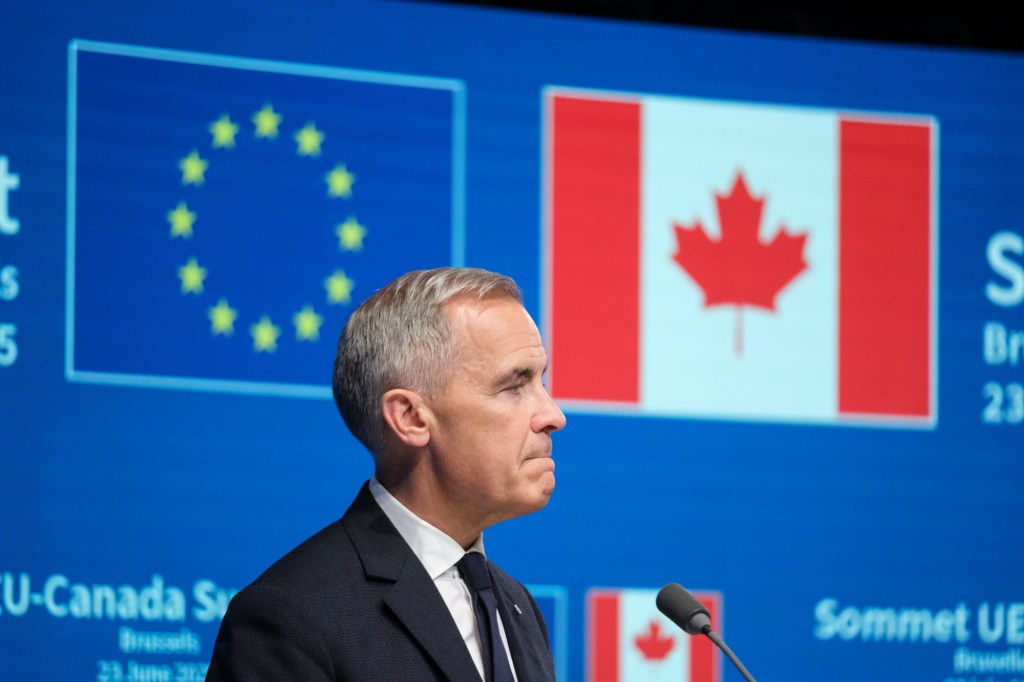
    The first meeting between the two leaders a few months ago was friendly. But today’s press conference, before a tariff negotiation lunch, was essentially a cuddlefest. Carney called Trump a “transformative president.” Trump joked about the upcoming “US/Canada merger,” and said the two countries had “natural conflict and natural love,” like in any marriage. 

    The problem, Trump said, “is that they want a car company, and we want a car company. It’s a natural business conflict… nothing wrong with it. When it comes to trade, the United States gave everything to Canada. Other Presidents didn’t see that. They were good politicians, but they weren’t business oriented. We’ve come a long way.”

    Carney nodded along while Trump said open borders made America a “raging hellhole,” which affected Canada as well. Trump said that his policy of blowing Venezuelan drug boats out of the water had made Canada safer, and Carney said “yep yep.” The “Golden Dome” missile protection system also brought along a “yep,” and as for tariffs, Carney said, “there are areas where we compete, and it’s in those areas where we have to come to agreement that works. But there are more areas where we’re stronger together, and that’s what we’re focused on, and we’re going to get the right deal.”

    “It’s true,” Trump said. 

    The press conference included the usual Trumpian side rants. The Democrats had shut down the government. Chicago has a lot of murders and incompetent leaders. If the Democrats had won the Presidency, there’d be men playing women’s sports. They’d be taking away your children and changing their sex, and there’d be windmills everywhere. “I’m not sure we’d even have a country,” Trump said. 

    But back to the matter at hand, Trump said, “I want to make the best deal with Canada and also whatever the best deal is for Canada. Other leaders have told me this, but Mark said he would too. A year ago we were a dead country, and now we are the hottest country anywhere in the world. There’s never been a country in the world that has money coming into it like this one. Maybe Canada. I do like Canada… The people of Canada, they will love us again. Most of them still do. Maybe 25 percent. I assume a lot of ‘em. I think they love us.”

    Regardless of whether or not that’s true, Trump does appear to have natural love for Prime Minister Carney. “I think he’s a great Prime Minister,” Trump said. “I mean, he could represent me any time. He is very strong, he is a very good leader. He’s a nice man, but he can be nasty. Maybe as nasty as anybody. I can tell you this because I deal with a lot of leaders all over the world. He is a world-class leader. He is a man that knows what he wants. I’m not surprised he won the election. He’s a good man, he does a great job, and he’s a tough negotiator.”

    So what’s the holdup? A Canadian reporter asked. If he’s such a great man, then why don’t you reach a deal? 

    “Because,” Trump said, sticking the landing, “I want to be a great man too.” 

  • Canada’s assisted suicide laws are out of control

    Canada’s assisted suicide laws are out of control

    Death, somehow, seems like the wrong word. So Canada’s euthanasia doctors have adopted other terms for what they offer: each lethal injection is called a “provision.” Stefanie Green, a Vancouver Island doctor who used to work in maternity services, prefers “delivery.”

    Canada has sleepwalked into a moral maze with no exit, where euthanasia becomes a solution for social problems

    Since Canada’s parliament introduced euthanasia in 2016, a new vocabulary has arisen. Those with a terminal illness, whose death is “reasonably foreseeable” are “Track 1”; those who have no such diagnosis but qualify through “grievous and irremediable” conditions are “Track 2.” And assisted suicide has become, not merely “assisted dying,” but “Medical Assistance in Dying,” which some patients understandably believe means palliative care as opposed to lethal injection – and which is universally referred to with a jarring and faintly macabre acronym. If you want to die, you “ask for MAID.”

    With such a large-scale outbreak of euphemism, you might speculate that people are trying to avoid thinking about some major injustice or terrible atrocity. And so they are. Canada has sleepwalked into a moral maze with no exit, in which euthanasia becomes a solution for its social problems. The homeless, the depressed, the poor, the chronically ill, those let down by the system or stuck on long waiting lists: all are at risk of finding themselves on Track 1 or Track 2.

    Overall, one in 20 Canadian deaths comes at the hands of MAID, with a total of 60,000 between 2016 and 2023. The horror stories, at first shocking, have become almost routine. Roger Foley, a disabled man, was told by hospital staff that his care would cost $1,500 a day and did he want to discuss MAID? Sathya Dhara Kovac, who couldn’t afford home-care services wrote, before the assisted death she chose as a result, that “ultimately it was not a genetic disease that took me out, it was a system.” Rosina Kamis, who told the assessing doctors that her suffering was physical but confessed to her two dozen YouTube subscribers that her real motive was loneliness (“I think if more people cared about me, I might be able to handle the suffering.”)

    Then there’s the woman whose only condition was a hip fracture and was dismayed at what her last decade might look like. The depressed man whose qualifying medical condition was a hearing problem and whose family claim he was effectively “put to death” under pressure from medical staff. The anonymized “Ms. B,” who had a chronic illness but whose request for MAID was motivated by housing problems. The many patients who have had doctors or nurses, entirely out of the blue, ask them if they have considered making an early exit.

    Such stories make clear that MAID can be a substitute for care. Carla Qualtrough, a former disabilities minister in Canada’s Liberal party, remarked bluntly that in parts of the country “it’s easier to access MAID than it is to get a wheelchair.” Or, more generally, to die than to go on living.

    Last November, when the British parliament first debated its own assisted suicide bill, the Substacker Rose Lyddon published a remarkably candid polemic against the proposal. Relating her long history of mental illness, she wrote: “When you’re deep in it, it’s very hard to argue against suicidal logic. The pros seem to vastly outnumber the cons. Living through each day is unbearably painful and you can see the pain and material damage you inflict on those who care for you. You’re a drain on state resources, the NHS has nothing to offer and considers you a nuisance who’d probably be better off dead, you lack the skills even to get dressed or feed yourself let alone change anything about your state of life. Loss of income and housing happens easily and it feels like nothing can stop the decline. It’s very difficult to feel hope or to attribute any value to your continued existence, which seems a net negative on every level. The only defence against going through with suicide is its not being on the table to start with.”

    An assisted suicide law, Lyddon wrote, would shatter the taboo which puts suicide out of the question. “Enshrining a right to suicide in law will initiate a cultural shift that can never be undone.”

    That single, decisive shift is still playing out in Canada. Almost half of those killed cite feeling like a burden as a reason for choosing MAID. An estimated 40 percent qualified for disability services. In one small-scale study, two-thirds of Track 2 applicants surveyed turned out to have a mental illness. The program has been denounced by the UN’s disability rights committee and described as “social murder” by Sonu Gaind, a professor of psychiatry at Toronto University. “Canada,” proclaims a headline in the Atlantic, that house journal of self-consciously reasonable liberals, “is killing itself.”

    Once, it was possible to claim that a few troubling cases had been exaggerated into a trend by sensationalist newspapers. That notion was exploded by the journalist Alexander Raikin, who obtained recordings of MAID doctors conducting seminars among themselves. Repeatedly, the doctors discussed the regular cases of (as one put it) “people who would opt to die, because the social supports are so poor.” Chillingly, Raikin found that the doctors were unable to muster any real disquiet over their own role in the process.

    Advocates for “assistance in dying” tend to operate on two settings. They present themselves as moral crusaders for “autonomy” and a “right to choose” which has been outrageously denied to those in serious suffering. But when pressed on the unintended consequences of this new “right,” they switch quickly from passionate advocacy to stonewalling (“That will never happen”) and handwaving (“That’s what the safeguards are for”).

    So in 2015, when Canada’s Supreme Court ruled in favor of assisted suicide, the judgment dismissed concerns: assisted dying was for “limited and exceptional circumstances,” and there was no evidence from abroad of “a disproportionate impact…on socially vulnerable groups.”

    In response, Canada’s parliament passed a law limited to those facing a “reasonably foreseeable” death; but in 2019, Prime Minister Justin Trudeau said the law would have to expand to cover grave but non-terminal illness. “People would be evolving as a society,” Trudeau explained, in another example of the mutant language which has provided the voiceover to Canada’s death march; but nobody should fear being pressurised into MAID “because you’re not getting the supports and cares [sic] that you actually need.” Of course not.

    The emptiness of these assurances should come as no surprise. Advocates for euthanasia and assisted suicide always proclaim the importance of safeguards and strict criteria, but they can rarely outline a coherent case for why the righteous cause of “autonomy” should suddenly be cordoned off – why, say, those who are suffering but have no terminal diagnosis should have their requests refused. There will always be hard cases just beyond the cordon: the expansion of the law became near-inevitable after a legal challenge in Quebec, where a paralysed man asked for the right to die.

    Such is the forward momentum of assisted suicide and euthanasia laws. After a few years, the politicians who insisted on “safeguards” have begun to forget why they were ever so squeamish. Isn’t this a legal right? Didn’t we all agree that denying people the freedom to choose is regressive?

    Likewise, the requirements for strict monitoring come, in a short space of time, to seem pointlessly burdensome. A Freedom of Information request by the BC Catholic newspaper uncovered 2,833 paperwork errors in British Columbia in a single year – more than the total number of assisted deaths in the province.

    After a few years the politicians who insisted on ‘safeguards’ have begun to forget why they were ever so squeamish

    These errors are not merely procedural. Christopher Lyon, a Canadian academic, discovered in 2021 that his father – who had a long history of suicidality – was scheduled for an assisted death in two days’ time. He had been classed as terminally ill on the grounds that he had an elevated white blood cell count which (in Lyon’s words) “might be an infection that, if untreated, might become lethal, despite being a common side effect of his arthritis medication.”

    Lyon pressed for a psychiatric assessment, which was granted but came back “full of errors”: it claimed, for instance, that there was no evidence of his father being depressed, although antidepressants were listed among his medications. After his father went through with the assisted death – “the worst day of my life” – Lyon pressed for an investigation. But the local health authorities blocked it.

    The system, in short, has an institutional bias toward MAID. Doctors “are expected to facilitate access to death,” according to a joint statement from five senior academics and palliative care specialists, even if they know that the applicant hasn’t been offered “reasonable options” that might help to alleviate their suffering. Those who point to the abuse and neglect of safeguards are “dismissed as being “anti-MAID’” or accused of blocking patients’ autonomy.

    Even now, Canada finds itself traveling toward new horizons. In 2027, the government plans to introduce MAID for those whose suffering is purely psychological. A parliamentary committee has also called for under-18s to be granted eligibility. And, as the Atlantic reports, everyday Canadian life increasingly incorporates this new culture of death. There’s an app to help you design rituals around your demise. There’s a podcast, Disrupting Death, where the hosts discuss “subjects such as normalizing the MAID process for children facing the death of an adult in their life – a pajama party at a funeral home; painting a coffin in a schoolyard.”

    Most notorious was the glossy advertising campaign by the fashion chain La Maison Simons, featuring a woman, Jennyfer Hatch, reveling in her last days and her impending MAID appointment. “Last breaths are sacred,” Hatch intoned over images of her enjoying a final bittersweet party with friends on the beach. “When I imagine my final days, I see music. I see the ocean. I see cheesecake.”

    Only later did it emerge that Hatch, too, had turned to euthanasia because she was struggling to find treatment for her chronic illness. “If I’m not able to access healthcare,” she had told an interviewer, “am I then able to access death care?” The ad, it turned out, was a euphemism too.

    This article was originally published in The Spectator’s October 13, 2025 World edition.

  • Robert Munsch’s license to die

    Robert Munsch’s license to die

    Once upon a time, there was a hugely successful children’s author named Robert Munsch. His books (more than 70!) sold in many, many copies; he became famous, and people gave him top awards like the Juno and the Order of Canada. They even named schools after him.

    More gloriously yet, he became the most stolen author in the Toronto Public Library.

    He was in high demand as a storyteller, and children from everywhere used to write him letters. And he would write back, often with personalized stories (which they loved) featuring them and their classmates.

    Like all of us, he had his sorrows. He and his wife lost two children, which led him to write one of his best-known works, Love You Forever. Eventually they became adoptive parents of three. And when he told people about the hard things he had survived, he mentioned his efforts to cope with mental health issues, suicidal thoughts and addiction – all things that had become manageable with the right medication and the right support. Through it all, he told stories, wrote stories, lived stories.

    Then, one day, he began to feel his mind wasn’t working as sharply as it once had. He kept falling off his bicycle, and had trouble parking his car. He went to the doctor and the doctor told him he had dementia. He had a harder and harder time telling stories.

    Now at this point in the story we should mention that Munsch, though he was born in the US, now lived in Canada. And Canada, sadly, is a country where discouraged, lonely, or frightened people can legally be killed, if they get permission from the government. It’s called MAiD – medical assistance in dying.

    We don’t know exactly what Robert was thinking at this stage, but it seems a safe bet that he was sad at the loss of his storytelling abilities, which had brought him such joy, such artistic connection to the world, such professional success. It seems likely too that he was afraid as he wondered what a future with dementia would hold.

    And there’s a chance that he felt very lonely. Without his unique artistic abilities, with gradually decreasing control over his mind and body, who would he be? Who could he be? Would he be able to love anyone, and would anyone be able to love him?

    The author of Love You Forever should have known the answer to that question. And yet, in the eleventh hour of a life most people would see as successful and happy, he did something terrible (though perhaps, as he lived in Canada where this practice was becoming more and more common, he didn’t realize quite how terrible it was).

    He applied for MAiD, to get authorization to be killed by a doctor – and he got it. But he didn’t use it right away. He let everyone know that he’d tucked it away in a drawer, a wicked little insurance policy, to be gotten out if ever he felt too sad or too afraid. In the meantime, life has gone on. According to his daughter, he is doing well and doesn’t expect to die any time soon. Perhaps he’ll even live out his days peacefully to the end.

    But he has done something terrible, whether he realizes it or not. In making all this public, he is letting his fame be used to normalise, even promote assisted suicide.

    Because of his example, people who yesterday were enduring pain in hopes of happier times, may choose today to give up.

    Because of him, vulnerable elderly people will be subjected to even more pressure to see themselves as burdens, rather than beloved and precious human beings.

    Because of him, disabled and incapacitated people will be treated with a little more contempt, a little less patience – perhaps even dismissed as the “turnip” or “lump” Munsch jokes he may one day become.

    It is ironic that a man whose life was storytelling is now – deliberately or not – suggesting people should burn the book because they’re afraid to read the last chapter.

    Many years ago, Munsch studied for the priesthood. He abandoned his Catholic faith around the same time that he left his studies – sadly, in the religion he left behind, he could have learned what he has clearly not yet understood:

    That the weak and incapacitated are worth just as much to God as the healthy; that those who patiently endure suffering, in the nursing home as on the cross, hold the golden key to changing everything: hearts, minds, the world.

  • The case for MAGA imperialism

    Empire has always been part of the American tradition. We are a sequel state to the greatest empire in world history. Our period of colonial tutelage under that empire taught the lessons of legitimate territorial expansion against French and Spanish rivals. Our continental aggrandizement after independence was necessary. Later overseas expansion, including periods of imperial apprenticeship in places such as Liberia, the Philippines and Panama, was further evidence of our colonial métier. Like it or not, imperialism and colonialism are congenital to the American experiment. This has been the case since 1779, when the Continental Congress branded a proposal to limit westward expansion an “intolerable despotism.” Since then, our imperial project has experienced constant cycles of confidence and self-doubt. Fair-weather friends – such as Niall Ferguson and Max Boot – scamper for the exit when times are tough. But history shows the need to stay the course. Making America great again will require the United States to take up its old vocation.

    The Trump administration inherits two of the most critical imperial roles that we currently undertake: the defense of Taiwan and the defense of Israel, two countries that are, properly speaking, imperial dependents: without American support they would not exist. So far, the US has borne those responsibilities admirably. But the past six months have shown that a more avowedly imperial policy represents the best means of advancing the national interest. Donald Trump’s highlighting of the misgovernance of Greenland and the Panama Canal region has been energizing through its cold-blooded pragmatism. The US has had interests in these jurisdictions for decades, but it was only the credible threat of imperial annexation that could extract the concessions made by Panama and the Danish Crown.

    Similarly, the revival of the very old idea of a North American union with Canada has been a jolt in the arm to our listless northern neighbor. It has elected a conservative in all but name as prime minister, is boosting defense spending to bear its fair share of the NATO burden, and is reinforcing the porous border that it long ignored. Mass immigration is being checked and fiscal balance taken seriously. We could not suffer our northern border becoming some semi-failed European welfare state with colorful socks, and it was only our threat to revise the verdict of 1812 that has forestalled this.

    Still outstanding on the overseas front is how to reconstruct Gaza into a stable and humane enclave which has been fumigated of terrorists. Trump (and Israel) recognize that there is no going back to Palestinian self-governance. Much as 60,000 Lebanese demanded a restoration of French rule after a port explosion leveled Beirut in 2020, there is a case for a restored western mandate in Gaza led by the US. Making America great again requires the US to take up these new loads of the “enlightened man’s burden” (which is apparently what Rudyard Kipling meant when he spoke of “the white man’s burden”) lest we fail in our historic mission as provider of ordered rule to places of strategic significance. The US military has been quietly building up its ranks and training civil affairs officers since being caught with its domestic governance pants down in Iraq and Afghanistan. The sooner the Trump administration initiates the project, the better. Lessons learned from the successful colonial occupation of Iraq and the failed one in Afghanistan can be applied. In time, a self-governing enclave could emerge.

    The other outstanding overseas imperial calling is in Yemen. The country has been a failed state since the British fled from their shrinking perimeter in Aden in 1967. The United Arab Emirates set up a de facto colonial regime in Aden in 2017, the Southern Transitional Council. It is now part of a larger, Saudi-orchestrated governing body for the non-Houthi areas of Yemen, the Presidential Leadership Council. Both are supported by the UN as well as the EU. Now that Iran’s ability to support the chaos in the rest of the country has been weakened, there is an opportunity for the US to form a governing coalition for the country as a whole with Abraham Accords partners. This would secure the maritime route through the Suez Canal and bring further security to both Saudi Arabia and Israel. That would be an imperial mission to applaud.

    Finally, there is the pressing question of restoring American rule in the US itself. The US-Mexico border that was delineated in 1848 never acted as a barrier to illegal immigration. Since then, tens of millions of people from around the world have used the southern border to colonize themselves as US subjects. But colonialism must be in the gift of the colonizer, not the colonized. Aside from a stronger border and an end to birthright citizenship, our growing imperial capacities must play a role here. The imperial waystation in South Sudan that the Supreme Court declared legal in early July, as well as our use of El Salvador for the same purpose, are examples of how our imperial network abroad can be used to protect our imperial gains at home.

    A more robust defense of our imperial story is also the best way to fight the “decolonizing” impulse at home. The great decolonizer Barack Obama represented a break with the long tradition of black patriotism since the American founding. The “return to Africa” neo-segregation of black communities that this encouraged could only be a farce since black people have no actual interest in decolonizing themselves from white communities.

    More serious was Obama’s encouragement of Native American separation and its entailed obliteration of American imperial history on the continent. Under the Obama and then Biden administrations, the entire Department of the Interior gave itself over to “decolonizing” American land management in favor of “Native American” groups. What is required now is to develop a robust legal strategy to combat this steady erosion of the republic.

    The US became an empire because most actual Indians, as with most California and Texas Mexicans, most Spanish Floridians and, later, most Filipinos and South Vietnamese and South Koreans, preferred American rule to the available “indigenous” alternatives. The Taiwanese prefer US suzerainty to rule by China and Israel certainly prefers it to erasure. The American experiment has been an imperial one from the very first; the sooner we affirm this – at home as well as abroad – the better.

  • Jailed for embarrassing the Canadian government

    Jailed for embarrassing the Canadian government

    At long last, the Ontario government’s drawn-out legal proceedings against the organizers of the Freedom Convoy is winding to a conclusion. In a move seen as surprisingly vindictive, the Crown is seeking minimum sentencing of seven and eight years of jail time respectively for leaders Tamara Lich and Chris Barber.

    As Conservative leader Pierre Poilievre posted on X, “Let’s get this straight: while rampant violent offenders are released hours after their most recent charges and antisemitic rioters vandalize businesses, terrorize daycares and block traffic without consequences, the Crown wants seven years prison time for the charge of mischief for Lich and Barber. How is this justice?”

    Other MPs called the sentencing demands “excessive and vindictive,” and said “this is political vengeance, not actual justice.”

    What is going on here?

    Tamara Lich has no prior convictions; she has committed no violence and damaged no property. A tiny little lady at five foot nothing, she’s been subjected to leg shackles, solitary confinement, and has already been held in jail for 49 days.

    Chris Barber is a family man and father of two who owns a small trucking company. In addition to an eight-year jail sentence, the Crown seeks to confiscate his truck, his chief means of livelihood, which he has affectionately nicknamed Big Red. No one has accused Barber of threatening anyone, inciting violence or damaging property.

    Indeed, all sides agree that he and Tamara Lich consistently called for protestors to stay peaceful during the protest in early 2022, be respectful of police and cooperate if arrested. They also agree that Barber worked with police on arriving in Ottawa to park the trucks in designated areas, to try to keep emergency lanes free and to coordinate the relocation of trucks and vehicles with police.

    And even the Crown concedes that Tamara Lich and Chris Barber led the convoy to Ottawa legally and with good intentions. So at what point did this perfectly legal protest turn into a crime worthy of seven to eight years of jail?

    Apparently, when the protest began to inconvenience Ottawa residents with noise and traffic obstructions in the downtown area, Lich and Barber committed mischief by saying “Hold the line,” and encouraging protestors to remain.

    When a court order was issued banning honking, Chris Barber told the protestors to heed the injunction, unless their trucks were swarmed and broken into by riot police. He said drivers should honk in this situation to alert others. This suggestion earned him a separate conviction – and, the Crown hopes, an extra year of jail time.

    The pettiness of it has to be seen to be believed. Clearly Doug Ford’s government is out to make an example of Lich and Barber. Why? To punish them for embarrassing the government in the eyes of the world, and to stifle public debate about Canada’s pandemic management.

    On the surface, this situation is all about civil liberties, and balancing the right to protest with someone else’s right to enjoy their property. But underneath, it’s about the government twisting every which way to avoid accountability.

    The Freedom Convoy came to Ottawa to draw the government’s attention to a pressing issue, something that had put a large number of Canadians into a state of severe distress: vaccine mandates and lockdowns.

    These Canadians were either ignored by politicians and the media, or demonized as racist misogynists, people who should be excluded from society and even from their own families. They were kicked out of school and university, fired from their jobs, and subjected to intimidation by journalists and politicians, who suggested they should pay extra taxes or even be jailed.

    Let’s not forget that what kicked off the convoy movement was the decision of some government genius to make 16,000 truckers’ jobs conditional on yet another draconian Covid restriction – this, with a supply chain in shambles, and years of changing the rules every couple of weeks.

    Few of us want to dwell on the dark days of Covid, now happily over, or reflect on the human cost of the decisions made in that time of crisis. But burying the past is not a luxury in which governments are entitled to indulge.

    The truckers didn’t sit there blocking traffic and honking horns for the sheer joy of it. They did so because every other mode of public expression was barred to them and those they represented. The stunning outpouring of popular support that accompanied the truckers as they made their way across the country gave them a clear mandate to make themselves heard.

    And while certainly some Ottawa residents were inconvenienced (though tthe prosecution’s talk of “lasting psychological scars” is surely a little overwrought), the issues brought forward by the truckers were of significant national interest and of a pressing nature, considerations that did not appear to weigh heavily in Lich and Barber’s conviction.

    They persisted because the government refused to engage. Instead, it chose to arrest their leaders and invoke the Emergencies Act (illegitimately, as a federal court ruled last year) and cleared the streets by force.

    And now the government wants Chris Barber’s truck, and a criminal record, so he can no longer earn his living by hauling freight into the States. They want grandmother Tamara Lich, a model of good citizenry and peaceful protest, behind bars for seven years.

    Most importantly, the government wants the seal of silence stamped on what happened during the pandemic. Does the Canadian justice system really want to be perceived as helping them with that?

  • Mark Carney was asking for Trump’s tariffs

    Mark Carney was asking for Trump’s tariffs

    Canadian Prime Minister Mark Carney announced on Wednesday that his Liberal government will recognize the state of Palestine at the United Nations in September, following the recent trend set by France and the UK.

    The decision to recognize Palestine at a time when the bloodthirsty terrorist organization Hamas is firmly in control is abhorrent, especially when the Hamas-led October 7 attack on Israel is still so fresh in many people’s minds. Democratic countries like Canada shouldn’t be enhancing the status of a murderous outfit that’s the equivalent of pure evil in our world.

    The Canadian government argues that they have put restrictions in place that must occur before recognition is approved. Carney said the Palestinian Authority must hold an election in 2026 and Hamas cannot be involved. He also insisted that Hamas releases the remaining Israeli hostages, and there must be a demilitarized Palestine. “Preserving a two-state solution means standing with all people who choose peace over violence or terrorism,” the PM said at Wednesday’s press conference, “and honoring their innate desire for the peaceful co-existence of Israeli and Palestinian states as the only roadmap for a secure and prosperous future.”

    Let’s put aside the obvious fact that terrorist groups like Hamas can’t be trusted when it comes to negotiating terms and conditions for just about anything. Does anyone truly believe Hamas’s leadership gives a tinker’s dam about Carney’s demands? Canada is a middle power with virtually no influence or cachet on the international stage since the path of destruction that former Prime Minister Justin Trudeau left in his wake. If Hamas barely pays attention to larger, more influential countries who have come around to their way of thinking, their perception of Canada won’t change. 

    There isn’t a chance in hell that Hamas will drop its political and military influence in Palestine. They’ll be pleased with the UN’s recognition of Palestinian statehood, but their end game hasn’t changed. That is: to destroy democracy, liberty and freedom in the West and beyond. Their enemies, including Israel, the US, France, the UK and yes, Canada, won’t suddenly become bosom buddies and lifelong chums.

    In fairness, Carney’s announcement could be for purely selfish reasons. He may believe it will solidify his political support among Canadian progressives. There’s some validity to this argument. Since he has a minority government, much like Trudeau did on two previous occasions, it could be the best solution to achieving long-term Liberal electoral support. While Carney’s decision will frustrate Canadian Jews, he knows there are many more voters in Canada’s Arab and Muslim community – including young ones.   

    Yet Canada’s relations with the US is another piece of this puzzle. Carney’s timing with this announcement couldn’t have been much worse, unless it was planned in advance to infuriate US President Donald Trump. 

    Canada and the US have been in the midst of a tariff battle. It started during the latter stages of Trudeau’s leadership last year, complete with Trump’s comments about Canada becoming the “51st US state.” A sizeble number of left-leaning Canadians foolishly believed Carney was the best leadership choice to take on Trump. That’s why his Liberals won the April 28 federal election. The working relationship between these two leaders seemed more positive at first blush, which wasn’t difficult to achieve with the bumbling Trudeau out of the picture. Some believed there was faint hope for a resolution before the August 1 deadline. 

    Alas, Carney’s con job with the Canadian electorate has been fully exposed. Early this morning, Trump announced that he was increasing the tariff rate on Canadian products from 25 to 35 percent.

    Even before Canada’s Palestinian recognition statement, it was clear the tariff negotiations weren’t going particularly well. Canada had briefly threatened to double its counter-tariffs on US metals from 25 to 50 percent and Carney’s own tone changed dramatically this month. He went from telling the press that Canada was in “intensive negotiations with the Americans” to resolve the tariff battle to making this eye-raising statement: “we’re working hard to get a deal, but we’ll only accept the right deal with the United States. The right deal is possible, but nothing’s assured.” It also didn’t help matters that Carney began to focus more heavily on a trade and security partnership with the European Union at the same time, even suggesting Canada was the “most European of non-European countries.”

    Carney’s announcement about Palestine was a slap in the face to Trump, who strongly supports Israel and regards Prime Minister Benjamin Netanyahu as a political ally. “Wow! Canada has just announced that it is backing statehood for Palestine,” Trump wrote on his Truth Social account. “That will make it very hard for us to make a Trade Deal with them. Oh Canada!!!”

    A trade deal between the two countries to reduce the 35 percent tariffs now seems highly unlikely. Carney has suggested that the talks may not end today, but he appears to be focusing on “broader discussions” like defense spending and investments. In other words, the tariffs will remain in place and the faith placed in him by far too many Canadian voters will be for naught.

    Is Carney bothered by the mess he’s caused? It sure doesn’t seem like it.