Category: Art

  • Is there such a thing as right-wing art?

    This has been adapted from a speech titled “The Myth-Maker as Nation-Builder,” which was delivered by Jonathan Keeperman, who runs publishing house Passage Press, at the National Conservatism Conference 2025.

    As W.B. Yeats once said: “There is no great literature without nationality. There is no great nationality without literature.” People often ask me whether it is possible to produce right-wing art, or otherwise to use art to engineer a more nationalist politics. But this strikes me as backward thinking. Culture is the field in which a people encounters the shared symbols and language that make political life possible. Art, done well, discloses the deeper truths a people already carry within themselves. Art therefore does not produce the nation; it reveals the nation.

    What is art trying to accomplish? This wanders a bit into the philosophical weeds, but I think it’s important to begin here. The purpose of art is to reveal what is capital-T true about the world and our experience in it. Some statements, stories, films, pieces of music have the quality of “truthness,” and some do not. Neither “truthness” nor “untruthness” is merely imagined or constructed. Some things are true and some things are not.

    But language alone cannot determine what is true and what is not. Argument alone cannot mediate our disagreements. Resorting only to language leaves us with such mistaken phrases as “Beauty is in the eye of the beholder.” This is wrong. This is also dumb. But it points to the difficulty of arguing our way into a shared understanding of what is or is not true.

    Rather, capital-T truth is felt, not something that is asserted. It is revealed to us, or unconcealed from us. Truth is disclosed. The philosopher Martin Heidegger talks about this as aletheia. Truth is about unconcealing reality, not being merely correct. We can then say that art is true when it creates the emotional and spiritual conditions for the world to be revealed, much like how a profound dream allows the mind to reveal itself to itself.

    For those who find Heidegger a little too abstruse, I offer Mr. Miyagi from The Karate Kid. Mr. Miyagi’s task is to train his pupil to become an expert at karate. But he doesn’t do this directly. If you recall the movie, Mr. Miyagi teaches a young Ralph Macchio through a series of household chores: painting a fence, cleaning a car – “Wax on! Wax off!” The philosophical lesson contained in this truth is unconcealed only when it is lived into and becomes embodied. As Sensei Miyagi says: “Lesson not just about karate. Lesson about whole life.”

    One of the bedrock properties of truth is that it coheres and it endures. Truth is lindy – it lasts. Falseness succumbs to entropy. To survive, it must be propped up and artificially stabilized. False stories, false art are brittle. Lies are brittle. Truth obtains.

    With this framework, we can understand artists as nation-revealers. First, understand that nations are constellations of enduring truths about a people, an embodied people. It’s their histories, their language, their rituals, their ways of being that cohere over time. When they no longer cohere, there is no longer a nation to speak of. Second, understand that artists and their art unconceal those truths about the people, preparing the mind and spirit so that those truths can become embodied and felt. The conclusion here is that it is therefore not the artist’s job to assert or construct or build the nation. It is the artist’s job to reveal the nation to itself.

    What are some examples of artists as nation-revealers? The first that came to mind for me was Theodor Herzl’s novel The Old New Land. He wrote this in 1902, while he was still in Austria. It’s a terrible novel. The dialogue is wooden; the characters are flat; the plot is stitched together absurdly. Its utopian vision of a future state of Israel is very naive and implausible – in a word, false.

    But it does have one redeeming quality in the form of a more enduring capital-T truth: the novel reveals the longing of European Jewry for the possibility of a nation, a nation reborn. And what Herzl’s book does is project a future in which Jews could and eventually do live.

    A less obvious example of nation revealing from this same period is the poetry of Yeats in Ireland. Yeats is reimagining Irish nationalism on the precipice of the war for independence. This came a couple of decades later, but he embarks on this very self-conscious cultural project right at the tail end of the 19th century. The poet is a Protestant, not a Catholic, who speaks English, not Irish, and is an avatar for this emergent Irish culture.

    His identity and art force a series of questions: is there such a thing as Ireland? And if so, what is it? Is there an Irish people? Who are they? Is Ireland Celtic? Is it Christian? Catholic? Republican? Norse? Danish? Scottish? Is it English? And how do all these different origin stories potentially fit together? Can some truth cohere out of this cultural mosaic? Through Yeats’s art, can Irishness be revealed and lived into by its people? Among all these disparate parts, can a shared identity be embodied?

    Yeats creates this identity not by projecting a future, like Herzl, but rather by looking into a mythic past. Following the insight that nationalism is first a state of mind, Yeats understood that to change the national state of mind, you must change what that mind feels to be true. He adopts a few strategies to achieve this. We know from his autobiographies that he did so intentionally.

    First, he revives the old Irish tradition of the poet as a central political figure. In the poem “To Ireland in the Coming Times,” he places himself in the pantheon of great Irish poets of the past who conferred legitimacy on their kings and often spoke on their behalf. The point of this for Yeats is to assert the importance of the role of the artist and of art more broadly so that the pronouncements of the artist carry the weight of political authority.

    He also deliberately and explicitly excavates the stories and heroes of the medieval Ulster Cycle. These poems are some of Yeats’s most well-regarded and demonstrate his real literary genius. They are self-consciously nostalgic and homesick for a lost Ireland that begs to be reclaimed, but without the cloying sentimentality that usually comes with these qualities. They also maintain a kind of mythic grandeur and supernatural magic that elevates them above mere history and above the specific ethnoreligious claims of any particular contemporary Irish subgroup while still being squarely grounded in a recognizably Irish tradition.

    Finally, Yeats understood that a nation’s art, if it is indeed going to bind the nation, must not be too insular. His Abbey Theatre, which he opened in 1904, puts his mythic poems on the stage where they can be more viscerally felt and made into a more central part of Irish cultural life. Yeats explained: “I am no longer writing for a few friends here and there, but I’m asking my own people to listen, as many as can find their way into the theater.” Perhaps through plays – where one has more room than in songs and ballads – one can explain those elaborate emotions and intricate thoughts that are oneself.

    What about America? The truth is that neither the examples of Herzl nor Yeats are applicable to us now. Our situation is very different. We do have an established past. We have a self-understanding of our founding. We reinterpret and negotiate that founding often – there are disagreements about motivations and intentions – but there is no disagreement about when and where and what it is. We agree that it happened when the Founders convened. We can point to Plymouth Rock. We can walk the battle green at Lexington.

    What we lack is confidence in our present. We do not need a Herzl to conjure a future or a Yeats to excavate a buried origin. We need artists who can reveal what America is now. Think again of Mr. Miyagi. His pupil will not be told. He must be led by indirection from self-doubt into confidence. Perhaps it is the case with our own self-conception. Now our cultural life is very confused, attenuated, lacking confidence, lacking coherence. It is too fragmented. It is self-antagonizing and it will not be explicitly directed. A durable national identity cannot be asserted into being.

    I’ll conclude with a poem that models an oblique kind of revelation of the type we ought to encourage would-be artists to consider carefully. This comes from William Carlos Williams, a 20th-century modernist poet. The poem is called “The Red Wheelbarrow” (1923):

    so much depends upon a red wheel barrow glazed with rain water beside the white chickens

    I will not elaborate further.

    This article was originally published in The Spectator’s December 8, 2025 World edition.

  • South America is flush with Nazi-looted art

    South America is flush with Nazi-looted art

    This summer, a niche story from the art world caught fire: an Old Master painting, stolen by the Nazis from a Dutch-Jewish art dealer, surfaced in Mar del Plata, Argentina. Remarkably, journalists from a Dutch newspaper spotted it on the wall of a house in a promotional photo that was part of a “for sale” real-estate listing.

    It turned out that one of the sellers of the house was the daughter of a Nazi official who worked for Reichsmarschall Hermann Göring, a notorious art plunderer. When the stolen painting was recognized, the daughter allegedly removed it from the wall, replacing it with another artwork – a tapestry. Argentine authorities then arrested her and her husband and charged them with concealing a crime.

    The story is not just another tale of Nazi-looted art, of which there are many. This one has deeper significance. It’s notable that the stolen art was found in a private home in South America. There have been many restitution claims for famous artworks in museums – “Portrait of Adele Bloch-Bauer I” (known as the “Woman in Gold,” pictured above) by Gustav Klimt, found in the Austrian National Gallery or the Cassirer Pissarro, found in the Thyssen-Bornemisza Museum in Madrid, for example. But a far greater number of looted works remain in private hands around the world.

    In 2000, the Presidential Commission on Holocaust Assets created by Bill Clinton estimated that the Nazis stole around 600,000 artworks, of which 100,000 are “missing” today. While these numbers are rough estimates (I helped compile them), they convey the truth that there is a lot of Nazi-looted art throughout the world that has been concealed from public view.

    With generational change comes inheritance, and it’s now the children and grandchildren of former Nazis, war criminals or even Allied servicemen who possess the looted art. They offer a work for sale, only to discover it is stolen property. Many claims are resolved privately: a restitution specialist at the Christie’s auction house in London recalls that during her 15-year tenure, she helped resolve around 250 cases. Due to a lack of transparency or due diligence, individuals may have purchased or inherited a work without fully understanding its provenance. Accordingly, there are likely to be far more looted works in private hands that were never properly returned than the public understands.

    In the case of this newly discovered Old Master – “Portrait of a Lady” by 17th-century artist Giuseppe Ghislandi – the possessor was Patricia Kadgien, the daughter of a powerful Nazi functionary who died in 1978. It was not just the top leaders such as Hitler or Göring who ended up with artworks looted from Jewish victims, but also their underlings. Göring looted “Portrait of a Lady” from Jacques Goudstikker in 1940 and took it to Germany, but he sent it back to Amsterdam, where his employee, Friedrich Kadgien, bought it from the “Aryanized” Goudstikker gallery in 1944. The Third Reich was a kleptocracy and its subleaders and functionaries found many ways to enrich themselves. The Ghislandi portrait was not the only one found with Kadgien’s daughter: 22 works by Henri Matisse were also discovered and are currently being researched.

    I delved into the topic of looted art in the hands of Nazi functionaries in the recent documentary film, Plunderer: The Life and Times of a Nazi Art Thief, featuring Göring’s agent in Paris, Bruno Lohse; his looted artworks ended up in a bank vault in Zurich, as well as in his home in Munich. It should not come as a surprise that another Nazi agent working for Göring, Friedrich Kadgien, should have the Ghislandi portrait. It is significant that Kadgien and the artwork turned up in South America. We know that many Nazis fled Europe at war’s end. Adolf Eichmann and Josef Mengele are the most notorious, but an estimated 10,000 Nazis made it across the Atlantic, either through the Vatican-supported “ratline” or in some other way.

    Experts in the field of Nazi-looted art have always suspected that a great deal of the plunder made its way to South America. Art is so fungible and transportable, and the market is international. We have had a few cases of such art popping up in Latin America, but there is much to do in this area. It’s an open secret that the region is flush with this artwork. One of the recommendations of the Clinton Presidential Commission on Holocaust-Era Assets was to bolster research into looted art in South America. The case of the looted Ghislandi should re-galvanize this effort. The Argentine authorities were aggressive in charging Kadgien and her husband with the alleged concealment of Nazi-looted art. By arresting them and charging them with crimes that could result in six years in jail, the Argentine authorities are making a statement. “The crimes that were being covered up are especially serious,” federal prosecutor Carlos Martínez told journalists after a court hearing at the end of October in Mar del Plata. “They are linked to crimes of genocide, to theft in the context of genocide.”

    While US and European law enforcement officials pride themselves on forensic skills, the Argentine police are the first since World War Two to employ criminal statutes to arrest possessors of Nazi-looted art and to use the criminal proceedings against possessors to ensure the return of the artwork.

    In the US in recent years, we have seen the restitution of Nazi-looted art not only through civil litigation, but also through criminal law. According to American law, there’s no such thing as a good title for stolen property. New York City District Attorney Alvin Bragg, along with his colleague Matthew Bogdanos, commenced criminal proceedings including seizures against US museums to compel them to hand over Nazi-looted artworks (notably, more than a dozen pictures by Austrian modernist Egon Schiele that were stolen from Viennese cabaret star Fritz Grünbaum). The tactic employed by Bragg and Bogdanos – leveling criminal charges against institutions – has been effective, leading to some of the most important restitution successes in recent years. Since World War Two, there has been a longstanding hope to complete the restitution process – a desire for closure. This began in the early 1950s, when Americans wanted to conclude the restitution work and focus on the intensifying Cold War. Efforts picked up again in the late 1990s when diplomat Stuart Eizenstat led efforts for a final reckoning regarding looted cultural property from World War Two.

    Restoring Nazi-looted art has had bipartisan support in the US. The Holocaust Expropriated Art Recovery Act (HEAR Act) of 2016, which helped Holocaust victims and heirs with their legal efforts to recover Nazi-looted art, became a milestone in the history of restitution. The law expires at the end of next year, but it is currently up for renewal, with continued bipartisan support. Indeed, some supporters of the renewal want to strengthen the provisions to aid victims and heirs. Yet, the New York Times and other media report that the Metropolitan Museum of Art and the Association of American Museum Directors have been lobbying against such a step.

    As the Times reported: “The museum also had a lobbyist meet with lawmakers and request they continue to allow time-barred defenses and include an expiration date on the legislation.” In the past, powerful institutions and individuals have fought restitution by using technical legal defenses, which is what led to the enactment of the HEAR Act in the first place, and the tactics highlight the need for the law to be strengthened. The tenacity of survivors and heirs is important. Marei von Saher, the heir to Jacques Goudstikker, said of her efforts: “My search for the artworks owned by my father-in-law Jacques Goudstikker started at the end of the 1990s and I won’t give up… my family aims to bring back every single artwork robbed from Jacques’s collection and restore his legacy.” So far, the Goudstikker family has recovered about 350 of the 1,300 pictures.

    Art is expressive and intimately shared, often passed down from generation to generation; it has more than monetary value. For the past 80 years, the US had taken the lead in restitution efforts – an honorable legacy, even if the work is incomplete. The looted Old Master painting in Argentina shows us that the restitution of Nazi-looted art remains an important part of “the unfinished business of World War Two.”

    As Jonathan Schwartz argued in a recent article in the Forward: “These works are not merely paintings or sculptures; they are fragments of stolen lives. Returning them is not charity; it is the fulfillment of justice long denied, part of an unfinished historical reckoning, one that museums should want to complete.” This case in Argentina reminds us that private individuals in possession of stolen art also have an obligation to return art that does not belong to them. And if they don’t, the law will come for them.

    This article was originally published in The Spectator’s November 24, 2025 World edition.

  • Bryan Garner has recovered a lost master

    Bryan Garner has recovered a lost master

    Bryan Garner has performed a remarkable act of cultural recovery with his vigorously written new book, The Etcher: The Life and Art of Oskar Stoessel, a long-forgotten Austrian artist who had total mastery of his form and deep understanding of the human face. Stoessel (1879-1964) attained success in the US in the 1940s after fleeing from the Nazis in 1938 with the help of US Minister to Austria, George Messersmith, who introduced him to elite American circles. Stoessel went on to etch portraits of Franklin Delano Roosevelt and Secretary of State Cordell Hull, among many others, and exhibited at the Corcoran Gallery in Washington, DC. He found his greatest supporters and subjects in the Supreme Court – he sketched all the sitting justices in 1941 and more in subsequent years. This association with the Court is the core of the book and of Garner’s interest. Despite such distinguished patrons, Stoessel eventually became reclusive, and moved back to Austria in 1960.

    Garner is one of the leading experts on the English language and has revolutionized learning about grammar and usage through such essential books as the compendious Garner’s Modern English Usage (now in its fifth edition from Oxford) and The Chicago Guide to Grammar, Usage, and Punctuation. He is also a law professor and author of books on legal writing. His path to his discovery and fascination with Stoessel’s work was as a collector of jurisprudence memorabilia: In 2014 he purchased an etching by Stoessel of Justice Robert H. Jackson. Garner bought it for the subject, not thinking about the artist. A few months later, Justice Antonin Scalia, Garner’s close friend with whom he co-authored two books (and whom he wrote a memoir about), noticed the etching in Garner’s office and asked, “Who was Oskar Stoessel?” Garner didn’t know, but Scalia’s question led him on the path to find out.

    Stoessel does not, as of this moment in fall 2025, even have an English Wikipedia page. Garner’s labor here was completely uphill. Such archival digs of unknown figures are not an easy sell, and Garner and his publisher have done a service by rescuing Stoessel’s art and social world from the void. Garner had to do some extensive trawling through correspondence of various Supreme Court justices, now held in the Library of Congress, to piece together the story of how Stoessel found work through and won the respect of these men. The Etcher kept reminding me of a similarly heroic recent book, To Anyone Who Ever Asks: The Life, Music, and Mystery of Connie Converse (2023) by Howard Fishman. Fishman recovers the unusual life of a long-forgotten original folk singer who (like Stossel) became reclusive and (unlike Stoessel) disappeared, yet who (like Stossel) left behind significant archival traces through her social circles.

    Garner covers the process and history of etching, which held great prestige before photography – and long after among European aristocracy – but was falling out of fashion by the time Stoessel reached middle-age. Stoessel received rigorous formal training; he entered the highly selective Imperial Academy of Fine Arts in Vienna in the year that Adolf Hitler’s application was rejected for the second time. Stoessel sought a teaching position in the US after 1938, but despite his training and connections, could not find one. He lived with his wife in the apartments at Carnegie Hall, an affordable enclave for people involved with the arts. Garner notes that Stoessel did not seem to look beyond DC and New York for teaching work yet could have looked farther afield; the University of Southern California employed a professor of etching in those years. Stoessel’s younger brother, Ludwig, attained success in California, first as a character actor in movies and television, and then as “that Little Old Winemaker” in Italian Swiss Colony wine commercials.

    In addition to its biographical narrative, this is also an art book. It contains one striking, soulful etching after another. It’s unfortunate that the form went into decline – it would be nice to have more etchings of more historical figures. A master such as Stoessel seems to capture something that photography cannot. Stoessel also painted in oils, and the book includes a few of those – an oil self-portrait, as well as a stunning portrait of a young African American woman, whom Garner speculates may be Billie Holiday. I’m not sure about that, although it is not entirely out of the question. I think it is more likely that the sitter is the jazz pianist Mary Lou Williams. Another supporter of Stoessel’s was David E. Finley Jr., director of the National Gallery of Art from 1938 to 1956 and head of the “Monuments Men,” who donated four portraits by Stoessel to the newly established National Portrait Gallery in 1962. They were the first works accessioned by that institution. Garner notes that Stoessel, back in Austria by then, may not have known of Finley’s donation. The author writes, “People come and go in this world. Stoessel came and went. Messersmith. FDR. Hull. Stone. Jackson. Finley. Eleanor Roosevelt. They strutted and fretted their hour on the stage, and then were heard no more. Those with a historical bent know the names to one degree or another. They were famous, but fame is fleeting. Oskar Stoessel’s plunge into obscurity is particularly fascinating.” Indeed, it is.

  • New York Fashion Week’s shimmer feels noticeably dimmed

    New York Fashion Week’s shimmer feels noticeably dimmed

    Crossing streets with lattes in hand, camera lights flashing, perfectly curated outfits meant to be noticed, and a crisp chill in the air means one thing: New York Fashion Week has arrived.

    The September Fashion Week has long stood as the pinnacle of American fashion prestige. As the leaves turn red and brown, style photographers capture eclectic ensembles in motion, A-listers march through the streets and assistants carefully place nameplates on front-row seats beside pristine runways. But this year the week’s shimmer feels noticeably dimmed.

    The big names still show up – Michael Kors, Calvin Klein, Tory Burch. But in recent years they’ve been eclipsed by smaller, edgier and distinctly New York-based designers. You may not have heard of KidSuper, Private Policy or Elena Velez, or ever worn their clothes, but they run the show now. Luxury and haute-couture designers are just not interested in New York.

    Why? Because New York Fashion Week has evolved into a content-driven machine – designed less for insiders and more for the camera and the internet. Outside every venue, photographers offer built-in photo ops. Inside, every runway look is instantly broadcast across social media. And the after-parties? They’re engineered for virality, not intimacy, with every detail curated to be posted.

    Take the party hosted by Valentino Beauty, for example, promoting its new Rendez-Vous Ivory fragrance. Styled as a revival of Studio 54 – the legendary nightclub and theater that launched the disco craze – the event featured multiple branded locations where guests could pose with products. The whole thing felt less like a nostalgic homage or reinvention and more like a giant, immersive ad campaign. Cher made an appearance, but the night was no tribute to old New York. It was a made-for-Instagram marketing opportunity.

    On the runways themselves, the front-row seats once reserved for the fashion industry’s power-players are now set aside for online influencers and content creators. A-list celebrities and arbiters of style such as Anna Wintour used to consistently own these seats. Today, they’re more populated by influencers such as Paige Lorenze, Brigette and Danielle Pheloung, and Ken Eurich. Never heard of ’em? Don’t worry – all you need to know is that their combined Instagram followings total around 2.8 million. All this is meant to make NYFW seem more accessible. As the stylist Sophia Isabella told me: “The reason brands invite influencers to their shows is to have this pseudo-concept of accessibility while also maintaining the old habits and rituals of exclusivity in fashion.”

    This points to a new, unstable tension. Social media has made it incredibly easy to compare our daily lives with those of influencers and public figures – people who feel relatable, except for one key difference: disposable income. This ease of comparison has fueled a culture of unsatisfiable trend-chasing and consumerism, as audiences try to emulate the lifestyles they see online. But aspiration and exclusivity have always been the core drivers of the high-fashion industry – even for those who believe they’ve gained access to it. No amount of pseudo-accessibility can change that, at least not without stripping high fashion of what makes it high.

    Many brands have begun to recognize this – too much accessibility has done them no good. In response, many luxury labels are starting to pull back and become even more exclusive. They’re going “offline” and departing from old staples, such as NYFW. Rather than letting any influencer with a few hundred thousand followers into their events, they’re curating their shows even more carefully and exclusively than they did before.

    Many are decamping to Paris, where influencers and social media are given less power. These Parisian events resist the hyper-glossy, social-media-ready structure of New York Fashion Week. This resistance pushes back against the homogenizing force of the internet and social media, which flattens everything it touches in its mission to make everything relatable and accessible. As the rest of the world becomes more connected and leveled, the savviest high-fashion houses are retreating further into intentional inaccessibility – that’s why they’re avoiding the limelight in New York.

    These elite houses – chief among them the Row, Proenza Schouler and Willy Chavarria – are bringing elitism, allure and mystery back into fashion. And they’re perhaps restoring high fashion to what it was always meant to be: an aspirational art, one that compels its aspirants to earn a place in elite society.

    This article was originally published in The Spectator’s October 13, 2025 World edition.

  • Trump is right to take on the Smithsonian

    Trump is right to take on the Smithsonian

    The last time Republicans were this mad at the Smithsonian Institution was in 1991. Then as now, America’s national museum system was gearing up to celebrate a major date: in that case, the quincentenary of the discovery of the Americas by Christopher Columbus. Senators threatened spending cuts, accusing Smithsonian officials of having a “political agenda” with their representations of race and immigration in exhibitions. Thirty-four years later, on the eve of the semiquincentennial of the Declaration of Independence, Republicans are saying the same things.

    Donald Trump reworded his predecessors’ criticisms in his own style, suggesting on Truth Social that the Smithsonian museums focus too much on the negative, too little on the positive. They are, he said:

    the last remaining segment of “WOKE.” The Smithsonian is OUT OF CONTROL, where everything discussed is how horrible our Country is, how bad Slavery was, and how unaccomplished the downtrodden have been – Nothing about Success, nothing about Brightness, nothing about the Future… We have the “HOTTEST” Country in the World, and we want people to talk about it, including in our Museums.

    The backlash was swift. Governor Gavin Newsom declared on X that Trump “is trying to ERASE slavery from US history.” Representative Eric Swalwell posted “Trump supports slavery.” But Trump’s Smithsonian blowup was a long time coming, and it has a lot to do with the National Museum of African American History and Culture, known by fans as the “Blacksonian.”

    Hostilities began in March, when Trump signed Executive Order 14253, “Restoring Truth and Sanity to American History.” The order targeted the Blacksonian, the American Art Museum and the Smithsonian Institution more generally. Trump laid out a plan to “prohibit expenditure on exhibits or programs that degrade shared American values [or] divide Americans based on race.” Meanwhile, on the other side of the National Mall, the secretary of the Smithsonian, Lonnie Bunch III – an African-American history scholar who oversaw the opening of the Blacksonian in 2016 – is in the process of planning another race-based museum, the National Museum of the American Latino.

    The curators’ political peacocking has long carried no risk. More than that, it has brought rewards

    On August 12, administration officials, including the Office of Management and Budget Director Russell Vought, escalated matters. They instructed Bunch to “begin implementing content corrections… replacing divisive or ideologically driven language with unifying, historically accurate, and constructive” materials. Their letter imposed a 30-day timeline for turning over the documents requested by the White House team.

    The letter was designed to force a public confrontation over Smithsonian exhibition content. Already the administration has publicized several “divisive” materials. In 2022, the National Portrait Gallery (NPG)’s choreographer-in-residence produced an interpretive dance inspired by a painting at the gallery titled “Refugees Crossing the Border Wall into South Texas,” which glorifies immigrants illegally entering the country. That same year, the American History Museum sought to undermine the Pilgrim “myth” and its place in the Founding.

    And in 2020, the Blacksonian produced a document declaring “hard work,” “respect [for] authority,” “delayed gratification,” “rational linear thinking,” and other traits to be “aspects and assumptions of whiteness and White culture in the United States.” This bizarre document is cited in Executive Order 14253 and was removed from the Blacksonian website following public criticism. It reads (charitably) like the product of a niche academic subfield or (uncharitably) like a case for white supremacy.

    The political exhibitionism of the curators seems, at first glance, irrational. The federal government provides 62 percent of the Smithsonian’s budget; the curators thus risk funding cuts and layoffs. But, seen from another angle, it’s perfectly rational.

    Political exhibitionism in the Smithsonian is not directed at Trump or even the museum-going public. Rather, it is an expression of intra-group rivalry, of the kind seen in peacocks. Male peafowl have famously beautiful, impractical trains, something not attributable to natural selection. Instead, evolutionary biologists posit that peahens express a strong preference for ornament as an expression of fitness. The resultant sex selection leads to eye-catching birds that are poorly adapted to escape predators.

    Finally, the government is stopping to ask whether Americans are interested in an Adam’s-appled Lady Liberty

    The Smithsonian’s curators have evolved similarly. They compete with one another for jobs and prestige, and their field privileges political ornament over survivalism (to say nothing of creating genuinely interesting exhibitions). That’s why, for example, the NPG’s former director Kim Sajet criticized her own museum as focusing too much on “the wealthy, the pale and the male.” Trump tried to fire Sajet in May; she resigned soon after. In 2019, Bunch made a comparable display of politics. He announced that he wanted “the Smithsonian to legitimize important issues,” such as climate change and the New York Times’s racist revisionist 1619 Project.

    This political peacocking has long carried no risk. More than that, it has brought rewards. When curators make an exhibition unpalatable to the public – for example, by including a painting of the Statue of Liberty as transgender, the way the NPG did this year – they signal to their peers their membership in an ideological wave; they position themselves on the avant-garde. It’s radical chic. Only now is the incentive structure finally shifting away from the academic in-group and toward the public. Finally, the government is stopping to ask whether the average American is interested in an Adam’s-appled Lady Liberty.

    Such peacocking within the curatorial class should be unsurprising. For one, these academics are highly credentialed. Most have PhDs, and curators generally pass through a handful of elite programs. They tend to be geographically rootless, and, most obviously, they are non-military civil service employees, a caste that has been a Democratic constituency for decades. The ingredients – well-educated, cosmopolitan, blue-voting public employees – combine to create a political bubble.

    Trump is right to pop it. Bursting such bubbles has become a favorite hobby of Republicans in recent years. In May 2023, for example, Governor Ron DeSantis signed a bill allowing parents in Florida to challenge the accessibility of books in school libraries on the grounds of sexual content. Critics cried fascism, but the move had a payoff. Highly sympathetic scenes emerged of parents being thrown out of school-board meetings for reading aloud obscenities from books available to their young children.

    And who can forget the 2023 scenes of Ivy League presidents called before the House refusing to condemn anti-Semitism? Their use of academic creole alienated viewers and forced the resignation of multiple university presidents.

    Trump’s feud with the Smithsonian is not impulsive. It is a well-planned offensive, designed to undermine an institution that he sees as disloyal to America – or to the administration – and beholden to the political and academic left. Democrats make a mistake by focusing on the rhetoric of the attack instead of addressing the real question: who curates the curators?

    This article was originally published in The Spectator’s September 29, 2025 World edition.

  • Why Jane Austen is still the queen of romance

    Why Jane Austen is still the queen of romance

    Jane Austen was born in Hampshire on December 16, 1775, the seventh child of a poor country rector. Despite being red-cheeked and a good dancer, she never married. And despite the handful of novels she wrote under the byline “A Lady,” she was always considered by her family less promising than her older sister. She died of a painful illness at 41.

    Her books found a readership that included the Prince Regent, but she had some prominent detractors. Charlotte Brontë scorned them: “I should hardly like to live with her ladies and gentlemen in their elegant but confined houses.” Where were the windswept moors, the big feelings? In the next century, D.H. Lawrence dismissed Austen as “mean” and “snobbish.” It is striking that 250 years after her birth, Austen should have surpassed these more passionate novelists – and everyone else, too – as the romance writer par excellence.

    The 1990s were her breakout decade, with adaptations and updates in every register. Emma Thompson and Kate Winslet starred in a classy Sense and Sensibility, Gwyneth Paltrow in an equally classy Emma. Alicia Silverstone played a SoCal Emma in Clueless. But the pop-Austen canon centers on Pride and Prejudice. In 1995, the UK ground to a halt once a week for the pious, plodding BBC miniseries that put Colin Firth in breeches and made him a supernova. In 1996 came Bridget Jones’s Diary, a bestseller whose heroine is “addicted” to the BBC series and aspires to her own Mr. Darcy. The third millennium brought a glossy feature-film Pride and Prejudice, among other delights. The undercard novels (Mansfield Park, Persuasion, Northanger Abbey, the fragment Sanditon) became feature films, BBC series, or both. We look forward to more in this anniversary year.

    Why do our hearts throb to Austen’s stories? Isn’t it all stilted dialogue in drawing rooms? Film directors, much like Brontë, don’t want to be stuck indoors with her ladies and gentlemen. They seek any excuse to send them outside, as Martin Amis tut-tutted over the BBC P&P. But there is plenty of warrant for it in the novels. Elizabeth Bennet rambles about the countryside and jumps over stiles; Marianne Dashwood tumbles down hills; Emma Woodhouse wants to spend more time outdoors than is proper for a lady; Fanny Price becomes wan if she doesn’t get her exercise on horseback. The gentlemen walk, ride and go shooting, for “gentlemen cannot be always within doors.” Austen’s romantic leads chafe, more or less discreetly, against physical and social and erotic constraint. It is a fact of their lives, and essential to their drama and pathos. “In vain have I struggled”: what is Darcy without a stick up his arse? Austen’s people are more strait-laced than we are, more buttoned-up and corseted, which is why they’re more romantic.

    Not only are civilized people sexier. We also appreciate Austen’s ethics

    Not only are civilized people sexier. We also appreciate Austen’s ethics. Her comedies drive toward marriage, the integration of individuals into couples and of couples into society. Failing this integration, romantic love degenerates into libertinism (think Wickham or Willoughby) or solipsism (think Marianne, swanning around the downs like a Brontë heroine and catching her death). Austen’s romances are more agenda-setting than Brontë’s or Lawrence’s because she foregrounds our desire that our loves should survive, and that we should survive our loves. We want harmony as well as authenticity.

    The balance is lost on many of her updaters, who prefer TMI to reticence and have no special regard for marriage. Bridget Jones is a 1990s-model Lizzy Bennet with the filter removed. Her goal is to marry Mark Darcy – or at any rate to shag him. Netflix’s recent Persuasion offers slapstick humor and, in the role of Austen’s most dignified heroine, Dakota Johnson, the erstwhile star of Fifty Shades of Grey.

    This summer, Lena Dunham returned to TV with a romantic comedy called Too Much. The heroine departs New York for England, which she views through the lens of BritBox. England appears as a fantasyland, dotted with tributes to Austen and other rom-com influences. In interviews, Dunham declared her intention to update the genre and make it “inclusive.” She gave us a heroine uninhibited in both speech and action – “messy,” in the show’s parlance, and proud of it.

    Here is another Austenian trait the modern rom-com has abandoned: she judges us, morally and not morally. In her novels, the lovers work to deserve each other. Elizabeth and Darcy overcome their pride (and prejudice). Bridget Jones wants to better herself, too, only not morally. She wants to be lovable – meaning thin – so her diary charts her weight-loss, at least in intention. With Too Much, the devolution continues. Dunham rejects the convention that a rom-com shows its lovers working on themselves. Her heroine is played by an overweight comedienne, a Bridget who doesn’t aspire to be thin, much less to grow in virtue.

    With its Austenian callbacks, Too Much reminds us that to dream of catching a Darcy (or a Firth as Darcy, or a Hugh Grant as Edward Ferrars) has become the proverbial romantic fantasy, at least for millennials. Austen scripted our dreams. And yet her novels are not escapist. She grants her characters no more happiness than they deserve, and often less. Like reality itself, she is sternly biased in favor of the young, pretty, witty, wealthy, healthy and virtuous. She shows that a woman may lack two, at most three, of those qualities and still be marriageable – but not the second and certainly not the sixth, which happens to cover the Sixth Commandment. The heroines of Sense and Sensibility and Pride and Prejudice are not wealthy. The heroine of Northanger Abbey is neither wealthy nor witty; that of Persuasion is neither witty nor young. The heroine of Mansfield Park is neither witty nor wealthy nor healthy. The heroine of Emma is everything. All of Austen’s heroines are pretty. All are virgins upon marriage.

    Bridget Jones’s Diary and Too Much splashily contend that a woman need be none of these things – well, maybe witty – to snag her Darcy. Of course, scorning prettiness has literary precedent. Brontë’s Jane Eyre attracts Mr. Rochester through expressive charisma, as in her heartfelt protest that plain women are people, too. Bridget Jones’s Diary and Too Much proclaim that messy women deserve romantic love. But a young man ought to be good-looking “if he possibly can,” says Elizabeth Bennet, and it’s witty because it’s true. The only correction we can offer is that it applies equally to young women.

    Austen is not here to affirm us. She did not write her novels in a spirit of inclusivity. As for the modern rom-coms that pay homage to her, the great irony is that they tear down Elizabeth Bennet. Generations of women have wished to see themselves in Elizabeth not primarily because she becomes Mrs. Darcy, but because she is herself to begin with: prettier, wittier, more virtuous than we are. Elizabeth, even more than Darcy, is an ideal. The modern rom-com forgets this because it’s so busy getting the hero on the cheap. Austen remains supreme in part because women don’t merely want dazzling men, we want to be dazzling ourselves.

    This article was originally published in The Spectator’s September 15, 2025 World edition.

  • Is Hilma af Klint overrated?

    Is Hilma af Klint overrated?

    At the corner of Manhattan’s Tenth Avenue and 22nd Street, there is a mural by the Brazilian artist Eduardo Kobra. Situated over the landmark Empire Diner, Kobra’s painting reimagines Mount Rushmore as a paean to art stardom or, depending on how one looks at these things, the tragically hip and perpetually overrated. 

    Kobra supplants George Washington, Thomas Jefferson, Abraham Lincoln and Theodore Roosevelt with the graffiti artists Keith Haring and Jean-Michel Basquiat, the Mexican fabulist Frida Kahlo and the melanin-deprived panjandrum of Pop, Andy Warhol. These cultural icons loom over the crowds supping on blistered shishitos and tuna tartare inside the diner.

    Having walked the dog past Kobra’s mural more times than bears counting, I’ve often wondered when the Swedish painter Hilma af Klint (1862-1944) will join their ranks. Few artists in recent memory have scaled the heights of popular taste quite as rapidly. A 2018 exhibition at the Guggenheim, Hilma af Klint: Paintings for the Future, was a watershed moment – Af Klint’s story keyed into ideological currents held dear by our educated classes, to wit: prescient womanhood, anticapitalism and a denial of rationalism. She was dubbed the real inventor of abstract art.

    You mean to say that a lady painter beat Vassily Kandinsky to the punch as the inventor of abstraction and did so by ignoring the marketplace and conferring with otherworldly entities? Audiences who previously had little taste for nonrepresentational art found themselves entranced by her diagrammatic accumulations of swirls and circles, blips and biomorphs. Frank Lloyd Wright’s rotunda could barely accommodate the crowds. Since then, the af Klint fan base has only grown.

    Should you be curious about an artist who considered herself an “atom in the universe, possessing infinite possibilities,” be advised that the Museum of Modern Art’s exhibition Hilma af Klint: What Stands Behind the Flowers offers a sampling of preparatory works-on-paper. Curated by Jodi Hauptman, the exhibition showcases MOMA’s acquisition of nearly 50 of af Klint’s botanical studies. 

    Af Klint’s family summers were spent at Hanmora, an exclusive manor on an island in Lake Mälaren, a locale where Hilma first had unmediated contact with the natural world. She went on to study at Stockholm’s Royal Academy of Fine Arts, where she proved herself adept at realism – so much so that she earned an income from portrait commissions and landscapes. 

    Historians conjecture that it was the death of her younger sister, Hermine, that prompted af Klint’s interest in Spiritism, but, hey, that stuff was in the air back in the day. The Russian mystic Madame Blavatsky and proud New Jerseyite Henry Steel Olcott cofounded The Theosophical Society, a group that cherry-picked its tenets from philosophical, scientific and occultist beliefs from all over the world. Af Klint joined the society’s Swedish branch and fostered a community of like-minds overseen by a cadre of deities known as The High Masters.

    So much hocus-pocus, right? Still, when the High Masters called, af Klint up-and-answered. Two of the highest among them designated Hilma and only Hilma as the artist capable of creating decorative panels for a devotional space to be erected at some nebulous point in the future. The resulting pictures, collectively titled “The Paintings of the Temple,” are impressive, with their towering scale, sugary colors and bobbing pictographs.

    The MoMA show offers a peek behind the curtain from which the oracle of Stockholm laid out the building blocks of her iconography, but the peek is by no means definitive. The High Masters were a demanding lot. A stress-laden af Klint sought relief from their hectoring by stepping outside the studio and communing with buttercups, horsetails and milkwort – in so many words, the real world.

    “What Stands Behind the Flowers” is a genteel venture that highlights a sensibility rooted in the conventions of scientific illustration. The pieces are fairly uniform in size – typically about 19” x 10” – and delineated in pencil and watercolor with touches of ink and metallic pigment. Each page is dominated by a sizable rendering of botanical example or two and is offset by geometric notations with specific symbolic undercurrents – among them, “Humble longing, peace and harmony” and “Less selfishness/Greater complacency.”

    Racks of magnifying glasses are provided for those museumgoers wanting to glean the details of af Klint’s brushwork, which prove more interesting as examples of painterly shorthand than of botanical exactitude. These drawings are introduced by a group of tightly stylized floral glyphs and back-ended by loose-limbed color studies sorely in need of her lattice-like linearity. 

    A smattering of schematic charts, as well as a vitrine of documentary items (including preserved specimens of plants), punctuate an exhibition that is less an earth-shaking visitation than a diligent feat of scholarship. As such, What Stands Behind the Flowers is likely to leave the uninitiated scratching their heads in equal degrees of admiration and puzzlement.

  • The Rockefeller Wing reopens

    The Rockefeller Wing reopens

    Of the 1,800 objects on display at the newly reopened Michael C. Rockefeller Wing at The Metropolitan Museum of Art, the funerary poles of the Asmat people stick out. 

    At 15 feet tall, they tower above the swarm of visitors and nearly touch the newly rendered, gorgeously curved ceilings. The poles, decorated with carvings of haunted-looking faces and bodies, were traditionally made to mark a violent death. Once that death was avenged, the poles were removed to the woods, where they were left to decay. 

    These particular poles have further meaning, though, beyond their eerie beauty and the symbolism they confer of the cycle of life. They were collected by Nelson Rockefeller’s son, Michael, on a trip to spend time with the Asmat in New Guinea in 1961. It was on that same visit that Michael, an anthropologist, disappeared at the age of just 23. 

    Michael’s body was never found, despite an extensive search effort (it is suspected that he drowned after his pontoon overturned). When the Met finally accepted Nelson’s extensive collection of art from Africa, Oceania and the ancient Americas, he named the newly opened 1982 wing after his son – memorialising, in his own way, the dead. 

    Now that wing is open again to the public for the first time since 2021, following a $70 million renovation. The refreshed galleries – featuring works from five continents – were designed by Kulapat Yantrasast’s WHY Architecture in collaboration with Beyer Blinder Belle Architects and the Met’s Design Department. While the old Rockefeller Wing felt cramped, poky and dark, despite being 40,000 square feet, the redesigned space is expansive – breathtaking in form as much as it is in content. 

    And what a joy it is to walk through. There’s the white domed ceiling (decked with vast arched ribs that reminded me of whale bones or an upturned boat hull) and slanted windows that face Central Park, filtering in light over the sturdy stone sculptures of the Americas. The more delicate art of Oceania, meanwhile, has been moved to the interior, where the materials, such as wood or fiber, can be protected from the damaging sun.

    Light is central here: both in terms of practicality (protecting those more vulnerable pieces) but also philosophically. The redesign works because it shines a light on an abundance of treasures as they should be seen: not tucked away in dusty corners, as if irrelevant to modern life, but mounted in crisp glass display boxes, which provide a 360-degree view and are airy and porous, inviting a two-way conversation. 

    Those treasures cover every type of material. There is a sturdy fabric cloak from the Māori in New Zealand; a soapy-looking sandstone sculpture from the Huastec of Mexico; and a painted wooden face mask with grimacing blue teeth from Liberia. The dates range from 900-400 BC (a jade sculpture of an Olmec head from Mexico) to the contemporary: Ghanaian artist El Anatsui’s metal tapestry – a comment on transatlantic trade – which was created from old bottle caps, shimmers and shines on the wall, like a frozen golden wave. 

    Tension is also provided from the juxtaposition of big and small. A tiny golden coiled snake, with beady staring eyes, is a symbol of feminine energy and fertility for the artisans of Cote d’Ivoire. That snake is as worth taking the time to appreciate as much as the more show-stopping pieces. These include a staggering 80-foot-long suspended ceiling from Papua New Guinea, commissioned in 1970 by the Met, and a taki,or colossal carved crocodile figure, also from the region. (Crocodile spirits were said to appear in men’s dreams to encourage thoughts of war – deceased enemy skulls were placed in the jaws of the taki).

    The Rockefeller Wing, of course, remains politically charged. There is the question of repatriation of works to their country of origin, particularly those which might have been stolen. That debate is barely touched upon and – rightly or wrongly – the redesign seems to state, through its boldness and emphasis on clarity and light, that this is where these works belong. 

    It is worth, remembering, too that the Met did not always want Nelson Rockefeller’s collection. When he first approached the museum to discuss donation in the 1940s, he met with resistance: he was told to give it to the Museum of Natural History instead (such non-Western “primitive” works were viewed then as anthropological pieces to study rather than art in its own right). It was only in 1969 that the Met saw sense and relented, leading to the wing’s original 1980s opening. 

    It is heartening, then, to see the Met not only prioritizing these riches but showing them with such ambition and oomph. Nowhere is this better witnessed than near the entrance, where a powerful wooden sculpture of a priest from Mali welcomes visitors with arms raised. He is naked and earthy, with a prominent bead and a slightly open mouth that gives the impression he is in the midst of a religious incantation. In a phrase that could stand in for every object here, the caption reads that the figure is “earthbound but reaching for the heavens.”

  • An American in Paris

    An American in Paris

    Oh, to be a 19th-century Parisienne! A creature like no other, she arose “like Venus from the waters of the Seine,” as one fanciful journalist put it, “the supreme fruit of civilization.” An elegant arbiter of taste, she could be seen attending plays, concerts and exhibitions, or walking along Haussmann’s airy boulevards. By the time of the Third Republic, she did not need blue blood, so long as she had thoughts on paintings, poetry and music. To a city recovering from the horrors of the Franco-Prussian War and the Paris Commune, which left thousands dead and monuments ravaged, she was a symbol of a brighter future.

    Artists flocked to paint the Parisienne (and expat wannabes), who in turn welcomed the opportunity to commission status-boosting likenesses. By the late 1860s, portraiture was gaining respect in France as a serious genre. The boldest painters freely combined neoclassical portrait conventions with aspects of the avant-garde Realist movement (and, later, Impressionism), but it was a delicate game for both artist and patron. A dull portrait was just that, but take too many risks, and the sitter might appear vulgar or attention-seeking, the ultimate faux-pas.

    Enter John Singer Sargent, the painter Henry James described as “cultivated to his fingertips.” Who better to capture the Parisienne’s charms? The ultimate cosmopolitan, he was born to American parents in Florence and raised all over Europe. In 1874, aged 18, he settled in Paris to train at the studio of portraitist Carolus-Duran, and later at the competitive École des Beaux-Arts. A prodigious draughtsman and colorist, he was also well-read, fluent in four languages, a gifted pianist and, above all, très discret. He could entertain and impress his sophisticated female subjects between sittings, without worrying their husbands.

    But he was nobody’s court painter. A visionary, he sought beauty in the strange, the exotic and the extreme – his childhood friend Vernon Lee noted his preference for “the bizarre and outlandish” – more than any patron’s approval. Before claiming his spot as a modern old master, he was bound to end up in hot water.

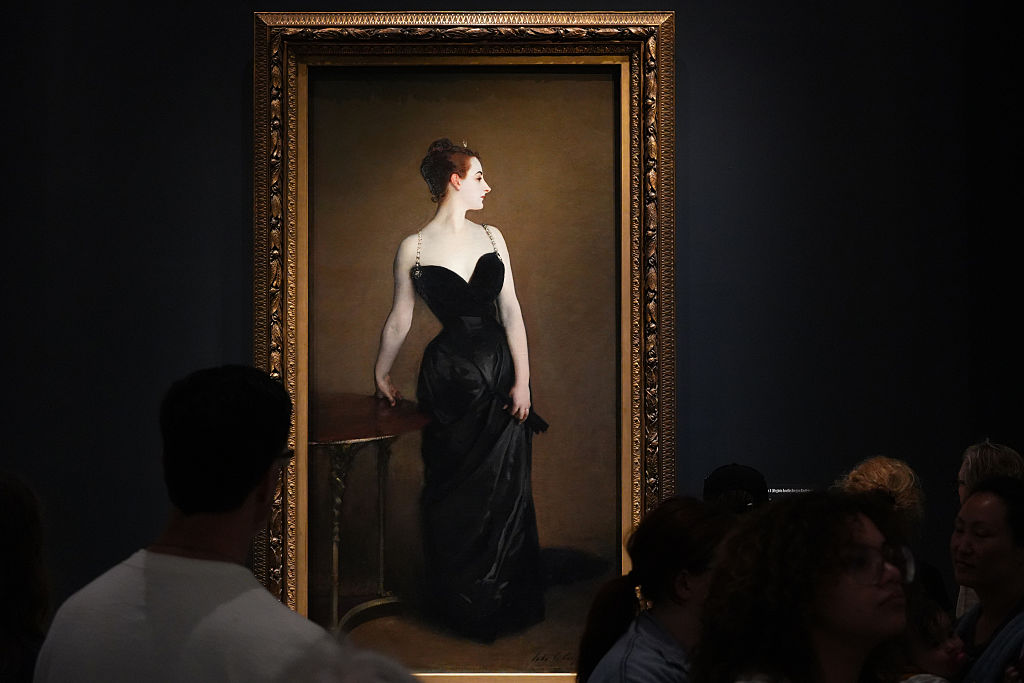
    “Sargent and Paris,” an exhibition at the Metropolitan Museum that soon travels to the Musée d’Orsay, accompanied by a book of essays, tells the fascinating story of his swift rise to the top of the French art world to his blazing exit ten years later, when he moved to London in the heat of a scandal ignited by the display of Madame X at the 1884 Paris Salon – a highly criticized portrait of the preening socialite Virginie Gautreau, dressed in a revealing black gown with a single jeweled strap falling off her shoulder. Displaying around 100 works from the first decade of his career, including dozens of early landscapes and travel scenes, the exhibition proves that the “curious intentions and strange refinement” one perplexed art critic saw in Madame X should really have come as no surprise at all.

    Take his oil sketch (c. 1879) of an orchestra rehearsing at the Cirque d’Hiver indoor amphitheater. The conductor, Jules-Étienne Pasdeloup, was known for his adventurous programs that championed modern composers such as Gabriel Fauré. Sargent’s experimental painting is equally adventurous, with bold cropping and a peculiar vantage point from the upper seats. With abbreviated brushstrokes, he shows the players, instruments and sheet music disintegrating into abstract shapes as they are swept into the curves of the amphitheater. Three whimsically dressed circus clowns appear in the foreground, one turning his head in profile, revealing a face covered in white makeup with a smear of red paint across his mouth.

    “Strange refinements” abound in his travel paintings, too. We see a study of the head and neck of Rosina Ferrara, his favorite model in Capri, shown in profile with a resolute stare, like the face on a medallion or cameo, or an illustration in an ethnographic study. She reappears in Among the Olive Trees – Capri (1879), standing in a complex pose in a field with her back to the viewer and head turned to the right, her arms intertwined around the branches of an olive tree. In The Spanish Dance (c. 1879–82), an evocative nighttime scene, two female dancers perform deep backbends with their arms raised and faces obscured, while a third leans forward, twisting to reach one arm to the ground.

    His early portraits are similarly daring. In his 1879 painting of the red-haired Marie Buloz Pailleron, he places her in a windswept park, combining the genres of landscape and portraiture while using loose, Impressionist-style brushwork and light colors. The dramatic red-on-red composition of Dr. Pozzi at Home (1881) is just as radical, capturing the eminent surgeon and art collector Samuel Jean de Pozzi not in a professional setting, but rather an informal, domestic one. The doctor sports a bright red robe and stands amongst red velvet curtains and a red carpet, redolent of paintings of Catholic cardinals (or indeed Jonathan Yeo’s 2024 portrait of King Charles).

    Dr. Pozzi, interestingly enough, was rumored to have been the lover of the aforementioned Virginie Gautreau, née Avegno. Born to French Créole parents in New Orleans, her mother came from a family of rich plantation owners, while her father, a Confederate general, died from wounds sustained during the Civil War. In 1867, aged eight, she was whisked away to Paris by her mother, who hatched a plan for her to enter high society. It worked, sort of: in 1878, a 19-year-old Virginie married the much older businessman Pierre Gautreau, whose fortune came from importing guano fertilizer from Peru. But she struggled to shake off her origins and be accepted as a true Parisienne.

    The city’s papers chronicled her active social life and highly cultivated appearance, labeling her a “professional beauty,” but also an “American.” According to art critic Theodore Child, she “carried to unparalleled perfection the art of maquillage, enamelling, and of eccentricity in costume and coiffure.” Her efforts at self-fashioning earned both admiration and ridicule; the Russian emigré painter Marie Bashkirtseff confessed in her diaries that she looked “horrible in daylight because she uses too much makeup . . . but at night she is truly very beautiful.”

    Sargent, for one, was enamored. He produced more studies of Gautreau than he did for any other portrait. We see pencil sketches capturing her unusual profile, which featured a long, upward-swooping nose and artificially lined eyebrows. In letters, Sargent expressed his delight and frustration in trying to record her “unpaintable beauty,” including the peculiar “lavender or chlorate-of-potash-lozenge” color of her made-up skin.

    Both artist and subject were thrilled with the final picture, with Gautreau declaring it a “masterpiece.” Neither expected a “great ruckus,” as one observer remembered. Though exhibited under the title Madame ***, to preserve her anonymity, Gautreau’s profile and red hair were easily identifiable by Salon-goers, and she was immediately ridiculed for her vanity. Not only was she accused of looking both artificial and decomposed, but also indecent, as if her dress were about to fall off. (Post-Salon, Sargent repainted her jeweled strap in its proper place.) Her contorted pose, meanwhile, seemed to suggestively echo that of the sirens carved into the legs of the wooden table beside her.

    The controversy briefly scared off Sargent’s patrons and perhaps hastened his decision to move to London. But they soon came running back. Sargent, for his part, always stood by Madame X, his American Parisienne, now a crown jewel of the Met’s collection. When the artist sold it to the museum in 1916, he declared in a letter to the director, “I suppose it’s the best thing I’ve done.”

    And what of Gautreau?

    After her initial distress – she and her mother came to Sargent’s studio “bathed in tears” – she seems to have taken the incident in her stride. A couple of weeks after the opening of the Salon, she was spotted at the theater in a dress with “a bodice held on the shoulders by diamond bracelets.”