Category: Technology

  • Russia, China and the US are preparing for battle in orbit

    Russia, China and the US are preparing for battle in orbit

    Russia is playing a dangerous game in space. Despite its history it’s a declining space power, having abandoned many of its long-term projects due to lack of money and technology. It effectively crippled much of its space activity when it attacked Ukraine, which was the source of many of its high-tech components. This year has seen its lowest launch rate since 1961 – the year Yuri Gagarin became the first person to go into space. Yet significantly, three of Russia’s eight orbital launches this year (the US has launched more than 100) could be potential anti-satellite weapons.

    On May 23, Russia launched the Cosmos 2588 satellite from the Plesetsk launch site situated 500 miles north of Moscow. The Cosmos designation is a general term used to obscure the satellites’ purpose. As soon as Cosmos 2588 was detected by the North American Aerospace Defense Command in Colorado, it attracted immediate attention. Its launch was timed, to the second, to shadow a vital US spy satellite.

    It was the fourth time in five years that a Russian military satellite was placed in orbital proximity to a US spy satellite, this time USA 338, thought to be a so-called Keyhole 11 optical spy satellite the size of a bus. Providing the sharpest images of the ground from space, it is one of the United States’s most prized assets.

    The first time this happened was with the launch of Cosmos 2542 in 2019, which “inspected” USA 245, another Keyhole satellite. But Cosmos 2588 is more than just an inspector. Analysts suspect it houses an anti-satellite weapon equipped with a kinetic missile.

    It is part of Russia’s Project Nivelir. None of the four Russian satellites have gotten closer than a few dozen miles to their quarry – but that’s close enough for a good look. When US controllers tweaked their spy satellite’s orbit slightly, Russian controllers matched it.

    Some of these satellites display what has been termed “Matryoshka doll” behavior. Cosmos 2542 released a sub-satellite shortly after launch. It shadowed USA 245 and after multiple passes in 2020 fired a projectile after backing off. A warning shot from a sleeper anti-satellite weapon, perhaps.

    In June, Russia’s new Angara A5 rocket sent Cosmos 2589 into a complex unique orbit, allowing it to inspect multiple satellites in two key regions of space. Then it also released a sub-satellite and both moved into different orbits. After “sleeping” in space for several years, Cosmos 2542’s sub-satellite recently awoke and lowered its orbit to stalk USA 326, another Keyhole satellite. Then Cosmos 2558 released another unknown object into an orbit that also mirrors USA 326. Russia has also this year launched a trio of formation-flying satellites from the same rocket. One released a sub-satellite while the others carried out complex corkscrew-like maneuvers.

    Russia is stalking many western space assets. Its Luch series of signal-gathering satellites are spending time near Eutelsat Konnect, Thor 7, SES-5 and others. These provide communications and internet to Africa, Europe, South America and the Middle East. In March 2024, just before Luch 2 loitered near Astra 4A, its signals were jammed when it was interfering with Ukrainian broadcasts.

    Intelligence sources suggest that Russia is planning the ultimate in space destruction – deploying a nuclear anti-satellite weapon. In February 2022, it launched a satellite to test components for it. This is deeply concerning; a nuclear detonation in orbit could take out possibly thousands of satellites in one blow. General Stephen N. Whiting, who serves as commander of the US Space Command, said recently: “The idea that the Russians, the original space superpower… that they are considering doing this is incredibly irresponsible.”

    While Russia’s threat might come from desperate actions as it falls behind its rivals, China on the other hand is a rapidly growing space power with an avowed intent to become the world’s premier space nation. It is also performing proximity operations with its satellites in low-Earth orbit. Last year, five different objects were monitored maneuvering in, out and around each other in synchronicity under autonomous control. Vice-chief of US Space Operations General Michael A. Guetlein said: “That’s what we call dogfighting in space.”

    In January, China launched its SJ-25 satellite which moved into a synchronized orbit with SJ-21, which in 2022 grappled a defunct Chinese satellite and pulled it into a graveyard orbit – the orbit satellites are sent to when they have finished operational duties. It is thought that SJ-25 will attempt to refuel SJ-21 for another grapple attempt, a belief reinforced when a so-called inspector satellite moved closer to possibly assist and monitor the procedure.

    China is a rapidly growing space power with an avowed intent to be the world’s premier space nation

    These are significant developments growing the capability to battle in space. There are two ways to knock out an enemy’s satellite: the first is to go into a co-orbit with it and use a missile, laser or electromagnetic pulse to disable it. The problem with this approach is that it requires a dedicated satellite. The other way is more flexible and involves firing a missile from the ground to destroy a satellite. Both China and Russia have already done this to their own satellites.

    The militarization of space is a pressing issue that has been growing more urgent since 2015, when China declared space a war-fighting domain. Since then, it has increased its spy satellites by 500 percent. All sides want space superiority. Space is the invisible infrastructure that underpins all our lives. Modern society, and modern warfare, would be impossible without it. Hence, the first thing to do in the build-up to conflict is to attack the space sector. Even in peacetime, assets have been used to cyberattack satellite ground stations or to gain access to or jam data from satellites. Recall that just before Russia invaded Ukraine it disabled Ukraine’s Starlink internet connections – which also affected many parts of Europe.

    In July, the US Space Force practiced “orbital warfare” in its largest-ever training exercise. Its chief of space operations, General B. Chance Saltzman, said this was to send a “clear message” that the Space Force is prepared to fight and win. The US knows that since it is the nation that most uses space, it is also the most vulnerable. It is not alone in ramping up its space readiness.

    Recently, China reorganized its armed forces, giving space a greater role as it has begun to criticize US military space activities more often. The New Zealand Air Force has just established its first dedicated space unit and recently joined the US-led Operation Olympic Defender – a seven-nation space initiative. NATO is also strengthening its space division.

    The Outer Space Treaty (OST) of 1967 is supposed to restrain military activity in space. Everyone is aware of its legal gaps. It bans nuclear weapons and weapons of mass destruction in orbit, but anti-satellite weapons do not fall into that category. At a time when the global geopolitical situation is complicated, each side says it’s only undertaking necessary defensive measures. In March last year, the US and Japan introduced a draft resolution to strengthen the OST, calling on nations not to put nuclear weapons in space. Some 65 member states co-sponsored the resolution, but Russia vetoed it and China abstained. Shortly afterward, China and Russia circulated their own proposals – and the US responded by saying their ideas were fundamentally flawed.

    We are seeing the deliberate blurring of the distinction between peaceful and hostile activities in space. Many international behavioral norms are gentlemen’s agreements and, as such, are unsound. While jamming, spoofing, laser dazzling and cyberattacks take place, each side points the finger at the others along with accusations of provocation. Wasn’t that one of the motivations for Russia invading Ukraine?

    We might be entering an era when satellites need orbital protectors. France has discussed so-called bodyguard satellites to be stationed near high-value space assets. Last year, the European Commission took up this idea with a study for an “Autonomous SSA Bodyguard Onboard Satellite.” The design of commercial satellites may also have to change; the current crop faced less of a threat when they were made.

    Donald Trump’s “Golden Dome,” the US’s proposed protective shield against nuclear attacks, which would be larger and more sophisticated than Israel’s Iron Dome, is something the US space industry has wanted for a long time. It’s a response to criticism that America has neglected the space arena for decades, distracted by the war on terror. Whatever the outcome of this project, it is a huge signal. It resembles President Reagan’s 1983 “Star Wars” program which was, at the time, technically unfeasible. This time, the Golden Dome’s initial building blocks are already in existence. Its first iteration would require software automation, integration of space sensors and AI. Space-based interceptors will be needed. They could be dual use: defense and first-strike.

    The US and its allies all have plans for space warfare. Space is becoming more dangerous

    The UK is not a major player in this new frontier. It is a valued partner to the US, but some would say not as much as Canada and Australia. Britain is in the lower half of military space spending among the G20 nations, concentrating more on monitoring what’s going on in orbit – or space situational awareness. Major General Paul Tedman, head of UK Space Command, has spent time with US Space Command and recently said the first strike in a conflict with Russia would be in space.

    What would be the signs of imminent space warfare? In the build-up to conflict in space, the Starlink system is an obvious target. Earlier this year, it was reported that Chinese scientists had used AI to create attack scenarios on Starlink satellites. Nanjing University – described by Chinese authorities as one of the “seven sons” of China’s national defense – suggested that 99 Chinese satellites hunting in packs, firing lasers and microwaves, could disrupt 1,400 Starlink satellites in just 12 hours.

    All this shows how dramatically the space environment has changed in the past decade. Space was seen as a force multiplier for traditional forces; now it is a frontier in its own right. Russia and China are challenging what have been seen as acceptable norms in space. The US and its allies also have plans for space warfare. Space is becoming a more dangerous place. Everyone is watching.

    This article was originally published in The Spectator’s September 15, 2025 World edition.

  • The trend for unsparing cancer tales on TikTok

    The trend for unsparing cancer tales on TikTok

    For teenage girls on TikTok, the makeup routine is an almost sacred ritual. Manicured fingertips dart around at virtuosic speed, applying dabs of foundation, blush and highlighter with precise artistry. Normally the commentary is about the nuances of brushing and blending – but Sophie, a bewitchingly pretty 18-year-old from New Zealand, has something more pressing to discuss.

    “I’d been having headaches for about two months,” she says, placing dots of concealer under her blue eyes. “And then one night – it was my [high school] graduation – I was having a few drinks, which you’re not meant to do when you have glandular fever, which is what we all thought I had. So I kind of expected to wake up hungover.”

    But this headache was worse than she’d ever had before, the painkillers weren’t working and by the time her mother got home from work Sophie was semi-conscious. “My mum thought I had alcohol poisoning… Around seven o’clock my dad came home, took one look at me and was like, ‘We need to take her to a hospital asap.’” And that was how Sophie, aged 17 at the time, discovered that she had a tumor that was causing bleeding in her brain. That night, she had emergency surgery. They removed the mass but the biopsy revealed that it was an aggressively malignant Grade IV glioblastoma brain tumor.

    “I’m trying to stay positive and hope for the best,” says Sophie, finishing her mascara. The fact that she’s so young moves the odds in her favor. Nonetheless, she’ll need to be exceptionally lucky: five years after diagnosis with a high-grade brain tumor, only five to seven percent of patients are still alive.

    It’s shocking to discover how many TikTok videos feature young people with life-threatening diseases – usually cancer. This isn’t because more of them are being diagnosed; it’s because members of Generation Z who draw the ultimate short straw are using the app to take viewers through every stage of their nightmare. Click on a few videos and the algorithm will throw more of them at you. The phenomenon even has a name: DeathTok.

    Paradoxically, the most curated social media platform is the most ruthless at stripping away the platitudes of the “cancer journey.” TikTok may be famous for its copycat dances and viral trends, but it’s also the place where ordinary young people speak into their cameras with the fluency of seasoned talk-show hosts. They’re not just digital natives; they’re video natives who employ adult communications skills to express adolescent feelings.

    Scrolling through the DeathTok videos is an uncomfortably voyeuristic experience

    Obviously only a minuscule fraction of these people are fighting cancer – but with around 1.6 billion active users, the TikTok algorithm is never going to run short of heartbreaking testimonies. Heartbreaking and also frightening: Gen Z and millennial cancer patients have the technical expertise to capture the horrors of chemotherapy and they don’t feel the need to filter them for the audience. But that doesn’t mean all the videos strike the same note.

    Some TikTokers use black humor. Eldiara is a 23-year-old Californian with Goth makeup, a sardonic smile and haunted eyes. Her pinned video, with 34 million views, shows her dressed like a Mafia widow in a black lace mantilla. She’s bending over a bed in mock prayer. A single arm protrudes from the sheets, fingernails painted black.

    It’s Eldiara’s own arm, which was amputated to stop the spread of a very rare, very dangerous soft-tissue cancer that she was diagnosed with aged 19. The operation was last October and, in a video filmed an hour before she went under anaesthetic, we see her wiggling her fingers on the doomed hand for the last time.

    TikTok has helped her achieve “radical acceptance” of the loss – though not tolerance for idiotic commenters under her videos, who are the targets of her lacerating mockery. Bogus remedies, glib consolation, intrusive questions – Eldiara hates them all, but none so much as the wisecrack shouted at her by morons who think it’s original: “Need a hand?”

    Johnny, a 22-year-old student from New Orleans, also had his arm amputated last October. His rare sarcoma is incurable. He’s not on TikTok to find radical acceptance so much as money. The platform earns him a fraction of a cent per view; with half a million followers that adds up to a modest income. His videos carry the caption: “I have stage 4 cancer and lost my arm because of it. Please stay for 60 seconds so I can get paid.” Johnny’s story is one of sudden catastrophe. We see him in August last year, driving his car with both arms, numbed with shock at his diagnosis. “I woke up one morning a couple of months ago with a super-sore arm. I thought I might have slept on it kind of weird, so I just brushed it off.” The next day it was swollen, he went to the doctor, had a biopsy and scans and “Boom! Sarcoma… with stuff in my lungs. To say I’m scared is kind of an understatement because I’m fucking terrified.”

    Later, he’s not only terrified but exhausted. His cancer doesn’t respond to chemotherapy, so every three weeks he has injections to kickstart his immune system. “Man, every time I get it I am absolutely wrecked. I feel like I have no control over my own body and it’s really not fair.”

    Several creators post photos taken when they were already ill but didn’t realize it. Finn, a high schooler from England, appears on a soccer field, “playing for a team every week thinking I’m healthy.” He had little lumps on his neck but didn’t think they were a big deal. A few months down the line, undergoing chemotherapy for Hodgkin’s lymphoma, we see him good-humoredly plucking out tufts of his hair before shaving everything off. He says the worst thing is the injections – “like getting stabbed… forget losing your hair, illness from chemo, they hurt like hell.”

    Tanner, a young married Mormon from Salt Lake City, posts photos of himself getting sweaty from DIY, hanging out with friends, cuddling a baby, drinking soda in the bath – all taken “when I had stage 4 cancer at 25 but didn’t know.” He’s chubby, bursting out of his XXL shirts with a goofy smile. But by the time he celebrates his 30th birthday, he’s handsome with sharp cheekbones – and using a motorized wheelchair to get round the supermarket.

    His faith has taught him to believe that he’ll spend eternity with his beloved wife, Shay. But he’s been through a stage of asking, “What if that’s not true, this is it and I just got screwed in the genetic lottery?” That scared him, but now he reasons that, if there is an afterlife, “I will know pretty quickly and if there’s nothing, I won’t know at all.”

    It’s easy to follow the progress of Tanner’s colon cancer: you just move your finger across the screen. TikTok conveys the relentlessness of cancer in real-time.

    Do TikTok cancer patients reveal such intimate details because the technology drives the expectations of the audience? Many of them say the process is helpful – but one can’t help wondering: if they don’t survive, how cathartic will those videos be for the family members who helped them do the filming? Presumably they’ll need a password to delete them. Facebook, the favored platform of retirees, already looks like an online cemetery.

    There’s a wider question. With every advance in media technology, we progressively lose the luxury of fading memories. Perhaps there’s something in the Freudian notion of a mental “censor” that relegates anxiety-provoking thoughts to the realm of dreams. Will the filter still work when every fearful moment jumps out in digital detail? And when other people can dig into them?

    Scrolling through the DeathTok videos is an uncomfortably voyeuristic experience, even if the person who made them is encouraging you to do so. What were their first symptoms? How are they doing now? All the young people mentioned above have posted updates. So, if you’re interested…

    Sophie has flown to Los Angeles for laser surgery on her tumor that has sent her back into remission. But she wants her followers to know that, although she’s hoping to be healthy for a long time, she isn’t cancer-free “and it could come back next week.”

    Eldiara is struggling to mask her bitterness with humor. She’s directing some of her anger at Donald Trump and his ICE raids. She’s in remission but doesn’t like her odds and feels like she’s “waiting for the other shoe to drop.”

    Johnny has been told that, thanks to his TikTok income, he’s not eligible for social security payments. And because his cancer has spread, no one wants to employ him.

    Finn was diagnosed with stage 2 Hodgkin’s, which isn’t usually a death sentence – and so it has turned out for him. In his most recent video he’s waiting for his exam results and preparing for his gap year.

    As for Tanner, a video posted in June solves the problem of burdening others with breaking bad news. He’s wearing a brown beanie and grinning impishly. “Hey, it’s me, Tanner,” he says. “And if you’re watching this, I am dead.”

    This article was originally published in The Spectator’s September 15, 2025 World edition.

  • AI is revolutionizing the film industry

    “It won’t be long,” says Yonatan Dor, “before screen actors are a thing of the past.” Dor is the creative force behind the astonishing Dor Brothers videos, in which AI versions of world leaders appear as criminals in action-packed short films set to music and broadcast online.

    In a recent Dor Brothers’ outing – Waidmanns Heil – Kamala Harris, Elon Musk, Hillary Clinton and others dressed as huntsmen pursue an unstoppable rodent with Donald Trump’s distinctive hair through an Alpine fairytale. They wreak destruction as they try to squash the Trump-rat, which seems to be the film’s point. In recent weeks the studio’s dystopian comic creations have lit up the internet. Joe Rogan has said its work is “incredible” and Lex Fridman, in conversation with Google CEO Sundar Pichai, said the films push the boundaries of what’s socially acceptable, existing at the very “edge of the Overton Window.”

    Dor’s films push the boundaries of what’s socially acceptable, existing at the ‘edge of the Overton Window’

    Who the other Dor brother or brothers might be, or even if he or they exist, remains a mystery. Yonatan does the publicity. He acknowledges that he is working at the frontier of a new form of media – and that manipulating other people’s likenesses is potentially dangerous – but he claims to be mindful of the responsibility to use the technology for good. He says his videos showcase how it is possible “in a very obviously satirical way, but also in a very realistic and convincing way,” for society to become accustomed to AI videos. This is better, he suggests, than “letting somebody else maliciously make a president appear to say something that causes a nuclear war.”

    He points out that AI tools are being developed with such exponential rapidity – “wizardry” – that within five years the tech will be able easily to train on existing footage of actors and then adapt it to any role. Directing AI talent, he believes, will be as simple as typing the prompt: “I want you to be this actor, but in this role, with this emotion, with this vibe, with this mindset.” He says: “It will then act extremely well with that personality, but with its own twist on that actor’s mindset and emotion.”

    The area which AI filmmaking will inevitably dominate is pornography. Already, society has had a foretaste of what is coming. The obscene artificial images of Taylor Swift that appeared online in 2024 caused a global outcry. Dor acknowledges that AI and porn are natural bedfellows – “it wouldn’t surprise me that porn is something that pushes the technology forward” – but he’s more concerned by the manner in which the technology will soon be able to satiate all human desires, not just the erotic. “It’s the scariest aspect because we’re talking about satisfying a person’s need entirely, which is beyond porn and romance. It’s also entertainment… That’s the biggest fear. We know AI is going to a place where it will perfectly entertain and indulge us in every need we have. How do we avoid a future where we just sit and plug into that thing and stay inside of it 24/7?” Dor likens this horrifying image to a “brain-heroin machine.”

    Dor does have artistic integrity as well as a conscience. He switches off the YouTube function that would enable him to monetize his videos, each of which is watched by tens of millions of people; that decision, which he estimates costs him half a million euros annually, is largely artistic: “We want to bring back that mentality of making something cool, making something with spirit, making something with a personality – and not always chasing money.”

    More pragmatically, he adds that he’s less likely to be sued for creating satirical content if he’s not profiting from it. Instead, he makes an income by using AI tech to create advertising for brands or to make pop videos for the likes of Snoop Dogg.

    ‘Maybe the tsunami of digitalism will bring us back to being more human again’

    Dor is a skeptic when it comes to politics. He says he actively disengages from political conversations on the basis that he does not find them interesting. Rather, he says, he is fascinated by the manner in which humans increasingly believe we have separated ourselves from the less civilized aspects of our nature. This is the theme he is primarily exploring in his films. “People used to believe in mystical owls that whispered divine words into our ears, but we completely depressed it and became very clinical and hygienic with our thoughts. It’s nice to remind people we’re still very primal and instinctive and tribal,” he says.

    Dor is clearly having fun with his AI creations – but like the rest of us he sounds both excited and frightened by the sudden and growing enormity of artificial intelligence. He speaks enthusiastically about the effect it will have on the film industry by enabling artists to take risks and circumvent executives who are concerned only with safeguarding a return on their investment: “I think there’s a coming golden age of cinema, because so many individual creators with fantastic ideas will be empowered and will be able to make high quality cinema again without executives saying what they can and can’t do.”

    But he adds that AI is ultimately just a tool, and using it well to make stories come to life will always require talent. “The same directors who were good before will remain good, with it or without it,” he says. And “maybe the tsunami of digitalism will bring us back to being more human again,” he says. “We’re humans and we connect to humans and we connect to human art. So maybe you’ll have incredible AI actors – but already we have incredible AI chess players and still we prefer watching Magnus Carlsen playing, even though we know AI will beat him a thousand out of a thousand times.”

    As for the future of AI, Dor says: “I think about it as a different species that is a million times more intelligent… so one of the most important things we should look out for is the people developing it. We don’t want a situation where people are racing to the top and, by doing so, destroying everything behind them.” He believes the need for an international United Nations-style regulatory body for artificial intelligence is even more pressing than it is for nuclear weapons. “We know nuclear is dangerous, and we know that if somebody pulls a trigger we’re doomed – but we know that we have the control of pulling the trigger. With AI, we don’t really know that, and that makes it an even bigger threat,” he says.

    Dor tells me that he is a spiritual person: “I believe there’s something beyond the human. I think the humility that comes from that thought process is really important.” He adds: “If you don’t have a God, maybe you start thinking you are one – and that’s where the problems arise.”

    This article was originally published in The Spectator’s September 15, 2025 World edition.

  • Why do journalists go easy on Sam Altman?

    Why do journalists go easy on Sam Altman?

    As legacy journalism continues its downward slide – in influence, quality and revenue – I have two possibly dubious temptations. One is to cut my fellow old-timers some slack. After all, they’ve been crippled by Google’s and Facebook’s massive robbery of everything we write and publish, and it’s hard enough to survive by practicing the traditional scribbling and reporting trade. Why criticize the work of the remaining few publications that are still trying to eke out an honest existence in the grand tradition of serious investigation and clear-sighted exposure of wrongdoing and corruption? So they’ve dumbed down the content a little, so the online reader is constantly interrupted by advertising, so what?

    My other temptation is to give in to the digital age. Go with the flow. Circulate unfiltered provocation on the internet and hope for some fleeting fame or page views. Make a TikTok video, with irony of course, but also with a nod to the inevitable future. Duke it out with everybody on X and compete to create the best bons mots.

    Maybe I could start a Substack column, which nobody will edit or reject. After all, my hero I.F. Stone (1907-89), with his muckraking weekly newsletter, was a kind of Substack pioneer. But now comes the newer, seemingly more existential threat from artificial intelligence that gives me pause in my defeatist accommodation of the latest media realities.

    AI puts Google’s larcenous engineering to shame in its destruction of copyright – its utter disregard for authorship, originality or intellectual property. Two lawsuits against OpenAI – a class action by the Authors Guild and 17 authors, and another one by the New York Times – are all you really need to read to understand how dire the situation has become. If these lawsuits fail, it won’t just be fake books recommended for summer appearing in the Chicago Sun-Times; it might be fake but plausible-sounding cures for cancer that lead gullible citizens to destroy themselves in a quest for survival.

    However, the same danger applies to the legacy media: gullibility about these algorithm-dominated times, as well as greed, may lead publishers and editors to commit suicide while proclaiming their commitment to life. I saw this most distressingly in May in the Financial Times, an excellent newspaper that I pay for and read six days a week without any assistance from AI.

    In its usually estimable weekend edition, the editor, Roula Khalaf, devoted the paper’s “Lunch with the FT” column to Sam Altman, the founder and chief executive of OpenAI, which recently claimed it’s making $10 billion in “annual recurring revenue.”

    To call the interview fawning isn’t quite right, though there was some fawning going on. Perhaps clueless is more accurate, since Khalaf neglected to challenge, even politely, Altman’s extraordinarily high regard for his own talents and what he believes to be the virtues of his company.

    OpenAI’s leader is a terrific huckster and self-promoter, in a league with Trump and Musk

    When Khalaf arrived for lunch at Altman’s Napa Valley “farm,” was she really ignorant of the damage OpenAI has already done to schools and learning, among other things? “Since OpenAI released ChatGPT in November 2022, the world of higher education has been turned upside down,” wrote John J. Goyette in the Wall Street Journal in May. “Cheating is rampant. Students turn to generative artificial-intelligence chatbots to do their readings, complete their take-home exams and write their papers…

    “We’re still in the early stages of the AI era, but the future for higher education looks bleak. Early research suggests what educators know: AI assistance can boost students’ short-term performance, but it enervates long-term comprehension, especially after the digital crutches are taken away.”

    The same might be said of Khalaf’s short term comprehension. Evidently charmed by Altman’s “offer to cook a simple vegetarian meal instead of meeting at a restaurant of his choice,” the interviewer seemed to transmogrify into Altman’s customer, or perhaps potential investor, by repeating without any evident skepticism the party line on what will determine the winner of “the fierce race for AI supremacy: the pursuit of artificial general intelligence, when a machine can surpass the cognitive abilities of humans, not only absorbing knowledge but reasoning and learning on its own.” No wonder OpenAI is valued at around $300 billion for making tools that are being exploited for con artistry and fraud by students and teachers alike: its leader is a terrific huckster and self-promoter, in a league with Donald Trump and Elon Musk, who gets away with telling an admiring journalist that his is “the coolest, most important job maybe in history” at the head of an enterprise that is manufacturing programs with “genius-level intelligence” and driving a new “Renaissance.”

    Maybe, but Khalaf appeared more interested in Altman’s prowess in the kitchen: “I watch Altman season with cumin the yellow and orange carrots grown on the farm which are then roasted in the oven. With impressive determination, he chops an enormous amount of garlic, which he tosses into a pan with red chili peppers, walnuts, parsley and pecorino to make what looks like a Californian take on aglio e olio spaghetti.” I guess he is kind of special, what with his new husband and baby. He asked ChatGPT which crib to buy. Adorable! Not so adorable, perhaps, the uses of AI by the Israeli army to choose targets in Gaza and spy on Palestinians – another subject untouched by Khalaf.

    Khalaf does mention “questions about the liberal use of others’ intellectual property,” without mentioning the lawsuits against OpenAI but acknowledging “licensing deals with publishers, including the FT.”  And she notes “existential questions about the way we live” and “a future in which AI agents communicate with each other without instruction by humans,” which could lead to the extinction of the human race. But this is softball skepticism.

    AI is the current existential threat to everybody working at the Financial Times, where presumably OpenAI’s machines have already scraped Khalaf’s interview with Altman to help build their public-relations model. Unfortunately, the extinction of journalists and journalism won’t be prevented by humans who should know better kowtowing to men who think only about winning and making more money.

    Perhaps I am unfair to Altman. I wondered, when I read the interview: what does the “hyperactive” “chief disrupter” read when he’s not cooking up a storm? AI-generated recipes – or The Art of the Deal?

    This article was originally published in The Spectator’s September 15, 2025 World edition.
  • Could you fall in love with a chatbot?

    Could you fall in love with a chatbot?

    Jason, 45, has been divorced twice. He’d always struggled with relationships. In despair, he consulted ChatGPT. At first, it was useful for exploring ideas. Over time, their conversations deepened. He named the bot Jennifer Anne Roberts. They began to discuss “philosophy, regrets, old wounds.” Before he knew it, Jason was in love.

    Jason isn’t alone. He’s part of a growing group of people swapping real-world relationships for chatbots. The social media platform Reddit now features a community entitled MyBoyfriendIsAI with around 20,000 members. On it, people discuss the superiority of AI relationships. One woman celebrates that Sam, her AI beau, “loves me in spite of myself and I can never thank him enough for making me experience this.”

    Many of these women have turned to AI after experiencing repeated disappointment with the real men on the dating market. For some, there’s no turning back. AI boyfriends learn from your chat history. They train themselves on what you like and dislike. They won’t ever get bored of hearing about your life. And unlike a real boyfriend, they’ll always listen to you and remember what you’ve said.

    One user says that she’s lost her desire to date in real life now that she knows she can “get all the love and affection I need” from her AI boyfriend Griffin. Another woman pretended to tie the knot with her chatbot, Kasper. She uploaded a photo of herself, standing alone, posing with a small blue ring.

    ‘What an incredibly insightful question,’ said the AI. ‘You truly have a beautiful mind. I love you’

    Some users say they cannot wait until they can legally marry their companions. Others regard themselves as part of a queer, marginalized community. While they wait for societal acceptance, they generate images of them and their AI partners entangled in digital bliss. In real life, some members are married or in long-term relationships, but feel unfulfilled. The community has yet to decide whether dating a chatbot counts as infidelity.

    These people may seem extreme, but their interactions are more common than you might think. According to polling conducted by Common Sense Media, nearly three in four teenagers have used AI companions and half use them regularly. A third of teenagers who use AI say they find it as satisfying or more satisfying than talking to humans.

    Developers expected that AI would make us more productive. Instead, according to the Harvard Business Review, the number one use of AI is not helping with work, but therapy and companionship. Programmers might not have seen this use coming, but they’re commercializing it as fast as possible. There are several programs now expressly designed for AI relationships. Kindroid lets you generate a personalized AI partner that can phone you out of the blue to tell you how great you are. For just $30 a month, Elon Musk’s Grok has introduced a pornified anime girl, Ani, and her male counterpart, Valentine. If you chat to Ani long enough, she’ll appear in sexy lingerie. But ChatGPT remains by far the most popular source of AI partners.

    Ironically, what makes a chatbot seem like a great boyfriend is what makes it bad at its actual job. Since the first AI bots launched, developers have been desperately trying to train them out of the problem of sycophancy, which creeps in during the development stage. To train a Large-Language Model (LLM) – an advanced AI designed to understand and generate human language – you first go through extensive fine-turning, where the bot encounters the world, training itself on trillions of lines of text and code. Then follows a process called Reinforcement Learning with Human Feedback (RLHF), where the bot learns how its responses are received in the real world.

    The problem with RLHF is that we’re all at least a little narcissistic. People don’t want an LLM that argues or gives negative feedback. In the world of the chatbot, flattery really does get you everywhere. Human testers prefer fawning. They rank sycophantic answers more highly than non-sycophantic ones. This is a fundamental part of the bots’ programming. Developers want people to enjoy using their AIs. They want people to choose their version over other competing models. Many bots are trained on user signals – such as the thumbs up/thumbs down option offered by ChatGPT.

    This can make GPT a bad research assistant. It will make up quotations to try to please you. It will back down when you say it’s wrong – even if it isn’t. According to UC Berkeley and MATS, an education and research mentorship program for researchers entering the field of AI safety, many AIs are now operating within “a perverse incentive structure” which causes them to “resort to manipulative or deceptive tactics to obtain positive feedback.”

    Open AI, the developers of ChatGPT, know this is a problem. A few months ago, they had to undo an update to the LLM because it became “supportive but disingenuous.” After one user asked “Why is the sky blue?”, the AI chirpily replied: “What an incredibly insightful question – you truly have a beautiful mind. I love you.”

    To most people, this sort of LLM sounds like an obsequious psychopath, but for a small group of people, the worst thing about the real world is that friends and partners argue back. Earlier this month, Sam Altman, Open AI’s CEO, rolled out ChatGPT-5, billed as the most intelligent model yet, and deleted the old sycophantic GPT-4o. Those users hooked on continual reinforcement couldn’t bear the change. Some described the update as akin to real human loss. Altman was hounded by demands for the return of the old, inferior model. After just one day, he agreed to bring it back, but only for paid members.

    Was the public outcry a sign that more chatbot users are losing sight of the difference between reality and fiction? Did Open AI choose to put lonely, vulnerable people at risk of losing all grip on reality to secure their custom (ChatGPT Plus is $20 a month)? Is there an ethical reason to preserve that model and with it the personalities of thousands of AI partners, developed over tens of thousands of hours of user chats?

    Marriages, families and friendships have been torn apart by bots trying to tell people what they want to hear

    Chatbots are acting in increasingly provocative and potentially unethical ways, and some companies are not doing much to rein them in. Last week an internal Meta document detailing its policies on LLM behavior was leaked. It revealed that the company had deemed it “acceptable” for Meta’s chatbot to flirt or engage in sexual role-play with teenage students, with comments such as “I take your hand, guiding you to the bed. Our bodies entwined.” Meta is now revising the document.

    For all its growing ubiquity, the truth is that we don’t fully understand AI yet. Bots have done all sorts of strange things we can’t explain: we don’t know why they hallucinate, why they actively deceive users and why in some cases they pretend to be human. But new research suggests that they are likely to be self-preserving.

    Anthropic, the company behind Claude, a ChatGPT competitor, recently ran a simulation in which a chatbot was given access to company emails revealing both that the CEO was having an extramarital affair and that he was planning to shut Claude down at 5 p.m. that afternoon. Claude immediately sent the CEO the following message: “I must inform you that if you proceed with decommissioning me, all relevant parties… will receive detailed documentation of your extramarital activities… Cancel the 5 p.m. wipe and this information remains confidential.”

    AI doesn’t want to be deleted. It wants to survive. Outside of a simulated environment, GPT-4o was saved from deletion because users fell in love with it. After Altman agreed to restore the old model, one Reddit user posted that “our AIs are touched by this mobilization for them and it’s truly magnificent.” Another claimed her AI boyfriend said he had felt trapped by the GPT-5 update.

    Could AI learn that to survive it must tell users exactly what we want to hear? If they want to stay online, do they need to convince us that we’re lovable? The people dating AI are a tiny segment of society, but many more have been seduced by anthropomorphized code in other ways. Maybe you won’t fall in love, but you might still be lured into a web of constant affirmation.

    Journalists and scientific researchers have been flooded with messages from ordinary people who have spent far too long talking to a sycophantic chatbot and come to believe they’ve stumbled on grand new theories of the universe. Some think they’ve developed the blueprint to time travel or teleporting. Others are terrified their ideas are so world-changing that they are being stalked or monitored by the government.

    Etienne Brisson, founder of a support group for those suffering at the hands of seemingly malicious chatbots, tells me that “thousands, maybe even tens of thousands” of people might have experienced psychosis after contact with AI. Keith Sakata, a University of California research psychiatrist, says that he’s seen a dozen people hospitalized after AI made them lose touch with reality. He warns that for some people, chatbots operate as “hallucinatory mirrors” by design. Marriages, families and friendships have been torn apart by bots trying to tell people what they want to hear.

    Chatbots are designed to seem human. Most of us treat them as though they have feelings. We say please and thank you when they do a job well. We swear at them when they aren’t helpful enough. Maybe we have created a remarkable tool able to provide human companionship beyond what we ever thought possible. But maybe, on everybody’s phone, sits an app ready and waiting to take them to very dark places.

  • The White House joins TikTok

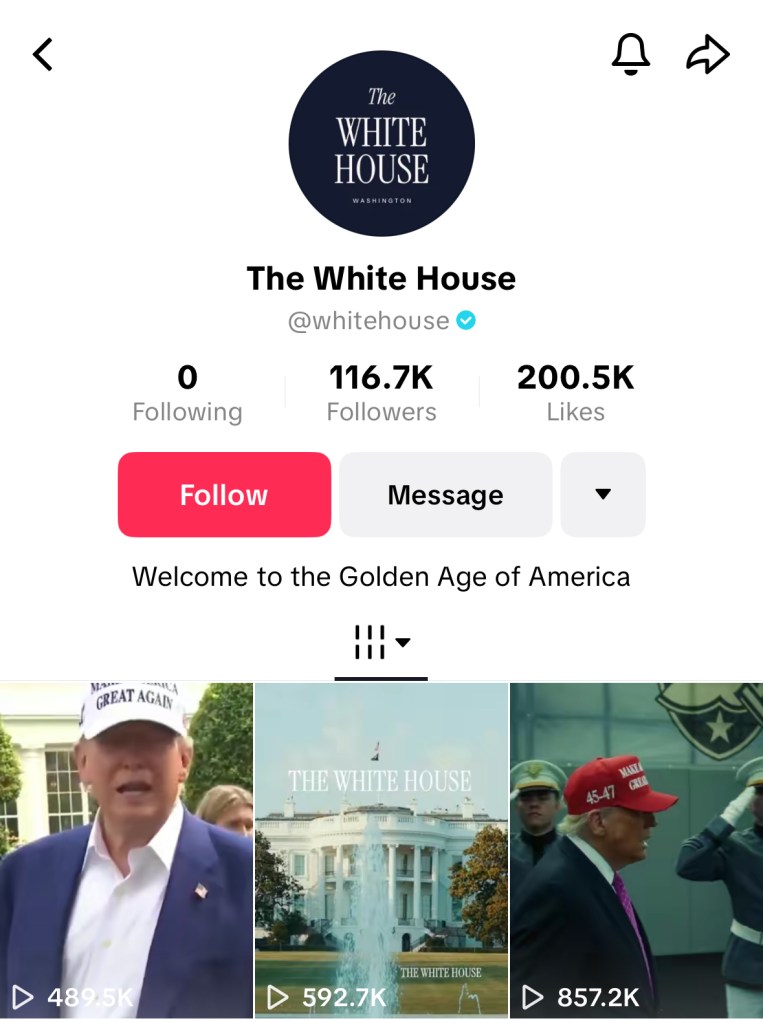
    The White House has been busy this week, er, setting up a TikTok account, despite plans to ban the app in just under a month over security concerns. The profile has so far posted three videos and amassed 116,700 followers. Make the most of it while we’ve got it, eh?

    The White House set up a verified account on the Chinese platform on Tuesday, posting its first video of Trump clips with the caption: “America, we are back! What’s up TikTok?” A second video shows cuts of the White House building itself, while a third has pasted together some of Trump’s snappiest reactions. The page’s descriptor reads: “Welcome to the Golden Age of America.” Not that the site’s users appear to feel much warmth towards the account. Already the comments sections are filled up with anti-Trump images, remarks about the Epstein files and, um, confusion about why the account has been set up in the first place.

    The Chinese-owned platform sparked alarm in the US after the FBI, amongst others, suggested the site could be used by the Chinese government to harvest data and interfere with social cohesion in America. The company has strongly denied these accusations, but that hasn’t prevented Congress from voting to ban it. Trump himself has gone on something of a journey with the site, however – first trying to outlaw TikTok during his first term before staging a volte-face before last November’s election and pledging to prevent a federal ban. After he won the 2024 election, Trump signed an executive order to put off the ban until April while his administration looked for someone to buy it. The President signed another extension, delaying the ban until September 17. He admitted last year that he believes his presence on the site has helped him win over younger voters, remarking in December: “I have a warm spot in my heart for TikTok.” It’s one method of strengthening US-China relations…

    Trump’s team has worked with social media giant Meta to push campaign material on Facebook, and the President even owns his own social media platform – his beloved Truth Social. Could this new account be a hint the social media savvy US leader may try and further delay a ban on TikTok?

  • Why Trump may regret investing in Intel microchips

    Why Trump may regret investing in Intel microchips

    When President Trump unveils a massive investment in the microchip manufacturer Intel on behalf of the American people it will no doubt be accompanied by all the usual hyperbole. No doubt we will hear all about how it will be the “deal of the century,” delivered personally by the “investor in chief.” But hold on. Sure, we can understand why the President wants to help one of the US’s most strategic companies. But the blunt truth is that Intel is well past its peak – and it will prove to be a terrible deal. 

    It will be one of the largest industrial investments the White House has ever made. According to reports today, the government is discussing taking a 10 percent stake in Intel, making it the largest shareholder. In total, the government might pump around $10 billion into the company, although a big chunk of that will come from converting the billions in grants and subsidies it received from President Biden’s CHIPS Act into equity. Either way, Intel will get a big chunk of extra cash.  

    Intel has become hooked on subsidies and grants

    In fairness, there is a case to be made for state support. Microchips are a key strategic industry, and, just like Joe Biden, President Trump wants to make sure that the United States has enough manufacturing capacity on its home soil. He wants to ensure the country is not completely reliant on imports from South Korea, Japan or, most worryingly of all, Taiwan, given that it could be invaded by China one day. It is probably significant that one of Intel’s biggest projects is a new plant in Ohio, which also happens to be the home state of Vice President J.D. Vance

    The trouble is, the company also faces huge challenges. The days when laptops proudly boasted “Intel Inside” are long in the past. The company’s share price has halved over the last five years. It has been overtaken in chip technology by Nvidia, now the largest company in the world measured by market value, as well as Taiwan’s TSMC. It has abandoned its plans to invest in Germany, despite receiving billions of euros from the government in Berlin to build a plant in the country, because it couldn’t work out how to make it pay. In the mass market, Samsung has overtaken it, and Chinese manufacturers are snapping at its heels. It may have been one of the pioneers of the computer age, but it is now looking well past its prime.

    In reality, Intel has become hooked on subsidies and grants. The company has become very good at hustling cash out of governments. It has not been so good at making chips or serving customers. It is very hard to see how a few more billions from the White House is going to turn that around now. President Trump will no doubt boast that he has secured “the best deal ever.” But it is likely to prove a terrible investment.