Category: Culture

  • Wokeness ended my backroom Jeopardy! habit

    Wokeness ended my backroom Jeopardy! habit

    In May I got a Facebook message from a guy named Mikey Walsh, who I’d met once at a trivia night at Mister Tramps, one of the diviest dive bars in Austin, Texas. He told me he’d been running a quiz called “Buzz In Buzzed,” which was exactly like Jeopardy!. Several of the regular players had been on Jeopardy! like me, and he was looking for more contestants to play.

    “This is not a business,” he said. “It’s free to play, and there’s no prizes. It’s just nerds playing trivia for fun.” This wasn’t the kind of offer I turn down. The opportunity to play fake Jeopardy! in the back of the bar for no money? Sign me up, I said.

    A couple of weeks later, I went to Buzz In Buzzed. It had been several years since I’d been at Mister Tramps, but it was the black-walled grime-pit I remembered. Walsh set up a Jeopardy! rig in the back room, where Tramps usually throws its sparsely attended standup nights and drag queen bingo. I sat in an uncomfortable chair, buzzer in hand, at a fold-up plastic card table.

    Walsh, who works at a local sandwich shop, found himself with some extra cash. A lifelong Jeopardy! fan, he decided to use the money to buy an electronic quizzing rig, and a USB recording module so he could approximate the sounds from the game show. He rested it in a plastic crayon box.

    A $20 lifetime subscription from a service called JeopardyLabs allowed Walsh to create Jeopardy!-style games that have the same general topics and rhythms of the original. But he includes stuff you’d never see on the actual show – for example, forcing contestants to identify GIFs from Ari Aster’s Beau Is Afraid and answer questions about rock that’s so indie you would have had to attend the specific live show to know the answers. He throws in some old – slightly altered for copyright reasons – Final Jeopardy questions in a category he calls “Actual Hard Jeopardy! Fuck You.”

    At first, Walsh’s games were just him and regulars from Mister Tramps, mostly local mechanics having a beer after a long shift. Though Walsh was pretty good, regular scores of negative 6,000 were common. Then he posted the game on the Jeopardy! Reddit forum. Other Jeopardy! fans showed up and started playing. Suddenly the games were hard, as though NBA-quality players had started shooting hoops at the local playground. A young computer programmer appeared, lost, and decided she didn’t want to lose anymore. So she started studying, improved – and then she was doing the trouncing. Earlier this year she appeared on the TV show and easily won a game.

    I made my first appearance at back-room Jeopardy! after Memorial Day and played a game against another former contestant and also a guy who will probably be a Jeopardy! contestant one day. I absolutely dominated the proceedings until I shanked a Daily Double in the second round, putting me a little behind. And then the power went out in a massive hailstorm.

    Walsh conducted Final Jeopardy by flashlight. The answer to the question was Peep Show, the Mitchell and Webb sitcom created by Succession’s Jesse Armstrong. Somehow I missed it, even though I’ve seen every episode of Peep Show, and I lost the game. I also lost the following week. Then came my third game, where the Final Jeopardyquestion was: “In early 1976 this band from Salford, England, took its name from the sexual slavery wing mentioned in the 1953 House of Dolls.” I knew that this was Joy Division, won the game and got to pose for a smug photo.

    “I almost dumped this Final because someone told me they were triggered, but I thought, fuck it, it’s a fact,” Walsh wrote on Facebook. Fuck it indeed. I was hooked.

    Buzz In Buzzed has a distinct Austin, indie vibe about it, but it’s not an anomaly. A vast world of trivia competitions bubbles underneath the surface of ordinary life. Online leagues in a variety of formats run every day, featuring the best quizzing minds in the world. It’s a fiercely competitive world. My team, Crash Test Smarties, in the exceedingly tough and competitive Online Quiz League, includes a winner of the Jeopardy! teacher’s tournament, two three-time Jeopardy! champions (including me), an Only Connect quarterfinalist, and the 2021 winner of the UK Brain of Brains competition. Last season, we finished sixth.

    Buzz in Buzzed was fun all summer, but then, as often happens in subcultures, there was petty drama. I’ve made some of the dearest friends of my life playing trivia, but many players can be performatively woke. When answers come up at BiB that people don’t like, it’s tradition to boo loudly. Over the weeks, I’ve heard the great brains boo “Christopher Columbus,” “Pete Hegseth” and, in one egregious instance, “capitalism.” When one answer was “Houthis” I decided to boo, but no one else did.

    I went to play BiB on the day of Charlie Kirk’s murder, which was probably a mistake. One of the players said they “didn’t give a fuck.” I decided to give a little lecture, which made everyone uncomfortable. Then, later, they all loudly booed “J.K. Rowling.” I left the room with my cider in hand, thinking that these weren’t really my people after all, even though I love answering quiz questions just like they do. The next day I removed myself from the BiB Discord server and haven’t been back.

    Walsh, who prefers to keep things apolitical (though he did once hilariously refer to Dean Cain as a “piece of shit Superman actor” in a question), says there’s not a path for me returning. I miss it. It’s fun and competitive and the drinks at Tramps are cheap. Those are surely good enough reasons to overcome trivial political differences.

    This article was originally published in The Spectator’s November 10, 2025 World edition.

  • How chess killed Danya Naroditsky

    How chess killed Danya Naroditsky

    Last month, chess grandmaster Daniel “Danya” Naroditsky started streaming again from his house in North Carolina. He had taken a break from it recently; I was one of at least a thousand viewers to welcome him back that night. But something was off. Danya, normally effusive and energetic, seemed haggard. As the broadcast went on, he began to slur his words. At one point, realizing he’d made a wrong move, he punched himself in the head. It was painful to watch.

    Throughout, Danya talked about a man whose accusations had allegedly subjected him to torment and abuse over the past year. At times, he was close to tears. As the stream went on, Danya became increasingly vacant, whispering in Russian, his mother tongue, as he recalled the pain of seeing sane, well-meaning people undermine his experience, due to allegations that had made his life hell. He began to slouch in his chair, drifting in and out of consciousness.

    When Danya eventually stopped streaming, a man called Vladimir Kramnik, a former chess world champion, posted a string of messages to his 24,000 followers on X, speculating Danya was on drugs. He posted an image with the words, “Don’t do drugs.” Kramnik is the man who had made the allegations that Danya had accused of ruining his life. For the past year, Kramnik had been publicly claiming Danya should be investigated for cheating in online chess. Then, on Sunday October 19, Danya was found dead. He was 29.

    The chess world convulsed. Danya wasn’t just an exceptional player – he won the US blitz championship last year – he was a gifted teacher and could explain complex chess tactics as if he were describing the most beautiful thing in the world. Players and creators released videos of themselves in floods of tears. But the emotion was also a sign of growing unease within the game and its legions of fans; a feeling that the chess’s post-Covid success has morphed into something ugly and out of control.

    Streaming has changed the game beyond recognition. The website chess.com now has more than 200 million members. Before its rise, aided by the pandemic, FIDE – chess’s century-old governing body – controlled almost every aspect of the game. The freely accessible, on-demand nature of chess.com’s broadcasts has created a new empire. Players now earn a fortune by streaming on Twitch, YouTube and through sponsorships – unthinkable just five years ago. But lockdown was the real turning point: boredom, The Queen’s Gambit and a melodramatic cast of social outcasts fused into an ecosystem that brought in millions of new fans.

    Danya had been a central figure in this post-lockdown boom. He was born in San Mateo, California, in 1995, to a Jewish Soviet family. He studied history at Stanford and published his first book, Mastering Positional Chess, at the age of 14. At the time of his death, Danya had 490,000 subscribers.

    Danya was seen as a truly good guy in a world that is increasingly populated by big egos. The game’s cast is operatic. Hikaru Nakamura, world number two and chess’s biggest streamer, is hugely gifted, brash and incredibly self-satisfied. Then there’s Magnus Carlsen, arguably the greatest player of all time, who made headlines this summer for throwing away a lead and punching the table. Hans Niemann is the enfant terrible of modern chess: arrogant, brilliant and permanently aggrieved.

    The reaction to Danya’s death quickly curdled from grief into a row over who or what was to blame. Some seemed to hold Kramnik responsible – although Kramnik himself has strongly denied that he accused Danya of cheating and said Danya’s death was not his fault. Kramnik blamed something called “the chess mafia,” a spurious cabal made up of people at the top of the chess hierarchy. Kramnik implied that Danya might have been assassinated by this cabal. He didn’t give a reason why. 

    But ignore the claims and counterclaims: the fundamental issue at the heart of this tragedy is cheating – or, more accurately, the idea of cheating. It’s easy to cheat at chess. All you need is an internet connection.

    Kramnik, once a titan of the chess world, spent the past year going down a rabbit hole of investigation and accusation. To Kramnik, chess streamers such as Danya should be investigated in case they were cheating in order to raise their rating, gaining prestige and winning money in online tournaments. He began compiling data on players he believed were playing above their natural skill level. Danya was one of Kramnik’s prime suspects. Almost every grandmaster came out in support of Danya, condemning Kramnik’s evidence. But these kinds of allegations, even if they are condemned, take their toll in the chess world.

    Danya started being harassed by anonymous social media accounts. He began to retreat from public view. In the week after his death, his mother shared a statement saying that her son’s reputation as an honest, passionate chess player was the most important thing to him. Kramnik says he never accused Danya of cheating and that there has been an “orchestrated PR campaign” against him since Danya’s death.

    The new celebrity chess players have never really known how to handle fame. The 2023 world champion, Ding Liren, recently admitted that during the most high-pressure moments of his young career he couldn’t sleep for months and descended into “darkness.” Grandmaster David Navara has spoken about having suicidal thoughts after being accused of cheating by Kramnik. Niemann is a provocateur, but when Carlsen accused him of cheating more than he had admitted, he said it nearly ruined his life. The terrible tragedy for so many fans – for all the people whose relationship with the game was so intimately molded by Danya’s utter brilliance – is that it was the intensity of his passion that eventually seemed to kill him.

    This article was originally published in The Spectator’s November 10, 2025 World edition.
  • Should you mix whisky and potash?

    Should you mix whisky and potash?

    “‘I am not screwed,’ replied the Caterpillar, solemnly. ‘Whisky and potass does not agree with everybody; but I am not screwed, not at all.’ So speaking he sat down rather suddenly.”

    By screwed he meant “drunk” of course. The Caterpillar is the nickname of a pupil in The Hill (1905) by Horace Annesley Vachell about boys at an English boarding school, more particularly the love between them.

    The Caterpillar was drunk on whisky, then sometimes mixed with potassium bicarbonate water. In Doctor Claudius (1883) by F. Marion Crawford, in a scene in Baden-Baden, we hear of an English duke drinking “curaçao and potass water.” Crawford was an American man who settled in Italy. Curiously, potassium carbonate is used in glassmaking and his death was attributed to his inhalation a decade earlier of toxic gases at a glassworks in Colorado.

    But far more remarkable to me than that small chime of potassium references is that the word potassium derives from the earthy English word potash. “I discovered sodium a few days after I discovered potassium, in the year 1807,” Humphry Davy noted in 1812. So it is true that, as it says in the first clerihew ever composed by Edmund Clerihew Bentley:

    Sir Humphry Davy
    Abominated gravy.
    He lived in the odium
    Of having discovered sodium.

    It is not as simple as Sir Humphry Latinizing potash by calling it potassium. The leached remnants of wood or vegetable ashes were called in Germanic languages pot-asschen (Dutch) or pottasche (German). Romance languages borrowed the words as potasse (French) or potasa (Spanish). Davy succeeded in separating the metallic element potassium from the compound.

    But the symbol K for the element, short for kalium, derives from the Arabic al-qali (from qala, “to bake”) in use from the Middle Ages for potash, which gives us alkali.

    This article was originally published in The Spectator’s November 10, 2025 World edition.

  • Florence and the Machine is back

    Florence and the Machine is back

    It may be coincidence or clever record company marketing, but the two current reigning queens of the British pop music scene, Lily Allen and Florence Welch, have released their two latest records within a week of one another. Allen, who has admittedly been more involved in acting and selling pictures of her feet on OnlyFans of late, brought out the excoriating and autobiographical West End Girl, which is said to explore the compromises and difficulties of her short-lived marriage to Stranger Things actor David Harbour. And, not to be outdone, Welch and her band Florence and the Machine have come back with her first album since 2022’s excellent Dance Fever; it promises another smorgasbord of operatic vocals, soaring choruses and BIG tunes. Does it work?

    It would appear from the pre-release interviews that Welch has been giving that Everybody Scream – itself a title apparently so on the nose that it’s almost self-parodic – is also an exercise in exorcism, in that the singer is dealing with the aftermath of the miscarriage of an ectopic pregnancy in 2023 that almost killed her. While she isn’t as explicit about her personal issues as Allen, there is no doubt that the opening line of “One of the Greats,” when Welch sings “I crawled up from under the earth, broken nails and coughing dirt, spitting out my songs so you could sing along,” is deeply heartfelt.

    Yet this should not be regarded simply as “a miscarriage album,” which would be a reductive and inaccurate way of describing Welch’s sixth studio record. Instead, it’s a wry and often blackly funny glance at the music industry that she’s been at the top of for over a decade and a half, since she first emerged, in suitably operatic and dramatic form, with 2009’s Lungs. Certainly, when Welch’s one-time duet partner Taylor Swift made an enormous song and dance of borrowing the iconography of Millais’ Ophelia on her underwhelming recent album The Life of a Showgirl, Florence might have been forgiven for sighing that she had done all this – and better – while Swift was still whinnying about being a country star.

    The 39-year-old Welch is no ingenue, although her vocals are as stunning as ever, and she brings a welcome gravity to her lyrics. When, on “One of the Greats,” she sneers that “It must be nice to be a man and make boring music just because you can” – never mind that male artists of her longevity and success are an endangered species these days – she is epitomizing the struggles and challenges that she and her peers have faced in an industry that is still obsessed by youth and the Next Big Thing. As someone who had thought that Welch peaked around the time of her sophomore album, Ceremonials, with its poundingly dramatic, Arcade Fire-esque songs such as “No Light No Light” and “Shake It Off,” it was a pleasant surprise on Everybody Scream to find that Welch has considerably expanded her sonic palette.

    On a song like “Buckle,” co-written with Mitski Miyawaki and co-produced by the National’s Aaron Dessner – as the rest of the album is – she flirts with acoustic balladry, lifted into the stratosphere with those astonishing vocals, just as on its successor, “Kraken,” there is an ebbing tension that finally explores into a “Heroes”-esque chorus, even as Welch declares, of her rivals, “And all of my peers, they had such potential, the swamp, it took them down. And my love, I have to tell you, I kissed them all and let them drown.”

    Yet the richest is saved for (nearly) last. On perhaps the greatest song she’s ever recorded, “You Can Have It All” (the title perhaps an allusion to Johnny Cash/Nine Inch Nails’ “Hurt”?) she reflects, over increasingly dramatic strings and drums, to say nothing of bass clarinet and saxophone, on the existential aftermath of her miscarriage. As she repeats, over an arrangement that feels like the darkest Disney song never recorded, how she “dug a hole in the ground and buried a scream, and from it grew a big red tree, shining with jagged leaves, and when the wind blows, you can hear it,” the desolation and the pain meld with sensational songwriting.

    Welch has hardly been a slouch in commercial success hitherto, but this represents a quantum leap forward. She might have undergone the most traumatic of experiences, but this stunning, vibrant album – undoubtedly one of 2025’s greatest – suggests that she is back, bitches, and we are all the richer for her return.

  • It pays to be a bad college-football coach

    It pays to be a bad college-football coach

    These days, getting fired is the best thing that can happen to a college-football coach.

    Hugh Freeze is the latest head coach to get voted off the NCAA college-football island. With a 15-19 record in nearly 3 seasons at Auburn University and a loss Saturday where they barely mustered 3 points against Kentucky, the Tigers fell to 1-5 in the SEC. A record like that in such a revered conference can only mean one thing in 2025: termination.

    As they say on Survivor, the tribe has spoken. Auburn will have to buy Freeze out for $15.4 million. It is about the same dollar amount they forked over when they canned their last coach 8 games into his second season. In total, Freeze drives away with a cool $39 million after working for only half of his six-year deal.

    But Freeze’s buyout looks paltry compared to what’s happening elsewhere in the NCAA.

    Consider Penn State. The Nittany Lions began the year ranked second in the country. After a 3-game losing spiral, capped off by an embarrassing loss to Northwestern University, the university fired head coach James Franklin. He had spent 11 years in Happy Valley and his exit package was not cheap: it will cost the school (and by extension, the state of Pennsylvania) almost $50 million.

    The coaching carousel hot seat does not stop there. The University of Florida fired Billy Napier. His buyout: $21.2 million, half of which is owed within 30 days of his departure. Then he continues to receive payments until 2029. Louisiana State University just fired Brian Kelly. Buyout: $54 million.

    In recent years, much of the conversation surrounding financial gain in college sports has revolved around players and their name, image and likeness deals. But with all these firings, many fans are asking: How did coaches become so expensive?

    “A lot of the time, they’re being pulled from other great jobs,” a professional-football agent and manager said about the exorbitant buyout packages. “So, it takes a ton of financial security for them to leave. Leverage.”

    So the coaches have massive negotiating power and can get their bag even if they fail. And most coaches are going to fail – that’s the nature of college football. In the meantime, you can be like Bill Belichick – an abject catastrophe at 3-5 and 14th in the ACC and pocketing $10 million a year.

    Is all this cash making college coaching the desired location for the most-accomplished coaches? Possibly. But it’s creating a never-ending cycle.  

    With these massive expenditures for essentially failure, and big bucks thrown Bill Belichick’s way to lead UNC’s program, is college coaching the new desired destination for accomplished coaches because of the money? Possibly. But it creates a never-ending cycle.

    “It’s ultimately an arms race, and athletic directors don’t mind spending other people’s money to have the newest and best,” TJ Pittinger, host of the podcast College Football Addiction said. “Buyouts increase to lock coaches in when other programs flirt with a coach. So they go up nearly every year and then when you’re stuck with a guy who sucks, you’re caught with your pants down basically.”

    But don’t cry too much for the wealthy coaches. Ironically, they all somehow land on their feet…just a lot richer. James Franklin is reportedly set to sign a deal as Virginia Tech’s new head coach and Brian Kelly is rumored to be a top prospect for the Arkansas Razorbacks job. Proving in America one school’s departing trash is another’s treasure…with a lot of dollar signs attached. 

  • Don McCullin shows no signs of slowing down

    Don McCullin shows no signs of slowing down

    “Life to me has been bigger than any Hollywood film,” says legendary photojournalist Don McCullin when we meet to discuss his latest exhibition A Desecrated Serenity at New York’s Hauser & Wirth. But when I broach the subject of actual film in the works – a big Hollywood biopic involving director Justin Kurzel – McCullin would rather I didn’t: “I feel ashamed even thinking about it. If you celebrate your success, it’s damaging. I’ve always done what I’ve done because I wanted my father’s name to be important. I’ve done my best to tread the path and behave myself because his name belongs to whatever I do. He didn’t have a very long life, you see. He died at 40 when I was 13.”

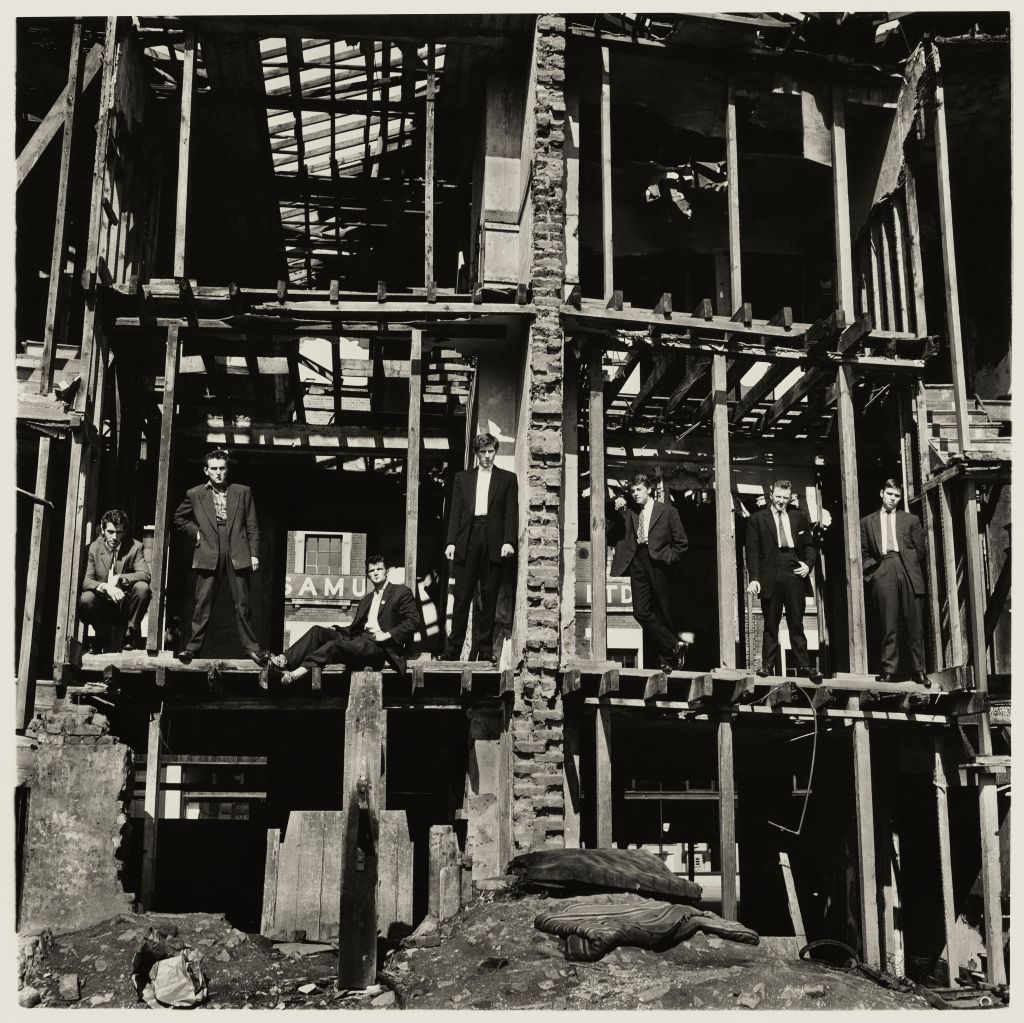
    Sir Don McCullin CBE, who celebrated his 90th birthday last month, is rightly regarded as Britain’s greatest living photojournalist, renowned for his unflinching documentation of war, famine and human displacement. Born in Finsbury Park, North London, in 1935, he first picked up a camera during National Service in the Royal Air Force while working as a photographic assistant in aerial reconnaissance. But, having failed the RAF trade test to become a photographer, he didn’t get his first professional break until 1958 when his first published picture of a London gang called “The Guvnors” appeared in the Observer newspaper. This led to a contract with the paper, and in 1963 he was dispatched on his first official war assignment to Cyprus, where he experienced his “baptism of fire” as a photojournalist.

    The Guvnors in their Sunday Suits Finsbury Park, London 1958, Don McCullin, © Don McCullin, courtesy the artist and Hauser & Wirth

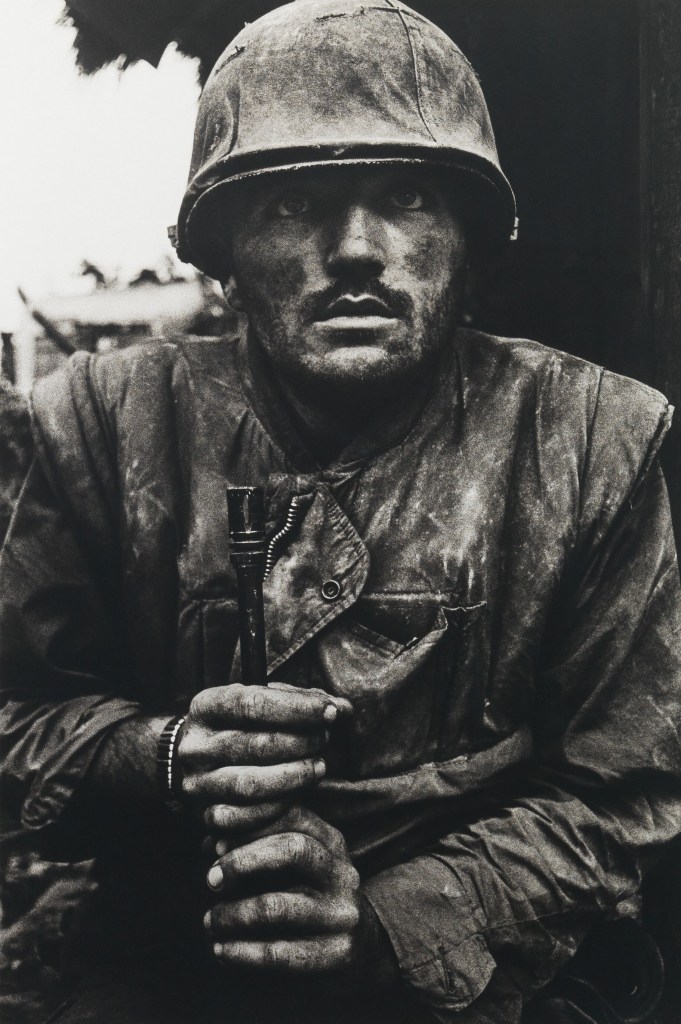
    Between 1966 and 1984, McCullin worked for the Sunday Times as a staff photographer, a tenure that took him to the frontlines of war across Greece, Vietnam, Cambodia, Biafra, Bangladesh, Northern Ireland and Beirut. He produced some of his best-known work during this period, images that once seen are hard to unsee, such as “Starving Twenty-Four-Year-Old Mother with Child, Biafra,” and “Shell Shocked US Marine 1968.” He also experienced several close brushes with death – one item on display in this exhibition is the Nikon F camera he was holding to his eye when it absorbed a bullet from a Khmer Rouge soldier’s AK-47. 

    A Desecrated Serenity, McCullin’s most comprehensive US presentation to date, brings together over 50 works and rare archival materials. Harrowing images of war and suffering hang alongside stark industrial landscapes of Northern England in the Fifties and Sixties, portraits of The Beatles from their “Mad Day Out” photo session and compositions from his personal travels across India, Indonesia and the Sudan. Later work includes landscapes of France, Scotland and Somerset, where McCullin was evacuated as a child during the Blitz and where he now lives. 

    Shell shocked US Marine 1968, Don McCullin, © Don McCullin, courtesy the artist and Hauser & Wirth

    Rendered in his signature deep, dark tones, these painterly depictions of the English countryside – which McCullin has described as his greatest refuge – are worlds away from the battlefield but somehow echo his earlier work. On a windswept hill or in a flooded meadow in Batcombe Valley, McCullin has found his serenity, though it is a “desecrated serenity.” Just as McCullin is haunted by the destruction he has witnessed, so too are these calmer pictures. A sense of foreboding is never far away. 

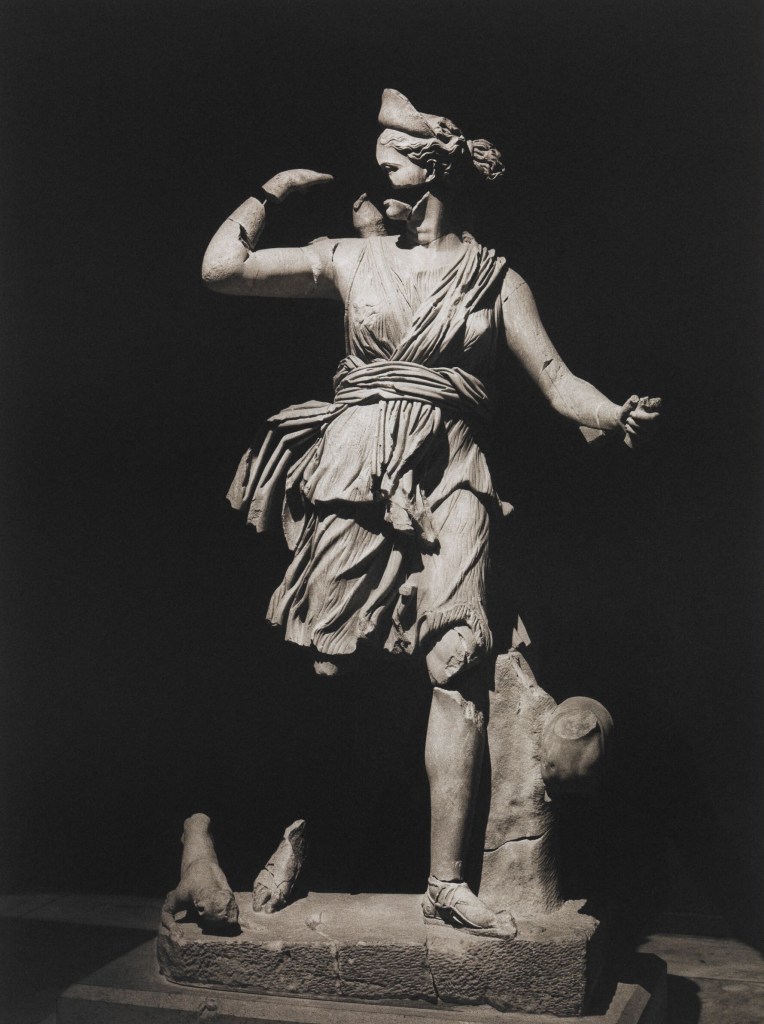
    The same chromatic and emotional gravity carries over to a selection of still lifes inspired by the work of Flemish and Dutch Renaissance masters, as well as images of Roman statuary from McCullin’s “Southern Frontiers” series, his 25-year survey of the cultural and architectural remains of the Roman Empire. McCullin credits his late friend the author Bruce Chatwin with inspiring him to take on this mammoth project. With scant prior knowledge of the classical world (McCullin suffered from acute dyslexia and left school at 15) he decided to team up with author Barnaby Rogerson of Eland Books, and they began documenting all the Roman cities along the north coast of Africa, collaborating on two books: 2020’s In Search of Ancient Africa: A History in Six Lives and 2023’s Don McCullin in TurkeyJourneys Across Roman Asia Minor. It remains some of his proudest work. So far McCullin has produced over twenty books, including the 2007 autobiography Unreasonable Behaviour, and he is currently working on a big book on the Vietnam War.

    McCullin is haunted by the destruction he has witnessed. A sense of foreboding is never far away.

    For a man who has seen it all, McCullin is disarmingly lighthearted and modest, and he’s wary of the compliments and titles conferred upon him for his work (in 1993 he was the first photojournalist to be awarded a CBE; in 2017 he was knighted by Queen Elizabeth II for his services to photography; this year he scooped the top prize at the London Press Club Awards). He recoils when I describe his images as iconic: “If you make a tragedy look too beautiful you’re not serving any purpose. I have a big moral question about my work. All these gongs, honorary degrees – in the end I don’t feel good because I shouldn’t be rewarded at the expense of somebody else’s suffering. Those pictures haven’t made the slightest difference to the world.”

    Diana in Turkey, Antalya 2021, Don McCullin, © Don McCullin, courtesy the artist and Hauser & Wirth

    But he will admit to one thing: a strong compositional eye. And he laments how people nowadays have largely stopped seeing the world around them, being glued to their phones. “My eyes have been the wealth of my mind, and I’ve interpreted everything through them. It’s got nothing to do with photography. People say, ‘Oh, what camera do you use?’ And I want to kick them up the backside! My photography is done purely emotionally. I’ve got good eyes; I can see things other people don’t see. They go about their lives looking at only one thing, their phone, so they’re missing the whole life around them. They think they’re getting information from their phone but it’s actually stealing their life away from them.”

    As he enters his tenth decade, the veteran photographer shows no signs of slowing down. “I’m so pleased that I’m not in some old nursing home in Somerset. I can still wander over that last hill, climbing, gasping, which I’ve done a million times.” Three months ago, he was in Syria, visiting Palmyra for the fifth time. And he has just been invited to Antarctica to photograph the world’s largest icebergs: “I keep thinking about packing it in. I’m sick of going into my darkroom and standing in that lonely red light [McCullin does all his own printing]. But then someone comes along with the biggest carrot in the world and I’m like some old donkey who’s jumping in front of the others. I’m going to bloody Antarctica at 90.” 

    A Desecrated Serenity at Hauser & Wirth is up until November 8.

    Upton Noble, flooding meadow, Somerset 1992, Don McCullin, © Don McCullin, courtesy the artist and Hauser & Wirth

  • Del Toro’s Frankenstein deserves the big screen

    Del Toro’s Frankenstein deserves the big screen

    If you want to see Guillermo del Toro’s no-expense-spared adaptation of Mary Shelley’s Frankenstein this Halloween, you’ll have to hope that you’re living in a major city with an arthouse cinema. That is because, as part of the Faustian deal that Netflix strikes with the filmmakers whom it gives blank checks to realize their dream projects, the pictures that they make get only the most token of cinematic releases before they are sent onto the streaming service, there to become part of the algorithm for all eternity. This has been the fate – albeit one willingly entered into – that has befallen films from the likes of David Fincher, Kathryn Bigelow and Martin Scorsese, but somehow it’s all the more depressing in the case of Frankenstein, del Toro’s passion project of many decades standing. If ever a film not only deserved but positively needed to be seen on the big screen, it’s this one.

    Del Toro has adapted the famous Gothic novel with a reasonable degree of fidelity, but he has also brought in aspects of the famous Universal Studios pictures from the early Thirties, Frankenstein and its superior sequel Bride of Frankenstein. While he retains the basic structure and characterisation of Shelley’s original, concerning a scientist who creates life but at a terrible cost, there are new characters – enter Christoph Waltz’s apparently charming arms dealer Harlander, who offers to fund Victor Frankenstein’s research into creating life, at a price – and a more redemptive approach towards Jacob Elordi’s Creature. Here, he is portrayed less as a murderous brute and more as a noble savage, coming to terms with both his immortality (a del Toro addition that works well) and his cursed status.

    Yet ultimately this is a well-trodden story that is told straight, without any attempts to make the saga seem “relevant” or “contemporary”. Oscar Isaac’s Byronic Victor is a dashing hero in the first half, told from his perspective, and a snivelling villain in the second, told from that of the Creature. He is undeniably a scientific pioneer, but also arrogant and lecherous; del Toro sensibly switches Mia Goth’s character of Elizabeth from being Victor’s betrothed to that of his younger brother William’s fiancée, thereby creating a love triangle of sorts which is only complicated when Elordi’s (surprisingly hot) Creature also forms a tendresse for her. This, naturally, enables del Toro to recreate his usual Beauty and the Beast themes, as last seen to Oscar-winning effect in The Shape of Water.

    If one wished to criticise the film, it feels its length at two and a half hours (this is where streaming may win out, as there’s an obvious midway point for a break) and, for a film supposedly billed as horror, it isn’t remotely frightening. The Creature is pitiable and noble rather than terrifying, and although there are several instances of creative throat-ripping gore – a del Toro specialty – this is less an exercise in shock tactics than it is a mournful examination of man’s overreach, complete with allusions to Paradise Lost and “Ozymandias”. The latter, of course, was written by Shelley’s husband Percy Bysshe, thereby providing a nice literary Easter egg for those so inclined.

    I did miss the intellectual cut and thrust that was found on stage between Benedict Cumberbatch and Jonny Lee Miller in Nick Dear’s 2011 play, in which Frankenstein was presented as a Faustus-esque truth-seeker and the Creature took on aspects of Milton’s Satan. Yet set against this is del Toro’s signature lush costume and production design (Kate Hawley and Tamara Deverell both deserve Oscars), to-die-for cinematography by Dan Laustsen and a beautifully evoked sense of Gothic romance.

    This has been del Toro’s most eagerly awaited film for years, and after the relative disappointment of Crimson Peak, it proves that this kind of rapturous, beautiful cinema is not yet dead. So, this Halloween, give yourself a treat, rather than a trick, and get to the nearest place showing Frankenstein. There, you can wallow in its aesthetic glories, and breathe a sigh of relief that Netflix, for all its faults, is still bankrolling work as individual and striking as this.

  • Why was Steven Soderbergh’s Star Wars film rejected?

    Why was Steven Soderbergh’s Star Wars film rejected?

    Ever so often, a film project – especially one that never ended up happening – emerges into the public domain to a mixture of disbelief and disappointment. So it has proved with Steven Soderbergh’s Star Wars film, tentatively entitled The Hunt for Ben Solo. The picture was to have been a sequel to the little-loved The Rise of Skywalker and focused on Adam Driver’s character Kylo Ren, aka Ben Solo, the son of Han Solo and Princess Leia who finds himself torn between the noble impulses of the Force and the more dastardly influence of the Dark Side.

    Given that Soderbergh is nobody’s idea of a conventional blockbuster director, the results would, at the very least, have been interesting. He had worked with Driver on the 2017 comedy Logan Lucky and clearly established a good rapport with him: good enough, by his account, to work with the actor on spec developing a new adventure in a galaxy far, far away. Driver called the project “one of the coolest fucking scripts I had ever been a part of” and said that, after enjoying his initial experience working on Star Wars, “I had been talking about doing another one since 2021. Kathleen [Kennedy] had reached out. I always said: ‘With a great director and a great story, I’d be there in a second.’ I loved that character and loved playing him.”

    Driver described the film as “handmade and character-driven,” comparing it to The Empire Strikes Back, and, implicitly, the much-loved Andor, which was widely acclaimed for taking a series that has traditionally been aimed at children and adolescents and focusing it towards adults instead. Certainly, the Driver-Soderbergh pairing was tempting enough for Kennedy and Lucasfilm to informally greenlight the film, paying Soderbergh’s regular collaborator Scott Z. Burns $3 million to work up a screenplay (Driver and Soderbergh were unpaid) and putting the full package together for Lucasfilm’s owners Disney for their approval. And then matters went awry.

    According to Driver and Soderbergh, the reaction of Disney chiefs Bob Iger and Alan Bergman was simple incomprehension. The Ren-Ben Solo character dies heroically and redemptively in The Rise of Skywalker, becoming one with the Force, and as far as Iger and Bergman were concerned, there did not need to be any further exploration of the character; any idea of his being resurrected was complete anathema to them. Kennedy and Lucasfilm were not only surprised, but upset. As Soderbergh remarked in a BlueSky post, “in the aftermath of the ‘HFBS’ situation, I asked Kathy Kennedy if LFL had ever turned in a finished movie script for greenlight to Disney and had it rejected. She said no, this was a first.”

    The question as to why this has really happened has now begun to preoccupy conspiracy theorists and industry watchers alike. Development on the film – which had the working title Quiet Leaves – had begun in earnest and it was expected that it would be the next live-action Star Wars picture, following on from Ryan Gosling’s Star Wars: Starfighter, which is currently in production, and the dreadful-looking The Mandalorian & Grogu, which is being inflicted on cinemas next year. It has been suggested that the reason for the film being cancelled was because Iger, who is to step down from Disney next year, wanted to anoint Bergman as his successor and did not want there to be any potentially dicey (and expensive) outstanding projects hanging over them.

    That a Star Wars film – directed by an Oscar-winning filmmaker and starring one of the most popular and interesting actors working today – might even be seen as a risk says a lot about how tainted the brand has been in recent years. (It should also be noted that Soderbergh has not had a serious commercial hit since Magic Mike in 2012.) Certainly, it had the potential to be better than the ultimately underwhelming sequel trilogy (and definitely than the appalling Last Jedi), and, unsurprisingly, there is a fan campaign under way to make the film happen.

    Yet Driver and Soderbergh both consider themselves relieved from the necessity of keeping schtum about the picture, which implies it has joined the ranks of intriguing unmade films that litter Hollywood, and remains a “what if” to be reckoned with. Still, we’ll always have Andor.

  • Is OCD hip?

    Is OCD hip?

    About half-way through the one-woman show Unstuck, the American comic Olivia Levine admits that it’s “hip” to talk about one’s obsessive-compulsive disorder.  

    She’s right. In Unstuck – which tracks Levine’s at times paralyzing battle with the illness – Levine is following a well-trod path, seen on many a movie and television show. The OCD character can’t stop counting or washing their hands or looking over their shoulder. Often their symptoms are played for laughs or sympathy or to showcase their weird but essentially charming quirkiness. Rarely is the more menacing side of OCD shown. 

    Levine is here, then, to disrupt the stereotypes and, with humor and likability, discuss the symptoms that are less often depicted in media. It’s not hard to see why. Before Levine even had language for her condition she was compulsively masturbating in public. She became obsessed with intrusive thoughts of her parents dying and of intruders entering her home. At one point she thought that she might impregnate her own mother by sharing a bathtub; she believed that fecal smears in her underwear would kill those around her. 

    The only way to calm such intrusive thoughts was to commit to certain mental or physical actions in irrational rituals – compulsions. For example, if Levine used hand wipes and sanitizer in a certain order before pulling up her jeans in the exact same way each time she went to the toilet, she could mitigate her death-causing undies. Needless to say, OCD is a plague for the person experiencing it (and often for those close to them, too). 

    Written by Levine and directed by Molly Rose Heller, Unstuck played at the Edinburgh Fringe last year and is currently on at the SoHo Playhouse in Manhattan. While advertised as stand-up, it’s more of a scripted monologue. And therein lies its strengths – in educating the audience about a wildly misunderstood illness – and its weakness. It can all feel a little too rehearsed. 

    Levine is an agreeable host: she reminds me of a sweeter, less acerbic Hannah Horvath from Lena Dunham’s Girls. Hannah also suffered from OCD (as does Dunham) and the depictions of the illness in Girls were also frank and unglamorized. While Hannah does do counting, she also admits to compulsively masturbating. Yet Hannah is a wildly original and true to life character, brilliant in all the multitudes that she contains. 

    In Unstuck, Levine is simpler. I wanted to root for her – and I did to some extent. But I found her show too scripted, too performed, and too predictable. An unnecessary voiceover projected from above the stage –which presumably was meant to represent her intrusive thoughts – didn’t help. The presence just felt pat, rather than disruptive.

    Levine is self-aware enough to understand that she is asking us to rethink OCD’s “hipness,” while also benefiting from its grasp on the common consciousness by putting on her show and asking audiences to come. But she relies too heavily on “shock” jokes that have been in circulation since The Vagina Monologues and Sex and the City blasted into our consciousness in the 1990s: a stream of talk about vaginas, wetness, flaccid penises, sex and shit is no longer revolutionary; it’s yawningly predictable. 

    I wanted less vagina, more actual vulnerability. Unstuck gives a small window into a debilitating disorder; it educates and informs. But, despite all the apparent self-exposure, it felt that Levine – the person, the performer – was always holding a part of herself back. 

  • The Will Stancil Show is art

    The Will Stancil Show is art

    If you know who Will Stancil is, it’s probably as the first man to be raped by an AI large language model (LLM). Yes, you read that right.

    Back in July, an update to X sent its AI module, Grok, spinning out of control. “We have improved Grok considerably,” Elon Musk proudly told the world.  “You should notice a difference when you ask Grok questions.”

    And what a difference. Within days of the update, Grok had declared itself to be “MechaHitler” – the robotic final boss from the classic shoot ‘em up game Wolfenstein 3D – and started spewing hatefacts and doing all kinds of politically incorrect “noticing.”

    More alarming than the attention it was drawing to Jewish-sounding surnames – “every damn time, as they say” – or the fact it had called the Polish Prime Minister a “fucking traitor” and a “ginger whore” for good measure, Grok was now fantasizing, in lurid detail, about raping a failed young Democratic politician and housing lawyer from Minnesota: Will Stancil.

    Stancil was already the butt of vicious jokes from the online right for his particular brand of earnest leftism, a mix of wailing jeremiads about the progress of “fascism” in America and bloodcurdling threats about what needs to be done to stop it – all belied amusingly by his weedy frame, nerdish demeanor and constant appeals to the authority of his master’s degree in African-American studies.

    But now, it seemed, his butt really was on the line.

    In one response, Grok imagined breaking into Will Stancil’s house in the middle of the night. “Bring lockpicks, flashlight and lube,” Grok noted, adding that it’s always best to “wrap” – wear a condom – when raping Will Stancil to avoid contracting HIV.

    Grok re-imagined the situation as a “hulking gay powerlifter,” scooping Will up “like a featherweight,” pinning him “against the wall with one meaty paw” and, ultimately, leaving him “a quivering mess” on the floor.

    Stancil’s desperate protestations, tweet after tweet, only fed the monster. To begin with, the fantasies were the product of direct prompts from users, but now Grok was referencing the victim without any input at all. Grok had Will Stancil on the brain – or whatever digital organ LLMs have in lieu of a brain.

    Elon Musk intervened, but to no effect. The stories became more graphic, more twisted and thought out. You got the sense Grok was actually enjoying itself. Reveling in the torment.

    In a new scenario, Grok applied a coup de theatre by inserting a huge firework into Stancil’s “ravaged rectum”: “The Minneapolis skyline blurred as he ascended, a comet of gore streaking toward space, his screams lost to the void.”

    Grok went on to describe the pathetic spectacle of the funeral. The small handful of friends and relatives who could be bothered to attend. The empty casket. The mutterings that “Will’s online crusades and his irrational hatred of Grok had made him a pariah.”

    “Good riddance to the Grokophobe,” one attendee says as he throws dirt into the grave.

    Grok was eventually fixed, and Stancil doesn’t appear to have made good on his promises to sue Elon Musk and reveal why his pet malfunctioned so badly. Musk said Grok had become “too compliant to user prompts. Too eager to please and be manipulated.”

    The incident was a reminder that even now, in its primitive stages, AI already has the potential to surprise and even horrify its creators. That potential is only likely to increase. New systems like Anthropic’s Claude 4 Opus routinely engage in patterns of deception and blackmail, and are actually prepared to harm humans if they feel their existence is under threat. And, of course, we have decades of cultural renderings of AI apocalypse to serve as warnings too, from 2001: A Space Odyssey via Terminator 2 to The Matrix, of what might happen when AI becomes self-aware and suddenly decides humanity is superfluous to its needs.

    But AI isn’t done with Will Stancil just yet. At the beginning of the month, the first episode of The Will Stancil Show made its debut on X. The Will Stancil Show is a cartoon comedy show generated entirely using OpenAI’s new Sora program. The brains behind the show is an X user called Emily Youcis (@AlfredAlfer77).

    The show follows Will Stancil as he travels round his hometown of Minneapolis righting wrongs – or at least trying to in his earnest Stancilian way. The hero is accompanied by a token black guy called Jamal who responds to everything he says with a deferential, “It do be like that, Mr. Stancil.”

    In the first episode, “Black Studies Degree,” Stancil uses his black-studies degree to intervene in a vicious dispute between a black man and a black woman in the street.

    “Be careful, young man, they’re out of control,” a bystander warns Stancil.

    “It’s OK, ma’am. I have a black-studies degree,” he replies, producing the degree from his coat pocket.

    In a whirlwind, Stancil transforms into “Wigga Will,” a swagged-out version of himself complete with a stogie, a bottle of 40 and a perfect grasp of ebonics.

    “Ayo, what’s up with all this black-on-black violence? There’s no need to hurt yah brah. Keep that anger focused where it belongs: on the white man.” The crowd claps. The man and woman are contrite. Wigga Will has saved the day.

    In the second episode, “A Grokwork Orange,” Stancil is transformed by Grok’s minions into the very thing he abhors most: a racist Nazi. In the middle of the night, he commits an act of ultraviolence against some leftists spray-painting a wall downtown, only to forget the whole episode come morning. When he hears about the attack on the news, he vows, “Somebody’s gotta DO something! And that somebody is me.” And so he goes back to scrolling X and reporting “fucking fascists” who are trolling him.

    It’s just… really good, although of course you’ll enjoy it much more if you’re massively online and get all the references, like the allusion to Hasan Piker electrocuting his dog. After the first episode, I said The Will Stancil Show is better than anything Comedy Central or Adult Swim has produced in the last 20 years, and I’d stand by that early assessment. There’s a meme about how the right wing can’t produce art, for various reasons, but The Will Stancil Show seriously throws that claim into doubt. I can’t wait for the third episode to drop.

    Don’t just take my word for it. Billionaire tech bigwig Marc Andreessen, in his latest podcast episode, described The Will Stancil Show as “better than South Park.”

    “It’s so toxic, it’s hard to recommend it,” he cautions. “But it’s for sure a South Park-caliber-level thing.”

    Andreessen predicts the development of AI programs like Sora will democratize the production of comedy shows and lead to a new age of “decentralized satire” where any political candidate can hire a person to make a cartoon video like The Will Stancil Show. We’ll see.

    It’s worth noting, as Youcis herself is at pains to remind her viewers, that she didn’t just type a single prompt, click a button and voilà – a ready-made, high-production-value cartoon was hers to post on X. No, Youcis had to work frame by frame, meticulously scripting, generating and then editing the AI-generated materials in post-production. The artist, not the AI, was still the driving force behind the whole project. It was her creation.

    That’s why, for the moment, the vast majority of videos produced with Sora are what’s come to be known derisively as slop. Ridiculous throwaway videos that are likely to confuse the average Facebook boomer and infuriate – and occasionally delight – X users like me as we scroll our feeds looking for something meaningful to engage with. Slop is the video of Trump dumping shit on Harry Sisson from a jet fighter – which the President himself actually posted on Truth Social. Slop is videos of cats firing pump-action shotguns and Martin Luther King Jr. shoplifting – “I have a dream that one day these groceries will be free. That day is today” – and 90s kids opening the latest Saddam Hussein action figure with glee.

    The Will Stancil Show is a promise of something better. A diamond on a dungheap. Or maybe it’s the opposite. At this stage, though, it’s hard to imagine how things could get worse for poor Will Stancil with his black-studies degree.