Category: Politics

  • ‘Nuking’ the filibuster would only aid Democrats

    ‘Nuking’ the filibuster would only aid Democrats

    Donald Trump keeps going nuclear. First it was his demand on Thursday that the Pentagon resume nuclear testing. Now he’s declaring that the Senate must abolish the filibuster in toto. In a post on his social media site, Trump announced: “THE CHOICE IS CLEAR – INITIATE THE ‘NUCLEAR OPTION,’ GET RID OF THE FILIBUSTER.”

    Are Republican senators seeking to duck and cover in the face of Trump’s exhortations? Not a chance. Rather, in an unusual turn of events, they are defying him.

    Senate majority leader John Thune issued a statement on Friday morning indicating that he has not altered his views about amending the filibuster. Meanwhile, Senator John Curtis of Utah posted on X Friday morning that the filibuster “forces us to find common ground.” He added, “Power changes hands, but principles shouldn’t. I’m a firm no on eliminating it.” The votes to abolish the filibuster don’t exist no matter how much Trump himself may complain about this procedure.

    There is an incongruity of interests between the White House and Capitol Hill. Now that he has basically precluded running for a third term, Trump has a different set of priorities than his Republican allies. He wants to rule, not govern. But polls indicate that the GOP continues to take on more water than Democrats over the government shutdown. At some point, Trump is going to have to dicker directly with Senate Minority Leader Chuck Schumer and House Minority Leader Hakeem Jeffries, a fate that he presumably regards as only slightly less horrifying than the release of the Epstein Files.

    Republicans are worried about a future Democratic administration passing sweeping legislation that would fundamentally alter the American economy and political system. The Republican party may control all three branches of government, but it’s overreach under Trump is more than likely to result in a backlash in the midterm elections. By 2028, Trump, whose popularity ratings are currently sagging, could be one of the most unpopular presidents in American history. This is why House speaker Mike Johnson stated that while he understands Trump’s vexation over the government shutdown, the “safeguard in the Senate has always been the filibuster.”

    Trump’s impatience, however, is understandable. The notion that almost any legislation can be stymied because it requires a minimum of 60 senators to advance it is fundamentally undemocratic. Trump may well increase the pressure on Republicans in coming weeks as Americans become increasingly restive over the shutdown. Flight delays are bound to increase. Supplemental Nutrition Assistance Program benefits are about to expire. Alaskans are stockpiling caribou and moose. And so on.

    If Trump were to prevail in overturning the filibuster, he would be doing Democrats an inadvertent solid. They could disclaim responsibility for the federal budget and point to the mounting healthcare costs that consumers are about to experience in the coming weeks. Above all, they would be positioned to enact their own sweeping reforms in the future. Say hello to statehood for Washington, DC and Puerto Rico and to sweeping firearms restrictions, among other things.

    For now, Republicans are in lockstep – against Trump. As Senate Republicans refuse to accede to Trump’s command, his lame duck stuck is coming more clearly into view. In seeking to eliminate the filibuster, he has not weakened the Democrats. Instead, he is exposing the limits of the Republican party’s fealty to him.

  • Prince Andrew no more

    It’s all over for Prince Andrew or, as he is now known, Andrew Mountbatten Windsor. The former Duke of York, ex-trade envoy and, for all we know, Grand Pooh-Bah of Kazakhstan, has been stripped of every one of his titles. Andrew has also been ejected from his Windsor mansion by his brother, the King.

    In a terse, angry statement, Buckingham Palace that said that: “His Majesty has today initiated a formal process to remove the style, titles and honors of Prince Andrew. Prince Andrew will now be known as Andrew Mountbatten Windsor. His lease on Royal Lodge has, to date, provided him with legal protection to continue in residence. Formal notice has now been served to surrender the lease and he will move to alternative private accommodation. These censures are deemed necessary, notwithstanding the fact that he continues to deny the allegations against him. Their Majesties wish to make clear that their thoughts and utmost sympathies have been, and will remain with, the victims and survivors of any and all forms of abuse.”

    And, with those 109 words – six more than the original statement that sent this rather tarnished Adam out of his garden of Eden, or at least the Royal Lodge that he had been living in, rent-free for decades – Andrew was removed into banishment.

    The language of the statement is unprecedented. “Censures” is a word that is particularly damning. So, too, is the statement’s sign off: that the Royals’ ‘thoughts and utmost sympathies’ are with abuse survivors.

    No doubt some will still choose to defend Andrew. Seven percent of the public expressed sympathy for Andrew this week, despite the publication of Virginia Giuffre’s memoir. Yes, 93 percent of Brits may have turned their back on Andrew, but it’s still remarkable that anyone is willing to stick up for Andrew.

    Perhaps they are entitled to, just as there are those who believe that Elvis is living in platonic bliss somewhere. But the realists will see that Mr. Andrew Windsor, as we can now, finally, call him, has been served the punishment that his arrogant, selfish actions have merited all along.

    Andrew can skulk in some ignominious corner of the Sandringham Estate in Norfolk, England for the rest of his days. Few would see that as anything other than a fitting judgment on a man who refused to believe, even when confronted with the most damning of evidence, that he had done anything wrong. Posterity, and his public, will contend otherwise.

  • Pray for the persecuted Christian church

    Pray for the persecuted Christian church

    Sunday November 2, 2025 marks the annual Day of Prayer for the Persecuted Church. Global violence against Christians has doubled in the last thirty years, and one in seven believers now suffers persecution. Today, “Christians constitute by far the most widely persecuted religion,” in the world.

    In sub-Saharan Africa, more than 16 million Christians have fled for their lives to escape violence or been forcibly displaced. Congressman Riley Moore has described Nigeria as “the deadliest place in the world to be a Christian.” So far this year in Nigeria at least 7,000 Christians have been put to death. More than 19,000 Christian churches have been burned to the ground or attacked in the last fifteen years. Countless Nigerian women and girls have been raped, trafficked, or forced into child marriages to Muslim men. Boko Haram and other Islamic terrorist groups roam at will with the complicity of a Muslim-dominated government.

    In the Middle East, Christians essentially face genocide, according to a review authorized by the British government. In Iraq, the Islamic terrorists who comprise ISIS drove out a 2,000 year old Christian community in Nineveh, while crucifying, torturing and raping women, men and children. ISIS sold Christian toddlers at sex slave markets, burned down churches and videotaped public beheadings of the faithful. In many nations, including Saudi Arabia, public Christian worship, construction of churches and even the display of Christian imagery are all unlawful.

    The Chinese Communist Party rules the world’s second most populous nation with an iron fist. Christians in China face imprisonment and hard labor, torture and the destruction of their houses of worship. The Chinese government forces all churches to “register,” regulates all such registered churches for compliance with official Communist teaching and forbids children under eighteen from attending church. Evangelism is forbidden. Church tithes may be confiscated as the proceeds of concocted “fraud,”; ordained ministers, lay leaders and members all face prosecution for “crimes” such as distributing Bibles; and evangelicals are forced underground.

    Americans and our government can and should act in the face of this reprehensible repression. First, the President and Congress should defund any nations that terrorize people on the basis of faith. As Senator Rand Paul of Kentucky urged, “regime change” is needed, and “foreign aid should be contingent on behavior.” Dr. Paul has introduced legislation to block foreign aid to nations that imprison and murder people of faith based on their religion. The Senate should vote to pass S.4685, a bill “to prohibit assistance to foreign governments that violate human rights with respect to religious freedom,” posthaste. Not one penny of the earnings of the hardworking American taxpayer should be used to subsidize religious oppression abroad.

    Second, Secretary of State Marco Rubio should restore the CPC (Countries of Particular Concern) designation of infringing nations, a label that summons international attention, prompts potential diplomatic consequences and imposes the possibility of economic sanctions. For example, in 2020, President Trump designated Nigeria as a CPC, only to watch President Biden inexcusably reverse that finding the very next year. The United States Commission on International Religious Freedom called on Congress to convene public hearings regarding the Biden State Department’s malfeasance. The Trump administration has yet another opportunity to right the wrongs of the past by simply acting as truthtellers for silenced people of faith in many nations.

    Third, as Justice Amy Coney Barrett famously reminded us during her 2020 Senate confirmation hearing, Christians “believe in the power of prayer.” Mark November 2 on your calendar. Pray that Christians in all lands may worship Jesus Christ freely, and people of any faith may practice their sincerely held beliefs without fear of reprisal. Send financial support to frontline workers, church ministries supporting overseas missions, and charitable organizations advocating for Christian freedom. Remember that elections are coming: lobby for people of faith with your elected representatives; volunteer your time for those fighting the good fight; and please, vote.

    If the Christians of the West could be roused from what too often seems our slumber, we could actively aid our brothers and sisters suffering for the faith around the world.


  • The Dutch elections are still a victory for Geert Wilders

    The Dutch elections are still a victory for Geert Wilders

    Early coverage of the Dutch elections has inevitably focused on Geert Wilders – still the bogeyman of the country’s political establishment. Wilders lost seats and saw some of his support drift towards other parties on the right and to the liberal center of Democrats 66 (D66). Wilders’s Party for Freedom and D66 are leading in the polls, with both set to take 26 seats.

    Yet the real story lies elsewhere: in the spectacular downfall of former EU Commissioner Frans Timmermans, whose brief and ill-fated return to Dutch politics as leader of the Labour party has ended in a shattering defeat.

    Timmermans was as divisive a figure to the Dutch right as Wilders is to the left. In Brussels, as architect of the European Green Deal – that sprawling climate agenda which has brought headaches across Europe to businesses and households alike – he became synonymous with bureaucratic zeal. His return to the Hague before the 2023 elections was driven by a single ambition: to become prime minister. He has failed. Twice.

    The much-touted merger between his venerable Labour party and the far more radical GreenLeft – itself an alliance of former communists, greens and other assorted leftist fragments – was supposed to revitalize the left. In practice, it was a catastrophic miscalculation. GreenLeft’s informal but loud sympathies for Extinction Rebellion, antifa, rewilding and the pro-Palestine movement only reinforced public unease. Timmermans and his increasingly doctrinaire allies seemed more concerned with Gaza, asylum seekers, or protecting wolves, than with Dutch voters. Yet neither Gazans, wolves nor illegal migrants have the vote in the Netherlands – and that is unlikely to change any time soon.

    As polling day approached, talk of a broad centrist coalition began to dominate. The center-right VVD ruled out any arrangement involving Timmermans, and his party’s polling numbers duly started to erode. After two years of solid support, GreenLeft-Labour slumped on election day, losing a fifth of its seats and tumbling to fourth place. Disillusioned voters flocked instead to the upbeat, reform-minded liberal democrats of D66.

    Almost overnight, Rob Jetten – the young, energetic and impeccably groomed leader of D66 – found himself center stage. With 99 percent of votes counted, he is neck and neck with Wilders. Jetten’s surge has been extraordinary: from laggard to frontrunner in a week, powered by a deft reinvention of his party. Once derided as Europhile, climate-obsessed and tediously woke, D66 has wrapped itself in Dutch flags, quietly shelved talk of net zero and pledged to reduce asylum numbers to manageable levels.

    And that matters. The party has long been the preferred habitat of Dutch public sector workers – dominant in the media, civil service, health and education and, if rumours are to be believed, the judiciary. Yet Jetten’s youthful charm – occasionally reminiscent of a young Mark Rutte – has seduced voters across the spectrum, even prising a few away from Wilders. Should he indeed finish first, he will gain the right to appoint a “scout” on Friday to explore possible coalitions. In case he comes second, any scout sent out by Wilders will no doubt find that all other big parties will refuse to work with him, clearing the way for Jetten to try to form a government.

    Yet, the underlying message of this election is unmistakable: the Dutch electorate continues to nudge the party system rightwards. D66 has shifted to the right, clearly allowing it to win big; Timmermans’s radical experiment on the left has been routed. Other left-wing parties fared no better. The small and once-Maoist Socialist party even lost 60 percent of its support – its tenth consecutive national defeat.

    The right, meanwhile, remains potent, merely redistributed. Wilders, ever the tribune of the disaffected, will carry on in opposition – a role made for him – railing against Islamization, immigration and rising living costs. Many of those abandoned by the left will still find refuge in his rhetoric.

    An Ipsos poll found that 40 percent of Dutch voters favor a right-wing coalition, with smaller minorities leaning left or center. Jetten faces a formidable task assembling a stable majority. A coalition with the VVD and Christian Democrats would form a centrist bloc, but still fall short. The VVD will block any role for GreenLeft-Labour, leaving Jetten to look instead towards JA21, a more polished, immigration-skeptical party on the right that did very well yesterday. Such an alliance would be fragile – yet broad enough to show that D66 intends to take the country’s asylum crisis seriously, and acknowledge that “anywheres” are not the only people in the country.

  • Activist silence over Sudan speaks volumes

    Activist silence over Sudan speaks volumes

    The city of El Fasher, long a symbolic and strategic stronghold in Darfur, has in recent days become the site of atrocities so grave that the United Nations has openly warned of the risk of genocide. Videos reviewed by the Office of the High Commissioner for Human Rights show scores of unarmed men executed in cold blood, some lying dead at the feet of Rapid Support Forces fighters, others dragged off and detained. Journalists and aid workers have disappeared. The last remaining functional hospital was shelled, killing patients and staff. The Saudi Maternity Hospital, once a rare lifeline, is now a mass grave.

    Volker Türk, the UN High Commissioner for Human Rights, has confirmed that his office is receiving “multiple, alarming reports” of summary executions and ethnically motivated killings. He has also warned of sexual violence, the targeting of civilians, and the use of starvation as a weapon.

    In January 2025, the United States government officially recognized the situation in Darfur as a genocide. That designation was based on documented patterns of targeted violence against the Masalit and other ethnic groups, carried out by the RSF with deliberate and systematic brutality. What is happening in El Fasher now appears to be a continuation of that same pattern, on a new and terrifying scale.

    Yet despite this, global attention has been almost non-existent. There are no viral campaigns, no slogans echoing across protest marches, no campus occupations. The cultural and political forces that mobilized with speed and intensity over Gaza have, in the case of Sudan, fallen almost entirely silent. The contrast is stark.

    The numbers speak with grim clarity. The Sudanese conflict has killed at least 150,000 people, displaced over ten million, and according to some reports starved thousands of children. Entire cities have been razed. Bodies lie buried in shallow graves along roadsides. And still, the attention from media, advocacy groups, and international institutions pales into insignificance when compared with the hysteria over Gaza.

    This dissonance raises uncomfortable questions. Why does a genocide carried out by paramilitaries with a documented record of mass atrocities provoke so little public response? Why has the legacy of the Janjaweed, now rebranded as the RSF, not inspired the same moral mobilization as other contemporary crises? It cannot be for lack of evidence. Nor can it be due to the complexity of the conflict, for the situation in Gaza is hardly less contested or politicized. The absence of Sudan from the activist conscience is hard to explain.

    Perhaps it’s a case of ideological selectivity. The Gaza conflict fits into a broader matrix of anti-colonial, racial and political narratives that have been adopted by global protest movements. Sudan, by contrast, does not map easily onto these frameworks. There are no obvious Western powers to blame, no clean dichotomy of occupier and occupied. And so, the killing of Sudanese civilians, even on genocidal terms, fails to galvanize.

    This is not an argument about proportionality. Every innocent civilian death is a tragedy, whether in Gaza, Sudan, or anywhere else. But the silence around Sudan is not merely an oversight. It is a revealing index of what captures the moral imagination of the world, and what does not. It suggests that certain atrocities only gain traction when they resonate with a pre-established political script, however transparently manipulated.

    Dr Tedros Adhanom Ghebreyesus, head of the World Health Organization, has called the El Fasher hospital attack “horrific” and reiterated that “health care is not a target.” The Sudanese Journalists’ Syndicate has demanded the release of Muammar Ibrahim and warned that communications blackouts are placing civilians and reporters at grave risk. Such pleas relating to hospitals and journalists may sound familiar from a war where one side openly and deliberately abused medical facilities and the guise of journalists to carry out brutal terrorism and killing: that in Gaza. And still, in this case, the world barely blinks.

    Sudan does not lack for suffering. What it lacks is a globalised network of advocacy targeting our media, schools, universities, pop concerts, fashion designs, and cultural institutions. The very experts and campaigners who demand accountability elsewhere must now be asked: why have they gone quiet here? If the war in Gaza is paused why has none of their energy to write open letters and organise marches been directed toward the dying in El Fasher?

    I know the answer. Do you?

  • A rare earths deal is China’s gift to Trump

    A rare earths deal is China’s gift to Trump

    Donald Trump went nuclear. Before his meeting with Chinese leader Xi Jinping at an air base in South Korea, he ordered the Pentagon to test atomic weapons on an “equal basis” with China and Russia. Was Xi impressed?

    Probably not. While Russia expressed indignation, China did not permit itself to be distracted by Trump’s nuclear shenanigans. Instead, Beijing aimed to obtain economic concessions from a prideful Trump, which it did. From the outset, Xi sought to bring Trump down a peg, declaring that “both sides should consider the bigger picture and focus on the long-term benefits of cooperation, rather than falling into a vicious cycle of mutual retaliation.”

    Trump seems to have absorbed the lesson. He caved to Xi on a number of fronts, including dropping tariffs to 47 percent (still a staggering amount that is set to punish the American consumer) and dropping port fees on Chinese ships. In return, Xi promised to end his suspension of the export of rare earth minerals for a year and to purchase soybeans from America. How many? Trump said it would be “tremendous” amounts. But during Trump’s first term, China made similar vows and never followed through. The big payoff for Trump, however, was that he and Xi agreed to meet each other next year. According to Trump, “I’ll be going to China in April, and he’ll be coming here sometime after that, whether it’s in Florida, Palm Beach or Washington, DC.”

    For Trump, the prospect of a fresh visit to Asia seems to possess a new cachet. He received no presents from Xi, but was clearly impressed by the numerous gifts that were bestowed upon him in Malaysia, Japan and South Korea. The high point came at South Korea’s Gyeongju National Museum, where Trump received a replica of a tall golden crown that he was told “symbolizes the divine connection between the authority of the heavens and the sovereignty on Earth, as well as the strong leadership and authority of a leader.” Trump also received the Grand Order of Mugunghwa, a civil honor made of a laurel leaf medal. Trump was pleased, indicating that he would “like to wear it right now.”

    So much for No Kings. The truth is that Trump has long had a penchant for viewing himself in monarchical terms. Earlier this year, the White House posted on social media a fake TIME magazine cover of Trump wearing a golden crown with the headline “Long Live the King.” South Korea was simply following Disraeli’s famous adage: “Everyone likes flattery; and when you come to Royalty, you should lay it on with a trowel.” 

    When he returns to America, however, Trump will encounter a less gilded reception. His popularity ratings continue to sink, according to a new Economist poll – 39 percent of American approve of the President and 58 precent disapprove. And for all Trump’s nuclear muscle-flexing, the National Security Nuclear Administration would require about three years to resume nuclear testing and many of its employees are currently furloughed as a result of the government shutdown. With problems mounting at home, it’s small wonder that Trump enjoys cavorting abroad and collecting tribute.

  • Was Trump and Xi’s meeting really a ‘12 out of 10?’

    Was Trump and Xi’s meeting really a ‘12 out of 10?’

    Donald Trump says his meeting with Xi Jinping on the sidelines of the APEC summit in South Korea today was “amazing” and that, on a scale of one to 10, it merited a 12. Which means that on a scale for skepticism, it probably deserves a 13.

    Its biggest achievement appears to have been to at least put the trade war between the world’s two biggest economies on hold, though stock markets, excitable all week as the summit approached, opened flat this morning. Fundamental issues remain unchanged, the momentum towards economic separation will continue, possibly accelerating during the breathing space provided by an extended truce that is unlikely to last.

    The two leaders’ first face-to-face meeting in six years was relatively short, just 90 minutes, endorsing a “framework” agreement hammered out last weekend by officials in Kuala Lumpur, the Malaysian capital. Speaking aboard Air Force One on his way back to Washington, Trump said he had agreed to halve the fentanyl-related tariff on China to 10 percent and Xi pledged to “work very hard” to stop the export of chemical ingredients for the deadly opioid. He also said they had settled a dispute over Chinese restrictions on rare earth exports and that China would start buying a “massive amount” of American soybeans.

    Mutual trade restrictions on maritime, logistics and shipbuilding industries will also be eased, at least temporarily, as will some aspects of America’s “entity list” of Chinese companies sanctioned as a threat to national security. “It was an amazing meeting,” Trump said, earlier describing Xi as a “great leader of a great country.” He said he would visit China in April and that Xi would make a reciprocal visit to the US – though this was not initially confirmed by Beijing.

    Yet on closer inspection it is all rather underwhelming. No formal agreement was signed – that will have to wait for further talks between officials. China’s restrictions on rare earths, a group of elements essential to high-tech industries from fighter jets to computer monitors, and where China has a near monopoly on refining, have been postponed for a year and not scrapped. Beijing’s licensing scheme, which was to have come into effect on December 1, goes far further than any coercive trade measures Beijing has ever imposed before and will remain hanging like a loaded gun over ongoing talks. It would effectively give the Chinese communist party a veto on the way these crucial elements are used worldwide.

    China appears no closer to getting its hands on top-end chips from America (or those made with American equipment) for its artificial intelligence industries, Trump saying that while they did discuss semiconductor exports, they did not talk about the most advanced versions. Again, it was pushed onto officials. Neither did they discuss Taiwan, according to Trump, which will come as a relief to those on the island who feared the US President might be tempted by some kind of grand bargain struck at its expense.

    China’s take on the meeting was more bland. No deals were confirmed, with the People’s Daily, a CCP newspaper, merely stating that Xi and Trump had “agreed to strengthen co-operation in areas such as trade and the economy, energy and the promotion of cultural exchanges,” noting that “both teams should refine and finalize the follow-up work as soon as possible, uphold and implement the consensus, and deliver tangible results.” The newspaper quoted Xi as saying they should avoid what he called a “vicious cycle of mutual retaliation.”

    The most difficult problem is one of trust. Chinese officials see Trump as volatile and unpredictable; meanwhile, there is deep skepticism in Washington that China will stick to any agreement. They point to the so-called Phase One trade deal struck during Trump’s first term, under which China promised but failed to buy $200 billion of extra US exports. A 2015 cyber espionage truce was also ignored, with Beijing continuing to penetrate and steal from western systems on an industrial scale.

    Both sides are unlikely to be deterred from aggressive decoupling of their economies. The US remains determined to deprive China of the most cutting-edge technologies that would give its military and security apparatus any advantage and to cut Beijing out of sensitive western supply chains more generally. Meanwhile, China has reiterated its determination to double down on technology self-reliance and secure a global lead in advanced manufacturing and technology – to which end it recently pledged to take “extraordinary measures” to achieve “decisive breakthroughs.” Perhaps the greatest value of this summit is to at least keep this decoupling process on rails and prevent it veering wildly out of control.

  • Trump’s Asian vacation

    Trump’s Asian vacation

    President Trump is meeting with Chinese Prime Minister Xi Jinping tonight, or tomorrow, or whenever it is in Asia. Regardless of the time, the meeting will have enormous implications for the future of the US economy and for geopolitical stability. Don’t worry, Trump told his dinner companions in South Korea last night. The three-to-four-hour meeting “will lead to something that’s going to be very, very satisfactory to China and to us. I think it’s going to be a very good meeting. I look forward to it tomorrow morning when we meet.”

    The China summit will cap what’s been an absolutely delightful Asian invasion for Trump and his retinue. Trump told reporters last week that he felt incredibly lucky. And he’s grinned his way across the largest continent like the luckiest man alive, on the vacation of his dreams.

    First, he did the Trump Dance on the tarmac in Kuala Lumpur alongside beautiful, gleaming young people dressed in traditional Malaysian garb. That was so much fun that he danced on his way out of Malaysia as well. Then, it was off to Japan, where he got a nice boat trip and appeared with new Japanese prime minister Sanae Takaichi on an aircraft carrier. “This woman is a winner,” he said as he embraced Takaichi. Later, Trump and his new “very close friend” ate American rice and American beef at Akasaka Palace, watched the Japanese-tinged World Series together, and signed baseball hats that read “JAPAN IS BACK.”

    Next came South Korea, for a state dinner that featured “Korean Flavors meet American spirit, celebrating the enduring friendship through taste.” The dishes included “a salad of shrimp, scallops and abalone tossed with autumn herbs in a classic Thousand Island dressing” (gross), and A Korean Platter of Sincerity: “Braised short ribs featuring tender Us beef complimented by chestnuts, mushrooms radish and carrot, served with steam rice and spinach soybean paste soup” (good). Trump also enjoyed Grilled deodeok with gochujang-ketchup glaze and a “Peacemakers Dessert” with gold adorned brownie and seasonal fruits served with buckwheat tea.

    This sounds like the Best Trip Ever, and Trump even skipped what we would all do if going to Asia for the first time. No Mount Fuji, Shibuya Crossing, Nintendo Museum, or Gangnam district for him. He should give his gold-adorned brownie to whoever set up his amazing itinerary, even if it was Chat GPT.

    North Korea appears to be off the table this week. The Trump Magic Peace Touch must bless Korean Unification at a later date. Trump said to South Korean President Lee Jae Myung that “You have a neighbor that hasn’t been as nice as they could be, and I think they will be. I know Kim Jong Un very well, and I think things will work out very well.”

    When Trump meets with Xi today (tomorrow), they’ll be discussing the ongoing trade war and tensions over rare-earth minerals and fentanyl production. “We have to get rid of it,” Trump said. They won’t, however, be discussing ongoing tensions between China and Taiwan. “Taiwan is Taiwan,” Trump said, which is very true. He won’t be doing the Trump Dance in Taipei on this trip, even though Taiwanese food is particularly delicious.

  • De Blasio ‘imposter’ hoodwinks British paper

    Of all the people to go as for Halloween, why would you choose Bill de Blasio, an undistinguished Mayor of New York and flame-out 2020 presidential candidate? 

    That’s a plausible explanation for the recent howler from the Times of London – Great Britain’s newspaper of record – whose veteran US correspondent Bevan Hurley quoted a man identifying himself as de Blasio on his misgivings about Zohran Mamdani.

    “While the ambition is admirable, the cost estimates – reportedly exceeding $7 billion annually – rest on optimistic assumptions… about eliminating waste and raising revenue through new taxes,” this total imposter told Mr. Hurley, with strange eloquence. “In my view, the math doesn’t hold up under scrutiny, and the political hurdles are substantial.” With a seasoned newsman apparently under his spell, the fake de Blasio could have plausibly put any words he wanted to into the former mayor’s mouth – like, say, an endorsement of George Wallace. How strange that he limited himself to a thoroughly centrist spiel on fiscal credibility. 

    All the same, Hurley must have thought he’d happened upon the scoop of the year: a left-populist denounces another left-populist days before an election. Hence, perhaps, the haste to get the story out, which duly appeared on the Times website at 4 p.m. ET Tuesday. 

    Mayor de Blasio was indignant. On X he declared that he was “appalled” by the story, which was “an absolute violation of journalistic ethics.” Tell Cockburn what you really think! The Mamdani campaign now seems more or less unstoppable, hence this slightly frantic attempt on de Blasio’s part to prove his loyalty to the candidate he’d endorsed.

    Hurley’s article was quickly deleted (though an archived version remains online). Cockburn notes that it’s traditionally been easy for foreign correspondents in America to bluff their way around on the strength of their accent; we may have just witnessed the first ever case of the opposite. 

  • Has the AI jobs bloodbath finally arrived?

    Has the AI jobs bloodbath finally arrived?

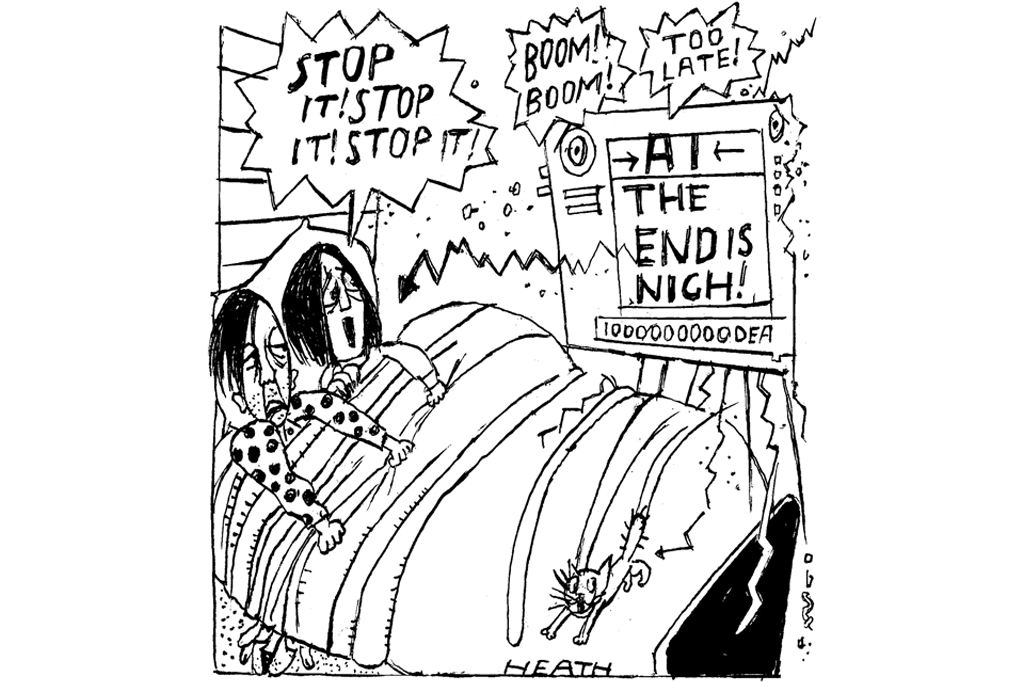
    There has been much wallowing over news that Amazon and UPS have each just cut 14,000 jobs. Some Amazon employees report of being fired with all the heartlessness you might expect in a world where tech has taken over: by automated email. Maybe it was even AI which handpicked them to be de-emphasized, to use that dreaded 1990s expression. This, then, seems to be the future: where an elite of AI entrepreneurs grow rich while the rest of us slop off into idleness and unemployment. So much for those who have been gleefully predicting the implosion of the AI boom. Nvidia has just been revealed to be the world’s first $5 trillion company, with a market capitalization greater than the whole of Germany.

    There is just one thing wrong with this analysis – and not just because it is hazardous to treat Amazon as if it were the entire economy (even if it seems sometimes to be so). If there are job losses in some areas, it doesn’t show up in the overall employment figures. The US Bureau of Labor Statistics recently reported that the number of payrolled positions was up another 22,000 in August. While job-creation has been a little on the quiet side since April, employment is up 1.466 million over the past 12 months – and this following on from a few thumping years of job-creation. This is a remarkably dry bloodbath.

    It has become a received wisdom in recent years that AI is the industrial revolution of the white collar classes. Where agricultural workers saw their jobs ravaged by the development of threshing machines and later factory workers saw themselves made redundant by more efficient machinery, now it is the turn of the professional classes. Lawyers, accountants, marketing people; all will be swept aside as AI romps through their professions. Yet take a look at the employment figures and they show a more nuanced story. “Professional and business services” show a fall, down 55,000 payrolled positions over the past year. Yet there has been a huge expansion in jobs in “private education and health services” – both of them industries which have been slated for mass job losses thanks to AI but which have grown 862,000 jobs over the past 12 months. If we are using AI to do our accounts we do not, at least yet, seem to be using it to educate our children or to take a look at our dodgy knees.

    The biggest source of job losses over the past 12 months has been in manufacturing, where 78,000 jobs have been lost – continuing a tale of the past few decades as rustbelt industries shed jobs. Whether or not AI is responsible for some of that, the figure certainly doesn’t say much for Donald Trump’s trade wars. Wasn’t that the whole point of the tariffs, to protect US manufacturing jobs?

    If AI does go on to lead to a mass net destruction of jobs it would be the first technology in history to do so. Similar claims have been made about all labor-saving technologies in history, from ploughs, to power looms to robotics. Yet for every job they destroyed, they provoked the creation of more than one new job in some other industry. They freed up labor to be used elsewhere, enriching society in the process. Why should we expect AI to be any different?

    There is just one way in which AI is a bit different, though: it has a habit of consuming its own children. Among the jobs being lost at the moment is reported to be a large number of coding jobs as their jobs start to be done by… AI. The technology is taking over from the very people who have been creating it. Unless you are right at the forefront of the coding profession, you should be watching your back – or rather your phone for an automated redundancy notice.