Earlier this month, the Republicans lost their first set of elections after Donald Trump’s victory last year, proving once again that without Trump, the GOP is cooked. Because yes – it really is all about him. Are you a narcissist if the world actually does revolve around you? Or are you just right? The problem for the GOP is that they need Trump to win, but Trump loves watching them lose without him. OK, maybe he is a narcissist.
What’s clear is that the 2024 election was not the final boss. It didn’t destroy wokeism. You have to picture the spider in The Lord of the Rings, Shelob, crawling back into her cave after being stabbed by Samwise. Is she injured? Yes. Dead? No. She will probably be back to kill you.
Republicans and pundits and podcasters will come up with all sorts of reasons for the latest losses (including blaming the Jews), but it comes down to fundamentals. Ground game. Optics. And of course, “It’s the economy, stupid!”
The GOP has no ground game in part because it depends on cultural momentum, in part because many of the biggest voices in conservatism right now are more concerned with grabbing market share in the attention economy than they are about winning elections. All of this underlines the tragic loss of Charlie Kirk. It appears Charlie really was the glue holding the entire conservative movement together. He was phenomenal at mobilizing and organizing Republican “get out the vote” efforts.
Charlie knew that politics was about changing hearts and minds. He also understood that the only way to win an election is to do the hard work and compete on the ground. Knock on doors. Register people to vote. Encourage them to get to the polls or mail in their ballot.
Zohran Mamdani won in New York because he focused on fundamentals. He ran a great ground game. He came up with creative ways to engage voters. He knocked on doors. He relentlessly spoke to the anxiety people feel about the cost of living.
It appears Trump may have overestimated his mandate, his popularity and just how far the average American is willing to go to correct some of the problems we face, such as immigration.
Americans are happy with the borders being secured. But the Trump administration’s attempt to bring back deterrence by turning ICE into a dystopian reality show is wildly unpopular with independents. I don’t think the average person is cool with masked men zip-tying abuela and throwing her into an unmarked van while tasing her grandson for trying to interfere. Obama deported more people than Trump has. But he did it the way Americans like: out of sight.
For a media genius, Trump doesn’t seem to get that optics matter. Building a gilded ballroom while the government is shut down and people are cut off from food stamps and aren’t receiving paychecks and flights are being canceled does not suggest that he cares about the struggles of the average American.
People are still poor (and getting poorer). AI is taking jobs. Grocery prices are high. Healthcare costs just increased astronomically. My groceries continue to go up in price. My electricity bill jumped 25 percent. Our healthcare premium went up a whopping 43 percent. All our insurances have increased in cost. Gas prices are down so that saves me about… $10 a month. In my podcasting business, I’ve also been giving work to talented freelance writers and designers who have been replaced with AI at big companies, just to help keep them afloat.
Recovering investment banker and best-selling author of You Will Own Nothing, Carol Roth, has been warning everyone about the K-shaped economy for years.
“A K-shaped economy describes an economy (or recovery or trend) where there is stark divergence in the experience or outcome of different groups – like the visual of the letter K,” Roth says. “Part of the country is experiencing an upward economic trajectory (you can think of that as the asset holders, with portfolios, 401(k)s, homes, etc.) that have been doing great (at least on nominal terms, meaning not inflation-adjusted). Others are experiencing a downward economic trajectory, dealing with a more expensive cost of living across [many] categories, as well as job losses or underemployment and wage stagnation.”
I think a big problem with our K-shaped economy is that those at the top have zero idea how bad it is for those sliding down. They assume that the people whining about the fact that the average age of a first-time home buyer is 40 must just be bad with money. And lots of boomers have no empathy. Yes, young people have some bad habits, but the game is very different for them.
Fielding questions from reporters and getting defensive about the economy, Trump says: “I don’t want to hear about affordability.” He doesn’t seem to understand that people can be pro-tax breaks and still think bananas are too expensive. (And thanks to his tariffs, banana prices happen to be up about 8 percent since April.)
Americans will put up with a lot of crap from their leaders, but this administration should have learned from Joe Biden that we won’t put up with being gaslit about rising prices. We know. We are the ones buying things. We are the ones choosing to get this instead of that. We are the ones who go to bed with crippling financial anxiety, wondering how we are going to pay for childcare and utilities and insurance and kids’ activities and student loans. We are the ones worrying about what the future will look like for our children if it’s already this unsustainable for us. I said it before when Trump won and I’ll repeat it: if Americans don’t feel real material relief, the right-wing vibe shift will be a one-hit wonder.
This article was originally published in The Spectator’s November 24, 2025 World edition.
Sometime in 1953, Dorothy Martin was contacted by aliens. They had bad news and they had good news. The bad: Earth was about to be swallowed up by floodwaters. The good: as the leader of a chosen few, Martin would be saved by flying saucers. Mankind had brought this calamity on itself by following Lucifer’s agents – scientists – and abandoning Christ. Over the next year or so, Martin assembled a little flock of disciples who believed their salvation, and the world’s end, would come on December 21, 1954.
A team of psychologists caught wind of Martin’s prediction. Leon Festinger, Henry Riecken and Stanley Schachter saw in Martin an opportunity to test a hypothesis: when people with strong convictions are faced with incontrovertible evidence that their beliefs are wrong, those believers will increase their proselytizing efforts rather than admit they’re wrong. Festinger and his little flock of scientists covertly infiltrated the religion and had their hypothesis confirmed when neither the flood nor the saucers materialized: faced with dissonance between faith and reality, Martin and her closest followers doubled down on the former. Festinger and his co-authors wrote up the nutty experience in When Prophecy Fails (1956), which became the basis of the theory of cognitive dissonance and scripture in the field of psychology.
One nitpick: they lied. As the political scientist Thomas Kelly recently discovered, Festinger’s researchers distorted key findings, misrepresented their actions and betrayed basic scientific standards.
Kelly first read When Prophecy Fails a couple of years ago. The whole thing seemed too neat. He noticed strange inconsistencies. Festinger, for example, claimed that Martin had only around eight true-believing disciples – and even among those eight there were wafflers. A year later, in his seminal A Theory of Cognitive Dissonance he claimed there were “25 to 30 persons” who “believed completely in the validity” of Martin’s messages. So Kelly went looking for the psychologists’ notes. The firsthand accounts of the researchers’ time among Martin’s followers are held at the University of Michigan’s Bentley Historical Library. Festinger’s family donated the box but ordered that it be sealed for 70 years. That decree expired this year. And Kelly has cracked the box open.
In poring over hundreds of pages of notes, Kelly noticed the researchers had left key observations out of the book. For example, they knew that Martin had engaged in serious evangelizing for months – writing to magazines, teaching neighbors and children – prior to the failure of her prophecies. But they leave nearly all of this out of the book to make their hypothesis appear stronger. Toward the end, the authors write that the core of the group emerged from their reality check with “faith, firm, unshaken, and lasting.” There is simply no evidence of this. In fact, Martin spoke to the UFO magazine Saucerian in 1955 – a year before When Prophecy Fails was published – recanting her belief in the UFO rescues. Kelly calls this fact check “trivial” – yet no one had performed it, apparently. “Maybe snobbery,” he says, explains why no other academic has bothered to look this stuff up.
But these slip-ups look minor compared to the other offenses Kelly uncovered. Any high schooler can tell you that a scientist isn’t supposed to influence his subject’s thinking. The authors of When Prophecy Fails acknowledge that their presence in the group may have had some influence, but they insist that it was passive and minimal – they were little more than flies on the wall.
It would be a problem then if, say, one of the lead researchers somehow became a de facto leader within the religion. But, whoopsie, that’s exactly what co-author Henry Riecken did. As “the favorite son” of those higher beings, Riecken earned the special title Brother Henry and was called upon to aid the faithful in moments of spiritual crisis. After one of Martin’s key prophecies failed, Brother Henry issued cryptic words to the group that reinvigorated their faith and, as he put it in his notes, “precipitated” their renewed evangelism.
But that was not even the researchers’ most disturbing act. Just before the world was set to end, a social worker appeared at the household of the Laugheads, some of Martin’s most dedicated followers. Charles Laughead’s sister had called the worker to check on her nieces and nephews, whom she feared were being neglected by the UFO-obsessed parents. A research assistant answered the door and saw the threat this intruder posed to the study’s continuation; she rebuffed the worker and then urged her higher-ups to delay the case. In a particularly twisted note, the researcher claims she’d also done this because she’d grown affectionate toward the Laugheads’ youngest child and wanted to “protect” her.
Look through these files – which Kelly has put online as open-source – and one thing you’ll notice is the contempt in which the researchers hold their subjects. Martin’s followers are called “idiots” and “pigs.” These are not the words of neutral observers.
The irony in all this would be funny, if it weren’t so sad. For decades, When Prophecy Fails has been used to bludgeon religion. In New Testament studies, for example, many academics take it for granted that Christ’s resurrection did not occur, and they’ve used the book’s analysis to explain why evangelism took off even after this anticlimax. These scholars have showered condescension on those they believe hold unexamined – which is to say, non-atheistic – convictions. Never mind that these same intellectuals have fallen victim to the false prophets Festinger, Riecken and Schachter for the past 70 years, or that When Prophecy Fails is just one of a spate of major social-science studies to be debunked in recent years. The prophets of this reigning pseudo-religion – psychology – seem to be failing. Will their followers see the light? Or double down on their delusions?
This article was originally published in The Spectator’s November 24, 2025 World edition.
When Anna Wintour announced she was stepping down as editor-in-chief of Vogue in June, it appeared to be the end of the ice queen’s reign. Yet Wintour retained her large, chintzy corner office as well as her two other roles – as Condé Nast’s global chief content officer and Vogue’s global editorial director.
If you looked closely, you might have seen a steely determination lurking behind her trademark sunglasses, the look of a generational editor intent on more power – and perhaps even revenge.
The Condé Nast Union naively regarded Wintour’s move as that of a then 75-year-old drifting into quiet retirement, the old guard surrendering to youth. The union, formed in 2022 and seemingly run by the most radical young left-wing journalists in the company, has quickly grown in power and influence. But various Condé Nasties have informed The Spectator that the union has become a parasite which threatens to consume its host.
When Wintour decided to close down Teen Vogue by folding it into Vogue.com – officially to consolidate resources – it was no surprise that a dozen angry young Jacobins from the union confronted the head of HR, Stan Duncan, about the layoffs of six staffers. However, instead of leaving with Duncan’s head in a basket, it was the four most vocally aggressive employees – lionized now as the “Fired Four” – who were guillotined: fired immediately and without ceremony. They learned the hard way that Condé is still a monarchy.
And, according to insiders, Wintour is only just getting started. Condé has filed a grievance against the union with the National Labor Relations Board. Insiders believe Wintour and CEO Roger Lynch are planning to throttle it with litigation after finally making “a business decision to face down the union.” This is a fight the company must win, sources say, if it is to have a future.
Those sources believe Condé has, “against its better judgment,” played ball with the union for too long. When the union threatened to form a picket line at last year’s Met Gala, the highlight of Vogue and Wintour’s social diary, Condé caved on the day of the event. The union, which represents more than 500 staffers at publications such as Vogue, GQ, Vanity Fair and Architectural Digest, won a $61,500 starting salary floor, $3.3 million in total wage increases and a host of benefits. Rather than assuaging the union, the agreement only emboldened its leaders. “The way the union won its settlement gave the members a sense of undue power,” one source said. “Some union members now go to work and they do their jobs – but only just.”
Part of the problem is that members of the union are not given an incentive to work hard. They are only meant to carry out their precise job descriptions rather than earn a promotion or pay raise, as the union now negotiates pay raises en masse. However, its members found enough time to compile a union “zine,” a highly produced pamphlet which provided advice on how to navigate “difficult conversations with managers.”
“Some people behave in the office as if the company owes them and their jobs are protected, they don’t seem to understand they work for a business,” another Condé Nast source said. “Teen Vogue was a great example of what staffers wanted to write about rather than what the magazine should have been writing about. The traffic had started to crater on Teen Vogue and it had become unsustainable as a business.”
The magazine hasn’t been in print since 2017 (its final issue featured Hillary Clinton on the cover, the kiss of death), but its website continued to churn out content that insisted to young girls and they/thems that woke political views were each season’s must-have accessories. The attitude of its staff was one of entitlement: they seemed to see journalism as a noble calling, not a business, therefore subscriptions had nothing to do with their salaries.
Among the union’s grievances, including that the publication is disproportionately firing “BIPOC, women or trans” employees, is that it no longer has any writers covering politics. Maybe that’s the point. Teen Vogue’s venture into Great Awokening-style politics has run well past its expiration date as the publication finds itself out of step with readers, advertisers and even some employees. Insiders say the dogmatic left-wing politics at Teen Vogue created a hostile workplace. “Internally, Teen Vogue will not be missed by a number of staffers who were tired of how inhospitable it was to staff who were not aligned politically. The way they wrote some articles about October 7 deeply upset some Jewish staffers, who questioned their ability to continue working for the brand,” says one insider.
Teen Vogue’s anti-Israel bias was called out last year by Vogue entertainment director Sergio Kletnoy in an email to Wintour and Lynch. While Wintour has not commented on Teen Vogue’s stance, it contrasts markedly with her own actions: she immediately parted company with Vogue contributing editor-at-large Gabriella Karefa-Johnson for an anti-Israel rant the day after October 7. Other brands at Condé are struggling to turn the smallest of profits – could they be on the chopping block next? Some staffers wonder whether the decay has already gone too far to save the business. Condé Nast is reportedly on target to miss its $1 billion revenue target this year. Global advertising revenue is down, and so is web traffic. While “go woke, go broke” holds true, Condé’s search traffic has also been hit hard by AI overviews.
Defeating the union is only part of the solution if Condé is to survive. Talking about an influx of British editors to the US, Wintour said Americans tend to think of British journalists as “cutthroat” and turn to them “when American media companies feel they need to fight to stay relevant, or profitable.”
We will see if Wintour still has that flintiness to her. The editorial shake-ups at CBS and the Washington Post are signs the age of liberal consensus in the media is over. Tough decisions are in store for publications if they want to stay competitive. When Americans can get their news for free from podcasts and social media, traditional outlets have to offer them something they’re willing to pay for. It turns out that teen angst and student politics don’t sell – even to teenagers.
This article was originally published in The Spectator’s November 24, 2025 World edition.
The most powerful intelligence alliance in the world is breaking up. In January, Donald Trump restricted intelligence-sharing on Russia and Ukraine, cutting allies out of negotiations and freezing certain channels entirely. Then in March came the so-called “Ukraine intel blackout,” an unprecedented freeze that shut Britain and Australia out of updates on Russian troop movements. And last month, the Dutch said they were scaling back intelligence-sharing with America over fears of “politicization.”
Trump tends to treat intelligence as leverage, a tool to reward countries that fall in line with Washington and punish those that don’t. In his hands, intelligence and secrets have become bargaining chips. But by holding information back, he’s weaponizing the very trust that built the western alliance and sustained the power of the Anglosphere. The “Five Eyes” – the spying network that comprises the US, the United Kingdom, Canada, New Zealand and Australia – is not a commercial arrangement. It can’t survive if its members start haggling over access.
There are good reasons for Trump to be wary of the Five Eyes. British and Australian agents, after all, were at the heart of the Russiagate saga which did so much to derail his first administration. More broadly, the alliance allows governments to spy on their own citizens through one another’s networks, sharing the results without technically breaking their own laws.
We like to believe our governments need warrants, oversight and law to reach into our private lives. In truth, the invasion of privacy in the West takes place on an industrial scale. Almost every phone call, search and message passes through a web of monitoring that’s rarely acknowledged and almost never constrained by law. Its defenders insist this cooperation keeps the West safe. Its critics call it institutionalized hypocrisy. Both are right to a degree.
American law forbids the National Security Agency from targeting US citizens without a warrant. British law requires GCHQ to obtain one under the Investigatory Powers Act. So the NSA collects on Britons. GCHQ collects on Americans. Data is exchanged. It’s a system built on plausible deniability. Each agency claims it is merely receiving “foreign intelligence.” The scale of the intelligence-gathering and analysis is staggering.
The US’s NSA alone intercepts hundreds of millions of text messages, emails and call records every day. Under its “Upstream” and “Prism” programs, the agency taps the world’s main fiber-optic cables and demands user data directly from US tech giants. Britain’s matching operation, GCHQ’s “Tempora,” stores three days of transatlantic internet traffic at any one time, with metadata retained for a month. Australia’s Signals Directorate monitors entire oceanic cable systems linking Asia to the Pacific. Canada’s Communications Security Establishment sits astride the Atlantic routes into North America, feeding bulk intercepts into shared databases that analysts in all five countries and beyond can query.
The alliance’s reach extends into almost every form of modern communication – mobile networks, satellite relays and social media platforms. Few of its targets are terrorists or spies. The agreement that started this system, known as UKUSA, was signed in 1946. It has never been ratified by any legislative body and remains classified in full. What we know comes from leaks, court rulings and declassified scraps. Over the years, the network has quietly expanded beyond its original five members to include associate and “third-party” partners in Europe, the Middle East and Asia. These extensions, often referred to as “Nine Eyes” or “Fourteen Eyes,” have turned the alliance into a sprawling global surveillance web, linking western intelligence agencies through shared databases, cables and monitoring systems that cover the planet.
The Five Eyes were born of Churchill’s idea of “the English-speaking people,” bound by language, law and a shared sense of moral purpose. Yet the values that once made Five Eyes a moral community have fractured. Today, the alliance binds countries that no longer see liberty, privacy or speech in the same way. In Britain, police arrest citizens for online “hate incidents.” In Canada, the government froze protesters’ bank accounts. Australia’s diplomats helped ignite an FBI investigation into a US presidential candidate.
The secrecy and the overreach are real, but Trump’s crusade against Five Eyes is not about curbing surveillance. It’s about dominance over the system. At the start of the year, the President began starving Washington’s allies of intelligence they’d once taken for granted. Then screenshots from a White House Signal chat appeared online, revealing private exchanges between senior aides discussing US military options in Yemen, shared by allies. The breach exposed not only sensitive operations but also the chaotic way Trump’s team handled classified material. British and Australian intelligence officers were said to be furious, prompting allies to scale back contributions. Former GCHQ staff described a collapse of confidence among the Five Eyes intelligence services.
London and Canberra have since formed smaller, closed sub-groups to coordinate without US participation. Canada, meanwhile, has scaled back its contributions after Trump publicly threatened to expel it from the alliance altogether, following months of tariff disputes. Inside Washington, intelligence veterans describe an atmosphere of suspicion not seen since the Cold War.
For Trump and his allies, the intelligence alliance is not a bond of friendship, but a nest of unelected bureaucrats, the “deep state abroad.” To him, distrust is not paranoia but prudence. He views the exchange of intelligence as a transaction and intelligence itself as a commodity. That’s not altogether wrong. The Five Eyes alliance has always been transactional, a system of barter between intelligence services, trading data for access, reach or favor. Trump’s battle is not against the surveillance itself. He is targeting the independence of allies who refuse to submit. Intelligence does not obey the laws of supply and demand. It depends on the unspoken belief that what is shared will not be politicized. Once that trust collapses, the value of the intelligence collapses with it. Trump is destroying Five Eyes by destroying the trust that underpins it. Whether that’s deliberate or not is hard to say.
This article was originally published in The Spectator’s November 24, 2025 World edition.
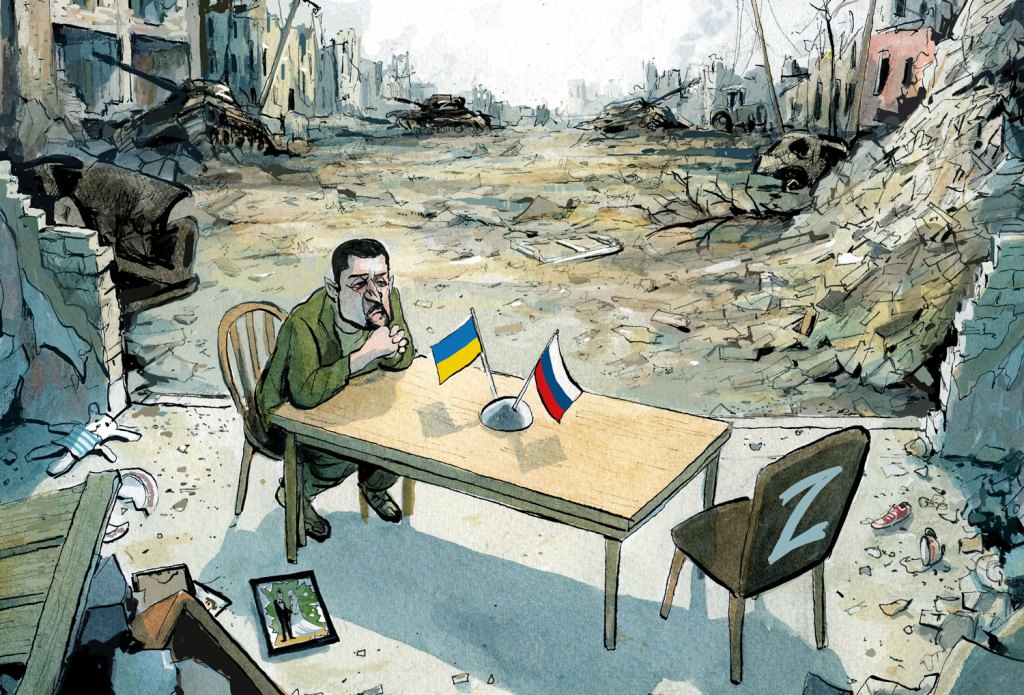
Who will pay for Ukraine’s war effort now the Trump administration has turned off the financial taps? European leaders have expressed themselves ready and willing to take up the burden, with European Commission President Ursula von der Leyen affirming that “if we continue to believe that Ukraine is our first line of defense, we need to step up our assistance.”
Individual countries have come up with generous funding packages – most open-handed of all being Germany, which has recently pledged more than €3 billion in direct funding. But that’s just a drop in the ocean compared to what Ukraine says it needs. With more than 40 percent of GDP destroyed and the tax base completely wrecked by the war, it’s not just Ukraine’s military spending but also its public services which are dependent on international handouts. At present, Kyiv’s war effort is facing not just a crisis in manpower but also a serious funding crunch.
So far, the financial support of western allies has been Kyiv’s superpower and force multiplier. Without it, Ukraine’s economic collapse at the outset of the war would have quickly translated into military collapse, too. Ukraine also enjoys the goodwill of world financial institutions such as the International Monetary Fund, the World Bank and the European Bank of Reconstruction and Development – as well as of international lenders who have collectively agreed to overlook the fact that Ukraine is effectively in default on its own debt.
That’s an advantage that Russia, by contrast, absolutely lacks. Cut off from international money markets, Moscow is forced, more or less, to balance its own books, borrow from its own major companies and print more money to fund its war production. But Ukraine’s reliance on outside funding is also a strategic weakness, leaving Kyiv entirely dependent on the goodwill of outsiders to continue the fight. Kyrylo Shevchenko, the former head of Ukraine’s Central Bank, calls the system “donornomics” – defined as “the fragile system where Ukraine’s fiscal survival depends on how far its allies are willing to go.”
How much cash does Ukraine need to fight Russia and survive as a functioning state? The basic figure that the Verkhovna Rada, Ukraine’s parliament, approved for defense and security this year was 2.2 trillion hryvnias, or $54 billion – equivalent to approximately 26 percent of Ukraine’s GDP. But that sum eats up more than half of Ukraine’s depleted tax take, so Kyiv needs to find additional money to fund everything else from healthcare, pensions and education to government salaries.
‘Come on Donald, amuse me.’
Ukraine’s 40 percent budget deficit has to be covered in one of three ways – from direct donations from allied countries, from internationally backed debt and, potentially, from Russian state funds currently held in G7 countries. That’s not even counting military expenses directly shouldered by Ukraine’s backers – most expensively the vital air defenses such as Patriot batteries which cost $1 billion dollars each and fire missiles costing around $4 million a shot. With Russian missile and drone attacks now regularly topping 600 projectiles a night, it’s a small wonder that Reuters has estimated the real cost of the war to be up to $150 million a day. Ukrainian eyes are focused on getting hold of Russia’s sovereign wealth funds, which were frozen at the beginning of the war. Estimates vary, but at least $250 billion of the Kremlin’s money is held in various G7 countries. At least €150 billion of that sum is parked in Belgium’s Euroclear, a depository system used by governments and central banks around the world to hold their hard currency assets. There is, as yet, no legal way that Belgium, the European Union, the United Nations or any other national or international body can just confiscate that money.
Indeed, many European leaders including French President Emmanuel Macron have warned that doing so would seriously jeopardize Europe’s reputation of having respect for the rule of law in the eyes of other sovereign investors such as China, Saudi Arabia and Qatar – and trigger sovereign capital flight that could quickly bankrupt the continent.
Instead, western finance officials have been dreaming up various legal workarounds that would allow the funds to remain formally the property of the Russian government, while in practice making them available for Ukraine’s use. In October last year, the G7/EU came up with a scheme known as the Extraordinary Revenue Acceleration loans mechanism, which created a $50 billion loan backed by the interest payments from Russian capital without touching the capital itself. But with the war effort burning through that sum annually, this year European leaders have attempted to create a similar loan package involving the whole sum.
The idea of this Special Purpose Vehicle (SPV) – also known as the Reparations Loan – has been to create a €140 billion loan backed by Russia’s Euroclear capital that would be lent to Ukraine and, notionally, repaid by Ukraine once Ukraine is paid back by Russia for wartime damages. The trouble is, reparations are vanishingly unlikely and are not even a subject of discussion in any iteration of peace talks with the Russians. On the contrary, the Kremlin very much does want its cash back – and it is very likely to make that, along with the lifting of sanctions, a key demand once negotiations begin in earnest. In other words, handing over Russia’s money to Ukraine could become an obstacle to peace.
On a practical level, too, the small print of the SPV means that Belgium would be on the hook if and when Russia sues for its money back. Bart De Wever, the Belgian Prime Minister, has refused to sign off on the loan unless all European nations share the risk. So far, they have refused – not least because Europe’s national bankers are legally forbidden from issuing or backing loans that have next to no chance of ever being repaid. The practice is known as “bad-faith lending,” and has been much abused by China in recent years as a way to grab strategic real estate across Africa and Asia in lieu of loan repayments. And since seizing Ukrainian assets isn’t the EU’s style, European taxpayers will ultimately be liable for the entire sum of the loan when the Russians inevitably refuse to pay war damages to Ukraine, forcing Kyiv to default.
Despite the shaky legal and political foundations of the SPV, “Kyiv sees these assets as the main pillar of budget stability for 2026-2027,” says Shevchenko. Indeed, securing a reparations loan from the EU is key to Kyiv’s parallel negotiations with the International Monetary Fund, from which Ukraine is hoping to secure a four-year multibillion-dollar extension of its existing $11 billion credit facility. But Ukraine has no real plan to repay the IMF except out of the SPV – effectively, one loan paying for another. European states do this kind of thing all the time – but they, unlike Ukraine, have predictable revenues and single-figure deficits. “The plan is risky,” says Shevchenko. “Without a deal, Kyiv’s $60 billion [budget] gap could deepen fast.”
Though using Russian assets to help Ukraine sounds like a panacea, many in Kyiv are also crying foul over Brussels’ suggestion that €45 billion of the SPV money be used right away to repay last year’s G7/EU Extraordinary Revenue Acceleration loan. More egregious still to Ukrainians has been German Chancellor Friedrich Merz’s suggestion that much of the SPV money be spent on arms for Ukraine manufactured by expensive European suppliers such as Germany, cutting Kyiv out of the picture. That is, more or less, what happened to the lion’s share of US aid which was never paid out to Kyiv at all and was instead sent to US defense contractors to replace old military equipment dispatched to Ukraine. And as the SPV-Reparations loan will be disbursed by the European Union, the temptation to buckle to lobbyists and spend the money inside the EU, pork barrel-style, will be high.
In addition to massive physical destruction, Russia’s invasion has also disrupted two key structural elements of Ukraine’s economy – access to cheap Russian gas, which was the secret to the competitiveness of much of the country’s industry, and cash income from transit of Russian gas to Europe. Remarkably, for the first three years of the war Ukraine continued to quietly move Gazprom gas across its land and into the EU via a network of pipelines to Slovakia. As late as last year, Kyiv was using the $900 million annual transit fees paid by Moscow (via a Swiss subsidiary) to help fund its war effort. Those payments, bizarrely, made Gazprom one of Ukraine’s biggest wartime budget contributors.
Some of Gazprom’s gas was even re-imported into western Ukraine’s Lviv and Ivano-Frankivsk provinces having looped through Slovakia, creating the legal fiction that the gas was European. It’s the same story with Russian crude oil pumped to Slovakia, the Czech Republic and Hungary via the Druzhba pipeline – which in fact crosses Ukrainian territory and generated precious revenue for Kyiv.
Under pressure from Brussels, Ukraine shut down most Russian gas transit at the start of this year, and is now moving to close down the Druzhba oil pipeline too. But that leaves Ukraine dependent on liquefied natural gas (LNG) imported from halfway across the world – and which costs up to three times as much as piped Russian gas. Early this month, under the auspices of Europe’s Partnership for Transatlantic Energy Cooperation, Ukraine’s Naftogaz signed agreements on the supply of at least 300 million cubic meters of American LNG with the Polish company ORLEN. Such western-provided supplies will, Kyiv hopes, be enough to keep heating and electricity going over the coming winter. But there’s no way Ukraine’s heavy industries can return to their prewar competitiveness with energy costs tripled.
The long-term outlook for a postwar Ukraine is as bleak as its current cashflow. A rapid damage and needs assessment, prepared by the Ukrainian government with the World Bank, UN and European Commission, estimates immediate recovery and reconstruction needs to be approximately $524 billion over the next decade – roughly 2.8 times Ukraine’s 2024 GDP. The good news is that official creditors – including holders of Kyiv’s government debt – have agreed to pause Ukraine’s debt service until the end of March 2027 pending restructuring. But with Kyiv already struggling to make ends meet without repaying its debts, that’s as useful as a chocolate teapot.
Underlying Kyiv’s coming cash crunch is a fundamental disconnect between Europe’s undoubtedly sincere desire to support Ukraine and the reality that the UK, France and Germany are facing serious fiscal crises of their own. Promises to support Ukraine are of a piece with European NATO members’ pledges to commit 5 percent of their GDP to defense spending by the end of the decade – both declarations are, for the most part, unfunded. Yet senior Brussels bureaucrats such as António Costa, President of the European Council, continue to make sweeping pledges – including in person to Ukrainian President Volodymyr Zelensky. “Today we will make the political decision to ensure Ukraine’s financial needs until 2026 and into 2027,” Costa told Zelensky last month. “We are not tired and we are here to continue to support Ukraine diplomatically, politically, militarily and financially.”
Costa isn’t lying – Europe’s material and political support for Ukraine will undoubtedly continue. The question is at what level – and for how long. The story so far of Europe’s engagement with Ukraine has been one of big pledges followed by considerably smaller deeds – and that was before Trump took away Uncle Sam’s billions. Unfortunately for Kyiv, there’s little to suggest that Europe has the means or the will to actually provide Ukraine as much as it needs, for as long as it needs.
This article was originally published in The Spectator’s November 24, 2025 World edition.
Since the start of the Russian invasion of Ukraine in February 2022, discussion of the Ukrainian far right has been verboten in western media, largely because one of Vladimir Putin’s stated war aims is the “denazification” of Ukraine. Putin’s claim that Ukraine is a Nazi state has been recycled by Russian propagandists and the western party line has consistently been that while the Ukrainian military does have far-right strains, they are marginal and inconsequential. This may have been true in 2022, but things have changed significantly after almost four years of war. Today, far-right figures control some of Ukraine’s strongest military units, and neo-Nazi ideology is displayed openly in the Ukrainian ranks.
The latest evidence of this came on November 4, when Volodymyr Zelensky handed out military awards to soldiers fending off the Russian offensive in the Donetsk region. As shown in photos published on Zelensky’s official Telegram and X accounts, some of the soldiers receiving the awards had patches with symbols that looked suspiciously like the emblem of Hitler’s SS. The unit flags adorning the walls told a similar story: the Azov brigade’s insignia is a variation of the Nazi Wolfsangel, while the Chervona Kalyna brigade’s ensign emulates the red-and-black flag of the Ukrainian Insurgent Army, a far-right militia that played an instrumental role in the Holocaust in western Ukraine and massacred tens of thousands of Poles in the regions of Volhynia and Eastern Galicia between 1943 and 1945. Zelensky was photographed with these two flags in the background.
Both the Azov and the Chervona Kalyna brigades form part of Ukraine’s 1st Azov corps, a unit that comprises tens of thousands. The corps is led by Denys Prokopenko, the commander of the Azov regiment that defended Mariupol in 2022 before being captured by the Russians. He and his men were eventually freed from captivity in a prisoner exchange and their “heroic resistance” was praised by the western media. What was often left out of the gushing puff pieces was Prokopenko’s background. In the 2010s, Prokopenko was a member of a far-right Ukrainian soccer-hooligan association called the “White Boys Club.” A quick browse through its Facebook page shows frequent glorification of Nazi units such as the 14th Waffen Division of the SS (also known as the 1st Galician division). In 2014, Prokopenko joined the nascent Azov. His platoon was nicknamed “Borodash” (bearded man) for its insignia, which featured a bearded Nazi Totenkopf. In spite of appearing to like the aesthetics, Prokopenko has denied that he or the men serving under him have far-right sympathies.
But the 3rd Army Corps, comprising some 40,000 men and widely heralded as Ukraine’s strongest military formation, is commanded by an even more sinister figure, Brigadier General Andriy Biletsky. In 2010, Biletsky publicly stated that Ukraine must “lead the white nations of the world in a final crusade for their survival, a crusade against the Semite-led Untermenschen.” In 2014, after being held as a political prisoner, he founded the Azov volunteer battalion to fight the Russian-backed separatists in the Donbas. From 2014 to 2022, human-rights organizations described widespread use of torture by Azov fighters against civilians in the Donbas and western media routinely reported on how this white-supremacist, fascist and neo-Nazi paramilitary unit served as a model for violent far-right extremists all over the world. In 2016, Biletsky also established the far-right political party National Corps, which the US State Department called a “nationalist hate group” in 2018.
In those days, contrary to Russian propaganda, the Ukrainian people had little affinity for the extremist ideology of Biletsky and the Azov movement. Although Biletsky managed to get himself elected to the Ukrainian parliament, his party only received 2 percent of the vote in the 2019 elections. In other words, prior to the war, Azov was a fringe phenomenon.
That changed in 2022. After the Azov’s capture and release by the Russians, figures such as Prokopenko and Biletsky became national and international heroes overnight. From a regiment in 2022, Azov grew to a brigade in 2023 and a full corps this year. Today, its members are among the most admired men in the country.
There’s a reason Zelensky is so resistant to signing an armistice, especially one involving territorial losses. In promoting such men as Prokopenko and Biletsky, the President has potentially created a monster. If their ideologies are as suspected, Ukraine is now in the position of Germany in 1918. Fighting a war of attrition against an opponent with vastly more resources, manpower and firepower, Ukraine is bound to lose, or at the very least to suffer major losses. After World War One, the Dolchstoßlegende – the stab-in-the-back myth – spread around Germany. It convinced many Germans that the country hadn’t lost the war on the battlefield but had instead been betrayed by citizens on the home front – Jews, mainly. After years of Ukrainian and western media hyping up the Ukrainian army and predicting a Russian collapse, an unfavorable peace risks creating Ukraine’s own version of the Dolchstoßlegende, with Zelensky playing the role of the Jewish scapegoat.
If a ceasefire is signed, it is far from clear whether Prokopenko and Biletsky, who believe in victory at any cost, will lay down their arms. Between them, they command tens of thousands of Ukraine’s best troops. Well-equipped, well-trained and ideologically motivated, these units have the potential to be Ukraine’s very own Freikorps, and Prokopenko and Biletsky may well lead their own Kapp Putsch or march on Kyiv in the event of an American-mediated diktat.
While some armies have neo-Nazis, in Ukraine some neo-Nazis have armies. The threat they pose to a democratic and prosperous postwar Ukraine is obvious.
This article was originally published in The Spectator’s November 24, 2025 World edition.
“I think the question that needs to be asked is: what kind of military does Canada even want?” Dallas Alexander has been all country-star cool until I ask about his former employer. Now his voice takes on a more earnest tone.
We’ve talked about the song the veteran-turned-singer considers his best – “Child of this Land,” a ballad about growing up in the remote Fishing Lake Métis Settlement in northern Alberta – and we’ve discussed which is the fan favorite: same, he says, or maybe the more upbeat “Can’t Blame My Bloodline.” To my mild surprise he doesn’t mention “Adios Amigo.” The song, with its catchy (and ominous) refrain, references the record-breaking sniper shot taken by Alexander’s team in 2017. Fired during the Battle of Mosul, the bullet traveled 2.2 miles before taking out an ISIS combatant who had just scrambled out of a window with an AK-47.
Back then, Alexander was a sniper with the elite Joint Task Force 2, a Canadian special ops unit on a par with America’s Delta Force and Britain’s SAS. But the Canadian Armed Forces were already beginning to lose their way, pursuing diversity, equity and inclusion at the expense of effectiveness – and only a few years later, Alexander would be hounded out.
Today, Alexander is unimpressed by General Jennie Carignan, the head of Canadian defense, who appeared on TV earlier this month with a tearful public apology for systemic racism. Alexander, who is Métis and served for 17 years, doesn’t think the military is systemically racist, as he understands the word “systemic.” He’s nuanced about it: racism, he says, can appear in any large group, especially in an aggressive workplace like a military unit or sports team, with “very get-after-it types of people.” But, “I don’t think the answer to any of it is a general – supposed to be in charge of a fighting force – crying on TV.”
It began when Alexander was still fighting with Joint Task Force 2. “It was starting to trickle in, you needed to do an Indigenous awareness course. And I was like, what the hell does this have to do with a special operations unit? And I’m Indigenous.” Gender awareness courses were next, then other sensitivity training, all eating into time previously spent on combat training.
The Canadian military has been struggling with recruitment and retention, and I remark that leadership seems to think that going down the sensitivity route will attract more people. “They’re going to get the people that they ask for, that’s all… recruiting might go through the ceiling,” but it’ll be “just a bunch of people that want to go in and be sensitive and get free money.”
When Covid hit, with its protocols and mandates, the troops felt they were being used as a testing ground; the government wanted to “be able to go to the world, or to the rest of Canada, and say: look, this group of people were 100 percent compliant.”
Alexander thinks that if every person in JTF2 at the time who didn’t want to be vaccinated had stuck to it, their unit might have gotten away with it. The government would have had to cancel the whole Tier 1 special operations program – and Alexander thinks that wouldn’t have happened. But there was a lot of pressure. “People got scared for their mortgages and their next positions.” Many caved; those who, like Alexander, held their ground were eventually forced out. He thinks the elite units took a gigantic hit at this point. “A lot of people that were very experienced in tons of operations, leaders, aggressive, what you need in a force like that,” left. “And like the cliché of an action movie, if I had to pick a team to go do some crazy mission, every single person I would add to that team is out of the military right now.”
How good was the Canadian military, before all this? “Second to none,” Alexander says of his unit. They trained and competed a lot with Delta in the US and though the Canadian special forces have nowhere near the same money and equipment, Joint Task Force 2 “kicked ass.”
If Canada wanted to turn things around, what could be done? “If I was in charge of the military in Canada tomorrow,” Alexander says, “I mean, this is gonna sound terrible, but I’m gonna say it anyway – I would cancel almost every part of the military and build a robust special operations unit and intelligence-gathering unit. And that is all that we would have. The rest would be volunteers to help within Canada. And that’s it.”
I ask him about PTSD. Alexander says he thinks a lot of veterans go through a similar cycle, becoming disillusioned when they “realize that the government… is corrupt and immoral.” He firmly believes soldiers need to know what their own morals are before heading out on deployment and “if someone tells you to do something against that, you tell them to go to hell.”
“Everyone says that’s not how the military works,” he says. But Alexander believes in morals. For him, they always came before orders. “Call me a bad soldier. I don’t really care. But I don’t have debilitating PTSD because I stuck to my morals.” He says a lot of young guys who go into the military early are put into situations for which they are unprepared. Then once they grow up, they have a lot of regrets that they have to work through. Moral preparation “isn’t popular because it makes soldiers harder to deal with. Instead of just taking some stupid order, you’re like, wait a minute… but I think it’s needed if you want to get out the other side and be able to sit peacefully at the dinner table with your family.”
What does Alexander think of the Canadian government offering euthanasia to vets asking for help with PTSD? “To me, that’s insane,” Alexander says. “It’s insane that that is a place where the government thinks it should be stepping in, offering to kill people who are its own citizens. I think it’s very weird. And especially people in vulnerable positions… it’s sickening.” Why pick on veterans in particular? “I mean, you look at it, it saves them a lot of money, that’s for sure. But I don’t know. It’s not a good enough reason, in my opinion.” Mine neither.
Alexander is pursuing his music career in Nashville now, where he’s making tour plans for 2026 and has founded Music City Gun Club for artists and musicians to go shooting with special operations instructors. He likes Tennessee. “I’m super happy and grateful for all that happened, because I’m way better off now,” he says. That said, speaking with Alexander, it seems to me that you can take the boy out of the country, but you can’t take the country out of the boy. Of his own songs, his favorite is “Child of This Land.” And that, in a way, says it all.
This article was originally published in The Spectator’s November 24, 2025 World edition.
I remember poring over the photos when they first appeared in Architectural Digest in early 2023. Even back then, before Lily Allen wrote what Rolling Stone called “the most brutal album of the year,” I knew in my gut that her marriage to that actor guy she met on Raya – whatshisface? David Strangerbeard? – wouldn’t last. Because looking at the pictures of their house made me feel queasy. There was something off about it. It just wasn’t right. It didn’t bode well.
It’s not that the house wasn’t gorgeous. It was – and still is – spectacular. A double-width brownstone in the slouchiest artisanal urban village on Earth: Carroll Gardens, Brooklyn. A house which was put back on the market for just under $8 million the same week as Allen’s new album West End Girl’s release in October.
Those vast double-aspect Georgian-paned windows. And that’s all before we even get to the inside. There’s a green velvet-tufted-gay-hairdresser-orgy-sofa, a pick ‘n’ mix clash of patterns, the patterned wallpaper, the floors. Carpet in the bathroom! Wall-to-wall plush! The absolute cheek of it.
The house is an exercise in trans-Atlantic retro-maximalism at the aesthetic’s peak-bling phase. It’s Edith Wharton meets Claus Von Bülow’s dead wife with insouciant accents of Disney-princess bordello. It’s an object of beauty specific to its time and place, which was 2023. But no one who saw that house in print ever forgot it. Seriously, I’ve done a vast survey using a sample group of six women at a dinner party.
But let me get to the heart of the matter. There was always something wrong about the house. Something dead behind the eyes. I felt queasy looking at the pictures. Didn’t you? I thought, “Eeeesh.” Human suffering radiated from the pictures on the page. The writing was on the wallpaper.
The Lily Allen/David Harbour saga is not about a break-up, nonmonogamy, the state of marriage, female outrage or male selfishness. It’s not even really about the songs on Allen’s album, which are catchy but only in the way that an entertaining musical is. Once the story – that Harbour sought an open marriage Allen didn’t really want – ceases to matter, the songs won’t seem so brilliant. The real story is that brownstone: the unhappy marital home that became a haunting piece of art and an object lesson for the (desperate?) housewives of America.
What the story of that house reveals about the rise of interiors porn is fascinating in a broader cultural sense. In London, the city where I live, just as much as in New York City, the house-beautiful cult is like a virus. It seems to grow in inverse proportion to the eternally dismal economic forecast. The house obsession never stops. For example, it has become commonplace for people where I live to regard their homes as set pieces and brand extensions rather than places where they live with their families. In my neighborhood, middle-class professionals think nothing of spending several years searching out, buying, gutting and meticulously doing up houses at enormous expense, not just to their bank balances but to their sanity and happiness. I have known not just one but several intelligent, educated women (always, always women, invariably mothers) who have abandoned and/or put on hold hard-won careers in order to “project manage” epic back-to-the-studs renovations that stretch on like Russian novels.
These women suffer and starve for periods of four to six years, sometimes more, because during these gut-jobs they lose their minds and become boring to everyone around them – including themselves. They cannot think or talk about anything of substance: it’s all weighted drawers, cornices, granite grain and light fixtures. They begin to believe these things are, genuinely, a matter of life or death. Renovation brain is like baby brain but so much worse, for the obvious reason there’s no baby involved. I have seen the best minds of my generation lost to kitchen extensions. Truly! Did we all actually go to university to become volunteer construction project mangers in middle age? It’s insane.
But surely no one actually believes that doing up a house is a substitute for meaningful work? Or that a perfect house makes for a perfect and harmonious family life? And yet, we do. Every generation falls for the same trick. Why?
There’s something else driving the perfect-house obsession. It’s the same pernicious fallacy that made women of previous generations obsessed with cleanliness and germ-killing, and before that flower arranging and needlepoint. It’s the delusion that if you can just focus on the details, fuss and fuss and fuss, eventually you make everything perfectly perfect and shiny on the outside. The inside will naturally follow suit. But life and human relationships don’t work like that. As Allen found out.
Having been through the wringer of divorce as both a child and an adult, I have moved house countless times and also been trapped in the marital home. I’ve done my fair share of renovating and agonizing over cabinet knobs, and here is what I have learned: beyond a modicum of comfort and space, the state of the family home is basically irrelevant to the state of the relationships that exist within it. Aesthetics are accessories to life, they are not love or art. They are not even water or food.
What divorce forces you to acknowledge is that your perfect house won’t save you. It didn’t save me as a child any more than it did as a middle-aged woman who made the same mistake my mother did. Allen’s album is a hit because it’s a reckoning with this universal thought-trap. The cautionary tale of the perfect house. New furnishings, same blunder. Having said that, I’m all for wall-to-wall patterned carpet in the bathroom.
This article was originally published in The Spectator’s November 24, 2025 World edition.
It is more than a month since thieves stole the crown jewels from the Louvre and the chances of recovering the loot, worth an estimated €88 million, diminish with every passing day.
The robbery was initially dubbed the “heist of the century,” a brazen theft in broad daylight as visitors strolled through the world’s most famous museum. There were up and down the ladder and in out of the museum in seven minutes, giving the impression that this was the work of villains well-versed in daring robberies.
But soon details emerged that suggested the gang of four weren’t quite of the caliber of the thieves immortalized in the Hollywood movie Ocean’s Eleven. They left behind a trail of clues: the two disc cutters used to open the display cabinets, a blowtorch, gloves, a walkie-talkie, a yellow vest, a blanket and the truck with extendable ladder. In their haste to escape, the thieves dropped Empress Eugénie’s crown, festooned with 1,354 diamonds and 56 emeralds. In total, explained Paris prosecutor Laure Beccuau, the police found “more than 150 DNA, fingerprint and other traces” at the scene.
Within a week two men were in custody, who swiftly admitted “partial” responsibility; for their role in the heist. A third was arrested a few days later. All were petty criminals from the Paris suburbs. “It is a type of delinquency that we do not generally associate with the upper echelons of organized crime,” said Beccuau.
One of the suspects is allegedly a former YouTube star famous for his motorbike stunts that he showed off on social media. According to media reports, his real name is Abdoulaye N, a 39-year-old with a rap sheet for petty crime stretching back two decades. Friends and associates claim that since he became a father he had settled down, and one told the New York Times: “He’s really the last guy I would have thought of for something like that.”
One of the three men in custody – not identified – was described at the weekend as a “good Samaritan.” Apparently he once came to the aid of a stranded motorist on the Paris ring road in September, offering a “calm and reassuring” presence to the distressed driver.
The fourth member of the gang has not been caught. Is he the one with the brains, as well as the booty? The thieves certainly knew what they were after. Rayan Ferrarotto, the commercial director of the French diamond merchant Celinni, says the jewels were stolen to order. “When you look at major art thefts, it is almost always the case that private collectors or enthusiasts commission the thefts to own a unique piece… it’s all about prestige and exclusivity.”
Beccuau says she is keeping an open mind about the theft. “We are examining all the possibilities on the parallel market for selling this jewellery… it could be used for money laundering, it could be used for trade; all leads are being explored.”
Is one possibility that getting caught quickly was part of the thieves’ plan? It subsequently emerged that the truck used in the robbery was stolen nine days earlier by two men who threatened the driver. Furthermore, that incident took place in Louvres, a town north-east of Paris. Perhaps the thieves had a good sense of humor. Or did they want to draw attention to themselves?
Knowing they had left behind so much incriminating evidence, why didn’t they flee France immediately instead of returning to their stamping ground in the suburbs of Paris?
Unless their bungling was all part of the plan. The maximum sentence in France for theft without violence is three years in prison and a €45,000 fine. In the case of aggravating circumstances, such as a gang robbery, the maximum sentence is five years in prison and a €75,000 fine. This increases to seven years when the theft involves “cultural property that is part of the public domain.”
With good behavior, and a willingness to “demonstrate efforts towards reintegration,” a prisoner can have six months per full year of incarceration reduced. In other words, even with a seven-year sentence, a well-behaved prisoner would be released after half that time.
In 2009, an armored cash van and its driver disappeared as it made a drop at a bank in Lyon. Initially it was feared the vehicle and its €11.6 million in deposit boxes had been hijacked. Eleven days later the driver, Tony Musulin, gave himself up and police retrieved €9 million of the money. Unfortunately, he said, €2.5 million had been stolen from him. He was sentenced to three years in prison. The missing money has never been found. In 2019, Musulin was briefly arrested in London when he tried to convert £75,000 into Euros at a bureau de change. He was released without charge after explaining that the money came from the sale of his Ferrari.
Musulin became something of a cult hero in France. Mugs and T-shirts were sold online emblazoned with “Tony Musulin, Best Driver 2009.” The Louvre thieves have also been feted in some quarters; a German company has used the robbery to promote its trucks with extendable ladders, telling customers they’re perfect for “when you need to move fast.”
Are the alleged perpetrators of the Louvre heist happy to go to prison for a few years knowing that when they get out they’ll get some of the proceeds? Or perhaps they are just opportunistic thieves who got lucky because the Louvre security was even more amateur than they were.
Olivia Nuzzi’s memoir about her scandalous affair with Robert F. Kennedy Jr., then a presidential candidate and now the country’s leading health bureaucrat, comes out next month. She’s called it American Canto, not to be confused with the bestselling novel Bel Canto, about terrorists who occupy an opera-themed party at a South American mansion. Instead, Nuzzi has trapped us all in the opera of her mind, and there’s no escape.
Nuzzi has the apparent ability to turn otherwise rational, educated men into blubbering masses of jelly. In a rather glowing profile over the weekend, accompanied by video of her blonde hair flowing in the wind on the Pacific Coast highway, the New York Times’s Jacob Bernstein said that “Nuzzi disappeared for a year, in self-imposed exile in Los Angeles” after details of the RFK affair came out. “She drives around in a white Mustang convertible, like a Lana Del Rey song come to life.” In reality, she has a job as an editor at Vanity Fair and lives in a house in Malibu. If that’s exile, then Cockburn has been dreaming of exile for decades.
In the book, Nuzzi continues to insist that she and RFK Jr. didn’t have sex. “We were not sleeping together,” she said in an interview last year. But they were very much in love, in a pretentiously intimate way that will make a normal person yak. She adored his “particular complications and particular darkness.” According to the Times, “he called her ‘Livvy’ and wrote her poems. He said he wanted her to have his baby. He promised to take a bullet for her.”
Good grief. Nuzzi also writes that both she and RFK “moved through the world with amused detachment and deep sensitivity, contradictions that worked somehow in concert.” You don’t say. Then there was the matter of RFK’s “brain worm,” about which he told her, “baby, don’t worry.” In the book, she writes, “I loved his brain. I hated the idea of an intruder therein.”
This sort of love has kept therapists and screenwriters busy for decades. “He was not quite mad the way they thought, but I loved the private ways that he was mad. I loved that he was insatiable in all ways, as if he would swallow up the whole world just to know it better if he could,” Nuzzi writes.
If that all seems like a bit much, Cockburn really choked on his morning bagel when he read this excerpt, which starts about RFK’s falconry hobby and gradually turns him into a Fabio romance-novel cover hero:
Like all men but more so, he was a hunter. In a literal sense, he used not a bullet but a bird. It was not about a chase but about a puzzle of logic and skill that amounted to a test of his self-mastery. He was the mouse and the architect of his maze. The giver of his own pleasure and torment… He desired. He desired desiring. He desired being desired. He desired desire itself. I understood this just as I came to understand the range of his kinks and complexes and how they fit within what I thought I understood of his soul.
The book may be called American Canto, but a better title might be TMI. Cockburn finds himself wondering why we know all this extremely icky private information at all. She has a job. He has a job. They can both get their names into the papers whenever they want. Our job, apparently, is to read about them and gossip about them. They’re like the lovers at the Coldplay concert, but they wanted to get caught for reasons of professional advancement. Don’t worry, baby. We all have a brain worm now.