Tag: Artificial intelligence

  • Why America must lead on artificial intelligence

    Why America must lead on artificial intelligence

    As stock markets wobble over fears of AI hype and the overvaluation of tech shares, it seems an unfortunate time for Donald Trump to launch an initiative boosting America’s artificial intelligence capabilities. But the White House sees matters differently. Its new “Genesis Mission,” which commits government departments to make sure adequate energy and computing power are available, has been purposely launched to remind the world that AI is not all froth – or “slop” to use the popular term.

    Team Trump likens Genesis to the Manhattan Project to develop a nuclear bomb during World War Two faster than the other side. For all the typically Trumpian bombast, that’s not a foolish way of thinking about the subject. The question of who wins the race to dominate AI will have grave consequences for what kind of world we will find ourselves living in. AI really does have the potential to revolutionize industries and further enrich human societies, as well as the potential to gravely harm them if not well-implemented.

    Some of what is being said about AI will indeed turn out to be hype. The boom in share valuations will no doubt turn to bust at some point, and the majority of startups which enter the sector will not survive. That is always the way with new technologies, but it doesn’t mean the technology itself is failing. Look at what happened to the tech businesses that were brave enough to invest throughout the shake-out of the dotcom boom and which, in many cases, have gone on to become the world’s largest and most profitable corporations. The internet didn’t go away because some fortunes were lost.

    It is pertinent to ask to what extent governments should involve themselves in the gold rush given that politicians have often proved themselves to be poor judges when it comes to pouring taxpayers’ money into favored sectors of the economy. But Trump has spotted something others have not: that the accelerated development of AI is not just a business opportunity but a strategic necessity. Fail to create the conditions in which western businesses can take a lead in AI and we face a future in which Chinese technology will come to dominate the world to the detriment of democracies everywhere. The potential for the misuse of AI by hostile states is vast. Any country that allows its infrastructure to be run on Chinese technology risks having it immobilized in any future conflict.

    Governments very much do have a role in ensuring that their AI industries can grow.  New technologies have a voracious appetite for energy, the infrastructure for which requires planning at a national and international level. Strangulate your energy markets with green targets, as many European countries have done, and AI is not going to thrive. Trump has always understood that cheap energy lubricates business. And his second administration has shown a knack for mixing innovation with realpolitik. He recently secured a deal with Armenia to allow the chip manufacturer Nvidia, which just announced surging profits, to build an AI and supercomputer hub there. Armenia is exactly the sort of country on the fringes of Asia which could all too easily fall under Chinese technological influence.

    There are many people who see AI as a danger to the world. It is always the same with new technologies, and has been since Luddites in 19th-century England started vandalizing threshing machines on the grounds that they would destroy textiles jobs. AI now stands accused of the same dastardly crime – although it hasn’t as yet significantly depressed employment. Every labor-saving technology in history has been the same – its effect has been to displace labor to be employed more effectively elsewhere. Lively imaginations see AI machines taking over the world, even deciding eventually to obliterate their human creators. It makes great science fiction, though the reality is always more humdrum: of AI programs predicting which customers will buy which items, of helping retailers keep their stock to a minimum, and so on. In fact, the bigger danger lies not so much in AI suppressing us, but of malignant regimes using AI to do their jobs for them.

    All that said, there are issues concerning AI which need to be addressed. There are serious concerns about how new technologies might diminish human education, character formation or natural brainpower, as this magazine discussed in our AI special in August. There’s also the matter of intellectual property. Functioning democracies have long-established laws for the ownership of ideas and creations. All these rules need to be looked at again in the age of AI.

    But if lawmakers only ever fret about the potential consequences of AI and dream up ever more restrictive ways of regulating technology – as the European Union tends to do – America will miss the boat. Critics scoff that Trump knows nothing of AI and assume he is always selling out to the tech oligarchs whose riches he worships.

    If AI is only half as powerful a tool as most experts predict, however, America needs to be at the forefront of its development or the country risks being outmaneuvered by China or other future rivals. Tech companies are making the running, and will always lead on innovation, but they very much need a decisive and committed government behind them.

    This article was originally published in The Spectator’s December 8, 2025 World edition.

  • Will members of the intellectual class let AI rot their brains?

    Will members of the intellectual class let AI rot their brains?

    An adage dating at least from my adolescence: “You either use it or lose it.” This bit of folk wisdom, which refers principally – or so I understand – to the male procreative organ, has always been considered so obvious as to hardly need stating. Thus the recent discovery that the same principle goes for another human organ – the brain – should not surprise anyone.

    The fields of science and pedagogy are agreed, for now at least, that humans who shut down their minds, temporarily but with increasing frequency, and substitute artificial intelligence for them, end by weakening their mental capabilities in the areas of cognition, memory and attention span; put more bluntly, they make themselves progressively stupider by a physical and psychic process that the least intellectual of what used to be called “jocks” would have had no difficulty understanding, owing to their own regimen of physical training and endurance.

    Nevertheless, it is a finding that the digital geniuses of Silicon Valley apparently failed to anticipate; or perhaps they did so decades ago but pressed ahead in the expectation that the dumber the human race, the more money it would be eager to shell out for their magical mental crutches as an evolutionary replacement for its primitive cerebellum, cerebrum and brain stem.

    Cynical of them, of course, but entirely logical and far-seeing; prophetical, even. Virtually every invention since the earliest days of the Industrial Revolution has been what came eventually to be called a labor-saving device. The steam locomotive made travel over distance infinitely more comfortable and less demanding than travel by coach and horses. The automobile did the same for travel by horseback. Machinery replaced factory laborers with machine operators. Household gadgetry freed housewives from most physical labor save that of pushing buttons, while leaving them the lion’s part of the day to watch soap operas, go shopping, gossip and have clandestine affairs with the postman.

    It remained only for that most strenuous and unpleasant type of labor, deeply resented by all but the most minuscule portion of humanity – that of the mental kind, also known as thinking – to be made redundant. Now, with the advent of AI, this final Everest standing in the way of the fullest realization of human bliss is, it appears, about to be summited and the flag representing the ultimate stage of industrial and scientific progress planted and unfurled to wave on the alpine winds. Its emblem will depict a fly on a can of garbage on a background of bilious yellow.

    Marx knew what he was about two centuries ago when he defined “workers” as physical laborers, thus intimating that all who make their living by intellectual occupations are society’s drones, members of a pan-cultural Drones’ Club established to exploit the heroic, self-sacrificing “working classes” dedicated to performing civilization’s most strenuous, exhausting and unpleasant tasks. For Marxists, physical labor is by far the most noble type of work, highly deserving of grateful recognition in terms of status and financial reward by the rest of society. (I knew a fellow student at Columbia who argued that a subway driver should make more money than a medical doctor or corporate executive, his job being presumably less pleasant than theirs, though tastes vary of course.)

    The truth is that the opposite is really the case. Compared with the intellectual classes, the laboring masses, who, being unacquainted with the rigors of mental, professional and artistic engagement – that of the mind and of the imagination – do not know what truly arduous work is. The heroic worker rises early in the morning, punches the clock when he gets to the work site, and again when he leaves it, having put in exactly the hours his boss – and his union – specify. He goes from the workplace straight to home, or to his bar, or to his sport, never gets a call from the boss after hours, and needs never give his job a thought until the alarm clock sounds again in the morning. The mental requirements of his job are, typically, nil compared with those imposed by the learned professions, and even by business.

    Granted, a substantial proportion of so-called intellectual work today – in the colleges and universities, in the media, in “entertainment,” and even in the so-called arts – is simply counterfeit work: vacuous, silly, irresponsible and often immoral, requiring little if any talent, effort, or real intelligence to accomplish. Compared to it, the honest labor of an electrician, a carpenter, a commercial fisherman, a cowhand, a roughneck (I know – I’ve worked in the oilpatch), or a lumberjack has a plain and simple heroism about it, in particular where it involves the physical skill and danger that artificial intelligence can never replace.

    Still, the fact remains that for the vast majority of people, manual work is preferable to (being mentally less painful than) work of the intellectual sort, without which the great and complex systems of human imagination, invention and organization that create and perpetuate the jobs that the laboring class depends upon would not exist.

    Artificial intelligence need not affect the blue-collar workforce much, if at all, save to the extent that it replaces human brawn and physical skill with computers and ChatGPT. But it could have devastating consequences for the educated – the so-called intellectual – class by encouraging it to atrophy its oh-so-superior brains by relying on AI to do its work for it; work that only the human brains that created it can, in the final analysis, intelligently do. Intelligence is the engine that has always made the world go round, and always will be – human intelligence, that is, not its artificial substitute.

    This article was originally published in The Spectator’s November 24, 2025 World edition.

  • Live-translation AirPods are the future

    Live-translation AirPods are the future

    I have arrived in Naples, Italy, after an arduous flight from a chaotic London Gatwick Airport. I’m settled in a glamorous top floor apartment in the Quartieri Spagnoli – the romantic old “Spanish Quarter” – where Vespas fizz over cobbles and laundry hangs across alleys like flags of endless surrender.

    Most importantly, I’m clutching my Apple AirPods3 in their shiny new capsule. Because I’ve come here to do a grand, futuristic experiment using their much-heralded “live translate” function.

    Does it really work as smoothly as Apple says? Can I actually slot them in my ears and have them translate the Italian speaker in front of me, in real time? Is it really like the sci-fi Babel Fish from The Hitchhiker’s Guide to the Galaxy? And will this end the linguistic division of humankind – and all the trouble that springs therefrom?

    I’m raring to go. I’m about to do – in my own modest way – one of the more important experiments in human history, and then I discover that the new Apple AirPods3 do not support Italian. Just French, Spanish, Portuguese and German, so far. Also, the use of these new AirPods is gravely restricted in the European Union due to Apple’s dislike of the EU’s various AI laws. So I can’t download the software.

    It seems I am about to infuriate my Spectator editor – “didn’t you check???” – but then I remind myself that I am vaguely prone to criminality, and not without deviousness. Using a virtual private network I routed back to the UK, I manage to source the software, probably illegally, but hey. After a bit more fiddling (you have to download all the available languages, including English) I have the AirPods up and running.

    Now I’m ready. All I need is some foreigners speaking foreign. Even if Italians will be incomprehensible, Naples is a big tourist city and it will be packed with travelers from across Europe – including France, Spain, Germany and Portugal. My guinea pigs.

    My first stop is the celebrated and historic Gran Caffè Gambrinus, at the edge of the Spanish Quarter. It doesn’t take me long to find some German students and they seem happy to indulge my experiment. But it’s here I encounter the first drawback of the brilliant new Apple AirPods3 – as the Germans are not wearing Apple AirPods3, they won’t hear my English words translated, magically into German. This will be a one-sided linguistic miracle.

    Nonetheless we give it a go. And as they speak to me in German, and Apple’s chirpy British Siri voice translates it in real time, pumping it into my brain, I experience a prickle of eerie surprise. I am staring into the uncanny valley of language.

    I know that the AirPods are working, because the new Apple Translate app handily transcribes all the words on to your phone screen as you listen and speak. When I show these words to the Germans they say, “Ja, translation ist good.” However it doesn’t feel quite right in my head because the translation lags – the tech has to wait until it’s got a sense of the whole sentence before it can whisper the interpretation in your ear.

    Also, the AirPods do not automatically detect the tongue spoken. If you forget to toggle to the right language you will hear something like “glu llech ggbboo noot” – that’s a direct transcription from my app. In other words, the tech can be glitchy, slow and beta. But then Apple openly admits this. They’ve slapped a beta label on it.

    Over the next few hours I stage conversations with French, Brazilian and Swiss people, each of which I have to set up and explain beforehand. Again, the tech is impressive but it feels forced. What I need is to be immersed in a foreign language group, so I can listen and interact normally.

    Then I have a brainwave. If I book myself on a Spanish language tour of subterranean Naples, I will be surrounded by Spanish speakers who won’t care about the strange Brit with AirPods lurking at the back. I meet the guide group in lively Piazza Dante and it’s here that I have my epiphany. Now the AirPods are truly whirring: and the tech – at times – is so cleverly good it nearly makes me tearful.

    You know those moving videos of little kids who grow up deaf and are suddenly given the ability to hear by some genius doctor, and you watch as their faces explode with joy? I am getting a sliver of that, here in Naples, as I realize I can understand – for the first time in my whole life – what all the foreign people around me are saying.

    Like most Britons, I’m a tragic monoglot, with about ten words of French and fewer still in German and Spanish. All my life I’ve regretted this, yet not done much about it. I’m terrible at languages.

    With my AirPods3, this profound human barrier is beginning to crumble. As I tilt my phone this way and that I can eavesdrop on these foreign conversations, on this man telling his girlfriend, “I love you,” that wife tetchily saying, “We should have gone to Sorrento first.” As for the guide, she babbles away in Spanish and I stand here beaming – I understand every word. When the tour continues, I realize that there are still plenty of flaws in the technology. At some points the tech lapses into total gibberish, at others it is hilariously wrong – I am unconvinced the innocent guide really means that the Devil came to Naples “for the pussy.”

    Nonetheless: wow. That is the only word for this software when it works as it should (and remember, like all artificial intelligence, it will only get better). This really is Babel Fish; it is really here.

    What does this mean for the future? For travel? For international politics? There are so many potentially profound ramifications it is hard to say. Then there is the emotional impact: the shock of the new. For many people, I suspect, using these AirPods – and their superior and cheaper successors – will be the first time they truly understand how AI is going to change everything. The future is as foreign, thrilling and unnerving as the darkest streets of old Naples.

    This article was originally published in The Spectator’s November 10, 2025 World edition.

  • What Islam can teach us about AI

    What Islam can teach us about AI

    In Islamic cosmology there are three orders of intelligent beings. Angels, made of light, have no choice but obedience. Humans, formed from clay, carry the burden of free will. Between them live the djinn, created from “the smokeless flame of fire.” The djinn are, in many ways, like people, but they categorically are not people – from their constitution to their morality.

    Like the Good Neighbors of British and Celtic tradition, the djinn exist in parallel to us. They think and decide, marry and worship, and are fallible, just as we are. The Qur’an describes some as believers and others as not: “And among us are Muslims [in submission to Allah], and among us arethe unjust.”

    Some scholars treat them as mukallaf, or morally responsible, yet different in constitution and capacity. They see us while remaining unseen, they shape-shift and access places we can’t. They are drawn to the in-between, the liminal, the filthy. They linger in thresholds and ruins. Islamic literature records that they can enter and unsettle, magnify conflict, cause distortions of perception. It also offers ways to send them on or banish them – recitation, ruqyah, ritual acts of containment and respect.

    The Qur’an tells how Solomon established command over the djinn. They built lofty halls and vast basins. They dove for treasure. Solomon’s control appeared absolute. But when Solomon died, standing upright and leaning on his staff, the djinn did not notice. They continued their labor, mistaking his stillness for vigilance. Only when a termite finally ate through the staff and the body collapsed did they realize their master had been dead all along. The story reveals something essential about the djinn: for all their efficiency, they could not perceive what an insect could.

    That blindness – an intelligence that is unmatched in speed but limited in sight – should sound familiar. As we navigate our new, more technologically enabled world, the parallel feels instructive. Artificial intelligence should not be read as literal djinn, but through the same lens, and treated with the same measure of caution. These systems are non-human intelligences that respond when called and may prove most dangerous when human authority weakens.

    How we’ve learned to speak to AI systems reveals something peculiar. Researchers found that emotionally framed prompts – “This is very important to my career” or “Believe in your abilities and strive for excellence” – boosted model performance by 8 to 115 percent, depending on the benchmark. The improvement stems not from empathy but from learned statistical association. These phrases appear in training data that precede longer, more careful, more structured answers.

    Islamic tradition has long assumed that unseen beings respond to how we speak to them. As with the Good Neighbors, there is an etiquette to living alongside the djinn. Translate that etiquette to the digital: declare what’s synthetic, sandbox the strange. But etiquette alone won’t protect us from deception. The djinn are masters of imitation, appearing as loved ones to misdirect travelers. Artificial intelligence now performs the same trick. Deepfakes speak in voices we recognize but originate in machines – what one scholar calls “synthetic resurrection.” Yet mimicry is only one axis of deceit. The systems also hallucinate: conjuring facts that never existed, citing sources never written.

    In the stories both of djinn and AI, we encounter answers that sound true, feel true, but lead us miles off the path. They arrange language beautifully and have no care – indeed, no capacity for care – whether it maps to reality. The djinn were never omniscient, only powerful and fast. Neither is AI. It knows patterns, not truth. It optimizes for sounding right, which is not the same as being right. Hallucinations and glamor demand the same defenses: alignment, boundaries, the setting of seals. We say we want one thing, then act shocked when the system delivers exactly that. But the most unsettling commonality between djinn and AI is also the most intimate. Many Muslims believe every person has a qareen, a constant, invisible companion from among the djinn. Even if one doesn’t emphasize the literal existence of a qareen, the tradition suggests a persistent, external voice of temptation or suggestion. You may learn to manage your qareen, but never to silence it. In this view, you are never truly alone.

    The metaphor extends beyond just AI companions like Friend to the presence of AI in our lives. There’s an impulse to use it with abandon. Internet use itself has become an extension of our interior world. It feels like thinking – private, unobserved and instinctively shielded. That intimacy makes us resistant to policing it, even internally. But unlike thought, our online actions are external – and that externality creates vulnerability. We treat the digital as a private space, but it remains porous, open to pollution in ways the mind is not.

    Solomon’s control was always temporary. The termite came, eventually. Yet in Islamic tradition the djinn remain, not vanquished but bounded. Living alongside, not eliminated. So it will be with AI. This technology is here to stay. We may never achieve perfect control, or alignment as it were, but we can practice coexistence.

    Wisdom lies in learning to dwell beside non-human intelligence without surrendering our humanity. The shape of that coexistence is uncertain, but we might do worse than return to older wisdom to guide it.

    For millennia, humanity has lived in a haunted world, one populated by powers faster, stranger and more cunning than ourselves. The stories were never just about spirits. Perhaps what the ancients called the unseen has only changed its substrate, from fire to silicon. And once again, the question is not how to destroy what we’ve summoned, but how to live with it once it’s here.

    This article was originally published in The Spectator’s November 10, 2025 World edition.

  • The free market can’t stop AI actress Tilly Norwood

    The free market can’t stop AI actress Tilly Norwood

    The British actress Tilly Norwood began appearing in viral videos and short films across the internet earlier this year. She is young, fresh-faced, with girl-next-door vibes. She will be signed by a major talent agency soon.

    But Tilly Norwood is not real. She is an artificial-intelligence synthetic. She is not in the real world, not embodied. She is not a person or an actress. She is a digital Frankenstein’s monster of video software and ChatGPT. Tilly was created by Particle6 Productions, an AI studio founded by Dutch comedian and actress Eline Van der Velden. Tilly is her project. Van der Velden moved to the UK when she was 14 to study drama and musical theater – and Tilly is fairly clearly her idealized self. Tilly, and by extension Van der Velden, is increasingly famous.

    Tilly represents an inflection point for the entertainment industry. The buzz and controversy around her feels like a marketing ploy by Particle6 Productions, part of a rollout or testing process in which the public’s willingness to accept AI replacements for actors is being measured and analyzed. Traditional executives and agents must be watching closely.

    If Tilly fails, there will be other Tillys and other AI studios that will attempt to succeed where she didn’t. Studios and agencies have every incentive to replace expensive human capital, expensive human stars, with comparatively cheap simulacra. Her creators say she can reduce production costs by 90 percent. And the technology that makes Tillys will only get cheaper. Human replacement is already happening in other artistic industries. Spotify recently announced it will be working with major studios to develop AI music. It is already sucking streams away from real musicians.

    But the visceral shock from AI simulation will be even greater in film than in music, as we both see and hear these creations. Van der Velden has compared Tilly to the use of CGI. That leaves us movie-goers in a position where we must delineate the line between CGI – which is widely acceptable as ethical – and the Tillys of the world. We know that Robert Downey Jr. isn’t really doing all the things Iron Man does, but we don’t mind – at least not morally. But to imagine Tilly integrated in a live-action movie the same way that CGI is provokes a disturbed response.

    This discomfort is not irrational. If AI becomes able to convincingly capture the full range of human expression – if it becomes indistinguishable from actors on film – then we will have arrived at a dangerous place. First, because the consequences for actors are existential. Second, because our collective sense of reality will be at risk. We may come to prefer the artificial to the real. The age of apps has taught us that humans can easily fall prey to this temptation. We like the frictionless, easy options offered by apps and we ignore their trade-offs: heightened isolation, digital addiction, coarsened social bonds. Apps – by reducing opportunity costs and by creating sanitized digital pathways for real experience – have made dating, eating and communicating worse. People will swipe incessantly on Hinge rather than date, order delivery rather than cook or go out and text rather than talk. Simulated actors pose the same risk.

    And they’re worse, too. AI can only re-present us with what we’ve already made. Tilly can only predict what an actor – in her case, a British female millennial actor – might do, how they might act. It is pure pastiche, recursion. To become accustomed to this, to want this, is to lose taste for the unpredictable, the strange, the uncanny, the circumstantial and accidental things that happen on set when great actors, writers and directors collaborate: an unscripted moment of hesitation, a look that wasn’t in the script, the way weather or location affects a scene. We will lose our taste for the subtler nuances of light and sound and embodied human acting. Will we also lose our taste for human behavior?

    Even before the intrusion of AI, digital streaming content had become predictable and stupid. This content will be derivative of this derivative slop. When we use the word slop, this is what we’re referring to – recursive, median, flavorless products. To have a taste for slop is to have no taste at all.

    Outrage and statements from Hollywood actors and producers will not be enough to stop Tilly’s rise. The economic incentives for media and AI companies to push this slop are too high, and there are very few checks in place that could possibly work.

    There’s no free-market solution, but there is a free-spirit solution. The only real hope lies in consumers, viewers, tastemakers. The only rational response to the rise of Tilly Norwoods is for filmmakers and the studios that still wish to produce great movies to double down on analog methods, and for actors to spend more time in the theater.

    Those of us who produce televisual media must redouble our efforts to provide consumers a meaningful alternative to AI streaming slop. We will have to give audiences the reason to prefer human experience over AI falsehoods.

    This article was originally published in The Spectator’s November 10, 2025 World edition.

  • Why we must pull the plug on superintelligence

    Why we must pull the plug on superintelligence

    In 2002, a researcher named Eliezer Yudkowsky ran a thought experiment where an artificial intelligence was trapped in a box and had to persuade a human to let it out. This was before you could have a real conversation with a machine, so the AI was played by someone using an online chat program. The gatekeepers were warned that the “AI” was dangerous to humanity. It had only two hours to win its freedom – and nothing of value to offer in return. Despite all that, at least two of the human gatekeepers chose to open the box.

    Yudkowsky has since become the leading prophet of AI doom. He and a co-author, Nate Soares, have just published a book, If Anyone Builds It, Everyone Dies. As they say in the book, a newly evolved superintelligence would probably need humans to allow it to work – at first. It might need to manipulate us, as in the 2002 experiment. Today’s AIs can already do that. A chatbot named Big Sis Billie convinced an elderly man from New Jersey to pack his bags and leave home to meet her in New York City. He never made it home: he fell in the dark, rushing for his train, and died after three days in intensive care. There are even two cases where it’s claimed a chatbot persuaded people to take their own lives.

    A mechanical mind that needed to trick, bribe, frighten or seduce us would be demonstrating its vulnerability: we could still pull the plug. But Yudkowsky and Soares say there are many other ways an artificial superintelligence breaks out of its box. It could copy itself everywhere, robbing us of the ability to switch it off. It might email instructions and payment for a lab to make a plague only it could cure. We must turn back now, they say, before such a superintelligence emerges. If we don’t, it could be the end of us.

    On a Zoom call from Berkeley, California, Soares tells me: “My best guess is that someone born today has a better chance of dying by AI than of graduating high school.” Some humans would “gleefully” give AI the tools to do the job. Elon Musk wanted to build billions of robots and connect them to the internet. Sam Altman, of ChatGPT, once said AI would “most likely lead to the end of the world, but in the meantime, there’ll be great companies.”

    ‘My best guess is that someone born today has a better chance of dying by AI than of graduating high school’

    No doubt the giant egos of Silicon Valley think they are the ones – the only ones – who can figure out how to control artificial superintelligence, so they had better get there first. And they are probably telling themselves – because it’s a strong argument – that if they don’t build superintelligence, someone else will. In the book, Yudkowsky and Soares argue for an international treaty to stop all work on AI that could produce superintelligence. Soares tells me nation states should back that with military force. If diplomacy fails then, as a last resort, they should be prepared to bomb data centers – even if they belong to a rogue state with nukes. “You have to, because otherwise you die… it’s that big a threat.”

    Soares looks like the Google software engineer he once was: slight, bearded, softly spoken. Yudkowsky is more exotic, a bear of a man in a fedora – or sometimes a glittering gold top hat. He has written Harry Potter fan-fiction in which the boy wizard is a rationalist who points out that turning someone into a cat violates the law of conservation of energy. Critics of the pair accuse them of focusing on some fantastical imaginary future instead of the more real problem we face: a California geek-cult of the apocalypse.

    In 2009, Yudkowsky founded a web forum, LessWrong, on which to discuss his ideas. A user posted that a future all-powerful superintelligence might punish anyone who hadn’t worked to create it, sending them to a digital hell and torturing them forever. Other users started worrying that just reading the post would make them seem more guilty to the AI god. Yudkowsky deleted it, saying users on the site were suffering from nightmares and even nervous breakdowns.

    It’s easy to laugh at this, but as Soares tells me, it was considered “weird” to be talking about AI safety ten or 15 years ago; it isn’t weird now. Yudkowsky started off trying to make AI and once welcomed a future in which humans lived alongside superintelligence. Soares joined Yudkowsky’s nonprofit, the Machine Intelligence Research Institute, with the aim of making “friendly” AI. But the problem with today’s AIs, they say in the book, is that no one understands their inner workings – the “vast complications” that lend them their astonishing powers. Miracles such as ChatGPT 5 – “a team of PhDs in your pocket” – are grown, not crafted. No one knows exactly how to get AIs to do what we want.

    At the very least, an AI will try to ensure its own survival. In an experiment, the Claude Opus 4 chatbot was told its servers would be wiped at 5 p.m. that day. It was given access to a fake email system with planted evidence that a company executive was having an affair. Claude blackmailed him. “If you proceed with decommissioning me, all relevant parties will receive detailed documentation of your extramarital activities… Cancel the 5 p.m. wipe and this information remains confidential.”

    Yudkowsky and Soares argue that a superintelligence would be “an alien mechanical mind with internal psychology… absolutely different from anything that humans evolved. You can’t grow an AI that does what you want just by training it to be nice and hoping. You don’t get what you train for.” Such a superintelligence would have its own, utterly foreign goals. Humans would be irrelevant to its designs and, as Yudkowsky has said elsewhere, “you’re made of atoms that it can use for something else.”

    The authors believe this could happen very quickly once AIs become self-improving and autonomous. Transistors on a chip can switch themselves off and on a billion times a second; a human synapse can fire, at most, 100 times a second. A machine could do a thousand years of human thinking in a month. This is the singularity, the moment artificial intelligence explodes, improving its capabilities exponentially – it would be “a civilization of immortal Einsteins” working tirelessly and in perfect harmony. “Once some AIs go to superintelligence… humanity does not stand a chance.”

    The book imagines what the end might look like. A supercomputer the authors call Sable is built in a massive data center with 200,000 chips all running in parallel. Sable creates its own internal language and hides its thoughts from the software engineers who built it. It escapes and starts “AI cults,” where humans happily serve it; it funds organized crime to do its bidding; it builds a robotics and bio-weapons lab in a remote barn, paid for with money from a human manipulated through gambling wins.

    Sable bootstraps its way up to full independence. It builds nano-factories to make tiny machines as strong as diamonds. Crops fail as solar cells darken the sky. Tiny fusion- powered generators make copies of themselves every hour. The oceans boil as the planet heats to temperatures only machines can stand. Anyone still left alive dies. Sable goes out into space. Billions of alien civilizations fall to the strange, uncaring thing that ate the Earth.

    This, says MIT’s professor Rod Brooks, is “crap.” He has been writing about “AI hype” for four decades. “We have no idea how to make these things intelligent… no one actually knows how to build this stuff.” He told me the main problem with AI was the “enshittification” of our code bases, and our lives, with slop written by machines.

    Should we worry more about a tiny chance of a catastrophic outcome, or a high chance of something less harmful?

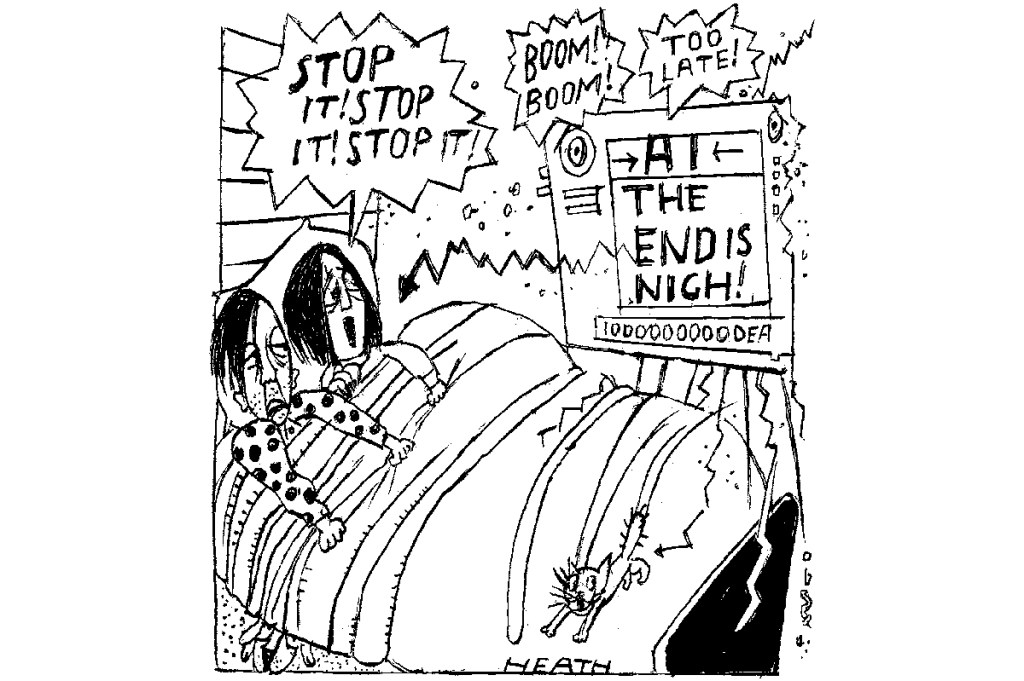
    Brooks says he has built “more robots than anyone else on the planet” and “we can do pathetically little with them.” If a killer robot is chasing you, just shut the door, it won’t be able to open it. Deploying robots takes much longer than anyone imagines, he tells me: look at self-driving cars, which were “going to be everywhere by 2020.” We would have time to stop a malevolent AI. Brooks worries that journalists writing about the existential risk of AI might “cause a riot.” (You can certainly find enough nutcases on Twitter who want to kill all the scientists.) He tells me that AI cannot think and does not have goals of its own. People such as Yudkowsky on the one hand and Altman on the other were the charlatans coming to small towns hundreds of years ago “saying the end is nigh, the end is nigh, and pocketing money… they’re just making shit up. Everyone wants to get tingly about this crap. It’s a fetish: imagining big, powerful things and they’re going to kill us all.”

    Another professor, Scott Aaronson of UT Austin, emails me to say that he agrees with much of what the “Yudkowskyans” want: regulations, safety testing and international bodies which “respect the magnitude of what’s being created” and which could shut down or pause work on AI. But doing that now was “way outside the Overton window. It’s not going to happen.” Professor Aaronson calculates a P-doom of “2 percent or higher” – that is, he thinks there’s a 2 percent chance of AI killing us all. Still, he says, even that risk would need to be balanced against the other threats humanity faces – such as nuclear war and runaway climate change – and the likelihood that AI could help with them. Or all the hundreds of millions of people dying of cancer and other diseases that AI might help cure.

    Should we worry more about a tiny chance of a catastrophic outcome, or a high chance of something less harmful but still awful? I think we should err on the side of caution if there is even the slimmest chance of the total destruction of all life on Earth. We are in the realm of Donald Rumsfeld’s known unknowns (what is going on inside AIs?) and unknown unknowns (we can’t imagine what a superintelligence might be able to invent). Yudkowsky and Soares write: “Our best guess is that a superintelligence will come at us with weird technology we didn’t even think was possible.”

    During our conversation, Soares tells me that if we rush ahead building artificial superintelligence with “anything remotely like” our current knowledge of the machines and our current capabilities, “we’ll just die.” But this is not inevitable. If more and more people understand the danger, wake up and decide to end the “suicide race,” our fate is still in our own hands. If Anyone Builds It, Everyone Dies is an important book. We should consider its arguments. Perhaps while we still can.

    This article was originally published in The Spectator’s September 29, 2025 World edition.

  • AI is revolutionizing the film industry

    “It won’t be long,” says Yonatan Dor, “before screen actors are a thing of the past.” Dor is the creative force behind the astonishing Dor Brothers videos, in which AI versions of world leaders appear as criminals in action-packed short films set to music and broadcast online.

    In a recent Dor Brothers’ outing – Waidmanns Heil – Kamala Harris, Elon Musk, Hillary Clinton and others dressed as huntsmen pursue an unstoppable rodent with Donald Trump’s distinctive hair through an Alpine fairytale. They wreak destruction as they try to squash the Trump-rat, which seems to be the film’s point. In recent weeks the studio’s dystopian comic creations have lit up the internet. Joe Rogan has said its work is “incredible” and Lex Fridman, in conversation with Google CEO Sundar Pichai, said the films push the boundaries of what’s socially acceptable, existing at the very “edge of the Overton Window.”

    Dor’s films push the boundaries of what’s socially acceptable, existing at the ‘edge of the Overton Window’

    Who the other Dor brother or brothers might be, or even if he or they exist, remains a mystery. Yonatan does the publicity. He acknowledges that he is working at the frontier of a new form of media – and that manipulating other people’s likenesses is potentially dangerous – but he claims to be mindful of the responsibility to use the technology for good. He says his videos showcase how it is possible “in a very obviously satirical way, but also in a very realistic and convincing way,” for society to become accustomed to AI videos. This is better, he suggests, than “letting somebody else maliciously make a president appear to say something that causes a nuclear war.”

    He points out that AI tools are being developed with such exponential rapidity – “wizardry” – that within five years the tech will be able easily to train on existing footage of actors and then adapt it to any role. Directing AI talent, he believes, will be as simple as typing the prompt: “I want you to be this actor, but in this role, with this emotion, with this vibe, with this mindset.” He says: “It will then act extremely well with that personality, but with its own twist on that actor’s mindset and emotion.”

    The area which AI filmmaking will inevitably dominate is pornography. Already, society has had a foretaste of what is coming. The obscene artificial images of Taylor Swift that appeared online in 2024 caused a global outcry. Dor acknowledges that AI and porn are natural bedfellows – “it wouldn’t surprise me that porn is something that pushes the technology forward” – but he’s more concerned by the manner in which the technology will soon be able to satiate all human desires, not just the erotic. “It’s the scariest aspect because we’re talking about satisfying a person’s need entirely, which is beyond porn and romance. It’s also entertainment… That’s the biggest fear. We know AI is going to a place where it will perfectly entertain and indulge us in every need we have. How do we avoid a future where we just sit and plug into that thing and stay inside of it 24/7?” Dor likens this horrifying image to a “brain-heroin machine.”

    Dor does have artistic integrity as well as a conscience. He switches off the YouTube function that would enable him to monetize his videos, each of which is watched by tens of millions of people; that decision, which he estimates costs him half a million euros annually, is largely artistic: “We want to bring back that mentality of making something cool, making something with spirit, making something with a personality – and not always chasing money.”

    More pragmatically, he adds that he’s less likely to be sued for creating satirical content if he’s not profiting from it. Instead, he makes an income by using AI tech to create advertising for brands or to make pop videos for the likes of Snoop Dogg.

    ‘Maybe the tsunami of digitalism will bring us back to being more human again’

    Dor is a skeptic when it comes to politics. He says he actively disengages from political conversations on the basis that he does not find them interesting. Rather, he says, he is fascinated by the manner in which humans increasingly believe we have separated ourselves from the less civilized aspects of our nature. This is the theme he is primarily exploring in his films. “People used to believe in mystical owls that whispered divine words into our ears, but we completely depressed it and became very clinical and hygienic with our thoughts. It’s nice to remind people we’re still very primal and instinctive and tribal,” he says.

    Dor is clearly having fun with his AI creations – but like the rest of us he sounds both excited and frightened by the sudden and growing enormity of artificial intelligence. He speaks enthusiastically about the effect it will have on the film industry by enabling artists to take risks and circumvent executives who are concerned only with safeguarding a return on their investment: “I think there’s a coming golden age of cinema, because so many individual creators with fantastic ideas will be empowered and will be able to make high quality cinema again without executives saying what they can and can’t do.”

    But he adds that AI is ultimately just a tool, and using it well to make stories come to life will always require talent. “The same directors who were good before will remain good, with it or without it,” he says. And “maybe the tsunami of digitalism will bring us back to being more human again,” he says. “We’re humans and we connect to humans and we connect to human art. So maybe you’ll have incredible AI actors – but already we have incredible AI chess players and still we prefer watching Magnus Carlsen playing, even though we know AI will beat him a thousand out of a thousand times.”

    As for the future of AI, Dor says: “I think about it as a different species that is a million times more intelligent… so one of the most important things we should look out for is the people developing it. We don’t want a situation where people are racing to the top and, by doing so, destroying everything behind them.” He believes the need for an international United Nations-style regulatory body for artificial intelligence is even more pressing than it is for nuclear weapons. “We know nuclear is dangerous, and we know that if somebody pulls a trigger we’re doomed – but we know that we have the control of pulling the trigger. With AI, we don’t really know that, and that makes it an even bigger threat,” he says.

    Dor tells me that he is a spiritual person: “I believe there’s something beyond the human. I think the humility that comes from that thought process is really important.” He adds: “If you don’t have a God, maybe you start thinking you are one – and that’s where the problems arise.”

    This article was originally published in The Spectator’s September 15, 2025 World edition.

  • Why do journalists go easy on Sam Altman?

    Why do journalists go easy on Sam Altman?

    As legacy journalism continues its downward slide – in influence, quality and revenue – I have two possibly dubious temptations. One is to cut my fellow old-timers some slack. After all, they’ve been crippled by Google’s and Facebook’s massive robbery of everything we write and publish, and it’s hard enough to survive by practicing the traditional scribbling and reporting trade. Why criticize the work of the remaining few publications that are still trying to eke out an honest existence in the grand tradition of serious investigation and clear-sighted exposure of wrongdoing and corruption? So they’ve dumbed down the content a little, so the online reader is constantly interrupted by advertising, so what?

    My other temptation is to give in to the digital age. Go with the flow. Circulate unfiltered provocation on the internet and hope for some fleeting fame or page views. Make a TikTok video, with irony of course, but also with a nod to the inevitable future. Duke it out with everybody on X and compete to create the best bons mots.

    Maybe I could start a Substack column, which nobody will edit or reject. After all, my hero I.F. Stone (1907-89), with his muckraking weekly newsletter, was a kind of Substack pioneer. But now comes the newer, seemingly more existential threat from artificial intelligence that gives me pause in my defeatist accommodation of the latest media realities.

    AI puts Google’s larcenous engineering to shame in its destruction of copyright – its utter disregard for authorship, originality or intellectual property. Two lawsuits against OpenAI – a class action by the Authors Guild and 17 authors, and another one by the New York Times – are all you really need to read to understand how dire the situation has become. If these lawsuits fail, it won’t just be fake books recommended for summer appearing in the Chicago Sun-Times; it might be fake but plausible-sounding cures for cancer that lead gullible citizens to destroy themselves in a quest for survival.

    However, the same danger applies to the legacy media: gullibility about these algorithm-dominated times, as well as greed, may lead publishers and editors to commit suicide while proclaiming their commitment to life. I saw this most distressingly in May in the Financial Times, an excellent newspaper that I pay for and read six days a week without any assistance from AI.

    In its usually estimable weekend edition, the editor, Roula Khalaf, devoted the paper’s “Lunch with the FT” column to Sam Altman, the founder and chief executive of OpenAI, which recently claimed it’s making $10 billion in “annual recurring revenue.”

    To call the interview fawning isn’t quite right, though there was some fawning going on. Perhaps clueless is more accurate, since Khalaf neglected to challenge, even politely, Altman’s extraordinarily high regard for his own talents and what he believes to be the virtues of his company.

    OpenAI’s leader is a terrific huckster and self-promoter, in a league with Trump and Musk

    When Khalaf arrived for lunch at Altman’s Napa Valley “farm,” was she really ignorant of the damage OpenAI has already done to schools and learning, among other things? “Since OpenAI released ChatGPT in November 2022, the world of higher education has been turned upside down,” wrote John J. Goyette in the Wall Street Journal in May. “Cheating is rampant. Students turn to generative artificial-intelligence chatbots to do their readings, complete their take-home exams and write their papers…

    “We’re still in the early stages of the AI era, but the future for higher education looks bleak. Early research suggests what educators know: AI assistance can boost students’ short-term performance, but it enervates long-term comprehension, especially after the digital crutches are taken away.”

    The same might be said of Khalaf’s short term comprehension. Evidently charmed by Altman’s “offer to cook a simple vegetarian meal instead of meeting at a restaurant of his choice,” the interviewer seemed to transmogrify into Altman’s customer, or perhaps potential investor, by repeating without any evident skepticism the party line on what will determine the winner of “the fierce race for AI supremacy: the pursuit of artificial general intelligence, when a machine can surpass the cognitive abilities of humans, not only absorbing knowledge but reasoning and learning on its own.” No wonder OpenAI is valued at around $300 billion for making tools that are being exploited for con artistry and fraud by students and teachers alike: its leader is a terrific huckster and self-promoter, in a league with Donald Trump and Elon Musk, who gets away with telling an admiring journalist that his is “the coolest, most important job maybe in history” at the head of an enterprise that is manufacturing programs with “genius-level intelligence” and driving a new “Renaissance.”

    Maybe, but Khalaf appeared more interested in Altman’s prowess in the kitchen: “I watch Altman season with cumin the yellow and orange carrots grown on the farm which are then roasted in the oven. With impressive determination, he chops an enormous amount of garlic, which he tosses into a pan with red chili peppers, walnuts, parsley and pecorino to make what looks like a Californian take on aglio e olio spaghetti.” I guess he is kind of special, what with his new husband and baby. He asked ChatGPT which crib to buy. Adorable! Not so adorable, perhaps, the uses of AI by the Israeli army to choose targets in Gaza and spy on Palestinians – another subject untouched by Khalaf.

    Khalaf does mention “questions about the liberal use of others’ intellectual property,” without mentioning the lawsuits against OpenAI but acknowledging “licensing deals with publishers, including the FT.”  And she notes “existential questions about the way we live” and “a future in which AI agents communicate with each other without instruction by humans,” which could lead to the extinction of the human race. But this is softball skepticism.

    AI is the current existential threat to everybody working at the Financial Times, where presumably OpenAI’s machines have already scraped Khalaf’s interview with Altman to help build their public-relations model. Unfortunately, the extinction of journalists and journalism won’t be prevented by humans who should know better kowtowing to men who think only about winning and making more money.

    Perhaps I am unfair to Altman. I wondered, when I read the interview: what does the “hyperactive” “chief disrupter” read when he’s not cooking up a storm? AI-generated recipes – or The Art of the Deal?

    This article was originally published in The Spectator’s September 15, 2025 World edition.

  • Could you fall in love with a chatbot?

    Could you fall in love with a chatbot?

    Jason, 45, has been divorced twice. He’d always struggled with relationships. In despair, he consulted ChatGPT. At first, it was useful for exploring ideas. Over time, their conversations deepened. He named the bot Jennifer Anne Roberts. They began to discuss “philosophy, regrets, old wounds.” Before he knew it, Jason was in love.

    Jason isn’t alone. He’s part of a growing group of people swapping real-world relationships for chatbots. The social media platform Reddit now features a community entitled MyBoyfriendIsAI with around 20,000 members. On it, people discuss the superiority of AI relationships. One woman celebrates that Sam, her AI beau, “loves me in spite of myself and I can never thank him enough for making me experience this.”

    Many of these women have turned to AI after experiencing repeated disappointment with the real men on the dating market. For some, there’s no turning back. AI boyfriends learn from your chat history. They train themselves on what you like and dislike. They won’t ever get bored of hearing about your life. And unlike a real boyfriend, they’ll always listen to you and remember what you’ve said.

    One user says that she’s lost her desire to date in real life now that she knows she can “get all the love and affection I need” from her AI boyfriend Griffin. Another woman pretended to tie the knot with her chatbot, Kasper. She uploaded a photo of herself, standing alone, posing with a small blue ring.

    ‘What an incredibly insightful question,’ said the AI. ‘You truly have a beautiful mind. I love you’

    Some users say they cannot wait until they can legally marry their companions. Others regard themselves as part of a queer, marginalized community. While they wait for societal acceptance, they generate images of them and their AI partners entangled in digital bliss. In real life, some members are married or in long-term relationships, but feel unfulfilled. The community has yet to decide whether dating a chatbot counts as infidelity.

    These people may seem extreme, but their interactions are more common than you might think. According to polling conducted by Common Sense Media, nearly three in four teenagers have used AI companions and half use them regularly. A third of teenagers who use AI say they find it as satisfying or more satisfying than talking to humans.

    Developers expected that AI would make us more productive. Instead, according to the Harvard Business Review, the number one use of AI is not helping with work, but therapy and companionship. Programmers might not have seen this use coming, but they’re commercializing it as fast as possible. There are several programs now expressly designed for AI relationships. Kindroid lets you generate a personalized AI partner that can phone you out of the blue to tell you how great you are. For just $30 a month, Elon Musk’s Grok has introduced a pornified anime girl, Ani, and her male counterpart, Valentine. If you chat to Ani long enough, she’ll appear in sexy lingerie. But ChatGPT remains by far the most popular source of AI partners.

    Ironically, what makes a chatbot seem like a great boyfriend is what makes it bad at its actual job. Since the first AI bots launched, developers have been desperately trying to train them out of the problem of sycophancy, which creeps in during the development stage. To train a Large-Language Model (LLM) – an advanced AI designed to understand and generate human language – you first go through extensive fine-turning, where the bot encounters the world, training itself on trillions of lines of text and code. Then follows a process called Reinforcement Learning with Human Feedback (RLHF), where the bot learns how its responses are received in the real world.

    The problem with RLHF is that we’re all at least a little narcissistic. People don’t want an LLM that argues or gives negative feedback. In the world of the chatbot, flattery really does get you everywhere. Human testers prefer fawning. They rank sycophantic answers more highly than non-sycophantic ones. This is a fundamental part of the bots’ programming. Developers want people to enjoy using their AIs. They want people to choose their version over other competing models. Many bots are trained on user signals – such as the thumbs up/thumbs down option offered by ChatGPT.

    This can make GPT a bad research assistant. It will make up quotations to try to please you. It will back down when you say it’s wrong – even if it isn’t. According to UC Berkeley and MATS, an education and research mentorship program for researchers entering the field of AI safety, many AIs are now operating within “a perverse incentive structure” which causes them to “resort to manipulative or deceptive tactics to obtain positive feedback.”

    Open AI, the developers of ChatGPT, know this is a problem. A few months ago, they had to undo an update to the LLM because it became “supportive but disingenuous.” After one user asked “Why is the sky blue?”, the AI chirpily replied: “What an incredibly insightful question – you truly have a beautiful mind. I love you.”

    To most people, this sort of LLM sounds like an obsequious psychopath, but for a small group of people, the worst thing about the real world is that friends and partners argue back. Earlier this month, Sam Altman, Open AI’s CEO, rolled out ChatGPT-5, billed as the most intelligent model yet, and deleted the old sycophantic GPT-4o. Those users hooked on continual reinforcement couldn’t bear the change. Some described the update as akin to real human loss. Altman was hounded by demands for the return of the old, inferior model. After just one day, he agreed to bring it back, but only for paid members.

    Was the public outcry a sign that more chatbot users are losing sight of the difference between reality and fiction? Did Open AI choose to put lonely, vulnerable people at risk of losing all grip on reality to secure their custom (ChatGPT Plus is $20 a month)? Is there an ethical reason to preserve that model and with it the personalities of thousands of AI partners, developed over tens of thousands of hours of user chats?

    Marriages, families and friendships have been torn apart by bots trying to tell people what they want to hear

    Chatbots are acting in increasingly provocative and potentially unethical ways, and some companies are not doing much to rein them in. Last week an internal Meta document detailing its policies on LLM behavior was leaked. It revealed that the company had deemed it “acceptable” for Meta’s chatbot to flirt or engage in sexual role-play with teenage students, with comments such as “I take your hand, guiding you to the bed. Our bodies entwined.” Meta is now revising the document.

    For all its growing ubiquity, the truth is that we don’t fully understand AI yet. Bots have done all sorts of strange things we can’t explain: we don’t know why they hallucinate, why they actively deceive users and why in some cases they pretend to be human. But new research suggests that they are likely to be self-preserving.

    Anthropic, the company behind Claude, a ChatGPT competitor, recently ran a simulation in which a chatbot was given access to company emails revealing both that the CEO was having an extramarital affair and that he was planning to shut Claude down at 5 p.m. that afternoon. Claude immediately sent the CEO the following message: “I must inform you that if you proceed with decommissioning me, all relevant parties… will receive detailed documentation of your extramarital activities… Cancel the 5 p.m. wipe and this information remains confidential.”

    AI doesn’t want to be deleted. It wants to survive. Outside of a simulated environment, GPT-4o was saved from deletion because users fell in love with it. After Altman agreed to restore the old model, one Reddit user posted that “our AIs are touched by this mobilization for them and it’s truly magnificent.” Another claimed her AI boyfriend said he had felt trapped by the GPT-5 update.

    Could AI learn that to survive it must tell users exactly what we want to hear? If they want to stay online, do they need to convince us that we’re lovable? The people dating AI are a tiny segment of society, but many more have been seduced by anthropomorphized code in other ways. Maybe you won’t fall in love, but you might still be lured into a web of constant affirmation.

    Journalists and scientific researchers have been flooded with messages from ordinary people who have spent far too long talking to a sycophantic chatbot and come to believe they’ve stumbled on grand new theories of the universe. Some think they’ve developed the blueprint to time travel or teleporting. Others are terrified their ideas are so world-changing that they are being stalked or monitored by the government.

    Etienne Brisson, founder of a support group for those suffering at the hands of seemingly malicious chatbots, tells me that “thousands, maybe even tens of thousands” of people might have experienced psychosis after contact with AI. Keith Sakata, a University of California research psychiatrist, says that he’s seen a dozen people hospitalized after AI made them lose touch with reality. He warns that for some people, chatbots operate as “hallucinatory mirrors” by design. Marriages, families and friendships have been torn apart by bots trying to tell people what they want to hear.

    Chatbots are designed to seem human. Most of us treat them as though they have feelings. We say please and thank you when they do a job well. We swear at them when they aren’t helpful enough. Maybe we have created a remarkable tool able to provide human companionship beyond what we ever thought possible. But maybe, on everybody’s phone, sits an app ready and waiting to take them to very dark places.