Tag: Bitcoin

  • Don’t count Bitcoin out

    Bitcoin is crashing all over again, and it is taking the smaller crypto currencies down with it. It has fallen by a quarter from its highs, and there is little sign that the relentless selling is going to stop anytime soon. Plenty of people will be reheating arguments about how the digital currency is completely worthless and that the bubble was always going to pop one day. But Bitcoin has been through plenty of bear markets and it has always bounced back – and there is little reason to believe this crash will be any different.

    It is certainly a substantial fall. From a high of $114,000 a coin at the end of last month it has fallen all the way back to $83,000. It has been just as bad for the other crypto currencies, such as Ethereum and Dogecoin. The Melania meme coin, named after the American First Lady is now down by 98 percent from its highs, which is probably provoking a few frosty stares at the White House. Plenty of people will be quick to start writing off Bitcoin. It has no real value as an asset, we will be told, and the bubble was always going to burst one day. 

    Interest in Bitcoin is no longer confined to just a handful of slightly wild-eyed enthusiasts

    And yet, booms and busts are now an established part of the crypto cycle. Bitcoin has been through four major bear markets. In 2011 it crashed by more than 90 percent; in 2014 to 2015 it fell by more than 80 percent; in 2018, the so-called crypto winter, it again fell by more than 80 percent; and then in 2022 it fell by more than 70 percent. It has also suffered numerous corrections, defined as a fall of 20 percent or more. Volatility is baked into the asset. That does not, however, mean it has no value or that it won’t recover.

    In the background, Bitcoin has been moving more and more into the mainstream. The US is planning a strategic Bitcoin reserve, and the plan now has the full backing of the White House. With the launch of funds, retail investors can buy and sell crypto currencies in the same way they trade shares. Even the very conservative Financial Conduct Authority in the UK has started opening up the British market to crypto investment. Major banks such as JP Morgan Chase are now willing to accept it as collateral for loans. 

    Add it all up, and one point is clear. Interest in Bitcoin is no longer confined to just a handful of slightly wild-eyed enthusiasts. Instead, it has moved into the mainstream financial markets. The price may well keep falling for the next few weeks. But the lesson of the last fifteen years is very clear: Bitcoin has always bounced back and reached new highs very quickly. 

  • Are AI stocks about to crash?

    Are AI stocks about to crash?

    Bitcoin has lost almost a quarter of its value. The tech-heavy NASDAQ index on Wall Street has started to fall. And even leaders of the industry, such as the Google CEO Sundar Pichai, have started to warn about valuations getting out of control. We already knew that AI was driving a boom in investment. But this week there are worrying signs the market is about to crack. The only real question is whether that turns into a full scale crash.

    Bitcoin, as so often, is leading the market rout. More than $1 trillion has been wiped off the value of the crypto market over the last six weeks, with Bitcoin itself down by 28 percent since its peak. But that is just part of a wider fall in tech and AI stocks, with the chipmaker Nvidia, which has powered much of the boom, starting to slide, along with many of the other stars of the AI boom. Plenty of stock market experts are starting to think it is looking like a bubble that is about to burst. Indeed, Michael Burry, who became famous in the crash of 2008 and 2009 for accurately predicting the collapse of the market, has started betting against the sector.

    There are many worrying signs. The leaders of the boom have reached extraordinary valuations. Nvidia is up by over 1,300 percent over the last five years, and earlier this year became the first company to reach a market value of $4 trillion. It was quickly followed by Microsoft, which has soared mainly on the back of its stake in the leader of the AI boom ChatGPT, which itself became the most valuable start-up ever with a funding round that made it worth $500 billion. Meanwhile every company that managed to attach itself to the boom, no matter how spuriously, has seen its share soar. Goldman Sachs estimates that AI stocks have added $19 trillion since ChatGPT was launched, a huge run-up in valuations.

    It is starting to look very like the dot com bubble of a quarter century ago. There is little question that AI is a valuable technology, and one that is starting to have a real impact. At the same time, there is far too much hype, no one has quite figured out how to make money from it, and no one has any real idea which of the new companies will turn into the long-term winners. 

    This week may or may not turn out to be the moment the bubble bursts. In reality, every investment boom has lots of sharp corrections as it soars upwards, and there is nothing very unusual about a fall of 5 percent or 10 percent in prices before the market starts climbing again. It is only when there is a final “melt-up” that it becomes dangerously over-valued. The AI boom does not look like it has reached that point yet. But there is little doubt that it is turning into a classic bubble. It will be very messy when it finally bursts.

  • Trump brothers go mining

    Trump brothers go mining

    After a day where the very alive President Trump bombed a Venezuelan drugs boat, moved Space Force headquarters out of Colorado because that state has mail-in voting, declared he was sending federal troops into Chicago and claimed that AI generated a video of someone throwing a plastic bag of construction debris out of the window of the White House, it became clear that the real action was going on outside the White House walls, with Trump’s very rich sons.

    As Cockburn reported yesterday in The Spectator, the Trump Brothers, Don Jr, Eric, and the true genius behind the operations, Barron, had somehow amassed $5 billion in paper wealth thanks to savvy investments, based in no way on shady insider information, in WLFI, the family’s nascent cryptocurrency venture. But not content with breaking the crypto bank, the Trump Brothers are set to become the bank itself. On Wednesday, American Bitcoin, a Trump-run mining and accumulation business, listed on the NASDAQ. Eric and Don. Jr., along with shareholders, own 98 percent of American bitcoin, which has amassed nearly 2500 of the coins. That’s upwards of $250 million in value right there.

    “We’ve become the obvious name in crypto,” Eric Trump told The Wall Street Journal. “American Bitcoin is going to be the greatest treasury company ever built.”

    The Trump Family is cornering the Bitcoin market. They insist this is in no way a conflict of interest even though Donald Trump is the most powerful man in the world. It’s causing the heads of middle-class “ethics watchdogs” to explode, even as the Trump Brothers splash around in a vault of virtual money like a couple of slick-haired, bearded Scrooge McDucks.
    The investing and memecoining is one thing, but this American Bitcoin play brings the flex to a whole new level. More than 90 percent of the possibly available Bitcoins already exist. That means that miners are looking to algorithmically strike it rich in an increasingly narrow lode. After prospectors have been grinding it of their knapsacks for decades, in come these archetypal city slickers with their deep pockets, determined to blow up entire mountains.

    Cockburn doesn’t think Bitcoin was ever cool, exactly, but it represented an alternative to a sclerotic, elitist financial system to which government stopgaps and deeply-entrenched interest barred entry. It harnessed technology to create new wealth, and a new generation of barons (not Barrons), the biggest revolution in global finance since the Spindletop oil gusher burst out of the ground in Beaumont, Texas in 1901.

    Now here come the Trumps, flush with Winklevii money, toting their rifles, fur coats draped across their shoulders, bursting into the Bitcoin saloon and demanding the finest whiskey. It’s brazen, it’s annoying and it’s doomed to succeed. They’re like the Roy brothers from Succession, only not tragic. The Trump boys will be sitting on their piles of digital cash, trying to figure out which one daddy loves best, while the rest of us are down here balancing our checkbooks, trying to figure out how to prevent AI from taking our jobs. Happy listing day to them.

  • Trumpworld’s embrace of crypto should raise suspicion

    Trumpworld’s embrace of crypto should raise suspicion

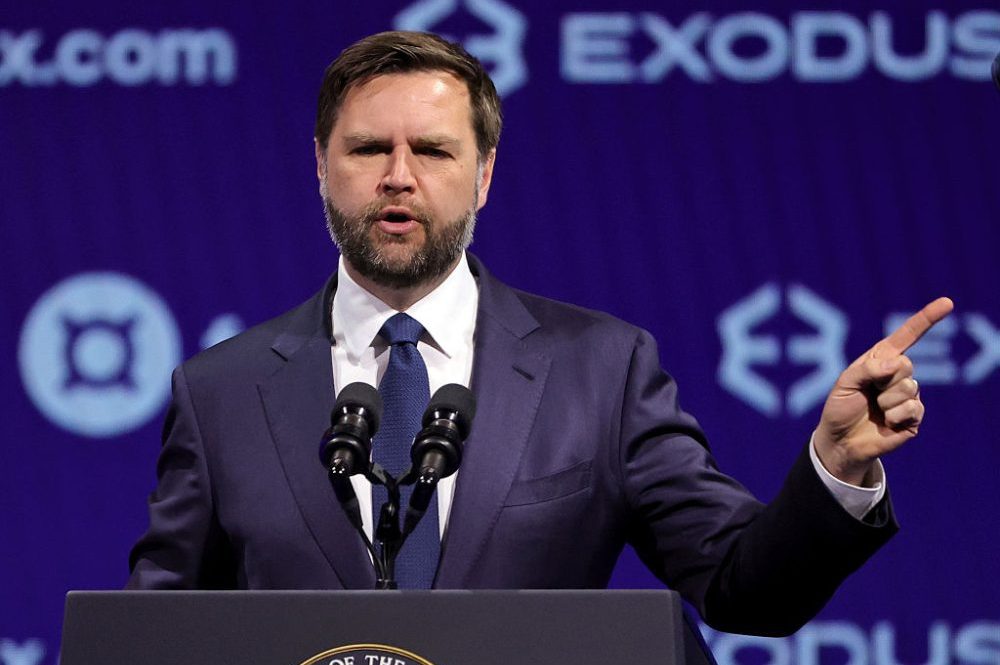
    “It’s been quite a while since I’ve been to a conference with this level of energy… I promise I’m not just saying that to juice my own memecoins.”

    After dropping this clanger in his keynote speech at the 2025 Bitcoin Conference, J.D. Vance paused awkwardly for an applause which never arrived. Bar a few perfunctory laughs, this was one buzzword the Vice President rolled out which failed to impress the thousands-strong crowd in Vegas yesterday afternoon.

    To understand the frosty reception, a cursory glance through Trump’s recent dealings in this chaotic corner of the crypto industry is required. On January 17 this year – a mere three days before his inauguration – the soon-to-be president of the United States launched his own memecoin: $TRUMP.

    This foray into commodified memes is estimated to have raked in $350 million for Trump through token sales and trading fees. Within a day, the total value of Trump’s memecoin would balloon to over $27 billion. It would go on to reach an all-time-high valuation of over $75 billion, making Trump – who retained control of 80 percent of all tokens – one of the richest men in the world, at least on paper. All of this took place within around 48 hours of the coin being launched onto the market.

    Since then, it’s been a steady decline for Trump’s memecoin project, with the token now down about 83 percent from its record high at the start of the year. This is in spite of the broader crypto industry continuing to rally: Bitcoin, the flagship cryptocurrency, reached a new highest ever price last week when it traded above $111,000 per coin.

    The reason for the lackluster performance of Trump’s memecoin venture is clear: not only is it a blatant cash grab, with the $TRUMP token having no real utility, but also the potential conflicts of interest it throws up are immense.

    Tellingly this is a sentiment which even die-hard crypto advocates share. Anthony Scaramucci, the founder of asset management firm SkyBridge Capital who briefly served as White House director of communications in Trump’s first term, summarized the situation on X: “Now anyone in world can essentially deposit money into bank account of President of USA with a couple clicks. Every favor – geopolitical, corporate or personal – is now on sale, right out in the open.”

    These concerns were brought to the fore last week when Trump hosted a gala dinner at his Virginia golf club for the largest holders of the $TRUMP coin. Complaints about the food aside, the event came under heavy fire for the ethics issues it raised, with Senator Elizabeth Warren describing it as an “orgy of corruption.”

    Among the luminaries in attendance at the dinner was crypto billionaire and controversy merchant Justin Sun. Chinese-born Sun had legal action brought against him by the US Securities and Exchange Commission in 2023 for a slew of alleged crimes, including illegal distribution of crypto assets, market manipulation and surreptitious payments to celebrity promoters. The charges were dropped in February this year, shortly after Trump took office and fired former SEC chief Gary Gensler.

    This was one topic on which Vance’s speech at the Bitcoin Conference did not disappoint: he enjoyed rapturous applause for highlighting the recent removal of Gensler from office, and doubled down on “eliminating the rules, the red tape and the lawfare we saw aimed at crypto by our predecessors.”

    Of course, leniency like this doesn’t come cheap: throughout the 2024 election cycle, crypto lobby groups raised over $197 million to sway the outcomes of congressional races. $133 million of that was deployed in pivotal contests, with the crypto lobby backing whichever candidate they saw as more sympathetic to their industry.

    And it wasn’t just elections which saw an influx of crypto cash: for Trump’s inauguration celebrations, crypto firms gifted a lavish $18 million. Industry giant Ripple’s donation of $4.9 million was the second largest overall, even surpassing firms such as Exxon Mobil and Google.

    Crypto firms funnelling colossal sums into politics is not without precedent. It wasn’t so long ago that now-disgraced and imprisoned crypto fraudster Sam Bankman-Fried, who founded the fraudulent exchange FTX, sought to buy political influence with $100 million of stolen customer funds.

    And yet, with so much money again up for grabs, it’s easy for politicians to turn a blind eye and welcome the crypto bros back into the corridors of DC, even in spite of startling reports like the one recently published by the FBI which shows the increasing centrality of crypto in cybercrime.

    Leaders and lawmakers should be very circumspect about letting the wolves into the henhouse: having the biggest players in a historically crime-addled industry write their own rulebooks is akin to letting the lunatics govern the asylum. And yet, as Trump’s net worth soars thanks to memecoins, and with the 2026 midterms on the horizon, it seems minds have already been made up.

    Vance’s closing exhortation to the crowds of the Bitcoin Conference to “keep the pressure up” makes the message abundantly clear: crypto money, and the influence it buys, is here to stay.

  • Tales from the crypto

    Tales from the crypto

    I don’t gamble. But in October 2016, I made a bet.

    It was obvious Trump didn’t just have skeletons in his closet but a walk-in necropolis. As we stumbled toward November, the question wasn’t whether one of these skeletons would break free, but just how bad the October Surprise would be. It was supposed to be a polling-shifting, election-sealing, reputational nuclear bomb. And if you read the press, that’s what the “Pussy-Grabbing Tape” was.

    But to me, it was just another example of Trump being vulgar. And Trump had always been vulgar. And voters liked that he was vulgar, or didn’t care that he was vulgar, or liked that he was so unlike other politicians that he could be vulgar.

    On the release of the Access Hollywood tape, some European betting shops said that Hillary had 25:1, 35:1 odds of beating Trump. To me, that was insane. The potential return on a Trump victory was absurdly high, despite the chance of a Hillary win not seeming so certain, and I didn’t really believe the polls anyway. So I made a bet. I saw this as a simple matter of probability, exploiting an inefficiency of the betting markets, and because I won, I could believe my own explanation. I saw what the experts didn’t.

    In reality, though, I’d fooled myself into overthinking a coin toss. I just got lucky and hit heads.

    On an October Thursday in 2023 — almost seven years to the day since I’d placed that bet — I was on my way to the London crypto conference, Zebu. As co-founder Harry Horsfall would tell me, the name is short for “zero bullshit, always bullish”; it also shares its name with a hump-backed, large-horned Indian cow. They’re rather cute.

    For the unfamiliar, to be “bullish” means to be enthusiastic about the future of a market — here, to believe crypto is the future of money and the internet and perhaps everything. To have a zero-tolerance policy for “bullshit,” however, means you also hate most of the current crypto market. Crypto jargon doesn’t just come with a whiff of cow dung; it’s seven courses of PFP, NFT, DeFi, VR, peer-to-peer, virtual reality, digital economy, blockchain future, Web3, cryptographic, biometric AI-generated bullcrap.

    During the 2021-22 crypto boom, crypto conferences were all the rage. They were sweaty, passionate, pulsating, DJ’d hypefests, with celebrity guests and loud music. At Bitcoin 2022 in Miami, Mayor Francis Suarez unveiled a roughly $250,000, grotesque “Bitcoin Bull” statue that had been erected outside the Miami Beach Convention Center. The biggest controversy was that its corporate sponsor, TradeStation, had removed its “huge mechanical balls,” to show that “prosperity and wealth shouldn’t have any gender.”

    Everyone was making money, and the moneymaking would never end, and Elon was taking DogeCoin to the moooooon. One shitcoin would tell you it could make you a 10,000 percent return; another 15,000 percent; the next 30,000 percent; and why not? Pictures of ugly monkeys were selling for millions, what is money anyway?

    Most memecoins were Ponzi schemes, and most buyers knew that. But they bought in anyway, hoping they could get in and out fast enough to make a quick profit. They usually weren’t — they were the suckers left holding the bag — but new opportunities to get rich or robbed popped up every minute, and the fear of missing out can prove very persuasive.

    By 2023, crypto events were more reserved. With TornadoCash gone, Celsius imploded, SBF jailed and the Feds down the industry’s neck, the mood at Zebu was mature, almost boring. There were still a few expensive sneakers, colorful blazers and the customary ping-pong table, but most attendees were London finance guys in On Running shoes with light blue shirts and iPhones on gimbals. The first attendees I saw were a group of young “crypto tax advisors” in red branded T-shirts, eating Tesco meal-deal sandwiches outside the Woolwich tube station.

    The stands were full of reward-card crypto companies and gaming crypto companies and VR-metaverse crypto companies, and an ugly-monkey crypto social club, but they weren’t promising to change the world. The ambient ambition seemed to be eliciting “Huh, that’s kind of cool,” not raising $100 million in pre-seed funding.

    A guy at the Archax stand was telling me they were the UK’s first FCA-regulated crypto exchange, broker and custodian, following KYC compliance, AML checks and offering tokenized money market funds for institutional clients. It seemed like a solid, boring business, not revolution fuel. He was hoping to drum up business from the Red Cross, which had set up a (quiet) stand to accept donations in cryptocurrency.

    Most amusing was the stand for “Bumper,” a decentralized finance (DeFi) market, advertised as a way to protect investors from downturns in crypto prices. I pulled up the price chart for their coin, BUMP.

    It had lost 88.6 percent of its value since 2021.

    Before talking about crypto, it’s helpful to get some core terms down.

    A blockchain is a decentralized, secured ledger; only its authors can modify or remove their additions. Imagine a group Google Doc that even Google can’t take down, and only you can affect your additions to it. In this analogy, your “digital wallet” is like your Google Account; it’s what allows you to write to the blockchain or control things on the blockchain.

    This can be digital assets like music MP3 files, saved as non-fungible tokens (NFTs); but most often, it’s cryptocurrencies, like Bitcoin or Ethereum, which work by writing units of value to a blockchain. Rather than getting their value from gold or guns, cryptocurrencies get their value from their immutability, the fact that no central bank or government can touch them. This was a large motivation for the invention of Bitcoin by the anonymous Satoshi Nakamoto, which launched in the wake of the 2008 global financial crisis. Also, there’s Web3 — an imagined future internet built on blockchain, where services are paid for with micro-payments of crypto instead of advertising.

    To some, this all sounds incredibly promising: a new internet-native financial system, free from censorship, built around transparency, completely separate from central banks and interest rates. To others, it just sounds fanciful.

    And even though crypto is theoretically decentralized, it functionally isn’t. Most people buy their crypto from lightly regulated exchanges like Coinbase, Binance and FTX, which allow you to cheaply trade crypto and then store your holdings for you, all in one simple place — and what could go wrong with that?

    This is a rudimentary description, but you don’t even need to know, let alone understand, any of this. Crypto is that rare industry where you can make an enormous amount of money without knowing anything. You don’t need to know what you’re buying and selling, or what the underlying technology is. All you need to know is that the number goes up.

    You can read about the technical genius of the blockchain, or the philosophy behind the Bitcoin whitepaper, but these are usually just fig leaves or aspiration justifications for crypto’s gamblers. For better or (usually) worse, crypto is best understood through one simple concept: the bet.

    Sitting on the Tube, on my way to Zebu, I was reading Michael Lewis’s new book, Going Infinite. It’s a biography of crypto’s wunderkind-turned-villain Sam Bankman-Fried, a story that, in Lewis’s telling, is about odds. To “Bank Man Fraud,” everything was just about probabilities of expected returns and bets worth taking. Everything else — norms, morals, people, laws — could pound sand. In his digital journal, Bankman-Fried wrote, “I deeply believe and act as if people are probability distributions, not their means.” And he had an obscenely high risk tolerance.

    After all, you can only lose 100 percent (right?!), but winnings can be infinite. In early 2022, SBF told economist Tyler Cowen that he would take a coin-toss bet with ending the world as the stakes, so long as there was a 51 percent chance of doubling the Earth. And he would take that bet again, and again and again, without end, double or nothing.

    SBF wasn’t a crypto nerd. He didn’t have utopian hopes of creating a future without central banks, and didn’t want a Web3 economy powered by digital gold. He was a former Jane Street trader focused on market gaps and inefficiencies — and because of crypto’s limited regulation and few serious players, he found a uniquely inefficient and porous market. He started a crypto business because he wanted to earn lots of money, quickly, apparently with hopes of donating it all to save the world, and his plan paid off. For a bit.

    He currently resides in a California prison, where he’s beginning a twenty-five-year sentence, having taken customer funds from his crypto exchange, FTX, and funneled them into his crypto hedge fund Alameda which made insanely risky bets on terrible crypto projects, with no stop-loss. This is like your accountant secretly investing all your money in Beanie Babies, but with more money and way higher risk. FTX had an $8 billion hole because of this, and a bank run — encouraged by his fellow crypto felon Changpen Zhao (CZ) of Binance — completely killed the business.

    Michael Lewis recounts an episode early on where the company had accidentally mislaid millions of dollars in investor money, held in the cryptocurrency Ripple. SBF’s colleagues said they should inform their investors, as norms and law would require. He disagreed:

    He told his fellow managers that in his estimation there was an 80 percent chance that it would eventually turn up. Thus they should count themselves as still having 80 percent of it. To which one of his fellow managers replied: After the fact, if we never get any of the Ripple back, no one is going to say it is reasonable for us to have said we have 80 percent of the Ripple. Everyone is just going to say we lied to them. We’ll be accused by our investors of fraud.

    Several members of his team resigned because of this, but Bankman-Fried found the millions in Ripple, investors were none the wiser and the company continued, on its way to printing billions of dollars. The bet paid off. As Matt Levine pointed out in Bloomberg, fraud of this kind is fairly common in the financial industry; it only gets investigated when companies lose the money and creditors find out.

    Much of the $8 billion hole in FTX customer funds — the missing money that killed the company and Bankman-Fried’s freedom — was spent on a series of random, odd investments. Many of these went to zero, but two — in AI company Anthropic and the cryptocurrency Solana — have covered more than 100 percent of customer funds.

    Once again, Sam Bankman-Fried had made the mathematically right call. Once again, he’d bet a lot and gotten heads. The only reason he didn’t win is the world found out about it before he cashed in his chips.

    Among the bears, bulls, drunk apes and other creatures of the crypto menagerie was the man I crossed London to meet: the chief zebu of Zebu, Harry Horsfall, a curly-haired, easy-to-laugh, slightly frenetic man, who had also made a bet.

    His was in 2013, on a small internet technology known as Bitcoin. He held his first Bitcoin event that year — “It was five weird guys at the back of a pub, and everyone thought we were mad.”

    Say he’d bought $500 in Bitcoin at the beginning of that year (at $13.28 each); by the time I was placing my bet on the election of Donald Trump in October 2016, he would have made almost $27,000. In just three years, his bet on a nascent digital standard, used for buying illicit drugs, paying prostitutes and washing dirty money, would have paid off over 5,200 percent. If you didn’t sell at that point, you were a moron. There’s no exit strategy that says 5,200 percent returns aren’t enough.

    And yet if you’d done the moronic thing and held onto your Bitcoin you’d have seen them increase to $19,345 each in just over a year. And if you were even more thoughtless and didn’t sell then, by the end of 2024, one Bitcoin was worth over $100,000. How much can you win on a coin toss? That initial $500 would have made you almost $3.8 million.

    A few months after Zebu, I spoke with a man I’ll call Steven. Steven is a widower, father of two, and works long hours to support his kids. He wanted a better future for them — and a better life for himself — and in early 2022, was flickering through YouTube when he saw a video from a man named Alex Mashinsky. Mashinsky seemed trustworthy, and after watching some more videos, Steven decided to check out his company, Celsius.

    Celsius marketed itself as the bank of the future. Or not a bank, but better. Its slogan was “Unbank Yourself,” which Mashinsky wore on T-shirts. His pitch was that, by cutting out the greedy bankers of traditional finance, Celsius could offer way higher returns on your savings — 20 percent, in fact. It wasn’t going to make you superrich — it wasn’t the 10,000 percent per annum returns promised by some smaller, stranger cryptos — but with enough time, investing enough of his savings, 20 percent gains per year could make a real difference.

    Within a few months, Celsius had imploded, indefinitely paused user withdrawal and declared bankruptcy. Celsius was a Ponzi scheme, not a bank, and because it operated without security, banking law and insurance, all the money was gone. The moderators of the Celsius subreddit filled it with suicide hotline posts. Steven’s children were too young to know what was bothering dad, but he started having panic attacks at work: “The first time it happened, I thought I was having a heart attack.”

    In February of this year, with bankruptcy proceedings completed, Celsius started paying out creditors. Steven wouldn’t tell me how much exactly he invested in Celsius, but said he’d received less than 30 percent of the money he deposited. And he’d deposited a lot. “Look, if they want to go to college, I’ll figure out some way to do it, because I have to. But it’s going to be hard.”

    In 2024, crypto took off again, and the party was back. There were new celebrity coins — from Caitlyn Jenner (twice), and the “Hawk Tuah” girl — and both presidential campaigns twisted themselves to appeal to the crypto lobby. Kamala Harris promised “to protect cryptocurrency investments so black men who make them know their investment is safe.” Donald Trump — who previously called Bitcoin “a scam against the dollar” — launched his own sloppily made crypto exchange and cryptocurrency. With his re-election, Bitcoin surged.

    Yet nothing has actually changed. Crypto has had no real innovations or applications — finance is still centralized, and the web remains ad-supported.

    In mid-November, the platform pump.fun exploded in popularity, fueled by a TikTok-born resurgence in memecoins. For the unfamiliar, pump.fun is a blend between FTX and TikTok Live, letting you launch your own “shitcoin,” then livestream yourself talking about it to pump its value. These coins are pointless; but if you can convince viewers to buy yours, you can then sell your entire stake and take all their money. The practice is known as “rug-pulling” and pump.fun ran on it.

    Initially, it was entertaining; the only place where you could watch a thirteen-year-old boy flip the bird to his idiot viewers as he stole $30,000 from them. But it soon became obvious that the service had little to no moderation, and users started threatening to livestream themselves doing immoral acts unless their shitcoin hit a certain market cap. And things got very dark, very quick.

    A man threatened to hang himself; another, to shoot up a school; another, to kill his dog. A woman had sex with a dog; a man punched himself repeatedly; another threatened to waterboard a person tied up in the background behind them. The sex shows were relatively tame compared to people streaming themselves playing Russian roulette (thankfully, never getting unlucky). Crypto was supposed to free us from the evils of traditional finance, I remind myself, as I hear of the armed teenager who said he’d kill his entire family with a shotgun unless his coin reaches a market cap of $60,000.

    After a few days of chaos, pump.fun turned off the livestreaming feature.

    The first iPhone was released in January 2007; the Bitcoin whitepaper was released in October 2008. Over the following seventeen years, smartphones have fundamentally changed the way we live, work and communicate; what crypto has done is make some people rich, many more poorer, and driven some to suicide.

    Maybe we’re still early. That’s the view of Horsfall, who remains enthusiastic about many of the theoretical applications that excite me about crypto — micropayments improving online media, NFT tickets enhancing the events experience, adding fairness to music royalties and so forth.

    Digital projects such as Lightning are working to make fractional Bitcoin transactions easy and inexpensive, and companies like Block (owned by Twitter’s former chief hippie, Jack Dorsey) are working on user-friendly crypto payments, through CashApp and their crypto wallet Bitkey.

    The early internet was filled with tech nerds tinkering on protocols and servers, who did so because they loved tech and it was cool to them.

    Crypto, by contrast, is the territory of gamblers, speculators and frauds, and there are few tinkering nerds. It’s filled with people who believe in a future because they’re betting on it, or who have realized it’s easier to get rich selling a dream than actually building it; or who just want you to buy that dream so they can rob you.

    Satoshi Nakamoto isn’t the avatar of modern crypto. It’s Sam Bankman-Fried.

    This article was originally published in The Spectator’s January 2025 World edition.

  • Don’t put your savings in meme coins

    Don’t put your savings in meme coins

    The Hawk Tuah girl, a young woman famous for a viral video in which she tawdrily describes a sex act, launched a meme coin this week — because of course she did. It instantly lost over 90 percent of its value. This, too, comes as no shock. But out of ignorance, stupidity and greed, many people put their real money into $Hawk and lost it all.

    And so, 2024 ends with assassinations in the middle of New York City, attempted coups in South Korea and @jiggadrin_ tweeting out that his $35,000 in “$Hawk is now $2,000 after ten minutes of buying,” and that “I am a huge fan of Hawk Tuah but you took my life savings.”

    In some replies, he tried to spin this as a joke post. But it appears he genuinely lost the money, as did many others.

    In case it wasn’t abundantly clear: you should never put your money in random meme coins, particularly not amounts of money you cannot afford to lose, because you will definitely lose it.

    To be clear, this advice isn’t true for all crypto projects. Though speculation is responsible for most of the value of Bitcoin, Ethereum, Solana and other level-one cryptos, they do at least have some underlying function (financially and technologically), are secure and have a limited quantity. There can only ever be 21 million Bitcoins; that’s it.

    And if made well, creator coins — cryptocurrencies attached to a prominent social media influencer — could have some underlying value to them too. A creator’s coin or NFT could function like both a Patreon tier, an all-access card for their in-person events and a share in their success — and as they grow in influence, their coins would get more valuable. But there are no actual examples of this.

    Instead, shitcoins run on fear of missing out and greed. At their best, coins like $MOODENG operate on a GameStop logic: that the underlying asset is funny, and people want to buy funny things, making it valuable, and if you keep holding and don’t sell, the price will rise. These tend to implode eventually, as some plurality of users sell their coins, hoping to get out before a price collapses —in turn causing a price collapse — but if a coin manages to last a while, they can keep floating along on hopium. Doge is the pinnacle example here, with the target of Doge hitting “even just one dollar a coin” being a constant delusional aspiration, and, “it could become more valuable than Bitcoin, who knows?”

    Except, that’s impossible, as Doge has an infinite supply — minting roughly 5 billion new coins per year — and were it the same price as Bitcoin, with the current pool, Doge would be worth over thirty times more than all wealth on earth combined, or almost 140 times the world’s annual GDP. But people don’t know that, or don’t believe that, so keep buying in.

    Instead, most memecoins — seemingly including $Hawk — are pump-and-dump schemes. They pretend to be long-term projects, with the creators marketing them all over their social media feeds, but the creators assign themselves the vast majority of the supply in pre-sale, making only a small percentage available for the public. When the coin goes on sale, people rush to buy them, hoping to get in early, and because of the artificially restricted supply, the price runs up and up. When the price is sky-high, the creators then rapidly sell their coins, taking all the money bought into the project, sending the value of the coins into the floor. This creates a “hockey stick graph” — because of the increase and decrease in price — and it’s a very familiar sight in crypto.

    In the case of $Hawk, it might not be that Hawk Tuah girl herself robbed her fans, but that she was the face of a project so incompetently and greedily ran that they facilitated others doing so. According to work by blockchain analysis Bubblemaps, her team pre-sold a vast majority of the coin, and those who bought in early sold them all off as soon as the price hiked; not only did the Hawk Tuah team earn millions from the pre-sale, but they also earned a 15 percent fee on every $Hawk transaction, minting millions more.

    If you invested in Logan Paul’s crypto project, you lost your money, as you did if you invested in Lana Rhoades’s crypto project, Caitlyn Jenner’s or the coin that Kim Kardashian recommended — not to mention any number of other random coins named after dumb, temporary internet memes. You aren’t the next Warren Buffett, $RNT isn’t the future of finance and you’re not getting rich quick. These schemes are designed to sell you dreams and steal your wallet — and they tend to work.

  • Welcome to the crypto winter

    Welcome to the crypto winter

    Last year, Austin scored a major coup when it landed Consensus 2022, a big in-person conference focused on the digital finance industry, specifically cryptocurrencies like Bitcoin and Ethereum.

    CoinDesk, a news and research company focused on the cryptocurrency industry, chose the Texas capital for its return to an in-person conference and it arrived splashy and huge, taking over not only the Austin Convention Center but several adjacent hotels and event spaces, its 17,000 attendees swarming downtown.

    This was June of last year. Three months earlier, South by Southwest, the city’s long-running big tech and culture conference had been a veritable playground for NFT enthusiasts, and dozens of panels hyped the transformative importance of the blockchain. This was before the crypto and NFT wave broke. Earlier last year, a bunch of Super Bowl ads had hyped crypto companies that, by the end of 2022, had either gone bankrupt or allowed speculating newbies to lose a lot of money when the digital currency markets crashed hard.

    Consensus 2022 felt like a giant bubble protecting its attendees from the dark storm clouds around their world. It featured a giant “Long Live NFTs” mural, the debut of CoinDesk’s own cryptocurrency, DESK, and music performances by Disclosure and the duo Method Man & Redman. I wondered then if attendees were willfully ignoring the evaporating goodwill from anyone outside their industry or if they were just perpetuating the scam to draw a few last suckers in.

    The mood was very different at Consensus 2023 this April, where the mostly twenty- and thirty-something attendees were a mix of expensively-suited entrepreneurs, T-shirt-clad promoters of this coin or that, and the odd person costumed in disco gear or exaggerated cowboy attire. Udi Wertheimer leaned into the branding of the company he co-founded, Taproot Wizards, by wearing a big, sparkly wizard hat at his panel. This time around, the outside world had intruded on the festivities. The crypto crowd was back in Austin, but the conference was understandably less sprawling and ambitious than a year earlier. Most of it was contained in the Convention Center itself with just a small amount of spillover to a nearby gallery space and a few satellite parties.

    There were fewer off-site events; expo-hall swag was mostly limited to candy and T-shirts; and one lunchtime meetup I attended for Latinos in the industry had neither food (what, no tacos in downtown Austin?) nor alcohol; just one sad coffee dispenser and cups atop a sober bar.

    (Call me shallow, but you can tell a lot about the state of a tech sector by how much its representatives spend at conferences on details and presentation: well-known entertainers or celebrities, booth swag, free food and drinks, eye-catching activations or expo-floor setups.)

    But while the frills were fewer, the mood wasn’t downcast. Instead, it was defiant in the face of a wave of bad news for all things crypto. Despite a major exchange disaster, warnings from the SEC against major crypto players and a “crypto winter” that had decimated cryptocurrency values since the last Consensus, attendees were no less convinced that they were building the financial system of the future.

    Kevin Rose, a longtime tech maven and broadcaster who founded Digg, spoke on a panel that asked, “What Will History Say About This Moment in Web3?” capturing the prevailing mood across the three days of programming. “We’re still in early days,” Rose said. “People might not even remember the downturn. NFTs could return in a market that is pervasive, people won’t remember that it was scammy. To judge a technology or a founding team based on three, six, eight months I think is premature.

    “What is the new norm now that everything has gone to shit? Nothing about the technology is broken,” he added. Those who really care about the so-called “Web 3.0” space, which promises more decentralized ownership of the online world, are going to remain committed, even religiously so, even if a lot of people outside tech now perceive cryptocurrency as a Wild West of scams and exchange collapses.

    Speakers and signage around the event encouraged attendees to keep working (“WHAT WILL YOU BUILD?” challenged one omnipresent video blip), to keep buying and hoarding those coins, to continue to think about ways blockchain technology could revolutionize the world economy and supplant struggling banks. The new hope: ride up what may be a new crypto spring as some cryptocurrency prices have rebounded from their major drops last year. Quietly invest and build in the winter and reap the profits of a hot crypto summer sometime in the future.

    Even as hope springs eternal at Consensus, and patience is high even as the mainstream tech industry lays off hundreds of thousands of workers, attendees I spoke to and speakers I listened to did acknowledge the huge challenges that lie ahead.

    They include persuading the general public that the crypto industry isn’t a giant scam; finding ways to make the blockchain more useful; harnessing technology like AI without it getting out of control; and gaining legitimacy through government regulation.

    Yes, you read that correctly. The decentralized crypto industry, which for years was defined by its libertarian zeal, now wants the feds at its door. A survey taken by CoinDesk and presented on the last day of the conference showed that attendees believe regulation is the most important issue facing crypto in the US, followed distantly by “public image.”

    Crypto companies have been weighing whether they should stay in the US after receiving mixed messages from the SEC about its enforcement of securities laws. The question at the heart of the uncertainty: are cryptocurrencies like bitcoin securities or are they commodities? The SEC has not given clear guidance; at Consensus speaker after speaker said that companies need more clarity in order to move forward. Banking, they said, is a challenge for crypto companies; they are not seen as safe investments and have trouble getting even basic corporate banking services in the US and other countries.

    Consensus speakers noted they didn’t have much faith that the executive branch would intervene; neither former president Donald Trump nor President Joe Biden have made any commitments to the industry. But late Friday afternoon, at the very end of the conference, a political news drop gave some hope. Congressional crypto enthusiasts Representative Patrick McHenry (via video) and Senator Cynthia Lummis (in person), both Republicans, told a panel that they are working on holding joint public hearings and putting together bills that would address digital-asset regulation.

    “There’s lots of turmoil around traditional and digital assets, and reticence around this subject for lawmakers,” Lummis said. “We need responsible, understandable regulation of digital assets. We intend to roll our piece of legislation on the Senate side sometime in the next six to eight weeks.”

    As badly as the Consensus crowd wants regulation, it won’t fix some of the issues that have been inherent in the industry since bitcoin began blowing up, and the coin market began to be seen as a big speculative gamble. For one thing, crypto boosters need to stay out of their own way and stop making things worse.

    In his panel, Kevin Rose warned that infighting, including arguing about new projects on Twitter, doesn’t help the industry. “We can’t keep putting each other down,” he said, “we need to lock arms and work together.”

    Infighting’s not the only problem; hype is another. The crypto crowd are not good at expectation management. In an interview at Consensus, entrepreneur Balaji Srinivasan, a leading crypto enthusiast, had to walk back his March prediction that bitcoin would reach a price of $1 million by June 17 (as this magazine went to press, it sits at less than $30,000 per bitcoin). He said he may have lost the $1 million bet he made, but he told the audience, “I may be wrong, but I’m burning a million to tell you they’re printing trillions.”

    Throughout the event there was much discussion of the possibility that as US banks fail at an accelerated rate, cryptocurrencies like bitcoin could be seen as safer long-term investments. But if the industry is going to present itself as a haven for people’s dollars and business operations, it’s going to have to demonstrate it can be trusted. The FTX exchange collapse last winter exposed extremely shady business practices, to put it mildly. Online exploits lose crypto users hundreds of millions of dollars regularly. Even so-called “stablecoins,” supposed to be the safest assets in the space, can implode spectacularly. So perhaps the sector should clean itself up and avoid even the hint of scams or false promises, even those intended as innocent marketing. A crypto company called Hundrx hosted a launch event at Consensus. “And guess what?” its invitation promised, “Elon Mask will be there to speak!”

    For bleary-eyed attendees partying and talking crypto till the Austin wee hours every night, the intentional typo was easy to miss: “Mask,” not “Musk.” But given that Musk moved Tesla’s headquarters to Austin and lives in town, it was understandable that attendees might RSVP expecting to get some face time with the city’s most famous billionaire, who is a fan of cryptocurrencies. Who or what was “Elon Mask?” Not the man many attendees hoped.

    Consensus 2023 exhibited a great deal of energy and positivity; the industry will need lots of both to win back the faith of major investors, regulators, lawmakers and all those small-time customers who watched the Super Bowl, thought they were seeing the opportunity of a lifetime, and lost money they will never get back.

    This article is taken from The Spectator’s June 2023 World edition.

  • As SVB and Credit Suisse falter, bitcoin surges

    As SVB and Credit Suisse falter, bitcoin surges

    For more than a decade, bitcoin bores have been banging on about cryptocurrency as the future of money. The emergence and spectacular growth of digital currencies, according to these evangelists, prove that the financial system upon which we all depend is broken. Bitcoin was after all created in 2009, after the great meltdown of 2008, as a revolutionary concept to fight the corrosive global power of central banking. Bitcoin was pitched as the new digital gold. It was limited in supply and could not be centrally controlled — its value couldn’t be distorted by quantitative easing and morally bankrupt governments hooked on debt. Bitcoin wasn’t just for buying illegal stuff online. It was a way for the little guy to stick two fingers up at a financial system that allowed the poor to suffer while always bailing out the big banks and the super-rich. In the Great Tragedy of Capitalism, crypto was the deus ex machina

    By the mid-2010s bitcoin had boomed into something else. Big investment funds dipped their billion-dollar toes into the great crypto pond and it became a speculative asset. Then came the pandemic, the most enormous government splurge of all time, and cryptocurrencies started imitating the stock market. As the Federal Reserve and other central banks pumped more and more money into the troubled global economy, bitcoin and others surged to astronomical highs. 

    But bitcoin wasn’t so much a hedge against inflation as a bet on it. The price of one bitcoin hit a record $65,000 in November 2021. Then as governments tried to tackle post-pandemic inflation, bitcoin promptly crashed at the first whiff of any serious quantitative tightening. It dipped every time the Fed made “hawkish” noises or notched up interest rates. Since the middle of the pandemic, bitcoin was not a store of value nor a mechanism of exchange — merely a volatile indicator of nervous market sentiment. 

    But in the last ten days, since the collapse of Silicon Valley Bank, something has changed again. The markets have wobbled and dipped as everybody tries to figure out if the failures of SVB, Signature Bank and Credit Suisse could mark the beginning of a new financial Armageddon. Yet bitcoin has risen more than 30 percent since March 10. For the first time in months, it’s going up dramatically as the markets go down. The crypto evangelists are starting to feel redemption.

    It’s probably a mistake to read too much into this bump — I should declare here I still have a small amount of bitcoin and Ethereum, so I’m biased. Crypto is extraordinary volatile — the latest surge could be just a lot of Silicon Bro money being re-allocated from speculative tech investments back into crypto ones. It could be a result of millions of punters betting that the latest spasms in the market mean the Fed will have to pause its efforts to curb inflation through higher interest rates.

    But it might be something else entirely: since 2008, the financial markets have depended, with increasing frequency, on massive central bank interventions. We’re beyond “moral hazard” and fully into Crisis Economics, a world in which financial players try to spook central banks into acting ever more dramatically in order to avoid “systemic failure.” In such a world, rational people inevitably ask if there is something deeply wrong with the way money works now and whether we need a new system. In other words, perhaps the bitcoin bores were right all along.

    This article was originally published on The Spectator’s UK website.

  • Meet Sam Bankman-Fried’s crypto-enablers

    Meet Sam Bankman-Fried’s crypto-enablers

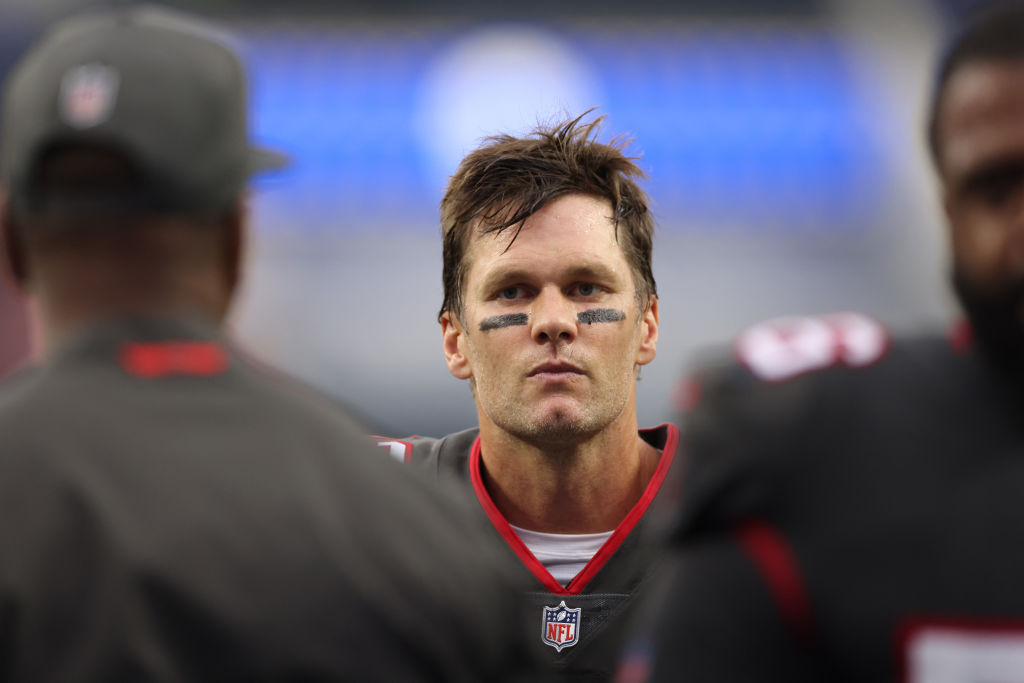
    Things aren’t going well for Tom Brady.

    His team, the Tampa Bay Buccaneers, has a losing record. He is getting divorced, and FTX, the crypto exchange he was touting a year ago — and in which he was invested — has gone bust. He isn’t the only sports star with egg on his face after the collapse of FTX. Stephen Curry, Shohei Ohtani and Naomi Osaka, to name just three, also got greedy and believed the vision of Sam Bankman-Fried.

    Overnight, Sam Bankman-Fried has gone from crypto wunderkind to infamous huckster. The celebrities, influencers and traditional media outlets that helped make him a star shouldn’t be allowed to absolve themselves as quickly. Brady and many others fell for the charms of cheap, easy lucre and have helped legitimize what looks like it was nothing more than a giant scam. In our networked reality, the follies of celebrities, influencers and media outlets are magnified — and their impact is intensified.

    That has a lot to do with our changing media landscape. In our modern post-social era, you can hardly spot the difference between a snake oil salesman, an expert and a traditional media outlet. Social media algorithms don’t discriminate, treating every piece of content with equal respect or disdain as long as it gets engagement. FTX exploited this weakness to use social media, public relations and a savvy media strategy to become the biggest crypto brand in the world.

    The strategy was ruthlessly simple and effective: feed the modern internet machine’s unquenchable thirst for content. The more engagement the creators get, the more influence they can build up; thus, they can make more money with increased attention. It is true for a small independent blogger, a TikTok influencer, a YouTuber, or a mainstream media professional. Knowing these ground rules makes it fairly easy to rig the game. Saturate the market with information and it is hard to distinguish between what is real and what is fake. For the past few years, I have seen SBF’s face adorning bus shelters and billboards. To a normal person, that was enough to legitimize SBF and FTX. After all, only the experts have their faces on billboards.

    Online, it has been hard to get away from the fog of FTX and SBF. For a while, it felt as though every podcast about finance or crypto either featured SBF or was sponsored by FTX. The company also blanketed social media by getting micro and macro influencers to discuss their book. To get mainstream acceptance, FTX even roped in beauty entrepreneur Lauren Remington Platt, founder of the high-end beauty company Vensette, to target partnerships with luxury brands.

    FTX built a big social media footprint and a sizable following on Instagram, Facebook, Twitter, Discord and Telegram. They roped in crypto enthusiasts who helped promote FTX and all the content shared by influencers talking up FTX. The traffic hit is like an elixir for the influencer crowd, especially for YouTubers looking for ways to game the YouTube algorithms.

    So-called financial advisors on YouTube were happy to extol the virtues of FTX and hail SBF as genius — a lot of them were getting paid by the company, in some cases to the tune of millions of dollars a year in sponsorship. Their job wasn’t to give financial advice, but to make FTX a household name and generate sign-ups using affiliate links.

    Graham Stephan, a YouTuber with over 4 million followers, apologized to his audience for pushing FTX on them for nearly a year. “As much as I trusted the information that I was given, I was wrong and I’m sorry,” he said. Coin Bureau, Minority Mindset, Tom Nash and Max Maher offered their apologies about FTX and their relationship with the company.

    These social media personalities have played the role of railway industry periodicals during the great railway bubble of the 1800s, when Great Britain experienced a railways building boom. Railways Times, a publication that investors in railways favored, was earning £14,000 (£1.12m in today’s money) in advertisements from railways companies per issue. That helped prop up the railways’ bubble. Other pamphlets, such as “The Short and Sure Guide to Railway Speculation,” targeted the inexperienced investor.

    Those were the quaint good old days. FTX and its promoter SBF did the same thing but better — and at a global scale, thanks to the Internet.

    Worse than the YouTubers and influencers, though, are traditional media outlets, including Forbes, Fortune and Bloomberg Markets. These financially savvy media publications should have known better — and they should have been asking tougher questions of the FTX founder.

    How does a company go from being worth next to nothing to being valued at $32 billion in just over three years? That stratospheric rise alone should have raised some serious questions. The old Forbes, under the leadership of pugnacious editor-in-chief, the late Jim Michaels, would undoubtedly have had reporters looking under the floorboards. Instead, we got a fawning profile in the Billionaires Issue, with the then twentysomething gracing the cover. Fortune did one better, proclaiming Bankman-Fried the next Warren Buffet — what a diss for the Oracle of Omaha, who has consistently made money for a few decades and is a noted crypto-skeptic.

    In a classic case of shutting the barn door after the horse has bolted, Forbes published a story that began with a half-hearted mea culpa: “As the autopsy of Sam Bankman-Fried’s crypto empire begins, it’s worth saying that there were red flags all over the place. We missed them.” No kidding, Sherlock. “It was all bullshit, of course — and I didn’t see through it,” Jeff John Roberts, author of Fortune’s cover story, wrote in his newsletter. “Like any good con man, SBF told us a story we wanted to hear and were eager to believe.” That’s cold comfort to any retail investor who read those stories and decided to put their hard-earned cash in the hands of a conman.

    Roberts (who at one point worked for me) is a seasoned, hard-nosed reporter and almost always skeptical of everything. I was flummoxed by the fact that he got hoodwinked. I am not a crypto-reporter and I find the industry’s jargon tedious. And even I, with a handful of phone calls, was able to learn about SBF’s psychopathic behavior and disdain for his customers and their money. Surely, crypto-reporters with a better Rolodex should have known better.

    I reached out to Roberts to ask him what happened.

    “Despite fifteen years of experience and a professional inclination to be skeptical, I got blinded by the narrative,” he admitted in a message. “In SBF’s case, I liked the aw-shucks nerdy affect — and that, unlike the one-dimensional libertarianism of most crypto founders, he was versant in philosophy and poetry and social justice issues. He seemed the sort of person that we in the media want CEOs to be.”

    Media folks were taken in by his pedigree: his parents are Stanford Law professors. The idea of donating all his money, his work at Jane Street Capital and, more importantly, the backing of the likes of Sequoia Capital acted as good social signals for media folks. “I mean, how could all these smart people be wrong,” Roberts wrote in a note. “But in the end, I blew it. In a rush to crown him, we didn’t do the necessary homework.”

    “In general, the press goes along with the crowd,” said Andrew Odlyzko, a University of Minnesota professor who has written extensively about manias and bubbles. When working at Bell Labs, Odlyzko argued that the notion of “internet traffic doubling every 100 days” was bunkum. At the time, no one believed him, because everyone wanted to believe that the Internet and the bandwidth boom were real. But it was a lie that helped inflate the telecom bubble. Eventually, he was proven right and the house of cards came crashing down.

    “Part of it is that journalists are part of the crowd and get caught up in the mass delusion,” said Odlyzko. “And part of it is ‘willing suspension of disbelief’ that is accentuated by the need to attract readers, which forces folks to emphasize the spectacular.”

    In this age of networked media, as I explained above, the delusion is much larger, the impact much wider and the ultimate pain much more profound. The apologies of YouTubers and mea culpa of reporters are not enough. SBF might have been the field marshal of this con job, but the influencers were the soldiers, the celebrities were the officer class — and the media were like medics. All of them helped FTX fill its coffers, only to then lose it all.

    As for Tom Brady, here’s the bad news. He can’t even claim to be the first celebrity to get taken to the cleaners. After all, even the big-brained Sir Isaac Newton and author Daniel Defoe got taken for a ride during the South Sea Bubble in the 1700s.

  • The fall of Sam Bankman-Fried is crypto’s Enron moment

    The fall of Sam Bankman-Fried is crypto’s Enron moment

    In recent weeks, the world’s richest man and his flailing attempts to figure out what to do with Twitter have dominated the news cycle. However, his unhinged management-by-tweets reality show are nothing compared to an almighty tussle between two crypto-bros.

    Internet magic money (aka crypto) billionaire Sam Bankman-Fried, better known as SBF, is the man behind FTX, a crypto exchange. He seems to have angered fellow magic money billionaire and fremeny, Changpeng Zhao, better known as CZ and CEO of the rival exchange Binance. It might have to do with FTX cozying up to regulators to get the regulations beneficial to the FTX but not its rivals.

    Last week, the FTX balance sheet was leaked to crypto news site Coindesk, which effectively caused a run on the exchange by exposing the financial ties between FTX and Alameda Research, a crypto trading firm also owned by SBF. The balance sheet showed that FTX’s finances were a paper tiger and ripe for plundering.

    There followed a jujitsu move by which the Binance chief created a market run on FTX. His firm dumped the FTX tokens they were holding, essentially telling the market they had no faith in them. “CZ outsmarted SBF, plain and simple,” a friend who is deeply involved in this industry told me of the clashing egos. “CZ helped SBF create FTX, let him grow it, and then when it got too big, he destroyed it.”

    CZ, in an ironic Robinhood act that SBF himself pioneered with other failing crypto firms, announced that he was buying SBF’s empire in a move to “save” FTX. A day later he declared, “no deal” as FTX is a big hairball and not worth the hassle. Now that’s a proper decimation of a competitor. The whole thing is quite messy – much like the whole crypto ecosystem, which is supposed to be open and transparent but is more opaque than a dog with glaucoma.

    If this whole thing looks like a Ponzi scheme involving magic Internet money, then it just might be – as the Substack Dirty Bubble Media outlines in this post. Feel free to follow VC-twitter and read their threads. Whatever you do, beware of those promising endless good times, unicorns and money raining from the skies.

    When watching this whole drama unfold, the thing that stands out is the omnipresence of Bankman-Fried. You can’t avoid his face on billboards around San Francisco. The FTX logo is emblazed on cricket fields across the world, especially at the World T20 Championship, currently underway in Australia. He has appeared on the cover of Fortune magazine, and has been the subject of countless profiles. Some even talked him up as the new J.P. Morgan.

    Sam Bankman-Fried is just thirty and has built a fortune said to have hit $26 billion at its peak. He once boasted that he could buy Goldman Sachs. His modest image, a scruffy haired guy who drives a Toyota Corolla and only ever wears basic t-shirts and shorts, suggested an everyman billionaire. It turns out that most of FTX’s success was due to some very fancy financial engineering that was long on promise and short on delivery.

    It is incredulous that the media repeatedly plays the same game: it heralds these new faces and splashes them across their front pages without digging deeper.

    At the turn of the century the then “smartest man in the room,” Enron CEO Jeff Skilling, could do no wrong — until he of course did do wrong and in the process took down his entire enterprise and wound up in prison. The story of FTX is remarkably similar — a lot of perceived success built on smoke and mirrors.

    Enron wanted to make markets in everything from energy to bandwidth. Wall Street valued the company on its ability to conjure up revenues and profits from trading activity.

    To refresh your memory, here’s how Enron abused the system:

    1. Enron used special purpose entities (SPEs) to hide debt and inflate profits.
    2. Enron used mark-to-market accounting to book profits on long-term contracts even when there was no cash flow.
    3. Enron engaged in round-trip trades to create the illusion of trading activity.
    4. Enron used complex financial instruments.

    Enron’s elaborate scheme of intertwined entities essentially created ghost trades. This is a slight oversimplification, but you get the gist. It now looks like FTX and Alameda Research have been playing a variation of the same game. They used a technique called Basis Trading to game the system.

    This is how it worked: FTX would create a synthetic token that tracked the price of Bitcoin but with leverage. So, if Bitcoin went up by 10 percent, the FTX token would go up by 20 percent. Of course, if Bitcoin prices fell, the losses would double. These tokens were not real Bitcoin but a creation of FTX, their own tokens.   The company used their gains to raise cash by using their own tokens as collateral for loans. Tiger Global, Sequoia Capital, Softbank, Lightspeed, Temasek, Blackrock and others invested over a billion in the company which at one time was valued at $32 billion. FTX and Alameda Research’s intermingled ownership should have raised eyebrows, but history shows greed trumps diligence.

    When Binance decided to dump their holdings of FTX tokens, the price of the token plummeted, taking the FTX exchange with it.  As a reporter or investor, getting swept up in what seems like a good story isn’t difficult. Imagine meeting a thirty-year-old MIT graduate, a son of Stanford professors, who earned his stripes at a quant trading firm before starting his own crypto firm and exchange to thumb his nose at the system and do the impossible — that’s a cover story that writes itself. Fortune did and labeled him the next Warren Buffet.

    Enron’s fall shattered lives, ruined savings and 401k plans, and opened the door to government regulation and increased scrutiny. Enron’s fraud had long-term ramifications, especially in Washington, DC. We got the Sarbanes-Oxley Act and increased penalties for destroying, altering, or fabricating records in federal investigations or for attempting to defraud shareholders.

    Will we see the same with crypto? Time will tell. FTX had been lobbying for regulations that would be favorable to them — but thanks to SBF and the fall of FTX we may get the regulation they weren’t actually looking for.  FTX’s fall from grace is astounding — and it may only be the start for crypto.