Tag: China

  • China intends to set the rules of a new world order

    China intends to set the rules of a new world order

    Beijing gave us a glimpse of the future this week. Across Tiananmen Square rolled column after column of tanks, missile launchers and robot dogs. Above, sleek new J-35 stealth fighters cut through the smog, together with drones and surveillance aircraft. The centerpiece was unmistakable: gleaming hypersonic and ballistic missiles, designed to extend China’s military reach across continents. Reviewing all this was Xi Jinping, flanked by Russia’s Vladimir Putin and North Korea’s Kim Jong-un. It was military theatre, yes. But it was also a declaration: China is no longer just a regional power. It intends to set the rules of a new world order.

    This was no isolated spectacle. It was the third act in a carefully choreographed summer. First, in July, the BRICS summit in Rio: a “Rio Declaration” with 126 commitments, called for reform that would see less Western influence and more involvement from the BRICS nations – and the general Global South – in international decision making.

    Then, in August, the China-led Shanghai Cooperation Organization’s largest-ever meeting in Tianjin saw Beijing reaffirm the call for a new model of global governance, one that aspired to “true multilateralism” in a clear swipe against the Trump agenda. This included plans for an SCO development bank which analysts saw as yet another move to develop an alternative payment system that could circumvent the US dollar and the power of US sanctions.

    The role of the Victory Day parade was to support Beijing’s political ambitions with a show of its military might. The post-war US-led order has long been underpinned by America being the pre-eminent military power. Now this is no longer the case (at least in terms of quantity, if not quality, given China’s lack of war-fighting experience), the premise of American global leadership and the global application of its liberal order is no longer secure.

    Overall, the message to the world of the last few months is clear: the center of gravity is shifting to Beijing.

    China and Russia, supported by other authoritarian states, are now attempting to build what might be called a Counter-Alignment: an alternative set of rules, laws, values and institutions underpinned by their combined power, but dressed in the rhetoric of multipolar fairness. They seek to achieve this not only through diplomacy but by harnessing technology, geography, and ideology. China’s drive to command the Fourth Industrial Revolution, the Counter-Alignment’s grip on key Eurasian trade routes, and Beijing’s cultivation of dependent states through infrastructure and digital standards all lend substance to a sovereignty-first order that challenges Western primacy.

    India’s position is the most striking. Long cast in the West as the democratic counterweight to Beijing, New Delhi has in fact been leaning into both BRICS and SCO with new enthusiasm. In Rio, Narendra Modi signed up to the bloc’s AI governance framework and echoed calls for equal rights in global rule-making. In Tianjin, he nodded along with Xi on cooperation against cross-border terrorism.

    True, he skipped the martial theatrics of the Beijing parade – unlike Putin and Kim – but the direction of travel is unmistakable. One reason is personal. Donald Trump has repeatedly needled India with fresh tariffs and treated Modi less as a partner than as a supplicant, a humiliation the Indian prime minister has not quickly forgotten. And India is hardly alone. Brazil, South Africa and a clutch of other Global South powers are embracing these Chinese-led forums, giving the Counter-Alignment a veneer of legitimacy that Western capitals dismiss as posturing but much of the developing world hails as overdue reform.

    The contrast with Trump’s own parade in Washington in June could not be starker. Ostensibly marking the US Army’s 250th anniversary, it was a brash, inward-looking jamboree: tanks parked on the Mall, fighter jets roaring overhead, a speech heavy on domestic grievance. Not a single foreign leader attended; the audience was largely red-capped supporters, not heads of state. Beijing’s extravaganza, by contrast, was outward-facing and international, with more than two dozen leaders in attendance. Trump staged a piece of political nostalgia; Xi orchestrated a global summit with missiles attached. One was a rally. The other, a manifesto.

    This all carries an uncomfortable lesson. The institutions and rules of the Western-led order – the UN, NATO, the Bretton Woods system – are being steadily co-opted, challenged and, in places, duplicated. What western politicians still wave away as talking shops, the summits of BRICS and the Shanghai Cooperation Organization are quietly evolving into something more substantial. They now produce development banks, alternative payment systems, and even draft frameworks for AI governance – the slow but deliberate scaffolding of a parallel order.

    Taken together, these initiatives form the basis of a new world system: one that borrows the architecture of the West but seeks to rewire its foundations around sovereignty, multipolarity, and Chinese leadership.

    The parade in Beijing was not simply a display of new hardware. It was a declaration of intent, a projection of power and a plea for legitimacy, delivered in front of a carefully curated international audience.

    We should recognize the deeper struggle unfolding: the fight over who writes the rules of the 21st century. Power, as history teaches us, only endures when it is coupled with legitimacy. China and Russia, with India and Brazil and others in tow, are betting they can assemble both. The West, distracted and divided, may soon find itself living in a world not of its making.
  • Putin doesn’t really want to live forever

    Putin doesn’t really want to live forever

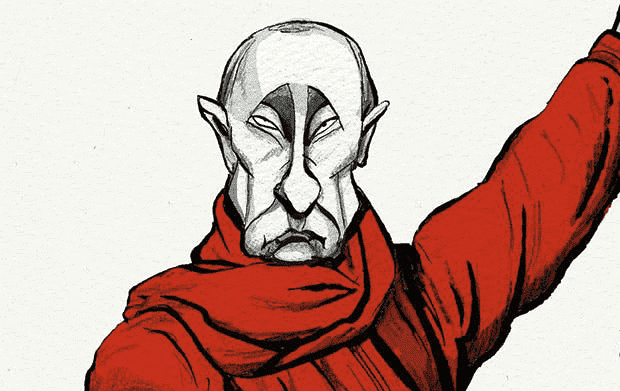
    Rejuvenation is unstoppable, we will prevail,’ blared the editorial in the Chinese newspaper Global Times. The subject was China’s resurgence, but it looked oddly apposite in light of an inadvertently overheard conversation between Vladimir Putin and Xi Jinping.

    Biotechnology is continuously developing,’ commented Putin as the two men walked towards the podium in Beijing’s Tiananmen Square during the military parade to mark 80 years since Japan’s surrender in World War Two.

    “In the past, it used to be rare for someone to be older than 70 and these days they say that at 70 one’s still a child,” the 72-year-old Xi replied to his similarly-aged counterpart.

    “Human organs can be continuously transplanted. The longer you live, the younger you become, and even achieve immortality.”

    “Some predict that in this century humans may live to 150 years old.”

    This was, of course, a gift to sketch-writers, satirists and anyone looking to poke fun at Putin in particular. Putin wants to be immortal! After all, there had already been the tales of his bathing in blood from the severed antlers of Siberian red deer as a rejuvenate folk remedy, and last year Putin established the New Health Preservation Technologies research centre, dedicated to developing “technologies that prevent cellular aging, neurotechnologies, and other innovations aimed at ensuring longevity.”

    We should hardly be surprised that an aging autocrat with the means to do so would support such research. I dare say many 70-year-olds might want another 70 years, if physical and cognitive decay can be kept in abeyance.

    There is also a powerful political dimension. In a personalistic system like Putin’s, so much depends on the health of the monarch. As soon as he anoints a successor, he risks becoming a lame duck – and he also recognizes what he is still trying to deny, that there can be a Russia without Putin.

    Putin’s family, his clients and his cronies also face a potentially bleak future, given that their security and pampered lives depend on his presence. Indeed, a cynic might wonder whether New Health Preservation Technologies was also a vessel for nepotism – that acceptable form of immortality-by-proxy – given that Putin’s eldest daughter, Maria Vorontsova, is an endocrinologist working on a genetic research program to boost longevity. Besides, is this that different from those tech bros like Bryan Johnson, who spends $2 million a year in a strict regime intended to stop or wind back his metabolic clock?

    As an opportunity for a more light-hearted Western reporting, it was a gift. But it was even more appreciated by Russians, who already have indulged their subversive spirit at the expense of Putin’s efforts to mask the ravages of age. Indeed, there was for a while a fashion for posting historical pictures “proving” that he is already immortal, following the publication of photos of a Bolshevik Red Guard from 1920 and a Soviet soldier from 1941, who did in fairness resemble a younger Putin.

    But while some Western journalists have mistaken this, and separate claims that Putin has a time machine or is a clone, as evidence of his hubris and his personality cult, they are, rather, example of styob. There’s no neat way of translating this Russian word, which has its roots in “lashing out.” It is essentially fanciful conspiracy theory mobilized as a parody of some orthodoxy. It is not meant to be enjoyed, but savored for its very transgressiveness and outlandishness.

    The most infamous was the tongue-in-cheek claim that Bolshevik leader Lenin had consumed so many magic mushrooms that he had actually become one himself. In what was a seemingly serious documentary broadcast on Leningrad TV in 1991, musician Sergey Kuryokhin played the role of an historian defending his thesis with all kinds of non sequiturs and fake “evidence.” It was the last year of the Soviet Union, and the Party’s grip on culture had loosened enough for this to be possible, but strong enough that this was still deliciously transgressive.

    This seems to be how most Russians are treating the whole “Putin wants to live forever” story. (Indeed, Xi himself seemed to be treating the conversation rather light-heartedly.) If we take it too seriously, well, then the styob’s on us.

  • Xi and Putin dabble in vampirism

    “They’re vampires” was my first thought. I had just heard the news that Putin and Xi were discussing how to prolong their lives, as they walked toward their places at the Tiananmen Square military parade. 

    On the official news footage, Putin’s translator could be heard saying in Chinese: “Biotechnology is continuously developing.” And then: “Human organs can be continuously transplanted. The longer you live, the younger you become, and [you can] even achieve immortality.” Xi responded: “Some predict that in this century humans may live to 150 years old.” Kim Jong-un was there too, but is not known to have contributed to the conversation.

    Maybe the blood-sucking image came to me because I was, when I heard this news, giving blood. My next thought was that it is the quintessence of secular individualism, to plot an attempt at immortality. It is a statement that one’s life is an entity unto itself, isolated from human community. Also, vampirism was an image favored by Karl Marx, in his description of capitalism. 

    In Capital, for example, he describes capital as “dead labour, that, vampire-like, only lives by sucking living labour, and lives the more, the more labour it sucks.” So it is interesting that these three men grew up under communism. It would seem that the ideology had no real substance, no moral force.

    By the way, I rather enjoyed giving blood. After a nice summer break, things were feeling a bit oppressive over here in London, a city of strangers, elbowing each other out of the way. And it cheered me up, a friendly chat with a nice young nurse, and a sense of local community, of shared values. I’d feel differently if I was being paid for my blood: I’d feel resentful of the person who could afford to buy it from me. I’d feel that we were rivals, competing for resources.

    The immortality story featured on the evening news, as part of the general coverage of the military parade. The next item was our head of state, King Charles III, visiting a hospital in Birmingham, a visit delayed by his own cancer treatment. Unlike those Oriental despots, our monarch displays the vulnerability that he shares with the rest of us. 

    If he and his son William were overheard discussing prolonging their lives through organ donation, the monarchy would be over. He said to one patient: “Hips don’t work so well, do they, once you get past 70?” I might live in a palace, he was saying, but I share your knowledge of bodily infirmity, vulnerability.

    I was also reminded of another king, David. He committed a sort of act of vampirism, bedding another man’s wife, and getting the man killed in battle. It was an act of total selfishness, a denial of common humanity. And he repented, and his change of heart resulted in the poetry of the Psalms, an ur-text of common human vulnerability. Let these men have a change of heart, one that does not involve literal organ transplants.

  • Don’t hold your breath for a Chinese-led world order

    Today’s vast military parade in Beijing is the climax of three days of political theatre orchestrated by President Xi Jinping, with supporting roles played by those pantomime villains Vladimir Putin and Kim Jong-un. The smirking North Korean and Russian dictators joined Xi to witness the People’s Liberation Army’s goose-stepping soldiers and shiny weaponry rumbling through Tiananmen Square. “Today, humanity is again faced with the choice of peace or war, dialogue or confrontation, win-win or zero-sum,”  Xi told the crowd of some 50,000 carefully selected spectators (which roughly matched the number of soldiers). He said the Chinese people “firmly stand on the right side of history.”

    Xi warned that China was “unstoppable” and is “never intimidated by bullies” before climbing on the back of an open-top car to inspect what seemed like miles of hardware lining Chang’an Avenue, warplanes flying overhead. China’s military expansion and modernization is racing ahead at a rate rarely seen in peacetime, and today’s show, reckoned to be China’s largest-ever military parade, was a showcase of some of the results, designed to throw the gauntlet down to the West.

    Western military attaches will no doubt be doing their own forensic inspections of Xi’s new kit, which included sea drones and multiple missile systems, among them intercontinental ballistic missiles designed to reach the United States. It also included cruise missiles and an array of anti-ship missiles, dubbed “carrier killers,” whose purpose is to deter American involvement in a war over Taiwan.

    It was the first time Xi, Putin and Kim had met together publicly, and in many ways it was a clarifying moment to witness as they walked shoulder to shoulder, the three protagonists of the Ukraine war. Putin, its architect; Kim, who is providing weapons and soldiers; and Xi, who is underwriting the whole enterprise through his economic support for Moscow.

    The parade, which lasted around 90 minutes, was supposed to mark the 80th anniversary of Japan’s surrender and the end of the Second World War. In fact, the Chinese Communist Party played only a marginal role in defeating Japan, with its rivals, the nationalist Kuomintang, doing most of the fighting. Mao Zedong cynically calculated that Japan would weaken his opponents, who could then be more easily defeated in the Chinese civil war. Mao would later confess that the communists would never have won without the Japanese invasion, going so far as thanking Japan’s prime minister Kakuei Tanaka for his “help” in defeating the nationalists, according to a memoir by Mao’s personal physician.

    Even the stars of today’s show – Xi, Putin and Kim – have deep mutual suspicions

    In the run-up to the parade, a propaganda blitz has attempted to portray the victory over Japan as a “people’s war of resistance” against Japan, whipping up a frenzy of nationalist sentiment, which has resulted in Tokyo expressing concern for the safety of its nationals in China. Last month, a Japanese women and her child were attacked in a subway station in Suzhou, one of a growing list of violent anti-Japanese incidents, which included the stabbing to death of a 10-year-old Japanese boy near a Japanese school in the same city.

    The 26 world leaders who attended the parade were mostly a familiar line-up of authoritarian faces, though they included Serbia’s Russia-friendly president Alexandar Vucic and Slovakian Prime Minister Robert Fico. Sharp-eyed Australians also spotted Daniel Andrews, a former Labor premier of Victoria, standing sheepishly at the back of a family photograph, with Xi, Putin and Kim to the fore. This is causing a storm down under.

    Today’s parade follows a meeting in Tianjin of the Shanghai Cooperation Organisation (SCO), a usually dozy talking shop, whose members include Russia, China and countries of central and south Asia. Xi used the platform to make his most audacious bid so far for world leadership. He criticized “bullying” and gave a woolly vision of a new China-centric world order to challenge the United States. The most significant images of the event were those of Narendra Modi, India’s prime minister cozying up to Putin and Xi.

    Some commentators have been quick to proclaim this week’s theatre as a seminal moment, of Donald Trump’s comeuppance, and Xi’s new world order becoming a reality. Not so fast. Wily and transactional leaders of the “global south,” while hardly enamored of Trump, are not about to ditch the American “hegemon” in favor of a Chinese one. Modi feels bruised and intimidated by his treatment by Trump but is sending a message to Washington, playing a game. His suspicions of China, with whom India fought a brief border war just five years ago, run deep and won’t be salved by Xi’s empty words at Tianjin. The SCO itself is riven with divisions; the former Soviet States of central Asia, each with big Russian-speaking populations, are deeply uneasy about Russia’s aggression in Ukraine.

    Even the stars of today’s show – Xi, Putin and Kim – have deep mutual suspicions. Putin was very much the supplicant in Beijing, bringing a host of officials with him from the oil, gas and arms industries, and even the governor of Russia’s central bank. All an expression of just how dependent he has become on Chinese support. Russia was quick to announce new deals on a much-delayed gas pipeline; China said little, since much of the detail, notably the price of the gas, has yet to be worked out.

    It’s fair to speculate as to whether Xi felt any unease today about the loyalty of the troops he was inspecting, having purged a swath of top military leaders in recent months – including the top echelons of the Rocket Force, which oversees those shiny new missiles. Today’s display, and Xi’s fiery words, certainly invoked visions of 1930s Germany, but it would be premature to proclaim the start of the new world order that China’s leader so craves.

  • Has Xi Jinping been reduced to a figurehead?

    China will celebrate the 80th anniversary of the end of the “war of resistance against Japanese aggression” (i.e. what we call VJ day) tomorrow. Given that Japan’s invasion of China started some four years earlier than Japan’s attack on Pearl Harbour in 1941, and cost an estimated 20 to 30 million Chinese lives, this week’s military parade is a major milestone. As the People’s Liberation Army Daily newspaper has explained:

    “One of the highlights is a grand military parade at Beijing’s Tian’anmen Square themed on commemorating the great victory and promoting the enduring spirit of the War of Resistance.”

    Not surprisingly, China is pushing the boat out in terms of its invitation list. It includes 16 presidents and ten other world leaders. Apart from the president of Serbia, Aleksander Vucic, and the prime minister of Slovakia, Robert Fico, European leaders will be notable for their absence.

    Most importantly, the attendance of Vladimir Putin and Kim Jong Un as guests of honor is being heralded as a diplomatic coup for Xi Jinping by much of the West’s media. Thus, the BBC, reflecting its dislike of Donald Trump, has gleefully headlined one of its pieces “Xi shows Trump who holds the cards as he sets up meeting with Kim and Putin.”

    But is it a triumph? Or are Putin and Kim coming to the party to find out if Xi is still running China? Since July this year there have been two conflicting narratives about what is going on in the opaque world of Chinese politics.

    One narrative, largely proposed by new media, notably expat Chinese watchers and academics hostile to China, who rely on discretely relayed inside information, suggests that Xi is now just a figurehead; he is in power but not in office. The other narrative, largely supported by Chinese and western legacy media, reports that nothing has changed; for them, Xi is still the all-powerful authoritarian leader who broke the mould by organizing an unprecedented third five-year term as general secretary of the Chinese Communist party (CCP). Britain’s Economist magazine has recently opined that “there is no immediate threat to Mr. Xi’s leadership.”

    The “Xi has lost power” narrative proposed by the new media world is as follows. At or shortly after the 3rd CCP plenum in July 2024, Xi Jinping, overweight and reputedly a heavy drinker of Kweichow Moutai – the most expensive brand of baiju, a hard liquor distilled from sorghum and wheat – reportedly had a health scare and was taken to hospital. These reports have not been confirmed. But video footage of Xi’s recent trip to Tibet suggests that he is not a healthy man. His wobbling gait was painful to watch.

    In his absence, Xi’s enemies pounced. The coup is said to have been led by the Central Military Commission (CMC) vice chairman Zhang Youxia. This highly regarded military leader, a princeling like Xi, and a rare veteran of military action in the China-Vietnam War, had provided the military backing that underwrote Xi’s taking of a third term of office. Subsequently, their relationship faltered. Seemingly, Zhang had argued with Xi about the advisability of a high-risk military attempt to take Taiwan.

    Xi, who, from his public utterances, seemed to see the re-taking of Taiwan as the fulfillment of his legacy to “restore the nation,” “helicoptered” Fujian clique ally General He Weidong into the co-vice chairmanship of the CMC. Zhang found himself surrounded by Xi’s appointees.

    One narrative suggests that Xi is now just a figurehead; he is in power but not in office

    But now, an isolated Zhang is said to have taken his chance to save his own skin by launching a coup against Xi’s loyalists in the military. Admiral Miao Hua, another member of Xi’s Fujian clique, was suspended in November 2024 and removed from the CMC in June. Even more dramatically, in March, He Weidong disappeared. Strangely, neither of these CMC members seems to have been replaced.

    Over the last year, dozens of high-ranking officers have been dismissed or have disappeared, mainly on grounds of corruption. Albeit an endemic problem in the People’s Liberation Army (PLA) it seems likely that the charges of corruption have been a cover for a purge of Xi’s military allies. Most notable has been the sacking of the generals who led the Rocket Force, which was particularly close to Xi.

    The Chinese leader’s high-profile wife, Peng Liyuan, has also largely disappeared from public view. She is a famous Chinese folksinger whom Xi incongruously promoted to the rank of major general and to a key role in the CMC’s opaque cadre selection committee. General Zhang Youxia was reportedly furious that promotions and appointments in the army were being made by a celebrity singer. As for Xi, he has not attended a CMC meeting for a year.

    Zhang’s alleged move has allowed Xi’s political enemies to come out of the shadows. Hu Jintao, Xi’s predecessor as general secretary, who was shockingly manhandled out of the 20th CCP congress on Xi’s orders, has reemerged as a leading figure in the cabal seeking to overthrow the General Secretary. His liberal Communist Youth League faction is now in the ascendancy.

    In addition, the “princelings,” the name given to the Red aristocracy that emerged from the early political and military leaders of the CCP, have come out in force to criticize Xi’s building of a Mao-style personality cult. These include Deng Pufang, son of Deng Xiaoping, the supreme leader who banned Mao’s personality cult. Deng Pufang’s back was broken when he was thrown off a roof by red guards during Mao’s Cultural Revolution. No wonder that he and many other princelings who were banished to the countryside during the cultural revolution baulked at Xi’s return to Maoist authoritarianism.

    Though Jiang Zemin, former general secretary between 1989 and 2002, died in November 2022, his Shanghai faction continues to have a presence. They are thought to be jockeying for position in case of a restructuring of the Politburo’s current all-powerful seven-man standing committee.

    The factions opposed to Xi are said to have agreed on a few policies. Xi’s Mao-style personality cult must not be repeated; the restoration of a maximum of two five-year terms for a general secretary has been agreed; the CCP will return to Deng Xiaoping’s liberal reform path; and Xi’s foreign policy, which has generated a great deal of pushback in both Asia and the west, should become less aggressive.

    Supposedly not yet decided by the opposition factions is whether Xi Jinping should be replaced immediately or at the 20th CCP congress in 2027. It seems likely that General Zhang would like a rapid resolution of the leadership issue. As the leader of what has, in essence, been a military coup, he knows that his head is on the line. A Xi comeback could end his life.

    By contrast Hu Jintao, for the sake of party stability and public face, would reputedly like Xi to continue as a “figurehead only” leader until the next congress. The situation is complicated by the fact that potential Xi replacements are thought to be reluctant to become CCP general secretary unless they are also appointed to Chairmanship of the CMC.

    Historically, this is not surprising. The only two general secretaries who did not hold the chairmanship of the CMC were sacked from office; Hu Yaobang in 1987 and Zhao Ziyang in 1989. Both these leaders were removed by Deng Xiaoping, who never held the post of CCP general secretary; Deng’s role as China’s supreme leader rested solely on his chairmanship of the CMC from 1981 to 1989 – a clear indication that, in China, the ultimate ring of power is held by the army.

    In July, it was noted that at the dinner held to celebrate the 98th anniversary of the founding of the Chinese People’s Liberation Army, several of Xi’s enemies were seated on top tables. The biggest surprise was the reappearance of General Liu Yuan. After disputes with Xi Jinping, Liu made a dramatic resignation from the PLA in 2015.

    The Chinese leader’s high-profile wife, Peng Liyuan, has also largely disappeared from public view

    Liu is the son of Liu Shaoqi, who succeeded Mao as chairman of the People’s Republic of China. Liu Shaoqi was subsequently arrested and killed during the Cultural Revolution. His crime was to favor liberalization of the Chinese economy. Indeed, during the Cultural Revolution, Mao referred to Liu Shaoqi and Deng Xiaoping as the “number one and number two capitalist roaders.” The reemergence of General Liu Yuan after a 10-year interval seems to confirm the dramatic political shift back to the ‘capitalist roader’ path forged by Deng Xiaoping.

    Given the parallel but opposing narratives of current Chinese politics, China watchers will be fixated on what happens at tomorrow’s military parade. Protocols and placements at the parades and dinners will be analyzed in detail. Some have even suggested the possibility of a coup.

    This seems highly unlikely. Instead, China watchers should wait for the 4th plenum of the 20th congress. It was announced on July 30 that this will take place in October. If there are major changes in the Chinese leadership before the 21st CCP congress in 2027, they are most likely to take place at a plenum session of which there are usually seven during a five-year National Congress term.

    The most talked-about successors to Xi are Hu Chunhua and Wang Yang. Hu, an acolyte of Hu Jintao and his Communist Youth League faction, is a liberal who was surprisingly pushed out of the Politburo’s Standing Committee at the 20th national congress in 2022. Wang Yang, another liberal and a former Standing Committee member, was similarly discarded when Xi embarked on his third term of office.

    These are interesting times in China; perhaps President Trump should have accepted the Chinese invitation to attend the September 3 celebrations after all – if only to get a peek inside the secret world of Chinese politics.

  • The White House joins TikTok

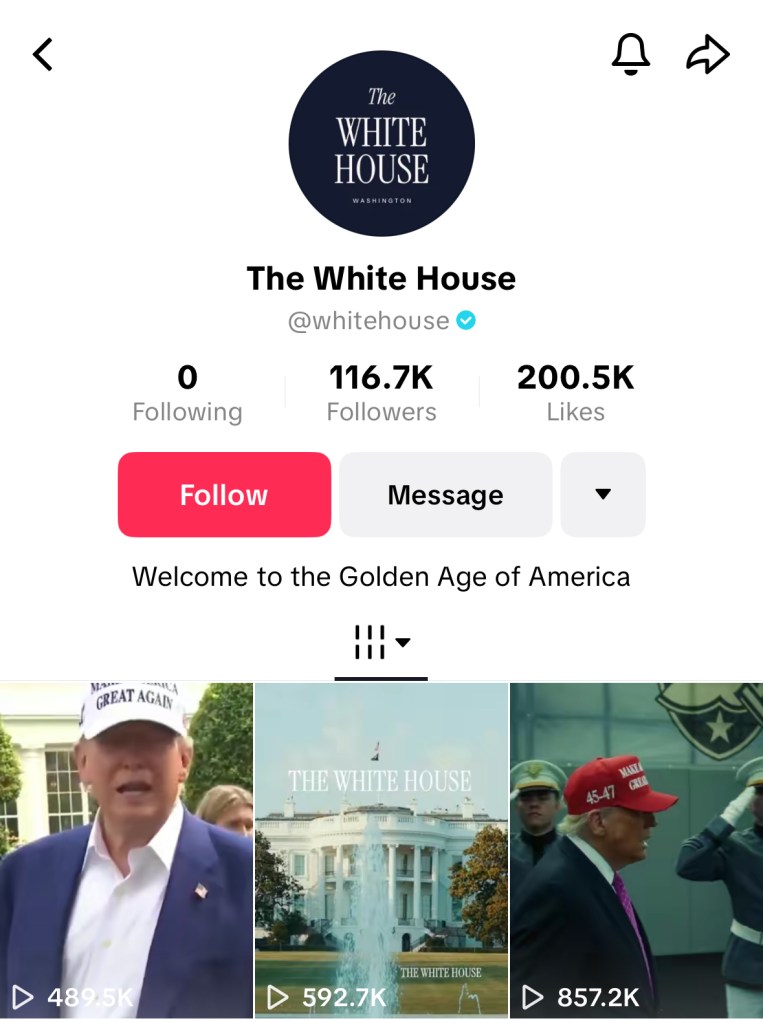
    The White House has been busy this week, er, setting up a TikTok account, despite plans to ban the app in just under a month over security concerns. The profile has so far posted three videos and amassed 116,700 followers. Make the most of it while we’ve got it, eh?

    The White House set up a verified account on the Chinese platform on Tuesday, posting its first video of Trump clips with the caption: “America, we are back! What’s up TikTok?” A second video shows cuts of the White House building itself, while a third has pasted together some of Trump’s snappiest reactions. The page’s descriptor reads: “Welcome to the Golden Age of America.” Not that the site’s users appear to feel much warmth towards the account. Already the comments sections are filled up with anti-Trump images, remarks about the Epstein files and, um, confusion about why the account has been set up in the first place.

    The Chinese-owned platform sparked alarm in the US after the FBI, amongst others, suggested the site could be used by the Chinese government to harvest data and interfere with social cohesion in America. The company has strongly denied these accusations, but that hasn’t prevented Congress from voting to ban it. Trump himself has gone on something of a journey with the site, however – first trying to outlaw TikTok during his first term before staging a volte-face before last November’s election and pledging to prevent a federal ban. After he won the 2024 election, Trump signed an executive order to put off the ban until April while his administration looked for someone to buy it. The President signed another extension, delaying the ban until September 17. He admitted last year that he believes his presence on the site has helped him win over younger voters, remarking in December: “I have a warm spot in my heart for TikTok.” It’s one method of strengthening US-China relations…

    Trump’s team has worked with social media giant Meta to push campaign material on Facebook, and the President even owns his own social media platform – his beloved Truth Social. Could this new account be a hint the social media savvy US leader may try and further delay a ban on TikTok?

  • Why Trump may regret investing in Intel microchips

    Why Trump may regret investing in Intel microchips

    When President Trump unveils a massive investment in the microchip manufacturer Intel on behalf of the American people it will no doubt be accompanied by all the usual hyperbole. No doubt we will hear all about how it will be the “deal of the century,” delivered personally by the “investor in chief.” But hold on. Sure, we can understand why the President wants to help one of the US’s most strategic companies. But the blunt truth is that Intel is well past its peak – and it will prove to be a terrible deal. 

    It will be one of the largest industrial investments the White House has ever made. According to reports today, the government is discussing taking a 10 percent stake in Intel, making it the largest shareholder. In total, the government might pump around $10 billion into the company, although a big chunk of that will come from converting the billions in grants and subsidies it received from President Biden’s CHIPS Act into equity. Either way, Intel will get a big chunk of extra cash.  

    Intel has become hooked on subsidies and grants

    In fairness, there is a case to be made for state support. Microchips are a key strategic industry, and, just like Joe Biden, President Trump wants to make sure that the United States has enough manufacturing capacity on its home soil. He wants to ensure the country is not completely reliant on imports from South Korea, Japan or, most worryingly of all, Taiwan, given that it could be invaded by China one day. It is probably significant that one of Intel’s biggest projects is a new plant in Ohio, which also happens to be the home state of Vice President J.D. Vance

    The trouble is, the company also faces huge challenges. The days when laptops proudly boasted “Intel Inside” are long in the past. The company’s share price has halved over the last five years. It has been overtaken in chip technology by Nvidia, now the largest company in the world measured by market value, as well as Taiwan’s TSMC. It has abandoned its plans to invest in Germany, despite receiving billions of euros from the government in Berlin to build a plant in the country, because it couldn’t work out how to make it pay. In the mass market, Samsung has overtaken it, and Chinese manufacturers are snapping at its heels. It may have been one of the pioneers of the computer age, but it is now looking well past its prime.

    In reality, Intel has become hooked on subsidies and grants. The company has become very good at hustling cash out of governments. It has not been so good at making chips or serving customers. It is very hard to see how a few more billions from the White House is going to turn that around now. President Trump will no doubt boast that he has secured “the best deal ever.” But it is likely to prove a terrible investment. 

  • Why Trump must build a nuclear reactor on the Moon

    Why Trump must build a nuclear reactor on the Moon

    Sean Duffy, the secretary of transportation whom President Trump appointed last month as temporary leader of NASA, has issued a directive to fast-track efforts to put a nuclear reactor on the moon. “To properly advance this critical technology to be able to support a future lunar economy, high power energy generation on Mars, and to strengthen our national security in space,” he says.

    A small nuclear reactor on the moon is a good idea, but the directive is about more than that: it is about renewing America’s leadership in space exploration that, with its magnificent achievements receding into the past, looks vulnerable.

    Bill Nelson, NASA’s last leader, didn’t mince his words when it came to the new rivals, China. “It is a fact: we’re in a space race.” He warned that Beijing could establish a foothold and try to dominate the most resource-rich locations on the lunar surface – or even shut the United States out. At a Congressional budget hearing he held up a picture of the moon’s crater-pocked south pole which has valuable resources of water ice in its permanently shadowed regions.

    “That is where we are going and where China is going,” he said, “with so many craters it’s a dangerous place to land. My concern is if China were to get there first and say this is our territory, you stay out.”

    According to the 1967 Outer Space Treaty nobody can lay claim to the moon, but if you place a nuclear reactor on its surface, you can get around that rule. This is why Mr Duffy says, “it is imperative the agency move quickly.” He cites plans by China and Russia to put a reactor on the moon by the mid-2030s as part of a partnership to build a base there. If they were first, China and Russia “could potentially declare a keep-out zone” that would inhibit what the United States could do there.

    Duffy stated that the reactor will be required to generate at least 100 kilowatts of electrical power – enough for about 80 households – and be ready to launch in late 2029. Experts, however, think that’s not feasible. Living on the moon is all about power. For a few days batteries will do but for longer you will need solar and nuclear power. Both NASA and China’s plans for a moonbase in the 2030s focus on the south polar region, where the sun is never high over the horizon and the depths of some craters have permanent shadows.

    In these regions there are certain crater rims and ridges where the sun shines almost all the time making them valuable sites for solar power and the most important regions on the moon. The plan would be to set down a placeholder nuclear reactor and then declare an exclusion zone.

    However, the US return to the moon is increasingly a mess. The first landing under the Artemis programme is scheduled for 2027, but no one expects it to be met. Essential components – including SpaceX’s Starship lunar lander – have failed and will need a sustained record of success before any thought is given to trusting them with the lives of astronauts. The other moon return components, the Space Launch System rocket and the Orion crew capsule that NASA has been working on for more than a decade, are also in trouble. They are expensive, face technical difficulties and are way behind schedule.

    At the same time China has said it intends to put its own astronauts on the Moon by 2030, possibly sooner, and prospect the resources there. Will China win the next space race? Space is important to China, “To explore the vast cosmos, develop the space industry and build China into a space power is our eternal dream,” said President Xi Jinping, “the space dream is part of the dream to make China stronger.” Space has excited China’s growing middle class in a way that has not happened to its great rival – the United States – since the heady days of the race to the Moon against the Soviet Union.

    China seeks dominance in the third space age. The first space age ended with the fall of the USSR in 1991. The second space age was again dominated by governments and space stations but with a growing number of other countries. The third began about a decade ago when Elon Musk’s SpaceX reused a core booster rocket. Now there are more countries than ever involved in space and a growing number of commercial companies. It’s never been busier, over the next decade there are more than a hundred planned missions, crewed and uncrewed, to the Moon.

    In retrospect the first two space ages look simple as the United States and the USSR generally stayed out of each other’s way. Now space is so important to society, national defense and pride that it is once again a source of tension.

    Neither side can get their small nuclear reactors onto the lunar surface soon enough.


  • Tariffs and the psychodrama of Trump diplomacy

    Tariffs and the psychodrama of Trump diplomacy

    A bleached white conference room, somewhere near Jeddah in Saudi Arabia. On one side sits Volodymyr Zelensky, the Ukrainian leader, in his soldier-boy outfit. On the other, Russian President Vladimir Putin in dark suit and tie. And in the middle, a beaming President Donald J. Trump. “People said this could never happen,” he says, as Zelensky and Putin stare awkwardly at the floor. “But it’s a beautiful thing.” A White House memo lands in inboxes across the world: “THE PEACEMAKER-IN-CHIEF…”

    Pure fantasy, perhaps, but Trump does have an almost cosmic ability to get what he wants – and he really wants to end the war in Ukraine.

    Last night, having spent weeks telling the world how “disappointed” he was with Putin, Trump abruptly announced “great progress” in US-Russia dialogue. His special envoy, Steve Witkoff, had just spent several hours talking to Putin in Moscow, and it promptly emerged that Trump and Putin could meet as early as next week for a preliminary sit-down ahead of a possible three-way session between Trump, Putin and Zelensky. Putin and Trump have not met since their infamous encounter in Helsinki in 2018 and, then as now, European leaders will be very nervous about the two men getting on. On the other hand, as Trump has always said, he just wants “people to stop dying.” And if he can achieve a meaningful peace deal in Ukraine, he should perhaps be rewarded with the Nobel Peace Prize that everyone says he craves.

    Call it the psychodrama – not madman – theory of international relations. The personal is political and, as we’ve seen with Kim Jong-un, Emmanuel Macron, Zelensky and now Putin, Trump likes falling out and making up with world leaders. It makes for great headlines, plus the emotional rollercoaster helps advance his agenda because statesmen have to worry about what’s in the news.

    The difficulty is that Putin is an exceptionally cold fish who doesn’t care about being hated outside of Mother Russia. The reason earlier peace initiatives failed is that Putin is not losing the war. Putin could “tap,” as Trump put it, America along because, having largely frozen Russia out of the international community, the West doesn’t have much clout over him.

    Trump understands the concept of leverage, which is why last month he agreed to provide new arms to Ukraine. That didn’t seem to intimidate Russia, so Trump also targeted India, the leading buyer of Russian seaborne crude oil, with punishment tariffs. And he ostentatiously dispatched two nuclear submarines towards Russia at the weekend.

    The India tariffs, in particular, appear to have brought the Kremlin back towards the peace table. But who is playing whom? It’s possible that Putin believes Trump’s trade aggression is pushing America’s rivals closer together, which is very much in Russia’s interest. The Kremlin has long believed that America’s hegemony is waning and that, while Trump’s theatrics might dazzle the world, in the long run the BRICS (Brazil, Russia, India, China and South Africa) are in the ascendancy. India’s Prime Minister Narendra Modi, for instance, shows no sign of breaking off trade relations with Russia in the face of Trump’s threats.

    “IT’S MIDNIGHT!!!” Trump barked on Truth Social at 11:58 p.m. ET last night, as his latest tariff program kicked into effect. “BILLIONS OF DOLLARS IN TARIFFS ARE NOW FLOWING INTO THE UNITED STATES OF AMERICA!”

    If only things were that simple. It’s no coincidence that Trump’s most punitive duties are now being imposed on India, Brazil and South Africa (the China and Russia tariff deadlines are upcoming). The White House believes that America still has enough financial muscle to disrupt the BRICS and play them off against each other.

    But, similar to Canada and Europe, the BRICS countries regard America as an increasingly unreliable mercantile power. The biggest downside to Trump’s tariffs, then, may turn out to be geo-strategic rather than economic – as a brave, new multipolar world increasingly tries to get along without America. Politics is personal. And the psychodrama is exhausting, after all.

  • The Art of the Dealmaker-in-Chief

    Who really thought Donald Trump’s America was about to join the stampede of first-world powers promising to recognize Palestine at the United Nations? 

    “Wow!” He exclaimed this morning on Truth Social. “Canada has just announced that it is backing statehood for Palestine. That will make it very hard for us to make a Trade Deal with them.” 

    All over the world, commentators convinced themselves that Trump’s expression of concern on Monday about “real starvation” in Gaza meant he was pivoting with global opinion and against Israel. 

    It turns out, however, that Team Trump is not for turning when it comes to the Middle East. Marco Rubio, the US Secretary of State, has accused the countries now embracing Palestinian statehood of falling for “Hamas propaganda”.

    Trump himself would rather focus all his diplomatic energy on trade, a subject about which he has been positively monomaniacal in recent days. He seems very taken with the new title he has given himself – the Dealmaker-In-Chief. 

    “We are very busy in the White House today working on trade deals,” said the President on Truth Social last night. Three hours later, he announced another “full and complete” agreement with South Korea, involving a 15 per cent tariff on them and $350 billion for the US. That’s on the heels of a deal between America and Japan, South Korea’s big rival in manufacturing terms. 

    The real coup for Trump’s trade strategy this week, however, has been the new framework arrangement with the European Union, which he announced on Sunday from his golf course in Turnberry, Scotland. 

    The EU deal is not simply a major breakthrough in and of itself. It’s also, as the US Treasury Secretary Scott Bessent suggested to my colleague Michael Simmons in Stockholm this week, a useful piece of leverage in the even bigger tariff struggle with China. Bessent was in Sweden for another round of negotiations with his Chinese compatriots and, for US officials, pulling Europe more towards a western trading orbit and less towards the east is an essential thing for the future of capitalism and the free world. China and the US appear to have agreed to take another pause from tariff hostilities – the two sides differ over fentanyl chemicals and Beijing’s role in supporting Iran and Russia. 

    It seems that now Russia is playing on Trump’s mind. On Monday, he suggested he would impose tariffs of up to 100 per cent on Russia if the war in Ukraine didn’t end within two weeks. Then yesterday, as he slapped further tariffs on India, he criticized New Delhi for buying up Russian oil and gas. “I don’t care what India does with Russia,” he said. “They can take their dead economies down together, for all I care.”

    Then, in perhaps the most intriguing trade development of the week, Trump declared a brand-spanking-new deal with Pakistan, including an arrangement to invest in Pakistani oil. “Who knows, maybe they’ll be selling Oil to India some day!” he “truthed”. 

    All jokes aside, Trump’s sudden enthusiasm for Pakistan at India’s expense marks a major shift in US policy in the last few years. Under Obama and Biden and Trump, the US state department has tended to prefer Modi’s India.  

    As ever with Trump, his apparent tantrum with India might conceal a subtler move. That’s the art of the Dealmaker-in-Chief. 

    In the last two decades, Beijing has made enormous investments in Pakistan, particularly in infrastructure through its Belt and Road Initiative. In some ways Pakistan has become an extension of China’s empire. 

    But not all Pakistanis relish the idea of being a Chinese satellite-state. And now the thought of Donald Trump suddenly wooing Pakistan’s government – which recently nominated him for the Nobel Peace Prize, funnily enough – will ring loud alarm bells among the highest ranks of the Chinese Communist party. With Trump’s international agenda, scratch beneath the hilariously crazy surface and you find a more serious campaign to isolate China, China, China. 

    This is taken from the latest Americano newsletter. To subscribe click here