Since the UN does not provide a definition of the “just war,” it is interesting to see the ancient take on the matter.
The Greeks contributed little. For Plato, war was necessary for the creation and survival of the city, but it was not its ultimate purpose: that was peace. For Aristotle, life consisted of three arenas of activity: war for the sake of peace, work for the sake of leisure and necessary and useful activities to demonstrate one’s worth.
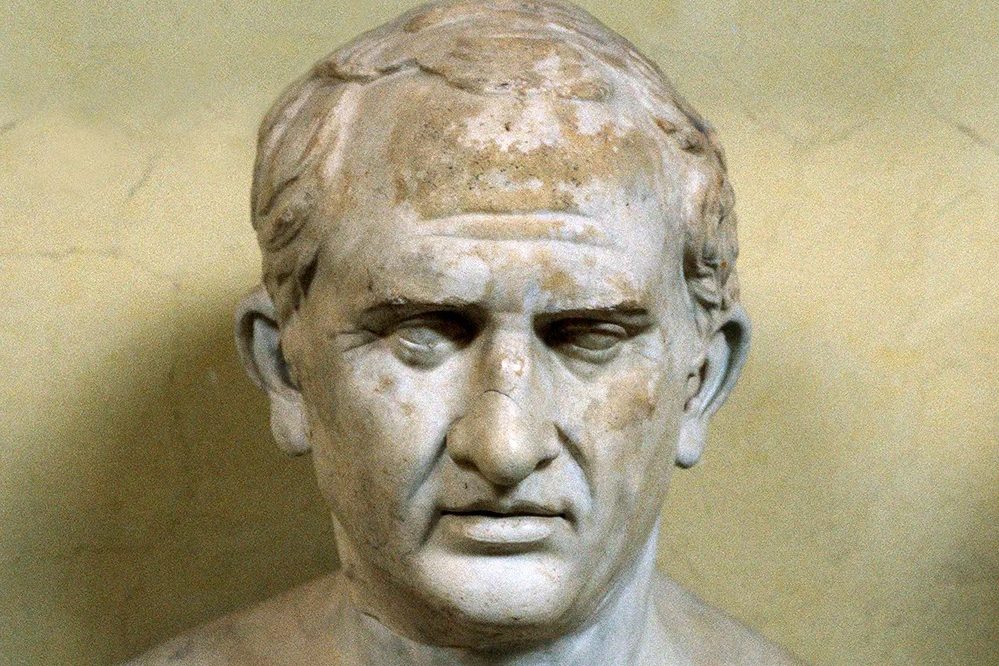
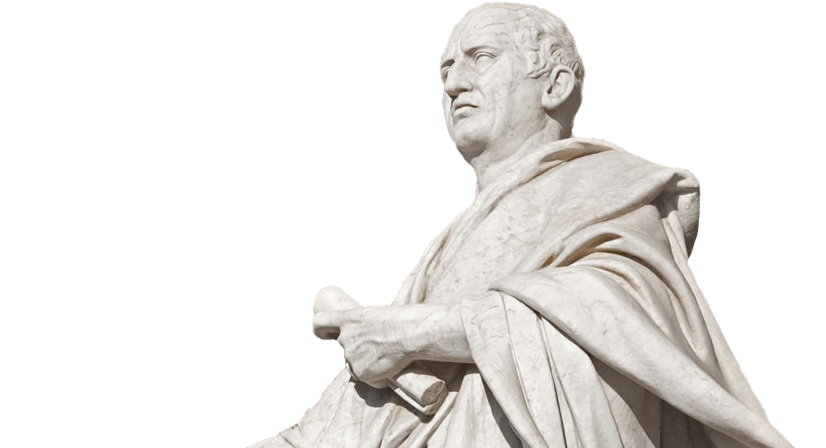
But Cicero (d. 43 BC) understood war in ways that have shaped our own understanding. His starting point was that there were two ways of settling an issue: by discussion, or by force. As he said, “the former [is] appropriate for human beings, the latter for animals.” Further, although Rome always marked a just war with a religious ceremony, Cicero thought a just war should flow not from religious sanction but from natural law.
The search, then, was on for a iusta causa to rectify the rupture of mankind’s natural state, peace. Clearly, self-defense was the most obvious, but equally no war would be just unless the enemy had been given the chance to offer redress. War should advance some good beyond merely self-interested expansion. Other legitimate reasons for going to war, Cicero suggested, should be as a response to an earlier wrong, such as an attack on allies or ambassadors, or to a breach of treaties; or against those who supported an enemy of Rome (which might involve punishing an enemy). Further, Cicero believed that Rome must fight honorably, must not involve civilians and must show mercy to the conquered, though Roman rules of war permitted the seizure of property and enslavement. Most significantly, the word “revenge” plays almost no part.
But Cicero’s world was torn apart by civil wars in the 1st century BC, triggering his reflections. He lamented that those unjust wars had destroyed the republic and ruefully commented: “As long as the sway of the Roman people was maintained by the bestowal of benefits, not by injustice, our sovereignty might then have been termed patronage, rather than domination, of the world.” Cause for thought?
This article was originally published in The Spectator’s October 27, 2025 World edition.
It is rare to read a book about Cicero that likens its hero to a demagogue. Rome’s prosecutor of conspiracy and corruption in the last years of the Republic is seen more commonly as a toga-draped crusader for virtue. Was he also a ranter steeped in violence, crude character-assassination, tendentious storytelling and racial stereotypes? Yes, argues Josiah Osgood, an American historian, whose book persuasively analyzes a range of Cicero’s murder, fraud and extortion cases. Other men of the time were often no better, he writes, but, echoing Michelle Obama on Donald Trump: “Fortunately for Cicero, if his opponents went low, he knew how to go even lower.”
Because Cicero wrote so much moral theory, it has been tempting to see him as he wanted to be seen. It has helped his reputation, too, that he died on the orders of the reviled Mark Antony, his hands and tongue nailed up in the forum lest he go on ranting in death. Osgood’s evidence of demagoguery includes texts used in centuries of school examinations and others less studied. The speeches against Catiline, the radical rebel, whose followers Cicero notoriously condemned to strangulation in 63 BC, stand alongside the Pro Cluentio, a case from 69 BC piled high with poisoned bodies in a plot that would take the rest of the space in this magazine to explain. In fragments of the Pro Fonteio we see a Cicero whose inner Trump more than matched his inner Obama, a man ever ready to deploy the rhetorical smear and to call all Gauls greedy, lying drunks in order to undermine a case by some Gauls against his client.
Cicero was lucky in life, becoming consul despite the handicap of his provincial family having never produced a consul before. But he was even luckier in his afterlife, because he wrote so much source material for the history of his time which has survived. A shelf of Cicero today includes more than 80 speeches, more than 20 philosophical essays and almost 40 books of letters.
Osgood is a shrewd judge of sometimes deliberately deceptive evidence. The fact that a legal speech survived is a strong indication that it originally persuaded the jury — but we often don’t know. We cannot be sure that Cicero won his famous first case, the defense of Sextus Roscius in 80 BC against a charge of patricide and the special death penalty of drowning in a sack of ritual animals. We can see how Cicero used his demagogic skills in the extortion courts by stereo-typing complainants as greedy, heavy-drinking Gauls, but we do not know the juries’ verdicts. Cicero left behind speeches that later teachers have valued wholly for their style. Who has ever cared in a Latin exam whether young Roscius went free to enjoy his father’s wealth or was drowned in a sack with a fox and a cockerel?
Cicero’s legal lessons, described by Osgood in appropriately punchy style, remain worth studying: the need for narrative theatrical skills; for the best means of challenging potentially hostile jurors; and the right level of rehearsal required for witnesses. The question cui bono? — who’s the gainer here? — popularized 50 years before Cicero’s time by a prosecutor of fallen Vestal Virgins, is still standard. Rules for relevance and admissibility of evidence were laxer in Cicero’s day. Expert witnesses were not used. The plausibility of a poisoning charge had to depend on the jurors’ own knowledge of poisons, carefully supplemented in court.
Knowledge of the law was a necessary start in Rome for anyone with political ambitions, even for such as Julius Caesar, for whom the army was the better springboard. Most voters might not be rich enough to be courtroom jurors (there was a varying but high property qualification), but all had the right to listen to the speeches from the edge of the court and remember whom they might want to be consul.
Through luck and choice of cases, Cicero won the allies who helped him to succeed. But at the center of Osgood’s account is an analysis of Cicero’s part in the political disintegration that vitiated his success. The violence of Antony, Catiline and Rome’s greatest extortionists inspired magnificent rhetoric from Cicero. But the rhetoric itself was vicious and violent.
Cicero did not use physical force well when, as consul, he had the opportunity. His decision to condemn Catiline’s allies to the state strangler was opposed by Caesar, a man with a much better instinct for when and when not to kill. Cicero should have listened. But if a gangster was on the right side, Cicero was happy, Osgood concludes, “to disregard laws when he thought them unjust or inconvenient.” The defender of Rome’s balanced form of government played a large part in its downfall. Cicero’s demagoguery helped the forces that would “ultimately kill him and destroy the Republic.”
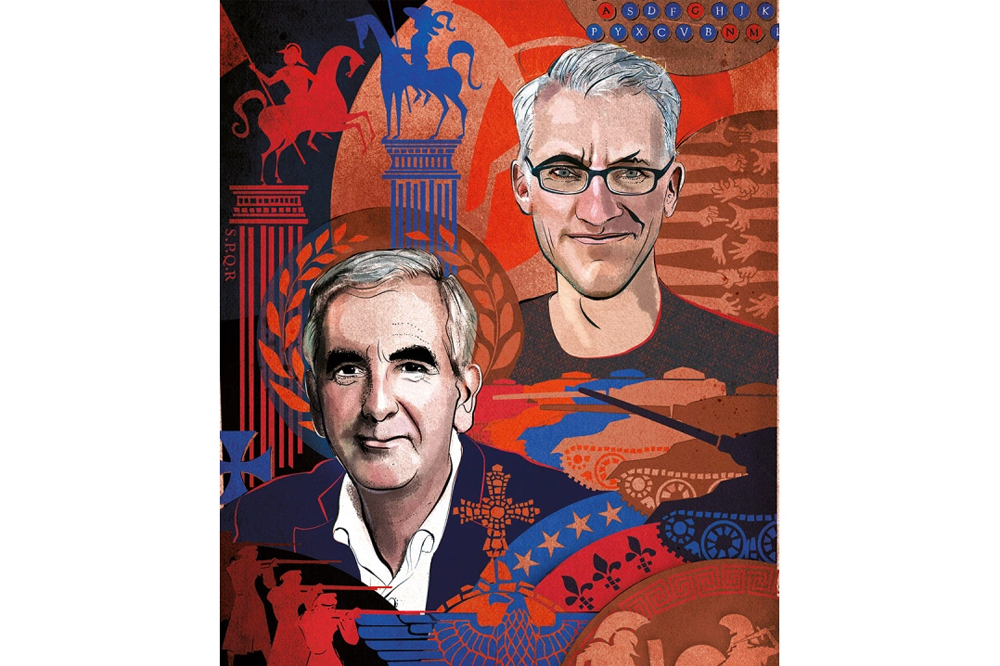
Tom Holland: Here’s something I always wonder when I read one of your books. You’ve written novels set in the present, you’ve even written a novel set in the future, but overwhelmingly your fiction is set in past periods, spanning ancient Rome up to the second world war. What is it about the past that appeals most to you as a novelist? The mirror that it holds up to the present or the sense of difference from the way we see the world?
Robert Harris: I’ve always been very interested in history. Really, but for the accident of having an English teacher who pushed me towards studying English, I would probably have studied history and indeed thought of changing halfway through my course in Cambridge. But it would have meant doing four years. So I didn’t. I’ve always been fascinated by how people lived, with the way societies were organized, with what it might have been like to have been alive in the past. I was born twelve years after the end of the second world war, and it was still a very real thing when I was growing up. I felt the weight of the past in the present as I lived it.
TH: I remember you did an article about it in the Sunday Times [of London] in the 1990s. I think it was accompanied by a picture of Hitler with the EU flag. And you made comparisons between Hitler’s plans for Europe and the EU, which in light of what subsequently happened, I thought it was an interesting irony that it should have been you in that article who was making the comparisons. Was that something that you found particularly provocative when you wrote Fatherland?
RH: I wrote Fatherland as a result of writing a book about the Hitler diaries, during which I read a lot of Hitler’s table talk. He laid out his plans for Europe as it would be after his victory, which he thought was coming. It would have been a Europe organized around German domination of currency and trade and so on. It was a time when Germany had reunified and become once again this country of 80 million at the heart of Europe. So it was a kind of jeu d’esprit, really. Listen folks, I don’t mean you to take me seriously! It was mischievous. No more than that. But it is interesting because the great question remains: how do you accommodate a country as powerful as Germany within a European polity? That question doesn’t go away. It amuses me that everyone thinks the question of Britain’s relationship with Europe was settled at 9 p.m. on June 23, 2016, when actually the story has been going on for centuries. It will never be settled.
TH: And then you went on to write Pompeii and the trilogy of books about Cicero. People have often assumed the Cicero books reflect your experience of engagement with New Labour. Was that part of the appeal of turning to Rome?
RH: Not really. I turned to Rome because politics has always fascinated me. I had just finished Pompeii, and then I read your book Rubicon and it struck me that here was the political novel I could write. I could write it because so many of the great Roman public figures at that time you could recognize as archetypes. Cato was an Enoch Powell or Tony Benn. Crassus — the millionaire trying to buy his way into politics. Cicero — the crafty lawyer playing one side off against another. It struck me as a way of writing about politics and the struggle for politics. Now, my greatest first-hand experience of politics was with New Labour and particularly Tony Blair. So I was able to draw on that experience. But the books, if they’re about anything, are about America and the end of a republic that collapses because it can no longer sustain the pressure.
TH: The collapse of a republic — that is also the theme of your new book, Act of Oblivion. Again, to come back to this question of whether the interest of the past is the fact that it’s different from us or that it holds a mirror up to us. The seventeenth century, and particularly the Civil War, is resonant for a country as divided as Britain is at the moment. Was that the source of the appeal or was it the inherent drama of the story that you tell, the pursuit of the regicide, the men who signed the death warrant for King Charles I?
RH: It’s always the drama of the story. That’s why I’m a novelist, rather than a historian. In this case, it was the idea of inventing the figure who might have pursued these regicides year after year, across America, in England. Who would have organized it? How would they have done it? It’s always the story. And then you find, as most people do who write historical novels, that you’re really writing about the present. There’s something subconsciously that drew you to the story because of its nature. It calls out to you, beneath the surface, and that’s what you respond to. I don’t think: “Oh, I’m going to write about divided Britain.” That would be boring.
TH: I guess the reason I ask is that when it comes to the two men who are pursued and in whose heads we live quite a lot in the book, you show us the inner workings of their minds, their hopes, their emotions and their religious convictions. You bring to life people who in many ways are quite distant from us. How much of a challenge was that?
RH: It was a very big challenge. As I say, I was drawn to the drama of the chase. Then I realized I’d landed myself with a problem of writing about two Puritan colonels [Edward Whalley and William Goffe]. I had a similar thing, oddly enough, when I was starting out to write Pompeii, which I thought was a crazy venture. I went to Pompeii and walked through the ruins. I felt the heat on my back and saw the outline of Vesuvius in the dazzling August sky and smelt water on stone. I realized I was experiencing everything that my character would have experienced.
A sunny morning in the empty forum of ancient Pompeii, Italy in the shadow of Mount Vesuvius (Alamy)
Well, with Whalley and Goffe, I started by thinking: what are the similarities that we have with them? First of all, they are practical men. They are essentially very successful career soldiers. They have their relationship, father-in-law and son-in-law, which seemed to me quite interesting. I was very fond of my late father-in-law, but I wouldn’t have wanted to go on the run with him. Whalley was a political moderate; he opposed Cromwell’s punitive expedition to Ireland, and that humanized him. What humanized Goffe was his love for his wife, Whalley’s daughter, which we know about from very tender letters they wrote to one another. So gradually I pieced together, I hope, rounded characters without sacrificing the fact that they would have read the Bible at least twice a day and they would have filled their speech with biblical references. I tried to meld all these things together.
TH: They are the quarry, they are the parliamentarians, they are the regicides. But you also have a Javert figure, Richard Nayler, the man who is constantly on the hunt and he becomes possessed by a sense of his quest. Did you come to dislike him?
RH: No, I liked him. One of the things I realized as I read more about the Civil War was that I was no Puritan. I might have been a Parliamentarian, but I was not a Puritan. My instincts are far more Cavalier.
TH: Would you rather have lived under Cromwell or Charles II, do you think?
RH: Charles II because I would have liked to have gone to the theater. I would have liked to have listened to music. I would not like to have some miserable devil telling me that I couldn’t celebrate Christmas. There was much wrong with Charles II’s court, but I did have an admiration for Sir Edward Hyde, Lord Clarendon, who is in the kind of Ciceronian tradition of wanting to keep the show on the road. Nayler is ruthless and reflects the cruelty of the age. But I put into his mouth and thoughts a lot of how I would have felt going out to Puritan New England and trying to make progress through this crazy landscape with all these religious zealots all around.
As I wrote, I realized, here is a very important strand of the DNA of modern America. One of the things a visitor from Europe to America always finds striking is the way that religion is woven into politics. It’s completely unlike anything in this country. Cromwell’s religious and political revolution sailed on after its defeat in England in the arc of New England.
TH: It’s strange that the trace elements of the Civil War and of Cromwell’s period of power are more palpable in America than they are in England. And yet obviously the impact in England — and Britain more generally and Ireland — is incredibly profound. It was Michael Foot’s father who famously asked the question “On which side would you have fought at Marston Moor?”, the great Civil War battle fought between Cromwell and Prince Rupert. The answer was the key to his understanding of the person’s politics. Whose side would you have fought at Marston Moor?
RH: Instinctively I would have been on the side of parliament against the king. But I don’t think I would have been one of the Ironsides, the Protestant Taliban, as it were, that eventually smashed parliament and expelled those members who didn’t agree with the army in order to put the king on trial. If there is a guiding thread through most of my books, it is an aversion to certainty and a fondness for those who doubt. I dislike certainty. I dislike the way people twist the facts and adjust them to their philosophy. I’ve seen that throughout my career as a journalist and I know how destructive that is. That tendency seems to have got worse and worse as time has gone on.
***
TH: Was the Civil War a period that you knew well before you began writing?
RH: I’d certainly never dressed up in uniform at weekends and gone into battle. I’m familiar with the era, but it’s curiously secondary in Britain to the Tudors, who are inescapable not only in academic work, but in popular culture. For some reason the Civil War isn’t. And yet it’s a stark fact that England was a republic for eleven years in the seventeenth century, 150 years before the French, 250 years before the Russians. We didn’t just get rid of Charles I, we got rid of the institution of the monarchy, the lords and the bishops. It is a huge thing in our nation’s history. It was a curious accident that a week after the book came out, the Queen died and then we had the accession of King Charles III. The name alone links us to that period. Then there was the accession with the Privy Council on the Saturday and the dealing with all the oaths about the Church of Scotland on the Sunday — the language was all seventeenth century. You realize that this is where we come from; it all stems from the seventeenth century and the settlement with parliament.
TH: What was your emotional response to the death of the Queen and the accession of the King?
RH: It moved me and it fascinated me. Years ago, I was a republican. Just logically, it seems that a modern state should not be organized in this way. Now my opinion is completely switched. I had a conversation with Eric Hobsbawm just before he died, and he said that the most civilized countries to live under, with the best guarantee of freedom in the world, were constitutional monarchies. He was right. After the Brexit division and the political chaos that has ensued, the madness of all these various prime ministers and resignations, it was a relief to see, from the passing of the Queen, the new figurehead marching through London. In my old age I found the continuity moving and important. Who would want to live under the political constitution of the United States at the moment, with their elected king? This country’s separation of politics from the state is serving us well in what might otherwise be a much worse and more divided time. So I can see why some people regard General Monck as one of the great figures of history.
A painting of George Monck by Sir Peter Lely (Alamy)
TH: He is a parliamentarian who brings the army round to back Charles II and presides over the spirit of compromise – the essence of the restoration.
RH: Exactly. The deal struck between Sir Edward Hyde and General Monck was the Act of Oblivion. We will start again, no recriminations, except for the people who executed the king. This aftermath of a revolution, the clearing up, the smell of gunpowder still lingering in the air — it’s always an interesting time in history.
***
TH: I read your book during the final two weeks of Truss’s prime ministership. What affected me reading it with that background was the incredible sense of yearning that your characters have for a degree of normality, to feel that chaos has been brought to an end. I felt that very strongly as a result of the political context that we were living through. Britain in the seventeenth century was a byword on the continent for a kind of mad political experiment and a kind of monstrous anarchy. We are used to thinking of ourselves now as a byword for constitutional stability and for sensible, pragmatic politics. But perhaps there’s a faint sense in which the past few years have been a return in that sense to the seventeenth century.
RH: Yes, I think that that’s true. I’ve just got back from Germany, and they’re wondering what’s happened to this country, with its reputation for pragmatic deal-making, no big grand schemes, no sudden lurches, observance of the rule of law, stability: where on earth has that country gone?
***
TH: You’ve written a lot about the past, but you’ve also written a really extraordinary work of science fiction [The Fear Index], which is a kind of blend of cyberpunk and Frankenstein. And then also you wrote a novel, The Second Sleep, set in the very distant future — 800 years, isn’t it? — where it’s a Britain that turns out to have forgotten industrialization. Does science fiction interest you as well as historical fiction?
RH: It’s an interesting question. I hadn’t really thought about science fiction very much, but I realized when I look back that one of the writers I used to read an awful lot when I was a boy was H.G. Wells. Wells was incredibly interested in politics and used the tools of his imagination to address political and social issues. I know that a lot of people thought a post-apocalyptic novel was a strange thing for me to have written. But it was part of my fascination with politics. I’m not interested in writing something set in outer space.
TH: You might be!
RH: I’ll be writing something set in a new galaxy. Every time I think that I’ve finally stopped wandering, I set off down some other avenue. You asked right at the beginning how I see the past and I think one of the things I do strongly feel — I don’t know whether you’d agree with this — is that a man like Cicero is virtually no different to us. He’s not an alien figure.
TH: I think there are aspects of him that are very familiar, worrying about the cracks in the wall of one of his villas or whatever. But I think the Roman Republic is, in a way, unfathomably weird. What I have found over the course of thinking and writing about Rome is, the more I do it, the stranger the Romans seem. Cicero is a really fascinating example because he has conditioned us. And when I say us, I mean West Europeans. People have been reading him for centuries and centuries and he has been the bedrock of education. In that sense, he has forged our understanding of what politics is and what philosophy is.
RH: I’m struck by the similarity of his philosophy to the message of Christianity: the good life is the life of helping others and doing good. That’s the only way to peace, and that’s the only way to immortality, to a settled feeling of not being afraid of death. If you live a life like Caesar, he thinks his is a wretched life. That seems to me to be quite a bridge to our times.
TH: You see, I think that we are closer to the religious radicals that you write about in Act of Oblivion than we are to Cicero. Cicero is a more distant, stranger figure than those are, even though you can absolutely imagine sitting down and having a chat with him about what’s going on in the world. But if you think about the utter conviction that the religious radicals have — that the last should be first and the first should be last, or the Fifth Monarchist, the idea that Christ will come and that the world is threatened with its end — I think that those are the instincts that are ruling contemporary society.
RH: The Fifth Monarchist instinct is one of the reasons America’s religious right supports Israel. It is to do with the rapture and the return of Christ to Earth. Really, in a sense, that’s my point: the rationality of a Cicero is certainly closer to me than the seventeenth century or the religious right in America now.
TH: It’s not just on the religious right. I was thinking more in the context of the JustStopOil protesters who’ve been videoing themselves on bridges over the M25 — the sense of their utter passionate conviction and that their message has to be proclaimed and that without their message, there will be no salvation. It’s not so distant from what the radicals in your book believed. I mean, the author of the apocalypse is different. It’s not God’s will; it’s not an apocalypse that’s been written in the Book of Revelation. But it is an apocalypse that is being visited on us for our sins.
RH: There’s definitely a puritanical belief on the left that consumption is sinful: shut down people’s modes of transport or attack works of art. That’s quite extraordinary, isn’t it? That’s like an instinct from the Cromwellian era: smashing up the stained glass.
***
RH: I have a kind of quantity theory of humanity. When I look at the Roman period or the seventeenth century or nineteenth-century France with its antisemitism and corruption, I still think that roughly half the population are pretty decent, actually. Maybe 30 percent obey the law, but they’ve got some nasty impulses. They’d go to watch the hangings at Tyburn — and a lot of them would. And then you’ve got — and here I’m starting to lose track of the proportions — but you’ve got maybe 5 percent of really brilliant people and you’ve got 10 percent psychopaths. It’s quite good. Societies go wrong, of course — Rome or Germany in the 1930s or Russia now when the psychopaths get into the position of power. But those quantities of human nature and human society don’t really alter. Look at the American midterm elections: it’s almost exactly 50:50. You feel the same about the Roman Republic when it teeters over the edge. It was 50:50.
TH: 48:52, you might say.
RH: But it’s so close! Why aren’t we just overwhelmingly one way or the other? It’s as if we have to create this 50:50 division constantly.
TH: It seems to me the tension that runs throughout so many of your novels is the question of what is the man in the middle to do about that.
RH: Precisely. There’s a wonderful letter that Cicero writes about how he thinks of the role of a statesman as like that of a doctor to tend to ills and change remedies, and let people enjoy life. Those are the sort of politicians that I admire. They have been in pretty short supply, I must say, in recent times.
TH: One last question. Can you say what your next book is about or is that too soon?
RH: I hope you’ll forgive me, but if I reveal an idea too soon, all you would need to do, Tom, was raise a skeptical eyebrow and I would think: “That’s a bad idea!”
TH: You have an incredible knack for picking on the most interesting angle of the most interesting periods, so keep it a secret. But I’m sure when the revelation comes, it will be worth the agony of having to wait. Robert, thank you so much.
“Why are the Wisest ever the most easy and content to die, and the Weak and Foolish the utmost unwilling? Is it not, think you, because the most Knowing perceive, they are going to change for a happier State, of which the more Stupid and Ignorant are uncapable of being sensible?”
Thus wrote Cicero in On a Life Well Spent, a 2,000-year-old essay. The English version I possess was published by Benjamin Franklin in 1744, and it was beloved by the Founders, one of the most remarkable generations to have graced the North American continent.
Well, so people used to think. Recent reappraisals of history — a la the 1619 Project, the Southern Poverty Law Center’s “Teaching Hard History” curriculum, and even the Broadway show Hamilton — have thrown a wrench into the long-held mythos of the American founding. Rather than a brilliant crew of patriots who sought to create a new country around principles of freedom and civic virtue, the Framers were, according to this new narrative, a cabal of racist, greedy oppressors who aimed to perpetuate a patriarchal society reliant on slave labor. Thus are the teachings of those “old white men” now also held suspect.
Which is fitting, in a way. Cicero was an old white male. So was most of the founding generation, even if Thomas Jefferson was thirty-three at the signing of the Declaration of Independence, and James Madison was thirty-six at the Constitutional Convention. Either way, it’s not a stretch to imagine that woke scholars and their acolytes believe the Founders’ love of the ancients was itself a weapon to sustain patriarchal, autocratic norms. As if Washington, Franklin and the rest conspired in smoke-filled rooms to persuade future generations that Plato and Seneca are worthy of reverence because they served to buttress their own systemically oppressive regime.
It’s not just America’s “first” generation that is taking a beating from the “chronological snobs,” as CS Lewis called those who stand in arrogant judgment over all earlier ages. Even the “Greatest Generation,” which lived through the Great Depression, sacrificed during the Second World War, and brought the Soviet Union to its knees, is increasingly viewed as guilty of the same alleged bigotry as their eighteenth-century predecessors. Many were taught to view the post-war era as a time of unprecedented prosperity (concurrent with high levels of civic participation and religious observance), but activist scholars note that black Americans continued to endure injustices like redlining, white flight, a systemically racist justice system, and even white theft of their cultural heritage, as one 1619 Project author argued (shame on you, Elvis).
Such appraisals have been on my mind of late, especially since the decline and recent passing of my grandmother, who died in mid-December in Hampton Roads, Virginia, at the age of 99. She was perhaps the epitome of every glowing caricature of the Greatest Generation: born in Kansas in 1922 to poor Irish Catholics, she lived through the Dust Bowl, worked in a powder plant during World War II, raised a family of five while her husband ran a small business, and was deeply invested in community service and religious activities. When one of her adult daughters unexpectedly died leaving two small children, she and my grandfather adopted them.
My grandmother personified stability, sacrifice, and selflessness. She never wavered from her Catholic faith, and shares responsibility for my own return to Catholicism in my 20s. She asked little, if anything, from anyone, and relentlessly gave of herself to family and friends. One of my favorite stories involves her famous chocolate chip cookies, which she carefully mailed to my cousin (one of the ones she raised) while he was deployed in Iraq more than ten years ago. Al-Qaeda in Iraq blew up that shipment before it could reach him. “Then it was personal,” my cousin jokes.
My grandmother’s qualities are the very ones that Cicero lauds. He praises the elderly man who “had no Reason to complain of Life, nor did he feel any real Inconveniency from Age: An Answer truly noble, and worthy of a great and learned Soul.” He exhorts readers to orient their lives to transcendent ends and blessing future generations: “I do it, he will say, for the Immortal Gods, who, as they bestow’d these Grounds on me, require at my Hands that I should transmit them improved to Posterity, who are to succeed me in the Possession of them.” And he urges us to accept each new stage of life with simple gratitude: “While you have strength, use it; when it leaves you, no more repine for the want of it, than you did when Lads, that your Childhood was past: or at the Years of Manhood, that you were no longer Boys. The Stages of Life are fixed.”
When I saw my grandmother for the last time, looking a bit more tired and despondent than usual, she made it clear she was ready and willing to accept what God had in store for her. Says Cicero: “We ought all to be content with the Time and Portion assigned us. No Man expects of any one Actor on the Theatre, that he should perform all the Parts of the Piece himself: One Role only is committed to him, and whatever that be, if he acts it well, he is applauded.”
That well describes not only my grandmother, but millions of other members of the Greatest Generation, who made do through each new national and personal crisis. They kept themselves, in Cicero’s words, “constantly employed,” perhaps a consequence of having lived through one crisis after another. Their legacy is one of the most powerful and most noble societies in human history, defined by “a well spent Life preceding it; a Life employed in the Pursuit of useful Knowledge, in honourable Actions and the Practice of Virtue.” For all their failures, how can we credit to them any lesser praise, given not only the defeat of fascism and communism, but a good-faith attempt to rectify centuries-old historical racial injustices?
It is hard not to feel a sense of shame when comparing myself both to the generation of my grandmother and that of America’s founding. What have I done with the cultural, economic, and political inheritance bequeathed to me by those who have come before? Have I sufficiently accepted the mantle of responsibility and sacrifice that millions of Americans before me gladly betook? Can my sacrifices in any way compare to those who have preceded me?
I fear few in my generation are even pondering such questions. They are too busy casting aspersions on those who created the comfortable world they now inhabit. Yet if America — and the West — have any chance at survival, we must approach our past with humility and charity. It is what the Founders did when they sought to build a nation based on eternal principles of justice and virtue. It is what our grandparents did in seeking to protect those principles for their own progeny.
If we, however imperfectly, can do the same, we too may be able at death’s door to declare what Cicero asserted with such remarkable confidence: “[Death] is to be valued, and to be desired and wished for, if it leads us into another State, in which we are to enjoy Eternity.”