“Tom Stoppard is dead.” For anyone who cares for the theater, the English language, and especially for those of us who knew him, these words are as unthinkable as they are hard to bear. How can such a force of nature, such a generosity of spirit, such a voice of sanity, have fallen silent?
And yet he has gone. To the end, his body emaciated by cancer, he was still the old Tom: self-deprecating but full of ideas and plans. He might have one more play inside him, he told me, but his fingers could no longer physically write and dictation somehow stopped the words from flowing. He was cared for by his magnificent wife Sabrina, who entertained us tirelessly.
A few months ago he rang out of the blue, as he sometimes did, to talk about my father, Paul Johnson, who was his dear friend over many decades and to whom he dedicated Night and Day, his play about journalism. Tom had learned his trade as a local journalist and freedom of expression was his lifelong cause. And he mercilessly mocked those who took liberties with such freedom. As one character in that play remarks: “I don’t mind the free press. It’s the newspapers I can’t stand.”
This was the master of comedy who never let us forget that no life is without tragedy, yet that we are redeemed by love. He made the world laugh in our darkest days: from the existentialism of Rosencrantz and Guildenstern Are Dead to the anarchism of Jumpers and Travesties, from the epic grandeur of The Coast of Utopia to the intimate agonies of The Real Thing, the poetry of Arcadia, the physics of The Hard Problem and the dialectics of Rock n’ Roll.
Tom’s last and most autobiographical play was Leopoldstadt, which depicts the fate of a Jewish family in Vienna from 1899 to 1955. Older fans had expected more laughs, but this was a subtler, less uproarious kind of humor. By the end, Stoppard had become the ironic Englishman.
Ideas and mathematics, art and music pepper the conversation in Leopoldstadt, his last play and his only tragedy, as they do throughout his oeuvre. The adjective “Stoppardian” embraces everything from bittersweet nostalgia to verbal pyrotechnics, but there is nothing frivolous about his achievement. Stoppard’s legacy bears comparison with the greatest luminaries of the theatrical tradition that stretches from Shakespeare and Marlowe to Beckett and Pinter. Tom Stoppard knew that tyrants who long to be feared quake at the sound of laughter.
Whatever happened to Britain, or the UK, or England, or whatever they’re calling it? We can’t even agree on what it’s called. But what happened to England, the England that, if you’re over 50, you grew up learning about, the England that controlled the world, the England that ran the largest empire in human history at the end of World War One?
Britain, which is an island in a pretty inhospitable climate, controlled literally a quarter of the Earth’s surface – and not controlled in the way the United States controls the rest of the world with an implied threat or with economic ties through trade, but with administrators and people sitting at desks with eyeshades, counting things. Way more than Rome, way more than the Mongols, way more than anybody, ever, or maybe in the future, ever.
Britain was the most powerful country in the history of the world. And then 25 years later, it was this kind of sad, soggy welfare state, which is, to some extent, what it still is, except maybe even a little bit worse. What happened?
There are a couple of levels on which to think about this. First is just geopolitical, and I guess they spent a lot of money in these wars and the ruling class, half the class at Eton in 1910 was killed in the trenches. You can think of a lot of different ways to explain what happened to Britain. The fact remains, however, the British won the two biggest wars in human history. They won and yet they’re still greatly diminished and to some extent humiliated. What is that?
So again, the first explanation can be described in economic terms. The United States took over. The British Empire just moved west to its child, the US. They just transferred the power and a lot of the gold to this new country, which had its systems and some of its customs.
But there’s something deeper. If that were the whole story, then Britain would still be recognizably Britain. The English people would still be recognizably English. They would just be not in charge anymore. They would have less money and less power. But the country would be, by any conventional measurement, thriving, just not running the Bahamas and Hong Kong and Pakistan.
But that’s not what’s happened. After winning the two biggest wars in human history, Britain has shrunken not just physically, but in some way that’s hard to describe. Its culture has changed, some might say has been destroyed, and it’s become something completely different. And what is that? And why does it matter what it is?
Well, it matters because what’s happened to Britain, to England, is also happening to many countries in the West, certainly its heirs, the Anglosphere: Australia, New Zealand, the United States, Canada, Ireland. It’s happening to those countries. It’s also happening to the rest of western Europe all at the same time.
A bunch of different profound, never seen before phenomena are happening to all of those countries, and again, including ours here in the United States. So it’s worth understanding what has happened to Britain. So maybe the best image that describes it is the one that we’re about to show you.
In case there’s no context in the tape, what you’re watching is a woman being arrested outside an abortion clinic. And keep in mind, as you watch this, she’s not being arrested for throwing a firebomb, a petrol bomb, through the window of this abortion clinic in the UK, or even for obstructing access to this abortion clinic. No – she is being arrested and taken to jail for praying outside the abortion clinic.
Watch this.
So what is that? It’s hard to argue that if your government is arresting people for praying that you’re watching a political phenomenon. Because, of course, praying is not simply a non-violent act. It’s not even a physical act. It can’t possibly, at least in secular terms, affect outcomes or harm anyone. Praying for people can never be a crime. But it is a crime in Great Britain, literally a crime. And the woman you saw is not the only person who’s been arrested for doing it. So clearly we’re watching a spiritual phenomenon here. There’s sort of no arguing it once you see things like that.
But what is that spiritual phenomenon and what are its effects on the people of this country? Before we go further, we should just say that if you visit the “Yookay” as it’s now called, or London, its capital and completely dominant city, the first thing you’ll notice is it’s actually pretty nice. The nice parts of London are as nice or maybe even nicer than any city in the United States. Certainly nicer than any city in Canada or Australia. It’s a great city, filled with lots of happy people.
But broadly speaking, this country has changed dramatically, and it’s changed in ways that are recognizable. Here’s what you recognize. The people of Great Britain are going through a series of crises, and they’re all internal. Drug use, alcohol use. Their appearance has changed. People are no longer as well kept, the streets, the landscape is not tidy anymore. It’s got lots of litter and graffiti in some places. To technocrats, these are not meaningful measures of anything. Who cares if you’ve got graffiti? Does that affect GDP? Well, maybe. Maybe not, but it’s definitely a reflection of how people feel about themselves.
People with self-respect do not tolerate public displays of disorder or filth or graffiti or litter because they care about themselves and their family and they understand intuitively, as every human being does, that once you allow chaos and filth in your immediate environment, you are diminished. So you just don’t allow that. No healthy society does.
But all through the West, these are not just features, they’re defining features. All western cities are filled with litter and graffiti, and people who look like they didn’t bother to get dressed this morning, but are instead wearing their pajamas in Walmart. It’s not just in your town, it’s everywhere in what we refer to as the West.
The point that underlies all of this is a really obvious one, that too few people say. This is the behavior of a defeated people. This is what it looks like when you lose. This is what it looks like when you’re on your way out to be replaced by somebody else. This is what it looks like to be an American Indian.
Now, one thing nobody in the United States ever says about the American Indians, except in a kind of pro-forma white guilt way, is these weren’t just impressive people – and no, they didn’t write the Constitution before we did – these were some of the most impressive people, most self-reliant, most dignified. Read any account of early American settlers, people who were pushing west, who came into contact with Indians and yes, were often scalped and forced to eat their own genitals and roasted over open fires. I mean, these were cruel people. But even the people who were in danger of being murdered by them respected them. Because the Indigenous Americans had a great deal of self-respect. They had what we call dignity. And now, hundreds of years later, the opposite is true. The poorest people in the United States are American Indians. Why? Because the federal government hasn’t given them enough. The federal government is completely in charge of the indigenous economy in the United States, and has been for over a hundred years, and it hasn’t worked. American Indians are still the poorest.
Why? Because the Iroquois and the Navajo weren’t impressive? No, they were the most impressive. Again, read the account of anyone who dealt with them. Even people who were dodging their arrows thought they were amazing people, because they were. And now they are by many measures, the saddest people in the United States. Why is that? Some inherent genetic predisposition to patheticness? They couldn’t deal with modernity? Well, they probably could. They were defeated. They were defeated. And in some deep, the deepest way, they wound up destroying themselves, and it’s not unique to them. That’s the point.
And just to be completely clear, all of this is observed with a great deal of sympathy, not scorn. No one’s mocking the American Indians. Everyone should feel bad about it. For real. Again, not in a silly white girl guilty way, but in a real way. These are amazing people. Greatly diminished. And the reason it’s worth remembering is the same thing is happening to the West.
And it makes you realize, especially if you travel a lot, that the problem is not necessarily the immigrants. The problem is what mass migration does to the people who already live there. They’re the victims of it in a way that, again, is hard to measure and sometimes hard to notice, but totally real.
So you walk through this city, London, and it’s been completely transformed by immigration. Completely. And the numbers are really, really clear. One hundred years ago it was 100 percent European white. Now it’s less than 40 percent. OK, that’s massive, unprecedented demographic change. The immigrant areas are absolutely poorer than the traditionally white English areas. There’s just no question about it. But wealth as measured by the government is not the only measurement. Actually, and this is true in the United States, too, lots of immigrants who have a lot less money than the native population seem a lot more balanced and happy, both because this is a huge upgrade for them just in terms of annual income and standard of living. But it’s more than that. They’re not defeated. They don’t hate themselves.
And if you have traditional nationalist opinions in the United States, I can confirm this personally, you’re never going to be stopped on the street and screamed at by some Guatemalan who’s like, you are racist for having your views on immigration. No, they’ll probably agree with you. The only people who ever get mad at you are the people who already hate themselves, and it’s always, famously, some private equity wife or somebody who should be happy about how things are going because they’re in the portion of the population that’s benefiting from it. But they’re not happy. They’re angry.
What is that? That exact same thing is going on in this country. Exact. And it’s part of a very recognizable syndrome, and it’s the most destructive of all. History is just filled with examples of people who get invaded and clubbed to death and have their women stolen from them, and they’re fine. They’re fine. It’s the people who feel defeated inside who no longer exist. And that is happening to the West. And it’s measurable.
What other society hates its own national symbols? It’s only happening in the West, only in Great Britain. This is coming to be true in the United States. It’s already true in Canada and Australia. What other country finds it embarrassing to fly their national flag? What are you saying if that embarrasses you? You don’t hate the flag. You hate yourself.
And it’s obvious because people who have dignity, self-respect, who believe in their own civilization want to continue it. How do you do that? By talking about it a lot? No. By continuing it through reproduction. No one is preventing the West from reproducing. And people who come up with these conspiracy theories, like, oh, they’re doing it. No, we’re doing it to ourselves. What else is abortion? It’s not empowering for women. Of course not. That’s absurd. Anyone who believes that is an idiot. Abortion is the way to stop people from reproducing. So is birth control, by the way, of course. So is convincing people that their dumb job is more important than having kids. It’s not. It never will be. Any person who can get clarity for a second will recognize that. It’s only about stopping you from having more of you.
And is there anything that’s a clearer representation of how you feel about yourself than how you feel about having kids? And by the way, it’s not just because these people are selfish and they want to go on vacation and don’t want to pay for children, or they’re worried about how much it might cost. Notice that none of these impoverished immigrants living on Snap and housing subsidies, they don’t seem worried about it at all because they know it’ll be fine. Most of the time it will be fine. They’re having kids when much more affluent natives are not, because they believe in themselves and their culture, their civilization. They’d like to see it continue. It’s the most basic of all human desires.
So here in Great Britain, which has about a 30 percent abortion rate, 30 percent of all conceived children are killed. Who’s doing that? It’s not the immigrants because they don’t hate themselves. They’re not defeated. They’re ascendant. And so they can see the future. They know that they may not live to experience it, but they’re still fully human. And they know you plant the tree not because you can bask in its shade, but because your grandchildren will. This is the most obvious of all human instincts and the most basic.
But the native population in Britain is not debating abortion because it’s not even a debate here. Everyone agrees it’s just an affirmative good, of course, to eliminate your own people. Absolutely. But again, no one’s making them do this. They’ve decided to do it themselves. But now their most enthusiastic campaign is for state sponsored suicide. They’ve already done this in Canada. It’ll come to the United States. What is that? That’s an entire people saying we should exit the stage. Our time is done. It’s over. Let’s go. Someone else will take our place. Not the first time that’s ever happened.
This is what defeated people do. This is what happens when you break people inside. And maybe it’ll just reach its terminus. Maybe there’s no way to stop it.
So in Great Britain, if you were to say, wait, what the hell is this? This looks nothing like the country I grew up in – guess who’s going to arrest you? Your fellow Britons. The ones whose great-grandparents lived here. The whites. They’re the ones enforcing this. They’re the ones determined to eliminate themselves.
I tweeted the other day that my social life in Trump’s DC is just getting dinner or drinks with a different Dr. Strangelove character every week. It sounds like an exaggeration, but it’s not. Not really. Every week brings its own apocalypse – and the cast of characters responds accordingly. Find here a taxonomy of DC types:
Dr. Strangelove (The theorist)
The end of the world approaches and only the strong will survive it. Hands trembling slightly from too much caffeine and suppressed grandeur, he (it’s always a he) declares his grand theory of the world in so many words. Women, of course, will be spared. Perhaps you, too, will be counted among the lucky ones. Oh, you’re over 30? If you just read a little more Spengler. Learned a little more about semiconductors. There might be room in the bunker.
Commander Mandrake (The visiting British correspondent)
Efficient. Relatively polite. A cultural anthropologist. Always calling the Uber, assembling the troops for the next pub – I mean, bar – and ordering a round of Guinness for the table. He’s here on duty to report on DC’s pomp and circumstance, endlessly teasing Americans about their earnestness while secretly searching for the nearest Waffle House. Washington isn’t that different from Westminster. It’s just a little more self-serious.
Jack D. Ripper (MAHA’s strongest soldier)
Walk into any bar on Capitol Hill and you’ll find a handful of these guys talking about what estrogenized water is doing to testosterone levels. What the great feminization is doing to the workplace. How the male essence must be preserved. Most likely to be a 40-year-old bachelor with the Red Scare podcast in his Hinge profile as an in-group signal to the based women of Washington. In fact, there may be more Jack D. Rippers in DC right now than at any other time in history. It’s a marvel Kubrick predicted their arrival back in the 1960s.
President Muffley (The earnest liberal)
Still believes in democracy and – bless his heart – due process. Reads the Atlantic like a moral instruction manual. Wants to be good. Wringing his hands at the degradation of decency, biding his time until the inevitable turning of the tides. In the meantime, he tends to his ficus plant and carefully curated coffee bar while stating “cautious optimism” over things that are already engulfed in flames. May have swung closer to the center since the last election, but still can’t quite stomach the rest of it. You’re faintly fond of him, in spite of the cloud of doom trailing his every word.
Major Kong (Defense tech enthusiast)
He works for Palantir or Anduril or something even more secret adjacent to the Department of War. Bicoastal (SF/DC) and proud of it. Certain that the average IQ is higher in the Bay, but Washington is where the decisions get made, so he begrudgingly keeps a Dupont apartment to schmooze with the shot-callers. You get a sense that he’d ride the drones he’s developing into the sunset if the job asked for it.
Colonel Bat Guano (The staffer)
Overworked. Pale. Nervous. Vibrating on Celsius and Zyn. He books the flights, he writes the speeches, he quietly holds the republic together with duct tape and WD-40 while everyone else is tweeting about it. Chain smokes like a ghost who died at inbox zero. When he says it’s been a “busy week,” he means he’s been sleeping on the floor of a congressional office for four days. The midnight oil never seems to run out. By the time he finally crashes, the other party might be in charge.
The War Room (The groupchat)
Where all decisions are made – or at least endlessly litigated. Less geopolitical influence than NATO, more emotional instability than a freshman dorm. All gossip, vice-signaling and purity-testing. Here you’ll find the middle managers of MAGA: men so high on their small-pond power they excommunicate anyone who threatens their crumb of relevance. If you ever find yourself added to one of their threads, don’t panic. Mute, pour yourself a drink and remember that empires fall, but receipts last forever.
This article was originally published in The Spectator’s November 24, 2025 World edition.
If you say the name Franco Zeffirelli to anyone under about 40, you’re likely to be met with bemusement. Find any opera or film lover over that age, however, and you will be greeted with a warm exclamation – “Ah!” – followed by a recitation of the Italian director’s greatest achievements.
From his emergence in international culture in the 1960s with his seminal film of Romeo and Juliet to his legendary work on stage with such operatic titans as Maria Callas and Plácido Domingo, Zeffirelli became synonymous with tasteful, intelligent productions of the classics, all of which made him, for a time, the best-known cultural figure in Italy.
It is fair to say that Zeffirelli, who died in 2019, didn’t always get it right, personally or politically. As his career went on, some of his films tended towards the self-parodic and as a man, he seemed torn between his right-wing political instincts and his own sexuality. To further the former, he joined Silvio Berlusconi’s Forza Italia party and came out with reactionary, even shocking public statements on such subjects as abortion and, ironically, homosexuality; as regards the latter, a string of young, handsome actors who worked with the director have come forward since his death in 2019 to testify to his distinctly hands-on working process.
Still, while one would never wish to whitewash Zeffirelli’s actions, there is no doubt that he was a man of exquisite taste, which he extended into both his work and his private residence, Villa Treville, just outside Positano on Italy’s Amalfi Coast. When Zeffirelli’s biographer David Sweetman was summoned to meet the great man there, it was an inauspicious journey. “It took hours. The taxi bill was unreal, but eventually we arrived at the top of this little winding road. And there was just a gate, and I had to go down all these bloody stairs to the villa.”
However, the destination soon justified the expense and effort. “Eventually, some ancient servant let me in, and I was shown on to this opera set. I’ve never seen anything like it. It seemed, just possibly, the most beautiful place on Earth.”
Sweetman was not wrong. Zeffirelli lived at Villa Treville for more than 40 years, during which time he saw Positano change from an obscure fishing village and occasional haunt of the glitterati into one of the world’s most celebrated destinations for cultured A-listers. He did more than his share to bring in international icons, musing on his guests as he sold his home in 2007: “Leonard Bernstein, Laurence Olivier, Maria Callas, Elizabeth Taylor – it sounds like a legend, doesn’t it?”
Now, a decade and a half since it first changed from being a private home of legendary status to what is surely even this ultra-exclusive area’s most impressive boutique hotel Villa Treville is keen both to honor its past and, in particular, its legendary owner, but also to look to the future. Other five-star options are available, in an area filled with opulent accommodations, but none has quite this level of cachet or history.
The hotel is reached via private transfer from Naples, which takes about an hour and a half. The last part of the journey is comfortably the most spectacular, as the car must negotiate the narrow roads hugging the Lattari Mountains, and peerless views of the Amalfi Coast are on offer to the enraptured passengers: assuming, of course, that the winding, vertiginous journey has not led to carsickness. Yet upon arrival, earthly cares and worries slip away in moments. Not for Villa Treville some grand, attention-seeking entrance. Instead, the car suddenly turns off through a discreet private gate and you walk down a small track into the reception, where the views – the peerless views – of glittering blue sea and the houses of Positano alike are enough to make even the most jaded and weary of travelers pause, slack-jawed in admiration.
Wandering round Villa Treville is an education both in aesthetics and in history. While the hotel has been carefully and sympathetically expanded from Zeffirelli’s day – it now comprises six houses, rather than the three (or tre ville) that it originally consisted of when the director lived here – it retains his sense of chutzpah and style in every well-furnished nook and cranny. There have, inevitably, been a few nods to the present day, with a useful lift connecting the various floors and, of course, wifi, along with the usual conveniences of a five-star hotel, but what is so refreshing about Villa Treville is that it has been kept as close to Zeffirelli’s own lifestyle and taste as possible.
To this end, the director’s books, personal possessions and objets d’art are festooned around the hotel, along with countless photographs of him and his famous friends. If you’re an opera lover, you’ll be delighted to find Zeffirelli’s original sketches for many of the set designs of the shows that he staged at the Met, the Royal Opera House and beyond. But this sense of the impresario just having popped out for a few moments extends far beyond simple décor. At breakfast in the appropriately named Maestro’s restaurant, for instance, guests are encouraged to walk into what was Zeffirelli’s kitchen to choose from a comprehensive and generous buffet selection of fresh fruit, locally sourced cheeses and deliciously decadent cakes and pastries, all of which are accompanied by a wider selection of eggs and pancakes from the à la carte menu.
The views are peerless, the food sublime; it’s enough to make you want to stay here forever. Zeffirelli was nothing if not well-connected: many of the suites bear the names of some of the famous guests at Villa Treville. Many of them have individual quirks that extend far beyond decorative decisions. The Bernstein suite, named after the composer, conductor and regular visitor Leonard Bernstein, contains a shower in the form of a converted bread oven and an outdoor bathtub in its tropical garden, just as the largest and most lavish suite, named after Zeffirelli himself, has been kept largely as it was when it was his bedroom.
Yet even the humbler accommodations, junior suites named after operas he staged such as Tosca and Carmen, still feature whitewashed tiles on the floors, walk-in showers, wonderfully large and comfortable beds and, of course, those breathtaking views, which manage to enrapture even the most seen-it-all of travelers whether by day or night.
The whole point of coming to the hotel is to relax and unwind, rather than embark on a hectic program of activities. Which is not to say that there aren’t plenty of things on offer to entertain you. Peerless treatments, complete with Barbara Sturm cosmetics, are conducted in the La Traviata spa, which itself is housed in a greenhouse rescued from one of Zeffirelli’s opera productions. It’s as peaceful and tranquil a place to unwind as you can imagine.
Then, if you wish to pep things up a bit, slide over to the all-white, appropriately named Bianca Bar, and admire the Moorish decor (again, another Zeffirelli holdover) while sipping one of the beautifully made and deceptively strong cocktails. Whether you fancy a classic espresso martini, a negroni or a twist on an old favorite, there will be something palate-cleansing on offer for a pre-prandial.
One of the joys of Villa Treville – and presumably the reason why it pays host to A-list celebrities who have recently included Madonna and Jennifer Lopez – is that it sticks firmly to a policy of complete discretion. The only people who are welcome here are guests of the hotel, meaning that dinner at Maestro’s, which is usually held outside on the terrace, is a relaxed and relatively informal affair. Chef Vincenzo Castaldo specializes in the pasta dishes of your dreams – if you want to see how they’re made, private cookery classes can be arranged, along with everything from ceramics decoration to cocktail masterclasses – and they’re served up along with a selection of pescetarian-heavy dishes, accompanied by a finely chosen variety of local Italian wines.
Yet even here, the maxim is one of pleasing the guests. I remarked in passing how much I’d love an oyster; a few moments later, a pair of beautifully dressed specimens, complete with apple granita, appeared before me, as if by magic. And magic, in its various forms, is what’s to be found in this most blissfully sybaritic corner of the Amalfi Coast. There is something otherworldly about Villa Treville, which clings to the side of the mountain like an especially opulent barnacle. Immersing oneself in this lifestyle for a few days is as enjoyable an experience as it’s possible to imagine.
Zeffirelli once remarked that, “Now I could start creating my dream world out of the three villas.” Entering into his dream is opulent, extravagant and unique. Just like its famous creator, then.
From €830 ($950) per night. For more information, visit: www.villatreville.com.
This article was originally published in The Spectator’s November 24, 2025 World edition.
“Life to me has been bigger than any Hollywood film,” says legendary photojournalist Don McCullin when we meet to discuss his latest exhibition A Desecrated Serenity at New York’s Hauser & Wirth. But when I broach the subject of actual film in the works – a big Hollywood biopic involving director Justin Kurzel – McCullin would rather I didn’t: “I feel ashamed even thinking about it. If you celebrate your success, it’s damaging. I’ve always done what I’ve done because I wanted my father’s name to be important. I’ve done my best to tread the path and behave myself because his name belongs to whatever I do. He didn’t have a very long life, you see. He died at 40 when I was 13.”
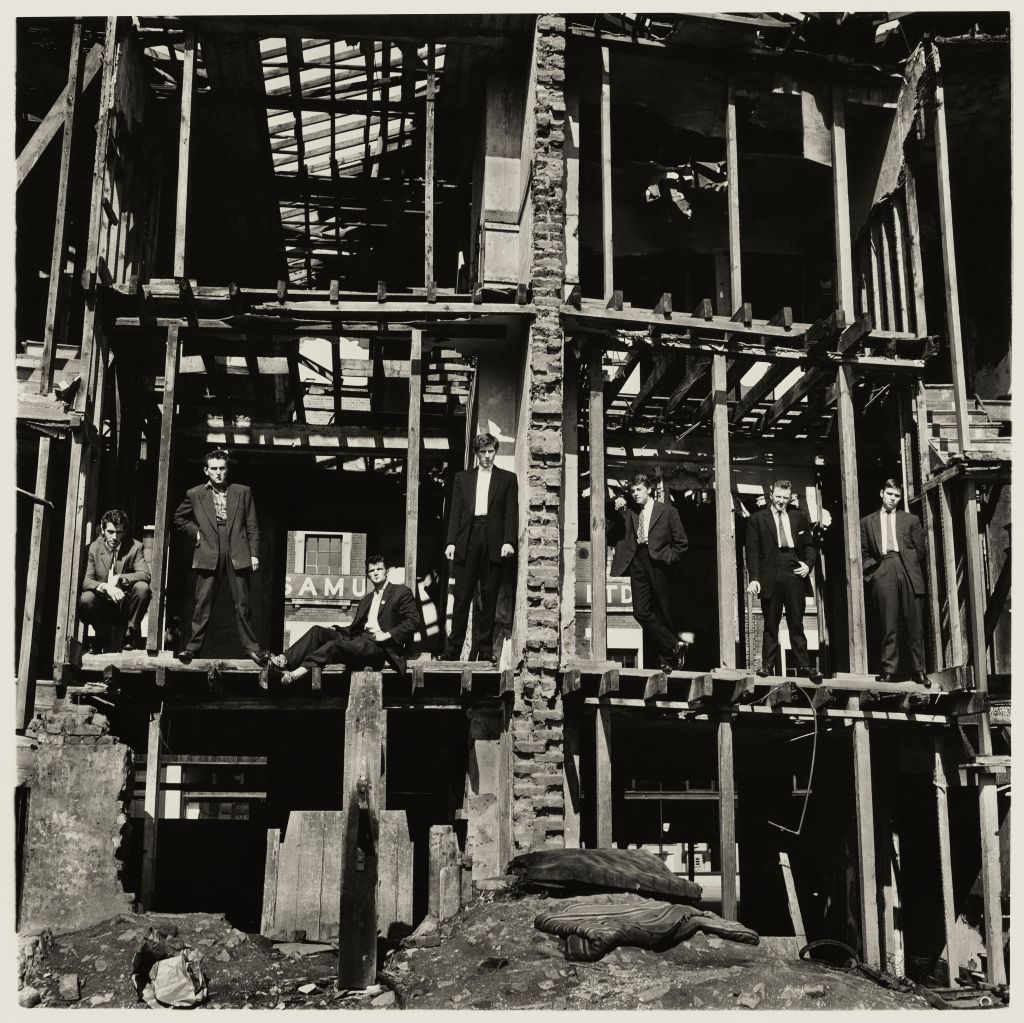
Sir Don McCullin CBE, who celebrated his 90th birthday last month, is rightly regarded as Britain’s greatest living photojournalist, renowned for his unflinching documentation of war, famine and human displacement. Born in Finsbury Park, North London, in 1935, he first picked up a camera during National Service in the Royal Air Force while working as a photographic assistant in aerial reconnaissance. But, having failed the RAF trade test to become a photographer, he didn’t get his first professional break until 1958 when his first published picture of a London gang called “The Guvnors” appeared in the Observer newspaper. This led to a contract with the paper, and in 1963 he was dispatched on his first official war assignment to Cyprus, where he experienced his “baptism of fire” as a photojournalist.
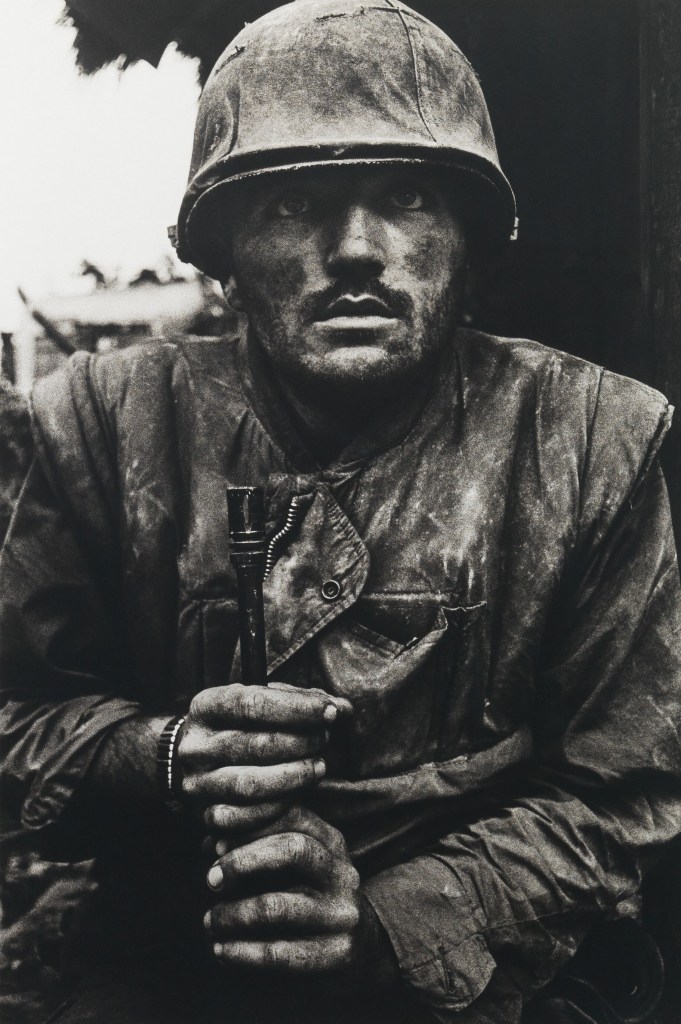
Between 1966 and 1984, McCullin worked for the Sunday Times as a staff photographer, a tenure that took him to the frontlines of war across Greece, Vietnam, Cambodia, Biafra, Bangladesh, Northern Ireland and Beirut. He produced some of his best-known work during this period, images that once seen are hard to unsee, such as “Starving Twenty-Four-Year-Old Mother with Child, Biafra,” and “Shell Shocked US Marine 1968.” He also experienced several close brushes with death – one item on display in this exhibition is the Nikon F camera he was holding to his eye when it absorbed a bullet from a Khmer Rouge soldier’s AK-47.
A Desecrated Serenity, McCullin’s most comprehensive US presentation to date, brings together over 50 works and rare archival materials. Harrowing images of war and suffering hang alongside stark industrial landscapes of Northern England in the Fifties and Sixties, portraits of The Beatles from their “Mad Day Out” photo session and compositions from his personal travels across India, Indonesia and the Sudan. Later work includes landscapes of France, Scotland and Somerset, where McCullin was evacuated as a child during the Blitz and where he now lives.
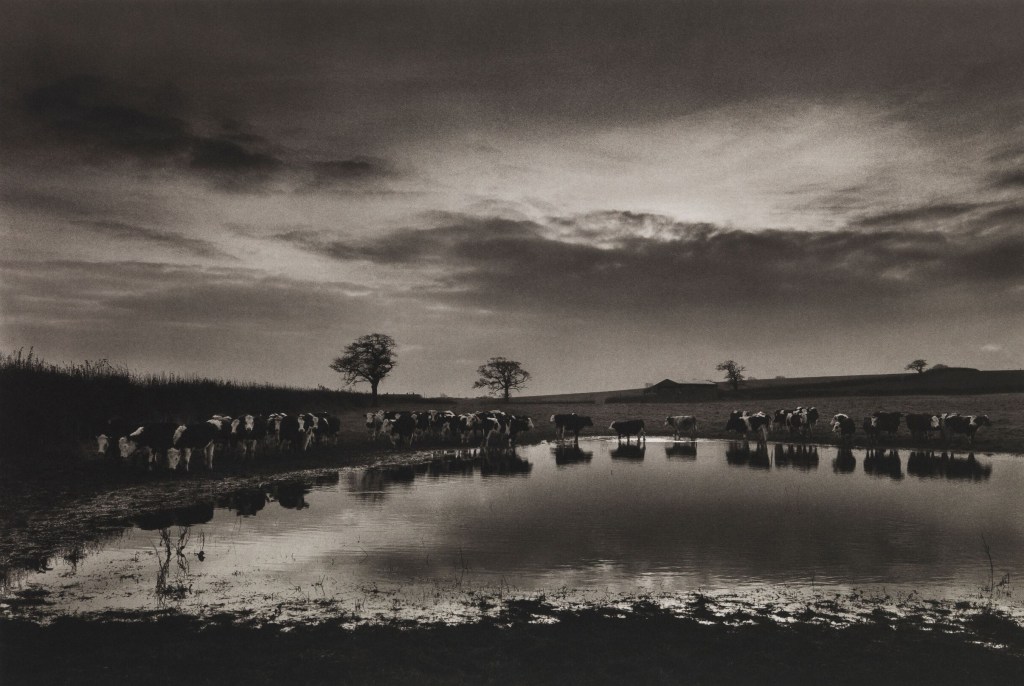
Rendered in his signature deep, dark tones, these painterly depictions of the English countryside – which McCullin has described as his greatest refuge – are worlds away from the battlefield but somehow echo his earlier work. On a windswept hill or in a flooded meadow in Batcombe Valley, McCullin has found his serenity, though it is a “desecrated serenity.” Just as McCullin is haunted by the destruction he has witnessed, so too are these calmer pictures. A sense of foreboding is never far away.
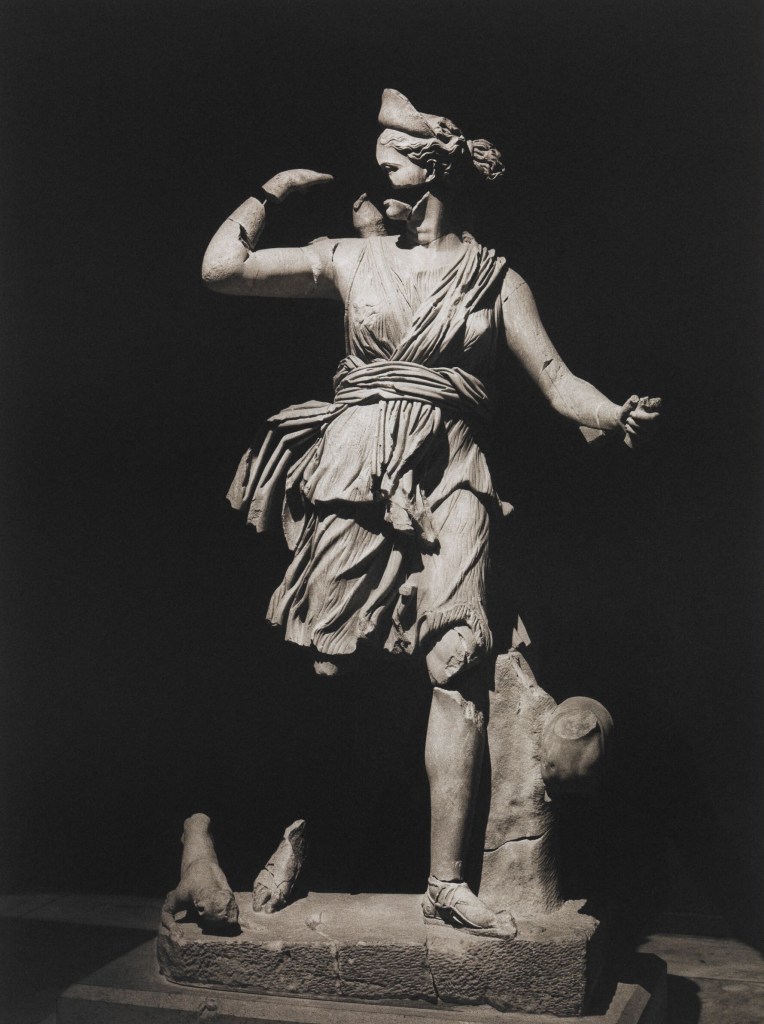
The same chromatic and emotional gravity carries over to a selection of still lifes inspired by the work of Flemish and Dutch Renaissance masters, as well as images of Roman statuary from McCullin’s “Southern Frontiers” series, his 25-year survey of the cultural and architectural remains of the Roman Empire. McCullin credits his late friend the author Bruce Chatwin with inspiring him to take on this mammoth project. With scant prior knowledge of the classical world (McCullin suffered from acute dyslexia and left school at 15) he decided to team up with author Barnaby Rogerson of Eland Books, and they began documenting all the Roman cities along the north coast of Africa, collaborating on two books: 2020’s In Search of Ancient Africa: A History in Six Lives and 2023’s Don McCullin in Turkey: Journeys Across Roman Asia Minor. It remains some of his proudest work. So far McCullin has produced over twenty books, including the 2007 autobiography Unreasonable Behaviour, and he is currently working on a big book on the Vietnam War.
McCullin is haunted by the destruction he has witnessed. A sense of foreboding is never far away.
For a man who has seen it all, McCullin is disarmingly lighthearted and modest, and he’s wary of the compliments and titles conferred upon him for his work (in 1993 he was the first photojournalist to be awarded a CBE; in 2017 he was knighted by Queen Elizabeth II for his services to photography; this year he scooped the top prize at the London Press Club Awards). He recoils when I describe his images as iconic: “If you make a tragedy look too beautiful you’re not serving any purpose. I have a big moral question about my work. All these gongs, honorary degrees – in the end I don’t feel good because I shouldn’t be rewarded at the expense of somebody else’s suffering. Those pictures haven’t made the slightest difference to the world.”
But he will admit to one thing: a strong compositional eye. And he laments how people nowadays have largely stopped seeing the world around them, being glued to their phones. “My eyes have been the wealth of my mind, and I’ve interpreted everything through them. It’s got nothing to do with photography. People say, ‘Oh, what camera do you use?’ And I want to kick them up the backside! My photography is done purely emotionally. I’ve got good eyes; I can see things other people don’t see. They go about their lives looking at only one thing, their phone, so they’re missing the whole life around them. They think they’re getting information from their phone but it’s actually stealing their life away from them.”
As he enters his tenth decade, the veteran photographer shows no signs of slowing down. “I’m so pleased that I’m not in some old nursing home in Somerset. I can still wander over that last hill, climbing, gasping, which I’ve done a million times.” Three months ago, he was in Syria, visiting Palmyra for the fifth time. And he has just been invited to Antarctica to photograph the world’s largest icebergs: “I keep thinking about packing it in. I’m sick of going into my darkroom and standing in that lonely red light [McCullin does all his own printing]. But then someone comes along with the biggest carrot in the world and I’m like some old donkey who’s jumping in front of the others. I’m going to bloody Antarctica at 90.”
A Desecrated Serenity at Hauser & Wirth is up until November 8.
Kaley Chiles is a Christian therapist who places the Bible at the center of her practice.
To many of her patients, religious faith is often more important than Freud. They see Bible readings, prayer and a focus on spirituality along with traditional principles of psychotherapy as essential elements of any treatment plan.
While outside the mainstream of psychoanalytic practice, Chiles’s technique combining traditional psychotherapy with Biblical precepts for years had been deemed non-controversial, if confined to more conservative regions of the country. But that all began to change in 2019 when the state of Colorado enacted legislation banning so-called conversion therapy for minors, a technique that aims to help gays change their sexual orientation.
Fearing the law would interfere with her treatment of teenage clients wrestling with their sexuality, Chiles filed suit in federal court against Colorado alleging the statute violated her First Amendment free speech rights. She lost at the trial level and in the initial round of appeals, with jurists finding that Colorado’s ban fell well within its right to regulate medical practice and protect patient safety.
But it now appears the US Supreme Court is leaning toward upholding Chiles’s right to advise young clients that changing their sexual orientation is a viable and realistic option, despite widespread medical and scientific agreement that such techniques rarely, if ever, work.
In oral arguments on October 7, the state’s conservative majority peppered both sides with questions suggesting they were leaning in Chiles’s favor. A decision upholding Chiles’s appeal would follow a string of Supreme Court rulings in recent years favoring religious conservatives while creating new hurdles for gays and transgenders.
Without First Amendment protections, “states can transform counselors into mouthpieces for the government,” argued James Campbell, a lawyer for Chiles, at the Supreme Court hearing.
The case poses novel Constitutional questions that center on ability of medical professionals to communicate with patients about treatments they believe are effective but that have been outlawed by state regulators.
On a deeper level, though, Chiles’s lawsuit and the legal battle surrounding it are simply the latest fight in the nation’s long running conflict over cultural values, ranging from gay and transgender rights to abortions and race relations.
In June, the court’s 6-3 conservative majority ruled in favor upheld a Tennessee ban on the use of puberty blockers and hormones for the treatment of young patients suffering from so-called gender dysphoria and seeking to change their gender identity. In another ruling this year, the court also upheld, on a temporary basis at least, the Trump administration’s ban on LGBTQ persons serving in the military while the litigation continues
And in a 2018 decision that may well have a bearing on Chiles’s appeal, the court found in favor of religious conservatives by striking down a California law requiring anti-abortion groups to provide information on state funded abortion and contraception when counseling their clients. The court found that the law infringed on anti-abortion groups’ free speech rights.
Reflecting the heated politics underlying the Chiles case, dozens of interest groups from both sides of the ideological spectrum have filed amicus briefs with the court. Medical societies of various stripes have been particularly scornful of Chiles’s case. One brief filed by the American Psychological Association, the American Medical Association and other organizations representing health care professionals maintained that conversion therapy rarely if ever works. It argued at the same time that the practice causes great harm to patients by further confusing them about their identity and disrupting family relations while raising the risk of suicide.
Conversion therapy embraces a wide range of techniques, some bordering on barbaric, including aversion therapies using electroshock treatment and nausea inducing drugs. Some 30 states have banned it.
Chiles and her lawyers say she would employ none of those practices and that she engages only in talk therapy. But in court filings and in interviews, they stop short of describing exactly what Chiles would tell clients seeking to change their sexual orientation, only that she might advise them on how not to act out unwanted sexual impulses.
“When she engages in those conversations, she’s encouraging them to achieve their goals,” Campbell said during oral arguments. “She’s discussing concepts of identity and behavior and attractions and how they fit together.”
This is an ongoing active dialogue where she’s helping them explore their goals, and that absolutely has to be protected by the First Amendment.”
The state of Colorado of course sees it differently.
“No one has ever suggested that a doctor has the First Amendment right to offer the wrong advice,” countered Shannon Stevenson, Colorado solicitor general. “The law applies only to treatments, that is, only when a licensed professional is delivering clinical care to an individual patient. In that setting, providers have a duty to act in their patients’ best interests.”
During the October 7 oral arguments, the court’s conservative justices seemed supportive of Chiles’s free-speech claims. Justice Samuel Alito for one opined that because Colorado law bans discussion of conversion therapy but permits therapists to advise clients on transitioning from one gender to another, the law had clearly crossed a First Amendment red line.
“That looks like blatant viewpoint discrimination,” Alito declared.
Justice Amy Coney Barrett queried Campbell on whether clients who felt they had been harmed by conversion therapy might be able to file a malpractice claim. It was a loaded question in the sense that proponents of Colorado law argue conversion therapy is harmful and that a First Amendment protection for therapists would leave patients defenseless.
Bryant’s question implied that civil litigation against irresponsible therapists might serve as a brake against harmful practices.
Chiles’s legal team, Alliance Defending Freedom, a prominent Christian legal organization that has participated in over 70 Supreme Court cases, has packaged their client in a way that aims not only to persuade jurists but also the public at large. That is hugely important in the world of civil litigation. Having a sympathetic client is often just as pivotal as a powerful claim or even a particularly effective legal team. All the legal firepower in the world won’t help if juries and judges are put off by the claimant.
On its website, Chiles, who is based in Colorado Springs, is depicted in a video hiking in the Rockies near Denver while she talks on an audio track about her clients and how Colorado’s conversion therapy ban had frustrated their efforts to regain emotional health.
“They say that emotions are like children. It’s not OK to let them drive the car and it is not OK to stuff them in the trunk,” she says in the video. “I counsel my clients on… how to make their lives more fulfilling, satisfying and more in line with who God created them to be. What I am struggling with right now is that the state of Colorado has decided to impose their own values, not only on me but more importantly on my minor clients.”
It’s a well-articulated rationale by a seemingly credible plaintiff. It’s just not altogether clear, from the science at least, that her clients would benefit.
The death of the actress Diane Keaton at the age of 79 was greeted with an understandable mixture of sadness and surprise. Sadness, because the death of one of the leading ladies of the Seventies and Eighties (and beyond) robs the film industry of one of its true originals, and surprise, because nobody had any idea that she had been unwell. Yet it is somehow typical of Keaton – perhaps the only woman in history to have dated the wildly disparate likes of Woody Allen and Warren Beatty – to depart the set in a wholly inimitable way. Nothing about her life and career was in any way typical or predictable, so it is equally fitting that her end should be equally confounding, too.
For those of a certain age, Diane Keaton was Annie Hall. There are many pleasures to be had from Woody Allen’s Oscar-winning romantic comedy, but perhaps the greatest one was Keaton’s distinctive and unforgettable performance in the lead. Not for her the usual Manic Pixie Dream Girl clichés. Instead, attired in a distinctive wardrobe of fedora hat, tweed jacket and Oxford bags like a Twenties flapper relocated to Seventies New York, Keaton managed to make her Annie both a fashion icon and a fascinating, relatable and, yes, damn sexy protagonist, whose offbeat love affair with Allen’s Alvy Singer made her into one of the most iconic characters ever seen in cinema. She deservedly won an Oscar for the part.
Keaton collaborated with Allen a further seven times, and many of these films – including Manhattan, Love and Death and Sleeper – were among the filmmaker’s best, suggesting that the actress’s work with him resulted in a unique alchemy that has seldom been captured elsewhere. Yet even when she wasn’t working with her one-time lover, she managed to be a fascinating presence on screen when used correctly. She played Al Pacino’s increasingly appalled wife Kay in the Godfather films, supplying those brilliant films with a moral center, and was superb in the dark Seventies thriller Looking For Mr Goodbar as a bored schoolteacher who drifts into a twilight netherworld of casual and increasingly risky sexual encounters with eventually fatal results.
She suffered from a mixture of typecasting and lazy directors in her latter years, with Nancy Meyers’ romantic comedy Something’s Gotta Give, in which she convincingly battled for the attentions of both Jack Nicholson and Keanu Reeves, perhaps the pick of a mediocre bunch. (It was sadly typical of Hollywood’s inability to view her as anything other than quirky that in the 2017 film Hampstead, Brendan Gleeson’s ornery tramp was her love interest.) Yet she was always an interesting presence on screen, even in films that wasted her, and offscreen she was a bright, vivacious figure, refreshingly unpretentious and down to earth.
Allen, albeit from the perspective of a biased observer, once called her “the finest screen comedienne we’ve ever seen”, and he may well have been correct. She could make audiences laugh themselves silly, and then tear up, with a gesture or a flick of her hair, and her premature end has deprived us of many of the great roles that she might have played as an older actress, including, potentially, a last collaboration with Allen. Still, we must be grateful for what we have, and, in Annie Hall in particular, she left her mark on cinematic history in a way that few others have ever come close to.
The Metropolitan Opera has been in the hole for years and for most of that time company leadership has pleaded ignorance as to why. Just this February, general director Peter Gelb lamented audiences’ lack of interest in the Met’s slate of contemporary operas. “It’s impossible to predict hits,” said the man paid $1.4 million a year to, well, predict hits.
In its 2025-26 season slate, the Met finally seems to be wising up – but it faces an uphill climb. For the better part of a decade, the company has been financially unprofitable, artistically boring and actively hostile to its audience.
‘It’s impossible to predict hits,’said the man paid $1.4 million a year to, well, predict hits
In the past four seasons especially, the Met has failed to fill the house or turn a profit. Last year, it sold just 72 percent of its capacity, which was no improvement on the previous year and a far cry from its pre-pandemic peak of 75 percent. For an organization as huge as the Met, those three percentage points represent around 25,000 audience members, or six full houses.
The problem only gets worse the more closely you look at the data. In 2023-24, the Met realized 64 percent of potential income on its tickets sold. In 2024-25, it only realized 60 percent of potential income, meaning that an equivalently sized audience to its 2023-24 audience paid less to be there. And even as the Met discounted more tickets, its number of new ticket-buyers dropped by 13 percent from 2023-24 to 2024-25.
How did Gelb react when these disheartening results were announced in June? By blaming Donald Trump, of course. Attendance during the 2024-25 season, Gelb said, “dropped slightly following the Trump administration’s immigration crackdown.” Conveniently, he avoided mentioning that the Met’s sales for the first half of the season, when Trump was not yet in office, were worse than its second-half results. In the same statement, Gelb preemptively blamed stock market uncertainty for disappointing ticket presales for 2025-26.
Smart observers should always smell a rat when a CEO blames short-term market headwinds for long-term underperformance, and that wisdom holds true here. The fact is that the Met has been consistently underperforming for most of Gelb’s two-decade tenure.
Why? For a range of reasons. Some are structural challenges facing the opera industry in general. But the comparatively stronger performance of many American opera companies during the same period suggests that a large portion of the blame should be placed at the doorstep of the Met’s musical and executive leadership.
Among those internal challenges, we must count the own-goals against his business that Gelb seems unable to avoid. He has, for example, refused to drop his ongoing feud with Russian diva Anna Netrebko, once a fixture on the Met Stage and as much of an audience magnet as can be found in 21st-century opera. Since 2021, Netrebko has been banned from Gelb’s Met for refusing to publicly criticize Vladimir Putin over her home country’s war in Ukraine. Not content merely to deprive Met patrons of Netrebko’s artistry, Gelb has periodically accused her of moral cowardice since banning her from the Met, with the unsurprising result that Netrebko is now suing both him and the company for national-origin discrimination.
There was also Gelb’s draconian handling of Covid. The Met was one of the last arts organizations in New York (and therefore in the entire country) to stop requiring audience members to wear masks during shows. They didn’t drop the mandate until October 2022, two and a half years into the pandemic. By putting his audiences through entire evenings of needless discomfort in service of scientifically dubious masking practices once the pandemic had already waned, Gelb probably lost more than a few long-term subscribers.
But these follies fade into insignificance next to the company’s greatest act of self-sabotage: its programming. The biggest reason audiences haven’t come out in recent years is, quite simply, that they don’t want what the Met is selling.
To see how, let’s look again at the data from the 2024-25 season, asking which operas outperformed the Met’s 72 percent average audience – and which underperformed it. First, the overperformers: Mozart’s TheMagic Flute translated into English; Verdi’s Aida; Jake Heggie’s Moby-Dick; Puccini’s Tosca; Tchaikovsky’s Pique Dame; and Puccini’s La Bohème.
The underperformers? John Adams’s Antony and Cleopatra; Osvaldo Golijov’s Ainadamar; Verdi’s Rigoletto; the German version of The Magic Flute; Offenbach’s Les Contes d’Hoffmann; and Verdi’s Il Trovatore. Dead last, at 50 percent, was the Met’s commissioned opera for this year and its opening-night production, Jeanine Tesori’s Grounded. One thing we should notice here right away is that on average, classic operas outperformed new ones. The classics were distributed evenly around the 72 percent average – some above, some below. The Magic Flute and Aida dramatically overperformed the average. Among contemporary operas, there was one hit: Heggie’s Moby- Dick. The other three – Adams, Golijov and Tesori – fell not only below the average, but way below it.
This continued a trend observed in the 2023-24 season, during which classics – Mozart’s The Magic Flute; Puccini’s Turandot; and Bizet’s Carmen – outperformed contemporaries. That year, only one contemporary opera outperformed the audience average: Anthony Davis’s X: The Life and Times of Malcolm X. The other four performed abysmally. After that season, Gelb also sounded the now all-too-familiar refrain of ignorance: “If we knew what would result in a sold-out house, everything would be sold out.”
Allow me to help him. There are a few conclusions that should jump out both from this data and from a general survey of the American opera landscape in the year 2025. Maybe they’ll help him learn what will result in a sold-out house.
The overriding principle the Met missed over the past two seasons is that 21st-century audiences come to the opera to escape. They come to bask in stories of high drama, tragedy, whimsy, love. They come for the magical, the mythical, the epic, the irrational, the ancient, for sumptuous sets and lavish costuming. This is why two of the Met’s three best-selling operas over the past two seasons were Puccini’s Turandot and Verdi’s Aida. They are not the best pieces of music the Met put on over that time. But taken together as both musical and visual artworks, they are the most impressive.
What do audiences not come to the opera for? They do not come to stay where they are – in a fractured American society in 2025. They do not come to feel as though they are prowling the mean streets of New York or at home watching the news. They do not come to be guilted. And most of all, they do not come to be bored.
What do audiences not come to the opera for? Most of all, they do not come to be bored
Specifically, they do not come to the opera to hear about the stresses of present-day female pilots who get pregnant (Grounded). They do not come to hear about chic editors, novelists and housewives in New York (Kevin Puts’s The Hours); or the legal proceedings following the rape and murder of a boy and girl in a parking lot (Heggie’s Dead Man Walking); or the life of New York Times columnist Charles Blow (Fire Shut Up in My Bones by Terence Blanchard). Nearly every single contemporary opera put on by the Met that has focused on recent events, current social issues or contemporary figures has flopped.
It also should not escape our notice that three out of four contemporary operas featuring black or Hispanic protagonists flopped. The lack of audience interest in such operas is not, of course, because audiences don’t want operas with minority protagonists. Rather, it’s that the Met, in its zeal to give them minority protagonists, neglected to offer stories that weren’t either unpleasant or boring. When audiences feel that they are being force-fed, they seek entertainment elsewhere.
This is all a great pity, because contemporary opera can be exciting. The great success of Heggie’s Moby-Dick, which deals with a classic American tale of a heroic, tortured soul at sea, proves it. So does the nationwide run of Kevin Puts’s Silent Night, a poignant tale of the 1914 Christmas Truce set to a sumptuously romantic score.
The Met does not need to abandon contemporary opera. What it does need to do is refocus its programming on the types of monumental heroic, tragic or comic stories that audiences come to see. And since the Met is one of the world’s largest opera-commissioning organizations, it can help steer the subjects of operatic composition and libretto writing in the direction its audiences are clamoring for: away from the mundane and toward the marvelous.
A full embrace of that principle alone will enable the Met to slow the bleeding on its ticket sales. But there are a few more principles the Met might glean from recent data. First, purist musicians may not like operas translated into English, but audiences do. It’s no accident that an English Magic Flute was the Met’s most popular show last season. Audiences feel more involved in the story when the singers are singing in their language. The Met should program translations far more often, potentially offering both English and original-language versions of the same show with alternate casts.
Second, John Adams is spent. His brand of pop-minimalism, first used to such brilliant effect in 1987’s Nixon in China, is wearing very thin. If the Met wants to make money, it should stop programming Adams operas. If it must offer some minimalism, Philip Glass’s Einstein on the Beach, Akhnaten or Satyagraha are always good for a reboot.
Third: Verdi operas – other than La Traviata – that don’t lend themselves to colossal staging, such as Aida, are fading in popularity. It’s still no problem to program Rigoletto or Il Trovatore, but it’s best to avoid both in the same season.
Things look to be turning around at the Met this year. The 2025-26 lineup boasts such classics as La Traviata, Porgy and Bess and Madama Butterfly, and only one contemporary opera of dubious interest – Gabriela Lena Frank’s El Último Sueño de Frida y Diego.
Gelb finally seems to be getting the message. Perhaps the Met’s audiences will be willing to give him one last chance. But if he returns to the let-them-eat-cake approach to business that has characterized his last several years at the Met, they won’t be eating it during intermission at the Met Café. They’ll be gone for good.
This article was originally published in The Spectator’s October 13, 2025 World edition.
America’s Montaigne, Gore Vidal, was born 100 years ago today. Born Eugene Luther Vidal, this Virgil of American populism entered the world on October 3, 1925 (“Shepherds quaked,” he later said, describing his arrival in his typical, wildly egotistical way).
His father, Eugene Luther Vidal – after whom he was named – was a former quarterback, Olympian and the founder of three commercial airlines. While he worshipped his father, Vidal had a hateful relationship with his mother, Nina Gore, a beautiful monster who would go on to marry two more times following her divorce from Vidal senior.
Vidal’s formative friendship was with Nina’s father, Thomas Pryor Gore, the blind senator from Oklahoma. Young “Gene” read him Voltaire, Gibbon, Shakespeare. He had read Livy in translation by the age of seven and attended his first presidential convention at 14, which was when he decided to drop ‘Eugene Luther’ and take “Gore” as his first name.
Enlisting in 1943 at the age of 18 during the second world war, Vidal served as a warrant officer aboard a freighter in the northern Pacific. This later inspired his first novel, Williwaw (1946), a Hemingway-esque tale of men at sea. He was heralded as a prodigy. But his next, The City and the Pillar (1948), the first serious American homosexual novel, proved divisive.
In need of money, having bought a Greek revival mansion in the Hudson Valley, Vidal began writing for television. He was a natural, commanding fees as high as $5,000 for a script. Writing the play The Best Man in 1960 inspired a bid for Congress in New York’s bedrock Republican 29th district. Despite help from Eleanor Roosevelt and the actress Joanne Woodward, he lost – but nevertheless managed to outpoll every previous Democratic candidate the district had had since 1910. His slogan “You get more with Gore” had some force – not least given his claim that he had had 1,000 lovers by the time he was 25.
Vidal’s enduring handsomeness fed an unembarrassed narcissism
Vidal relished the fact that, following the breakdown of her second marriage, his mother was succeeded as Hugh D. Auchincloss’s wife by Janet Lee Bouvier, mother of Jacqueline Kennedy and Lee Radziwill. He would enjoy an easy relationship with John F. Kennedy but his brother Robert disliked and distrusted him. At a White House reception, he had upbraided Vidal for putting his arm around the First Lady (well, they had shared a step-father). The episode was inflamed by Truman Capote claiming a drunken Vidal had been evicted. Vidal successfully sued but his White House days were over.
Having been a mainstream liberal democrat, it was accepted that Vidal moved to the left in the mid Sixties, after his break with the Kennedys. There was his loathing of American “empire” and bankers, but he became a populist reactionary who believed his country had been injured by tyranny and foreign adventurism. Thus, the author Michael Lind believed he was more in the mould of his maverick Senator grandfather: that he moved not to the left but “to the South and West and back in time.” A final tilt at the Senate in 1982 also proved unsuccessful.
He relished enduring feuds with not just Capote but also the writers Norman Mailer, Truman Capote and William F. Buckley. His friendships, meanwhile, were eclectic: Woodward and her husband Paul Newman, the actresses Claire Bloom, Susan Sarandon and Joan Collins – and Princess Margaret. Later in life, he described himself as such:
“I’m exactly as I appear. There is no warm, lovable person inside. Beneath my cold exterior, once you break the ice, you find cold water.“
Yet, after an interview with this magazine’s Mary Wakefield, he blew her a kiss. On interviewing Vidal at 70 for the New York Times, Andrew Solomon wrote:
“His epigrammatic discourse – bred in equal measure of imagination, affectation and brilliance – is delivered in a voice as rich & smooth and alcoholic as zabaglione.”
Given that voice and his patrician hauteur, the journalist Mark Lawson thought it a minor tragedy that no director had ever cast him as The Importance of Being Earnest’s Lady Bracknell.
On Labor Day in 1960, Vidal met his life partner, Howard Austen, a would-be pop singer with stage fright who became an advertising executive. Vidal claimed the union endured because it was sexless. In 1972, they bought a villa – La Rondinaia – on the Amalfi coast in Italy, perched on a cliff in the commune of Ravello. From this august exile, the historical Narratives of Empire series of novels appeared – the revolutionary era of Burr (1973) via Lincoln (1984) to Hollywood (1990) and The Golden Age (2000). Between them, they covered a century of American history.
Vidal’s self-mythologising memoirs, Palimpsest (1995) and Point To Point Navigation (2006),proved immensely readable but his legacy is his essays – self-assured, original, erudite, elegant and acerbic. His 1,300-page anthology, United States: Essays 1952-1995, is only two-thirds of his output.
TheNew York Times’s Charles McGrath believes Vidal will “live on most vividly on YouTube.” As Vidal himself used to say, “there are two things in life you should never turn down: the opportunity to have sex and the chance to appear on television.”
His enduring handsomeness fed an unembarrassed narcissism: “I have the face now of one of the later, briefer emperors.” His Wildean bon-mots were usually unkind – but memorable: “A good deed never goes unpunished” and his classic “Every time a friend succeeds, I die a little.”
A confidant of Tennessee Williams and a lover of Jack Kerouac, Vidal knew Christopher Isherwood, E.M. Forster, Albert Camus, Sartre, Anaïs Nin and William Faulkner. We know because he often said so. “Allen Ginsberg kissed my hand as Jean Genet looked on,” he once said. And “I have never much enjoyed the company of writers – who are less famous than I am.” Vidal’s philosophy? “There is not one human problem that could not be solved if people would simply do as I advise.”
Austen’s health forced a return home in 2003 to the Hollywood Hills. His death a few months later left Vidal bereft and a long, slow self-ruination followed. He died on July 31, 2012, aged 86.
Sandy Hook was supposed to be the tipping point in our national conversation about mass shootings. This wasn’t a shopping mall or movie theater. It wasn’t a high school. We could imagine this happening at a high school. We had seen that before. But we could not imagine anyone shooting six-year-olds. It was so monstrous that it seemed beyond the realm of possibility.
Since that day, 13 years ago, the killings have continued and their settings have shifted. Earlier this month, a gunman opened fire at a Turning Point USA event, fatally shooting conservative commentator Charlie Kirk. In the past year or so, 15-year-old Natalie Rupnow killed a teacher and a fellow student in Madison, Wisconsin, before taking her own life. Solomon Henderson opened fire in a Nashville school cafeteria. Luigi Mangione allegedly murdered healthcare executive Brian Thompson. Aaron Bushnell set himself on fire outside the Israeli Embassy in Washington, DC.
These episodes are not identical. What unites them is an atmosphere: not tidy ideology but an appetite for meaning where meaning has been hollowed out.
Two specters haunt our culture, and both conclude that life should be extinguished. The first says life is meaningless. The second says life is suffering. They arrive at the same destination from different directions. The nihilists believe in the void. For them, all human values are illusions, all meaning is projection, all morality is “cope.” Violence becomes their demonstration: proof that nothing matters.
The Columbine killers left behind hours of video explaining this worldview. James Holmes, the Aurora theater shooter, documented his sense of meaninglessness. William Atchison posted for years about nihilism before killing two students in 2017. Their massacres were philosophical proof that caring about anything was absurd.
Before the internet, killing manifestos would have stayed in evidence lockers. Now they circulate endlessly online
The other philosophy comes from pain, not emptiness. Life is not meaningless but unbearable. Adam Lanza, who committed the Sandy Hook massacre argued that culture itself was a disease and schools were its transmission belt. Killing children, in his philosophy, was a mercy: putting an end to life before it could propagate suffering. He spent years developing an anti-natalist framework explaining why human consciousness itself was the error. This is not nihilism but something else entirely: the conviction that existence is fundamentally malignant. Today’s killers inherit one or both philosophies.
Mangione appears to have absorbed years of discourse about the moral emergency of medical bankruptcy and denial of coverage until the healthcare system seemed so cruel that killing an executive felt like justice. Bushnell consumed footage of the destruction in Gaza until self-immolation seemed the only proportionate response to unbearable reality. It now seems plausible that Tyler Robinson watched political polarization escalate until violence appeared to be a logical act of justice against a hateful world. To these young assassins, the system is torture and spectacular action is the only authentic response. Rupnow and Henderson found their way to “764,” a decentralized online network that grooms young people into self-harm and violence. Such networks are like pneumonia attacking someone who already has HIV. They don’t create nihilistic children; they find the ones who are already hollowed out by the media environment, already convinced they have no future – that the world has no future – already oscillating between numbness and panic. The groups are symptoms more than the disease. They could not recruit effectively in a culture that gave young people genuine hope.
Journalists and politicians still default to familiar explanations – guns, video games, mental illness – because those frames are simple and politically serviceable. The left calls for stricter gun control; the right leans on mental-health narratives. But both of those responses miss the crucial layer: the cultural conditions that make both philosophies persuasive.
Earlier mass killers had comprehensible motives: postal workers had grievances, political assassins had targets, even serial killers had pathologies and fixations. But Columbine, in 1999, introduced killing as philosophy. Before the internet, the manifestos that accompany such actions would have stayed in evidence lockers. Now they circulate endlessly online, providing vocabulary for those who already sense the void or the pain, but lack words for it. Each new shooter studies the last, refining the argument.
The internet doesn’t create these philosophies but accelerates their transmission. This is why policy responses that focus only on guns or only on therapy or only on “rooting out” political extremism will fall short; they are necessary but not sufficient. Shutting down grooming networks treats the pneumonia, not the HIV. We must address the underlying condition: the media environment that oscillates between numbness and panic, the economic system that tells the young they have no future, the culture that produces people primed for violence.
About a year ago, I interviewed a young man who had fallen into one of the darkest corners of the internet via the “furry community.” Furries are people who role-play as, draw fan art of and, famously, wear fursuits of anthropomorphic animals. They’re more important to the history of the internet than they’re often given credit for. They were experimenting with identity in online environments long before most people first logged on to social media. The culture of pseudonymous performance, fan-driven art economies and elaborate online communities – now standard features of the internet – were partially pioneered in furry spaces. Most furries are, at worst, eccentrics immersed in a fandom that doesn’t always feel accessible to normal people.
That being said, there is a fringe dark side to the furry subculture and this boy’s involvement led eventually to him watching violent, animal-torture pornography. There aren’t many practical case studies of what falling down an internet rabbit hole looks like, so his experience and the conversation we had matters. It shows how these online communities can potentially mutate and hurt people, and how some of those offshoots can draw people toward obsession, alienation and harm.
It should be a warning to all parents everywhere that this boy wasn’t a troubled or traumatized kid. His parents were inattentive, not criminally neglectful. “My home life was pretty calm,” he told me. “My parents worked a lot. They’d usually be home at maybe five or six. And from there they wouldn’t really, like, interact with me much. I would just be in my room and I would say I was doing homework when really I wouldn’t even start doing homework until ten.”
In seventh grade the boy got a smartphone and at that point, he says, his internet usage got out of control. He’d be online until two or three o’clock in the morning. His parents did notice his internet addiction but they were out of their depth. “They tried to push me to go to club meetings or they’d set up screen-time passwords,” the boy told me, but younger generations are at home online in a way their parents are not. He says he felt like he was always a step ahead of them. They never saw the extreme, violent pornography that the boy ended up addicted to. “If they did discover anything there, they never said anything, which frankly, if that was the case, I don’t think I could forgive them.”
The furry community can be and often is benign, but as the boy says, it can also be a portal to an actual hell. “It was very easy to find people who are into normal furry stuff, and then find people who are specifically into furry drawings of like realistic genitals, and then hyper realistic stuff. And from that point, it’s very easy to find just straight up zoophilia. I feel molested by the internet – that’s how I’d describe it,” he says. “I feel like it touched me someplace, very deeply, like part of my soul was trapped in cyberspace and I’ve been kind of clawing to get it back.”
Violence has become imaginable to people who before might have found solace in work, family or civic life
I do not want to blame the internet. But the internet is like a sort of fairyland – as full of danger as it is enchantment. What we face in such a moment is less a conventional political battle than a spiritual one. This boy’s experience is a perfect case in point. The choice is not between conservative or progressive policies but between frameworks that affirm life and those that render it either meaningless or unbearable. America’s epidemics of despair have combined with technological access to make violence imaginable to people who, in another era, might have found solace in work, family or steady civic life.
If we are to respond honestly, we must recover the vocabulary of meaning-making: institutions which offer identity beyond consumption and outrage; communities that restore durable ties; media that privileges context over immediacy; and education that teaches people how to live, not just how to perform. This will not be quick. It will not be purely legislative. But until we address what makes both “life is meaningless” and “life is unbearable” persuasive philosophies that demand violent manifestation, we will keep mistaking symptoms for causes.
Until we confront that – until we admit that even ordinary-seeming people can be recruited into these philosophies – we will continue to misdiagnose what happened in these classrooms, cafeterias and political spaces. The specters are everywhere now: in the manifesto and in the feed, in the philosophy seminar and in the TikTok video.
These are not anomalies. They are signals that America’s crisis is not only political or technical but spiritual: the routinization of despair, the auditioning for obliteration.
This article was originally published in The Spectator’s September 29, 2025 World edition.