Tag: enviromentalism

  • King Charles and Pope Leo share the same religion

    King Charles and Pope Leo share the same religion

    The historic meeting October 23 between Pope Leo XIV and King Charles III – the first between a pope and an English monarch since before the Reformation – goes beyond the obvious religious significance. It suggests future cooperation in promoting an entirely different religion, one favored by most of the world’s elites.

    That religion preaches environmental sustainability through draconian measures that demand humanity’s submission at the expense of common sense and science. Not for nothing did Leo and Charles meet less than three weeks before the start of COP30, the United Nations’ annual conference on climate change.

    Throughout his public life, Charles positioned himself as Defender of the Environment. His portfolio supports replacing fossil fuels with alternative energy sources, farming without nitrogen-based fertilizers and instituting carbon taxes and carbon credits. His Majesty even advocates radically changing international economics to achieve environmentalist goals.

    “We must recognize that our economic system is at the heart of the problem precisely because it is at odds and not in harmony with nature’s own economy,” Charles said in 2022. “This situation is indeed dire and the consequences of inaction and business as usual are unimaginable. However, this same economic system of ours, if retargeted, is key to the solution.”

    Charles’ rhetoric and actions match what Pope Leo’s predecessor produced. Pope Francis made environmental activism his papacy’s hallmark when he wrote in 2015 the encyclical Laudato Si, in which he demanded radical, immediate change to avert an environmental collapse that would devastate social and political systems and wreak havoc on the poor.

    “Halfway measures simply delay the inevitable disaster,” Francis wrote. “Put simply, it is a matter of redefining our notion of progress. A technological and economic development which does not leave in its wake a better world and an integrally higher quality of life cannot be considered progress.”

    Francis solidified his agenda in 2021. On May 14, the Vatican held a one-day conference on environmental and economic issues. John Kerry delivered a keynote address for a panel on “Integral Ecological Sustainability” regarding energy and food.

    Eleven days later, Francis announced the Laudato Si Platform, a seven-year campaign to implement the UN’s Sustainable Development Goals. Francis described it as belonging to a thrust toward what he called “green economics,” “green education” and “green spirituality.”

    Francis and Charles thus forged a close relationship. In 2017, Francis hosted Charles and his wife Camilla for a papal audience In April, the king and queen made an informal visit to Francis 12 days before his death.

    Most importantly, both backed the World Economic Forum’s Great Reset and the UN’s Sustainable Development Goals, part of its Agenda 2030. Charles lent his voice to a video introducing the WEF’s program in 2020.

    “We need nothing short of a paradigm shift, one that inspires action at revolutionary levels and pace,” Charles said. “We simply cannot waste anymore time, and the time to act is now.”

    Four months after issuing Laudato Si, Francis addressed the UN. He called Agenda 2030 “an important sign of hope” because “a selfish and boundless thirst for power and material prosperity leads both to the misuse of available natural resources and to the exclusion of the weak and disadvantaged.”

    Tellingly, the Vatican entitled its 2021 conference on environmental and economic issues, “Dreaming of a Better Reset.”

    Leo intends to continue Francis’ activism. The new pope indicated that commitment clearly as the Vatican commemorated Laudato Si’s 10th anniversary October 1.

    “We inhabit the same planet, and we must care for it together,” Leo said. “I therefore renew my strong appeal for unity around integral ecology and for peace! We must shift from collecting data to caring; and from environmental discourse to an ecological conversion that transforms both personal and communal lifestyles.”

    But the European Union’s focus on solar and wind power makes it dependent on energy sources that are more expensive, less reliable and counterproductive to economic growth. Italy, Britain, Ireland, Germany, the Netherlands and Denmark pay the highest electric bills yet the EU wants to reduce carbon emissions by 90 percent by 2040.

    Meanwhile, such developing nations as China, India, Brazil and Indonesia invest heavily in fossil fuels despite emissions.

    “This climate crusade is a masterclass in self-sabotage, chaining its economy to ruinous policies while preaching moral superiority,” said environmental analyst Bjorn Lomborg. “It is economic suicide dressed in eco-virtue.”

    Even Bill Gates believes the panic ranges beyond overstatement.

    “Although climate change will have serious consequences – particularly for people in the poorest countries – it will not lead to humanity’s demise,” Gates wrote. “People will be able to live and thrive in most places on Earth for the foreseeable future.”

    Given such problems as clerical sex abuse and the breakdown of societal order due to unchecked Muslim immigration, St. Peter’s and Buckingham Palace, respectively, abandon their responsibilities and identities for the sake of intellectual fashion.
  • Is Caspar David Friedrich ‘kitsch’?

    Is Caspar David Friedrich ‘kitsch’?

    Imagine wandering through Germany. You might picture blustery Baltic seascapes, seen from island retreats such as Rügen. Or you might be hiking in the central Harz mountains, peering down at clouds that drift into green pastures and blend into brownish rock. Perhaps you’re standing at the country’s eastern edge, gazing at moonlight that gleams through gaps in the forests and ravines of sandstone highlands.

    What we sketch in our minds probably follows the contours of the canvases of Caspar David Friedrich, Germany’s Romantic artist-in-chief. And these stock images have been reproduced in many a tourist guide. They’re now on display again, in full color and new frames — literally and figuratively — to mark 250 years since Friedrich came into the world. We’re well into the drawn-out celebrations: the last of the year’s three major exhibitions, in Dresden, is underway and runs until January. Art for a New Age, meanwhile, is the print catalogue that memorializes the opening Hamburg show. But the book stands out on its own terms, its 400 illustrations accompanied by thick contextual detail and eleven masterly essays.

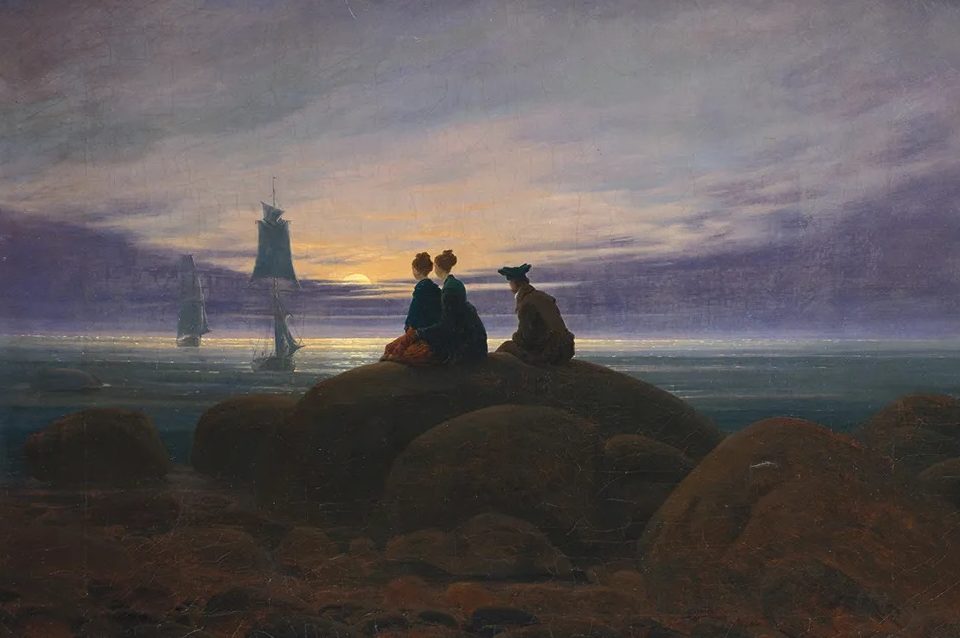
    Its overarching theme is the climate crisis. “The Wanderer above the Sea of Fog” (c.1817) is the primal man, and internet meme, of the Anthropocene. Although the environment sounds too predictable a hook for hanging landscape paintings, the editors offer a thoughtful rationale that emerges from the pictures themselves. Friedrich’s scenes may appear to depict nature unbound and untouched, but they’re also famous for their Rückenfiguren in the foreground: the men and women who stand with their backs to the viewer, facing what we also see. Johannes Grave stresses that these works are really about the relationships between humans and the natural world. Markus Bertsch emphasizes the paradox that Friedrich’s aesthetic immersion in landscape is enabled by distance — spatially and subjectively. A Romantic perspective on nature is actually an uneasy one.

    Friedrich’s wanderer stands back, but appears in the middle of the canvas. Compare the painting to the inspirational landscapes by the Dutch master Jacob van Ruisdael, which are peopled by figures less concerned by, and less central to, their surroundings. (Indeed, some were probably added later.) The fact that the Romantic poet Johann von Goethe saw them as more significant speaks to an experience of nature that was typical of the era: as somehow self-reflexive. When Friedrich’s “The Monk by the Sea” went on display in 1810 (and was bought by King Wilhelm III), Heinrich von Kleist was drawn to the Capuchin brother, and disturbed by the painting as a representation of nature — rather than the immense bleakness of the shoreline itself.

    Friedrich is so compelling because his art works on two levels. There is an undeniable immediacy of nature that, ironically, is also obviously mediated for all to see. Or, as this book’s section of notes and illustrations devoted to the Rückenfiguren phrases it, here we are “observing nature observed.” Throughout, contributors refer to Friedrich’s characteristic ambiguity, which they read in relation to the literature and thought of the German Romantics. But they avoid the term irony, which was the watchword for authors and philosophers around 1800. 

    Perhaps highlighting irony would have risked encouraging more satirical reenactment shots taken up on a hill, with the back to camera, facing into the mist. (And how much of that viral kitsch has there been this year?) But beyond the scholarly field, Friedrich remains misunderstood, anyway — and, by and large, he is viewed unambiguously. The Financial Times sought to inspire readers with a romantic vision of sacred landscape that, in Friedrich’s day, was apparently not yet spoiled by tourism, even though, historically speaking, the scenes were set by industrialization cranking into gear. Getting outdoors became a popular Romantic pastime, with market potential; the railways and package tours just followed the course already laid out around 1800. Part of the problem is that Friedrich, as Grave points out, didn’t depict a changing environment and society explicitly. His figures appear as individuals: although they may bear some markings of middle-class urban holidaymakers, they can feel timeless, too. They are not representative types. And so we easily reduce the aesthetic effect of Friedrich’s paintings to their natural content, overlooking the subtle inconsistencies of their overall perspective.

    The New Statesman laid it on thick and called Friedrich kitsch. A good old German word, but more applicable to Friedrich’s followers. Carl Gustav Carus’s “Goethe Monument” (1832), included in Art for a New Age, portrays conifers, rocks and the poet’s tomb, which takes center stage, shrouded in mist. Gone are Friedrichesque contradictions, uncertainties and silent debts. Ambivalence is also absent in the latest artistic responses. The first shot in Swaantje Güntzel’s series of photographs, documenting her intervention “Arctic Yogurt” (2021), is arresting and unnerving. Standing with her back to the viewer in striking red, before whitish gray Norwegian fjord, she holds an empty yogurt pot in her hand, as if she is about to drop it. Is this figure immersed and unaware, awed by nature alongside her, complicit in consumer society? Or is she casually disinterested, and potentially destructively so, because of comfortable alienation? The subsequent stills become troublingly clear. Güntzel throws the trash into the water, revealing a careless attitude that arises from Romantic contemplation. On a practical level, we should read the writing on the wall. But conceptually, this work is surely a ready-made of artistic environmentalism.

    Such simple criticism reinforces a sticky, reductive interpretation of Romanticism — in a rather polluting dialectic. Mari Eastman’s painting from 2001 is another classic, mockingly portraying a “very Caspar Friedrich David mood.” (It’s misnamed with laconic purpose.)

    Together, the works in the second half of Art for a New Age tend to lack a sense of their own ironies. By contrast, as the first, historical half of the book shows, the Romantics wrestled with the very paradoxes that produced their paintings and writings. Friedrich’s art was created for a commercial market, and he visited the emergent tourist hotspots of Rügen, the Harz and the eastern valleys of the Elbe for inspiration. He sought to transcend that context, without wholly negating or celebrating it. Representing the absolute was anything but.

    Recent artists and critics may see a fatal flaw in an ironic attitude: it’s not committed enough to frame our own earnest times. But irony is the hidden driver of the culture industry’s “Casper David Friedrich 250” campaign, as it trundles on through the German landscape to the end of the year. I’m reminded of Friedrich’s contemporary, the poet Heinrich Heine, who went walking in the Harz in autumn 1824. With his back to Göttingen, facing the mountains, he stood in wonder, wrote heartfelt verse, and joined in the polite conversation and pseudo-profundity that he heard around him. The Romantic wanderer, the kitschy cultural tourist and those of us looking for critical takeaway certainties share the same trail. We undercut and reinforce each other to co-exist. And we all emerge from a modern, mediated relationship with the environment, which in turn we ironize, repress and oppose. That irony is what’s most eerie about both German Romanticism, and this fine catalogue.

    This article was originally published in The Spectator’s UK magazine. Subscribe to the World edition here.