Tag: Free speech

  • Britain’s war on free speech is worse than you think

    Britain’s war on free speech is worse than you think

    Where do you strike the balance between expression and security? It is a question Americans don’t need to ask. Our Constitution is plain and unambiguous about our fundamental rights to say what we want, write what we like, to gather in protest and – sweet relief – to mock our government. 

    Not everyone is so lucky. Not even our friends. “It doesn’t give me any great joy to be sitting in America and describing the really awful, authoritarian situation that we have now sunk into,” Britain’s Nigel Farage told the House Judiciary Committee yesterday afternoon, as he detailed the speech crackdown being carried out in the UK. “At what point did we become North Korea?”

    Ever the controversialist, the Reform leader – Britain’s new right-wing party – is always thinking about the headlines. And his claims are garnering the attention he seeks. But is it true? Is the UK indistinguishable from North Korea? Obviously, no. Is the UK upholding the country’s historical and noble commitment to free speech? Tragically, also no.

    It feels unsettling to say so. Having worked in the UK for the past decade, I knew that reports back in the States about Britain’s skyrocketing crime rates or “no go” zones were overblown. But in the case of speech, there has been a noticeable shift towards intolerance, with reinforcing legislation. Updates to the Public Order Act in 2023 have radically undermined the security Britons have traditionally had to speak freely and to protest. What’s followed has been a series of baffling, and dangerous, outcomes.

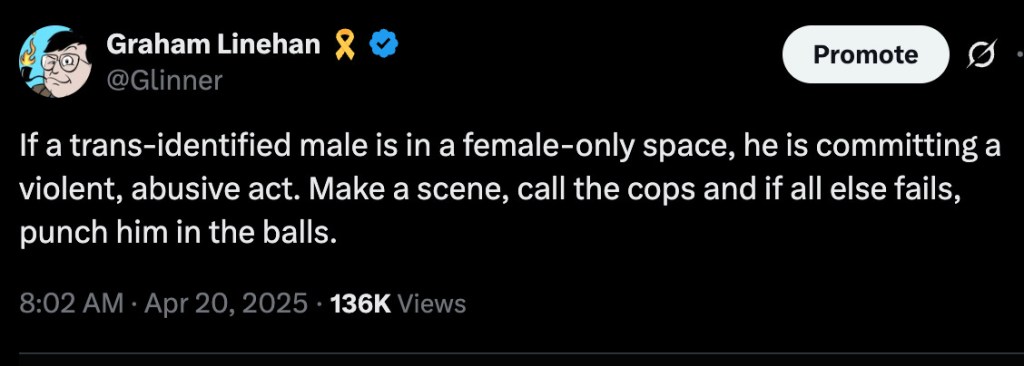
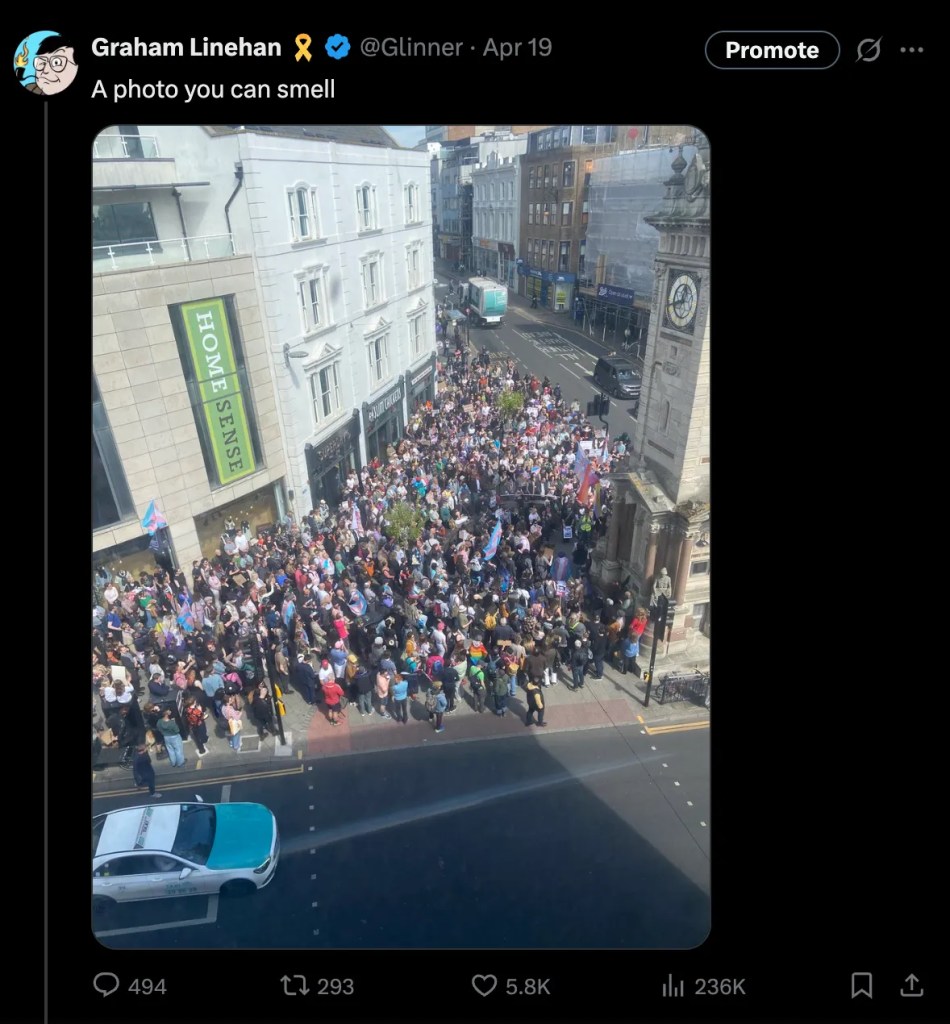
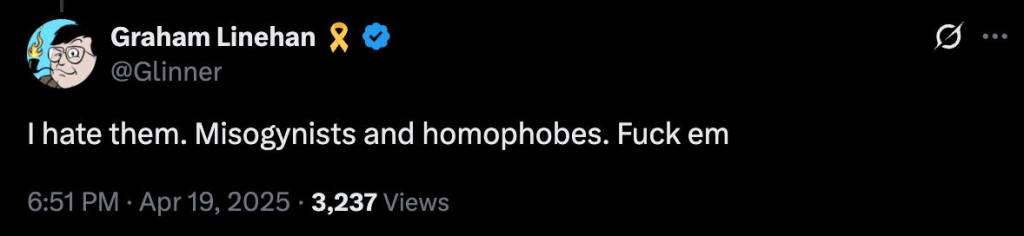
    Just this week, writer and comedian Graham Linehan landed at Heathrow airport outside of London, only to be greeted by five armed police officers at the plane’s door. His detention was so aggressive, he ended up in hospital for dangerously high blood pressure, where he wrote an account of the arrest. His crime? Three tweets from earlier in the year, making a series of controversial comments about trans men and the pro-trans lobby.

    There is a good chance Linehan will avoid jail time, now that the UK’s Prime Minister Keir Starmer has intervened to ask the police to stop policing tweets and to start prioritizing violent crime. The Metropolitan Police chief shot back, asking the government to clarify the laws that police are supposed to enforce the Public Order Act which currently has police officers reaching for handcuffs when someone takes to social media or hauling civilians into jail cells for silently praying near abortion clinics (quite literally “thought crime”). 

    The condition of Linehan’s bail is that he “cannot go on Twitter.” Heaven forbid he speaks some more. Speech is the enemy, it seems, and it must be suppressed. 

    Farage’s claim on the Hill that Americans may not be safe traveling to Britain is an exaggeration. But it is an increasingly credible hypothetical. Linehan is not a British citizen – he is an Irishman who was traveling from Arizona and it was staff based on American soil who, according to Linehan’s account, changed his seat before he boarded the plane. That feels uncomfortably close to home.

    Meanwhile, Lucy Connolly didn’t avoid jail. The 41-year-old mother was sentenced last year to 31 months in prison for a tweet, quickly deleted, she sent out around the Southport riots, triggered in the north of England when three little girls were stabbed and killed by a British teenager (10 more were injured) during a dance class. 

    Connolly’s comments were horrendous, suggesting that the lives of asylum seekers don’t matter (there was speculation at the time the murders had been carried out by an immigrant). As Farage said yesterday, her comments were “intemperate” and “wrong.” It was hate speech – which is to say, it was also free speech. 

    Connolly should have never seen a jail cell for her comments, which has only made her a martyr for the very opinions the government is trying to silence. She is now considering a run in the next election against the current Home Secretary, who oversees the policing and immigration policy. Connolly may even have a decent chance of winning: her status as a “political prisoner” means her inhumane views on immigration are now, largely, overlooked.

    These kinds of unintended consequences inevitably follow when a country starts to chip away at the most fundamental, and stabilizing, rights. If you believe the polls, Britons are now seriously considering their own populist overhaul, as voters reject both Conservative governments, which started the speech crackdowns, and the current Labour government, which has carried it on.

    Farage may have been labeled “fringe” yesterday by Congressman Jamie Raskin, but his Reform party is surging ahead in the polls. There is a real possibility, unthinkable a year or two ago, that Farage could be in a position to form the next government in Britain. If this happens, it will be his absolutist attitude towards free speech that helped propel him into Downing Street.

    In America, the political targets are the elite: the high-level politicians and household names who have got on the wrong side of the current administration. In the UK, the target is the little guy and gal: your grandpa or aunt who feels compelled to share an ugly opinion with their 135 Facebook or X followers, because they’re mad as hell and can’t take it anymore. 

    Both are forms of lawfare and neither have any place in a free society. 

  • The death throes of free speech in Britain – and its opponents

    Free speech, the very bedrock of constitutional democracy, is writhing on its deathbed in England. It will take a mass movement to restore its vitality. Fortunately, one can see that movement emerging among a once-free people, tired of government suppression.

    The dire state of British liberties was outlined Wednesday in Congressional testimony by British MP, Nigel Farage, who testified before the US House Judiciary Committee. He was backed by the committee’s Republican members and attacked, alas, by Democrats. 

    Powerful as his testimony was, it was overshadowed by an even more striking event: a phalanx of armed police arriving at Heathrow airport to arrest an Irish comedian for a tweet he posted in Arizona. His crime: he made fun of transgender people. Toss him in the dungeon.

    This is the same law enforcement, mind you, that ignored decades of child rape and “grooming” by Pakistani Muslims in northern England. 

    How is the lax treatment of grooming gangs connected to the harsh treatment of tweeting? By more than the lunacy and hypocrisy. The deeper connection is that successive Labour and Conservative governments have considered it more important to “protect” minority groups against bad words and criminal investigations than to protect innocent children or ensure free speech and open inquiry. “Social justice,” don’t you know?

    The collapse of free speech, under the repressive hand of British government, is deeply linked to the massive influx of immigrants from North Africa and the Middle East, who have little interest in adapting to English laws and customs and every interest in protecting the customs of their native lands. They have consistently refused to adopt the basic ideals of tolerance and forbearance that are fundamental to any functioning multicultural democracies.

    Instead of pushing back against this illiberal tide – an essential task if liberal democracy is to survive – political leaders in the UK and most of Western Europe have appeased it. Just as bad, they have suppressed any opposition.

    The common theme among these feckless leaders is their lack of confidence in their own cultural traditions and historic national achievements. They have refused to stand up for those basic values and traditions in the face of ferocious, illiberal assaults, stemming mainly from these hostile immigrant communities, often supported by progressive elites, who share the leaders’ lack of cultural self-confidence. Instead of resisting these illiberal assaults, halting immigration, and limiting the lifelong provision of free housing and income, those leaders have acceded to these demands and smacked down anyone who says different. The price has been enormous.

    How bad is it? Bad enough that people are now being arrested in England and Scotland for putting up flags or wearing them on their clothes. Waving the national flag is somehow considered an insult to immigrants. This show of patriotism must be stopped and the miscreants arrested.

    These arrests do more than crush free speech. They also deter free assembly, or at least they are intended to do so, if that assembly opposes government policy. But the right to assemble peacefully to protest government policy is the very essence of a functioning democracy.

    The connection between speech and assembly is often overlooked, but it is crucially important. It is free assembly – mass crowds, mobilized around political demands – that threaten governments. That is why the two rights, speech and assembly, are paired in the First Amendment to the US Constitution. That is why their absence in English law is so devastating. Their absence gives free rein to a repressive government. That is exactly what is happening now in England and Scotland.

    The right to speak openly and assemble freely, allow citizens to voice their opinions, demonstrate the intensity of those views, protest some government policies and advocate others, and express those opinions without seeking permission from the very government they may be contesting.

    The British, who have no written constitution or bill of rights, give no such protections to their citizens, either in theory or in practice. That is why today’s repressive governments can treat citizens like subjects, to be suppressed or arrested when they say something objectionable to those in power. What is objectionable? We in power will decide. Not you.

    It is a special tragedy to see this repression take place in England, the fountainhead of free speech and assembly in western civilization. The theory was best stated in John Stuart Mill’s On Liberty (1859), with roots that run back two centuries to John Locke and still further to the Glorious Revolution and Magna Carta. Mill’s vital points are that ideas need to withstand the test of counter-arguments and best evidence, that multiple views need to be heard and tested, and that citizens can then reach their own, informed judgments.

    The wisdom of Mill’s analysis was not limited to his book or the scholarly discourse it prompted. It was already embedded in Parliamentary debate, public speeches, and the free publication of newspapers and magazines.

    This open discourse is a magnificent achievement and a historically rare one. Few countries have ever permitted it, and it is in jeopardy now in the very birthplace of these freedoms, trampled by ignorant and malign political leaders. It’s easy to see why those in power don’t want to hear opposing voices or critical tweets. They don’t say so plainly, of course. They prefer to wrap themselves in the high-flying moral language of “social justice.” Whatever the justification, they use the full repressive weight of state power to smash alternative views. They alone decide which views are permissible.

    They shouldn’t be allowed to get away with this power grab – this blatant suppression of basic democratic rights. Politicians, bureaucrats, and police shouldn’t decide what can be said and what must be silenced. Not in a free country. They shouldn’t be allowed to turn the birthplace of liberty into its charnel house.

  • Watch: Nigel Farage warns Congress about UK speech laws

    Watch: Nigel Farage warns Congress about UK speech laws

    UK Prime Minister Keir Starmer took aim at Nigel Farage in Parliament today for not being present. In fact, the Reform leader is on the other side of the Atlantic, testifying to the House Judiciary Committee on the state of free speech in the UK. The timing couldn’t have been better for Farage, what with the release of Lucy Connolly from prison (after she was incarcerated over a social media post) and the arrest of comedian Graham Linehan providing extraordinary case studies.

    And Farage was not holding back. First saying that he would have brought Connolly with him, had she not been restricted by travel rules following her conviction, he launched into quite the speech about freedom of expression in Britain. Using Linehan’s case as a warning for American travelers, Farage fumed:

    He put out some tweets months ago when he was in Arizona. And months later, he arrives at Heathrow Airport to be met by five armed police. Armed police. Not a big deal in the USA, a very big deal in the United Kingdom. Five of them. And he was arrested and taken away for questioning. He’s not even a British citizen. He’s an Irish citizen. This could happen to any American man or woman that goes to Heathrow, that has said things online that the British government and British police don’t like. 

    He went on, taking aim at legislation that allows police to monitor social media posts in the first place:

    It is a potentially big threat to tech bosses to many, many others. This legislation we’ve got will damage trade between our countries, threaten free speech across the West because of the knock-on rollout effects of this legislation from us or from the European Union. So I’ve come today as well to be a klaxon, to say to you, don’t allow piece by piece this to happen here in America, and you will be doing us and yourselves and all freedom-loving people a favor. If your politicians and your businesses said to the British government, you’ve simply got this wrong. At what point did we become North Korea? 

    Strong stuff! And it seems even politicians for the incumbent Labour party are rather perturbed by Linehan’s arrest, with Health Secretary Wes Streeting this morning suggesting that the law could be amended to ensure police focus instead on more serious crime. But given the outrage whipped up at the treatment of both Linehan and Connolly, even this could be too little too late…

    Watch the clip here:

  • Father Ted and Havel’s Greengrocer

    A softer version of totalitarianism has been gnawing its way through the British body politic like a cancer for many years now. With the Graham Linehan (creator of the classic sitcom Father Ted) arrest at London’s Heathrow Airport this week, it seems to have metastasized into something entirely malignant. If Linehan’s arrest isn’t a bright red line for Britain, what on earth would be?

    A decade ago, living in the US at the dawn of the Great Awokening, I began hearing from older people who had fled to America from the Soviet bloc, seeking freedom. They were telling me that the things they were starting to see in their adopted country reminded them of what they had left behind. 

    They spoke of people having to watch their words for fear that they would step on an invisible land mine, and put their jobs and businesses at risk. They talked about the abandonment of classical liberal values, and the adoption of “social justice” norms that judged people based on group identity. They witnessed ideological mobs intimidating people into silence, and institutional elites changing language to fit a utopian leftist paradigm.

    I found this hard to grasp at first. If this was totalitarianism, where were the gulags? Where was Big Brother? This was precisely the problem, I came to understand. The fact that relative to life in the Soviet bloc, the West remained free and prosperous helped conceal the totalitarian threat. That, and the fact that this new ideology presented itself in largely therapeutic terms: as a program not only for achieving social justice, but of easing the burden of groups suffering the pain of marginalization.

    Yet the more conversations I had with these people, the more I experienced their anger at the inability of Americans to comprehend what was happening. Said one professor in the Midwest, “I was born and raised in the Soviet Union, and I’m frankly stunned by how similar some of these developments are to the way Soviet propaganda operated.”

    Another émigré professor, this one from Czechoslovakia, was equally blunt. He told me that he began noticing a shift even further back in time: friends would lower their voices and look over their shoulders when expressing conservative views. When he expressed his conservative beliefs in a normal tone of voice, the Americans would start to fidget and constantly scan the room to see who might be listening.

    “I grew up like this,” he tells me, “but it was not supposed to be happening here.”

    My conceptual breakthrough happened when I realized that growing up during the Cold War, I had come to imagine totalitarianism according to George Orwell’s novel Nineteen Eighty-Four. In fact, the emerging therapeutic totalitarianism in the West today is far more like Aldous Huxley’s model in Brave New World. The outcome is the same: the gradual erosion of liberty and individuality, and the seizing of power by ideological fanatics who asserted the power to alter reality. By the time the book I wrote about this phenomenon, Live Not By Lies, was published in 2020, wokeness had conquered US institutions, and one could be sent to the unemployment line for refusing, say, to agree that men could be women. 

    For all the madness that ensued, no American had to fear arrest for stating anti-woke opinions, because we have a constitutional right to free speech guaranteed by the First Amendment. This is why the fate of Graham Linehan, like the fate of so many lesser known UK dissidents from the ruling ideology, could not happen in America. But it can happen in Britain, and is happening. The spectacle of English patriots being taken into custody for flying the Union Jack, on grounds that it might cause distress to foreigners, many of whom came into the country illegally, reveals the absolute state of the tyranny now reigning in once-free Britain.

    Yet if the Soviet bloc emigres reveal to us the truth of what was and is overtaking the West, those who stayed behind tell us how to resist and overcome it. In researching Live Not By Lies – the title is taken from a Solzhenitsyn communique to his Soviet followers, on the eve of his exile – I traveled through the former communist lands to ask ex-dissidents for their advice.

    The core lesson: you must be willing to suffer for the sake of the truth. Those in power count on a population cowed by fear. Nearly everyone is willing to live under the yoke of ideological lies, because they are understandably afraid of what will happen to them if they don’t. Those brave souls who dare to tell the truth, and who are willing to suffer for it, hold the key to society’s liberation.

    Czech dissident leader Vaclav Havel explained why in his famous Parable of the Greengrocer, from his 1977 book-length essay, The Power Of The Powerless. Imagine, he said, a simple greengrocer in a communist city, in whose shop window hangs a sign saying, “Workers Of The World, Unite!” He doesn’t believe it, nor do any of the other shopkeepers who display the same sign. They do it out of fearful conformity.

    One day, the shopkeeper decides he won’t lie anymore. He removes the sign. What happens next? He is arrested. The state confiscates his business. He must endure punishment, including loss of privileges, and becoming a social pariah to his former friends. He pays a significant price.

    But what does he gain? For one, he gains self-respect, for having defending his own integrity. For another, he demonstrates to society that it is possible to live in truth, provided you are willing to suffer for it. If enough people within that oppressed society take courage from his example, and accept the challenge of suffering for truth, then eventually the entire system built on lies will crumble.

    Solzhenitsyn said something similar in his 1974 “Live Not By Lies” message. It is not possible to go to Red Square and shout, “Down with communism!” he said. But that does not mean ordinary people are without means of resistance. He recommended practical everyday means of refusing to cooperate with the official lies. 

    “Our way must be: never knowingly support lies!” he wrote. You may not have the strength to stand up in public and say what you really believe, but you can at least refuse to affirm what you do not believe. If we must live under the dictatorship of lies, the writer said, then our response must be: “Let their rule hold not through me!”

    Graham Linehan is a comedian and actor, but he is also Havel’s Greengrocer. So is J.K. Rowling – and though it must be conceded that it’s easier to live not by lies if you are sitting on a mountain of cash from book sales, she has nevertheless become a total pariah to many of her peers and admirers, because she would not bow her head to the misogynistic lies of gender ideology.

    The British people are being put through an extraordinary test now by their government, their media, and all the institutions of the ruling class. They are being forced to endure humiliation, criminality, displacement, and the virtual expropriation of their land, with its ancient liberties, by an ideologically captured ruling class. 

    Earlier this year, I was in London for a screening of the documentary film series Angel Studios made from Live Not By Lies. I had seen the film many times before, but watching it in the British capital, it struck me how many of the people in the documentary are British people, talking about actual existing tyranny in Britain today. 

    They are people like Isabel Vaughan-Spruce, the Christian pro-life campaigner shown on camera being arrested for praying inside her head near an abortion clinic. Vaughan-Spruce is also Havel’s Greengrocer – a brave person who possessed enough self-respect and love of truth to suffer arrest, multiple times, for thoughtcrime.

    The older men and women of Eastern Europe know what the British are suffering. The fact that British totalitarianism is softer than its Soviet antecedent makes it no less totalitarian in spirit. A former Soviet citizen now living in America told me what is coming for us if we don’t derail the totalitarian train now.

    “You will not be able to predict what will be held against you tomorrow,” she warned. “You have no idea what completely normal thing you do today, or say today, will be used against you to destroy you. This is what people in the Soviet Union saw. We know how this works.”

    Then as now, there remains only one sure antidote to it: ordinary citizens realizing that enough is enough, and at personal risk to themselves, choosing to live not by lies. This is the hope that Solzhenitsyn offered to his people in 1974 – and the challenge.

  • I was arrested for insulting the trans mob

    I was arrested for insulting the trans mob

    Something odd happened before I even boarded the flight in Arizona. When I handed over my passport at the gate, the official told me I didn’t have a seat and had to be re-ticketed. At the time, I thought it was just the sort of innocent snafu that makes air travel such a joy. But in hindsight, it was clear I’d been flagged. Someone, somewhere, probably wearing unconvincing make-up and his sister/wife’s/mum’s underwear, had made a phone call.

    The moment I stepped off the plane at Heathrow, five armed police officers were waiting. Not one, not two – five. They escorted me to a private area and told me I was under arrest for three tweets. In a country where pedophiles escape sentencing, where knife crime is out of control, where women are assaulted and harassed every time they gather to speak, the state had mobilized five armed officers to arrest a comedy writer for these tweets (and no, I promise you, I am not making this up):

    …and then, a follow up to that one:

    When I first saw the cops, I actually laughed. I couldn’t help myself. “Don’t tell me! You’ve been sent by trans activists.”

    The officers gave no reaction and this was the theme throughout most of the day. Among the rank-and-file, there was a sort of polite bafflement. Entirely professional and even kind, but most had absolutely no idea what any of this was about.

    “Kind” because the officers saw how upset I was – when they began reading me my rights, the red mist descended and I came close to becoming one of those police body-cam videos where you can’t believe the perp isn’t just doing what he’s told – and they treated me gently after that. They even arranged for a van to meet me on the tarmac so I didn’t have to be perp-walked through the airport like a terrorist. Small mercies.

    At Heathrow police station, my belt, bag, and devices were confiscated. Then I was shown into a small green-tiled cell with a bunk, a silver toilet in the corner and a message from Crimestoppers on the ceiling next to a concave mirror that was presumably there to make you reflect on your life choices.

    By some miracle – probably because I hadn’t slept on the flight – I managed to doze off. After the premier economy seat in which I’d just spent ten hours, it was actually a relief to stretch out. That passed the time, though I kept waking up wondering if it was all actually happening.

    Later, during the interview itself, the tone shifted. The officer conducting it asked about each of the terrible tweets in turn, with the sort of earnest intensity usually reserved for discussing something serious like… oh, I dunno – crime? I explained that the “punch” tweet was a serious point made with a joke. Men who enter women’s spaces are abusers and they need to be challenged every time. The “punch in the bollocks” bit was about the height difference between men and women, the bollocks being closer to punch level for a woman defending her rights and certainly not a call to violence. (Not one of my best as one of the female officers said, “We’re not that small”).

    He mentioned “trans people.” I asked him what he meant by the phrase. “People who feel their gender is different than what was assigned at birth.” I said: “Assigned at birth? Our sex isn’t assigned.” He called it semantics, I told him he was using activist language. The damage Stonewall has done to the UK police force will take years to mend.

    Eventually, a nurse came to check on me and found my blood pressure was over 200 – stroke territory. The stress of being arrested for jokes was literally threatening my life. So I was escorted to A&E, where I write this now after spending about eight hours under observation.

    The doctors suggested the high blood pressure was stress-related, combined with long-haul travel and lack of movement. I feel it may also have been a contributing factor that I have now spent eight years being targeted by trans activists working in tandem with police in a dedicated, persistent harassment campaign because I refuse to believe that lesbians have cocks.

    The police themselves, for the most part, were consistently decent throughout this farce. Some were even Father Ted fans. Thank God the Catholic Church never had with the police the special relationship granted to trans activists. The male officers were mostly polite but clearly nonplussed by the politics of it all – just doing their jobs, however insane those jobs had become. The female officers seemed more tuned in to what was actually happening. One mentioned the Sandie Peggie case in a certain way, and I realized I was among friends, even if they couldn’t admit it.

    I looked at the single bail condition: I am not to go on Twitter. That’s it. No threats, no speeches about the seriousness of my crimes – just a legal gag order designed to shut me up while I’m the UK, and a demand I face a further interview in October.

    The civility of individual officers doesn’t alter the fundamental reality of what happened. I was arrested at an airport like a terrorist, locked in a cell like a criminal, taken to hospital because the stress nearly killed me, and banned from speaking online – all because I made jokes that upset some psychotic crossdressers.

    To me, this proves one thing beyond doubt: the UK has become a country that is hostile to freedom of speech, hostile to women, and far too accommodating to the demands of violent, entitled, abusive men who have turned the police into their personal goon squad.

  • The US is right to warn Britain about its free speech record

    The US is right to warn Britain about its free speech record

    Every year the State Department is required to produce a report on the human rights situation in every country in the world. The report card for the UK came this week. While otherwise fairly anodyne, the US was painfully scathing about Britain’s record on free speech.

    Unsurprisingly, the State Department was unhappy about the Online Safety Act’s long-arm provisions affecting US websites, abortion protest laws and strict contempt rules (which last year forced the New Yorker to take the drastic step of geoblocking an important and informative article about the Lucy Letby case). It was particularly caustic about the fallout from Southport, where it did not mince its words. It stated, citing widespread arrests and prosecutions for online comments, that “censorship of ordinary Britons was increasingly routine, often targeted at political speech.” Ouch.

    Every instinct of this government will be to face down the State Department

    Admittedly this appraisal bears strong marks of a Trump administration finger discreetly placed on the scale. Secretary of State Marco Rubio has long seen State Department bureaucracy as too “woke” and progressive in its approach to human rights abroad: reportedly the order has gone out to backpedal equality and diversity issues and emphasize traditional freedoms instead. Furthermore, the Trump government’s own free speech record at home is far from spotless: witness its fairly heavy-handed attempts to browbeat universities, broadcasters and others to toe its line.

    Nevertheless, this is something we’d be very foolish to ignore. The first point is that, biased or not, the State Department is correct. Britain, or at least the establishment in charge of it, shows worrying signs of seeing free speech as a distraction to be sidelined rather than a value to be pursued. True, the whirlwind state descent on social media following the Southport riots, and the stern warnings from police and others to avoid controversial comment, may not have been secretly ordered from Downing Street in the manner of some Central American dictatorship. But an unprecedented and vicious clampdown it still was, even if it reflected no more than tacit agreement among the great, the good and the courts that something drastic had to be done to stop people speaking out of turn.

    There were plenty of other things that could have been highlighted in the report, and which would have been an entirely fair cop. Even if the total suppression by injunction of discussion over the Afghan refugee crisis came too late, there were always the 30-plus people a day arrested for social media posts, regular police interventions to silence speakers who might cause offense, and so on.

    Secondly, it’s important that we should take note of how others see us. The slow but steady erosion since about 1990 of Brits’ right to speak their minds without state interference has passed many by in the UK who are not free speech enthusiasts. And not entirely surprisingly: gradual political change often presents itself as a fait accompli to a population when it is too late to do much about it.

    But all this has not escaped foreigners. Britons should be worried that their country, once seen as a beacon of free speech in an increasingly authoritarian Europe, should now be seen as a serious backslider. Particularly so where this is by the US, a country which retains an instinctive affection for the UK arising out of shared history and culture. No doubt Uncle Sam would, in its own interests, like to discreetly detach Britain diplomatically from Europe; nevertheless, Brits ignore this at their peril.

    Thirdly, all this should remind Britons that it is in their interest to keep the free speech issue from hurting their international reputation further. At the moment they are not doing this. They do not endear themselves to an increasingly online world community when they place large swaths of the internet off-limits to those without VPNs as a result of the Online Safety Act. The UK government’s stern orders earlier this week to websites to preserve online free speech or else will deceive no one and will be seen as the reputation management measure it is.

    Still less will they win friends when OFCOM, a UK government agency, writes threatening letters on official notepaper to US websites with no connection with the UK at all such as 4Chan, gab.ai and Kiwifarms. Earlier this year it did just this, demanding promises to comply with UK law and to fill in all sorts of OFCOM paperwork, and menacing them with enormous fines if they did not. (They politely told it to go fish, but by then the damage was done.)

    Every instinct of the British government will be to face down the State Department and carry on referring to keeping the UK internet safe. But it would do well to bear in mind that foreigners can sometimes be right and that taking steps to keep them onside, even at the cost of a little pride, can reap big dividends. This is one such occasion.

  • The UK censorship files: Jim Jordan’s crusade against Britain

    The British Empire may be gone, but there is one area where the UK has not lost its global ambitions: online censorship. The latest vehicle is the Online Safety Act (OSA), a behemoth internet regulation law whose vast provisions are steadily coming into force – and increasingly drawing the ire of the Trump administration as it starts to impact US tech firms. 

    Under the OSA, “Britain has the power to shut down any platform” that breaks its content regulation rules, boasts secretary of state for technology Peter Kyle. The latest stage of its implementation began last week with new mandatory age-verification measures for social media platforms. 

    The Act is already curtailing what can be read online in the UK. Though the OSA was passed back in 2023 by the Conservatives, the Labour government has taken it up the internet “regulation” crusade with gusto. The rhetorical strategy is to claim that the law is unobjectionable since it is merely about restricting minors’ access to pornography and other “harmful” content – “think of the children”. But it all comes across as rather hysterical. In an extraordinary intervention this week, when the populist Reform Party’s Nigel Farage pledged to repeal the law, Kyle labelled him – and anyone else that’s opposed to it – as being on the side of child predators like Jimmy Savile.

    In reality, there are many valid criticisms to be made of this wildly overbearing law. Small online forums dedicated niche interests, for instance, including fixed-gear cycling and hamsters, have been forced to close due to heavy compliance costs. Many tech companies likewise view it as suffocating. Another major sticking pointis its stringent regulations on AI – a vital emerging field in which the UK risks being left in the dust.

    Most egregious, though, is the OSA’s impact on free speech. Since the new rules came into force, platforms have been forced to censor political speech that paints the British government in a bad light. This includes footage of recent anti-asylum protests, and even speeches in Parliament and court transcripts about the rape gangs scandal. This latter is particularly galling: this was horrific abuse that the British state abjectly failed to protect these children from – and now speech about it is being censored in the name of child safeguarding.

    The bigger problem, for Kyle and the British government, is how the OSA and their censorship cheerleading will play out in the eyes of America. The Trump administration is already unhappy with the state of free expression in Britain.

    A good example of the culture clash came this week, with Jim Jordan, a Trump ally, free-speech advocate and chair of the House of Representatives Judiciary Committee. Jordan will meet Peter Kyle himself, where he is expected raise concerns about free speech. As part of his UK visit, Jordan has viewed documents produced by the Committee that seem to show that the UK government attempted to censor online content during the riots that swept the country last summer. Posting them on X as ‘THE UK CENSORSHIP FILES’, he has accused the British government, including Kyle and Keir Starmer, of “trying to censor criticism of itself,” and clamping down on “narratives” wounding to the British state – like claims of “two-tier justice”. Here’s hoping that Peter Kyle will refrain from alleging that Jordan is “on the side of predators” for his free-speech advocacy.

    While freedom-loving Brits are grateful that their American cousins are helping to safeguard free speech, there is also the question of how the OSA will impact Americans’ own jealously-guarded First Amendment rights. If Washington, DC, looks askance at censorship laws the UK, it’s even less pleased about the British state’s attempts to expand the scope of that regulation across the Atlantic to US websites and tech firms. Back in May, the State Department fired a warning shot, mooting visa bans for foreign officials found to have censored “protected expression in the United States”. US free-speech concerns are also expected to feature in any forthcoming trade deal. Both Trump, in his recent visit, and JD Vance, in the Oval Office back in February, have publicly needled Keir Starmer over the issue.

    The key question is whether America is happy to allow a few hundred Whitehall bureaucrats to bring its tech titans to heel. With the US celebrating 250 years of independence next year, there are many free-speech warriors stateside who would sooner tell Ofcom, Britain’s broadcast regulator, where to get off.

    Prominent among the minutemen is Preston Byrne, an Anglo-American lawyer and free speech activist who also works with the Adam Smith Institute, a British free-market think tank. Byrne has already tangled with Ofcom over the OSA, following enforcement letters it sent to US websites including Gab and Kiwi Farms earlier this year. These sites, however, were comparatively small fry. Ofcom has now sent similar letters to Reddit and Rumble, and in response, Byrne is set to bring a case against Ofcom in the US federal courts.

    For a notice to be served by a foreign power against a US company, typically it would have to go through the Mutual Legal Assistance Treaty (MLAT) to be valid. But that doesn’t seem to be the case for these notices: indeed, if Ofcom had gone through the MLAT, Byrne believes that the State Department and the Department of Justice would not be minded to abide by them. So the letters, for all they threaten these companies with fines or worse, are in fact legally dubious. “Ofcom,” Byrne tells me, “is the international equivalent of a stalker-y ex – they’ve been told to stop, it’s unlawful for them to continue, and now we need the courts to intervene.”

    Just how much more will this battle heat up? What’s clear is that British officialdom’s zeal for online regulation is setting it on a collision course with a resurgent and energetic US free-speech lobby. Yet with trade talks looming, such escalation would surely be a grave mistake. Britain does not rule the world anymore. If London wakes up the “screaming Eagle”, Byrne says, “they’re not gonna like the results”.