Perhaps living in Seattle should inure you to shock. This is the city where, in the name of the George Floyd riots of mid-2020, armed fanatics took over a four-block chunk of downtown, a development Seattle’s moonbeam mayor of the day said reminded her fondly of the Summer of Love, only for the good vibes to dissipate when the commune’s residents started shooting one another on a nightly basis. And the squalor: in recent years, the general look of America’s Emerald City has passed from one characterized by its backdrop of snow-capped mountains and sparkling lakes to something more like one imagines central Berlin to have been after a particularly hard night of bombing in April 1945.
Even so, the news that 43-year-old Katie Wilson had defeated the incumbent Bruce Harrell to become Seattle’s next mayor came as something of a jolt. The result of the race was only made known on November 13, nine days after the polls closed. It took that long because Washington is one of the states where people vote exclusively by mail, and it apparently takes a week or more for the USPS to successfully convey a ballot from one side of town to the other. Each day at 4pm we were given the latest running count, at which point election officials went home again before beginning their next grueling six-hour shift the following morning, with time off for holidays and weekends. This is how we do business in our part of the world.
For anyone not previously familiar with Mayor-elect Wilson, she’s the mini-Mamdani in these parts: against homelessness (is anyone in favor of it?), and having the police deal with ‘mental-health disturbances’, such as that occasioned by the raving lunatic who accosts you on the street; and all for something called news vouchers, which her campaign has said would extract another $9 million from Seattle taxpayers to create jobs for fifty new reporters to balance the well-known right-wing media bias in these parts. That works out at a salary of $180,000 per hack, so perhaps I should apply.
Wilson was raised in Binghamton, New York, where her college-professor father David Sloan Wilson once wrote a book by the title of The Neighborhood Project: Using Evolution to Improve My City, One Block at a Time, and another one called Atlas Hugged, his riposte to Ayn Rand. One dimly begins to see the picture: a household steeped in the belief that human nature is essentially benign, and that all it takes is sufficient community goodwill to beat the corporate greedheads. Katie went off to read philosophy and physics at Oxford, but, displaying that whimsical spirit we may all yet come to know, chose to drop out six weeks before graduation. After that she drifted out to the west coast, married a fellow activist who supported himself by busking on the San Francisco light-rail system, and embarked with him on a Greyhound tour of the country to determine where they might start their new life together. Somehow unsurprisingly, they hit on Seattle. It’s traditionally the place where generations of the nation’s failed, felonious, or fed-up have gone to disappear, and, perhaps not coincidentally, where there hasn’t been a Republican mayor since the days of the LBJ administration.
To make ends meet, Wilson painted boats, worked construction, and played her guitar around the Pike Place Market for spare change. A non-driver, she then started a group called the Seattle Transit Riders Union to improve services and lower fares on public transportation, paying herself a token $73,000 a year to keep the show on the road. Next it was campaigning for a payroll tax to subsidize low-income housing, one of several such initiatives to face the electorate each November. It’s a strange thing about the homelessness issue in these parts. The more politicians throw our money at the problem, the worse it gets. If you drive from my blue-collar suburb to downtown, as I do most days, it’s as if you leave a Norman Rockwell painting and abruptly enter one by Hieronymus Bosch. There’s an authentic touch of Dunkirk about the final stretch of the journey as you pass by bedraggled-looking campers hunched together around braziers or stretched out on army-surplus cots. It’s a dreadful prospect, on a number of levels, and one’s heart naturally goes out to the public-compassion zealots who display yard signs that read: ‘In this town we believe Black Lives Matter, Women’s Rights are Human Rights, no Human is illegal’, and whose essential solution to the homelessness epidemic is, like our new mayor’s, for all of us to continue to spend much, much more on community-outreach services.
We’re always told that the outcome to each election is of “existential” significance, but perhaps Katie Wilson truly did have an opportunity for change during her recent campaign. She could have argued, for instance, that devoting more taxpayers’ money to Seattle’s destitution crisis is a snake-oil remedy that shows no signs of actually solving the problem. She might have added that pressing for a higher minimum hourly wage is good as far as it goes, but that someone has to pay for this munificence, and that the hardworking Seattle resident already faces the nation’s highest chain-restaurant prices and the second-highest gas prices, behind only California. She might even have found it in her heart to note that the city currently boasts a violent crime rate of 775 per 100,000 residents, which is more than double the national average of 359, and that one possible solution to this state of affairs might be to significantly enhance the local police force, instead of further defunding it, as she’s loudly proposed in the past.
Back in the mid-1970s, a couple of local real-estate agents paid to erect a huge billboard in downtown Seattle, in response to the city’s Boeing-led economic nosedive. ‘Will the last person to leave town turn out the lights?’ the slogan read. Fifty years later, its time may have come again.
Tag: George Floyd
-

Mini-Mamdani is (finally) new mayor of Seattle
-

Zohran Mamdani pledges free everything on Fox News
Ahead of tomorrow night’s debate with Andrew Cuomo and Curtis Sliwa, Democratic socialist and future mayor of New York City Zohran Mamdani appeared on Fox News this afternoon for the first time.
Anyone expecting a clash of cultures, or 15 minutes of pure ideological arguing, would have been disappointed. Fox anchor Martha MacCallum asked tough, pointed questions, but it was a respectful exchange between two New Yorkers who clearly don’t summer in the same ZIP code.
That doesn’t mean the interview lacked news value. The most shocking part came before the commercial break, when Mamdani said it was “too early” to give President Trump credit for the Middle East peace deal. When MacCallum asked him to denounce Hamas, he instead invoked the “crimes” of the Israeli military, who he said had killed five Palestinians this week. Hamas has killed more Palestinians that that, MacCallum said, but Mamdani deflected.
“I have no issue in critiquing Hamas and the Israeli government because my focus is on universal human rights,” he said. He also refused to retract his call to arrest Benjamin Netanyahu if Netanyahu visited New York. Mamdani said he would respect the judgment of the International Criminal Court, which has issued a warrant for Netanyahu’s arrest. Again, when MacCallum pressed him, Mamdani wouldn’t say a crossed word about Hamas. “I don’t really have opinions about the future of Hamas and Israel other than questions about universal safety,” Mamdani said, having clearly sewn up whatever percentage of the Jewish vote he needs to win.
Part two of the exchange, about Mamdani’s plans for the city, was actually the friendlier of the two segments. Mamdani said New York should be “the capital of where working people can afford to live,” and MacCallum agreed with him that the city was too expensive. “You’ve done a lot to bring people’s attention to affordability,” she said. “I appreciate that,” Mamdani said.
She didn’t seem too keen on his proposals to raise taxes on the wealthiest New Yorkers by 2 percent, or on his proposals to raise corporate taxes, which is out of his power anyway because Albany sets New York tax policy. “What Andrew Cuomo said is that if he had $959 million he’d give it to Elon Musk for tax credits,” Mamdani said. “I’m talking about raising taxes on the wealthiest. When I’ve spoken to Trump voters, they told me it was cost of living that drove them to vote for Donald Trump. What we’re seeing time and time again is a focus on billionaires instead.”
That’s Democratic socialism, folks – and Mamdani said he’ll use that increased tax revenue to pay for his controversial program to make city buses free, as well as everything else. “I think everyone would love to have free healthcare and free buses and all these things,” MacCallum said, sounding skeptical.
Unappealing to Republicans, and almost everyone else, is Mamdani’s plan to place mentally ill New Yorkers into “peer-led rehabilitation programs,” which is where he said he would have placed the man who murdered a 64-year-old on a subway platform last year. He wants to “end the revolving door” of a “broken system.” When MacCallum asked Mamdani to apologize to police officers, who he’s called racist, “wicked and corrupt,” he looked at the camera and said, “I’ll apologize to police officers right now. I’m looking to work with these officers. They put their lives on the line every single day.” And then he invoked the Central Park Five, Eric Garner and George Floyd, which I’m sure put backers of the blue at ease.
Zohran Mamdani didn’t get to his current position by tacking to the center, and his Fox News appearance was pretty consistent with what he’s put out with the rest of the campaign: a mix of left-wing populist economics, which the Democratic party sorely needs, and foreign-policy and criminal-justice positions that wouldn’t be out of place on BlueSky. But he didn’t come across as crazy, weird or unprepared. He’s got his plans – and he’s sticking to them. New York already has its most hilarious mayor of all time in Eric Adams. The Mamdani years might end up being a tragedy, but the comedy is about to end.
-

The end of the race hustle
Decarlos Brown Jr. should never have been on the streets. The man suspected of murdering 23-year-old Iryna Zarutska, a Ukrainian refugee, in Charlotte, North Carolina, in August had been arrested 14 times in almost as many years, charged with armed robbery, shoplifting and property damage. According to his sister, he is a schizophrenic who suffers from paranoid delusions. But he was free to roam in part because of the race hustle.
Want to fire an employee? Good luck if that employee is black; such a dismissal would be presumptively racist
For decades, pointing out that any action, public or private, had a black target or fell disproportionately on black people was sufficient to discredit that action, regardless of whether it was couched in terms of race or had a racist intent.
Want to fire an employee? Good luck if that employee is black; such a dismissal would be presumptively racist. Tempted to criticize a government official for alleged incompetence or unethical conduct? If that official is black, think twice, since blackness is used as a shield. Try to jail a serial violent offender, such as Brown Jr., who happens to be African-American? That would contribute to racial inequity.
The idea that racial disparities in arrest and incarceration rates reflect discrimination and not disparities in criminal offending has been a staple of Democratic policymaking for years. The “systemic criminal justice bias” conceit has led district attorneys across the US to stop prosecuting and stop seeking jail terms for a host of crimes, simply because penalizing those crimes would have a disparate impact on black criminals.
North Carolina has embraced the disparate impact idea. In 2020, after the George Floyd race riots, then-governor Roy Cooper established the “Task Force for Racial Equity in Criminal Justice,” which pushed to eliminate racial disparities in charging decisions. It demanded racial-equity training for district attourneys, judges and parole officers and sought to educate prosecutors about “unconscious bias.” The Office of Equity and Inclusion in Mecklenburg County (where Charlotte is located) is dedicated to reducing racial disparities in the criminal justice system and has hired equity and inclusion consultants to help.
If white toddlers were gunned down at the rate black toddlers are, there would be a revolution
Charlotte’s police chief, Johnny Jennings, believes law enforcement is “based on racism.” In 2020, he announced an intention to “slow down” on discretionary arrests. It was overdetermined, then, that Zarutska’s future murderer would not be locked up. The system was no longer set up to hold him or anyone else who committed similar crimes.
Today, the race card is being furiously played against several of Donald Trump’s initiatives. On August 11, Trump declared a “liberation day” in Washington, DC: “I’m announcing a historic action to rescue our nation’s capitol from crime, bloodshed, bedlam and squalor and worse. This is liberation day in DC, and we’re going to take our capital back… we’re not going to let it happen anymore. We’re not going to lose our cities over this.” The President ordered a limited deployment of the National Guard to the Capitol and gave the head of the Drug Enforcement Administration oversight authority over the DC police force.
Democratic politicians, interest groups and the media immediately accused Trump of an illegal power-grab and insisted that there was no crime problem in Washington because crime there had dropped since the previous year. But it was still at a level that should be unacceptable in a civilized society. The DC homicide rate after that modest crime decline is 21 times that of London, for example, and almost 60 times that of Switzerland, a condition that might well be considered a national emergency. Those DC murders, as in other American cities, regularly include child victims, such as three-year-old Honesty Cheadle, who was caught in a drive-by shooting after a Fourth of July cookout this year, and Ty’ah Settles, also three, who was felled by a stray bullet from a drive-by shooting in May 2024.
Trump mused about taking his focus on crime to other cities, especially after the positive results from the federal deployment in DC started rolling in. He has mentioned Chicago, Los Angeles, Baltimore, Oakland and New York City as possible targets. The race hustle, already in play, leapt to the fore. Washington, DC, and the five other candidate cities all have black mayors, it was pointed out ominously. Some have large black populations. So Trump was motivated by racial animus and his crime initiative could not possibly be legitimate.
Trump had said nothing about race. It did not matter. On August 12, the Associated Press declared: “Trump’s DC rhetoric echoes a history of racist narratives about urban crime.” The AP invoked a favorite Democratic trope: that whenever a Republican official speaks about law and order, he is exploiting a nonexistent problem to win over racist white voters. The organization also said the deployment of the National Guard echoed “uncomfortable historical chapters when politicians used language to paint historically or predominantly black cities and neighborhoods with racist narratives to shape public opinion and justify aggressive police action.” The AP did not ask whether crime levels ever justify a promise to restore law and order; it assumed that they never do.
Amnesty International USA echoed the AP line. The federal initiative was the “latest expression of a longstanding racist narrative: that black and brown communities represent danger, disorder, and lawlessness and that only force can restore control. This problematic and untrue framing has deep historical roots in white supremacy and racist myth-making and its resurrection underlines how ‘public safety’ has often been weaponized against communities of color.”
Marc Morial, president of the National Urban League, told NBC News that Trump was “playing the worst game of racially divisive politics, and that’s all it is.” Baltimore Mayor Brandon Scott complained that Trump was “spouting these racist-based, right-wing propaganda talking points about cities and black-led cities,” reported Politico. Trump had obeyed America’s etiquette on crime and had stayed silent about its demographic distribution. Yet since his opponents have introduced the subject of race, it is worth looking at the numbers that are ordinarily kept far offstage.
In Washington, DC, from 2019 to the end of 2020, black people made up nearly 97 percent of homicide suspects, according to the National Institute for Criminal Justice Reform. White people accounted for 0.8 percent of homicide suspects. Black people are 46 percent of the DC population, white people 38 percent. The black homicide commission rate is roughly 99 times higher than the equivalent for white people. In Los Angeles in 2022, black people were more than 21 times as likely to be suspected of a violent crime as their white counterparts. They were nearly 37 times as likely to be the suspect in a robbery. Black New Yorkers were 46 times as likely to commit a shooting as white ones in 2023.
Even if a Democrat were to retake the White House, the racial juggernaut may be too difficult to reassemble
Data on the race of crime suspects is becoming harder and harder to obtain; at best, most departments provide only victim race data. But victim race is a decent proxy for suspect race, since, as the left likes to say (without understanding the implication), most crime is intraracial. (The predominance of intraracial crime does not mean that interracial crime is not also racially disproportionate. The Zarutska killing was typical. A black person is roughly 35 times as likely to commit an act of violence against a white person as the other way around, according to the National Academy of Sciences.)
From 2000 to 2019, nationally, black men between the ages of 15 and 24 died of homicide at a rate of 75 per 100,000, according to a study in JAMA Network Open. The white male homicide victimization rate in that age group was a little over four per 100,000, making the black homicide victimization rate 18 times greater.
A CDC study found that black people between the ages of ten and 24 died of gun homicide at nearly 25 times the rate of white people in that age cohort from 2020 to 2021. A JAMA Network Open research letter published in March 2023 found that black juveniles were shot at 100 times the rate of white juveniles in LA, New York, Chicago and Philadelphia in the post-George Floyd era.
Who is shooting and killing these black victims? Overwhelmingly, black perpetrators. Disparities in criminal victimization rates mirror disparities in criminal offending rates. That symmetry explains why Black Lives Matter activists are silent about the dozens of black people killed in homicides every day – more than all white and Hispanic homicide victims combined, though black people only make up 13 percent of the population. If the activists were to draw attention to the victims of that daily bloodshed, they would risk drawing attention to the perpetrators as well.
If white toddlers were gunned down at the rate that black toddlers are, there would be a revolution. But young black victims such as Honesty Cheadle are ignored by the national media and activists: her suspected killer was also black. No one – outside her family – says her name.
Racial disparities in criminal victimization mean that the police cannot go where people are most being terrorized by street crime without being disproportionately in black neighborhoods. The bodies do not lie. You can have data-driven law enforcement targeting crime or you can avoid disparate impact. You cannot have both.
So when Trump vows to tackle the urban crime problem, he will necessarily be directing federal attention to cities with significant black populations. That does not mean that he is targeting them because of their demographics or leadership.
Trump’s plans, announced in September, to send more federal resources to Memphis and New Orleans elicited the usual response. “Memphis, like most of the cities singled out for perceived leadership failings, is led by a black mayor and has other prominent black leaders in city government,” observed the New York Times. “The head of the police department is also black.” New Orleans Council member Lesli Harris said: “Sending troops into black and brown cities is not a solution.”
The race card is also being played with regards to Trump’s effort to fire Lisa Cook, who is described in headlines as the first black female governor on the Federal Reserve Board. The Guardian wrote: “The first Black woman to sit on Fed board faces another obstacle in a long line she has faced and written about.” NBC News added: “Cook weathered racist attacks as a child and became a pioneer as a black woman economist. Her latest fight is to keep her position on the board of governors at the Federal Reserve.” And Democracy Now! carried the headline: “First Black Fed Governor, Lisa Cook, Sues Trump over His Attempt to Fire Her.”
Trump’s indifference to being called a racist may be having a wider effect
Cook illustrates the asymmetry of the race card. Once someone is elevated to a position for race reasons, that person is protected from removal for non-race reasons. It was Cook’s identity as a black woman and her advocacy of black victimology that recommended her to Joe Biden in the first place, not any grounding in monetary economics or other policy areas in the Fed’s purview. Cook’s most circulated quote is her claim in a 2019 New York Times opinion piece that “if economics is hostile to women, it is especially antagonistic to black women.” In 2020, she called for the editor of the Journal of Political Economy to be fired for criticizing the “defund the police” movement. Her research on racial disparities has had replication problems and she has never provided full access to her data.
Yet her race helped her into a position on the Fed’s board. In 2022, then-Democratic senator Sherrod Brown claimed that Republicans should be “ashamed” to vote against her because “it’s been 109 years and seven people on the Federal Reserve at one time, and not one African-American woman ever.” Brown did not ask what the pool of competitively qualified female black economists has been over the last 109 years. The answer? Likely nonexistent. In 2022, there were 12 economics PhDs awarded to black women in the US. This constituted 0.8 percent of all economics PhDs awarded that year. But we are to believe that suitable female black economists have been regularly denied a seat on the Fed’s board due to racism.
The race defense is also active against Trump’s large-scale cuts to the federal bureaucracy. According to a front-page article in the New York Times, those cuts “disproportionately affect black employees – and black women in particular. Black women make up 12 percent of the federal workforce, nearly double their share of the labor force overall.” A Chicago Tribune columnist echoed the charge: “Trump and his MAGA supporters are happily targeting people of color, especially African-American women.”
Worse, according to the Times, “agencies where minorities and women were the majority of the workforce, such as the Department of Education and USAID, were targeted for the largest workforce reductions or complete elimination.” Never mind that those agencies were the most bloated, least effective and most politicized parts of the federal bureaucracy. Race ideology means that when an organization becomes disproportionately black, it becomes untouchable.
Never mind, too, that in light of the academic skills gap, such overrepresentation of minority women raises the possibility of a serious sacrifice of merit in favor of preferences. The average math score for a black pupil sitting the SAT in 2024 was 440 on an 800 point scale. The average math score for an Asian pupil was 629. Black pupils’ average total score on a scale of 1,600 was 907 last year, compared with the average of 1,024 for all test-takers (with 1,228 for Asian pupils and 1,083 for white pupils). The SATs measure language capacity and reasoning skills, still useful in government work, however debased such work has become.
The Times highlighted the higher-ranking black female managers whom Trump has removed, “often disparaging them as incompetent, corrupt or DEI hires.” But maybe they were at least some of those things. They were certainly committed to diversity ideology, whether believing in “white privilege” or “bringing an equity lens to [their] work” and that ideology is now being extirpated from the executive branch. Plenty of white male bureaucrats have been fired as well, but they do not have an identity defense available to them.
The race hustle has been one of the dominant forces in American society for decades. But is it finally losing its power? It has had zero effect on Trump. He continues to promise further federal deployments to high-crime cities. A few hours after Trump again criticized Illinois Governor J.B. Pritzker’s failure to control crime in Chicago, the city’s gang members obligingly proved the President’s point with a drive-by rampage in Bronzeville (on Chicago’s South Side). Seven people were shot. That late August outburst was part of the usual violence that accompanies holiday weekends in urban America – in this case, Labor Day weekend. Bronzeville saw another mass shooting with five victims on Labor Day itself. All in all, nine people were killed and 52 wounded in Chicago’s South and West Sides over the three-day weekend.
Notwithstanding Mayor Scott’s earlier charges of racism, Trump has re-upped his threat to order federal resources to Baltimore. “We have an obligation to protect this country, and that includes Baltimore,” he said on September 2. Scott, ever-hopeful, played the race card again. “It seems they want chaos,” he said during a news conference. “It seems that they want certain images and certain types of people, especially people that look like me, to be easily depicted as violent or ‘born criminals,’ so to speak.”
Actually, Trump wants peace. He regards any murder as one too many. And he is going after crime where its toll is the most lethal. He cannot help the fact that 85 percent of Baltimore’s homicide victims from 2005 to 2017 were black men, while just 4 percent were white, reflecting an equal if not greater disparity in their assailants. (Baltimore’s population has historically been about 60 percent black and 30 percent white.)
Trump has not backed down from his efforts to remove federal bureaucrats and to extirpate federal agencies which he believes impede his agenda, regardless of the racial incidence of those cuts. Cook’s blackness did not scare him.
Trump’s indifference to being called a racist may be having a wider effect. Americans have played along for decades with the race hustle, terrified to be accused of bias or of insensitivity to the premier victim group. Now a collective fatigue may be setting in.
This latest round of racial critique seems to be falling flat and to be out of sync with the times. Maybe not everywhere and maybe not even now. But in four years, after the public has watched a President who is patently and shockingly indifferent to identity-based blackmail, arguments from skin color may be met with an eye roll.
Even if a Democrat were to retake the White House, the racial juggernaut may be too difficult to reassemble. Perhaps the universities, with their entrenched diversity infrastructure which is, at present, furiously camouflaging itself, will hold out. But everywhere else, the spell will be broken. If so, it will be one of Trump’s most transformative accomplishments.
This article was originally published in The Spectator’s October 13, 2025 World edition.
-

To mark George Floyd or Charlie Kirk?
October 14 will mark the birthday of two very different American martyrs.
On that day in 1973, George Floyd was born. And, as everyone knows only too well, he died in 2020 after being placed under arrest by a Minneapolis police officer.
Twenty years later Charlie Kirk was born on the same October day. The nation is still coming to terms with his assassination while speaking to students on the Utah Valley University campus two weeks ago.Floyd’s death was the result of a tragic mistake; officer Derek Chauvin was convicted of second-degree murder, but on the basis that he killed Floyd unintentionally. Kirk was struck down by an assassin with an explicitly political motive.
Floyd was unknown to the world until his death, while the 31-year-old Kirk had founded and built one of the most powerful organizations in the country, not to mention been the confidant of a president.
Both deaths were not just tragedies, they had profound political and social aftershocks that have shaped the national psyche.
And as the anniversary of their birth approaches, how that day is marked by their respective followers will reveal how close to boiling point America really is.
The House and Senate have passed a resolution deeming October 14 of this year a National Day of Remembrance for Kirk, an inoffensive measure aimed merely at encouraging the country “to observe this day with appropriate programs, activities, prayers, and ceremonies that promote civic engagement and the principles of faith, liberty, and democracy that Charlie Kirk championed.”
Speaker Emerita Nancy Pelosi was among the 22 Democrats to walk out of the House chamber during the vote.
That act marked a stark contrast from June 2020, when Pelosi and her colleagues – dressed up in performative Kente cloth stoles – knelt for eight minutes and 46 seconds – the time Floyd was pinned under a cop’s knee for – in the Capitol Building’s Emancipation Hall to honor Floyd.
“We’re here to observe that pain,” declared Pelosi. “We’re here to respect the actions of the American people to speak out against that.”
There was, of course, much pain to observe. Floyd’s death kicked off a summer of divisive disorder that yielded pain, destruction, and still more death.
In the twin cities of Minneapolis and St. Paul alone, more than 1,500 businesses were damaged and well over $500 million in property destruction was wrought in violent riots in the days after his killing. Five years later, businesses are still struggling.
“Even the guy that, you know, helped George Floyd, helped the guy get convicted for the murder. He had a black Chinese spot. He had to move out because he couldn’t afford it, you know. He wasn’t generating any income,” one resident noted.
By the fall of 2020, the Insurance Information Institute was projecting that across only 20 states, $1 to $2 billion in paid insurance claims were forthcoming.
The losses were more than pecuniary. It was reported that 17 people had died “in incidents stemming from the unrest following Floyd’s May 25 death.” Among those killed was David Dorn, a 77-year-old, retired black police officer who was shot and killed after responding to a break-in at his friend’s pawn shop in St. Louis.
Contrast this carnage with the reaction to Kirk’s planned murder on the basis of his widely-held beliefs – a murder that was openly celebrated by the far-left, and lied about in the mainstream press.
Where are the riots? Where’s the violence and recriminations? What about the vandalism and economic ruin? Has there even been a discernible amount of bitterness?
Certainly not from Erika Kirk, the widow of the fallen and heir to his organization.
“That man, that young man, I forgive him,” declared Kirk before a roaring stadium at her husband’s memorial last Sunday. “I forgive him because it was what Christ did, and is what Charlie would do.”
“The answer to hate is not hate. The answer we know, from the Gospel, is love and always love,” she added.
Good people lamented the deaths of both George Floyd and Charlie Kirk, and bad actors tried to take advantage of both tragedies.
But how October 14 is marked will show whether the left has learned lessons from its last self-righteous moral panic – and likely demonstrate that the country is not yet done excusing the indefensible, both then and now.
-

The cultification of math and science
My, how we laughed, nearly 30 years ago, when the physicist Alan Sokal hoaxed a social science journal into publishing a paper “liberally salted with non- sense” (in his own words) but that “flattered the editors’ ideological preconceptions.” Its title gave away the joke: “Transgressing the Boundaries: Towards a Transformative Hermeneutics of Quantum Gravity.” Little did we in the truth-seeking enterprise known as science realize verbose and vapid social deconstruction was coming for us too. In a landmark new book, called The War on Science, edited by the astrophysicist Lawrence Krauss, 20 scientific scholars lament the corruption of their field by left-wing ideological nonsense. Whereas once a book with this title would have raged at the conservative right pushing creationism and sexism in the teeth of truth, now they are raging at the woke left pushing identity ideology and intersectionality at the expense of reason.
In 2022, Nature magazine, at the pinnacle of the scientific establishment, published an editorial stating that from now on it would refuse or retract papers that “could reasonably be perceived to undermine the rights and dignities of an individual or human group on the basis of socially constructed or socially relevant human groupings.” The editors went on to reassure readers that they would consult “advocacy groups” before doing this, just as they once had to consult popes before denying that the earth circles the sun. This was an open invitation to activists to censor science they did not like.
Sure, scientists always had their prejudices, ideological biases and blind spots, but almost by definition they regarded those as bad things to be minimized, not good things to be magnified. Here was a manifesto for deliberately injecting bias into science.
As I said, back in the 1990s we laughed off this threat. The structure of DNA, the charge of an electron, the distance to Andromeda – these were neutral facts, not social constructs and always would be. Foucauldian gobbledygook could be ignored as a disorder of the humanities and sociology. Then the ramparts of anthropology were overrun by those who insisted science must come second to cultural hypersensitivity when discussing indigenous peoples. Then much of psychology went the same way: the sensible compromises between nature and nurture that every sane person had accepted were thrown out in favor of the outdated fable of blank-slate social construction.
But surely biology was safe, let alone chemistry and physics? How naive we were! Gender became the new front line. Journals were falling over themselves to declare sex a spectrum and any other view a heresy, despite the fact that all animals divide neatly into a sex with large, immobile gametes and a sex with small, mobile gametes – and there are no other sexes, just some rare develop- mental anomalies. Deviate from this new Lysenkoism by saying there are two sexes and you will be excommunicated.
Richard Dawkins once pointed out innocently in a tweet that a mostly white woman had been pilloried for “identifying as black,” which seemed puzzling given that race is a spectrum in a way that sex is not. Why is it all right for a man to identify as a woman but not for a white person to identify as black? Just for raising the issue, he was retrospectively stripped of his Humanist of the Year award by the American Humanist Association. They accused him of implying “that the identities of transgender individuals are fraudulent, while also simultaneously attacking Black identity.”
So biology fell, but physics and math? Incredibly, yes, they too are battlefields for this nonsense. In 2023, a physics journal published an article on “observing whiteness in introductory physics, a case study” and a math conference heard a talk on “undergraduate mathematics education as a white cisheteropatriarchal space and opportunities for structural disruptions to advance queer of color justice.” Hilariously, the ideologues have painted themselves into an awkward corner in their attempts to decolonize mathematics. They demand non-western slants on algebra and algorithms, which are words of Arabic origin, while rewriting exam problems to replace adding up grocery bills (which “carry the ideological message that paying for food is natural”) with calculating how many aboriginal people can fit in a tipi, which is patronizing to the point of racism. One right-on mathematician admitted this change was insulting, but only “because indigenous people would not divide themselves in the way stated… relational and spiritual factors would dominate.” Meanwhile, New Zealand now requires schools to teach indigenous Maori “ways of knowing” as equivalent to scientific ones. So creationism is fine if brown people do it?
Many scientists continue to do good work unperturbed by this revolt against critical thinking. But the sheer volume of funding, publishing and attention that is being siphoned off into this pathology represents a massive opportunity cost. Grants are being spent, papers retracted, scientists sanctioned, hiring practices altered and peer-reviews corrupted, while scientists are self-censoring to prevent their cancellation. Four-fifths of students say they self-censor, many more than at the height of McCarthyism.
It is clear that embracing ideology over truth directly led to scientists misleading us during the pandemic. In an open letter published in 2020, more than 1,200 academics argued with a straight face that the mass protests about George Floyd’s death during lockdown were safe, while visiting a dying relative in hospital was not. This helped torpedo the reputation of science. Science has always behaved like a cult to some extent, enforcing dogma and persecuting heretics, but it has grown far worse with wokery. Science as a philosophy is still great, but science as an institution is about as true to its philosophy as the church was under the Borgias, and as ripe for reformation.
This article was originally published in The Spectator’s September 29, 2025 World edition.
-
Why Trump is right to take over DC
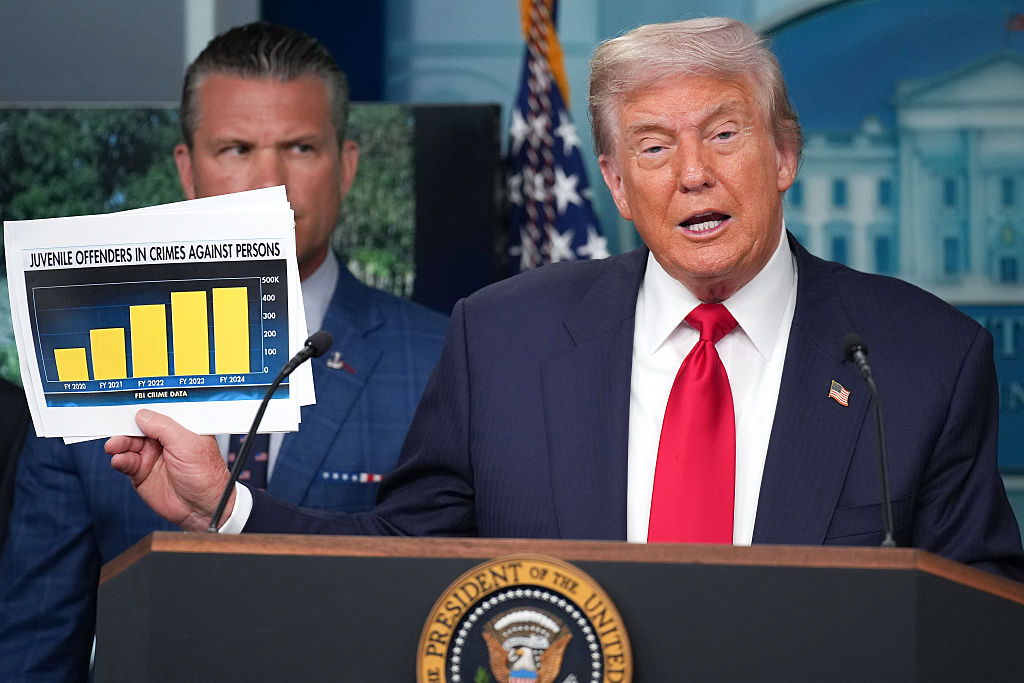
Donald Trump‘s press conference announcing a federal takeover of Washington, DC‘s police force was packed to the gills with White House reporters – many of whom live in DC and the surrounding area, and are more than familiar with the degradation of law and order in the region. But just because they know it’s bad doesn’t mean they want to give Trump any credit for trying to clean up the city – in fact, they’re likely to attack the move from both sides.
The ramifications of Trump’s takeover, under Section 740‘s emergency rule, will have undetermined ripple effects in the capital city, but the initial reaction to it illustrates the difficult position in which it puts the president’s critics. Arguments from commentators on CNN and MSNBC immediately turned to official statistics, which show declines in violent crime in the past year and a half. The only problem? A DC police commander has already been suspended for cooking the books on those numbers, a practice that the DC police union claims is commonplace.
“When our members respond to the scene of a felony offense where there is a victim reporting that a felony occurred, inevitably there will be a lieutenant or a captain that will show up on that scene and direct those members to take a report for a lesser offense,” Fraternal Order of Police Chairman Gregg Pemberton said. “So, instead of taking a report for a shooting or a stabbing or a carjacking, they will order that officer to take a report for a theft or an injured person to the hospital or a felony assault, which is not the same type of classification.”
Ever since the violent summer of George Floyd, Washington has struggled to achieve the same return to normalcy that has been the case in other major cities. A major driver is the lack of sufficient police staffing, with the Metro Police Department running almost a thousand officers short of needed levels. Carjackings and vehicle theft are three times the national average, and the homicide rate is six times that of New York City. The poor response times and lack of an ability to disburse gang activity is taken for granted by residents, with restaurant closures and other venues seeing less foot traffic because of the crime concerns.
“Over the last two years, DC has experienced a 52 percent drop in violent crime and is now at a 30-year low,” tweeted Councilman Charles Allen of the DC Council. “While any crime is one too many, every local leader in DC is committed to the work and progress of safer communities and preventing violence.” These words are particularly rich coming from Allen, who faced a recall campaign after being the council’s leading voice on reducing the number of MPD officers and pushing for slack sentencing guidelines for teenage perps.
The overall result of Trump’s move in media terms will be to make national figures finally pay attention to how bad things are in DC, if only to deny they justify his actions – but they’ll also be set to use any criminal activity that does happen going forward to argue that the administration methods are ineffective. But this is a sideshow: the real question is how DC’s citizens feel about what comes next, and whether it makes DC feel safe again. As a local who hasn’t been willing to risk taking my children into the city late in the day, I can hope that changes soon.