Tag: Illinois

  • Life in Chicago with ICE and the National Guard

    Life in Chicago with ICE and the National Guard

    Every day, Chicagoans outside the immediate areas where federal forces are deploying pick up fragments of what feels like an unfolding drama.

    Here’s a representative example: on the app NextDoor, the Chicago subreddit and in neighborhood Facebook groups, we watch cell-phone footage from Logan Square of smoke spreading through an intersection as a federal vehicle pulls away. Eventually, local outlets verify that a masked federal agent dropped canisters outside the Rico Fresh supermarket near Funston Elementary. It appears the air was filled with a chemical irritant, causing people to panic, and the vehicle departed. NBC Chicago asked Immigrations and Customs Enforcement and the Department of Homeland Security for explanations and, as of publication, had not received a detailed public rationale. Another cluster of videos captures tense scenes outside the ICE processing center in Broadview, a suburb just west of Chicago. In September, a federal agent positioned above the facility fired a projectile that struck Pastor David Black in the head.

    I witnessed an arrest last Saturday afternoon – a man purchasing a hot dog was picked up by CBP. A Greek-American friend, with olive skin and a mess of dark, curly hair, claims in a groupchat that he was asked to show his passport while walking downtown – sparse on details, high on alarm. Another friend, an undocumented immigrant from Ukraine, shares with me that she’s scared of being seized. Each day, a new story and mixed context for residents who may not understand what’s actually happening. 

    The Trump administration has deployed about 500 National Guard troops in the Chicago area for an initial period of 60 days – around 300 from Illinois and 200 from Texas. Federal officials say the mission is to protect personnel and property at federal sites, especially those used by ICE. On social media, there are reports that Chicagoans are preventing federal officials from doing their job through civil disobedience, which, some conservatives say, is justification for the Trump administration to step up operations.

    Illinois and the City of Chicago have sued, arguing the orders are unlawful and implicate the Posse Comitatus Act, which limits the use oIf the military in civilian law enforcement. Filed October 6, the complaint challenges both the federalization of the Illinois Guard and the importation of Texas Guard forces. A judge in Chicago is set to rule on whether to block the deployment while the case proceeds.

    Northern Command has publicly declared the troops are there to protect federal workers and property, not to perform general urban policing – though the chatter online tells a different story. There’s a general sense that Chicago is a “war zone” and that the presence of the National Guard is “overdue.” The White House itself has described the deployment as a “protection mission,” while DHS refers to the broader ICE enforcement escalation as Operation Midway Blitz.

    Reporters have yet to work out a complete, detailed after-action account explaining why gas was deployed in Logan Square at that moment. Federal officials have not produced a cohesive public explanation tying together the scattered incidents across the city. And so residents and observers have basic questions that remain unanswered: who ordered the canisters in Logan Square? What does it mean, practically, that one of our alderwomen was briefly handcuffed? Was she arrested or just threatened? Eventually there are fractions of answers, but not all emerge in time to affect public understanding.

    What many Chicagoans are experiencing is uncertainty, amplified by a lack of clear news sources. Local journalists are doing the work: verifying incidents, seeking official responses, documenting what happens on the ground. But that reporting doesn’t reach most people in its original form. Instead, it gets broken apart and redistributed through social platforms, stripped of context, arriving as fragments rather than as coherent stories. 

    From social media, people assemble different stories. Some accept the administration’s framing – that the Guard is there to keep federal workers safe in a city that allegedly refuses to do so. Others see the footage as evidence that federal power is expanding into everyday life  –  understood as authoritarian overreach. Both sides point to authentic images and cite official statements, but few can point to a single, verified timeline that links them all.

    The Guard deployment is real, active and officially limited to protecting federal personnel and property. ICE enforcement in the region has intensified under a named operation, producing repeated confrontations with residents and protesters. And the public does not yet have a stable, integrated account that links these episodes into a common operational plan. This is, in large part, a distribution problem. The pieces are authentic. The whole picture remains incomplete.

  • Chicago Public Schools have failed. But there’s another option

    Chicago Public Schools have failed. But there’s another option

    Illinois recently released its 2024 Educational Report Card. The grades are, not surprisingly, bleak. Eighty schools reported not a single student who reached grade proficiency in math. Of the state’s low-income students, only 24.6 percent are proficient in reading, and 13.7 percent in math.

    The Chicago Teachers Union – with impeccable grammar and punctuation – blames insufficient funding: “[Governor JB] Pritzker cries poor, he is leaving $10 billion in billionaire and big tech tax breaks on the table. Reversing just a fraction of that windfall would provide [Chicago Public Schools] and all Illinois schools the funds they need to thrive.”

    Not that the CPS or the CTU have proven themselves emblems of fiscal responsibility. CPS is running a $734 million deficit and devotes 7 percent of its funding to debt service. It suffers immense administrative bloat: fewer than half of its 45,965 full-time employees are teachers. Despite falling enrollment rates, its budget balloons every year. Chicago schools face an incredibly difficult task. But to spend $9.9 billion this year alone, while 18,000 students attend zero-proficiency schools? That seems slightly excessive.

    The CTU, meanwhile, charges its teachers $1,410.98 a year and devotes 80 cents on the dollar to campaign donations. Following a 2021 discrimination lawsuit against CPS (not to be confused with the more recent labor negotiation that increased CPS operating costs by $1.5 billion), the union paid its law firm $4 million in fees. It just so happens that the firm is owned by the mother of the union’s vice president, Jackson Potter. The union’s president, Stacy Davis Gates, declared on X that ”*School choice* was actually the choice of racists” while her son was enrolled in a prestigious Catholic school. Not surprisingly, the union maintains a shining 21 percent favorability rating within the state.

    Perhaps it is time to try something new.

    Investing in charter schools is a good first step. According to a 15-year Stanford University study, charter schools across the nation consistently yield higher reading and math outcomes than their public-school counterparts. Few charter-school studies have followed Chicago specifically in recent years, but as of 2017, the city’s charter schools sent 19 percent more of their graduates to four-year colleges than did its district high schools. Yet these charter schools operated on 36 percent less spending per student than mainstream public schools. This disparity could be interpreted in three ways: that charter schools operate efficiently because they must compete for students to enroll; that they are underfunded; or that typical public schools are not so starved for cash as they claim (one Douglass Academy High School spent $93,787 per student in 2024, and 100 percent of its students still failed in math). Regardless of which interpretation you choose, the upshot is that charter schools are succeeding (comparatively, at least) where typical public schools are failing. The very fact that the parents of one in four Chicago high-schoolers choose to enroll in a charter school indicates a higher level of trust than in district schools. Taxpayers ought to be questioning why CPS agreed, in the March labor negotiation, to place a moratorium on the founding of new charter schools.

    Better yet, Illinois could give students the opportunity to escape the dismal public-school system altogether. The state currently offers a 25 percent tax credit for educational expenses such as private-school tuition, but it caps the credit at $750 per family. While this modest break may be nice for middle- to high-income families with students enrolled in private schools, it does not bridge the gap for severely disadvantaged families. Illinois once enabled these low-income students to receive tuition scholarships via its “Invest in Kids” program, which gave a 75 percent tax credit to families and businesses that donated to Scholarship Granting Organizations (SGOs). But in 2023, at the behest of you-guessed-who, the CTU, Illinois axed the program.

    Fortunately, Congress has offered Illinois the opportunity to grant school choice to those families whom the public-school system has failed. The Big Beautiful Bill created a 100 percent tax credit – should a state governor or legislature opt-in – to match an individual’s donation to an educational SGO. These organizations then grant scholarships to low-income or disabled students to attend private schools. The new program would cost neither the state of Illinois nor the local public-school district a cent.

    Both CPS and the CTU have failed the students of Illinois. With the federal scholarship program, a 12-year-old in West Garfield Park could attend a private school that invests in children, not political campaigns. Governor Pritzker must decide: will only the wealthy be taught to read?

  • Trump starts Christmas now

    Trump starts Christmas now

    There’s no small irony in the fact that Texas Democratic state legislators, fleeing a congressional redistricting attempt by Texas’s Republican majority, have sought shelter in Illinois. They’re acting like political refugees in what is, in fact, the most gerrymandered state in the country.

    Look at Illinois District 13, which snakes up from the Missouri border nearly to the gates of Indiana, bisecting the state (and District 15) like Illinois’s small intestine. Chicago is a very populous city, but the state has carved up its Congressional districts like a turducken, giving us as many (D-Chicagos) as humanly possible.

    The Illinois Democratic machine has had an outsized influence on American politics, much less Illinois politics, for decades. Its favorite son, Barack Obama, even became president. Now that Texas is serving up a gerrymandering machine that’s just as powerful, and just as corrupt, Illinois is offering asylum. That’s rich.

    Cockburn has been to both states. They both offer occasional moments of grace punctuated by millions of acres of cow manure. May they gerrymander each other out of existence and let a non-corrupt state devoted to direct democracy, wherever that may exist, take control of Congress.

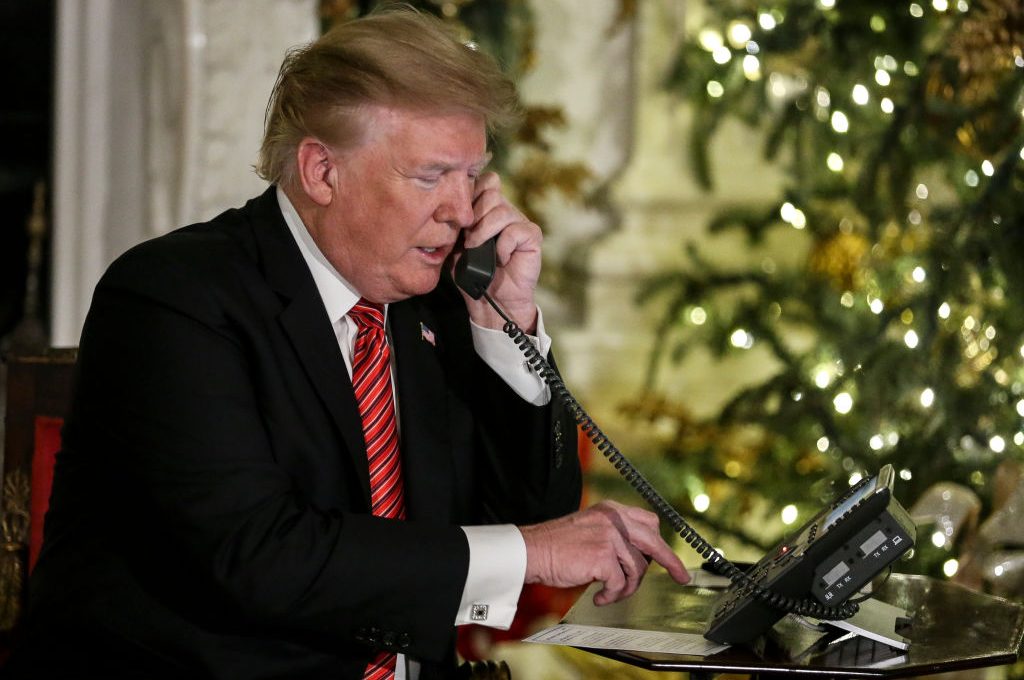
    With Trump, Christmas starts now

    It’s August, which means that Christmas is just around the corner. While Cockburn hangs around the house drinking spritzes and swatting mosquitos on the patio, the White House has announced it’s time to receive applications to help with Christmas decorations and to perform at holiday open houses. ’Tis the season, I guess! To the administration’s credit, they didn’t announce they’re officially renaming the holiday The First Lady Melania Trump Christmas Spectacular.

    While countless school choirs and dance teams will certainly bring the jolly, Cockburn would like to see various administration figures appear as part of the festivities. Director of National Intelligence Tulsi Gabbard can finally reveal who was behind the cover-up of the Santa Files (not David Sedaris’s, the real ones). Pete Hegseth can dress up as Santa and send selfies to the group chat. We look forward to Barron Trump’s Christmas Crypto Bash. Most prominently, J.D. Vance can fulfill his destiny by dressing as Buddy the Elf and proclaiming “Santa? I know him!!!” – a nice summary of his relationship with President Trump.

    On our radar

    UP ON THE ROOFTOP Joined by several men in suits this morning, President Trump took questions from the roof of the White House. Apparently, he was surveying the building for his recently announced $200 million ballroom.

    RUSSIA RUSSIA RUSSIA Pam Bondi directed the DoJ to launch a grand jury investigation into allegations that the Obama administration manufactured intelligence about 2016 election interference.

    EPSTEIN UPDATE Ghislaine Maxwell has been transferred to a minimum security prison in Bryan, Texas. Meanwhile, Bill and Hillary Clinton are set to be deposed by the House Oversight Committee this October for their connection to Epstein.

    Going Postal

    News broke this week (in the New York Post, appropriately enough), that the paper is soon to begin publishing a California edition, called the California Post. These happy tidings are almost enough to make Cockburn want to move back to California, where he spent some very happy, idle months at the Chateau Marmont in the 80s, and also the 90s.

    Regardless, this is great news for California’s bleak, bland, hyper-woke media offerings, punctuated only by the occasional conservative opposition blog, Adam Carolla X account or grouchy late-night AM radio hosts. An active Page Six alone will help burst the Hollywood PR bubble, and Cockburn relishes the idea of holding Gavin Newsom and Karen Bass’s feet to the fire on any number of issues. Newspapers aren’t, in fact, dead. They’re just not giving people something that they want to read. And as much as they hate to admit it, everyone wants to read the Post.