Former vice president Dick Cheney, who died on Monday at age 84, loathed Donald Trump. In a 2022 election campaign ad for his daughter, Liz, a congresswoman from Wyoming, he declared: “In our nation’s 246-year history, there has never been an individual who is a greater threat to our republic than Donald Trump.” Yet Cheney was more responsible for Trump’s rise than almost anyone else in the Republican establishment. He helped to mastermind the calamitous Iraq War and preached the unitary executive theory of the presidency. Instead of vilifying Cheney, MAGA-world should offer him a bouquet of appreciation.
Recall that it was during the 2016 South Carolina primary that Trump first showed his real independence from the folderol surrounding the Iraq War. Trump created shock and awe by denouncing it. “The war in Iraq,” he said, “was a big, fat mistake.” Until then, Republicans had marched in lockstep beneath the George W. Bush banner.
After Trump’s abortive attempt to overturn the 2020 election, Liz Cheney headed a commission to expose his machinations. But it blew up in her face. The Cheney brood now became heroes to Democrats. During the 2024 election Kamala Harris was endorsed by Dick Cheney. Harris said that she was “honored” to have the backing of the “well-respected” Cheney. Well-respected? Harris was in essence effacing the true legacy of Cheney and the Iraq War. Writing in the New York Review of Books, Fintan O’Toole acutely notes that Trump had recognized that Americans had “soured on the extended occupations of Iraq and Afghanistan… It is quite extraordinary that the Democrats allowed Trump a virtual monopoly on the exploitation of this profound disillusionment, and that Harris never stopped to ask who, exactly, Dick Cheney remains “well-respected” by.
Who indeed? The Cheney era has become synonymous with imperial overreach and disdain for constitutional safeguards. Cheney’s hubris had its sources in Watergate, when he served as a young aide in the Nixon administration. He rose seamlessly in Republican ranks, entering Congress in the 1978 election as a representative from Wyoming. His highpoint was serving as Secretary of Defense under George H.W. Bush during the 1991 Gulf War when America repelled Iraqi dictator Saddam Hussein from Kuwait.
But Cheney and his aides, including Paul Wolfowitz, became obsessed with the idea of toppling Saddam himself from power. This idee fixe led Cheney to empower the neocons after 9/11, when America failed to capture Osama bin Laden in Tora Bora and instead focused its effort on concocting a fictitious case for war in Iraq. Cheney and his cohort succumbed to paranoia, seeking to tie Saddam by whatever means necessary to the attack on the Twin Towers. This was fantasy. But it issued in a war that turned into a debacle. At the summit of their power and influence the neocons were discredited by a bungled crusade to implant democracy in the arid soil of the Middle East.
It wasn’t until the 2006 midterm elections, when the GOP suffered a brutal buffeting, that George W. Bush began to follow a more pragmatic approach, ousting Defense Secretary Donald Rumsfeld. Cheney’s influence had passed its high-water mark. Bush started to realize that he had been conned by the neocons. “Am I the evil genius in the corner that nobody ever sees come out of his hole?” Cheney once remarked. “It’s a nice way to operate, actually.” It was indeed. But the consequences of Cheney’s decisions continue to reverberate in insalubrious ways.
Former vice president Dick Cheney died last night aged 84. He arrived in Washington as a congressman for Wyoming, then became secretary for defense under George H.W. Bush and served for eight years as George W. Bush’s vice president. He was considered by many to have pulled the strings behind the Bush administration.
What is perhaps his most lasting legacy is the “Cheney Doctrine,” which influenced America’s decision to engage in wars in the Middle East. He campaigned for a military response to the 9/11 terrorist attacks, which drove his conviction that any country, organization or individual that posed a threat to the US, or that might in the future, needed to be taken out.
Cheney had something of an imperial mind, a belief that presidential power had to be restored after it had been curbed following the executive crises of the 20th century, like the Vietnam war and Watergate. His will to power earned him comparisons with the Star Wars villain Darth Vader – critically by the left, and admiringly by Steve Bannon: “Darkness is good. Dick Cheney. Darth Vader. Satan. That’s power.”
Cheney was critical of Donald Trump, especially after the 2021 election. He called Trump a “threat to the republic” and a “coward” who tried to steal the election using “lies and violence.” Yet it could also be said that the Cheney years paved the way for a powerful executive like Trump. Where one president acted in the shadows, the other craves the limelight.
I grew up in the Bush-Cheney years, with a father who was frequently away from our family on deployments fighting in Middle Eastern conflicts. If circumstances had been slightly different, if my father had not come back, I might easily see Cheney as one of the great villains of American history. I would not be alone in thinking so. Cheney is one of the most unpopular figures in US politics of the 21st century, and the America First movement has arisen largely in reaction to his foreign wars.
My instinct is still to be highly critical of entanglements abroad, but it is impossible to judge what the world would be like if America had not fought the war on terror. Throughout his life, Cheney held that what he had done was necessary. He believed at the time, and continued to believe, that invading Iraq was the right thing to do.
“John Bolton Surrenders To Federal Authorities” is a headline I could have only dreamed of seeing 20 years ago, but this morning it came true. Following yesterday’s grand-jury indictment of Bolton, the former Trump National Security Advisor and W. Bush Iraq War architect/manipulator gave himself up and pled not guilty in federal court on charges of mishandling classified information. But if Bolton isn’t guilty, I’m a high-stakes poker professional.
The charges claimed that Bolton was “unlawfully hoarding” documents, that he sent classified information over grandpa communication medium AOL instant Messenger in 2018 and that he shared more than 1,000 pages of notes, while working on a memoir, with his wife and daughter, neither of whom had security clearances. “From on or about April 9, 2018, through on or about September 15, 2019, on a regular basis, Bolton sent diary-like entries to [his wife and daughter] that contained information classified up to the Top Secret/SCI level,” says the indictment.
Now, let’s be clear, even though we can dream, this isn’t Julius and Ethel Rosenberg or Aldrich Ames-like stuff. Bolton was just trying to enjoy a final cashing-in on a lifelong career of neoconservative warmongering. But Iranian hackers, representatives of a government that wouldn’t mind targeting Trump, not to mention Bolton, also have access to AOL. According to the indictment, they intercepted the messages. Looks like the man with the walrus mustache got a little careless with his “secret travel memos.”
Bolton said, in a statement, “These charges are not just about [Trump’s] focus on me or my diaries, but his intensive effort to intimidate his opponents, to ensure that he alone determines what is said about his conduct,” Bolton said. “Dissent and disagreement are foundational to America’s constitutional system, and vitally important to our freedom. I look forward to the fight to defend my lawful conduct and to expose his abuse of power.”
It’s true that Bolton has had some unkind things to say about Trump since leaving his political orbit, and it’s also true that Trump is using any means necessary to target his political enemies, real or perceived. But unlike James Comey and Letitia James, Trump’s other two most powerful recent lawfare targets, Bolton’s indictment actually has a chance to stick. He almost certainly won’t serve a full 10-year sentence, but the grand jury indictment is quite specific and pointed. The law tends to be biased against a guy who’s “hoarding strategic government communications” for his memoir.
Let’s keep in mind that Bolton was a key architect of one of the biggest government deceptions of our time, or any time, the absolute insistence of the George W. Bush administration that Saddam Hussein possessed weapons of mass destruction, which led to one of the most pointless wars in American history. Talking to NPR in 2023, a sure sign that the political winds had shifted, Bolton said, “it depends on how you define a lie, because if you believe that’s a lie, then a lot of what I hear on NPR on any given day is a lie. To me, a lie is a statement that’s untrue, that’s uttered deliberately knowing it’s false. The administration didn’t lie.”
Sure, John. In my mind, Bolton’s indictment is about yellowcake uranium, not about saying mean things about Donald Trump in a memoir called The Room Where It Happened. But you can only go to war with the army you have. John Bolton as the ultimate defender of free speech, dissent and disagreement feels like a bit much to me. Next thing you know, Democrats will be trying to rehabilitate the reputation of the Cheney family. Truth be told, it’s kind of hard to believe.
It’s great that J.D. Vance is all for free speech, though he does tend to shoot off his mouth in an off-putting way. He is, as Disraeli said of Gladstone, “a sophistical rhetorician, inebriated with the exuberance of his own verbosity.”
In an interview with Fox News’s Sean Hannity last night, the vice president said: “If you want real security guarantees, if you want to actually ensure that Vladimir Putin does not invade Ukraine again, the very best security guarantee is to give Americans economic upside in the future of Ukraine. That is a way better security guarantee than 20,000 troops from some random country that has not fought a war in thirty or forty years.”
Cue an army of touchy British commentators taking the vice president to task for his apparent diss to their boys. What about the 179 British soldiers who died fighting the futile American-led war in Iraq? Or the 457 British soldiers who perished failing to achieve America’s objectives in Afghanistan? J.D. Vance promptly took to X this morning to say it was “absurdly dishonest” to suggest he meant Britain or France, “both of whom have fought bravely alongside the US over the last twenty years.” In a follow-up post, he added: “But let’s be direct: there are many countries who are volunteering (privately or publicly) support who have neither the battlefield experience nor the military equipment to do anything meaningful.”
Which country did he mean, then? Perhaps we’ll never know; perhaps he doesn’t even know himself. The vice president is not quite as “direct” as he makes out.
However, if you take out the “random country” part, it’s clear that Vance is right.
An economically binding deal between Kyiv and Washington over minerals would be a more realistic guarantor of Ukrainian security than British and European boots on the ground in the Donbas. Even if a British-European defense force could be rustled up at short notice, Vladimir Putin’s Russia is very unlikely to accept the idea of a significant deployment of what it would regard as hostile forces on its borders. As Starmer has acknowledged, the US has to be the “backstop” and the best means of locking in Uncle Sam’s involvement is by more closely aligning Ukraine to US interests. Zelensky seems to understand that, too, which is why he’s just announced that he’s ready to sign the deal after all; that he’s grateful to America; and that Friday’s fallout was “regrettable.” As Trump put it, “you don’t have the cards right now. With us, you start having cards.” Zelensky said he wasn’t playing cards. But he was always going to have to fold.
There’s fighting wars, there’s fighting about wars, and then there’s ending wars and achieving peace. Rather than bleating about how Britain stood side-by-side with America in the disastrous war on terror, a more interesting response to J.D. Vance today might be to ask: when did the US, with all its awesome power, win a significant war? Iraq, Afghanistan and Vietnam all turned into operational quagmires. One could argue that, with its ruthless bombing of Bosnia, US air power achieved its aims, or that America successfully crippled ISIS in the late 2010s. But these were hardly conventional victories. The truth is that, since World War Two, the US armed forces have specialized in short, stunning displays of ferocious might, followed by strategic muddle and often retreat.
Which brings us back to Vance and the war-wary outlook of the second Trump administration. In Trump’s first term, America’s hard power was still overseen to a large extent by “Trump’s generals” — men such as Generals Jim Mattis and HR McMaster, who served in Afghanistan and Iraq at a high level, but who ended up breaking with the president over his improvisational approach to foreign affairs. In 2025, Team Trump has Vance, secretary of defense Pete Hegseth and Tulsi Gabbard as his director of national intelligence. These three figures all served at comparatively low ranks in Iraq and their worldview is naturally informed by their experience in that ill-fated conflict. They saw the limits of American power first-hand. It’s that experience, the ghost of Iraq, that now haunts the Trump administration’s thinking on Ukraine. And it’s obvious that the war in Ukraine has the potential to put the US into a direct conflict with Russia, a nuclear-armed power far more threatening than the Taliban, the Vietcong, or any force in Mesopotamia. That’s a fight which no western country is seriously willing to engage in, for all the bluster you hear against “appeasement” in European capitals.
Trump and Vance understand this. That’s why their bust-ups and make-ups with Zelensky and others in the last few days are already proving to be a mere shadow play to eventual accommodation. What’s really happening is a more fundamental Trump-led resetting of the international politics, one based on realpolitik and an understanding that, while America may remain an indispensable nation in terms of military strength, even the greatest powers can’t change the world. That point may offend delicate western feelings about the so-called “rules-based” order. But it’s a truth that all countries, random or not, cannot afford to ignore for much longer.
Sir Roger Scruton may not be Prime Minister Keir Starmer‘s favorite author. Apparently Starmer prefers Victoria Hislop. But as he prepares to travel to Washington next week, the PM could scarcely spend his time more wisely than burying his nose in The Uses of Pessimism — and the Dangers of False Hope, one of Scruton’s most powerful works.
“Hope untempered by the evidence of history is a dangerous asset,” says Scruton. “And one that threatens not only those who embrace it, but all those within range of their illusions.” That is the correct, pessimistic, cast of mind with which to approach not just the war in Ukraine, and America’s ongoing commitment to Europe, but to international affairs overall.
Donald Trump’s presidency is the harbinger of many things — a vibe-shift in our culture, a dismantling of bureaucratic and therapeutic government, a commitment to what the Silicon Valley entrepreneur Alex Karp calls a “Technological Republic.” But it also marks a return to a bleaker, starker, more pitiless world landscape.
The ideal of a rules-based international order, where multilateral institutions restrain states pursuing their self-interest, has proved to be a false hope. Instead of a world operating according to the dreams of Antonio Guterres or Ursula von der Leyen, we are back to a world closer to that of Thucydides in which the strong do what they can and the weak suffer what they must. It’s not a new world order but a based world outlook.
As a politician, I indulged in as many false hopes as anyone. I hoped regime change in Afghanistan and Iraq might see democracy spread across the Middle East. I imagined that the Arab Spring and the fall of Gaddafi would mark the eclipse of tyranny and terror. I sat around the cabinet table when we vowed with Boris that Putin must lose. So I am a reluctant realist, a chastened idealist not so much red-pilled by MAGA as schooled by unending history.
Which is why I sympathize with the prime minister’s stated strategy for Ukraine but fear it may be another false hope. His wish to commit British troops, alongside Britain’s allies, to keep the peace in Ukraine with an American “backstop” sounds measured and noble. But it’s also willfully blind. The revealed preferences of our European partners is to provide Ukraine with all available assistance short of actual help, and the attitude of America now is to wind down commitments to Europe as fast as feasible, the better to concentrate on the threat from China in the Pacific. How can Britain, with our economy in the mire and our armed forces suffering from long-term neglect, possibly hope to play policeman in eastern Europe?
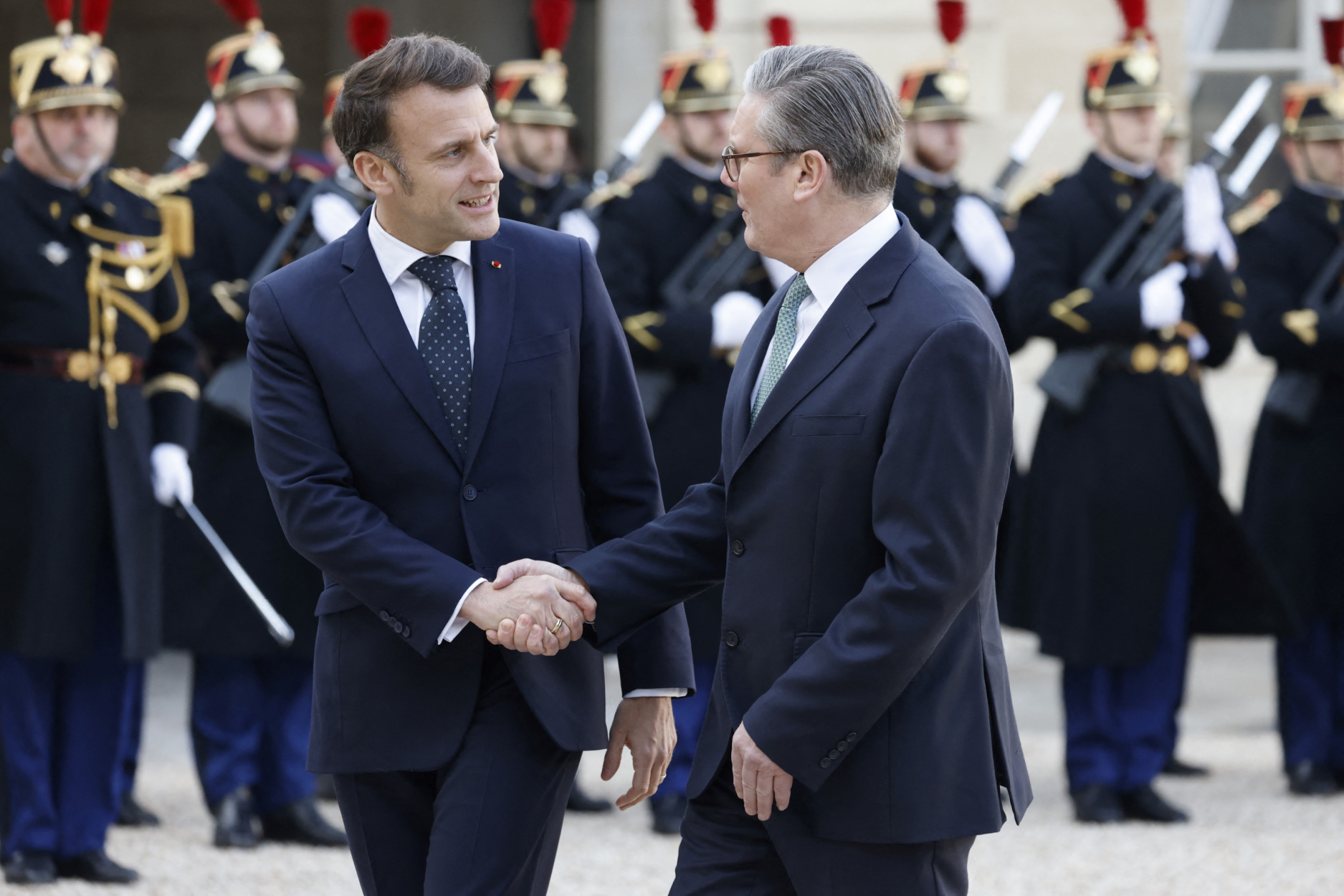
Emmanuel Macron welcomes Keir Starmer at the Elysee Palace before a summit on European security, February 17, 2025 (Getty)
There is something unattractive in Trump’s recent rhetoric on Ukraine — victim-blaming tinged with conspiracy theorism. His suggestion that Kyiv provoked the conflict is perverse, the shade cast in Zelensky’s direction an ugly echo of the Tucker Carlson view of Ukraine as a Potemkin democracy.
But there is a bigger strategic imperative driving Trump’s agenda. He believes America is overstretched and China is the real danger. He is conscious that China is anxious to do what it can to take over Taiwan before the demographic disaster of the one-child policy decimates its working-age population. He knows that America depends on Taiwan for the chips which assure its technological ascendancy and that denial of access to Taiwan semiconductor manufacturing would be the severing of his country’s carotid artery. So, like an investor seeing that there are only minutes left before the markets close, he wants to exit what he sees as a losing European trade and defend his important Asian equities.
Britain is still better placed than most nations to secure an audience at the Trump court. Ironically for Starmer, that’s partly because of Brexit. The UK is not in the same league as the EU when it comes to inflicting trade deficits on the US. And our independent stance on AI — which led us to join the US in rejecting the European approach to constraining that technology — has won favor in the White House. But winning a hearing is not the same as winning the argument.
British leaders might think that peace with Putin is appeasement that will only encourage Beijing, but Trump believes it is a pivot away from a war the West cannot win to preparation for one it cannot afford to lose. We might think that everyone gains from a rules-based international order. But for President Trump, the deal appears to involve America paying to uphold that order — while the rules on everything from tech regulation to carbon emissions are being set by others in ways which weaken the US.
For a president elected on a platform of America First, that system makes no sense. And for any realist, born-again or otherwise, hard facts have to be faced. No nation can forever be bound to operate against its own self-interest — democracies least of all. Populations will not long endure being taxed beyond their incomes, sending their boys overseas and accepting unequal terms of trade simply so diplomats can have an easier time at cocktail parties.
Britain must accept that if we are to earn the respect of others and the right to determine the future, we need a realist reset. The PM has realists in his circle — Defense Secretary John Healey and the philosopher Jonathan Rutherford — and he is known to admire the work of John Bew, the biographer of Castlereagh and Attlee and author of a brilliant work on realpolitik. Let me tentatively offer some rules for realists in the world we now inhabit — a world where China’s Leninists seek to exploit our weakness economically, Russia’s gangster regime tries to bully us militarily, and Islamist terrorists and their sponsors hope to subvert us internally.
How can we ask people to integrate into a society where the forces of disintegration go unchecked?
Rule 1 There is no substitute for hard power. A nation’s ability to defend its people, its values and its allies, let alone its potential to advance noble causes, depends crucially on military strength. And that is much more than just the percentage of GDP allocated to defense. Size matters when it comes to your security budget, but not as much as how you use it. Europe’s revealed preference over many years has been to invest defense spending in more conferences, more complex command structures, more byzantine procurement regimes and more efforts at European “integration,” rather than more highly trained troops and more effective kit.
Rule 2 We can no longer afford luxury beliefs. It’s not sustainable to have investment funds which shun arms companies on ESG grounds. It’s no good saying you want to save the planet if you can’t stop China and Russia controlling more and more of it. It’s self-harming to apply DEI policies to the military. The services are there to intimidate and, if that fails, kill our enemies, not impress them with how kind we are to people struggling with their gender identity. Laws policed by foreign courts which prevent our security and intelligence services doing what is necessary to keep us safe are weapons we have fashioned to arm the terrorists who wish to harm us. If our agents can’t do their job because of the ECHR, it must be changed until they can. Or junked.
Rule 3 A House Divided Against Itself Cannot Stand. There is a limit to how long any state can remain resilient if it imports large numbers of people from abroad and not only does not require them fully to integrate but actually apologizes for the history and character of the nation they have chosen to make their home. If we are set upon hand-wringing about our past, decolonizing our curriculum, entertaining the idea of reparations for historic sins, dismantling our privilege and declining to take pride in our culture, then what is it we are actually seeking to defend? How can we ask people to integrate into a society where the forces of disintegration go unchecked? And how can we ask citizens, however long their families have lived here, to bear arms and risk their lives for our nation if we can’t bear to say we’re proud of it?
Rule 4 Unilateral disarmament was bonkers when it came to nukes and it’s no better when it comes to energy. Giving up our nuclear deterrent when Brezhnev was in the Kremlin would not have encouraged him to do the same. Our headlong drive towards net zero doesn’t seem to have given China cause to slow down its consumption of hydrocarbons. It has, however, given them an opportunity to make the West as reliant on their EVs and solar panels as Germany has been dependent (until recently) on Russian gas.
It may be the feeblest of false hopes to imagine that a government with Richard Hermer as attorney-general and Ed Miliband as energy secretary would embrace such flinty realism. So I have to be pessimistic about the prospect of any of these suggestions finding favor.
But what is the alternative? As Bismarck said, “a conquering army at the border will not be stopped by eloquence.” Whichever border we wish to defend — whether a principle that cannot be crossed or a frontier that should not be breached — we need to show a steeliness that has eluded us thus far. If Trump can teach us anything, it is that.
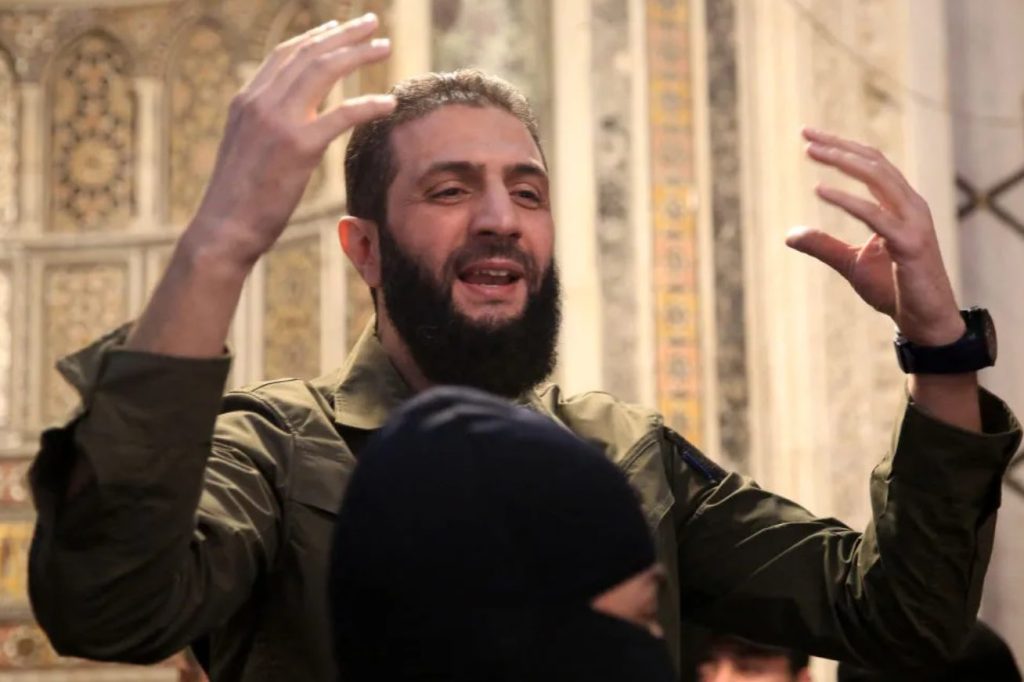
The victorious Syrian rebel leader now in control of Damascus has already learned a key lesson in history. After his forces swept into the capital, Abu Mohammad al-Jolani, head of the Islamic militant group, Hay’at Tahrir al-Sham (HTS), might have been expected to lay waste to all the institutions which had helped to keep the repressive Assad dynasty in power for fifty-three years, but instead he chose pragmatism. He announced he would do business with the Syrian government and wanted civil service staff to stay in their jobs to keep the country functioning.
This doesn’t make al-Jolani or Ahmed al-Sharaa as he now wants to be called (his real name rather than his nom de guerre), a Kissinger-style diplomat whom the world can embrace as a long-awaited savior. However, he only had to look back twenty-one years to see what the Americans did when the US-led coalition toppled Saddam Hussein from power in 2003, to know what to avoid at all costs.
It seems the hope of those now in charge in Damascus is for all civil servants to return to duty
Against the advice of the CIA and the US military who warned of dire consequences, the so-called “viceroy” of Iraq, Paul Bremer, a Pentagon official delegated by then-president George W. Bush to administer Iraq during a transitional period, announced a wholesale de-Ba’athification program.
Anyone associated with Saddam’s regime as a senior member of the ruling Ba’ath party was fired. That effectively meant the entire civil service was dismantled. The officials were sent home without jobs. The Iraqi army was also scrapped. Saddam soldiers with their guns went awol, by order. As a result, there was a gigantic vacuum. Bremer had no experience of Iraq, but he had the impossible task of building a new civil service and army from scratch.
It was a grave error which led to an embittered Iraqi army, thousands of disillusioned government employees, and, worst of all, to an anti-West insurgency that lasted for eight years out of which rose the Islamic State and its self-styled caliphate across great swathes of Iraq and Syria.
Eight days before the US led a coalition of forces across the Kuwaiti border into Iraq on March 20, 2003, the general in charge of 26,000 troops of the 1st UK Armoured Division envisaged a very different scenario. Speaking at his desert divisional headquarters north of the Mutla Ridge mountain range close to the border with Iraq, Major General Robin Brims, told me he hoped that Iraqi soldiers unwilling to fight should join the coalition against Saddam.
“I wouldn’t expect them to march north with us [to Baghdad] but they could just go to their barracks and wait there,” he said. “After the war, Iraq will still need armed forces and they will have a role to play in securing their country’s future.”
It was a visionary moment in the lead-up to what was to be a swift victory for the coalition, but followed by political decisions which condemned Iraq to years of torment and destruction and tens of thousands of civilian deaths.
Today in Damascus, there will be many civil servants who served in President Bashar al-Assad’s regime who will be afraid to return to their posts. Al-Jolani, the HTS leader, has declared he will issue a list of military and security officials who will be charged with war crimes. But this is actually in line with United Nations Security Council Resolution 2254, adopted on December 18, 2015, which laid down a roadmap for Syria’s political transition. It included accountability for atrocities committed by the Assad regime.
While the search for Assad’s henchmen continues (similar to the US hunt for Saddam’s main acolytes), it seems the hope of those now in charge in Damascus is for all civil servants to return to duty to help keep the administration of government running smoothly while the potentially dangerous and unpredictable transition period is orchestrated.
It will also be a period in which other nations in the Arab and western world, as well as Israel, will rapidly have to grasp what could be a pivotal opportunity to influence the way forward in Syria and also to take advantage of the impact the dramatic change in Damascus could have on the whole of the Middle East and on Russia and Iran, Assad’s principal backers.
If al-Jolani sticks to his promise and encourages the Syrian institutions to return to normal working routines, the new government in Damascus will have at least a chance of bringing some stability to the parts of the country where Assad formerly had control.
Provided pragmatism wins and ideology is kept contained, the lessons of the past, notably in Iraq and Libya, will guide the new Syrian leaders, as the rest of the world comes to terms with the downfall of Assad.
In an era of declining trust, the military retains widespread public confidence — 61 percent as of a Gallup poll this year. Large majorities of Americans look up to those who wore the uniform and associate serving in the military with positive stereotypes like self-discipline, loyalty and responsibility. Politicians and our political system? Not so much.
Only 26 percent of Americans have confidence in the presidency, and confidence in Congress stands at 9 percent. It’s no wonder that both parties recruit military veterans to run for office, hoping that the halo from their service will soften the sharp edges of political reality and garner crossover appeal come election day.
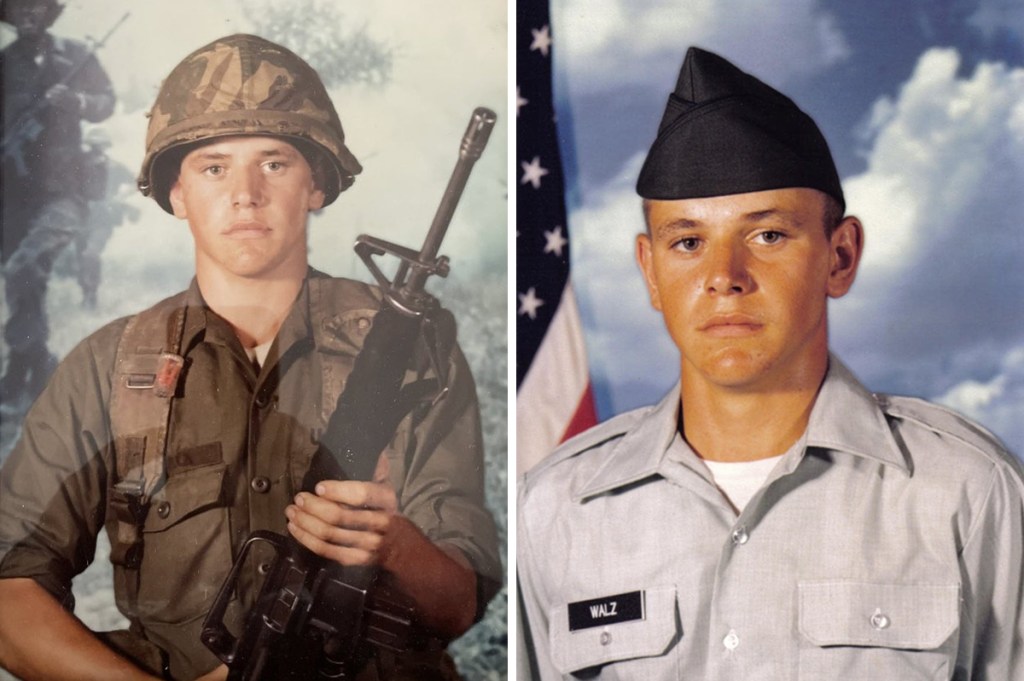
Vice President Kamala Harris’s selection of Minnesota governor Tim Walz as her running mate this week spurred adulation from groups as varied as the Democratic Socialists of America and mainstream pundits — but it also brought renewed scrutiny of Walz’s service record as a retired senior non-commissioned officer in the Army National Guard. There is no dispute that Walz enlisted in 1981 and retired in 2005 after twenty-four years of service, including several peacetime/non-combat rotations. Yet Walz’s characterization of his service record raised questions that deserve close appraisal, not scattershot attacks.
When Walz first enlisted, nearly one in five Americans had served in the military; today it’s closer to one in twenty. Fewer Americans understand service from personal experience; most rely on media depictions shaped by over two decades of conflict. As a result, the image of a veteran in many Americans’ minds is someone who put their on the line fighting overseas. While reality is quite different — there are roughly ten support personnel for every combat arms soldier — the political temptation for a candidate to wrap themselves in the warfighter narrative is hard to resist.
The year before he first ran for Congress in 2005, Walz cloaked himself in that image, holding a sign that read, “Enduring Freedom Veterans for [John] Kerry” at an event for the then-presidential candidate. In a technical sense, this was not a lie: Walz had mobilized to Europe that year to provide base security, a mission characterized as “in support of Operation Enduring Freedom,” the overarching name of the post-9/11 anti-terrorism mission. At the time, Kerry’s own service record in Vietnam was under attack — and his criticism of then-President Bush’s prosecution of the Iraq War led some to question Kerry’s patriotism.
The takeaway of “Enduring Freedom Veterans for Kerry” was clear: attacks on Kerry were baseless; war veterans who put their lives on the line overseas had Kerry’s back. Walz encouraged this deceptive picture, albeit without telling an outright lie himself. Edging up to that line may have had political upside for Walz, but it came with risks too. In 2009, National Guard veterans filmed themselves questioning his congressional staff about Walz’s remarks tying his service to Operation Enduring Freedom, arguing the implication he served in Afghanistan violated the Stolen Valor Act of 2005.
Lying about your service, or falsely claiming experiences or awards not received, is the fastest way to become persona non grata in other veterans’ eyes. Yet the mortal sin of stolen valor can become blurred by the natural tendency to embellish. There’s a reason veterans joke about “no shit, there I was…” tales that get a bit further from the truth with each retelling. That line comes into sharp focus when stakes are considered: bending the truth for a laugh over beers is one thing; claiming undeserved credibility, that others earned at great personal expense, is another.
This habit of encouraging a false impression of his service continued when Walz decided to run for Minnesota governor. In Congress, Walz struck a more moderate tone for a Democrat, earning an “A” rating from the National Rifle Association in the four cycles leading up to his 2018 gubernatorial run. It wasn’t until after the Parkland school shooting that year that Walz reversed his pro-gun stance, pivoting in support of an assault weapons ban by arguing, “those weapons of war, that I carried in war is the only place where those weapons are at.”
Walz’s defenders argue he spoke too quickly, that a pause was missed and he meant to say, “those weapons of war, that I carried — in war is the only place where those weapons are at.” The less charitable read is that Walz claimed, “I carried [weapons] in war.” It’s a critical distinction, and frankly arguable. What’s inarguable is that Walz used his authority as a military veteran to argue for an assault weapons ban, encouraging listeners to confer on his stance a battle-born credibility he never earned.
Walz owes it to his fellow veterans, and the voting public, to fully clarify these remarks and apologize for any false impressions of combat service. The absence of such a clarification, along with Walz’s lesser mischaracterizing his retirement rank, has stoked angry accusations of stolen valor from the right. I don’t think this issue is as neatly cut-and-dried as some claim, but if the parties were reversed there is no doubt that every liberal pundit praising Walz’s service today would be eviscerating a Republican with a similar record for stolen valor.
And therein lies the rub. Service members swear an oath to the Constitution. We served the nation, not a party, but when service gets dragged into partisan politics, there is no patience for accurate appraisals. Walz put himself in this position by playing fast and loose with his service record, encouraging a misimpression of his record to further his political career. But training fire on his otherwise respectable service gives Walz a pass on his shapeshifting political beliefs and burnishes the moderate image Kamala Harris needs him to project.
In July 4, 1821, secretary of state John Quincy Adams gave a speech to Congress on American foreign policy. He said of the United States that “wherever the standard of freedom and independence has been or shall be unfurled, there will her heart, her benedictions and her prayers be. But she goes not abroad, in search of monsters to destroy.”
For the first 150 years of the republic, its leaders dutifully observed Adams’s counsel. But after Woodrow Wilson’s intervention in World War One, American policy has tacked in the opposite direction. For over a century America has indeed been going abroad, searching for monsters to destroy. Steve Coll has explored how America’s proactive and tentacular foreign policy has shaped the histories of countries very distant and very different from the United States. His prize-winning books on Afghanistan, Pakistan, Saudi Arabia and the global oil market have all parsed how policies developed in Washington have played out overseas, often with disastrous consequences.
In The Achilles Trap: Saddam Hussein, the CIA, and the Origins of America’s Invasion of Iraq, Coll turns his focus to Iraq. His story begins in 1979, the year Saddam Hussein became president. It would have been hard then to imagine that Iraq would much interest the United States. A country of only 14 million people, it had little to distinguish it from other newly independent states in the region. Nor was Saddam Hussein all that different from the strongmen that held power across the global south. Saddam was a secular modernizer, corrupt and unusually brutal, but recognizably in the same mold as a dozen other Third World dictators. His regime was neither pro-American nor pro-USSR. It had no time for Islamism. If it had any ideological character at all, it was the generic anti-imperialism and anti-Zionism found across the region. With his pistol tucked into his military fatigues and a cigar in his hand, Saddam was an Iraqi Castro without the Marxism.
Yet Saddam’s entire life was shaped by the vagaries of American policy. A CIA-backed coup in 1963 brought the Ba’ath Party to power and gave him his entrée to politics. In the 1980s, Saddam was wooed by Washington and fawned over by Donald Rumsfeld. Oil deals worth billions of dollars were signed. When Iraqi jets mistakenly bombed the USS Stark in 1987 the incident was brushed over. Then the Washington machine turned against him after Iraq invaded Kuwait. The United States invaded Iraq in 1991 and then again in 2003. In between, it subjected the country to occasional bombings, a program of destabilization campaigns and a brutal sanctions regime that reduced GDP per capita by 90 percent. The second Gulf War toppled Saddam’s government, killed his sons and de-Ba’athified the country. American special forces pulled Saddam out of a hole near Tikrit in 2003; the American military guarded the court that condemned him to death in 2006.
Coll’s title alludes to Homer, and his subject matter has the arc of Greek tragedy. It is a superb and terrifying account of how the life of one man became the plaything of the gods of the Washington metropolitan area. It is impossible to read it and not paraphrase Laocoön’s famous admonition from the Iliad: beware of Americans bearing gifts. Although Saddam’s story begins in 1979, his imbroglio with the United States began on July 27, 1982 when Tom Twetten stepped off a plane in Baghdad. Twetten worked for the CIA and he had come with an unsolicited offer. Saddam was at war with Iran. The war wasn’t going well. The United States had satellite intelligence which could help the Iraqis on the battlefield. Saddam could have it, no strings attached. “We don’t need it,” came the response. “We don’t want it — and you can leave.”
It is tempting to speculate what history would have looked like if Iraq’s initial refusal had stuck. But that’s not what happened. The CIA persisted and eventually the Iraqi military began using American intelligence. The tide of war turned in their favor. So began a near decade-long romance between Washington and Baghdad. Coll chronicles how, virtually up until the moment that Saddam invaded Kuwait, the first Bush administration was looking at ways to deepen Iraqi-American relations.
The First Gulf War is the fulcrum of The Achilles Trap. It was the event that changed everything and ultimately led to Saddam’s downfall. The war is often remembered as the moment when the world woke up to the horror of Saddam’s regime and moved to restrain a rabid dictator. Coll’s expert retelling complicates that narrative. Saddam had already started one illegal war when he invaded Iran; Kuwait was not his first rodeo. While the world rightly remembers his horrific repression of the Kurds in the immediate aftermath of the Iraqi withdrawal from Kuwait, here too he had form. Some of the most disturbing parts of The Achilles Trap describe the persecution of the Kurds during the Anfal campaign of 1988. Over a period of seven months that year, some 50,000 Kurds were trucked out into the desert and shot; in Halabja Kurds were attacked with mustard gas, killing and injuring thousands. The Reagan administration knew and successfully blocked a bill in Congress which would have sanctioned Iraq for the systematic murder of its Kurdish minority. From Saddam’s point of view, US indifference to this recent history signaled that it wasn’t bothered by his planned invasion of Kuwait. He assumed the CIA knew about it and that if the Americans had wanted to stop him they would have. Years later he would ask American investigators: “If you didn’t want me to go in, why didn’t you tell me?”
The real reason the First Gulf War constituted a turning point was because it exposed the extent of Saddam’s WMD program. Saddam had been attempting to acquire a nuclear weapon for a decade and had used chemical weapons against both the Iranians and the Kurds. But it was not until the American intervention in Kuwait that the CIA woke up to the full extent of his ambitions. Saddam thought of WMD as a legitimate force multiplier that would allow Iraq to stand on equal terms with its regional rivals, especially Israel. This, Coll writes, was “a complete misreading of international attitudes.” Saddam didn’t understand that WMD were taboo and that the United States would never tolerate a nuclear Iraq.
His failure to grasp this essential fact was his undoing; it is also an insight into Saddam’s character. Unlike the urbane men who ruled in Amman, Riyadh and Cairo, Saddam was a lower-middle class provincial, who had come up through violence, spoke no English and had a poor understanding of the world beyond Iraq’s borders. He never developed a sophisticated understanding of the United States and his self-image as an anti-imperialist warrior prevented him from seeing how America viewed his regime.
The irony was that the war did actually impress upon Saddam the significance of the taboo on nuclear proliferation. In its aftermath he canceled his nuclear program and destroyed his WMD stocks. He also permitted a team of UN inspectors to operate inside Iraq. The problem was that Saddam never confessed to having destroyed his weapons and his henchmen obstructed inspections, making it look like he had something to hide. This game of masquerade and misperception led to the tragicomic diplomatic standoff that preceded the 2003 invasion, wherein the Bush administration insisted that the only way Saddam could avoid regime change was by proving he did not have the WMD that he really did not have. Coll sees the Second Gulf War as motivated neither by oil nor by neocon fantasies. Instead, Bush inherited a set of attitudes and policies toward Iraq that had been in place since 1991 and had led to a general sense that Saddam was a problem that needed an American solution.
Coll is more a hedgehog than a fox. His method is to dive deeply into one subject rather than surveying a dozen. Perhaps, he suggests, if we can understand the story of America’s encounter with Iraq, we will have a model for understanding American empire more generally. Saddam is not just a case-study but a synecdoche. If this approach has a drawback it is that we occasionally lose sight of Iraq’s position on the larger chessboard. Like the Norwegians in Hamlet, the Iranians are lurking offstage in The Achilles Trap and are in some respects its real protagonists.
Tom Twetten went to Baghdad to prevent Iran taking Basra and precipitated a series of events that led to the de facto Iranian takeover of Iraq and a massive increase in Iranian influence in Syria, Lebanon and Yemen. Saddam, as George W. Bush might put it, was a bad guy and his comeuppance was richly deserved. But his removal solved nothing and complicated everything. Twenty years on there are still monsters everywhere.
This article was originally published in The Spectator’s April 2024 World edition.
An end to endless wars? Get real. America’s foreign policy since the end of the Cold War is a never-ceasing tragedy. One front improves, another worsens.
On Sunday, it emerged that the Taliban council had agreed a ceasefire in Afghanistan, a development that could at last end America’s longest war, its 18-year military engagement in the graveyard of empires. Maybe President Donald Trump really could make good on his promise to end America’s hopeless and destructive foreign entanglements.
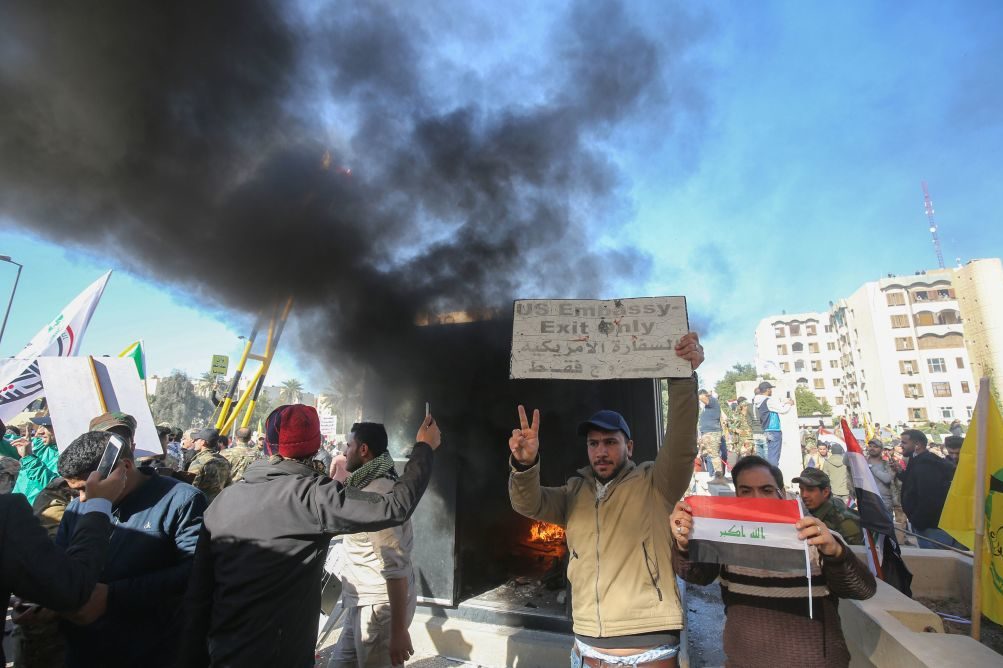
At the same time, however, Iraq has fallen into greater chaos again — because America can’t stop meddling. George W. Bush’s other great disaster continues. The failure cycle whirs. Last night, Shiite protesters stormed the US embassy compound in Baghdad in protest at US airstrikes in Iraq in recent days, which killed 25 fighters of the Iranian-backed militia Kataib Hezbollah. The airstrikes were themselves a response to the killing of an American contractor in Iraq. The protesters shouted: ‘Down, Down, USA’, ‘Death to America’, and ‘Death to Israel’. It’s all so appallingly familiar. Everybody sees the hand of Iran, and already the more bellicose pundits are talking about the need for America to tackle Tehran directly.
But the latest Iraq eruption points not just to Iran, but to a serious flaw in Trump’s leadership. The 45th president was meant to be the great disruptor on the world stage — a leader so unorthodox that he could dismantle the national security establishment’s grip on America’s armed forces. He was meant to be against the foreign-policy swampthink in DC, the military-industrial complex and so on.
In some ways, he is. But there has been a disconnect between his public anti-war stance and the covert hawkishness of his administration. America First realism has been something of a cypher: in many areas, Trump has merely continued the foreign policy of Barack Obama: fighting shadow wars across the Middle East, as America tries, cack-handedly, to pull away from conflicts but always ends up being drawn back in. Quagmires abroad don’t just vanish with a new man in the White House.
Donald Trump wasn’t just elected because he said he’d build a wall. He was elected because he spoke about America’s exhaustion with war and ‘losing’ — so did Obama in 2008. But disentangling from conflicts in Iraq, Syria, and Afghanistan requires not just warm words about bringing troops home. It demands careful, strategic thought, something that appears to be lacking in this administration.
Trump excels at the pyrotechnics of dealmaking. He generates crisis headlines to achieve resolution headlines. But, as we have seen with North Korea, foreign policy problems are more intractable than real-estate deals. Trump has been disruptive enough to open up new avenues of possibility in foreign affairs. But so far he hasn’t been able to exploit those opportunities.
Faced with complexity, Trump often defers to the more war-prone voices in the State Department and elsewhere. He likes to believe he is cleverly triangulating between the hawks and the doves, keeping everyone guessing while he forges ahead in America’s best interests.
Yet the reality of Trump’s foreign policy and his bragging at rallies don’t add up. Trump ‘destroyed’ Isis, famously. Now Isis is back with a vengeance. He tore up the Iran deal, and his admirers said that Iran’s theocratic regime would fall apart. Iran has been weakened, no doubt. But Tehran is duly causing more trouble in Iraq, not less. Trump’s great skill is his ability to simplify messages for public consumption. He reduces difficult opponents to two-word insults. He specializes in feel-good and feel-bad slogans. But resolving war requires more than just salesmanship. And achieving peace needs more than just hot air.