Tag: Keir Starmer

  • Trump team warned over London’s Chinese super-embassy

    Trump team warned over London’s Chinese super-embassy

    So much for simple Chinese takeout. In his never-ending search for economic growth, British Prime Minister Sir Keir Starmer has finally alighted on the obvious answer: cozying up to the liberal-minded democrats of Tiananmen Square. The Prime Minister is expected to fly to Beijing in the new year, once the long-awaited Chinese super-embassy in the London neighborhood of Tower Hamlets secures planning approval next month. No wonder 2025 is the year of the snake, eh? 

    But there now seems to be a wrench in the works, ahead of the mooted approval on December 10. For a group of American politicians are up in arms about the possible threat to global financial security. Cockburn has been shown a letter by a quartet of Nebraskan state politicians addressed to Scott Bessent, the Secretary of the Treasury. It warns that the Royal Mint Court site in London poses potential risks to “Nebraska-based insurers and financial-services firms and, by extension, the broader US financial system,” arguing that:

    Because the site may provide a vantage point for physical access to fiber-optic lines, the risk extends beyond accidental outages and could include intentional metadata capture or traffic interception… Many US insurers and financial-services firms rely, directly or indirectly, on systems routed through London. Should an incident occur, the underwriting, operational-resilience, and reputational capacities of firms far removed from London could be strained.

    State Senator Eliot Bostar went further, telling Cockburn:

    It is one thing for the UK to take decisions that imperil its own national security, but quite another for risks to be taken which impact United States financial services. As a close ally of the UK and Five Eyes partner, we expect credible assurances, not denials or obfuscation. Such assurances have yet to be provided.

    So much for the “Special Relationship,” eh?

  • What the UK can learn from Trump’s second term

    What the UK can learn from Trump’s second term

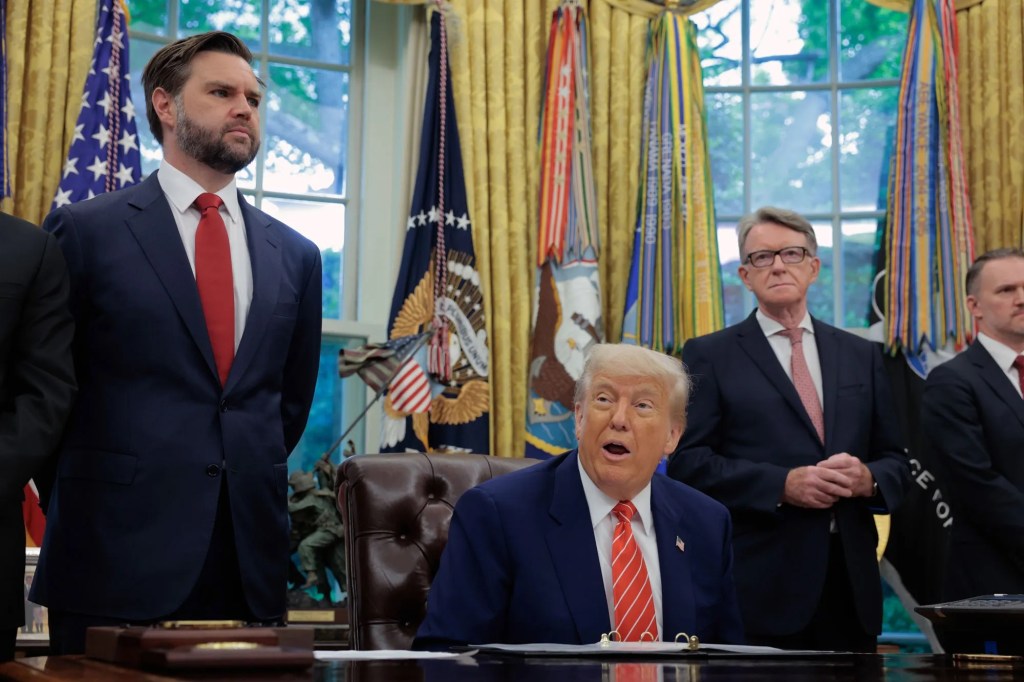
    When John Swinney, the Scottish National Party leader, and former ambassador Peter Mandelson visited Donald Trump in the Oval Office a few months ago, the President showed them three different models for his planned renovation of the East Wing of the White House, which he has demolished to build a new ballroom. “If you’re going to do it,” Scotland’s First Minister suggested, “you might as well go big.”

    This Wednesday marked one year since Trump’s election victory, and going big captures the essence of his second term – bold and controversial moves, which have impressed even British politicians who thought him reckless in his first term. When Trump visited Chequers, the British Prime Minister’s country residence, on his state visit to the United Kingdom in September, one senior official told him: “You’re the most consequential president of my lifetime.”

    It has not all been decorous. Convention, tradition and the law have been subordinated to delivery. The East Wing redevelopment is a case in point. “When they were bulldozing, they came across some Jefferson-era brick,” explains one White House watcher. “They kept going.” Why tiptoe around the author of the Declaration of Independence when there is a real estate deal to complete?

    And yet the Trumpites see themselves as like the founding fathers, forging a new nation. “The bricks have become trophies,” says one Washingtonian. “It’s like people keeping chunks of the Berlin Wall.” Just as that was torn down, so Trump’s second term, much more radical and (so far) successful than the first, has been one of discontinuity and disruption.

    After speaking to more than a dozen British and American officials, aides to the President and the Prime Minister Keir Starmer, civil servants, former diplomats in both countries, pollsters and political strategists, it is clear there is much that Trump II can teach Britain. In his first term, Trump was held back by staff who didn’t share his world view and the claims of Russian interference in the 2016 election. This year, he issued hundreds of executive orders and successfully brought migration to a halt at the Mexican border. Private polling circulating in the highest reaches of the Republican party shows that even 22 percent of those who voted for Kamala Harris a year ago support what Trump is doing on immigration.

    Those who helped him triumph say Trump II is very different from Trump I, in that he “brought in a team which supports his agenda” and his chief of staff, Susie Wiles, enforced a rigorous policy of loyalty to the President. “In this administration everyone has to be loyal to everyone,” a Washington-based diplomat observes. “There is no infighting, it’s simply not allowed.”

    This unity of purpose and direction has given Trump the ability to “move fast and break things” – and even the British in Washington, who were horrified in 2016, seem energized by his example this time around.

    “Think about the speed at which we’ve been able to move,” says one White House official. “We’ve cut out so much infighting and been able to execute. In the first term a lot of cabinet members thought they should be president. We also found there were a lot of unnecessary layers in the bureaucracy. Now the President gets the right people in the room, and if we need to move fast we will. We didn’t want to be Tony Blair, after a long campaign saying, ‘What do we do now?’ on day one. The President said he wanted the ‘big beautiful bill’ passed by July 4. There was a mentality to get things done. That was very different this time.”

    These are lessons that it is now too late for Labour to learn, after 16 months in power. This is a government that never seemed clear on what it wanted to achieve at the beginning, nor, as things have deteriorated, on what to do next. In Washington, every-one knows what Trump wants. Keir Starmer has been unable to provide similar clarity.

    However, Trump II is providing a blueprint for Reform UK party leader Nigel Farage, another populist insurgent, on how to seize power and then use it effectively in the face of a hostile political establishment.

    Key players in the White House and the MAGA movement say that Farage must be ready on day one, as Trump was, to impose his power on the permanent civil service. That could mean ramming legislation through parliament in a single day to give Downing Street the ability to issue emergency orders as well as immediately publish bills on key issues.

    Dominic Cummings, a chief adviser to former prime minister Boris Johnson, who has discussed how to reshape Britain’s civil service with Farage, wrote on Sunday: “A true strategy needs defined goals, a plan for controlling the government and building a team… It should include writing key primary legislation well in advance of an election.”

    In Trump’s case, key policy proposals were worked up by the Heritage Foundation thinktank and the America First Policy Institute, who also identified people who could be drafted in to work on them in government. “They had hundreds of executive orders ready to go,” says one who admired Trump’s preparations. “Susie Wiles said, ‘The President wants to deliver on migration, tariffs and tech,’ and worked out who could deliver it. She sent Stephen Miller to go after woke stuff and [Robert] Lighthizer to work on tariffs. She sent the attorney general’s office to go after the people who tried to shaft Trump in the first term. The orders went out, the foot soldiers did their thing. It was a masterclass.”

    Asked how Reform UK could prepare for power, Sebastian Gorka, the White House head of counterterrorism, says: “That’s easy. Be even more like President Trump.”

    While curbing migration was a central election pledge, Trump’s more notable achievements have come in the international arena. From the once queasy Europeans there is mostly admiration for the ceasefire in Gaza, and for Trump’s decision to attack Iranian nuclear sites with bunker buster bombs.

    “What they’ve done in the Middle East with Netanyahu and Hamas is pretty impressive,” one British official says. Security sources say the attack did not destroy Iran’s nuclear program, as Trump has claimed, but he has “trimmed them” and delayed them by “a few years.” More importantly: “He’s demonstrated they can do it. The bottom line is that they can do it again – and they will.”

    After months of playing footsie with Vladimir Putin, Trump also seems to have finally lost patience with the Russian President and has moved to impose sanctions. “He’s genuinely putting pressure on Putin now,” a Foreign Office source says. “At Chequers he was so angry at him.”

    Trump told Starmer: “I thought he was a good guy, I thought I could do a deal with him, but every time we agree something his people then renege on it.”

    In many ways, the “special relationship” is in rude health. UK and American sources say Jonathan Powell, officially Starmer’s national security adviser and unofficially the head of UK foreign policy, helped with the substance of the Gaza deal, alongside his old boss Tony Blair, Trump’s special envoy to the Middle East Steve Witkoff and the President’s son-in-law Jared Kushner.

    When Trump hit Russia’s two largest oil companies, Rosneft and Lukoil, he did so just days after Britain sanctioned the same firms. “We were able to give Witkoff a palette of options when the President was deciding what to do,” a senior UK government source says. “And we’re prepared to talk Trump’s language on tariffs.”

    The proto-populist Trump and the cautious, legalistic Starmer are odd bedfellows, but insiders say the relationship is still strong. One witness to their exchanges says, “Keir agrees with him as far as he can and then he’ll say, ‘I disagree on that but let me explain why we see things differently.’ Trump looks at him and listens and says, ‘OK.’”

    Keeping a volatile President on side has been one of the signal successes, if not the signal success, of Starmer’s premiership, but there are some cracks in the paintwork. “President Trump likes winners,” says a Trump aide who follows British politics, “and Starmer is beginning to look like a loser.” On areas of domestic policy Trump has become more outspoken in recent months about what he sees as Britain’s sclerotic economic approach, as well as the failure to exploit energy resources in the North Sea. “The President tore him a new one on this stuff in private at Chequers,” a US official says.

    Among the MAGA fraternity in Trump’s team – including the Vice-President J.D. Vance, Miller and Gorka – there are also concerns that the UK has allowed mass migration to dilute its cultural heritage. All three have an Atlanticist Judeo-Christian concept of western civilization in which American democracy stands in a direct line of descent from Magna Carta, the rule of law and trial by jury.

    Vance has spoken about the erosion of free speech in Europe. Miller is urging British officials to limit migration, as America did between the 1920s and 1970s, to allow new arrivals to be properly integrated. He sees Islamist imports from the tribal areas of Pakistan as a cultural challenge Britain will need to deal with. They cite the fact that the FBI was set up to combat the Mafia, who along with millions of Italian migrants arrived in the US in the 19th century. This is uncomfortable territory for many in No. 10, but one senior figure says: “If your friends are telling you something out of concern, then perhaps we should listen.”

    On illegal migration in particular, the Americans find the inability of the government to prevent cross-Channel crossings inexplicable. Asked what Trump would do, one source suggests: “Tell the French that British intelligence officers and special forces will destroy the boats before they sail. Slash them with knives, use snipers. Burn down the warehouses of the gangs, use cyber to attack their communications.”

    The most acute source of tension was the forced departure of Peter Mandelson as ambassador to Washington over his friendship with the convicted pedophile Jeffrey Epstein. While Mandelson was an adept operator, some in the President’s circle never forgave his historic anti-Trump comments. Trump’s campaign manager Chris LaCivita publicly condemned the appointment (and privately told British friends that Mandelson was doomed to fail because he had criticized Trump). US officials say White House aides boycotted dinners at Mandelson’s official residence at the instigation of Wiles, though some did meet him outside. “There was great irritation that Mandelson was rammed through in the dying days of the Biden administration,” a source close to the White House reveals.

    Mandelson was initially saved by Mark Burnett, the British-born Apprentice producer who is Trump’s envoy to the UK. He convinced Trump that Mandelson was contrite. A US diplomat says: “Mark knew a rejection would be awkward for Morgan McSweeney [Starmer’s chief of staff],” who had pushed Mandelson’s case. The episode suggests the Trump team, often depicted as a bull in a China shop with allies, actually has a sophisticated and sympathetic understanding of No. 10’s internal issues.

    Insiders say LaCivita will probably run “opposition research” on any new candidate for ambassador. “Do not pick someone who has, at any point, gone on the record to criticize Trump,” the US diplomat says. That rules out Mark Sedwill, the former cabinet secretary, who has denounced Trump publicly for “blundering” and “capriciousness with allies.” It is understood that he has not actually applied.

    Those with their hats in the ring include Christian Turner, the political director at the UK government’s Foreign, Commonwealth & Development Office, and Simon Manley, who was ambassador to the World Trade Organization and the United Nations in Geneva until July, plus a British Ministry of Defence official. Oliver Robbins, the British Foreign Office permanent secretary, is expected to give Starmer a list of those who are “appointable” by the end of the month.

    Varun Chandra, Starmer’s business liaison man, who played a key role in ensuring that Britain got reduced tariffs, is widely seen as the frontrunner. The US diplomat says Chandra got his current role because Mark Burnett told Starmer’s team that “he knows how to talk to Americans.” A second source says: “Lutnick loves him, Bessent loves him, Susie Wiles loves him.” It is also said that James Roscoe, the acting ambassador, is well plugged in with the White House; US officials say Trump “likes him” and they hope he remains in some capacity.

    The final area of potential tension is China, where Trump is trying to neutralize Beijing’s control of the global market in rare earth minerals, while Starmer is desperate to go to China to secure investment. Labour is embroiled in the fallout from the recent collapse of the trial of two suspected Chinese spies and Beijing’s demand that it be allowed to build its vast new embassy in London, which many view as a security risk. “It’s been made clear by Beijing that Keir’s trip to China is contingent on them getting the embassy,” a government source says.

    Many in Washington are skeptical about whether the economic spoils of cozying up to Beijing will be worth the political costs. When UK Chancellor Rachel Reeves visited China she only secured investments worth £600 million ($785 million), a rounding error in government finances. By contrast, whoever becomes ambassador to the US will try to hurry into play the £150 billion ($196 billion) pledged by US companies as part of the recent UK-US tech deal, which Chandra and Mandelson helped secure.

    It is not all good news for Trump. On economic matters he has a lot of the same problems as Labour: stubbornly high inflation, a sluggish job market and (as the election of the socialist Zohran Mamdani as mayor of New York City shows) facing a left-wing populist surge like the one fueling support for the Green party in Britain.

    Both Trump and Starmer face crunch elections next year: the Prime Minister in the Welsh, Scottish and council elections, the President in the midterms. A big defeat might cost Starmer his job. If the Republicans lose control of Congress, Trump might well face fresh indictments from his political opponents or another impeachment charge. The loss of the Virginia and New Jersey governor races on Tuesday night points to a tough road ahead. The polling circulating among Republicans shows the Democrats winning the House of Representatives by a single seat next year, but predicts Trump will hang on after redistricting electoral boundaries.

    On Tuesday, Rachel Reeves rolled the pitch for massive tax rises in the Budget, blaming her economic inheritance, but even Labour insiders found her unconvincing. A source close to Downing Street characterized the Chancellor’s argument as: “Don’t blame me, I’m just the Chancellor. We have no power, we are just the government.”

    Trump also has a big speech on the economy this week, and there are similar stirrings in MAGA world. “The numbers are shifting on the economy,” says a prominent Trump ally. “I think people are concerned. They’re not feeling like prices are much lower. We’ve done a lot of international stuff. We need a pivot to the economy.” However, the Republican pollster says Trump’s early success and his decisiveness mean that even those feeling the pinch are still prepared to give him the benefit of the doubt: “People are feeling worse off but they think he has a plan.”

    The same, demonstrably, is not true of Labour, where Starmer’s failure to “go big,” as Trump has done, has left Labour vulnerable. Perhaps Starmer should draw up plans to bulldoze part of Downing Street.

  • Lord Young goes to Washington

    Lord Young goes to Washington

    I’m writing this from Washington, DC, where I’ve spent the best part of a week talking to politicos and think-tankers about the state of free speech in the mother country. Don’t believe our Prime Minister when he says it’s in rude health, I’ve been telling them. It’s on life support and any pressure that can be brought to bear on His Majesty’s Government to protect it would be hugely appreciated. Once again, it’s time for the new world to come to the rescue of the old.

    Not that they need much convincing. The view of Britain among Washington’s political class isn’t informed by diplomatic cables or articles in the Economist, but by viral videos on X. The impression these give is of a country rapidly descending into lawlessness in which the police are too busy arresting people for hurty words to protect them from violent criminals. “What the hell’s going on over there?” is the constant refrain.

    When I tell them the footage they’ve seen is just the tip of the iceberg and the police are detaining more than 30 people a day for speech offenses – outdoing Russia – they’re anxious to help.

    But what can they do? I had hoped that the US-UK trade deal might provide Donald Trump’s administration with some leverage. Could a preamble be included in which both sides affirm their shared commitment to the long-standing guarantees of freedom of expression and association as set out in the First Amendment? That wouldn’t be legally enforceable, but would be politically significant and might make Keir Starmer think twice before further eroding free speech, lest he be accused of jeopardizing the deal.

    However, the people I met in the State Department said the President is anxious to get the trade agreement over the line and unlikely to countenance anything that would delay it. The sense I got from meetings with members of the administration, which probably won’t come as a surprise, is that Trump is very much in charge and no one wants to do anything to irritate him. Indeed, they were careful to refer to the “Department of War” and the “Secretary of War,” even to me, although occasionally they stumbled and said: “The Department of Defense… I mean War.” A Washington Post editor I had lunch with confirmed this was an important loyalty test, with WaPo journalists getting into bad odor with the President because the newspaper insists on continuing to use “Defense Department.”

    Trump’s iron grip was often contrasted with the chaos of the previous administration, with Joe Biden portrayed as a drooling idiot. I met with staffers at the Republican-controlled House Oversight Committee, which has just published a report accusing a group of senior Democrats in the last administration – the “Politburo” – of covering up the President’s cognitive decline and effectively ruling in his place, signing off executive orders – and pardons – using an autopen. The Committee’s view is that all the clemency actions taken by the Biden administration were illegitimate.

    Does this mean Anthony Fauci, pardoned by Biden in one of his final acts before leaving the White House, can now be prosecuted? I asked an assistant secretary at the Department of Health and Human Services over dinner and he laughed but declined to answer. Incidentally, I was reliably informed that Health Secretary RFK Jr is the second most popular member of the administration after Trump. The reception he gets from the MAGA faithful is rapturous, apparently.

    Another possibility I discussed with officials was withholding visas from UK citizens who work for censorship bodies such as Ofcom, which is currently trying to take enforcement action against US tech companies that refuse to comply with Britain’s new “Online Safety Act.” But after kicking around that idea we concluded it would probably be politically unhelpful. If Dame Melanie Dawes, the CEO of Ofcom, was refused a travel visa, she’d spin it as Trump doing the bidding of his buddy Elon Musk when all she’s trying to do is keep children “safe.” A better alternative, we thought, would be for the White House to offer political asylum on human rights grounds to British thought criminals. That would be a piece of epic trolling, given that our PM is Mr Human Rights. If any Christian street preachers are facing prosecution for misgendering some pro-abortion activists, do get in touch.

    Even that might not fly. The overall impression I got is that, for reasons no one was quite able to explain, the President still thinks of Sir Keir as a useful ally. So our best hope of harnessing the might of the US to protect free speech in the UK is if Starmer is replaced by someone more antagonistic to Trump. It surely won’t be long.

  • Press-pool stew

    Press-pool stew

    Looking for a good time, sweet’eart?

    Team Trump is back in Washington today after their sojourn to Britain for a state visit. The President took to the Old Country with the gusto of an American girl on study abroad: castles, royals, knights, fancy dinners, all the pageantry. “I saw more paintings than any human being has ever saw, and statues,” he gushed to the press pool on the flight back.

    He even managed to dodge the most difficult question in his joint press conference with Prime Minister Keir Starmer, flatly claiming “I don’t know him, actually,” of ousted UK ambassador Peter Mandelson, who was fired over new revelations of his ties to Jeffrey Epstein. That’s some departure from their Oval Office meeting in May, when Trump complimented Mandelson on his “beautiful accent.” Both Trump and Mandelson feature in the financier’s 50th birthday book; only Trump contests the authenticity of his entry.

    Having a less joyous time in Blighty? Secretary of State Marco Rubio, who was spotted by a couple of journalists wandering around the car park of Chequers, the PM’s stately home, without security. The Secretary is shorter than you’d expect, a senior Westminster source tells Cockburn: “He really is Lil’ Marco.”

    And while Donald and Melania had the honor of being hosted by the King and Queen at Windsor Castle, the traveling press corps’ lodgings were somewhat less illustrious. They were put up in the May Fair Radisson, a hotel that often receives guests partaking in illicit activities. “Scandalized American reporters were clutching their pearls after being approached by icky pimps and drug dealers on the street outside, who kept mentioning cocaine and women,” one reporter told Cockburn. “One could barely make it across the street to Sainsbury’s for supplies without being propositioned. Prostitutes in fake furs and teeny dresses loitered in packs outside of Sexy Fish, the restaurant catty-corner to the backside of the May Fair.”

    A veteran reporter described the scene inside the hotel to Cockburn: “Worthy-looking American journalists in shirts, chinos, dad sneakers and baseball caps wandering around with their credentials, while shifty-looking clients and their female companions were slinking in for a bit of afternoon nookie. It made for an interesting crowd at the bar.”

    On our radar

    XI TIME President Trump spoke with President Xi Jinping of China this morning. In a Truth Social post, Trump said the pair had “made progress” on issues including fentanyl, trade, Russia-Ukraine and a TikTok deal, agreed to meet at APEC in South Korea and visit each other’s countries.

    AOC TIME Representative Alexandria Ocasio-Cortez’s team are positioning her to run either for the US Senate or the presidency, per Axios.

    PLAN B TIME Wealthy Americans are acquiring second passports in Latin America and Asia for tax purposes, according to a report in Business Insider.

    ‘Je suis Jimmy’

    It’s all hands on deck for the world of light entertainment after ABC suspended Jimmy Kimmel, an act that Hollywood is treating as if it’s part of a Stalinist purge. Panic is only increasing as rumors fly that the FCC is coming for The View next. We should be so lucky. Cockburn doesn’t really care about daytime TV schedules as long as The Young and the Restless is safe.

    Now Jimmy Fallon has mysteriously canceled public appearances, hoping that if he remains invisible, they can’t touch him. Meanwhile, Marvel actor Tatiana Maslany encourages people to unsubscribe their Disney+/Hulu/ESPN bundles, but if her woeful She-Hulk show didn’t cause them to jump ship, then this certainly won’t. Marc Maron, who’s already self-deported from his podcast, warns on Instagram Reels of a Hitlerian-level emergency. Last night Jon Stewart convened an emergency satirical episode of The Daily Show, where he dressed like Donald Trump and appeared with a White House-style gilded backdrop, begging Dear Leader to have mercy on him. “Tonight, we are all Jimmy Kimmel,” Stephen Colbert said on his own canceled show. Speak for yourself, Stephen!

    Adam Carolla, Kimmel’s former co-host on The Man Show, is probably the best person to comment on this situation. On his podcast, he called Kimmel a “very good guy and a generous guy,” even though he thinks Kimmel was “inaccurate” in the Charlie Kirk/MAGA comments that led to this mess in the first place. “I don’t like the government getting involved,” Carolla, a Republican, said. “I just want people to speak and then the ratings will do the talking.” And now, girls jumping on trampolines.

    This week in free speech

    Charlie Kirk died demonstrating his commitment to free speech and open debate. In the nine days since his assassination, America has seen its Attorney General looking to punish “hate speech” and its Vice President using a guest-host slot on Kirk’s show to encourage citizens to call the employers of people they perceive to be celebrating Kirk’s death. It’s not clear who gets to decide what constitutes a “celebration,” versus a crass joke or commentary. The employer? The government? A mob on X?

    Speaking of X, “free-speech absolutist” Elon Musk called for the streamer Steven “Destiny” Bonnell to be jailed for incitement to murder and domestic terrorism. Bonnell has made a series of unsavory comments in the aftermath of Kirk’s murder. And according to reporting from Ken Klippenstein on Substack, “the Trump administration is preparing to designate transgender people as ‘violent extremists’.” Specifically, “Under the plan being discussed, the FBI would treat transgender suspects as a subset of the Bureau’s new threat category, ‘Nihilistic Violent Extremists’ (NVEs).”

    All of this is unfolding in parallel to the investigation and charging of Tyler Robinson, Kirk’s accused assassin, as FBI and state officials in Utah uncover more details about his actions, connections and beliefs – and people online seize on them to prove the Kirk murder reaffirms what they’d already decided about it beforehand.

    Subscribe to Cockburn’s Diary on Substack to get it in your inbox on Tuesdays and Fridays.

  • Has Trump changed Britain’s stance on Palestinian statehood?

    Has Trump changed Britain’s stance on Palestinian statehood?

    As Donald Trump visited the United Kingdom this week, the press seized the opportunity to confront both him and Prime Minister Keir Starmer about the issue of Hamas and Britain’s posture towards Palestinian statehood. In a rare moment of lucidity, and perhaps influenced by the firm presence of the President, Starmer appeared, briefly, to align his moral compass. Faced with questions over why his government was proceeding with the recognition of a Palestinian state in the wake of the October 7th atrocities, Starmer delivered what may be his most unequivocal statement to date:

    “Let me be really clear about Hamas: They’re a terrorist organization who can have no part in any future governance in Palestine. What happened on October 7th was the worst attack since the Holocaust. We have extended family in Israel. I understand first-hand the psychological impact that that had across Israel. So I know exactly where I stand in relation to Hamas. Hamas of course don’t want a two-state solution. They don’t want peace. They don’t want a ceasefire. I’m very clear where I stand on Hamas.”

    It was also strikingly convenient that, at this critical juncture, Starmer suddenly remembered his extended family in Israel. One wonders how reassured they feel about his use of them in such a moment – deployed as a sort of bauble to decorate a policy that is not only contradictory but potentially dangerous. If they are to serve as moral ballast for his position, they deserve more than to be name-dropped in the midst of strategic incoherence.

    Had Starmer stopped there, one might have mistaken him for a leader with conviction. But in the next breath, he returned to form, assuring the press that his decision to recognize a Palestinian state had been set out in July and had “nothing to do with this state visit.” He insisted that the matter had been discussed with president Trump “as you would expect among two leaders who respect each other and like each other and want to bring about a better solution in the best way we can.”

    The irony, of course, is that just as Starmer found the fortitude to call Hamas what it is, the group was issuing yet another declaration of grotesque barbarism. In a statement released by its al-Qassam Brigades, Hamas promised to turn Gaza into a “graveyard” for Israeli soldiers, to use hostages as human shields, and to ensure that not a single captive would be recovered alive. They referenced Ron Arad, the long-lost Israeli airman abducted by Iran-backed terrorists in Lebanon, as a model for how future hostages would disappear without trace.

    “We have prepared for you an army of martyrs,” they declared. “Your prisoners are scattered throughout Gaza City’s neighborhoods, and we will not spare their lives… you will not recover a single prisoner, neither dead nor alive, and their fate will be the same as that of Ron Arad.”

    So when Starmer finally managed to utter the truth about Hamas, it was as though he had been coaxed into it by the magnetic clarity of the man standing beside him. Trump, sensing the moment, actually grinned with approval and gave him a pat on the back – like a dog that had finally learned to sit when commanded. It is said the two spent around thirty minutes alone before the press conference, with no aides present. One can only imagine what was said, but it would not be a stretch to presume that Trump reminded him of the basics: do not reward genocidal jihadists with the trappings of statehood.

    Yet, despite the bluster, Starmer still intends to confer symbolic recognition upon a Palestinian entity that does not exist in any coherent, lawful or democratic form. He has mouthed the words of moral clarity, but he cannot follow them through with coherent policy. This is the essence of his weakness: he learns to say the lines but not to dance the dance. For all the talk of opposing Hamas, his government is giving succor to its cause by validating the fantasy of a state that Hamas itself openly defines through martyrdom, bloodshed, and the annihilation of Jews.

    Starmer’s rhetoric on Hamas is thus at odds with every other aspect of his posture. He decries their atrocities, then gestures toward recognition of a statehood project that would reward them. He acknowledges they do not want peace, then backs a policy that empowers them. He understands their strategy of hostage warfare, then gestures towards concessions that would only embolden it. And he said nothing of the failures of literally all other mainstream Palestinian leaders and political movements to act with decency, respect for humanity or international law, or indeed any ambition of peaceful coexistence with the Jewish state. If not Hamas, Sir Keir, then who? It is not biased or racist to state these facts, however distressing and undesirable: it is merely looking a hard truth in the eye. Without that, how else can the situation be improved?

    Starmer’s position makes Britain appear rudderless. If the leader of His Majesty’s Government cannot translate his apparent convictions into action, if he cannot resist the theater of international appeasement even in the face of Islamist terror, then he diminishes not only himself but the standing of the nation he represents. One hopes that Trump, in those thirty private minutes, managed to plant a seed of realism. But there is, as yet, no sign that it has taken root.

  • Donald Trump and Keir Starmer make an interesting pair

    Donald Trump and Keir Starmer make an interesting pair

    There is just something innately funny about seeing Keir Starmer and Donald Trump together. Two men so obviously different; in character, interests, ability and shape, forced together by circumstance. Watching them at the press conference today was no exception. They put me in mind of Bialystock and Bloom from The Producers: the bombastic Broadway shyster and his hapless sinusitis-suffering goon.

    First, for their “business roundtable,” they sat together behind a comically small table inside a marquee, which made them look like an unlikely scoring partnership at a village cricket match or as if they were signing the registers at a low-budget gay wedding. Alternatively, they looked a bit like they were appearing on a British panel show. I can think of a title: Don’t Mention Mandy! Two statesmen have to get through an Anglo-American bilateral summit without mentioning the sacking of a certain ambassador just last week for high-profile nonce-adjacency!

    Sir Keir spoke first, about the substance of the deal that they were about to sign, but also gave himself a series of pats on the back for having achieved it. “It comes down to leaders who respect each other, to leaders who genuinely like each other.” At this point the Prime Minister gave the President a weird sort of tap on his shoulder which I think was meant to be affectionate. Donald smiled a smile which might have been a Cheshire Cat grin or could have been the sort of smile a Mafia boss gives when he makes a note to have someone killed for a minor slight.

    When it came to his turn, Trump repeated that it was the first time there had been a second state visit, three times, which was numerically quite confusing. Then again, so much of how the President operates comes down to his truly bizarre use of the English language. It’s almost hypnotic. Again the contrast with Sir Keir couldn’t be clearer. Starmer speaks in robotic, staccato sentences. Everything. Is. Designed. To. Sound. Like. A. Safety. Briefing. In contrast Mr Trump embarks on long sweeping sentences, beautiful sentences, often with an aside about something that a lot of people don’t realize, which is OK, before ending up on a subject completely different from where he started.

    Certain words were used by Trump again and again – “beautiful,” in particular. Things the President believed were beautiful varied from Her Majesty Queen Camilla, Sir Keir Starmer’s renovation of Chequers and the British aerospace industry. He did speak briefly about the deal before going into one of his meandering concertos of consciousness about the things that made America the “hottest country in the world.” Awkwardly for Sir Keir, one of these was getting the border under control. As he did so, the PM sat there, going both pink and grey at once, like a condemned tin of luncheon meat. Still, Donald eventually came into land with a final nod to Britain and, as if by magic, folders appeared for the men to sign, the Prime Minister with the Parker pen which he doubtless got for free for just enquiring and the President with a massive Sharpie.

    After lunch, the unlikely duo hosted a press conference in front of a Jacobean fireplace and enough national flags to make Emily Thornberry squirm. The President thanked British subjects for their condolences following Charlie Kirk’s murder, and spoke of Vladimir Putin as if he were a philandering ex: “He’s let me down. He’s really let me down.”

    Bev Turner of GB News asked the Prime Minister a question about Christianity – which in fairness is one of the few beliefs Sir Keir has never professed to hold. But perhaps not for much longer; the avowed atheist spoke of being christened and the importance of the Church of England throughout his life. Given how desperate his domestic situation is, perhaps a conversion is on the cards. To paraphrase Voltaire on his deathbed when asked to denounce the devil: “Now is not the time to be making enemies.”

    Turner also asked a question about the free speech situation in Britain – a subject which triggers palpable discomfort in the PM, who always reaches for the same identically-worded answer. “We have had free speech in Britain for a long time,” he droned, inevitably, through his nose. For what it’s worth, I don’t think this is quite the defense Sir Keir perceives it to be, especially coming from him. After all, we’ve had agriculture since probably the Bronze age and he seems pretty determined to destroy that.

    Finally a reporter invoked the Mandy-shaped elephant in the room. President Trump having denied ever knowing his former ambassador, the question passed to Sir Keir, who shuffled his notes and gave another answer that sounded like it had been dictated by a solicitor or crisis-comms team. “New information came to light,” he snapped. “It’s very straightforward!” Luckily for him, there were no supplementary questions.

    It was all smiles, but I suspect the Donald knows that next time he comes to visit his favorite foreign country, it might well be someone else meeting him off the plane.

  • Trump will be on his best behavior for King Charles

    Trump will be on his best behavior for King Charles

    The Donald has touched down in Britain for his unprecedented second state visit. It makes sense in a way that this most unconventional of American presidents is being granted a privilege that has never been offered to any other US leader, namely a repeat performance of pageantry and pomp that will flatter this Anglophile’s ego to its considerable core. That the event is happening against King Charles’s wishes might bother any other prime minister, but such was Keir Starmer’s desire to curry favor with Trump that he even waved the King’s handwritten invitation on camera. And with that he ensured favorable treatment for the country he is (barely) governing. The question is what happens next.

    Unusually, Trump is not the issue at hand, at least as far as things currently stand. For all of his volatility and unpredictability, he is a fully paid-up admirer of the royal family. He has proudly, if erroneously, boasted that he was the late Queen’s favorite president. As such, he is unlikely to make any sort of trouble during his notably brief visit to Britain.

    He will be feted during Charles’s speech at Windsor Castle during the formal banquet, given every kind of pomp and respect that he surely sees as his due, and will generally be treated like a major global politician. Trump is a man of considerable ego, and that ego will be flattered. From Starmer and the government’s perspective, it is unlikely to be a troublesome trip.

    However, from Charles’s perspective, Trump’s ingress into Britain is less welcome. The two men may only be three years apart in age, but they could scarcely be more different. Charles is a liberal horticulturalist who has a great love of art, literature and history. Trump is a McDonald’s-munching pragmatist whose bestselling book was entitled The Art of the Deal; meanwhile, his host’s best-known publication is called A Vision of Britain.

    The King is a traditionalist – and a small, rather than large, ‘c’ conservative – who likes to think of his country as a fine place besmirched by ugly progress. Trump, meanwhile, shares the monarch’s idea of his own country having fallen behind, but his rabble-rousing slogan of “Make America Great Again” will find no echo this week. For Charles, Britain has never stopped being great.

    There are other issues that might prove contentious. The King has begun cautious steps towards a rapprochement with his younger son, and Trump’s last reported comment on Prince Harry was to say that, although he was now prepared not to deport him over his admitted drug use, “I’ll leave him alone. He’s got enough problems with his wife. She’s terrible.” It is probably accurate to say that Charles’s thoughts on his daughter-in-law may be similar, but he would rather see his throne fall than ever be caught making such an indiscreet admission.

    This sums up the difference between the two men and their respective values. One has always believed that “never complain, never explain” is an admirable way to live one’s life; the other has complained, explained, and then, for good measure, hurled invective at his enemies. How they will make small talk off camera remains to be seen.

    Still, one thing that decades spent as Prince of Wales have taught Charles is the value of smiling and waving, even when a situation – or a person – is not to his taste. Veteran royal watchers can easily see when the King has exerted his own influence (witness his reception of Zelensky at his private home of Sandringham, a conspicuous mark of regard after his appalling treatment by Trump and his Vice President J.D. Vance in the Oval Office earlier this year). Although Trump will be on his best behavior this week, every tactless or crass remark of the President’s will be noted. You can be sure that Starmer’s government will never be allowed to forget the help that Charles has given them – assuming, that is, Starmer is still in office, if not Labour in power, long enough for the King to ever call in his favor.

  • Trump returns to backwater Britain

    Trump returns to backwater Britain

    President Trump returns to Britain this week for his second state visit, to a country which is much changed yet depressingly still the same. On his first, six years ago, Britain had yet to complete its departure from the EU, Elizabeth II was still on the throne and the Conservatives still in power – with three Prime Ministers to go before their eventual ejection from office. He will no doubt receive a warm and dignified welcome from King Charles, whatever is going through the monarch’s head – the impeccable neutrality of the British throne has survived the change of reign. Yet the President will find a country that is anything but transformed by Brexit or by its change of government.

    Brexit presented Britain the opportunity to take a sharply different route from the low-growth track on which socially democratic Europe is trapped. Yet neither this government nor the previous one have chosen to exercise their new-found freedoms. Britain instead has become just another brand of European social democracy. It has a few new trade deals, not least a more favorable regime with the US, which it would not otherwise have. Yet far from controlling its borders, Britain has opened them up while politicians promised to do the opposite. Illegal arrivals in boats from France (who account for a small proportion of overall migration but a very visible one) have mushroomed, the government apparently powerless in the face of human rights lawyers. Few migrants even need to complete the crossing in their rubber dinghies – they are picked up and delivered to UK shores by coastguard patrol. Many are then put up in hotels. The public seems finally to have had enough: when an Ethiopian asylum-seeker was arrested for suspected sex offenses against a 14-year-old girl in July (he was later convicted) it sparked a summer of protests outside the hotel.

    But above all else, Britain remains trapped in economic mediocrity. Keir Starmer’s Labour party came to power in July last year promising “growth, growth, growth” – the same promise made by Liz Truss in her short-lived spell as Prime Minister in 2022. The economy failed to register any growth in July, and is up a weak 1.5 percent in the past year. In terms of GDP per capita the UK economy is no larger than it was at the time of Trump’s 2019 state visit. Moreover, the government seems to have few policies which are likely to achieve growth. On the contrary, one forthcoming parliamentary bill threatens to make it far harder to fire inadequate staff and will make it easier for unions to go on strike. Having escaped from EU regulation, Britain now seems intent on outdoing the bloc on job-destroying laws. It doesn’t help that the Labour government, in one of its first acts, awarded large pay rises to doctors, train drivers and other public sector workers without attaching any conditions to improve productivity. Rising UK government bond prices are a hint as to how dispassionate global investors see Britain: a country trying to live beyond its means, and consequently where inflation is bound to run ahead of other countries. Even Greece, thought of as a basket-case until recently, has lower yields on its long-dated bonds.

    Britain’s lack of confidence is there to be seen in the sinking fortunes of its governing party. Prime Minister Keir Starmer was never as popular as his huge parliamentary majority suggested – he commanded only just over a third of the popular vote last year, in spite of his party winning a handsome majority of its seats. Yet there is a serious possibility that Starmer will not make it to fight another general election due in 2029. He is deeply unpopular even within his own party. He has been badly damaged by two recent resignations: first of deputy Prime Minister Angela Rayner, who admitted to underpaying tax on an apartment she bought on the south coats, and then that of US ambassador Peter Mandelson, after details of his close relationship with Jeffrey Epstein were revealed. Starmer, it seems knew some of the details but had chosen to appoint him to the job anyway.

    For the moment, the political future seems to belong to Reform UK and its charismatic leader Nigel Farage. The party is steadily displacing the Conservatives as the party of the right, yet is also picking up disaffected working classes in Labour-held seats. Not unlike the US, Britain is undergoing a political transformation in which the party of the right is becoming the party of the working class and the party of the left the party of educated professionals. Yet Reform UK only has five seats in the House of Commons, and has already lost two of its MPs elected last year, one of them in a very public bust-up. It is going to have its work cut out finding enough credible candidates to win an election in four years’ time.

    In the meantime, Britain faces a swing to the left. If Starmer is forced out of office his replacement will very likely be someone who favors wealth taxes and yet more regulation on business. Britain’s long economic night seems far from over.

  • What to expect from Trump’s UK visit

    What to expect from Trump’s UK visit

    The first time Donald Trump was on an official visit to the UK, in July 2018, he was deep in conversation with Theresa May during the state banquet at Blenheim Palace when his interview with the Sun dropped, offering a range of unwelcome thoughts about the then prime minister and her handling of Brexit. May’s communications team decided to let her enjoy the meal before dealing with the fallout.

    When the President lands in Britain next week for another two-day jamboree of pomp and politics, Keir Starmer’s aides know what to expect. “The one thing about Trump which is entirely predictable is his unpredictability,” one ventures.

    The potential landmines lie in plain sight this time – including a possible interview with GB News’s Beverley Turner. Six of Trump’s cabinet recently attended the US launch of the channel’s Washington bureau. “He likes GB News,” a British Trump whisperer explains. “But he loves Bev Turner…” As a Downing Street official observes: “He could say literally anything to GB News.”

    When Turner last interviewed Trump, she pressed him to criticize growing limits to freedom of speech in the UK, an issue which is also close to the heart of J.D. Vance, the Vice President. Starmer’s decision to recognize a Palestinian state soon after Trump’s visit, the war in Ukraine and the conflict in Gaza are all areas where Downing Street and the White House are not quite on the same page.

    Yet the striking thing is that British officials involved in the preparations for the visit seem sanguine about what will follow. They believe the substance and upside will far outweigh passing media squalls. They think the public is now used to Trump’s off-piste verbal excursions, which they say are “known unknowns.” Those who want Trump to join their attacks du jour on the government may be disappointed.

    More fundamental to Trump than ideology is his abiding love of the deal. Recent British visitors to the White House noted with approval that on the wall of the staircase between the ground and first floors of the West Wing there now hangs a picture of Trump at the G7 summit, with Starmer peering over his shoulder, as he signed the executive order which implemented the recent trade deal with Britain. When Turner asked Trump about freedom of speech during his recent visit to Scotland, the President agreed it was an important issue but added: “I like your Prime Minister… He is a good man who got a trade deal done… It is a good deal.”

    It is not the first time the online right has been disappointed by Trump’s pragmatism and periodic politeness. Claims that he would block the Chagos Islands deal and Peter Mandelson’s appointment as ambassador in Washington were both wrong. Vance’s holiday in the Cotswolds passed without incident. “We think we have an agreement to politely disagree on Palestine before the state visit,” a diplomat reveals, “which I very much hope lasts after the state visit.”

    J.D. Vance, Donald Trump and Peter Mandelson in the Oval Office, May 8, 2025 (Getty)

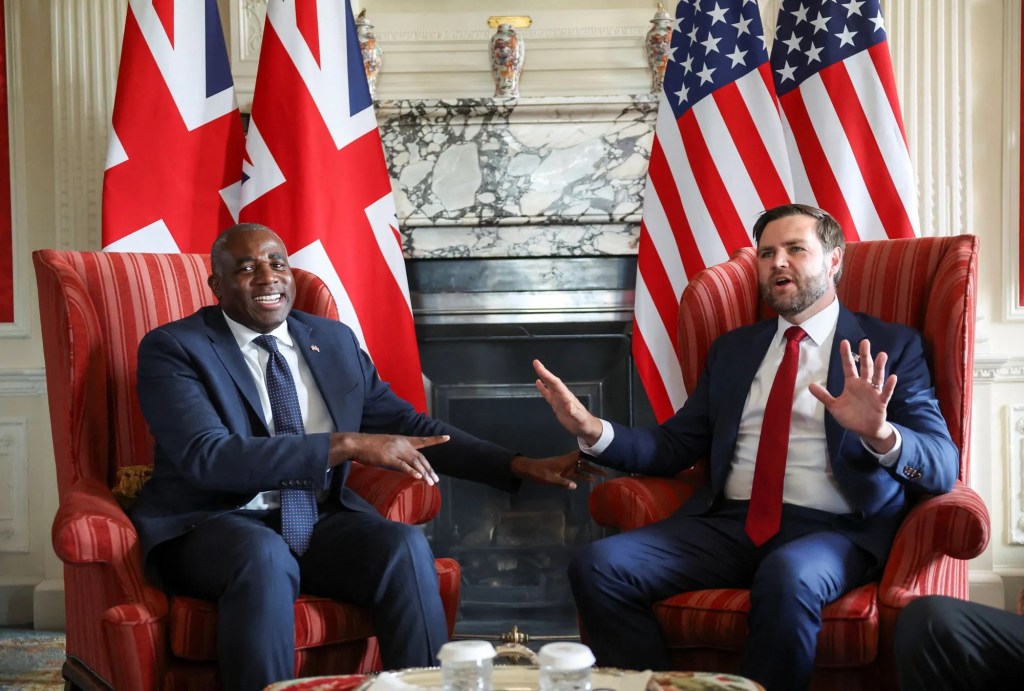
    It helps that Britishness is now fashionable in Washington (where Irish origins used to be the thing to trumpet). Vance, along with other MAGA tech bros, has had his DNA tested, and discussed the results with British politicians who met him over the summer, including David Lammy, the outgoing foreign secretary, when he hosted him at Chevening. “Vance has discovered he is English,” says one of those who took part in these conversations. “He talked a lot about his roots and his ancestry. The tech-right has got very into genetic tests and Americans are discovering they’re all English.”

    The big announcement next week will be a new Anglo-American tech deal which will be worth “billions of pounds of investment” to Britain at a time when the Treasury is crying out for anything which can boost growth. The deal will see more joint research and co-investment in three crucial areas: AI, quantum computing, which will hugely increase the power of AI, and nuclear fusion, which will create near limitless energy to fuel the supercomputers.

    Progress has been aided by the fact that the White House is not just going through the motions. “The administration has been genuinely committed,” explains one of those involved in the negotiations. “They usually drag their feet on everything.” Insiders say that on arriving in DC, Mandelson, a prominent cheerleader for a tech deal, asked Vance to “lean into it,” which the Vice President did with gusto. After a row over encryption was resolved, Vance declared: “OK, let’s go!”

    When Vance met Lammy at Chevening he spoke with passion about the possibilities. “I’ve been in lots of meetings with the Americans over the years, in which people like Vance and Jake Sullivan [Joe Biden’s national security advisor] refer to AI, quantum, biotech and fusion as millennia-defining technologies,” says one senior official. “If we can crack the computing power that will let AI transform medicine and the limitless energy needed to run it, you and I might live to 150.” Lammy, who was appointed Deputy Prime Minister in last week’s reshuffle, will deputize for Starmer at international events such as the UN General Assembly, and having developed a rapport with Vance is expected to keep talking to him weekly.

    Peter Kyle, who as science minister was heavily involved in the negotiations, flew to DC this week in his new brief in charge of business and trade to try to finalize some of the details. Attempts are also under way to get some tweaks to US tariffs on Britain, something Kyle took up in his first meetings with Howard Lutnick, the commerce secretary, and Jamieson Greer, the US trade representative.

    David Lammy hosts J.D. Vance at Chevening House, August 8, 2025 (Getty)

    The case for the deal was outlined in a speech by the omnipresent (until this week) Mandelson at Ditchley Park last week. He pitched it as a way for the western allies to fight a global power struggle with China and its autocratic allies. “China is racing to dominate artificial intelligence, quantum computing and biotechnology,” he warned, arguing that a “full spectrum US-UK technology partnership” was crucial for “mutual defense” and “to lift us out of the economic stagnation we have experienced over the last decade.”

    The need for better cyber-security, another plank of the deal, was clearly illustrated this week with the publication of thousands of leaked documents from the office of Boris Johnson, revealing further details of his enthusiastic quest for cash. The revelations were not hugely surprising (one former cabinet colleague joked: “They hacked the wrong hard drive!”) but there is a serious point. The security services believe Johnson was hacked by Kremlin proxies as part of an attack on western politicians. “It is Russian in origin,” a senior security source reveals. The firebomb attack on Starmer’s constituency home earlier this year was also considered to have been a Russian operation.

    Johnson was approached last summer by the National Cyber Security Centre, part of GCHQ, and told that his documents had been placed on a public website, but it was only this week that they made it to the media. “He’s notoriously lax about his own phone and cybersecurity,” says one security source, who’s scarred by the way in which Johnson ignored requests by intelligence chiefs and mandarins to take the issue more seriously when he was PM. Insiders say Johnson was hit by a phishing malware attack, unleashed when a female aide opened an attachment to an email.

    Beyond the tech deal, the reason there is an attitude of “what will be, will be” in Downing Street about the state visit is because officials are confident that Trump is sincerely well disposed to the UK and to Starmer and is keen to show that Brexit has brought rewards to Britain (not that No. 10 will be caught spouting that line). When Nigel Farage met Trump in the Oval Office a week ago, after testifying to Congress about free speech, he concluded (somewhat to his distress) that the President “genuinely likes Starmer.” Farage also found Trump relaxed and upbeat. “He’s in a very good mood because he’s got no opposition,” the Reform leader told one associate. “The Democrats are in such a mess.”

    Trump and Melania, the First Lady, are “very excited” about staying at Windsor Castle, where the state banquet will be held on Wednesday evening in St. George’s Hall and Trump will be greeted by a guard of honor. When Farage last saw Trump he gave him a history lesson on Windsor Castle, the residence most beloved by senior royals.

    Wednesday will be all style while Thursday brings the substance. Trump will travel to Chequers for a working lunch and a mid-afternoon press conference – another moment which could be love-in or landmine. “Private time,” when Starmer and his wife Victoria will entertain Trump and Melania, has also been worked in. In 2018, Trump was feted at Blenheim, Winston Churchill’s birthplace. This time, the President will visit the Hawtrey Room at Chequers, where Churchill recorded many of his wartime radio speeches. A senior No. 10 source says: “Winston Churchill’s legacy will feature prominently – not as nostalgia, but as a reminder of leadership during uncertain times. We want this visit to set a new standard for how modern diplomacy looks: respectful of tradition, but relentlessly focused on outcomes.”

    Starmer will privately stress the UK’s continuing viability as a military partner for the US, emphasizing the worth of the Aukus defense deal with Australia, which has been questioned in Washington. There is talk of a military flypast to reinforce this image for Trump. Also up for discussion will be the future of western support for Ukraine, following the failure of Trump’s push for peace with Vladimir Putin. Starmer will talk to Trump about introducing further sanctions on Moscow and how to pressure the Europeans into releasing frozen Russian assets to fund Ukraine’s war effort, though aides caution against any major announcement next week.

    The only thing missing from the visit will be a round of golf. (Trump claims to have a handicap of two, but a regular British golfing partner says: “He plays off eight or nine.”) Starmer has no ability at, or interest in, the sport, and the best golfer in the cabinet is the very un-Trump-like Lord Hermer, the attorney general (though colleagues say the recent arrival in No. 10 of Tim Allan as communications director means Hermer is no longer the best golfer in the government). Remarkably, chatter on the Foreign Office grapevine reveals that Hermer once (presumably jokingly) volunteered his services to Mandelson as a “potential golfing partner” to butter up the President.

    It is this column’s loss that the offer was not taken up, but probably Britain’s gain. Whatever Trump says this week, Starmer intends to focus on the positives. If the tech deal helps to kickstart the economy, it won’t matter if the President’s apparent tendresse for Beverley Turner coaxes him into being indiscreet about other subjects.

  • Trump leads tributes to Charlie Kirk

    Trump leads tributes to Charlie Kirk

    Charlie Kirk’s senseless murder on a Utah college campus yesterday led to an instant and disgusting avalanche of celebration from a small minority on the extremely online left. But Kirk’s friends and allies also rallied to pay tribute to the slain conservative activist. They know what we lost.

    President Trump gave a four-minute message from the Resolute Desk and Truth Social, “The Great, and even Legendary, Charlie Kirk, is dead. No one understood or had the Heart of the Youth in the United States of America better than Charlie. He was loved and admired by ALL, especially me, and now, he is no longer with us. Melania and my Sympathies go out to his beautiful wife Erika, and family. Charlie, we love you!”

    In his video address, Trump took a somber, more combative tone, accurately calling this “heinous assassination” a “dark moment for America.” At a 9/11 commemoration this morning, the President announced he would be posthumously awarding Kirk the Presidential Medal of Freedom.

    Kirk also received tributes from world leaders. Javier Milei of Argentina called him a “formidable spreader of the ideas of liberty and staunch defender of the West” and “the victim of an atrocious assassination in the middle of a wave of left-wing political violence.” Israel’s Benjamin Netanyahu referred to him as a warrior for freedom and a “lion-hearted friend of Israel.” “It is heartbreaking that a young family has been robbed of a father and a husband,” said British Prime Minister Keir Starmer. “We must all be free to debate openly and freely without fear – there can be no justification for political violence.”

    Vice President J.D. Vance published a lengthy tribute to Kirk on X. “Charlie had an uncanny ability to know when to push the envelope and when to be more conventional,” the VP wrote. “I’ve seen people attack him for years for being wrong on this or that issue publicly, never realizing that privately he was working to broaden the scope of acceptable debate.”

    Secretary of State Marco Rubio said he was “heartbroken” and called Kirk “an incredible husband and father and a great American.” Donald Trump Jr. called Kirk “a true inspiration,” “like a little brother to me” and “one of the most courageous, principled men I’ve ever known.”

    “Charlie was never a threat to anyone,” Don Jr. wrote. “He was civil, he was kind, he listened and responded with respect. The only ‘threat’ he ever posed was that he was incredibly effective. He was a powerful messenger of truth, and people heard that truth. That’s what made him a target.”

    The Daily Wire’s Ben Shapiro wrote, “It was a privilege to watch this principled man stand up for his beliefs and create the single most important conservative political organization in America.”

    Dave Portnoy of Barstool Sports said, “It doesn’t matter what your opinion is of Charlie or his politics; if you don’t view this as one of the darkest days in American history than you are part of the problem.”

    In a country so deeply divided, it was good to see kindness from Democratic politicians too. Governor Gavin Newsom of California, who hosted Kirk on his podcast, wrote that the “senseless murder is a reminder of how important it is for all of us, across the political spectrum, to foster genuine discourse on issues that deeply affect us all without resorting to political violence.”

    Mayoral candidate Zohran Mamdani, speaking at a New York campaign event, took the opportunity to condemn a “plague” of gun violence, said, “it’s not a question of political agreement or alignment that allows us to mourn. It must be the shared notion of humanity.” Mamdani struck the right tone; there’s a reason why he’s winning.