Tag: Mexico

  • The Last Westerner captures the American Southwest

     The epigraph to this novel is from Chretien de Troyes’s Lancelot, one of the French author’s Arthurian romances. It is fitting because The Last Westerner is a medieval romance, as well as an epic set in the American Southwest in the closing years of the 20th century. The dedication is to the author’s wife and to the late Edward Abbey, a personal friend. It is equally fitting because The Last Westerner is a western novel in setting and theme and will bring to mind other western novels such as Abbey’s The Brave Cowboy (1956) and Cormac McCarthy’s All the Pretty Horses (1992). Abbey’s book is subtitled, An Old Tale in a New Time. That could be the subtitle for The Last Westerner too, and as for pretty horses, Chilton Williamson, Jr.’s novel is full of them. For this is a story about the search for a beautiful horse, a Peruvian Paso named Cortez. And as far as the Western landscape it is here too in all its awful grandeur, evoked beautifully by riveting descriptive prose like that found in McCarthy.

    The story begins at the Bar Nun Ranch in southeastern Utah, owned by Jody James. The prized show horse is hers, and when it’s stolen, thus initiating the action of the novel, her lover Jeb Ryder vows to recover it for her. Ryder is a retired range detective in his early 50s, and what follows is a story that turns into an epic quest on horseback through the canyons and desert mountains of western New Mexico and eastern Arizona, a journey that finally ends in Mexico. The horse changes hands many times, and once is running with a herd of wild horses. Early on, Ryder acquires a helper, a 16-year-old Navajo kid named John-Wayne Bilagody, who was one of the thieves. He wants the horse too, for his girlfriend. Williamson means us to think of Don Quixote’s loyal retainer Sancho. It is not the only reference or evocation of that greatest of novels. For Ryder, like the famous Don, is trying to live according to values of an older more honorable time. Like him, he sometimes looks ridiculous, as when in a fever-induced delirium he charges the radio telescopes at the National Radio Astronomy Observatory west of Socorro, New Mexico. Ryder is the last westerner, then, in two distinct senses. He is a holdover from the Old American West of history and folklore, and he is a western knight-errant in a postmodern America.

    While Ryder is convalescing at the Quantrill ranch in Catron County, New Mexico, John-Wayne takes over the narration. Ryder has gotten himself into trouble with the law, but the ranch owner, Jack Quantrill, is a local lawyer who knows how to deal with a judge. Quantrill brings to this reviewer’s mind Gavin Stevens, the gentleman lawyer from William Faulkner’s novel Intruder in the Dust. Like Stevens, Quantrill is a regional patriot and lover of books, rooted in the land and loyal to the values of another time.

    Ryder has a female counterpart also, Carmen Dominguin, a beautiful woman of Spanish and English ancestry, who is the leader of an armed band of Mexican insurgents who have crossed the border into the United States to escape pursuing government forces. Now they have Cortez, whom Carmen names Juarez (after the famous Mexican revolutionary). She promises to return the horse, but not until the brigada gets back to Mexico. So Ryder and John-Wayne must ride with them south through the remnant of what Williamson calls “the ancient American wilderness.” It is still there, even today, crisscrossed by highways of course, which the brigada crosses at night to avoid detection. The greatest danger to the two Americans is the second-in-command, Humberto, who wants to kill them to simplify things, and to eliminate a rival (he is in love with Carmen also); but they are protected by Carmen, who lives and commands by a code of honor very similar to Ryder’s.

    Williamson has a fine eye for detail, and his prose captures, or recreates, the subtle changes in climate (fall is approaching), as well as the changes in light and temperature from early morning to twilight, and from day to day as the nights grow colder and the light becomes more angular. Nor does he neglect describing the physical work of making camp, finding water, shooting game, bedding down.

    The last section takes place in the State of Sonora in Northern Mexico. The ordeal is over, but the story is not, nor the romance. Ryder claims Cortez (or Tortuga, as he has nicknamed him), but pays John-Wayne for his help, plenty for him to buy his own girlfriend a horse. Ryder and Carmen spent several weeks in the charming colonial-era city of Hermosillo, and then journey to the Sea of Cortez. At Bahia Kino, a fisherman offers to take them to visit an island. They are nearly trapped by a storm, but escape. Ryder, being a man of his word, returns with the horse to Jody and her splendid Utah ranch. But he finds that things have changed. Jody is not exactly overjoyed to see Ryder, or the horse (it’s three months of living in the wild have ruined it for showing). And so Ryder is a free man again, free to return to Mexico and Carmen. Searching for months for a prized possession, he has found what is infinitely more important. For Ryder, the son of chivalry, “women are the whole world, and the promise of it.”

  • The stubborn resilience of Mexico

    The stubborn resilience of Mexico

    When they looked back, indigenous historians remembered how the fall of the Aztec empire to Hernán Cortés had been prefigured by terrifying omens and portents. The central valley had been plagued by comets, eclipses and supernatural storms. The previous emperor, Ahuitzótl, died after hitting his head on a lintel. A strange woman stalked the streets of Tenochtitlán, the capital, at night, crying “O my sons! We are about to perish.”

    But there were other signs that might have been heeded, too. The empire itself was only a few decades old when Cortés arrived in 1519. It was a patchwork of rebellious territories and city states, surrounded by yet more hostile peoples. Tenochtitlán fell after a three-month siege in 1521. It was the Aztecs’ many local enemies that sealed the empire’s fate; Cortés proved better at negotiating competing political realities than many of his successors. At the beginning of that year, he had fewer than 600 of his own men under his command. Thanks to indigenous support, however, he had at his disposal more than 100,000 troops.

    As Paul Gillingham makes clear in his magnificent new history of post-conquest Mexico, this fractious relationship between the margins and the center, the governed and the governing, would prove a surprisingly consistent feature of Mexican politics over the centuries. Something of this tension is reflected in the book’s structure: a strong narrative is interspersed with chapters approaching it from different thematic perspectives that reflect some of the country’s many contradictions.

    New Spain, as the territory was called, would be a viceroyalty – a semi-autonomous kingdom – not a colony. Its autonomy was amplified by imperial indifference: “I have had no reply [to my letters],” Luis de Velasco, the second viceroy, wrote to Charles V in 1553. “It is two-and-a-half years since I wrote the first of them.” The indifference was often mutual. There was a diplomatic, if paradoxical, formula for evading unpalatable edicts: obedezco pero no cumplo (“I obey, but I won’t do it”).

    Stubbornness, the persistence of difference, is another recurrent theme; Gillingham stresses continuity as much as change. Old boundaries and family-based political structures remained largely in place. The elites that most indigenous people dealt with were their own from the pre-conquest world. The Montezuma family held power in Mexico City into the 1620s; a century later, one of them, the count of Montezuma, would be the last Habsburg viceroy.

    Nevertheless, the Spanish did bring profound disruption. New diseases – smallpox, typhoid, malaria, yellow fever and more – caused devastation. “They died in heaps, like bedbugs,” the Franciscan friar Motolinía reported of the arrival of smallpox in 1520. Two 16th-century outbreaks of enteric fever, a kind of typhoid, reduced the population of Texcoco from 15,000 to 600. The bishop of Oaxaca reported that in 20 years it killed 90 percent of his flock. Quarantine was one of the few available means of halting disease. The Spanish policy of congregación was its opposite: villagers were driven into towns where Christianity was easier to impose and people were easier to tax and control.

    Control wasn’t easy. Riots were common: Gillingham records 140 of them in central Mexico and Oaxaca alone between 1680 and 1811. The greatest, in Mexico City, in June 1692, began with the death of a pregnant woman in a hungry crowd outside the city’s grain exchange. Government buildings went up in flames, including the viceroy’s palace and the mint. There were moments of humor – “Shoot! Shoot!” one protester shouted. “And if you have no musket ball, hurl tomatoes!” – but 12 rioters were either hanged or beheaded. This was the exception, however. Reprisals were rare. Bargains were usually struck and order restored. Riots, Gillingham suggests, were typically “counterintuitive solutions to conflict.”

    Gillingham’s is first and foremost a political and economic history, and he is keen to show Mexico’s place on the world stage. First discovered in 1546, Mexican silver revolutionized the global economy, he argues. It flooded Europe. At least a third of it ended up in Asia, paying for silk and spices, tea and cotton. It also fueled urban growth in Mexico, making it “the world’s first wholly multicultural place.” To New Spain’s 160 ethnic groups were added some 150,000 people of African descent by the mid-17th century, together with traders and migrants from across Europe and Asia.

    The Spanish fought a long, futile taxonomic battle to demarcate the population along racial lines. An entire genre of painting – the pinturas de castas, showing 16 different Mexican racial types – was invented. But the enslavement of Indians was illegal from 1542. Those who sued their owners usually won. In 1549, two slaves named Pedro and Luisa sued the conquistador Nuño de Guzmán – notorious for torture, enslavement and slaughter – and secured both freedom and substantial compensation. Indians proved enthusiastic litigants: one judge complained of endless opportunistic lawsuits, “Indians against Indians… subjects against lords… towns against towns.”

    In 1810, two years after Napoleon placed his own brother on the Spanish throne, a parish priest in an obscure northern town launched a rebellion, ringing his church bell and shouting, “Death to the Spaniards! Long live the Virgin of Guadalupe!” It turned into a war. Independence came in August 1821. But it was only the beginning of Mexico’s troubles: the government changed hands 48 times in the next 34 years.

    The country’s elites became addicted to a distinctively Mexican form of low-fat coup called a pronunciamiento – Gillingham calls them “choreographed rituals” of revolt. Like the riots, they were more bargaining mechanism than revolutionary moment. General Santa Anna, intermittently the country’s president, specialized in them. He launched one in 1822 to reopen Congress and another in 1835 to close it. “He was very good at getting power,” Gillingham notes, “and very bad at exercising it.” The century also saw the beginning of Mexico’s difficulties with its increasingly powerful neighbor. “So far from God, so close to the United States,” the cliché ran. Texas seceded. The US invaded and took California, Utah and much else besides. The French put another Habsburg on the throne; Emperor Maximilian lasted three years before he was executed by Benito Juárez in 1867. His death was a watershed: between them, Júarez and a successor, Porfirio Díaz, would rule the country for more than 50 years.

    Mexico modernized fast, helped by foreign money: half of all US overseas investment went into Mexico. The country’s GDP trebled, but economic links to the US proved a double-edged sword. When the US went into recession in 1907, Mexico followed. Díaz, nearing 80, promised to allow free elections in 1910. Then he changed his mind.

    Guerrilla warfare erupted in the always-fractious north. The revolution lasted a decade. It cost close to one-and-a-half million lives – Gillingham calls it “the greatest mass dying in Latin America since the conquest” – and became a self-perpetuating cycle of violence. “La Revolución es la Revolución,” the saying went; a rhetorical shrug of the shoulders. Gillingham places the death toll in a contemporary global context. It is dwarfed by the collective dead of Ypres, the Somme and other such battles.

    A further civil war erupted in the 1920s between the government and the Catholic Cristeros; civil war, a contemporary wrote bitterly, was “Mexico’s national sport.” Another was assassination.

    Serious land reform arrived in the 1930s when the government redistributed nearly half of Mexico’s cultivable land – some 46 million acres. Lázaro Cárdenas, the president, hoped to “Mexicanize the indio,” the old dream at the heart of Mexican history. But there were always too many Mexicos, each as proud and independent as any other.

    From 1938 until 2000, the country was a one-party state – sometimes a dictablanda, a soft dictatorship with elements of both democracy and autocracy, but latterly unambiguously dictatorial.

    The October 1968 massacre of dozens, perhaps hundreds, of protesting students in Mexico City’s Tlatelolco district was a particular low. The government was in the early years of a guerra sucia, a “dirty war,” against some 40 different guerrilla groups nationwide. Suspects were disposed of in canvas sacks dropped from low-flying planes over the Pacific. How many isn’t known, but “the regime clearly killed thousands.” As ever, there are contradictions: this all coincided with 1,000 percent increases in health and welfare budgets; a million new homes were built for the country’s poor.

    Gillingham’s account of Mexico’s history since its return to democracy in 2000 is dominated by the war against the drug cartels, which has many of the hallmarks of a full-blown civil war. It’s another facet of the country’s complex relationship with America. Mexico’s drug use is low by global standards; the cartels exist to feed US demand. By 2020, 200,000 Mexicans had been killed and a similar number had become refugees. Migration is another constant. The country’s first female president, Claudia Sheinbaum, elected last year, has troubles to confront.

    But what a history her country has, and Gillingham’s account of it is a tour de force. If it’s easy for critics to focus on Mexico’s long struggle with internal violence, we might also think more about its enduring resilience and endless capacity for negotiating peace and stability – however contested – from apparent chaos. There is always cause for hope, however dark the omens. There are indeed many Mexicos; but there is also only one.

    This article was originally published in The Spectator’s December 8, 2025 World edition.

  • Inside the gruesome world of the ‘human safari’

    Inside the gruesome world of the ‘human safari’

    “People don’t actually do that, right?” my publisher asked nervously. “No one actually goes on a human safari, do they?”

    Eight years ago, I didn’t know for sure. There had certainly been rumors for years that wealthy foreigners were traveling to conflict zones to kill civilians at random. Gradually I had concluded that some people were indeed heading off to complete their bucket list of horrors.

    In my novel To The Lions, I placed the “human safari” in a fictional refugee camp in southern Libya. Concrete proof, however, was almost impossible to find.

    Several times during my years as an investigative journalist, I heard stories about nightmarish things going on in places where law and order had collapsed. As part of my job, I visited refugee camps close to the Syrian border and in southern Bangladesh, where hundreds of thousands of Rohingya refugees have fled over years of conflict.

    Anyone who has spent time in refugee camps knows that human trafficking is almost routine. If someone isn’t worried about trafficking a preteen girl into a brothel, it’s not an enormous leap to assume that they might be open to enabling other forms of abuse. Slowly, depressingly, I started to realize that if you really wanted to – and, importantly, you had the cash – human safaris were indeed possible.

    And now evidence is finally starting to emerge. Prosecutors in Milan have just opened an investigation into Italians who allegedly visited Sarajevo during the Bosnian war in the 1990s to shoot at people trapped in the besieged city. Early on in that war, the main street running into Sarajevo became known as “Sniper Alley.” Thousands of people were killed there over a four-year period. Now prosecutors believe some of these deaths occurred because rich foreigners allegedly paid members of the Bosnian Serb army to escort them to the hills above Sarajevo to shoot and kill citizens.

    The prosecution in Milan doesn’t surprise me. When societies collapse, some people will go out and do exactly what they want. While I was reporting in Libya shortly before Muammar Gaddafi was killed in 2011, I watched excitable young men drive very expensive cars extremely fast along the seafront. They’d always wanted to do it, they said cheerfully, and now they could. A few days later they all ran out of gasoline and that was that.

    But what would you do if there was no risk of being caught? Some people want to kill. And in our globalized world, I believe that some of those people jump on a plane and head off to those collapsed societies in order to embark on the worst sort of tourism.

    The rumors were almost impossible to prove. The people who went on human safaris weren’t going to talk. Those in their sights – some of the most vulnerable people in the world – had no way of knowing what was going on until it was too late. Even if they had their suspicions, they had no one to tell. The rumors continued to emerge in odd places. While I was chasing Somali pirates around the Indian Ocean with the British Navy, the Royal Marines took several captives. It hadn’t been the most equal battle – a US Navy ship on one side of the tiny pirate ship, a British ship on the other and a Lynx helicopter firing rows of bullets straight over the pirate ship’s bow – but the pirates themselves were heavily armed with guns and rocket-propelled grenades.

    In the aftermath of the arrests, I went out to the tiny pirate ship with the Marines and spoke to the captives. Most of them were uncommunicative. One pirate – who memorably had six fingers on each hand and six toes on each foot – was rather more chatty. He soon realized I was a journalist and attempted to spark up conversation with me first in fluent Italian and then in fluent German. He couldn’t speak English, but we eventually established that we could both speak French.

    After we had discussed the pirate’s cousin (who lived in Manchester), and he had suggested that we get married – a proposal I had to turn down – we moved on to stories he had heard about Russians prowling around the Red Sea attacking Somali pirates. These people, he insisted, were not Russian armed forces. They weren’t mercenaries hired by shipping magnates, either. These were people on expensive, glamorous yachts who wanted to kill someone – anyone. They were there for fun, the pirate said, and it was clear that no expense had been spared.

    As my would-be fiancé pointed out, absolutely no one was going to care if a Somali pirate was killed. Out on the high seas, no one would ever even know. And if anyone did find out, they might conclude that the pirate had got what he deserved.

    It is this gray area – where people manage to convince themselves that they’re meting out “justice” – that I suspect drives some “human safaris.” It is easy to find videos on social media of vigilantes claiming to have gunned down illegal immigrants who are attempting to cross the US/Mexico border. Heavily armed groups of civilians routinely patrol the border areas.

    “We were going out huntin’,” Bryan C. Perry, of Clarksville, Tennessee, announced on TikTok as he set out his plans to head down to the border in 2022. And he was going to “shoot to kill.” If you’re off to kill someone and you’re clearly going to enjoy it, where exactly is the line? Perry is now serving several life sentences.

    The late critic A.A. Gill faced a storm of complaints after he admitted that he had shot a baboon to “get a sense of what it might be like to kill someone, a stranger.” He was open in his curiosity, at least. Some people are fascinated by the idea of killing. They want to know how it feels to kill a man, a woman or a child. And in some parts of the world, they can satisfy that urge – and absolutely no one will stop them.

    This article was originally published in The Spectator’s December 8, 2025 World edition.

  • Is America at war?

    Is America at war?

    President Trump’s undeclared war on Latin America’s drug smugglers escalated dramatically on Tuesday when US air strikes destroyed four more boats allegedly carrying narcotics – this time in the eastern Pacific Ocean 400 miles south of the Mexican coastal city of Acapulco.

    At least fourteen crew members died in the attacks, and one was rescued alive by the Mexican navy, bringing the total number killed by the US campaign in the last two months to 57.

    Mexico’s President Claudia Sheinbaum condemned the attacks as a violation of international law, and said Mexico’s ambassador in Washington would lodge a protest and demand an explanation from US officials.

    The latest strikes were personally authorized by Trump and announced by War Secretary Pete Hegseth. Videos were released showing the boats hit and bursting into flames. One of them appeared to be laden with large parcels which Hegseth claimed were drugs bound for America’s cities.

    Although the nationality of the vessels was not disclosed, the location of the strikes in the Pacific suggests that they were Colombian. The left-wing Colombian President, Gustavo Petro, has been engaged in a war of words with the Trump administration who accuse him of ties to the drugs cartels. During a recent visit to the UN in New York, Petro called the strikes a war crime, and Washington responded by sanctioning him and his family members.

    The previous US air strikes hit Venezuelan vessels in the Caribbean, and were aimed at another leftist regime – Venezuela’s authoritarian President Nicolás Maduro. Eight Venezuelan vessels have been sunk by the strikes since August , and dozens of their crew members killed.

    Maduro responded to the attacks by accusing Trump of planning to overthrow his regime, and mobilized his defense militia to resist. Trump has made little secret of his desire to be rid of the socialist President, whose rule has plunged the oil rich nation into economic chaos and has led to one in three Venezuelans fleeing their country, with many heading towards the America. Trump has openly ordered the CIA to carry out covert operations inside Venezuela aimed at deposing Maduro, whose reelection last year is widely thought to have been rigged.

    The Trump administration is shaking a very big stick against its Latin American neighbours. The Gerald Ford carrier group, whose eponymous flagship is the world’s biggest warship, is currently sailing from the Mediterranean to join the Naval task force already patrolling the Venezuelan coast.

    Although the aggressive US air war against drug smugglers has been denounced by several Latin American states, Trump is gambling that it proves popular in the US where cities have been ravaged by drugs like cocaine and fentanyl that have their origins south of the Rio Grande.

    Mexico, which has historically fought several shooting wars with America, is in the front line of this latest conflict. However, President Sheinbaum is constrained in her protests because she is currently engaged in delicate trade talks with Trump to try and moderate the tariffs that he is imposing on this, the most populous and powerful Latin American nation.

  • How the drug cartels are ‘diversifying’ into baby-trafficking

    How the drug cartels are ‘diversifying’ into baby-trafficking

    Juárez, Mexico

    On the morning of September 2, in Juárez, Chihuahua, Mexican law enforcement raided a remote safehouse and uncovered one of the most grotesque cartel operations they had ever encountered. They found not just the usual drugs but rudimentary medical equipment and bloodstained tarps. The evidence confirmed what many investigators had suspected but couldn’t prove: that growing US demand has created a black market in human babies. Police arrested a brutal female gangster, Martha Alicia Mendez Aguilar, who was allegedly running an operation that procured these babies, luring in young mothers and performing illegal C-sections. On the streets they call her La Diabla: the She-Devil.

    Many of these women were lured with promises of easy cash jobs during the final months of pregnancy

    For months, the US National Counterterrorism Center (NCTC) had tracked La Diabla’s movements. The dossier they compiled before the raid described a woman who was an expert at seeking out impoverished, pregnant girls and reeling them in with promises of work or money. For the girls in La Diabla’s grip, the promises proved empty. The babies were cut from the young mothers’ bodies and sold for as much as 250,000 pesos ($14,000) to American buyers in El Paso, Texas. It has been alleged that many of the girls did not survive the ordeal and their organs became another product to be sold.

    This seems almost too macabre to be true, but an account I heard from the mother of one victim persuaded me that the worst can and does happen. I talked to her in a cramped car in Chihuahua state as she clutched a rosary. “My daughter was a good person, she never wronged anybody… she was so excited to have her baby, investigators asked me if my daughter wanted to sell her baby, but that wasn’t the case. She was already buying everything for her son, and telling her daughter how she was going to be a big sister.”

    Her voice broke as she described searching police stations, hospitals, morgues – any place that might give her answers after her daughter went missing. It was only after La Diabla’s arrest that investigators confirmed that her daughter had been one of La Diabla’s alleged victims, lured with the promise of money for prenatal care. In the end she was butchered for profit.

    It would be one thing if La Diabla were a horrific anomaly but such stories echo across Mexico’s northern states, where women vanish daily into the machinery of organized crime. For years, Juárez has been synonymous with femicide, the killings of women often dismissed as collateral damage in cartel wars. La Diabla’s alleged operation is only the latest twist in the awful story.

    Many of the women who fell into her operation were offered promises of easy cash jobs during the final months of pregnancy, others with invitations to make new friends or meet a man interested in taking them on a date. One woman told me she narrowly escaped La Diabla’s network. She had been promised simple, legal work for quick pay in Juárez, nothing that seemed suspicious at first. “My friend had been working with people in Juárez and making money, so I guess she told them to contact me. Over messages the guy made it seem like a good deal and I wouldn’t have to stay long. They said they wanted to help me because I’m pregnant and they kept telling me how much money I would make with them.”

    She described being contacted over Facebook by a persistent individual, urging her to meet. This Facebook profile was later identified as one of those linked to La Diabla. A relative became suspicious and advised her that the offer seemed odd and the young woman backed out of the meeting. Her testimony is now part of the prosecution’s case. Her survival offers a rare glimpse into the mechanics of the trade: recruitment, transport and coercion. How many others never made it out alive?

    Investigations into this network, on both sides of the border, are only just beginning. A Mexican law-enforcement source who worked on the investigation spoke to me on the condition of anonymity. He told me: “There is a lot of talk that these babies were sold into illegal adoption but when we checked the phone contacts of the woman [La Diabla], the men transferring the money and crossing the babies were smugglers. We don’t know where the babies eventually ended up.”

    These smugglers are experts in moving everything and anything across the border. One man was recently found to have a six-week-old Bengal tiger cub from Tijuana in his car. Dried hummingbirds – a necessary ingredient for a folk-magic love potion – have been seized. Smuggling babies is more complex. Sham paperwork is often procured, including Mexican birth certificates, while the babies are sometimes drugged to ensure they don’t start crying, bringing attention to the smugglers.

    Why would the Cártel de Jalisco Nueva Generación (CJNG), one of the world’s wealthiest cartels, move into baby-trafficking? The short answer is that there’s money in it, and because impunity allows experimentation. Trafficking older children has long been a shadow industry in Latin America and the US, for illegal adoptions, child labor, sex-trafficking. But the industrial-scale operation uncovered in Juárez points to something new: a cartel cutting babies straight out of mothers and then selling them to the highest bidder.

    Since January, the southern border crackdown has hit cartel profits harder than most US policymakers probably realize. Stricter enforcement and expanded surveillance have disrupted some of CJNG’s most lucrative human-smuggling routes and slowed the flow of fentanyl shipments north.

    To compensate, cartels have pivoted, inventing new economies of violence. Baby-trafficking, organ-harvesting, crypto-laundering – each is a response to lost revenue. Every shift in US policy changes the underworld of organized crime. Crackdowns don’t end the business, they mutate it.

    Cartels adapt faster than the governments trying to contain them, turning political victories in Washington into new criminal blueprints in Sinaloa, Jalisco, and now Juárez. The arrest of La Diabla was made possible by unprecedented coordination between US and Mexican agencies.

    NCTC Director Joe Kent later called it a “terrorist cartel” operation, a phrase once controversial, now codified by President Trump’s designation of CJNG and other cartels as Foreign Terrorist Organizations. This meant that US counterterrorism infrastructure could be redirected against them. Intelligence once focused on al-Qaeda and ISIS now targets cartels such as CJNG that control swaths of Mexican territory with military precision.

    After the border crackdown, cartels have pivoted – inventing new economies of violence

    US officials insist this is the only way to treat them: as terrorists. And yet, for families in Juárez, Chihuahua, Guadalajara, and beyond, the designation doesn’t matter. What matters is that women are dying, babies are vanishing, and every cartel bust feels like just another head cut from a hydra.

    “This is one example of what terrorist cartels will do to diversify their revenue streams and finance operations,” Kent said. Yet what I saw in Juárez was beyond policy language. It was the commodification of life at its most obscene. For American couples desperate for a baby, willing to look the other way about how it came into their arms, $14,000 is a fraction of the cost of legal adoption. For child-traffickers, it’s even better, and for CJNG, it’s a goldmine. But for the women left behind, it’s a death sentence.

    As La Diabla sits in a Juárez prison awaiting trial, the questions are piling up. How many babies were sold? How many women were allegedly killed? Who on the US side is being held accountable for buying into this supply chain? Mexican authorities say they have identified several women connected to the network, though they will not disclose their identities.

    US officials insist investigations into American buyers are ongoing. But in borderland cities like Juárez, the fear remains. Everyone wonders if another La Diabla is already taking her place.

    For the families I spoke to, there’s no comfort in intelligence victories or policy designations. There is only the gnawing absence of their daughters and granddaughters and the knowledge that somewhere, their stolen babies might still be alive, raised in American suburbs with no memory of the women who carried them.

    Before I left Chihuahua, the mother I interviewed cried with me for her daughter and the granddaughter she leaves behind. “I want justice, I want this woman to pay for what she did to my daughter. She was smirking in the courtroom, and I need her to pay.”

    This article was originally published in The Spectator’s October 27, 2025 World edition.

  • Inside Trump’s war on the cartels

    Inside Trump’s war on the cartels

    To deal with big problems, the second presidency of Donald Trump adopts a three-step approach. First, the declaration of authority: in this case, the designation announced in February of multiple Mexican and South American cartels as international terror organizations, opening up new avenues for legal, intelligence and potential military responses.

    Next, eye-popping kinetic action: this came with SOUTHCOM’s deployment in August of eight warships to the Caribbean and Pacific Oceans, including three Aegis guided-missile destroyers parked off the coast of Venezuela along with a landing dock, amphibious assault ships and a fast-attack nuclear submarine. These vessels can carry 4,500 Navy and Marines along with helicopters, advanced surveillance equipment and cruise missiles that can strike anywhere at will.

    Earlier this month, we saw a missile kill 11 “narco-terrorists” on a boat coming out of Venezuela. “Instead of interdicting it, on the President’s orders, we blew it up,” confirmed Secretary of State Marco Rubio. “And it’ll happen again.”

    The third step involves a very public forging of Trumpian symbolism: look to Defense Secretary Pete Hegseth’s announcement last month of the restoration of the Mexican Border Defense Medal, an award given originally to the armed forces that supported the expedition of General “Black Jack” Pershing (a personal favorite of Trump’s) in Mexico more than a century ago. The bronze Roman sword and crossed sabers on a medal emblazoned “For Service on the Mexican Border” could hardly send a louder message. Watch out, Mexico: MAGA has found the one war it wants.

    If this second administration has a motto, it’s “again this time, but for real.” Tweets fired off from the hip, now in the form of Truth Social posts, could once be dismissed even by the President’s supporters as something to be taken seriously, but not literally. Now, the Donald’s outbursts are gospel. In his first term, Trump and the likes of then-secretary of state Mike Pompeo publicly entertained the idea of escalating the mission against Mexico’s cartels to a military priority, but never formally did so. This time, the primary Mexico brief landed not at State, Homeland Security or Justice – but with gung-ho Defense Secretary Pete Hegseth.

    On his first call in January with Mexican officials, the newly confirmed Hegseth delivered an unequivocal message: that unilateral US military action was on the table if Mexico didn’t step up action against the cartels – a statement that left the Mexican brass “shocked and angered” according to the Wall Street Journal, but directly preceded the unprecedented handover of 29 top cartel officials for extradition.

    If that was supposed to satisfy Hegseth, it hasn’t – in the months since, he has publicly stated that “we’re taking nothing off the table – nothing,” when it comes to potential strikes and that “we’re watching [the cartels], and we know a little bit more than they think we know about them.”

    A network of drones and spyplanes provide an eye-in-the-skyview of cartel assets and activity

    What the US knows is largely thanks to a network of drones and spy planes which provide an eye-in-the-sky view of cartel assets and activity. They are technologically capable of transforming from watchers to weapons as they have to great effect in Africa and the Middle East. Razing targets from the sky is not something the Mexican military is built to defend against: their assignment is the control of the Mexican people. One analyst told me: “There is no part of Mexico we cannot reach.” But this White House and the key players in Trump’s cabinet also recognize that declaring war on the cartels – by wiping out fentanyl labs, demolishing training camps in Jalisco, or killing drug kingpins – is pointless if, Hydra-like, the monster’s heads simply grow back.

    That’s why for this White House, success is defined as forcing the Mexican government to do what it doesn’t want to. As Hegseth indicated on that first call, Mexico must handle the cartel problem itself, lest the Americans handle it instead.

    One reason war on the cartels has become a MAGA priority is due to the forward-looking politics of the top men surrounding the President. Vice President J.D. Vance, Rubio and even Hegseth himself could conceivably run in 2028, and Trump’s close advisors, such as Stephen Miller, have warned that a temporarily quiet border isn’t enough. Mexico is a problem to be solved now, not when the cartel’s spigot of drugs and trafficking presumably turns back on in three years’ time.

    It’s telling that Rubio is aligned with this stepped-up mission, potentially breaking with the prevailing views among long-serving diplomatic experts such as Spanish-born former ambassador to Mexico Christopher Landau, currently Deputy Secretary of State, who prefer the public-facing perception of cooperation and fear potential blowback over military action. While officials who prioritize the status quo are loath to openly criticize Mexican leadership, within the administration there is a sizable faction, possibly including the President himself, who no longer believe Mexico’s President Claudia Sheinbaum when she says she’s cooperating. “The Mexicans are just trying to buy time until the White House changes hands again,” one analyst told me.

    For Mexican nationalists and anti-war critics on right and left, Trump’s burgeoning cartel war is framed as an act of imperial authoritarianism: simply the next step for a President who talked of buying Greenland and making Canada the 51st state. The less radical criticism raised in the pages of the New York Times and the Wall Street Journal has focused more on the lack of effectiveness: that Hydra problem again. But the truth is that Trump and his team of warriors have no designs to conquer Mexico, or even to eliminate the cartels completely – instead, they view the aim of kinetic military action as a threat designed to force Mexico to end the dominance of the cartels itself.

    Left to its own devices, Mexico would have little appetite for this. The protection of these powerful entities has become the number one priority of the state. The cartels raked in billions from trafficking millions of people and poisoning tens of thousands during the Joe Biden years, and they paid a pretty penny to the Mexican government to do so. This effectively turned our neighbor into a quasi-failed narco state.

    In Mexico, politicians work for criminals – or else they are the criminals. And the politicians have hardly been quiet about it – see former president (and still the most influential politician in Mexico) Andrés Manuel López Obrador, who declared any assault on the cartels as tantamount to war on all Mexicans. He called it “demonization,” saying that the cartels were “respectful people” who “respect the citizenry.”

    The former ruler now presides from the security of his ranch, La Chingada (translated, it means “the fucking thing” or “the one who’s fucked”), where he exercises control of the ruling party via his son and a vast network of cronies. On the rare occasions where Sheinbaum has opposed an AMLO decision, such as nominations for various offices, the former president’s loyalists in the Mexican Congress have reminded her who’s actually boss. They remain loyal to the leader who enriched them so well with decades of bribes and kickbacks. But there is a crack in the facade: AMLO is well aware he enjoys his quasi-retirement (he is ostensibly writing a history of Mexico) only so long as his successor succeeds in keeping the US out.

    As AMLO’s chosen heir, Sheinbaum is a true believer following a more pragmatic leftist nationalist – imagine a Bernie superfan inheriting the mantle from the man himself. Berkeley-educated Sheinbaum has managed her relationship with Trump relatively well, praising him in English and saving her criticisms for Mexican audiences. Yet part of the reason AMLO chose her in the first place is her weakness – she has no organic base within the Morena party apart from him. And her naive ideological commitment to AMLO’s utopian program has earned her disdain and even naked contempt from the former president’s cronies, who were spotted earlier this year declining to shake her hand after a major public speech. 

    There’s a distinct lack of on-the-ground human intelligence about the cartels’ activity, but a series of recent court deals could play an important role. Information from Ismael “El Mayo” Zambada, the co-founder of the Sinaloa Cartel who faces a life sentence after pleading guilty in New York, and from Ovidio Guzmán López, son of El Chapo, who pleaded guilty in Chicago, could change that. Both have the ability to inform on key figures within the cartels and the Mexican government itself.

    Mexico hawks believe recent improvement on the border is not due to Sheinbaum, but to a change of mindset by the cartels and their government cronies who have perhaps calculated that a few lean years under Trump are tolerable, especially if Gavin Newsom takes over next. But a temporarily quiet border isn’t enough for this version of Trump, and Mexico is one area where the MAGA base and its brain trust seem open to the idea of more aggressive action.

    “There’s a 1,950-mile border that changes the calculus for MAGA, with a much more present awareness of the danger because of that proximity,” says Heritage Foundation President Kevin Roberts. He emphasizes that the institutional right would be “categorically supportive” and dismisses the idea of backfire from the President’s base. “There are a lot of us outside the White House who are working with the folks on the inside on raising up Monroe Doctrine 2.0, including key players in the administration. If you do what needs to be done to wreck the cartels, who would complain on the right?”

    Roberts also believes that a motivating factor for some is Mexico’s Chinese connection – comparing it to Germany’s Zimmermann Telegram of 1917 – both through investment and as a source for the basic elements of drug production. “[MAGA] people who want us to be less active in the Middle East and Europe are aware of this,” Roberts says. “The threat of increased presence of China in our hemisphere makes this a problem people are willing to confront, even if they are more uncertain about how to deal with challenges like Taiwan.”

    Ryan P. Williams, president of the California-based Claremont Institute, echoes this view. “This is about reflexive Jacksonian values. Our hemisphere has been the central focus of American foreign policy going back to a more responsible era when our statesmen were better educated by eighth grade than our leaders today,” he says, comparing the moment to John Quincy Adams’s defense of Andrew Jackson’s conquest of Florida. “If you have sovereign control over territory and you lose it, and violence comes from that which hurts our citizens, it’s our right to fix a situation if you can’t or won’t, including with force.”

    This is the one war MAGA believes is worth starting. “The bureaucratic institutional culture in Washington at places like the State Department thinks of problems as something to be managed and under no condition ever disrupted,” Williams says. “But a big course correction when it comes to Mexico has been long overdue, and the threat of a quasi-failed state run by cartels, with regular incursions over our southern border by drones and other forces, with drugs flowing into our streets fueled by Chinese materials – we should not put up with this any longer.”

    The drones are silent for now. Trump’s current approach is an encirclement strategy led by SOUTHCOM – going after the Venezuelans, the Cubans and the Nicaraguans, partnering with friendly governments such as Ecuador to eliminate Mexican criminals in their own state, and operating in a concentric fashion in an attempt to accomplish America’s aims without pulling the trigger. But the government stands ready, should that approach fail, in all likelihood followed by a solemn statement sincerely thanking our willing partners in the Mexican government for their cooperation and help – whether or not they gave it.

    This article was originally published in The Spectator’s September 15 2025 World edition.

  • WATCH: DHS tries to make ICE cool again

    WATCH: DHS tries to make ICE cool again

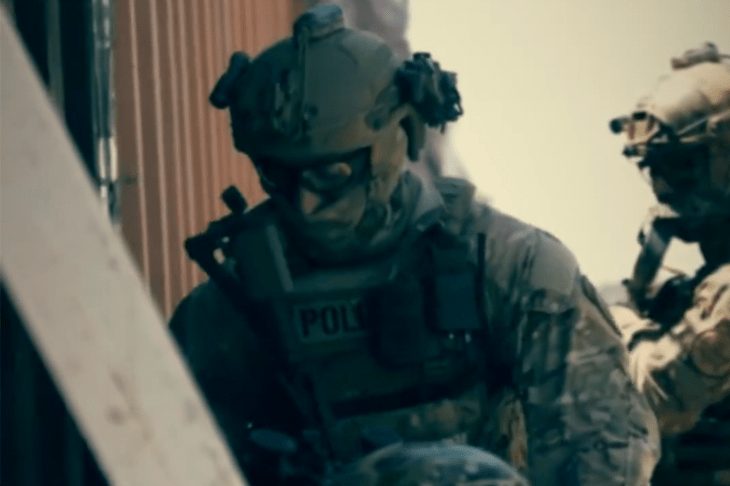
    Cockburn and his colleagues are currently obsessed with the new ICE recruitment video that’s gone viral online. “Allow me to introduce myself, my name is HO HO H to the O V,” Jay-Z, who currently lives comfortably in a Tribeca penthouse with Beyonce, raps over grainy footage of camo-clad soldiers busting open shipping containers, riding rough in the backs of open trucks, and flying in helicopters. It all takes place in dark warehouses or under a dusty, cloudless skies, until the scene shifts to nighttime, and the soldiers raise their hands, getting ready to do violence while lit up in dystopian reds and blues. Denis Villeneuve, who made Sicario, couldn’t have directed it any better. 

    At the end of the 50-second video, we see the words, in Gothic gang-inspired script: “Hunt Cartels. Save America. Join ice.gov.”

    Cockburn doesn’t think Dean Cain is the target audience for this campaign. This isn’t about busting illegal immigrants in textile warehouses or cabbage fields. ICE is clearly aiming at patriots in the tougher districts of Compton, or the Bronx, or, say, Yuma, where danger is a middle name and a $50,000 signing bonus to kick down drug-gang doors while holding a rifle at eye height seems like a huge career opportunity. 

    Your correspondent acknowledges that drug cartels are an ongoing enormous problem, toxic to security on both sides of the Southern border. But there’s no sign in this video that well-funded, well-armed drug lords and their fentanyl-slinging minions exist on the other side of those doors, or just beyond those walls. It’s no accident that the only “cartel” member we see  is some poor innocuous schmo in a pink hoodie who’s about to become a literal dog’s breakfast for a leaping, snarling German shepherd. We assume that badass perrito didn’t have a choice about whether or not it would become a vest-wearing member of the ICE cartel squad. 

    The Trump administration has, thus far, done a fine job of keeping American soldiers out of harm’s way in foreign entanglements. But it must feed the military-industrial beast somehow; this video makes it clear that there’s an ongoing ramp-up against the cartels, and that ICE agents are the new front-line grunts. The video has a kind of disingenuous ghetto Starship Troopers vibe to it, as though the Nixon administration had used Jimi Hendrix or Creedence songs to try and lure innocent young men to their deaths in Vietnam to fight communism. Instead of the Middle East or Southeast Asia, the plan is to send a generation to its death in Tucson and environs.

    Cockburn gets it: this is 2025, gee-whiz “do your part” recruitment tactics don’t work anymore. Whoever put together this ICE video is hip enough to use a 2003 Jay-Z song and the video stylings of an excellent drug-cartel thriller from 10 years ago. But if ICE truly intends to do this fight, then let’s be clear: it will not be cool, it will not be fun, and the music will probably not be particularly good, either. At the end of this endless war, blood will coat the dust. ICE may be recruiting to “Save America,” but in the end, dogs won’t do most of the dirty work. American men and women will die in this quest. That font really is cool, though.