Tag: Microsoft

  • Are AI stocks about to crash?

    Are AI stocks about to crash?

    Bitcoin has lost almost a quarter of its value. The tech-heavy NASDAQ index on Wall Street has started to fall. And even leaders of the industry, such as the Google CEO Sundar Pichai, have started to warn about valuations getting out of control. We already knew that AI was driving a boom in investment. But this week there are worrying signs the market is about to crack. The only real question is whether that turns into a full scale crash.

    Bitcoin, as so often, is leading the market rout. More than $1 trillion has been wiped off the value of the crypto market over the last six weeks, with Bitcoin itself down by 28 percent since its peak. But that is just part of a wider fall in tech and AI stocks, with the chipmaker Nvidia, which has powered much of the boom, starting to slide, along with many of the other stars of the AI boom. Plenty of stock market experts are starting to think it is looking like a bubble that is about to burst. Indeed, Michael Burry, who became famous in the crash of 2008 and 2009 for accurately predicting the collapse of the market, has started betting against the sector.

    There are many worrying signs. The leaders of the boom have reached extraordinary valuations. Nvidia is up by over 1,300 percent over the last five years, and earlier this year became the first company to reach a market value of $4 trillion. It was quickly followed by Microsoft, which has soared mainly on the back of its stake in the leader of the AI boom ChatGPT, which itself became the most valuable start-up ever with a funding round that made it worth $500 billion. Meanwhile every company that managed to attach itself to the boom, no matter how spuriously, has seen its share soar. Goldman Sachs estimates that AI stocks have added $19 trillion since ChatGPT was launched, a huge run-up in valuations.

    It is starting to look very like the dot com bubble of a quarter century ago. There is little question that AI is a valuable technology, and one that is starting to have a real impact. At the same time, there is far too much hype, no one has quite figured out how to make money from it, and no one has any real idea which of the new companies will turn into the long-term winners. 

    This week may or may not turn out to be the moment the bubble bursts. In reality, every investment boom has lots of sharp corrections as it soars upwards, and there is nothing very unusual about a fall of 5 percent or 10 percent in prices before the market starts climbing again. It is only when there is a final “melt-up” that it becomes dangerously over-valued. The AI boom does not look like it has reached that point yet. But there is little doubt that it is turning into a classic bubble. It will be very messy when it finally bursts.
  • How the firing of Sam Altman impacts the AI race

    How the firing of Sam Altman impacts the AI race

    Until this week, OpenAI seemed like an unstoppable force. In the space of little more than a year, the San Francisco-based organization was transformed from a research unit on the fringes of the tech industry to the world’s number one dominant AI business.

    Every newspaper on the planet seems to have covered the rapid rise of ChatGPT, its flagship AI product. Everyone from software engineers to the local cabbie seems to be using it, with the site attracting in the region of 1.5 billion visits per month.

    Control of AI is now firmly concentrated back in the hands of a familiar group of tech behemoths

    Such was the might of OpenAI that Microsoft quickly wanted in, committing an eye-watering $10 billion in funding for a stake in the business. And such was the international fame that its star CEO, Sam Altman, had attracted, that Rishi Sunak was desperate to be pictured brushing shoulders with him at Bletchley Park during the British prime minister’s AI safety summit at the start of the month.

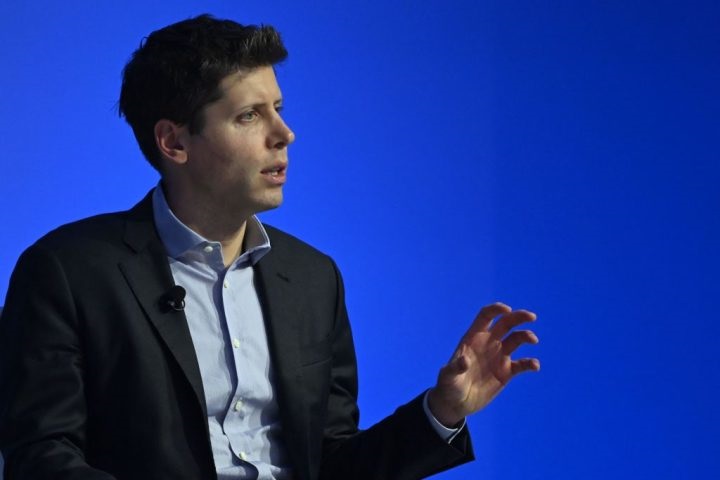
    Then, almost overnight, OpenAI’s gleaming reputation came crashing down. Thirty-seven-year-old Altman was summed to an impromptu Google Meet, at which he was abruptly fired. The firm’s board put out a statement on Friday saying it “no longer has confidence in his ability to continue leading OpenAI,” adding, as if to twist the knife in, that Altman was “not consistently candid in his communications with the board.”

    The news rocked the tech world, and OpenAI scrambled to get itself together and salvage its image. A new CEO was appointed later that day — but by Sunday, Altman was back at its head office with a guest pass, apparently seeking to claw his way back to the top. That didn’t work out, and by Sunday night, OpenAI had appointed a new CEO (its third in as many days), with hundreds of staff reportedly calling on the board to resign.

    The debacle exposed deep flaws in the way the business was governed internally, despite its shiny exterior. The weird corporate structure of the company — part charity, part business — meant it was in a constant internal identity crisis over its mission and its vision. Meanwhile, the firm’s hodgepodge board — comprised not of experienced C-suite execs but a university researcher, a robotics engineer and the boss of a Q&A website — more closely resembled a neighborhood watch forum than the team running a global tech firm.

    The upshot is that OpenAI, widely touted to be the world’s leader in the advancement of artificial intelligence, now looks like a tech start-up that got a little ahead of itself.

    But while the tech community was watching the firm’s apparent downfall in a state of shock, senior leaders in Silicon Valley were quietly rubbing their hands with glee. OpenAI, the upstart rival with its unique not-for-profit philosophy, looked poised to unseat its giant tech rivals to build tools that were better, faster and more popular, leading the AI race in the process.

    ChatGPT has something like six times the online interest of Google’s rival chatbot Bard, according to Google Trends data, and about twelve times the interest of Elon Musk’s rival, Grok. But OpenAI’s stumble in the race to develop super-powerful AI throws it back open. It has handed the lead to Amazon and Google — who together own stakes in rival Anthropic — and Meta. That Microsoft has hired Altman and ousted OpenAI president Greg Brockman to lead its own in-house AI research unit is a sign it may be losing faith in its $10 billion investment.

    Control of AI is now firmly concentrated back in the hands of a familiar group of tech behemoths, dashing hopes that a new, less corporate-focused approach to building potentially dangerous frontier technologies might be adopted. The damage to OpenAI is good news for them — it could well prove less good news for the rest of us.

    This article was originally published on The Spectator’s UK website.

  • FTC chair Lina Khan accused of résumé inflation and lying to Congress

    FTC chair Lina Khan accused of résumé inflation and lying to Congress

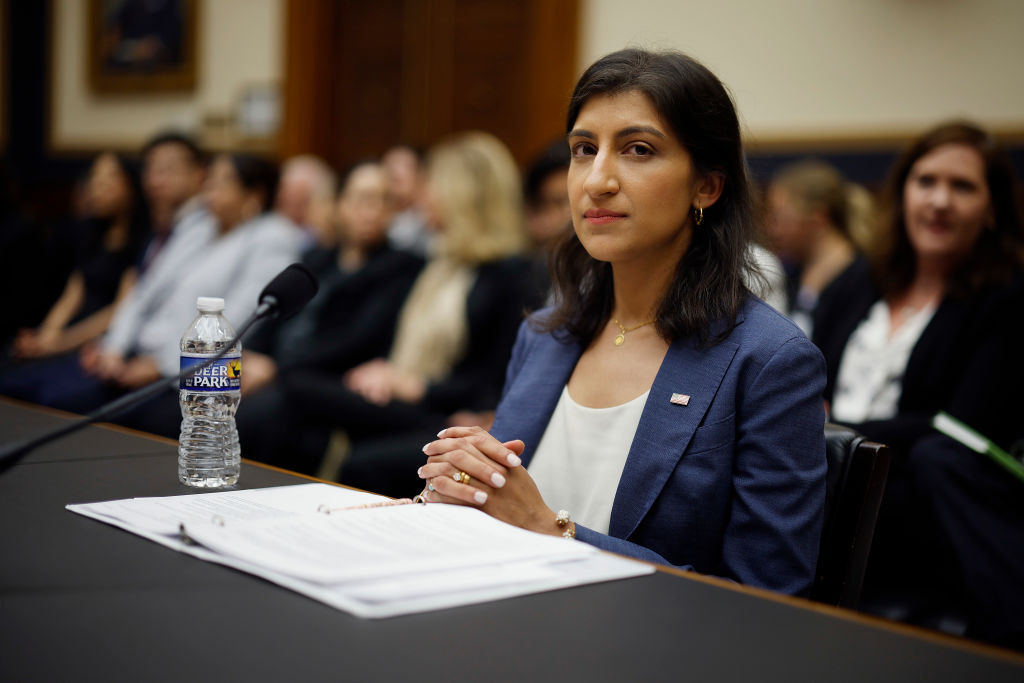
    Lina Khan, the chairwoman of the Federal Trade Commission was supposed to be the next great trustbuster. But on the course of her rise to the nation’s top antitrust law office, Khan allegedly misrepresented her credentials throughout her career and stands accused of lying to Congress.

    Representative Harriet Hageman, a Republican on the House Judiciary Committee, levied a series of accusations to Khan in a barrage of Questions for the Record obtained by The Spectator. Hageman’s most sensational claims are that Khan lied to Congress, lied by omission to Congress and misrepresented herself as a lawyer while lacking the appropriate law license.

    In the first instance, Hageman references a hearing where Representative Cathy McMorris Rodgers asked Khan if she had ever ignored the advice of the FTC’s Designated Agency Ethics Official (DAEO), to which Khan replied “no.” That, Hageman claims, is a lie under oath.

    Taking issue with Khan’s long history of activism against Facebook, the FTC’s DAEO wrote to “recommend Chair Khan recuse to avoid an appearance of partiality concern” because “there is a reasonable appearance [of] concern with her participation in this matter.” Khan “rejected” the advice, according to Bloomberg; Hageman writes that Khan’s answer to Rodgers was therefore likely “false, deceptive, misleading or some combination of all three.” 

    One of the reasons why progressives are so enamored with Khan — her anti-Big Tech history — could prove to be a substantial problem. Prior to helming the FTC, Khan was a fierce critic of Facebook, and argued that Facebook should never be allowed to acquire another company. During Khan’s time as FTC chair, Meta tried to do just that, attempting to acquire a virtual reality startup.

    Khan’s insistence on sitting as a judge on the FTC’s Meta trial was so controversial that one of her Republican colleagues resigned because of it, citing “continuing lawlessness” under Khan and Khan’s “disregard for the rule of law and due process.” A federal court subsequently struck down Khan’s suit.

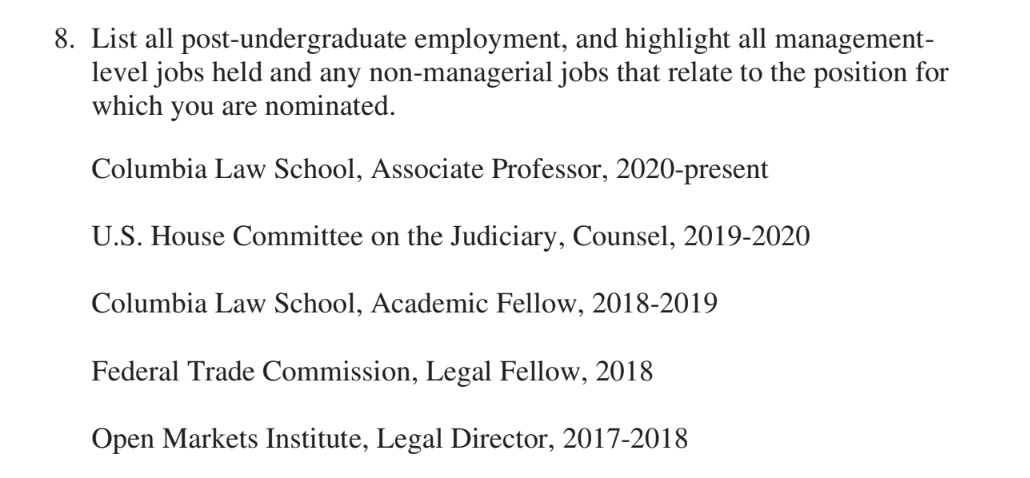
    Hageman accuses Khan of lying to Senate-side Republicans in two main forms. The first allegation is résumé inflation. In documents Khan submitted to the Senate Commerce Committee, she claimed she had worked as a “legal fellow” at the FTC that she now chairs. 

    However, Hageman alleges that “[she] did not possess that title” and it is a position that does not, and never has, existed. The truth is, her ally, FTC commissioner-turned Consumer Financial Protection Bureau (CFPB) director Rohit Chopra brought her on board as a law clerk, not a legal fellow. Internal emails obtained by Hageman show that FTC staff knew that Khan is “not your typical ‘law clerk,’” because of her close ties to Chopra.

    Those ties have continued. Khan’s first chief of staff, director of Bureau of Consumer Protection, director of the Bureau of Competition and first chief technologist were all previously on Chopra’s staff, leading some to speculate that he has kept close tabs on his former employees.

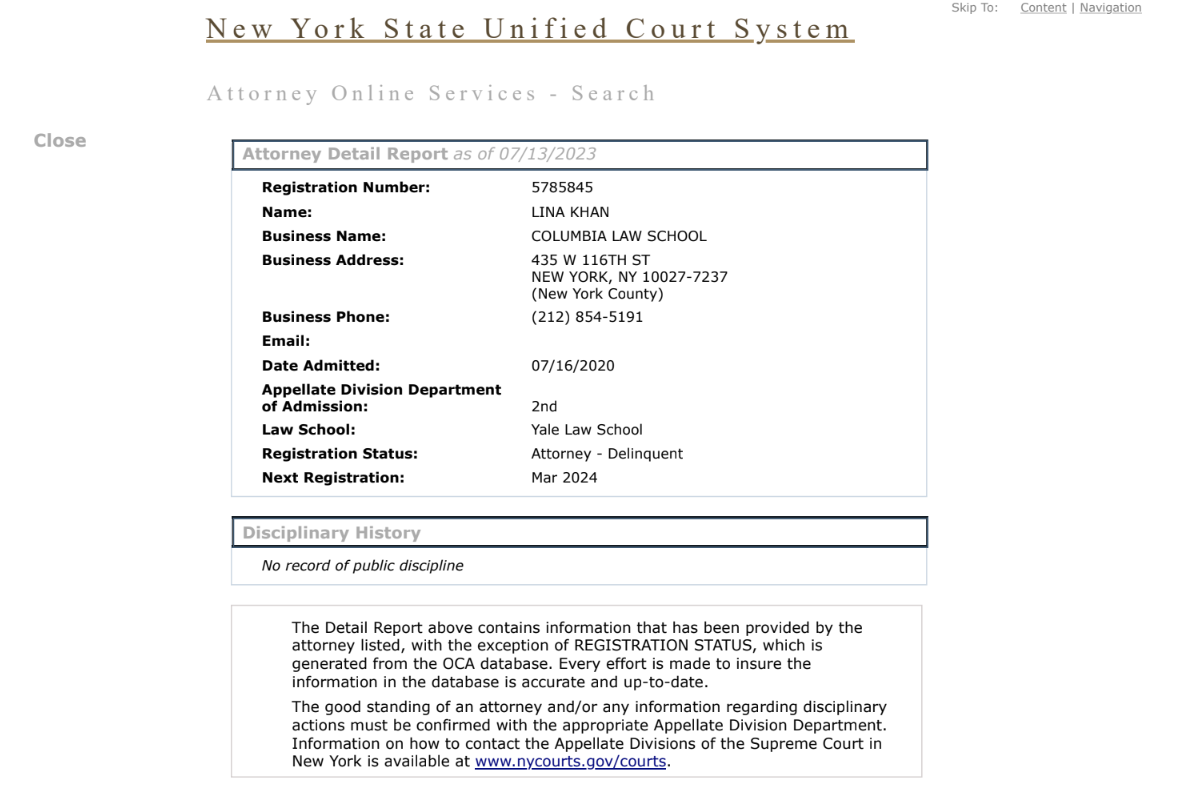
    Hageman also writes that Khan appeared to be in “violation of District of Columbia law” while she was working as majority counsel on the Judiciary Committee, because she spent much of that time operating without a DC law license. Hageman notes this is all the more curious because Khan passed the New York Bar in 2017, but spent approximately one year as counsel without having a law license.

    Hageman writes that “in the District of Columbia people are prohibited from holding themselves out as engaged in the practice of law without first obtaining a license to do so.” 

    “Lina Khan lied to Congress on an issue of great importance,” Hageman told The Spectator. “She has no moral authority to lead an agency such as the FTC. She should resign.”

    A spokesperson for the FTC declined to comment on Hageman’s allegations.

    Under Khan, the FTC has suffered a series of embarrassing legal setbacks, failing in both federal court cases Khan has tried. In addition to her Meta failure, Khan recently suffered another legal blow when a federal court denied her request for a preliminary injunction to stop Microsoft from purchasing Activision Blizzard.

    Beyond her 0-2 record in federal courts, Khan has chosen a curious set of foes, previously reported by The Spectator. She is currently preventing a merger of healthcare companies that could expand access to early detection of cancer screenings. Unlike Meta and Microsoft, neither Illumina nor Grail, the healthcare companies trying to merge, could be described as big businesses.

    “Destroying the medical breakthrough that Illumina and Grail are trying to offer for the reasons she has stated could be the biggest mistake a federal regulator has ever made,” California congressman Darrell Issa told The Spectator. “For her to swing at Microsoft and hit a cancer patient and still think that she is on target shows how dangerous she is.”

    Khan is a longtime ally of Senator Elizabeth Warren, whose presidential aspirations were notoriously stymied after the Massachusetts senator was found to have misreported about her race and ancestry. Could Khan’s haziness on vital details of her biography also prove to be her undoing?