Tag: Nato

  • Why Europe can’t go it alone on Ukraine

    Why Europe can’t go it alone on Ukraine

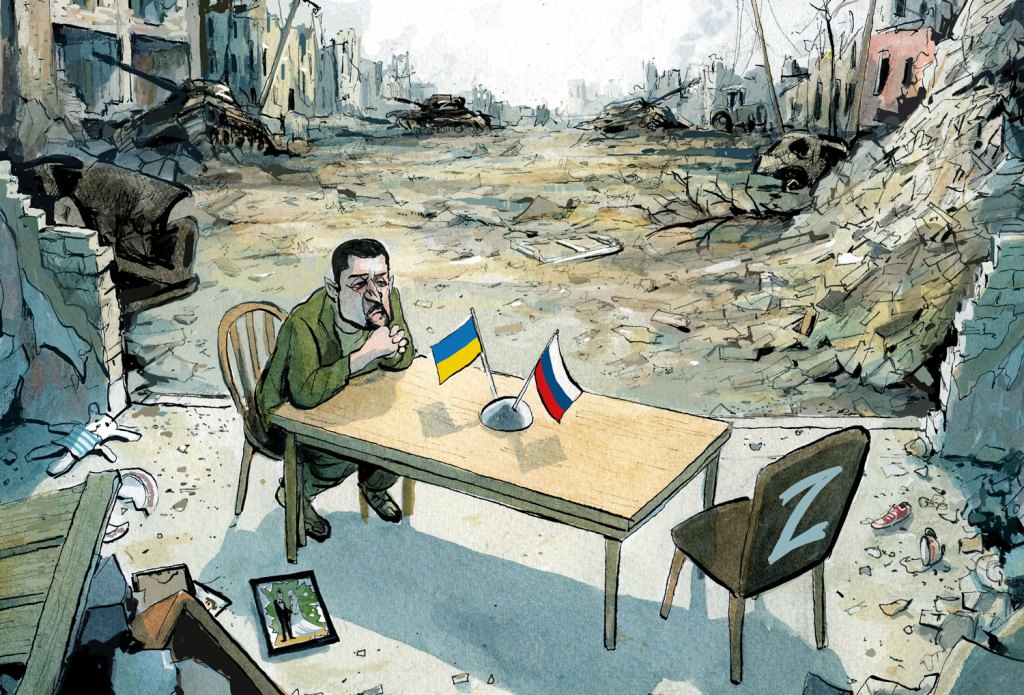
    Who will pay for Ukraine’s war effort now the Trump administration has turned off the financial taps? European leaders have expressed themselves ready and willing to take up the burden, with European Commission President Ursula von der Leyen affirming that “if we continue to believe that Ukraine is our first line of defense, we need to step up our assistance.”

    Individual countries have come up with generous funding packages – most open-handed of all being Germany, which has recently pledged more than €3 billion in direct funding. But that’s just a drop in the ocean compared to what Ukraine says it needs. With more than 40 percent of GDP destroyed and the tax base completely wrecked by the war, it’s not just Ukraine’s military spending but also its public services which are dependent on international handouts. At present, Kyiv’s war effort is facing not just a crisis in manpower but also a serious funding crunch.

    So far, the financial support of western allies has been Kyiv’s superpower and force multiplier. Without it, Ukraine’s economic collapse at the outset of the war would have quickly translated into military collapse, too. Ukraine also enjoys the goodwill of world financial institutions such as the International Monetary Fund, the World Bank and the European Bank of Reconstruction and Development – as well as of international lenders who have collectively agreed to overlook the fact that Ukraine is effectively in default on its own debt.

    That’s an advantage that Russia, by contrast, absolutely lacks. Cut off from international money markets, Moscow is forced, more or less, to balance its own books, borrow from its own major companies and print more money to fund its war production. But Ukraine’s reliance on outside funding is also a strategic weakness, leaving Kyiv entirely dependent on the goodwill of outsiders to continue the fight. Kyrylo Shevchenko, the former head of Ukraine’s Central Bank, calls the system “donornomics” – defined as “the fragile system where Ukraine’s fiscal survival depends on how far its allies are willing to go.”

    How much cash does Ukraine need to fight Russia and survive as a functioning state? The basic figure that the Verkhovna Rada, Ukraine’s parliament, approved for defense and security this year was 2.2 trillion hryvnias, or $54 billion – equivalent to approximately 26 percent of Ukraine’s GDP. But that sum eats up more than half of Ukraine’s depleted tax take, so Kyiv needs to find additional money to fund everything else from healthcare, pensions and education to government salaries.
    ‘Come on Donald, amuse me.’

    Ukraine’s 40 percent budget deficit has to be covered in one of three ways – from direct donations from allied countries, from internationally backed debt and, potentially, from Russian state funds currently held in G7 countries. That’s not even counting military expenses directly shouldered by Ukraine’s backers – most expensively the vital air defenses such as Patriot batteries which cost $1 billion dollars each and fire missiles costing around $4 million a shot. With Russian missile and drone attacks now regularly topping 600 projectiles a night, it’s a small wonder that Reuters has estimated the real cost of the war to be up to $150 million a day. Ukrainian eyes are focused on getting hold of Russia’s sovereign wealth funds, which were frozen at the beginning of the war. Estimates vary, but at least $250 billion of the Kremlin’s money is held in various G7 countries. At least €150 billion of that sum is parked in Belgium’s Euroclear, a depository system used by governments and central banks around the world to hold their hard currency assets. There is, as yet, no legal way that Belgium, the European Union, the United Nations or any other national or international body can just confiscate that money.

    Indeed, many European leaders including French President Emmanuel Macron have warned that doing so would seriously jeopardize Europe’s reputation of having respect for the rule of law in the eyes of other sovereign investors such as China, Saudi Arabia and Qatar – and trigger sovereign capital flight that could quickly bankrupt the continent.

    Instead, western finance officials have been dreaming up various legal workarounds that would allow the funds to remain formally the property of the Russian government, while in practice making them available for Ukraine’s use. In October last year, the G7/EU came up with a scheme known as the Extraordinary Revenue Acceleration loans mechanism, which created a $50 billion loan backed by the interest payments from Russian capital without touching the capital itself. But with the war effort burning through that sum annually, this year European leaders have attempted to create a similar loan package involving the whole sum.

    The idea of this Special Purpose Vehicle (SPV) – also known as the Reparations Loan – has been to create a €140 billion loan backed by Russia’s Euroclear capital that would be lent to Ukraine and, notionally, repaid by Ukraine once Ukraine is paid back by Russia for wartime damages. The trouble is, reparations are vanishingly unlikely and are not even a subject of discussion in any iteration of peace talks with the Russians. On the contrary, the Kremlin very much does want its cash back – and it is very likely to make that, along with the lifting of sanctions, a key demand once negotiations begin in earnest. In other words, handing over Russia’s money to Ukraine could become an obstacle to peace.

    On a practical level, too, the small print of the SPV means that Belgium would be on the hook if and when Russia sues for its money back. Bart De Wever, the Belgian Prime Minister, has refused to sign off on the loan unless all European nations share the risk. So far, they have refused – not least because Europe’s national bankers are legally forbidden from issuing or backing loans that have next to no chance of ever being repaid. The practice is known as “bad-faith lending,” and has been much abused by China in recent years as a way to grab strategic real estate across Africa and Asia in lieu of loan repayments. And since seizing Ukrainian assets isn’t the EU’s style, European taxpayers will ultimately be liable for the entire sum of the loan when the Russians inevitably refuse to pay war damages to Ukraine, forcing Kyiv to default.

    Despite the shaky legal and political foundations of the SPV, “Kyiv sees these assets as the main pillar of budget stability for 2026-2027,” says Shevchenko. Indeed, securing a reparations loan from the EU is key to Kyiv’s parallel negotiations with the International Monetary Fund, from which Ukraine is hoping to secure a four-year multibillion-dollar extension of its existing $11 billion credit facility. But Ukraine has no real plan to repay the IMF except out of the SPV – effectively, one loan paying for another. European states do this kind of thing all the time – but they, unlike Ukraine, have predictable revenues and single-figure deficits. “The plan is risky,” says Shevchenko. “Without a deal, Kyiv’s $60 billion [budget] gap could deepen fast.”

    Though using Russian assets to help Ukraine sounds like a panacea, many in Kyiv are also crying foul over Brussels’ suggestion that €45 billion of the SPV money be used right away to repay last year’s G7/EU Extraordinary Revenue Acceleration loan. More egregious still to Ukrainians has been German Chancellor Friedrich Merz’s suggestion that much of the SPV money be spent on arms for Ukraine manufactured by expensive European suppliers such as Germany, cutting Kyiv out of the picture. That is, more or less, what happened to the lion’s share of US aid which was never paid out to Kyiv at all and was instead sent to US defense contractors to replace old military equipment dispatched to Ukraine. And as the SPV-Reparations loan will be disbursed by the European Union, the temptation to buckle to lobbyists and spend the money inside the EU, pork barrel-style, will be high.

    In addition to massive physical destruction, Russia’s invasion has also disrupted two key structural elements of Ukraine’s economy – access to cheap Russian gas, which was the secret to the competitiveness of much of the country’s industry, and cash income from transit of Russian gas to Europe. Remarkably, for the first three years of the war Ukraine continued to quietly move Gazprom gas across its land and into the EU via a network of pipelines to Slovakia. As late as last year, Kyiv was using the $900 million annual transit fees paid by Moscow (via a Swiss subsidiary) to help fund its war effort. Those payments, bizarrely, made Gazprom one of Ukraine’s biggest wartime budget contributors.

    Some of Gazprom’s gas was even re-imported into western Ukraine’s Lviv and Ivano-Frankivsk provinces having looped through Slovakia, creating the legal fiction that the gas was European. It’s the same story with Russian crude oil pumped to Slovakia, the Czech Republic and Hungary via the Druzhba pipeline – which in fact crosses Ukrainian territory and generated precious revenue for Kyiv.

    Under pressure from Brussels, Ukraine shut down most Russian gas transit at the start of this year, and is now moving to close down the Druzhba oil pipeline too. But that leaves Ukraine dependent on liquefied natural gas (LNG) imported from halfway across the world – and which costs up to three times as much as piped Russian gas. Early this month, under the auspices of Europe’s Partnership for Transatlantic Energy Cooperation, Ukraine’s Naftogaz signed agreements on the supply of at least 300 million cubic meters of American LNG with the Polish company ORLEN. Such western-provided supplies will, Kyiv hopes, be enough to keep heating and electricity going over the coming winter. But there’s no way Ukraine’s heavy industries can return to their prewar competitiveness with energy costs tripled.

    The long-term outlook for a postwar Ukraine is as bleak as its current cashflow. A rapid damage and needs assessment, prepared by the Ukrainian government with the World Bank, UN and European Commission, estimates immediate recovery and reconstruction needs to be approximately $524 billion over the next decade – roughly 2.8 times Ukraine’s 2024 GDP. The good news is that official creditors – including holders of Kyiv’s government debt – have agreed to pause Ukraine’s debt service until the end of March 2027 pending restructuring. But with Kyiv already struggling to make ends meet without repaying its debts, that’s as useful as a chocolate teapot.

    Underlying Kyiv’s coming cash crunch is a fundamental disconnect between Europe’s undoubtedly sincere desire to support Ukraine and the reality that the UK, France and Germany are facing serious fiscal crises of their own. Promises to support Ukraine are of a piece with European NATO members’ pledges to commit 5 percent of their GDP to defense spending by the end of the decade – both declarations are, for the most part, unfunded. Yet senior Brussels bureaucrats such as António Costa, President of the European Council, continue to make sweeping pledges – including in person to Ukrainian President Volodymyr Zelensky. “Today we will make the political decision to ensure Ukraine’s financial needs until 2026 and into 2027,” Costa told Zelensky last month. “We are not tired and we are here to continue to support Ukraine diplomatically, politically, militarily and financially.”

    Costa isn’t lying – Europe’s material and political support for Ukraine will undoubtedly continue. The question is at what level – and for how long. The story so far of Europe’s engagement with Ukraine has been one of big pledges followed by considerably smaller deeds – and that was before Trump took away Uncle Sam’s billions. Unfortunately for Kyiv, there’s little to suggest that Europe has the means or the will to actually provide Ukraine as much as it needs, for as long as it needs.

    This article was originally published in The Spectator’s November 24, 2025 World edition.

  • How Germany is preparing for war

    How Germany is preparing for war

    Hamburg

    What would happen if Russia was planning an attack on Estonia, Lithuania or Latvia – and the threat was sufficiently great that NATO felt the need to send troops east across Europe to face off against Moscow?

    This was the scenario the German Bundeswehr spent several days rehearsing last month, working out how the army would transport its soldiers towards NATO’s eastern flank in the event of conflict in the Baltics. For three days, the port city of Hamburg played host to the exercise Red Storm Bravo: 500 soldiers, along with roughly 300 members of the emergency services and other civilian organizations, took part – the largest military exercise in the city since the end of the Cold War.

    In the event of conflict with Russia, Germany would, because of its geographical position, become a “hub” for NATO to coordinate the flow of soldiers and weaponry to the front line in the east. Troops from the US and across western and southern Europe – including Britain – would flow through the country toward Warsaw and on. The purpose would be deterrence in the hope that a show of international force would put Vladimir Putin off an attack that would test NATO’s commitment to Article 5, which considers an attack on one member to be an attack on all.

    It would be a huge operation: the Bundeswehr’s Operation Plan Germany, details of which were leaked to the press last year, envisages 800,000 NATO troops and 200,000 vehicles traveling across the country toward the front line. According to one army source, even with Germany’s motorways and ports used to full capacity, this would take close to a week. Red Storm Bravo was a rehearsal of the section of Operation Plan Germany that runs through Hamburg.

    The purpose of Red Storm Bravo was as much to familiarize German civilians as the army regarding what to do in the event of a coming war. Only a fraction of the Operation Plan Germany soldiers took part but the scenarios neatly reflected the possible challenges. Soldiers rehearsed setting up and manning checkpoints; the fire service practiced fishing a sinking barge out of Hamburg’s port; and the ambulance service simulated a mass casualty event with multiple victims.

    The first day’s main event was moving a military convoy through the center of the city after dark. As the sun set over Hamburg’s port, I watched the heavily armed soldiers march toward a fleet of about 70 military vehicles, lined up three abreast. Some were small armored vehicles, others enormous Rheinmetall-branded trucks, several with machine-gun turrets that would later be manned as the convoy sped through the city. Many soldiers wore balaclavas to prevent them being identified, according to our Bundeswehr escort.

    There is an art to traveling in a convoy. It moves as one, meaning that as long as the leading vehicle continues to move, the others follow in an unbroken line, regardless of red traffic lights or civilian traffic. This convoy of just 70-odd vehicles snaked back roughly 2.5 miles – a considerable logistical challenge.

    At two points along the route, the convoy was stopped by pretend protests: at the first, army reservists in civvies waved banners and chanted at the convoy to “turn back”; at the second, “protesters” staged a sit-in, with signs saying “glue” around the necks of some to denote those who would have stuck themselves to the ground. The point was for the riot police to practice removing them. Groups of three took turns: a grab at the protester’s head from behind and a knee to the back, one arm twisted around, then the other, allowing the police to peel them off the ground and carry them away.

    When the planning for Red Storm Bravo was initiated, few could have predicted the new significance it would take on in the weeks leading up to it. Last month, a series of suspected Russian drone incursions into NATO territory set alarm bells ringing. Alongside Germany, Romania, Denmark, Norway and Poland have all reported drone activity close to military bases and other critical infrastructure. Meanwhile, three Russian MiG-31 fighter jets entered Estonian airspace for a total of 12 minutes on September 19.

    “We developed the scenario for Red Storm Bravo last December and now reality has actually caught up with us somewhat,” said Captain Kurt Leonards, the head of the Bundeswehr’s Hamburg command, who oversaw the exercise. “Whether that’s in Poland, in Estonian airspace, or even the whole discussion now taking place in Denmark, it shows how topical this issue is, and that’s why we have to react very quickly and expand our capabilities.”

    Poland and Estonia triggered NATO’s Article 4 less than two weeks apart, requesting alliance members come together to discuss the incursions. While the mood in NATO’s Brussels HQ appears to be calm so far, the rhetoric coming from individual members is somewhat more bellicose.

    In comments supported by NATO chief Mark Rutte, Donald Trump gave his endorsement to any NATO ally shooting down Russian aircraft entering its territory. Poland and Lithuania have declared they will do precisely this. German Chancellor Friedrich Merz said: “We are not at war, but we are no longer living in peace either.” The German government intends to change the law this fall to allow the army to shoot down any drones deemed a threat. Last month, the EU agreed to move forward with building a technological “drone wall” along its eastern boundary.

    The mood on the ground in Germany is clearly jumpy, too. At approximately 1 a.m. on a stretch of road just outside the center of Hamburg, as the Red Storm Bravo convoy paused to set up for the second of its two protest simulations, a whining buzz became audible overhead. Alarm bounced around the crowd of assembled press and official observers as a small black drone hovered above us. “Is it one of ours?” someone asked nervously. It was only after a press photographer was able to get a grainy shot of it that one of our military escorts confirmed it did indeed belong to the Bundeswehr.

    Leonards agreed that Hamburg had seen an increase in drone activity. “Of course, you don’t always know where the drones are coming from,” he said. “Are these drones the work of a state actor that’s systematically operating here? Or do we have a teenager with a remote-controlled drone who wants to test how fast the police can arrive on the scene?”

    Following years of underinvestment, the German army is restocking its arsenal thanks to reforms that will see defense spending exempt from the country’s rigid debt rules and a one-off €100 billion fund ringfenced by Merz’s predecessor, Olaf Scholz. Some of this will be invested in anti-drone technology.

    Following years of underinvestment, the German army is restocking its arsenal

    In an army barracks in the Hamburg suburbs, the Bundeswehr demonstrated some of the gadgets already available. First to be sent up was a type of “hunter drone” capable of ensnaring other drones mid-flight by shooting out a web, Spider-Man-style. Disabling drones this way avoids having to use expensive weaponry to shoot them down and lowers the risk of falling debris injuring civilians. Once the hunter drone had lowered its catch to the ground, a four-legged “drone dog” dubbed “Lassie,” equipped with a camera and other sensors, was sent out to inspect it.

    Despite these recent undertakings, questions over the German army’s readiness for conflict remain. In June, defense chief General Carsten Breuer warned that Russia could be ready to launch an attack on a NATO state by 2029; according to one government source I spoke to, this could be even sooner. Meanwhile, according to official figures, just under 183,000 soldiers are actively serving in the Bundeswehr, and a damning report published in May revealed that, at the end of last year, more than 20 percent of military positions remained vacant. The reintroduction of conscription seems inevitable to meet its commitment to NATO troop numbers.

    So, is Germany prepared for the defensive challenges ahead? When asked this, Leonards said: “Germany is in the process of significantly developing its armed forces and the Bundeswehr. And I believe we’re really on the right track.” Not a resounding yes, then. But any preparation against an increasingly provocative Russia is better than none.

    This article was originally published in The Spectator’s October 27, 2025 World edition.

  • Moldova has been saved from Russian influence – but at what cost?

    Moldova has been saved from Russian influence – but at what cost?

    The European Union, guardian and champion of democracy, rightly takes a dim view when ruling parties ban their opponents, refuse to open polling stations in areas likely to vote against them, censor opposition news channels and allow a large staff of foreign election monitors to police social media in the run-up. If Serbia, say, or Georgia tried systematic election rigging of this kind, Brussels would be the first to call foul and disregard the result as illegitimate. But when it’s the EU that’s running the interference, as in Moldova this week, the rules are apparently quite different.

    This week the pro-EU party of Maia Sandu, Moldova’s President and a former World Bank official, won a slim majority in a general election. Her main opponent was Igor Dodon, who led a coalition of pro-Russian parties which were heavily backed by the Kremlin (lest anyone doubt their ideological bent, the opposition’s election symbol was a hammer and sickle inside a heart inside a Soviet five-pointed star). The race was seen as a showdown between Europe and Moscow over control of a poor but strategically important ex-Soviet state – a category that also includes Georgia and Ukraine.

    “Not only did you save democracy and kept the European course, but you have also stopped Russia in its attempts to take control over the whole region,” the Polish Prime Minister Donald Tusk wrote in his public congratulations to Sandu. “Moldova, no attempt to sow fear or division could break your resolve,” wrote the European Commission president Ursula von der Leyen. “You made your choice clear: Europe. Democracy. Freedom. Our door is open. And we will stand with you every step of the way.”

    There is little doubt that Moscow opened its wallet wide – as well as its usual bag of electoral dirty tricks – in its attempt to influence Moldova’s elections. Telegram, a news and messaging app, openly hosted channels offering cash for votes. There were well-documented stories of Orthodox priests receiving bribes in order to influence their flocks. Several main opposition parties were not just pro-Moscow but provably funded by Moscow too. Pro-government Moldovan media estimate – without much proof – that the Kremlin dropped some $400 million, or 1.5 percent of Moldova’s GDP, on its failed influence operation.

    To counter the Kremlin’s campaign, the EU deployed what the foreign policy commissioner Kaja Kallas described as “a specialist team on the ground [to help] Moldova address illicit financing around the elections” as well as “a group of experts, a hybrid rapid response team, to support Moldova against the foreign interference.” Among the tasks of the EU’s team of electoral experts was to monitor online news and social media, and to use Europe’s investigative firepower to track campaign finance violations in the form of Russian money. The European Commission also dangled an irresistible €1.8 billion support package to underpin Moldova’s economic growth plan on its path to the EU.

    According to Telegram’s founder, the Russian billionaire Pavel Durov, Europe had some dirty tricks of its own to play. The day of the election, Durov announced that France’s secret services had approached him last year with a covert deal while he was detained in Paris on charges of failing to police criminal activity on Telegram. According to Durov, French spooks “reached out to… ask me to help the Moldovan government censor certain Telegram channels ahead of the presidential elections.” In exchange, the security services allegedly offered to help Durov with his legal problems – apparently a crude good cop, bad cop shakedown.

    At first, Durov claims, Telegram “identified a few [channels] that clearly violated our rules and we removed them.” But when a second list was produced that for the most part included channels that were “legitimate and fully compliant with our rules” but were simply critical of the Moldovan government, Durov refused to comply. “Telegram is committed to freedom of speech and will not remove content for political reasons,” he wrote. “I will continue to expose every attempt to pressure Telegram into censoring our platform.” France’s security services have not commented.

    Just two days before the vote, Moldova’s electoral commission banned two opposition parties – both believed to be funded by Moscow – though their names remained on the ballots, meaning that the votes of anyone who mistakenly voted for them were lost or went to other parties. President Maia Sandu had called for the large numbers of Moldovans working abroad to take an active part in elections. But just two polling stations were set up in Russia to serve the estimated 78,000-150,000 electors who live there versus more than 70 in Italy, home to some 100,000 Moldovans. In the neighboring Russian-controlled statelet of Transnistria, which lies between Moldova and Ukraine, several polling stations were moved at the last moment and two of the bridges linking the territory to Moldova were under repair, hindering people’s ability to vote.

    Do such measures amount to anti-democratic censorship and electoral interference – or are they legitimate acts of self-defense? The story of Moldova’s elections is reminiscent of Cold War Europe, when Moscow poured cash and resources into Euro-communist parties while Washington bankrolled right-wing parties such as Italy’s Christian Democrats – explaining why many Europeans are still so prone to political conspiracy theories and to seeing the secret hand of America everywhere. Moscow, for its part, has long maintained that democracy movements in the former Soviet Union, from Kyiv to Tbilisi, Minsk to Bishkek, have all been orchestrated, financed and directed by the West as a covert means of extending power through the former Soviet Empire.

    On balance it’s probably Europe, with its huge trading bloc, track record of fighting corruption in its newest member states and deep (at least by Moldovan standards) pockets that offers a brighter future for the country than Russia. Today’s Kremlin, unlike its Soviet predecessor, offers no inspiring ideological vision and can’t spare much cash to fund its overseas clients. But at the same time Russia remains a major trading partner of Moldova, and many citizens feel close cultural ties to Moscow. Forcing Russia’s neighbors to make a binary decision between East and West has proved not just divisive but has also, in the case of Ukraine and Georgia, led to bloodshed. In Georgia, recent elections have rejected former president Mikheil Saakashvili’s radical pro-EU, pro-NATO course in favor of friendship with Russia – with the result that Georgia’s economy grew a staggering 9.4 percent last year.

    Many Europeans are congratulating not just Moldova but themselves on saving the country from Russian influence. But the question remains whether Sandu’s victory makes Europe look strong or weak. On the one hand, Brussels won. On the other, just as with Boris Yeltsin’s gerrymandered election victory in 1996, democracy had to be strangled in order to save it.

  • No, Trump has not changed course on Ukraine

    President Trump has once again played the global foreign-policy commentariat for fools. They have taken a startling statement from Trump’s Truth social-media account on Tuesday as a sign of a new policy – or at least a new attitude – toward the Russia-Ukraine war. Yet what Trump actually wrote says nothing of the sort. 

    If Trump really were newly committing himself to Ukraine, why would say, as he’s so often said before, “I wish both countries well”? One country has invaded the other; wishing one of them well means wishing defeat on the other. Wishing them both well indicates indifference.

    At a stretch, one might choose to believe Trump meant his kind regards to both sides as a mere pleasantry, or perhaps he meant that sub specie aeternitatis he wishes the people of both nations well. His record belies that interpretation. So does the rest of what he wrote Tuesday.

    Trump’s Truth statement came on the heels of a meeting with Ukraine’s President Zelenskyy in New York. The Ukrainian leader accentuated the positive: “Trump is a game-changer by himself,” he said. Yet Trump’s words describe a very familiar game, played by the rules Trump has followed all along.

    If anything, he has reiterated more forcefully before that Ukraine is Europe’s affair, not America’s. Look closely. “I think Ukraine, with the support of the European Union, is in a position to fight and WIN all of Ukraine back in its original form.”

    That means if Ukraine falls short of that optimistic conclusion, it will be the EU’s fault, along with Zelenskyy’s – but not America’s.

    “With time, patience, and the financial support of Europe and, in particular, NATO, the original Borders from where this War started, is very much an option.” 

    The US is, of course, part of NATO, but near the end of the post, Trump adds this in clarification: “We will continue to supply weapons to NATO for NATO to do what they want with them.”

    That hardly sounds like the United States asserting its leadership role in the alliance to direct greater aid to Ukraine. It’s instead a restatement of an existing policy (“we will continue”) and a reminder that Trump sees Europe’s NATO members as being responsible for their own decisions (“do what they want with them”) and whatever results they get – or don’t get.

    Trump emphasized to Vladimir Putin that his war is a failure and an economic catastrophe, and the administration’s disappointment with Russia’s intransigence in prolonging the war is no secret. Despite what his detractors may believe, Trump did not come back into office intent upon delivering Ukraine to Putin. If a negotiated peace, or at least armistice, is not available, Trump is quite comfortable keeping up military aid of the sort the US has been providing all along. Yet his Truth post suggests even that will increasingly be framed in terms of Europeans’ self-responsibility. This is their war, and theirs to end, where Trump is concerned.

    NATO’s Eurocrats should think twice before popping the champagne. If Trump sounds more sanguine than ever before about total victory for Ukraine, what will he say about Europe, and NATO, if that happy ending doesn’t come to pass? Will he say Europe, including NATO, lost a war that should have been easy to win and thereby proved its uselessness – proved, in fact, the need for regime-change in Europe’s own capitals and for America to slash its underwriting of the Continent’s defense? Trump has now set extremely high expectations for others to meet. You can be sure he hasn’t done so unwittingly.

    Trump doesn’t want to see Ukraine utterly crushed by Russia. Yet he also doesn’t want NATO to be America’s business rather than Europe’s. Business is about profit, and in Trump’s eyes, NATO is unprofitable. For now the president is providing charity; he’s a generous man. But if NATO’s European members can’t realize the returns that Trump says are attainable, he’s going to curtail his giving.

  • Trump takes a pass on brokering peace in Ukraine

    Trump takes a pass on brokering peace in Ukraine

    Has Donald Trump just announced the most consequential foreign policy reversal of his presidency? If so, Ukraine’s President Volodymyr Zelensky and France’s Emmanuel Macron – the last leaders to speak to Trump just before his epochal announcement – should be careful what they wish for.

    In the mother of all flip-flops, Trump on Wednesday posted on Truth Social that “Ukraine, with the support of the European Union, is in a position to fight and WIN all of Ukraine back in its original form.” That’s a position that even Biden, in his most optimistic moments, never dared to take. Trump claimed that Russians were finding it “almost impossible” to buy gasoline (by implication, as a result of Ukrainian drone strikes), that “Putin and Russia are in BIG Economic trouble.” To add insult to injury, Trump also called Russia a “paper tiger” that had been “fighting aimlessly for three and a half years a War that should have taken a Real Military Power less than a week to win.” 

    Ouch. That’s about as hard a diplomatic gut-punch that Trump could deliver, short perhaps of calling Putin a coward and a liar. Trump also went out of his way to praise Zelensky at a civil sit-down meeting at the United Nations. “Frankly, Ukraine is doing a very good job of stopping this very large army,” Trump said. “It’s pretty amazing.” That’s a very far cry from Trump’s confrontational “you have no cards” speech to Zelensky in the Oval Office in February. 

    On the face of it, Zelensky got exactly what he wanted from Trump, pushing the line that Moscow faces economic collapse and that Ukraine has a realistic chance of expelling Russian forces from its territory. But in truth Trump’s announcement is terrible news for Kyiv and the future of its war effort. 

    Trump’s statement is not a declaration of support for Ukraine, it’s Trump’s resignation from further participation in the peace process. And the sting in the tail of Trump’s announcement is a crystal-clear declaration that he now considers the Ukraine war Europe’s responsibility. A Ukrainian victory is possible “with the support of the European Union,” wrote Trump. All it will take is “time, patience, and the financial support of Europe and, in particular, NATO.” Except, crucially, that Trump clearly refers to NATO as something distinct from the US, promising that Washington “will continue to supply weapons to NATO for NATO to do what they want with them.” Note the weasel word “they.”

    To be fair to Trump, walking away from trying to make peace in Ukraine was always on the cards. Back on April 18, Trump told reporters at the White House that he wanted to get a peace deal “quickly.” But he also warned that “if for some reason one of the two parties makes it very difficult, we’re just going to say, ‘you’re foolish, you’re fools, you’re horrible people, and we’re going to just take a pass. But hopefully we won’t have to do that.”

    Turns out Trump did end up taking a pass, just like he promised – and Vladimir Putin is to blame. Despite a reputation in some quarters for being a master manipulator, Putin utterly failed to correctly read Donald Trump. Defying media criticism and resistance from parts of the Republican party, Trump took a major political risk in inviting Putin to Anchorage, Alaska, giving the Russian leader red-carpet treatment and even repeating some of Putin’s talking points. Trump gave Putin respect, face and made him a supremely generous offer essentially to freeze the front lines in Ukraine and allowing Russia to hold on to the occupied territories. 

    Instead of banking that amazing breakthrough and calling it a day in Ukraine, Putin stupidly did not give Trump an inch. Instead of stopping his missile bombardments of Ukraine – something that clearly angered Trump and prompted his angry message “VLADIMIR, STOP!” – Putin instead doubled down and intensified his attacks on Ukrainian cities to unprecedented levels. Instead of continuing talks with Kyiv, Putin high-handedly ignored Trump’s calls for him to meet Zelensky. And instead of winding down the war, the Kremlin has done the opposite, launching a series of incursions into NATO airspace. Seen from the White House, Putin’s recent behavior has not just been murderous and provocative – it’s been downright disrespectful. And Trump does not appreciate being disrespected. 

    There is possibly another, more calculating hypothesis behind Trump’s reversal. It’s been clear for a while now that the peace process with Putin is dead in the water – which means no great oil and gas deals or multi-billion dollar mineral rights that will help make America great again. So it’s time to open the shop doors wide and allow Europeans to buy hundreds of billions of high-end weapons from the US for use by Ukraine. The bill just for Patriot missiles of the kind that Ukraine says it needs to create an Iron Dome-like air defense system is $100 billion for that system alone. That way the US economy gets a different kind of boost, while Trump washes his hands of any political downside.

    If there’s one thing Trump hates more than disrespect, it’s to be seen to fail. With his peace initiative floundering on Putin’s intransigence, small wonder that Trump chose to walk away from the coming train wreck and leave European allies to sort out the mess – and foot the bill. 

    Essentially, Trump has called Europe and Zelensky’s bluff. You say you can defeat Putin? You go for it, buddy. You say you won’t allow aggression to be rewarded in Europe? Sure, guys, knock yourselves out. Trump also made it clear that he’s walking away from sanctions, too, by pointing out the painfully obvious fact that it’s Europe, not just China and India, which remains a major importer of Russian energy and therefore one of the biggest funders of the Kremlin’s war machine. Trump told the Europeans he would not sanction Russia further until they stopped importing Putin’s oil and gas – which the EU can’t and won’t do, despite all their fighting talk. 

    For the whole duration of the war European leaders have been making fine-sounding promises to Ukraine that it expects the US to pay for. That includes Macron and Sir Keir Starmer’s latest idea of creating a “coalition of the willing” which proposes a “reassurance force” on the ground in Ukraine – just as long as its backed by US air-power. With his flip-flop on Ukraine, Trump has clearly signaled that Uncle Sucker isn’t going to play that game any more. Trump may still be willing to defend its NATO allies – but when it comes to Ukraine, Europe is on its own, militarily and diplomatically.  By the same token, the White House is through with listening to any more of Putin’s bull-crap. In the rich Russian phrase, Putin “doprygalsya” – literally, jumped himself into a bunch of trouble. 

    Ukraine, Russia and Europe have nothing to celebrate and a lot to rue. Thousands more people are going to die pointlessly, with little prospect of achieving a significantly different outcome than the one Trump put on the table and Putin rejected. The dogs of war remain off their leashes, and the havoc will continue until Ukraine runs out of men – or Russia runs out of money.

  • Can Trump force NATO to step up on Russian sanctions?

    Can Trump force NATO to step up on Russian sanctions?

    The pipelines would be sealed off. The supertankers would be left in the ports, and the wells would have to be capped. When Russia invaded Ukraine three years ago, it was confidently assumed that sanctions on Moscow’s oil and gas industry would be so punishing for its fragile economy that it would quickly force Vladimir Putin to plead for a settlement. Unfortunately, it has not worked out like that. Instead, the sanctions against Russia have been widely flouted. In response, President Trump has demanded that NATO makes them stick. But would sanctions really work and cripple Putin’s war machine? 

    President Trump was in typically robust form. Over the weekend, he demanded that the rest of NATO enforce the sanctions that have been imposed on Russia. Quoting from a letter sent to all members of the alliance, he wrote on social media:

    I am ready to do major sanctions on Russia when all NATO Nations have agreed, and started, to do the same thing, and when all NATO Nations STOP BUYING OIL FROM RUSSIA. As you know, NATO’S commitment to WIN has been far less than 100%, and the purchase of Russian Oil, by some, has been shocking!

    If the whole of the alliance stepped up to the plate, he continued, the United States would impose far tougher sanctions on Russia and force a peace between the two countries.

    Despite the demonic language, Trump, as so often, has a point. There is plenty of evidence that the sanctions have been quietly ignored. According to the Centre for Research on Energy and Clean Air, Turkey is the third largest buyer of Russian fossil fuels after China and India, followed by two EU members, Hungary and Slovakia. The EU itself is only aiming for 2028 for ending all contracts with Russia. And those, of course, are just the official figures.

    There is a booming trade in black market oil, with tankers routed through third countries to disguise its origins. The strategy Ukraine’s allies are imposing is clearly not working. Despite the sanctions, the Russian economy has been booming, with 4 percent growth last year; while some of that may well be artificial, it has hardly brought the country to its knees, let alone stopped the war in Ukraine.

    Of course, it is easy for the US to be tough on sanctions. It is self-sufficient in oil and gas – although Europe could easily be self-sufficient as well if it legalized fracking – and doesn’t need to import anything from Russia. Even so, it is hard to see the point of NATO if its members cannot stick together on this issue.

    Donald Trump has a point. It is not fair to expect the US to take all the pain of sanctions if other members can’t be bothered. And neither is there much point in ramping up sanctions if the ones that were imposed three years ago can’t be made to work. He is almost certainly wrong to believe that they will force Putin to capitulate or even persuade him to start serious negotiations. But NATO should at least try – because right now, the sanctions in place against Russia are a joke.

  • Why is Putin probing Poland with drones?

    Provocation, mistake, or something in between? Either Putin sent Russian drones into Poland’s airspace on Tuesday night to test Nato’s reaction, or Ukrainian electronic jamming scrambled the targeting systems on Russian drones and sent them haywire. Or perhaps the Kremlin is playing a grey-zone game, launching an accidentally-on-purpose attack to push Europe’s boundaries. 

    Whatever Putin’s intent, the shooting down of several drones marks the first time ever that Nato warplanes have engaged and destroyed Russian weapons in European airspace. Though Polish prime minister Donald Tusk noted that “there is no reason to claim that we are in a state of war” he did call the incursion “significantly more dangerous than all previous ones” and warned that a military conflict with Russia is “closer than at any time since the second world war.”

    The problem with the Kremlin testing the boundaries theory is that it doesn’t make much political or military sense. Poland’s relations with Ukraine are already souring, which is exactly how the Kremlin wants it. Just days ago Polish President Karol Nawrocki said that he believed that Ukraine’s accession to Nato should be “postponed” because of the risk of automatically involving allies in a conflict with Russia. He added that discussions about Ukraine’s EU membership were “premature,” stressing that such processes “require time and the consideration of economic factors.” Decoded, Nawrocki fears that Poland’s agricultural sector will be undercut by cheap Ukrainian produce, and Kyiv will receive all the EU subsidies that currently go to Warsaw. Poland also recently ended most benefits payments to Ukrainian refugees settled in its territory. 

    Why, when relations between Poland and Ukraine are heading into choppy waters, would Putin wish to rekindle their solidarity by attacking Polish territory directly? 

    Militarily, too, it’s not clear what the purpose of a deliberate Russian “probing attack” might be. The drones seem to have flown in different directions, one ending up 275 kilometres into Polish territory toward Warsaw while the others were shot down around Rzesow in the south-east of the country. A true test of Poland’s air defense would presumably involve a concentrated attack on a specific target. And Shahed drones – and their Russian-made clones, known as Geran – are a strange way to test defenses as they are notoriously slow and heavy, unlike Russian cruise missiles or indeed hypersonic rockets like the nuclear-capable Kinzhal. The military utility of Shahed attacks is to overwhelm air defense batteries by sheer force of numbers, relying on just 10 or 20 percent of the drone swarm getting through. 

    The problem with the Kremlin testing the boundaries theory is that it doesn’t make much political or military sense

    Another piece of evidence that the incursion may not have been deliberate are reports indicating that after the drones went Awol into Polish airspace some Russian strategic bombers aborted their missions, returning to base without launching their cruise missiles against Ukrainian targets. If true, it could suggest that Russian commanders were wary of escalating the war beyond Ukrainian territory.

    This week Russia and Belarus are about to commence scheduled joint military exercise dubbed Zapad-2025, designed to test their response to a western attack on Russia. For decades, the annual ritual of the Zapad war-games have been a moment of heightened tension for Poland and the Baltic states. To deliberately stage a serious provocation against Nato on the eve of the exercise would be a reckless and foolish move by the Kremlin. But then again the whole full-scale invasion of Ukraine was in itself a massive act of recklessness and folly. 

    What is clear is that Putin is very serious about smashing Ukraine’s energy and transport infrastructure before winter sets in. The massive swarms of missiles and drones that Russia has been sending almost nightly set new records for their scale. A major target seems to be military supply hubs for Nato materiel around Lviv, Lutsk and Rivne – all close to Ukraine’s border with Poland. 

    In the wake of the drone incursion Tusk invoked Nato’s Article Four for only the seventh time since the alliance was founded, calling on allies to “consult” in case of a threat. That will be an important test of Donald Trump’s attitude to Nato. Last week Trump had said that “we are with Poland all the way and we will help Poland protect itself.” Blasting Nato’s European members as free riders has been a long-time Trump talking point. But in July EU leaders pledged to up their contributions to 5 percent of GDP – and Nato’s secretary general Mark Rutte called Trump “Daddy.” Whether this has fundamentally changed Trump’s attitude to Nato remains to be seen.  

    European Commission president Ursula von der Leyen in her State of the Union address vowed that Europe would apply “more pressure on Russia to come to the negotiating table. We need more sanctions.” France’s Emmanuel Macron called the airspace violation “simply unacceptable… We will not compromise on the safety of our allies.” But so far nothing that Nato, or Europe, has done so far has succeeded in deterring Putin or swerving him from his systematic campaign to crush Ukraine. 

  • Europe is a paper tiger

    Europe is a paper tiger

    “The purpose of NATO,” Lord Hastings Ismay, the alliance’s first secretary general, once quipped, was “to keep the Americans in, the Russians out, and the Germans down.” That formula defined Europe’s security for decades, and it worked because US power anchored the alliance. But as President Donald Trump’s administration demands its European allies carry their share of the burden, shows little appetite for sending troops to Europe and worries more about the Southeast Asian theater, Europeans are being forced to confront their lack of political will for their own security, underinvestment in defense and dwindling public appetite to fight for their country. 

    Following the meeting with President Donald Trump at the White House, discussions among European leaders and Volodymyr Zelensky began on potential security guarantees for Ukraine, should a peace settlement with Russia be achieved. Italian Prime Minister Giorgia Meloni described the proposition similar to NATO’s “Article 5-like” framework, a collective commitment that would assemble a coalition of the willing to deploy European troops. Reportedly, plans envision European states taking a lead in ground deployment, while the United States would focus on providing air support, logistical assistance and other non-combat roles.

    “Nobody believes that NATO countries would join the war. So, the promise of a NATO Article 5 is a red herring,” Matthew Savill, director of military sciences at the London-based Royal United Services Institute told The Spectator. “They talk about air policing, but what does that mean? Are you going to shoot down Russian jets?”

    That goes to the heart of the issue: would a European force genuinely deter Moscow, or merely create the appearance of resolve?

    During the Cold War, deterrence stood where troops stood. More than 300,000 US troops were stationed across Europe, on the ground in Germany (250,000) and elsewhere, ready to fight if the Soviet Union moved west. By the time Russia launched its full-scale war in Ukraine in 2022, that number had dwindled to about 60,000.

    As the Western European nations prospered through the 1960s and 70s, defense budgets rarely matched economic growth, and after the Soviet collapse in the 1990s, spending plummeted further. Only a handful of countries, such as France, the UK and Poland, kept spending close to NATO’s 2 percent target. Others including Germany, Italy, Spain and the Netherlands let defense spending fall to just 1 percent of GDP. Decades of neglect left the industry on the continent scrambling. Arms industries were neglected, with little investment in air and naval power, and NATO’s eastern flank continues to rely on Washington’s backbone.

    “We decided that we weren’t going to face a major war,” Savill explained. 

    In Europe tens of billions of euros were redirected each year to other priorities, particularly social welfare. Germany alone saved more than €20 billion annually compared with what it would have spent at higher levels of military investment. 

    “If tomorrow Russia would invade NATO, the only army that would be ready to fight is Turkish,” a Ukrainian senior official who spoke on the condition of anonymity told The Spectator. “All the other ones are good for parades, not for real war.”

    The continent is now playing catch up. The European Union announced that it will mobilize €800 billion for defense investments, a plan Brussels wants to spread over four years through higher deficits, joint borrowing and redirected EU funds. Germany voted for historic military investments, while Italy ramps up arms production and Poland wants to double its military. 

    “The big problem Europeans have is that when you point at something they have and say, ‘oh, this is quite good,’ they just don’t have much of it, and much of it isn’t at a high level of readiness. It takes time before you can deploy it or use it. France and the UK have maintained very good armed forces, but they are small,” Savill points out.

    At the NATO summit in the Hague in June of this year, NATO allies agreed to raise defense spending to 5 percent. But few leaders are willing to touch the social spending that makes up one-fifth of the EU budget.

    “It turns out that Germany has lots of jets that don’t fly. Their army isn’t that deployable,” Savill said. “It will take several years to ramp production back up. Rheinmetall can’t suddenly produce shells, and MBDA can’t suddenly produce missiles. The trend has been reversed, but it will take years.” 

    Much of Europe spends more than twice as much on defense as Russia, but money doesn’t translate into military strength. Moscow pays its soldiers far less and maintains equipment at a fraction of Western costs. When adjusted for what each side can actually buy, the picture flips: Russia fields almost five times the military power of France’s defense budget, and six times that of Germany or the UK.

    Budgets and capabilities are not Europe’s only challenge. Public spirit is just as much of a problem. Gallup polls show the EU with the lowest readiness worldwide: only a third of citizens say they would fight for their country while non-EU states report far higher levels – a vulnerability money alone cannot solve. 

    As Europe begins to learn from its mistakes, Russia already has. It has rebuilt its military industry and armed forces, while fighting a high-intensity war. By late 2024, more than 600,000 Russian soldiers were on the frontlines, nearly double the initial invasion force. Moscow’s defense industry has been put on a war footing, opening new factories and converting civilian production lines. This has allowed Russia to replace its battlefield losses: in one year alone, it’s expected to roll out 1,500 tanks, 3,000 armored vehicles, and 200 Iskander missiles, while producing 250,000 artillery shells every month. Stockpile three times greater than the US and Europe combined. 

    Zelensky, fearing another onslaught, insists on 100,000 foreign troops in Ukraine under any settlement. Military arithmetic makes that impossible. A front-line force requires three times as many in reserve and support. Europe might muster 10,000 quickly but it would be a political gesture more than a shield and would still rely heavily on US enablers. The 100,000 Zelensky wants would take months, if not years, and expose shortages in weapons and ammunition, and be unsustainable without Washington.

    Germany and Italy have already ruled out deployments. Britain and France may be willing, but their forces are too small for long-term operations. The Europeans hope to resolve the dilemma with so-called “tripwire” assurances which entails that even small deployment on the Ukrainian soil, can trigger larger intervention if attacked, preferably from the United States. 

    With its grand claims to be able to protect Ukraine, Europe has become a paper tiger. And Putin is very well aware. However guarantees are dressed up, they will rest not on Brussels but on Washington, and on a president whose stance, observers note, often shifts depending on who spoke to him last.

  • Will Germany actually send troops to Ukraine?

    Will Germany actually send troops to Ukraine?

    As Donald Trump presses on with his breathless efforts to secure an end to the war in Ukraine, the leaders of Europe face a task of their own. In the event of a peace deal with Russia, how will they – in place of an America that can’t be trusted as a reliable ally – provide Kyiv with the security guarantees against Russian aggression that it craves? And even if they are willing, are they capable of delivering them?

    The idea of sending a peacekeeping force to Ukraine at some point in the future has split Germany down the middle

    Stepping out of the White House following Monday’s hastily arranged summit with Trump, Volodymyr Zelensky and other European leaders, German chancellor Friedrich Merz signaled that yes, his country was willing and able to provide Ukraine with security guarantees.

    “It is clear to me that we, as the Federal Republic of Germany, also have a strong interest and a strong responsibility to participate in this,” he said. He caveated his declaration of intent by saying he would be discussing everything with European allies and that any final decision regarding German boots on the ground in Ukraine would be put to a vote in the Bundestag as per German law.

    In what is increasingly becoming a pattern of this fairly new Chancellor’s governance, Merz’s comments stirred the political hornets’ nest in Berlin within hours. By the time he had landed back in Germany, a full-throated debate on the Bundeswehr’s potential support for Ukraine was under way.

    The idea of sending a peacekeeping force to Ukraine at some point in the future has split Germany down the middle. According to a poll conducted by the research institute Civey, 51 percent of Germans think including the Bundeswehr in a peacekeeping mission to Ukraine is a bad idea. Just 36 percent of respondents think it is a good one.

    Russia’s invasion feels much closer to home for the average German – with just one country, Poland, separating them from the conflict. As such, right from the start of the war in February 2022, there has been a lingering sense of unease about politicians in Berlin dragging Germany into a war it did not start. The country’s Nazi past – still very much at the forefront of the national consciousness – makes the idea of proactively sending German troops into territory its predecessors did their best to annihilate barely 80-odd years ago sit uncomfortably with many, even if the circumstances are now vastly different. A survey from May showed that 64 percent of Germans were at least “very worried” about the return of war to Europe.

    Both the German far right and the far left have jumped on Merz’s comments as an example of what they want to portray as his warmongering credentials. Alice Weidel, co-leader of the far-right Alternative für Deutschland (AfD) party branded his words “dangerous and irresponsible.”

    By Tuesday, the AfD had mocked up an unnerving new post for their social media. Sending soldiers to Ukraine “would not be peacekeeping, but a permanent escalation against Russia,” it reads. Accompanying this was a sepia-toned image showing five frowning youths being loomed over by Merz, his smile fixed in a maniacal grin and the tips of his fingers touching in a steeple. Underneath, the slogan: “Merz wants to send YOU to Ukraine? We don’t!”

    While superficially the image makes Merz look like a cartoon villain, it has prompted disgust for how evocative it is of the anti-Semitic propaganda distributed during the Nazi era portraying Jewish people as power-hungry villains. Many have seen this as yet further confirmation of how the AfD is growing increasingly comfortable flirting with the symbolism and rhetoric of Germany’s National Socialist past.

    Sahra Wagenknecht, the far-left leader of the eponymous Bündnis Sahra Wagenknecht (BSW) also hopped on the bandwagon. In a video posted to social media on Wednesday, she warned: “Your father, your brother, your son could soon be fighting Russia in Ukraine.” Merz’s willingness to consider sending troops to Ukraine is “dangerous” and “completely oblivious to history.” “Should the conflict break out again, Germany would immediately become a party to the war,” she added. She has called for a “peace rally” in Berlin on 13 September 13 to “stop the federal government’s war course.”

    If such warnings of escalation in the conflict sound familiar, that’s because they are. Following the Ukraine summit in Washington on Monday, the spokesperson for the Russian foreign ministry Maria Zakharova addressed Ukraine’s allies in a statement. Reinforcing the Kremlin’s rejection of any NATO troops being sent into Ukraine to keep the peace, Zakharova said “this risks uncontrollable escalation with unpredictable consequences.” The AfD and BSW have made little effort to distance their messaging from that of Moscow’s.

    Despite sitting on opposite sides of the political spectrum, both the AfD and BSW have, over the years, acquired reputations for being pro-Russia. They are both in favor of dropping sanctions against Moscow and restoring diplomatic relations. Both oppose sending weapons to Ukraine. But their calls for peace are also tinged with cynicism: the largest voter bases for both parties are predominantly located in the former East Germany, where cultural memory of the GDR means distrust of NATO and likewise a fear of Russian aggression are higher. Both the AfD and BSW are quite comfortable using the debate around a peacekeeping force in Ukraine to stoke fear with their voters.

    Merz has had little help from his own cabinet in backing up his commitment to Ukraine. As the Chancellor was flying to Washington, his foreign minister Johann Wadephul unhelpfully declared that sending German troops to Ukraine would “probably overwhelm” the Bundeswehr alongside its commitment to creating a new brigade of 5,000 in Lithuania – expected to be operational by 2027. The German army has been chronically under-resourced for years: it is currently approximately 20,000 soldiers short and is struggling to replace much of the vital equipment donated to Ukraine over the past 3.5 years. While Merz eased the country’s state debt rules on coming into power, which will allow a huge boost for military spending in the coming years, it will nevertheless take a while for the full benefits to be felt.

    There is, of course, also the question of what Germany’s role in any peacekeeping force would look like in Ukraine. The defense minister Boris Pistorius has kept his cards close to his chest, saying “what a German contribution to the security guarantees will look like has not yet been determined.” There is every chance that, should opposition to boots on the ground prove too fierce for Merz to push through the Bundestag, this could be watered down to see the German army simply provide Ukraine with, for example, reconnaissance data and intelligence, further arms deliveries or training for its soldiers.

    With little prospect of a ceasefire between Russia and Ukraine any time soon, Merz has time to rally his government, prepare the army and fight off his opponents on the political fringes. But if the first seven months of Trump’s second term have taught the Chancellor and his fellow European leaders anything, it is that predictability and caution don’t come naturally to the American president. A peace deal with Moscow could be foisted on Kyiv by Trump at a moment’s notice. Merz has his work cut out ensuring Germany is prepared for that moment when it arrives.

  • Putin has yet to make any real concessions

    Putin has yet to make any real concessions

    After the jaw-dropping spectacle of the Putin-Trump summit in Alaska, there was another full day of theater on Monday as Trump hosted European leaders and President Volodymyr Zelensky at the White House. Yet the results of this three-day diplomatic pageant are embarrassingly modest.

    In the absence of a breakthrough on this important question, Trump’s diplomacy is little more than a fireworks show

    One of Trump’s trumpeted achievements is Russia’s alleged agreement to western security guarantees for Ukraine. It was President Trump’s special envoy Steve Witkoff who first announced this breakthrough, with some fanfare, in an interview with CNN’s Jake Tapper. “We sort of were able to… get an agreement,” Witkoff said, “that the United States could offer Article 5 protection [for Ukraine], which was the first time we had ever heard… the Russians agree to that.”

    The word “sort of” does a lot of heavy lifting here because Russia’s unprecedented concession is not a concession at all, or certainly not Russia’s concession. It is the United States that, ignoring Zelensky’s pleas, has refused to provide tangible security guarantees to Ukraine for fear that doing so could lead to a direct conflict with Russia. But, ever the salesman, Trump has managed to sell a US concession to Ukraine as Russia’s major concession and an indication that Putin is willing to talk peace.

    As for Putin, it remains to be seen what he has actually agreed to. During his joint press conference with Trump, the Russian President referred vaguely to the importance of assuring Ukraine’s security. “Of course, we are willing to work on this,” he offered.

    But it is important to remember that already in the spring of 2022, during the ill-fated talks in Istanbul, the Russians provisionally agreed to a security mechanism for Ukraine that would involve the United States and other western powers. However, Putin made it clear then that he expected to have the right to veto any collective action to help Ukraine. It is unclear whether this expectation was brought up during his brief interaction with Trump in Anchorage. Thus constrained, any US security guarantee would not be worth the paper it’s written on.

    The other major uncertainty pertains to Russia’s willingness (or not) to permit Western contingents in Ukraine as part of a peace settlement. Moscow has repeatedly rejected the idea of troops on the ground in Ukraine if these troops are from NATO member states.

    The latest rebuttal came even as Trump was meeting European leaders in Washington in the form of a scornful comment by the eccentric spokesperson of the Russian Foreign Ministry Maria Zakharova who criticized Great Britain – which, along with France, has been one of the leaders of the so called “coalition of the willing” and has broached the subject of sending contingents to Ukraine – for “risky and ill-thought-through geopolitical gambits” and for trying to “obstruct the careful work of the Russian and American negotiators.”

    Helping Maria Zakharova’s case, President Trump has not been very forthcoming with concrete details of US participation. His message – as he put it in a joint press conference with President Zelensky – is that Europe would be “the first line of defense… but we’re gonna help them out also.” What that “help” may amount to remains to be seen. For now, at least, Trump’s security promise sounds rather hollow.

    So, the big question – what kind of security guarantees Russia has agreed to, and what kind of security guarantees the United States might be willing to offer – remains completely obscure. In the absence of a breakthrough on this important question, Trump’s diplomacy is little more than a fireworks show: it offers a momentary distraction from the grueling reality of war.

    Trump has now kicked the ball back over to the Russians and the Ukrainians. He expects Putin and Zelensky to meet in person and just work it out among themselves. In a middle-of-the-night phone call with Trump, Putin promised – per Russian readout – to “consider the possibility of raising the level of representatives of Ukrainian and Russian sides… participating in direct negotiations.” In the meantime, Russian forces continued pummeling targets across Ukraine.

    Putin has offered no concrete evidence that he is willing to make a deal on terms that would fall short of Ukraine’s capitulation. “If there aren’t concessions, if one side gets everything they want, that’s called surrender,” Secretary of State Marco Rubio declared on August 17, shortly after Alaska. But he has failed to show what concessions Putin has made. By all indications, Putin has promised nothing in the way of substance, yet just enough for Trump to drop all talk of “severe consequences” for Russia if he continued to drag his feet.

    Shortly before his meeting with European leaders, Trump was caught in a hot mic moment: “I think he wants to make a deal for me,” he said. “Do you understand? As crazy as it sounds.” Trump may be crazy to believe Putin’s good intentions, but he has had us all glued to TV screens in the hope that somehow, against all evidence to the contrary, he will in the end pull a rabbit out of the hat and finally deliver peace. There has been nothing in the hat so far.