There is an unhappy history of left-wing Britons getting involved in US elections. Back in 2004, the Guardian – the flagship organ of the British left – organized a letter-writing campaign, urging voters in the swing state of Ohio not to re-elect George W. Bush. The good people of Ohio didn’t take kindly to a bunch of North Londoners telling them how to vote, and although the Guardian’s campaign probably can’t be given all the credit, the voters of Ohio duly went to the polls and swung firmly behind Bush.
One wishes that London Mayor Sadiq Khan’s intervention in this week’s election in New York might have had a similar result. Interviewed shortly before Zohran Mamdani was elected, the Mayor of London praised the Democratic Socialist candidate for mayor of New York as “fun” and “authentic.” A spokesman for the London mayor proclaimed: “The mayor hopes that like in London, New Yorkers see through the politics of hatred and fear and embrace Mamdani’s hopeful and optimistic vision for the future.”
I think we all know the drill here. If the subtext of the Guardian’s fateful 2004 intervention in US politics was that a bunch of rural hicks in Ohio needed to be instructed by better educated types about what a ghastly man their then president was, then the subtext of the mayor of London’s intervention into the New York race is that if you don’t vote for the Socialist candidate it’s because you’re anti-Muslim and therefore anti-progress and anti-diversity.
The trouble is that not many New Yorkers want to hear from the Mayor of London on how to run a city. While Khan wafts around the world telling everyone what a diverse and vibrant place London is, the news that floats back over the Atlantic from London is rarely positive.
Most Americans I speak to who have recently been to our capital return rather shocked. Not least among their observations is how wild the crime in London is. New Yorkers might risk being set on fire on the subway by a spice-addled illegal immigrant, but they are also used to being able to walk down a street with their phone in their hand. They do not have to hide their device for fear that it is going to be snatched from them by a youth on a bike. Every American tourist who does experience this aspect of London tends to tell their friends about it. So while Khan thinks that London’s bad reputation in the US is a result of Donald Trump’s occasional swipes at his mayoralty, it is in fact merely a reflection of Americans visiting Khan’s London and returning home with stories of the reality.
Another line I hear plenty of people voicing in America is something along the lines of: “Whatever happened to London?” This would of course be dismissed as appalling, backwards racism by Khan and his PR team. But I have heard it often enough to know that it is an expression of genuine surprise. There was a time when you could tell American friends that it was all fine really, and that Downton Abbey and other popular dramas might have unduly raised expectations of what the average day in Britain looks like. But these American visitors are on to something. The problem with “diverse” cities is that they all end up monotonously resembling each other.
In any case, if New York really is going to follow London’s lead, then New Yorkers can only blame themselves. Mamdani must count as the least qualified person ever to run for major political office. The son of a Columbia University professor and an award-winning film-maker, he seems to have drifted through his career. He tried and failed to be a rapper. Then he worked for his mother for a bit. And now he’s meant to run the biggest city in America.
It is true that he seems to have entranced many voters because of his youth (he’s 34) and “vibe.” But whenever he has actually been questioned about his policies he cannot explain how he is going to pay for any of them, other than by taxing the rich.
To say that he is economically illiterate is an understatement. Early in the campaign it became clear that he cannot read a budget sheet. It also transpired that he thinks that the already beleaguered New York Police Department is some sort of wing of the KKK. Trained by the Israelis, naturally.
Possibly alert to the whiffs of anti-Semitism that have pervaded his career, he has chosen to counter this by saying that any criticisms of him are because of his Muslim-ness. In fact few New Yorkers, like Londoners, care what religion their mayor is. But they do take exception when a candidate stands outside a mosque during election season, as Mamdani did, and starts to tear up while telling a story about an aunt (who turned out not to be an aunt) who was said to be fearful of wearing her hijab in New York after 9/11 – as if she was the real victim of that day.
One of the demonstrations that New York is not the city that Mamdani sometimes pretends it is can be seen from the fact there was no widespread “anti-Muslim” backlash after 9/11. Just as there was no meaningful opposition to his candidacy because of his Muslim faith.
It was one thing for the Guardian to misread the people of Ohio. It is quite another for people running for elected office to misrepresent their fellow citizens.
Perhaps this is just one more similarity between London and New York. Both must count as among the world’s most tolerant populations. But they are populations that have become used to being misrepresented by politicians whose own gilded lives and effortless careers should be demonstration enough that we aren’t the people they often find it useful to pretend we are.
William F. Buckley Jr. once quipped that he would rather be governed by the first 2,000 names in the Boston phone book than by the Harvard faculty. New York City is about to be governed by the Columbia University student body. A city that used to think of itself as grown up has just elected a mayor who seems the very embodiment of the American college student: uninformed, entitled and self-important, enjoying a regal quality of life that depends parasitically upon a civilization about which he knows nothing, yet for which he has nothing but scorn.
American college students regularly act out little psychodramas of oppression before an appreciative audience of diversity deanlets and associate vice-provosts of inclusion and belonging. Zohran Mamdani, the quintessential product of the academy, is poised to take such performative grievance to one of the biggest stages in the world. The results will not be pretty.
Mamdani’s governing agenda reflects his family background, education and negligible post-college career. Now 34, he was born in 1991 to a professor of postcolonial studies and a filmmaker. The family moved to New York City from Uganda in 1999 so that Mamdani’s father, Mahmood, could teach in Columbia University’s Middle Eastern, South Asian and African Studies Department and direct the university’s Institute of African Studies. The young Mamdani imbibed academic anti-westernism at the family dinner table, which hosted such leading lights of postcolonial studies as Columbia’s Edward Said and Rashid Khalidi.
Mamdani fashions himself a champion of the working class. He chose not to attend New York’s most storied working-class college, the public City College of New York (then $6,330 a year), however, in favor of the private Bowdoin College, a bucolic, secluded retreat in Maine (then $59,900 a year). The centuries-old New England institution grew out of the finest ideals of America’s Founders; it boasts Nathaniel Hawthorne, Henry Wadsworth Longfellow, US president Franklin Pierce, Supreme Court justices, decorated Civil War generals, abolitionists and industrialists among its graduates.
Today, however, a Bowdoin education is awash with victim ideology, as documented by the National Association of Scholars in 2013, the year before Mamdani graduated. As an Africana studies major, Mamdani would have taken courses along the lines of “Race, Land and (Dis)/(Re)possession: Critical Topics in Environmental (In)justice and Subaltern Geography,” which examines how “race, gender, and class operate under racial capitalism and settler colonialism both in ‘the past’ and in ‘the contemporary.’” This is a new offering, but the high theory-based fields have been ossified since Jacques Derrida’s Of Grammatology burst onto the American scene in 1967. The rhetoric of 2025 is identical to that of 2014.
Zohran Mamdani campaigns in New York City in August (Stephanie Keith/Getty)
Had Mamdani attended college ten years later, he would probably have led chants of “globalize the intifada” from an anti-Zionist encampment on his campus quad. Instead, he did an arguably even more important thing for the pro-Palestinian cause: he founded Bowdoin’s inaugural chapter of Students for Justice in Palestine (SJP). From his leadership position with SJP, the keffiyeh-wearing undergraduate tried to jumpstart a Bowdoin boycott of Israeli universities. Israeli higher education, he wrote, was “both actively and passively complicit in the crimes of both the Israeli military and the Israeli government in all its settler-colonial forms.” Mamdani had well absorbed his intellectual patrimony.
Of course, no immersion in anti-colonialism would be complete without close study of Frantz Fanon, the Algerian revolutionary who legitimated Third World terrorist violence. Mamdani’s senior thesis focused on Fanon’s relationship to the thought of Jean-Jacques Rousseau.
Thus launched into the real world with an unclouded ignorance of private enterprise and public virtue, Mamdani drifted through his first six years after graduation. Just as the young Barack Obama had struggled in Chicago to find a cause to organize around, Mamdani hopscotched among various left-wing activist groups – MoveON Seattle, TexPIRG and Chhaya, the latter a government-funded social justice organization in New York. His mother briefly employed him as a “music supervisor” on one of her films. A career as a rapper was abortive. He worked on an unsuccessful political campaign or two for New York progressives, then decided he was ready for office himself.
He was elected to the New York State Assembly for Queens in 2020 on the Democratic Socialists of America ticket. As a member of the State Socialists in Office bloc in Albany, he can take credit for a negligible three bills and a lot of missed Assembly votes. Next up: the New York mayoralty. Mamdani’s governing philosophy can be encapsulated in the slogans beloved of undergraduates confronting supposed injustice for the first time in human history: “People before profits!” “Fight corporate greed!” “Housing is a human right!” His campaign focused on four proposals, all inspired by the city’s alleged affordability crisis: he would freeze rents; make city buses free; offer free universal childcare; and open a government-operated grocery store in each of the city’s five boroughs.
These four proposals run the gamut from sweeping to weirdly narrow. But they all treat urban governance primarily as a means of shrinking the role of for-profit enterprise, expanding public control and redistributing wealth from its creators to the so-called poor. They may be quickly disposed of.
Proposal one: decommodify housing! Mamdani’s rent freeze would apply to nearly half of all rental units in the city: those whose rents are set by an appointed “Rent Guidelines Board,” not by the housing market. Those million or so rent-stabilized apartments make up one-third of the city’s homes, including owner-occupied homes.
Even left-wing economists have concluded that rent controls produce only housing shortages. Yet for those with an undergraduate mindset, landlords are greedy for wanting to earn a market rent, whereas tenants enjoying a below-market rent are merely receiving their due.
The four-year freeze would decimate New York’s housing stock. The city’s small landlords are already at death’s door. Maintenance costs have risen by 28 percent over the last five years; the regulated rents fail to cover repairs, property taxes or the costs of deadbeat tenants. Thanks to the city’s advocate industry it takes about two years to evict a nonpaying renter, during which time the landlord has to provide him the same services as paying tenants. Apartment owners shell out their own lawyers’ fees; activist-assisted tenants do not.
There are already 50,000 to 60,000 abandoned rental properties in the city. That number would balloon under a rent hike moratorium, adding to the city’s blight. Ripple effects could spill over to the banking sector. But more abandoned properties merely mean more opportunities to move “toward the full de-commodification of housing,” as Mamdani puts it. Meanwhile, the rent freeze would do nothing to lower the cost of other housing in the city, in which the majority of New Yorkers live.
Proposal two: farebeating for all! Mamdani wants to make city buses free, at the cost of almost three-quarters of a billion dollars a year in canceled fares.
Nearly half of all New York City bus passengers already steal their rides. That is not because they are poor, but because they feel entitled to free stuff. Though the full transit fare – $2.90 a ride, with discounts for those with weekly or monthly passes – is already heavily subsidized, the city offers half-priced transit fares to lower-income residents. But fewer than 40 percent of those eligible have signed up for the half-price fare program.
If the principle of free bus rides is established, farebeating in the subways, already pervasive, will skyrocket. The loss to the city will be more than monetary. The greater loss will be in the further degradation of public order underground.
Proposal three: it takes a village! Mamdani is promising $5 billion worth of free childcare to all New Yorkers, starting from the sixth week after birth. Where this new army of social-service workers will come from is anyone’s guess. Their level of competency, however, is predictable. Run-down nonprofit organizations providing taxpayer-funded foster care, welfare programs, illegal immigration support and the like dominate the streetscapes in less affluent New York neighborhoods. Their employees are often but one baby step ahead of their clients in terms of social functioning.
Proposal four: fight hunger! Or rather: fight food insecurity! Or, well… whatever! Mamdani’s fourth election plank is among his most quixotic: a city-run grocery store in each borough. We are to believe that New Yorkers can’t afford to feed themselves from private grocery chains, due to the evil profit motive of greedy store owners. To test this proposition, exit the Lexington Avenue subway line at 125th St. in Harlem. You will emerge into a sea of fast-food detritus – half-eaten pizza slices, discarded soda cans, paper wrappers from submarine sandwiches, chicken bones with the meat still on them, greasy Styrofoam clamshell containers. The fast-food outlets on 125th St. do a brisk business, even though a large, well-stocked supermarket is just a block away from the subway station, offering sustenance at a fraction of the cost of takeout.
In an October 16 mayoral debate, Mamdani claimed that children in New York were going hungry. In fact, their biggest problem is obesity. If their meals are haphazard, the reason is not the cost of food but the disorganization of their usually single mothers, sometimes strung out on drugs.
The American grocery store is a miracle of capitalist abundance; Mamdani sees it as a scourge. We are to believe that the government can master supply chains without taking price signals into account and can run clean, well-stocked stores that meet consumer demand. Mamdani is apparently unaware of the state of retail under communist and doctrinaire socialist countries or of their people’s struggles to throw off the shackles of government control.
If there is a food problem in New York, it is the relative scarcity of grocery stores in some areas, not the cost of their contents. There would be more options if the city reduced shoplifting. Target opened its first Manhattan branch in East Harlem in 2010 to great fanfare, despite the efforts of Mamdani’s ideological allies to keep such a capitalist Goliath from besmirching the city’s corporate-chain-free purity. The East Harlem outlet boasted an exquisitely multicultural inventory and low-cost fresh food. It shut down in 2023 due to retail theft and crime risk to its employees. For its losses it can thank the Manhattan District Attorney, Alvin Bragg, who has decriminalized shoplifting by not prosecuting it. Mamdani would not even have the police arrest shoplifters in the first place, since shoplifting is not a “serious” crime.
Mamdani’s public grocery stores resemble the pro-Hamas encampments that sprang up across college campuses in the wake of the October 7 terror attacks: both are elaborate charades of revolutionary fervor, fake to the core. The campers play-acted the role of brave dissidents standing up to brutal state power, all the while safely guarded from external threat, watched over in their North Face tents by worried administrators, supplied with pizza and vegan protein bars by sympathetic faculty, no more at risk than a child who has built a cozy fort under a blanket on a rainy day.
The city-run grocery stores will depend on the wonders of capitalist production in all its multifaceted complexity, their wares supplied by communications networks of smartphones and satellites, by trucks and warehouses, by delivery companies and agricultural concerns, all generated by competition and the profit motive. The city commissaries’ thin little crust of pretend socialism will rest upon a solid infrastructure of private enterprise.
So much for Mamdani’s four-part affordability agenda. But the rest of his platform reflects the same adolescent unawareness of reality.
Housing for the many! Mamdani wants to “unleash the public sector to build housing for the many,” to the tune of another 200,000 units. Never mind that New York’s existing portfolio of 177,000 public-housing apartments is so poorly run that the NYC Housing Authority operates under a federal monitor. The monitor has hired private managers to try to overcome the system’s chronic lack of hot water and electricity and crumbling infrastructure. Mamdani the socialist purist would purge the private partners. You can’t say that New Yorkers have not been forewarned about what that portends. On October 1, a 20-story ventilator shaft on the outside of a Bronx public-housing building sheared off from the main structure in an avalanche of bricks and mortar.
It is not just publicly owned buildings that are collapsing. Roads and subway tunnels regularly flood. On July 15, 20 subway stations were closed because of rain. This infrastructure decay did not figure in Mamdani’s campaign.
Defund the police! Dismantle the carceral state! The biggest lacuna in Mamdani’s pitch for the mayoralty concerned the biggest problems blighting New York: public disorder and explosive random assaults. When prompted to address them, he offered solutions right out of the black studies/postcolonial theory playbook. The press has consistently allowed Mamdani to get away with his claim to have abandoned his “defund the police” agenda. He has not. In 2022, two years after stating that the New York Police Department is “racist, anti-queer and a major threat to public safety,” he was calling for the already straitened NYPD to be reduced by another 1,300 officers. “We can’t reform our way out of a racist police system that’s working exactly as designed – as a means of control over black & brown New Yorkers,” he wrote. Mamdani’s current crime platform would reallocate $600 million from the NYPD’s traditional patrol activities to a new $1.1 billion bureaucracy within the NYPD: a new Department of Community Safety. Traditional policing would be defunded in order to bring in a cadre of social workers. But isn’t traditional policing already about “community safety?” Yes, it is. The name change reveals that something else is going on.
The new army of social workers – the same near-unemployables already liberally presumed upon in the rest of Mamdani’s platform – would allegedly prevent crime by addressing what Mamdani deems its root cause: “inequality, exploitation, and disinvestment.” Police officers would be limited to arresting offenders for what Mamdani calls “serious crimes.” Mamdani would put a further pincer around officers’ capacity to arrest by shutting down the city’s aging jail complex before any new lockup facilities can be put into operation.
The ideas animating the proposed Department of Community Safety have been repeatedly discredited. There is no rigorous, replicable evidence that so-called community-based alternatives to policing consistently lower crime. “Violence interrupters” are a key component of such non-police interventions. These former gangbangers are supposed to defuse the “street” tensions that generate retaliatory drive-by shootings; they have a history of getting rearrested for new crimes themselves.
The NYPD already pays 50 nonprofits to use non-policing strategies to reduce gun violence. If that initiative conclusively worked, the data-driven NYPD would have already greatly expanded it.
The Mayor’s distinction between “serious” and “unserious” crime is beloved of cop-haters everywhere. When pressed, an anti-police activist will say that he can accept arrests for “serious” crime – but not, implicitly, for “unserious” crime. This distinction has it exactly backwards. Criminals are polymorphous offenders; instead of specializing, they offend across the board. The best way to prevent “serious” crime is to enforce lower-level offenses. Waiting around for a “serious” offender to commit a “serious” crime ignores routine opportunities to get him off the street. Virtually all of the fiends who have committed heinous offenses in the lead-up to the election have long histories of misdemeanor and public-order crimes which, cumulatively, should have resulted in their long-term incarceration. Mamdani has said that he would “take every step to decarcerate.” In fact, the US does not incarcerate enough. Prison remains a lifetime achievement award for persistence in criminal offending. You have to work very hard to get yourself punished with, and held to, a long-term prison stint. Most criminals are given alternative, nonpenal sentences “in the community” – if they are prosecuted at all.
In 2022, Assemblyman Mamdani backed a bill that made it harder to revoke parole for felons who violate the conditions of their parole. This September, a parole violator was accused of slaughtering an elderly Queens couple, Frank and Maureen Olton. Jamel McGriff, a convicted sex offender, was still out “in the community” at the time of the alleged attack, despite having failed to correctly register with his parole officer. The burly McGriff allegedly knocked on the couple’s door and asked to recharge his cell phone. They had let him in to do so. So much for white racism.
According to sources, McGriff spent the next five hours sexually assaulting and torturing his benefactors before setting their house on fire. He then is alleged to have proceeded to the inevitable shopping spree with the victims’ credit cards. McGriff had 11 prior convictions and was out on parole when he allegedly committed these crimes. Without the Mamdani-backed loosening of New York’s parole laws in 2022, McGriff’s failure to register as a sex offender might have sent him back to prison.
Mamdani wants to shift the authority to discipline and fire police officers from the New York City Police Commissioner to the Civilian Complaint Review Board, a mark of his continuing mistrust of the police. The CCRB investigates civilian complaints against officers and recommends disciplinary measures. The police commissioner can override its findings. Police officers see that override power as a check on a leftward-leaning body that has no understanding of the challenges of urban policing. Giving the CCRB final say over an officer’s career would be a blow to already rock-bottom morale and could accelerate the exodus from the department.
In late October, Mamdani said that he would ask the respected current police commissioner, Jessica Tisch, to stay on board. Given her radically different view of law enforcement – she is for it – her tenure in a Mamdani mayoralty would be stormy and probably short-lived.
As for Mamdani’s claim that “inequality, exploitation and disinvestment” cause crime, New York’s young thugs almost invariably have smartphones and the latest sneakers and parkas. Inequality and disinvestment do not lead young men to indiscriminately spray bullets across sidewalks; such behavior stems from a lack of impulse control and poor socialization. Redistribution will not cure those deficits – they are best combated by responsible parents.
Housing first! One of the activist class’s greatest public relations coups has been to brand untreated mental illness and drug addiction as a housing problem. When, in the 1980s, the “homeless” coinage was new, perhaps a policymaker could be forgiven for buying into it. Since then, however, the reality of “shelter resistance” has been proven on a daily basis, every time a “homeless outreach” team sallies forth with offers of shelter and services, only to be rebuffed by vagrants who would prefer to stay on the streets.
A good part of Mamdani’s Department of Community Safety will be taken up with this futile business of trying to coax drug-addicted, mentally ill vagrants to accept services and housing. According to the Mayor’s plan, social workers alone will respond to 911 calls that have a mental health element; a police officer will come along only if the dispatcher deems violence a possibility. But violence is always a strong possibility when mental illness and chemical addiction are combined. Routine assaults and stabbings by the mentally ill chemical abuser (MICA) population, routine pushing of passengers onto subway tracks, are 100 percent predictable. Every day that politicians look away as MICAs decompose in public is a day that those politicians are complicit in likely predation.
Like much of Mamdani’s platform, his vagrancy proposals simply throw more money at programs that New York has already been operating to little effect. His billion-dollar Department of Community Safety is merely a better-endowed version of an existing multimillion-dollar homeless outreach initiative. Most of its clients never take their prescribed medications or follow up on appointments with their assigned psychiatrist or nurse.
The only thing that will solve the vagrancy crisis in American cities is compulsion. New York is bound by a misguided court decree to provide shelter to anyone who asks for it. The rule should be: if taxpayers are obligated to provide shelter on demand, its intended recipients must use it. They may not appropriate public space and jeopardize the safety of the law-abiding. There is nothing compassionate about allowing these pitiable scarecrows to wander alone and crazed, beneficiaries of an advocate-generated, purely theoretical autonomy that ignores their patent inability to use it.
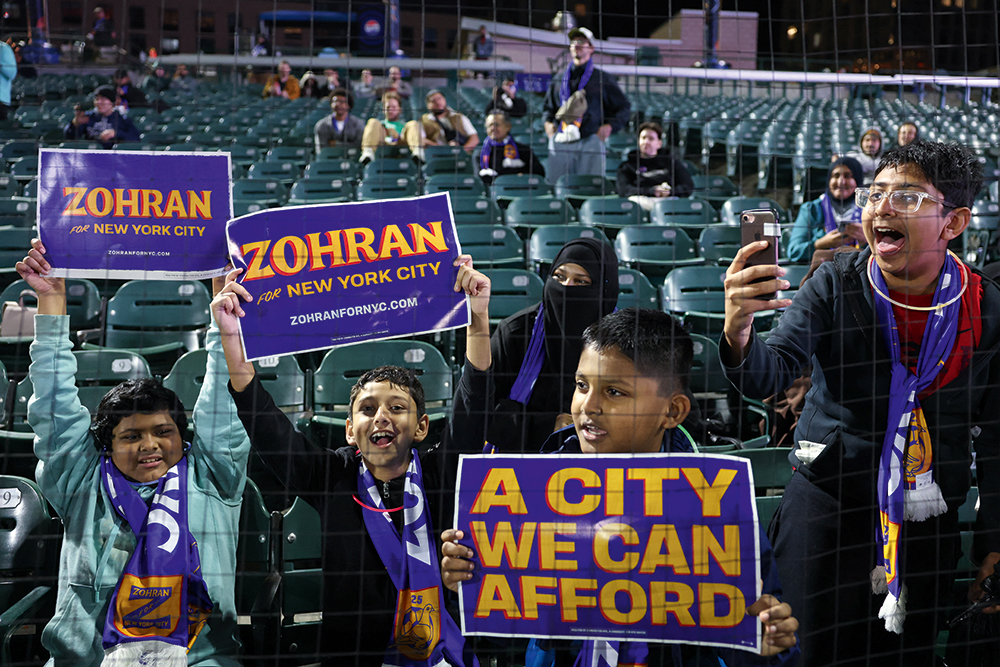
Boys holding campaign posters cheer as Mamdani hosts a ‘Cost-of-Living Classic’ soccer tournament in mid-October (Getty)
But Mamdani has no intention of getting vagrants off the streets. He opposes involuntary commitment, conceding only that it should be the “last resort” a city takes. We are already long past that last resort. It must now be the first resort.
So far, Mamdani’s policing and vagrancy ideas are a retread of failed policies. His one new idea serves only to drive home how cut off he is from any connection to reality. The New York subway system contains abandoned retail spaces tucked into stair landings and on platforms. These erstwhile shoe stores, watch-repair stores, electronics outlets and takeout stands were wiped out by the Covid lockdowns and rising crime. Mamdani would turn those empty spaces into homeless drop-in centers. You would no longer face a chance of being accosted by a mentally ill vagrant as you tried to get to work – in many stations, you would be all but guaranteed such an encounter.
Fight the 1 percent! Mamdani estimates that his free buses, free childcare, taxpayer-funded public housing expansion and other goodies will cost an additional $10 billion a year. (That $10 billion – nearly 10 percent of the city’s existing $111 billion budget – is undoubtedly an undercount.) No problem! It’s about time the rich “pay their fair share,” as Mamdani puts it. The mayor has never seen a high tax rate that does not fill him with envy and longing, if it is higher than what New Yorkers pay. So when he observes that neighboring states allegedly have higher corporate tax rates, he does not see a comparative advantage, he sees a missed opportunity. Any money left in the private economy, whether through insufficiently high taxes or inadequate tax collection, is money that is “being wasted,” he says. It could otherwise be “invested in the future of this city,” according to Mamdani – because, you know, private enterprise does not generate urban growth.
The economies of these neighboring states are even more underperforming than New York’s; they face the same exodus of businesses and residents to low-tax red states. But since private enterprise exists only to generate tax revenue, who cares if it leaves? The resourceful socialist can further raise taxes on the businesses that remain. By hiking New York State’s corporate tax rate from 7.25 percent to that of New Jersey – 11.5 percent – New York City would allegedly capture another $5 billion from the private sector (assuming that corporations in Buffalo would accede to paying higher taxes to subsidize free buses in Gotham).
Then there’s the individual taxpayer. One percent of the city’s residents earn more than $1 million a year. That 1 percent – 34,000 households out of the city’s 3.3 million – pay 48 percent of all income taxes in New York City. They are ditching their fair share, Mamdani alleges. He has never indicated what would be their fair share, but as an interim step toward economic justice, he would add a 2 percent surcharge on the wealthy’s current 3.9 percent income tax rate, to yield an expected $4 billion.
Like many of Mamdani’s promises, his vow to make the wealthy pay their fair share is playacting. He cannot raise city and state taxes unilaterally; that can only be done by the state legislature and governor. To date, New York Governor Kathy Hochul has ruled out further tax hikes. Hochul’s slavish endorsement of Mamdani to prove her progressive street cred, however, is a worrisome sign of a possible future rapprochement.
Likewise, Mamdani cannot unilaterally freeze rents or liberate downtrodden bus riders from having to pay for a service. What counts, apparently, is that his intentions are “good” – however the socialist credo defines goodness. And by voting for him, New Yorkers have proven that they, too, are good and that they oppose Republican, and especially Trumpian, greed and injustice.
Running the Leviathan that is New York City government is not an ideological project, it is an enormous management challenge. Mamdani’s assembly staff in 2021 consisted of four women. He will now be overseeing a 300,000-strong public workforce and thousands more private and nonprofit contractors. Putting him at the top of Gotham’s government is like parking someone who cannot read music in front of an orchestra and expecting him to conduct Stravinsky’s Rite of Spring.
It took an urban-governance revolution to wrench New York from decades of squalor. That revolution borrowed management techniques from the private sector: measuring results, holding officials accountable and paying contractors for performance, not effort. Mayor Rudolph Guiliani’s City Hall (1994 to 2001) measured and monitored everything. First deputy mayor Joe Lhota got a briefing book every morning with performance data from the day before: what crimes had happened? How much trash had been collected and what was the condition of the streets? If Lhota saw graffiti on his way to work, he would make a call to have it immediately removed. If it was still there the next day, heads would roll.
As Giuliani cleaned Times Square of prostitutes and porn parlors, as he evicted squatters from Tompkins Square Park and other anarchist havens on the Lower East Side, the New York Times and other mainstream outlets started asking plaintively if New York was losing its “grit.” Midwestern families, instead of pimps and drug dealers, were now walking around Times Square at all hours of the night. The Crossroads of the World had been reduced, in progressive eyes, to a horrifying “Disney theme park.” Graffiti, litter, disorder – these are all signs of authenticity to a progressive, if he even notices them at all.
Mamdani surely will not. Even if he did, it would be a miracle if he had the leadership skills to do anything about the rising entropy. The overgrown college student takes for granted all the miracles of affluence and the centuries-long evolution of private institutions and public stability that undergird his privileged lifestyle. Mamdani may think that those are eternal and inevitable aspects of the world. The city will learn under his leadership that they are not.
This article was originally published in The Spectator’s November 10, 2025 World edition.
The Whitney’s Sixties Surreal is not about Surrealism. I spent about a week trying to figure out what it might actually be about, before I gave up. The show claims to seek to answer a simple question: what if Surrealism, rather than Cubism, had been the dominant thread in modern American art? This is funny to me, as Dalí’s melting clocks are far better known in America than any Cubist painting. Regardless, the museum never provides an answer. Instead, the Whitney jumps right to its agenda: reviving what it deems an overlooked thread of countercultural art. Ah, yes, the woefully neglected subject of… counterculture in the 1960s.
The museum director, Scott Rothkopf, writes that the show was inspired by his undergraduate thesis, which makes sense, because it feels like one – big on ambition but lacking ammunition. There is a rich story to tell about the impact of the original Surrealists on American artists of the 1960s. Both groups responded to worlds in flux by embracing the absurd. But the Whitney hardly makes this point. Rather than stage a conversation between the two movements, the curators assembled a meandering roll call from the art-historical sidelines. The result is a show curated like a thrift store – a hodgepodge of art whose only commonality is having been left behind.
Much of the art is garish and facile – seemingly selected for the sort of maximalists who would hang a gemstone-studded rhinoceros head above the fireplace. The erect penises on a Vietnam battlefield of Judith Bernstein’s “Vietnam Garden” (1967) offer no more insight than a Sharpie drawing on a bar’s bathroom stall. Peter Saul’s faux-graffiti nightmare “Saigon” (1967) invites little engagement beyond, “Whoa that’s trippy, man” – that and “How many penises can I find in this painting?”
The image that’s on every ad for the show, Linda Lomahaftewa’s “Untitled Woman’s Faces” (1965-71), merges colorful faces with mountains in a way that might be jarring if you hallucinated the scene while on DMT, but it feels totally tame painted on a canvas. The problem with these extravagant approaches to the “surreal” is that the world has not turned into a Seussian nightmare in the way the artists prophesied. To the extent that it has, the decay is much more subtle. Democracy crumbles into autocracy bit by bit, not all at once. The digital technology that we bemoan today for dulling life was accepted gradually and was at one point lauded for its innovation. Art seeking to portray the insidious perils of blindly trusting “progress” should capture such uncanny shifts.
The best works in the show are the most careful – they take the real world as a point of departure and make slight changes that subvert our expectations. One example is Gunvor Nelson and Dorothy Wiley’s short film “Schmeerguntz” (1965). Set to the soundtrack of Bach’s “Little” Fugue in G Minor, the black-and-white montage runs through scenes modified with very simple editing to make them even more disgusting: vomit going backward into the mouth; a close-up of hands picking coagulated wet hair out of a drain.
Rupert García’s “Unfinished Man” (1968) is similarly disturbing. A man’s face, painted in grayscale, is cut off in the middle like a webpage that didn’t finish loading. The bottom half is a gaping mouth, implying that the top would be looking up and begging for mercy. The viewer is left to imagine the horror.
My favorite room in the show is grouped under the theme “Assembling.” It comprises works of art made from junk. Jack Smith’s film “Scotch Tape” (1959-62) shows him climbing around a mountain of trash, which calls our attention to the immense masses of byproducts we produce simply by being alive – enough to make a jungle we can get lost in.
Melvin Edwards’s “Cotton Hangup” (1966) dangles precariously above our heads – a slab of metal resembling a blade beckons your neck like a guillotine as if the scrap metal we discarded is back for revenge.
The gallery titled “Mojo Secrets” is another success. Every artwork in the space resembles a spiral of some kind – as in Robert Smithson’s drawing of a cyclops or in Carlos Villa’s abstraction of feathers. The patterns are hypnotic and illusory – both destabilizing and addictive to stare at. The lynchpin of the room is Betye Saar’s “Ten Mojo Secrets” (1972), a stele decorated with trinkets and charms that evoke voodoo worship. With its dark purple walls, the room provokes the same feeling I get when someone makes me listen to a horoscope: I know it’s hokum, but what if it’s not?
There are genuinely striking and provocative objects in the exhibition, but they are better served solo. With the exception of two good rooms, most of the show’s groupings raise more questions than they answer – and the connections that the wall texts suggest don’t make much sense. But, then again, it wouldn’t be so surreal if they did.
This article was originally published in The Spectator’s November 10, 2025 World edition.
Unwitting historians often reveal just as much – if not more – about their own time and place than the time and place they claim to describe. The curators of Spectrum of Desire: Love, Sex, and Gender in the Middle Ages, a new exhibition at the Met Cloisters, are prime examples. Gathering manuscript illustrations, paintings, sculptures, jewelry and more from the 13th to 16th centuries, the exhibition promises to uncover “the hidden sexuality and sensuality of medieval art.” The intent is “queering the past,” and the objects were chosen to show expressions of “desire” in as many forms as possible – a saucy premise that appeals to contemporary trends. But many of the new interpretations range from the woolly to the laughable.
The show aims to “uncover new meanings but also make way for moments of ambiguity.” Ambiguity is the keyword. One of the first pieces is a tiny illustration of a young man gazing at his reflection in a pool of water, from a 14th-century French manuscript of the allegorical courtly love poem Roman de la Rose. The image may be of Narcissus, as the label claims, or it may actually be Amant, the poem’s narrator, who in his dream stumbles upon the Fountain of Love where Narcissus perished. He thus risks succumbing to a similar fate. Does this image of a man admiring his own face really “hint at homoerotic longing,” as the display text suggests, or is it rather a warning against self-obsession and excessive pride?
Later on, we see two illustrations of female saints, Wilgefortis and Marina, taking on the appearance of men. While the exhibition seems to interpret these examples in light of modern ideas about gender fluidity, their hagiographies reveal they were acting out of self-preservation, not personal expression. Wilgefortis, pictured bearded on a cross, asked God to make her ugly to escape a forced marriage to a pagan; her father crucified her for this disobedience. Marina, in a 15th-century Belgian manuscript of The Golden Legend, is shown in monk’s dress. As she had no family apart from her father, the text says, she joined him at a monastery in disguise as “Marinos,” a ruse she kept up after his death. In the harsh late-antique world, it isn’t hard to imagine why a kinless young woman might think it prudent to conceal her identity while taking refuge in an all-male residence.
There are some genuinely transgressive pieces displayed that were likely to have been judged acceptable to their medieval owners only because they depict legends set in a pre-Christian past. We see a multicolored 15th-century Venetian glass goblet illustrating the violent apocryphal tale of Virgil, here a poet-sorcerer, and a Roman princess, Febilla. After being publicly humiliated by the maiden, Virgil extinguishes all light in the city and fills her with hot coal. To relight their candles, the villagers are pictured queuing up to insert them into her… use your imagination (or, preferably, don’t), as blood streams down her legs. A 14th-century French tablet depicts the same scene in carved ivory, only here Febilla has a wry smile, indicating the scene is meant to be taken as a dirty joke.
High points are the detailed saddle inlaid with bone and boxes made of ivory and embossed leather, which show scenes of courting couples, including a woman offering a belt to a man and another running a comb through her lover’s hair. Decorative examples of combs are displayed nearby. Giving a comb suggested a special intimacy, as a woman’s hair would only be loosened in private. (The catalog tells us that delousing a loved one’s scalp was a way of showing affection in a time of plague and pestilence.)
The insistence, however, on sexualized readings of artworks depicting suffering holy figures is tiresome and tells us a lot more about the preoccupations of the curators than the intentions of the artists. For example, in a late 14th-century devotional oil panel by the French painter Jean de Beaumetz, once hung in a monk’s cell at the Carthusian monastery at Champmol, we see a sickly looking crucified Christ with copious amounts of blood dripping over his body. His head flops down pathetically, lips tinged with gray. To suggest, as the wall text and catalog do, that such an image could inspire “impure thoughts” on account of its “diaphanous loincloth,” without evidence, is to accuse its monastic viewer of harboring a state of mind so dark the accusation feels libelous, even today.
There isn’t space here to delve into the improbable suggestion that solemn wooden sculptures of the Virgin Mary and her cousin Elizabeth, and of Jesus and John the Evangelist, allude to same-sex desire only on account of their right hands clasping, a gesture associated with betrothed couples. You-know-what sells, I guess, so you can’t blame anyone too much for trying to spice things up at the Met’s medieval outpost. In the age that birthed chivalric romances and courtly poetry, artists hardly shied away from portraying desire – but this exhibition spends too much time looking in the wrong places.
This article was originally published in The Spectator’s November 10, 2025 World edition.
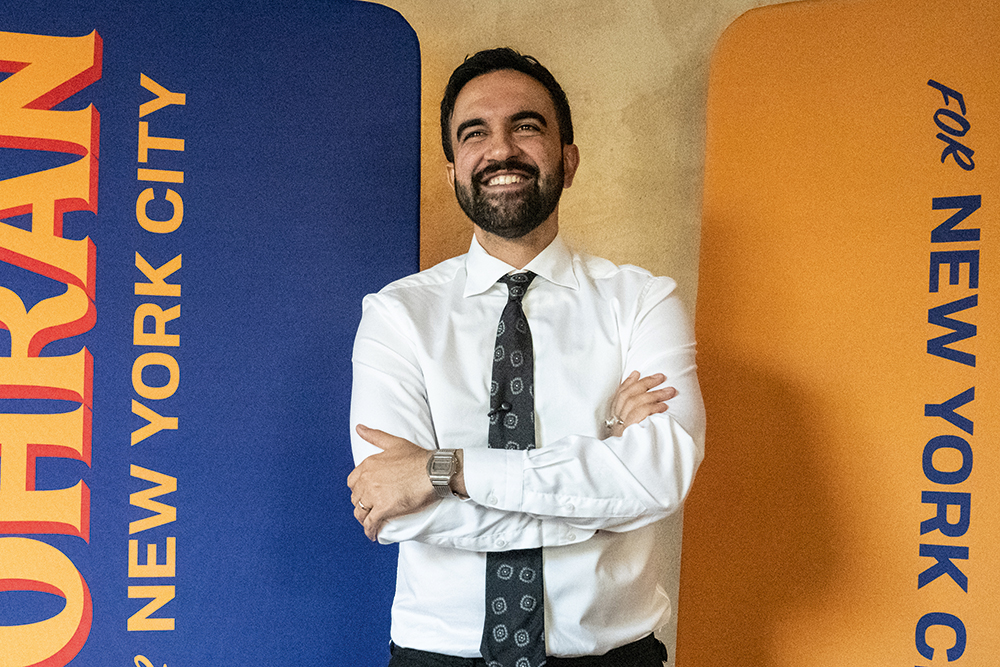
Zohran Mamdani is the mayor-elect of New York City, and the progressive wing of the Democratic party is Champagne drunk celebrating his ascension.
But should it be? Mamdani has only narrowly prevailed in a race with a clear spoiler candidate, Republican Curtis Sliwa, lead-blocking for him against a charmless opponent, former governor Andrew Cuomo. With tougher, more honorable competition, it’s possible – likely, even – that he may not have even made it to the general election, much less won it.
Only when compared to a corrupt, sleazy, nepobaby with blood on his hands, and a beret-clad, narcissistic cat-man whose own friends begged him to step aside, did voters view Mamdani as a much-needed alternative. Both the Republican and Democratic establishments in New York have much to reflect upon – and atone for. Mamdani’s victory is less a ringing endorsement of his agenda than it is an indictment of the lazy, complacent power brokers to whom he’s meant to be a middle finger.
Moreover, while he may scratch every neurotic, fanciful itch to plague his party’s radical base, Mamdani’s mayoralty will most assuredly prove a failure. And on a scale that neither the nation, nor even the Democrats, will be able to deny.
The tragedy of it all, though, is that for the country to avoid falling into the hands of an explicitly anti-American socialist, its greatest city will have to do just that. For New Yorkers, it’s difficult to imagine Tuesday night’s results yielding anything but pain, and, indeed, suffering. Four years ago, Eric Adams swept into office amid not only the Covid-19 pandemic, but the crime epidemic that accompanied it. The intervening years have seen a partial recovery, with significant decreases in some of the most important categories.
Mamdani threatens to reverse what progress has been made. In 2020, amidst the pandemic crime wave, he declared that “police do not create safety,” and “actually create and amplify violence,” even going so far as to suggest that non-cops should be the ones to respond to domestic violence calls. In other comments, Mamdani smeared law enforcement as “racist,” “wicked,” and “anti-queer,” lamented the “boot of the NYPD” on residents’ necks, and reveled in officers’ tears.
The mayor-elect may have tacked to the center and apologized to the NYPD during his campaign, but the sheer number of prior statements expressing his vitriol in no uncertain terms suggests that his backtrack was one borne of convenience rather than a genuine change of heart. Not only can New Yorkers expect Mamdani to implement policies that will leave them and their loved ones less safe, but his presence in Gracie Mansion will send unmistakable messages to police and criminals alike – with terrible consequences.
Similarly, while Mamdani has succeeded, in large part, thanks to his focus on affordability, his agenda in action will make life anything but. Price controls have failed anywhere and everywhere they’ve been tried, but that hasn’t stopped Mamdani from touting them as the fix for the city’s housing crisis. What else? How about free transit and childcare, a ludicrous minimum wage hike up to $30 an hour, and, get this, city-owned and operated grocery stores.
These heavy-handed interventions into the free market, which are meant as stepping stones toward a seizure of the means of production, if Mamdani himself is to be taken at his word, are sure to have the exact opposite effect they’re meant to. It has been said that a rising tide lifts all votes. By driving wealth out of the city and punishing that which remains, Mamdani will lower the tide to the detriment of every boat on the Hudson, from the most magnificent yacht to the smallest dinghy.
New York’s fall is a moral one, too, of course. It isn’t just a city in America, it’s a symbol of it. Alas, there is little sign Mamdani has anything but resentment for his adopted country or the values for which it stands. Hence his shameless photo-ops with an unindicted co-conspirator of the 1993 World Trade Center bombing, and a far-left influencer who believes the United States had 9/11 coming.
And all of that is to say nothing of his undeniable sympathy for Hamas, or his obsessive hatred for the world’s Jewish-majority state, about which he has articulated conspiracy theories worthy of the Protocols of the Elders of Zion.
So yes, New York has fallen, but not permanently. The good news is that David Dinkins and Bill de Blasio’s disastrous tenures both led to furious, righteous backlashes, and so too will Mamdani’s.
The better news is that Mamdani’s shortcomings will serve as a warning system for the nation.
The closest parallel to Mamdani on the national stage, Representative Alexandria Ocasio-Cortez, lives in his city. Both rose to national prominence inside of blue bubbles where progressive politics are not just popular, but required. Both have proudly claimed, rather than run away from, the dreaded “socialist” descriptor. Both have been praised for their communications skills and social media strategies. And both defeated avatars of a complacent – even stultifying – Democratic establishment on their way to victory.
Ocasio-Cortez is among the early favorites in the 2028 Democratic primary, and was a vocal backer of Mamdani’s campaign. Ironically though, she may end up a victim of his success.
For the better part of a decade now, Ocasio-Cortez has been able to skate by as a congresswoman – one of 435 – whose unpopular, destructive ideas are never actually put into action. Now, those ideas will take centerstage as New York plays the role of a lab rat seemingly blissfully unaware of the toll the experiment took on its forerunners, let’s call them San Francisco and Chicago.
America as a whole is seemingly next up, but will have every opportunity to opt out after surveying Mamdani’s handiwork.
So enjoy that Champagne tonight, progressives. It isn’t the kind that ages well.
Americans head to the polls today, with gubernatorial elections in Virginia and New Jersey and mayoral elections in New York City and Minneapolis. The races are being talked of as an early test for Trump, a bellwether for the public mood after a breakneck ten months back in the Oval.
A qualifying remark. Each of these races are taking place in traditionally blue cities and states – Virginia has not voted for a GOP presidential candidate since 2004; New Jersey since 1988; Minnesota since 1972. Still, these places – even New York – trended strongly purple at the last election; in this sense, today’s elections will be a test of the so-called “vibe-shift” and its extent.
On the other hand, back in 2021 the success of Glenn Youngkin’s gubernatorial bid in Virginia was said to be a bad omen for the new Biden presidency. Serious reversals in what can still be called Democratic strongholds would likely throw the party into renewed crisis.
Virginia
In the Old Dominion, Republican Winsome Earle-Sears takes on Democrat Abigail Spanberger for the governor’s mansion. As Margaret Mitchell has noted, the issues that carried Youngkin’s candidacy – such as critical race theory and transgender bathrooms – are not nearly as salient as they were in 2021, with much of this agenda having since been rolled back. In this sense, Earle-Sears is a victim of the right’s broader success. In their absence Virginia politics is now returning to its default mode: as a state dominated by government and government-adjacent employees concentrated in “NoVa” (Northern Virginia) – fertile ground for the former CIA officer Spanberger. RealClearPolitics’s poll of polls has her leading by around 10 points.
Meanwhile, the race for the state’s Attorney General has achieved a rare national prominence due to a scandal involving the Democratic candidate, Jay Jones. Last month it was revealed that in 2022 Jones had, in a series of texts and calls to a GOP colleague, called for the deaths the then-Virginia House Speaker Todd Gilbert as well as his children. Polls have Jones and the Republican incumbent Jason Miyares neck-and-neck.
Polls close in Virginia at 7 p.m. ET, with most precincts expected to report by 9-10 p.m.
New Jersey
Republican Jack Ciattarelli is having another tilt for the governorship after coming within 3 percent of victory back in 2021 – this time against Democratic Congresswoman Mikie Sherrill. New Jersey is probably the most promising prospect for the GOP tonight: the state only plumped for Harris by 6 percent – an unthinkable margin ten years ago. A Republican in the governor’s mansion of this stalwart blue state would be a major endorsement of the President’s agenda. RealClearPolitics’s poll of polls has Sherrill leading by 3.3 percent.
Polls close in New Jersey at 8 p.m. ET, with most precincts expected to report between 10 p.m. and midnight.
New York
Easily the most prominent of today’s contests, the race for the New York mayoralty has become a proxy war for the future of the Democratic party, with millennial socialist Zohran Mamdani unexpectedly beating hoary old Andrew Cuomo to the nomination, who is now running as an independent. If Mamdani wins, as the polls still suggest he will (despite narrowing considerably in recent days), then this will represent the first triumph for the American hard left since Bernie Sanders’s victory in the Nevada primary back in 2020.
There’s also the perennial Republican candidate Curtis Sliwa, whose homespun manner and trademark red beret (the uniform of the “Guardian Angels” neighborhood watch, which Sliwa founded in 1979) has won him a devoted following. Donald Trump has, however, chosen to endorse Cuomo as the best chance to ward off the socialist tide. RealClearPolitics’ poll of polls has Mamdani on 46.1 percent, Cuomo on 31.8 percent, and Silwa on 16.3 percent. The Mamdani camp is said to be feeling bullish amid reports of record youth turnout.
Polls close in New York City at 9 p.m. ET, with a projection expected at 1 a.m.
Minneapolis
Another intra-Democratic scrap in Minneapolis, where the hard-left Omar Fateh seeks to oust Jacob Frey – who, as you may remember, played a key role in the events of summer 2020 after the death of George Floyd. Fateh was endorsed by the Minneapolis branch of the Democratic-Farmer-Labor (the local Minnesotan chapter of the Democratic party), but the endorsement was revoked in August amid claims of electoral skulduggery by the Fateh camp at its convention. Another complicating factor is that Minneapolis uses a ranked-choice voting system, meaning that – unlike Mamdani – Fateh cannot rely on division among the non-socialists to win.
Polling for this race has been scant, but a recent survey found that 51 percent of city residents had an unfavorable view of Frey.
Polls close in Minneapolis at 9 p.m. ET, with a projection expected between 11 p.m. and midnight.
Is Maud Maron crazy? Bill Ackman certainly thought the Republican candidate for Manhattan DA was, she tells me, when she asked him for $2 million. While the billionaire hedge fund CEO said he could easily raise the money she needed to fund her campaign in a single night, ultimately he chose not to – and instead focused on backing Andrew Cuomo for mayor.
Ackman thought “oh, she’s a nice lady, but she’s crazy,” Maron recalls. “She’s running as a Republican in a Democratic city.”
Fast forward six months and Cuomo is on the brink of losing to Zohran Mamdani – and Ackman has cast a vote for Maron, who he now calls “great.”
“I’m not crazy, I’m just ahead of the curve,” says Maron, a former public defender “And I am trying to find the least obnoxious way to say ‘I told you so’ to all of the big donors in New York.”
Maron is fighting an uphill battle of her own against current DA Alvin Bragg. The Democrat is expected to win. But she contends that it is Cuomo’s anticipated loss that should change Republican calculus in the city – and end the failed strategy of always backing the least worst Democrat.
As a recent candidate herself in two Democratic Congressional primaries, Maron knows about New York Democrats. But her critical view of DEI (for which she was called a “racist”), of trans issues (on which she said “any dude who feels like a woman is supposed to be treated like a woman – that’s absurd”) and staunch support of Jews (over which she was suspended from her post as parent council president for criticizing a letter that defended October 7) put her out of step with the party that has been captured by its progressive wing. She was beaten on both occasions and switched teams.
Those losses, combined with Cuomo’s expected defeat, augur well, Maron argues, for Republicans.
“Donors in the past have put in a lot of money to convince Republicans to register as Democrats because they thought the Democratic primary decides the election. But if you felt like your vote would count whether you were registered as a Democrat or a Republican, you would see an exodus from the Democratic party.
“Cuomo has already started that process by standing as an independent. Once you get people to say ‘I’m not just going to vote straight Democrat, I’m going to go listen to both candidates and see who’s better,’ then there’s a vote to be gotten.”
That the blue and red tectonic plates have shifted is beyond doubt with a certain New Yorker now residing in the White House and with the very real prospect of a Republican moving into the Governor’s mansion in neighboring New Jersey for the first time since 2013. The most recent polls show a dead heat between Democrat Mikie Sherrill and Republican Jack Ciattarelli.
“Trump won all seven swing states and the popular vote really just by turning up and talking to people. Republicans win where Republicans show up and fight with some money and some infrastructure, that’s what we see in New Jersey too.
“And there’s something going on with the Democrat party. There’s a switcheroo happening where working class people are now finding themselves more drawn to and represented by the Republican party. You saw it with Robert F. Kennedy and Tulsi Gabbard joining the Trump campaign. There’s a lot of Democrats out there who want something better than what the Democratic party is offering right now, which is far left extremism.”
But why should anyone listen to – let alone donate $2 million to – a candidate who is likely to lose on November 4 to a District Attorney so bad that the conviction rate has fallen every year since he took over in January 2022 and now stands at just 35 percent?
“Far left progressive prosecutors are winning because big donors like George Soros are funding the Democratic Socialists of America. But the backlash has started: Chesa Boudin was recalled in San Francisco and George Gascon was voted out of Los Angeles. When enough voters see what extreme leftism looks like in practice, they’re ready for an alternative.
“Republicans need to copy the DSA because they did a really smart thing. They invested a ton of money and recruited candidates when nobody took them seriously. You have to show up and you need money and you need infrastructure. In New York, that just has not been happening.
“As a Republican I haven’t been able to raise the millions of dollars that you would need to have a real fighting chance.” In the end Maron raised $500,000, still four times more than the last Republican DA candidate.
The further left the Democrats track, Maron says, the greater the opportunity for Republicans.
“Moderates can’t win in the Democratic primary, that’s why we have Mamdani. Democrats have lurched so far to the left because every single Democrat in office is worried about a challenger from their left. So they all tack left with their loony legalized prostitution, legalized marijuana, safe injection sites, they don’t arrest people for jumping the turnstile or beating up a cop. They are not worried about a challenger from the Republican party.”
Maron laughs at the thought of standing for mayor herself – “not a job I’m after” – and says the city needs another Michael Bloomberg. “I don’t think Curtis Sliwa will run again. New Yorkers won’t be put off by voting Republican if it’s somebody like Bloomberg who knows how to run things and turn things around.”
Politics is a contact sport these days, which is perhaps one of the reasons Maron, a mother of four who lives in Manhattan, wouldn’t seek the mayor’s office. Recently her nine-year-old son asked her why people were calling her racist. “It can get kind of nasty sometimes. But it does make the kids a little bit tougher and stronger.”
Maron predicts that under Mayor Mamdani “New York is about to have a rude awakening.” But, if her analysis is correct, when the contest is held again in four years time the Big Apple will be also low-hanging fruit, ripe for the plucking by Republicans.
Of all the people to go as for Halloween, why would you choose Bill de Blasio, an undistinguished Mayor of New York and flame-out 2020 presidential candidate?
That’s a plausible explanation for the recent howler from the Times of London – Great Britain’s newspaper of record – whose veteran US correspondent Bevan Hurley quoted a man identifying himself as de Blasio on his misgivings about Zohran Mamdani.
“While the ambition is admirable, the cost estimates – reportedly exceeding $7 billion annually – rest on optimistic assumptions… about eliminating waste and raising revenue through new taxes,” this total imposter told Mr. Hurley, with strange eloquence. “In my view, the math doesn’t hold up under scrutiny, and the political hurdles are substantial.” With a seasoned newsman apparently under his spell, the fake de Blasio could have plausibly put any words he wanted to into the former mayor’s mouth – like, say, an endorsement of George Wallace. How strange that he limited himself to a thoroughly centrist spiel on fiscal credibility.
All the same, Hurley must have thought he’d happened upon the scoop of the year: a left-populist denounces another left-populist days before an election. Hence, perhaps, the haste to get the story out, which duly appeared on the Times website at 4 p.m. ET Tuesday.
Mayor de Blasio was indignant. On X he declared that he was “appalled” by the story, which was “an absolute violation of journalistic ethics.” Tell Cockburn what you really think! The Mamdani campaign now seems more or less unstoppable, hence this slightly frantic attempt on de Blasio’s part to prove his loyalty to the candidate he’d endorsed.
Hurley’s article was quickly deleted (though an archived version remains online). Cockburn notes that it’s traditionally been easy for foreign correspondents in America to bluff their way around on the strength of their accent; we may have just witnessed the first ever case of the opposite.
About half-way through the one-woman show Unstuck, the American comic Olivia Levine admits that it’s “hip” to talk about one’s obsessive-compulsive disorder.
She’s right. In Unstuck – which tracks Levine’s at times paralyzing battle with the illness – Levine is following a well-trod path, seen on many a movie and television show. The OCD character can’t stop counting or washing their hands or looking over their shoulder. Often their symptoms are played for laughs or sympathy or to showcase their weird but essentially charming quirkiness. Rarely is the more menacing side of OCD shown.
Levine is here, then, to disrupt the stereotypes and, with humor and likability, discuss the symptoms that are less often depicted in media. It’s not hard to see why. Before Levine even had language for her condition she was compulsively masturbating in public. She became obsessed with intrusive thoughts of her parents dying and of intruders entering her home. At one point she thought that she might impregnate her own mother by sharing a bathtub; she believed that fecal smears in her underwear would kill those around her.
The only way to calm such intrusive thoughts was to commit to certain mental or physical actions in irrational rituals – compulsions. For example, if Levine used hand wipes and sanitizer in a certain order before pulling up her jeans in the exact same way each time she went to the toilet, she could mitigate her death-causing undies. Needless to say, OCD is a plague for the person experiencing it (and often for those close to them, too).
Written by Levine and directed by Molly Rose Heller, Unstuck played at the Edinburgh Fringe last year and is currently on at the SoHo Playhouse in Manhattan. While advertised as stand-up, it’s more of a scripted monologue. And therein lies its strengths – in educating the audience about a wildly misunderstood illness – and its weakness. It can all feel a little too rehearsed.
Levine is an agreeable host: she reminds me of a sweeter, less acerbic Hannah Horvath from Lena Dunham’s Girls. Hannah also suffered from OCD (as does Dunham) and the depictions of the illness in Girls were also frank and unglamorized. While Hannah does do counting, she also admits to compulsively masturbating. Yet Hannah is a wildly original and true to life character, brilliant in all the multitudes that she contains.
In Unstuck, Levine is simpler. I wanted to root for her – and I did to some extent. But I found her show too scripted, too performed, and too predictable. An unnecessary voiceover projected from above the stage –which presumably was meant to represent her intrusive thoughts – didn’t help. The presence just felt pat, rather than disruptive.
Levine is self-aware enough to understand that she is asking us to rethink OCD’s “hipness,” while also benefiting from its grasp on the common consciousness by putting on her show and asking audiences to come. But she relies too heavily on “shock” jokes that have been in circulation since The Vagina Monologues and Sex and the City blasted into our consciousness in the 1990s: a stream of talk about vaginas, wetness, flaccid penises, sex and shit is no longer revolutionary; it’s yawningly predictable.
I wanted less vagina, more actual vulnerability. Unstuck gives a small window into a debilitating disorder; it educates and informs. But, despite all the apparent self-exposure, it felt that Levine – the person, the performer – was always holding a part of herself back.
New Yorkers received visits from two ghosts of Christmas past and one ghost of Christmas present at its last 2025 mayoral debate on Wednesday night. Republican nominee Curtis Sliwa and champion of himself Andrew Cuomo lobbed Grumpy Old Man insults across the stage at each other while Zohran Mamdani stood center stage, fresh and gleaming, deflecting blows and acting with all the confidence of a football team that has a three-touchdown lead at the two-minute warning. The historical turn, potentially tragic, that will lead to the Democratic Socialists taking over America’s largest city, is reaching its conclusion, and there won’t be a final twist.
Sliwa, who won’t become mayor in this or any other reality, offered passionate proposals to reform the housing-court system and to protect New York’s forgotten animals. If cats and dogs could vote, Sliwa would be a shoo-in. He played the populist card in his opening, saying “it’s us versus them, it’s us versus the insiders and the billionaires. It’s us versus Cuomo, it’s us versus Zohran. We’re not going to be silenced any more, we’re going to fight.”
Cuomo spent most of the night deflecting attacks on his now-settled sexual harassment allegations, on his mishandling of the MTA in the summer of 2017, and on his disastrous policies in the early days of COVID that led to the deaths of thousands of elderly New Yorkers. He countered by saying that if (when) Mamdani wins, Donald Trump will be running the city. “He has said he will take over New York if Mamdani wins, and he will. He thinks Mamdani is a kid and he’ll knock him on his tuchus.”
Mamdani said, “My opponents, who spend more time convincing each other to drop out, speak only of the past, because that’s all that they know. I am the only one who speaks to the future of the city.”
He had a point. At times, the debate was like watching a community-theater production of The Sunshine Boys. One of the moderators even said, at one point, as Sliwa and Cuomo carped at each other over some ancient issue that even they barely understood, “we’re going to stay in this century, guys.”
The three candidates debated housing issues, transit issues, policing issues, education issues and various finer points of New York policy that matter to me only marginally, because I live in a state with no income tax in a city recently named the most-affordable housing market in the United States. Not my movie. But antisemitism is my movie, so my ears perked up substantially when the candidates started debating the “Jewish question” like this was Berlin in 1931.
“I will be the Mayor who doesn’t just protect Jewish New Yorkers, but also celebrates and cherishes them,” said Mamdani, who hundreds of rabbis denounced this week.
“Not everything is a TikTok video,” said Cuomo. “You’re the savior of the Jewish people? You won’t denounce ‘Globalize the Intifada,” which means “kill Jews.” Sliwa, who apparently has Jewish children, said they view Mamdani “as an arsonist who fanned the flames of antisemitism. You’ve got a lot of explaining to do, a lot of apologizing to do.”
Mamdani said he has never once “spoken out in favor of global jihad” and said that criticisms of him were, in fact, Islamophobic. “New York deserves a leader who takes antisemitism seriously, not one who weaponizes it to score political points.”
Mamdani, who has an uncanny ability to wriggle out of tough spots, has run a slick campaign, but he’s also been fortunate in his choice of opponents. Sliwa is a quintessential New York tough-guy character, and might even be a good mayor if given a chance, but he’s also extremely goofy and there’s no way liberal New York will elect a Republican populist mayor in the age of Trump. And Cuomo is perhaps the most flawed candidate in a generation. This attempt to revive his political fortunes, given the disgraces he suffered earlier in the decade, has been a pathetic display of hubris. He touted himself as the candidate of “experience,” which led Mamdani to say,
“We have all experienced your experience. We have experienced you taking a five million dollar book deal while sending seniors to their death in their nursing homes. The Issue IS your experience.”
This debate was the last bellow of Boomer New York. The ghosts of Christmas past are vanquished and the Free Palestine Gen-Z TikTok kids are taking over. Winter is coming. To paraphrase Tiny Tim, God help us, everyone.