Tag: Nigel Farage

  • Fact check: are the NYT’s experts right about UK immigration?

    Fact check: are the NYT’s experts right about UK immigration?

    Yesterday’s release of immigration figures by Britain’s Office of National Statistics didn’t make for particularly pleasant reading. While net migration had fallen to around 200,000 in the 12 months to June, much of this was down to an unusually high exodus of people, with 693,000 leaving the country over the same period. Many of those leaving were under the age of 30.

    That news, however, seemed to prompt something approaching gloating over at the New York Times, which published a piece yesterday headlined: “The British Public Thinks Immigration Is Up. It’s Actually Down, Sharply.” To labor the point, the piece was accompanied by a picture of anti-migration protestors in Scotland. The not-so-subtle subtext being: what a bunch of gammon thickos the anti-migration lot are in the UK.

    The piece went on to chastise Home Secretary Shabana Mahmood, saying her “fiery rhetoric does not entirely match the reality” of migration, as well as Nigel Farage, Kemi Badenoch and the British public at large:

    Britain’s political elites are focusing the public’s attention on migration in ways that are not always accurate, especially when it comes to describing the scale of the flow of people into the country, experts say. That is helping to create a gap between how people perceive immigration in Britain and the facts.

    Hmmm, what are the facts though? And do they actually match the NYT’s version of reality?

    When you strip away the net migration figures – which are influenced by people leaving the country – and look at immigration alone, you perhaps get a clearer picture of the situation.

    The NYT rightfully mention that immigration was down last year from 1.3 million to around 898,000. But it rather neglects to mention the fact that this is still stupendously high in the history of the British Isles. It only looks like a sharp fall if you compare it to the peaks of 1.4 million in 2023.

    In fact, if you don’t count the Boriswave surge in immigration post-2020, last year would have been the highest recorded immigration since records began.

    In other words, it looks like the British public are far more in tune with the realities of immigration than the so-called experts advising the US paper of record.

    It looks like it’s gammons 1 – NYT 0.

  • What the UK can learn from Trump’s second term

    What the UK can learn from Trump’s second term

    When John Swinney, the Scottish National Party leader, and former ambassador Peter Mandelson visited Donald Trump in the Oval Office a few months ago, the President showed them three different models for his planned renovation of the East Wing of the White House, which he has demolished to build a new ballroom. “If you’re going to do it,” Scotland’s First Minister suggested, “you might as well go big.”

    This Wednesday marked one year since Trump’s election victory, and going big captures the essence of his second term – bold and controversial moves, which have impressed even British politicians who thought him reckless in his first term. When Trump visited Chequers, the British Prime Minister’s country residence, on his state visit to the United Kingdom in September, one senior official told him: “You’re the most consequential president of my lifetime.”

    It has not all been decorous. Convention, tradition and the law have been subordinated to delivery. The East Wing redevelopment is a case in point. “When they were bulldozing, they came across some Jefferson-era brick,” explains one White House watcher. “They kept going.” Why tiptoe around the author of the Declaration of Independence when there is a real estate deal to complete?

    And yet the Trumpites see themselves as like the founding fathers, forging a new nation. “The bricks have become trophies,” says one Washingtonian. “It’s like people keeping chunks of the Berlin Wall.” Just as that was torn down, so Trump’s second term, much more radical and (so far) successful than the first, has been one of discontinuity and disruption.

    After speaking to more than a dozen British and American officials, aides to the President and the Prime Minister Keir Starmer, civil servants, former diplomats in both countries, pollsters and political strategists, it is clear there is much that Trump II can teach Britain. In his first term, Trump was held back by staff who didn’t share his world view and the claims of Russian interference in the 2016 election. This year, he issued hundreds of executive orders and successfully brought migration to a halt at the Mexican border. Private polling circulating in the highest reaches of the Republican party shows that even 22 percent of those who voted for Kamala Harris a year ago support what Trump is doing on immigration.

    Those who helped him triumph say Trump II is very different from Trump I, in that he “brought in a team which supports his agenda” and his chief of staff, Susie Wiles, enforced a rigorous policy of loyalty to the President. “In this administration everyone has to be loyal to everyone,” a Washington-based diplomat observes. “There is no infighting, it’s simply not allowed.”

    This unity of purpose and direction has given Trump the ability to “move fast and break things” – and even the British in Washington, who were horrified in 2016, seem energized by his example this time around.

    “Think about the speed at which we’ve been able to move,” says one White House official. “We’ve cut out so much infighting and been able to execute. In the first term a lot of cabinet members thought they should be president. We also found there were a lot of unnecessary layers in the bureaucracy. Now the President gets the right people in the room, and if we need to move fast we will. We didn’t want to be Tony Blair, after a long campaign saying, ‘What do we do now?’ on day one. The President said he wanted the ‘big beautiful bill’ passed by July 4. There was a mentality to get things done. That was very different this time.”

    These are lessons that it is now too late for Labour to learn, after 16 months in power. This is a government that never seemed clear on what it wanted to achieve at the beginning, nor, as things have deteriorated, on what to do next. In Washington, every-one knows what Trump wants. Keir Starmer has been unable to provide similar clarity.

    However, Trump II is providing a blueprint for Reform UK party leader Nigel Farage, another populist insurgent, on how to seize power and then use it effectively in the face of a hostile political establishment.

    Key players in the White House and the MAGA movement say that Farage must be ready on day one, as Trump was, to impose his power on the permanent civil service. That could mean ramming legislation through parliament in a single day to give Downing Street the ability to issue emergency orders as well as immediately publish bills on key issues.

    Dominic Cummings, a chief adviser to former prime minister Boris Johnson, who has discussed how to reshape Britain’s civil service with Farage, wrote on Sunday: “A true strategy needs defined goals, a plan for controlling the government and building a team… It should include writing key primary legislation well in advance of an election.”

    In Trump’s case, key policy proposals were worked up by the Heritage Foundation thinktank and the America First Policy Institute, who also identified people who could be drafted in to work on them in government. “They had hundreds of executive orders ready to go,” says one who admired Trump’s preparations. “Susie Wiles said, ‘The President wants to deliver on migration, tariffs and tech,’ and worked out who could deliver it. She sent Stephen Miller to go after woke stuff and [Robert] Lighthizer to work on tariffs. She sent the attorney general’s office to go after the people who tried to shaft Trump in the first term. The orders went out, the foot soldiers did their thing. It was a masterclass.”

    Asked how Reform UK could prepare for power, Sebastian Gorka, the White House head of counterterrorism, says: “That’s easy. Be even more like President Trump.”

    While curbing migration was a central election pledge, Trump’s more notable achievements have come in the international arena. From the once queasy Europeans there is mostly admiration for the ceasefire in Gaza, and for Trump’s decision to attack Iranian nuclear sites with bunker buster bombs.

    “What they’ve done in the Middle East with Netanyahu and Hamas is pretty impressive,” one British official says. Security sources say the attack did not destroy Iran’s nuclear program, as Trump has claimed, but he has “trimmed them” and delayed them by “a few years.” More importantly: “He’s demonstrated they can do it. The bottom line is that they can do it again – and they will.”

    After months of playing footsie with Vladimir Putin, Trump also seems to have finally lost patience with the Russian President and has moved to impose sanctions. “He’s genuinely putting pressure on Putin now,” a Foreign Office source says. “At Chequers he was so angry at him.”

    Trump told Starmer: “I thought he was a good guy, I thought I could do a deal with him, but every time we agree something his people then renege on it.”

    In many ways, the “special relationship” is in rude health. UK and American sources say Jonathan Powell, officially Starmer’s national security adviser and unofficially the head of UK foreign policy, helped with the substance of the Gaza deal, alongside his old boss Tony Blair, Trump’s special envoy to the Middle East Steve Witkoff and the President’s son-in-law Jared Kushner.

    When Trump hit Russia’s two largest oil companies, Rosneft and Lukoil, he did so just days after Britain sanctioned the same firms. “We were able to give Witkoff a palette of options when the President was deciding what to do,” a senior UK government source says. “And we’re prepared to talk Trump’s language on tariffs.”

    The proto-populist Trump and the cautious, legalistic Starmer are odd bedfellows, but insiders say the relationship is still strong. One witness to their exchanges says, “Keir agrees with him as far as he can and then he’ll say, ‘I disagree on that but let me explain why we see things differently.’ Trump looks at him and listens and says, ‘OK.’”

    Keeping a volatile President on side has been one of the signal successes, if not the signal success, of Starmer’s premiership, but there are some cracks in the paintwork. “President Trump likes winners,” says a Trump aide who follows British politics, “and Starmer is beginning to look like a loser.” On areas of domestic policy Trump has become more outspoken in recent months about what he sees as Britain’s sclerotic economic approach, as well as the failure to exploit energy resources in the North Sea. “The President tore him a new one on this stuff in private at Chequers,” a US official says.

    Among the MAGA fraternity in Trump’s team – including the Vice-President J.D. Vance, Miller and Gorka – there are also concerns that the UK has allowed mass migration to dilute its cultural heritage. All three have an Atlanticist Judeo-Christian concept of western civilization in which American democracy stands in a direct line of descent from Magna Carta, the rule of law and trial by jury.

    Vance has spoken about the erosion of free speech in Europe. Miller is urging British officials to limit migration, as America did between the 1920s and 1970s, to allow new arrivals to be properly integrated. He sees Islamist imports from the tribal areas of Pakistan as a cultural challenge Britain will need to deal with. They cite the fact that the FBI was set up to combat the Mafia, who along with millions of Italian migrants arrived in the US in the 19th century. This is uncomfortable territory for many in No. 10, but one senior figure says: “If your friends are telling you something out of concern, then perhaps we should listen.”

    On illegal migration in particular, the Americans find the inability of the government to prevent cross-Channel crossings inexplicable. Asked what Trump would do, one source suggests: “Tell the French that British intelligence officers and special forces will destroy the boats before they sail. Slash them with knives, use snipers. Burn down the warehouses of the gangs, use cyber to attack their communications.”

    The most acute source of tension was the forced departure of Peter Mandelson as ambassador to Washington over his friendship with the convicted pedophile Jeffrey Epstein. While Mandelson was an adept operator, some in the President’s circle never forgave his historic anti-Trump comments. Trump’s campaign manager Chris LaCivita publicly condemned the appointment (and privately told British friends that Mandelson was doomed to fail because he had criticized Trump). US officials say White House aides boycotted dinners at Mandelson’s official residence at the instigation of Wiles, though some did meet him outside. “There was great irritation that Mandelson was rammed through in the dying days of the Biden administration,” a source close to the White House reveals.

    Mandelson was initially saved by Mark Burnett, the British-born Apprentice producer who is Trump’s envoy to the UK. He convinced Trump that Mandelson was contrite. A US diplomat says: “Mark knew a rejection would be awkward for Morgan McSweeney [Starmer’s chief of staff],” who had pushed Mandelson’s case. The episode suggests the Trump team, often depicted as a bull in a China shop with allies, actually has a sophisticated and sympathetic understanding of No. 10’s internal issues.

    Insiders say LaCivita will probably run “opposition research” on any new candidate for ambassador. “Do not pick someone who has, at any point, gone on the record to criticize Trump,” the US diplomat says. That rules out Mark Sedwill, the former cabinet secretary, who has denounced Trump publicly for “blundering” and “capriciousness with allies.” It is understood that he has not actually applied.

    Those with their hats in the ring include Christian Turner, the political director at the UK government’s Foreign, Commonwealth & Development Office, and Simon Manley, who was ambassador to the World Trade Organization and the United Nations in Geneva until July, plus a British Ministry of Defence official. Oliver Robbins, the British Foreign Office permanent secretary, is expected to give Starmer a list of those who are “appointable” by the end of the month.

    Varun Chandra, Starmer’s business liaison man, who played a key role in ensuring that Britain got reduced tariffs, is widely seen as the frontrunner. The US diplomat says Chandra got his current role because Mark Burnett told Starmer’s team that “he knows how to talk to Americans.” A second source says: “Lutnick loves him, Bessent loves him, Susie Wiles loves him.” It is also said that James Roscoe, the acting ambassador, is well plugged in with the White House; US officials say Trump “likes him” and they hope he remains in some capacity.

    The final area of potential tension is China, where Trump is trying to neutralize Beijing’s control of the global market in rare earth minerals, while Starmer is desperate to go to China to secure investment. Labour is embroiled in the fallout from the recent collapse of the trial of two suspected Chinese spies and Beijing’s demand that it be allowed to build its vast new embassy in London, which many view as a security risk. “It’s been made clear by Beijing that Keir’s trip to China is contingent on them getting the embassy,” a government source says.

    Many in Washington are skeptical about whether the economic spoils of cozying up to Beijing will be worth the political costs. When UK Chancellor Rachel Reeves visited China she only secured investments worth £600 million ($785 million), a rounding error in government finances. By contrast, whoever becomes ambassador to the US will try to hurry into play the £150 billion ($196 billion) pledged by US companies as part of the recent UK-US tech deal, which Chandra and Mandelson helped secure.

    It is not all good news for Trump. On economic matters he has a lot of the same problems as Labour: stubbornly high inflation, a sluggish job market and (as the election of the socialist Zohran Mamdani as mayor of New York City shows) facing a left-wing populist surge like the one fueling support for the Green party in Britain.

    Both Trump and Starmer face crunch elections next year: the Prime Minister in the Welsh, Scottish and council elections, the President in the midterms. A big defeat might cost Starmer his job. If the Republicans lose control of Congress, Trump might well face fresh indictments from his political opponents or another impeachment charge. The loss of the Virginia and New Jersey governor races on Tuesday night points to a tough road ahead. The polling circulating among Republicans shows the Democrats winning the House of Representatives by a single seat next year, but predicts Trump will hang on after redistricting electoral boundaries.

    On Tuesday, Rachel Reeves rolled the pitch for massive tax rises in the Budget, blaming her economic inheritance, but even Labour insiders found her unconvincing. A source close to Downing Street characterized the Chancellor’s argument as: “Don’t blame me, I’m just the Chancellor. We have no power, we are just the government.”

    Trump also has a big speech on the economy this week, and there are similar stirrings in MAGA world. “The numbers are shifting on the economy,” says a prominent Trump ally. “I think people are concerned. They’re not feeling like prices are much lower. We’ve done a lot of international stuff. We need a pivot to the economy.” However, the Republican pollster says Trump’s early success and his decisiveness mean that even those feeling the pinch are still prepared to give him the benefit of the doubt: “People are feeling worse off but they think he has a plan.”

    The same, demonstrably, is not true of Labour, where Starmer’s failure to “go big,” as Trump has done, has left Labour vulnerable. Perhaps Starmer should draw up plans to bulldoze part of Downing Street.

  • Britain’s MAGA moment is coming

    Britain’s MAGA moment is coming

    Summer is fun. Winter is serious. Autumn in London feels almost Boolean – the light, the air, the mood, seemed to turn on an equinox dime. The political situation, I heard, had grown even stranger since my last sojourn. “Cool Britannia” is dead. Nothing today is more dated than centrism.

    And yet the inexorable rules of the unwritten constitution mean no election until 2029. And the great barbarian, Nigel Farage, his weapons a grin and a beer, lies in wait as his numbers rise. Like J.D. Vance and Donald Trump, in an age of immediate media, Farage’s great weapon is that he is human. The same in public and private. Who is Kemi Badenoch in private, or Keir Starmer? Are they even anatomically correct? Someone must know. We never will.

    A series of small quakes shake the bond market. All of Britain, chic and squalid, tower blocks and Jermyn Street, is in the red. It borrows and borrows – for what? For railroads, factories, fabs, tangible capital? For single-needle shirts, for motability (lol), for a vast, shady corps of Afghan “interpreters.” A pound is not a dollar – not even a euro. Sure, with infinite Fedbucks the IMF can bail anyone out. And Glendower can call spirits from the vasty deep – but if they come when he calls, it is Trump who sends them. Will he? And if he does, what are the terms of the deal?

    And yet! Johnson remains right: when one is tired of London, one is tired of life. On stage in Hampstead, Alastair Campbell told me scornfully that I and my fellow MAGAts think London is some Turd World Mogadishu Dhaka Trenchtown hellhole. Maybe in Idaho, but we contain multitudes. If life was not real I would live nowhere else but London. And I never feel real when I’m in London. Even the problems are surreal. Problem: can’t enter a proper club without a collared shirt that takes a tie. Can’t film a chat with Lord Skidelsky without a mandarin collar to match my Nehru jacket (bought 25 years ago in… London). On my way from A to B, would I find myself on Jermyn Street? Would just the right thing appear in a window? For less than a hundred pounds, even? Yes, yes and no.

    Alastair Campbell. Somehow this dark lord of the Britpoppers, the Vader to Tony Blair’s Palpatine, was tricked by a sly impresario into literally “platforming” me, presumably under the impression that he would get to work out on some weird San Francisco nerd in pajamas, before a sympathetic audience of classic North London champagne Bolshies. No one expects the Nehru! Before the match, like boxers, we traded backhanded sartorial compliments. Yes, my charcoal trousers were a shade long. Yes, while I would never wear paisley, it did compliment his thin lapels and aged, yet athletic, physique. And yet it’s not all fun and games out there. I had questions. Security questions. The answer: an absolutely lovely chap who looked like he’d been a West Ham supporter since roughly 1980 (and 1980 was rough indeed!) and who shadowed me at every point. Not much may be left of the Homeric Bill Buford Among The Thugs world I devoured as a teenager, but the yobbo ultra we have always with us. And on that crisp fall day, nothing looked better than those face tattoos. And nothing happened. Thanks, mate. Thanks from my wife as well – thanks from my unborn son. No one is immune, and anyone can be a threat.

    It was not just Charlie Kirk’s assassination that woke up the American normiecons – it was the cruel, mendacious, gleeful response of millions of seemingly civilized liberals. Leftism, we realized, is not love. It is the violent lust for power. The left in power is soft and flabby, yet nothing of its darkness is slaked. Once it stops being able to silence its enemies with a quiet call to Nick Clegg at Facebook, it goes right back to bullets and bombs. The anni di piombo return. Wait ’till anyone can buy a war drone on Alibaba. I shudder. Fun time is over.

    When we of the right do next get the power in our hands, how do we handle this? Not with maximum violence – violence is the language of the left. With maximum force – force is the language of the right. Violence is chaos. Force is order. My own clever idea – one which will measure my actual influence over the Trump administration, which sadly is almost (but not quite) zero, is to prosecute old 1960s radicals. Bill Ayers. Angela Davis. Like good ol’ boys in the 1960s Deep South, they did political murders and got off, “guilty as sin and free as a bird” – in Ayers’s own words. Well, the federal government invented double-jeopardy “civil rights” laws to deal with that. A legal solecism. Who cares. And the Department of Justice even has an office, OSI, for prosecuting 99-year-old Auschwitz secretaries. What are they supposed to do for the next century? Twiddle their thumbs?

    The pendulum theory of politics is over. The Roman Republic will not endlessly oscillate between optimates and populares. One side will win – and win permanently. Britain and America will restore their greatness, or become Third World Chinese tributary debt farms with posh Hunger Games museum tourist enclaves. From where we are, frankly, I would bet on the enemy! But nothing is written yet.

    This article was originally published in The Spectator’s October 13, 2025 World edition.

  • Inside GB News’s Great British bash

    Inside GB News’s Great British bash

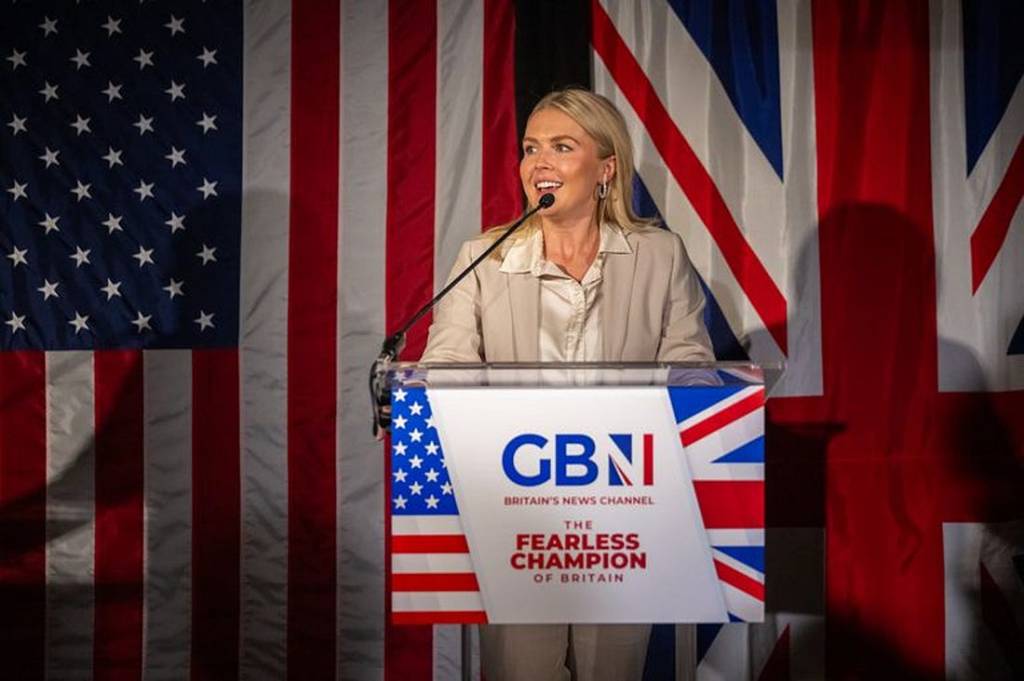
    Cockburn spent Wednesday night at the ultra-exclusive Ned’s Club near the White House for a shindig celebrating the launch of GB News’s DC bureau. The network, which launched in 2021, will be airing a US politics show from 7-9 p.m. ET (that’s midnight to 2 a.m. UK time), anchored by Bev Turner.

    Nigel Farage, who hosts a primetime show on the network, held court by the central bar. Cockburn spotted him chatting to Jim Jordan, who chairs the House Judiciary Committee which Farage had addressed on free speech in Britain earlier in the day.

    Attendees were treated to remarks from Farage, White House Press Secretary Karoline Leavitt, Commerce Secretary Howard Lutnick and other GB News top brass, including co-owner Sir Paul Marshall (also the proprietor of this magazine). Referring to the “Britain has fallen” meme, Marshall said, “I wouldn’t say we’ve fallen; we’re falling.” He also lambasted the BBC, which he branded the “Biased Broadcasting Corporation.” Farage, Turner, Marshall and co-owner Christopher Chandler had been for an Oval Office meeting with the President earlier in the day. The speakers were introduced by Jason Miller, who Cockburn hears has been put on a hefty retainer to help steer the GB News launch.

    During the speeches, journalist Michael Tracey was pestering a visibly annoyed Steven Cheung, the White House comms director. Guests could also see event host Steve Clemons and Tammy Haddad, two of Washington’s permaclass, ingratiating themselves in the new Trumpian establishment. They are masters of reinvention, truly DC’s answer to Prince and Madonna.

    Cockburn was amused to see Politico Playbook managing editor Jack Blanchard in attendance. On the morning of the party, Blanchard described GB News as a “conservative U.K. media outlet”; slightly revising the language he used about the network on June 30, when he branded it an “upstart alt-right British TV channel.” (In a previous life, Blanchard had a show on rival network Sky News, which has dwindled into obscurity since GB launched.) “Attacks like this only serve to strengthen our resolve to deliver the bold and fearless journalism that’s making us number one,” a GB News insider told Cockburn.

    Appropriately for a British affair, things turned rather rowdy toward the end. One bartender had to recuse himself to get some air for a few minutes after having to clear up someone’s sick. Gulp.

    Spotted: SBA administrator Kelly Loeffler; UN Ambassador nominee Mike Waltz; Kari Lake of the US Agency for Global Media; Will Scharf, Alex Pfeiffer, Olivia Wales, Allison Schuster and Kush Desai from the White House; senior director for counterterrorism Dr. Sebastian Gorka (peace be upon him); Treasury senior counselor Alexandra Preate; Kellyanne Conway; Adele Malpass; Caroline Wren; Human Events’s Jack Posobiec; Grover Norquist; Sam Brown; Sean Spicer; Winston Marshall and Melissa Chen; Alan McCormick, Christopher Hope, Steven Edginton and Michael Booker of GB News; the Washington Examiner’s Byron York; the New York Times’s Shawn McCreesh; NBC News’s Katherine Doyle and her husband Alex deGrasse; Politico’s Rachael Bade; Semafor’s Shelby Talcott and Dave Weigel; Jacob Heilbrunn of the National Interest; Richard Hanania, and Ben Domenech of Fox News and The Spectator.

    At the Cole face

    Perhaps the only British journalist in DC not in attendance at the GB News bash: Harry Cole, the Sun’s new US editor-at-large. Cole was the subject of a vigorous contest between his newspaper and GB News earlier this year – with the journalist ultimately deciding to stick with his current employer after they promised to dispatch him to DC with a new title, a Fox News contributorship and a new multi-platform show.

    Your ever-dogged correspondent got his hands on the brief being circulated to prospective guests. The program will be called Harry Cole Saves the West and is being billed as “a high impact, hard-hitting and unapologetically pro-West TV show and podcast.”

    “The show’s core credo is about defending timeless Western traditions and treasured truths – faith, family, freedom and fortified frontiers,” the brief reads. Cockburn will be keeping an eye out for Cole in the pews come Sunday morning.

    On our radar

    NEVER POST CNN’s KFile has unearthed BLS pick E.J. Antoni’s old Twitter account, upon which he made a series of disparaging remarks about women’s appearances and accused prominent liberals of being pedophiles. Their story follows Cockburn’s reporting on Antoni’s comments on gender and IQ last Friday.

    NO MORE SUMMER FRIDAYS The President is currently credentialing ambassadors in the Oval Office for 10 countries including Germany and Italy. Later today he will sign executive orders (2 p.m. ET), make an announcement (4 p.m.) and host a dinner in the Rose Garden (7 p.m.).

    NEW BALLS, PLEASE President Trump will then head to his home neighborhood of Queens for Sunday’s US Open men’s tennis singles final. He will watch Novak Djokovic 🇷🇸 or Carlos Alcaraz 🇪🇸 face Jannik Sinner 🇮🇹 or Felix Auger Aliassime 🇨🇦.

    Is your date Suspiciously Attractive for Washington?

    If you’re a middle-aged bureaucrat at the Department of Justice and you draw the interest of a sexy young Georgetown au pair named Skylar on Hinge, then chances are you’ve fallen into some sort of honey trap. In the case of Joseph Schnitt, deputy chief of the Special Operations Unit of the Department of Justice’s Office of Enforcement Operations, the honey was set by James O’Keefe of Project Veritas, who hasn’t changed his sneaky ways now that Trump is back in charge.

    “Skylar” managed to get Schnitt on record in August as saying that the DoJ would edit any Republicans out of the Epstein Files. Whoopsie! Then, in a move that would make J. Edgar Hoover cringe, the DoJ tweeted out its face-saving response as a screenshot of an email from Schnitt to his boss, typed from an iPhone in AirPlane mode. “The comments I made were my own personal comments on what I’ve learned in the media and not from anything I’ve done or learned at work,” Schnitt wrote, presumably with a face redder than a Thai chili.

    Cockburn hopes that Skylar, who no longer exists, was worth it, Mr. Schnitt. She offers a crash course in potential partners who are “SAW” (Suspiciously Attractive for Washington). Remember: if your date is significantly better looking than you, it’s not because you have a great personality – this is DC. It’s because she’s honey-trapping for an American adversary, she’s a Project Veritas operative or she expects to be paid. Stay alert, schlubs. Your job may Hinge on it.

    Subscribe to Cockburn’s Diary on Substack to get it in your inbox on Tuesdays and Fridays.

  • The death throes of free speech in Britain – and its opponents

    Free speech, the very bedrock of constitutional democracy, is writhing on its deathbed in England. It will take a mass movement to restore its vitality. Fortunately, one can see that movement emerging among a once-free people, tired of government suppression.

    The dire state of British liberties was outlined Wednesday in Congressional testimony by British MP, Nigel Farage, who testified before the US House Judiciary Committee. He was backed by the committee’s Republican members and attacked, alas, by Democrats. 

    Powerful as his testimony was, it was overshadowed by an even more striking event: a phalanx of armed police arriving at Heathrow airport to arrest an Irish comedian for a tweet he posted in Arizona. His crime: he made fun of transgender people. Toss him in the dungeon.

    This is the same law enforcement, mind you, that ignored decades of child rape and “grooming” by Pakistani Muslims in northern England. 

    How is the lax treatment of grooming gangs connected to the harsh treatment of tweeting? By more than the lunacy and hypocrisy. The deeper connection is that successive Labour and Conservative governments have considered it more important to “protect” minority groups against bad words and criminal investigations than to protect innocent children or ensure free speech and open inquiry. “Social justice,” don’t you know?

    The collapse of free speech, under the repressive hand of British government, is deeply linked to the massive influx of immigrants from North Africa and the Middle East, who have little interest in adapting to English laws and customs and every interest in protecting the customs of their native lands. They have consistently refused to adopt the basic ideals of tolerance and forbearance that are fundamental to any functioning multicultural democracies.

    Instead of pushing back against this illiberal tide – an essential task if liberal democracy is to survive – political leaders in the UK and most of Western Europe have appeased it. Just as bad, they have suppressed any opposition.

    The common theme among these feckless leaders is their lack of confidence in their own cultural traditions and historic national achievements. They have refused to stand up for those basic values and traditions in the face of ferocious, illiberal assaults, stemming mainly from these hostile immigrant communities, often supported by progressive elites, who share the leaders’ lack of cultural self-confidence. Instead of resisting these illiberal assaults, halting immigration, and limiting the lifelong provision of free housing and income, those leaders have acceded to these demands and smacked down anyone who says different. The price has been enormous.

    How bad is it? Bad enough that people are now being arrested in England and Scotland for putting up flags or wearing them on their clothes. Waving the national flag is somehow considered an insult to immigrants. This show of patriotism must be stopped and the miscreants arrested.

    These arrests do more than crush free speech. They also deter free assembly, or at least they are intended to do so, if that assembly opposes government policy. But the right to assemble peacefully to protest government policy is the very essence of a functioning democracy.

    The connection between speech and assembly is often overlooked, but it is crucially important. It is free assembly – mass crowds, mobilized around political demands – that threaten governments. That is why the two rights, speech and assembly, are paired in the First Amendment to the US Constitution. That is why their absence in English law is so devastating. Their absence gives free rein to a repressive government. That is exactly what is happening now in England and Scotland.

    The right to speak openly and assemble freely, allow citizens to voice their opinions, demonstrate the intensity of those views, protest some government policies and advocate others, and express those opinions without seeking permission from the very government they may be contesting.

    The British, who have no written constitution or bill of rights, give no such protections to their citizens, either in theory or in practice. That is why today’s repressive governments can treat citizens like subjects, to be suppressed or arrested when they say something objectionable to those in power. What is objectionable? We in power will decide. Not you.

    It is a special tragedy to see this repression take place in England, the fountainhead of free speech and assembly in western civilization. The theory was best stated in John Stuart Mill’s On Liberty (1859), with roots that run back two centuries to John Locke and still further to the Glorious Revolution and Magna Carta. Mill’s vital points are that ideas need to withstand the test of counter-arguments and best evidence, that multiple views need to be heard and tested, and that citizens can then reach their own, informed judgments.

    The wisdom of Mill’s analysis was not limited to his book or the scholarly discourse it prompted. It was already embedded in Parliamentary debate, public speeches, and the free publication of newspapers and magazines.

    This open discourse is a magnificent achievement and a historically rare one. Few countries have ever permitted it, and it is in jeopardy now in the very birthplace of these freedoms, trampled by ignorant and malign political leaders. It’s easy to see why those in power don’t want to hear opposing voices or critical tweets. They don’t say so plainly, of course. They prefer to wrap themselves in the high-flying moral language of “social justice.” Whatever the justification, they use the full repressive weight of state power to smash alternative views. They alone decide which views are permissible.

    They shouldn’t be allowed to get away with this power grab – this blatant suppression of basic democratic rights. Politicians, bureaucrats, and police shouldn’t decide what can be said and what must be silenced. Not in a free country. They shouldn’t be allowed to turn the birthplace of liberty into its charnel house.

  • Watch: Nigel Farage warns Congress about UK speech laws

    Watch: Nigel Farage warns Congress about UK speech laws

    UK Prime Minister Keir Starmer took aim at Nigel Farage in Parliament today for not being present. In fact, the Reform leader is on the other side of the Atlantic, testifying to the House Judiciary Committee on the state of free speech in the UK. The timing couldn’t have been better for Farage, what with the release of Lucy Connolly from prison (after she was incarcerated over a social media post) and the arrest of comedian Graham Linehan providing extraordinary case studies.

    And Farage was not holding back. First saying that he would have brought Connolly with him, had she not been restricted by travel rules following her conviction, he launched into quite the speech about freedom of expression in Britain. Using Linehan’s case as a warning for American travelers, Farage fumed:

    He put out some tweets months ago when he was in Arizona. And months later, he arrives at Heathrow Airport to be met by five armed police. Armed police. Not a big deal in the USA, a very big deal in the United Kingdom. Five of them. And he was arrested and taken away for questioning. He’s not even a British citizen. He’s an Irish citizen. This could happen to any American man or woman that goes to Heathrow, that has said things online that the British government and British police don’t like. 

    He went on, taking aim at legislation that allows police to monitor social media posts in the first place:

    It is a potentially big threat to tech bosses to many, many others. This legislation we’ve got will damage trade between our countries, threaten free speech across the West because of the knock-on rollout effects of this legislation from us or from the European Union. So I’ve come today as well to be a klaxon, to say to you, don’t allow piece by piece this to happen here in America, and you will be doing us and yourselves and all freedom-loving people a favor. If your politicians and your businesses said to the British government, you’ve simply got this wrong. At what point did we become North Korea? 

    Strong stuff! And it seems even politicians for the incumbent Labour party are rather perturbed by Linehan’s arrest, with Health Secretary Wes Streeting this morning suggesting that the law could be amended to ensure police focus instead on more serious crime. But given the outrage whipped up at the treatment of both Linehan and Connolly, even this could be too little too late…

    Watch the clip here:

  • Will Trump meet British woman, Lucy Connolly, who was jailed for a tweet?

    Will Trump meet British woman, Lucy Connolly, who was jailed for a tweet?

    “Mass deportation now, set fire to all the fucking hotels full of the bastards for all I care, while you’re at it take the treacherous government & politicians with them. I feel physically sick knowing what these families will now have to endure. If that makes me racist, so be it.”

    Those 51 words earned Lucy Connolly – a babysitter from Northampton, in the East Midlands of England – the longest sentence ever handed down in the UK for a single social-media post. Last week, Connolly was released from prison, having served nine months of a 31-month term for “inciting racial hatred.”

    She will serve the rest of her sentence on probation. But she is not going back to a quiet life, it seems. Indeed, she is fast becoming a totem in the transatlantic culture war over Britain’s speech laws. Connolly is in touch with the Trump administration. Reform UK leader Nigel Farage is spoiling to bring her to the US, to sit alongside him when he testifies to Congress next month about the parlous state of free speech in Britain – a stunt which will probably be scuppered by the travel restrictions imposed by Connolly’s early release.

    If that’s the case, Farage won’t struggle to find another mascot. Indeed, Connolly’s speech crime is almost unusual in that what she said was genuinely vile and inflammatory. You can be locked up for a lot less in the UK these days. At least 30 people a day are now arrested in the UK for what they post online. Said speech criminals include a feminist who dared to call a man a man on social media, and a prankster who posted a selfie of himself dressed like the Manchester Arena bomber.

    But Connolly’s case has undoubtedly struck a nerve, given the insanely harsh punishment she received and concerns that politics might have had something to do with it. Certainly, for the more Anglophile Trumpists, she has come to symbolize how far our two nations have drifted apart when it comes to freedom of speech.

    Connolly posted her life-ruining missive on X on July 29, 2024, hours after three young girls had been stabbed to death at a Taylor Swift-themed dance class in Southport, a seaside town in the north-west of England. Misinformation had swirled online that the killer was an asylum seeker, one of the tens of thousands who have arrived in dinghies across the English Channel over recent years, and now reside in hundreds of hotels that have been requisitioned to house migrants while they wait for their asylum applications to be processed.

    In truth, the culprit was Axel Rudakubana, a depraved 17-year-old, the British-born son of Rwandan parents. He had long had a fixation on murder, terrorism and genocide. Connolly, having lost a child to medical malpractice, says she was left in a state of rage by Southport. The tweet was up for a few hours, and had been viewed 310,000 times, before she deleted it. Apparently, she thought that would be the end of it.

    But then violence erupted across the nation. Scumbags began throwing bricks at mosques, tried to set hotels on fire and rampaged through minority areas, smashing windows and screaming racial slurs. Amid the worst anti-migrant riots Britain has seen in modern times, the message rang out that a firm hand would be shown not only to those engaging in racist violence, but also to those “whipping up this action online”, as Prime Minister Keir Starmer put it from the Downing Street podium.

    Of course it is absurd to blame this horrific unrest on a single tweet posted in Northampton. In the US, Connolly would have never seen the inside of a cell, given the hard-won protections of the First Amendment, under which incitement to violence is tightly defined, as speech both likely and intended to cause imminent violence.

    But Brits enjoy nothing like the same protections. Connolly was convicted of a far more nebulous crime of “stirring up racial hatred”. She was held in police custody and denied bail. She pleaded guilty, she claims, because she wanted to get back to her family as soon as possible, hoping for leniency. As it turned out, she received a heftier sentence than some of the rioters did.

    You need not believe Connolly is a political prisoner, as she and her supporters have dubbed her, to see the murky waters that surround her case. At the time she was hauled in by police, the words “Think before you post” were being blared out from government social-media accounts. Attorney General Richard Hermer, who has to sign off on all “incitement to racial hatred” prosecutions, issued what he called a “stark warning that you cannot hide behind your keyboard.”

    The decisions of cops, prosecutors and judges will obviously have been shaped by this climate. Indeed, just before sending down Connolly, Judge Melbourne Inman at Birmingham Crown Court took it upon himself to perform a paean to multiculturalism. “It is a strength of our society that it is both diverse and inclusive”, he said. Connolly was later denied temporary leave, which would have granted her a few nights at home each month, even though she was a first-time offender and, by all accounts, a well-behaved inmate. Internal documents suggest this was due to “media interest”.

    Above all, questions hover over why Connolly was denied bail, which swayed her towards pleading guilty, fearing she would be in custody for months before trial. Ricky Jones, a Labour Party councillor, was acquitted earlier this month of encouraging violent disorder. Jones had addressed an “anti-racist” demonstration in London in the wake of the Southport riots, telling a whooping crowd that far-rightists should have their throats slit. He was bailed, and pleaded not guilty. The jury agreed.

    Connolly returns to a changed nation. Mercifully, the bigoted riots of last summer haven’t been repeated. In their place, peaceful protests have been held outside of migrant hotels, with mothers and grandmothers to the fore. In the Essex town of Epping, the Bell Hotel has just been ordered by a judge to close its doors to asylum seekers, following a string of charges brought against migrants in its care, including sexual assault and arson. Meanwhile, England and Union flags are being hoisted on lampposts by locals across the country, as part of a campaign calling itself Operation Raise the Colours, only for them to be ripped down by local councils. While Connolly’s ghastly tweet hardly spoke for the peaceful, patriotic majority, a sense of being silenced lingers.

    As Mr. Farage goes to Washington, with or without Ms. Connolly, Britain’s free-speech wars are going global. And no wonder. Once the cradle of liberalism, the UK is now a warning to the rest of the freedom-loving world. The UK’s decades-long experiment in policing hate – real and imagined – has produced nothing but fear, loathing and authoritarianism. Locking people up for tweets. This is what you get when you take a match to your liberties.

  • The folly of labeling air conditioning ‘far right’

    The folly of labeling air conditioning ‘far right’

    If you want to understand what lies behind the rise of Nigel Farage’s Reform party and its consistent – indeed, deepening – lead in the UK polls, I have a suggestion: French air conditioning.  

    To be more specific, if you want to understand the difficulty Reform’s opponents have in tackling it and why the party’s rise seems inexorable, the row going on at the moment in France over air conditioning offers a guide.

    When you insist that wanting cool air is ‘far right’, you are in the same sphere as those who say that protecting borders is pandering to the far right

    The New York Times reports how Marine Le Pen has said, with her typically incisive populist touch in the middle of a heat wave, that if she became president she would introduce a “major air-conditioning equipment plan” around France. She was backed by an opinion piece in Le Figaro, arguing that “making our fellow citizens sweat limits learning, reduces working hours and clogs up hospitals.”

    With its equally typical tone-deaf response, the French left is using the heat wave to campaign against air conditioning. Libération, the left’s house newspaper, called air con “an environmental aberration that must be overcome” because it uses up too much energy. 

    We’ve all heard the arguments many times. But more than that, Brits live in a country where air con is viewed by the authorities as something close to evil. In Florida, aircon is standard in 95 percent of new homes, as in Australia where 75 percent of homes have it. In Europe, long considered an aircon backwater by Americans, it is present in 30 percent of Italian homes and 40 percent of Spanish houses. And it is entirely normal in hospitals and care homes almost everywhere. Except, of course, in the UK – despite the appalling consequences of this. Last year 496 people died in care homes from heat, with a further 473 dying in hospitals. 

    But there is one argument against aircon I confess to not having come across before, until I read the New York Times report. A French talk show host introduced its debate on Le Pen’s proposals by asking, “Is air-conditioning a far-right thing?”

    If you want to take advantage of technology to be cool in your own home, you may, it seems, be far right.  Forget the fact that modern air-to-air pumps remove much of the green issues around cooling, for some supposed progressives, the very concept of cool air is seen by some as “far right.”

    Which brings us to Reform, and also to the protests currently taking place in Britain outside asylum hostels and hotels. Because if you insist that wanting cool air is “far right,” you are in the same sphere as those who say that protecting borders is pandering to the far right, and that worrying that your neighborhood is housing sex offenders and dangerous young men also shows you are far right. You are removing any real meaning from the term by using it to describe mainstream ideas held by tens of millions.

    And so the more you insist that such ideas are far right, the more you turn your defeat into a self-fulfilling prophecy. Screaming “far right” at people who want air conditioning won’t lead to anyone deciding they would rather sweat in the heat, just as labeling as far right anyone concerned over the influx of asylum seekers in their neighborhood won’t cause them to suddenly take stock and welcome them into the village. 

    Quite the opposite, in fact. Because the more you label politicians who support ideas which are widely popular as “far right,” and the more you attack those who agree with those politicians, the more likely you make it that those you attack will draw the logical conclusion: that those politicians are the ones on their side. And the more their support will grow.

    But more than that, the more likely you also make it that those who really are far right are able to present themselves as being smeared, because the term has become devoid of real meaning.

    How is it that such a basic lesson still needs to be learned?