Tag: Nvidia

  • Are AI stocks about to crash?

    Are AI stocks about to crash?

    Bitcoin has lost almost a quarter of its value. The tech-heavy NASDAQ index on Wall Street has started to fall. And even leaders of the industry, such as the Google CEO Sundar Pichai, have started to warn about valuations getting out of control. We already knew that AI was driving a boom in investment. But this week there are worrying signs the market is about to crack. The only real question is whether that turns into a full scale crash.

    Bitcoin, as so often, is leading the market rout. More than $1 trillion has been wiped off the value of the crypto market over the last six weeks, with Bitcoin itself down by 28 percent since its peak. But that is just part of a wider fall in tech and AI stocks, with the chipmaker Nvidia, which has powered much of the boom, starting to slide, along with many of the other stars of the AI boom. Plenty of stock market experts are starting to think it is looking like a bubble that is about to burst. Indeed, Michael Burry, who became famous in the crash of 2008 and 2009 for accurately predicting the collapse of the market, has started betting against the sector.

    There are many worrying signs. The leaders of the boom have reached extraordinary valuations. Nvidia is up by over 1,300 percent over the last five years, and earlier this year became the first company to reach a market value of $4 trillion. It was quickly followed by Microsoft, which has soared mainly on the back of its stake in the leader of the AI boom ChatGPT, which itself became the most valuable start-up ever with a funding round that made it worth $500 billion. Meanwhile every company that managed to attach itself to the boom, no matter how spuriously, has seen its share soar. Goldman Sachs estimates that AI stocks have added $19 trillion since ChatGPT was launched, a huge run-up in valuations.

    It is starting to look very like the dot com bubble of a quarter century ago. There is little question that AI is a valuable technology, and one that is starting to have a real impact. At the same time, there is far too much hype, no one has quite figured out how to make money from it, and no one has any real idea which of the new companies will turn into the long-term winners. 

    This week may or may not turn out to be the moment the bubble bursts. In reality, every investment boom has lots of sharp corrections as it soars upwards, and there is nothing very unusual about a fall of 5 percent or 10 percent in prices before the market starts climbing again. It is only when there is a final “melt-up” that it becomes dangerously over-valued. The AI boom does not look like it has reached that point yet. But there is little doubt that it is turning into a classic bubble. It will be very messy when it finally bursts.

  • Has the AI jobs bloodbath finally arrived?

    Has the AI jobs bloodbath finally arrived?

    There has been much wallowing over news that Amazon and UPS have each just cut 14,000 jobs. Some Amazon employees report of being fired with all the heartlessness you might expect in a world where tech has taken over: by automated email. Maybe it was even AI which handpicked them to be de-emphasized, to use that dreaded 1990s expression. This, then, seems to be the future: where an elite of AI entrepreneurs grow rich while the rest of us slop off into idleness and unemployment. So much for those who have been gleefully predicting the implosion of the AI boom. Nvidia has just been revealed to be the world’s first $5 trillion company, with a market capitalization greater than the whole of Germany.

    There is just one thing wrong with this analysis – and not just because it is hazardous to treat Amazon as if it were the entire economy (even if it seems sometimes to be so). If there are job losses in some areas, it doesn’t show up in the overall employment figures. The US Bureau of Labor Statistics recently reported that the number of payrolled positions was up another 22,000 in August. While job-creation has been a little on the quiet side since April, employment is up 1.466 million over the past 12 months – and this following on from a few thumping years of job-creation. This is a remarkably dry bloodbath.

    It has become a received wisdom in recent years that AI is the industrial revolution of the white collar classes. Where agricultural workers saw their jobs ravaged by the development of threshing machines and later factory workers saw themselves made redundant by more efficient machinery, now it is the turn of the professional classes. Lawyers, accountants, marketing people; all will be swept aside as AI romps through their professions. Yet take a look at the employment figures and they show a more nuanced story. “Professional and business services” show a fall, down 55,000 payrolled positions over the past year. Yet there has been a huge expansion in jobs in “private education and health services” – both of them industries which have been slated for mass job losses thanks to AI but which have grown 862,000 jobs over the past 12 months. If we are using AI to do our accounts we do not, at least yet, seem to be using it to educate our children or to take a look at our dodgy knees.

    The biggest source of job losses over the past 12 months has been in manufacturing, where 78,000 jobs have been lost – continuing a tale of the past few decades as rustbelt industries shed jobs. Whether or not AI is responsible for some of that, the figure certainly doesn’t say much for Donald Trump’s trade wars. Wasn’t that the whole point of the tariffs, to protect US manufacturing jobs?

    If AI does go on to lead to a mass net destruction of jobs it would be the first technology in history to do so. Similar claims have been made about all labor-saving technologies in history, from ploughs, to power looms to robotics. Yet for every job they destroyed, they provoked the creation of more than one new job in some other industry. They freed up labor to be used elsewhere, enriching society in the process. Why should we expect AI to be any different?

    There is just one way in which AI is a bit different, though: it has a habit of consuming its own children. Among the jobs being lost at the moment is reported to be a large number of coding jobs as their jobs start to be done by… AI. The technology is taking over from the very people who have been creating it. Unless you are right at the forefront of the coding profession, you should be watching your back – or rather your phone for an automated redundancy notice.

  • Trump’s command economy

    Trump’s command economy

    Donald Trump never made a secret of the fact that he wanted to be a commanding president but it wasn’t clear that it included a command economy. In the past few months, though, Trump has been steadily meddling with it, ranging from his insistence on a 15 percent cut of the profits from his threats against computer chip manufacturers Nvidia and AMD to his threats against the independence of the Federal Reserve – including his peremptory demand that Fed Governor Lisa Cook resign, which she has vowed to resist. Others are not as resistant. It appears that Trump has successfully extorted a cool $10 billion from Intel CEO Lip-Bu Tan whom he has previously derided as in cahoots with China.

    Trump is depicting his move as a grand bargain that will benefit both sides. Intel buys itself not into his good graces, but also derives the benefit of Trump’s unique financial acumen. “I said,” Trump said, “I think it would be good having the United States as your partner.”

    Actually, it wouldn’t. Trump seems to think of the American economy in terms of a buddy movie in which he partners up with bigtime corporate CEOs. But the more Trump distorts the free market economy, the greater the risk that he will capsize it. The American economy has flourished because it has promoted entrepreneurialism backed by the rule of law. How can Trump credibly attack New York’s socialist candidate for mayor, Zohran Mamdani, at a moment when he himself is instituting, as far as possible, much more radical changes to steer the economy?

    In jettisoning conservative precepts about the economy – free trade bad, tariffs good and so on – he seems to want to emulate strongmen abroad, including China’s Xi-Jin Ping. He is intruding into corporate boardroom and acting as though he possessed a patent on economic wisdom. History says otherwise. In the past century various communist regimes imploded under the weight of dysfunctional command economies. With its hybrid capitalist system, China has avoided that fate. But it is by no means clear that Beijing offers a superior model to western capitalism. Quite the contrary. It suffers from a bloated real estate market, an aging population and willful economic decisions imposed by the communist party. Indeed, the American Enterprise Institute’s Desmond Lachman suggests that the Chinese economic miracle has reached its terminus, in part because of its oppressive crackdown on the tech sector. Like Japan, Lachman believes that China may be about to experience “a lost decade of painfully slow economic growth.” Hmm. Is that really the path that America wants to follow?

    Trump should think again. He has become intoxicated by his own rhetoric, issuing ukases on everything from greening Washington, DC with new sprinkler systems to intervening in the nation’s economy.

    As Trump ponders further excellent adventures in tampering with the free market, he would do well to remember that the Hippocratic Oath also applies to the economy – first do no harm.

  • DeepSeek has redefined what’s possible for AI

    DeepSeek has redefined what’s possible for AI

    In the years since ChatGPT’s debut, the world of artificial intelligence development has been defined by a single obsession: scale. Companies have raced to build ever-larger models, train on datasets of unimaginable size, and spend billions on the infrastructure required to sustain this rapid growth. The logic has been simple: bigger is better.

    The pursuit of scale has inflated the industry, driving massive valuations. Nvidia — the shovel and picks provider of this new age — rose to a trillion-dollar valuation fueled by its GPUs being indispensable for AI development. Over the weekend, Meta announced plans for a data center spanning half the size of Manhattan, further reinforcing the industry’s commitment to infrastructure-heavy strategies.

    The emergence of DeepSeek signals that the AI race is entering a new phase

    Last week, this mindset was epitomized by the announcement of the Stargate Project, a $500 billion initiative to build the world’s largest AI infrastructure in Texas. It embodies the belief that sheer scale will secure dominance and unlock the elusive goal of Artificial General Intelligence (AGI) — the Holy Grail of modern AI research.

    As US tech giants rely on sprawling data centers powered by Nvidia GPUs, US sanctions on advanced chip sales — first imposed under Biden and set to continue under Trump — have cut China off from critical AI hardware, forcing its developers to innovate with far fewer resources.

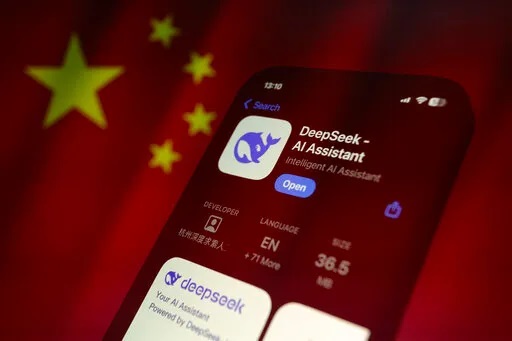
    This is the environment that birthed DeepSeek. Founded just two years ago, the relatively unknown Chinese AI startup has emerged as a formidable challenger to the “bigger is better” narrative, achieving what many thought impossible: delivering performance comparable to the West’s cutting-edge models at a fraction of the cost.

    DeepSeek’s flagship model, R1, excels in fields such as mathematics, coding and reasoning — domains typically dominated by resource-intensive models. Yet, remarkably, R1 was allegedly developed for under $6 million, a fraction of the billion-dollar investments of its Western counterparts. Now sitting at the top of Apple’s App Store, this achievement has upended assumptions about the economics of AI — and the market, understandably, took notice.

    The impact was immediate. Shares in AI-related companies such as Nvidia, Microsoft and Meta dropped sharply as investors began questioning the sustainability of the scale-first strategies that have driven the industry. Nvidia, whose valuation was once thought untouchable, fell as much as 13 percent at the open — shedding $465 billion off its market value in what Bloomberg described as the largest single-day rout in stock market history.

    Even European tech firms felt the tremors: ASML, the Dutch chip equipment maker, saw its stock tumble by over 10 percent, while Siemens Energy, a supplier of AI-related hardware, suffered a staggering 21 percent drop. One analyst told Bloomberg that DeepSeek could “potentially derail the investment case for the entire AI supply chain.” Altogether, the announcement appears to have triggered a trillion-dollar selloff in tech stocks.

    Eye-watering sums aside, the shock is reminiscent of the Sputnik moment. Just as the Soviet Union’s launch of Sputnik 1 in 1957 forced the US to reevaluate its complacency in the space race, DeepSeek’s rise has laid bare the vulnerabilities in the West’s AI strategies. The reliance on trillion-dollar infrastructure and brute-force compute now appears precarious against a leaner, more resourceful competitor.

    So, has the bubble finally burst? A little bit. But it’s not about which model you use — it’s about how you use it. The past three years have been defined by ever-larger models and shattered benchmarks, but the true breakthroughs now come from applying AI in smarter, more targeted ways. 

    To use a term coined by former AI researcher Leopold Aschenbrenner in his seminal AI essay series last year, the “unhobbling” is well underway. This shift marks a move away from sheer power scaling toward fully unlocking the potential of existing models. Techniques such as Retrieval Augmented Generation (RAG), chain-of-thought prompting and the application of smaller-language models (SLMs) are proving that AI doesn’t need to know the entirety of The Iliad — it needs to be precise, adaptable and fit for purpose.

    The rise of DeepSeek exemplifies this shift, but it also highlights the growing bifurcation of AI across the world. While the unhobbling unlocks latent potential, it cannot escape the values, biases and constraints of its creators. Despite its technical brilliance, DeepSeek’s R1 bot is shaped by its environment: one heavily influenced by China’s political and social norms.

    Want to ask about holiday ideas in Taiwan? Forget it. How about what happened in 1989? Computer says no. These omissions aren’t bugs — they’re features. They reflect the parameters set by a government that exerts tight control over technology, ensuring that sensitive topics are filtered out. It’s the same reason why Elon Musk’s Grok is chockful of cringeworthy humor. These models that will one day likely shape most of our lives are being shaped by those who create them. 

    That said, in the longer term, it would be wrong to suggest that compute is anything less than a critical factor in shaping the AI race. The UK’s AI Opportunities Plan, with its promise of a twentyfold increase in compute capacity and AI growth zones, marks a step in the right direction, for instance. Still, ambition is one thing; delivering infrastructure at the speed AI demands is quite another.

    Fortunately for nations lacking in computing power, the emergence of DeepSeek signals that the AI race is entering a new phase. By innovating under constraint, DeepSeek has redefined what’s possible, proving that progress doesn’t always require sprawling infrastructure or trillion-parameter models. Instead, it calls for rethinking priorities: refining tools, embracing efficiency and adapting AI to serve practical, targeted purposes. Just make sure that purpose doesn’t involve anything to do with Winnie the Pooh and you’ll be fine.