Tag: Olivia Nuzzi

  • Olivia Nuzzi and the return of ‘celebrity journalism’

    Olivia Nuzzi and the return of ‘celebrity journalism’

    There are two competing ideas going around about “the old days” of journalism. In one, journalism was a sober public service, safeguarded by editors and ethics, untainted by the capital-A, capital-E Attention Economy. In the other, it was a racist, sexist boys’ club we managed to leave behind – even if only briefly, for long enough to support Teen Vogue’s politics vertical. (May they rest in peace.)

    The current pile-on concerning celebrity reporter Olivia Nuzzi, whose ex Ryan Lizza has revealed her affair with Robert F. Kennedy Jr., leans hard on the first fantasy. Once there were newsrooms; now there are “personal brands.” Once we had Walter Cronkite and Edward R. Murrow; now there is a woman in a Lana Del Rey cosplay Mustang with 1990s porn-star brows.

    Colby Hall’s viral Mediaite column makes this case – journalism has all but collapsed under the weight of the internet’s vampiric demand for entertainment. For Hall, Nuzzi’s affair with RFK Jr. and the subsequent comeback tour represent everything wrong with modern media. It is a broken system that spent “years” – years, not decades – rewarding personality over substance. It is influencing by another name.

    Hall is right that something has been lost – fact-checking, rigor, objectivity, preparation, craft – I’ve made the argument myself. But he is wrong that journalism has ever been free of its Nuzzis. The “celebrity reporter who is also the scandal” is not a creature of the digital age. She – though, historically, more often he – is at least a century old. One might imagine the celebrity star reporter was born in tandem with the newspaper.

    In the 1800s, Joseph Pulitzer’s New York World and William Randolph Hearst’s Journal didn’t run “objective” institutional prose. They aggressively promoted voicy “star reporters” with huge bylines and promotional campaigns that would make a modern publicist blush. All that to say, the reporter wasn’t a medium for transparency and facts; the reporter was the product.

    Nellie Bly became a household name at the World for going undercover in a mental asylum – it was genuine reform journalism that also happened to be a sensation. But her most famous exploit was racing around the world in 72 days, beating the fictional Phileas Fogg’s record. The World turned it into a national event – a spectacle – complete with a reader contest. The stunt had no news value. It was entertainment. Its entire premise was that the reporter herself was the story.

    Richard Harding Davis, only ten years later in the 1890s, offers an even starker example. Davis was famous for his war correspondence, yes, but equally famous for his good looks and romantic entanglements. Charles Dana Gibson literally used him as the model for the “Gibson Man.” Publishers marketed him, not his reporting – though that may have, incidentally, been valuable. But it was his face that sold papers. By the 1930s, Walter Winchell had perfected the form. His gossip column and radio show reached tens of millions; he could make or break careers, shape elections. Winchell was notorious for his personal life – feuds, an affair. He operated at exactly the nexus we’re told is new: tabloid sex, political intrigue and the journalist as main character.

    Wasn’t there a period when professionalism held? Cronkite, Murrow? Sort of. The norms we treat as timeless were largely innovations of the early 20th century, emerging for commercial reasons as much as ethical ones. The Associated Press needed to sell copy to papers of different political persuasions, so it developed a style that could offend no one. “Objectivity” was a business model before it was a philosophy.

    Even at its peak, the professional era was messier than nostalgia allows. James Reston of the New York Times was celebrated as the greatest Washington correspondent of the mid-century: “America’s conscience.” He was also a conduit for official leaks, so embedded with his sources that he would run stories by them before publication.

    The access journalism Colby Hall decries wasn’t an aberration from the golden age. It was the golden age’s operating procedure. Then came “new journalism”: Wolfe, Didion, Thompson, Mailer, Talese. They wrote brilliantly, but their work placed the self at the center of the story. Thompson covering the 1972 election was a drug-addled performance piece – though an insightful, well-written one. Mailer literally stabbed his wife. Talese had a very public affair while writing Thy Neighbor’s Wife. Nuzzi’s specific transgressions are her own. But the intensity of the reaction, the suggestion that her entire career was somehow fraudulent, misses the point. This is what it has always meant to play the gonzo game. The system that produced Nuzzi has been with us since the 1890s and so “fixing” journalism isn’t as simple as finger-wagging.

    So what has eroded? Because I agree Hall’s right, and it’s significant. But it’s not the impulse toward celebrity or self-promotion. Those are as old as the penny press. It’s the production of any real news at all – particularly vital local news stories. Newsroom employment has fallen by a quarter since 2008. The profession that once offered careers now offers gigs. Young reporters are told building a personal brand is essential to their survival, because the institutions can no longer protect them. The people investigating corruption or reporting the important news of the day aren’t usually the celebrities. Hall’s golden age had room for both, and occasionally for someone who could do both. Today we only offer success to one type. And it turns out that success is brittle.

    Nuzzi may have done real harm. She violated real ethical boundaries. She destroyed the sanctity of several marriages and her own relationships. She lit her own credibility on fire. But she didn’t invent the game she’s playing.

    This article was originally published in The Spectator’s December 8, 2025 World edition.

  • Olivia Nuzzi, teen-pop sensation

    Olivia Nuzzi, teen-pop sensation

    We all know far too much about Olivia Nuzzi. The first excerpts from American Canto, her unwelcome addition to the “spliterature” genre about her affair with Robert F. Kennedy Jr., have been unavoidable for the past few days. Cockburn can’t decide what’s worse: the revelations themselves or the windy prose in which Nuzzi’s editors have allowed her to inflict them on us. Her ex-fiancé Ryan Lizza’s addition to “the Discourse” last night didn’t help matters.

    Rather than envisioning who sent pictures of what to whom, or getting jealous of a brainworm, Cockburn has found himself nostalgic. He’s casting his mind back to 2009, back when Nuzzi sought attention in a more innocent fashion: as an aspiring teen-pop starlet. Her MySpace page showcasing her singing talents as “Livvy” has unfortunately been deleted, but one enthusiast archived it so fans can at least see what it looked like.

    “Livvy is a sixteen year old singer, songwriter and actress,” the page reads. “A former Wilhelmina model, she has appeared in various commercials, films, television programs and print ads since her start in the business at the age of five.” A child star… she never stood a chance.

    The page begins with Nuzzi’s trademark modesty:

    The day that Madonna released “Erotica”
    The day that Andy Warhol made his first film
    The day that Freddie Mercury sang his last note
    The day that Judy Garland conceived Liza Minnelli
    The day that Britney Spears told you to hit it one more time
    The day that Cher first met a sequin
    The day that Candy Darling took her last breath
    The day that Mick Jagger first strut across a stage
    The day that Pamela Anderson was introduced to silicone
    The day that David Bowie sang “Lady Stardust”
    The day that Michael Jackson first slipped on a white glove
    … was the day that Livvy was born

    Lower down, we are treated to a breathy description of Livvy’s vibe:

    LIVVY is a pop chorus.
    LIVVY is a rock ballad.
    LIVVY is a hip hop beat.
    LIVVY is the past.
    LIVVY is the future.
    LIVVY is now… and she’s about to blow your mind.

    Eat your heart out, brainworm…

    Comments on the page suggest Livvy was beloved. “hi pretty Livvy, you radiate beauty,” writes one rather intense young man. “omg i love your music its there a cd i could buy ??” asks another. Sadly not: we’ll have to make do with the looming American Canto audiobook. (Cockburn’s nieces prefer the stylings of Zara Larsson, for what it’s worth.)

    The book itself is out December 2, in time for Christmas and to ruin Secret Santas across the District.


    Fox News deploys Palantir’s AI in digital operation

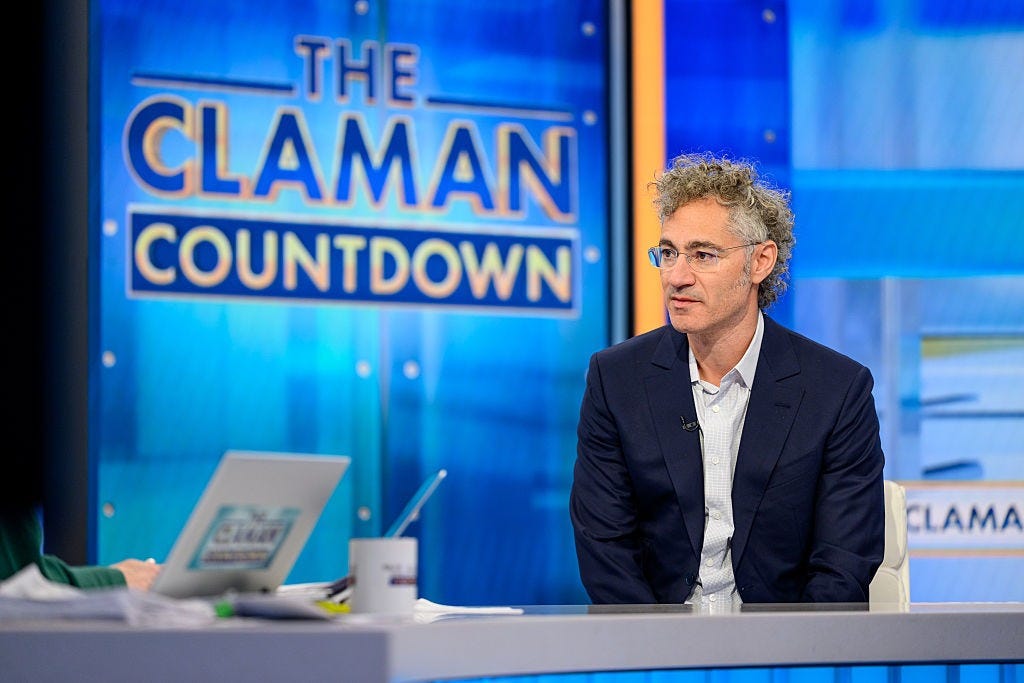
    Palantir CEO Alex Karp appears on Fox Business, October 2025 (Getty)

    Palantir is best known for the AI-powered cutting-edge software it provides to the federal government to give the US military and intelligence communities a leg-up over foreign competitors. Now, Palantir is in the news business as well.

    Over the last six months, with the help of Palantir engineers sitting in on high-level meetings and advising everyone from executives to writers, Fox News has scaled up its use of Palantir’s algorithms in simplifying its workflows. Readers of the nation’s most read right-of-center news outlet are therefore now influenced by the nation’s most ascendant defense contractor for which stories they see and how they’re framed.

    “We are building a first-class platform alongside Palantir engineers that will empower our editorial team to do great journalism and tell important stories,” a Fox News insider told Cockburn. “We are re-imagining and re-building every aspect of our workflow that will help our journalists be more effective and impactful in their jobs.”

    Almost every journalist uses AI in some small way – Cockburn couldn’t live without Sonix, the software that transcribes his interviews. And the use of technology in deciding which stories to elevate up the page isn’t new. For years, media companies have utilized apps such as Chartbeat and Parsely that provide real-time info on which stories are under- or over-performing.

    Fox News’s choice to employ Palantir’s Foundry – a data-integration tool employed by the Department of Homeland Security, Morgan Stanley and Merck, among others – is nonetheless a landmark one. Theoretically, use of the software could free up Fox’s journalists to spend more time on reporting and less on the menial tasks that have taken up a lot of digital-journalist time over the past decade or so.

    When asked if the site is already seeing improvements following the Palantir partnership, a Fox News insider said, “Yes, big time.”

    Not all Fox’s humans are delighted by the new tech, however. Homepage editors have been told that their role is mostly to “just check it [the AI’s suggestions] for factual mistakes,” a source with knowledge told Cockburn. “Everybody has been on edge and stressed as Palantir has essentially taken over Digital, especially the homepage,” another source told Cockburn. “Not only have the AI mandates bogged down writers like myself and others, but it has zapped the creativity out of us and made us lazier and more reliant on this technology.”

    Cockburn has no beef with Palantir pitching their algorithms to willing American buyers. But still – if one of the nation’s most powerful defense contractors is influencing what news you end up seeing, wouldn’t you want to know? And wouldn’t you want that news outlet to disclose it when, say, that company’s CEO pops up on their business channel?


    On our radar

    ARABIAN DAYS President Trump has a full schedule of events with Saudi Prince Mohammed bin Salman today. It’s the prince’s first visit to Washington since the assassination of Jamal Khashoggi. Tuesday’s foreign pooler, Nadia Bilbassy, comes courtesy of Saudi state media; the killing didn’t come up in the briefing that was circulated ahead of time, to the chagrin of several other correspondents…

    TATE WITH DESTINY Disgraced White House official Paul Ingrassia intervened in an official capacity on behalf of his former clients the Tate brothers, to get their cell phones returned when they were seized by Customs and Border Patrol, ProPublica reports.

    VANCE TO THE MUSIC OF TIME A Michigan man called J.D. Vance has been jailed for two years for making online threats against an Ohio man called J.D. Vance (the Vice President) and his boss.


    Summers lovin’, happened so fast

    Former Harvard president and Clinton-era Treasury secretary Larry Summers is “stepping back from public commitments” and is “ashamed” at having asked Jeffrey Epstein for dating advice as recently as 2019 – the year Epstein didn’t kill himself – according to the New York Times. Summers wrote, while pursuing a “love interest” who was seeing another man, “I dint want to be in a gift giving competition while being the friend without benefits.” Oh no he dint! Epstein replied, “shes smart. making you pay for past errors. ignore the daddy im going to go out with the motorcycle guy.”

    As the emails are revealing, Jeffrey Epstein was everyone’s daddy. Perhaps Summers would have been better off asking a different New York billionaire for dating tips…


    Evening Wood

    Cockburn sidled into the cocktail hour at the National Building Museum for the American Enterprise Institute gala a touch after 6:30 last night. Hundreds of guests donned black tie and gathered to see 91-year-old historian Gordon G. Wood receive the Irving Kristol Award. The nonagenarian New Englander drew inspiration from the Founding Fathers in his remarks. Beforehand, AEI president Robert Doar offered a brief tribute to former vice president Dick Cheney, an AEI trustee, whose funeral takes place in DC Thursday. Attendees sipped Cabernet Sauvignon and enjoyed small portions of short rib.

    Spotted: Jonah Goldberg; Joshua Katz; Philip Klein; Katherine Mangu-Ward; Megan McArdle and Peter Suderman; Adam and April O’Neal; Chloe Ross; Robby Soave and Byron York.

    Subscribe to Cockburn’s Diary on Substack to get it in your inbox on Tuesdays and Fridays.

  • Olivia Nuzzi tells all on RFK Jr.

    ​​Olivia Nuzzi’s memoir about her scandalous affair with Robert F. Kennedy Jr., then a presidential candidate and now the country’s leading health bureaucrat, comes out next month. She’s called it American Canto, not to be confused with the bestselling novel Bel Canto, about terrorists who occupy an opera-themed party at a South American mansion. Instead, Nuzzi has trapped us all in the opera of her mind, and there’s no escape. 

    ​Nuzzi has the apparent ability to turn otherwise rational, educated men into blubbering masses of jelly. In a rather glowing profile over the weekend, accompanied by video of her blonde hair flowing in the wind on the Pacific Coast highway, the New York Times’s Jacob Bernstein said that “Nuzzi disappeared for a year, in self-imposed exile in Los Angeles” after details of the RFK affair came out. “She drives around in a white Mustang convertible, like a Lana Del Rey song come to life.” In reality, she has a job as an editor at Vanity Fair and lives in a house in Malibu. If that’s exile, then Cockburn has been dreaming of exile for decades. 

    ​In the book, Nuzzi continues to insist that she and RFK Jr. didn’t have sex. “We were not sleeping together,” she said in an interview last year. But they were very much in love, in a pretentiously intimate way that will make a normal person yak. She adored his “particular complications and particular darkness.” According to the Times, “he called her ‘Livvy’ and wrote her poems. He said he wanted her to have his baby. He promised to take a bullet for her.”

    ​Good grief. Nuzzi also writes that both she and RFK “moved through the world with amused detachment and deep sensitivity, contradictions that worked somehow in concert.” You don’t say. Then there was the matter of RFK’s “brain worm,” about which he told her, “baby, don’t worry.” In the book, she writes, “I loved his brain. I hated the idea of an intruder therein.”

    ​This sort of love has kept therapists and screenwriters busy for decades. “He was not quite mad the way they thought, but I loved the private ways that he was mad. I loved that he was insatiable in all ways, as if he would swallow up the whole world just to know it better if he could,” Nuzzi writes. 

    ​If that all seems like a bit much, Cockburn really choked on his morning bagel when he read this excerpt, which starts about RFK’s falconry hobby and gradually turns him into a Fabio romance-novel cover hero:

    ​Like all men but more so, he was a hunter. In a literal sense, he used not a bullet but a bird. It was not about a chase but about a puzzle of logic and skill that amounted to a test of his self-mastery. He was the mouse and the architect of his maze. The giver of his own pleasure and torment… He desired. He desired desiring. He desired being desired. He desired desire itself. I understood this just as I came to understand the range of his kinks and complexes and how they fit within what I thought I understood of his soul.

    The book may be called American Canto, but a better title might be TMI. Cockburn finds himself wondering why we know all this extremely icky private information at all. She has a job. He has a job. They can both get their names into the papers whenever they want. Our job, apparently, is to read about them and gossip about them. They’re like the lovers at the Coldplay concert, but they wanted to get caught for reasons of professional advancement. Don’t worry, baby. We all have a brain worm now.