Tag: Palantir

  • Why DC loves to hate Partiful

    Why DC loves to hate Partiful

    If you’re under 50, you may have noticed that Partiful has quietly annexed the American social calendar over the past year or two. The event-planning app, founded by former Palantir employees, began as another Silicon Valley toy, but it didn’t stay regional for long. Its loud dashboard aesthetic spread quickly through the Bay Area and then achieved escape velocity in Washington, DC. I wouldn’t be surprised if the strong cultural current between tech and defense is what created near-perfect conditions for a social revival in nerd world.

    While I understand a bit of snobbery over the aesthetics, I’ve been surprised by the constant performative disdain I’ve observed accompanying its rise. Everywhere I go, I hear people say they “hate” Partiful. I watch otherwise socially adept adults roll their eyes at the indignity of being invited to yet another birthday karaoke or themed dinner through an app, of all things, as if the rest of their lives aren’t already dictated by Outlook and Slack.

    Receiving a Partiful link is akin to a minor social injury, a digital affront to imagined analog elegance. This is nothing more than user error, in my view. Partiful’s origins do give it an undeniable tinge of dorkiness, but only the constitutionally weak would let that get in the way of a good time.

    Sure, the format is corny. The animated sparkles, the tie-dye backgrounds, the GIFs. But in a society where birth rates are in a nosedive, no one’s heard of sex before and social skills are degrading by the minute, I am more than happy to turn a blind eye to a few lurid colors and kitschy animations in service of prosocial behavior.

    Infact, I’d go as far as to say that my social diary has never been busier thanks to the efficient plug-in between Partiful and my iPhone calendar. I know exactly when everything is happening and I am rarely at risk of double-booking myself, which is more than I can say for the pre-Partiful days when RSVPs were a veritable archaeological dig through texts, DMs and half-remembered conversations.

    Indeed, it may be the only app that’s as effective at getting people to log off as it is at getting people to use it. For the socially blessed, perhaps the garishness of it all is a true burden – not all of us are well-connected enough to enjoy a constant whisper-network of parties, or handwritten calling cards from a generous host.

    For the rest of us, the mere fact that someone went out of their way to invite you to something, even through a candy-colored interface, is hardly an indignity. If being invited to a party is the worst thing that has happened to you this month, I congratulate you on your charmed life.

    The main complaint I hear beyond the superficial is that the app feels “too public.” The guest list is visible. The RSVPs are visible. People can see you were invited. They can see you RSVP’d “maybe” and then never updated your status. Knowing who is attending an event supposedly ruins the mystery of running into an exciting stranger or, more thrillingly, an unwelcome ex. But this transparency only offends those who relied on ambiguity to maintain their mystique. Some of us know how to withhold, wherever we go.

    Another accusation: the app’s design encourages people to RSVP just to see who else is coming, which allegedly leads to inflated guest lists full of ambiguous spectators. While I’ll admit that this is gauche, it does reflect a fact of human nature. People have always wanted to know who will be at a party before deciding to attend. Partiful simply removed the need for back-channel interrogation and gossip-triangle logistics. Tacky as this may be, millennials have no right to be so snooty about it, given the fact that their long-forgotten Facebook events had the same feature.

    If you read between the lines you’ll notice that DC in particular loves Partiful because it flattens status games while simultaneously revealing them. The everyday social life of the city, the informal gatherings of the civil servants and hard-drinking journalists, becomes a semi-public ledger of who’s hosting, who’s being invited and who’s orbiting which micro-scene.

    In a city where professional life and social life blur, where a dinner can double as a networking event and a house party can function as a quasi-policy salon, this level of transparency is intoxicating. People here love data, for good or ill, and Partiful gives them plenty of it.

    Partiful exploits Washington’s weakness for structure, but in my view, the exploitation is a net positive and benefits all stakeholders. It makes it easier for hosts to gather people, easier for newcomers to break in, and easier for the city’s chronically Type-A residents to remember that fun is a scheduling problem more than a metaphysical one. The app has created a small renaissance in casual hosting: backyard dinners, themed cocktail nights, going-away parties, last-minute potlucks.

    I’ve been to five-person movie nights and 500-person galas because of it. It has lowered the barrier to entry for throwing something together. It has reminded people that to enjoy a party, you have to log off and actually attend it.

    If some find this embarrassing, so be it. But it’s hard not to admire an app that has done more for community-building than a decade of think-tank happy hours. DC may scoff at Partiful, but it also cannot stop using it. And maybe that’s the clearest sign of all that the app is here to stay.

    This article was originally published in The Spectator’s December 8, 2025 World edition.

  • Olivia Nuzzi, teen-pop sensation

    Olivia Nuzzi, teen-pop sensation

    We all know far too much about Olivia Nuzzi. The first excerpts from American Canto, her unwelcome addition to the “spliterature” genre about her affair with Robert F. Kennedy Jr., have been unavoidable for the past few days. Cockburn can’t decide what’s worse: the revelations themselves or the windy prose in which Nuzzi’s editors have allowed her to inflict them on us. Her ex-fiancé Ryan Lizza’s addition to “the Discourse” last night didn’t help matters.

    Rather than envisioning who sent pictures of what to whom, or getting jealous of a brainworm, Cockburn has found himself nostalgic. He’s casting his mind back to 2009, back when Nuzzi sought attention in a more innocent fashion: as an aspiring teen-pop starlet. Her MySpace page showcasing her singing talents as “Livvy” has unfortunately been deleted, but one enthusiast archived it so fans can at least see what it looked like.

    “Livvy is a sixteen year old singer, songwriter and actress,” the page reads. “A former Wilhelmina model, she has appeared in various commercials, films, television programs and print ads since her start in the business at the age of five.” A child star… she never stood a chance.

    The page begins with Nuzzi’s trademark modesty:

    The day that Madonna released “Erotica”
    The day that Andy Warhol made his first film
    The day that Freddie Mercury sang his last note
    The day that Judy Garland conceived Liza Minnelli
    The day that Britney Spears told you to hit it one more time
    The day that Cher first met a sequin
    The day that Candy Darling took her last breath
    The day that Mick Jagger first strut across a stage
    The day that Pamela Anderson was introduced to silicone
    The day that David Bowie sang “Lady Stardust”
    The day that Michael Jackson first slipped on a white glove
    … was the day that Livvy was born

    Lower down, we are treated to a breathy description of Livvy’s vibe:

    LIVVY is a pop chorus.
    LIVVY is a rock ballad.
    LIVVY is a hip hop beat.
    LIVVY is the past.
    LIVVY is the future.
    LIVVY is now… and she’s about to blow your mind.

    Eat your heart out, brainworm…

    Comments on the page suggest Livvy was beloved. “hi pretty Livvy, you radiate beauty,” writes one rather intense young man. “omg i love your music its there a cd i could buy ??” asks another. Sadly not: we’ll have to make do with the looming American Canto audiobook. (Cockburn’s nieces prefer the stylings of Zara Larsson, for what it’s worth.)

    The book itself is out December 2, in time for Christmas and to ruin Secret Santas across the District.


    Fox News deploys Palantir’s AI in digital operation

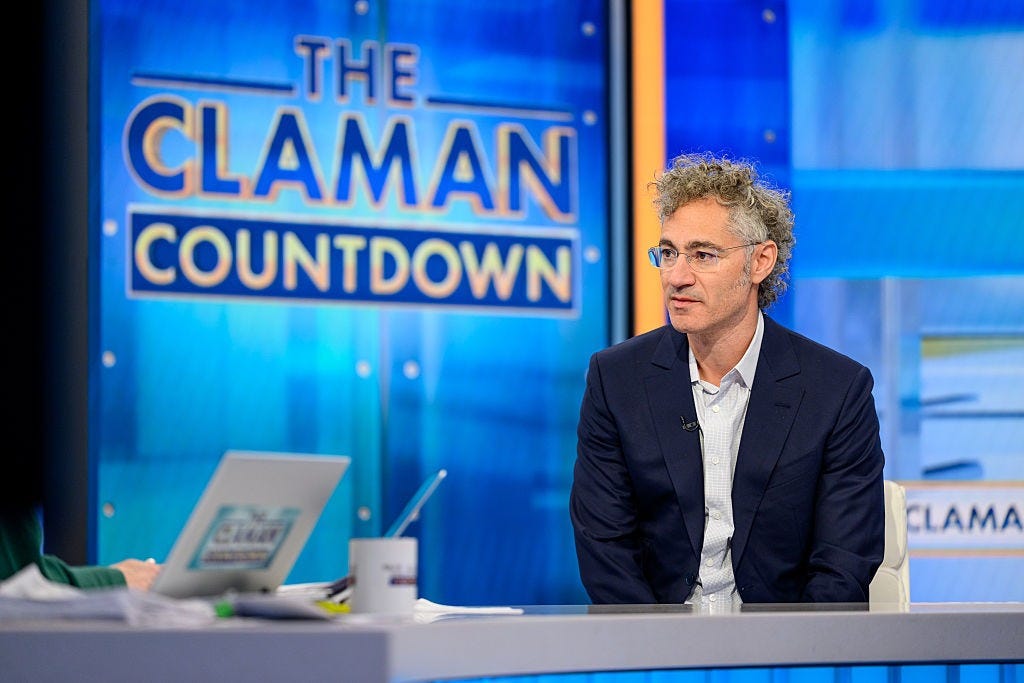
    Palantir CEO Alex Karp appears on Fox Business, October 2025 (Getty)

    Palantir is best known for the AI-powered cutting-edge software it provides to the federal government to give the US military and intelligence communities a leg-up over foreign competitors. Now, Palantir is in the news business as well.

    Over the last six months, with the help of Palantir engineers sitting in on high-level meetings and advising everyone from executives to writers, Fox News has scaled up its use of Palantir’s algorithms in simplifying its workflows. Readers of the nation’s most read right-of-center news outlet are therefore now influenced by the nation’s most ascendant defense contractor for which stories they see and how they’re framed.

    “We are building a first-class platform alongside Palantir engineers that will empower our editorial team to do great journalism and tell important stories,” a Fox News insider told Cockburn. “We are re-imagining and re-building every aspect of our workflow that will help our journalists be more effective and impactful in their jobs.”

    Almost every journalist uses AI in some small way – Cockburn couldn’t live without Sonix, the software that transcribes his interviews. And the use of technology in deciding which stories to elevate up the page isn’t new. For years, media companies have utilized apps such as Chartbeat and Parsely that provide real-time info on which stories are under- or over-performing.

    Fox News’s choice to employ Palantir’s Foundry – a data-integration tool employed by the Department of Homeland Security, Morgan Stanley and Merck, among others – is nonetheless a landmark one. Theoretically, use of the software could free up Fox’s journalists to spend more time on reporting and less on the menial tasks that have taken up a lot of digital-journalist time over the past decade or so.

    When asked if the site is already seeing improvements following the Palantir partnership, a Fox News insider said, “Yes, big time.”

    Not all Fox’s humans are delighted by the new tech, however. Homepage editors have been told that their role is mostly to “just check it [the AI’s suggestions] for factual mistakes,” a source with knowledge told Cockburn. “Everybody has been on edge and stressed as Palantir has essentially taken over Digital, especially the homepage,” another source told Cockburn. “Not only have the AI mandates bogged down writers like myself and others, but it has zapped the creativity out of us and made us lazier and more reliant on this technology.”

    Cockburn has no beef with Palantir pitching their algorithms to willing American buyers. But still – if one of the nation’s most powerful defense contractors is influencing what news you end up seeing, wouldn’t you want to know? And wouldn’t you want that news outlet to disclose it when, say, that company’s CEO pops up on their business channel?


    On our radar

    ARABIAN DAYS President Trump has a full schedule of events with Saudi Prince Mohammed bin Salman today. It’s the prince’s first visit to Washington since the assassination of Jamal Khashoggi. Tuesday’s foreign pooler, Nadia Bilbassy, comes courtesy of Saudi state media; the killing didn’t come up in the briefing that was circulated ahead of time, to the chagrin of several other correspondents…

    TATE WITH DESTINY Disgraced White House official Paul Ingrassia intervened in an official capacity on behalf of his former clients the Tate brothers, to get their cell phones returned when they were seized by Customs and Border Patrol, ProPublica reports.

    VANCE TO THE MUSIC OF TIME A Michigan man called J.D. Vance has been jailed for two years for making online threats against an Ohio man called J.D. Vance (the Vice President) and his boss.


    Summers lovin’, happened so fast

    Former Harvard president and Clinton-era Treasury secretary Larry Summers is “stepping back from public commitments” and is “ashamed” at having asked Jeffrey Epstein for dating advice as recently as 2019 – the year Epstein didn’t kill himself – according to the New York Times. Summers wrote, while pursuing a “love interest” who was seeing another man, “I dint want to be in a gift giving competition while being the friend without benefits.” Oh no he dint! Epstein replied, “shes smart. making you pay for past errors. ignore the daddy im going to go out with the motorcycle guy.”

    As the emails are revealing, Jeffrey Epstein was everyone’s daddy. Perhaps Summers would have been better off asking a different New York billionaire for dating tips…


    Evening Wood

    Cockburn sidled into the cocktail hour at the National Building Museum for the American Enterprise Institute gala a touch after 6:30 last night. Hundreds of guests donned black tie and gathered to see 91-year-old historian Gordon G. Wood receive the Irving Kristol Award. The nonagenarian New Englander drew inspiration from the Founding Fathers in his remarks. Beforehand, AEI president Robert Doar offered a brief tribute to former vice president Dick Cheney, an AEI trustee, whose funeral takes place in DC Thursday. Attendees sipped Cabernet Sauvignon and enjoyed small portions of short rib.

    Spotted: Jonah Goldberg; Joshua Katz; Philip Klein; Katherine Mangu-Ward; Megan McArdle and Peter Suderman; Adam and April O’Neal; Chloe Ross; Robby Soave and Byron York.

    Subscribe to Cockburn’s Diary on Substack to get it in your inbox on Tuesdays and Fridays.