Tag: Parenting

  • The reality of raising an autistic child

    The reality of raising an autistic child

    Although I disagree with Donald Trump’s and Robert F. Kennedy Jr.’s suggestion that mothers who took Tylenol during pregnancy may have caused the huge rise of children born with autism in the US, I also can’t agree with the spate of articles and interviews that have followed – several by high-functioning autistic adults, others by parents of autistic children – basically saying it is great to be autistic. I understand that they are fearful that Trump’s idea of a “cure” could result in anyone with special needs being regarded as subnormal and a second-class citizen, but it’s not helpful, either, to pretend that autism is without its many frightful drawbacks.

    My son, 42, was diagnosed with Asperger syndrome on his 13th birthday in 1996. Then, not so much was known about the condition, and my ex-husband, my daughter and I went through hell wondering why my son was so difficult – and then dealing with his strange, often explosive behavior. I would invite children over to play with him and his older sister, but he seemed to regard them as an alien species and she would end up playing with both visiting children.

    When he went to kindergarten, in the room with all his peers, he would often put his hands over his ears and scream. He preferred to be alone in the corridor. When I asked why he didn’t like his companions he said: “They have squeaky voices” and imitated them. Instead of toys, he had his obsessions – balloons, then houseplants, the cartoon film Robin Hood, tarantulas. The obsessions seemed to give him as much pain as pleasure. The balloons burst or flew away or weren’t the right type. (One category he called “All March Down the Room Balloons.”) He would think a houseplant was dying when it wasn’t and scream with frustration, even grief, and throw the plant and its pot down.

    Aged 11, he announced: “My obsessions have ruined my life!” Years later, I recall his only real friend Peter, then 31, who also had Asperger’s, waiting with me in a car park for my son to turn up. Peter turned to me and said seriously: “We don’t want to have our obsessions. We’d rather not have them.”

    Their obsessions, their high anxiety, their misunderstanding of others’ talk and gestures and their inability to hold conversations, make even high-functioning autistic people isolated and unable to lead a calm, fulfilling life.

    My son’s condition causes him to reiterate the same obsessive stories going round and round in his head

    My son has tried several simple jobs such as cleaning in a supermarket, being a night porter in a hotel, working in a care home for the elderly, but has failed through misunderstanding the social behavior of his coworkers. (In the care home he was intimidated by the advances of what he called “yee-ha girls” – forward young female workers.)

    Much is made now of special interests and the genius of certain people with autism being able to concentrate on their great skills, but I wonder which of them wouldn’t sacrifice these just to have one proper friend. Peter no longer lives near my son, so he is mostly reliant on part-time carers, tolerant women of my age and his father’s elderly relatives. The overtures of a sweet local artist of his age were rejected.

    To be blunt, he is no further on with his contemporaries than he was as a child. His autism causes him to reiterate the same obsessive stories going round and round in his head, often about the past, even about dead relatives – such as my father – whom he has never met. How can most people relate to this? My son wants to marry and have a family but does not know how to go about it and says if the children don’t fit his criteria he won’t like them.

    And would anyone wish to live, as he does, with a terror of dragonflies, convinced they bite? Or with an exaggerated fear of certain local areas, making travel difficult because of a past misunderstanding with a bus driver or passenger? (Actually it is my son, over 6ft, sometimes shouting on a bus, who probably frightens other passengers.)

    And what about us mothers and fathers? In my experience, there are constant discussions and often blame between the parents of these children on how best to treat them. Studies show that 80 percent of parents of autistic children split up. The financial strain – difficulties getting funding for them – stress and emotional toll associated with raising any child with a disability are all contributing factors. There’s also the frequent problem of physical aggression, surely a manifestation of extreme frustration and surging hormones, when the autistic child reaches adolescence. At 14, my son would would often lash out at me, his father – we split up when he was eight – and his sister.

    And it can continue into adulthood. A friend’s nonverbal autistic adult son caused a knee injury to a carer which will never properly heal. Another friend’s adult autistic son, intelligent and articulate as my son also can be, smashed up his parents’ house during lockdown. My son once destroyed the staircase of a rented apartment and the police have been called because of his behavior. At 17 he was involuntarily hospitalized for 28 days and in his twenties was in a psychiatric unit. And what about nonverbal autistic adults who need the physical care normally given to babies? How much I admire parents and carers who have to deal with that.

    On the plus side, my son is a good artist who has sold paintings to strangers, he is an excellent cook and can perform hilarious imitations of people and situations. He likes to make meals for his three young nephews and has given them many well-thought-out gifts. He is in some ways more compassionate than I am to people who are bereaved.

    I will let him have the last word: “Some people with Asperger’s can do extremely well and have successful jobs. But autism, OCD and ADHD get in the way of learning and living life.”

    This article was originally published in The Spectator’s October 13, 2025 World edition.

  • How trans ideology paved the way for motherless babies

    How trans ideology paved the way for motherless babies

    The future is technological, and this includes human reproduction. In Silicon Valley, a very particular sort of technological pro-natalism is emerging – not a movement to try to persuade ordinary people to have families so much as a push to create genetically superior children. The way they see it, the future of human reproduction is – and should be – increasingly technological.

    There’s a vast amount of money moving into the reproduction industry. Interestingly, the big players here are often the same people who have been ruthlessly pushing gender ideology – the insane idea that you can change your sex at will. Why would this be? What is the connection between the fad of transgenderism and tech-fatalism?

    It’s not hard to see why Silicon Valley billionaires would be interested in reproductive tech. Emma Waters of the Heritage Foundation has reported on the wealthy elites who invest heavily in technologies that enable the creation of “superior” children – the embryos chosen for health, creativity or other traits. Waters notes that in 2022 alone, $800 million was poured into fertility-tech startups, with a focus not on addressing the decline in the US birth rate, but on curating the best possible offspring.

    Tech moguls such as Jeff Bezos, Elon Musk, Marc Benioff, Peter Thiel and others have financial interests in reproductive technologies. Musk, for example, believes that humanity’s evolution will increasingly involve cyborgs and AI, and is investing millions in fertility initiatives focused on countering declining birth rates. What few people seem to grasp is that much of the groundwork for getting people to accept radical genetic engineering has been laid by gender ideology. People think of gender ideology in terms of sexuality and identity, but it functions not just as a social movement, but also a highly effective marketing campaign, particularly targeting young minds.

    It forces a shift in perception, undermining the male-female sex binary across various cultures and societal structures – legal, political, medical and social. Gender ideology insists that sex is fluid and that individuals can transcend their biological reality. Its core message – that human beings are not sexually dimorphic, that sex exists on a spectrum and that men can breastfeed – prepares us to accept radical shifts in reproduction, such as the idea of male motherhood and pregnancy.

    This dovetails with the “tech-natalist” idea that mothers don’t matter, and that superior humans can be gestated in laboratories outside a woman’s body. Scientists have already made progress with developing artificial wombs and, as Waters points out, many in the Valley would like to see the development of complete ectogenesis, outsourcing the entirety of pregnancy to these artificial wombs.

    They don’t seem to understand the terrible price we’d pay for this, and the suffering it would impose on the children of the future. The whole concept of motherhood, which is increasingly viewed as irrelevant, is at stake.

    What people have been led to believe is that gender ideology is simply a culture-bound syndrome like anorexia, or a medical scandal like the opioid crisis. While this may be comforting (it gives the impression that gender madness will simply fade out), it also provides false hope and prevents us from seeing the real target – and the power of the forces aimed at that target.

    Technological advancements are challenging societal norms in profound ways. Many people are unaware of how far these technologies have come or how massive the financial investments in the industry are. The billions of dollars invested by philanthropic oligarchs, the medical and tech sectors and governments in gender ideology are much more aligned with reshaping human reproduction than simply supporting a small group of young people undergoing a “social contagion.”

    Irwin Jacobs and his late wife Joan, for instance, have funded both the gender industry and tech-natalism. Their financial support of civil-rights organizations such as the ACLU as well as tech institutes that promote gender-identity ideology, shows how interconnected these social-engineering movements are. They have also donated to the Salk Institute for Biological Studies, which embraces AI and the future of human biology. Capital management firms such EY and BlackRock are also deeply involved in the gender industry, but not because they hope to profit from the market for surgeries and hormone treatments. Even if these procedures lead to further health complications, requiring more medical interventions, the financial returns are not likely to justify the huge investments.

    The reason LGBTQI+ NGOs receive such large sums from these companies to promote gender ideology is that it sets the stage for them to control how we reproduce. So the true target of the gender industry is not how we experience sex, or who we are attracted to, but how we have children.

    Seen in this light, the billionaire pushers of gender ideology are clearly not champions of gay men or women at all. Their excitement is about engineering superior humans, which makes it all the more sinister that they’re simultaneously pushing for the sterilization of young people via puberty blockers and surgery.

    Proponents of the movement argue that there is no downside to technological reproduction and that it could even create greater equality between the sexes. One of the most prominent supporters of this idea is Martine Rothblatt (born Martin) who wrote the first international bill of gender rights. Martine is an American entrepreneur and lawyer who identifies as transsexual and trans-humanist. He has four children with his wife Bina and yet he entirely overlooks and downplays the unique abilities of women.

    True equality lies in respecting differences, not in erasing them. Perhaps this is distasteful to Rothblatt and his trans friends who would like to believe that there is no part of womanhood they can’t simply put on like lipstick.

    But women have a genius for bearing and raising children. And if society convinces that being liberated from gestation and motherhood is a form of freedom, it risks erasing the very essence of humanity.

    This article was originally published in The Spectator’s May 2025 World edition.

  • The importance of the Band-Aid

    The importance of the Band-Aid

    Alexandria, Virginia

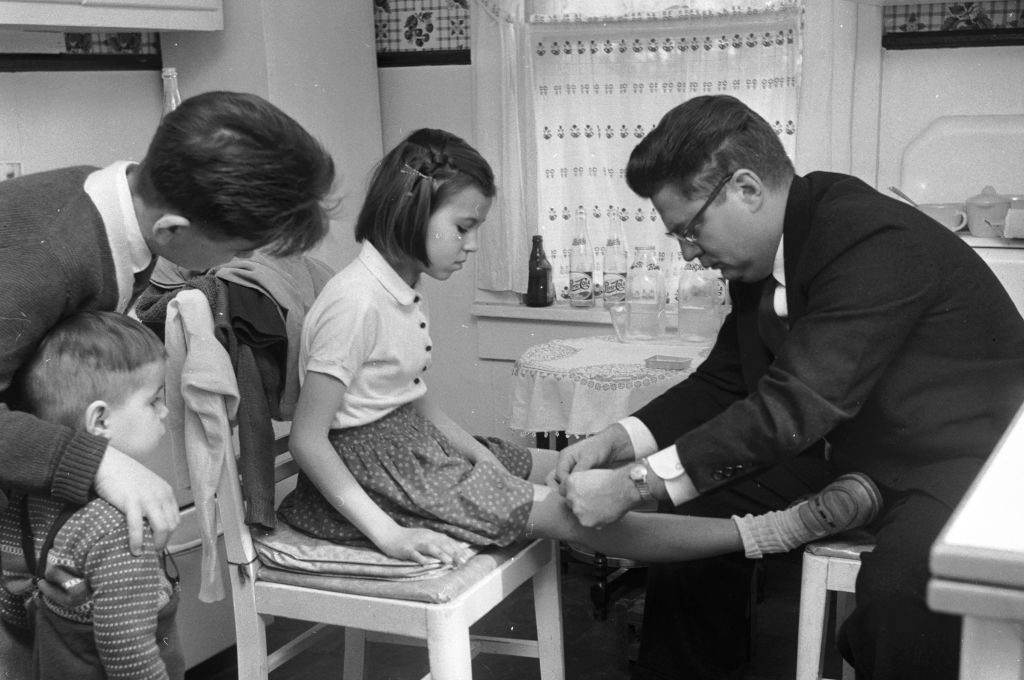
    Back in February, the first grader sustained a scrape that left a tiny red dot on her leg. She requested a soft cast and a medevac chopper. She settled for a dollar-store bandage. She shouldn’t have: it turns out she was quietly bleeding to death from the inside. She would have continued to deteriorate had we not been alarmed by a toilet clog the week after she fell.

    The Band-Aid was invented in 1920 by one Earle Dickson, a New Jersey cotton buyer with a clumsy wife. All her cooking mishaps inspired her exhausted husband to combine his stock with the methacrylates of surgical tape and some crinoline fabric found in petticoats. The J&J website can’t help but note that Mr. Dickson is enshrined in the National Inventors Hall of Fame “in the ranks of fellow innovators like Thomas Edison and Alexander Graham Bell”; the identity of the traveling salesman who first suggested the company supply the Boy Scouts of America with customized first aid kits remains lost to history.

    The Boy Scout partnership kept the adhesive bandage around while J&J executives awaited the next world war, which is always useful in the wound-repair industry. The Band-Aid was cemented in the American consumer consciousness even before J&J plastered Mickey Mouse on to the crinoline fabric in 1951. The marketing strategy lives on. Baby registries are now littered with elaborate first aid kits, complete with all manner of bandages and thermometers.

    The overprepared father quickly learns that all these products are useless with the exception of the nasal aspirator, which you can slip in your pocket when the delivery room nurses turn their backs – a wholly unnecessary act of rebellion that nevertheless takes the sting out of the five-figure bill to come. Nearly every ailment you’ll encounter in the opening months of life can be soothed by pouring breast milk on it, a miraculous panacea for treating seasonal colds, thrush, pinkeye and eczema. It does everything that your wife’s essential-oil-peddling-friend promised when she presented her gift at the baby shower. So effective is mother’s milk it would probably cure Covid, too, if that ailment weren’t designed in a lab to spare children.

    You learn triage as a child grows. During your residency as battlefield medic-cum-surgeon, you are taught to memorize the phrase, “tough girl, brush off.” You will recite these words to the patient while slapping your hands together in as goofy a manner as possible.

    The procedure is suitable for treating any injury short of compound fracture and chronic traumatic encephalopathy; in the event of either case, repeat the phrase while throwing in a healthy dose of laughter to distract from your ashen face. When these remedies fall short, a mother’s kiss and quick cuddle should suffice.

    The stockpiling of bandaging and peroxide is nevertheless inevitable. There will come a day when your child asks you to “kiss it better” as she gestures to a moderate case of diaper rash. These cases are rare, for the majority of children self-wean from mother’s kisses just as they once did from mother’s milk – particularly once they notice that no amount of tender caresses and cooing can tuck that tibia back beneath the skin, and frankly, the wound is beginning to smell. It’s off to the drug store to begin your next chapter.

    The first officially designated ticker-tape parade occurred in lower Manhattan in 1919, the year before Dickson debuted his invention in suburban New Jersey. He couldn’t have known that he was about to transform the life of every parent in America. Our hardwood floors are awash with discarded plastic and resin and once-sterile fabric, an annoyance that takes on a more sinister turn with a crawler roaming the halls. I cannot recall how many used Band-Aids and their individual wrappers we’ve removed from an infant’s mouth.

    The graduation from boo-boo kisses to Band-Aids is one of the most underappreciated milestones in a child’s development, but it is a vital one for any father. You get to see firsthand the idiocy with which they exercise independence. There is no better argument against Whig history and Rousseau’s license than witnessing the application of an 8”x4” piece of gauze to a pinprick, the Neosporin-soaked wrapper tossed casually to the ground. You’d conjure Dr. Johnson and dispute it with a kick, but that would mean retrieving another oversized Band-Aid necessary to avoid the attention of CPS.

    Parades always come to a disappointing end. The once enthusiastic flow of ticker tape recedes. Boo-boos will become the mere stuff of biology, to be clinically corrected rather than cooed over. You can’t help but notice in those sterile environs that even a blood transfusion appears bloodless, and it strikes you that there will come a day when your hardwood floor is just hardwood. And dust.

    This article was originally published in The Spectator’s May 2025 World edition.

  • A life shaped by my father’s bedtime stories

    A life shaped by my father’s bedtime stories

    It’s half an hour before lights out when my dad arrives at my bedroom door holding Roald Dahl’s Danny the Champion of the World. He kicks off his shoes, loosens his tie and wedges himself next to me in my small single bed, his toes waggling in their socks as they regain freedom after a long day in the office. In the evening he smells of the menthol toothpicks he always carries in his top pocket (in the morning, when he drops me off at school, he smells of the spicy pink toothpaste which I once tried and which burned the roof of my mouth). I lie with my head resting in the crook of his arm as he flicks the book open to the first page, clears his throat, making his Adam’s apple bob, and starts reading: “When I was four months old, my mother died suddenly and my father was left to look after me all by himself…”

    Being a man of few words, he borrowed them from others. And it was a kind of magic trick 

    When people ask me why I became an author, I always scroll back to this scene. I could tell them that it was also because my mother had died suddenly, when I was three and a half, leaving my older sisters and me unmoored in a frightening new world in which stories became my escape. That would be true, too. But my mind always tugs me back to these moments with my father at the end of the day, squashed up in bed as he drew pictures in the air with his deep reading voice.

    The green walls of my bedroom would fade away and we became other people in faraway worlds: Danny and his father picking their way through the forest as they went to outwit the greedy Victor Hazell by drugging and poaching all of his pheasants. Or the impoverished Sylvia and her rich cousin Bonnie from The Wolves of Willoughby Chase, speeding through the frozen countryside in a train as the wolves howl around us.

    I see now that these nightly rituals did much more for me than instill my love of reading and story-telling. My father was a South African businessman who had lost his young wife abruptly to a brain tumor, leaving him with three little girls and not much idea of what to do. Like the father in Danny the Champion of the World, my dad was an “eye-smiler” with twinkling eyes. We never doubted he loved us. But he wasn’t given to expressing his emotions, much less talking to us about grief and loss, his or ours. Making sure he raced home from the office every day to read to us individually was his way of parenting us during a time I now understand is every father’s worst nightmare.

    Being a man of few words, he borrowed them from others. And it was a kind of magic trick. Because, looking back, I realise that it wasn’t only that these were the times I felt most connected to my father, most loved and secure. I gained other parents, too. All of the books that swept me away were about children who had lost one or both parents. There was Mary Lennox in The Secret Garden and Sara Crewe in A Little Princess, and later Jane Eyre and Great Expectations, whose long words I would mispronounce when repeating proudly in class. Often they found strength in friendships or other parent figures, a strength gained through their adventures that let them stand on their own two feet and look after themselves.

    The writers never spelt it out — they were far too good for that — but the absent parent was always hovering between the lines. The redemption at the end of the story was never explicitly about dealing with loss and yet it was always about that, too. When the story ended I felt a little stronger and wiser, inspired to be like one of the characters whose lives I had inhabited.

    For as long as I can remember, I wanted to be someone who made up stories like this, too. Books that could look after people, stories that could have the effect of a good parent. But along with my dreams of being an author, there was always a parallel, more childish fantasy. One day I would write a book for my father, I would dedicate it to him. Over the years, during a string of false starts and dead ends in becoming a fiction writer, I never stopped secretly toying with the words to this imaginary dedication. What could I possibly say to thank the father who had become my whole world, who had saved us when the world went dark after our mother died? Like my father before me, I was lost for words.

    These days my dad is ninety-three, and spends a fair amount of the day in bed. We have just started re-reading Danny the Champion of the World together, an illustrated version, with Quentin Blake drawings that he delights in. Now I am the one reading it to him, this magical, uplifting story about a father and motherless son whose bond becomes even closer when they embark on their daring heist. Being as old and powerless as my father now is must be its own version of a terrifying loss, and I hope that the story — not just the act of reading to him — is, in some way, parenting him back. And I’m glad that I finally found the words to dedicate my first novel to him, which sits above us on the shelf as we turn the pages together: “For Dad, who read to us, night after night.”

    Kate Weinberg’s There’s Nothing Wrong With Her is out now.

  • Why I changed my mind on content warnings

    Why I changed my mind on content warnings

    As we sat down at the Royal Opera House in London to watch one of the Royal Ballet’s soloists perform Letter to Tchaikovsky, an announcement began. “Tchaikovsky is understood to have been a gay man, who was forced by the conventions of society to marry a woman,” explained an earnest female voice from off-stage. “The music, words and dance describe the pain and guilt he experienced as a closeted queer person… but like many others before and since, the fact that he was queer meant that he had to stay secret about who he really was… It is still illegal to be gay or queer in sixty-nine countries, and queer people continue to face discrimination or violence all over the world, including here in Britain.”

    As we bombard children with the world’s ills, is it any wonder that childhood anxiety is soaring?

    The audience didn’t seem hugely concerned by this news. They were, however, very bothered by who would get to sit on the limited number of beanbags at the front of the auditorium. The performance was part of a family event for small children, and a few parents did look a little perplexed as to why the announcement was necessary. At least we were spared the details of Tchaikovsky’s incestuous relationship with his own nephew, a concept possibly too advanced for even the most enlightened in London.

    Afterwards, I wrote to the Royal Opera House to find out if there had been a “content warning” that I might have missed. The ROH is not typically shy about these: ticket holders for Donizetti’s Lucia di Lammermoor were duly warned about the opera’s graphic depictions of sex and violence.

    The reply I received directed me to the QR codes, which — had I spotted and chosen to use them — would have alerted me to the show’s message that “Everyone should be free to live openly wherever they are in the world.” “We will ensure going forwards that there is a clearer summary of the content themes in each piece, so parents and children can be better informed to choose whether particular events are right for them,” I was told.

    Navigating modern parenthood is tricky, especially when trying not to come across as a reactionary pearl-clutcher. Yes, yes, of course it is wrong that it is still illegal to be gay in so many countries. I imagine every adult member of the audience felt the same. We’re the sort of smug, self-consciously liberal types who choose the Royal Opera House over church on a Sunday morning. But had I known my four-year-old daughter was about to be introduced to queer persecution, I might have suggested we head to the puppet-making stand instead.

    Was I being homophobic? I don’t think so. It’s not so much the subject matter that unsettled me as the fact that a political point was being shoehorned into a performance aimed at infants. At some point, my daughter will inevitably learn about the grim realities of the world: how Iran executes gay teenagers, say, or how in Saudi Arabia, gay men face lashings and imprisonment. When she does, I imagine she’ll want to do something about it, even if the obvious truth is she can’t.

    It’s that sense of agency that seems important to try to preserve for children. We should avoid burdening them with serious problems they feel powerless to fix. Yet, as we bombard them from increasingly young ages with the world’s ills, from racism and slavery to genocide and human rights abuses, is it any wonder that childhood anxiety is soaring? Greta Thunberg’s rallying cry for children to solve climate change is, for all its sincerity, as much a fairy tale as anything you might find by Hans Christian Andersen. In trying to raise activist warriors, we’ve produced anxious worriers.

    So I have become that neurotic mother, firing off letters about content warnings, desperately trying to shield my child from the harshness of the world. I don’t agree with content warnings in general, so why am I writing to the ROH asking about theirs? Get a grip, Lara. Don’t be that person.

    But then a week later, at a friend’s house, my daughter picks a book from the Little People, Big Dreams series for me to read to her. It is about Princess Diana — a story that will, I suppose, teach her that not all princesses live happily ever after. We begin to read. “Whenever she felt alone, [Diana] sought relief by eating all the cakes she could find in the royal kitchen. But that sweet feeling of comfort didn’t last long. Once it was gone, she would try to get rid of all the food she had eaten by making herself sick… Even though her life seemed to be taken from the pages of a fairy tale, she soon realized that the prince’s heart belonged to someone else. Over time that sadness grew into an eating disorder called b…u…l…i…”

    I slam the book shut. I can’t do it. I don’t want my daughter to know that word, not yet, not for as long as I can possibly prevent her from learning it. I feel angry at the publishers for thinking an eating disorder is an appropriate detail to include in a book aimed at young girls. Could they not have brushed over it? I note the book avoids talking about Diana’s death but three pages are devoted to her eating disorder. I suggest we choose something else instead. Roald Dahl? Let’s find Charlie and the Chocolate Factory, the unedited version, with fat Augustus Gloop, the little brute.

    I immediately revise my position on content warnings, suddenly feeling hardline on the matter. The Princess Diana book should have had a very clear content warning on the front cover and yes, maybe Letter to Tchaikovsky should have had one too. I don’t want to feel ambushed by activism.

    When I later check the ROH website, I see that the next Family Sunday performance of Letter to Tchaikovsky now comes with a more detailed description. “Tchaikovsky composed some of the world’s most loved fairytale ballets. In his life, however, he found it challenging to find his ‘happy ever after’ because of his love for another man.” I may have triggered a content warning, and I am not sure how I feel about it. All I can conclude is that I do not feel cut out for the confusing dance that is modern parenthood — but I suspect I am not the only one.

    What are Spectator columnists highlights — and lowlights — of the year? Rod Liddle, Lionel Shriver, Matthew Parris and Mary Wakefield join Lara, and William Moore, on the Christmas special of The Edition podcast to discuss:

    https://audioboom.com/posts/8622930-christmas-special-2024-with-rod-liddle-lionel-shriver-matthew-parris-and-mary-wakefield
  • My parental lobotomy

    My parental lobotomy

    On August 25, 1953, neurosurgeon William Beecher Scoville drilled holes into the skull of a young epileptic named Henry Gustav Molaison and vacuumed out part of his brain. In August 2023, Mrs. McMorris watched her husband turn his hat backward while teaching her daughters to fish — and then she drank wine.

    Modern man tends to think “botched lobectomy” is redundant, though the frequency and severity of Molaison’s seizures receded. Picture the neurosurgeon, contemplating the forthcoming medical association medals, the ceremonies he would keynote as the Jonas Salk of drilling holes into skulls, the Clara Barton of vacuuming-out brain tissue. Mr. Molaison left the operating room able to recount his childhood crush but could not tell you whether his parents were alive.

    Over the next six decades Patient H.M., as he came to be known, became a human guinea pig. His inability to form new memories altered our understanding of the brain.

    None of the literature I have read has linked Dr. Scoville’s groundbreaking brain vacuuming to the propagation of our species, but in my experience anterograde amnesia is just as essential to the creation of new life as wine. There is no other way to explain why mothers so easily forget the trauma of childbirth, nor for that matter why fathers are surprised anew by forty consecutive weeks of hormonal earthquakes. “This time will be different!” we say with each pregnancy test.

    After a certain number of children, people expect a heightened level of expertise, particularly if you are writing a lifestyle column for which the sole qualifications are: “has kids; male.” I have failed this sort of test before. When my wife married the oldest of nine children, she assumed he would be able to answer queries about vital milestones in infant development. I didn’t mean to mislead her. I truly have been changing diapers since the age of ten, but you develop other skills when you’re barraged by newborns from the age of two to seventeen: namely, the ability to sleep through the night no matter how loud a baby cries.

    After #1 was born, Mrs. McMorris was just as frustrated as Dr. Scoville must have been about his unfortunate breakthrough. But now that #6 is here, she too has fallen victim to anterograde amnesia. Thirteen years of sleep deprivation will do that. Here is a short list of the things we forget each go-round:

    • The age at which babies outgrow Size 1 diapers (however old she was Tuesday)
    • Every baby is born a beer snob. Instead of boring you with a disquisition about how a bottle does not allow the hops to breathe, she shrieks in your face to demonstrate her preference for tap, which is altogether a more pleasant experience than spending time with beer snobs
    • The age at which babies experience sleep regression (the day they start blowing out Size 1 diapers)
    • To retrieve the older children from school

    Mr. Molaison may have lost his ability to form new memories, but his intelligence remained. He passed the time in hospital wards filling out crossword puzzles and was by all accounts good at them so long as clues predated 1953 — back when the Braves played in Boston, John F. Kennedy was a congressman and the dolorimeter was an acceptable medical instrument.

    Dolorimeters delivered concentrated heat rays to a patient’s skin. They were designed to measure pain tolerance. Medical researchers of the day may have been fine with questionable brain surgery, but they believed enough in informed consent to allow patients to self-administer the death ray and withdraw it when they felt discomfort. The tougher patients could withstand a few seconds before throwing the instrument across the room. The problem is Molaison never budged even as researchers maxxed out the temperature. By day’s end he had no memory of holding the device.

    And here is where the parent-as-infamous-amnesiac metaphor falls apart. For the pains associated with childrearing are real. The diapers need changing, the sheets need sterilizing, the cries need soothing — at least until month five when sleep training begins, a milestone as unforgettable to dad as Molaison’s childhood crush was to Patient H.M. You may grow accustomed to the discomfort of nature’s dolorimeters, but you can never grow numb to them. A funny thing happens as you clutch those self-administered death rays. All the particulars of discomfort are lost amid the milestones that matter: the first step, the first word, the first fish they catch while your wife is drinking wine. You adjust your hat. “This time it will be different.”

    This article was originally published in The Spectator’s October 2024 World edition.

  • Kids with conservative parents are happier

    Kids with conservative parents are happier

    Welcome back to Culture Shock! I hope everyone had a wonderful holiday season and is gearing up for the big winter storm that is supposed to hit the east coast this weekend. The latest models in the DMV suggest we’re mostly getting sleet, which is a bit disappointing after years of mild winters and very little snow.

    This was my first Christmas since getting married, and it’s tough to figure out how to divide time between your family and your in-laws. We decided to spend Christmas Eve with my family and then flew to Florida on Christmas morning to see my husband’s family for a couple of days. I am very lucky in that pretty much all of my family members are conservative, so our political arguments are limited in scope.

    Just before the holidays, I stumbled across a new Gallup study that had some fascinating findings on the impact of parents’ political ideology on their children. Specifically, children of very conservative parents have much better mental health outcomes than the children of liberals. I have been meaning to write about it for a while because it didn’t get much attention in the mainstream media, for reasons you can probably guess.

    The study was conducted by Jonathan Rothwell, a principal economist at Gallup and a senior fellow at the Brookings Institution, and published by the Institute for Family Studies. In June 2023, Gallup collected data from 6,643 parents and 1,580 adolescents on issues like adolescent mental health, parental demographics, parents’ political views, parenting practices, and more. 

    The study chiefly found that there are specific parenting practices that lead to better mental health outcomes for adolescents. Children respond the best to parents who are warm and affectionate but also set boundaries and discipline their children when necessary. For example, requiring a child to complete priorities set by parents before allowing them to play or relax, setting a regular routine for school days, hugging or kissing the child every day and responding quickly to a child’s needs are all associated with an approximately seven-percentage-point-higher chance of the child having good mental health. Alternatively, practices like finding it difficult to discipline a child or letting the child get his or her way in a conflict are associated with decreased mental health outcomes for the child. 

    Unsurprisingly (to me at least), the study also finds that conservative parents are more likely to adopt the warm, authoritative parenting style and thus have stronger relationships with their children. As a result, their children have much better mental health outcomes. Contrastingly, liberal parents are more likely to adopt a permissive parenting style, which is associated with a poor parent-child relationship and, consequently, poorer mental health outcomes for the child. 

    Seventy-seven percent of adolescents with very conservative parents reported good or excellent mental health, compared to just 55 percent of adolescents with liberal parents. 

    “As it happens, being raised by liberal parents is a much larger risk factor for mental health problems in adolescence than being raised in a low-income household with parents who did not attend college,” Rothwell writes.

    Overall, Rothwell finds that parenting is one of the most important factors in adolescent mental health. This is key at a time when teen mental health is on the decline and no one seems to know exactly why.

    Instead of getting to the core of this sad trend, many have explained it away, arguing that it’s simply the case that the stigma around mental health has declined and so more people are seeking therapy and treatment for their issues. Yet the more we seem to be talking about and “treating” mental health in this country, the worse our mental health seems to get. Reducing the “stigma” has had the unfortunate effect of glorifying mental illness, to the point that young people broadcast and brag about their increasingly bizarre self-diagnoses on social media as a way to seem unique or special. Labeling ourselves as mentally unwell can become a self-fulfilling prophecy; we pathologize normal emotions and view ourselves as helpless victims to diseases of the mind. Negative experiences or feelings quickly become the center of our world. Big Pharma pushes medication to “cure” us, even as the latest research debunks the idea that depression and anxiety are due to “chemical imbalances” in the brain, not to mention these medications have a litany of horrific side effects. 

    Sigh. 

    In summary, give your kids a hug every day and put them in timeout when they deserve it. You just might save their life. 

  • Anti-surrogacy activists are looking out for the kids

    Anti-surrogacy activists are looking out for the kids

    Conservative commentator Guy Benson and his husband recently announced the arrival of a new baby, born via surrogate. Controversy erupted when they tweeted out the news. Last year, when Dave Rubin, another conservative commentator, and his husband announced they would have two surrogate babies, there was a similar flare-up.

    Surrogacy is the only way a male couple can biologically become parents, but the practice is increasingly questioned due to moral and ethical concerns surrounding the industry and the rights of children.

    Now, the issue is dividing conservatives who have recently found common ground against things like radical transgender ideology. Some immediately conclude that critics of surrogacy harbor bias against gay families.

    Chad Felix Greene, for example, wrote that after “finally see[ing] good movement on slowing down the LGBTQ left’s aggressive sexual and gender policies,” social conservatives pivot to “attack[ing] surrogacy and gay families.”

    But the message for Greene, and others, has been lost in translation. Opponents of surrogacy object to it for both same-sex and opposite-sex couples. Anti-surrogacy efforts do impact gay couples indirectly, a natural result of opposition to a corrupt industry that exploits women, commercializes children and often denies them of their right to two biological parents.

    Gay couples also feel attacked because social conservatives argue for the well-researched truth that children who grow up with their biological mother and father fare better than those who don’t — even those adopted at birth. Adoptees all experience the early trauma of infant-mother separation and ultimately have a higher risk of suicide and other mental health struggles. The same statistics would apply to surrogate-born children.

    To be clear: surrogacy opponents are not against adoption, far from it. However, data surrounding the lifelong effect of separation from birth mothers is relevant. Plus, there’s a stark difference between adoption and surrogacy.

    Adoption often arises from an unplanned pregnancy where the optimal choice is placing the child into a caring family. Conversely, surrogacy intentionally imparts trauma and creates adverse circumstances by design. To take a baby from the only body, home, voice and smell they’ve ever known at birth can have lifelong effects.

    In Birth Psychology, Paula Thomson writes that “early pre- and post-natal experiences, including early trauma, are encoded into the implicit memory of the fetus.”

    These memories, says Thompson, “will travel with us into our early days of infancy and beyond and more importantly… set our ongoing physiological and psychological regulatory baselines.”

    In other words, mother-child connection in the womb matters deeply, regardless of if the birth mother is genetically related to the child. But do couples desiring children at any cost care about that?

    Parenthood’s core theme is encapsulated in: “It’s no longer about me.” Surrogacy and families without a mother or father (either gay couples or single adults) solely focus on the involved adults. Children’s rights and needs always come second in these cases.

    In a just society, the responsible adults must be centered on the needs of the most vulnerable. In this case, children lack the choice or consent for a life marked by trauma and disadvantage.

    As a result, an increasing number of donor-conceived individuals are now speaking out against surrogacy and donor conception.

    “I always knew that I was purchased and created precisely to make her happy,” writes the donor-conceived Alana. “My father was never a full human being to [my mother], only a handful of breeding details.”

    Sounds familiar. This week, a clip went viral of a man who said he “spent a quarter of a million” to ultimately get an “Ivy League-educated…. Brazilian supermodel” to be the bio mom for his child.

    An anonymous, donor-conceived TikTok user told me she was devastated to discover her biological mother had no interest in a relationship. The “mother” viewed herself as an egg donor, nothing more. But to this young woman, that “egg donor” was part of her identity.

    Viewing surrogacy in its starkest terms, it’s easy to repudiate. In theory, human selling (aka “trafficking”) is illegal. In reality, you can buy a baby at $50,000 a pop within the Wild West that is unregulated surrogacy in the US. We’re one of the only Western countries with few restrictions on who can buy a baby, so long as they cough up the cash.

    Surrogacy has ballooned from a $4 billion to a $14 billion industry in just the last two years and is slated to grow to $129 billion by 2032. Vulnerable women from places like war-torn Ukraine and impoverished Uganda are often used to grow babies for wealthy Americans.

    Not every couple who uses a surrogate is wealthy. They may save for years to move ahead with this dream of a family. And many surrogates themselves genuinely want to help others start a family. But how many would step forward if payment were unavailable? Despite framing this activity as altruistic, it is fundamentally commercial and ethically questionable at best.

    And the linguistic gymnastics used to justify the practice are obvious. Men and women who contribute to a baby’s creation are called egg and sperm “donors.” Yet they are paid for their specimen, something you can’t legally do with any other body part.

    Female “gestational carriers” earn tens of thousands of dollars for the use of their bodies — mere rental wombs for the human life they grow and give up after nine months.

    In Rubin’s case specifically, there were possibly six people involved in the creation of two babies: two men who provided sperm, two women who provided eggs and two different women who were the birth mothers. These confusing biological and physical details are part of a real human’s story, one that will require them to navigate a complex mess of identity.

    There may be accusations of anti-gay bias when it comes to surrogacy, but these are false. The concern lies in totality with the wellbeing of the child, whom society has considered least of all in this dialogue.

  • Why I have no children

    Why I have no children

    “Do you have children?” This stock question still floors me. When confronted, I don the mask, breathe deeply, get a grip and try to answer honestly. It doesn’t always work out that way. In line for the supermarket, my bored fellow shopper seems happy with my breezy reply: “Yes! One’s at university, the other teaches English as a foreign language, online.”

    Lying doesn’t come happily or naturally to my husband or me. Where it won’t land us in trouble, inventiveness has become our coping strategy for what seems a casual disregard of the possibility that we might not have children and that our childlessness might not be voluntary. When I must be honest, I brace for the invariable slight pause after my answer, the fleeting look of something I can’t quite fathom — disapproval? Pity? Certainly some sort of deflating expression.

    Everyone’s home should be alive with rugrats (a term I dislike), little pattering feet, hungry youths, grown-up children, grandchildren and, if you’re lucky, great-grandchildren. The failure to have children — whether by design or not — is stigmatized. Having children is what you do. Positively deciding not to have a family (not a decision I made) is deemed selfish. You grow up, get partnered, have children. How couples have children seems irrelevant. I’m only relieved we don’t live somewhere that regards a childless woman as a criminal embarrassment who should be put to death. But even in Britain, I’ve heard television presenters proclaim: “A home just isn’t a home without children.”

    You grow up, get partnered, have children. How couples have children seems irrelevant

    I don’t blame my career or anything else; my life worked out like that. The tricky thing was, most people I met in my twenties and thirties had partners/spouses and, often, children. Nearly thirty years ago, at an after-work social event, I told a female colleague that I’d love to be married with children. The colleague, who was happily married with a delightful teenage daughter, looked at me in bewilderment and asked: “Why?”

    A few years later, when I had almost become resigned to my involuntary singledom and aloneness, and so had my parents, my husband-to-be turned up. But our ardent efforts to have a child failed. We sought medical advice but were told we were too old for IVF. We discounted adoption.

    We quietly accepted our childlessness until, seven years later, in a town where we had moved for my husband’s work, a casual conversation with a doctor led us to a local fertility guru. She suggested egg donation. The doctor was aghast that this procedure hadn’t originally been offered to us. So, in a final attempt at parenthood, we embarked on an invasive, emotionally turbulent and financially draining egg donation venture. But Mother Nature was having none of it.

    We decided one try was enough. It would, in truth, be selfish to have a child when we already lacked the energy of twenty — or thirty-somethings. We were also aware that it was possible that if we did have a child, they would be prematurely orphaned through having been born to middle-aged parents.

    I wrote to the original hospital who had said I was too old for IVF, asking why I had not been offered egg donation when conventional IVF was discounted. They replied: “We did not want to cause you offense.” I responded that the only thing that offended me was learning of the option seven years too late. Then, with nothing else to lose, I sued the hospital.

    Our nephews, nieces and two great-nieces admirably fill our family gap. And we feel close, in a way similar to family closeness, to some of our friends’ children. We see how tough life is for many families and for young people. Our friends and relatives perpetually worry about their brood, whatever age they are. That’s what having children is like, I’m told. You worry all the time.

    Some people have casually said how lucky I am not to have children, because I “don’t know how they’d have turned out.” A distant in-law, sour that my husband and I once owned a modest holiday home, complained to us that she and her husband couldn’t afford one because they had children. I nearly asked her if she’d like to swap.

    Now, as age advances, my children thrive in a misty but lively corner of my imagination. As for the case against the hospital — they settled out of court. The compensation will eventually go to a children’s charity.

    This article was originally published in The Spectator’s UK magazine. Subscribe to the World edition here.

  • White feminists are finding new problems with motherhood

    White feminists are finding new problems with motherhood

    Do you ever wish that your young children would stop asking you questions, constantly touching your body and being needy for your love and attention? That’s called being “touched out,” a new-age expression for the Extremely Online mother who can’t seem to reconcile with the idea that her life is going to be different after she has children. It’s also the title of Amanda Montei’s memoir-cum-cultural criticism on how modern motherhood in America is indistinguishable from the pervasive rape culture that permeates every aspect of a woman’s life in the country, including marriage, the workplace and yes, parenthood.

    Montei’s revelations about motherhood came to her after #MeToo took off. One evening, as she was feeling “touched out” — because her toddler wanted to play and read books on her lap — she disassociated from her body by thinking about unsatisfying sexual encounters she had with various men in her twenties. She saw the “demands of modern motherhood as inseparable from the broader violence against women in the US,” with breastfeeding being a particularly “triggering” activity that reminded her of all the ways “men had used and scrutinized her body” throughout her life.

    I’ll pause here for a moment so you can reflect on everything you’ve just read. 

    Montei’s book is a window into how women on the left have come to pathologize motherhood, driven in no small part by the desire to appeal to one of the largest and fastest growing demographics in America: childless women. This trend of describing the everyday challenges of motherhood in therapy speak is the result of more and more liberal women being diagnosed with mental health issues and seeking psychological help to make sense of their lives. Liberal women aren’t having kids and they’re miserable, and those who do decide to become mothers need to make sure their childless peers don’t feel too bad about being left in the dust.

    Another book trying to “demystify” motherhood under the guise of radical honesty is Mom Rage — also a term borne out of the psychobabble of internet mom speak — about the “rage that festers beneath the shame” of being a “bad mom.” The book’s thesis was so poorly argued, even the flagship publication of bleeding-heart liberals — the New Yorker — couldn’t give it the kind of glowing review the author, Minna Dubin, was gunning for. Indeed, one of the most glaring issues with Dubin’s book is how specific the experience of having “mom rage” is to her. She claims her son suffers from “sensory-processing disorder, fine and gross motor delays, food rigidity and autism-spectrum disorder,” and how his unwillingness to cooperate with her demands around food, potty-training and crossing the street thrust her into a blinding fury that often sees her engage in physical violence towards him. This level of candor is used to showcase her family’s private moments of hardship so voyeuristic, childless women can pat themselves on the back for choosing against the hellscape that is motherhood. Motivations and ethics be damned when your book is being reviewed in the most prestigious journal in America by none other than celebrity literary critic Merve Emre. 

    These books are not for the vast majority of mothers out there. They’re written for the primary purpose of making sure their authors are not sidelined in the progressive circles they inhabit. They want to stay relevant, be part of the conversation about “inequities in parenting” and the “gendered misogyny” of motherhood, even if it means throwing their kids under the bus for clout with their liberal peers in influential circles who want to do away with the nuclear family. God forbid they have to settle for moving to the suburbs into a four-bedroom house with their two mid-size SUVs and live happily with their husband, 2.1 kids and dog. The horror!

    One of the unsaid tenets of modern feminism is the rejection of all old-world traditions, marriage and parenthood included. Under the guise of “choice,” radical feminists are silently judging anyone who claims to be for the cause, but behaves in a way that casts doubt on their loyalty to capital-F Feminism. This includes engaging in behaviors associated with the conservative camp of existence: giving importance to family values and living in line with traditional gender roles without railing against the omnipresent boogeyman of “capitalist patriarchy.” A real Feminist aspires to a life of hedonistic spinsterhood, and if you want the privilege of using the label, you have to self-flagellate for deviating from that path, which is exactly what Montei and Dubin are doing.

    Under the pretense of being profound and “speaking their truth,” these women are swimming in an ocean of resentment aimed at their children (and to a lesser extent, their feminist husbands) for not “having it all” as they believed they would. Montei claims she breastfed her daughter for so long, she lost friends along the way and had to give up a “promising academic career” and turn to running her own daycare because she couldn’t afford the high cost of childcare. Insights that “get real about parenting” allow her to keep her Feminist card because she says she’s suffered, and based on all the coverage her book is getting from the liberal press, she has been absolved for stabbing Feminism in the back. 

    Touched Out and Mom Rage are to motherhood what Robin DiAngelo’s White Fragility is to race relations. Status-seeking, white women who don’t want to be seen as “Karens” or be told they’re upholding “white supremacy” have found a way to lump themselves in with the “oppressed” by way of problematizing motherhood. They’ve learned from the Lena Dunham school of “how to be a good liberal” by saying outlandish things like wishing they had gotten an abortion

    The age of motherhood is dead; long live Motherhood.