Tag: Place

  • In awe of Fuji-san

    In awe of Fuji-san

    My personal version of hell? Shibuya station, Tokyo. Shibuya Scramble is one thing: the busiest pedestrian intersection on the planet, it sees two million people elbow each other, every day. But the train station that thousands of them are trying to get to? That’s where my hopes go to die. A place where you’ll find me near tears, wondering if I’ll ever see my loved ones again. It’s almost impossible to navigate, spread across a dizzying number of floors and stuffed with throngs of human beings speaking a dozen languages. New platforms spring up all the time, often at the top of an unassuming escalator, or via a tiny hidden exit of the Hikarie shopping mall. There are (one or two) signposts, sure, but my Japanese leaves much to be desired.

    Hopping on a limousine bus from Shibuya Mark City, which is attached to Shibuya Station, to Kawaguchiko had sounded doable, positively luxurious compared to my myriad disastrous transport experiences in the world’s most populous city. Like most wide-eyed first-time travelers to Japan, for reasons I wasn’t quite sure of, I just had to get to Mount Fuji. There’s something intangible, even magical about that volcano, its indelible shape scoring our collective consciousness through pop culture: I must have absorbed it through anime, wall posters and Godzilla movies.

    A friend and I would spend three nights at Hanz Outdoor Retreat, a mini-village of glamping villas and dome tents amid forests and lakes, Fuji (or “Fuji-san” as the locals call it) providing a pretty unforgettable backdrop. It would be the perfect escape from the maelstrom that is Tokyo.

    “Run!” Claire screeched via a voice note. I had seven minutes to follow photos she hurriedly sent through WhatsApp, breadcrumbing essential directions needed to find the series of escalators and narrow staircases hidden behind random doors that would eventually lead to the tiny coach terminal at Shibuya Mark City, found inexplicably on “4F.” Sweating, I found my comrade, and we tracked down the right vehicle by sheer luck. On instinct, I followed a tourist wearing a T-shirt printed with an image I’d associated with Japan as long as I could remember – Mount Fuji peeking out from behind a huge white-crested wave, in a storm-tossed sea. If anyone knew where I was going, it was this guy.

    Like most first-time travelers to Japan, for reasons I wasn’t quite sure of, I just had to get to Mount Fuji

    As the journey wore on, he and the rest of the passengers pressed their noses and phones to the windows, distracted by the mountain’s sheer magnificence, said to have formed over the past 2.6 million years.

    Picked up two hours later by our guide Savvas, we had no difficulty settling into the peaceful hotel complex, stopping in the grounds to stare up at the volcano. Our villa was reminiscent of an old-fashioned nagaya (Japanese row house), laden with heavy fur throws and slouchy bean bags. A cavernous private Jacuzzi bath tempted us for a quick soak before a porter arrived with the ingredients for a tremendously large Sukiyaki hot pot to cook ourselves, on our freezing private terrace. We duly put on our coats.

    “We call it wine beef,” Savvas explained, talking us through the types of Wagyu bubbling in an umami broth as he unwrapped huge plates of pickled butterbur and tuna carpaccio. “The meat is from Kodagu and Koshu,” Savvas explained. After weeks of being spoiled by Japan’s precision flavors, meticulous food rituals and exceptional regional specialities, I’d set impossibly high standards. Yet this meal stood out as the best of our six-week trip, the hot pot loaded with thick noodles and fresh vegetables.

    “Umami is more than a flavor; it’s an essence,” Savvas added, using chopsticks to push slabs of beef deeper into the pot. Stays at the retreat are hands-on; at the breakfast counter we found marshmallows for toasting on a huge outdoor fire. Guests are given camping stoves at each table to heat sausages and cook their eggs any way they choose. Later, Claire took great pleasure in chopping a piece of firewood cleanin half.

    “I feel… powerful!” she yelled, hotel staff erupting in applause. The main building is made with materials purchased from a Samurai’s family home and held up by old wooden rafters. Inside are small, gendered bathing areas – ubiquitous in Japan – with waters heated to a toasty 107°F. One ten-person villa comes with a private chef, for groups who want to live as the Japanese do. Parties gather around the irori – a sunken hearth for feasting and keeping warm – while getting tipsy on chunky regional sake. I prefer a craft peach Chu-hi, a sweet, low-alcohol drink made from potato or wheat.

    “What animals live here?” we asked. “Cows… frogs. Plenty of deer. Look out for flying squirrels, too.”

    Our first morning took us to Fujiyoshida Sengen shrine, a Shinto sanctuary at the volcano’s base. Through relentless rain, we huddled under umbrellas to admire the stone lantern-lined entrance, purify our hands and purchase amulets for fortune and safe travels. The main trail to Fuji’s summit – a six-hour climb – was closed for the season. Instead, we’d tackle a shorter ascent that promised yet another perspective of the mountain’s perfect symmetry.

    After filling our bottles with Fuji water from the retreat’s well and raiding a local bakery for matcha bread and pork cutlet sandwiches, we strapped ice grips to our boots. Ascending Dragon’s Mountain on snow-covered pathways proved challenging – to put it politely – but the view of Motosuko, one of the Fuji Five Lakes, rewarded our efforts. An hour later and just shy of the top, we admitted defeat, stopping to open flasks of coffee. The snow-capped peak of Mount Fuji was starting to feel like a family member.

    “She was worth it,” Claire nodded, pleased with herself.

    “She’s a she?” I pondered.

    “Look at her. How could she be anything else?” said Claire. A quick Google found Claire to be correct: Mount Fuji is often referred to as a woman, or “Onna Fuji” (with a gently sloping ridgeline and a huge crater at the summit, go figure). My internet search informed me somewhat ironically that women were forbidden from climbing mountains in Japan until 1872.

    We felt the guilt for not continuing on, but we had a villa to vacate, a forest to camp in, and charcoal that wasn’t going to light itself.

    Cooking our next meal by lamplight, on an open flame, I prayed to any god who might be listening that I’d cooked the chicken through. I scraped garlicky ajillo sauce from a jar, and warmed vegetables dipped in oil. We skipped beers at the bar stationed next to our tent and passed out under thick blankets.

    The next day, after burning our breakfast sandwiches, we slid our feet into Crocs and crunched across the icy forest floor to an outdoor sauna. There we remained until it was time to bid the retreat, and our girl Onna Fuji, “jaa ne.”

    It was a tough goodbye, one that had us resolving to come back one summer – but she wasn’t done with us just yet.

    Feeling brave, we opted to take the train back to Tokyo, Savvas helpfully translating ticket machine instructions. We waved him and Mount Fuji goodbye, before pulling out laptops and phones to catch up on work. Two hours later, I surfaced from a sea of emails to check on our progress.

    “Um, Claire. Why can I still see her?”

    A gasp.

    “We missed the stop. We were supposed to change trains a while ago. Oh my god, we’ve been going in a circle.”

    We laughed hard, counting exactly how many angles from which she’d now silently judged our navigational prowess.

    A sweet young commuter named Yoshi kindly directed us to the correct train line and the new tickets that would help us finally wave off our sister. Chatting until we reached our stop, I asked him if he might know the name of the artist responsible for the T-shirt print that had helped us find Mount Fuji in the first place.

    He took out his phone, and together we found it to be Katsushika Hokusai, or Hokusai, a painter and printmaker from the Edo period. “It is a woodblock print! It is called ‘The Great Wave off Kanagawa.’” Reading over his shoulder, I started laughing again.

    “Claire. That artwork with the wave. It’s from a series of prints. Guess what they’re called.”

    “Go on.”

    “Thirty-six Views of Mount Fuji.”

    This article was originally published in The Spectator’s October 27, 2025 World edition.

  • The theater of the Galápagos Islands

    The theater of the Galápagos Islands

    It was stiflingly hot in the middle of the Pacific Ocean. I was exploring the eastern Galápagos Islands, living cheek-by-jowl on a former casino ship with a cast of characters plucked straight from a murder mystery novel: a former British supermodel, an Ecuadorian presidential candidate, the ex-drummer of a band who once supported the Who and an influencer couple who looked like they had stumbled off the set of Triangle of Sadness.

    The stars of the show – and boy did they know it –were the sea lions

    While the trip had all the ingredients to cook up an irresistible whodunit, I was not just there to inspect the wildlife on board but to observe the wildlife off it. The Galápagos Islands are a volcanic archipelago of 21 islands 600 miles off the coast of Ecuador, and they are rightly considered to be one of the greatest national parks on our planet. The islands are home to some 4,000 species, around 40 percent of which are found nowhere else on Earth.

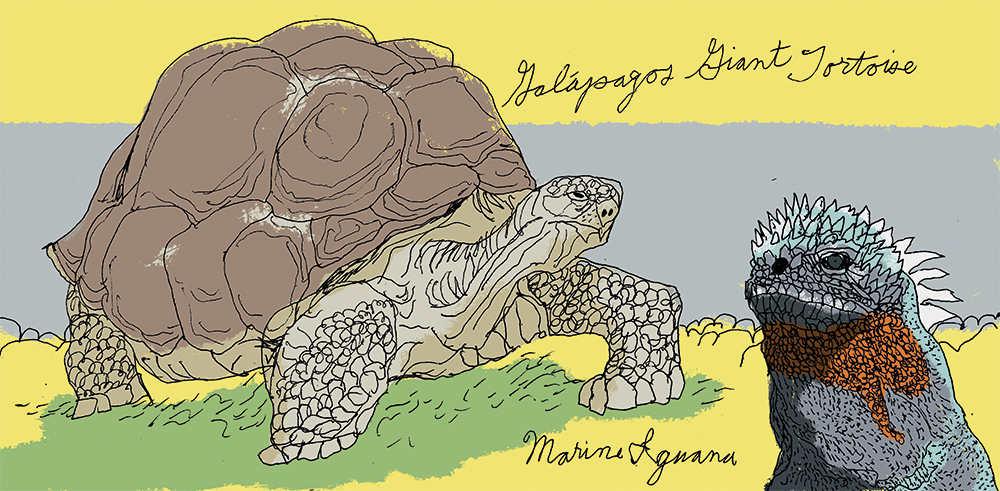
    It is almost 500 years since the accidental discovery of these islands by Tomás de Berlanga in 1535. Berlanga was the bishop of Panama and he was tasked with travelling to Peru to mediate a dispute between Francisco Pizarro and the Spanish Crown. Midway through his journey, wild winds knocked him off course and he drifted towards an unknown island. Berlanga and his crew arrived cotton-mouthed, so parched they began to drink cactus water. Soon, they came across giant tortoises, sea lions and marine iguanas. “Like serpents!” Berlanga wrote to the Spanish king, describing his surreal encounter. “And so silly they don’t know how to flee.”

    Three centuries later, in 1835, a 22-year-old naturalist named Charles Darwin sailed to the islands on HMS Beagle after completing a surveying mission of the South American coast. He was fascinated by the volcanic nature of the islands but, like Berlanga, was hardly enamored. “Nothing could be less inviting than the first appearance,” he recorded. But during his five weeks on the islands, living among fluttering finches and prickly pear cacti, Darwin’s theories of evolution began to take shape. In 1859, On the Origin of Species was published: we know it as the foundation of evolutionary biology.

    I confess that I, too, was guilty of judging the islands too quickly. On first glance, many of them – with their harsh, rugged and sun-scorched terrain – can seem uninviting, even post-apocalyptic. But the magic of these islands is that once you get closer, a whole spectacle begins.

    A trip to the Galápagos is, of course, a far more curated and bureaucratic affair than what would have taken place in Berlanga and Darwin’s day. The archipelago is a UNESCO World Heritage site and national park, so it is subject to strict conservation laws. The Ecuadorian government, along with various international organizations, works tirelessly to protect this fragile ecosystem, particularly as tourism increases.

    Visitors must: obtain a transit control card, travel with an authorized guide, stay on marked trails and never feed or touch the animals. “Please do not touch the sea lions!” the guides – long-suffering but commendably patient – repeated, even as the sea lions, coquettish as ever with their cartoonish eyes, wobbled up to our ankles. It often felt like the wildlife had more freedom on these islands than we did.

    [Eric Hanson]

    Our voyage on yacht La Pinta looped east from Baltra to Santa Fé and San Cristóbal before swerving south to Española and Punta Suárez. As we boarded the dinghy to reach the islands themselves, a fleet of frigatebirds – known as the “pirates” of the sky – heralded our arrival, slicing through the wind with their black plumage and forked tails. A trip to the Galápagos Islands is pure theater. Each island is a different stage; each animal plays a different part. Visitors merely sit back and watch the show.

    The overture began on South Plaza, one of the smallest islands in the archipelago, known for its fiery red carpetweed. It changes to purple, green and orange as the seasons shift. Creeping through the color were dinosaur-like marine iguanas, a remarkable example of natural selection and the only seafaring lizard in the world. South Plaza is also the place to spot the rare marine-land hybrid iguana, a mishmash of species with distinctive black coloring and long yellow stripes believed to be able to survive in both marine and terrestrial environments.

    Next came Santa Fé (or Barrington) Island, one of the oldest in the archipelago. Unlike its neighbors, its formation stems from geological uplift rather than a volcanic eruption, creating a relatively flat terrain punctuated with prickly pear forests and crab-covered rocks. The island teemed with endemic species: the Santa Fé land iguana, Darwin’s finches, Galápagos hawks and swallow-tailed gulls, whose red-rimmed eyes made them look as though they hadn’t slept since 1535.

    The stars of the show – and boy did they know it – were the sea lions, who sprawled across the rocks like Titian’s “Venus of Urbino.” If they weren’t basking in the sun they were lolloping onshore, flapping their fins like quarreling siblings and barking with an emphysemic honk. They showed no fear and were consummate performers. Thespians of the highest pedigree.

    The easternmost island is San Cristóbal, which is composed of extinct volcanoes and lava fields. Darwin noted the remarkable tameness of the animals during his visit – and so did we. As we wound our way up a trail, it felt like the show’s crescendo had begun when we finally glimpsed the comical feet of a blue-footed booby. “Look! Love is in the air,” Pancho, our peppy, silver-haired naturalist exclaimed. A male frigatebird was just ahead of the booby, inflating his bright red throat pouch as if it were a whoopee cushion. Pancho explained that once puffed up – a process that can take half an hour –  the males begin their mating call: shaking their wings, swaying their heads and drumming their bills on the pouch. Females hover above, judging the performance. “It’s a crazy time to be in the Galápagos,” Pancho grinned. “This is one of the best mating rituals to see.” It was 95 degrees and not yet 10 a.m., but for these frigatebirds, the action had begun.

    Our curtain call came on Española Island, the southernmost point in the archipelago and the primary nesting site for the world’s entire population of waved albatrosses. Here we found “Christmas iguanas” – marine iguanas colored festive red and green – and colonies of wheeling, squawking seabirds. On the return from the trail, we paused to look at a Galápagos hawk’s nest: the apex predator of the islands. “Nature is full of surprises!” Pancho beamed once more, explaining that the female hawk mates with multiple males, leaving paternity an open question – the Mamma Mia! of the bird world.

    The trip felt like one big open-air opera. Berlanga and Darwin may have escaped the constraints of modern-day tourism, but the wildness they encountered here remains unchanged by time. This is nature in its purest form: unscripted, unfiltered, unchained.

    Saffron visited Ecuador and the Galápagos lslands with Metropolitan Touring. Yacht La Pinta offers four- and six-night itineraries around the islands with luxury cabins starting from US $5,870.

    This article was originally published in The Spectator’s October 13, 2025 World edition.

  • Is this America’s most racist town?

    Is this America’s most racist town?

    On a suffocatingly humid Friday morning in August, I sat in a rental car parked outside the home of Thom Robb, the leader of the Ku Klux Klan, wondering if I should knock on his door. A shirtless, muscle-bound, heavily tattooed carpenter who lived down the road – and swore he wasn’t racist or a Klansman – said Robb was “a really nice guy” who wouldn’t mind my turning up at his house without an appointment.

    Klansmen, I reckon, aren’t “nice” guys by definition, and as Robb’s mean-sounding dog barked at me from the other side of his fence, I feared the neighbor was setting me up to get my head blown off. I wondered if Arkansas, the only state in the Union where they’ll throw you in prison for failing to pay your rent, had a stand-your-ground law that would justify Robb spraying a few bullets in my general direction. I wanted to leave, but I knew I’d probably never again be in the backwoods of Arkansas with an opportunity to meet one of the country’s most notorious racists. I really wanted to meet this man, for reasons I still do not completely understand.

    I met Justin, a portly young man who, when I asked if he was from Harrison, said ‘unfortunately, yes’

    Why was I visiting Arkansas solo in August, the swampiest month of the year in a state that sees comparatively few visitors from outside the region? Arkansas may not lead the country in much, but it has had its share of colorful nicknames: the Bear State, the Toothpick State, the Land of Opportunity, Rackensack and the Natural State. It has the Ozark Mountains; it was the home state of the “Man from Hope,” Bill Clinton; it has the most Walmart locations per capita and hosts the company’s headquarters; it is the birthplace of cheese dip. But it is often overshadowed by its Deep South neighbors. A popular YouTuber, for example, rates it as only the second most redneck state in America, behind Mississippi. And while Mississippi and Alabama typically place 49th and 50th in poverty and other socioeconomic metrics, Arkansas usually lands 46th or 47th – forgettable in its sub-mediocrity.

    That’s a shame, because, as I found out this summer, it’s a strangely appealing place, full of surprises. Who knew the second-most redneck state in the country was also full of antique shops, bookstores and charming small towns with perfect squares? Places like Leslie, Conway, Wilson, Mountain Home and Pocahontas are virtually unknown outside the state but are as delightful as any small towns I’ve visited anywhere in America. But I didn’t travel to Arkansas to sightsee.

    My primary purpose was to explore two communities accused of racism. Harrison and the neighboring hamlet of Zinc, population 90, have been jointly branded the “most racist town” in the US thanks to a pair of men named T(h)om: Robb, whose Christian Identity Church and KKK headquarters are in the unincorporated backwoods between the two places, and Tom Bowie, a Zinc resident who’s been labeled “America’s most racist man” in a host of viral YouTube videos. I also wanted to visit Return to the Land, an intentional “whites only” community three hours to the east.

    Robb’s pontificating gave me a headache, but I still had more racists to meet

    For a place with a serious PR problem, Harrison – with its quaint town square and appealing shops – made an unexpectedly good first impression, though a barbershop just off the square with a Confederate flag out front isn’t something you see in most states. Outside the bustling Town House Café on the square, I met Justin, a portly young man who, when I asked if he was from Harrison, said “unfortunately, yes.” I asked him if the YouTubers who’ve accused Harrison of being the “most racist town” were accurate and he said, “I think they’re very accurate.” A gay man, Justin said the town was full of bigotry of all sorts and insisted he planned to leave as soon as he finished nursing school.

    Elsewhere in Harrison, I met a young couple about to leave their home for the long commute to their jobs at the Trump store in Branson, Missouri. The young man was wearing a T-shirt depicting a muscle-bound Donald Trump and the phrase, “Everyone Wants to Be Trump, Until it’s Time to Do Trump Stuff.” Both insisted that theirs isn’t a racist town. “The most popular kids in high school were black,” said the woman. On the gravel road leading to the KKK compound, the shirtless man who said Robb was a nice guy also maintained that neither Harrison nor Zinc is racist. “He’ll show you his church,” he said of Robb, “just stop by his house.”

    He then gave me directions to the house, which is right around the corner from the compound. On the way there, I met Tom Bowie and his wife, who were hauling jugs of water back to their home. I told him that his racist musings on YouTube had helped several black creators make a lot of money and he didn’t disagree. His wife insisted that Arkansas was considered racist long before her husband moved to the state from Maryland. She said he was speaking “truths” that others were too afraid to. Some of these included her contentions that “the Indian people that come over here do not know nothing” and “the Jews run a lot of things.”

    I don’t know if Robb has a side hustle – I imagine being head of the KKK renders you unemployable – or if he draws a salary as the head of the Knights party and pastor of the Christian Identity Church, but the man has a pleasant two-story home with a wide porch and an expansive lawn. I let his dog bark for a bit to see if Robb would come out to greet me. When he didn’t, I drove to the gates of the compound, which were locked. A middle-aged woman – you guessed it, white – who introduced herself as Rebecca was parked outside the gate. I told her I had a travel YouTube channel called Mad Traveler and liked to visit offbeat places, which is true and seemed more innocuous than saying I was a journalist. She promised to go get Robb. Five minutes later he arrived, driving a white Jeep with a novelty Confederate flag license plate on the front.

    Robb is 78 and gives off a grandfatherly vibe, at times grasping, Biden-like, for words. “I don’t like to waste my time with most YouTubers,” he said. “But Rebecca said you seemed nice.” I hopped in my car and followed him up the gravel path between rows of American flags toward the KKK headquarters. Robb wore jeans, a checked short-sleeve button-down shirt, and a cowboy hat. He was initially cordial, but when we walked by a sign listing the Ten Commandments and I asked him if being a Klansman was compatible with the Golden Rule (love thy neighbor), he grew combative. “So, that’s why I can’t understand why people don’t love their heritage,” he said. “They claim to believe in the commandments, but they don’t love the people. They’re willing to watch white people being genocided, and they don’t care.”

    There wasn’t much to see. The church – whose parishioners are roughly half Klan members, Robb said – was unremarkable. The KKK headquarters could have been a branch of State Farm if it weren’t for the black-and-white photos of hooded Klan members at rallies of yesteryear on the walls. We sparred a bit unproductively. Robb kept asking me to “name a white neighborhood where I’d be afraid to visit.” I explained that if he looked up my YouTube channel, he’d see I wasn’t afraid to go anywhere. I had just recently visited some of South Africa’s most notorious black townships and found nothing but nice people in them. He insisted that he wasn’t giving Harrison or Zinc a bad name and pointed to modest population growth in the area. “People want to live in safe white areas,” he said.

    Democrats and those who list their pronouns on social media are unlikely to be accepted

    Robb’s pontificating gave me a headache, but I still had more racists to meet that day, outside the tiny town of Ravenden. Return to the Land is a 160-acre community with a private membership of “a few dozen,” according to the co-founders, Eric Orwoll and Peter Csere. One must apply to join, and only straight white people who are Christian or not “militant” atheists are accepted. As I drove the lonely country roads of northeast Arkansas heading to their compound, I saw numerous Trump flags and a massive billboard that said “TRUMP WON – BIDEN CHEATED.”

    Ravenden is 97 percent white. I asked Orwoll, 35, why it was necessary to restrict non-whites since such people would be unlikely to apply anyway. “America is becoming less white so unless we have intentional spaces for white Americans, there’s no guarantee that’s going to be an option for my kids and grandkids and they should at least have that option,” he said, noting that he grew up in Southern California but “no longer feels welcome there” due to immigration. A burly man named Scott, who wore a heavy plaid shirt despite the heat, said, “We want to live around other whites… and you never know, it only takes one business to bring in tons of foreign workers, change the whole demographics of the town.” Scott told me there’s no requirement to be a Republican but acknowledged that Democrats and those who list their pronouns on social media would be unlikely to be accepted. Csere, 34, is a former liberal who founded a vegan commune in Ecuador where he lived for nine years. He said he didn’t want to live near gay people because he claimed that they are more likely to molest children. Days before I arrived, the New York Times published a deeply critical piece on the Arkansas community, noting that Csere was once arrested in Ecuador for stabbing a miner (he says it was self-defense and was apparently never convicted of a crime) and stands accused of stealing tens of thousands of dollars from the vegans. The Times also rehashed a story from London’s Daily Mail that Orwoll and his ex-wife, who also lives in the community, used to livestream sex acts on a porn website, where her profile said she was into men, women and trans people.

    I steered clear of all these allegations because I was primarily interested in why they felt the need to form this community, but nevertheless Orwoll and the rest were on edge in the wake of the Times hit piece. I asked him, his fiancée Allison and Scott if they’d rather live with white liberals or black conservatives. They all said they preferred white liberals because they could possibly change their politics. But this question and others I asked irritated Orwoll, who said I was “ruder and pushier” than reporters from the New York Times and CNN. Apparently, he thought that since I’m generally conservative, I was coming to town to tell them what a great idea their community was and was disappointed that wasn’t the case.

    I had recently taken a 23andMe DNA test which revealed that I have 5 percent African ancestry. Orwoll said this blemish wouldn’t “necessarily” scuttle my application should I choose to apply to Return to the Land, but he made it sound like it was a strike against me. I wanted to interview some of the women in the community, but Orwoll said he couldn’t recommend me, since I didn’t seem “friendly” to their goals.

    On my way out, I went to say goodbye to Steve, a Canadian who had been cordial to me when I arrived. He was hammering nails into his half-built home, listening to loud country and western songs with liberal use of the n-word and other racial epithets including “coons.” Apparently, Eric had by that point sent a Telegram message to the community advising them to steer clear of me. Steve wouldn’t look at me or shake my hand when I extended it to him. “Nah, I’m good,” he said, turning his back.

    This article was originally published in The Spectator’s September 29, 2025 World edition.

  • Confessions of a bear hunter

    Confessions of a bear hunter

    Southwest Virginia, October. Gravel groaned under my creek-numbed feet. I looked up at a mountain laid out like a fist and I climbed toward the most violent knuckle. But before I got there, the world turned on its side. I don’t know for sure why I collapsed. Maybe it was food poisoning, maybe a heart attack. I felt my face resting on cold stone and gripped the dark walnut of my rifle stock as I passed out.

    Eleven hours later, a new day started. A distant pickup truck with glass-pack mufflers fired up, then idled in a deep rumble. I stood – before the sun came up – and did squats for warmth, surprised I felt as good as I did, but I had a decision to make: walk off the mountain or hunt my way out. May as well hunt.

    I did not grow up hunting bears, and bear hunting is as different from deer hunting as cage fighting is from arm wrestling. More effort, yes, but even more than that, because in bears we see ourselves. Because we’ve castrated him, turned him from wild animal to plush toy. Because we’ve forgotten our tangled past. But I was here to understand it. And to get meat for my family and fat for my friend in Choctaw, Mississippi.

    Songbirds chattered and a dead fog masked the valley. My head throbbed and I shivered as I sipped a cold batch of rehydration salts. And the mountain top teased me, lying just a hundred feet upslope. Distant dogs yapped, searching. In time, the sounds came more quickly. Their individual voices, distinct as yours or mine, blended and rose, choir-like. Then all hell broke loose.

    I’d never killed a bear before. I’d hunted other animals: deer, rabbits, doves, ducks, turkeys and so on

    The dogs’ gleeful barks told me they had driven a bear up into a tree, and I imagined them circling and trying to channel their inner cat and climb.

    Feeling stronger than I should have, I started uphill toward them. The most natural thing would have been for a bear or a dinosaur to step out of the thick primeval woods. Neither did, but indentations through the leaf litter told a story I trusted so I followed the trail down the knife ridge toward the road that lay a couple miles away.

    My plan was this: sneak along as slowly as I could manage, like eight hours for one mile slow. If I took a bear, I’d dress it, load my pack, hang the rest and walk out. The mountain was a refrigerator, so no meat would be lost waiting for my return.

    When the wind blew, I moved. I scratched the leaves to emulate a turkey. Then I’d stand stock-still, listening for any footfall and watching for movement in the vertical world of trees. I’d squat. Study the signs and listen. And so it went, until the sun lay low across the mountain. Bears were omnipresent ghosts.

    Something shifted – on the mountain and within me. Everything fell in new rhythms. The limbs of two oaks nearly intertwined as they dropped elongated acorns, pat-pat, pat-pat. A thick-chested hickory dropped large round nuts in rarer thuds. And beechnuts landed like bugs’ feet on the dry leaves.

    The leaves were turned up where bears had been eating and there were signs of fresh scat. It wouldn’t get any better than that. So I sat and waited. The animals, I reckoned, would come from the thicker slope. So just over the crest I tucked into the base of a broad oak. Now and again I tossed stones to imitate falling acorns and rubbed them together to imitate squirrels’ teeth grinding on hickory nuts. In time, related or not, squirrels came in. Then turkeys. Then deer. And I willed bears.

    When the sun dropped over the ridge, strands of spider silk glowed like blown glass. The temperature dropped. Bear dogs sounded, back in their kennels, resting for tomorrow. In the dying light, thermal currents snatched my scent safely away.

    I felt it was about to happen. I stood, leaned into the oak and mouthed what I could recall of that old bear hunters’ incantation, “Now surely we and the good black things, the best of all, shall see each other.”

    Then there it was. “Nita,” as my friends in Choctaw, Mississippi know it. I raised my rifle. An American black bear, weighing about 100 pounds or so, stopped and rooted. And I watched him. He had not a clue I was there. There was an intimacy to watching it all unfold so close to me that I could hear the acorns and the hickory nuts popping and grinding in his jaws.

    I’d never killed a bear before. I’d hunted other animals: deer, rabbits, squirrels, doves, ducks, turkeys and so on, since I was five or so. But I’d never killed a bear. We didn’t have them to hunt. They’d been nearly extirpated in Mississippi, where I grew up.

    My finger considered the trigger. I settled the crosshairs. And when he turned, I lowered my gun and backed away. It wasn’t that I couldn’t pull the trigger, rather that I didn’t feel impelled to do so. It just wasn’t necessary. The adventure was complete. Being so near a wild bear unmolested was the perfect punctuation. That was the climax. There’s just no explaining some things. This was one. I walked off the mountain.

    But soon I was back in the mountains with my bow. And that time I walked away with a bear. But that’s a different story.

    This article was originally published in The Spectator’s September 15, 2025 World edition.