Tag: Saudi Arabia

  • Olivia Nuzzi, teen-pop sensation

    Olivia Nuzzi, teen-pop sensation

    We all know far too much about Olivia Nuzzi. The first excerpts from American Canto, her unwelcome addition to the “spliterature” genre about her affair with Robert F. Kennedy Jr., have been unavoidable for the past few days. Cockburn can’t decide what’s worse: the revelations themselves or the windy prose in which Nuzzi’s editors have allowed her to inflict them on us. Her ex-fiancé Ryan Lizza’s addition to “the Discourse” last night didn’t help matters.

    Rather than envisioning who sent pictures of what to whom, or getting jealous of a brainworm, Cockburn has found himself nostalgic. He’s casting his mind back to 2009, back when Nuzzi sought attention in a more innocent fashion: as an aspiring teen-pop starlet. Her MySpace page showcasing her singing talents as “Livvy” has unfortunately been deleted, but one enthusiast archived it so fans can at least see what it looked like.

    “Livvy is a sixteen year old singer, songwriter and actress,” the page reads. “A former Wilhelmina model, she has appeared in various commercials, films, television programs and print ads since her start in the business at the age of five.” A child star… she never stood a chance.

    The page begins with Nuzzi’s trademark modesty:

    The day that Madonna released “Erotica”
    The day that Andy Warhol made his first film
    The day that Freddie Mercury sang his last note
    The day that Judy Garland conceived Liza Minnelli
    The day that Britney Spears told you to hit it one more time
    The day that Cher first met a sequin
    The day that Candy Darling took her last breath
    The day that Mick Jagger first strut across a stage
    The day that Pamela Anderson was introduced to silicone
    The day that David Bowie sang “Lady Stardust”
    The day that Michael Jackson first slipped on a white glove
    … was the day that Livvy was born

    Lower down, we are treated to a breathy description of Livvy’s vibe:

    LIVVY is a pop chorus.
    LIVVY is a rock ballad.
    LIVVY is a hip hop beat.
    LIVVY is the past.
    LIVVY is the future.
    LIVVY is now… and she’s about to blow your mind.

    Eat your heart out, brainworm…

    Comments on the page suggest Livvy was beloved. “hi pretty Livvy, you radiate beauty,” writes one rather intense young man. “omg i love your music its there a cd i could buy ??” asks another. Sadly not: we’ll have to make do with the looming American Canto audiobook. (Cockburn’s nieces prefer the stylings of Zara Larsson, for what it’s worth.)

    The book itself is out December 2, in time for Christmas and to ruin Secret Santas across the District.


    Fox News deploys Palantir’s AI in digital operation
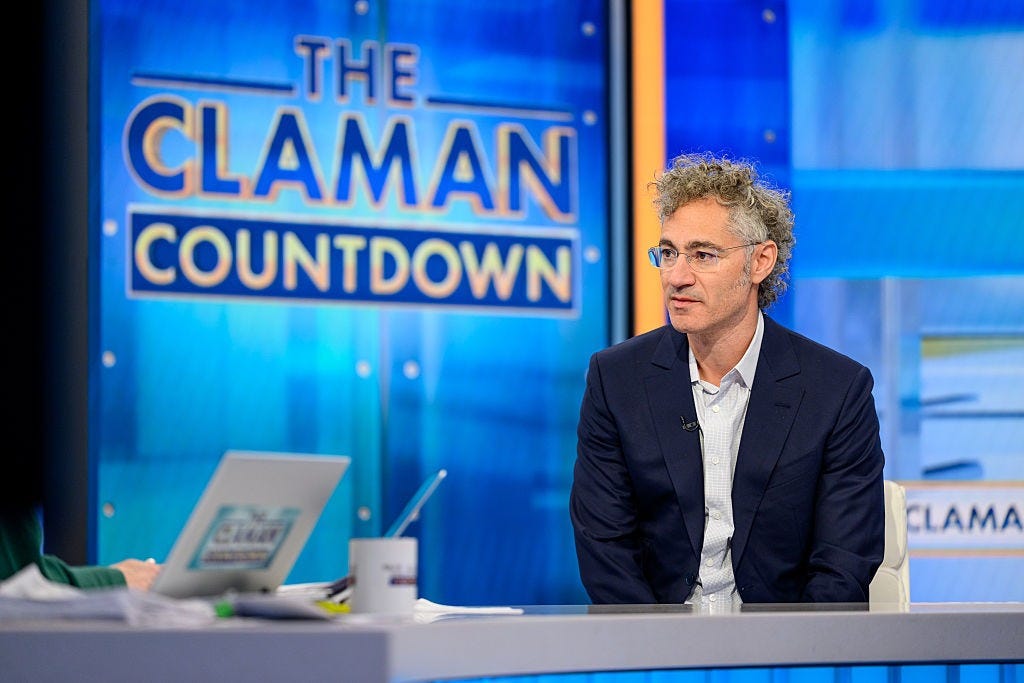
    Palantir CEO Alex Karp appears on Fox Business, October 2025 (Getty)

    Palantir is best known for the AI-powered cutting-edge software it provides to the federal government to give the US military and intelligence communities a leg-up over foreign competitors. Now, Palantir is in the news business as well.

    Over the last six months, with the help of Palantir engineers sitting in on high-level meetings and advising everyone from executives to writers, Fox News has scaled up its use of Palantir’s algorithms in simplifying its workflows. Readers of the nation’s most read right-of-center news outlet are therefore now influenced by the nation’s most ascendant defense contractor for which stories they see and how they’re framed.

    “We are building a first-class platform alongside Palantir engineers that will empower our editorial team to do great journalism and tell important stories,” a Fox News insider told Cockburn. “We are re-imagining and re-building every aspect of our workflow that will help our journalists be more effective and impactful in their jobs.”

    Almost every journalist uses AI in some small way – Cockburn couldn’t live without Sonix, the software that transcribes his interviews. And the use of technology in deciding which stories to elevate up the page isn’t new. For years, media companies have utilized apps such as Chartbeat and Parsely that provide real-time info on which stories are under- or over-performing.

    Fox News’s choice to employ Palantir’s Foundry – a data-integration tool employed by the Department of Homeland Security, Morgan Stanley and Merck, among others – is nonetheless a landmark one. Theoretically, use of the software could free up Fox’s journalists to spend more time on reporting and less on the menial tasks that have taken up a lot of digital-journalist time over the past decade or so.

    When asked if the site is already seeing improvements following the Palantir partnership, a Fox News insider said, “Yes, big time.”

    Not all Fox’s humans are delighted by the new tech, however. Homepage editors have been told that their role is mostly to “just check it [the AI’s suggestions] for factual mistakes,” a source with knowledge told Cockburn. “Everybody has been on edge and stressed as Palantir has essentially taken over Digital, especially the homepage,” another source told Cockburn. “Not only have the AI mandates bogged down writers like myself and others, but it has zapped the creativity out of us and made us lazier and more reliant on this technology.”

    Cockburn has no beef with Palantir pitching their algorithms to willing American buyers. But still – if one of the nation’s most powerful defense contractors is influencing what news you end up seeing, wouldn’t you want to know? And wouldn’t you want that news outlet to disclose it when, say, that company’s CEO pops up on their business channel?


    On our radar

    ARABIAN DAYS President Trump has a full schedule of events with Saudi Prince Mohammed bin Salman today. It’s the prince’s first visit to Washington since the assassination of Jamal Khashoggi. Tuesday’s foreign pooler, Nadia Bilbassy, comes courtesy of Saudi state media; the killing didn’t come up in the briefing that was circulated ahead of time, to the chagrin of several other correspondents…

    TATE WITH DESTINY Disgraced White House official Paul Ingrassia intervened in an official capacity on behalf of his former clients the Tate brothers, to get their cell phones returned when they were seized by Customs and Border Patrol, ProPublica reports.

    VANCE TO THE MUSIC OF TIME A Michigan man called J.D. Vance has been jailed for two years for making online threats against an Ohio man called J.D. Vance (the Vice President) and his boss.


    Summers lovin’, happened so fast

    Former Harvard president and Clinton-era Treasury secretary Larry Summers is “stepping back from public commitments” and is “ashamed” at having asked Jeffrey Epstein for dating advice as recently as 2019 – the year Epstein didn’t kill himself – according to the New York Times. Summers wrote, while pursuing a “love interest” who was seeing another man, “I dint want to be in a gift giving competition while being the friend without benefits.” Oh no he dint! Epstein replied, “shes smart. making you pay for past errors. ignore the daddy im going to go out with the motorcycle guy.”

    As the emails are revealing, Jeffrey Epstein was everyone’s daddy. Perhaps Summers would have been better off asking a different New York billionaire for dating tips…


    Evening Wood

    Cockburn sidled into the cocktail hour at the National Building Museum for the American Enterprise Institute gala a touch after 6:30 last night. Hundreds of guests donned black tie and gathered to see 91-year-old historian Gordon G. Wood receive the Irving Kristol Award. The nonagenarian New Englander drew inspiration from the Founding Fathers in his remarks. Beforehand, AEI president Robert Doar offered a brief tribute to former vice president Dick Cheney, an AEI trustee, whose funeral takes place in DC Thursday. Attendees sipped Cabernet Sauvignon and enjoyed small portions of short rib.

    Spotted: Jonah Goldberg; Joshua Katz; Philip Klein; Katherine Mangu-Ward; Megan McArdle and Peter Suderman; Adam and April O’Neal; Chloe Ross; Robby Soave and Byron York.

    Subscribe to Cockburn’s Diary on Substack to get it in your inbox on Tuesdays and Fridays.

  • The joke’s on Dave Chappelle

    The joke’s on Dave Chappelle

    The problem with Dave Chappelle taking his comedy to Saudi Arabia isn’t the money they paid him. It’s what they bought.

    We’re all familiar with the reputation laundering that the Middle East has engaged in on a grand scale in recent years, spending big to get into sports, entertainment and now hosting more than fifty of the biggest names in standup comedy for a Riyadh Comedy Festival. Chappelle’s performance was notable for its direct attack on the quality of free speech rights in America – and a claim that Saudi Arabia of all places is actually more free.

    “Right now in America, they say that if you talk about Charlie Kirk, that you’ll get canceled,” he said according to the New York Times. “It’s easier to talk here than it is in America.”

    During his set, Kevin Hart – no stranger to the appeal of a dollar – was even more obsequious. “I love what y’all are doing here,” Hart said. “I’ll continue being a positive ambassador of your change to the world.” Who knew that amount of cringe could come in such small packages?

    Of course, the conditions for these men and others to go to Saudi Arabia in the first place was to break faith with the whole mindset of comedy. Entering a country where all media is government approved and massive legal sentences can be directed at people who flaunt the most basic conventions is easier when you’re a paid guest – but they still had to sign on a dotted line of a contract that included this prohibition:

    “[Artists] shall not prepare or perform any material that may be considered to degrade, defame, or bring into public disrepute…The Kingdom of Saudi Arabia, including its leadership, public figures, culture, or people; B) The Saudi royal family, legal system, or government, and; C) Any religion, religious tradition, religious figure, or religious practice.”

    The actual problem isn’t accepting the money. Plenty of artists and performers and businesses have done the same. The problem is signing away the whole reason your comedy became popular in the first place. Hart is one thing – he’s always been a corporate shill, Jumanji, Draft Kings, Saudis, what’s the difference? No one would be surprised at him making the hand prints in the sand ceremony.

    Chappelle was different. He made a career skewering the hypocrisy and posturing of right, left, and middle for years. He made a recurring hilarious joke of going after George W. Bush. And the only real threat he ever experienced to free speech in America was when he ran afoul of the trans mob, who endeavored unsuccessfully to get him canceled from Netflix.

    When Chappelle signed up for the Saudi cash, he was giving something up by agreeing to their terms and going above and beyond to criticize America along the way. He was agreeing not to keep it real, lest anything go wrong. And the Saudis knew it, and were happy to pay for it. That’s because what they were buying wasn’t comedy – it was compliance.

  • ‘From the folks that brought you 9/11’

    ‘From the folks that brought you 9/11’

    The American comedy world finds itself embroiled in a not-so-civil war of words over the Riyadh Comedy Festival, sponsored by the Saudi royal family. The Saudis have given enormous paychecks to big names like Kevin Hart, Dave Chappelle, Louis C.K., Aziz Ansari, and Bill Burr

    On one side, you have the people invited to perform at the festival, who mostly lean toward the anti-woke, sometimes-semi-canceled, will-do-anything-for-a-dollar camp. On the other, you have hyper-woke, mostly male Gen X comics whose routines these days involve delivering panicked podcast screeds about the end of democracy. 

    Our comedy scene is booming like never before, though it’s rarely been less funny, and the Riyadh Comedy Festival has performed a public service by revealing exactly what type of morons American comics truly are. 

    Grumblings about the Riyadh festival have been stirring for months, but reached a peak when it actually kicked off last weekend. “From the folks that brought you 9/11,” Marc Maron said on Instagram a couple of weeks ago. “Two weeks of laughter in the desert, don’t miss it.” The Saudis didn’t invite Maron, who said, “It’s kind of easy for me to take the high road on this one. Easy to maintain your integrity when no one’s offering to buy it out.”

    It was less easy for comedian Shane Gillis, who turned down the Saudi money bag. He revealed his “principled stand” on his “Secret Podcast,” saying “You don’t 9/11 your friends.”

    But no one went harder against Riyadh than never-nude David Cross, who posted a screed on his website. “I am disgusted, and deeply disappointed in this whole gross thing. That people I admire, with unarguable talent, would condone this totalitarian fiefdom for… what, a fourth house? A boat? More sneakers?

    “These are some of my HEROES! Now look, some of you folks don’t stand for anything so you don’t have any credibility to lose, but my god, Dave and Louie and Bill, and Jim? Clearly you guys don’t give a shit about what the rest of us think, but how can any of us take any of you seriously ever again? All of your bitching about “cancel culture” and “freedom of speech” and all that shit? Done. You don’t get to talk about it ever again. By now we’ve all seen the contract you had to sign…You’re performing for literally, the most oppressive regime on earth. They have SLAVES for fuck’s sake!!!”

    Around the web, comedy podcasts, blogs, feeds and comment sections on comedy podcast blog feeds are appalled that these comedian “heroes” would accept a seven-figure check for performing in a foreign country. Suddenly, every person who has ever been onstage or in the audience at the Comedy Cellar cares about Jamal Khashoggi or the rights of Saudi women, who’ve been legally allowed to drive, after all, since 2018. Now you care about “artwashing”?  The self-righteousness is a little hard to stomach. 

    Then you have Bill Burr, who performed at the festival and has made a vast fortune not giving a shit what anyone thinks. He says the much-criticized “restrictions” placed on comedians at the event boiled down to: don’t make fun of the government, or talk about religion, which actually is kind of a lot. But Burr, on his podcast, still marveled at how the Saudis were “just like us” and that Riyadh has Starbucks, McDonald’s, and Chili’s. 

    “It was great to experience that part of the world and to be a part of the first comedy festival over there in Saudi Arabia,” Burr said. “The royals loved the show. Everyone was happy. The people that were doing the festival were thrilled. The comedians that I’ve been talking to are saying, ‘Dude, you can feel [the audience] wanted it. They want to see real stand-up comedy.’ It was a mind-blowing experience. Definitely top three experiences I’ve had. I think it’s going to lead to a lot of positive things.”

    Easy for the rich guy to say, but Burr does seem a lot happier in the aggregate than David Cross. Then there’s Dave Chappelle, the most self-absorbed man on the planet not named Donald Trump. Chappelle said onstage in Saudi Arabia that “it’s easier to talk here than in America.” He even told the audience that he was afraid to return to America because he’s not allowed to truly speak his mind. He said he’d let his new Saudi fans know if he was being censored, even though the odds of Dave Chappelle actually being censored are lower than the Carolina Panthers winning the Super Bowl. 

    Chappelle said, in the creepy conspiratorial audience whisper that’s his trademark, “It’s got to be something I would never say in practice, so if I actually say it, you’ll know never to listen to anything else I say after that. Here’s the phrase: ‘I stand with Israel.’” 

    Nice, Chappelle. Also, up yours, you anti-Semitic jerk. Enjoy your freedoms. 

    Much less controversial than Chappelle in Saudi Arabia was Kevin Hart, the world’s greatest sellout. “I love what y’all are doing here,” he said. “I’ll continue being a positive ambassador of your change to the world.” 

    With that, the positive ambassador of T-Mobile and Capital One credit cards went back to his hotel suite to wallow in his pile of gold. 

  • When will we learn the truth about Saudi involvement in 9/11?

    When will we learn the truth about Saudi involvement in 9/11?

    Will Saudi Arabia ever be held to account for the 9/11 terror attacks? For decades, the Kingdom has successfully parried lawsuits in the United States accusing it of providing logistical and financial support to a network of Islamic extremists who launched a global terror campaign, culminating in the September 11 attacks on the Pentagon and the World Trade Center.

    Those attacks occurred 24 years ago and since then survivors and victims of the 9/11 hijackings have had to counter not only vigorous Saudi denials mounted by their well-funded American legal team but also repeated attempts by the US government to thwart the lawsuits.

    But there are signs the pendulum has begun to swing the other way. On August 28, US District Judge George B. Daniels, in a little noticed ruling in Manhattan, denied a motion by the Kingdom to dismiss the case, opening the way for a trial. In his decision, Daniels found that a small cadre of Saudi government employees tied to the consulate in Los Angeles had formed a support network for two of the 9/11 hijackers in 2000 and 2001 and probably had advance knowledge of the plot. In his opinion, Daniels raised the prospect of wider involvement by Saudi officials. Daniels ruling is the first judicial finding in the United States that the government of Saudi Arabia may have played a role in the 9/11 attacks.

    A key piece of evidence in the case, what plaintiffs lawyers call an al-Qaeda surveillance video of the US Capitol, came from the United Kingdom’s Metropolitan Police Service. The Met obtained the video during a raid of the Birmingham home of a suspected Saudi intelligence operative, Omar al-Bayoumi, two weeks after 9/11. 

    Daniels said the evidence suggests Bayoumi, employed ostensibly as an accountant for a Saudi aviation firm, and Fahad al-Thumairy, a radical cleric based in the Los Angeles consulate, assisted two of the hijackers in advance of the attacks in their official capacity as Saudi government employees. “Thumairy and Bayoumi were not just acting as an imam and accountant,” Daniels declared. “Their employment with the Kingdom of Saudi Arabia likely had some connection with assisting the hijackers.”

    Nineteen al-Qaeda terrorists, 15 of them Saudi nationals, hijacked four commercial airliners in the United States the morning of September 11, 2001, and crashed them into the twin towers of the World Trade Center in lower Manhattan and the Pentagon. A fourth plane, which the terrorists apparently intended to use to attack the US Capitol building in Washington, DC, crashed in a field in Shanksville, Pennsylvania, after passengers revolted and rushed the cockpit.

    In all, nearly 3,000 people lost their lives, including 657 at the investment firm of Cantor Fitzgerald, who were killed when American Airlines Flight 11 crashed into the north tower of the World Trade Center. Cantor’s former CEO, Howard Lutnick, now US Commerce Secretary, is a plaintiff in one of the lawsuits against the Kingdom.

    Plaintiffs lawyers have been collecting evidence of Saudi involvement almost from the day of the attacks – the first lawsuit against the Kingdom was filed on September 10, 2003 – and those facts have long suggested that the Saudis provided logistical and financial support to al-Qaeda and other terrorist groups. The plaintiffs’ theory rests in part on uncontroverted evidence that the Saudi royal family and Saudi government officials, beginning in the mid-1980s funded Islamist charities that in turn supplied weapons and logistical support to mujahideen fighters in Afghanistan.

    That movement later spread to the vicious Balkans war of the 1990s, which pitted indigenous Muslims and their al-Qaeda allies against local Serbs and Croats. From there, al-Qaeda quickly leapfrogged to attack other western targets including two US embassies in East Africa and the US Navy destroyer, USS Cole, culminating in the 9/11 attacks.

    Regional offices of the charities employed al-Qaeda members in senior positions and these charities supplied money, travel documents, arms, safe houses and other assistance to al-Qaeda cells, the plaintiffs allege. Absent the assistance of Saudi government funded charities, a half dozen of which were designated as terrorism supporters by the US Treasury Department, al-Qaeda and bin Laden never could have mounted the logistically complex 9/11 operation.

    So alarmed were US government officials by the role of the Saudi charities in funding international terror that then-vice president Al Gore met privately in 1999 with then crown prince Abdullah in the White House to ask for assistance in tracking down terror groups based in the Kingdom. Abdullah agreed to put senior US intelligence officials with their Saudi counterparts, but US officials said nothing came of it.

    “We went to the Saudis as a government, showed them what we had, asked them for more information, warned them of what might take place and ultimately nothing happened,” said Jonathan Winer, then deputy assistant secretary of state for international law enforcement. 

    Central to the lawsuits against the Kingdom are reports that emerged within days of the attacks that Bayoumi and Thumairy, the Saudi consular official, assisted Nawaf al-Hamzi and Khalid al-Mihdhar, the first 9/11 hijackers to arrive in the United States, getting settled in southern California in January of 2000.

    Bayoumi’s ostensible employment as an accountant was with a Los Angeles based Saudi aviation company named Dallah Avco, in a government funded position. While Bayoumi drew a salary, fellow employees told investigators he only rarely showed up for work. He did, though, have multiple contacts with the hijackers, along with Thumairy, helping them find an apartment and co-signing a lease for a rental in San Diego, and arranging for them to take flying lessons and learn English. 

    When interviewed by the FBI shortly after 9/11, Bayoumi said he had met the hijackers by chance in a Middle Eastern restaurant in Los Angeles on February 1, 2000, near the Saudi consulate, where he had traveled to clear up a visa problem. He claimed to have taken the initiative to introduce himself to the hijackers when he heard them speaking an Arab dialect common in the Persian Gulf and felt it was his duty as a fellow Muslim to help them get settled.

    This claim was dismissed early on by FBI investigators who concluded that Bayoumi’s luncheon meeting with the hijackers had been planned and that he likely was a Saudi intelligence operative with links to al-Qaeda. “(Bayoumi) acted like a Saudi intelligence officer, in my opinion,” an FBI agent told congressional investigators. “And if he was involved with the hijackers, which it looks like he was, if he signed leases, if provided some kind of financing or payment of some sort, then I would say there might be a clear connection between Saudi intelligence and UBL (Osama bin Laden).”

    Bayoumi moved to England before 9/11, but soon after the attacks FBI agents who had picked up his trail in southern California, alerted British authorities of his potential role and the Met Police searched his Birmingham home. Among the items taken from the house was a video recording Bayoumi made of the US Capitol building in 1999 along with the Washington Monument and other landmarks. Also confiscated was a drawing of an airplane with a calculation that experts for both the FBI and plaintiffs lawyers later concluded was a mathematical formula showing the rate of descent necessary for an airplane to collide with a target on the ground.

    While he made the video, Bayoumi was accompanied by two Saudi embassy officials from the Ministry of Islamic Affairs, a branch of the Saudi government staffed at the time by radical clerics whose role was to propagate a militant form of Wahhabi Islam that vilified the west. In the video, Bayoumi takes pains to note the Capitol’s main entrances and points out locations of the capitol’s security staff.

    Former acting CIA director Michael Morrel, and other former US intelligence officials have described the video as a casing film made in preparation for a terrorist attack. “No doubt in my mind that al-Qaeda tasked him to do this casing video,” Morrel said in an interview with CBS news.

    One of the more salient aspects of the aftermath of 9/11 is the degree to which the United States government has sought to conceal what it knows about the origins of the plot, a tactic that has frustrated efforts by the plaintiffs lawyers to get at the truth while greatly benefiting the Saudis. The stonewalling began with the administration of President George W. Bush, which insisted on classifying and keeping from public view portions of the first congressional investigation, the so-called Joint Inquiry, raising questions about Bayoumi and the potential role of the Saudi government.

    The late Senator Bob Graham, who co-chaired the investigation, then went so far as to accuse Bush of protecting the Kingdom because of Bush family ties to the oil industry and Saudi royals. 

    The equivocations and evasions continued through each succeeding administration. The FBI, for example, has been in possession of the Bayoumi video of the Capitol building since 2001, but failed to turn it over to not only plaintiffs lawyers but also the 9/11 commission. The plaintiffs only were able to access the video when the Met Police agreed to give it to them in 2022.

    Some of the foot dragging at times has resembled theater of the absurd. Early in the case, when plaintiffs lawyers requested the Justice Department make public a copy of the Interpol bin Laden arrest warrant, the answer they got back was the warrant was protected by privacy rules and that department couldn’t release it without bin Laden’s permission.

    At other points, the government obstruction was of far greater import. In 2009, then US Solicitor General Elena Kagan, now a US Supreme Court Justice, filed an amicus brief in the litigation asking the Supreme Court not to hear an appeal of a lower court decision dismissing the case against the Kingdom. Kagan argued there was no persuasive evidence of Saudi government involvement, even as the FBI continued to pursue evidence Bayoumi was a Saudi intelligence operative with possible links to al-Qaeda. The Supreme Court, heeding Kagan’s request, declined to hear the matter.

    Later, in 2016, the Obama administration lobbied heavily against legislation intended to aid the 9/11 victims by expanding the basis for suing foreign governments that foment terrorism. Administration officials warned the Saudis would withdraw upwards of $750 billion in assets from US financial institutions if the bill became law. Obama vetoed the measure after both the House and Senate passed it overwhelmingly. Congress overturned the veto and the bill became law.

    That measure, the Justice Against Sponsors of Terrorism Act, clarifies the US State Department need not designate a foreign government a terrorism supporter as a condition for being sued in US courts, a requirement that had hampered the 9/11 lawsuits. It also makes clear that not all of the tortious conduct must to take place in the United States.

    The dire scenarios depicted by the Obama administration never came to pass, while the measure gave new life to the plaintiffs’ litigation and set the stage for Daniels’ groundbreaking decision on August 28. 

    Now that the lawsuits seem to be headed for trial, 9/11 victims and their families, along with the nation as a whole, may finally get answers to questions about Saudi Arabia’s involvement that have been swirling around the case since the beginning.