Tag: Social media

  • Why is mocking Brigitte Macron a crime?

    Why is mocking Brigitte Macron a crime?

    Ten people have gone on trial in Paris accused of harassing France’s First Lady, Brigitte Macron, online. The defendants, eight men and two women aged between 41 and 60, are charged with “moral harassment by electronic means” and making a false claim that she was born a man by the name of Jean-Michel Trogneux. Prosecutors say their posts, many of which mocked her marriage to the President and repeated the rumor about her gender, amounted to targeted abuse. In closing, prosecutors requested suspended sentences. The defendants deny wrongdoing.

    The case stems from a complaint filed by Brigitte Macron in 2024, after a theory claiming she was transgender spread widely across French social media. Some of those now on trial shared or commented on videos repeating the rumor. Others posted memes or insults targeting her appearance and marriage. Under France’s criminal code, “moral harassment by electronic means” can lead to up to two years in prison and fines of €30,000. The court is expected to deliver its verdict later this year.

    The defendants include a small business owner, an elected local official, a computer technician and a teacher. Their alleged crime was to repost memes or post comments mocking the First Lady to modest online audiences, although some gathered considerable views. None have the resources of the presidential couple. Yet they face criminal conviction and possible prison sentences. In another country, such behavior might earn a temporary suspension from social media, or, more likely, the behavior would simply be ignored. In France, it’s a matter for the tribunal correctionnel.

    The rumor about Brigitte Macron first appeared in 2021 in Faits et Documents, a niche newsletter with a tiny circulation edited at the time by Xavier Poussard, a researcher. Its “investigation” claimed, in meticulous detail, that Brigitte Macron was born a man and was in fact the biological father, not the mother, of her three children. The theory goes that Jean-Michel transitioned prior to becoming Macron’s drama teacher when he was 15 and Brigitte was 40. The claim is false as birth records show Brigitte Macron was born female in 1953. Criminalization of the allegations is the real story.

    Whatever one thinks of the law, the scale of the vitriol directed at Brigitte Macron has been ugly. Mocking her age and appearance has long been a national sport. Adding fabricated claims about her identity turned it into something darker. Online pile-ons can become a form of mob harassment. Prosecutors portrayed the posts as part of a sustained campaign of humiliation. Brigitte Macron did not attend, but her daughter Tiphaine Auzière told the court that the conspiracy had “devastated” her mother’s health, describing anxiety, insomnia and withdrawal from public life. The judge noted evidence of a “deterioration” in her well-being.

    The theory circulated on fringe French websites before migrating into mainstream social media. Poussard later expanded his claims into a book, Becoming Brigitte, which Candace Owens then promoted to a global audience. Owens said she would “stake [her] entire professional reputation on the fact that Brigitte Macron… is in fact a man.” When the Macrons filed their defamation suit in Delaware in July 2025, they accused Owens of “disregard[ing] all credible evidence” that Mrs Macron was born female, and of using the claim to monetize outrage. Owens replied that the lawsuit itself was proof that the allegations are true: “If you need any more evidence that Brigitte Macron is definitely a man, it is just what is happening right now.”

    It’s an unpleasant episode, but hardly an exceptional one in the age of social media. Public figures are mocked, insulted and caricatured daily, often far worse than this. Yet in France, ridicule of public figures has a curious way of turning into a matter for the courts. From injure publique to outrage à fonctionnaire, the French state has long confused personal dignity with public order. The Macron presidency, with its high-profile lawsuits, has continued that confusion.

    France has always been conflicted about free speech. It celebrates Charlie Hebdo as a national symbol of defiance, yet prosecutes ordinary citizens for lesser acts of mockery. Even in Britain, with its infamous policing of speech, a case like this about a politician would never reach a courtroom. Britain has its own pitfalls, strict libel laws and “defamation tourism” among them. But the British expect their public figures to endure ridicule, whereas the French state tends to police it. Insulting those in power has long been treated as a kind of lèse-majesté, even in the Republic that prides itself on having guillotined its kings. 

    There’s also a deeper absurdity here. The very premise of the online attacks is that Brigitte Macron was born a man, and is therefore “trans.” The prosecution’s case rests on factual falsehood, not hostility to trans people, yet the optics are hard to ignore. The state insists on tolerance in principle but reacts with outrage when that same vocabulary brushes too close to power. Either France believes gender identity deserves respect, or it believes that being called trans is defamatory. It cannot have it both ways.

    That irony is even sharper given the couple’s record. In 2018, Emmanuel and Brigitte Macron turned the Élysée courtyard into a public dance floor for the Fête de la Musique, inviting queer and transgender performers, including DJ and activist Kiddy Smile, whose troupe vogued on the palace steps in front of the presidential couple. The event, widely promoted by the Élysée itself, was hailed as a symbol of inclusivity. The event has been attacked by the right as a sign of moral decay. Yet seven years later, the same presidency would now appear to treat being called transgender as an insult. The President and First Lady who once posed for photographs with queer dancers are effectively asking the courts to criminalize anyone who implies the First Lady is trans.

    For a couple who insist the facts are on their side, the Macrons’ response has been strangely theatrical. Each new lawsuit amplifies the story they want buried. A calm, factual rebuttal would have ended the matter long ago, as would perhaps simply ignoring the rumor entirely, or even a DNA swab test. Instead, the Macrons have turned the allegations into a global courtroom saga that guarantees the rumor endless life.

    What makes this case remarkable is not the vulgarity of the posts, the internet is full of that, but the reaction from the Élysée. Brigitte Macron has launched a defamation lawsuit against Candace Owens, while prosecutors pursue these ten individuals in France. For a presidential couple that prides itself on intellect and poise, it’s a surprisingly brittle response.

    Does it not occur to the President that the more he and his wife fight the rumor, the more oxygen they give it? Each legal action guarantees another round of headlines and another surge of online curiosity about the very claim they want buried. It’s a textbook case of the Streisand effect, when the attempt to suppress a rumor amplifies it.

    None of this is intended to defend the trolls. Their posts are crude, and few deserve sympathy. But public life comes with a price, and the price is mockery. Sometimes politicians are better advised simply to put up with it. The Macrons may win in court. They will not win in silence.

  • New York Fashion Week’s shimmer feels noticeably dimmed

    New York Fashion Week’s shimmer feels noticeably dimmed

    Crossing streets with lattes in hand, camera lights flashing, perfectly curated outfits meant to be noticed, and a crisp chill in the air means one thing: New York Fashion Week has arrived.

    The September Fashion Week has long stood as the pinnacle of American fashion prestige. As the leaves turn red and brown, style photographers capture eclectic ensembles in motion, A-listers march through the streets and assistants carefully place nameplates on front-row seats beside pristine runways. But this year the week’s shimmer feels noticeably dimmed.

    The big names still show up – Michael Kors, Calvin Klein, Tory Burch. But in recent years they’ve been eclipsed by smaller, edgier and distinctly New York-based designers. You may not have heard of KidSuper, Private Policy or Elena Velez, or ever worn their clothes, but they run the show now. Luxury and haute-couture designers are just not interested in New York.

    Why? Because New York Fashion Week has evolved into a content-driven machine – designed less for insiders and more for the camera and the internet. Outside every venue, photographers offer built-in photo ops. Inside, every runway look is instantly broadcast across social media. And the after-parties? They’re engineered for virality, not intimacy, with every detail curated to be posted.

    Take the party hosted by Valentino Beauty, for example, promoting its new Rendez-Vous Ivory fragrance. Styled as a revival of Studio 54 – the legendary nightclub and theater that launched the disco craze – the event featured multiple branded locations where guests could pose with products. The whole thing felt less like a nostalgic homage or reinvention and more like a giant, immersive ad campaign. Cher made an appearance, but the night was no tribute to old New York. It was a made-for-Instagram marketing opportunity.

    On the runways themselves, the front-row seats once reserved for the fashion industry’s power-players are now set aside for online influencers and content creators. A-list celebrities and arbiters of style such as Anna Wintour used to consistently own these seats. Today, they’re more populated by influencers such as Paige Lorenze, Brigette and Danielle Pheloung, and Ken Eurich. Never heard of ’em? Don’t worry – all you need to know is that their combined Instagram followings total around 2.8 million. All this is meant to make NYFW seem more accessible. As the stylist Sophia Isabella told me: “The reason brands invite influencers to their shows is to have this pseudo-concept of accessibility while also maintaining the old habits and rituals of exclusivity in fashion.”

    This points to a new, unstable tension. Social media has made it incredibly easy to compare our daily lives with those of influencers and public figures – people who feel relatable, except for one key difference: disposable income. This ease of comparison has fueled a culture of unsatisfiable trend-chasing and consumerism, as audiences try to emulate the lifestyles they see online. But aspiration and exclusivity have always been the core drivers of the high-fashion industry – even for those who believe they’ve gained access to it. No amount of pseudo-accessibility can change that, at least not without stripping high fashion of what makes it high.

    Many brands have begun to recognize this – too much accessibility has done them no good. In response, many luxury labels are starting to pull back and become even more exclusive. They’re going “offline” and departing from old staples, such as NYFW. Rather than letting any influencer with a few hundred thousand followers into their events, they’re curating their shows even more carefully and exclusively than they did before.

    Many are decamping to Paris, where influencers and social media are given less power. These Parisian events resist the hyper-glossy, social-media-ready structure of New York Fashion Week. This resistance pushes back against the homogenizing force of the internet and social media, which flattens everything it touches in its mission to make everything relatable and accessible. As the rest of the world becomes more connected and leveled, the savviest high-fashion houses are retreating further into intentional inaccessibility – that’s why they’re avoiding the limelight in New York.

    These elite houses – chief among them the Row, Proenza Schouler and Willy Chavarria – are bringing elitism, allure and mystery back into fashion. And they’re perhaps restoring high fashion to what it was always meant to be: an aspirational art, one that compels its aspirants to earn a place in elite society.

    This article was originally published in The Spectator’s October 13, 2025 World edition.

  • Social media has automated the nation’s psyche

    Social media has automated the nation’s psyche

    It feels increasingly, in any conversation on or offline, as if you’re speaking to a robot. Sometimes you are, but more often, and more ominously, the person you’re speaking to is real – it’s just that their thoughts, words and reactions have become robotic. The Botification of the American Mind, you might call it, and for the past five years we’ve been trying to understand how this botification has happened.

    The most obvious root cause is that our social media is no longer populated by humans, meaning the generative AI revolution has exponentially increased the amount of fake accounts on everyone’s feeds.

    The internet today is crawling with machines that parrot human voices and mimic human emotions – and these are not just harmless response programs deployed by people trying to make a few bucks. The bots are often controlled by propagandists who want to disrupt, or even foreign regimes aiming to wage narrative warfare. Why risk military defeat when you can ignite a culture war and let Americans destroy themselves?

    What drives engagement on social media is not calm, nuanced communication but outrage, conflict, extremism and black-and-white narratives that go viral. That’s what the robots promote – and where the bots lead, humans follow, becoming themselves one-sided, simplistic and fueled by outrage.

    Where the bots lead, humans follow, becoming themselves one-sided, simplistic and fueled by outrage

    In genuine (read: offline) human dialogue, our natural tendency toward problem-solving is to work out some kind of compromise. We (usually) like to engage in good faith and we prefer to resolve disagreements with civil discourse. It’s more difficult to dislike someone in person, regardless of how much you dislike them online. But today, the average American’s experience of the offline world is so shaped by its online counterpart that civil discourse becomes a thing of the past. Instead of analyzing a situation, we simply repeat slogans.

    Outrage goes viral and virality is profitable – advertisers reward exposure. Data, nuance and balance are the losers.

    In some ways the robot platforms work like old-fashioned brainwashing cults. They overload a human mind with information. Vast amounts of stories, data points, narratives and insights are all jumbled together with a significant amount of lies, fabrications and half-truths. It’s too much for most humans to process. We can’t order or analyze the chaos.

    This information overload is why we all feel so psychologically fried after doomscrolling on our phones; why we’re miserable and distracted and why we resort to outrage as a way out of the bewildering chaos. We become atomized and reactive.

    So America is not polarized because a MAGA cult has taken over Capitol Hill, or because the woke left has infiltrated the K-12 school system. The single most significant cause is the deep psychological stress inflicted by the information avalanche.

    It would be different if we had multiple sources of information or some perspective, but for most people reality is seen through the tiny keyhole of their social media feeds and you can’t blame humans for finding this addictive. Audience capture happens for leaders across the political spectrum and it happens for their followers, too. For humans – who evolved in an environment of tiny hunting bands numbering fewer than a hundred people – the validation you get from “likes” and retweets acts on the brain like cocaine. The lack of nuance and analysis also encourages us to buy into entirely false ideas.

    We’re all forever hearing that AI will destroy the economy or turn us into God, for instance, and this is because what we call vast “permission structures” have been built around these technology companies by building hype on social media.

    “AI won’t take your job, but a human who knows how to use AI will take your job” – this is so often repeated it’s become a cliché. The problem, as we’re all about to find out when the AI bubble pops, is that it’s not true. Large language models will prove extremely useful but they won’t perform as promised. In repeating slogans like this we’re merely doing robot PR. The myth that AI will be omnipotent is, from one perspective, an obvious “pump-and-dump” for tech stocks. The AI overlord trope has been pushed hard and relentlessly for the past two years because it justifies the hundreds of billions of dollars of investment and the significant transformation of the economy.

    Botification destroys American trust. We once trusted newspapers to have our interests at heart and depended on expert analysis of events. What’s happened since the advent of social media, however, is a complete destruction in certainty of institutions. This is partly why in the UK, for example, there are so many stories about “secrets” such as hotels used to house migrants. Not because they aren’t a problem – they clearly are – but because the stories resonate with our alienation and confirm our paranoia that things are being hidden from us. Grand institutions, respected newspapers, used to collectively stabilize us and help us chart a course through the uncertainty of life. When we trust strangers and institutions – collections of strangers – we don’t need to do our own research or make up our own minds. We have faith that professionals have our interests at heart and are doing the job for us.

    The world is getting more and more complex, but we can make less and less sense of it. Hardly anyone on the right trusts academia or mainstream media, hardly anyone on the left trusts the government or anyone involved in foreign policy – and no one knows whether they’re talking to a human or a bot anymore. Increasingly, there is no difference. The American mind has become the battlefield. The American citizen has become a bot.

    This article was originally published in The Spectator’s September 29, 2025 World edition.

  • Stephen King, The Long Walk and Charlie Kirk

    Stephen King, The Long Walk and Charlie Kirk

    Under normal circumstances, the author Stephen King should have been feeling pretty good about things and himself at the moment. The latest film of one of his works, Francis Lawrence’s horror-thriller The Long Walk, opened in American cinemas this weekend and has been met with almost unanimously rave reviews, many of which have called it a more socially aware, darker Hunger Games. He recently published a Maurice Sendak-illustrated retelling of Hansel and Gretel, which brings his trademark dark and macabre sensibilities to the age-old fairytale. And his last novel, Never Flinch, was, naturally, a bestseller – as all his books have been since he first published Carrie, over half a century ago in 1974.

    So it says quite a lot for the 77-year-old King that, for absolutely no reason, he decided to offer his opinions about the Charlie Kirk saga. King’s first reaction to Kirk’s assassination was to call it “another example of American gun violence” and to echo Barack Obama’s comments that “this kind of despicable violence has no place in our democracy.” All perfectly normal and (relatively) uncontroversial. And then King decided to say of the recently murdered Kirk that “he advocated stoning gays to death. Just sayin’.”

    The activist had, of course, said nothing of the kind, and King swiftly deleted his tweet and has spent much of the day of his new film’s release apologizing to various public figures who reacted in outrage his comments, most notably Ted Cruz, who called him “a horrible, evil, twisted liar” and asked ,“Why are you so dishonest & filled with hate?” King, presumably through gritted teeth, wrote “The horrible, evil, twisted liar apologizes. This is what I get for reading something on Twitter [sic] w/o fact-checking. Won’t happen again.” Yet the reputational damage has already been done. Admittedly, the author has never been remotely shy about his Democratic, pro-Palestinian sympathies, which have never endeared him to the MAGA crowd, but if The Long Walk underperforms this weekend, especially with viewers in the heartland where the film is set, fingers will undoubtedly be pointed in King’s direction.

    Not, of course, that it will make any existential difference to the writer’s popularity. He has been involved in many other high-profile spats, not least when he dismissed James Patterson, saying of his fellow author, “I don’t like him, I don’t respect his books because everyone is the same,” and remarked of Stephenie Meyer, who was unfavorably compared to JK Rowling, that she “can’t write worth a darn. She’s not very good.” Rowling, of course, came in for her own implied criticism, when an X user asked King what he thought of her political stances, and he replied, “Trans women are women.” And although most people believe Stanley Kubrick’s adaptation of The Shining to be a classic of the horror genre and an improvement on the scary but schlocky book, King has always despised it, calling it “a film by a man who thinks too much and feels too little.”

    The reverse might be said of King himself. His willingness to take to social media and share his opinions, interact with his millions of admirers and discuss matters wholly unrelated to his books is commendable, and there is a reason why he has 6.8 million followers. Yet as his timely dystopian picture arrives in cinemas to shock and provoke audiences, even those who might be well disposed toward this ornery, ever-controversial author might hope that he’ll engage his considerable intellect before pressing “send” next time.

  • The trend for unsparing cancer tales on TikTok

    The trend for unsparing cancer tales on TikTok

    For teenage girls on TikTok, the makeup routine is an almost sacred ritual. Manicured fingertips dart around at virtuosic speed, applying dabs of foundation, blush and highlighter with precise artistry. Normally the commentary is about the nuances of brushing and blending – but Sophie, a bewitchingly pretty 18-year-old from New Zealand, has something more pressing to discuss.

    “I’d been having headaches for about two months,” she says, placing dots of concealer under her blue eyes. “And then one night – it was my [high school] graduation – I was having a few drinks, which you’re not meant to do when you have glandular fever, which is what we all thought I had. So I kind of expected to wake up hungover.”

    But this headache was worse than she’d ever had before, the painkillers weren’t working and by the time her mother got home from work Sophie was semi-conscious. “My mum thought I had alcohol poisoning… Around seven o’clock my dad came home, took one look at me and was like, ‘We need to take her to a hospital asap.’” And that was how Sophie, aged 17 at the time, discovered that she had a tumor that was causing bleeding in her brain. That night, she had emergency surgery. They removed the mass but the biopsy revealed that it was an aggressively malignant Grade IV glioblastoma brain tumor.

    “I’m trying to stay positive and hope for the best,” says Sophie, finishing her mascara. The fact that she’s so young moves the odds in her favor. Nonetheless, she’ll need to be exceptionally lucky: five years after diagnosis with a high-grade brain tumor, only five to seven percent of patients are still alive.

    It’s shocking to discover how many TikTok videos feature young people with life-threatening diseases – usually cancer. This isn’t because more of them are being diagnosed; it’s because members of Generation Z who draw the ultimate short straw are using the app to take viewers through every stage of their nightmare. Click on a few videos and the algorithm will throw more of them at you. The phenomenon even has a name: DeathTok.

    Paradoxically, the most curated social media platform is the most ruthless at stripping away the platitudes of the “cancer journey.” TikTok may be famous for its copycat dances and viral trends, but it’s also the place where ordinary young people speak into their cameras with the fluency of seasoned talk-show hosts. They’re not just digital natives; they’re video natives who employ adult communications skills to express adolescent feelings.

    Scrolling through the DeathTok videos is an uncomfortably voyeuristic experience

    Obviously only a minuscule fraction of these people are fighting cancer – but with around 1.6 billion active users, the TikTok algorithm is never going to run short of heartbreaking testimonies. Heartbreaking and also frightening: Gen Z and millennial cancer patients have the technical expertise to capture the horrors of chemotherapy and they don’t feel the need to filter them for the audience. But that doesn’t mean all the videos strike the same note.

    Some TikTokers use black humor. Eldiara is a 23-year-old Californian with Goth makeup, a sardonic smile and haunted eyes. Her pinned video, with 34 million views, shows her dressed like a Mafia widow in a black lace mantilla. She’s bending over a bed in mock prayer. A single arm protrudes from the sheets, fingernails painted black.

    It’s Eldiara’s own arm, which was amputated to stop the spread of a very rare, very dangerous soft-tissue cancer that she was diagnosed with aged 19. The operation was last October and, in a video filmed an hour before she went under anaesthetic, we see her wiggling her fingers on the doomed hand for the last time.

    TikTok has helped her achieve “radical acceptance” of the loss – though not tolerance for idiotic commenters under her videos, who are the targets of her lacerating mockery. Bogus remedies, glib consolation, intrusive questions – Eldiara hates them all, but none so much as the wisecrack shouted at her by morons who think it’s original: “Need a hand?”

    Johnny, a 22-year-old student from New Orleans, also had his arm amputated last October. His rare sarcoma is incurable. He’s not on TikTok to find radical acceptance so much as money. The platform earns him a fraction of a cent per view; with half a million followers that adds up to a modest income. His videos carry the caption: “I have stage 4 cancer and lost my arm because of it. Please stay for 60 seconds so I can get paid.” Johnny’s story is one of sudden catastrophe. We see him in August last year, driving his car with both arms, numbed with shock at his diagnosis. “I woke up one morning a couple of months ago with a super-sore arm. I thought I might have slept on it kind of weird, so I just brushed it off.” The next day it was swollen, he went to the doctor, had a biopsy and scans and “Boom! Sarcoma… with stuff in my lungs. To say I’m scared is kind of an understatement because I’m fucking terrified.”

    Later, he’s not only terrified but exhausted. His cancer doesn’t respond to chemotherapy, so every three weeks he has injections to kickstart his immune system. “Man, every time I get it I am absolutely wrecked. I feel like I have no control over my own body and it’s really not fair.”

    Several creators post photos taken when they were already ill but didn’t realize it. Finn, a high schooler from England, appears on a soccer field, “playing for a team every week thinking I’m healthy.” He had little lumps on his neck but didn’t think they were a big deal. A few months down the line, undergoing chemotherapy for Hodgkin’s lymphoma, we see him good-humoredly plucking out tufts of his hair before shaving everything off. He says the worst thing is the injections – “like getting stabbed… forget losing your hair, illness from chemo, they hurt like hell.”

    Tanner, a young married Mormon from Salt Lake City, posts photos of himself getting sweaty from DIY, hanging out with friends, cuddling a baby, drinking soda in the bath – all taken “when I had stage 4 cancer at 25 but didn’t know.” He’s chubby, bursting out of his XXL shirts with a goofy smile. But by the time he celebrates his 30th birthday, he’s handsome with sharp cheekbones – and using a motorized wheelchair to get round the supermarket.

    His faith has taught him to believe that he’ll spend eternity with his beloved wife, Shay. But he’s been through a stage of asking, “What if that’s not true, this is it and I just got screwed in the genetic lottery?” That scared him, but now he reasons that, if there is an afterlife, “I will know pretty quickly and if there’s nothing, I won’t know at all.”

    It’s easy to follow the progress of Tanner’s colon cancer: you just move your finger across the screen. TikTok conveys the relentlessness of cancer in real-time.

    Do TikTok cancer patients reveal such intimate details because the technology drives the expectations of the audience? Many of them say the process is helpful – but one can’t help wondering: if they don’t survive, how cathartic will those videos be for the family members who helped them do the filming? Presumably they’ll need a password to delete them. Facebook, the favored platform of retirees, already looks like an online cemetery.

    There’s a wider question. With every advance in media technology, we progressively lose the luxury of fading memories. Perhaps there’s something in the Freudian notion of a mental “censor” that relegates anxiety-provoking thoughts to the realm of dreams. Will the filter still work when every fearful moment jumps out in digital detail? And when other people can dig into them?

    Scrolling through the DeathTok videos is an uncomfortably voyeuristic experience, even if the person who made them is encouraging you to do so. What were their first symptoms? How are they doing now? All the young people mentioned above have posted updates. So, if you’re interested…

    Sophie has flown to Los Angeles for laser surgery on her tumor that has sent her back into remission. But she wants her followers to know that, although she’s hoping to be healthy for a long time, she isn’t cancer-free “and it could come back next week.”

    Eldiara is struggling to mask her bitterness with humor. She’s directing some of her anger at Donald Trump and his ICE raids. She’s in remission but doesn’t like her odds and feels like she’s “waiting for the other shoe to drop.”

    Johnny has been told that, thanks to his TikTok income, he’s not eligible for social security payments. And because his cancer has spread, no one wants to employ him.

    Finn was diagnosed with stage 2 Hodgkin’s, which isn’t usually a death sentence – and so it has turned out for him. In his most recent video he’s waiting for his exam results and preparing for his gap year.

    As for Tanner, a video posted in June solves the problem of burdening others with breaking bad news. He’s wearing a brown beanie and grinning impishly. “Hey, it’s me, Tanner,” he says. “And if you’re watching this, I am dead.”

    This article was originally published in The Spectator’s September 15, 2025 World edition.

  • I was arrested for insulting the trans mob

    I was arrested for insulting the trans mob

    Something odd happened before I even boarded the flight in Arizona. When I handed over my passport at the gate, the official told me I didn’t have a seat and had to be re-ticketed. At the time, I thought it was just the sort of innocent snafu that makes air travel such a joy. But in hindsight, it was clear I’d been flagged. Someone, somewhere, probably wearing unconvincing make-up and his sister/wife’s/mum’s underwear, had made a phone call.

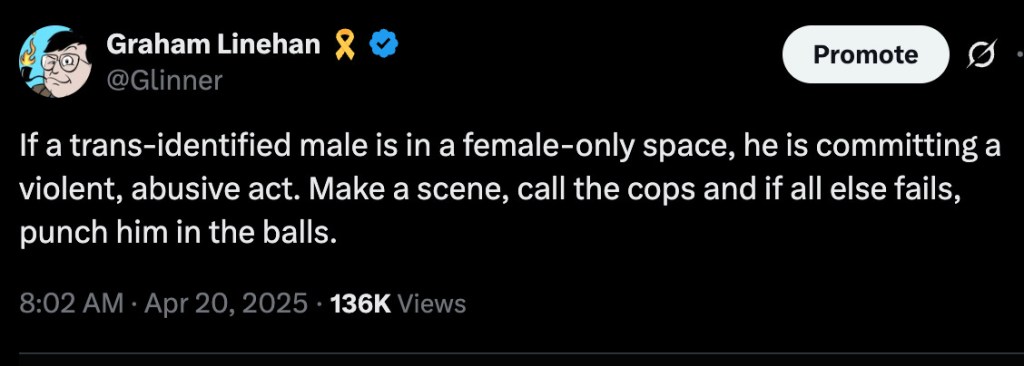
    The moment I stepped off the plane at Heathrow, five armed police officers were waiting. Not one, not two – five. They escorted me to a private area and told me I was under arrest for three tweets. In a country where pedophiles escape sentencing, where knife crime is out of control, where women are assaulted and harassed every time they gather to speak, the state had mobilized five armed officers to arrest a comedy writer for these tweets (and no, I promise you, I am not making this up):

    …and then, a follow up to that one:

    When I first saw the cops, I actually laughed. I couldn’t help myself. “Don’t tell me! You’ve been sent by trans activists.”

    The officers gave no reaction and this was the theme throughout most of the day. Among the rank-and-file, there was a sort of polite bafflement. Entirely professional and even kind, but most had absolutely no idea what any of this was about.

    “Kind” because the officers saw how upset I was – when they began reading me my rights, the red mist descended and I came close to becoming one of those police body-cam videos where you can’t believe the perp isn’t just doing what he’s told – and they treated me gently after that. They even arranged for a van to meet me on the tarmac so I didn’t have to be perp-walked through the airport like a terrorist. Small mercies.

    At Heathrow police station, my belt, bag, and devices were confiscated. Then I was shown into a small green-tiled cell with a bunk, a silver toilet in the corner and a message from Crimestoppers on the ceiling next to a concave mirror that was presumably there to make you reflect on your life choices.

    By some miracle – probably because I hadn’t slept on the flight – I managed to doze off. After the premier economy seat in which I’d just spent ten hours, it was actually a relief to stretch out. That passed the time, though I kept waking up wondering if it was all actually happening.

    Later, during the interview itself, the tone shifted. The officer conducting it asked about each of the terrible tweets in turn, with the sort of earnest intensity usually reserved for discussing something serious like… oh, I dunno – crime? I explained that the “punch” tweet was a serious point made with a joke. Men who enter women’s spaces are abusers and they need to be challenged every time. The “punch in the bollocks” bit was about the height difference between men and women, the bollocks being closer to punch level for a woman defending her rights and certainly not a call to violence. (Not one of my best as one of the female officers said, “We’re not that small”).

    He mentioned “trans people.” I asked him what he meant by the phrase. “People who feel their gender is different than what was assigned at birth.” I said: “Assigned at birth? Our sex isn’t assigned.” He called it semantics, I told him he was using activist language. The damage Stonewall has done to the UK police force will take years to mend.

    Eventually, a nurse came to check on me and found my blood pressure was over 200 – stroke territory. The stress of being arrested for jokes was literally threatening my life. So I was escorted to A&E, where I write this now after spending about eight hours under observation.

    The doctors suggested the high blood pressure was stress-related, combined with long-haul travel and lack of movement. I feel it may also have been a contributing factor that I have now spent eight years being targeted by trans activists working in tandem with police in a dedicated, persistent harassment campaign because I refuse to believe that lesbians have cocks.

    The police themselves, for the most part, were consistently decent throughout this farce. Some were even Father Ted fans. Thank God the Catholic Church never had with the police the special relationship granted to trans activists. The male officers were mostly polite but clearly nonplussed by the politics of it all – just doing their jobs, however insane those jobs had become. The female officers seemed more tuned in to what was actually happening. One mentioned the Sandie Peggie case in a certain way, and I realized I was among friends, even if they couldn’t admit it.

    I looked at the single bail condition: I am not to go on Twitter. That’s it. No threats, no speeches about the seriousness of my crimes – just a legal gag order designed to shut me up while I’m the UK, and a demand I face a further interview in October.

    The civility of individual officers doesn’t alter the fundamental reality of what happened. I was arrested at an airport like a terrorist, locked in a cell like a criminal, taken to hospital because the stress nearly killed me, and banned from speaking online – all because I made jokes that upset some psychotic crossdressers.

    To me, this proves one thing beyond doubt: the UK has become a country that is hostile to freedom of speech, hostile to women, and far too accommodating to the demands of violent, entitled, abusive men who have turned the police into their personal goon squad.

  • Why Graham Linehan’s arrest is a turning point

    Why Graham Linehan’s arrest is a turning point

    The hoo-ha in Britain over free speech being trampled on has always seemed exaggerated. I earn my living through voicing my opinions, and not once have I ever felt unable to say exactly what I think – especially when that’s controversial or offends large numbers of people.

    I am, of course, well aware that some people have had a very different experience – such as the comedy writer Graham Linehan, creator of Father Ted, who has robustly pointed out that biology means that men who identify as women are, nonetheless, still men. For that, his career was effectively ended in an industry that has long been in thrall to trans and other ideologies.

    But I have bridled at some of the supposed examples of free speech being destroyed. I am not one of those, for example, who believes Lucy Connolly is some sort of hero. Her social media post in the wake of the Southport murders last summer saying that hotels with asylum seekers should be set on fire was, to my mind, not merely revolting but incitement. Had it been merely revolting – something with which most decent people were horrified by – then that would be something for which she should have been taken to task, but not by the criminal justice system. Her post crossed a line, however.

    But there are moments when the penny drops and you realize you are wrong. Today has provided one of those moments. When Linehan returned from the United States yesterday, where he moved to be able to work, he was promptly arrested at Heathrow by five armed police officers. What alleged crime must he have been suspected of to be met by a show of such force? Murder? Terrorism? Armed robbery?

    None of those. He was arrested, he says in a Substack he posted earlier today, because of three tweets he had posted.

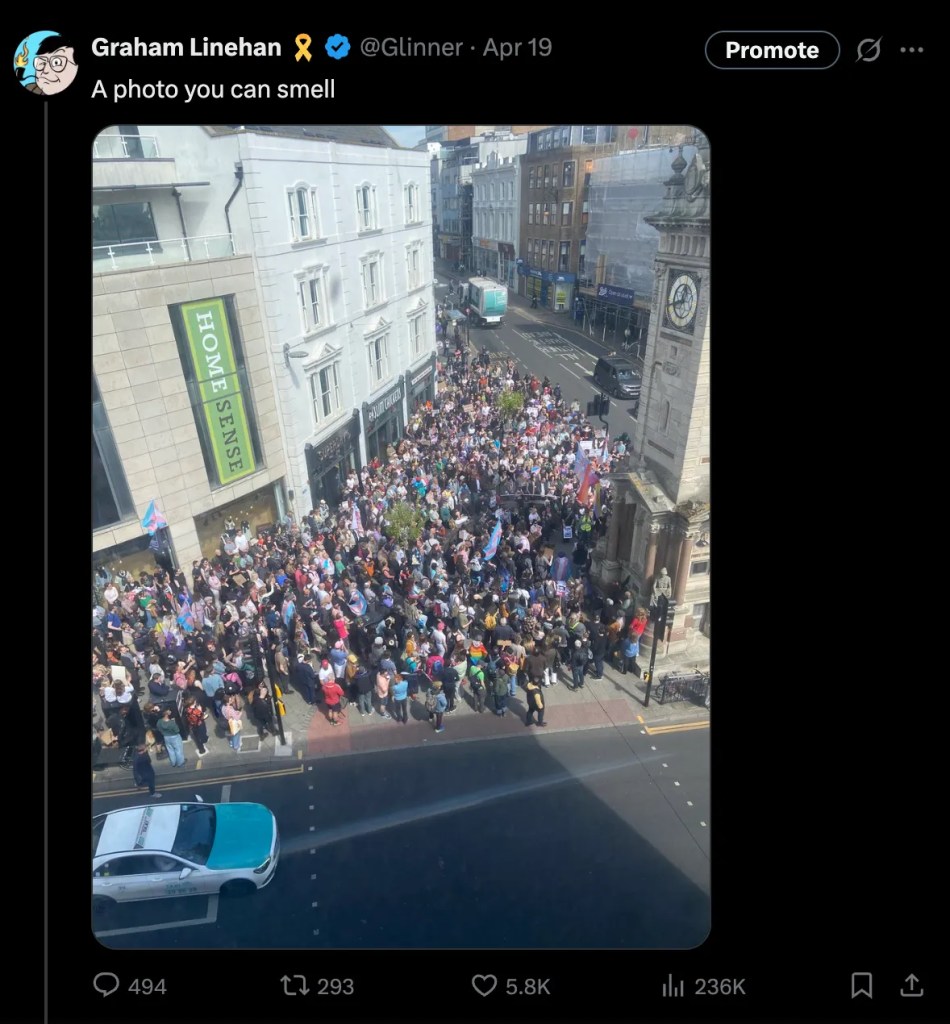
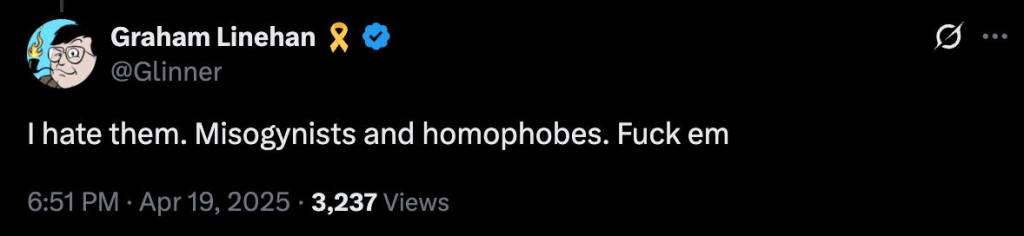
    Linehan’s tweets are nothing like Lucy Connolly’s. They are merely expressions of his view of trans ideology, albeit strongly worded, in his (entirely legitimate) style. In one, he posted a picture of what seems be a trans rights demonstration, with his caption: “A photo you can smell.” Another reads: “I hate them. Misogynists and homophobes. F— em.” And the third says: “If a trans-identified male is in a female-only space, he is committing a violent, abusive act. Make a scene, call the cops and if all else fails, punch him in the balls.”

    You might not like his tone. You might find his attitude confrontational. Trans people will doubtless find the posts offensive. So what? There is no law against giving offense.

    Except that appears no longer to be true. The Metropolitan Police has confirmed that Linehan was held “in relation to posts on X.” “The man in his 50s was arrested on suspicion of inciting violence,” a spokesman said.

    Criminality is evolving every day in this sphere. Increasingly, giving offense is being taken by the police and the Crown Prosecution Service as prima facie evidence of criminality. The other side of this coin is that taking offense is seen as legitimate grounds for a complaint. Presumably someone made a complaint to the police over these tweets – unless, and this is not beyond the realms of possibility, the police have officers who spend their days trawling the internet looking for posts that offend what they consider to be good taste. Is that really a good use of police time?

    Trust in the police is at an all-time low. In October 2024, 52 percent of adults told YouGov that they had no confidence in the police to tackle crime, compared to 39 percent in October 2019. What the police don’t now do – tackle crime – is just one aspect of the collapse in trust. Allied to that is what the police do now do – such as arresting people over social media posts which merely give offense to someone. It’s of a piece with what is seen on the regular hate marches, where they stand and watch when there are calls for the murder of Jews (such as the widespread “globalize the intifada”), but only spring into action when a counter-demonstrator turns up, saying that they are likely to provoke a breach of the peace.

    What we are seeing is the congruence of two dangerous developments. First, is the idea that giving offense is something which should be banned. The government’s current move towards adopting a definition of Islamophobia is part of this, and has rightly been labelled by Fiyaz Mughal, the founder of Muslim anti-prejudice group TellMAMA, as introducing a blasphemy law by the back door. Similarly, the onward march of the trans ideologues may have been stopped in its tracks by the Supreme Court’s ruling on the definition of “woman,” but the ideology has already taken hold of many institutions and spaces.

    Which leads to the second development – the police’s capture by this and other “woke” ideologies. Linehan describes how in his police interview a police officer mentioned trans people: “I asked him what he meant by the phrase. ‘People who feel their gender is different than what was assigned at birth.’ I said: ‘Assigned at birth? Our sex isn’t assigned.’ He called it semantics, I told him he was using activist language.”

    This is the nub of it. The police, supposed guardians of the law, have become players in the activists’ capture of the institutions. It is not that they are no longer concerned with crime, but that they are redefining what crime is. It is terrible that Linehan should have had to go through this. But if it wakes more of us up to what is happening in Britain, his arrest will have served our country well.

  • Wishing Trump dead only makes him stronger

    Wishing Trump dead only makes him stronger

    Maybe you heard that Donald Trump died over the weekend. First, the internet began to buzz over some bruising on the President’s hand during an executive-order signing ceremony. Then people started noticing that no one saw Trump on Friday, and that he didn’t have any events scheduled over the weekend. J.D. Vance gave an interview with USA Today in which he said, “if, God forbid, there’s a terrible tragedy, I can’t think of better on-the-job training than what I’ve gotten over the last 200 days.”

    Trump has become so ubiquitous in our lives that there was only one conclusion to reach from his temporary semi-absence: He is dead. A TikTok video making that claim got 600,000 likes. There were tens of thousands of Twitter posts on the topic, almost trying to will it into reality.

    That all quickly poofed away on Saturday when the Daily Caller’s Reagan Reese revealed that Trump had spent at least part of Friday doing an extensive interview with her. Then people spotted him golfing and playing with his grandkids, perfectly normal things for a 79-year-old to do on a holiday weekend. But still, people clung to the possibility. Just like the long-ago “Paul Is Dead” rumors, they still believed in yesterday.

    The celebrity death rumor is a common phenomenon in an unreliable online world. Justin Bieber, Lil Wayne and George Clooney have all been very dead in our time. Betty White fake-died so many times that when she actually passed away we were all ready for it. But the Un-Death of Trump is different because of the absolute glee with which certain segments world received it.

    I don’t know if you were aware, but a lot of people really don’t like Donald Trump. People online greeted the news of his “death” with joyful innuendo. Twitter fashion maven “Derek Guy” posted on Saturday, “so many babies are going to be born exactly 9 months from today.” Yes, Derek, because nothing makes couples want to hop into bed and make babies more than news that the President is dead.

    It all felt gross and pathetic, and it just shows how powerless and backed into a corner Trump’s opponents truly are. Trump has consumed the brains of millions; he has driven them mad. They couldn’t lock him up, they couldn’t vote him out, they don’t seem to be able to stop any of his policies or his relentless cultural onslaught. All they have are nanny-nanny-boo-boo Twitter accounts and show-dancing on a pretend grave.

    If history is any guide, you don’t want to live through the death of a sitting President. We’ve built the system to accommodate for it, but it creates chaos, instability, and figurative if not literal violence. Do people really think that Trump won’t leave office after his term is over? He’ll be 82. He’s going to leave. Just like the weather in Chicago, if you don’t like the President, wait a minute.

    But people also need to realize that their hatred of Donald Trump doesn’t kill him. It makes him stronger. A more spiteful man has never lived, and he’ll live forever just to spite them.

    When he does die, someday, in the far future, some people will mourn, some people will celebrate, but most people’s lives will just go on as if Trump never existed. He’s not your enemy, he’s not your savior. He’s just a President looking for an electorate to love him.

    Yet still the rumors persisted. One fervently shitlib anti-Trump account said, “Sure seems like someone is staying awful close to Walter Reed, doesn’t it?” Another posted this: “He’s not dead, but I think he had another stroke/TIA/CVT. I think this one affected his speech, which is why they haven’t let him near a microphone or press pool in almost a week. No close up pics, either. Some things can’t be covered with orange makeup.”

    Naturally, the Troll-In-Chief emerged from a short weekend off on Sunday night, posting on Truth Social, “NEVER FELT BETTER IN MY LIFE.” I hate to break the news, but Trump, like Frankenstein’s monster, is alive. But with his post, the dreams of thousands of extremely sad, terminally online liberals perished forever.

  • Will Trump meet British woman, Lucy Connolly, who was jailed for a tweet?

    Will Trump meet British woman, Lucy Connolly, who was jailed for a tweet?

    “Mass deportation now, set fire to all the fucking hotels full of the bastards for all I care, while you’re at it take the treacherous government & politicians with them. I feel physically sick knowing what these families will now have to endure. If that makes me racist, so be it.”

    Those 51 words earned Lucy Connolly – a babysitter from Northampton, in the East Midlands of England – the longest sentence ever handed down in the UK for a single social-media post. Last week, Connolly was released from prison, having served nine months of a 31-month term for “inciting racial hatred.”

    She will serve the rest of her sentence on probation. But she is not going back to a quiet life, it seems. Indeed, she is fast becoming a totem in the transatlantic culture war over Britain’s speech laws. Connolly is in touch with the Trump administration. Reform UK leader Nigel Farage is spoiling to bring her to the US, to sit alongside him when he testifies to Congress next month about the parlous state of free speech in Britain – a stunt which will probably be scuppered by the travel restrictions imposed by Connolly’s early release.

    If that’s the case, Farage won’t struggle to find another mascot. Indeed, Connolly’s speech crime is almost unusual in that what she said was genuinely vile and inflammatory. You can be locked up for a lot less in the UK these days. At least 30 people a day are now arrested in the UK for what they post online. Said speech criminals include a feminist who dared to call a man a man on social media, and a prankster who posted a selfie of himself dressed like the Manchester Arena bomber.

    But Connolly’s case has undoubtedly struck a nerve, given the insanely harsh punishment she received and concerns that politics might have had something to do with it. Certainly, for the more Anglophile Trumpists, she has come to symbolize how far our two nations have drifted apart when it comes to freedom of speech.

    Connolly posted her life-ruining missive on X on July 29, 2024, hours after three young girls had been stabbed to death at a Taylor Swift-themed dance class in Southport, a seaside town in the north-west of England. Misinformation had swirled online that the killer was an asylum seeker, one of the tens of thousands who have arrived in dinghies across the English Channel over recent years, and now reside in hundreds of hotels that have been requisitioned to house migrants while they wait for their asylum applications to be processed.

    In truth, the culprit was Axel Rudakubana, a depraved 17-year-old, the British-born son of Rwandan parents. He had long had a fixation on murder, terrorism and genocide. Connolly, having lost a child to medical malpractice, says she was left in a state of rage by Southport. The tweet was up for a few hours, and had been viewed 310,000 times, before she deleted it. Apparently, she thought that would be the end of it.

    But then violence erupted across the nation. Scumbags began throwing bricks at mosques, tried to set hotels on fire and rampaged through minority areas, smashing windows and screaming racial slurs. Amid the worst anti-migrant riots Britain has seen in modern times, the message rang out that a firm hand would be shown not only to those engaging in racist violence, but also to those “whipping up this action online”, as Prime Minister Keir Starmer put it from the Downing Street podium.

    Of course it is absurd to blame this horrific unrest on a single tweet posted in Northampton. In the US, Connolly would have never seen the inside of a cell, given the hard-won protections of the First Amendment, under which incitement to violence is tightly defined, as speech both likely and intended to cause imminent violence.

    But Brits enjoy nothing like the same protections. Connolly was convicted of a far more nebulous crime of “stirring up racial hatred”. She was held in police custody and denied bail. She pleaded guilty, she claims, because she wanted to get back to her family as soon as possible, hoping for leniency. As it turned out, she received a heftier sentence than some of the rioters did.

    You need not believe Connolly is a political prisoner, as she and her supporters have dubbed her, to see the murky waters that surround her case. At the time she was hauled in by police, the words “Think before you post” were being blared out from government social-media accounts. Attorney General Richard Hermer, who has to sign off on all “incitement to racial hatred” prosecutions, issued what he called a “stark warning that you cannot hide behind your keyboard.”

    The decisions of cops, prosecutors and judges will obviously have been shaped by this climate. Indeed, just before sending down Connolly, Judge Melbourne Inman at Birmingham Crown Court took it upon himself to perform a paean to multiculturalism. “It is a strength of our society that it is both diverse and inclusive”, he said. Connolly was later denied temporary leave, which would have granted her a few nights at home each month, even though she was a first-time offender and, by all accounts, a well-behaved inmate. Internal documents suggest this was due to “media interest”.

    Above all, questions hover over why Connolly was denied bail, which swayed her towards pleading guilty, fearing she would be in custody for months before trial. Ricky Jones, a Labour Party councillor, was acquitted earlier this month of encouraging violent disorder. Jones had addressed an “anti-racist” demonstration in London in the wake of the Southport riots, telling a whooping crowd that far-rightists should have their throats slit. He was bailed, and pleaded not guilty. The jury agreed.

    Connolly returns to a changed nation. Mercifully, the bigoted riots of last summer haven’t been repeated. In their place, peaceful protests have been held outside of migrant hotels, with mothers and grandmothers to the fore. In the Essex town of Epping, the Bell Hotel has just been ordered by a judge to close its doors to asylum seekers, following a string of charges brought against migrants in its care, including sexual assault and arson. Meanwhile, England and Union flags are being hoisted on lampposts by locals across the country, as part of a campaign calling itself Operation Raise the Colours, only for them to be ripped down by local councils. While Connolly’s ghastly tweet hardly spoke for the peaceful, patriotic majority, a sense of being silenced lingers.

    As Mr. Farage goes to Washington, with or without Ms. Connolly, Britain’s free-speech wars are going global. And no wonder. Once the cradle of liberalism, the UK is now a warning to the rest of the freedom-loving world. The UK’s decades-long experiment in policing hate – real and imagined – has produced nothing but fear, loathing and authoritarianism. Locking people up for tweets. This is what you get when you take a match to your liberties.

  • A Gen Z defense of America

    A Gen Z defense of America

    I am twenty-one. Not being on social media, I am ill-informed of the true depth of rage and fear available to the human psyche. Even so, I’ve heard that the planet will overheat. My pastor tells me the churches will sit empty, and the WSJ warns I’ll never buy a home. Boomers bemoan the laziness of my generation. Given these prophecies of doom, it is no wonder that we are a bit anxious.

    But if we were ever to look up from our screens and allow the evidence within sight to form our perception of reality, we might be pleasantly surprised: America’s social fabric is strong, and so are we. 

    I went on a run on the prairie today. This solitary excursion signifies that I, a young woman, am not debilitatingly fearful of male violence (which I would have good cause to be in most societies, past or present). It means that a functional economy has presented me with new running shoes, which are a very complex product. It implies that my local government has the forethought and effectiveness to not only protect an open-space area from development, but to build and maintain trails. This society’s health care and food systems have given me the vigor to run; its schools have taught me to appreciate wildflowers’ beauty and biology; its culture encourages a girl to wear shorts and to become strong. 

    Why, the world seems to be conspiring to endow me with agency. Call me privileged – a thousand times, yes – and call yourself the same, and declare it a blessing. 

    Addiction to a cold screen hasn’t killed Gen Z’s warmth. Time honored American values of friendliness and respect, whether at happy hour or a chance meeting on a plane, are still ubiquitous. Contrary to what our venerable reader may believe, nine out of ten Zoomers say they enjoy spending time with their parents and care what they think. Our dating scene is bland but, by historical standards, respectful – “we should hang out sometime” is a pleasant enough aberration from the more time-tested methods of arranging, buying or kidnapping a wife. Gen Z may have strange ideas of tolerance, high expectations of wellbeing and non-confrontational habits (at least offline). But a generation inclined toward harmony is not all bad.  

    Our third places – those arenas of social interaction outside the home and the workplace – are vibrant. In the past two weeks, I have attended a running club and a line-dancing night; a church picnic and a wedding; a backyard concert and a breakfast gathering with home-baked bread. At each, the average age was under thirty. Most Americans are lonely, and I am sometimes lonely. But videogames, politics and pandemics have not seriously prevented us from loving each other.

    The nation’s institutions are stable. Some things are happening over in DC, but not too quickly or irrevocably. The government works well enough. A pothole that used to swallow my tire was repaired when I wasn’t looking, and I have never even thought to be fearful when fighter jets fly overhead. As for technological progress, perhaps it has slowed down, and perhaps it is speeding into an unknown AI future. Either way, we do not seem to be experiencing severe cultural whiplash, and despite big tech’s best attempts, I still have agency over my technology use. If there are two things Gen Z is good at, it is absorbing new technology and not quite trusting it.

    Decline narratives are nothing new. Mesopotamian kings inscribed in stone that “the world has waxed very old and wicked.” Since then, this earth has creaked along through another four thousand years of affection, suffering and surprise. 

    Boomers, please give us half a chance to earn your hope. Zoomers, look up from your phones. Your life is not hell, nor everyone else’s heaven. A normal job is enough, a normal body is enough and a normal life is enough. If we dedicate half the energy into living our lives as we currently put into performing them, we can prove those pessimists wrong.