Tag: Stephen Miller

  • What the UK can learn from Trump’s second term

    What the UK can learn from Trump’s second term

    When John Swinney, the Scottish National Party leader, and former ambassador Peter Mandelson visited Donald Trump in the Oval Office a few months ago, the President showed them three different models for his planned renovation of the East Wing of the White House, which he has demolished to build a new ballroom. “If you’re going to do it,” Scotland’s First Minister suggested, “you might as well go big.”

    This Wednesday marked one year since Trump’s election victory, and going big captures the essence of his second term – bold and controversial moves, which have impressed even British politicians who thought him reckless in his first term. When Trump visited Chequers, the British Prime Minister’s country residence, on his state visit to the United Kingdom in September, one senior official told him: “You’re the most consequential president of my lifetime.”

    It has not all been decorous. Convention, tradition and the law have been subordinated to delivery. The East Wing redevelopment is a case in point. “When they were bulldozing, they came across some Jefferson-era brick,” explains one White House watcher. “They kept going.” Why tiptoe around the author of the Declaration of Independence when there is a real estate deal to complete?

    And yet the Trumpites see themselves as like the founding fathers, forging a new nation. “The bricks have become trophies,” says one Washingtonian. “It’s like people keeping chunks of the Berlin Wall.” Just as that was torn down, so Trump’s second term, much more radical and (so far) successful than the first, has been one of discontinuity and disruption.

    After speaking to more than a dozen British and American officials, aides to the President and the Prime Minister Keir Starmer, civil servants, former diplomats in both countries, pollsters and political strategists, it is clear there is much that Trump II can teach Britain. In his first term, Trump was held back by staff who didn’t share his world view and the claims of Russian interference in the 2016 election. This year, he issued hundreds of executive orders and successfully brought migration to a halt at the Mexican border. Private polling circulating in the highest reaches of the Republican party shows that even 22 percent of those who voted for Kamala Harris a year ago support what Trump is doing on immigration.

    Those who helped him triumph say Trump II is very different from Trump I, in that he “brought in a team which supports his agenda” and his chief of staff, Susie Wiles, enforced a rigorous policy of loyalty to the President. “In this administration everyone has to be loyal to everyone,” a Washington-based diplomat observes. “There is no infighting, it’s simply not allowed.”

    This unity of purpose and direction has given Trump the ability to “move fast and break things” – and even the British in Washington, who were horrified in 2016, seem energized by his example this time around.

    “Think about the speed at which we’ve been able to move,” says one White House official. “We’ve cut out so much infighting and been able to execute. In the first term a lot of cabinet members thought they should be president. We also found there were a lot of unnecessary layers in the bureaucracy. Now the President gets the right people in the room, and if we need to move fast we will. We didn’t want to be Tony Blair, after a long campaign saying, ‘What do we do now?’ on day one. The President said he wanted the ‘big beautiful bill’ passed by July 4. There was a mentality to get things done. That was very different this time.”

    These are lessons that it is now too late for Labour to learn, after 16 months in power. This is a government that never seemed clear on what it wanted to achieve at the beginning, nor, as things have deteriorated, on what to do next. In Washington, every-one knows what Trump wants. Keir Starmer has been unable to provide similar clarity.

    However, Trump II is providing a blueprint for Reform UK party leader Nigel Farage, another populist insurgent, on how to seize power and then use it effectively in the face of a hostile political establishment.

    Key players in the White House and the MAGA movement say that Farage must be ready on day one, as Trump was, to impose his power on the permanent civil service. That could mean ramming legislation through parliament in a single day to give Downing Street the ability to issue emergency orders as well as immediately publish bills on key issues.

    Dominic Cummings, a chief adviser to former prime minister Boris Johnson, who has discussed how to reshape Britain’s civil service with Farage, wrote on Sunday: “A true strategy needs defined goals, a plan for controlling the government and building a team… It should include writing key primary legislation well in advance of an election.”

    In Trump’s case, key policy proposals were worked up by the Heritage Foundation thinktank and the America First Policy Institute, who also identified people who could be drafted in to work on them in government. “They had hundreds of executive orders ready to go,” says one who admired Trump’s preparations. “Susie Wiles said, ‘The President wants to deliver on migration, tariffs and tech,’ and worked out who could deliver it. She sent Stephen Miller to go after woke stuff and [Robert] Lighthizer to work on tariffs. She sent the attorney general’s office to go after the people who tried to shaft Trump in the first term. The orders went out, the foot soldiers did their thing. It was a masterclass.”

    Asked how Reform UK could prepare for power, Sebastian Gorka, the White House head of counterterrorism, says: “That’s easy. Be even more like President Trump.”

    While curbing migration was a central election pledge, Trump’s more notable achievements have come in the international arena. From the once queasy Europeans there is mostly admiration for the ceasefire in Gaza, and for Trump’s decision to attack Iranian nuclear sites with bunker buster bombs.

    “What they’ve done in the Middle East with Netanyahu and Hamas is pretty impressive,” one British official says. Security sources say the attack did not destroy Iran’s nuclear program, as Trump has claimed, but he has “trimmed them” and delayed them by “a few years.” More importantly: “He’s demonstrated they can do it. The bottom line is that they can do it again – and they will.”

    After months of playing footsie with Vladimir Putin, Trump also seems to have finally lost patience with the Russian President and has moved to impose sanctions. “He’s genuinely putting pressure on Putin now,” a Foreign Office source says. “At Chequers he was so angry at him.”

    Trump told Starmer: “I thought he was a good guy, I thought I could do a deal with him, but every time we agree something his people then renege on it.”

    In many ways, the “special relationship” is in rude health. UK and American sources say Jonathan Powell, officially Starmer’s national security adviser and unofficially the head of UK foreign policy, helped with the substance of the Gaza deal, alongside his old boss Tony Blair, Trump’s special envoy to the Middle East Steve Witkoff and the President’s son-in-law Jared Kushner.

    When Trump hit Russia’s two largest oil companies, Rosneft and Lukoil, he did so just days after Britain sanctioned the same firms. “We were able to give Witkoff a palette of options when the President was deciding what to do,” a senior UK government source says. “And we’re prepared to talk Trump’s language on tariffs.”

    The proto-populist Trump and the cautious, legalistic Starmer are odd bedfellows, but insiders say the relationship is still strong. One witness to their exchanges says, “Keir agrees with him as far as he can and then he’ll say, ‘I disagree on that but let me explain why we see things differently.’ Trump looks at him and listens and says, ‘OK.’”

    Keeping a volatile President on side has been one of the signal successes, if not the signal success, of Starmer’s premiership, but there are some cracks in the paintwork. “President Trump likes winners,” says a Trump aide who follows British politics, “and Starmer is beginning to look like a loser.” On areas of domestic policy Trump has become more outspoken in recent months about what he sees as Britain’s sclerotic economic approach, as well as the failure to exploit energy resources in the North Sea. “The President tore him a new one on this stuff in private at Chequers,” a US official says.

    Among the MAGA fraternity in Trump’s team – including the Vice-President J.D. Vance, Miller and Gorka – there are also concerns that the UK has allowed mass migration to dilute its cultural heritage. All three have an Atlanticist Judeo-Christian concept of western civilization in which American democracy stands in a direct line of descent from Magna Carta, the rule of law and trial by jury.

    Vance has spoken about the erosion of free speech in Europe. Miller is urging British officials to limit migration, as America did between the 1920s and 1970s, to allow new arrivals to be properly integrated. He sees Islamist imports from the tribal areas of Pakistan as a cultural challenge Britain will need to deal with. They cite the fact that the FBI was set up to combat the Mafia, who along with millions of Italian migrants arrived in the US in the 19th century. This is uncomfortable territory for many in No. 10, but one senior figure says: “If your friends are telling you something out of concern, then perhaps we should listen.”

    On illegal migration in particular, the Americans find the inability of the government to prevent cross-Channel crossings inexplicable. Asked what Trump would do, one source suggests: “Tell the French that British intelligence officers and special forces will destroy the boats before they sail. Slash them with knives, use snipers. Burn down the warehouses of the gangs, use cyber to attack their communications.”

    The most acute source of tension was the forced departure of Peter Mandelson as ambassador to Washington over his friendship with the convicted pedophile Jeffrey Epstein. While Mandelson was an adept operator, some in the President’s circle never forgave his historic anti-Trump comments. Trump’s campaign manager Chris LaCivita publicly condemned the appointment (and privately told British friends that Mandelson was doomed to fail because he had criticized Trump). US officials say White House aides boycotted dinners at Mandelson’s official residence at the instigation of Wiles, though some did meet him outside. “There was great irritation that Mandelson was rammed through in the dying days of the Biden administration,” a source close to the White House reveals.

    Mandelson was initially saved by Mark Burnett, the British-born Apprentice producer who is Trump’s envoy to the UK. He convinced Trump that Mandelson was contrite. A US diplomat says: “Mark knew a rejection would be awkward for Morgan McSweeney [Starmer’s chief of staff],” who had pushed Mandelson’s case. The episode suggests the Trump team, often depicted as a bull in a China shop with allies, actually has a sophisticated and sympathetic understanding of No. 10’s internal issues.

    Insiders say LaCivita will probably run “opposition research” on any new candidate for ambassador. “Do not pick someone who has, at any point, gone on the record to criticize Trump,” the US diplomat says. That rules out Mark Sedwill, the former cabinet secretary, who has denounced Trump publicly for “blundering” and “capriciousness with allies.” It is understood that he has not actually applied.

    Those with their hats in the ring include Christian Turner, the political director at the UK government’s Foreign, Commonwealth & Development Office, and Simon Manley, who was ambassador to the World Trade Organization and the United Nations in Geneva until July, plus a British Ministry of Defence official. Oliver Robbins, the British Foreign Office permanent secretary, is expected to give Starmer a list of those who are “appointable” by the end of the month.

    Varun Chandra, Starmer’s business liaison man, who played a key role in ensuring that Britain got reduced tariffs, is widely seen as the frontrunner. The US diplomat says Chandra got his current role because Mark Burnett told Starmer’s team that “he knows how to talk to Americans.” A second source says: “Lutnick loves him, Bessent loves him, Susie Wiles loves him.” It is also said that James Roscoe, the acting ambassador, is well plugged in with the White House; US officials say Trump “likes him” and they hope he remains in some capacity.

    The final area of potential tension is China, where Trump is trying to neutralize Beijing’s control of the global market in rare earth minerals, while Starmer is desperate to go to China to secure investment. Labour is embroiled in the fallout from the recent collapse of the trial of two suspected Chinese spies and Beijing’s demand that it be allowed to build its vast new embassy in London, which many view as a security risk. “It’s been made clear by Beijing that Keir’s trip to China is contingent on them getting the embassy,” a government source says.

    Many in Washington are skeptical about whether the economic spoils of cozying up to Beijing will be worth the political costs. When UK Chancellor Rachel Reeves visited China she only secured investments worth £600 million ($785 million), a rounding error in government finances. By contrast, whoever becomes ambassador to the US will try to hurry into play the £150 billion ($196 billion) pledged by US companies as part of the recent UK-US tech deal, which Chandra and Mandelson helped secure.

    It is not all good news for Trump. On economic matters he has a lot of the same problems as Labour: stubbornly high inflation, a sluggish job market and (as the election of the socialist Zohran Mamdani as mayor of New York City shows) facing a left-wing populist surge like the one fueling support for the Green party in Britain.

    Both Trump and Starmer face crunch elections next year: the Prime Minister in the Welsh, Scottish and council elections, the President in the midterms. A big defeat might cost Starmer his job. If the Republicans lose control of Congress, Trump might well face fresh indictments from his political opponents or another impeachment charge. The loss of the Virginia and New Jersey governor races on Tuesday night points to a tough road ahead. The polling circulating among Republicans shows the Democrats winning the House of Representatives by a single seat next year, but predicts Trump will hang on after redistricting electoral boundaries.

    On Tuesday, Rachel Reeves rolled the pitch for massive tax rises in the Budget, blaming her economic inheritance, but even Labour insiders found her unconvincing. A source close to Downing Street characterized the Chancellor’s argument as: “Don’t blame me, I’m just the Chancellor. We have no power, we are just the government.”

    Trump also has a big speech on the economy this week, and there are similar stirrings in MAGA world. “The numbers are shifting on the economy,” says a prominent Trump ally. “I think people are concerned. They’re not feeling like prices are much lower. We’ve done a lot of international stuff. We need a pivot to the economy.” However, the Republican pollster says Trump’s early success and his decisiveness mean that even those feeling the pinch are still prepared to give him the benefit of the doubt: “People are feeling worse off but they think he has a plan.”

    The same, demonstrably, is not true of Labour, where Starmer’s failure to “go big,” as Trump has done, has left Labour vulnerable. Perhaps Starmer should draw up plans to bulldoze part of Downing Street.

  • In Georgetown, the scariest part of Halloween is the virtue-signaling

    In Georgetown, the scariest part of Halloween is the virtue-signaling

    Halloween has never been my favorite holiday, but as I was warned when we moved here last November, in Georgetown it is a serious affair. For the entire month of October, giant spiders scale the rowhouses, ghosts and cadavers dangle from trees, cackling animatronic witches guard the cemetery and the local bed and breakfast, parking spaces are “reserved” for ghostbusters and on every other block there’s a 12-foot-tall skeleton waiting to send my two-year-old into shrieks of delight.

    Then there are the pumpkins: every shape, size and color, stacked by the dozen in tasteful arrangements on every step of every stoop in town. How does everyone pull this off, I asked my real-estate agent, my one-stop source for all Georgetown-related trivia. There’s a pumpkin-delivery service, of course. For $1,300, you can “bring the full pumpkin patch experience right to your doorstep.” As one friend quipped when passing a particularly bountiful stoop, I’m pretty sure these pumpkins cost more than my monthly rent.

    Call me a Halloween convert: I confess I love it. I proudly spent more money than my husband needs to know on the pumpkins lining our driveway and the skeletons climbing our trellises. It’s a joy to see the season through my toddler’s wide eyes and to join in the silly traditions of our new neighborhood, where, it seems, everyone – not just the politicians – has a lot of skeletons in their closet. Indeed, as you walk the festive brick-paved sidewalks here, you could almost forget the political fights happening just across Rock Creek and the fact that half the neighborhood is currently furloughed. Almost.

    But a few stubborn neighbors won’t let you forget it. For them, it seems, Halloween isn’t about the children – it’s an opportunity to virtue-signal.

    “Elect a clown. Expect a circus.” Under blood-stained, striped banners in a front yard on a prominent corner, this sign sits amid a sea of clown-nosed skeletons, labeled the “White House of Horrors.” Each skeleton has been given a name and a costume. There’s Stephen Miller, dressed like a ghoul or Dementor. “Cosplay Kristi,” with a brown wig and camouflage vest (American flag upside down). Pete Hegseth, or “Secretary WhiskeyLeaks 👊🇺🇸🔥,” in an army jacket. Scott “Scottie” Bessent with a tee shirt expressing his love of tariffs. RFK Jr., “Secretary of Sick,” a monkey perched on his shoulder with a stethoscope.

    And, of course, skeletal Trump himself, with a blond wig and full clown regalia. “Carnival Barker-in-Chief. Don the Con. Tangerine Palpatine. Cadet Bone Spur. Commander-in-Cheese.” Gosh, so clever!

    A mere month after the biggest political assassination in decades, this Georgetown resident is living out a blood-soaked fever dream of dead political rivals. It’s crass, it’s incendiary, and it’s not particularly funny. Whatever it means to be in the Halloween spirit, this ain’t it.

    Nor is it neighborly. Scott Bessent and RFK Jr. both live practically within spitting distance of this house. They’re big boys, of course, and can handle some dark satire. They’ve seen worse: indeed, just weeks ago police responded to a bomb threat at Kennedy’s house. But what sort of message does it send to our children – who are, after all, the primary audience for these Halloween decorations – about how to coexist with those with whom you disagree?

    Remarkably, in a district with the highest percentage of Democrats in the nation (75.6 percent at last count), Georgetown is not a political monolith. On the contrary, it is the least politically predictable place I’ve ever lived. One minute, you’re commending a neighbor for lowering his flag to half-mast in honor of Charlie Kirk; the next you’re waving to Alejandro Mayorkas. At our avowedly apolitical local church, you can find yourself seated simultaneously behind a high-ranking member of the Trump administration and beside a woman carrying an Obama “Hope” tote bag. And in my (admittedly limited) experience, the people here who don’t work in politics – the butchers, the real-estate agents, even the consultants – are far less political than, say, your average New Yorker, presumably because to do good business in this town, you have to get along with everyone.

    So there’s a real opportunity here to have conversations across the aisle with the person living across the street from you. Conversations that could change minds and even change policy. As Henry Kissinger famously observed, “The hand that mixes the Georgetown martini is time and again the hand that guides the destiny of the western world.”

    But conversations are hard, and virtue-signals are easy. Ever since the Secretary moved in last spring, RFK Jr.’s immediate neighbor has staged a series of silent protests, devoting a prominent window display first to autism and then to DC statehood. Now, the house is decorated for Halloween, but a skeleton in the window holds a sign: “WISH I HAD TAKEN MY VACCINE!” And the house next to that one has followed suit, its front yard decorated with fake gravestones, one of which says, “I did my own research.”

    On the other side of the anti-vax skeleton, Kennedy’s neighbor has hung another sign in spooky letters: “WELCOME.” But who is welcome, exactly? Will Kennedy’s grandchildren be welcome if they ring the doorbell on Halloween? Will my daughter?

    The Gospel commands us to love thy neighbor – and not just the good neighbor who helps you with your recycling. Love the bad neighbor who blasts loud music into the night. And love the neighbor whose politics you abhor. This doesn’t mean you can’t criticize your neighbor: Jesus himself practiced tough love, and tough love requires criticism. But it does mean you should offer those criticisms respectfully and in good faith.

    Maybe that’s what it means to be in the Halloween spirit. This spooky season, ring a neighbor’s doorbell and have a conversation, even an argument. And welcome any neighbor who knocks at your own door, with a bowl of candy… and, for the grown-ups, a freshly mixed martini.

  • Why is Stephen Miller so divisive?

    Why is Stephen Miller so divisive?

    One of the most striking things about Trump 2: The Trumpening is how few characters are still on board from the Donald’s first term. Other than the President himself, it’s almost a completely different cast. Even the First Lady only rarely appears, as though she’s contractually obliged as a guest star for the occasional episode.

    But there’s one very important exception: White House Deputy Chief of Staff Stephen Miller. And while Trump Derangement Syndrome afflicts millions of Americans, Miller Derangement Syndrome is, as they used to say during Covid, a comorbidity.

    MDS may have reached its peak earlier this month when Representative Alexandria Ocasio-Cortez referred to Miller as a “clown.” “I’ve never seen that guy in real life,” she said in an intimate Instagram Live video for her followers, “but he looks like he’s like 4’10”. And he looks like he is angry about the fact that he’s 4’10”. And he looks like he is so mad that he is 4’10” that he has taken that anger out on any other population possible.”

    The only problem with the insult is that Miller is, in fact, 5’10”, the average height for an American man. Appearing with Laura Ingraham on Fox News that week, Miller called AOC a “walking nightmare” whose eyes and brain “don’t work.” AOC had to go back on to Instagram Live to say she didn’t believe in “body-shaming.” “I want to express my love for the short king community,” she said. “I am talking about how big or small someone is on the inside.”

    ‘We are the storm,’ Miller said during Kirk’s memorial – and that storm is playing out as we watch

    Whatever his size, it’s no stretch to say that, other than Trump himself, Miller is the most important figure steering American politics today. You can trace many of the administration’s key priorities – a closed border, hardline illegal immigration enforcement, an unbending support for Israel and the utter dismantling and humiliation of the Obama-era woke social order – to Miller and his ideas. He’s divisive, dogged and nearly omnipresent. Appearing in October on the final episode of the WTF podcast with Marc Maron, which late in its existence turned into a lodestar for the permanently traumatized liberal establishment, Barack Obama excoriated American institutions for “bending the knee” to Miller’s policies. “We’re not going to be bullied into saying that we can only hire people or promote people based on some criteria that’s been cooked up by Steve Miller,” he said. This, coming from a man who Miller referred to as “one of the worst presidents, if not the worst president, in US history,” felt extremely personal.

    But what exactly is this ideology that has Democrats shrieking in terror? Miller doesn’t like illegal immigration or DEI policies in the workplace or academia, but these days, that places him smack in the American mainstream. He’s certainly not a “white nationalist,” as many of his detractors claim: observant Jews tend to shy away from white nationalism as a rule.

    Miller grew up well-to-do in Santa Monica, California. His parents were conservatives, but they lived in one of the most liberal enclaves in America, which presented the illusion to him that he was a permanently oppressed underdog. As a high-school student, Miller called in to the conservative Larry Elder Show and brought Elder and conservative writer David Horowitz to speak at his school. Miller railed against fellow students and speakers who spoke Spanish and waged a successful campaign to get his school to institute a daily recital of the pledge of allegiance.

    At Duke University, Miller wrote a column for the conservative newspaper called “Miller Time” and introduced himself to his fellow students by saying “I’m from Santa Monica, California – and I like guns.” In many ways, he resembles the late Charlie Kirk, though he lacks Kirk’s easygoing charm and charisma. Both were white millennial men who came of age in Obama’s America, were shocked by the absence of patriotism, religion, and traditional values and brought about a change in that culture by sheer force of will.

    Miller’s speech at Charlie Kirk’s memorial was one of the most divisive (to liberals) and welcome (to conservatives) pieces of rhetoric in recent memory. “To our enemies,” he said, “you have nothing to give, you have nothing to offer, you have nothing to share but bitterness. We have beauty, we have light, we have goodness, we have determination, we have vision, we have strength. We built the world that we inhabit now.” It was the rhetoric of an angry man grieving the loss of his friend, and of someone who was determined to press forward.

    Speaking on Kirk’s podcast with guest host and Vice-President J.D. Vance the week after Kirk’s assassination, Miller said he was going to use all his power to dismantle nongovernmental organizations that he says created the climate that led to Kirk’s murder. “The organized doxxing campaigns, the organized riots, the organized street violence, the organized campaigns of dehumanization, vilification, posting people’s addresses, combining that with messaging that is designed to trigger [or] incite violence and the actual organized cells that carry out and facilitate the violence,” Miller explained. “It is a vast domestic terror.”

    He’s certainly not wrong about that. The fact is that every single one of Miller’s policy priorities have come to fruition since January. From media to academia to entertainment, the liberal establishment is on the defensive, with a diminishing toolset with which to battle Miller’s tactics. The ongoing street fights over ICE, the attempts to root out antifa, even the rhetoric about restoring religion to American life, are thoroughly Miller’s doing, and the administration isn’t backing down. “We are the storm,” Miller said during Kirk’s memorial – and that storm is playing out as we watch. This is Trump’s America, and the Short King’s world. Good luck to anyone who tries to get in his way.

    This article was originally published in The Spectator’s October 27, 2025 World edition.

  • The Bush shoe-thrower is jacked now

    The Bush shoe-thrower is jacked now

    Muntadhar al-Zaidi, the man who once threw a shoe at George W. Bush during a press conference, posted a gym selfie on X the other day. Cockburn is here to tell you that the man is yoked. “Have a nice day” indeed, Muntadhar!

    “This is a farewell kiss from the Iraqi people, you dog,” al-Zaidi shouted at Bush in 2008, before throwing his shoe. He subsequently spent nine months behind bars. After a release for good behavior, he said he intended to start a foundation that would “build orphanages, a children’s hospital, and medical and orthopedic centers offering free treatment and manned by Iraqi doctors and medical staff.”

    That doesn’t appear to have happened. Al-Zaidi also ran, unsuccessfully, for public office in Iraq in 2018. He now works as a writer and broadcast journalist, but appears to be spending a lot of time and effort getting swole, perhaps doing the “Pete and Bobby Challenge.” Unsurprisingly, a lot of al-Zaidi’s “journalism” these days appears to be of the “free Palestine” variety, but he did post a surprising tweet approving of the death sentence for Iryna Zarutska’s killer.

    But al-Zaidi has never forgotten his roots. Shortly after his workout pic, he reposted a photo of a T-shirt that reads, “Mentally I Am On The Timeline Where Both Shoes Hit George Bush.” Aren’t we all?

    On our radar

    IN THE ROUGH President Trump is currently watching Team USA undergo a testing start to the Ryder Cup in Bethpage, New York. They trail Europe 3-1.

    COULD THIS HAVE BEEN AN EMAIL? Defense Secretary Pete Hegseth has ordered hundreds of admirals and generals to attend a short-notice meeting in Virginia next week.

    JIM TIME Former FBI director James Comey posted a defiant video on social media after being indicted by a grand jury in Virginia.

    Get your ‘Stephen Miller, sexual matador’ poster here

    The Trump White House is notorious for producing its share of glorious quotes – but even by its high standards, this was a banner week. On Monday, when the President was alleging a connection between taking acetaminophen during pregnancy and autism, he said, “Nothing bad can happen, it can only good happen.” The next day at the United Nations, he dragged the organization for their technical difficulties: “These are the two things I got from the United Nations: a bad escalator and a bad teleprompter.” Then when President Erdoğan of Turkey visited the Oval Office, Trump couldn’t help a joke about the leader of the NATO “democracy”: “He knows about rigged elections better than anybody.”

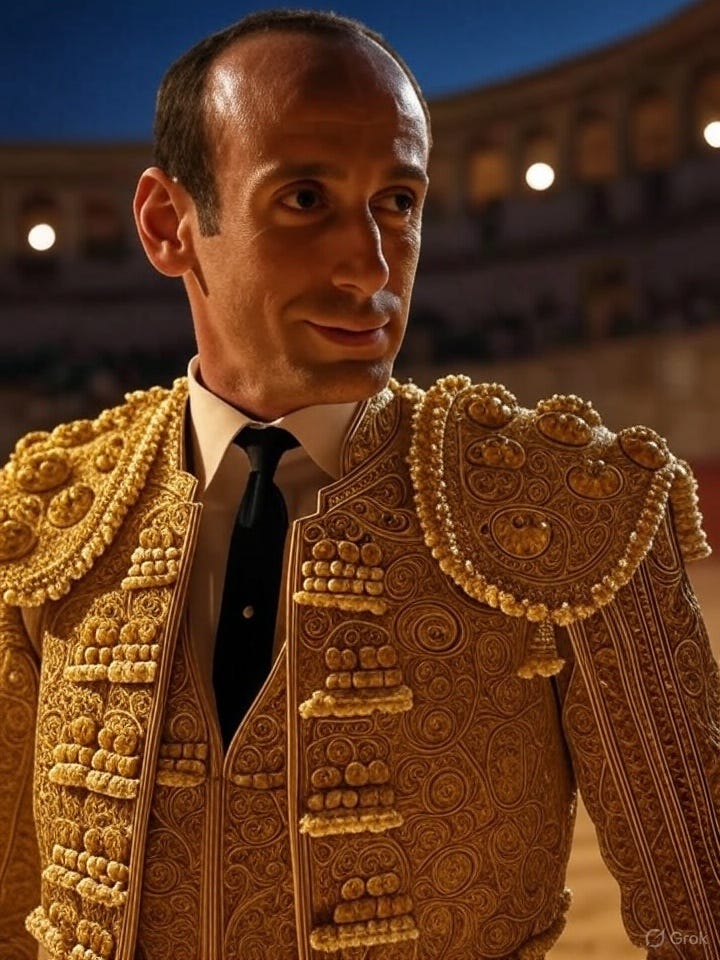
    It takes a lot to top Trump. Step forward Katie Miller, wife of White House aide Stephen and a former aide to Elon Musk herself. Mrs. Miller has a new gig podcasting, and appeared with Jesse Watters on Fox News. If she was after a viral moment to boost her numbers, she bagged it. After Watters said that, being married to Stephen, she was the “envy of all women,” Katie quipped, “the sexual matador, right?”

    If you’re not scarred by the mental image of that, don’t worry: Cockburn asked Grok to depict Stephen Miller as a sexual matador (and then told it to “make him sexier” twice):

    Now you can print him out and put him on your bedroom wall.

    Moscow fools

    Top brass at the Telegraph, a British newspaper, are more red-faced than usual this week after issuing an apology for wrongly accusing a State Department official’s wife of having Kremlin ties.

    The article in question, by Benedict Smith “erroneously stated that Mr. Sergei Chernikov – and, by association, his niece, Ms. Yulia Kirillova – had current ties to the Kremlin and to President Putin personally. This is false,” the apology reads. “In fact, neither Mr. Chernikov nor Ms. Kirillova has any association with the Kremlin or Mr. Putin. Mr. Chernikov has lived away from Russia since 2008 and has not returned since 2020.”

    Kirillova is married to Darren Beattie, a senior State Department official who currently serves as the under secretary for public diplomacy and public affairs. Before his role in Foggy Bottom, Beattie was a speechwriter for the first Trump White House and for then-congressman Matt Gaetz – as well as founding the New Right-ish news site Revolver. Presumably that was enough for the British media to try to depict him as a Kremlin stooge. What is the charge? Having a wife, a beautiful Slavic wife?

    Cockburn hopes Team Telegraph won’t be Russian to conclusions quite so fast next time…

    Subscribe to Cockburn’s Diary on Substack to get it in your inbox on Tuesdays and Fridays.

  • J.D. Vance presents The Charlie Kirk Show

    J.D. Vance presents The Charlie Kirk Show

    Charlie Kirk’s assassination was a shock to the conservative movement and a tragedy for those who knew him personally. For Vice President J.D. Vance, Kirk wasn’t just another conservative influencer – he was a close friend, a mentor and an ally who helped introduce him to donors and gave him a platform when he was still an unknown Senate candidate. Hosting The Charlie Kirk Show from the White House was, in many ways, a natural act of loyalty. It was also a rare moment of vulnerability from a politician often cast as calculating: a man honoring his fallen friend.

    But even in mourning, there is a temptation in politics that must be resisted – the temptation to turn personal loss into partisan ammunition. And that’s where Vance’s tribute stepped onto shakier ground.

    During the broadcast, Vance vowed to “go after” left-wing NGOs he accused of “fomenting and facilitating violence.” One of his guests, former Trump advisor Stephen Miller, sharpened the point, warning against “unfocused anger” while urging conservatives to direct “righteous anger” against political enemies. The message was unmistakable: Kirk’s death would not only be remembered – it would be weaponized.

    This is the wrong lesson to draw from such a brutal killing.

    No one should minimize the rage conservatives feel at losing a friend and ally to political violence. But the danger lies in making Kirk’s death the justification for sweeping crackdowns on vaguely defined “left-wing NGOs” or in portraying one side of the political spectrum as inherently violent. Such rhetoric may rally the base, but it also feeds the very cycle of polarization that makes political violence more likely, not less.

    The truth is uncomfortable for both sides: violence is not the monopoly of the left or the right. The left can point to January 6. The right can point to last week’s shooting in Utah. Neither side escapes blame. If conservatives want to honor Charlie Kirk honestly, we must be willing to admit that political violence is an American problem before it is a partisan one.

    That doesn’t mean ignoring ideology. Kirk’s own career was built on identifying ideological excess – especially in higher education – and rallying young conservatives to push back. But it does mean that in the aftermath of his assassination, our first instinct should not be to widen the political battlefield. Vance’s vow to “go after” NGOs raises more questions than it answers. Who decides what qualifies as fomenting violence? Will this drag in any left-leaning nonprofit that criticizes the administration or stages protests? And do conservatives really want to hand the precedent of government crackdowns on nonprofits to future Democratic administrations?

    This is the irony: in trying to honor Kirk, we risk betraying one of the principles he himself championed – free speech. Charlie Kirk was combative, sometimes divisive, but he thrived in the realm of debate. His strategy was not to silence his opponents, but to expose them, ridicule them, and out-organize them. For those who often disagreed with his methods, it’s important to note that Kirk himself built his career not by calling for government crackdowns, but by confronting his opponents directly. His approach was consistent: he thrived in the arena of debate, not in silencing dissent.

    If the conservative movement takes Kirk’s death as a license to wield the state against its enemies, it will be pursuing power in a way that Kirk himself never had. Worse, it will entrench the very culture of “us versus them” politics that makes tragedies like this more likely.

    The better path is harder but more worthy of Kirk’s legacy: to channel grief into discipline, not escalation. That means recommitting to building institutions that last, training the next generation of leaders and modeling the resilience that Kirk himself embodied. It means condemning political violence no matter who the target is, while refusing to let the other side dictate our terms of debate. And it means holding our leaders accountable when they risk turning mourning into opportunism.

    To be clear: J.D. Vance’s tribute was not malicious. It was heartfelt, and it reflected real pain. But as conservatives, we must remember that personal grief does not excuse political overreach. The state should not become an instrument of vengeance. The conservative movement should not confuse righteous anger with unchecked power.

    Charlie Kirk’s assassination is a wake-up call. It reminds us of the fragility of civil discourse and the dangers of living in a country where political opponents are increasingly seen as enemies to be destroyed rather than fellow citizens to be debated. If conservatives want to carry Kirk’s torch forward, we must not repeat that mistake.

    Let the tribute stand as a reminder of his energy, his influence, and his drive. Honoring his life doesn’t require uncritical agreement with his politics. It requires recognizing the movement he built and refusing to let his death be used as justification for more division. But let us also reject the instinct to weaponize his death. That is how we honor his legacy – not by escalating division, but by proving that even in tragedy, our movement can choose principle over vengeance.