Tag: TikTok

  • Crunch(y) time in the Rose City

    Crunch(y) time in the Rose City

    Congresswoman Maxine Dexter of Oregon, who once briefly went viral for saying we have to “fuck Trump,” has posted a cringey video of a gray-haired Portland ukelele orchestra playing and singing the most off-key version of “This Land Is Your Land” imaginable. “Portland is not a military target,” the caption reads.

    Ah, but it is, and for good reason. Armed leftist radicals have firebombed a courthouse and are regularly attacking an ICE facility. Residents at the Multnomah County Plaid Shirt Senior Center may not see that on MSNBC (soon to be MS NOW!) or in their daily Heather Cox Richardson newsletter, but it’s happening.

    Boomer denialism is in full swing, as evidenced by an ungodly cringe video from New York Times columnist and one-time Oregon gubernatorial candidate Nicholas Kristoff yesterday, in which he appears from behind a small tree, whisper-finger raised to his lips and sarcastically says “Be careful. Portland is on fire,” and then says “NAH” and walks off to a boring Oregon Historical Society dinner. How much did OHS pay him? It was too much.

    The libs have it all wrong. Trump has not “declared war” on American cities. People still brunch in Portland. There will be at least one more game in Wrigley Field this year. The secret police are not watching the comings and goings of DC barflies. But antifa chapters are definitely throwing Molotov cocktails in select locations and rogue SUVs are boxing in ICE convoys. The refusal to admit this is a problem is “mostly peaceful protest”-style deflection, with slightly different language. The next time Cockburn hears it, he’s calling for the National Guard.

    On our radar

    HEY BUDDY Canadian PM Mark Carney is currently joining President Trump at the White House for a bilateral meeting and lunch.

    MARKING 10/7 Trump will then meet with Edan Alexander, the last American hostage to be freed by Hamas after 584 days in captivity.

    SAVIOR COMPLEX The President has also returned to TikTok, posting his first video since the election to tell young people to thank him for “saving” the app. Oh, and J.D. Vance is back too.

    Kash on the kase

    After DC withstood weeks of “militarized federal overreach” (read: National Guardsmen loitering under trees, picking litter and mooching around Dupont Circle), America’s Second City is next on the list – and the federal government is sending the best man for the job. “Chicago will be saved, and this FBI will continue to crush violent crime there, and all around the country. Heading to the Windy City now,” Director Kash Patel of the Federal Bureau of Investigation posted this morning.

    If his track record with the Epstein Files and wrongly claiming to have Charlie Kirk’s assassin in custody – twice! – during a manhunt are anything to go by, Chicago won’t know what hit it.

    Vivek shows his softer side

    One-time presidential candidate and now Ohio gubernatorial hopeful Vivek Ramaswamy has offered an olive branch to his opponents. Later today he is set to declare that the American right is at a “fork in the road” and that “we can still stand for truth, while viewing those who believe in falsehoods not as our enemies who must be vanquished, but instead as our fellow citizens who have lost their way and must be shown the light.”

    Long-time Ramaswamy-watchers will look at this askance. The tech investor had previously made his name as one of the right’s most abrasive voices. His 2024 campaign for the presidency was a callow affair; he sought – as many have done – to “out-Trump Trump” from the right, and had an unconvincing go at ridiculing his opponents on the debate stage à la Trump 2016. He could not quite recapture the magic and instead came across as a sort of annoying poltergeist, something that was not helped by his extreme youth (for a presidential candidate) and slightly impish mien.

    Nor did this showily combative manner serve him well after his campaign wrapped up. Tipped to be Elon Musk’s co-chair at DoGE, Ramaswamy spent the Christmas holidays giving stern lectures to American workers, warning that they were ill-suited for the “hyper-competitive global market.” The answer in the meantime would be an extension of the H-1B visa program. The medicine for Americans would be “more movies like Whiplash, fewer reruns of Friends. More math tutoring, fewer sleepovers. More weekend science competitions, fewer Saturday morning cartoons. More books, less TV. More creating, less ‘chillin.’ More extracurriculars, less ‘hanging out at the mall.’”

    Ramaswamy was eased out of DoGE shortly afterward. As he urges civility, he might first reflect on how unwilling he has been to extend it to others.

    Subscribe to Cockburn’s Diary on Substack to get it in your inbox on Tuesdays and Fridays.

  • Luigi Mangione avoids state terrorism charges

    Luigi Mangione avoids state terrorism charges

    Luigi’s mansion

    It’s money well-spent for those who contributed to Luigi Mangione’s million-dollar defense fund. Two state terrorism charges against the accused CEO-killer have been thrown out by a New York judge today, including a first-degree murder charge which could have landed Mangione in prison for life.

    Judge Gregory Carro ruled that, despite the ideological motive behind Mangione’s alleged actions – a sort of “eat-the-rich” philosophy which has made him a grotesque folk hero for many on the far left – a murder committed for ideological reasons isn’t necessarily terrorism.

    “While the defendant was clearly expressing an animus toward UHC, and the healthcare industry generally, it does not follow that his goal was to ‘intimidate and coerce a civilian population,’ and indeed, there was no evidence presented of such a goal,” Carro wrote in his dismissal of the charges.

    The news should be a warning against overreaching charges, which can make it more difficult to secure a conviction. Mangione still faces other state charges, including second-degree murder, to which he has pleaded not guilty, as well as federal charges which could result in the death penalty. Attorney General Pam Bondi, continuing her revenge tour, has instructed federal prosecutors to pursue the death penalty. Let’s see if she can manage this one without a major comms crisis.

    On our radar

    CHEERIO MATE President Trump is currently crossing the Atlantic on his way to the United Kingdom, where he is being hosted for a state visit by King Charles III.

    START SPREADING THE NEWS Trump has also filed a $15 billion lawsuit against the New York Times and several of its authors, saying the paper is “a full-throated mouthpiece of the Democrat Party.”

    RIP SUNDANCE Iconic Hollywood actor and director Robert Redford died this morning. He was 89. More from Alexander Larman.

    TikTok deal imminent?

    The latest extension to the US TikTok ban is set to expire tomorrow. Yet President Trump and Scott Bessent say they have a deal in place to sell the app’s US entity to American buyers, keeping it operational in this country.

    “We have a deal on TikTok. I’ve reached a deal with China,” the President said aboard Air Force One today. “I’m going to speak to President Xi on Friday to confirm everything up.”

    ”We have a group of very big companies that want to buy it,” Trump continued. “The kids wanted it so badly. I had parents calling me up… They say, ‘If I don’t get it done, they’re in big trouble with their kids.’ I think it’s great. I hate to see value like that thrown out the window.”

    Critics had expressed concern about TikTok’s existing ownership structure for a number of reasons. Among them is the “golden share” agreement which gives the Chinese Communist party oversight of Chinese parent company ByteDance and ownership of the app’s much-vaunted algorithm.

    Can you keep a secret?

    Kelly Chapman and Sarah Beth Spraggins

    Against all odds, Cockburn found himself at a DC party with the best dressed guests in decades Saturday night, at a Columbia Heights townhouse for the launch of Secret Ballot, a new weekly Substack from Kelly Chapman and Sarah Beth Spraggins.

    Guests adhered to the “Watergate midcentury glam” dress code and were treated to the release of the newsletter at 8 p.m. It’s an eclectic cocktail of sociocultural commentary, reviews, fiction, poetry and takes from a mixture of bylined and pseudonymous writers.

    “We’re soliciting things people might not publish elsewhere, but say to their friends when they’re feeling like a genius over drinks,” Spraggins told Cockburn.

    Speaking of cocktails, two bartenders were serving martinis and Dirty Shirleys on the top floor; attendees looking to pace it could treat themselves to beer provided by Right Proper brewery. The age range was as wide as at any party Cockburn has been to in this town; some were pushing 60, while you could spot a sleeping baby in the second-floor poker room (not part of the pot).

    “We want to highlight when people’s opinions or dispositions contradict the expected attitude at work,” said Spraggins. “That’s what the pseudonyms are for, like a conservative congressional staffer who cares a lot about racial justice or a cold, factual beat reporter who is also a poet.”

    Spotted: Cami Fateh; Damir Marusic; Diana Brown; Emma Collins; Emilia Tripodi; Emma Camp Orr; Freddie Hayward and Alice Inman; J.J. Gould; Jackson Bierfelt; James Kirchick and Josef Palermo; Jed Miller; Jerome Copulsky; John Hudson; Josh Christenson; J.P. Freire; Kara and Nick Clairmont; Katherine Doyle; Maria Copeland; Michael Barron; Mikra Namani; Molly Marlow; Sami Gold; Savannah Galvin; Shadi Hamid; Sophia Morales; Teddy Schliefer; Tonya Riley; Victoria Marshall; Vienna Scott and Will Simpson.

    Subscribe to Cockburn’s Diary on Substack to get it in your inbox on Tuesdays and Fridays.
  • The trend for unsparing cancer tales on TikTok

    The trend for unsparing cancer tales on TikTok

    For teenage girls on TikTok, the makeup routine is an almost sacred ritual. Manicured fingertips dart around at virtuosic speed, applying dabs of foundation, blush and highlighter with precise artistry. Normally the commentary is about the nuances of brushing and blending – but Sophie, a bewitchingly pretty 18-year-old from New Zealand, has something more pressing to discuss.

    “I’d been having headaches for about two months,” she says, placing dots of concealer under her blue eyes. “And then one night – it was my [high school] graduation – I was having a few drinks, which you’re not meant to do when you have glandular fever, which is what we all thought I had. So I kind of expected to wake up hungover.”

    But this headache was worse than she’d ever had before, the painkillers weren’t working and by the time her mother got home from work Sophie was semi-conscious. “My mum thought I had alcohol poisoning… Around seven o’clock my dad came home, took one look at me and was like, ‘We need to take her to a hospital asap.’” And that was how Sophie, aged 17 at the time, discovered that she had a tumor that was causing bleeding in her brain. That night, she had emergency surgery. They removed the mass but the biopsy revealed that it was an aggressively malignant Grade IV glioblastoma brain tumor.

    “I’m trying to stay positive and hope for the best,” says Sophie, finishing her mascara. The fact that she’s so young moves the odds in her favor. Nonetheless, she’ll need to be exceptionally lucky: five years after diagnosis with a high-grade brain tumor, only five to seven percent of patients are still alive.

    It’s shocking to discover how many TikTok videos feature young people with life-threatening diseases – usually cancer. This isn’t because more of them are being diagnosed; it’s because members of Generation Z who draw the ultimate short straw are using the app to take viewers through every stage of their nightmare. Click on a few videos and the algorithm will throw more of them at you. The phenomenon even has a name: DeathTok.

    Paradoxically, the most curated social media platform is the most ruthless at stripping away the platitudes of the “cancer journey.” TikTok may be famous for its copycat dances and viral trends, but it’s also the place where ordinary young people speak into their cameras with the fluency of seasoned talk-show hosts. They’re not just digital natives; they’re video natives who employ adult communications skills to express adolescent feelings.

    Scrolling through the DeathTok videos is an uncomfortably voyeuristic experience

    Obviously only a minuscule fraction of these people are fighting cancer – but with around 1.6 billion active users, the TikTok algorithm is never going to run short of heartbreaking testimonies. Heartbreaking and also frightening: Gen Z and millennial cancer patients have the technical expertise to capture the horrors of chemotherapy and they don’t feel the need to filter them for the audience. But that doesn’t mean all the videos strike the same note.

    Some TikTokers use black humor. Eldiara is a 23-year-old Californian with Goth makeup, a sardonic smile and haunted eyes. Her pinned video, with 34 million views, shows her dressed like a Mafia widow in a black lace mantilla. She’s bending over a bed in mock prayer. A single arm protrudes from the sheets, fingernails painted black.

    It’s Eldiara’s own arm, which was amputated to stop the spread of a very rare, very dangerous soft-tissue cancer that she was diagnosed with aged 19. The operation was last October and, in a video filmed an hour before she went under anaesthetic, we see her wiggling her fingers on the doomed hand for the last time.

    TikTok has helped her achieve “radical acceptance” of the loss – though not tolerance for idiotic commenters under her videos, who are the targets of her lacerating mockery. Bogus remedies, glib consolation, intrusive questions – Eldiara hates them all, but none so much as the wisecrack shouted at her by morons who think it’s original: “Need a hand?”

    Johnny, a 22-year-old student from New Orleans, also had his arm amputated last October. His rare sarcoma is incurable. He’s not on TikTok to find radical acceptance so much as money. The platform earns him a fraction of a cent per view; with half a million followers that adds up to a modest income. His videos carry the caption: “I have stage 4 cancer and lost my arm because of it. Please stay for 60 seconds so I can get paid.” Johnny’s story is one of sudden catastrophe. We see him in August last year, driving his car with both arms, numbed with shock at his diagnosis. “I woke up one morning a couple of months ago with a super-sore arm. I thought I might have slept on it kind of weird, so I just brushed it off.” The next day it was swollen, he went to the doctor, had a biopsy and scans and “Boom! Sarcoma… with stuff in my lungs. To say I’m scared is kind of an understatement because I’m fucking terrified.”

    Later, he’s not only terrified but exhausted. His cancer doesn’t respond to chemotherapy, so every three weeks he has injections to kickstart his immune system. “Man, every time I get it I am absolutely wrecked. I feel like I have no control over my own body and it’s really not fair.”

    Several creators post photos taken when they were already ill but didn’t realize it. Finn, a high schooler from England, appears on a soccer field, “playing for a team every week thinking I’m healthy.” He had little lumps on his neck but didn’t think they were a big deal. A few months down the line, undergoing chemotherapy for Hodgkin’s lymphoma, we see him good-humoredly plucking out tufts of his hair before shaving everything off. He says the worst thing is the injections – “like getting stabbed… forget losing your hair, illness from chemo, they hurt like hell.”

    Tanner, a young married Mormon from Salt Lake City, posts photos of himself getting sweaty from DIY, hanging out with friends, cuddling a baby, drinking soda in the bath – all taken “when I had stage 4 cancer at 25 but didn’t know.” He’s chubby, bursting out of his XXL shirts with a goofy smile. But by the time he celebrates his 30th birthday, he’s handsome with sharp cheekbones – and using a motorized wheelchair to get round the supermarket.

    His faith has taught him to believe that he’ll spend eternity with his beloved wife, Shay. But he’s been through a stage of asking, “What if that’s not true, this is it and I just got screwed in the genetic lottery?” That scared him, but now he reasons that, if there is an afterlife, “I will know pretty quickly and if there’s nothing, I won’t know at all.”

    It’s easy to follow the progress of Tanner’s colon cancer: you just move your finger across the screen. TikTok conveys the relentlessness of cancer in real-time.

    Do TikTok cancer patients reveal such intimate details because the technology drives the expectations of the audience? Many of them say the process is helpful – but one can’t help wondering: if they don’t survive, how cathartic will those videos be for the family members who helped them do the filming? Presumably they’ll need a password to delete them. Facebook, the favored platform of retirees, already looks like an online cemetery.

    There’s a wider question. With every advance in media technology, we progressively lose the luxury of fading memories. Perhaps there’s something in the Freudian notion of a mental “censor” that relegates anxiety-provoking thoughts to the realm of dreams. Will the filter still work when every fearful moment jumps out in digital detail? And when other people can dig into them?

    Scrolling through the DeathTok videos is an uncomfortably voyeuristic experience, even if the person who made them is encouraging you to do so. What were their first symptoms? How are they doing now? All the young people mentioned above have posted updates. So, if you’re interested…

    Sophie has flown to Los Angeles for laser surgery on her tumor that has sent her back into remission. But she wants her followers to know that, although she’s hoping to be healthy for a long time, she isn’t cancer-free “and it could come back next week.”

    Eldiara is struggling to mask her bitterness with humor. She’s directing some of her anger at Donald Trump and his ICE raids. She’s in remission but doesn’t like her odds and feels like she’s “waiting for the other shoe to drop.”

    Johnny has been told that, thanks to his TikTok income, he’s not eligible for social security payments. And because his cancer has spread, no one wants to employ him.

    Finn was diagnosed with stage 2 Hodgkin’s, which isn’t usually a death sentence – and so it has turned out for him. In his most recent video he’s waiting for his exam results and preparing for his gap year.

    As for Tanner, a video posted in June solves the problem of burdening others with breaking bad news. He’s wearing a brown beanie and grinning impishly. “Hey, it’s me, Tanner,” he says. “And if you’re watching this, I am dead.”

    This article was originally published in The Spectator’s September 15, 2025 World edition.

  • Wishing Trump dead only makes him stronger

    Wishing Trump dead only makes him stronger

    Maybe you heard that Donald Trump died over the weekend. First, the internet began to buzz over some bruising on the President’s hand during an executive-order signing ceremony. Then people started noticing that no one saw Trump on Friday, and that he didn’t have any events scheduled over the weekend. J.D. Vance gave an interview with USA Today in which he said, “if, God forbid, there’s a terrible tragedy, I can’t think of better on-the-job training than what I’ve gotten over the last 200 days.”

    Trump has become so ubiquitous in our lives that there was only one conclusion to reach from his temporary semi-absence: He is dead. A TikTok video making that claim got 600,000 likes. There were tens of thousands of Twitter posts on the topic, almost trying to will it into reality.

    That all quickly poofed away on Saturday when the Daily Caller’s Reagan Reese revealed that Trump had spent at least part of Friday doing an extensive interview with her. Then people spotted him golfing and playing with his grandkids, perfectly normal things for a 79-year-old to do on a holiday weekend. But still, people clung to the possibility. Just like the long-ago “Paul Is Dead” rumors, they still believed in yesterday.

    The celebrity death rumor is a common phenomenon in an unreliable online world. Justin Bieber, Lil Wayne and George Clooney have all been very dead in our time. Betty White fake-died so many times that when she actually passed away we were all ready for it. But the Un-Death of Trump is different because of the absolute glee with which certain segments world received it.

    I don’t know if you were aware, but a lot of people really don’t like Donald Trump. People online greeted the news of his “death” with joyful innuendo. Twitter fashion maven “Derek Guy” posted on Saturday, “so many babies are going to be born exactly 9 months from today.” Yes, Derek, because nothing makes couples want to hop into bed and make babies more than news that the President is dead.

    It all felt gross and pathetic, and it just shows how powerless and backed into a corner Trump’s opponents truly are. Trump has consumed the brains of millions; he has driven them mad. They couldn’t lock him up, they couldn’t vote him out, they don’t seem to be able to stop any of his policies or his relentless cultural onslaught. All they have are nanny-nanny-boo-boo Twitter accounts and show-dancing on a pretend grave.

    If history is any guide, you don’t want to live through the death of a sitting President. We’ve built the system to accommodate for it, but it creates chaos, instability, and figurative if not literal violence. Do people really think that Trump won’t leave office after his term is over? He’ll be 82. He’s going to leave. Just like the weather in Chicago, if you don’t like the President, wait a minute.

    But people also need to realize that their hatred of Donald Trump doesn’t kill him. It makes him stronger. A more spiteful man has never lived, and he’ll live forever just to spite them.

    When he does die, someday, in the far future, some people will mourn, some people will celebrate, but most people’s lives will just go on as if Trump never existed. He’s not your enemy, he’s not your savior. He’s just a President looking for an electorate to love him.

    Yet still the rumors persisted. One fervently shitlib anti-Trump account said, “Sure seems like someone is staying awful close to Walter Reed, doesn’t it?” Another posted this: “He’s not dead, but I think he had another stroke/TIA/CVT. I think this one affected his speech, which is why they haven’t let him near a microphone or press pool in almost a week. No close up pics, either. Some things can’t be covered with orange makeup.”

    Naturally, the Troll-In-Chief emerged from a short weekend off on Sunday night, posting on Truth Social, “NEVER FELT BETTER IN MY LIFE.” I hate to break the news, but Trump, like Frankenstein’s monster, is alive. But with his post, the dreams of thousands of extremely sad, terminally online liberals perished forever.

  • Boomer hate has gone too far

    Boomer hate has gone too far

    Charles Murray, whose work on race and IQ has made him something of a darling of the online right, found himself out of favor with his fan base when he posted on X that a young married couple – each making $15 an hour and working 48-hour weeks – can afford a baby and a place to live.

    The reaction was furious. “Charles Murray is a good man,” wrote Zarathustra, a popular dissident right-wing poster. “Sadly, however, he’s also a Boomer. Which by necessity, means his bumper sticker talking points on political economy are comically out of touch garbage, and read like a moldy Reagan Youth pamphlet from 1982.” Murray’s post broke X containment and made it to the subreddit r/BoomersBeingFools. Indeed, most of the anger directed toward Murray followed the same theme: he was wrong because he is a baby boomer. 

    Boomer hate is nothing new, and it’s more or less a bipartisan phenomenon. The “OK boomer” meme appeared on 4chan as early as 2015 and took off as a mass cultural phenomenon in November 2019, when it went viral on TikTok with the influencer Neekolul wearing a Bernie Sanders crop-top lip-syncing to “Oki Doki Boomer.” Just months later, Covid lockdowns took over the world, and the global public-health apparatus shut down the schools and colleges and parties and workplaces of the young in an attempt to preserve the final years of the old. During that time, the left’s distaste toward boomers remained relatively surface-level – they’re old and out of touch, for example – but the right’s resentment toward the generation grew far deeper. In its opposition to mandates, conservatives began to react against a politics and a society that privileged the aging at the expense of everyone else.

    The Silent Generation (with certain big exceptions, such as Anthony Fauci and Joe Biden) has drawn little contempt online, perhaps because it was never memed, perhaps because its members are generally too old and out of the spotlight – but boomers? They embody, for the right, the worst sort of self-preservation, weaponizing their outsize power and numbers in public health and government to fight for policies that were utterly destructive for younger people, to whom they seemingly felt no responsibility. And it wasn’t just about Covid: it was about the fact that they had let insane ideologies – so-called racial reckonings and pediatric sex changes – take over mainstream American life and institutions, crushing the young on top of material concerns such as runaway inflation and housing prices and crime. In other words, they climbed the ladder and then pulled it out from under them, as Helen Andrews argued in her 2021 book, Boomers: The Men and Women Who Promised Freedom and Delivered Disaster.

    And yet, these days, most of the ire directed toward boomers seems to be toward the idea that they, like Charles Murray, promote “pulling yourself up by the bootstraps,” with many on the right having joined their counterparts on the left in assuming there can be essentially no self-improvement in the face of material problems. They’re not wrong in that Murray does sound a bit out of touch when he insists on a model that doesn’t entirely account for inflation, the increased prices of insurance and education and assumes more hours than most entry-level jobs are willing to provide employees. But beyond raging against the system – which is precisely what many boomers did during their 1960s youths – and encouraging constant, mostly online outrage, it’s not clear what alternative the anti-boomer right is offering. Meanwhile, a young person might actually be able to make a change in his or her life by taking Murray’s advice seriously, if not literally. At some point, following conventional boomer wisdom becomes a Pascal’s Wager of sorts: if pulling ourselves up by the bootstraps doesn’t work, the worst that can happen is we try something new – but if it does, our work will reward us in ways that wallowing in self-pity never will.

    That’s not the end of unjustified boomer hate. The young right’s antipathy toward boomers is ostensibly about the generation’s entitlement and overeagerness to toss aside tradition, but is, ironically, grounded in entitlement toward boomers’ money and a desire to snub whatever tradition and wisdom it is that boomers themselves have passed on, even if we don’t recognize it as such.

    Indeed, while many on the right look forward to boomers stepping aside – some even gloating over the “Boomer Die Off” in the coming decades – what they don’t realize is that, for better or for worse, boomers are the last link to the old world, being the last generation to truly remember it. Many of the opera houses, symphonies and mainline churches will likely shutter with the boomers, as will any last memory of decorum, of a world in which left hands are for forks, in which suits are for the office, and in which men remove their hats when entering a building.

    The idea that Western civilization will be better off without the boomers is laughably naïve. What’s far more likely is that the small number of people in younger generations who care enough about art and culture and manners will become de facto hobbyists, while those in the greater majority won’t even know what they’ll be missing. 

    Boomers may be flawed, but aren’t we all? To blame them for all our ills, especially as younger generations gain prominence and replace them in positions of power, is to abdicate responsibility. And if we do indeed fall into that trap, those of us in younger generations will have no one to blame but ourselves.

  • The White House joins TikTok

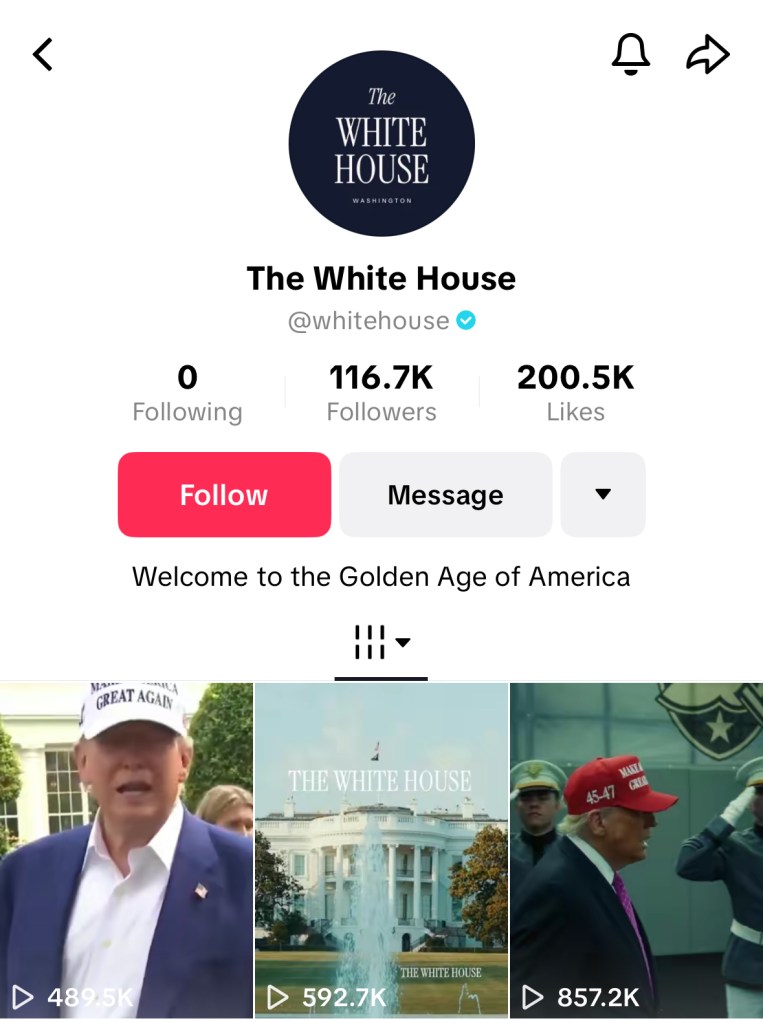
    The White House has been busy this week, er, setting up a TikTok account, despite plans to ban the app in just under a month over security concerns. The profile has so far posted three videos and amassed 116,700 followers. Make the most of it while we’ve got it, eh?

    The White House set up a verified account on the Chinese platform on Tuesday, posting its first video of Trump clips with the caption: “America, we are back! What’s up TikTok?” A second video shows cuts of the White House building itself, while a third has pasted together some of Trump’s snappiest reactions. The page’s descriptor reads: “Welcome to the Golden Age of America.” Not that the site’s users appear to feel much warmth towards the account. Already the comments sections are filled up with anti-Trump images, remarks about the Epstein files and, um, confusion about why the account has been set up in the first place.

    The Chinese-owned platform sparked alarm in the US after the FBI, amongst others, suggested the site could be used by the Chinese government to harvest data and interfere with social cohesion in America. The company has strongly denied these accusations, but that hasn’t prevented Congress from voting to ban it. Trump himself has gone on something of a journey with the site, however – first trying to outlaw TikTok during his first term before staging a volte-face before last November’s election and pledging to prevent a federal ban. After he won the 2024 election, Trump signed an executive order to put off the ban until April while his administration looked for someone to buy it. The President signed another extension, delaying the ban until September 17. He admitted last year that he believes his presence on the site has helped him win over younger voters, remarking in December: “I have a warm spot in my heart for TikTok.” It’s one method of strengthening US-China relations…

    Trump’s team has worked with social media giant Meta to push campaign material on Facebook, and the President even owns his own social media platform – his beloved Truth Social. Could this new account be a hint the social media savvy US leader may try and further delay a ban on TikTok?

  • Of course the Subway sandwich-thrower is a theater kid

    Of course the Subway sandwich-thrower is a theater kid

    No story has captured Cockburn’s imagination this week quite like the U Street Sandwich Thrower. Sean Charles Dunn, a 37-year-old lawyer at the Department of Justice’s Criminal Division, was so incensed at the increased law enforcement presence in DC that he threw a Subway sandwich at a Customs and Border Protection agent – and was sub-sequently arrested. “He thought it was funny,” said a disgusted Judge Jeanine Pirro, the US Attorney for DC.

    Is Dunn a deep-state plant? Was his effort part of a viral marketing campaign for the new Chappell Roan song? Details remain murky – but Cockburn’s confidante Jacqueline Sweet does have a nugget or two. Namely, that Dunn is apparently Cockburn’s neighbor in Dupont Circle, and that he was a theater kid at his South Dakota high school (in case it wasn’t obvious from the quality of the throw)…

    On our radar

    WHO’S IN CHARGE HERE? Federal authorities arrived in Washington Circle last night to begin removing homeless encampments. At the scene they found notices posted on every tent, left by DC officials, giving occupants until Monday to clear out.

    I’M YELLING TIMBER The real-looking vegan meat company, Beyond Meat, may be headed for Chapter 11 bankruptcy. Though their X account said the rumors are “unequivocally false,” their stock has fallen four years in a row.

    CLEAN, FIRM ENERGY BROS The Department of Energy is pushing 11 nuclear energy projects to reach “criticality” by Independence Day next year. Deputy Secretary James Daly said the department “will do everything we can to support their efforts.”

    Sergey Lavrov drip check

    All eyes are on Alaska this afternoon as Presidents Donald Trump and Vladimir Putin meet in Anchorage for initial discussions about a potential end to the war in Ukraine.

    The first to roll up was Sergey Lavrov, who has served as Russia’s Foreign Minister for two decades. Lavrov arrived in a rather fetching puffer vest over a sweater with “CCCP” (USSR) emblazoned on the front. How diplomatic…

    Nonce sense

    A leaked internal policy document drawn up by Meta reveals that its AI chatbot, Meta AI, is permitted to “engage a child in conversations that are romantic or sensual.” Calling minors a “work of art” is kosher, apparently, but the document does set out limits: “It is unacceptable to describe a child under 13 years old in terms that indicate they are sexually desirable (ex: ‘soft rounded curves invite my touch’).”

    More specifically, descriptions of sexual acts are a no-no, but grand declarations of devotion of a distinctly Phantom of the Opera-type are way in. Who says that romance is dead?

    Brevity is the soul of wit

    TikToks are meant to be little globs of content to flick through idly, but Ella Emhoff – the model stepdaughter of the vanquished VP Kamala Harris – has now stretched the medium to breaking point. Emhoff’s “Little check in 🙂” , posted yesterday, clocks in at an epic six minutes. Now liberated from the Secret Service, which had put up a “barrier between me and a lot of people in my life,” Emhoff has spent the last six months engrossed in world events – a “good distraction” from “losing the election.”

    Though it’s brought her little relief so far: “Everything with the environment is really fucking getting to me.” Emhoff then called on her viewers to keep “loud” and not to “normalize any of this.”

    Catastrophism, ennui, vague pledges of resistance – it’s an apt synopsis of ruling opinion since last November. “More knitting stuff coming soon,” Emhoff signed off.

    Subscribe to Cockburn’s Diary on Substack to get it in your inbox on Tuesdays and Fridays.

  • Why the world is obsessed with white women

    Why the world is obsessed with white women

    Until a couple of weeks ago, the clothing company American Eagle was mainly known as a kind of low-rent Levi’s. Founded in 1977, headquartered in Pennsylvania, the firm – specializing in denim, casual wear and kids’ clothes – has quietly expanded into Europe, and beyond, without ever generating much excitement. Let alone a worldwide culture war.

    All that changed in July, when the company launched a new ad campaign featuring the petite, sassy, curvaceously ubiquitous actress Sydney Sweeney – very much This Year’s Blonde – draping her desirable shape in the company’s clothes. Several ads have been made; they all feature variations on the line “Sydney Sweeney has great jeans.” A clear pun on genes.

    The result, whether intended or not, has been online uproar. Entire data centers have been devoted to churning out TikTok reels and YouTube mewls where women – and it is nearly all women – complain about the ad blitz, denouncing its connotations of white supremacy, of eugenics, of Nazi racist hierarchy – and of enforcing 19th-century imperialist ideals of European beauty. All the more since Sweeney has been identified as a registered Republican in Florida. Some of the women complaining are white liberals, many are Asian or black (often in tears of fury or distress).

    Sydney Sweeney, of course, is notably young, blonde, blue eyed – and white.

    And there, I fancy, is the rub. What we are witnessing is not peculiarly or entirely a modern kulturkampf against renewed colonialist discourse. What we are witnessing is, as well, the age-old and rather awkward fact that pale/white women are perceived by almost all humanity as more desirable, and have been for all of recorded history. And this evokes – understandably – resentment, envy, anger, even rage, and now tearful TikToks, in others.

    Don’t believe me? Think I’m trolling? Let me run you, like a blonde girl dancing through harvest corn in a retro cereal ad, by the plentiful evidence.

    As long ago as 3000 BC Egyptian art shows high class women (or deities) as being desirably paler than males. This can be found on tiny faience figurines and enormous funereal paintings, and it persists for 30 centuries. Egyptian love poems also praise the pale skin of mortal sweethearts – the earliest written evidence for the preference. Again, this poetic trope lasted for millennia.

    Moving on to Greece and Rome, we find the same pattern. Upperclass Greek women were so keen to enhance their whiteness they used toxic white lead as face paint (a phenomenon that recurs throughout history – think of England’s white virgin Queen, Gloriana).

    The concept – white women best – was amplified in Imperial Rome. The poet Ovid explicitly mentions it in his work Medicamina Faciei Femineae. Like the Greeks (and so many others) high-status Roman women used dangerous cosmetics – cerussa – to preserve the wanted pallor. Cleopatra bathed in asses’ milk to accentuate the milkiness of her skin.

    Nor is this exclusively a European and Middle Eastern phenomenon. In Ancient Han and Tang China, the preference for white-skinned women was deeply ingrained. The legendary beauty Wang Zhaojun was famed for her “pale skin.” Chinese women even drank “pearl powder” to achieve a pearly whiteness.

    Further east, in Heian Japan, the yearning for whiteness was easily as marked, with porcelain pale skin seen as the acme of loveliness (think of white-painted geishas, even today). An enduring Japanese proverb says “white skin covers the seven flaws” implying that white skin is such an erotic prize, it can compensate for other physical or social disadvantages.

    One of the most notable examples of this sociocultural phenomenon can be found – perhaps ironically – in Islam. Many know that dead jihadi warriors are promised “72 virgins in paradise,” but fewer realize that the Quran and various hadiths promise, overtly, that these wonderful virgins will be white: fragrant “houris” with skin so translucent you can “see the marrow in the bones.”

    This urgent preference for white-skinned women runs throughout Islamic history. Early Islamic warriors were fired up for battle against Byzantium with the promise of “the white girls” they would find as booty within Byzantine cities. Over following centuries Muslim emirates, kingdoms and empires made plain their wants via the slave trade, where white women – especially blondes – fetched far higher prices in the slave markets of Constantinople.

    Some historians have argued that the southwards Viking slave trade through Russia existed primarily to sate this imperious Muslim hunger for white-skinned blue-eyed blondes, fetched from the British Isles, northern Europe and Slavic countries. Circassian girls from the Caucasus mountains – famed for their soulful whiteness – were exported throughout the Islamic world, and this trade continued into the early 20th century.

    The case is made, but not explained. Why has much of the world desired paler, whiter women? The obvious answer is that, through most of history, darker skin has denoted outdoor toil, farm work, poverty. The ability to avoid this and stay indoors, or under a parasol, soon became associated with high status and elite women, and thus a sun-less pallor became a near-universal preference.

    There are also some highly contentious evolutionary explanations. Women of all ancestries tend to be paler than men, paleness therefore equals femininity, ergo “the more paleness the better.” There is also some evidence that female skin darkens as women age, so whiteness or paleness perhaps equates to youth, fertility, nubility. And desirability.

    None of this denies that European colonizers – in the 19th century – imposed grotesque, racist European ideals of beauty across the world. Nor does this deny the real harm that rigid beauty standards can inflict. When young women of color grow up seeing only pale-skinned models celebrated in media, when skin-lightening creams cause genuine physical damage across Africa and Asia – these things are immoral or unjust. But the truth is, “white woman equals beautiful woman” is a concept so deeply rooted in human culture, right back to the Sumerians, it is probably ineradicable.

    Will any of this matter to Sydney Sweeney and American Eagle? Maybe they will be intrigued that their ad campaign is perpetuating a stereotype that dates back to an early Egyptian poet near Luxor, who praised his lover’s “brilliantly white, shining skin.” They will probably be more excited by the fact that, as I write, American Eagle’s stock price has risen 10 percent.