Tag: Ukraine war

  • How much of a say does Zelensky still have?

    Over 1,265 days of full-scale war, Volodymyr Zelensky has delivered almost as many nightly addresses to the nation. Only a handful have been truly decisive. There was one just hours before the invasion when he asked, “Do the Russians want war?” and vowed that Ukraine would defend itself. The next day, standing outside his office in Kyiv with his top officials, he told the world: “I’m here. We’re all here.” And last weekend, when he declared that Ukraine would not surrender its land to the occupier – and that the war must end with a just peace:

    “[Putin’s] only card is the ability to kill, and he is trying to sell the cessation of killings at the highest possible price. It is important that this does not mislead anyone. What is needed is not a pause in the killings, but a real, lasting peace. Not a ceasefire sometime in the future – months from now – but immediately. President Trump told me so, and I fully support it.”

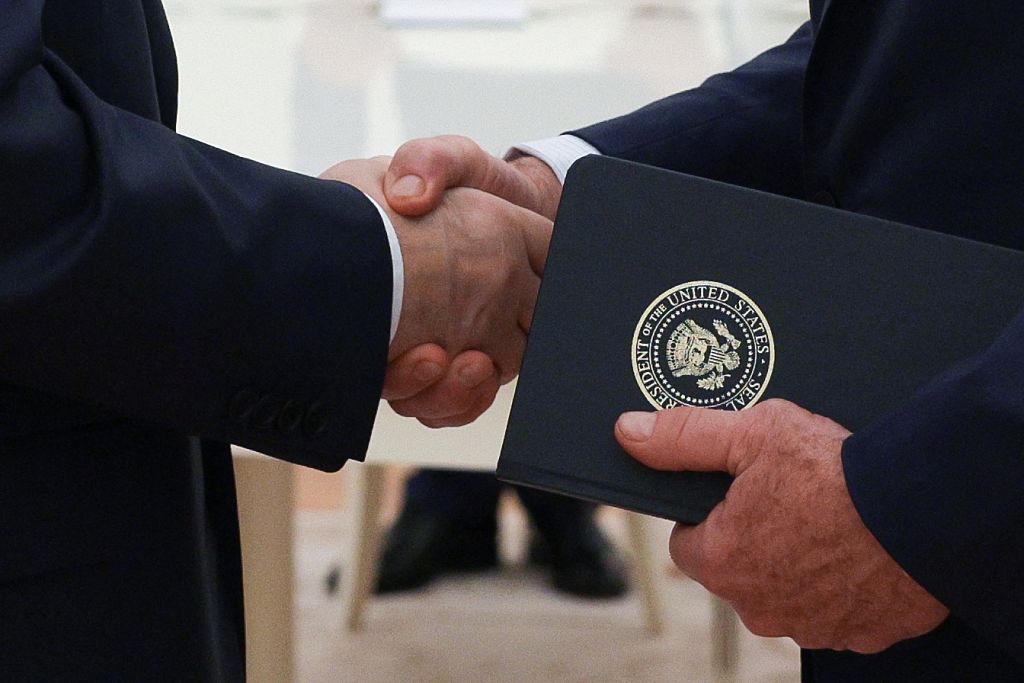
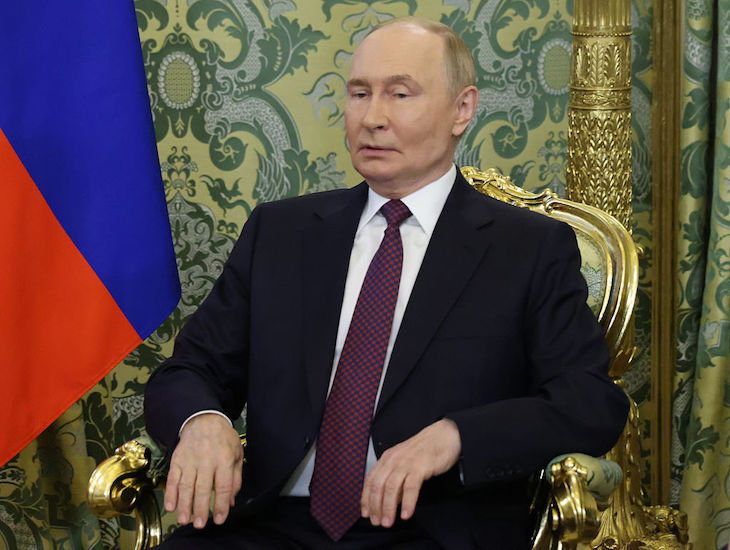
    Zelensky has felt blindsided by Donald Trump’s decision to meet Vladimir Putin in Alaska this Friday to discuss Ukraine’s fate without Ukraine present. Putin has reportedly proposed a ceasefire – not an end to the war, but a temporary halt ahead of the next stage of talks – in exchange for Ukrainian territory. Ukrainian forces would have to withdraw from the entirety of the Donetsk region, leaving the 2,500 square miles – about a quarter of the region – that they still hold. 

    This includes fortress cities such as Pokrovsk, Kramatorsk and Sloviansk, the strongholds Russia can’t seize quickly. The Institute for the Study of War notes that while the Russian push towards Pokrovsk has picked up speed in recent weeks, Moscow has spent the last 18 months fighting for an area of just ten square miles. It took 26 months for Russian forces to advance seven miles from western Bakhmut to western Chasiv Yar. This battle began in April last year and ended only last week, with Russia bearing immense losses. Since January only, Putin has lost 100,000 troops, according to Nato chief Mark Rutte. 

    Accepting Putin’s offer would strip Ukraine of its main defensive line at the western edge of the Donetsk region, which it has fortified since 2014, leaving only open fields all the way to the Dnipro river. That is why Zelensky insists that any discussion of territory can only happen after the guns fall silent. The idea of Russia pulling back from parts of the Kherson and Zaporizhzhia regions in exchange for Donbas has been floated before, and this land swap could be agreed de facto but not de jure. But even that seems to be a fantasy at the moment, given that Putin will not give up his land corridor to Crimea, and Zelensky will not hand over hundreds of thousands of Ukrainians still living in the part of the Donetsk region under Kyiv’s control – people who oppose their homes being ceded to Russia.

    Zelensky insists that any discussion of territory can only happen after the guns fall silent

    Kyiv’s stance was backed this week in a joint statement by European leaders, whom Zelensky has been calling to forge a united negotiating position to present to Trump before Alaska. “Meaningful negotiations can only take place in the context of a ceasefire or reduction of hostilities,” it read. “We remain committed to the principle that international borders must not be changed by force. The current line of contact should be the starting point of negotiations.”

    With Europe behind him, Zelensky tried to appeal to Trump on Saturday. In his speech, Zelensky reminded the American president that Ukraine had backed all of Trump’s earlier proposals, including an unconditional ceasefire and talks with the Russians in Istanbul, even while Moscow stalled and bombed Ukrainian cities. No one, Zelensky said, doubts America’s power to end the war. The mere threat of secondary sanctions on Russia and its allies had been enough to drag Putin out of his bunker and into negotiations. “The President of the United States has the leverage and the determination,” Zelensky said, leaving hanging the question of why Trump is not using them.

    Ukrainians have seen where appeasing an aggressor leads. Putin was allowed to take Crimea, and that led to the occupation of parts of the Donetsk and Luhansk regions. No punishment followed when he massed over 100,000 troops on Ukraine’s borders – and that led to the full-scale war, further occupation and hundreds of thousands of deaths. 

    “Putin wants to exchange a pause in the war, in the killings, for the legalization of the occupation of our land,” Zelensky warned. “We will not allow this second attempt to partition Ukraine. Knowing Russia, where there is a second, there will be a third. That is why we stand firm on clear Ukrainian positions.”

    Finally, Zelensky turned to the Ukrainian people, many of whom were protesting outside his office just two weeks ago after the government attacked anti-corruption agencies, to thank them for standing with him. A new poll from the Kyiv International Institute of Sociology shows 76 per cent strongly oppose Russia’s proposed peace deal. If even half were in favour of peace at any price, Zelensky might have been tempted to respond differently to Putin’s offer. But as Ukrainians are afraid that without cast-iron security guarantees, Russia will start the war again, they expect their president to fight for a lasting peace. 

    “Independence is built on dignity,” Zelensky said. “Fear and concessions do not make nations safe. Russia’s desire to rule over Ukrainian territory will remain just that – a desire – for as long as Ukrainians stand shoulder to shoulder, helping the army and the state.”
  • Tariffs and the psychodrama of Trump diplomacy

    Tariffs and the psychodrama of Trump diplomacy

    A bleached white conference room, somewhere near Jeddah in Saudi Arabia. On one side sits Volodymyr Zelensky, the Ukrainian leader, in his soldier-boy outfit. On the other, Russian President Vladimir Putin in dark suit and tie. And in the middle, a beaming President Donald J. Trump. “People said this could never happen,” he says, as Zelensky and Putin stare awkwardly at the floor. “But it’s a beautiful thing.” A White House memo lands in inboxes across the world: “THE PEACEMAKER-IN-CHIEF…”

    Pure fantasy, perhaps, but Trump does have an almost cosmic ability to get what he wants – and he really wants to end the war in Ukraine.

    Last night, having spent weeks telling the world how “disappointed” he was with Putin, Trump abruptly announced “great progress” in US-Russia dialogue. His special envoy, Steve Witkoff, had just spent several hours talking to Putin in Moscow, and it promptly emerged that Trump and Putin could meet as early as next week for a preliminary sit-down ahead of a possible three-way session between Trump, Putin and Zelensky. Putin and Trump have not met since their infamous encounter in Helsinki in 2018 and, then as now, European leaders will be very nervous about the two men getting on. On the other hand, as Trump has always said, he just wants “people to stop dying.” And if he can achieve a meaningful peace deal in Ukraine, he should perhaps be rewarded with the Nobel Peace Prize that everyone says he craves.

    Call it the psychodrama – not madman – theory of international relations. The personal is political and, as we’ve seen with Kim Jong-un, Emmanuel Macron, Zelensky and now Putin, Trump likes falling out and making up with world leaders. It makes for great headlines, plus the emotional rollercoaster helps advance his agenda because statesmen have to worry about what’s in the news.

    The difficulty is that Putin is an exceptionally cold fish who doesn’t care about being hated outside of Mother Russia. The reason earlier peace initiatives failed is that Putin is not losing the war. Putin could “tap,” as Trump put it, America along because, having largely frozen Russia out of the international community, the West doesn’t have much clout over him.

    Trump understands the concept of leverage, which is why last month he agreed to provide new arms to Ukraine. That didn’t seem to intimidate Russia, so Trump also targeted India, the leading buyer of Russian seaborne crude oil, with punishment tariffs. And he ostentatiously dispatched two nuclear submarines towards Russia at the weekend.

    The India tariffs, in particular, appear to have brought the Kremlin back towards the peace table. But who is playing whom? It’s possible that Putin believes Trump’s trade aggression is pushing America’s rivals closer together, which is very much in Russia’s interest. The Kremlin has long believed that America’s hegemony is waning and that, while Trump’s theatrics might dazzle the world, in the long run the BRICS (Brazil, Russia, India, China and South Africa) are in the ascendancy. India’s Prime Minister Narendra Modi, for instance, shows no sign of breaking off trade relations with Russia in the face of Trump’s threats.

    “IT’S MIDNIGHT!!!” Trump barked on Truth Social at 11:58 p.m. ET last night, as his latest tariff program kicked into effect. “BILLIONS OF DOLLARS IN TARIFFS ARE NOW FLOWING INTO THE UNITED STATES OF AMERICA!”

    If only things were that simple. It’s no coincidence that Trump’s most punitive duties are now being imposed on India, Brazil and South Africa (the China and Russia tariff deadlines are upcoming). The White House believes that America still has enough financial muscle to disrupt the BRICS and play them off against each other.

    But, similar to Canada and Europe, the BRICS countries regard America as an increasingly unreliable mercantile power. The biggest downside to Trump’s tariffs, then, may turn out to be geo-strategic rather than economic – as a brave, new multipolar world increasingly tries to get along without America. Politics is personal. And the psychodrama is exhausting, after all.

  • Putin’s economic alchemy begins to tarnish

    Putin’s economic alchemy begins to tarnish

    The Kremlin’s accountants are having a problem: Russia’s state budget, once the engine of spectacular growth, is now flashing red. The mathematics are brutal. Russia’s fiscal deficit has ballooned to 3.7 trillion rubles in June – roughly $46 billion – skating perilously close to this year’s legal limit. As a share of GDP, the deficit threatens to breach the 1.7 percent ceiling, a prospect that has Valentina Matviyenko, speaker of the Federation Council, preaching the gospel of “strict savings” with all the enthusiasm of a Victorian governess.

    The root of Moscow’s monetary malaise lies in spectacular overoptimism. Last September, officials confidently predicted a 2025 deficit of just 0.5 percent of GDP, banking on Brent crude at $66 per barrel, robust 2.6 percent growth, and a conveniently weak ruble at 100 to the dollar. Instead, they’ve watched their projections crumble fast.

    The transformation of a petro-state into a war economy was supposed to demonstrate Russian resilience

    In the first half of the year, oil and gas revenues, which fund more than a quarter of the Russian state, have collapsed by 17 percent compared to last year and 25 percent below projections. The market consensus for next year’s Brent prices hovers between $55 and $65 per barrel, below the government’s projections. Meanwhile, an unexpectedly strong ruble means fewer rubles per exported barrel, creating the peculiar problem of being too successful at currency strength.

    The broader economy tells an equally grim tale. Growth has plummeted from a respectable 4.3 percent in 2024 to 1.4 percent in the first quarter of this year, with the Central Bank now forecasting sub-1.5 percent growth for 2025. Lower growth translates to reduced VAT and income tax receipts, creating a vicious cycle that would make even Gordon Brown wince. Lower growth also means lower GDP, and with nominal fiscal deficit rising monthly, the 1.7 percent legal threshold for this year’s deficit to GDP ratio has all the chances to be blown.

    Putin’s bookkeepers face a difficult problem. The president promised not to raise taxes, ruled out meaningful currency devaluation (which would stoke inflation and increase government costs), and ringfenced defense, security and social spending. What remains is a game of fiscal Jenga where removing the wrong piece brings down the entire structure.

    Defense spending alone accounts for roughly $172 billion – 7.7 percent of GDP – with little prospect of meaningful reduction. The stockpiles of Soviet weaponry that initially sustained the Ukraine campaign are running dangerously low, forcing expensive rearmament. The Kremlin has convinced itself that military production must remain the economy’s primary driver, a strategy worthy of Stalin planners’ applause, but expensive for the state finances.

    With limited options, the government would be passing the fiscal burden to business and citizens with the subtlety of a Moscow traffic policeman. Companies face the prospect of losing subsidies while shouldering additional costs for security and social programs: hardly conducive to investment or innovation. Citizens, meanwhile, can expect higher duties on vehicle registration, steeper excise taxes on life’s small pleasures, and increased fines. It’s austerity with Russian characteristics: brutal but presented as a patriotic duty.

    The regime’s fiscal contortions reveal a deeper vulnerability.

    In 2022, when sanctions first bit, Russian businesses and citizens queued cap-in-hand for state assistance, receiving generous help in exchange for war enthusiasm. Now the state coffers are running dry, but the enthusiasm must remain undimmed – dissent being rather more dangerous than bankruptcy in Putin’s Russia.

    Two external threats loom large over this precarious balancing act. Should President Donald Trump make good on threats to throttle Russian oil trade, or should Brussels tighten technological sanctions, Moscow’s fiscal gymnastics could collapse entirely. The Kremlin has thus far managed to fund its war without triggering mass protests, but the margin for error is shrinking.

    Putin’s great gamble – that Russia could outlast Western resolve while maintaining domestic stability – increasingly depends on economic alchemy. The transformation of a petro-state into a war economy was supposed to demonstrate Russian resilience. Instead, it may prove that even autocrats cannot indefinitely defy the laws of arithmetic.