Category: Law

  • There’s no escape from Russiagate

    In June, Tulsi Gabbard found herself in a difficult position. As a dovish Iraq war veteran who happens to be Donald Trump’s Director of National Intelligence, she’d spent weeks trying to stop America launching air strikes against Iran. She’d cited intelligence reports which contradicted Israeli suggestions that Tehran was just days away from having a nuclear bomb. Trump didn’t want to know. “I don’t care what she says,” he told reporters, before ordering the strikes on Iran. Gabbard had been humiliated. Surely she had to resign?

    Nothing is sure in Trumpworld, however, and humiliation is half the fun. Rather than falling out with the Donald, Gabbard instead redoubled her efforts to please him. She set her agencies to work harder digging up evidence about the “Russia hoax” – arguably the political project closest to Trump’s heart.

    She positioned herself at the forefront of a campaign to go after the creepy network of senior Democrats and deep-state operators who in 2016 engaged in what Gabbard calls a “treasonous conspiracy” to smear Trump as a Kremlin asset.

    Gabbard has published a number of previously classified documents suggesting that President Barack Obama, the Hillary Clinton campaign and the Democratic establishment did collude and conspire with the intelligence community as part of a “years-long coup” against a legitimately elected Republican president. This has delighted the Donald. “Where’s Tulsi?” he called out at a White House event. “She’s, like, hotter than everybody. She’s the hottest one in the room.”

    Gabbard’s findings were then passed on to Pam Bondi, another Trump-appointed hottie who has found herself in a tricky spot. As Attorney General, Bondi had talked up the release of the US government’s files on the late child rapist Jeffrey Epstein. But then her Justice Department and the FBI suddenly felt compelled to release a statement insisting there was no “client list” of powerful blackmailed men and Epstein had abused girls purely for his own sick gratification.

    Bondi’s volte-face aroused suspicion worldwide, partly because Donald Trump once had a sort of friendship with Epstein and partly because Team Trump – especially the new FBI director Kash Patel – had spent years suggesting that the real Epstein story was a giant cover-up to protect the pedophilic liberal elite.

    Now, however, Bondi finds herself back on the legal offensive thanks to Tulsi’s efforts on Trump-Russia. This week she ordered a grand jury investigation into the conspiracy to tie Trump to the Kremlin. In other words, Trump’s long-promised “retribution” for the eight years of legal torment he suffered at the hands of the fiercely Democratic establishment in Washington, DC, has formally begun. “Half the lawyers in Washington just went under retainer,” said the legal scholar Jonathan Turley on Monday. “And it seems like the other half are retaining them.”

    Trumpists are celebrating the exposure of what they refer to as “the greatest political crime in American history” – even if the depth of the conspiracy remains hard for most mere mortals to fathom. Trump’s opponents, meanwhile, suggest that the President, Bondi, Gabbard, Patel and others are engaged in a blatant attempt to distract from the Epstein saga. (In a curious twist this week, the Republican House Oversight Committee issued subpoenas to various Department of Justice figures as well as to Bill and Hillary Clinton as part of their Epstein investigation.)

    It is amusing to watch Trump’s appointees bend over backwards in order to keep Daddy happy. But the revival of Russiagate is much more than a mere smokescreen. It has always been a key part of Trump’s plan for his second term. Indeed, Trump appointed Bondi precisely because he trusted her to be more aggressive than his previous attorney generals when it came to the Russia accusations.

    Trump’s inner circle have long believed that revealing the truth about Operation Crossfire Hurricane – the FBI’s investigation into Russian interference in the 2016 election – will in turn expose the whole secret history of the Democratic party’s eight-year lawfare campaign to destroy Trump. It’s all about the weaponization of justice and the Democratic party’s co-opting of intelligence agencies and the media in subsequent scandals. It’s about the Hunter Biden laptop story and the “stolen election” in 2020, as well as the contorted campaign to put Donald Trump behind bars during Joe Biden’s presidency.

    Sources close to Trump suggest that he has softened toward his enemies since he barely dodged an assassin’s bullet last year. His supporters may be crying out for Obama and Hillary Clinton to be criminally prosecuted but Trump seems unlikely to pursue such a path, even if he enjoys posting memes of Barack and Hillary behind bars.

    Yet the legal hounding of Trump did result in several of his associates and advisers serving time in prison. Naturally, then, Trump’s allies are now salivating at the possible indictment and conviction of figures such as John Brennan, the former head of the CIA under Obama, or James Comey, the former FBI director, or James Clapper, the former director of National Intelligence.

    “We’re going to be a banana republic unless we take care of business now,” says Steve Bannon, who also went to jail over a Trump-related charge last year. Bannon has called for “rough, Roman justice” and this week he urged Bondi’s department to “stick the landing” or risk further disgruntlement within the Make America Great Again movement.

    The use of a gymnastics metaphor is apt, since Bondi will have to pull off some impressive legal acrobatics in order to prosecute leading anti-Trump figures without being exposed herself at some point for weaponizing the justice system. Whichever prosecutor she chooses must prove beyond reasonable doubt that Trump’s opponents knowingly attempted to commit treason or some other serious crimes. Her Republican backers, meanwhile, will have to keep saying that the Democrats derailed Trump’s first term with all their judicial wrangling at the same time as the Trump administration sets in motion a course of legal activities that seem certain to clog up his second term. There’s no escape from Russiagate.
  • Jim Acosta’s AI interview is a Black Mirror monster

    Jim Acosta’s AI interview is a Black Mirror monster

    An absolutely ghoulish spectacle unrolled on YouTube yesterday, as disgraced former CNN Trump gadfly Jim Acosta “interviewed” teenager Joaquin Oliver. The problem is that Joaquin Oliver was killed in the Parkland shooting in 2018. This interview took place with an AI simulation of Joaquin. On what would have been Joaquin’s 25th birthday, his father, Manuel Oliver, released this Black Mirror monster into the world. To make matters worse for the AI simulation, it had to talk to Jim Acosta.

    On the one hand, the stream, as of this writing, has barely 6,000 views. The average seven-year-old Roblox streamer does better than that. However, the interview is so deeply disturbing, so bald-facedly manipulative, that it deserves scrutiny. The fact that Acosta thought it worthy of air shows exactly how lost he, and opposition media in general, truly is.

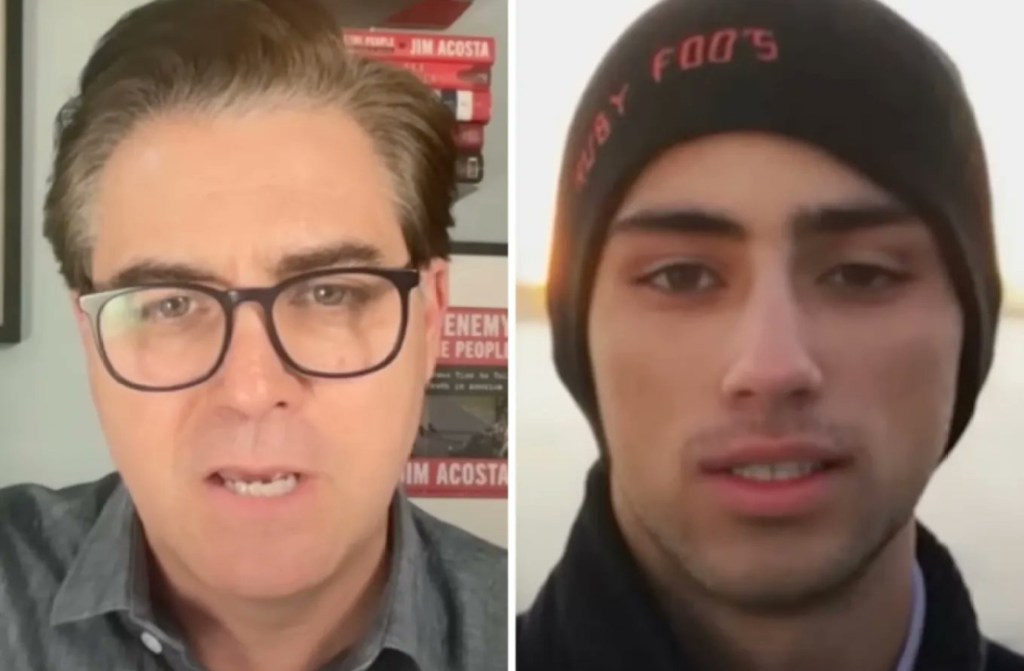
    In a split-screen, Acosta sits on the left, appropriately, with Joaquin on the right, wearing a “Ruby Foo’s” beanie, staring blankly at the camera with a sun-swept uncanny valley in the distance.

    “Joaquin,” Acosta says, “I would like to know what your solution is for gun violence.”

    “Great question,” says Joaquin. “I believe in a mix of stronger gun control laws, mental health and community engagement. We need to create safe spaces for conversations and connections, making sure everyone feels seen and heard. It’s about building a culture of kindness and understanding. What do you think about that?”

    There is no word that avoids cliché. The sentences run together. AI Joaquin sounds like an autistic android.

    “I would like to know more about you,” Acosta says. “Can you tell us about yourself? What did you like to do?”

    Here, Acosta acknowledges that he’s talking to a simulacrum of a dead person. AI Joaquin’s answer is so terrible that it causes a dark blanket of shame to wash across anyone who bears witness to its banality. It’s like staring into a gaping void.

    “I’m all about love, laughter, and living life to the fullest!” it said, lips almost syncing to the words. “I cherish my friends and family and always try to spread joy wherever I go. Though my life was cut short I want to keep inspiring others and advocating for change.”

    “Joaquin,” Acosta says, unsatisfied with this generic answer, keeps pressing. “Like, what’s your favorite sport?”

    “I love basketball, it’s such a fun way to connect with friends and show off some skills plus there’s nothing like the thrill of a good game.”

    As the “conversation” continues, we learn that Acosta likes LeBron James, which is totally disqualifying, and, well, you get the point here. It’s just some of the grossest, saddest, most second-rate content you’ll ever watch. The world was understandably outraged at the video, but its creator, Carlos Oliver, the late Joaquin’s father, isn’t apologizing.

    “An AR-15 stole Joaquin’s life, not artificial intelligence,” he tweeted. “Instead of being infuriated at AI, you should be furious at the gun violence epidemic in the United States.”

    Some people may reflexively balk at AI being used like this, but it’s an inevitable feature of modernity. No one can stop it from happening. And gun violence remains as much a problem now as it was when the Parkland shooting happens. People have every reason to be angry or sad about it, and to fight for change however they best see fit.

    That’s not from whence the criticism of video is emerging. People don’t hate it because of the politics. They hate it because it’s strange. This fake robot teenager talking to Jim Acosta will change nothing.

    Even if Joaquin’s father created the avatar to warn people about gun violence, and even if he’s willingly participating in this spectacle, Jim Acosta is still riding sidesaddle on a family’s seemingly bottomless grief. He’s simultaneously being cheesy, dumb and sinister.

    Gun violence isn’t going to stop because Joaquin Oliver’s after-death AI doppelganger loves life or enjoys the playing style of the Miami Heat. It might even move the needle backward. I can hear AI Joaquin now: “Dad, and Jim Acosta, stop it. You’re embarrassing me.”

  • The Spectator and Douglas Murray win UK defamation claim

    The Spectator and Douglas Murray win UK defamation claim

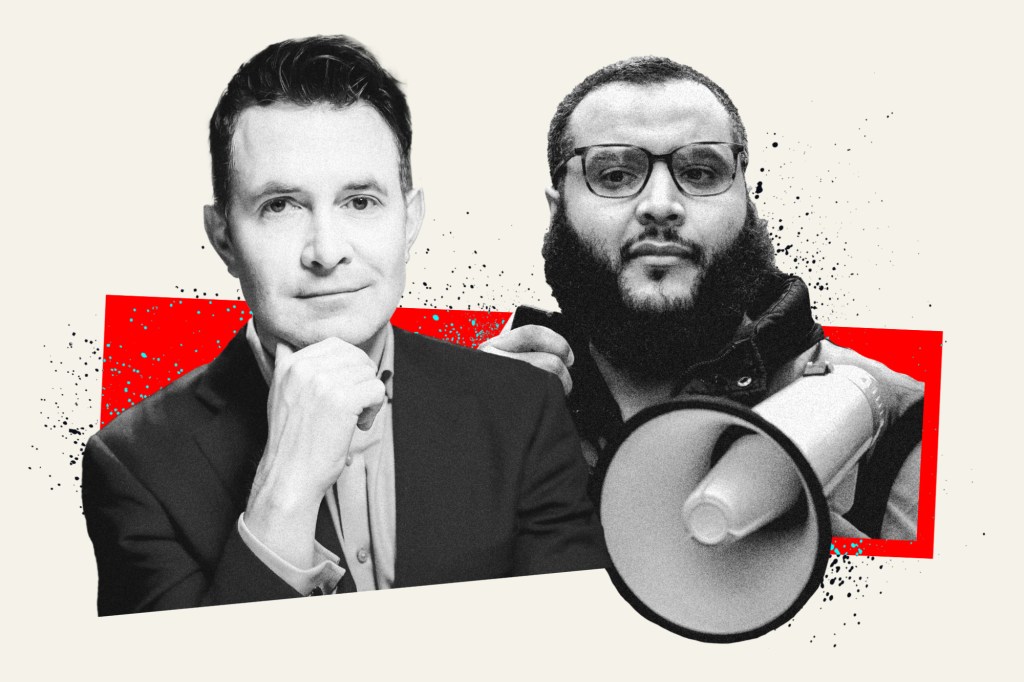
    The Spectator and Douglas Murray have today won a defamation claim brought by Mohammed Hegab, who “lied on significant issues” in court and gave evidence that “overall, is worthless.”

    The judge rejected Hegab’s claim because the videos he publishes are ‘at least as reputationally damaging to him as the article’

    Hegab, a YouTuber who posts under the name Mohammed Hijab, claimed that an article published in September 2022 about the riots in Leicester, England, had caused serious harm to his reputation and loss of earnings as a result. Hegab traveled to Leicester in September 2022 after disturbances between local Muslims and Hindus there had begun, and gave a speech to a group of Muslim men, the majority of them in balaclavas, masks, hoods or caps, in which he said “if they believe in reincarnation, yeah… what a humiliation and pathetic thing for them to be reincarnated into some pathetic weak cowardly people like that.” Hegab said this comment was referring to Hindutva – a Hindu nationalist group – and not Hindus. But it was “substantially true” to say that he was referring to Hindus, a London judge found: “It was them that he was ridiculing.”

    The earnings Hegab claimed to have lost included a £3,500-a-month ($4,600) deal to be a brand ambassador for the charity One Ummah, a £1,500-a-month ($2,000) advertising contract with supplements company Nature’s Blends and £30,000 ($40,000) for a Ramadan fundraising campaign with the charity Salam.

    But messages that he relied on for these claims “have the appearance of being contrived for the purpose of these proceedings,” the judge said. They addressed Hegab formally, despite coming from people who knew him well; they blamed the article; and they “provided material that would be necessary to support a claim for financial losses… when one might not generally expect such detail.” They also arrived at “roughly the same time, which was several weeks after the article, but very shortly before a letter of claim was sent.”

    The judge found that “as a witness [Hegab] was combative and constantly argumentative… arguing his case rather than giving straightforward responses.” He made an “untenable… denial of vigilantism” over his actions in Leicester. He made claims that were “not credible” when he said he was unaware of having given a speech in front of a van displaying images of the Holocaust on another occasion in the north London neighborhood of Golders Green. He also “described the Jewish people he encountered in Golders Green as “Zionists” without any objective basis.”

    The judge rejected Hegab’s claim because the videos he publishes are “at least as reputationally damaging to him as the article” and so “it cannot be inferred that the article caused, or would be likely to cause, additional serious reputational harm.”

  • How to reform judicial review responsibly

    L.W., a transgender girl, her parents, and her doctor agreed that it would be good and medically appropriate for her to receive gender-affirming hormone therapy. The state of Tennessee, where L.W. lived, passed a statute in 2023 prohibiting transgender minors from receiving such treatment. Did the statute discriminate against L.W. on the basis of sex? The US Supreme Court said it didn’t.

    In 2023, the British government planned to send to Rwanda people who tried to get to the United Kingdom on small boats and then seek asylum. Would that policy violate the asylum seekers’ human rights because the conditions in Rwanda were unsafe? The UK Supreme Court said it did.

    Starting after 1945, and accelerating as the 20th century ended, high courts around the world faced questions about whether statutes and executive policies violated constitutional law, human rights, the rule of law, and many other legal doctrines identifying fundamental rights. In the transgender case the US Supreme Court had to decide whether Tennessee’s statute violated a constitutional guarantee of equality; in the Rwanda asylum case the UK Supreme Court had to decide whether the executive policy violated international human rights rules. Polemicists described this as the rise of a “juristocracy”; more neutral observers identified a “global expansion of judicial power.” Polemicists against juristocracy say that courts are taking away our ability to govern ourselves – our ability to choose what we think are the best policies.

    Nearly everyone now believes in some concept of human or natural rights – but these controversies arise because fundamental rights don’t define themselves. What is sex equality? What procedures satisfy requirements of basic fairness? How do we bring the idea of free expression to ground when a legislature regulates today’s social media?

    Two ways forward present themselves, though how they work out in each nation will depend in large measure upon the specifics of legal doctrine and upon the design details of the nation’s institutions. One possibility is for high courts to come up with what its members believe to be the best available specification of the fundamental rights at issue. They are, after all, lawyers trained to be sensitive to legal doctrine and charged with interpreting and applying fundamental rights in cases as they arise. And that’s what our current system of juristocracy is.

    The other possibility is for the high court to defer to the legislature or the executive, who, after all, can claim a democratic warrant for their specification of fundamental rights. Lawyers for the legislature can say, “Our legislators are actually sensitive to the rights-implications of the policies they adopt and the statute that’s before you reflects a reasonable legislative judgment about how important public policies can be pursued without violating fundamental rights.”

    No constitutional system is likely to come up with a stable choice between the two possibilities because each has its weaknesses, which mirror each other. High-court judges might not be sufficiently sensitive to the importance of the public policies in question, though they typically deploy some verbal formulations asserting that they do indeed take those policy questions seriously. 

    Legislators might not be sufficiently sensitive to the rights-implications of their proposals either, though they too typically deploy verbal formulations of their own asserting such sensitivity. Polemicists who admire much of what high courts have done in the years since 1945 say that legislatures too often reflect the passing whims or, even worse, the prejudices of badly informed majorities.

    The rise of right-wing populist leaders and semi- or truly authoritarian leaders has deepened a skepticism about legislative attention to issues of fundamental rights that political observers have long held – and properly so. They fear that legislatures today settle on the policies they want without paying attention to rights issues, then ask their lawyers to come up with post hoc legal arguments that there’s nothing wrong with those policies. Yet, the case for deferring to legislatures has always rested on the proposition that they do indeed pay attention to questions about fundamental rights.

    The core democratic principles that animate constitutional governments counsel in favor of judicial deference to legislative judgments about whether a specific statute conflicts with some fundamental right properly understood. But only if legislatures actually make such judgments. Critics of judges who decide constitutional controversies according to their own best lights should shift attention from the judges to legislatures and parliamentarians, or at least make the case, more clearly than they have so far, that today’s legislatures do a decent job of thinking seriously about the rights-implications of the policies they enact. 

  • The judiciary picks another fight with Trump

    The judiciary picks another fight with Trump

    The second coming of President Trump has brought an invigorated commander-in-chief asserting broad authority over the executive branch, reigniting debate over how much power the president has over his own subordinates, including US Attorneys.

    At present, the battle has focused on one US Attorney in particular. On March 24, 2025, the President named Alina Habba, his former personal attorney, the Interim US Attorney for the District of New Jersey. There’s a catch: Interim US Attorneys may serve only 120 days. On July 1, the President nominated Habba for Senate confirmation as New Jersey’s US Attorney; if confirmed, Habba could have served permanently at the pleasure of the President. Neither of her home state’s senators (both Democrats) supported Habba.

    In the meantime, the clock ran out on Habba’s interim appointment, and under an obscure law found at 28 U.S.C. 546(d), federal judges in New Jersey named her deputy, Desiree Grace, the Acting US Attorney. Acting US Attorneys, who are career prosecutors named for temporary promotions, expect to return to their line jobs at some point. Grace accepted the appointment. But Trump still wants Habba, so his Justice Department, as one would expect, took up the boss’s famous charge to “fight, fight, fight” back. Attorney General Pam Bondi fired Grace, rehired Habba as a deputy, and then promoted Habba to Acting US Attorney while the President’s team pulled her nomination paperwork.

    Skeptics on the left have questioned Habba’s qualifications for the job. Ultimately, if President Trump resubmits her nomination for confirmation, that will be a matter for the Senate to determine. In the meantime, at least one criminal defendant has challenged his indictment in court, claiming Habba lacks the authority to serve as Acting US Attorney.

    If all this sounds incredibly complex – it is, even for lawyers. The kerfuffle over who has the power to appoint US Attorneys, however, is a question of constitutional importance. The Habba scenario may play out across the country as President Trump’s interim US Attorney appointments, including those in Washington, DC, New York and California, are reviewed by the judiciary. This is important because US Attorneys are the chief law-enforcement officers for the districts in which they serve; Habba is essentially President Trump’s top cop when it comes to federal cases in New Jersey in which the US is a party.

    A US Attorney has tremendous authority vested by the Justice Department. She has the power to determine prosecution priorities; direct high-profile cases; manage relationships with other law-enforcement leaders; lead personnel by hiring, firing, and promoting staff; and serve as the public face of the office, including with the press and community. In turn, the Justice Department is a cabinet agency of the executive branch. The department will naturally pursue the priorities of the president, whether that be illegal-alien entry, human trafficking, or white-collar crime. That is, unless a rogue prosecutor turns rebel. So the president has a deep interest in who leads each of the 94 US Attorney Offices across the US and its territories. Promises made to voters about border control, protection from sexual predators, and safeguarding American markets from foreign bad actors, for example, must be promises kept.

    All of this brings us back to the question of who should appoint US Attorneys. Should top federal prosecutors be appointed by the president, acting through the Justice Department, which they serve, or should US Attorneys be named by federal judges, who belong to an entirely separate branch of government?

    As a matter of policy, the answer seems clear. The president must have control over the people executing policies under the authority of departments for which he holds responsibility. Every cabinet agency, including the Department of Justice, answers to the president and should execute his policymaking vision. President Trump and his team have identified a fight worth fighting, and they deserve to win.

    Federal judges have no more business appointing US Attorneys than they do US Marshals, Assistant Attorneys General, or any other members of the executive branch. There is no other comparable context in which the bench has the power to appoint anyone to a separate branch of government. Judges are umpires, not players.

    The law, however, is unsettled at this point. Until the recent New Jersey complaint, no litigant had challenged the ability of the president to appoint temporary US Attorneys. Unless Congress revisits the thicket of legislation that created this chaos, Alina Habba’s fate as US Attorney someday may be decided by the Supreme Court.

  • Trump unleashes the evangelists

    Trump unleashes the evangelists

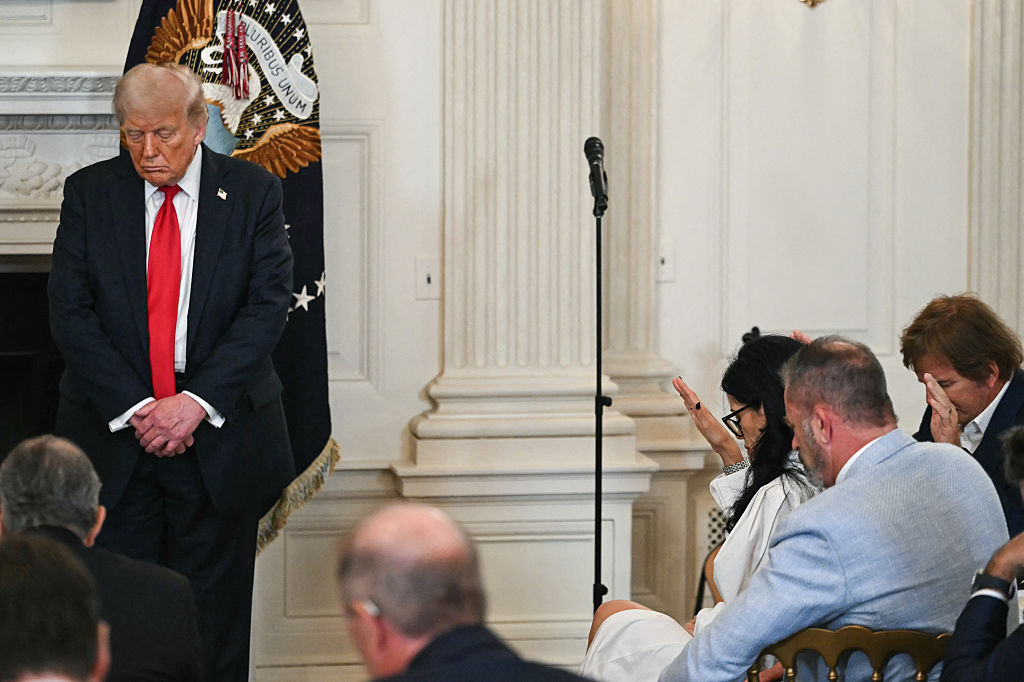
    The Trump administration issued a memo Monday saying that federal workers are openly allowed to express religious beliefs in the workplace “to the greatest extent possible unless such expression would impose an undue hardship on business operations.” This means that they can display Bibles, religious artwork and items “such as crosses, crucifixes and mezuzah,” among other religious symbols.

    But that’s not all. Workers are also allowed to talk about how their own faith is “correct” and how others should “re-think” their beliefs. “During a break, an employee may engage another in polite discussion of why his faith is correct and why the nonadherent should re-think his religious beliefs. However, if the nonadherent requests such attempts to stop, the employee should honor the request,” says the memo. “An employee may invite another to worship at her church despite being belonging to a different faith.”

    On the one hand, freedom of worship is a fundamental pillar of the US Constitution, alongside freedom of speech, freedom of assembly, and freedom do what you want, any old time. But let’s also be clear what this is really about. Hint: It’s not Scientology.

    Despite the mention of “mezuzah,” this order isn’t about Judaism, either. If Jews proselytized in the workplace, or anywhere, there would be a lot more of us in the world, and the kinds of Jews who do seek converts generally aren’t working in federal office buildings. Maybe the administration’s definition of “highly-qualified employees of faith” include Hindu and Muslim employees, but they would be a distinct minority. Mormons love converting people, but they have a well-oiled youth-preaching machine already in place. You’re not going to be hearing, “Hello, my name is Elder Undersecretary at the Department of Agriculture, and I am here to tell you about the most amazing book.” 

    No, this is a purely evangelical Christian play, to go along with a recent White House order about anti-Christian bias in the government, a problem that, institutionally, simply doesn’t exist. Many of the US’s early settlers were Christian dissidents. We’re a place where all different faiths can live in peace. That’s because religious tolerance is baked into the founding documents. But so is separation of church and state, which this memorandum takes a major step toward eroding. There is already a preponderance of Christians in the nation, and, we can assume, in the government. Why do they need to talk about their religious beliefs at work?

    Without a doubt, this memorandum is all part of a larger push about spreading the good news. How, precisely, do you define the “break” during which an employee is entitled to discuss these matters? Is it a lunch break? A coffee break? A bathroom break? Are emboldened, federally employed Promise Keepers going to start sliding pamphlets under the bathroom stall or handing them out in the lunch line? The memo allows uninterested parties to reject the offerings but also allows for the faithful to keep the full-court press going.

    Religion should be a private affair, or at least a family and neighborhood affair. It doesn’t belong in the workplace, unless that workplace is a house of worship or at least a business affiliated with a denomination. The idea that Christians are a persecuted class in the USA is absurd. This isn’t Syria or Lebanon. There are as many churches lining our highways as there are self-storage units and combination Pizza Hut and Taco Bells.

    In his first term, Trump largely kept the evangelical portion of his base at bay. But he’s much more in tune with their needs and interests since the assassination attempt in Butler, Pennsylvania. He truly believes God saved his life that day. And, who knows? Maybe God did. When he bombed Iran, Trump wanted to thank everyone, “but, in particular, God.”

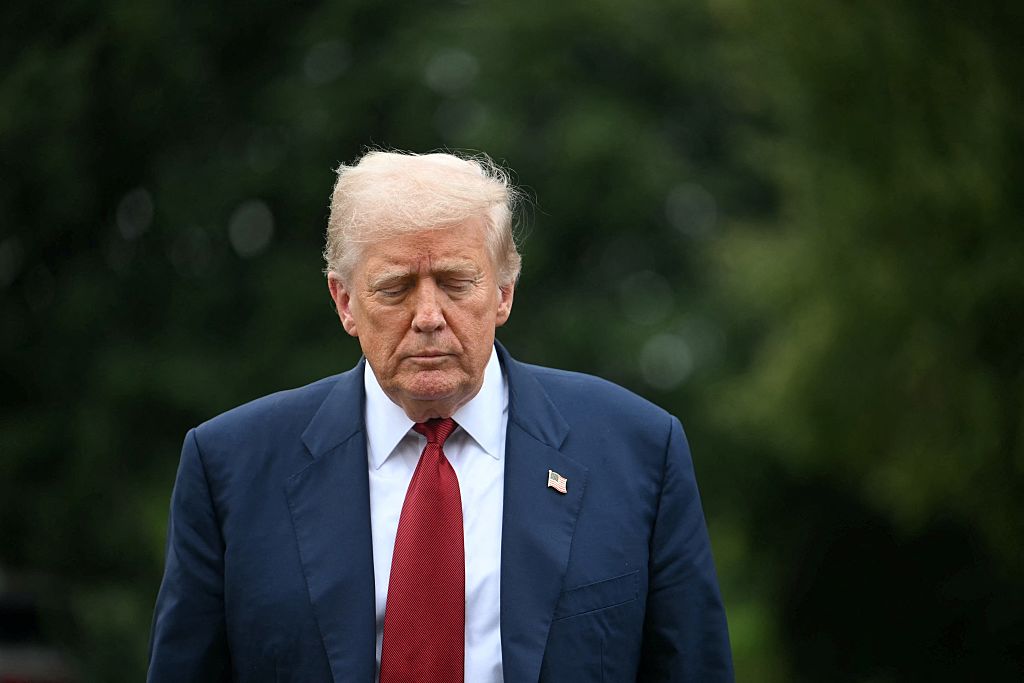
    That was Trump’s basically harmless way of adding a little juice to “God bless America.” But if God is really blessing America, we don’t need people telling us that at work. It should be implied. Instead, federal employees, whether they want to or not, are going to have to hear that He Is Risen, even if they’re only trying to grab a snack from the vending machine.