“I have a good memory, so I can remember things, which is very fortunate,” a tuxedo-clad President Trump said on the red carpet before hosting the Kennedy Center Honors. “But just, I wanted to just be myself. You have to be yourself.”
To open the show, Trump stood behind the presidential lectern and invoked the name of Johnny Carson, who, he said, was a master improviser like him. Trump hadn’t prepared much. He didn’t need to. “This is the first time a president of the United States has ever hosted the event. I don’t know why.”
It’s actually kind of an interesting question. Ronald Reagan, of course, would have made an excellent Kennedy Center honors host. Both Bill Clinton and Barack Obama enjoyed a stage and an audience in their primetime years, and George W. Bush could have smirked his way through some one-liners and artist introductions. Other presidents would have been awful: imagine Gerald Ford, Jimmy Carter or George H.W. Bush trying to host an awards show. We all know Joe Biden couldn’t have done the job. “They tried to get Biden to do this four years in a row,” Trump said on Sunday night. “I would have watched.”
But for Trump, who, more than anyone ever, loves being president, hosting a show like this is his final form. He appeared on stage three times: at the beginning, at the end and before the intermission. The show also included segments, taped from the White House, where Trump introduced the individual honorees. “This is fantastic, isn’t it?” Trump said after the intermission. “It is just so incredible… This is the greatest evening in the history of the Kennedy Center. Not even a contest. There has never been anything like it. The show is already getting rave reviews. I guarantee you the fake news will say he was horrible as an emcee.”
The fake news has said no such thing yet, but that’s partly because only a handful of fake news reporters were present on Sunday night. The actual ceremony will air on CBS and Paramount+ on December 23. This broadcast will ruin the Christmases of the types of people who like to warn us on social media that democracy is in danger.
Trump referred to the building as the “Trump-Kennedy Center,” and, after an awkward response to that comment, said, “I’m sorry. This is terribly embarrassing.”
“Well, we’re really having a good time tonight,” he continued. “So many people I know in this audience. Some good. Some bad. Some I truly love and respect. Some I just hate.”
By now, we all know the somewhat odd list of honorees by heart: Sylvester Stallone, Michael Crawford, George Strait, Gloria Gaynor and KISS. Anyone who had “President Donald Trump honors KISS at the Kennedy Center” on their bingo card 40 years ago would have gotten a one-way ticket to Bellevue. But here we are.
America is back, Trump said, invoking the name of a disco queen whose biggest hit came 45 years ago. “Stallone said it strongly in the movie. It’s all about winning, if you move forward that’s how winning is done. The winners are exactly what these great legends are about. They also know how to go through hell.” The honorees, he said, are “giants” in their genres. “Many of you are horrible, miserable people but you never give up.”
The show closed with Cheap Trick performing a cover of KISS’s “Rock and Roll All Nite” that had the audience on its feet, and Trump, presumably, doing the Trump Dance. “They probably don’t like me very much,” Trump said. “But we don’t care. We want bigness. We don’t care if they like Trump or not.”
There are two competing ideas going around about “the old days” of journalism. In one, journalism was a sober public service, safeguarded by editors and ethics, untainted by the capital-A, capital-E Attention Economy. In the other, it was a racist, sexist boys’ club we managed to leave behind – even if only briefly, for long enough to support Teen Vogue’s politics vertical. (May they rest in peace.)
The current pile-on concerning celebrity reporter Olivia Nuzzi, whose ex Ryan Lizza has revealed her affair with Robert F. Kennedy Jr., leans hard on the first fantasy. Once there were newsrooms; now there are “personal brands.” Once we had Walter Cronkite and Edward R. Murrow; now there is a woman in a Lana Del Rey cosplay Mustang with 1990s porn-star brows.
Colby Hall’s viral Mediaite column makes this case – journalism has all but collapsed under the weight of the internet’s vampiric demand for entertainment. For Hall, Nuzzi’s affair with RFK Jr. and the subsequent comeback tour represent everything wrong with modern media. It is a broken system that spent “years” – years, not decades – rewarding personality over substance. It is influencing by another name.
Hall is right that something has been lost – fact-checking, rigor, objectivity, preparation, craft – I’ve made the argument myself. But he is wrong that journalism has ever been free of its Nuzzis. The “celebrity reporter who is also the scandal” is not a creature of the digital age. She – though, historically, more often he – is at least a century old. One might imagine the celebrity star reporter was born in tandem with the newspaper.
In the 1800s, Joseph Pulitzer’s New York World and William Randolph Hearst’s Journal didn’t run “objective” institutional prose. They aggressively promoted voicy “star reporters” with huge bylines and promotional campaigns that would make a modern publicist blush. All that to say, the reporter wasn’t a medium for transparency and facts; the reporter was the product.
Nellie Bly became a household name at the World for going undercover in a mental asylum – it was genuine reform journalism that also happened to be a sensation. But her most famous exploit was racing around the world in 72 days, beating the fictional Phileas Fogg’s record. The World turned it into a national event – a spectacle – complete with a reader contest. The stunt had no news value. It was entertainment. Its entire premise was that the reporter herself was the story.
Richard Harding Davis, only ten years later in the 1890s, offers an even starker example. Davis was famous for his war correspondence, yes, but equally famous for his good looks and romantic entanglements. Charles Dana Gibson literally used him as the model for the “Gibson Man.” Publishers marketed him, not his reporting – though that may have, incidentally, been valuable. But it was his face that sold papers. By the 1930s, Walter Winchell had perfected the form. His gossip column and radio show reached tens of millions; he could make or break careers, shape elections. Winchell was notorious for his personal life – feuds, an affair. He operated at exactly the nexus we’re told is new: tabloid sex, political intrigue and the journalist as main character.
Wasn’t there a period when professionalism held? Cronkite, Murrow? Sort of. The norms we treat as timeless were largely innovations of the early 20th century, emerging for commercial reasons as much as ethical ones. The Associated Press needed to sell copy to papers of different political persuasions, so it developed a style that could offend no one. “Objectivity” was a business model before it was a philosophy.
Even at its peak, the professional era was messier than nostalgia allows. James Reston of the New York Times was celebrated as the greatest Washington correspondent of the mid-century: “America’s conscience.” He was also a conduit for official leaks, so embedded with his sources that he would run stories by them before publication.
The access journalism Colby Hall decries wasn’t an aberration from the golden age. It was the golden age’s operating procedure. Then came “new journalism”: Wolfe, Didion, Thompson, Mailer, Talese. They wrote brilliantly, but their work placed the self at the center of the story. Thompson covering the 1972 election was a drug-addled performance piece – though an insightful, well-written one. Mailer literally stabbed his wife. Talese had a very public affair while writing Thy Neighbor’s Wife. Nuzzi’s specific transgressions are her own. But the intensity of the reaction, the suggestion that her entire career was somehow fraudulent, misses the point. This is what it has always meant to play the gonzo game. The system that produced Nuzzi has been with us since the 1890s and so “fixing” journalism isn’t as simple as finger-wagging.
So what has eroded? Because I agree Hall’s right, and it’s significant. But it’s not the impulse toward celebrity or self-promotion. Those are as old as the penny press. It’s the production of any real news at all – particularly vital local news stories. Newsroom employment has fallen by a quarter since 2008. The profession that once offered careers now offers gigs. Young reporters are told building a personal brand is essential to their survival, because the institutions can no longer protect them. The people investigating corruption or reporting the important news of the day aren’t usually the celebrities. Hall’s golden age had room for both, and occasionally for someone who could do both. Today we only offer success to one type. And it turns out that success is brittle.
Nuzzi may have done real harm. She violated real ethical boundaries. She destroyed the sanctity of several marriages and her own relationships. She lit her own credibility on fire. But she didn’t invent the game she’s playing.
This article was originally published in The Spectator’s December 8, 2025 World edition.
I should begin by making something clear. Splicing together two parts of a speech to give the impression they were one unbroken excerpt is a grave professional error, and would be viewed as such by any broadcaster in the business. The error would be egregious even if there were no suggestion it reinforced the accusation that Donald Trump was inciting riotous behavior, simply because what viewers thought they witnessed did not occur. There is no excusing what the BBC did to Donald Trump’s January 6, 2021 speech.
Nobody in the senior ranks of the BBC is to blame for not knowing about this at the time; but once it did become known, an immediate and unconditional apology should have been made. Crisply and severely dealt with, the story could have been contained, and it’s for their failure to get on the front foot after a bad mistake that the Corporation has deserved censure. Please, therefore, do not think me an apologist either for misconduct in the making of the Panorama program, or for the BBC’s handling of the scandal.
But about the effect in practice of this splicing, I’m less sure. I’ve read verbatim the entire speech. It’s peppered with the imagery of battle. “Fight,” “fighting” etc occur throughout, and though the combative language may have been used metaphorically, the effect of the repetition is undoubtedly to stiffen the sinews and summon up the blood. Though Trump did once (and only once) tell the crowd they were going “to peacefully and patriotically” protest, the violence of his language all through the speech, and his repeated suggestion that America itself was under attack and his and the crowd’s mission was to “save” the country – along with sentences like “We fight like hell! And if you don’t fight like hell you’re not going to have a country any more!” – can plausibly be interpreted as being calculated (in the legal sense of the word) to inflame the marchers. His later urging of his supporters to “remain peaceful” could equally be interpreted as implicit recognition that he had started a riot.
I do not myself believe that Trump had a plan to provoke violence, but I do suspect he was careless whether he had that effect. I think too that, on the evidence, the accusation that he did know what he was doing would be fair comment on a matter of intense public interest.
That, presumably, was the argument Panorama were rehearsing, and entitled to rehearse. And in doing so by splicing, they fell into a type of self-justification that does not infect the BBC alone but can be encountered everywhere in the media – though notably less in newspapers than the audiovisual media.
Are you familiar with the word “truthiness?” The expression (I read) was invented by Stephen Colbert in The Colbert Report 20 years ago. He was making fun of media professionals who justify the purveying of untruths by explaining that if the purpose of journalism is to reveal a greater truth, then we may deploy a degree of artifice in our methods. If it feels true, if it conveys a truth without being itself literally true, then never mind the absolute truth: it has truthiness.
Despicable? Do not imagine that the pursuit of truth through truthiness always feels outrageously wrong. Let me give you the most anodyne of examples, employed by the closest we have in Britain to a television saint: David Attenborough. Sir David once told me that, in a TV sequence showing reindeer migrating across snowfields in Lapland, long-lens cameras were used to zoom in on the herd from a considerable distance. Viewers would be able to see the reindeer close up. No problem with that. But if they were to be seen close up, viewers would expect to hear them close up too. For this, Sir David confided, dry custard powder and a pestle and mortar did the trick wonderfully. The sound, being almost indistinguishable from the real thing, had truthiness.
I find it hard to get indignant about that. But this is a slippery slope. Attenborough had been criticized for taking us, his viewers, into a snow tunnel to see a baby polar bear nurtured by its mother. Well, mother polar bears do nurture baby bears in tunnels in the snow. But in the arctic, how would you get a camera in to capture the scene? So the program used a constructed maternal scene, viewed through a glass panel in a Dutch zoo, while Attenborough talked about the wild, which viewers thought they were seeing. I feel uncomfortable about this, but I reckon (and TV professionals reckon) most viewers would be fairly relaxed about not being told. The bear nursery we saw had truthiness.
During the last century, in the depth of John Major’s troubles as Britain’s prime minister, the news media started using a photograph of him, head sunk in his hands. Sir John has told me he was in fact bored, and shielding his eyes from the lights while attempting a limerick on a notepad beneath the desktop. So the image’s implication was false. But it had truthiness.
Down the slippery slope we go, until we reach Trump in that Save America speech. Its effect was incendiary: to inflame his roaring crowd of supporters (“We love you! We love you!”) they kept chanting. I’d submit that there was nothing dishonest about a documentary arguing that Trump was whipping his supporters into a riotous mood. That is believed by many. And he did shout: “We’re gonna walk down to the Capitol… and I’ll be there with you.” And then at another point in his speech he did shout: “And we fight! We fight like hell!” And if run together, you do get the impression he was at the very least careless about what he was starting. And if that is what the program–makers were arguing in good faith, then to them the splicing had truthiness. I too find the possibility truthy. But beware of that innocent-looking little y.
When Anna Wintour announced she was stepping down as editor-in-chief of Vogue in June, it appeared to be the end of the ice queen’s reign. Yet Wintour retained her large, chintzy corner office as well as her two other roles – as Condé Nast’s global chief content officer and Vogue’s global editorial director.
If you looked closely, you might have seen a steely determination lurking behind her trademark sunglasses, the look of a generational editor intent on more power – and perhaps even revenge.
The Condé Nast Union naively regarded Wintour’s move as that of a then 75-year-old drifting into quiet retirement, the old guard surrendering to youth. The union, formed in 2022 and seemingly run by the most radical young left-wing journalists in the company, has quickly grown in power and influence. But various Condé Nasties have informed The Spectator that the union has become a parasite which threatens to consume its host.
When Wintour decided to close down Teen Vogue by folding it into Vogue.com – officially to consolidate resources – it was no surprise that a dozen angry young Jacobins from the union confronted the head of HR, Stan Duncan, about the layoffs of six staffers. However, instead of leaving with Duncan’s head in a basket, it was the four most vocally aggressive employees – lionized now as the “Fired Four” – who were guillotined: fired immediately and without ceremony. They learned the hard way that Condé is still a monarchy.
And, according to insiders, Wintour is only just getting started. Condé has filed a grievance against the union with the National Labor Relations Board. Insiders believe Wintour and CEO Roger Lynch are planning to throttle it with litigation after finally making “a business decision to face down the union.” This is a fight the company must win, sources say, if it is to have a future.
Those sources believe Condé has, “against its better judgment,” played ball with the union for too long. When the union threatened to form a picket line at last year’s Met Gala, the highlight of Vogue and Wintour’s social diary, Condé caved on the day of the event. The union, which represents more than 500 staffers at publications such as Vogue, GQ, Vanity Fair and Architectural Digest, won a $61,500 starting salary floor, $3.3 million in total wage increases and a host of benefits. Rather than assuaging the union, the agreement only emboldened its leaders. “The way the union won its settlement gave the members a sense of undue power,” one source said. “Some union members now go to work and they do their jobs – but only just.”
Part of the problem is that members of the union are not given an incentive to work hard. They are only meant to carry out their precise job descriptions rather than earn a promotion or pay raise, as the union now negotiates pay raises en masse. However, its members found enough time to compile a union “zine,” a highly produced pamphlet which provided advice on how to navigate “difficult conversations with managers.”
“Some people behave in the office as if the company owes them and their jobs are protected, they don’t seem to understand they work for a business,” another Condé Nast source said. “Teen Vogue was a great example of what staffers wanted to write about rather than what the magazine should have been writing about. The traffic had started to crater on Teen Vogue and it had become unsustainable as a business.”
The magazine hasn’t been in print since 2017 (its final issue featured Hillary Clinton on the cover, the kiss of death), but its website continued to churn out content that insisted to young girls and they/thems that woke political views were each season’s must-have accessories. The attitude of its staff was one of entitlement: they seemed to see journalism as a noble calling, not a business, therefore subscriptions had nothing to do with their salaries.
Among the union’s grievances, including that the publication is disproportionately firing “BIPOC, women or trans” employees, is that it no longer has any writers covering politics. Maybe that’s the point. Teen Vogue’s venture into Great Awokening-style politics has run well past its expiration date as the publication finds itself out of step with readers, advertisers and even some employees. Insiders say the dogmatic left-wing politics at Teen Vogue created a hostile workplace. “Internally, Teen Vogue will not be missed by a number of staffers who were tired of how inhospitable it was to staff who were not aligned politically. The way they wrote some articles about October 7 deeply upset some Jewish staffers, who questioned their ability to continue working for the brand,” says one insider.
Teen Vogue’s anti-Israel bias was called out last year by Vogue entertainment director Sergio Kletnoy in an email to Wintour and Lynch. While Wintour has not commented on Teen Vogue’s stance, it contrasts markedly with her own actions: she immediately parted company with Vogue contributing editor-at-large Gabriella Karefa-Johnson for an anti-Israel rant the day after October 7. Other brands at Condé are struggling to turn the smallest of profits – could they be on the chopping block next? Some staffers wonder whether the decay has already gone too far to save the business. Condé Nast is reportedly on target to miss its $1 billion revenue target this year. Global advertising revenue is down, and so is web traffic. While “go woke, go broke” holds true, Condé’s search traffic has also been hit hard by AI overviews.
Defeating the union is only part of the solution if Condé is to survive. Talking about an influx of British editors to the US, Wintour said Americans tend to think of British journalists as “cutthroat” and turn to them “when American media companies feel they need to fight to stay relevant, or profitable.”
We will see if Wintour still has that flintiness to her. The editorial shake-ups at CBS and the Washington Post are signs the age of liberal consensus in the media is over. Tough decisions are in store for publications if they want to stay competitive. When Americans can get their news for free from podcasts and social media, traditional outlets have to offer them something they’re willing to pay for. It turns out that teen angst and student politics don’t sell – even to teenagers.
This article was originally published in The Spectator’s November 24, 2025 World edition.
When Whoopi Goldberg announced on The View that Senator John Fetterman of Pennsylvania would appear on the show to discuss why he voted to end the government shutdown, one audience member shouted “Boo!” It was just one audience member, on The View, on a Monday morning. But the liberal mind loves performative booing.
Fetterman appeared on the show today via split screen from Washington, DC, wearing his signature black hoodie. The man won’t dress up for any occasion, and we must admire him for that. View host Alyssa Farah Griffin, the token Republican on the panel, said:
You were critical of this shutdown from the outset, saying it never should have happened, never should have come to this, even at times criticizing your own party. So I want to ask you why did you ultimately decide to support this agreement? And where do you stand on the growing number of Democrats who are calling for leader Schumer to step down in light of the shutdown deal?
That was a good question, though Fetterman wisely avoided the Schumer pile-on. “I effectively kind of led the charge that it’s wrong to shut our government down and then enough of us realized that that’s just too risky and that’s too much chaotic,” he said. “When you’re confronting mass, MASS chaos, you know, I don’t think you should respond with more chaos or fight with more chaos. It’s like, no, we need to be the party of order and logic.”
Fetterman said he felt like the shutdown was hurting more people than it was helping, which is why he’s one of the eight Democrats who pulled the plug. It was time to stop playing with people’s lives just to own Trump. “And now I refuse to weaponize the SNAP benefit for 42 million Americans,” he said, “you know, that rely on feeding themselves and their family, or making flying in America, you know, less safe, or I refuse not to pay our military and all of the unions attached to all of this and people.”
To me, a man who has now been forced to watch The Viewtwice in two weeks, this was the most newsworthy of Fetterman’s comments, but not the most notable. Though the shutdown is in the news, Fetterman has a book to promote, Unfettered, which is mostly about his struggles with depression. Today’s New York Times review calls the book “dour and mournful.” Fetterman dedicates it to “anyone with depression.” In it, he writes, “I didn’t deserve anything except loneliness and sadness and isolation.”
The View showed the book’s cover, but Fetterman used this platform to not talk about himself too much. Instead, he mentioned, on Veterans Day, how 17 veterans take their own lives daily. He begged us to think about them on this, a day that many of us get off from work.
As he writes in the book, “a defining quality of depression, the building blocks of which I had probably struggled with ever since I was a kid. My parents were 19 when I was conceived, and I have always felt it was because of me that my parents were unable to follow their own dreams. When your self-image is negative, as mine was growing up, you gravitate toward shame. You gravitate toward feeling unwanted.” That feels familiar to anyone who’s ever even suffered a mild case of the blues, much less crippling depression.
The View was very kind to the Senator, who clearly suffers from mental illness. He had to be hospitalized after he defeated Dr. Oz for the US Senate seat because he couldn’t deal with the criticism. You can’t, on the other hand, attribute kindness to the New York Times. In her review, Jennfier Szalai criticizes Fetterman for not sufficiently denouncing Israel or ICE. The book is out there, and all criticism is fair game. But sometimes, the last thing someone suffers from melancholy wants to hear, even a prominent Democratic senator who often sides with a Republican President, is a performative “Boo!” It’s a truly depressing situation.
President Trump is waging war on the great British disinformation complex. The White House is gearing up to revoke the visa of British citizen and chief executive of the Centre for Countering Digital Hate (CCDH), Imran Ahmed, amid the Trump administration’s greater battle against the BBC.
By “countering digital hate,” the CCDH means censoring speech it disagrees with. The British campaign group, which has an office in Washington, has pushed for the deplatforming of Trump officials from social media and for greater restrictions on speech online generally. The CCDH advocated that Twitter/X remove Robert F. Kennedy Jr.’s account for spreading anti-vaccine “disinformation,” and a whistleblower revealed last year that an internal memo had listed “kill Musk’s Twitter” as one of CCDH’s priorities.
The founder of the CCDH, Morgan McSweeney, left to work as chief of staff to British Prime Minister Keir Starmer. McSweeney is considered one of the most, if not the most, influential figures on the British left. When the Labour government passed the UK Online Safety Act, which places restrictions on online speech, the CCDH claimed it was instrumental in passing the bill into law.
The White House has raised concerns about the Online Safety Act – not only because it dangerously and undemocratically stifles dissent against a failing political class, but because it has emboldened the UK’s online regulator Ofcom to pressure US companies to conform with the Act. Last month, the online messageboard 4chan was fined £20,000 by Ofcom. American companies could be fined by the UK for allowing American citizens to exercise their right to free speech. Where are those people who in 2016 were so concerned about foreign interference in our democracy?
The Trump administration has taken an interest in free speech in Britain as a cautionary tale of how the left’s obsession with policing “digital hate” and “misinformation” can lead to imprisonment for social media posts, as in the case of Lucy Connolly. The resignations over the weekend of two of the BBC’s highest executives, director-general Tim Davie and CEO Deborah Turness, are major victories in Trump’s war on Britain’s censorship complex.
Davie and Turness both resigned after revelations about the BBC’s bias against the President. Britain’s national broadcaster was exposed by the Telegraph for doctoring a speech Trump gave on January 6, 2021. The edited clip, which aired in a TV program a week before the 2024 election, made it sound like he was urging supporters to storm the Capitol, rather than telling them to “peacefully and patriotically make your voices heard.”
The two snippets which were spliced into one – “We’re going to walk down to the Capitol and I’ll be there with you” and “We fight. We fight like hell and if you don’t fight like hell, you’re not gonna have a country anymore” – occurred nearly an hour apart in the actual speech Trump gave. When BBC executives were presented with the now-leaked internal report, which voiced concerns about this program and other distortions in reporting, they ignored it.
“On top of everything else, they are from a Foreign Country,” the President wrote on Truth Social of Davie and Turness. Secretary of State Marco Rubio’s warning that the US could revoke visas for foreign nationals engaged in censorship indicates that the US is ready to wage diplomatic war to protect the First Amendment at home, and even export it abroad. Not satisfied with the heads of Davie and Turness, Trump has sent a letter to the BBC threatening legal action and demanding the UK’s national broadcaster pay $1 billion in damages. Telegraph sources tell Cockburn that “spirits are high” at the paper after their shoutout from the Donald.
Karoline Leavitt called the doctored clip “purposefully dishonest” and evidence that the BBC are “total, 100% fake news.” In a nod to the Trump administration’s preference for smaller, scrappier “new media” – for example, the latest member of the Pentagon’s press corps, Laura Loomer – Leavitt gave her recommendation for Brits on how to avoid establishment brainwashing. She wrote on X that the BBC “is dying because they are anti-Trump Fake News. Everyone should watch @GBNEWS!” And read The Spectator, of course…
When I joined The Spectator in 2000, the office was in Bloomsbury, in a four-story Georgian house, and the further down the building you went, the more stylish, the more Spectator (I thought), everything became. On the top floor, blinds drawn, sitting in the half-dark, was Kimberly Fortier, the American publisher, often in long meetings with media alpha males. She would soon be married to the publisher Stephen Quinn and having an affair with former British home secretary David Blunkett, but was always looking to widen her portfolio.
One floor down was former British prime minister Boris Johnson, then editor of the magazine, mostly immersed in meetings of his own with associate editor Petronella Wyatt. We’d sometimes find him on the landing, staring mistily into the middle distance. “Petsy looks like a Bond girl. Doesn’t she look like a Bond girl?” he’d ask nobody in particular.
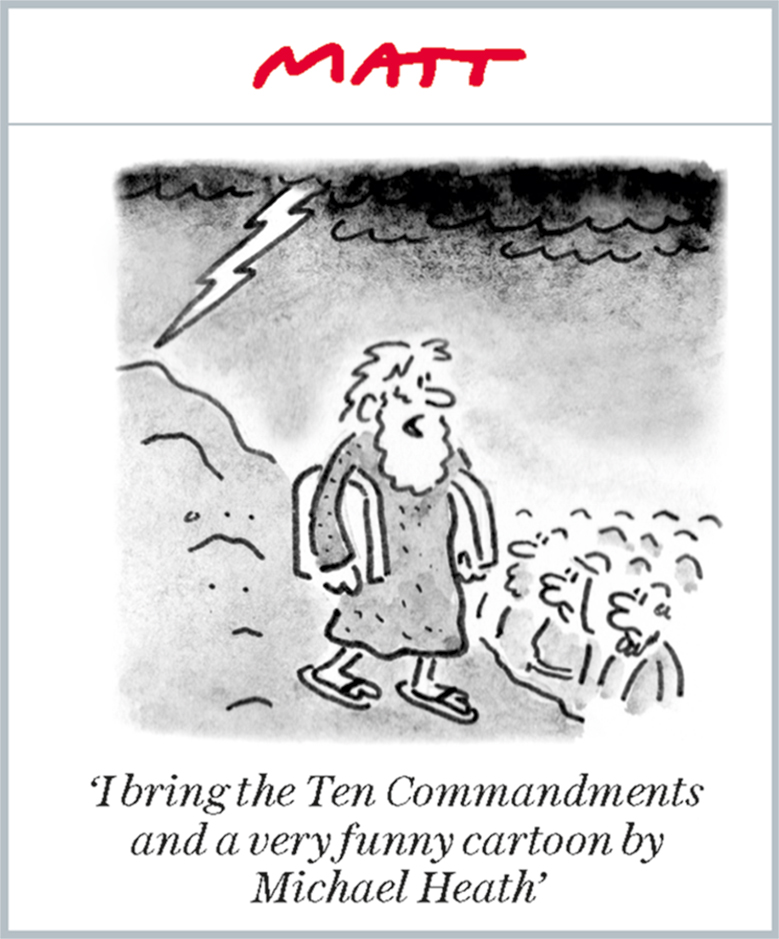
The real Spectator was below the editor’s office: Stuart Reid, Mark Amory, Clare Asquith, Liz Anderson, all squashed into a tiny ground floor room; Michael Heath in Prada and a round felt hat, drawing ceaselessly in black Indian ink, whistling Charlie Parker through his teeth.
Even then, he was the longest-standing contributor. “I had my first cartoon accepted when I was 15, in 1950,” he says. “How’s that?” Now Michael is 90, The Spectator is pushing 200 and, he says, “I’ve been at the magazine longer than most of its columnists have been alive.
“Think of that! Actually I think I’m the world’s oldest working cartoonist or something… is that a good thing? Sometimes I feel like my brain is melting.”
Back in 2000, Michael and I would walk around Bloomsbury at lunchtime, he pointing out every trend: trousers worn down around the mid-bum, the new fashion for skinny jeans – details that would then appear in the afternoon’s drawings. We’d walk down Rugby Street where he’d lived as a young man and often talk about women. “I came home one evening, and the missus had changed the locks. And she’d sold all my furniture! Nightmare!”
Michael is back on Rugby Street these days, with a new wife, Hilary, who won’t change the locks. And that’s where we are now, side by side on the sofa, on the eve of the 90th birthday, talking about where it all began. What makes a good cartoonist? “Well it helps to be neurotic, lonely and an only child, preferably with some talent for drawing,” he says.
Were you a lonely only child? “Yes, I suppose so. My mother used to sleep all afternoon and I don’t think my father ever said a word to me. He drew comic strips too – not funny stuff though. Cowboys and Indians for boys’ magazines.”
Why didn’t he talk to you? “I don’t think I was his son.” In all the years we walked about, I never heard this one. Whose son were you? Michael looks pensive. “Well, a man turned up at our house once every year. They called him Dogsbody. He smoked continually, hand-rolled cigarettes with his name on. He and my mother, they’d obviously had an affair. He’d bring all this stuff, for me, toys, but soon as he went, my father gave the toys to people next door.”
After the war, London began to loosen up and the young Michael Heath with it. “I didn’t want to be like my mother and father, so when all the boys and girls began to run around town and go dancing, I decided to draw them. The wacky shoes and the hair. There was a newness about everything. Everybody was having affairs, all over the place, but drugs hadn’t taken over yet. Everyone talked and laughed.”
Don’t people talk and laugh today? “They’re too busy texting to talk, aren’t they? And they can’t take a joke. You can’t joke about women, fat people, thin people. Even sex is a very serious business now, all about identity. And everyone’s terrified of saying something which will upset people.”
This was absolutely not the case in 1970s and 1980s Soho, where Michael and Jeffrey Bernard, The Spectator’s first “Low life” columnist, spent their days and where upsetting people was very much the thing. “We’d go to the Colony Room, and Ian Board [the barman and later the owner] would greet you with: ‘Oh fuck off, c**t,’” says Michael. “Francis Bacon would be at the bar, cutting people to shreds. Some people couldn’t take it. They were destroyed.” Michael did a cartoon strip back then called “The Regulars” for the satirical magazine Private Eye. “Half my ideas came from sitting in the French House and the Coach and Horses, listening to Jeffrey and to other people,” he says. “You didn’t need to draw parliament – you could find every kind of idiot in Dean Street.”
Bernard once said of Michael: “Heath doesn’t talk much. But he listens. Then he goes home and draws what you said – badly – and everyone thinks it’s genius. Bastard.”
Michael says now of Bernard: “He could write. However pissed he was, he could write. And even though terrible things happened to him as a result of the drink – I mean, he had half his foot taken off – women were still attracted to him for reasons unknown to me. Intelligent women! They used to bring him food from Fortnum’s and he’d be terrible to them. They loved it. I don’t understand women.” Christopher Howse, Michael’s old friend, explained the appeal of Soho in conversation with him in 2018: “It was just great fun, despite the misery. It was funnier than any situation comedy could be, because you knew all the people.
“The things that happened were astonishing and it always ended in tragedy, breakdown of health, falling down the stairs. Death – that was the automatic ending. But in the meantime it was great fun.”
“I was with Jeffrey when he died,” says Michael. “If you’ve never been with an alcoholic you wouldn’t understand, but that’s how it is. They drink themselves to death. In the end he just overdosed on whatever it was he was taking. ‘I never felt so happy in all my life,’ he said. And died.”
But how did you survive? How did you keep on observing and drawing through all the drinking? Gags, strips, vast detailed satirical drawings, Private Eye, The Spectator, London’s Mail on Sunday. “I always worked. I was working all the time and still I am,” Michael says. “You know, I haven’t got the guts to stop it.”
The editor who invented the modern Spectator was Alexander Chancellor and when he died, the satirist Craig Brown wrote of him: “The lunches, the enjoyment, the fun, were all part of his armory. Beneath it all, that brilliant mind has never stopped whirring.
“More puritanical editors, priggishly insulated from the world outside, had nothing of Alexander’s verve and excitement.”
The same is as true of Michael. Through all the wine, the wives, the changing of locks, he never stops. Drawings pile up around him, satirical, joyful. Your cartoons can be cutting, but the drawing never seems angry, unlike other cartoonists, I say, not naming names. “You mean Gerald Scarfe and Steadman and that lot?” says Michael. “All those people shouting and falling over, shrieks and splatters? The trouble with that is, it’s always the same picture, isn’t it? It gets old.”
We get off the sofa and cross the road to the Rugby Tavern, where Michael jokes loudly about the things you can’t joke about anymore. “All this sort of non-binary stuff. It’s everywhere, isn’t it? I mean, get her, over there!”
I tell him how much I love his ongoing Spectator strip “The Battle for Britain” – surreal, outrageous and often weirdly prescient. Michael was mocking woke a decade before the rest of us caught up. “You can’t say anything these days,” he shouts at the Rugby Tavern barman, as he reaches for his glass of white. But he can, he always has, and he does.
This article was originally published in The Spectator’s November 10, 2025 World edition.
Last week, in anticipation of her appearance on The View this morning (or afternoon, depending on your local listings), Congresswoman Marjorie Taylor Greene tweeted out an image of her perfect “100 A Liberty Score,” given out by Conservative Review and Blaze Media. “Nothing has changed about me, I’m 1,000,000% America ONLY,” she wrote. “Sorry I’m not sorry. I don’t obey Republican men’s demands that I, as a woman, don’t remain seen but not heard.”
Well, there’s no chance of us not hearing Rep. Greene. As I’ve pointed out before, it rings a little hollow to cry “sexist Republican” when you a) are a Republican and b) the thoroughly Republican-dominated government includes a Justice Department and a Department of Homeland Security run by women and a female White House Chief of Staff. But there MTG was today, on The View, crying sexism.
MTG molded into the all-female panel very well. Whoopi Goldberg bemoaned high soybean prices and the Argentina bailout, two topics on which I’m sure she has substantial expertise. “What is going on?” she asked MTG.
“I don’t know,” Greene said. “I’m so America First. I feel like I live it and breathe it.” People in her district, she said, “are so tired of their hard-earned tax dollars being sent overseas to foreign wars, and foreign aid and foreign causes, while life in America just becomes more and more unaffordable.”
This is what she campaigned on, she said. “Everyone is saying Marjorie Taylor Greene has changed. Oh no. Nothing has changed about me.” Manufacturing in her district is crumbling, she said. Small businesses, shuttered during COVID, cannot reopen. People are suffering in Georgia, which is why it’s fortunate that their representative is in New York City chit-chatting with Sunny Hostin and Sara Haines. “I’ll do anything I can to save this country,” she said.
“Maybe you should become a Democrat, Marjorie,” Joy Behar said to her, in all seriousness.
“I’m not a Democrat,” she said. “I think both parties have failed.”
“So you don’t believe in the Q-Anon conspiracies anymore?” Hostin asked her.
“Oh, I went over that a long time ago,” said Taylor Greene, who recently commented to Bill Maher that she thinks UFOs may actually be “fallen angels.”
“So you’ve changed,” Hostin said, hopefully.
“No, I haven’t. I was a victim – just like you were – of media lies and stuff you read on social media. You all have attacked me on this show many times.”
“We have.”
“Because of things you’ve read about me that weren’t true.”
“Or clips we’ve seen.”
“Or clips that took me out of context.”
At another moment, Behar said, “you’re slamming Republicans too much. You’re taking my job.”
Maybe that’s the point. Taylor Greene laughed, as unwitting victims of social media conspiracy theories are wont to do.
“You’re slamming Republicans a lot on topics like healthcare, and the Epstein Files,” Behar said. “I know Truman’s still your favorite president. I mean, Truman is mine.”
Behar was referring to Harry S. Truman, who died long before MTG was born, but the comment brought to mind a different, somewhat more contemporary Truman. The whole world is now Taylor Greene’s Truman Show. She made a lot of new friends today on that glistening set.
“There’s a lot of paid social media influencers,” she said, to a chorus of “mmm hmms.”
“And I found it very interesting that they were the MAGA accounts” – with ‘MAGA’ in air quotes – “but they were all paid, and they all attacked me when I announced I was coming to join you ladies on The View. And I think that was very weak and pathetic. But when I talk about weak Republican men, I’m pretty much talking about the leadership in the House and the Senate. They’re not getting our agenda done.”
There’s more than a shred of authentic critique in what Taylor Greene is saying. But we’ve all had someone ring our doorbells, trying to sell us something that we don’t want, or that we don’t need. And I’m pretty sure that today on The View, the house megaphone for clueless, entitled liberalism, MTG wasn’t trying to sell America First. The only product on offer was herself.
There are many showrunners in contemporary Hollywood who are, essentially, all-powerful – Vince Gilligan and Aaron Sorkin have been able to do what they like for a considerable time now, for instance, and I doubt anyone’s giving the White Lotus’s Mike White too many notes, unless they’re blank checks – but there are two men who are primus inter pares when it comes to their relationship with their studios. Ryan Murphy more or less is Mr. Netflix, as can be seen by the streaming service merrily bankrolling everything he writes and/or creates – even something as unpleasant and morally corrupt as the recent Ed Gein show – and Taylor Sheridan and Paramount have been hand in glove for years now. Until, that is, they’re not.
The reason why Taylor Sheridan is leaving the network with whom he has had huge success for years is, as usual, a dispute about money. His perspective is that his work with Paramount, during which time he has more or less reinvented the contemporary western with such shows as Yellowstone and Landman, as well as prequels including 1883 and 1923 and such popular crime series as Tulsa King and Mayor of Kingstown, has been exemplary both on an artistic and commercial level, and that he deserves a Murphy-level deal. Paramount’s argument, as expressed by its new CEO David Ellison, is that Sheridan may be a hugely talented writer-director-showrunner, but he is ultimately an expendable figure who has, wrongly, seen himself as bigger than the shows he has produced.
Both sides have ground for their respective arguments. When Yellowstone was at its peak, it managed to be one of those rare shows that overcame the potential hokiness of its premise (and some terrible early reviews) to become appointment viewing, the Dynasty for our time but considerably better. And everything that Sheridan has worked on since has been similarly successful, even if the spy thriller show Lioness has never really caught fire, despite a starry cast including Morgan Freeman, Nicole Kidman and Zoe Saldaña. In an America that is now considerably more attuned to MAGA sensibilities that it was when he began his screenwriting career a decade ago with the (excellent) films Sicario and Hell or High Water, Sheridan can convincingly suggest that he has captured the zeitgeist of his country more entertainingly than any other writer today, and that this success should be rewarded accordingly.
Ellison, however, is said to be less enamored of Sheridan’s considerable ego. When it was suggested to the showrunner that he produce a show celebrating America’s 250th anniversary, he simply refused, suggesting that it was “too politically charged”. Sheridan, however, was smarting from Paramount’s refusal to make one of his screenplays, entitled Capture the Flag – no prizes for guessing what kind of genre of film that would have been – and seemingly decided that the studio that had built his career was no longer the right fit for him. Enter Donna Langley, all-powerful head of Universal, and a woman with considerable form in luring away talent from their former homes: it was she who convinced Christopher Nolan to leave Warner Bros and won him Oscars for Oppenheimer in the process. Sheridan’s price, paid willingly: a billion-dollar deal and complete creative control.
There are, of course, several more shows left to run in his Paramount deal, which does not expire until 2028, but it looks unlikely that such series as the Yellowstone spin-offs 1944 and The Madison will be entered into with the same zeal that his previous work. Certainly, Sheridan has been working at a rate of energy that would kill many lesser men, and it has been whispered that Ellison believed that not only was the hyphenate at risk of creative burn-out, but that with him gone, it would be easier to control Paramount, rather than with this particular alpha male attempting to dominate proceedings.
He may, of course, be right. Yet if there’s anything Sheridan has done successfully in his shows, it is to bring in the big dog that so many of his peers have shied away from creating, and make him not just relatable, but likable. It is not too big a stretch to believe that many of these figures were created in his own image, and that Sheridan himself is as outsized and swashbuckling as any John Dutton or Mike McLusky. What are the chances that a future show of his will feature a similarly titanic lead taking on the callow entertainment industry, and winning in the process? Sheridan – and Universal – will be hoping that life imitates art, and vice versa. Ellison will be just as fervently hoping the opposite, and the rest of us will be watching with as much fascination as we have devoted to the shows.
“Have some of these raids gone too far?” Norah O’Donnell asked Donald Trump of ICE immigration arrests as he sat down with 60 Minutes for the first time in five years.
Trump refused to take the bait. Instead of ranting or insulting O’Donnell, as she may have hoped, he was calm – and even counterintuitive.
“We have to start off with a policy, and the policy has to be, you came into the country illegally, you’re going to go out,” he said. “We’re going to work with you,” he continued, “and you’re going to come back into our country legally.”
Pressed on whether he plans to use the military to crack down on anti-ICE protests, Trump declined. “I could,” he said, “but I haven’t chosen to use it. I hope you give me credit for that.”
On tariffs, a line of concern across the aisle, Trump simply pointed to the stock market. “Look, because of tariffs, we have the highest stock market we’ve ever had,” he said.
O’Donnell parried. “When the stock market is doing well, that doesn’t affect everybody,” she said, as Trump shot back that record high 401(k)s do indeed impact the average Joe.
The CBS News show contextualized the government shutdown under the specter of needy Americans losing their SNAP benefits as Republicans fight to purge the Obamacare rolls.
Trump, however, simply blamed the Democrats. “The Republicans are voting almost unanimously to end it, and the Democrats keep voting against ending it,” Trump said of the shutdown. “This has happened like 18 times before.”
Government shutdowns are, of course, nothing new. But it always works out, despite collective hyperventilation. Polls show that less than one-quarter of the country find themselves “very concerned” about the latest.
As the interview continued, Trump touted the new trade deal with China, the ceasefire in Gaza and his efforts to resolve the war in Ukraine. He even dispelled the liberal fever dream of seeking a third term.
Legal immigration, surging stock markets, modest diplomatic inroads and run-of-the-mill partisan bickering – it’s not exactly a groyper’s dream come true. Yet in-fighting has dominated right-wing discourse in recent weeks, perhaps to the greatest degree since Jan. 6 or even the launch of the original Never Trump movement.
The Young Republican group chat leak from mid-October – filled with racist snark – set off a cycle of denunciations and apologias within the right, with some saying the conservative movement must draw a line at genuine bigotry while defenders countered that those pearl-clutchers were simply useful idiots for the left. This continued with the leaked messages of Trump nominee Paul Ingrassia, and has now seemingly reached its peak after Tucker Carlson’s controversial interview with Nick Fuentes last week. Still, it’s all anyone seems to be talking about on X.
All of this has culminated in questions of whether the right can govern without tearing itself apart? But as Trump touts substantive and broadly appealing victories, the answer seems obvious to anyone outside an echo chamber.
The “discourse” seems hysterically detached from political reality, symptomatic of terminally online influencers too content to hear themselves talk. Far from radicalism running amok in the GOP, the CBS interview suggests the opposite.
In rare form, Trump did not in fact shoot himself in the foot. He didn’t go off on obscure tangents that appear inexplicable or scary to a CBS viewer. At the same, O’Donnell didn’t lean into the media’s most divisive attacks that have been used to demonize Republicans in the Trump era – Nazism, white supremacy or egregious “gotcha questions” designed to impart racist vitriol. She simply kept to the good old fashioned liberal bias.
Is the world healing? Are we returning to the days of civility politics that self-declared centrists so longingly yearn for? Is Trumpism now so dominant that it can govern as a milquetoast status quo? It’s surely too soon to say.