So there you have it: the feelings of white men matter more than the rights of black lesbians. That’s the takeaway from the mad fracas at a Gold’s Gym in Los Angeles this week, where a female gym-goer by the name of Tish Hyman says her membership was unceremoniously revoked. Her offense? She dared to complain about the presence of a person with a penis – what we used to call a bloke – in the women’s changing room.
Ms. Hyman is a lesbian and a singer originally from the Bronx in New York. She says she encountered a man who identifies as a woman in the changing area of the gym she uses in LA. She was shaken.
“I was naked in the locker room,” she said. “I turn around and there’s a man there in boy clothes, lip gloss, standing there looking at me. I’m butt naked.” Understandably unsettled by this experience, she made a fuss. And yet it was reportedly her who was kicked out.
Clips of the showdown between Ms. Hyman and the gym staff have gone viral. They make for extraordinary viewing. In one, Hyman makes an impromptu and thundering speech in the gym’s reception area.
“Men, grown men, with big dicks, in the women’s locker room!” she says. “Everyone saw that man in the women’s locker room but no one’s saying shit.” She is, though. “I’m fucking done with it,” she says. Many people – me included – will have cheered while watching this forceful, moving plea for a woman’s right to privacy and dignity.
The response of her fellow gym-goers was somewhat more muted. As she holds forth on how scandalous it is that a member of the opposite sex was allowed to see her naked – “without my permission” – they just mill around, nonplussed. I guess that’s LA for you, a city so sozzled on “social justice” nonsense that it shrugs its shoulders at the thought of males in a female changing room.
In another clip, Ms. Hyman can be seen confronting the male in question. There seems to be some historic beef here. It would appear that she has filed complaints about him before but nothing was done. He is quite clearly a man. I know you’re not supposed to say that. I know it’s “transphobic.” But, like Ms. Hyman, I’m done with surrendering the truth of my own eyes to appease ideologues who dream of erasing the reality of sex. Truth matters. As do women’s rights.
Isn’t it crazy where “progressive” politics has ended up? A woman booted out after she objected to the presence of a male in a women-only zone. A black lesbian reprimanded for daring to challenge a white male. A black woman in 2020s America reportedly banished from a building for standing up for her right to undress in peace.
Imagine going back to 2005 and trying to explain this to people – that in the future a black lady would be punished for not wanting male eyes on her naked body. People would have thought you mad. There’s no way that will happen, they’d have said. Yet here we are. Tish Hyman in LA. Sandie Peggie in Fife, the nurse who’s suing her hospital trust for making her share an intimate space with a trans-identifying male. The Darlington nurses who are also suing their trust for compelling them to disrobe among biological males. The lunacy is transatlantic.
Women’s rights have been broken on the wheel of the trans ideology. It’s so clear now that what passes for “progressive” activism is really an assault on the properly progressive gains of the 20th century. It feels like misogyny in drag: the unwinding of the hard-won rights of womankind dressed up in the language of progress. Such is the social delirium unleashed by identity politics and the cult of DEI – we end up in a situation where a black lesbian is shamed for wanting the most basic of rights.
It’s not trans-identifying males who are part of a new civil-rights movement. It’s women like Tish Hyman, who are speaking out for the re-establishment of women’s dignity. There was a Rosa Parks vibe to her angry gym speech. Where Mrs. Parks refused to sit at the back of the bus, Ms. Hyman refuses to get undressed in front of male strangers. Two cries for liberty I can get behind.
In the heartland of America, an inflection point has come to pass. Minneapolis was once immortalized in the 1970s television series The Mary Tyler Moore Show, when Mary Richards made her bright-eyed and optimistic journey there in search of opportunity and a new life. But now it is a relic; worn away, gritty and unwelcoming – with more empty storefronts than warm smiles. Of course, the decay didn’t happen overnight.
The failed policies of a series of Democratic leaders and a progressive city council have left the biggest city in the Minnesota Nice State a shadow of its former self. Minneapolis has had a Democrat mayor (Democrat-Farmer-Labor in this neck of the woods) every term since 1976 and hasn’t had a Republican mayor since Richard Erdall served one day on December 31, 1973. Out of the 15 candidates who ran for mayor this year, there were no Republicans.
This Election Day the choice was between the current mayor, Jacob Frey, who oversaw the disastrous “Summer of Love” 2020 riots in the aftermath of George Floyd’s death, from which the city is still reeling, and Omar Fateh, the Ilhan Omar and Democratic Socialists of America-endorsed state senator who won reelection in 2022 and touts his work there as “transformative policy.”
Ultimately, Jacob Frey won his third mayoral term with 50.03 percent of the vote after the second round of ranked-choice voting (no candidate received more than 50 percent in the first round) was counted on Tuesday. But the contest was fraught.
Fateh’s state’s legislative session in 2023 was controversial and included a massive new state-run paid family leave program, free school breakfast and lunch for all K-12 students, regardless of family income, free college tuition and healthcare for illegal immigrants, free housing and free menstrual products in all school bathrooms, including boys. All this spending blew away previous state budget records, with the omnibus bill increasing spending by 40 percent – from $51.6 billion to $71.5 billion over two years.
For his part, Frey has tried to hold together a city at odds with itself – consistent with the divisions within the Democratic Party, not just in the city or the state, but the country at large, most notably in New York City. The battle is between radical-left progressives – who want males to participate in female sports and gender-affirming surgery for minors – and moderate Democrats who reject much of the woke ideology, language and radical policies that have run the political and cultural conversations of the last five years (think “defund the police” and not knowing what a woman is).
Frey branded himself as a “pragmatic progressive.” Considering the state of Minneapolis politics, this means he sounds more like an establishment Democrat; supportive of law and order, public safety, affordable housing (while addressing the city’s persistent homelessness problem) and green energy policies. He won the endorsements of U.S. Sen. Amy Klobuchar, former U.S. Attorney for Minnesota Andrew Luger and two previous Minneapolis chiefs of police.
Fateh is one of a rising group of Democratic-Socialists running for office across the country this election cycle – not only against their immediate opponents, like Frey in Minneapolis, but against the party establishment and gatekeepers who they see as hindrances to their turn at power, all with a raised fist that combines elements of Occupy Wall Street, Black Lives Matter, BDS and antisemitism.
From the outside, it looked like a left versus further-left fight. Still, one issue has really rubbed Minneapolitans the wrong way: a guaranteed minimum wage and worker protection for rideshare drivers like Uber and Lyft, which Fateh championed in the state senate. The effects have increased the cost of rideshare and delivery services in a city where “affordability” is a buzzword.
Further, the city was ground zero for the 2020 costly and deadly race riots in a state that might be the most corrupt in the nation, with $1 billion stolen from government coffers in fraud schemes, all with ties to the immigrant Somali community, including Fateh.
It turns out that Minneapolis had more pragmatic Democrats, Independents and Republicans, who held their nose to vote for Frey, than New York City did in voting for Mayor Mamdani.
And, zooming out from the mayoral race, the Minneapolis City Council appears to have leaned away from its previous progressive bloc and will no longer have a veto-proof majority. Frey’s “pragmatic” approach appealed to right-of-socialist voters and motivated them to turn out as well.
Taken together, voters in Minneapolis decided to keep limping along with the devil they know rather than to go all-in with a mayoral candidate who could put the final nail in the city’s coffin. Minneapolis might not make Mary Richards smile, but she might just make it after all.
There is an unhappy history of left-wing Britons getting involved in US elections. Back in 2004, the Guardian – the flagship organ of the British left – organized a letter-writing campaign, urging voters in the swing state of Ohio not to re-elect George W. Bush. The good people of Ohio didn’t take kindly to a bunch of North Londoners telling them how to vote, and although the Guardian’s campaign probably can’t be given all the credit, the voters of Ohio duly went to the polls and swung firmly behind Bush.
One wishes that London Mayor Sadiq Khan’s intervention in this week’s election in New York might have had a similar result. Interviewed shortly before Zohran Mamdani was elected, the Mayor of London praised the Democratic Socialist candidate for mayor of New York as “fun” and “authentic.” A spokesman for the London mayor proclaimed: “The mayor hopes that like in London, New Yorkers see through the politics of hatred and fear and embrace Mamdani’s hopeful and optimistic vision for the future.”
I think we all know the drill here. If the subtext of the Guardian’s fateful 2004 intervention in US politics was that a bunch of rural hicks in Ohio needed to be instructed by better educated types about what a ghastly man their then president was, then the subtext of the mayor of London’s intervention into the New York race is that if you don’t vote for the Socialist candidate it’s because you’re anti-Muslim and therefore anti-progress and anti-diversity.
The trouble is that not many New Yorkers want to hear from the Mayor of London on how to run a city. While Khan wafts around the world telling everyone what a diverse and vibrant place London is, the news that floats back over the Atlantic from London is rarely positive.
Most Americans I speak to who have recently been to our capital return rather shocked. Not least among their observations is how wild the crime in London is. New Yorkers might risk being set on fire on the subway by a spice-addled illegal immigrant, but they are also used to being able to walk down a street with their phone in their hand. They do not have to hide their device for fear that it is going to be snatched from them by a youth on a bike. Every American tourist who does experience this aspect of London tends to tell their friends about it. So while Khan thinks that London’s bad reputation in the US is a result of Donald Trump’s occasional swipes at his mayoralty, it is in fact merely a reflection of Americans visiting Khan’s London and returning home with stories of the reality.
Another line I hear plenty of people voicing in America is something along the lines of: “Whatever happened to London?” This would of course be dismissed as appalling, backwards racism by Khan and his PR team. But I have heard it often enough to know that it is an expression of genuine surprise. There was a time when you could tell American friends that it was all fine really, and that Downton Abbey and other popular dramas might have unduly raised expectations of what the average day in Britain looks like. But these American visitors are on to something. The problem with “diverse” cities is that they all end up monotonously resembling each other.
In any case, if New York really is going to follow London’s lead, then New Yorkers can only blame themselves. Mamdani must count as the least qualified person ever to run for major political office. The son of a Columbia University professor and an award-winning film-maker, he seems to have drifted through his career. He tried and failed to be a rapper. Then he worked for his mother for a bit. And now he’s meant to run the biggest city in America.
It is true that he seems to have entranced many voters because of his youth (he’s 34) and “vibe.” But whenever he has actually been questioned about his policies he cannot explain how he is going to pay for any of them, other than by taxing the rich.
To say that he is economically illiterate is an understatement. Early in the campaign it became clear that he cannot read a budget sheet. It also transpired that he thinks that the already beleaguered New York Police Department is some sort of wing of the KKK. Trained by the Israelis, naturally.
Possibly alert to the whiffs of anti-Semitism that have pervaded his career, he has chosen to counter this by saying that any criticisms of him are because of his Muslim-ness. In fact few New Yorkers, like Londoners, care what religion their mayor is. But they do take exception when a candidate stands outside a mosque during election season, as Mamdani did, and starts to tear up while telling a story about an aunt (who turned out not to be an aunt) who was said to be fearful of wearing her hijab in New York after 9/11 – as if she was the real victim of that day.
One of the demonstrations that New York is not the city that Mamdani sometimes pretends it is can be seen from the fact there was no widespread “anti-Muslim” backlash after 9/11. Just as there was no meaningful opposition to his candidacy because of his Muslim faith.
It was one thing for the Guardian to misread the people of Ohio. It is quite another for people running for elected office to misrepresent their fellow citizens.
Perhaps this is just one more similarity between London and New York. Both must count as among the world’s most tolerant populations. But they are populations that have become used to being misrepresented by politicians whose own gilded lives and effortless careers should be demonstration enough that we aren’t the people they often find it useful to pretend we are.
To his fellow high priests of the church of climate change, Bill Gates has just committed the ultimate heresy. He has told us that we are not all going to die from scorching temperatures, despite in the past having said “we are setting ourselves up for a humanitarian and geopolitical disaster.” In a new essay posted on his personal website, he has attacked the “doomsday view” that “in a few decades, cataclysmic climate change will decimate civilization.” He writes: “Fortunately for all of us, this view is wrong. Although climate change will have serious consequences… it will not lead to humanity’s demise.”
His rejection of catastrophism is no small matter. Next week, the world’s great and good will board their private jets and head off to the Brazilian city of Belém for COP30, an annual shindig that is very much based on the premise that the world is coming to an end unless we take drastic action. According to UN Secretary General António Guterres last month, climate change has pushed humanity “to the brink” – a variation on last year, when he told us we were at “breaking point.” Spewing out the superlatives has been an annual ritual since even before Al Gore told us in 2006 that we had ten years left to save the planet. The only variation is exactly how long we have left before we seal our fate, ranging from eight years (then-Prince Charles in 2009), to five years (the WWF in 2007 and again in 2024), three years (former UN climate chief Christiana Figueres in 2017) or two years (current UN climate chief Simon Stiell in 2024.)
As every doomsayer has discovered throughout history, it is one thing to gain attention with your grim prophecies before the hour at which you say they will happen, but it becomes a little harder once those dates have passed and we are all still living and breathing. Gates, for one, has realized that the hyperbole is starting to lose its effect. Anyone who wants to retain public attention on the issue will have to acknowledge that actually, no, we are not all going to die from climate change. Most won’t even notice.
What the doom-mongers ever thought they would achieve was always puzzling. Telling people that they are all going to die is hardly the greatest way of motivating them. Set impossible deadlines for human societies to eliminate their greenhouse-gas emissions and you encourage them into apathy more than anything. You plant the idea in people’s heads: why not enjoy our last few years and go out in style? Eat, drink and be merry, for tomorrow we fry!
Of course, many young people indoctrinated into the doomsday cult by their teachers and professors had just the opposite response. More than half of all zoomers and millennials report that so-called eco-anxiety distresses their mental health; 52 percent of them say the looming threat of climate change makes them less likely to have children. Maybe this is why Generation Z is so antisocial – no time to party when you’ve gotta save the planet! Will Gates and his jet-set peers apologize for creating a generation of childless neurotics? Probably not. Better just to bury your reversal in a bland memo.
Note the timing of Gates’s newfound wisdom. Since President Donald Trump was re-elected, it’s become politically and financially inconvenient to be so green and gloomy. “Drill, baby, drill,” commands the President, and poof goes corporate America’s insistence that we all must buy overpriced, dumb-looking electric vehicles.
President Trump has said his favorite architectural style is that of Louis XIV – think gold, grand, a bit gaudy. Hence his gilded plans for the White House’s new ballroom. Like that French monarch, nicknamed the Sun King, Trump has the nation’s oligarchs revolving around him. None dare stray too far from his light, as the President has no qualms about picking winners and losers among the titans of industry. Musk, Zuck, Altman and Bezos figured this out quickly, and soon after the election began making journeys to Trump’s palace of Mar-a-Lago to pay tribute.
Gates is a late entry to this popularity contest, and we’re not likely to see him riding shotgun in a golf cart with the President around the links. But his defection from the progressive orthodoxy bodes well: other billionaires will surely follow, and the ruling class may finally begin to respond to Americans’ needs rather than what that class thinks those needs should be.
But it’s not just Trump who should be thanked for the billionaire red shift: New York’s incoming Mayor Zohran Mamdani deserves some share of the gratitude as well. No city has more billionaires or millionaires than New York. As Heather Mac Donald explains in our cover story, that economic boon may not survive Mamdani’s reign. Mayor Mamdani is committed to making the rich “pay their fair share,” whatever that means, and to fighting the 1 percent. There’s a word for this: extortion. Fortunately for the city’s many business leaders, plenty of low-tax, red-state promised lands across the country will welcome their exodus.
This article was originally published in The Spectator’s November 10, 2025 World edition.
If only work had started sooner on the new extension to the East Wing of the White House. Then President Donald Trump might be able to inaugurate it with a party for the man who owns arguably the grandest ballroom in the world (one Mr. Trump knows well).
Discussions are ongoing for a state visit to the US by King Charles III and Queen Camilla next year. President Trump has now logged an unprecedented two state visits in an easterly direction and common courtesy dictates a return invitation for the Windsors to pay a visit to the White House.
Next year is the obvious date. It will be 250 years since the US came into being by extracting the colonies from the rule of the King’s fifth great-grandfather, George III. As divorces go, it has proved to be the most enduring and amicable bust-up in history – and that surely warrants a party. Some readers will be old enough to remember the euphoric events in honor of the 200th in 1976. The late Queen Elizabeth II was the guest of honor back then. Next year will also be her centenary so there will be a poignant subtext to the visit, not least because Trump was the last state visitor of her record-breaking reign.
So how will things pan out this time? Overall, they will certainly be more upbeat than might have been expected had Kamala Harris won the presidential election. The last administration was treading very warily around the 250th for fear of looking triumphalist. Back in 1976, the anniversary celebrations were a straightforward “three cheers for the heroes of the Revolution,” “down with the evil Redcoats” and “no hard feelings.” Philadelphia turned out in force to welcome the Queen sailing in aboard the Royal Yacht Britannia carrying a brand new Liberty Bell from the same Whitechapel foundry that had made the original. And the partying went on and on. Ahead of 2026, the Democrats were agonizing about the elephant in the corner of Independence Hall. How to handle the Founding Fathers’ extensive links with slavery while those villainous Brits, rather awkwardly, had been offering emancipation? Maybe it was time to tone down all that revolutionary hoopla.
Trump is certainly not going down that route. He will see things in much the same way Gerald Ford saw them in 1976: this was the birth of the greatest nation on Earth, warts and all, with all the freedoms that followed. In other words, it’s going to be big. Very big. And there is really only one other nation which needs to be at the party (though the French might claim an invitation to the top table).
In 1976, the only debate was choosing which day the Queen should arrive. She had been invited for July 4 but thought it best to let the US have its moment. “Forgiveness can only go so far,” a waspish British embassy spokesman told the New York Times. It was decided that she should arrive on July 6 instead. No sooner had she stepped off the Britannia than she was delivering the first of several George III jokes. As she declared in Philadelphia: “Without that great act in the cause of liberty 200 years ago, we could never have transformed an Empire into a Commonwealth!”
The bicentennial royal tour included Boston and New York, where the Queen insisted on a trip to Bloomingdale’s and Prince Philip jauntily wore a “Big Apple” sticker on his dinner jacket. The centerpiece was the White House ball in Washington, with Bob Hope acting as master of ceremonies. It also featured a fabulous faux pas which enraged Ford and greatly amused the Queen. As he led her on to the dance floor, the bandmaster chose that moment to strike up “The Lady is a Tramp.”
I would envisage a little more history in the mix this time around. The King has always been fascinated by George III – whom he feels is greatly misunderstood – and the Royal Archives have recently digitized hundreds of thousands of Georgian documents with generous American support from organizations such as the Omohundro Institute of Early American History. I made a program about it all for the BBC. What sticks in the mind – along with firing guns at Yorktown and seeing Ivan Schwartz create the first American statue of the tyrant King since 1776 – is the way in which George moved on so swiftly from his “America is lost!” trough of despair to building the foundations of today’s “special relationship.”
That, incidentally, was a banned phrase in British diplomatic circles at the time of the bicentennial. Timid Foreign Office mandarins were worried that it sounded presumptuous and that it might irk the UK’s European allies (Prince Charles was specifically ordered to remove it from his 1970 speech to the Pilgrims Society of Great Britain). That will certainly not be the case next year. Expect to hear it trumpeted at every turn following the President’s heartfelt words on the bilateral relationship at the Windsor state banquet in September: “‘Special’ does not begin to do it justice.”
It should be a great party. Make that two parties if the Prince and Princess of Wales (as I expect) also undertake a US 250 tour of their own. Mr. Trump just needs to keep a close eye on his bandmaster.
Ten days ago, I woke up in a six-by-nine concrete box. No camera crews. No suits. No applause. Just silence and steel. I was in solitary confinement, locked down 23 hours a day, pacing in circles inside a room smaller than my walk-in closet. The walls seemed to have their own heartbeat. Every breath echoed. Every second felt like an hour. When I entered prison in July, I thought I knew what to expect. I thought humility would come gently. Instead, it came like a storm. You don’t understand loneliness until the lights go out and the only sound is your own heartbeat. I wrote letters to my husband and my sister and prayed to God. In my darkest moments, I even wrote suicide notes. I had to keep reminding myself: this can’t be the end of my story.
Solitary confinement stripped me bare. I wasn’t a congressman anymore. I wasn’t a public figure. I was inmate number 58474-510. My meals came in dirty plastic trays that smelled rancid. Showers were only three times a week and outdoor time was only one hour a day, Monday to Friday. After 41 days, the door opened. They told me I was going back to general population. It felt like breathing after being underwater. I didn’t feel free, but I felt alive. In that chaotic, crowded dorm, I found unexpected mercy from men who had endured far worse. And then everything changed.
It started with whispers in the cafeteria. The television showed a breaking-news banner: “President Donald J. Trump Commutes George Santos’s Sentence.” I didn’t believe it. I thought it was a mistake. I ran to the phones and called home. My husband already knew. He had spoken to the President himself and told me he was coming to pick me up. When I walked out of that prison in the dead of night, politics was the last thing on my mind. I was thinking about the taste of fresh air, my husband and the sushi I had been craving for months. I said it then, and I’ll say it again: if Trump had pardoned Jesus Christ from the cross, he would still have critics. Everyone is a critic these days. But I understand grace now. I understand humility. And that’s what I’m holding on to.
That night, I prayed. I thanked God. I thanked my family. And I thanked President Trump for believing in redemption. America is a country built on second chances. This nation was designed to allow grace. It’s who we are. The next morning, my phone exploded. Fox News. CNN. The BBC. Israeli TV. Everyone wanted to hear the story. The fall, the prison time, the rebirth. I told them the truth. I made poor choices. I hurt my colleagues, my constituents, my party. I can’t erase that. But I’ve also seen what’s wrong with our system, how inhumane it is. I talk about the meals that resembled cat food, because I can’t think of a better way to describe the conditions. They strip people of dignity. We’re not rehabilitating prisoners; that’s why recidivism is so high.
Now I want to turn my pain into purpose. I’ve started working with youth-outreach and prison-reform groups. My message to young people is simple: you don’t want to go to prison. You think you’re tough, but it will break you. It broke me. My days are now a blur of studio lights and microphones. They’re calling it the “International Redemption Tour.” I call it therapy. Every interview is a step closer to forgiving myself. I’m not interested in relitigating my past. But I’ve already been asked about restitution, and I answered honestly: it’s not required by law, but I’m exploring it with my legal team and will do so when I can. I’m not going to lie or pander for approval. Transparency is my only way forward. To my critics I say this: keep your outrage. It doesn’t move me anymore. The only thing that moves me now is the responsibility to make meaning out of this chaos. I see the world differently now. I see the man in the mirror differently.
I’m back home. I went to Mass and sat in the pews like every other sinner seeking grace. I know some people will never forgive me. But I also know that in America, no one is beyond redemption. I was in solitary confinement weeks ago. Today, I’m speaking to the world. That’s not luck – that’s providence. That’s what happens when God gives you one more chance and the President believes you deserve it. My story isn’t over. It’s just beginning again – not as Congressman Santos, but as George. Just George. A man who fell hard, got back up and intends to make every breath count.
This article was originally published in The Spectator’s November 10, 2025 World edition.
William F. Buckley Jr. once quipped that he would rather be governed by the first 2,000 names in the Boston phone book than by the Harvard faculty. New York City is about to be governed by the Columbia University student body. A city that used to think of itself as grown up has just elected a mayor who seems the very embodiment of the American college student: uninformed, entitled and self-important, enjoying a regal quality of life that depends parasitically upon a civilization about which he knows nothing, yet for which he has nothing but scorn.
American college students regularly act out little psychodramas of oppression before an appreciative audience of diversity deanlets and associate vice-provosts of inclusion and belonging. Zohran Mamdani, the quintessential product of the academy, is poised to take such performative grievance to one of the biggest stages in the world. The results will not be pretty.
Mamdani’s governing agenda reflects his family background, education and negligible post-college career. Now 34, he was born in 1991 to a professor of postcolonial studies and a filmmaker. The family moved to New York City from Uganda in 1999 so that Mamdani’s father, Mahmood, could teach in Columbia University’s Middle Eastern, South Asian and African Studies Department and direct the university’s Institute of African Studies. The young Mamdani imbibed academic anti-westernism at the family dinner table, which hosted such leading lights of postcolonial studies as Columbia’s Edward Said and Rashid Khalidi.
Mamdani fashions himself a champion of the working class. He chose not to attend New York’s most storied working-class college, the public City College of New York (then $6,330 a year), however, in favor of the private Bowdoin College, a bucolic, secluded retreat in Maine (then $59,900 a year). The centuries-old New England institution grew out of the finest ideals of America’s Founders; it boasts Nathaniel Hawthorne, Henry Wadsworth Longfellow, US president Franklin Pierce, Supreme Court justices, decorated Civil War generals, abolitionists and industrialists among its graduates.
Today, however, a Bowdoin education is awash with victim ideology, as documented by the National Association of Scholars in 2013, the year before Mamdani graduated. As an Africana studies major, Mamdani would have taken courses along the lines of “Race, Land and (Dis)/(Re)possession: Critical Topics in Environmental (In)justice and Subaltern Geography,” which examines how “race, gender, and class operate under racial capitalism and settler colonialism both in ‘the past’ and in ‘the contemporary.’” This is a new offering, but the high theory-based fields have been ossified since Jacques Derrida’s Of Grammatology burst onto the American scene in 1967. The rhetoric of 2025 is identical to that of 2014.
Zohran Mamdani campaigns in New York City in August (Stephanie Keith/Getty)
Had Mamdani attended college ten years later, he would probably have led chants of “globalize the intifada” from an anti-Zionist encampment on his campus quad. Instead, he did an arguably even more important thing for the pro-Palestinian cause: he founded Bowdoin’s inaugural chapter of Students for Justice in Palestine (SJP). From his leadership position with SJP, the keffiyeh-wearing undergraduate tried to jumpstart a Bowdoin boycott of Israeli universities. Israeli higher education, he wrote, was “both actively and passively complicit in the crimes of both the Israeli military and the Israeli government in all its settler-colonial forms.” Mamdani had well absorbed his intellectual patrimony.
Of course, no immersion in anti-colonialism would be complete without close study of Frantz Fanon, the Algerian revolutionary who legitimated Third World terrorist violence. Mamdani’s senior thesis focused on Fanon’s relationship to the thought of Jean-Jacques Rousseau.
Thus launched into the real world with an unclouded ignorance of private enterprise and public virtue, Mamdani drifted through his first six years after graduation. Just as the young Barack Obama had struggled in Chicago to find a cause to organize around, Mamdani hopscotched among various left-wing activist groups – MoveON Seattle, TexPIRG and Chhaya, the latter a government-funded social justice organization in New York. His mother briefly employed him as a “music supervisor” on one of her films. A career as a rapper was abortive. He worked on an unsuccessful political campaign or two for New York progressives, then decided he was ready for office himself.
He was elected to the New York State Assembly for Queens in 2020 on the Democratic Socialists of America ticket. As a member of the State Socialists in Office bloc in Albany, he can take credit for a negligible three bills and a lot of missed Assembly votes. Next up: the New York mayoralty. Mamdani’s governing philosophy can be encapsulated in the slogans beloved of undergraduates confronting supposed injustice for the first time in human history: “People before profits!” “Fight corporate greed!” “Housing is a human right!” His campaign focused on four proposals, all inspired by the city’s alleged affordability crisis: he would freeze rents; make city buses free; offer free universal childcare; and open a government-operated grocery store in each of the city’s five boroughs.
These four proposals run the gamut from sweeping to weirdly narrow. But they all treat urban governance primarily as a means of shrinking the role of for-profit enterprise, expanding public control and redistributing wealth from its creators to the so-called poor. They may be quickly disposed of.
Proposal one: decommodify housing! Mamdani’s rent freeze would apply to nearly half of all rental units in the city: those whose rents are set by an appointed “Rent Guidelines Board,” not by the housing market. Those million or so rent-stabilized apartments make up one-third of the city’s homes, including owner-occupied homes.
Even left-wing economists have concluded that rent controls produce only housing shortages. Yet for those with an undergraduate mindset, landlords are greedy for wanting to earn a market rent, whereas tenants enjoying a below-market rent are merely receiving their due.
The four-year freeze would decimate New York’s housing stock. The city’s small landlords are already at death’s door. Maintenance costs have risen by 28 percent over the last five years; the regulated rents fail to cover repairs, property taxes or the costs of deadbeat tenants. Thanks to the city’s advocate industry it takes about two years to evict a nonpaying renter, during which time the landlord has to provide him the same services as paying tenants. Apartment owners shell out their own lawyers’ fees; activist-assisted tenants do not.
There are already 50,000 to 60,000 abandoned rental properties in the city. That number would balloon under a rent hike moratorium, adding to the city’s blight. Ripple effects could spill over to the banking sector. But more abandoned properties merely mean more opportunities to move “toward the full de-commodification of housing,” as Mamdani puts it. Meanwhile, the rent freeze would do nothing to lower the cost of other housing in the city, in which the majority of New Yorkers live.
Proposal two: farebeating for all! Mamdani wants to make city buses free, at the cost of almost three-quarters of a billion dollars a year in canceled fares.
Nearly half of all New York City bus passengers already steal their rides. That is not because they are poor, but because they feel entitled to free stuff. Though the full transit fare – $2.90 a ride, with discounts for those with weekly or monthly passes – is already heavily subsidized, the city offers half-priced transit fares to lower-income residents. But fewer than 40 percent of those eligible have signed up for the half-price fare program.
If the principle of free bus rides is established, farebeating in the subways, already pervasive, will skyrocket. The loss to the city will be more than monetary. The greater loss will be in the further degradation of public order underground.
Proposal three: it takes a village! Mamdani is promising $5 billion worth of free childcare to all New Yorkers, starting from the sixth week after birth. Where this new army of social-service workers will come from is anyone’s guess. Their level of competency, however, is predictable. Run-down nonprofit organizations providing taxpayer-funded foster care, welfare programs, illegal immigration support and the like dominate the streetscapes in less affluent New York neighborhoods. Their employees are often but one baby step ahead of their clients in terms of social functioning.
Proposal four: fight hunger! Or rather: fight food insecurity! Or, well… whatever! Mamdani’s fourth election plank is among his most quixotic: a city-run grocery store in each borough. We are to believe that New Yorkers can’t afford to feed themselves from private grocery chains, due to the evil profit motive of greedy store owners. To test this proposition, exit the Lexington Avenue subway line at 125th St. in Harlem. You will emerge into a sea of fast-food detritus – half-eaten pizza slices, discarded soda cans, paper wrappers from submarine sandwiches, chicken bones with the meat still on them, greasy Styrofoam clamshell containers. The fast-food outlets on 125th St. do a brisk business, even though a large, well-stocked supermarket is just a block away from the subway station, offering sustenance at a fraction of the cost of takeout.
In an October 16 mayoral debate, Mamdani claimed that children in New York were going hungry. In fact, their biggest problem is obesity. If their meals are haphazard, the reason is not the cost of food but the disorganization of their usually single mothers, sometimes strung out on drugs.
The American grocery store is a miracle of capitalist abundance; Mamdani sees it as a scourge. We are to believe that the government can master supply chains without taking price signals into account and can run clean, well-stocked stores that meet consumer demand. Mamdani is apparently unaware of the state of retail under communist and doctrinaire socialist countries or of their people’s struggles to throw off the shackles of government control.
If there is a food problem in New York, it is the relative scarcity of grocery stores in some areas, not the cost of their contents. There would be more options if the city reduced shoplifting. Target opened its first Manhattan branch in East Harlem in 2010 to great fanfare, despite the efforts of Mamdani’s ideological allies to keep such a capitalist Goliath from besmirching the city’s corporate-chain-free purity. The East Harlem outlet boasted an exquisitely multicultural inventory and low-cost fresh food. It shut down in 2023 due to retail theft and crime risk to its employees. For its losses it can thank the Manhattan District Attorney, Alvin Bragg, who has decriminalized shoplifting by not prosecuting it. Mamdani would not even have the police arrest shoplifters in the first place, since shoplifting is not a “serious” crime.
Mamdani’s public grocery stores resemble the pro-Hamas encampments that sprang up across college campuses in the wake of the October 7 terror attacks: both are elaborate charades of revolutionary fervor, fake to the core. The campers play-acted the role of brave dissidents standing up to brutal state power, all the while safely guarded from external threat, watched over in their North Face tents by worried administrators, supplied with pizza and vegan protein bars by sympathetic faculty, no more at risk than a child who has built a cozy fort under a blanket on a rainy day.
The city-run grocery stores will depend on the wonders of capitalist production in all its multifaceted complexity, their wares supplied by communications networks of smartphones and satellites, by trucks and warehouses, by delivery companies and agricultural concerns, all generated by competition and the profit motive. The city commissaries’ thin little crust of pretend socialism will rest upon a solid infrastructure of private enterprise.
So much for Mamdani’s four-part affordability agenda. But the rest of his platform reflects the same adolescent unawareness of reality.
Housing for the many! Mamdani wants to “unleash the public sector to build housing for the many,” to the tune of another 200,000 units. Never mind that New York’s existing portfolio of 177,000 public-housing apartments is so poorly run that the NYC Housing Authority operates under a federal monitor. The monitor has hired private managers to try to overcome the system’s chronic lack of hot water and electricity and crumbling infrastructure. Mamdani the socialist purist would purge the private partners. You can’t say that New Yorkers have not been forewarned about what that portends. On October 1, a 20-story ventilator shaft on the outside of a Bronx public-housing building sheared off from the main structure in an avalanche of bricks and mortar.
It is not just publicly owned buildings that are collapsing. Roads and subway tunnels regularly flood. On July 15, 20 subway stations were closed because of rain. This infrastructure decay did not figure in Mamdani’s campaign.
Defund the police! Dismantle the carceral state! The biggest lacuna in Mamdani’s pitch for the mayoralty concerned the biggest problems blighting New York: public disorder and explosive random assaults. When prompted to address them, he offered solutions right out of the black studies/postcolonial theory playbook. The press has consistently allowed Mamdani to get away with his claim to have abandoned his “defund the police” agenda. He has not. In 2022, two years after stating that the New York Police Department is “racist, anti-queer and a major threat to public safety,” he was calling for the already straitened NYPD to be reduced by another 1,300 officers. “We can’t reform our way out of a racist police system that’s working exactly as designed – as a means of control over black & brown New Yorkers,” he wrote. Mamdani’s current crime platform would reallocate $600 million from the NYPD’s traditional patrol activities to a new $1.1 billion bureaucracy within the NYPD: a new Department of Community Safety. Traditional policing would be defunded in order to bring in a cadre of social workers. But isn’t traditional policing already about “community safety?” Yes, it is. The name change reveals that something else is going on.
The new army of social workers – the same near-unemployables already liberally presumed upon in the rest of Mamdani’s platform – would allegedly prevent crime by addressing what Mamdani deems its root cause: “inequality, exploitation, and disinvestment.” Police officers would be limited to arresting offenders for what Mamdani calls “serious crimes.” Mamdani would put a further pincer around officers’ capacity to arrest by shutting down the city’s aging jail complex before any new lockup facilities can be put into operation.
The ideas animating the proposed Department of Community Safety have been repeatedly discredited. There is no rigorous, replicable evidence that so-called community-based alternatives to policing consistently lower crime. “Violence interrupters” are a key component of such non-police interventions. These former gangbangers are supposed to defuse the “street” tensions that generate retaliatory drive-by shootings; they have a history of getting rearrested for new crimes themselves.
The NYPD already pays 50 nonprofits to use non-policing strategies to reduce gun violence. If that initiative conclusively worked, the data-driven NYPD would have already greatly expanded it.
The Mayor’s distinction between “serious” and “unserious” crime is beloved of cop-haters everywhere. When pressed, an anti-police activist will say that he can accept arrests for “serious” crime – but not, implicitly, for “unserious” crime. This distinction has it exactly backwards. Criminals are polymorphous offenders; instead of specializing, they offend across the board. The best way to prevent “serious” crime is to enforce lower-level offenses. Waiting around for a “serious” offender to commit a “serious” crime ignores routine opportunities to get him off the street. Virtually all of the fiends who have committed heinous offenses in the lead-up to the election have long histories of misdemeanor and public-order crimes which, cumulatively, should have resulted in their long-term incarceration. Mamdani has said that he would “take every step to decarcerate.” In fact, the US does not incarcerate enough. Prison remains a lifetime achievement award for persistence in criminal offending. You have to work very hard to get yourself punished with, and held to, a long-term prison stint. Most criminals are given alternative, nonpenal sentences “in the community” – if they are prosecuted at all.
In 2022, Assemblyman Mamdani backed a bill that made it harder to revoke parole for felons who violate the conditions of their parole. This September, a parole violator was accused of slaughtering an elderly Queens couple, Frank and Maureen Olton. Jamel McGriff, a convicted sex offender, was still out “in the community” at the time of the alleged attack, despite having failed to correctly register with his parole officer. The burly McGriff allegedly knocked on the couple’s door and asked to recharge his cell phone. They had let him in to do so. So much for white racism.
According to sources, McGriff spent the next five hours sexually assaulting and torturing his benefactors before setting their house on fire. He then is alleged to have proceeded to the inevitable shopping spree with the victims’ credit cards. McGriff had 11 prior convictions and was out on parole when he allegedly committed these crimes. Without the Mamdani-backed loosening of New York’s parole laws in 2022, McGriff’s failure to register as a sex offender might have sent him back to prison.
Mamdani wants to shift the authority to discipline and fire police officers from the New York City Police Commissioner to the Civilian Complaint Review Board, a mark of his continuing mistrust of the police. The CCRB investigates civilian complaints against officers and recommends disciplinary measures. The police commissioner can override its findings. Police officers see that override power as a check on a leftward-leaning body that has no understanding of the challenges of urban policing. Giving the CCRB final say over an officer’s career would be a blow to already rock-bottom morale and could accelerate the exodus from the department.
In late October, Mamdani said that he would ask the respected current police commissioner, Jessica Tisch, to stay on board. Given her radically different view of law enforcement – she is for it – her tenure in a Mamdani mayoralty would be stormy and probably short-lived.
As for Mamdani’s claim that “inequality, exploitation and disinvestment” cause crime, New York’s young thugs almost invariably have smartphones and the latest sneakers and parkas. Inequality and disinvestment do not lead young men to indiscriminately spray bullets across sidewalks; such behavior stems from a lack of impulse control and poor socialization. Redistribution will not cure those deficits – they are best combated by responsible parents.
Housing first! One of the activist class’s greatest public relations coups has been to brand untreated mental illness and drug addiction as a housing problem. When, in the 1980s, the “homeless” coinage was new, perhaps a policymaker could be forgiven for buying into it. Since then, however, the reality of “shelter resistance” has been proven on a daily basis, every time a “homeless outreach” team sallies forth with offers of shelter and services, only to be rebuffed by vagrants who would prefer to stay on the streets.
A good part of Mamdani’s Department of Community Safety will be taken up with this futile business of trying to coax drug-addicted, mentally ill vagrants to accept services and housing. According to the Mayor’s plan, social workers alone will respond to 911 calls that have a mental health element; a police officer will come along only if the dispatcher deems violence a possibility. But violence is always a strong possibility when mental illness and chemical addiction are combined. Routine assaults and stabbings by the mentally ill chemical abuser (MICA) population, routine pushing of passengers onto subway tracks, are 100 percent predictable. Every day that politicians look away as MICAs decompose in public is a day that those politicians are complicit in likely predation.
Like much of Mamdani’s platform, his vagrancy proposals simply throw more money at programs that New York has already been operating to little effect. His billion-dollar Department of Community Safety is merely a better-endowed version of an existing multimillion-dollar homeless outreach initiative. Most of its clients never take their prescribed medications or follow up on appointments with their assigned psychiatrist or nurse.
The only thing that will solve the vagrancy crisis in American cities is compulsion. New York is bound by a misguided court decree to provide shelter to anyone who asks for it. The rule should be: if taxpayers are obligated to provide shelter on demand, its intended recipients must use it. They may not appropriate public space and jeopardize the safety of the law-abiding. There is nothing compassionate about allowing these pitiable scarecrows to wander alone and crazed, beneficiaries of an advocate-generated, purely theoretical autonomy that ignores their patent inability to use it.
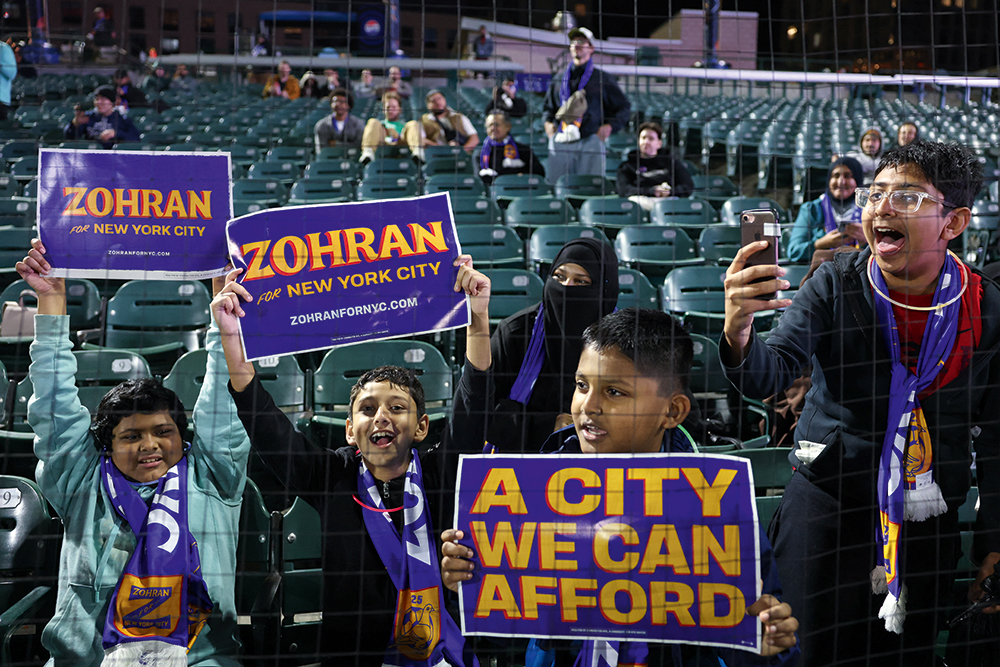
Boys holding campaign posters cheer as Mamdani hosts a ‘Cost-of-Living Classic’ soccer tournament in mid-October (Getty)
But Mamdani has no intention of getting vagrants off the streets. He opposes involuntary commitment, conceding only that it should be the “last resort” a city takes. We are already long past that last resort. It must now be the first resort.
So far, Mamdani’s policing and vagrancy ideas are a retread of failed policies. His one new idea serves only to drive home how cut off he is from any connection to reality. The New York subway system contains abandoned retail spaces tucked into stair landings and on platforms. These erstwhile shoe stores, watch-repair stores, electronics outlets and takeout stands were wiped out by the Covid lockdowns and rising crime. Mamdani would turn those empty spaces into homeless drop-in centers. You would no longer face a chance of being accosted by a mentally ill vagrant as you tried to get to work – in many stations, you would be all but guaranteed such an encounter.
Fight the 1 percent! Mamdani estimates that his free buses, free childcare, taxpayer-funded public housing expansion and other goodies will cost an additional $10 billion a year. (That $10 billion – nearly 10 percent of the city’s existing $111 billion budget – is undoubtedly an undercount.) No problem! It’s about time the rich “pay their fair share,” as Mamdani puts it. The mayor has never seen a high tax rate that does not fill him with envy and longing, if it is higher than what New Yorkers pay. So when he observes that neighboring states allegedly have higher corporate tax rates, he does not see a comparative advantage, he sees a missed opportunity. Any money left in the private economy, whether through insufficiently high taxes or inadequate tax collection, is money that is “being wasted,” he says. It could otherwise be “invested in the future of this city,” according to Mamdani – because, you know, private enterprise does not generate urban growth.
The economies of these neighboring states are even more underperforming than New York’s; they face the same exodus of businesses and residents to low-tax red states. But since private enterprise exists only to generate tax revenue, who cares if it leaves? The resourceful socialist can further raise taxes on the businesses that remain. By hiking New York State’s corporate tax rate from 7.25 percent to that of New Jersey – 11.5 percent – New York City would allegedly capture another $5 billion from the private sector (assuming that corporations in Buffalo would accede to paying higher taxes to subsidize free buses in Gotham).
Then there’s the individual taxpayer. One percent of the city’s residents earn more than $1 million a year. That 1 percent – 34,000 households out of the city’s 3.3 million – pay 48 percent of all income taxes in New York City. They are ditching their fair share, Mamdani alleges. He has never indicated what would be their fair share, but as an interim step toward economic justice, he would add a 2 percent surcharge on the wealthy’s current 3.9 percent income tax rate, to yield an expected $4 billion.
Like many of Mamdani’s promises, his vow to make the wealthy pay their fair share is playacting. He cannot raise city and state taxes unilaterally; that can only be done by the state legislature and governor. To date, New York Governor Kathy Hochul has ruled out further tax hikes. Hochul’s slavish endorsement of Mamdani to prove her progressive street cred, however, is a worrisome sign of a possible future rapprochement.
Likewise, Mamdani cannot unilaterally freeze rents or liberate downtrodden bus riders from having to pay for a service. What counts, apparently, is that his intentions are “good” – however the socialist credo defines goodness. And by voting for him, New Yorkers have proven that they, too, are good and that they oppose Republican, and especially Trumpian, greed and injustice.
Running the Leviathan that is New York City government is not an ideological project, it is an enormous management challenge. Mamdani’s assembly staff in 2021 consisted of four women. He will now be overseeing a 300,000-strong public workforce and thousands more private and nonprofit contractors. Putting him at the top of Gotham’s government is like parking someone who cannot read music in front of an orchestra and expecting him to conduct Stravinsky’s Rite of Spring.
It took an urban-governance revolution to wrench New York from decades of squalor. That revolution borrowed management techniques from the private sector: measuring results, holding officials accountable and paying contractors for performance, not effort. Mayor Rudolph Guiliani’s City Hall (1994 to 2001) measured and monitored everything. First deputy mayor Joe Lhota got a briefing book every morning with performance data from the day before: what crimes had happened? How much trash had been collected and what was the condition of the streets? If Lhota saw graffiti on his way to work, he would make a call to have it immediately removed. If it was still there the next day, heads would roll.
As Giuliani cleaned Times Square of prostitutes and porn parlors, as he evicted squatters from Tompkins Square Park and other anarchist havens on the Lower East Side, the New York Times and other mainstream outlets started asking plaintively if New York was losing its “grit.” Midwestern families, instead of pimps and drug dealers, were now walking around Times Square at all hours of the night. The Crossroads of the World had been reduced, in progressive eyes, to a horrifying “Disney theme park.” Graffiti, litter, disorder – these are all signs of authenticity to a progressive, if he even notices them at all.
Mamdani surely will not. Even if he did, it would be a miracle if he had the leadership skills to do anything about the rising entropy. The overgrown college student takes for granted all the miracles of affluence and the centuries-long evolution of private institutions and public stability that undergird his privileged lifestyle. Mamdani may think that those are eternal and inevitable aspects of the world. The city will learn under his leadership that they are not.
This article was originally published in The Spectator’s November 10, 2025 World edition.
Is Donald Trump a more sophisticated mathematical thinker than we give him credit for?
The other day, on one of the Sunday talk shows, a lawyer named Sarah Isgur explained the logic Trump was following in throwing the book at those who had once done the same to him. Isgur, who served in the first Trump administration, sees in the President’s actions something more sophisticated than mere revenge: “What you will hear from those people in the Department of Justice is: this is what deterrence theory is about. When you’re playing a cooperative game and the other side defects,” Isgur said, “then you hit them back disproportionately to create that deterrence.”
“Cooperative game,” “defect,” “deterrence” – this is the vocabulary of game theory, the recondite discipline developed by John von Neumann and other 20th-century European scientists to describe how certain structured encounters such as negotiations will play out, and how one can win at them. Back in the Cold War, when the US and the Soviet Union were negotiating over how to avoid a nuclear confrontation, game theory was something that could come up on the television news any evening.
But only geezers remembered that, at least until last April, when the US and China were at loggerheads over trade, the dollar was tumbling, interest rates were rising and Treasury Secretary Scott Bessent was pressed to explain why Trump had threatened to raise duties on Chinese goods to eleventy-zillion percent. “In game theory,” Bessent replied, “this is called strategic uncertainty.”
Could Trump have acted in such a premeditated way? There is little evidence for it in The Art of the Deal. And yet the President emerged from a decades-long business career during which he built nothing of enduring value yet somehow earned billions – he must have had some system for coming out on top during negotiations.
Those who believe he has mastered game theory point to his bargaining on tariffs. They argue that his strategy revealed an intuitive understanding of the prisoner’s dilemma, the classic game-theory problem. Say you and a friend rob a house and get caught. The police don’t have enough evidence to convict you – unless one of you snitches on the other. So they give you incentives. If you betray your friend, he’ll go to prison for four years and you’ll go free immediately. If you both betray each other, you’ll each get two years. If you both remain silent, you’ll both be held in custody for about a year. The upshot is this: it’s always in the collective interest of you and your partner to stay quiet, but it’s in your individual interest to betray each other. When he tariffed nearly every country in the world, Trump separated trading partners who might otherwise have been able to form a common front against the US. Every nation became incentivized to fight for itself.
Throughout his trade negotiations, Trump has also showed a keen awareness of a trade-relations paradox: in many cases, the worse your position is in a trading relationship, the better it is at the negotiating table. If you believe, as Trump does, that a trade deficit is a catastrophe, then a country that runs big trade deficits, such as the US, has less to lose in walking away from the negotiating table. China, in the Trumpian view, will suffer more than America, should trade relations break down.
For game theorists, the heart of negotiating strategy is the ability to make credible threats and promises. In the closing stages of the Vietnam War, when the war’s unpopularity in the US gave the North Vietnamese every incentive to continue fighting all the way to victory, Richard Nixon was desperate to negotiate a settlement. American diplomats therefore put the word out that Nixon was not right in his head and might resort to an insane escalation. The hope was that this would convince the North Vietnamese to come to the negotiating table.
Trump doesn’t require any of those Nixonian theatrics to convince his partners that he is willing to inflict damage at the drop of a hat. In late October he threatened Canada with fresh tariffs over a television advertisement that rubbed him the wrong way. The problem with this sort of melodrama is that it is self-undermining: the more credible it makes your threats, the less credible it makes your promises.
A foreign trading partner could be forgiven for asking what good can come of making any concession to the United States at this point. Trump has decided to use the American role as the West’s defender to engage in hegemonic rent extraction, as game theorists put it. Or, as historians put it, to exact tribute. We now monetize everything, including solidarity. Humiliations result for our friends in Europe as well as for our rivals in Russia and China. This may well be a clever move in a dollars-and-cents way. It could revive American industry. It could even help balance the budget. But the problem for Americans is that humiliations and broken relationships have a cost, and it is one that is hard to calculate until it is too late. You don’t need to be a game theorist to know that.
This article was originally published in The Spectator’s November 10, 2025 World edition.
New York socialist Zohran Mamdani is hailed as the social media sensation of American politics. He knows how to talk directly to young people, we’re told. Yet an account called “Thomas Sowell Quotes” has almost twice as many followers on X as Mamdani.
Sowell turned 95 this year. He is an unlikely influencer and yet hour-long interviews with him, published by Stanford’s Hoover Institution, have been watched millions of times. In his most popular video, Sowell argues for personal responsibility over dependence on the state and is meticulous in his use of empirical evidence. Black men who read newspapers and own library cards have had the same income as their white counterparts since 1969. Married black couples have the same poverty rate as white couples and have done for decades. And then comes the understated, Sowellian kicker. “Apparently lifestyle choices have consequences.”
This is Sowell at his intellectual finest, cutting through stupidity and receiving wisdom with precision. There are those, he argues, who have an unconstrained view of politics, in which elites can create a perfect world. Then there are realists like him, who accept that humans have flawed natures and that much about our lives is unknowable.
Those utopians are not just misguided but dangerous, harming the very people they hope to help. What follows from this relentless logic leads Sowell and his followers toward a kind of libertarian conservatism. We’re told that MAGA has killed the old Republican mantra of small government and free markets. And yet Sowell is more popular than ever.
I joined a recent celebration of his life at the Hoover Institution, watching as prominent conservatives and libertarians met to talk about his ideas and influence. There was a surprising amount of emotion as people discussed a man who has remained intensely private even in his role as a “public” intellectual. Sowell appeared in a brief video message from his office.
Those who know of Sowell know the official story. He was born in 1930 in the Jim Crow South and was raised in a house without electricity or running water. He was orphaned as a child, sent to live in racially segregated Harlem with his aunt and then, somehow, turned his life around. At 16 he dropped out of school and was hired by Western Union, delivering telegrams. Walking the streets, he watched New Yorkers and wondered why some lived in splendor while others led lives of squalor.
This question, one of social justice, led him to Harlem’s public libraries where he found the works of Karl Marx. Sowell joined the Marines during the Korean War, learned the value of discipline, left for the civil service in DC and night school. From there he made it into Harvard – and a life of research and argument. He is still a social justice warrior, not the shrill kind that he debates but a warrior armed with truth and reason.
During his time in Korea, Sowell learned how to use a camera and developed a love of photography. It seems appropriate for a man whose life has been about accurately representing the world. Back at the Hoover Institution, some attendees expressed surprise at an artistic display of his photography, featuring grand images of Yosemite and the Pyramids of Giza. Sowell is a man of many talents.
He has also seemingly met, mentored, or influenced every prominent black conservative you can think of, from Walter Williams to Shelby Steele to Supreme Court Justice Clarence Thomas. Thomas took the stage to share stories of his own deep friendship with the man. As a young student and an anarchist anti-war protester, Thomas said he once threw one of Sowell’s books into the trash out of furious disagreement.
He must have taken it out of the trash because, just a few years later, he met Sowell and, like a groupie, asked for his signature. The Supreme Court Justice told how Sowell’s thought has been like “an oasis in the desert,” inspiring him to stand against a sea of critics. Thomas had to pause at one moment, the room quiet as he tried not to be overwhelmed by emotion.
On stage, too, was Peter Robinson, a former speechwriter for Ronald Reagan, who reminded Thomas that he’d once toured his Supreme Court chambers and saw a large brass plaque etched with the Sowellian phrase from the Griswold decision: “Do not emanate into the penumbra.” When Robinson rushed with glee to tell Sowell about it, the economist replied: “I know – I gave Clarence that plaque.”
Robinson is now known as the bespectacled host of Hoover’s Uncommon Knowledge interview series, appearing in many of the most popular clips with the latter-day Sowell, teeing up quotes from the likes of Ta-Nehisi Coates for the wiser man to demolish. In one of the happy accidents of longform interviews, the interactions are easily clipped for the era of YouTube shorts, Instagram reels, even TikTok.
The format is repeated: Robinson poses a seemingly daunting, complicated question and Sowell responds by lacing a heater over the right-field wall (a chance he never got when, as a high-school dropout, he tried out for the Brooklyn Dodgers in 1948 – he failed the necessary fielding test). Sowell’s gift for the pointed jab can be traced back to his days as a student, when he admits he once described a classmate from England that he found particularly irritating as “nasty, British and short.”
Sowell’s acerbic intellect is a joy to watch; you can almost imagine his fans giggling as this gentleman in large-rimmed glasses and a sweater delivers pithy put-downs of (mostly) leftist ideas. There are also a quarter of a century of columns to read from too, for those not yet inured to the social media age. Of the Democratic socialists, he writes: “The fatal attraction of the government is that it allows busybodies to impose decisions on others without paying any price themselves. That enables them to act as if there were no price, even when there are ruinous prices paid by others.”
For the race-hustling reparation advocates: “Anyone who wants reparations based on history will have to gerrymander history very carefully. Otherwise, practically everybody would owe reparations to practically everybody else.”
For anyone in particular: “It is usually futile to try to talk facts and analysis to people who are enjoying a sense of moral superiority in their ignorance.” What disabused him of the Marxism of his youth? Facts and analysis, of course.
Sowell’s appeal is that he refuses to be confined to just one lane of commentary and he has no fear of controversial topics – particularly criticism of liberal weaponization of white guilt. Look, he says, armed with statistics and evidence, at the effect that well-meaning governments have on black Americans. He was scrutinizing the same arguments made by Ibram X. Kendi, Nikole Hannah-Jones and the 1619 Project decades before they made them.
Coleman Hughes, the young essayist known for his insights on race and culture, told of a conversation he’d recently had with his New York finance fiancée. “She said, ‘Did you know that the British Empire ended slavery?’” Hughes discovered that she, too, had seen Sowell’s videos on her timeline, delivering truth in the clear and certain tones of a well-read man.
For all his achievements, Sowell’s work has remained at the outskirts of the academy. Scottish historian Niall Ferguson told us that he learned about Scottish history from Sowell’s writings and yet says Sowell is “utterly exiled from graduate courses.”
Victor Davis Hanson, who also works at the Hoover Institution and has lunched with the man every week for decades, says Sowell has a way of infuriating those who object to his views. “Tom understands how much he frustrates people simply by force of experience.” The irony is that Sowell’s rejection by academia has coincided with an explosion of his commentary as it reaches new generations and an online audience.
Hughes said the appeal of Sowell in this era of social media is partly down to his distrust for the established intelligentsia and his rejection of its convoluted language. “The expert class bamboozles with big words. Sowell despises that and expresses it in these direct terms,” Hughes says. “Sowell cuts through the noise with deep insight, straight to the point.”
For an author whose books would weigh down even a strong back, Sowell’s aphoristic style fits the era of short attention spans. Even at 95, his charm and intelligence are enough to intimidate his academic foes and inspirational enough to make Clarence Thomas cry.
This article was originally published in The Spectator’s November 10, 2025 World edition.
Oh God, not that. That’s all we need, I thought, reading in a long account of Britain’s Prince Andrew’s current travails that “according to visitors to Royal Lodge,” he now “spends much of his time playing video games.” Even before all the unpleasantness with the child-rape allegations against Jeffrey Epstein, one of the Prince’s more embarrassing qualities was his appearing as an “ambassador” for this or that – usually accompanied by a helicopter trip to a golf course.
Now he’s reduced – no chopper, no putting green; woe is him – to being an ambassador for adults who play video games. As an adult who plays video games, and even writes about them from time to time, I generally welcome news of figures in public life who do the same. Not on this occasion.
Does it not, after all, play into the worst stereotypes of the hobby? We are invited to picture this paunchy blue-blooded delinquent – a man so gauche he’s said to have rejoiced, lifelong, in demanding his phone extension end in 007 – sitting in his monogrammed underpants and his silk robe, surrounded by old pizza boxes, hammering away at the PlayStation into the small hours of the morning because he has nothing else in his life. Curiously, the exiled Syrian dictator Bashar al-Assad is also said to spend most of his time holed up in his Moscow apartment gaming. Rumor has it that he tends to play World of Tanks, a multiplayer online game in which he prefers using Russian equipment.
What games is Andrew playing, the likes of me can’t help but wonder? The generic mobile game Royal Match – in which you shuffle gems into rows of the same color to rescue a portly royal personage from drowning, being eaten by a snake or locked in prison – would be a bit on the nose. Is he trash-talking noobs in some Call of Duty multiplayer lobby? Again, unlikely: a man with the prince’s ego wouldn’t stick long at a game in which the hand-eye coordination of a 65-year-old is tested anonymously against that of a teenager. I prefer to imagine that he’s playing through some deep, long, immersive, cartoony, learn-at-your-own-pace one-player game of the sort that bears no relation to reality. Super Mario Galaxy, say, or Zelda: Breath of the Wild.
In that case, we can say that this situation is decipherable – that if you were watching the only life you have known crashing around your ears, you might like to escape into another world. A defining quality of good video games – which makes them as addictive as other things that share this property – is that they are deeply absorbing. They take you out of yourself and into another place. That is not in and of itself a bad thing. Humankind cannot, as a wise man once said, bear very much reality.
It strikes me that video games could offer a safe and harmless outlet for the prince’s bruised ego. He is a man, after all, who sets very great store by rank and station. He loves to be called “Sir.” A couple of weeks ago, a bit before the Firm harvested his various titles like Mario running through a cache of power-ups, it was reported that he had emailed Epstein saying “We are in this together” fully three months after he claimed to have ceased all contact. Andrew has always denied any wrongdoing. What struck me most strongly, apart from him contradicting his earlier statement, was that said email was apparently signed: “A., HRH The Duke of York, KG.” Could there be anything more cringe-inducing than following that slightly nauseating just-the-initial signature with a cavalcade of formal titles? Even if this was the work of a standard email footer, it tells you something about the man.
All those titles and honors he collected, cherish them as he did, arrived by accident of birth. They were imaginary honors – no more substantial than pixels on a screen. Yet there’s something to be learned from that. Even if the wider world disdains him and the titles he hoarded are gone, he can acquire some new ones in the virtual world. Better ones, in fact.
For any achievements he earns in a video game are ones he will have gained by working for them. My 11-year-old was cock-a-hoop when he cracked platinum ranking in Rocket League (a game where you play soccer with cars, m’lud) – and I don’t blame him. It’s a positively Ruritanian honor as far as the outside world is concerned, but it means that in this small arena, he excels. Same with, say, a purple parse on Ragnaros in Warcraft Logs.
They don’t hand video game achievements out for free. You have, in the parlance of that world, to grind for them. There’s no shortcut to the muscle memory that allows you to navigate the final level on Bubble Bobble or learn how to snapshot trinket procs for the optimal feral rotation; no way of bypassing the endless matches you need to play to optimize your team on FIFA.
Just ask Elon Musk. So hungry was he for the approbation of the video game community, the big wally, that he claimed to be in the top 20 Diablo IV players in the world – only to be called out when live-streaming a game which showed that he had only a semi-shaky grasp of the skills involved. It was widely concluded that he had been getting other players to “boost” his character. No great surprise. Reaching that sort of rank in that or any other game would require not only unusual talent but the investment of much, much more time than Musk can reasonably be expected to have devoted to it.
You can’t rank up in video games, as you can in the royal family, by whining at Mom until she gives you another medal, feathered hat or garter ribbon. You need to work at it. So if Prince Andrew devotes himself to collecting 121 stars in Super Mario Galaxy, we should regard it as the closest thing this wretched creature will get to redemption.
This article was originally published in The Spectator’s November 10, 2025 World edition.