Category: Politics

  • Time for a reckoning on the 2020 election

    Time for a reckoning on the 2020 election

    Last spring and summer I watched bits of our contemporary gladiatorial contests, AKA congressional confirmation hearings. One thrust that many Democrat inquisitors relied on to soften up their victims was some form of the question: “Do you believe that Joe Biden won the 2020 election?”

    At least one contestant resorted to the parry “I believe that Joe Biden was seated as president,” which of course is not quite the same thing as acknowledging that he actually won. The subterfuge did not pass by unnoticed. Nothing escapes these Democrat Divas of the Dialectic. Having exposed the equivocation, they attempted to pounce. “Aha! So you are an election denier! Now let’s talk about the attempted insurrection of January 6.”

    I do not believe that, regarded as political theater, these exhibitions were crowd-pleasers. The main reason is that, despite the round-the-clock emergency support from the in-the-tank media, the public continued to have doubts about the 2020 election – just as, truth be told, it had begun to turn against the prevailing narrative regarding January 6.

    The problem with the Potemkin village erected around the 2020 election can be encapsulated in one simple word: numbers.

    In 2020, Joe Biden received – or was it only “received”? – 81.3 million votes. Donald Trump got 74.2 million. A commanding win for Mr. Senility, right? That translates to a popular-vote victory of 51.3 percent to 46.8 percent. True, Trump won 2,588 counties to Biden’s 551. That is why those post-election maps are filled with red, flecked here and there by little pustules of blue. But the cold light of day shone down from the number 306, which was the number of electoral votes accorded to Scranton Joe. Trump managed a paltry 232. End of story?

    Not quite. Here is where the word “anomaly” enters. Many commentators have noted that the 2020 election is hedged with anomalies. In 2016 Donald Trump received 63 million votes and 304 electoral votes. A look at history would suggest that he would receive fewer votes in 2020. But that is not what happened. In fact, he received 11 million more in 2020 than in 2016. Anomaly number one.

    In 2008 the super-smooth historic cleans-up-well rocket man Barack Obama got 69.4 million votes, crushing John McCain. (In 2012, Obama snagged just shy of 66 million.) In 2020 sleepy Joe Biden, campaigning from his basement, seems to have blown by Obama’s historic victory. Biden, remember, clocked in at 81.3 million votes. Turnout in that election was an astonishing 66.6 percent, a number that dwarfed Obama’s 61.6 in 2008. Amazing. Astonishing. Or anomaly number two?

    It was such numbers that led some observers to speak not of “turnout” but rather of “turn-in” in the 2020 election. All those mail-in ballots. All those drop boxes. There were plenty of recounts following the 2020 election. But how many audits were there? It is one thing to count the number of pebbles in a box two or three separate times. It is something else to find out how the pebbles got there in the first place.

    We haven’t done that. And, as the canny former prosecutor who writes on Substack under the soubriquet “Shipwreckedcrew” observed in a newsletter on October 26, it may well be “impossible to know with any certainty… whether Joe Biden or Donald Trump received more validly cast and counted ballots in the 2020 election.”

    And that fact, the fact that we just do not know what happened in the 2020 election, means that lurking just behind the word “anomaly” is the word “fraud.” As Shipwreckedcrew notes, because every state has its own procedures for administering presidential elections and for dealing with challenges to the results, “there is no uniform standard for what is to happen if outcome-determinative fraud is discovered.” Moreover, “we do not have a solution for the problem of fraud that changes the outcome of a presidential election.”

    Trump is determined to find that solution. On October 26 he returned to one of his old standbys: that the 2020 election was “rigged and stolen.” “We now know everything,” Trump wrote on Truth Social. “I hope the DOJ pursues this with as much ‘gusto’ as [befits] the biggest SCANDAL in American history!” Is this just sour grapes: the tired, repetitive motions of a sore loser? I do not think so. On the contrary, I think Shipwreckedcrew is right:

    If any President has unanswered questions about possible election fraud at the state level during the time period between election day and the inauguration, to do nothing is to abdicate the responsibility to the voters who cast their ballots for the ostensible losing candidate if there is evidence that the candidate they voted for might actually have won. Those voters would have had their civil rights violated if subjected to the leadership of a president who did not receive the necessary number of votes to hold that office.

    Covid, January 6, the snarling distemper of the anti-Trump media made it essentially impossible for Trump to investigate the 2020 election before he left office on January 20, 2021. Now he is back in office, wielding the reins of executive power. The Hillary Clinton retort – “What difference, at this point, does it make?” – will not wash. Shipwreckedcrew rightly argues that “the 47th President of the United States, now that he has the tools, has an obligation to examine the 2020 election with the Department of Justice if he concludes that the 46th President failed to do so out of the 46th President’s self-interest to not have his victory called into question.” Trump has so concluded. Buckle up.

    This article was originally published in The Spectator’s November 10, 2025 World edition.

  • Putin thinks time is on his side

    Putin thinks time is on his side

    Very well then – war. That is the bottom line of Vladimir Putin’s response to Donald Trump’s latest attempts at mediating an end to Russia’s invasion of Ukraine. In August, Putin rejected the peace deal that Trump lined up in Alaska. Now, the Kremlin has scuttled the White House’s plan for a summit in Budapest by insisting that Russia’s demands for Ukrainian demilitarization and “de-nazification” remain in force. Clearly, the Russian President still believes that he can win the war on the battlefield – and terrorize Ukraine’s civilians.

    What is Putin’s plan? Why does he still believe that Russia can chart a path to victory even as Washington unveils painful new sanctions on the country’s two largest oil exporters, Ukrainian drones have begun smashing up oil refineries deep inside Russia and a summer of heavy fighting in the Donbas has moved the front line forward by a handful of miles at huge cost in blood?

    First and foremost, Putin is gambling that time is on his side – backed by Russia’s cruel allies General Winter and General Frost. Massive missile and drone attacks on Ukraine’s energy and transport infrastructure are aimed at making as many cities as possible uninhabitable as temperatures drop. It’s not a new strategy. But the increased scale and accuracy of Russian strikes over recent months will make this winter the coldest that Ukraine has faced. According to one senior official source, Germany’s security services have already warned Berlin to brace for a fresh influx of Ukrainian refugees.

    Like many elements in this apparently deadlocked conflict, the livability of a city can radically change in a tipping-point moment such as the destruction of an electricity substation or gas pipeline. Early last month, a series of catastrophic hits on Kyiv’s power grid left half the capital without power. Some areas waited a week for it to be restored. Smaller cities with fewer air defenses are suffering worse. “My hometown Kherson is turning into a ghost city,” reports Iuliia Mendel, former press secretary to Volodymyr Zelensky. “Relentless Russian shelling has driven out nearly four out of five residents – just 65,000 remain from the 300,000 who once called it home.”

    Putin’s forces are targeting other humanitarian essentials, too. In late October, Russian missiles scored a series of direct hits on the Kyiv warehouse of Ukraine’s second-largest pharmaceutical distributor, Optima Pharm, destroying an estimated $100 million of medicines.

    Whether a dark winter will precipitate a morale crisis in Ukraine – and a crisis in Zelensky’s legitimacy – remains to be seen. But a new wave of Ukrainian refugees would certainly stress European political resolve. Forcing a mass winter exodus of Ukrainian women and children (military-age men have been banned from leaving Ukraine since the start of the war) is the Kremlin’s ruthless way of weaponizing civilian suffering and testing the limits of Europe’s support.

    Poland has recently suspended benefits to many Ukrainian refugees, and leaders in some countries – such as Lithuania and Germany – have begun arguing that Ukrainian men should be sent home to address the country’s recruitment needs.

    On the front line in the Donbas and around the edges of the Kharkiv province, the apparent stalemate may not be as stable as it appears. Russian progress toward encircling the “fortress cities” of western Donbas has been painfully slow and increasingly bloody. Analysis by Britain’s Ministry of Defence suggests that this year has been Russia’s deadliest of the war: 100,000 Russian soldiers have been killed from a total of nearly 250,000 since 2022. But if Russia’s forces succeed in taking Pokrovsk in the north of Donetsk province, then the 50-kilometer fortress line of Slovyansk, Kramatorsk and Konstantinovka becomes vulnerable to outflanking from both north and south.

    Ukrainian efforts to find manpower are becoming increasingly critical, even more so than weapons procurement or missile defense. Every month, Ukraine mobilizes 30,000 soldiers. Army press gangs often use brutal methods to snatch unwilling recruits off the streets and bundle them into buses. But, admits Ukrainian MP Fedir Venislavskyi – a member of Zelensky’s party and of the Committee on National Security, Defense and Intelligence – up to 20,000 soldiers will desert or go absent without leave over the same time period.

    That leaves only 10,000 fresh recruits, most of them conscripts. Ukraine’s military blogging sites are full of officers complaining about manpower shortages. “Our frontline units operate at about 50 percent strength,” Ukrainian army Major Yegor Checherinda recently told the website Voennoe Delo. Bohdan Krotevych, a former Azov regiment officer, complains that “frontline units currently operate at only about a third of their required strength.”

    But the most important arms race isn’t playing out in the trenches of the Donbas, but in the skies above the Russian and Ukrainian heartlands. Attacks by 800 Russian drones and missiles a night have become commonplace. Until recently, up to 80 percent of these weapons were typically downed by air defenses. But Russian glide bombs – created by attaching wings, rocket motors and guidance systems to 500-kilo conventional bombs – are much harder to hit and have a 200-kilometer range. Over recent weeks, Russia has significantly increased glide-bomb use, with devastating effect.

    Ukraine has unveiled a homemade cruise missile called the Flamingo, with a warhead weighing more than a ton and a range of 1,500 kilometers. Since August, long-range Ukrainian drones have begun regularly striking Russian oil refineries and arms factories. Kyiv can use domestically built missiles to strike targets deep inside Russia without restrictions from western allies.

    Russia’s economy – in particular its oil and gas production and export – has become Putin’s most dangerous vulnerability both militarily and diplomatically. Publicly available maps of Russia’s pipeline network clearly show that just two dozen key nodes and pumping stations are crucial to the whole system. Many of these – through quirks of geography and Soviet-era planning – lie within striking distance of Ukraine’s drones and missiles.

    The Biden administration held Kyiv back from crippling Russia’s oil industry for fear of causing a spike in global prices – and, for the same reason, never directly banned or sanctioned Russian oil. Under Trump, that’s changed. Recently announced US sanctions on Lukoil and Rosneft, Russia’s two biggest oil companies, could squeeze 65 percent of Moscow’s exports. These announcements seem to have caught Putin off guard. Like a helicopter trying to dodge heat-seeking missiles, the Kremlin’s response has been to fire off hot propaganda chaff left and right.

    For example, in response to Trump’s announcement, Putin hastily revealed a new super weapon: the Burevestnik, a cruise missile powered by an onboard nuclear reactor that can stay aloft for days and carry nuclear warheads. The unveiling looked a lot like Putin’s announcement last November of a new model of the Oreshnik hypersonic nuclear missile. The Kremlin believes both weapons showcase Russia’s military-industrial complex – but more importantly, their rollout serves as a not-so-subtle message to the world that Russia is a nuclear power and shouldn’t be messed with.

    The Kremlin also immediately dispatched Kirill Dmitriev – the Harvard Business School-educated former Goldman Sachs banker who heads Russia’s sovereign wealth fund – to Washington. Putin believes that Dmitriev, with his excellent English and extensive US contacts, is an ideal Trump-whisperer. Dmitriev has been busy talking up the grand possibilities of US-Russian business cooperation on Arctic oil exploration and rare-earths mining during a series of meetings with Trump’s envoy Steve Witkoff. But Dmitriev’s welcome seems to be wearing thin. No top member of Trump’s team met with him publicly during this last visit, and Treasury Secretary Scott Bessent called him a “Russian propagandist.”

    According to Sir William Browder, once the largest foreign portfolio investor in Russia, “the fact that Putin dispatched Dmitriev to Washington within minutes of the US sanctioning Lukoil and Rosneft shows just how rattled Putin is.” But Dmitriev’s message to Washington showed little sign of Russian willingness to compromise. He mostly hyped up the power of the Burevestnik. He told Fox News and CNN that Putin considers Ukraine an existential threat to Russia and that he won’t back down.

    Ukraine and Russia are in a war of attrition – and that is a war Putin bets he can win. Even as commodities analysts report that many of Rosneft and Lukoil’s biggest customers in India and China are canceling orders and seeking oil from non-Russian sources, other market players are busy finding ways to circumvent the latest sanctions. The markets doubt that Trump can keep the 4.4 million barrels a day exported by those Russian companies from flowing. The futures price of Brent Crude oil, for instance, ticked up 3 percent after the announcement, but has since sunk close to the pre-sanctions level.

    “If you really remove that much oil from the market, you will have a huge price spike [that] Trump won’t tolerate,” says Ben Aris of media company Business New Europe. “Midterm elections are not that far away. Oil experts say it will only take a few months for the Russians, Chinese and Indians to find some sort of workaround. They have in every case of new sanctions so far.”

    Russia undoubtedly faces further economic pain as the war continues. But Ukraine’s economy, and indeed its ability to finance its war effort at all, is in far worse shape. The Trump administration has pulled funding, and Europe’s promise to raise a reparations loan backed by frozen Russian assets remains in legal limbo.

    One thing is certain. Winter is coming, and it will be much more painful for Ukraine than it will be for Russia. Those who predict that the pressures of war will collapse Ukraine and those who say the same of Russia are both right. The only difference is the timeline. Putin remains convinced that his economy, his people and his soldiers can take whatever he asks of them – and hold out longer than their enemies in Kyiv.

    This article was originally published in The Spectator’s November 10, 2025 World edition.

  • I’m a slave to my Apple Watch

    I’m a slave to my Apple Watch

    Aside from streaming on an iPad, when riding a stationary bike one of the few entertainments on offer is tracking your heart rate. Breaking 150 beats per minute provides a fleeting (and doubtless misplaced) sense of achievement. Yet the wearable heart monitor that came with my exercise bicycle proved unreliable; one’s BPM never truly drops from 137 to 69 in one second. This is all to explain why I bought the fitness freak’s fetish: an Apple watch.

    Its heart rate monitors are accurate. I opted for a reconditioned older model, not only half the price of the new ones but inclusive of the pulse oximeter function, which a medical technology suit has forced Apple to eliminate in current American models until the litigant’s patent runs out in 2028. I’d never much cared about tracking my blood oxygenation, but this is how technology works now: the very fact that a gizmo can do something overrides the fact that you never really wanted to be able to do that. Thus later models denying me an oximeter made me obsessed with acquiring a model that provided one. Naturally, since testing it once fresh from the package, I’ve never used the oximeter function again.

    For uninitiates, heart rate with this thing is just the beginning. After pairing with the sacred iPhone, you’re forced to choose a set of physical “goals,” unaware that your buzzing wrist will soon torture you with these arbitrary numbers all day long, whether you meet, fall short of or exceed them. An Apple watch is not a passive adornment. It wants to be your friend.

    Yet this is intended to be a two-way relationship. So the first time I straddled the stationary bike and informed the busybody watch that I was going for an “indoor cycle,” I made myself miserable for an enmoistening 47 minutes, only for my watch to announce that my effort had been merely “moderate.” I was insulted. The next furious cycle to nowhere, I really pressed the pedal to the metal. Whether I quite admitted it to myself, I was trying to please my watch. At last my taskmaster granted that my workout had been “hard.” “So there,” I said aloud. “Happy now?” Ever since, I’ve been reporting to the taskmaster on my left wrist every time I exercise in any fashion, because I do not want this object to wheedle and nag. I want credit for my efforts, of course, but most of all, as this device’s new buddy I don’t want to be a disappointment.

    I’ve always had a childlike penchant for anthropomorphizing the objects in my surround, especially my bicycle (the kind that takes you somewhere). When my bike was stripped of all its salable parts in Manhattan while parked on the street, I must have blubbered over its bleeding carcass at 3 a.m. for close to an hour, expressing a grief that I might not have lavished on a mugging victim with two legs. All my bikes have had names. Well, this is a babyish relationship to the inanimate world that Big Tech is aggressively pushing on us all.

    It started when you switched on stereos or CD players and they trailed out “Hello” rather than merely displaying green indicator lights. Now I’ve got a watch that incessantly calls me “Lionel,” in the same brown-nosing spirit in which many Americans use your name in every other sentence. It’s programmed to treat you like an eight-year-old. “You’ve almost closed your Stand ring, Lionel! You can do it! Just 15 more minutes!” It hands out cheap rewards: “Congratulations, Lionel, you’ve had a perfect week!” It does not know my week was not perfect by a long shot.

    AI, of course, is the ultimate in anthropomorphism, but this imputation of personhood to the insentient is spreading everywhere. Siri assumes whatever accent you prefer, and its lilt is purposefully ingratiating. Japanese caretaking robots cultivate intimacy. Our refrigerators note we’re out of milk, which they’ll soon buy for us like cuboid lackeys. And AI has clearly been consciously designed to be fawning. These large language models could have been trained to tell us to sod off or to deride us for asking stupid questions. They might have been trained to have no attitude, to have no fabricated relationship to their users. Instead they are crafted to be digital arse-licks.

    The cruel irony of the once-inert suddenly springing to life the way teapots and spoons dance and sport smiley faces in children’s cartoons is that we’re getting ever more crap at relating to human beings, whom we don’t anthropomorphize enough. My husband wears noise-canceling headphones all day – I am the noise – and to the degree that he acknowledges my existence at all, I am a physical obstacle en route to the kitchen: wife-as-furniture. Meanwhile, marriage rates have plummeted. Fertility is waning. Men have no friends. Kids arrive at kindergarten barely able to talk. Blaring music in nightclubs is surely meant to reprieve young people from the horror of conversation. Should they ever meet in person, teenagers sit around a table glooming at their phones.

    The cumulative effect of the inanimate environment feigning human feeling is to imbue the cultural atmosphere with emotional fraudulence. Fake affection, fake admiration, fake congratulations. Worse, when users fall in love with ChatGPT; elderly Japanese form passionate attachments to robots; and I exercise to suck up to my watch, human relationships start to seem suspect, too. If a machine – which constantly emits approving messages, blandishes you with encouragements and, unlike most people, does what it’s told – successfully substitutes for or even improves upon interaction with another human, doesn’t that indict flesh-and-blood relationships as mechanical, too – as transactional? If a machine makes a credible friend, why bother with the fickle kind? I should obviously trade my husband for an android that also loves my books, compliments my cooking and lies that I look beautiful, but doesn’t appear nearly as annoyed when I ask it to take off its headphones.

    This article was originally published in The Spectator’s November 10, 2025 World edition.

  • Humans are more than just apes

    Humans are more than just apes

    Revolutions in science happen like Mike’s bankruptcy in Hemingway’s The Sun Also Rises: slowly, then suddenly. For the past two decades, neuroscientists have been interested in the ways that the human brain differs from those of other primates. The prevailing assertion among primatologists was that our genome is only 1 to 2 percent distinct from chimps’. Then in April, a team of more than a hundred of the world’s top geneticists published an article in Nature revealing that it’s actually ten times as different.

    This has enormous implications. After all, if humans aren’t just souped-up chimps – as primatologists have often suggested – then many widely accepted ideas about our nature must be reconsidered. One that seems to be particularly open to rethinking revolves around our predilection for war.

    When primate researchers began their field studies of chimps and gorillas in the 1970s, they supposed that apes were less violent than humans. The fact that apes killed one another was taken as proof that although they were essentially genial and benign, they had some of our savagery within them and their occasional nastiness was seen as evidence of an underlying commonality. Yet the more primatologists observed apes – chimps especially – the more apparent it became that this was not so. Chimps slay one another at rates that exceed those of many human populations by hundreds or even thousands of times.

    Thus, by the early years of this century, anthropologists began to assert that humans were more “prosocial” than apes – in other words, that we are more inclined toward empathy and cooperation. It was a belated admission that what they had been claiming during the 1970s was entirely backwards – and that was ratified by the research of neuroscientists studying the parts of the brain associated with our feelings of compassion and connection to others.

    Neuroscience shows how our brains focus us upon satisfying communal codes of behavior. Social rejection causes stimulation of the same parts of our brain as those activated by bodily discomfort. In humans there is actually a neural link between feelings of isolation and physical pain.

    Nonetheless, presuming that humans should be understood simply as more advanced apes, anthropologists interpreted the phenomenon of war as a demonstration of how innately violent we are. Perhaps, though, there is another explanation. Maybe it is not a bloodlust that pushes us to violence, but rather our docility.

    Desperate as we are for acceptance, we yearn to be part of the in group. Combined with our tameness, this desire for acceptance causes young men who lack a sense of identity to be led into war. It is not so much animalistic impulses toward violence as it is obedience that makes us so dangerous.

    We can see other examples across the animal kingdom. The ant is the most war-like of all creatures – and also one of the most obedient. This would also explain why the animals we use in battle – dogs, pigeons, elephants, horses and camels – are docile. War is the action of a tame, cooperative being. This even explains the real purpose of military training. Shaving off a recruit’s hair, providing him with a uniform, drilling him in marches, teaching him to salute: the instruction is imposed to make him compliant and to offer him an identity. Similarly, a soldier’s attachment to his unit is based not in aggressive impulses but in feelings of devotion.

    He does not go over the top of the trenches because he hates the enemy across no man’s land – he does it because the leader he’s loyal to tells him to. Those emotions are cultivated further as he is taught to venerate fallen comrades and to resign himself to the possibility of his own untimely demise. That passion for a noble death isn’t encountered in apes. Not surprisingly then, there’s no documented case of a primate committing suicide. Yet more humans kill themselves each year than are murdered. What animals appear to end their lives deliberately? Other tractable creatures such as ants – animals that either fight wars or assist in ours.

    All this offers hints that our wars primarily arise from our willingness to obey the orders of psychopathic overlords, not from a chimp-like savagery. That would also explain why democracies in which women possess the right to vote have been far less likely to go to war with each other. That might be because of a part of the brain that functions differently in humans and chimps, the anterior cingulate gyrus. Studies have revealed that there is a correlation between its size and the capacity for empathy, and it’s been found that this area tends to be larger in women than it is in men.

    More remarkably, whether it’s working properly has been shown to be an indicator of whether a prison inmate is capable of avoid repeating mistakes. Criminals with poor function in the rear of the cingulate gyrus are more prone to recidivism.

    Without autocrats guiding us we don’t easily incline toward collective violence. This point was well understood by Stanley Milgram, the famous (or infamous) figure whose experiments demonstrated that ordinary people could be persuaded to place high-voltage shocks on one another when they were instructed to do so by an authority figure. Milgram noted that if the figure was absent then test subjects wouldn’t engage in acts of torture.

    So how were the rest of us persuaded that a creature who frets about whether he is choosing the right shade of drapes and worries about what his neighbors think of his lawn ornaments is as instinctively brutal and rapacious as a chimp? Maybe this is a further proof of how docile and obedient we are. We simply believed what we were told.

    This article was originally published in The Spectator’s November 10, 2025 World edition. It is adapted from the author’s new book, The Primate Myth.

  • Pope Leo is following in Francis’s footsteps

    Pope Leo is following in Francis’s footsteps

    Since Pope Leo XIV’s election in May, Catholics have wondered whether he would continue Pope Francis’s radical agenda or ignite a more conservative reaction. After five months, the verdict appears clear. Leo will not only promote the principal policies in Francis’s agenda, but work to solidify them. This includes suppressing traditionalist theology and liturgy while bolstering activism on the environment, migration and same-sex relationships.

    Traditionalists initially viewed Leo with hope. They noted his ability to recite the Latin Mass, his choice of papal livery favored by Pope Benedict XVI and his meeting with Cardinal Raymond Burke, who supports maintaining the Latin Mass.

    But the new pope refuses to discipline bishops who move against traditionalists. On May 23, just two weeks after Leo’s election, Bishop Michael Martin announced he would end the Latin Mass at four traditionalist parishes in his Charlotte, North Carolina, diocese. The diocese would build a centrally located chapel for the Latin Mass, a lonely new location that would create a two-hour trek for many communicants. More importantly, Catholics would not receive six of the church’s seven sacraments there.

    In Knoxville, Tennessee, Bishop James Mark Beckman went further. On October 7, he said Latin Masses would be discontinued by the end of the year.

    In July, Detroit Archbishop Edward Weisenburger made the most arbitrary move, dismissing three theologians from the archdiocese’s seminary for criticizing Pope Francis. One, Edward Peters, a renowned canon lawyer, said on X he had “retained counsel.”

    When Ralph Martin, another of the three, asked Weisenburger for an explanation, “he said he didn’t think it would be helpful to give any specifics but mentioned something about having concerns about my theological perspectives.”

    Martin, Peters and Eduardo Echeverria questioned Francis’s commitment to orthodoxy, his tendency to stir theological confusion and his refusal to confront clerical sex abuse. Weisenburger, appointed by Francis in February, supports the late pope’s stances on traditionalist worship and migration.

    Detroit’s new archbishop limited the Latin Mass to four chapels in his archdiocese and suggested “canonical penalties” – including excommunication – for Catholics who work for Immigration and Customs Enforcement or the Border Patrol, or even support harsh immigration policies.

    Leo provided the velvet glove for Weisenburger’s and Martin’s iron fists in a homily during an October 12 Mass: “Some forms of worship do not foster communion with others and can numb our hearts. In these cases, we fail to encounter the people God has placed in our lives. We fail to contribute, as Mary did, to changing the world…”

    “Changing the world” to reflect Pope Francis’s image describes Leo’s political agenda. The new pope reinforced the commitment to environmental activism while commemorating Francis’s environmentalist encyclical, Laudato si’. He also quoted Francis’s apostolic exhortation, Laudate Deum, to disparage opponents. That entreaty, said Leo, “noted that ‘some have chosen to deride’ the increasingly evident signs of climate change, to ‘ridicule those who speak of global warming’ and even to blame the poor for the very thing that affects them the most.” As part of the festivities, Leo blessed a block of ice.

    On migration, the new pope imitates Francis’s position down to the melodramatic rhetoric. In his October 5 sermon, Leo decried “the coldness of indifference” and “the stigma of discrimination” awaiting migrants with “eyes filled with anguish and hope.”

    Francis denounced “the globalization of indifference” toward migrants during a pastoral visit in 2013 to the Italian island of Lampedusa, where thousands fleeing Libya’s civil war were detained. Ten years later in Marseille, he criticized the “fanaticism of indifference” shown by European governments restricting migration. When it comes to his native land, the Chicago-born pope slammed Donald Trump’s “inhuman treatment of immigrants” being deported in an interview on September 30 and told immigration advocates visiting him on October 8 that the United States Conference of Catholic Bishops must become involved: “The church cannot be silent.”

    Leo’s embrace of same-sex relationships appears similar to his predecessor’s, as he showed in late summer. On August 28, Leo met with Sister Lucía Caram, a backer of homosexual marriage. “I would be in favor of homosexuals getting married in the church because God always blesses love,” she said back in 2023.

    Three days later, Leo received the Revd James Martin, the editor-at-large of the Jesuit magazine America, founder of the Catholic LGBTQ ministry Outreach and a papal communications advisor. Martin promotes LGBTQ ideology, endorses transgender medical procedures for children and opposes biblical teaching against homosexuality.

    On X, Martin wrote he was “moved to hear the same message I heard from Pope Francis on LGBTQ Catholics, which is one of openness and welcome. For me, it was a deeply consoling meeting.”

    Then on September 6, Leo opened St. Peter’s Basilica to LGBTQ pilgrims for a Mass marking the Holy Year Jubilee. More than 1,000 pilgrims participated, with rainbow regalia everywhere. By contrast, the Vatican prohibited another Catholic organization supporting homosexuality, Dignity-USA, from the 2000 Holy Year Jubilee.

    Leo’s most important divergence concerns finances. Unlike Francis, Leo will permit outside agencies to manage the Vatican’s investments to reduce an annual deficit of between €50 million and €90 million. But that divergence generates minimal passion.

    Leo’s papal name offers insight into his agenda. When the College of Cardinals elected Jorge Bergoglio in 2013, the archbishop of Buenos Aires named himself “Francis” to honor St. Francis of Assisi. Leo was that Italian saint’s most devoted acolyte.

    This article was originally published in The Spectator’s November 10, 2025 World edition.

  • Trump is being misled on Venezuela

    Trump is being misled on Venezuela

    President Trump is being misled into a regime-change war close to home. Few Americans nowadays find much to celebrate in the Iraq War or the intervention that overthrew Libya’s Muammar Gaddafi. Regimes were successfully changed both times, but what came after the dictators’ downfall was civil war, regional instability and mass-migration flows that exported many of those nations’ troubles to their neighbors.

    Now the Trump administration wants to do to Venezuela’s despot, Nicolás Maduro, what George W. Bush did to Saddam Hussein and Barack Obama did to Gaddafi. That will predictably do to the Americas – including the US – what the War on Terror did to the Middle East, North Africa and Europe.

    Why would Donald Trump make such a mistake? Bush and Obama’s foreign-policy blunders gave the President one of his strongest campaign themes in 2016, and his first term was distinguished by his success at keeping America out of new wars. His use of force abroad has typically been selective – why depart from what’s worked?

    If the examples of Bush II and Obama aren’t enough, the Trump administration should consider what happened when Ronald Reagan and Jimmy Carter intervened in places such as El Salvador. The US-backed civil war in El Salvador sent waves of refugees and immigrants northward, including to the US, where some of the new Salvadoran communities formed gangs – notably MS-13.

    The tension in the Trump coalition isn’t just between foreign-policy hawks and doves – it’s between hawks and immigration restrictionists. Refugees and mass migration are inevitable consequences of today’s wars. And the Trump administration’s policy does not make sense as a tactic to stop illegal drugs, especially fentanyl, from reaching our border: the chaos and population flows that regime change triggers are a boon to drug networks and human traffickers.

    It’s true that Maduro and his predecessor Hugo Chávez have also caused some migration by remaining in power, but the people fleeing because of socialism are often middle-class and freedom-loving; war uproots everyone, especially the poor.

    Despite claiming in 2016 that George W. Bush should simply have taken Iraq’s oil, Trump is probably not contemplating an invasion to seize Venezuela’s petroleum resources. He’s conducting a “maximum pressure” campaign to make an example out of Maduro, regardless of whether or not the socialist dictator can be forced out of power.

    Trump wants to show that there are rewards for America’s friends and painful punishments for her enemies, and he takes the Western Hemisphere particularly seriously. Maduro’s agony will be a lesson to anyone else in Latin America who thinks of making a foe out of Washington. At least, that’s the theory – but the US has a long history of throwing its weight around in Latin America and only making enemies in the process.

    The model Trump should adopt isn’t Reagan’s strategy in Latin America but rather the one that won the Cold War in Europe: stabilizing America’s friends and helping them prosper, thereby heightening the contrast between life under freedom and life under socialism.

    Seeing that contrast inspired Europeans to liberate themselves, tearing down the Berlin Wall and replacing communist governments with democratic ones. If Latin Americans want freedom – and they do, as Argentina’s election of Javier Milei indicates – they can achieve it just as Eastern Europeans did.

    The examples of those places where the US relied most on force during the Cold War are overwhelmingly negative. Even the great triumph of Reagan-era political warfare in Afghanistan defeated a Soviet puppet only to create conditions that brought the Taliban to power and provided al-Qaeda a haven from which to attack the US. That’s a Pyrrhic victory if ever there was one.

    The Trump administration’s interest in toppling Maduro preceded Marco Rubio’s tenure as secretary of state, and sources with ties to the administration say it’s unfair to blame Rubio for the neocon tilt of Venezuela policy. But if there’s a war, it will be Rubio’s at least as much as Trump’s, and if it goes badly, Rubio will get the blame – not least from the President himself.

    Rubio has earned a great deal of respect from many in the MAGA movement who once thought of him as a Bush Republican – weak on immigration, neocon in foreign policy. He risks proving his detractors right if he embraces a regime-change program left over from the days of Mike Pompeo.

    As for Trump himself, he sees force as another form of leverage in negotiations. He won’t bomb allies in trade talks, but he will use America’s military might to change the way adversaries think. And if he’s not about to start a war with China, he’s fully prepared to demonstrate what he can do on Maduro.

    Making an educational point, rather than actually changing the regime in Caracas, may be his objective. But there’s a constituency in the Republican party that wants more than that, and Trump likes to give everyone in his coalition something they have their hearts set on.

    In this case, however, he can’t please neocons or hawks without harming immigration restrictionists as well as doves. Obama, Bush II, Reagan and Carter have shown that when America tries to change other regimes, the result is mass migration that changes Europe and the US. Regime change abroad leads to regime change at home, and right now Trump is the regime.

    This article was originally published in The Spectator’s November 10, 2025 World edition.

  • Wokeness ended my backroom Jeopardy! habit

    Wokeness ended my backroom Jeopardy! habit

    In May I got a Facebook message from a guy named Mikey Walsh, who I’d met once at a trivia night at Mister Tramps, one of the diviest dive bars in Austin, Texas. He told me he’d been running a quiz called “Buzz In Buzzed,” which was exactly like Jeopardy!. Several of the regular players had been on Jeopardy! like me, and he was looking for more contestants to play.

    “This is not a business,” he said. “It’s free to play, and there’s no prizes. It’s just nerds playing trivia for fun.” This wasn’t the kind of offer I turn down. The opportunity to play fake Jeopardy! in the back of the bar for no money? Sign me up, I said.

    A couple of weeks later, I went to Buzz In Buzzed. It had been several years since I’d been at Mister Tramps, but it was the black-walled grime-pit I remembered. Walsh set up a Jeopardy! rig in the back room, where Tramps usually throws its sparsely attended standup nights and drag queen bingo. I sat in an uncomfortable chair, buzzer in hand, at a fold-up plastic card table.

    Walsh, who works at a local sandwich shop, found himself with some extra cash. A lifelong Jeopardy! fan, he decided to use the money to buy an electronic quizzing rig, and a USB recording module so he could approximate the sounds from the game show. He rested it in a plastic crayon box.

    A $20 lifetime subscription from a service called JeopardyLabs allowed Walsh to create Jeopardy!-style games that have the same general topics and rhythms of the original. But he includes stuff you’d never see on the actual show – for example, forcing contestants to identify GIFs from Ari Aster’s Beau Is Afraid and answer questions about rock that’s so indie you would have had to attend the specific live show to know the answers. He throws in some old – slightly altered for copyright reasons – Final Jeopardy questions in a category he calls “Actual Hard Jeopardy! Fuck You.”

    At first, Walsh’s games were just him and regulars from Mister Tramps, mostly local mechanics having a beer after a long shift. Though Walsh was pretty good, regular scores of negative 6,000 were common. Then he posted the game on the Jeopardy! Reddit forum. Other Jeopardy! fans showed up and started playing. Suddenly the games were hard, as though NBA-quality players had started shooting hoops at the local playground. A young computer programmer appeared, lost, and decided she didn’t want to lose anymore. So she started studying, improved – and then she was doing the trouncing. Earlier this year she appeared on the TV show and easily won a game.

    I made my first appearance at back-room Jeopardy! after Memorial Day and played a game against another former contestant and also a guy who will probably be a Jeopardy! contestant one day. I absolutely dominated the proceedings until I shanked a Daily Double in the second round, putting me a little behind. And then the power went out in a massive hailstorm.

    Walsh conducted Final Jeopardy by flashlight. The answer to the question was Peep Show, the Mitchell and Webb sitcom created by Succession’s Jesse Armstrong. Somehow I missed it, even though I’ve seen every episode of Peep Show, and I lost the game. I also lost the following week. Then came my third game, where the Final Jeopardyquestion was: “In early 1976 this band from Salford, England, took its name from the sexual slavery wing mentioned in the 1953 House of Dolls.” I knew that this was Joy Division, won the game and got to pose for a smug photo.

    “I almost dumped this Final because someone told me they were triggered, but I thought, fuck it, it’s a fact,” Walsh wrote on Facebook. Fuck it indeed. I was hooked.

    Buzz In Buzzed has a distinct Austin, indie vibe about it, but it’s not an anomaly. A vast world of trivia competitions bubbles underneath the surface of ordinary life. Online leagues in a variety of formats run every day, featuring the best quizzing minds in the world. It’s a fiercely competitive world. My team, Crash Test Smarties, in the exceedingly tough and competitive Online Quiz League, includes a winner of the Jeopardy! teacher’s tournament, two three-time Jeopardy! champions (including me), an Only Connect quarterfinalist, and the 2021 winner of the UK Brain of Brains competition. Last season, we finished sixth.

    Buzz in Buzzed was fun all summer, but then, as often happens in subcultures, there was petty drama. I’ve made some of the dearest friends of my life playing trivia, but many players can be performatively woke. When answers come up at BiB that people don’t like, it’s tradition to boo loudly. Over the weeks, I’ve heard the great brains boo “Christopher Columbus,” “Pete Hegseth” and, in one egregious instance, “capitalism.” When one answer was “Houthis” I decided to boo, but no one else did.

    I went to play BiB on the day of Charlie Kirk’s murder, which was probably a mistake. One of the players said they “didn’t give a fuck.” I decided to give a little lecture, which made everyone uncomfortable. Then, later, they all loudly booed “J.K. Rowling.” I left the room with my cider in hand, thinking that these weren’t really my people after all, even though I love answering quiz questions just like they do. The next day I removed myself from the BiB Discord server and haven’t been back.

    Walsh, who prefers to keep things apolitical (though he did once hilariously refer to Dean Cain as a “piece of shit Superman actor” in a question), says there’s not a path for me returning. I miss it. It’s fun and competitive and the drinks at Tramps are cheap. Those are surely good enough reasons to overcome trivial political differences.

    This article was originally published in The Spectator’s November 10, 2025 World edition.

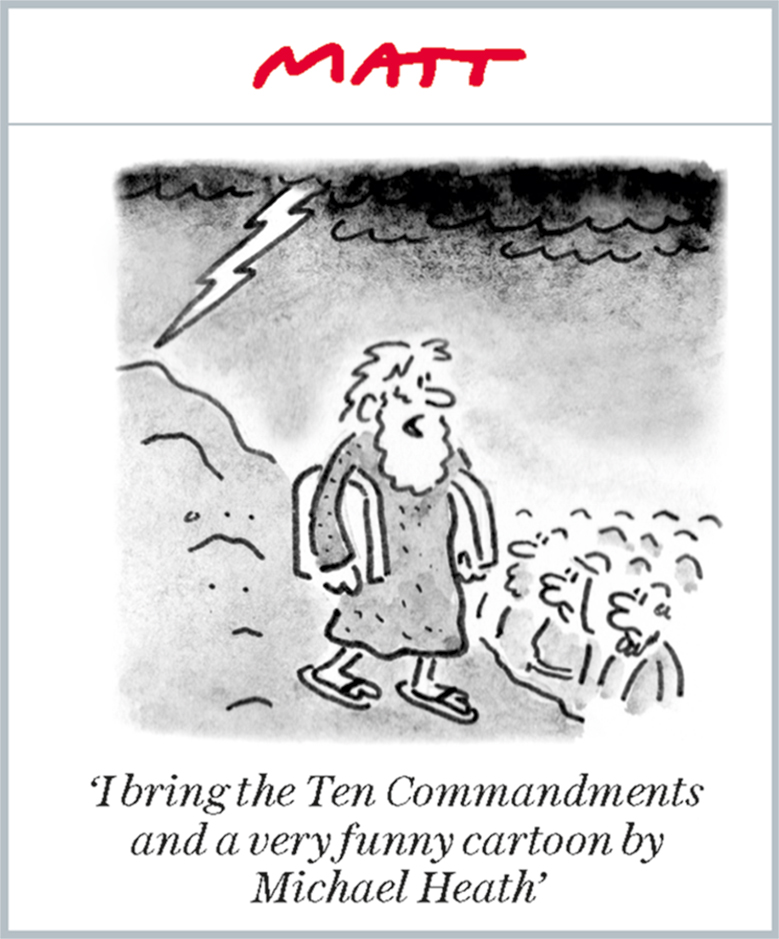
  • Michael Heath on 75 years at The Spectator

    Michael Heath on 75 years at The Spectator

    When I joined The Spectator in 2000, the office was in Bloomsbury, in a four-story Georgian house, and the further down the building you went, the more stylish, the more Spectator (I thought), everything became. On the top floor, blinds drawn, sitting in the half-dark, was Kimberly Fortier, the American publisher, often in long meetings with media alpha males. She would soon be married to the publisher Stephen Quinn and having an affair with former British home secretary David Blunkett, but was always looking to widen her portfolio.

    One floor down was former British prime minister Boris Johnson, then editor of the magazine, mostly immersed in meetings of his own with associate editor Petronella Wyatt. We’d sometimes find him on the landing, staring mistily into the middle distance. “Petsy looks like a Bond girl. Doesn’t she look like a Bond girl?” he’d ask nobody in particular.

    The real Spectator was below the editor’s office: Stuart Reid, Mark Amory, Clare Asquith, Liz Anderson, all squashed into a tiny ground floor room; Michael Heath in Prada and a round felt hat, drawing ceaselessly in black Indian ink, whistling Charlie Parker through his teeth.

    Even then, he was the longest-standing contributor. “I had my first cartoon accepted when I was 15, in 1950,” he says. “How’s that?” Now Michael is 90, The Spectator is pushing 200 and, he says, “I’ve been at the magazine longer than most of its columnists have been alive.

    “Think of that! Actually I think I’m the world’s oldest working cartoonist or something… is that a good thing? Sometimes I feel like my brain is melting.”

    Back in 2000, Michael and I would walk around Bloomsbury at lunchtime, he pointing out every trend: trousers worn down around the mid-bum, the new fashion for skinny jeans – details that would then appear in the afternoon’s drawings. We’d walk down Rugby Street where he’d lived as a young man and often talk about women. “I came home one evening, and the missus had changed the locks. And she’d sold all my furniture! Nightmare!”

    Michael is back on Rugby Street these days, with a new wife, Hilary, who won’t change the locks. And that’s where we are now, side by side on the sofa, on the eve of the 90th birthday, talking about where it all began. What makes a good cartoonist? “Well it helps to be neurotic, lonely and an only child, preferably with some talent for drawing,” he says.

    Were you a lonely only child? “Yes, I suppose so. My mother used to sleep all afternoon and I don’t think my father ever said a word to me. He drew comic strips too – not funny stuff though. Cowboys and Indians for boys’ magazines.”

    Why didn’t he talk to you? “I don’t think I was his son.” In all the years we walked about, I never heard this one. Whose son were you? Michael looks pensive. “Well, a man turned up at our house once every year. They called him Dogsbody. He smoked continually, hand-rolled cigarettes with his name on. He and my mother, they’d obviously had an affair. He’d bring all this stuff, for me, toys, but soon as he went, my father gave the toys to people next door.”

    After the war, London began to loosen up and the young Michael Heath with it. “I didn’t want to be like my mother and father, so when all the boys and girls began to run around town and go dancing, I decided to draw them. The wacky shoes and the hair. There was a newness about everything. Everybody was having affairs, all over the place, but drugs hadn’t taken over yet. Everyone talked and laughed.”

    Don’t people talk and laugh today? “They’re too busy texting to talk, aren’t they? And they can’t take a joke. You can’t joke about women, fat people, thin people. Even sex is a very serious business now, all about identity. And everyone’s terrified of saying something which will upset people.”

    This was absolutely not the case in 1970s and 1980s Soho, where Michael and Jeffrey Bernard, The Spectator’s first “Low life” columnist, spent their days and where upsetting people was very much the thing. “We’d go to the Colony Room, and Ian Board [the barman and later the owner] would greet you with: ‘Oh fuck off, c**t,’” says Michael. “Francis Bacon would be at the bar, cutting people to shreds. Some people couldn’t take it. They were destroyed.” Michael did a cartoon strip back then called “The Regulars” for the satirical magazine Private Eye. “Half my ideas came from sitting in the French House and the Coach and Horses, listening to Jeffrey and to other people,” he says. “You didn’t need to draw parliament – you could find every kind of idiot in Dean Street.”

    Bernard once said of Michael: “Heath doesn’t talk much. But he listens. Then he goes home and draws what you said – badly – and everyone thinks it’s genius. Bastard.”

    Michael says now of Bernard: “He could write. However pissed he was, he could write. And even though terrible things happened to him as a result of the drink – I mean, he had half his foot taken off – women were still attracted to him for reasons unknown to me. Intelligent women! They used to bring him food from Fortnum’s and he’d be terrible to them. They loved it. I don’t understand women.” Christopher Howse, Michael’s old friend, explained the appeal of Soho in conversation with him in 2018: “It was just great fun, despite the misery. It was funnier than any situation comedy could be, because you knew all the people.

    “The things that happened were astonishing and it always ended in tragedy, breakdown of health, falling down the stairs. Death – that was the automatic ending. But in the meantime it was great fun.”

    “I was with Jeffrey when he died,” says Michael. “If you’ve never been with an alcoholic you wouldn’t understand, but that’s how it is. They drink themselves to death. In the end he just overdosed on whatever it was he was taking. ‘I never felt so happy in all my life,’ he said. And died.”

    But how did you survive? How did you keep on observing and drawing through all the drinking? Gags, strips, vast detailed satirical drawings, Private Eye, The Spectator, London’s Mail on Sunday. “I always worked. I was working all the time and still I am,” Michael says. “You know, I haven’t got the guts to stop it.”

    The editor who invented the modern Spectator was Alexander Chancellor and when he died, the satirist Craig Brown wrote of him: “The lunches, the enjoyment, the fun, were all part of his armory. Beneath it all, that brilliant mind has never stopped whirring.

    “More puritanical editors, priggishly insulated from the world outside, had nothing of Alexander’s verve and excitement.”

    The same is as true of Michael. Through all the wine, the wives, the changing of locks, he never stops. Drawings pile up around him, satirical, joyful. Your cartoons can be cutting, but the drawing never seems angry, unlike other cartoonists, I say, not naming names. “You mean Gerald Scarfe and Steadman and that lot?” says Michael. “All those people shouting and falling over, shrieks and splatters? The trouble with that is, it’s always the same picture, isn’t it? It gets old.”

    We get off the sofa and cross the road to the Rugby Tavern, where Michael jokes loudly about the things you can’t joke about anymore. “All this sort of non-binary stuff. It’s everywhere, isn’t it? I mean, get her, over there!”

    I tell him how much I love his ongoing Spectator strip “The Battle for Britain” – surreal, outrageous and often weirdly prescient. Michael was mocking woke a decade before the rest of us caught up. “You can’t say anything these days,” he shouts at the Rugby Tavern barman, as he reaches for his glass of white. But he can, he always has, and he does.

    This article was originally published in The Spectator’s November 10, 2025 World edition.
  • The return of Erik Prince

    The return of Erik Prince

    Erik Prince, the American mercenary, wants to sell you a phone. His Unplugged phone is aimed at stopping big tech and big government spying on you. It’s available in the United States, and shortly in the United Kingdom too. He tells me: “It’s been troubling for me to see the crackdown on free expression in the UK.” But the phone is a sideline. His main business remains sending private armies to some of the world’s most dangerous places. The Biden years were lean ones, or at least quiet ones; now that Donald Trump’s back, so is Prince.

    Most people know Prince as the founder of Blackwater, the world’s most notorious private military company. In 2014, four of Prince’s soldiers got long prison sentences in the US for opening fire on Iraqi civilians, killing 14. Trump eventually pardoned the four men, but by then Blackwater had been renamed and merged out of existence. Prince moved on. He traded under a series of bland corporate identities: Xe Services, Vectus, Presidential Airways. His latest proposal is for a mercenary force to protect Christians in Nigeria.

    Prince talks to me about this on a video call from what looks like a pickup truck as he drives around his estate in Virginia. He was once a Navy SEAL and is still absurdly clean cut: short blond hair, blue eyes, square jaw. “Tens of thousands” of Christians are being killed by jihadi gangs, he tells me; the Nigerian army won’t stop it because “corrupt” generals are skimming a bloated defense budget and $28 billion of oil is being stolen every year – the world’s “largest case of industrialized crime.” But, he says, “the private sector can actually help put that fire out.”

    Prince offered his services to the Pope on X. Under a video of Pope Leo blessing a block of ice – a Papal gesture toward climate change – Prince posted: “@Pontifex Sir, I have a better idea. Why don’t you fund my colleagues to protect Nigerian Christians from the marauding Muslims who are slaughtering them.” He hasn’t heard back from the Pope and doesn’t really expect to. It’s all part of the Prince publicity machine.

    Professor Sean McFate, who wrote The Modern Mercenary, thinks Prince might be the best-known mercenary in the world. But, he told me, one of the most important things a mercenary sells is plausible deniability – they can be deployed without any public link to whoever is paying their wages. “It is supposed to be the silent profession. [Prince] is anything but.” He calls Prince a “pitchman.” If so, he’s perfectly suited to doing business under Donald Trump, the ultimate pitchman.

    Prince has long had an interest in Africa, land of opportunity for the private soldier. During his Off Leash podcast last year he said that in “pretty much all of Africa, they’re incapable of governing themselves… it’s time for us to just put the imperial hat back on, to say: ‘We’re going to govern those countries.’” He is working in the Democratic Republic of the Congo now, helping its government to fight smuggling, corruption and general lawlessness. If his men pacify the vast terrain they’ve been given, more taxes are collected – and Prince gets a cut.

    Is this an American version of Russia’s Africa Corps, the Wagner Group as it used to be known? Wagner is half mafia, half mercenaries, a tool of Kremlin foreign policy, licensed to fill its boots with as much gold or oil or diamonds as it can. Prince rejects the comparison. Wagner just “muscles in” on mines and other lucrative assets, he says; his enterprises are more like the British East India Company, which had to perform the functions of government where they wanted to trade. “And, yeah, they definitely kicked ass when they had to. The French were removed from India, not by the British Crown, but by the East India Company.”

    The East India Company was Prince’s proposed model for ending the Afghan war. This was not well-received in Afghanistan, where stories are handed down of Britain’s bloody 19th-century campaigns: “butcher and bolt.” But Prince tells me he could have held the country with only 6,000 private soldiers – “everybody else could leave.” He claims he could have done it for 5 percent of what the US government was spending.

    The regular army is like the postal service, he tells me, whereas he’s FedEx – a line he’s used many times before. He says that conventional armies don’t understand unconventional warfare. The US military has a “CT [counterterrorism] fetish” of “just killing the leaders” of whichever group they are fighting. “It ignores the history of warfare. You have to crush the manpower, finances, logistics – at the bottom of the pyramid, the broadest number, not just a select few at the top.” If you need to kill a lot of bad guys, Prince will get the job done.

    He has a contract in Haiti, where a desperate government is losing a war with street gangs. The gangs opened the prisons and tens of thousands of Haiti’s most dangerous criminals are now on the loose, armed with “increasingly heavy weaponry,” killing, organ-harvesting, practicing Voodoo, “some really, really bad stuff.” Some 90 percent of the capital is controlled by gang members, he says. His mercenaries use drones to kill them – more than 200 in the first three months of their deployment, according to a human rights group.

    Prince doesn’t like the term mercenary. “The idea of compensating professionals that can bring specialty skills to local governments is as old as warfare.” The UN said that in 2019 he’d brought his “specialty skills” to the Libyan warlord Khalifa Haftar, including a “high-value target termination unit” – a death squad. A UN investigation found he’d broken the Libyan arms embargo by sending spy planes, attack helicopters and drones to help Haftar overthrow the government. Prince tells me he has an alibi: he was on a road trip from Wyoming to Alaska with his son. “So, I was not involved in that.”

    The exhaustive UN investigation did not accuse Prince of going to Libya in person. Instead, it found he’d met Haftar in a hotel in Cairo to plot the coup. It ended in ignominious failure, with Haftar furious at the quality of the weapons he’d been sent. The mercenaries had to flee Libya in rubber dinghies. They blamed Prince, according to someone who spoke to them at the time. “They wanted to kill him. They wanted to hunt him down and execute him.”

    In 2020, the Intercept reported that Prince tried to get back into Libya by proposing a partnership with the Wagner Group, by then already under American sanctions for its role in Russia’s 2014 invasion of Ukraine. Prince sued the website for libel, though the case was thrown out.

    A source who helped with the UN investigation told me Prince was questioned in Egypt and in the UAE, which had supposedly paid for the Haftar operation and wasn’t pleased. Prince is having none of it. “You can quote me on this,” he says. “Tell your sources: go get fucked, because it speaks to how utterly idiotic they are… those motherfuckers are full of shit… Let them come out. Name themselves… I’m going to sue the motherfucking pants off them.”Prince has a tangled history with Russia. He visited Moscow in 2012 because, he says, the Russians wanted to ask him to recreate Blackwater there. Nothing came of it, and he’s had “no contact with them in any way, shape or form since.”

    There was a curious meeting in the Seychelles in 2017 between Prince, the head of Russia’s sovereign wealth fund, and a fixer for the UAE. The Mueller report – remember that? – cast the meeting as a Russian attempt to open a back channel to the new Trump administration, with Prince a willing participant. Prince said he’d bumped into the Russian at the bar and they’d had a beer.

    Is there anyone whose money he wouldn’t take? The Chinese Communist party was a big investor in Prince’s Hong Kong company, Frontier Resources Group. But he says: “We didn’t do any guns… we didn’t do any training of the security people.” All he did was to tell “airline or bank employees” how to avoid being kidnapped. He says he left when he came under pressure to have a CCP committee in the company. “Hard no.”

    A former Blackwater mercenary, Morgan Lerette, told me Prince was “a hell of a businessman.” He went on: “The guy’s looking to make a buck. He can do patriotism and Christianity and all the other stuff. At the end of the day, he worships the almighty dollar.” As Lerette said, Americans are tired of war and don’t want boots on the ground anywhere. Demand for privatized warfare will only grow.

    Controversy follows Prince around as he tries to cash in on this. He tells me that there’s “no shortage of assholes in the world” trying to tear down people who prefer to “do, not pontificate.”

    He admires figures from military history such as John Smith, the British mercenary who led the settlers in Jamestown, Virginia; and Myles Standish, another British soldier who was hired by the Pilgrims to defend Plymouth Colony. America was civilized by mercenaries, “by bold people who wanted to create a new opportunity.”

    Prince wants to do the same for Africa. “It pains me when I go to these struggling countries… the murder, rape and mayhem that is endemic in these places.” A “steady hand on the wheel” would be “infinitely better” for hundreds of millions of Africans suffering in this way.

    “I am an unabashed defender and lover of western civilization.” In this new imperial mission, ideology meets profit, and every crisis is an opportunity.

    This article was originally published in The Spectator’s November 10, 2025 World edition.

  • How chess killed Danya Naroditsky

    How chess killed Danya Naroditsky

    Last month, chess grandmaster Daniel “Danya” Naroditsky started streaming again from his house in North Carolina. He had taken a break from it recently; I was one of at least a thousand viewers to welcome him back that night. But something was off. Danya, normally effusive and energetic, seemed haggard. As the broadcast went on, he began to slur his words. At one point, realizing he’d made a wrong move, he punched himself in the head. It was painful to watch.

    Throughout, Danya talked about a man whose accusations had allegedly subjected him to torment and abuse over the past year. At times, he was close to tears. As the stream went on, Danya became increasingly vacant, whispering in Russian, his mother tongue, as he recalled the pain of seeing sane, well-meaning people undermine his experience, due to allegations that had made his life hell. He began to slouch in his chair, drifting in and out of consciousness.

    When Danya eventually stopped streaming, a man called Vladimir Kramnik, a former chess world champion, posted a string of messages to his 24,000 followers on X, speculating Danya was on drugs. He posted an image with the words, “Don’t do drugs.” Kramnik is the man who had made the allegations that Danya had accused of ruining his life. For the past year, Kramnik had been publicly claiming Danya should be investigated for cheating in online chess. Then, on Sunday October 19, Danya was found dead. He was 29.

    The chess world convulsed. Danya wasn’t just an exceptional player – he won the US blitz championship last year – he was a gifted teacher and could explain complex chess tactics as if he were describing the most beautiful thing in the world. Players and creators released videos of themselves in floods of tears. But the emotion was also a sign of growing unease within the game and its legions of fans; a feeling that the chess’s post-Covid success has morphed into something ugly and out of control.

    Streaming has changed the game beyond recognition. The website chess.com now has more than 200 million members. Before its rise, aided by the pandemic, FIDE – chess’s century-old governing body – controlled almost every aspect of the game. The freely accessible, on-demand nature of chess.com’s broadcasts has created a new empire. Players now earn a fortune by streaming on Twitch, YouTube and through sponsorships – unthinkable just five years ago. But lockdown was the real turning point: boredom, The Queen’s Gambit and a melodramatic cast of social outcasts fused into an ecosystem that brought in millions of new fans.

    Danya had been a central figure in this post-lockdown boom. He was born in San Mateo, California, in 1995, to a Jewish Soviet family. He studied history at Stanford and published his first book, Mastering Positional Chess, at the age of 14. At the time of his death, Danya had 490,000 subscribers.

    Danya was seen as a truly good guy in a world that is increasingly populated by big egos. The game’s cast is operatic. Hikaru Nakamura, world number two and chess’s biggest streamer, is hugely gifted, brash and incredibly self-satisfied. Then there’s Magnus Carlsen, arguably the greatest player of all time, who made headlines this summer for throwing away a lead and punching the table. Hans Niemann is the enfant terrible of modern chess: arrogant, brilliant and permanently aggrieved.

    The reaction to Danya’s death quickly curdled from grief into a row over who or what was to blame. Some seemed to hold Kramnik responsible – although Kramnik himself has strongly denied that he accused Danya of cheating and said Danya’s death was not his fault. Kramnik blamed something called “the chess mafia,” a spurious cabal made up of people at the top of the chess hierarchy. Kramnik implied that Danya might have been assassinated by this cabal. He didn’t give a reason why. 

    But ignore the claims and counterclaims: the fundamental issue at the heart of this tragedy is cheating – or, more accurately, the idea of cheating. It’s easy to cheat at chess. All you need is an internet connection.

    Kramnik, once a titan of the chess world, spent the past year going down a rabbit hole of investigation and accusation. To Kramnik, chess streamers such as Danya should be investigated in case they were cheating in order to raise their rating, gaining prestige and winning money in online tournaments. He began compiling data on players he believed were playing above their natural skill level. Danya was one of Kramnik’s prime suspects. Almost every grandmaster came out in support of Danya, condemning Kramnik’s evidence. But these kinds of allegations, even if they are condemned, take their toll in the chess world.

    Danya started being harassed by anonymous social media accounts. He began to retreat from public view. In the week after his death, his mother shared a statement saying that her son’s reputation as an honest, passionate chess player was the most important thing to him. Kramnik says he never accused Danya of cheating and that there has been an “orchestrated PR campaign” against him since Danya’s death.

    The new celebrity chess players have never really known how to handle fame. The 2023 world champion, Ding Liren, recently admitted that during the most high-pressure moments of his young career he couldn’t sleep for months and descended into “darkness.” Grandmaster David Navara has spoken about having suicidal thoughts after being accused of cheating by Kramnik. Niemann is a provocateur, but when Carlsen accused him of cheating more than he had admitted, he said it nearly ruined his life. The terrible tragedy for so many fans – for all the people whose relationship with the game was so intimately molded by Danya’s utter brilliance – is that it was the intensity of his passion that eventually seemed to kill him.

    This article was originally published in The Spectator’s November 10, 2025 World edition.