Category: Politics

  • Why Trump’s Muslim Brotherhood crackdown is long overdue

    Why Trump’s Muslim Brotherhood crackdown is long overdue

    Donald Trump has begun the process of banning the Muslim Brotherhood. The President asked his officials last week to investigate whether certain chapters of the group should be classed as foreign terrorist organizations, which would result in economic and travel sanctions.

    Some are portraying this as a reckless lurch into Islamophobia. In fact, it is overdue by at least a decade. The Muslim Brotherhood is not a benign religious association. It is a disciplined ideological movement with a century-long record of exploiting political systems. Its explicit objective is to work towards the establishment of a global caliphate – only by gradualist means, rather than the reckless confrontation and brutality favored by its distant offshoot, ISIS.

    Its approach varies by setting, not by moral principle. Where the environment is permissive – in fractured states, or in countries with weak institutions or sympathetic governments – it behaves like a revolutionary vanguard. Where the environment is rules-bound and resistant, it burrows into student groups, charities, interfaith organizations, academic centers and even government institutions, steadily strengthening its influence. But wherever it operates it has the same ultimate aim.

    The Brotherhood’s modus operandi has been understood by intelligence services for years. Trump’s move is less a policy innovation than an admission of reality.

    There are several reasons why Trump is acting now. One is legislative: the “Muslim Brotherhood Terrorist Designation Act of 2025” was introduced in Congress in July, championed in the House by Representative Mario Díaz-Balart and in the Senate by Ted Cruz. The Act’s progress created a political incentive for Trump to get ahead of Congress and demonstrate leadership on the issue. The MuslimBrotherhood has piqued Republican anxieties about national security for two years now, ever since Hamas’s attack on Israel unleashed near-constant Islamist-flavored protests on American streets and campuses. 

    The battle against progressive academia, where such protests have often turned outright anti-Semitic, has become a mainstay of Trump’s political platforms. Pro-Hamas encampments, faculty statements whitewashing Hamas’s atrocities, and the open collaboration between progressive student groups and Islamist-aligned organizations shocked even those who thought they had become accustomed to the intellectual decay of American academia.

    For Republicans, the protests confirmed what they have long suspected: that American universities have been significantly penetrated by an unholy alliance of the progressive left and Islamist networks, each using the other’s grievances for its own ends.

    For decades, university administrators, civil-rights bureaucracies and even parts of the intelligence community have tiptoed around clear signs of Islamist organizing on campus. They have convinced themselves that confronting Islamist activism would lend credence to the narrative of a persecuted minority and so make radicalization worse. 

    In fact, the opposite happened: the vacuum left by institutions gave ample room for Brotherhood-affiliated groups to pose as authentic voices of Muslim America, even when their aims bore little resemblance to the concerns of ordinary Muslims. This appeasement occurred in many other civic spaces besides academia.

    Targeting the Brotherhood abroad allows Republicans to confront it where it is vulnerable. The Executive Order sensibly says that three foreign branches of the Brotherhood – in Egypt, Jordan and Lebanon – should be investigated, with reports due on them in mid-December and decisions to be made on their fate by the end of January.

    This approach gives the new policy a good chance of success. Investigators can now follow financial and organizational trails they previously might have considered too politically sensitive to pursue. Brotherhood-linked institutions will be subjected to a level of scrutiny they have long avoided. Intelligence agencies have long claimed they are too busy to address “non-violent Islamism,” even when states like Egypt and the UAE have provided information about the Brotherhood’s malign activity. Trump’s Executive Order puts a stop to that “not my department” approach. It will be fascinating to see what kind of terrorist activity this sudden beam of light will reveal.

    The one point Trump appears not to have fully considered is the contradiction between this ban and his warm relations with Qatar and Turkey, the two most prominent state sponsors of the Muslim Brotherhood. The two countries were left off the proscription list. Doha bankrolls Brotherhood-aligned groups across the region and hosts the Hamas leadership; Ankara sees the Brotherhood as a natural extension of its regional ambitions.

    It may be Trump’s view that some contradictions are simply the cost of doing business in the Middle East. If the ban is to have lasting credibility, however, Washington will have to square its antipathy to the Brotherhood with a foreign policy that still treats key Brotherhood sponsors as indispensable partners. Laura Loomer, the influential but controversial right-wing commentator, has already complained loudly about Qatar and Turkey being left out of the scope of the Executive Order. 

    Loomer is impatient for these countries to be held to account. But of course intelligence about the activities of Egyptian, Jordanian and Lebanese Islamists will rapidly implicate Qatar and Turkey as the Brotherhood’s key international sponsors. Likewise, accumulating information about foreign infiltration of the US education sector will yield damning information about hostile Qatari activity that Trump will find it difficult to ignore.

    The significance of this goes beyond American borders. Other Western democracies have also spent years tying themselves in knots over how to approach the Brotherhood.

    European governments, in particular, have long worried that their cautious approach to Islamist activism has created precisely the conditions that the Brotherhood exploits best: permissive legal frameworks, weak enforcement, and a political class anxious to avoid accusations of prejudice. Trump’s designation should embolden them to follow the example of Austria, the one European country that has proscribed the Brotherhood as a terrorist organization. The Austrian ban has not caused community relations to collapse. Many Muslims hate the Brotherhood as false representatives of their views and interests, and bullies bent on suppressing their freedom.

    For all the unanswered questions around Trump’s decision, its core logic is sound. The Muslim Brotherhood has thrived on western hesitation, on the belief that ambiguity is safer than clarity. The Brotherhood’s furious online response to last week’s policy shift shows how much it values that hesitation and wants to encourage it. The Executive Order is a belated correction. Whether it is the beginning of a sustained shift, or simply another false dawn of resolution in the face of Islamist infiltration, subversion and intimidation, will depend on what Washington and its allies choose to do next.

  • Climate doom is not science

    Climate doom is not science

    The costs of not dealing with climate change are, of course, much higher than the costs of dealing with it. We know this because, as climate campaigners keep telling us, climate change is going to set the world alight and unleash mad tempests which are going to wreak destruction on the global economy. Not a few of them have been trying to prove this by parroting a paper by the Potsdam Institute for Climate Impact Research published in the journal Nature in 2024 which concluded that a rise of 8.5 Celsius in global temperatures by 2100 will shrink the economy by 62 percent. Never mind that hardly anyone thinks that such temperature rises are even remotely likely – we are certainly not presently experiencing even nearly such an upwards trend in global temperature – the paper was widely reported as scientific fact rather than as a piece of highly speculative modeling.

    But now it appears that the paper fails even as a piece of speculative modeling. Following a critique by economists at Stanford University in August the paper has been withdrawn by Nature. A cock-up with the data for a single country, Uzbekistan, turns out to have skewed the figures so much that, when corrected, the paper suggested a fall of 23 percent in global economic output, not 62 percent.

    Needless to say, the reaction of some climate campaigners has been to say that 20 percent of the global economy is still quite a lot of money, and still shows the dramatic impact of a changing climate. But that is hardly the point. If you can magically reinstate 40 percent of global output by correcting some statistics for Uzbekistan, what does it tell you about the whole exercise? This, and all other modeling of its kind, are essentially useless. Economic forecasts for 12 months ahead have shown themselves to have a pretty appalling record. Why does anyone think that a study trying to predict the global economy in 75 years’ time – climate change or no climate change – has any veracity whatsoever? All the model is doing is reflecting the assumptions which are put into it, which are themselves skewed by the prejudices of the people who build it. In this case, and in the case of all this kind of research, that tends to focus on negative effects of a changing climate – higher temperatures and rainfall – while ignoring the positive changes: fewer cold extremes and a world which appears to be becoming steadily less windy.

    According to one often-repeated claim, crop yields are going to collapse, causing widespread hunger – a claim which is in direct odds to real world data showing that crop yields continue to increase. When you look a little more carefully at the models which show yields will collapse you find that they analyze all kinds of negative effects of climate change – that some places may experience desertification, without any attempt to acknowledge that other locations will see more favorable conditions for growing food nor that technology is surely going to continue to boost yields by other means, such as gene-editing and improved cultivation techniques.

    One apocalyptic paper in a scientific journal has been exposed as deeply flawed – a piece of news which is unlikely to be reported with nearly as much enthusiasm as the original paper. But that doesn’t mean that we won’t continue to be bombarded with fanciful, doom-laden predictions regarding climate change. There is a deep negative bias in this kind of work, and that will remain the case.

  • Why Putin thinks he’s winning

    Why Putin thinks he’s winning

    The Kremlin pulled out all the stops for the visit of Donald Trump’s son-in-law Jared Kushner and special envoy Steve Witkoff to Moscow yesterday. Accompanied by Putin’s envoy Kirill Dmitriev, Witkoff and Kushner strolled through crowds on Red Square with minimal security after lunching at a fancy restaurant on Petrovka street. Not coincidentally, Chinese foreign minister Wang Yi was also in town for a meeting with Russian Security Council head Sergei Shoigu, where Russia affirmed its support for Beijing’s One China policy. 

    It was a sophisticated piece of great power signaling intended to send a multi-part message to Donald Trump. First and foremost, the Kremlin was showing off its new solidarity with China – the DragonBear alliance ready to step up as the world’s next dominant superpower. Second, it was demonstrating that Russia regards Ukraine as a mere detail in a much larger geopolitical realignment where three great powers carve up the world between them and Europe is relegated to a yapping irrelevance. Third, by walking Witkoff through the streets of Moscow – including a stroll past the TsUM department store with its window displays piled with luxury, sanctions-busting Western goods – the Kremlin was showing off the Russian capital’s obvious wealth, stability and security. This is a city that hasn’t noticed there’s a war on, went the Kremlin’s not-so-subliminal message. It’s a city where top officials can stroll through crowds with no fear of being accosted by angry citizens. 

    Even as he talks about a peace plan for Ukraine, Vladimir Putin believes that the world is going his way. Yes, his economy has been battered by huge war expenses and sanctions – and is about to be battered a whole lot more by Ukrainian attacks on shadow fleet tankers at sea, on oil terminals and refineries. But all in all, Putin has good reason to believe that his opponents and rivals from Washington to Brussels to Kyiv are in worse shape than he is. And that belief is the wellspring of his stubborn insistence on sticking to his maximalist war aims. Even as European leaders and Volodymyr Zelensky whittle down the White House’s 28-point peace plan – dubbed the “28PPP” – the Kremlin seems to be going in the opposite direction, insisting that the 28PPP does not go far enough in Russia’s favor. 

    The very fact that Washington is so eager to talk peace is seen by the Kremlin as a sign of weakness, argues former Russian diplomat Boris Bondarev, the most senior Russian official to defect to the West in protest at the 2022 invasion. “The emergence of such a US initiative signals, in Putin’s view, that Washington is capitulating … not because it has suffered losses but because it is tired, frightened and eager to avoid involvement,” wrote Bondarev in a recent essay. From Russia’s point of view, Trump is “declaring the impotence of a superpower incapable of defending its own interests.” Worse, Trump “does not understand that once a state pledges support to an ally, it cannot abandon that promise so ostentatiously,” says the former diplomat.  

    The Trump administration has already indicated it is willing to recognize both the Donbas and Crimea as Russian. More significantly, even prominent pro-Ukraine Senator Lindsey Graham has made it clear that the US will never contemplate Ukraine in Nato – something that has long been obvious but which former US Secretary of State Antony Blinken refused, fatefully, to put on paper on the eve of the war. With Kyiv’s most powerful one-time ally already conceding these fundamental points at the very beginning of talks, why would Putin not be tempted to push for even more? 

    On the front lines in Ukraine, Russia is positioning itself for further advances on the ground. The grim and protracted battle for control of the Donbas town of Pokrovsk – which Putin announced had fallen this week – have distracted attention from much larger Russian advances in the south around Zaporizhzhia. Russian forces occupied some 193 square miles of territory in November, mostly in this sector, four times more than in September. The Kremlin’s troops are now just around 12 miles from the provincial capital of Zaporizhzhia – the third largest city on the eastern bank of the Dnipro river after Kharkiv and Donetsk – and are moving to surround Hulaipole. Moscow’s ruthless and systematic air war against Ukraine’s energy grid is moving towards its grim goal of plunging whole regions into winter darkness. 

    In Kyiv the political mood is febrile. Last week Volodymyr Zelensky was forced to fire his closest adviser and right-hand man Andriy Yermak after anticorruption police investigating an ugly $100 million embezzlement scheme of defense construction funds raided his home. The war profiteering scandal has already claimed several of Zelensky’s top ministers and friends. This week Ukrainian MPs blocked the start of parliamentary proceedings with chants of “government out!”

    According to Zelensky’s former spokesperson Iullia Mendel, “Ukraine’s parliament is paralyzed … The country’s long-simmering political crisis has now reached its boiling point.” Political analyst Volodymyr Petrov, a longstanding friend and mouthpiece of Zelensky’s, claimed in a television interview on Tuesday that found Zelensky “tired of us … I feel like he’s decided to send us all to hell … he’s tired of explaining to all of us why the fuck we need this war.” He also predicted, without producing evidence, that “by 15 December we will sign a ceasefire and Zelensky will leave.”

    Zelensky himself has been touring European capitals to drum up diplomatic and financial support, exchanging hugs on the steps of Paris’ Elysee Palace with his stalwart supporter – and critics say, fellow lame-duck – French President Emmanuel Macron. Characteristically upbeat, Macron claimed that a new round of European sanctions against shadow fleet tankers that carry some 40 per cent of Russia’s oil will soon bring Russia to its knees. ‘I truly believe that in the coming weeks, the pressure on Russia’s economy and its ability to finance the war will change dramatically,’ said Macron.

    Yet even as he spoke, the European Central Bank effectively killed off Europe’s plan to raise a €140 billion ($163 billion) “reparations loan” backed by frozen Russian assets on the grounds that the loan would violate EU treaties. “This shows the hard limits of ‘donor-onomics’,” says former head of Ukraine’s Central Bank Kirilo Shevchenko. “Europe wants to support Ukraine at scale, but no major institution wants to underwrite the legal and political risks tied to Russia’s immobilized assets.” The proximate result of that decision is that Kyiv is fast running out of options to finance a continued war. 

    Even former Ukrainian foreign minister Dmytro Kuleba, a long-time stalwart of talks with Ukraine’s allies for the first three years of the war, admits that “the time has come to acknowledge a deep and painful truth” that “Ukraine is facing a tactical defeat … as soon as we recognize that and face it, we can start rebuilding our future.”

    With military disaster and political crisis stalking Kyiv, an economic squeeze rendering Europe strategically impotent and a US administration in a hurry to do a peace deal at almost any price, it’s small wonder that Putin believes that time and destiny are on his side. Yet at the same time, as Kuleba pointed out, Ukraine remains independent and free, for all Putin’s attempts to crush it. And as long as that remains true what Putin has achieved is not victory but a very bloody annexation of the Donbas, leaving the remaining 80 per cent of Ukraine beyond his command. 

  • Trump’s cabinet is a liberal’s nightmare

    Trump’s cabinet is a liberal’s nightmare

    “Some people will correct me. They love to correct me. Even though I’m right about everything,” President Trump was saying, but no one was about to correct the President at this December cabinet meeting, the last in a series of extremely long such affairs that TV has carried this year. At this point, YouTube might as well set up a 24-hour livestream from inside the White House, like the sorts of stunts that were popular at the dawn of the personal video era. Trump is always with us, and talking at us.

    Before the roundtable of cabinet members listing their accomplishments and kissing the boss’s butt, Trump talked for nearly 30 minutes. Some highlights: “affordability” is a “fake narrative that Democrats talk about”; Federal Reserve chair Jerome Powell is “incompetent,” a “real dope” and “a stubborn ox who probably doesn’t like your President, your favorite President”; prices have come down substantially for “the fat drug for fat people”, and, stop the presses, “at some point in the not-so-distant future you’re not going to have income tax to pay.”

    And lest someone test Donald Trump’s mental acuity, he put all doubt to rest by saying, “I sit here and do four news conferences a day and answer questions from very intelligent lunatics, you people. I’ll let you know when there’s something wrong with me. There will be some day. It happens to all of us. I think I’m sharper now than I was 25 years ago. I took a cognitive test. I asked “is it hard?” Biden didn’t have a news conference for eight months and you said he was fine. I went one day without doing a news conference and you all went back and wrote “what’s wrong with the President?” I read in the New York Times, ‘Is Trump sharp?’ Trump is sharp. They’re not sharp.”

    The cabinet meeting was a liberal’s nightmare, with all their villains taking turns speaking. War Secretary Pete Hegseth used the word “lethality” several times, saying, “We’ve only just begun striking narco boats and putting terrorists at the bottom of the ocean.” Commerce Secretary Howard Lutnick extolled the virtues of the tariff regime, while Transportation Secretary Sean Duffy said that people were no longer wearing pajamas and slippers on airplanes, to which Trump said, “We’re saving our country. I don’t want to be braggadocious. Our country was down and it was never coming back.”

    Attorney General Pam Bondi said her department was keeping men out of women’s sports, fighting DEI, antifa and sanctuary cities, and helping free J-6 rioters from prison. Over in Homeland Security, Kristi Noem said Joe Biden “used this department to flood the country with terrorists. It’s our job to get them out. We’re going to send more home for the holidays, to make sure they can spend the holidays with their families.” Meanwhile, the head of the Small Business Administration invited everyone to join her in daily Bible study, and EPA administrator Lee Zeldin said “the Green New Scam is dead.” RFK Jr. said the Trump administration is defeating “the mercantile interests of Big Pharma and the medical-industrial complex” and Secretary of State Marco Rubio said this was “the most transformational year in American foreign policy since the end of the Second World War.”

    That all took more than an hour, after which Trump said, “I hope it wasn’t too long but it was very concise.” Then came everyone’s favorite segment, Q&A. An early question was about Elon Musk, whose hyperactivity was often a focus of the early-year cabinet meetings, before Trump tossed DoGE into the dustbin of history. A reporter asked if Trump and Musk were still friends. Trump said, sort of, he guesses. “We had one problem, I didn’t want everyone to have an electric car. And he makes electric cars.”

    Of the attacks on Venezuelan boats, Trump said, “I want those boats taken out, and if we have to we’ll attack on land as well, just like we attacked on sea.” That was sort of ominous, and Hegseth added that even though he didn’t witness the “second strike” on a boat that’s creating controversy and congressional investigations, he hardly apologized for the action. He said, “We will eliminate that threat, and we’re proud to do it… these white bales are not Christmas gifts from Santa.”

    “This is what’s called the fog of war,” Hegseth said, even though, technically, we’re not at war. “This is what you the press don’t see. You sit in your air conditioned offices or on Capitol Hill… while we’re doing dark and difficult things in the dead of night on behalf of the American people.”

    The gathering ended with Trump talking about Minnesota welfare fraud to benefit Somali terrorist groups, which had him incensed, as it does all right-thinking people. “When I see what’s happening in Minnesota, the land of a thousand lakes, I don’t know how many lakes, they got a lotta lakes, it makes me mad. Our country’s at a tipping point. We could go bad. We could go one way or another. We’re going to go bad if we keep taking garbage into our country… if they come from hell and they complain and they do nothing but bitch, we don’t want ‘em in our country.”

    Around the room, people pounded the table at that piece of closing rhetoric. The President had spoken on behalf of the American people. Trump, leading the greatest cabinet the world has ever seen from “the most transparent administration in history,” was very sharp indeed.

  • Why America must lead on artificial intelligence

    Why America must lead on artificial intelligence

    As stock markets wobble over fears of AI hype and the overvaluation of tech shares, it seems an unfortunate time for Donald Trump to launch an initiative boosting America’s artificial intelligence capabilities. But the White House sees matters differently. Its new “Genesis Mission,” which commits government departments to make sure adequate energy and computing power are available, has been purposely launched to remind the world that AI is not all froth – or “slop” to use the popular term.

    Team Trump likens Genesis to the Manhattan Project to develop a nuclear bomb during World War Two faster than the other side. For all the typically Trumpian bombast, that’s not a foolish way of thinking about the subject. The question of who wins the race to dominate AI will have grave consequences for what kind of world we will find ourselves living in. AI really does have the potential to revolutionize industries and further enrich human societies, as well as the potential to gravely harm them if not well-implemented.

    Some of what is being said about AI will indeed turn out to be hype. The boom in share valuations will no doubt turn to bust at some point, and the majority of startups which enter the sector will not survive. That is always the way with new technologies, but it doesn’t mean the technology itself is failing. Look at what happened to the tech businesses that were brave enough to invest throughout the shake-out of the dotcom boom and which, in many cases, have gone on to become the world’s largest and most profitable corporations. The internet didn’t go away because some fortunes were lost.

    It is pertinent to ask to what extent governments should involve themselves in the gold rush given that politicians have often proved themselves to be poor judges when it comes to pouring taxpayers’ money into favored sectors of the economy. But Trump has spotted something others have not: that the accelerated development of AI is not just a business opportunity but a strategic necessity. Fail to create the conditions in which western businesses can take a lead in AI and we face a future in which Chinese technology will come to dominate the world to the detriment of democracies everywhere. The potential for the misuse of AI by hostile states is vast. Any country that allows its infrastructure to be run on Chinese technology risks having it immobilized in any future conflict.

    Governments very much do have a role in ensuring that their AI industries can grow.  New technologies have a voracious appetite for energy, the infrastructure for which requires planning at a national and international level. Strangulate your energy markets with green targets, as many European countries have done, and AI is not going to thrive. Trump has always understood that cheap energy lubricates business. And his second administration has shown a knack for mixing innovation with realpolitik. He recently secured a deal with Armenia to allow the chip manufacturer Nvidia, which just announced surging profits, to build an AI and supercomputer hub there. Armenia is exactly the sort of country on the fringes of Asia which could all too easily fall under Chinese technological influence.

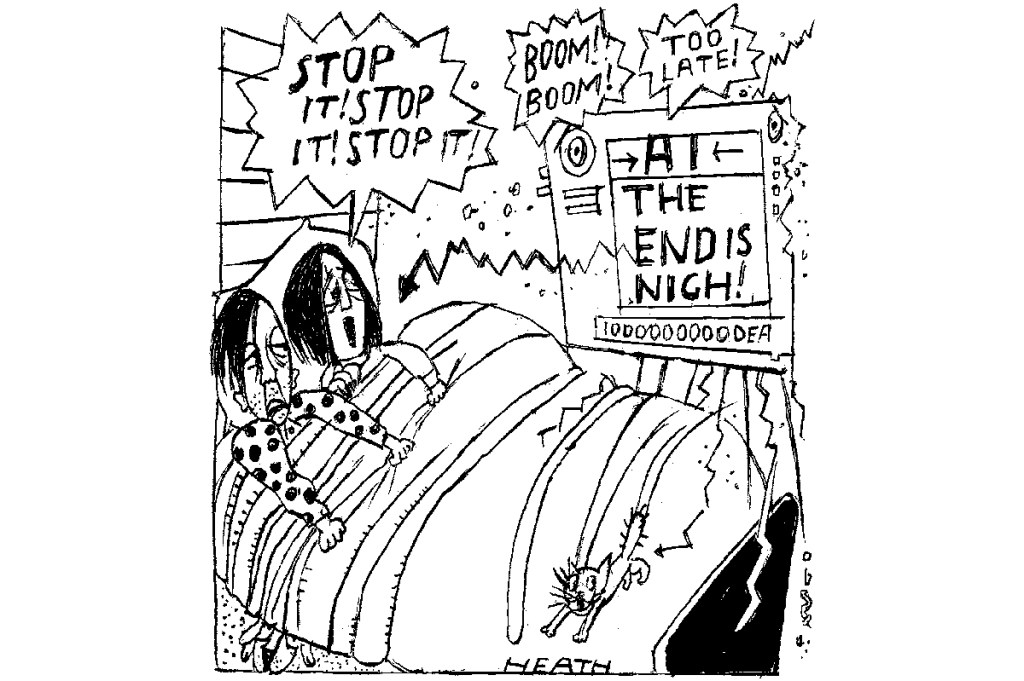
    There are many people who see AI as a danger to the world. It is always the same with new technologies, and has been since Luddites in 19th-century England started vandalizing threshing machines on the grounds that they would destroy textiles jobs. AI now stands accused of the same dastardly crime – although it hasn’t as yet significantly depressed employment. Every labor-saving technology in history has been the same – its effect has been to displace labor to be employed more effectively elsewhere. Lively imaginations see AI machines taking over the world, even deciding eventually to obliterate their human creators. It makes great science fiction, though the reality is always more humdrum: of AI programs predicting which customers will buy which items, of helping retailers keep their stock to a minimum, and so on. In fact, the bigger danger lies not so much in AI suppressing us, but of malignant regimes using AI to do their jobs for them.

    All that said, there are issues concerning AI which need to be addressed. There are serious concerns about how new technologies might diminish human education, character formation or natural brainpower, as this magazine discussed in our AI special in August. There’s also the matter of intellectual property. Functioning democracies have long-established laws for the ownership of ideas and creations. All these rules need to be looked at again in the age of AI.

    But if lawmakers only ever fret about the potential consequences of AI and dream up ever more restrictive ways of regulating technology – as the European Union tends to do – America will miss the boat. Critics scoff that Trump knows nothing of AI and assume he is always selling out to the tech oligarchs whose riches he worships.

    If AI is only half as powerful a tool as most experts predict, however, America needs to be at the forefront of its development or the country risks being outmaneuvered by China or other future rivals. Tech companies are making the running, and will always lead on innovation, but they very much need a decisive and committed government behind them.

    This article was originally published in The Spectator’s December 8, 2025 World edition.

  • Howard’s beginning: the luck of Lutnick

    With Elon Musk no longer sleeping in a cot in Washington, only one member of the White House inner circle comes close to matching Donald Trump’s net worth: Commerce Secretary Howard Lutnick. Commerce is usually a mid-tier cabinet post; even fervent political observers would be hard-pressed to name previous officeholders. But Lutnick has been one of Trump’s most impactful advisors in this second term. His ideas about tariffs have greatly affected the world’s economy, and have influenced Trump’s mercurial tariff pronouncements. Plus, he’s worth about $3 billion himself. Even Treasury Secretary Scott Bessent, himself a billionaire, is only worth about half as much.

    Lutnick made his name as CEO of Cantor Fitzgerald, a major New York financial services company. After hundreds of Cantor employees, including Lutnick’s brother, died in the 9/11 attacks, Lutnick rebuilt the company and provided support to the families of the victims, which amounted to two-thirds of the company’s workforce. Trump later called Lutnick “the embodiment of resilience in the face of unspeakable tragedy.”

    The two met in 2008, when Lutnick appeared on an episode of Trump’s TV show The Apprentice, but Lutnick wasn’t part of the conversation during the Donald’s first term. By the end of that term, he’d become a major Trump donor, and he stuck by Trump during the years of impeachment, the January 6 rebellion and exile. Lutnick is credited with raising $75 million for Trump’s 2024 capaign – and Trump rewarded Lutnick by making him co-chair of the presidential transition team.

    Trump’s nomination of Lutnick for Commerce met with controversy and resistance. One critic called it “totally sketchy” and others said that Cantor Fitzgerald’s vast interconnected business ties made it impossible for Lutnick to be an impartial bureaucrat. “Howard has gotten out way over his fucking skis on this,” a senior Republican official told Politico.

    The ballooning cryptocurrency industry was a particular space of concern, given Cantor Fitzgerald’s relationship with the controversial crypto company Tether, which issues a stablecoin tied to the value of the US dollar. Trump, who himself was about to make a vast fortune in crypto, hardly seemed to care, vowing to turn the US into “the crypto capital of the planet.” Who better to do that than Lutnick? “There’s nobody more loyal and capable than Howard,” Trump said.

    Given that tariffs are the shining centerpiece of Trump 2.0’s economic program, it’s not surprising that Lutnick supports them wholeheartedly. For him, tariffs are not just economic tools, but weapons that the government can use to affect national security and industrial policy. In an April interview with CNBC, he touted tariffs as the key element in transforming the American economy and was thrilled that a president, for once, was listening to him.

    “When I say to him we want fair trade, we want to be treated the way we deserve to be treated, that’s what’s happening now,” Lutnick said. “Finally, someone is behind the desk who is going to protect America. It feels great.”

    On tariffs, trade and industrial policy, Lutnick sounds so much like Trump it’s hard to tell where one man’s monologue ends and the other’s begins. “The rest of the world’s markets have been taking advantage of the trading policy,” he told CNBC. “Our policies were designed to make you rich and make us poor.” It’s been a non-stop tariff blitz for months. Back in April, Lutnick said on CBS’s Face the Nation, “The tariffs are coming. [Trump] announced it – and he wasn’t kidding. The tariffs are coming. Of course they are.” On Newsmax around the same time, he said “tariffs are not inflation. It is outrageous that people think tariffs are inflation.”

    In an economy run by two of America’s richest men, it’s hard to focus on, say, Lutnick’s efforts to onshore US semiconductor production. Tariffs take up all the oxygen. “Trump wants the people of America to appreciate these tariffs,” Lutnick said on Fox Business in November, “If he puts money into their pockets, they’ll better understand how important this is for America.” And there’s a literal plan to put money into the pockets of Americans, with the administration proposing a “tariff dividend” of $2,000. Why, with that, Americans could buy nearly 1/20th of a Bitcoin! “Yes, it’s going to make the country stronger,” Lutnick said.

    Then there’s the matter of Lutnick’s sons. In May, he transferred his ownership shares in Cantor Fitzgerald to his four children. His “economic benefits” have ceased but the family still runs the firm – and Bloomberg said, “the grip on his businesses is bolted tight.” Lutnick’s son Brandon is CEO and chairman and another Kyle, is executive vice-chairman. They’ve out-Successionedeven the Trump family. Brandon Lutnick is leaning hard into special-purpose acquisition companies, or SPACs, for crypto, even while his father pushes the President to establish a national crypto reserve.

    “President Trump’s billionaire Commerce Secretary has been playing the ultimate Washington insider game to pad his family’s riches,” left-wing watchdog site Accountable.US said earlier this year. While it’s true the Lutnicks won’t be qualifying for a $2,000 tariff dividend check, it remains to be seen whether or not all boats rise with theirs.

    Once upon a time, Kyle Lutnick was an aspiring rapper who performed under the name “Kxtz.” Though it appears he’s moved on, one residual lyric still seems relevant: “Until I run the game, I’ve got everything to gain.” But now Kxtz has put aside childish things. In November, Bloomberg reported that Cantor Fitzgerald was about to post a 2025 annual revenue of $2.5 billion, an all-time high and 25 percent more than the previous reporting period. “When you have a titan of industry and an indomitable personality like Howard, who was here for 40 years and ran the firm for 30 years, it can leave a significant vacuum when he leaves,” a Cantor official said. “The whole firm stepped up… and that’s because of Brandon. That’s because of Kyle as well.” The rich, it seems, are getting richer.

    This article was originally published in The Spectator’s December 8, 2025 World edition.

  • Goodbye to the Smoky Yolk diner

    “Actually, yes, please, I would like the pastrami corned-beef hash on the side – extra brown, extra peppers. Perfect complement to my Prime Benny. May want to hold the cheesy grits, though, but I’d love a side of maple and a large strawberry shake. Man needs his fruit!” “Whip cream?” “Oh, I think, absolutely.” It wasn’t a novel conversation. I used to entertain similar, equally weighty questions at least three times a week here. But I do recall thinking, then, and many times previously: if one is scarfing a monster shake at 7:30 on a Tuesday morning, is whipped cream really your most likely coronary catalyst? (Always skip the cherry; nothing found in nature – even adjacent to nature – can achieve such brilliant degrees of radiation red.)

    No one in diner-world cares. It’s a judgment-free zone. A celebration of freedom and options and culinary abandon. It is a perpetual carb-and-protein rush, an extravaganza of grease and oil and butter, with ample amounts of sugar in all its blissful variations. There were no scolds here. There were also no glass coffee “mugs.” No avocado toast and no burrata. Nothing was served on artisanal bread. Good luck requesting a “smoothie.” Or masala chai. Same goes for non-fat yogurt, Greek or otherwise.

    I’d never ordered a salad here, but it was certainly represented on the menu. Have faith, it wouldn’t be arugula, endive, kale or some other iceberg-usurper, the name of which is not even worth the attempt to pronounce it: it did not exist 25 years ago. Shaved radish. Bean or Brussels sprouts. Strained and extra virgin truffle oil. Balsamic “glaze.” None of these striving posers were welcomed here. No visa. No green card. Not even a day pass. Whether you were tucked away in one of the plump maroon booths that lined two long walls, or, perched, as I often was, upon one of the brown faux-leather, full-backed, boot-pegged, counter-swivel-stools, your personal cluster of spices sat before you, along with ample, and endless amounts of butter.

    This is the family-owned Smoky Yolk, in the middle of James Island, South Carolina. And, until it shuttered without warning in November, I was proud to call it my local diner. It was seemingly unchanged in the past half century, save the free WiFi, surround-sound music and habanero mustard on request. The Smoky Yolk didn’t have a website or employ a hostess. It didn’t accept Amex, ApplePay or Bitcoin. The eggs were fluffy and the bacon was crisp. The three-egg omelets were fat, half-pan crescents of ridiculous goodness and could be stuffed with any manner of protein or vegetable the mind and salivary glands could conjure, from fresh jalapeño to chorizo. Thick slabs of non-processed cheddar and Swiss were perpetually on-deck. The waffles were browned and thick, yet light and crunchy.

    Chicken and waffles were a legitimate dish here and came with a special high-heat honey mustard, as well as syrup and an angioplasty balloon (or at least they brought me one. Perhaps others had to request it). There were certainly no calorie counts. There were no handwritten menus or meticulously curlicued wall-chalk-art depicting the daily specials. On weekends, a cute teenager named Maddie – with scrubbed cheeks, athletic efficiency and the waning innocence of the barely pre-corrupted – ushered the elderly and stroller-clad families to their tables. The rest just grabbed a menu and sat themselves.

    A word about that menu: it was a thickly laminated, double-sided one-sheet and, at first glance, acceptably clean. But it was old and presumably unchanged across the decades. It had been fondled, grappled, clutched, smeared and spilled on by legions of South Carolinians and random passers-through. I often wondered if there were any cold cases in the forgotten files of the James Island homicide bureau and, if so, whether they’d ever considered subjecting the menus to forensic examination.

    Often, there were no paper towels in the bathroom dispenser. Soap either, though the floor was always clean, there was an ancient toe-to-breast American Standard, white porcelain urinal and the water in the sink flowed hard and hot – so hot, you didn’t even need soap. Dogs often joined their owners for a meal, though my own five sat in the car, too unwieldy – and pork-focused – to handle the welcoming confines of the Smoky Yolk. Instead, they waited, tense and wet-mouthed, hoping Jeremy, cheerful sous chef, would sneak them some bacon, as he often did. A small Christian cross adorned the back wall next to an American flag, weathered, but clean and untattered. Not enough politics in your life? Want some virtue-affirmation with your short stack? Sorry, kings may actually have lived here. No signs claimed otherwise. No harpy admonitions this was a “gun-free zone.” My own Kimber K6 revolver often sat snuggled in its soft case atop the counter, hardly the only firearm in evidence. This is the American South.

    There was “endless coffee,” good, and hot, served in heavy, stain-veined formerly off-white porcelain mugs, sturdy enough to brain a mouthy waiter named “Chad.” Fortunately, there were no waiters here named Chad. No waiters at all. This was strictly waitress domain. Every size, shape and age, and each possessed with the cheerful, contained, competent professionalism and dignity that used to define the American service industry. And the country. When I track the owner down to convey my obvious grief, I’m also going to inquire about that American Standard.

    This article was originally published in The Spectator’s December 8, 2025 World edition.

  • The end of the climate cult

    The end of the climate cult

    Finally, thankfully, the global warming craze is dying out. To paraphrase Monty Python, the climate parrot may still be nailed to its perch at the recent COP summit in Belém, Brazil – or at Harvard and on CNN – but elsewhere it’s dead. It’s gone to meet its maker, kicked the bucket, shuffled off this mortal coil, run down the curtain and joined the choir invisible. By failing to pledge a cut in fossil fuels, COP achieved less than nothing, the venue caught fire, the air-conditioning malfunctioned – and delegates were told on arrival not to flush toilet paper. Bill Gates’s recent apologia, in which he conceded that global warming “will not lead to humanity’s demise,” after he closed the policy and advocacy office of his climate philanthropy group is just the latest nail in the coffin.

    In October, the Net Zero Banking Alliance shut down after JPMorgan Chase, Citigroup, Bank of America, Morgan Stanley, Wells Fargo and Goldman Sachs led a stampede of other banks out the door. Shell and BP have returned to being oil companies, to the delight of their shareholders. Ford is about to cease production of electric pickups that nobody wants. Hundreds of other companies are dropping their climate targets. Australia has backed out of hosting next year’s climate conference.

    According to analysis by the Washington Post, it is not just Republicans who have given up on climate change: the Democratic party has stopped talking about it, hardly mentioning it during Kamala Harris’s campaign for president last year. The topic has dropped to the bottom half of a table of 23 concerns among Swedish youths. Even the European Parliament has voted to exempt many companies from reporting rules that require them to state how they are helping fight climate change.

    It has been a long, lucrative ride. Predicting the eco-apocalypse has always been a profitable business, spawning subsidies, salaries, consulting fees, air miles, best-sellers and research grants. Different themes took turns as the scare du jour: overpopulation, oil spills, pollution, desertification, mass extinction, acid rain, the ozone layer, nuclear winter, falling sperm counts. Each faded as the evidence became more equivocal, the public grew bored or, in some cases, the problem was resolved by a change in the law or practice.

    But no scare grew as big or lasted as long as global warming. I first wrote a doom-laden article for the Economist about carbon dioxide emissions trapping heat in the air in 1987, nearly 40 years ago. I soon realized the effect was real but the alarm was overdone, that feedback effects were exaggerated in the models. The greenhouse effect was likely to be a moderate inconvenience rather than an existential threat. For this blasphemy I was abused, canceled, blacklisted, called a “denier” and generally deemed evil. In 2010, in the pages of the Wall Street Journal I debated Gates, who poured scorn on my argument that global warming was not likely to be a catastrophe – so it is welcome to see him come round to my view.

    The activists who took over the climate debate, often with minimal understanding of climate science, competed for attention by painting ever more catastrophic pictures of future global warming. They changed the name to “climate change” so they could blame it for blizzards as well as heat waves. Then they inflated the language to “climate emergency” and “climate crisis,” even as projections of future warming came down.

    “I’m talking about the slaughter, death and starvation of six billion people this century. That’s what the science predicts,” said Roger Hallam, founder of Extinction Rebellion in 2019, though the science says no such thing. “A top climate scientist is warning that climate change will wipe out humanity unless we stop using fossil fuels over the next five years,” tweeted Greta Thunberg in 2018. Five years later she deleted her tweet and shortly after that decided that Palestine was a more promising way of staying in the limelight.

    Scientists knew that pronouncements like this were nonsense but they turned a blind eye because the alarm kept the grant money coming. Journalists always love exaggeration. Capitalists were happy to cash in. Politicians welcomed the chance to blame others: if a wildfire or a flood devastates your town, point the finger at the changing climate rather than your own failure to prepare. Almost nobody had an incentive to downplay the alarm.

    Unlike previous scares, climate fear has the valuable feature that it can always be presented in the future tense. No matter how mild the change in the weather proves to be today, you can always promise Armageddon tomorrow. So it was that for four long decades, climate-change alarm went on a long march through the institutions, capturing newsrooms, schoolrooms and boardrooms. By 2020 no meeting, even of a town council or a sports team, was complete without a hand-wringing discussion of carbon footprints. The other factor that kept the climate scare alive was that reducing emissions proved impossibly difficult. This was a feature, not a bug: if it had been easy, the green gravy train would have ground to a halt. Reducing sulfur emissions to stop acid rain proved fairly easy, as did banning chlorofluorocarbons to protect the ozone layer. But decade after decade, carbon dioxide emissions just kept on rising, no matter how much money and research was thrown at the problem. Cheers!

    Switching to renewable energy made no difference, literally. Here’s the data: the world added 9,000 terawatt-hours per year of energy consumption from wind and solar in the past decade, but 13,000 from fossil fuels. Not that wind and solar save much carbon dioxide anyway, their machinery being made with coal and their intermittency being backed up by fossil fuels.

    Despite trillions of dollars in subsidies, these two “unreliables” still provide just 6 percent of the world’s energy. Their low-density, high-cost, intermittent power output is of no use to data centers or electric grids, let alone transport and heating, and it effectively poisons the economics of building and running new nuclear and gas generation sites by preventing continuous operation. Quite why it became mandatory among those concerned about climate change to support these unreliables so obsessively is hard to fathom. Subsidy addiction has a lot to do with it, combined with a general ignorance of thermodynamics.

    Now the climate scare is fading, a scramble for the exits is beginning among the big environmental groups. Donations are drying up. Some will switch seamlessly to trying to panic us about artificial intelligence; others will follow Gates and insist that they never said it was the end of the world, just a problem to be solved; a few will even try declaring victory, claiming unconvincingly that promises made at the Paris climate-change conference a decade ago have slowed emissions enough to save the planet.

    Of course, Al Gore, the former vice president who did more than anybody else to alarm the world about climate change and made a $300 million fortune from it, has been at the recent conference in the Brazilian jungle – the one where they felled a forest to build the access road. As he railed against Gates last week for abandoning the cause and accused him of being bullied by Donald Trump, he sounded like one of those Japanese soldiers emerging from the jungle who did not know World War Two was over.

    Perhaps Gore might now regret his exaggerated preachings of hellfire and damnation. In his 2006 film An Inconvenient Truth, for which he jointly won a Nobel Prize, he predicted a sea-level rise of up to 20 feet “in the near future” – out by around 19 feet and nine inches. In 2009, he said there was a 75 percent chance all the ice in the Arctic Ocean would disappear by 2014. In that year there was 5 million square kilometers of the stuff at its lowest point – about the same as in 2009; this year there was 4.7 million square kilometers. At the film’s showing at the Sundance Festival, Gore said that unless drastic measures to reduce greenhouse gases were taken within ten years, the world would reach a point of no return. Yet here we are, 19 years later.

    Gore is correct that fear of retribution from the Trump administration drives some of the corporate retreats. President Trump has already canceled $300 billion of green infrastructure funding and purged government websites of climate rhetoric. But even if the Republicans lose the White House in 2028, it will be hard to reinflate the climate balloon. The proportion of Americans greatly worried about climate change is dropping. If Trump takes America out of the 1992 treaty that set up the United Nations Framework Convention on Climate Change it would require an unlikely two-thirds vote of the Senate to rejoin.

    Bjørn Lomborg, the Danish economist who is president of the Copenhagen Consensus and has fought a lonely battle against climate exaggeration for decades, recently explained the shift in public opinion: “The shrillness of climate doom also wears down voters. While climate is a real and man-made problem, constant end-of-the-world proclamations from media and campaigners massively overstate the situation.”

    A key figure in the collapse of the climatocracy is Chris Wright, the pioneer of extracting shale gas by hydraulic fracturing who was appointed by Trump as Energy Secretary this year. Wright commissioned a review of climate science by five distinguished academics that set out just how non-frightening the facts of climate change are: slowly rising temperatures, mainly at night in winter and in the north, correspondingly less in daytime in summer and in the tropics where most people live, accompanied by a very slow rise in sea level showing no definite acceleration, minimal if any measurable change in the average frequency and ferocity of storms, droughts and floods – and record low levels of deaths from such causes. Plus a general increase in green vegetation, caused by the extra carbon dioxide.

    Melissa, the category-5 hurricane that devastated Jamaica last month, killed around 50 people. In the past – before global warming – hurricanes like that killed tens if not hundreds of thousands. In total, weather events killed just 2,200 people globally in the first half of this year, a record low, whereas indoor air pollution caused by poor people cooking over wood fires because they lack access to gas and electricity kills three million a year. So yes, Gates, influenced by Lomborg and Wright, is correct to say that getting cheap, reliable, clean energy to the poor is by far the more urgent priority.

    Sources tell me that Wright is treated like a rock star at international conferences: his fellow ministers, especially those from Africa and Asia, are thrilled to talk about the need to get energy to people instead of being hectored about emissions. Only a few western European ministers sneer, but even some of them (the British being an exception) quietly admit that they need to find a way to climb down off their green high horses.

    Fortunately, they now have convenient cover for doing so: artificial intelligence. We would love to go on subsidizing wind and solar, say the Germans privately, but if we are to have data centers, we need lots more reliable and affordable power so we will now build gas – and maybe even some nuclear – turbines.

    Likewise, throughout the tech world of the American west coast, emoting about climate suddenly seems like a luxury belief compared with the need to sign contracts with firm power suppliers, mostly burning natural gas – or get left behind in the AI race. The world’s gas glut is impossible to overstate: thanks to fracking, we have centuries’ worth of cheap gas. The tech bros are piling into nuclear, too, but that won’t address the needs for extra power until well into the next decade – and the need is now.

    The climatastrophe has been a terrible mistake. It diverted attention from real environmental problems, cost a fortune, impoverished consumers, perpetuated poverty, frightened young people into infertility, wasted years of our time, undermined democracy and corrupted science. Time to bury the parrot.

    This article was originally published in The Spectator’s December 8, 2025 World edition.

  • Eclipse of the boomers

    Eclipse of the boomers

    Shortly after Christmas, the oldest baby boomer will turn 80. The 75 million people born between 1946 and 1964 who have dominated the American political imagination since the Eisenhower administration are starting to fade from the scene.

    Anyone who has felt oppressed by the baby boom – and this includes virtually every non-senior citizen in the country – will complain that it’s about frickin’ time. If the boomers are only now losing their influence, they long ago lost their marbles. What was the archetypal boomer moment of recent years? Probably Hillary Clinton’s 2016 presidential campaign. But maybe it was the indignant boycott of Spotify by Neil Young and Joni Mitchell over the Covid “misinformation” to which Joe Rogan allegedly gave vent in 2022. Although this pair of Woodstock-era Canadian singer-songwriters are slightly too old to belong to the baby boom proper, the crusade to which they were summoning their fans was a perfect example of the boomer style, with its sanctimony, its performative dudgeon, its imputation of ignorance and immorality to anyone who disagrees – all in the service of a questionable proposition.

    Spotify executives must have agonized for nanoseconds over how to respond to this “either-he-goes-or-we-go” ultimatum. Should they cut loose Rogan, the most listened-to talker in the fastest-growing audio-streaming genre, with a political influence to match? Or should they part with two folk singers whose Spotify fanbase (however numerous their listeners elsewhere) probably consists of 11 septuagenarians sniffling in front of their toasters in retirement communities across Arizona? Hmm. The Spotify execs didn’t need a weatherman to know the way the wind blows.

    Looking at the boomers these days, it is natural to ask how anybody could ever have been pushed around by such a feckless and unconvincing bunch. The answer is an actuarial one. It wasn’t the boomers’ powers of persuasion that enabled them to rally the country behind a succession of dim ideas, from complex derivatives to the Iraq war. It’s just that they were numerous enough to be demographically invincible. If the boomers wanted something, they got it, by force of numbers, and this was as true when they were six as it was when they were 60.

    Before they could even talk, society was being reconfigured around them, for better and for worse. By 1964, all 75 million boomers had been born – and the United States had only 191 million people in it. Boomers made up about 40 percent of the country. What sort of parents wouldn’t have voted for a vast expansion of secondary and university education to speed their kids’ way into the upper-middle class? On the other hand, a bumper crop of 18-year-olds stretching as far as the eye can see did nothing to reduce Lyndon Johnson’s crazy ambition to fight a war in Vietnam, where tens of thousands of boomers would die.

    Although no one ever sat down and calculated it, this critical number – 40 percent – would give a rough idea of baby-boom power as the generation passed through the various stages of life. Boomers started voting in the 1966 elections, and by the time Ronald Reagan chased Jimmy Carter from the White House in 1980, they were casting 40 percent of the votes. Two years later they were at 43 percent.

    The boomers were sometimes polarized on major issues, it is true. But on any matter that united them, it required a near-unanimous resistance movement to stop them. That is why politicians made the country liberal on sex in the 1970s, when the boomers were mostly in their twenties; business-friendly in the 1980s, when the boomers were mostly in their thirties; and investment-friendly – starting with Bill Clinton’s second term – in the 1990s, when the oldest boomers were entering their fifties.

    This was important, because the boomers’ command over the economy would wind up more impressive than their command over the political system. When the Berlin Wall fell in 1989, the boomers were between 25 and 43, entering their most energetic adult years just as America was being called on to write the rules for the global economy. When they were in their prime, in the prosperous 1990s, they made up well over half the workforce.

    But now the boomers, submerged beneath immigration and colliding with mortality, make up only about 20 percent of the population. Each year, 1.8 million of them die, and that number is set to rise steeply.

    This is going to have a startling consequence. The baby-boom vision of what American society is about has been embraced almost unanimously by all society’s institutions since about 1968, when the oldest boomers were graduating from college. Boomers quarrel over the details of this vision, but not over its basic tenets, which seem to be: 1) The main thing that happened in American history is slavery; 2) There is not much difference between men and women; 3) Youth is the best part of life.

    Through their preponderance in the marketplace and the voting booth, boomers have been able to sell these propositions to the American public as the merest common sense. But they are no such thing. For most of American history they were considered outright untruths, and most non-boomers probably think of them as such today.

    There is going to come a moment when the boomers’ political power falls below the threshold necessary to prop up this vision of things. It could happen before the next election. And then something is going to happen that no one has given much thought to: control over our politics and our culture is going to pass to a non-baby boom generation – perhaps a much younger one – that looks at the world in its own, totally different way.

    This article was originally published in The Spectator’s December 8, 2025 World edition.

  • The theater of Washington

    The theater of Washington

    Suddenly it’s Ibsen season in Washington, DC. It’s true that only Shakespeare’s plays are performed worldwide more often than Henrik Ibsen’s. But to have two of the great 19th-century Norwegian playwright’s works running at once in the nation’s capital is unusual. And the works in question – An Enemy of the People and The Wild Duck – deliver contradictory messages. Together they say something not only about the state of the arts in Washington, but also about the state of the liberal mind.

    Politics is very much a presence on the capital’s stages. The city’s two main Shakespeare organizations, the Shakespeare Theatre Company and the Folger Theatre, last year presented seasons heavily influenced by the presidential election. Folger’s Romeo and Juliet made the Montagues and Capulets representatives of rival political parties, though the point was rather lost in a messy production that also tried to be trendy.

    The STC was subtler, with a lineup that spoke to liberal electoral anxieties. Babbitt, based on the Sinclair Lewis novel, is partly the tale of a demagogue’s rise. Yet there was also a post-election production of Leopoldstadt, Tom Stoppard’s reflection on the lives of Viennese Jews as bourgeois anti-Semitism made way for Nazi violence, that spoke to the darkest fears, or the most overheated rhetoric, of theater-going liberals.

    Knowing the politics of the capital and its theaters, one isn’t surprised to see Enemy revived. On the surface, Ibsen’s play about a scientist who discovers an environmental hazard that threatens to upend the economy of a resort town – and is met with furious denunciations by the authorities for his discovery – seems like a parable flattering to many a crusading liberal. And sure enough, the program for this production drew a parallel between Ibsen’s protagonist, Dr. Thomas Stockmann, and Dr. Anthony Fauci, to liberals the hero (and to the right, the villain) of America’s Covid response. “At least one congressman has labeled Dr. Fauci an ‘enemy of the people’,” the program noted. It’s a phrase Trump bandied about, too.

    Yet Ibsen was no mere liberal, although the extent of his distrust for ideology is masked by Amy Herzog’s “new version” of Enemy, which debuted on Broadway last year and was staged in DC last month. The authentic Stockmann, as Ibsen wrote him, says near the play’s end: “I only want to knock a few ideas into the heads of these mongrels: that the so-called liberals are free men’s most dangerous enemies; that party platforms wring the necks of every young and promising truth; and that party-political-opportunism turns morality and justice upside down…”

    He adds: “We have to get rid of the party bosses – a party boss is just like a wolf – a ravenous wolf,” words that wouldn’t comfort an audience that might include Chuck Schumer or Nancy Pelosi. Ibsen’s Stockmann ends up something of a Nietzschean, declaring himself “one of the strongest men in the whole world,” an heroic individual standing against party and press, rejecting the hypocrisies of those who claim to be altruistic progressives or, in the case of radical newspapermen, revolutionaries.

    Herzog’s Stockmann, as presented in DC, is an altogether tamer animal whose concluding words instead hymn the power of imagination to lead us to a better world. Ibsen has been rewritten to sound like Kamala Harris – the party bosses have won. Do DC theater-goers appreciate the irony?

    The point in An Enemy of the People is to stand by the truth, no matter whom it offends or however great the suffering one endures on account of doing so. Stockmann loses his job and becomes the most hated man in his community rather than compromise his message. So what is the point of a theater company presenting the play in a compromised form? Ibsen was concerned about something more than the purity of a town’s water supply. Liberals of his own time were scandalized; it’s a testament to his genius that he remains ideologically indigestible.

    Something of his intended meaning does come through despite the censorship, however, and even a viewer less skeptical of progressive than myself might wonder, watching this Enemy, whether a figure as demonized by the political authorities and progressive journalists as Stockmann is better matches Fauci – a state employee – or the independent critics of government Covid policy who suffered for their skepticism, like the now-vindicated Dr. Jay Bhattacharya.

    Then there’s the other Ibsen lately on stage in Washington: STC’s production of The Wild Duck. For all that STC operates in keen awareness of the city’s politics, artistic director Simon Godwin clearly has an interest in art for its own sake, which is in evidence in productions of Chekhov and Ibsen he’s directed recently. The Wild Duck (1884) seems to have been Ibsen’s response to those who took the wrong lessons from Enemy (1882): the truth-telling radical who drives the action of The Wild Duck is a fanatic who brings ruin to his dearest friend. Gregers Werle is a man who sees it as his calling to liberate goldfish from their bowls, to borrow an image from G.K. Chesterton. But instead of allowing them to swim free, men like Werle only reveal that creatures accustomed to captivity cannot survive in an atmosphere of pure truth. They need what Werle’s philosophical opponent in the play, a doctor named Relling, calls “the life-lie.”

    A would-be savior can be a calamity for the very people he intends to save, and Werle is a man of purest enlightenment philosophy and romantic longing for authenticity – a liberal or progressive, in other words. His idealism is diabolical, leading an innocent to suicide and revealing the inability of ordinary people to live the lives an idealist thinks worth living. Ibsen and Nietzsche were contemporaries, and neither had much direct influence on the other. Yet Ibsen is Nietzsche on the stage – even the politically progressive stage of Washington, DC.

    This article was originally published in The Spectator’s December 8, 2025 World edition.