Category: Politics

  • Sip shots and stuff your face, it’s shutdown season

    Sip shots and stuff your face, it’s shutdown season

    With the federal government shut down indefinitely, paychecks are going to be light or non-existent around DC, putting disposable income at a premium. Businesses in the Capital are stepping into the breach with the greatest array of discounts in memory. Cockburn will do his best to take advantage of them with his fake government ID. He wonders if anyone will realize he’s not actually “Rashida Tlaib.”

    Some of Cockburn’s favorite DC spots are bringing items back to 2010-ish prices. The legendary Tune Inn will offer $4 Lemon Drop “Shutdown Shots,” $8 two-cheese Bipartisan Melt with French fries, and $7 “Gridlock Nachos” from 2 p.m. to 8 p.m. Furlough Fizzes for everyone! Up the street, MAGA hangout Butterworth’s offers a $5 Welsh rarebit, one of Cockburn’s childhood comfort foods, and a $10 “Furlough-rita,” one of his adult comfort drinks.

    Logan Circle’s Amelie serves up, for $21, a plate of mussels and fries, plus a glass of wine, which is about what you’d pay to eat at Shake Shack. The DC outlet of Osteria Morini is practically giving away $15 pasta specials.

    For now, DC is a city of all-day happy hours, $2 oysters, half-price sandwiches, $10 pizzas, $2 drip coffees and free admission to museums and women’s soccer games, all under the watchful eye of a permanently deployed National Guard. The only drawback is that everyone is out of work. It’s utopia and dystopia, caused by federal myopia. Cockburn will criss-cross the happy-hour strewn boulevards of Washington, drunken and bloated, until the gears of state once again grind to life.

    On our radar

    ‘PEACE IN THE MIDDLE EAST ONE WAY OR THE OTHER’ In a Truth Social post, President Trump gave Hamas a deadline of Sunday 6 p.m. ET to agree to the peace deal with Israel he presented on Monday.

    BROTHER, CAN YOU SPARE A DIME? The top 1 percent of Americans saw their wealth reach $52 trillion in the second quarter of this year.

    OBAMA THE AURA FARMER Former president Barack Obama resumed his annual tradition of posting an anniversary picture with Michelle – one that is much more flattering to him than to her.

    Inside The Spectator’s NYC hard-hat party

    Spectator parties have been a rarity on this side of the pond – so naturally Cockburn made the trip up the Acela Corridor for Tuesday’s “hard-hat” party in his magazine’s New York office. The new digs are atop a NoMad high-rise and will doubtless be the envy of the city when completed – threatened features include an event space for talks and a broadcast studio, to accompany the gorgeous wrap-around terrace. Yet upon his arrival your correspondent found the bureau in a state of relative undress: knocked-through walls, an air-conditioning dial hanging from the ceiling. Still, the promised hard-hats were there – and there were two bars.

    Early concerns about an outdoor party in late September were allayed by the sunshine – the first major weather incident was a hurricane called Caroline Calloway breezing in an hour and a half before the start time. The author and influencer grabbed a glass of chablis, regaled Cockburn and his colleagues with Dimes Square gossip, posed with a hard hat, fitted an orchid flower crown and dashed out to make the evening performance of Turandot at the Met. Special points for her Midsommar-inspired dress, which she designed herself. “The nightgown is from Etsy, the dupioni silk is from India and I had a tailor in Florida combine the two to my liking, with a biiiiig bow,” she said.


    Caroline Calloway (The Spectator)

    Around 150 or so guests took the long elevator ride up, a mixture of journalists and authors, artists and socialites. “You’re getting your fill,” Ted Lasso’s Keeley Hazell said to Cockburn as he retrieved four drinks from the bar for his friends. She wasn’t mistaken. Your correspondent also chatted to Emma Mnuchin, daughter of the former Treasury secretary Steve. He told her that her stepmother Louise Linton had written a Diary for the first US edition of The Spectator in October 2019, the last time the magazine threw an NYC bash.
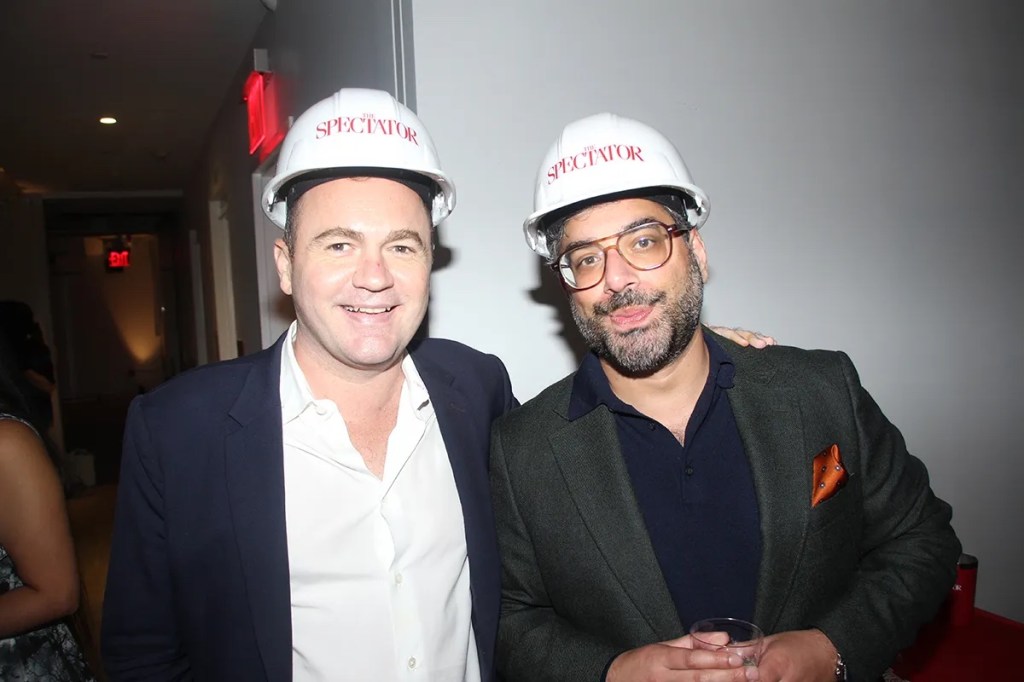
    Lachlan Cartwright and Raheem Kassam (Lily Burgess/The Spectator)

    Spotted at the event: Nick Allen and Shannon Totten; the Times of London’s Katy Balls and Megan Sheets; the Daily Mail’s Kayla Brantley, Chelsea Ritschel, Wills Robinson and Karen Ruiz; Breaker Media’s Lachlan Cartwright; Monica Chmelev; the New York Post’s Oli Coleman and Keith Poole; Ann Coulter (on her way to the Yankees game); National Review’s Caroline Downey; GB News’s Steven Edginton; FeedMe’s Cami Fateh; Ryan Girdusky; the National Pulse’s Raheem Kassam; Red Scare’s Anna Khachiyan; Roger Kimball and a petite battalion of New Criterion staffers; Harper’s John R. MacArthur; Chadwick Moore; Ed Roman; Kat Rosenfield; Allison Schrager; Lionel Shriver; IWF’s Inez Stepman (and June Stepman, aged almost one, who charitably offered her pacifier to Ben Domenech), and representatives from The Spectator’s DC, London and New York offices. More pictures here. Props to organizers Zack Christenson and Orson Fry. Next time in Washington?

    Labor of love

    So long to EJ Antoni, the Heritage Foundation economist whose nomination to head up the Bureau of Labor Statistics was quietly withdrawn this week. Antoni’s prospects of Senate confirmation grew increasingly slim after a series of troubling stories – among the first of which appeared in this newsletter, when Cockburn revealed on August 29 how Antoni had discussed the relationship between gender and IQ with last summer’s Heritage intern class. Cockburn’s report followed a story from NBC that Antoni was in the crowd outside the Capitol on January 6, 2021, while a subsequent story from CNN’s KFile showed that Antoni had an anonymous Twitter account replete with a number of fruity posts about feminists and homosexuality.

    You would be blissfully unaware of Cockburn’s involvement if your sole source of the news of Antoni’s departure was the Washington Post. A triple-bylined story earlier this week says:

    Antoni had shared a controversial scientific theory of differences of intellect between men and women during remarks to Heritage Foundation interns last year, The Washington Post reported.

    It is true that the Post published a story on September 2 by Jacob Bogage about Antoni’s comments… but that story cites Cockburn’s report, which was published four days earlier. What could possibly explain their failure to credit? Cockburn’s editor emailed the corrections desk to ask. Their response:

    We spoke to the assignment editor who handled this story, and she said that The Post put a lot of resources into our own report on this allegation, including reaching out to all three interns who were present, as well as many hours listening to recordings of conversations in the article that Jacob anchored (in which The Post gave the Spectator credit for reporting the allegation first).

    In the story about Antoni, we decided to cite our own story, which we put so much work into. At no point did we claim to have broken the story.

    In the eyes of the Post therefore, you can claim credit for a story you didn’t break if you put lots of effort into your later version. Cockburn is looking forward to telling people about how The Spectator reported out Watergate and the Pentagon Papers at dinner later. Democracy is dying in darkness…

    Subscribe to Cockburn’s Diary on Substack to get it in your inbox on Tuesdays and Fridays.

  • Does Prince William need to ‘change’ the British monarchy?

    Does Prince William need to ‘change’ the British monarchy?

    Of all the people who might be expected to get revelatory public comments out of the Prince of Wales, the beetle-browed actor Eugene Levy would not be high on the list. Yet during the Schitt’s Creek and American Pie thespian’s new show, The Reluctant Traveler, Levy ticks off a series of “bucket list” experiences – one of which was getting close to the royal family. While it would, presumably, have been fairly easy to get an audience with Prince Harry, Levy’s intentions instead lay with Britain’s actual royal family, and so the encounter took place between him and Prince William.

    The most striking remarks that the heir to the throne made to Levy were that he clearly regards his father’s reign as an interregnum between two rather more significant periods on the throne: his grandmother’s, and his own. Not, of course, that he was so tactless or brazen to make such a comment, but Levy managed to elicit some unusually candid remarks from William, who was filmed drinking a pint of cider with him in Windsor’s best pub, the Two Brewers.

    “I like a little bit of change,” said William. “I want to question things more. I think it’s very important that tradition stays. And tradition has a huge part in all of this. But there are also points where you look at tradition and go, ‘Is that still fit for purpose today?’ So I like to question things.”

    Levy, scenting something of a scoop, pressed him by saying “it sounds like the monarchy will be shifting in a slightly different direction”, to which the Prince of Wales expressed agreement.

    It was notable that, while William talked fondly about his grandmother at several points during the interview, his father King Charles was barely mentioned, save for the rather blasé observation that: “My father needs a bit of protection but he’s old enough to do that himself as well.” In other words, recent gossip that the relationship between king and heir has been strained of late will only be fanned by this, rather than dispelled.

    There were, of course, fond comments about his family. Unsurprisingly, William described 2024 as “the hardest year I’ve ever had”, remarking that “it’s important my family feel protected and have the space to process a lot of the stuff that’s gone on [in the] last year.”

    Sounding more like his estranged brother than usual, he went on to sigh: “I enjoy my job but sometimes there are aspects of it, such as the media, the speculation, the scrutiny…” And, he might have added, participating in such pieces of entertainment as The Reluctant Traveler.

    Yet whether it worked or not as television, it was a fascinating insight into a very private man’s psyche. It is widely expected that William will be a transformative monarch in a way that his father has not been. His comments that he will not be looking to the past were more telling than might have been intended. William said that: “I think if you’re not careful history can be a real weight and an anchor around you. And you can feel suffocated by it and restricted… It’s important to live for the here and now. But also I think if you’re too intrinsically attached to history, you can’t possibly have any flexibility because you worry that the chess pieces move too much and therefore no change will happen.”

    This may be true. However, one hopes that if William has a trusted courtier or two at his side, that they might be able to convince him that change – presumably on the significant scale that he is intending – is not always a good or even necessary thing. In any case, a reign that many have pre-emptively dismissed as dull might yet surprise the world, although whether for good or ill remains to be seen.

  • The Free Palestine mob’s response to the Manchester attack was shameful

    The Free Palestine mob’s response to the Manchester attack was shameful

    As so often, the Chief Rabbi Ephraim Mirvis hit the nail on the head over yesterday’s terror attack in Manchester. It was, he said, the result of “a tidal wave of Jew hated.”

    Jews have spent the past two years highlighting the danger posed by the authorities’ refusal to take more than perfunctory action against the regular hate marches and gatherings. We have warned what was coming – and yesterday it came. It will, I dread to write, not be the last terror attack.

    Palestinian statehood is a decent and worthy cause. It is no more intrinsically poisonous than the push for a Scottish, Welsh or Catalan state, or indeed Irish unification. But as with the latter, for all that there are those who are entirely decent in the way they advocate and campaign for their cause, the broader movement has indeed been infected with poison.

    Look at what happened last night, hours after two Jews had been murdered and the deaths of many others prevented only by heroism. How did the so-called Free Palestine movement react? By staging an “emergency” pro-Palestine protest organized by the “Global Movement for Gaza UK” on Whitehall. Mobs gathered not just in Whitehall but also in London railway stations and in Leeds, Manchester, Bristol, Bournemouth and elsewhere. Is this how normal people react after a terrorist attack?

    While the answer to that is clearly “no,” it is exactly how the Free Palestine mob react. It is, for example, how the Palestine Solidarity Campaign (PSC) reacted after the October 7, 2023 massacre of 1,200 Jews. On the day itself, while the massacre was still in progress, the PSC contacted the Metropolitan Police to signal their intention of staging a march the following week – on October 14, before Israel had even entered Gaza. It was the very definition of a hate march. And it was the first of the many that have followed, on which Jew hate is openly displayed, from banners with antisemitic caricatures that could have come straight out of Der Stürmer, the Nazis’ propaganda tabloid, to chants calling to the “globalize the intifada” – kill Jews – and “Khaybar, Khaybar, Ya Yahud! Jaish Mohammad sawf ya’ud!,’” which means “Khaybar, Khaybar, O Jews! The Army of Muhammad Will Return!”.

    Dismissing these examples as the work of “bad apples” on the marches doesn’t wash. For one thing, all too often the organizers have utterly failed to condemn those responsible. Of course they have – because such behavior is in the DNA of the movement. Look at the smaller mobs that gather regularly – such as one in London on Wednesday night, the day before the Manchester attack. It was not just physically threatening, launching fireworks and pushing its way through crowded streets. It was united in chanting for the destruction of Israel.

    These mobs spring up across the country on streets, in malls, at railway stations – anywhere where they can be seen and intimidate. And, almost always, the police stand and watch (although yesterday’s mob in Whitehall turned so bad that 40 people were arrested, six of whom were for attacks on the police).

    Back to October 7, and the idea of staging a march straight after a massacre of Jews. Guess what is now scheduled for this Saturday, two days after the murder of Jews? A rally for Palestine Action, the proscribed terrorist group. The police have asked the organizers to reschedule, given that they are on high alert for more terror attacks on Jews. Leave aside that pathetic phrase, “the police have asked,” and ponder why on earth a mob which harasses, frightens and intimidates Jews would respond to the murder of Jews by stepping back from its latest plan that will harass, frighten and intimidate Jews.

  • Gore Vidal was the Virgil of American populism

    America’s Montaigne, Gore Vidal, was born 100 years ago today. Born Eugene Luther Vidal, this Virgil of American populism entered the world on October 3, 1925 (“Shepherds quaked,” he later said, describing his arrival in his typical, wildly egotistical way).

    His father, Eugene Luther Vidal – after whom he was named – was a former quarterback, Olympian and the founder of three commercial airlines. While he worshipped his father, Vidal had a hateful relationship with his mother, Nina Gore, a beautiful monster who would go on to marry two more times following her divorce from Vidal senior.

    Vidal’s formative friendship was with Nina’s father, Thomas Pryor Gore, the blind senator from Oklahoma. Young “Gene” read him Voltaire, Gibbon, Shakespeare. He had read Livy in translation by the age of seven and attended his first presidential convention at 14, which was when he decided to drop ‘Eugene Luther’ and take “Gore” as his first name.

    Enlisting in 1943 at the age of 18 during the second world war, Vidal served as a warrant officer aboard a freighter in the northern Pacific. This later inspired his first novel, Williwaw (1946), a Hemingway-esque tale of men at sea. He was heralded as a prodigy. But his next, The City and the Pillar (1948), the first serious American homosexual novel, proved divisive.

    In need of money, having bought a Greek revival mansion in the Hudson Valley, Vidal began writing for television. He was a natural, commanding fees as high as $5,000 for a script. Writing the play The Best Man in 1960 inspired a bid for Congress in New York’s bedrock Republican 29th district. Despite help from Eleanor Roosevelt and the actress Joanne Woodward, he lost – but nevertheless managed to outpoll every previous Democratic candidate the district had had since 1910. His slogan “You get more with Gore” had some force – not least given his claim that he had had 1,000 lovers by the time he was 25.

    Vidal’s enduring handsomeness fed an unembarrassed narcissism

    Vidal relished the fact that, following the breakdown of her second marriage, his mother was succeeded as Hugh D. Auchincloss’s wife by Janet Lee Bouvier, mother of Jacqueline Kennedy and Lee Radziwill. He would enjoy an easy relationship with John F. Kennedy but his brother Robert disliked and distrusted him. At a White House reception, he had upbraided Vidal for putting his arm around the First Lady (well, they had shared a step-father). The episode was inflamed by Truman Capote claiming a drunken Vidal had been evicted. Vidal successfully sued but his White House days were over.

    Having been a mainstream liberal democrat, it was accepted that Vidal moved to the left in the mid Sixties, after his break with the Kennedys. There was his loathing of American “empire” and bankers, but he became a populist reactionary who believed his country had been injured by tyranny and foreign adventurism. Thus, the author Michael Lind believed he was more in the mould of his maverick Senator grandfather: that he moved not to the left but “to the South and West and back in time.” A final tilt at the Senate in 1982 also proved unsuccessful.

    He relished enduring feuds with not just Capote but also the writers Norman Mailer, Truman Capote and William F. Buckley. His friendships, meanwhile, were eclectic: Woodward and her husband Paul Newman, the actresses Claire Bloom, Susan Sarandon and Joan Collins – and Princess Margaret. Later in life, he described himself as such:

    “I’m exactly as I appear. There is no warm, lovable person inside. Beneath my cold exterior, once you break the ice, you find cold water.

    Yet, after an interview with this magazine’s Mary Wakefield, he blew her a kiss. On interviewing Vidal at 70 for the New York Times, Andrew Solomon wrote: 

    “His epigrammatic discourse – bred in equal measure of imagination, affectation and brilliance – is delivered in a voice as rich & smooth and alcoholic as zabaglione.”

    Given that voice and his patrician hauteur, the journalist Mark Lawson thought it a minor tragedy that no director had ever cast him as The Importance of Being Earnest’s Lady Bracknell.

    On Labor Day in 1960, Vidal met his life partner, Howard Austen, a would-be pop singer with stage fright who became an advertising executive. Vidal claimed the union endured because it was sexless. In 1972, they bought a villa – La Rondinaia – on the Amalfi coast in Italy, perched on a cliff in the commune of Ravello. From this august exile, the historical Narratives of Empire series of novels appeared – the revolutionary era of Burr (1973) via Lincoln (1984) to Hollywood (1990) and The Golden Age (2000). Between them, they covered a century of American history.

    Vidal’s self-mythologising memoirs, Palimpsest (1995) and Point To Point Navigation (2006), proved immensely readable but his legacy is his essays – self-assured, original, erudite, elegant and acerbic. His 1,300-page anthology, United States: Essays 1952-1995, is only two-thirds of his output.

    The New York Times’s Charles McGrath believes Vidal will “live on most vividly on YouTube.” As Vidal himself used to say, “there are two things in life you should never turn down: the opportunity to have sex and the chance to appear on television.”

    His enduring handsomeness fed an unembarrassed narcissism: “I have the face now of one of the later, briefer emperors.” His Wildean bon-mots were usually unkind – but memorable: “A good deed never goes unpunished” and his classic “Every time a friend succeeds, I die a little.”

    A confidant of Tennessee Williams and a lover of Jack Kerouac, Vidal knew Christopher Isherwood, E.M. Forster, Albert Camus, Sartre, Anaïs Nin and William Faulkner. We know because he often said so. “Allen Ginsberg kissed my hand as Jean Genet looked on,” he once said. And “I have never much enjoyed the company of writers – who are less famous than I am.” Vidal’s philosophy? “There is not one human problem that could not be solved if people would simply do as I advise.”

    Austen’s health forced a return home in 2003 to the Hollywood Hills. His death a few months later left Vidal bereft and a long, slow self-ruination followed. He died on July 31, 2012, aged 86. 

    So, Gore Vidal was human after all.

  • Do Jews have a future in Britain? 

    Do Jews have a future in Britain? 

    I was on my way to synagogue yesterday when I got news that was surprising and unsurprising at the same time. That there had been an attack at a Manchester synagogue on Yom Kippur was a shock, but only the location and the timing. The fact that terror had struck our community felt like the confirmation of our worst fears – and something that was grimly predictable. 

    For as long as I can remember, Jewish life in the UK has been closely guarded and protected. My childhood synagogue in the leafy London suburb of Surbiton was behind locked gates with security guards posted outside when anyone was in the building. My Jewish newspaper office today has similar protections and an address we’re told must never be made public. Every kosher shop in North London has a permanent security presence, twice or three times that of a supermarket in a dodgy area. 

    British Jews are always watching over their shoulders, silently clocking the escape routes out of synagogues and constantly feeling like a target when we congregate. We are a group that, by virtue of existing, is targeted. Jewish schoolchildren are told to change their uniforms when going home on public transport, observant Jewish men hide their kippahs with baseball caps when on the tube, everyone does the little things they can to try and feel safe. 

    All of this of course, was true before October 7 and it will be true for a long time after this war ends. But there has been a remarkable uptick in the last two years. The right-thinking consensus that anti-Semitism was bad is crumbling before our eyes, as the horseshoe theory that sees us hit from the far-left and the far-right becomes stronger every day.

    The Community Security Trust, a Jewish organization that collects data on anti-Semitism in Britain has recorded an unprecedented rise in all manner of attacks on British Jews, from casual anti-Semitic remarks to violent assaults on visibly Jewish people, buildings and communities. Just last month, a man was arrested in North London for a spate of attacks where he smeared his own excrement on synagogues. 

    The reaction to what’s happening in the Middle East is coming home to affect British Jews, making us feel like outsiders in a country that we’ve lived in and loved for centuries. I see it all the time in my own life and work. The social media channels of the Jewish Chronicle are inundated with hateful, anti-Semitic comments every day that have nothing to do with Israel. I’ve seen anti-Semitic graffiti appear all over my neighborhood in south London and I’ve been accused of “killing kids” at a friend’s birthday party by someone I had just met. 

    The nature of anti-Semitism means that it is ever-present, always under the surface. And it has been allowed to fester. Partially by a government that through its own poor politicking is pandering to extremists in its own party, but also by a media so desperate to raise the temperature of debate in Britain, that it forgets that Jewish people’s safety is at stake. Anti-Semites across the UK and in public life have been allowed to grow in confidence, to march on the streets of London, a city that Jews have thrived in, with placards of blood-drenched swastikas and depictions of Jewish leaders with horns. 

    Britain has always been seen as different to the rest of Europe when it comes to Jewish life. For years, our community has looked at violence in places like France, where Islamist terror attacks against Jews are a regular fixture and thought, “That wouldn’t happen here”. 

    But now it has. The events of yesterday will be a scar on Britain’s Jews, in the same way that the Tree of Life shooting, and the HyperCache attack, and the Boulder firebombing forever changed those communities. The Jews of Manchester and those across the UK will remember Heaton Park for years to come. There will also be soul-searching. Does this mean we should all go to Israel, to live among a different type of Islamist threat? What can we do to prevent this happening ever again? 

    There’s a certain feeling among British Jews that in any country other than Israel we are not in control of our own destiny, that our safety in the UK or in any other country is dependent on the government of the day listening to our pleas and taking our security seriously. To the credit of the police, they acted quickly to protect the Jews of Heaton Park. But many Jews today will be feeling that the attack was grimly predictable, and wondering why the government or the police allowed this country to become a place where Islamists’ toxic ideas and hatred of Israel are allowed to take the lives of British Jews. 

    Killing Jews in Manchester or London or Paris or Washington DC will not bring this war to an end. Not a single Palestinian life is saved by the taking of one from a synagogue worshipper. Yesterday’s attack feels like a turning point. If British Jews can be killed simply for being Jewish, then do the rest of us have a future here?

  • ‘Media Literacy’ and the decline of Woke

    What is “woke”? To Jordan B. Peterson it is “postmodern neo-Marxism.” To James Lindsay it is “critical race theory” and latterly “revisionism” in general. These theories of what woke means take for granted that one of its core tenets is a denial of objective truth under the influence of what is broadly called “critical theory,” but the thinking behind contemporary wokeness falls far short of these theoretically exalted standards.

    Critical theory was a movement, primarily among academics, in the mid 20th century which had a diverse array of followers, but the common denominator was the belief that texts, whether literary works like novels, or historical documents, had no inherently “true” interpretation. What this means, to hugely simplify, is that there exist as many ways to read a story as there are readers. The critical theorists arrived at this idea by different arguments, one of the most famous is Roland Barthes’ reading of Sarrasine, a short story by the 19th century French writer Honore de Balzac, by breaking down each sentence into a system of “signs” largely borrowed from psychoanalysis. 

    It is pretty obvious, if you are an activist interested in spreading your ideology to as many different media as possible, that an idea which lets you disregard the intention of the original author would be appealing. When critical theory crossed the Atlantic (and hopped across the Channel), it rapidly lost its brooding, Nouveau Roman character and found its utility in readings which emphasized the implicit racial, sexual and gendered meanings of texts. This was not always the case: one of the foremost critical theorists, Paul de Man, was a collaborationist writer in Nazi-occupied Belgium. De Man conceived of his own brand of critical theory as a means of pre-empting, and expurgating, any intrusion of “the social” into literature by claiming that any such reading was arbitrary. 

    However, today, the left has entirely abandoned even the pretense of postmodern skepticism present in retro-eighties critical theory. The phrase of the day is “media literacy,” a meme implying that there is an objectively “correct” way to read texts, or watch movies, and a set of compulsory moral judgments about art to be derived from it. Go on Google Trends and you’ll see searches for “media literacy” jump in the 2022-23 mid-Biden era, when woke influencers like Hasan Piker and @woke_karen on TikTok began using the term. Search the tweets of a typical woke kingpin like evan loves worf or Will Stancil on X and you will see “media literacy” breathlessly invoked as if it were the God of a newly imported cult. The term is ubiquitous in the subreddits associated with these communities.

    Media literacy does not, like the critical theorists, try to read texts through complex philosophical lenses like Marxism, let alone deconstruct them. It exists at the intersection of the vast online world we call “fandom” – in which very basic storytelling techniques, tropes and characterization are explained in less rigorous terms for the sake of entertainment – and the lowest levels of woke academia (“Why The Matrix is about Late Capitalism”). If critical theory proclaimed the death of the author, media literacy is the deification of fandom. What other people say about the work is all that matters to understanding it.

    The left has entirely abandoned even the pretense of postmodern skepticism

    What does this look like in practice? A frequent subject of the media literacy polemic is the film Starship Troopers, beloved of many online right-wingers because it shows a militarised, quasi-fascist society battling hostile aliens. An Adorno, a Derrida or a Foucault would, albeit badly, try to analyze what this says about fascists. The contemporary woke leftist can only point to the dismal intention of the creators for this to be a “satire”. This is what the term means 90 percent of the time it is used: a generic right-winger, somewhere, likes a piece of art but rejects the moral assumptions of the fandom or the creator. Thus, the right-winger is somehow “illiterate” because… because… they just are. Much like, I suppose, anyone who reads The Tempest, and finds the portrayal of the colonized subject Caliban more sympathetic than Prospero, “doesn’t understand” Shakespeare. 

    An uncontroversial standard of “good” art is that it should stand on its own terms and be judged on qualities inherent in the work – in common parlance “show, don’t tell.” The judgment of fandom websites and creators is an example of telling and not showing. The fact that a creator wills something to be a satire does not make it satirical. Satire, for example, requires at least some people to find it funny; the 2008 comic strip PowerUp Comics is intended to be a “satire” of George W. Bush but does not work because it is so obvious. Contrary to the creators’ intention, the comic today is enjoyed ironically as an example of on-the-nose moralizing. 

    Similarly, simply declaring that you find your creations immoral does not mean people with different moral views are “misunderstanding” the work. When right-wingers decide that they support the supposedly parodic protagonists of Starship Troopers, Watchmen and Warhammer 40k they are not failing to understand something about the show. Rather, they are rejecting socially mediated signifiers to liberate the pure text. They are, in short, ideal postmodern readers.

    Modern wokes remind me of the career of an earlier French literary critic, Sainte-Beuve. Sainte-Beuve thought that he was woke. He was steeped in Eclecticism, a minor philosophical movement which took inspiration from Hegel. But Sainte-Beuve got it wrong. He thought that what this meant was that writers could only be understood by their biographies, which inevitably included a great deal of moral commentary on the value of the lives in question. He rapidly became a catchphrase of ignominy among 19th century cognoscenti. Nietzsche called him an “ass” and Marcel Proust devoted an essay to making fun of him, because his oeuvre rapidly degenerated into a series of tabloid kiss-and-tell stories about whether such-and-such writer was a good husband. 

    So, too, have many educated in the tradition of critical theory ended up recapitulating a basically Victorian literalism in how they see art: art is good if it is produced by good people, if it carries sentimental value and if it edifies society. Criticism is good if it comprehends the moral intention of a morally virtuous creator. This is not just bad news for the arts (left-wing people are and will remain dominant in culture for at least another generation) but bad news for the left. As we see Trump’s Department of Homeland Security making repatriation the subject of jokes, it is not that the right “doesn’t understand” some facet of left-wing morality – they actively reject it. If the left wants to put up a persuasive counterargument, it must be prepared to face moral differences head on, rather than outsource their critical faculties to consensus.

  • The sombrero memes will continue until morale improves

    The sombrero memes will continue until morale improves

    House Minority Leader Hakeem Jeffries is shocked, shocked, that President Taco Bowl is using memes online to mock his comportment during the government shutdown. Jeffries calls the memes, which depict Jeffries and Chuck Schumer wearing sombreros and sporting handlebar mustaches “racist” and has tough-guyed Trump to “say it to my face.”  

    Cockburn enjoys a good troll-meme and suddenly finds himself in a world where Republicans are the ones with a sense of humor. House Speaker Mike Johnson told “my friend Hakeem” to “just ignore it.”  

    “These are sideshows. People are getting caught up in – in battles over social media memes,” Johnson said in the Hill. “This is not a game. We’ve got to keep the government open for the people. I don’t know why this is so complicated.” 

    Johnson mentioned that Gavin Newsom, who plays the Twitter troll game on Trump’s level, depicted him as a minion from Despicable Me. “He painted me yellow with big glasses and overalls. And I thought it was hilarious. You don’t respond to it. Don’t respond to it.”  

    But Jeffries can’t help it, and Democrats have been complaining all day and all night about the memes on MSNBC and CNN, like big dumb pond fish who can’t resist a juicy worm. They are simpering nerds, who simply don’t understand the world in which they now reside, getting destroyed by frat pranks.  

    Vice President J.D. Vance, the most memed-person on X this year, thinks it’s great. “The President’s joking, and we’re having a good time,” Vance said. “You can negotiate in good faith while also poking a little bit of fun at some of the absurdities of the Democrats’ positions.” He added that the memes will stop when the Democrats help reopen the government. In other words, the sombreros will continue until morale improves.

  • Let the retribution begin

    Let the retribution begin

    Let the retribution begin. A federal grand jury in the eastern district of Virginia, a suburb of Washington, DC, has indicted former FBI director James Comey for lying to Congress about leaking classified information to the press. During his four years at the FBI, Comey became a linchpin of the movement among Democrats in Congress and their legacy press supporters to oust Donald Trump during his first term.

    Trump never forgives and he never forgets. He’s been vocal in calling for his Attorney General Pam Bondi to bring the hammer down on Comey and applauded the departure of the acting US attorney for eastern Virginia, whom he called a “woke RINO [Republican in name only]” when he declined to seek indictments of Comey and New York State Attorney General Letitia James, another Trump scourge.

    Comey’s bizarre tendency to insert himself into electoral politics is well documented. In July 2016, as Hillary Clinton moved toward winning the Democratic presidential nomination, Comey held a press conference to announce the results of a months-long investigation into Clinton’s use of a private email server, which contained hundreds of classified emails and which the FBI determined had probably been hacked by foreign governments. Despite finding that Clinton’s private server was likely to have violated the law – an apparent effort to hide her email communications from congressional investigators and the press – Comey gave Clinton a pass. “No reasonable prosecutor” would ever bring such a case, he declared, without providing much in the way of explanation. 

    Yet three months later, just weeks before the general election, Comey announced that he had found a new trove of Clinton emails and that he had reopened the investigation. The ensuing uproar changed the dynamic of the race, with Clinton having to defend herself against allegations she’d broken laws designed to protect government secrets from foreign spies. Clinton later blamed her narrow election loss on Comey’s decision to disclose the reopened investigation shortly before the election – and she was probably right in thinking so. 

    On the Republican side, no government figure was more instrumental in triggering the cascade of lawfare that overwhelmed Trump’s first term. Comey engineered a questionable criminal investigation into Trump’s first national security advisor, Michael Flynn, who was indicted on overblown allegations that he’d lied to FBI agents in a set-up interview.

    In the world of white-collar crime, such charges are tantamount to door prizes for also-ran prosecutors who fail to prove the crime that initiated the investigation in the first place – in this case, colluding with the Russians. After years of legal wrangling, Trump pardoned Flynn and the Justice Department withdrew the case. But the affair bankrupted Flynn, who had to sell his house to pay the gargantuan legal bills. And of course, his career in public service was destroyed. Later, after hinting in congressional testimony that Trump had been colluding with the Russians in the 2016 election, Comey arranged to brief Trump on the almost entirely fallacious dossier of former British spy Christopher Steele, which asserted that the Trump election campaign was working with the Russians. The Steele dossier had been circulating among a handful of reporters in Washington in the fall of 2016, but no news organizations would touch it at first, so cartoonish were its allegations. 

    The briefing solved that dilemma. Word of Comey’s sit-down with Trump was leaked to CNN, which was then able to coyly explain that the dossier was newsworthy and important because, after all, it was the subject of a presidential briefing. In the minds of many Republican voters, Trump’s transparent desire to hit back at Comey is not only predictable but a desirable outcome. After all, the Russia collusion investigation turned up no evidence that Trump or his campaign worked with the Russians to defeat Clinton in 2016, yet much of Trump’s first term was consumed with pushing back against a manufactured scandal. 

    Although the allegations were baseless, they were like catnip for the anti-Trump press. Thus, more than a few Republicans have been heard to remark about Trump’s targeting of political enemies: “Yes, this is what I voted for.” But this is an extremely shortsighted approach. Just as the Biden administration’s targeting of Trump posed grave risks for the country, so too does Trump’s singling out of political enemies for prosecution. This case seems weak, based as it apparently is on conflicting “he said, she said” accounts of what Comey supposedly did. The congressional testimony in question took place on September 30, 2020, and the five-year statute of limitations was set to run out, meaning criminal charges would have been barred after the end of last month. 

    Career prosecutors in the US Attorney’s Office for eastern Virginia and Attorney General Pam Bondi – who’s no woke RINO – all reportedly recommended against pursuing the matter. It’s not implausible that the trial judge may take a look at the evidence and dismiss the case at the outset. In law enforcement, a system driven by reprisals and a payback mentality quickly loses credibility and public trust.

    Independence and judicious application of the law without political bias are fundamental characteristics of a credible justice system. Any hope that citizens will believe the law is being fairly applied, that there is such a thing as right and wrong and that prosecutors and judges are making good-faith decisions based on the law rather than some crass election issue would soon be dashed if it becomes acceptable practice to use law enforcement as a tool for pursuing political vendettas.

  • The Manchester synagogue attack should not come as a surprise

    The Manchester synagogue attack should not come as a surprise

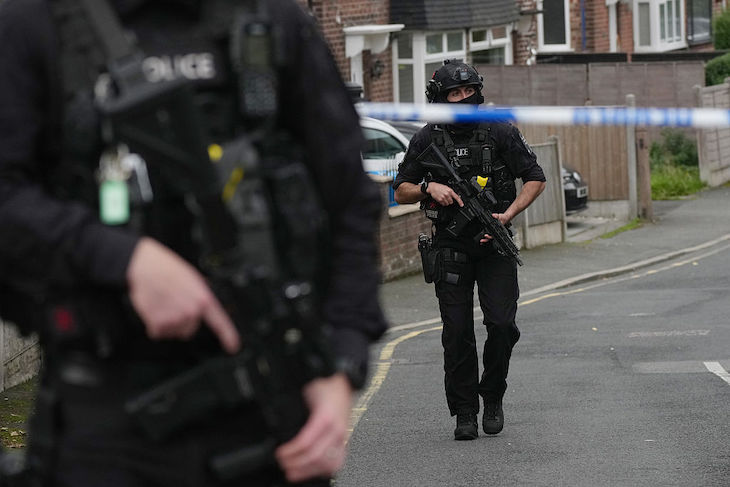
    It is still early in the investigation, and key details remain unconfirmed. But what is already known about this morning’s attack in Manchester is horrifying. At least two people are dead, as well as the attacker. Three others are in a “serious condition.” The attack occurred outside Heaton Park Hebrew Congregation Synagogue, shortly after 9.30 a.m., as members of the Jewish community gathered for prayers on Yom Kippur, the holiest day in the Jewish calendar.

    According to Greater Manchester Police, the attacker used a vehicle to ram into pedestrians before stabbing at least one individual. Armed officers responded within minutes. The suspect was shot but, according to witnesses, appeared to rise again, prompting a second round of fire. Bomb disposal units were later seen surrounding the body. Though authorities have not confirmed whether he was wearing an explosive device, the protocol and urgency of the response strongly suggest that possibility, as do some reports from the site.

    A major incident was declared within minutes. Operation Plato, the UK’s emergency response to a suspected “marauding terror attack,” was activated. Counter-terror police and MI5 are now involved in the investigation.

    At the time of writing, police have not released the name of the attacker or officially stated a motive. But it does not take a great leap of imagination to discern the likely nature of what occurred. This attack bears the hallmark of Islamic terrorism. The method – ramming, stabbing and potential bombing – is grimly familiar. And the choice of target – a synagogue, on Yom Kippur – suggests deliberate timing, designed to cause maximum fear, disruption and symbolic harm to British Jews.

    To state what should be obvious: synagogues are not random venues. They are not theaters or shopping centers or commuter hubs, caught up in indiscriminate violence. They are specific, communal, identifiably Jewish. This was an attack on Jews because they were Jews, gathering to pray on our most sacred day.

    That in 2025 this must still be said is its own indictment. British Jews, just 0.48 percent of the population, have lived under heightened threat for years. Our synagogues, schools and community centers require guards, cameras, fences and entry protocols. The Community Security Trust (CST), a communal charity, operates a national control centre and deploys trained security volunteers across the country. These lived necessities were born of painful experience.

    Today is the brutal consequence of what so many Jews have been warning about, and living with, for years.

    Since the Hamas attacks of October 2023 and the subsequent war in Gaza, the UK has witnessed an unprecedented wave of anti-Jewish hatred. CST recorded over 4,000 anti-Semitic incidents in 2023, double the previous year, and the highest ever documented. Last year brought more of the same: verbal abuse, online threats, vandalism, assaults, intimidation of children in schools, harassment of Jewish students on campus, doctors spreading anti-Jewish rhetoric without sanction. In London, Manchester, Birmingham and beyond, Jews have felt exposed and abandoned, and have warned over and over again only to be ignored.

    The atmosphere is toxic. Many Jews have stopped wearing visible signs of identity. Some no longer speak Hebrew in public. Conversations about emigration, once marginal, have become widespread. The mood is not just anxious; it is alienated. And this will only make it worse. Many of us feel our country has abandoned us and worse encourages those who hate us, giving them license to express their hatred more openly and brazenly every day.

    All of this has happened against a backdrop of regular “anti-Israel” marches where chants spill into open hatred of Jews, sermons from mosques which have been exposed on national television spew invective, and media narratives frame Jewish safety as a political inconvenience. A climate like this does not stay rhetorical. It incubates violence.

    Armed police seal off a road close to the scene of the fatal attack (Getty Images)

    This is the real climate crisis of our era, and yet “net zero” for Jew-hatred is nowhere on our government’s agenda. Instead, our Prime Minister rushed to recognize a Palestinian state days before a serious plan was unveiled by America and Israel to end the war in Gaza and start a process to encourage the Palestinians to reject extremism and violence. The UK emboldened Hamas and those who have marched against Israel and Jews week after week on our streets. The global warming we ought to be most worried about is the rising temperature of debate and news coverage when it comes to Jews and Israel, for today’s attacks like today’s is where that leads.

    Keir Starmer has said “additional police assets” will be deployed to synagogues nationwide and promised that the government “will do everything to keep our Jewish community safe.” He has expressed his horror that such an attack took place on Yom Kippur. This is hardly reassuring. Many blame him for his government’s absurd emboldening of Hamas, and constant vindictive, anti-Israel actions and statements. The fish rots from head.

    Words of sympathy are necessary, but they cannot substitute for years of ignored warnings. Repeated failures to arrest hate preachers, to discipline antisemitic professionals, to prosecute violent demonstrators, or to confront institutional media bias have left the Jewish community exposed. It is not the fault of Jews that we must secure ourselves through voluntary communal organizations – it is the fault of a society that allows hatred to fester.

    And now, on the Day of Atonement, in a city where Jews have lived for centuries, in a once great nation where Jews have contributed disproportionately in every field, we face the all too familiar spectacle of our sacred space turned into a crime scene. Jewish blood is cheap, it seems.

    Let no one pretend this came from nowhere. Let no one feign surprise. The signs have been visible. The hate has been loud. And the consequences are now bleeding into the streets.

  • Moldova has been saved from Russian influence – but at what cost?

    Moldova has been saved from Russian influence – but at what cost?

    The European Union, guardian and champion of democracy, rightly takes a dim view when ruling parties ban their opponents, refuse to open polling stations in areas likely to vote against them, censor opposition news channels and allow a large staff of foreign election monitors to police social media in the run-up. If Serbia, say, or Georgia tried systematic election rigging of this kind, Brussels would be the first to call foul and disregard the result as illegitimate. But when it’s the EU that’s running the interference, as in Moldova this week, the rules are apparently quite different.

    This week the pro-EU party of Maia Sandu, Moldova’s President and a former World Bank official, won a slim majority in a general election. Her main opponent was Igor Dodon, who led a coalition of pro-Russian parties which were heavily backed by the Kremlin (lest anyone doubt their ideological bent, the opposition’s election symbol was a hammer and sickle inside a heart inside a Soviet five-pointed star). The race was seen as a showdown between Europe and Moscow over control of a poor but strategically important ex-Soviet state – a category that also includes Georgia and Ukraine.

    “Not only did you save democracy and kept the European course, but you have also stopped Russia in its attempts to take control over the whole region,” the Polish Prime Minister Donald Tusk wrote in his public congratulations to Sandu. “Moldova, no attempt to sow fear or division could break your resolve,” wrote the European Commission president Ursula von der Leyen. “You made your choice clear: Europe. Democracy. Freedom. Our door is open. And we will stand with you every step of the way.”

    There is little doubt that Moscow opened its wallet wide – as well as its usual bag of electoral dirty tricks – in its attempt to influence Moldova’s elections. Telegram, a news and messaging app, openly hosted channels offering cash for votes. There were well-documented stories of Orthodox priests receiving bribes in order to influence their flocks. Several main opposition parties were not just pro-Moscow but provably funded by Moscow too. Pro-government Moldovan media estimate – without much proof – that the Kremlin dropped some $400 million, or 1.5 percent of Moldova’s GDP, on its failed influence operation.

    To counter the Kremlin’s campaign, the EU deployed what the foreign policy commissioner Kaja Kallas described as “a specialist team on the ground [to help] Moldova address illicit financing around the elections” as well as “a group of experts, a hybrid rapid response team, to support Moldova against the foreign interference.” Among the tasks of the EU’s team of electoral experts was to monitor online news and social media, and to use Europe’s investigative firepower to track campaign finance violations in the form of Russian money. The European Commission also dangled an irresistible €1.8 billion support package to underpin Moldova’s economic growth plan on its path to the EU.

    According to Telegram’s founder, the Russian billionaire Pavel Durov, Europe had some dirty tricks of its own to play. The day of the election, Durov announced that France’s secret services had approached him last year with a covert deal while he was detained in Paris on charges of failing to police criminal activity on Telegram. According to Durov, French spooks “reached out to… ask me to help the Moldovan government censor certain Telegram channels ahead of the presidential elections.” In exchange, the security services allegedly offered to help Durov with his legal problems – apparently a crude good cop, bad cop shakedown.

    At first, Durov claims, Telegram “identified a few [channels] that clearly violated our rules and we removed them.” But when a second list was produced that for the most part included channels that were “legitimate and fully compliant with our rules” but were simply critical of the Moldovan government, Durov refused to comply. “Telegram is committed to freedom of speech and will not remove content for political reasons,” he wrote. “I will continue to expose every attempt to pressure Telegram into censoring our platform.” France’s security services have not commented.

    Just two days before the vote, Moldova’s electoral commission banned two opposition parties – both believed to be funded by Moscow – though their names remained on the ballots, meaning that the votes of anyone who mistakenly voted for them were lost or went to other parties. President Maia Sandu had called for the large numbers of Moldovans working abroad to take an active part in elections. But just two polling stations were set up in Russia to serve the estimated 78,000-150,000 electors who live there versus more than 70 in Italy, home to some 100,000 Moldovans. In the neighboring Russian-controlled statelet of Transnistria, which lies between Moldova and Ukraine, several polling stations were moved at the last moment and two of the bridges linking the territory to Moldova were under repair, hindering people’s ability to vote.

    Do such measures amount to anti-democratic censorship and electoral interference – or are they legitimate acts of self-defense? The story of Moldova’s elections is reminiscent of Cold War Europe, when Moscow poured cash and resources into Euro-communist parties while Washington bankrolled right-wing parties such as Italy’s Christian Democrats – explaining why many Europeans are still so prone to political conspiracy theories and to seeing the secret hand of America everywhere. Moscow, for its part, has long maintained that democracy movements in the former Soviet Union, from Kyiv to Tbilisi, Minsk to Bishkek, have all been orchestrated, financed and directed by the West as a covert means of extending power through the former Soviet Empire.

    On balance it’s probably Europe, with its huge trading bloc, track record of fighting corruption in its newest member states and deep (at least by Moldovan standards) pockets that offers a brighter future for the country than Russia. Today’s Kremlin, unlike its Soviet predecessor, offers no inspiring ideological vision and can’t spare much cash to fund its overseas clients. But at the same time Russia remains a major trading partner of Moldova, and many citizens feel close cultural ties to Moscow. Forcing Russia’s neighbors to make a binary decision between East and West has proved not just divisive but has also, in the case of Ukraine and Georgia, led to bloodshed. In Georgia, recent elections have rejected former president Mikheil Saakashvili’s radical pro-EU, pro-NATO course in favor of friendship with Russia – with the result that Georgia’s economy grew a staggering 9.4 percent last year.

    Many Europeans are congratulating not just Moldova but themselves on saving the country from Russian influence. But the question remains whether Sandu’s victory makes Europe look strong or weak. On the one hand, Brussels won. On the other, just as with Boris Yeltsin’s gerrymandered election victory in 1996, democracy had to be strangled in order to save it.