In a fascinating blast from the past, two of the main figures in the biggest political scandal of the 1980s, Iran-Contra, have now married. Former National Security Council member Lieutenant Colonel Oliver North and his ex-secretary Fawn Hall tied the knot privately last month in Virginia, after it was reported they reconnected at the funeral of North’s late wife in 2024. The pair were key figures in the Reagan-era scandal, with North running the arms-for-hostages operation and Hall providing assistance in smuggling documents, avoiding public scrutiny, and shredding evidence. Hall was granted immunity for her testimony, while North was convicted of three criminal offenses before they were overturned on appeal. During the controversy, Hall and North were rumored to have been having an affair, but both strenuously and publicly denied this. Their marriage has now brought those rumors back into the public eye.
Certainly, their unique shared experience as some of the brightest stars in the first televised real-life political drama bound them forever. The Iran-Contra hearings were the precursor to the circus-like atmosphere we see in Congress today, with round-the-clock coverage, live televised hearings and lashings of salaciousness. Both Hall and North led highly highly public lives in the immediate wake of the controversy – the former getting into Hollywood (after turning down Playboy) and the latter going into political punditry. They were pioneers of the now well-worn path of shamelessly turning scandal into celebrity.
The scandal itself could have easily been ripped from today’s headlines. Within the past 15 years, we have seen illicit arms trafficking to Latin American groups, clandestine attempts to hide government involvement in questionable national security efforts and deliberate mishandling of classified documents by top American officials. Right now, there are American hostages in the Middle East, held by Iran-backed Islamist terror groups. There are backroom negotiations to free those hostages and others around the world that result in concessions to unsavory characters. There are clandestine operations to advance American interests under the aegis of the federal government. There are increasing interventions against anti-American leftist regimes in Latin America. And the Sandinistas are still in charge in Nicaragua, running an authoritarian leftist regime.
The only real difference is that Iran-Contra would not have triggered nearly as much outrage today as under Reagan. Not only have we turned every issue into a partisan firefight that plays out in the culture, on 24/7 cable news and across the cesspools of social media, we have become inured to controversy altogether. Shame is no longer an operative part of the American ethos. It can be debated as to when that process began – the Lewinsky scandal played a big role – but it has found its full flowering in the second Trump administration.
The Iran-Contra hearings began as a bipartisan affair that was characterized by genuine interest in government oversight and an attempt to have a nonpartisan consensus. Media involvement shaped the controversy into what it became: a three-ring circus. Today, there would be nakedly partisan hearings, dueling reports, chronic leaks and constant online punditry from committee members. The leading female players would not be offered Playboy spreads, but instead might have set up their own OnlyFans accounts. North would no doubt launch his own podcast, whisky and merchandise empire.
Instinctively Donald Trump would have embraced a semi-rogue actor like North. His top negotiator, Steve Witkoff, talks directly with terrorists from Hamas – a far cry from the 1980s when negotiating with terrorists was scorned. A Truth Social post lauding the operation despite its illegality wouldn’t be out of the question.The operation itself would likely not be concealed by layers of bureaucracy and plausible deniability, but announced from the White House podium. And partisans on both sides would immediately retreat into their own echo chambers and spin entirely divergent narratives about the truth, hyper-charged by social media.
Reached by phone, North declined to comment on his new marriage, apart from quoting a line delivered by Clark Gable’s character in “Gone with the Wind.”
“Frankly, my dear, I don’t give a damn,” he told CNN.
With that kind of supercharged chutzpah, Ollie North was simply ahead of his time. He would have fit perfectly within a MAGA White House. Given the turnover in the Trump administration’s national security apparatus, perhaps he’ll have another chance.
Category: Politics
-

Oliver North was ahead of his time
-

America’s ‘fringe’ has taken over the country
Another day, another public execution. The talking heads on television and Twitter tell us not to worry too much: America is still strong. They repeat this sentiment after every waking nightmare. These horrific events are not the norm, they say. They’re just the actions of a few people on the “fringe.”
But what is the American “fringe”?
The “fringe” tried to incinerate the country in 2020. The “fringe” tore down statues of George Washington and Abraham Lincoln. The “fringe” control the universities and has spent years indoctrinating kids with discriminatory dogmas. The “fringe” created the policies that let violent, mentally ill men prowl the streets and kill refugees. The “fringe” killed a healthcare CEO at sunrise in December. The “fringe” tried to kill Donald Trump last summer. The “fringe” killed Charlie Kirk on Wednesday.
The “fringe” celebrated everything that was destroyed and every life that was taken.
The “fringe” is a bunch of very normal people I went to high school and college with, who have spent the last three days cavorting and reveling over the death of a man they never met and whose actual beliefs they likely cannot articulate, let alone rebut. These are not incels or idiots; they’re ostensibly educated people with jobs and families and degrees. And yet they’re possessed by an ideology that apparently prohibits them from accepting the sanctity of every human life.
The “fringe” is not on the fringes. It’s everywhere. It’s taking over the country.
And yet for years, well-intentioned voices have told us that the madness we see online is somehow unreal – that the internet is not real life. It may be true that the internet cannot replace real life, but it can certainly destroy very real, meaningful parts of life.
And it’s succeeding, especially in its pursuits to rot the brains of young people. To say that the radicalization we’re seeing is a “fringe” issue is to simply admit you have no idea the scale of the problem; it reveals you do not know what’s happening to young people online.
If you’re a Boomer, or a “not very online” person, you won’t understand the extent of the problem. That’s not a criticism. It means you’re probably doing something right – you’ve not witnessed the effects of online addiction. You’re not seeing the kinds of vile images and videos and calls to arms that create the world’s Luigi Mangiones and their disciples. But just because you’re not seeing radical, politically insane, very subversive, and dangerously attractive content online all day doesn’t mean others aren’t.
More and more of my friends are becoming openly Bolshevist or sympathetic to nihilistic authoritarianism, every month. This isn’t because they’re reading Lenin or Marx or Marcuse. No, they don’t read at all. No one does. Their minds have been captured by algorithms that exist solely to weld their eyes to their screens. Those algorithms feed them craziness to intrigue the scroller, and, with enough time, that craziness starts to feel normal to the addict, who then goes seeking crazier content, which the algorithm gladly supplies. This cycle replays millions of times across the country, every day. And then, before you know it, you have millions of people rejoicing over the death of a civilian who’d broken no laws.
Refusing to acknowledge that these screechers are destroying the nation’s harmony is a refusal of duty. The very insistence that these people are fringe has allowed this scourge to grow to the size it has now, where it can take lives and endanger the democratic process.
It’s also made social media a more miserable place (which it was always destined to be). That has in turn made social life in America more miserable. Anyone still insisting that these forces are marginal is naïve or complacent, or speaking with their hands over their eyes. Perhaps they’re afraid of what they’d see if they peeked through their fingers.
Because the “fringe” has already infiltrated real life, real America. They were educated in our schools, and they now teach our children. They tyrannize the public square. They swing clubs when they cannot win debates. They disrespect our gods. They ransack our churches, and, like the barbarians of old, they do not speak our language. They speak only the language of violence and convulsion. And they are not “fringe.”
-

Utah’s Spencer Cox has displayed America’s best values
Governor Spencer Cox of Utah rose above the crowd when he spoke of Charlie Kirk‘s assassination and the apprehension of his suspected killer. It was the second time in as many days that Cox voiced thoughts we all needed to hear. Instead of rage, the governor’s plainspoken, heartfelt language, together with his quotes from Charlie, underscored our country’s highest and best values. They were sober, profound thoughts, and we needed to hear them.
Governor Cox’s comments on Thursday and Friday demonstrated rhetorical clarity and solid constitutional foundations, grounded in our shared humanity. In a time of pain and emotional turbulence, those are the words we all needed to hear, just as we needed (and, fortunately, received) superb professionalism from the FBI and local law enforcement. Significantly, they worked in tandem at a time when so many jurisdictions refuse to work with federal officials, even to apprehend the worst of the worst. Not so in Utah.
Utah’s governor was also clear that his state intends to seek the death penalty for this heinous crime.
And it was heinous. All murders are, and unprovoked murders even more so. This crime was both, but its significance is greater, as the national outpouring of sympathy makes clear.
The first and most important reason is that this killing was explicitly political. The killer’s motive is beyond doubt now that the public has been told of the messages he scribbled on his rifle shells. They were covered in propaganda, trying to justify the murder as “anti-fascist.”
The second reason is Kirk’s murder was so heinous is that it was a deliberate effort to suppress an alternative view, one the killer loathed. Engaging alternative views was why Charlie Kirk took his message to college campuses, like Utah Valley University, where he died. He not only wanted to persuade his audience, he wanted to demonstrate the right way to engage different viewpoints: peacefully and respectfully.
Charlie’s tent proudly said, “Prove me wrong.” In a democracy and in a university, that proof can come only from coherent arguments and solid evidence, which others are allowed to test, rebuke, and counter with their own arguments.
The crucial point is that this opposition should never be accompanied by blunt force—from a bullet, a mailed fist, or threats from an intolerant teacher or activist mob, as happens all too often these days. Charlie’s campus tour was a vibrant rebuke to this toxic brew, as Governor Cox recognized so clearly.
Finally, political murders are especially heinous because they strike at the heart of a constitutional democracy. Why? Because they constitute a deliberate assault on our peaceful, settled procedures to debate public policies, resolve disputes, choose leaders, and remove unwanted ones from office. An assassin’s bullet is a deadly challenge to that constitutional order, which took centuries to establish and is extremely rare in human history.
What America needs now is a calm restatement of these basic values, voiced with moral clarity and without apology or self-flagellation. That was Governor Cox’s achievement. He restated our country’s fundamental values, including free speech and peaceful disagreement, and rejected incitement, rioting, and vigilante “justice.”
Thankfully, Charlie’s supporters agree with Cox, as do so many others, left and right. It is important that this agreement comes from all political persuasions, including those who disagreed sharply with Charlie’s policy prescriptions.
That agreement is not universal. Kirk’s most extreme opponents responded with joy to his killing and posted their feelings online. Fortunately, their numbers are small, though even small numbers are troubling. Worse yet, we saw the same revolting performance on the floor of the US Congress, when a few representatives shouted down a moment of silent prayer in Charlie Kirk’s memory. Have they no sense of decency? The question answers itself.
Thankfully, the vast majority of Americans share a deeper understanding of what makes our democracy work. They understand political killings drive a stake into the beating heart of our constitutional order, compounding the troubles and divisions we see all around us.
It is imperative that good people say so, that they speak out clearly. That is exactly what Governor Cox did. For that, he deserves our gratitude and praise.
-

What to expect from Trump’s UK visit
The first time Donald Trump was on an official visit to the UK, in July 2018, he was deep in conversation with Theresa May during the state banquet at Blenheim Palace when his interview with the Sun dropped, offering a range of unwelcome thoughts about the then prime minister and her handling of Brexit. May’s communications team decided to let her enjoy the meal before dealing with the fallout.
When the President lands in Britain next week for another two-day jamboree of pomp and politics, Keir Starmer’s aides know what to expect. “The one thing about Trump which is entirely predictable is his unpredictability,” one ventures.
The potential landmines lie in plain sight this time – including a possible interview with GB News’s Beverley Turner. Six of Trump’s cabinet recently attended the US launch of the channel’s Washington bureau. “He likes GB News,” a British Trump whisperer explains. “But he loves Bev Turner…” As a Downing Street official observes: “He could say literally anything to GB News.”
When Turner last interviewed Trump, she pressed him to criticize growing limits to freedom of speech in the UK, an issue which is also close to the heart of J.D. Vance, the Vice President. Starmer’s decision to recognize a Palestinian state soon after Trump’s visit, the war in Ukraine and the conflict in Gaza are all areas where Downing Street and the White House are not quite on the same page.
Yet the striking thing is that British officials involved in the preparations for the visit seem sanguine about what will follow. They believe the substance and upside will far outweigh passing media squalls. They think the public is now used to Trump’s off-piste verbal excursions, which they say are “known unknowns.” Those who want Trump to join their attacks du jour on the government may be disappointed.
More fundamental to Trump than ideology is his abiding love of the deal. Recent British visitors to the White House noted with approval that on the wall of the staircase between the ground and first floors of the West Wing there now hangs a picture of Trump at the G7 summit, with Starmer peering over his shoulder, as he signed the executive order which implemented the recent trade deal with Britain. When Turner asked Trump about freedom of speech during his recent visit to Scotland, the President agreed it was an important issue but added: “I like your Prime Minister… He is a good man who got a trade deal done… It is a good deal.”
It is not the first time the online right has been disappointed by Trump’s pragmatism and periodic politeness. Claims that he would block the Chagos Islands deal and Peter Mandelson’s appointment as ambassador in Washington were both wrong. Vance’s holiday in the Cotswolds passed without incident. “We think we have an agreement to politely disagree on Palestine before the state visit,” a diplomat reveals, “which I very much hope lasts after the state visit.”
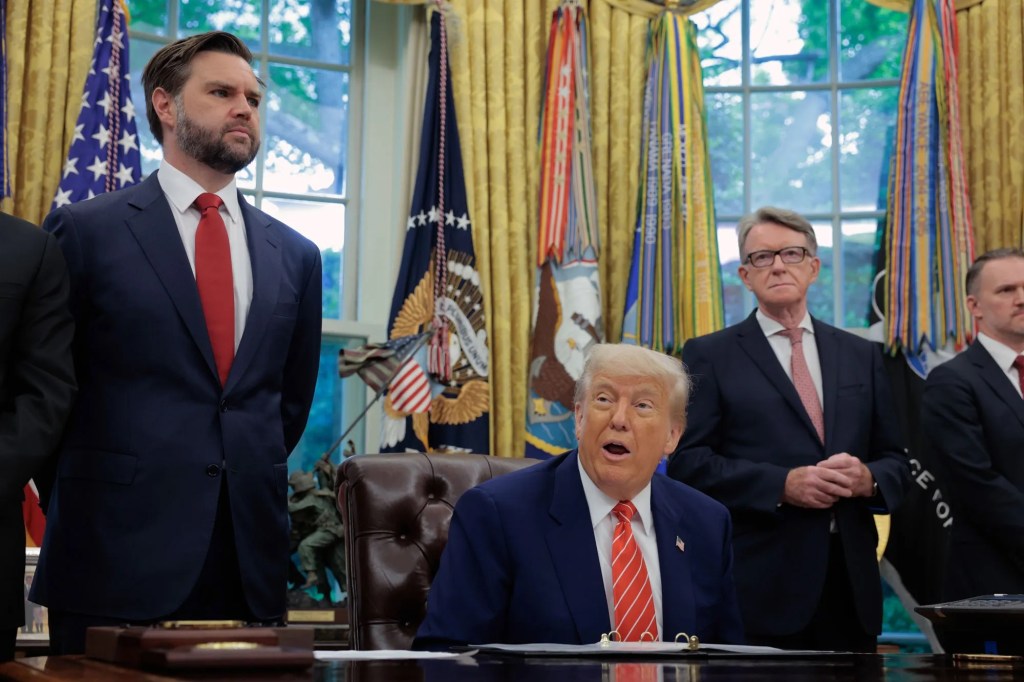
J.D. Vance, Donald Trump and Peter Mandelson in the Oval Office, May 8, 2025 (Getty) It helps that Britishness is now fashionable in Washington (where Irish origins used to be the thing to trumpet). Vance, along with other MAGA tech bros, has had his DNA tested, and discussed the results with British politicians who met him over the summer, including David Lammy, the outgoing foreign secretary, when he hosted him at Chevening. “Vance has discovered he is English,” says one of those who took part in these conversations. “He talked a lot about his roots and his ancestry. The tech-right has got very into genetic tests and Americans are discovering they’re all English.”
The big announcement next week will be a new Anglo-American tech deal which will be worth “billions of pounds of investment” to Britain at a time when the Treasury is crying out for anything which can boost growth. The deal will see more joint research and co-investment in three crucial areas: AI, quantum computing, which will hugely increase the power of AI, and nuclear fusion, which will create near limitless energy to fuel the supercomputers.
Progress has been aided by the fact that the White House is not just going through the motions. “The administration has been genuinely committed,” explains one of those involved in the negotiations. “They usually drag their feet on everything.” Insiders say that on arriving in DC, Mandelson, a prominent cheerleader for a tech deal, asked Vance to “lean into it,” which the Vice President did with gusto. After a row over encryption was resolved, Vance declared: “OK, let’s go!”
When Vance met Lammy at Chevening he spoke with passion about the possibilities. “I’ve been in lots of meetings with the Americans over the years, in which people like Vance and Jake Sullivan [Joe Biden’s national security advisor] refer to AI, quantum, biotech and fusion as millennia-defining technologies,” says one senior official. “If we can crack the computing power that will let AI transform medicine and the limitless energy needed to run it, you and I might live to 150.” Lammy, who was appointed Deputy Prime Minister in last week’s reshuffle, will deputize for Starmer at international events such as the UN General Assembly, and having developed a rapport with Vance is expected to keep talking to him weekly.
Peter Kyle, who as science minister was heavily involved in the negotiations, flew to DC this week in his new brief in charge of business and trade to try to finalize some of the details. Attempts are also under way to get some tweaks to US tariffs on Britain, something Kyle took up in his first meetings with Howard Lutnick, the commerce secretary, and Jamieson Greer, the US trade representative.
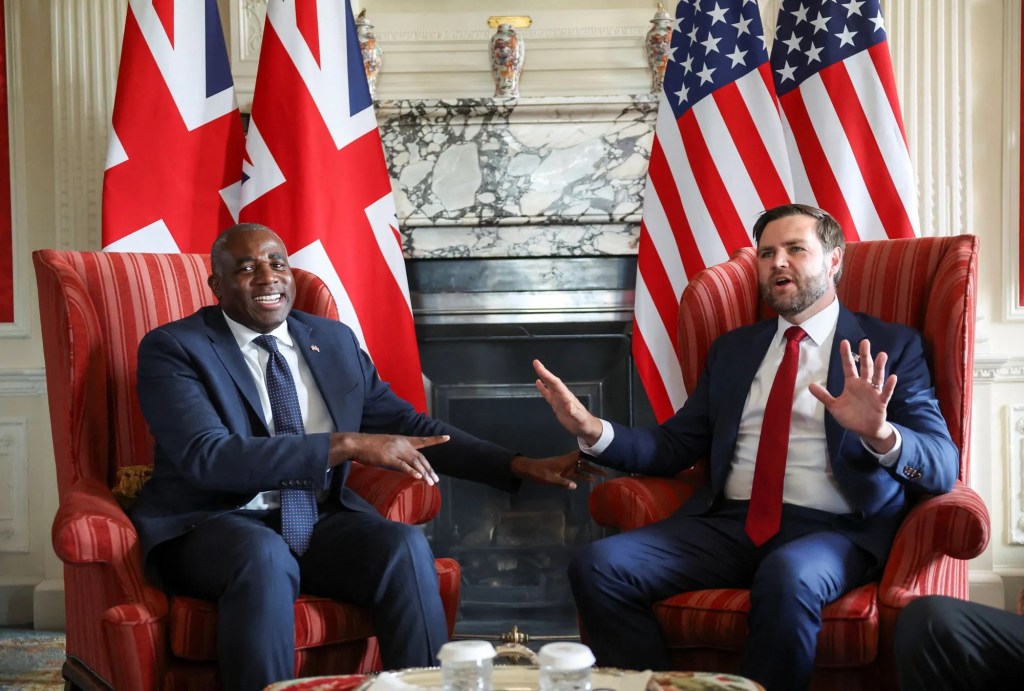
David Lammy hosts J.D. Vance at Chevening House, August 8, 2025 (Getty) The case for the deal was outlined in a speech by the omnipresent (until this week) Mandelson at Ditchley Park last week. He pitched it as a way for the western allies to fight a global power struggle with China and its autocratic allies. “China is racing to dominate artificial intelligence, quantum computing and biotechnology,” he warned, arguing that a “full spectrum US-UK technology partnership” was crucial for “mutual defense” and “to lift us out of the economic stagnation we have experienced over the last decade.”
The need for better cyber-security, another plank of the deal, was clearly illustrated this week with the publication of thousands of leaked documents from the office of Boris Johnson, revealing further details of his enthusiastic quest for cash. The revelations were not hugely surprising (one former cabinet colleague joked: “They hacked the wrong hard drive!”) but there is a serious point. The security services believe Johnson was hacked by Kremlin proxies as part of an attack on western politicians. “It is Russian in origin,” a senior security source reveals. The firebomb attack on Starmer’s constituency home earlier this year was also considered to have been a Russian operation.
Johnson was approached last summer by the National Cyber Security Centre, part of GCHQ, and told that his documents had been placed on a public website, but it was only this week that they made it to the media. “He’s notoriously lax about his own phone and cybersecurity,” says one security source, who’s scarred by the way in which Johnson ignored requests by intelligence chiefs and mandarins to take the issue more seriously when he was PM. Insiders say Johnson was hit by a phishing malware attack, unleashed when a female aide opened an attachment to an email.
Beyond the tech deal, the reason there is an attitude of “what will be, will be” in Downing Street about the state visit is because officials are confident that Trump is sincerely well disposed to the UK and to Starmer and is keen to show that Brexit has brought rewards to Britain (not that No. 10 will be caught spouting that line). When Nigel Farage met Trump in the Oval Office a week ago, after testifying to Congress about free speech, he concluded (somewhat to his distress) that the President “genuinely likes Starmer.” Farage also found Trump relaxed and upbeat. “He’s in a very good mood because he’s got no opposition,” the Reform leader told one associate. “The Democrats are in such a mess.”
Trump and Melania, the First Lady, are “very excited” about staying at Windsor Castle, where the state banquet will be held on Wednesday evening in St. George’s Hall and Trump will be greeted by a guard of honor. When Farage last saw Trump he gave him a history lesson on Windsor Castle, the residence most beloved by senior royals.
Wednesday will be all style while Thursday brings the substance. Trump will travel to Chequers for a working lunch and a mid-afternoon press conference – another moment which could be love-in or landmine. “Private time,” when Starmer and his wife Victoria will entertain Trump and Melania, has also been worked in. In 2018, Trump was feted at Blenheim, Winston Churchill’s birthplace. This time, the President will visit the Hawtrey Room at Chequers, where Churchill recorded many of his wartime radio speeches. A senior No. 10 source says: “Winston Churchill’s legacy will feature prominently – not as nostalgia, but as a reminder of leadership during uncertain times. We want this visit to set a new standard for how modern diplomacy looks: respectful of tradition, but relentlessly focused on outcomes.”
Starmer will privately stress the UK’s continuing viability as a military partner for the US, emphasizing the worth of the Aukus defense deal with Australia, which has been questioned in Washington. There is talk of a military flypast to reinforce this image for Trump. Also up for discussion will be the future of western support for Ukraine, following the failure of Trump’s push for peace with Vladimir Putin. Starmer will talk to Trump about introducing further sanctions on Moscow and how to pressure the Europeans into releasing frozen Russian assets to fund Ukraine’s war effort, though aides caution against any major announcement next week.
The only thing missing from the visit will be a round of golf. (Trump claims to have a handicap of two, but a regular British golfing partner says: “He plays off eight or nine.”) Starmer has no ability at, or interest in, the sport, and the best golfer in the cabinet is the very un-Trump-like Lord Hermer, the attorney general (though colleagues say the recent arrival in No. 10 of Tim Allan as communications director means Hermer is no longer the best golfer in the government). Remarkably, chatter on the Foreign Office grapevine reveals that Hermer once (presumably jokingly) volunteered his services to Mandelson as a “potential golfing partner” to butter up the President.
It is this column’s loss that the offer was not taken up, but probably Britain’s gain. Whatever Trump says this week, Starmer intends to focus on the positives. If the tech deal helps to kickstart the economy, it won’t matter if the President’s apparent tendresse for Beverley Turner coaxes him into being indiscreet about other subjects.
-

Stephen King, The Long Walk and Charlie Kirk
Under normal circumstances, the author Stephen King should have been feeling pretty good about things and himself at the moment. The latest film of one of his works, Francis Lawrence’s horror-thriller The Long Walk, opened in American cinemas this weekend and has been met with almost unanimously rave reviews, many of which have called it a more socially aware, darker Hunger Games. He recently published a Maurice Sendak-illustrated retelling of Hansel and Gretel, which brings his trademark dark and macabre sensibilities to the age-old fairytale. And his last novel, Never Flinch, was, naturally, a bestseller – as all his books have been since he first published Carrie, over half a century ago in 1974.
So it says quite a lot for the 77-year-old King that, for absolutely no reason, he decided to offer his opinions about the Charlie Kirk saga. King’s first reaction to Kirk’s assassination was to call it “another example of American gun violence” and to echo Barack Obama’s comments that “this kind of despicable violence has no place in our democracy.” All perfectly normal and (relatively) uncontroversial. And then King decided to say of the recently murdered Kirk that “he advocated stoning gays to death. Just sayin’.”
The activist had, of course, said nothing of the kind, and King swiftly deleted his tweet and has spent much of the day of his new film’s release apologizing to various public figures who reacted in outrage his comments, most notably Ted Cruz, who called him “a horrible, evil, twisted liar” and asked ,“Why are you so dishonest & filled with hate?” King, presumably through gritted teeth, wrote “The horrible, evil, twisted liar apologizes. This is what I get for reading something on Twitter [sic] w/o fact-checking. Won’t happen again.” Yet the reputational damage has already been done. Admittedly, the author has never been remotely shy about his Democratic, pro-Palestinian sympathies, which have never endeared him to the MAGA crowd, but if The Long Walk underperforms this weekend, especially with viewers in the heartland where the film is set, fingers will undoubtedly be pointed in King’s direction.
Not, of course, that it will make any existential difference to the writer’s popularity. He has been involved in many other high-profile spats, not least when he dismissed James Patterson, saying of his fellow author, “I don’t like him, I don’t respect his books because everyone is the same,” and remarked of Stephenie Meyer, who was unfavorably compared to JK Rowling, that she “can’t write worth a darn. She’s not very good.” Rowling, of course, came in for her own implied criticism, when an X user asked King what he thought of her political stances, and he replied, “Trans women are women.” And although most people believe Stanley Kubrick’s adaptation of The Shining to be a classic of the horror genre and an improvement on the scary but schlocky book, King has always despised it, calling it “a film by a man who thinks too much and feels too little.”
The reverse might be said of King himself. His willingness to take to social media and share his opinions, interact with his millions of admirers and discuss matters wholly unrelated to his books is commendable, and there is a reason why he has 6.8 million followers. Yet as his timely dystopian picture arrives in cinemas to shock and provoke audiences, even those who might be well disposed toward this ornery, ever-controversial author might hope that he’ll engage his considerable intellect before pressing “send” next time.
-
Bolsonaro’s conviction reveals a divided Brazil
Brazil’s former right-wing president Jair Bolsanaro has been sentenced to 27 years in jail after being found guilty by the Supreme Court in Brasilia of plotting a coup and attempting the assassination of his leftist successor, the current President Luiz “Lula” da Silva.
The five-person court panel trying the case delivered a verdict, with four judges voting guilty and one voting to acquit. The casting guilty vote was returned by a female judge, Carmen Lucia.
Donald Trump, who regards Bolsanaro as a personal friend as well as an ideological ally, has described the trial as a “witch hunt” and a “political assassination.” He has imposed 50 percent tariff charges on Brazil in response, and has threatened to increase the sanctions if Bolsanaro goes to jail. Bolsanaro’s son Eduardo has been in the US lobbying for such sanctions in protest at the “political persecution” of his father.
The trial of the controversial conservative politician stems from his narrow election defeat by “Lula” in 2022. Bolsanaro – like President Trump after his 2020 defeat by Joe Biden – cried foul and according to prosecutors worked with seven co-conspirators to persuade Brazil’s senior military officers to mount a coup and assassinate the incoming president.
Suspicions that the court is prejudiced against the ex-president were also given weight by the fact that one of the judges who condemned him was Lula’s lawyer, while another served as his justice minister
In January 2023, in a carbon copy of the invasion of the Washington Capitol by Trump supporters seeking to prevent Biden’s inauguration, thousands of Bolsanaro fans stormed federal buildings in Brasilia in a bid to persuade the army to launch a coup against “Lula.”
Both the coup and the assassination plot only failed, the prosecution argued, because Bolsanaro was unable to convince enough generals to back him and overturn democracy in Latin America’s biggest nation. Brazil has had extensive experience of a military regime as it was ruled by such a dictatorship for twenty years between 1964 and 1985 after a coup overthrew a previous left-wing president, Joao “Jango” Goulart. Many Brazilians believe that Goulart – who died in exile in Argentina in 1976 – was poisoned by agents of the military junta, although the cause of his death was officially said to be a heart attack.
Bolsanaro, a former army captain, was an outspoken supporter of the dictatorship. He won power in 2018 in a bitterly-fought election campaign during which he was stabbed in the abdomen and almost died. Since that attack, the ailing politician has suffered recurrent health problems and required repeated surgical operations.
His supporters claim that he wouldn’t survive the lengthy prison sentence that the court is expected to impose. Credence to the ex-president’s charge that he is a victim of biased political persecution is given by the way that he has been treated during the long trial. Bolsanaro was ordered to wear an ankle tag and placed under house arrest in his Brasilia home. As a result he was not in court to hear the verdict. The restrictions were imposed after the judges accused Bolsanaro of attempting to seek asylum in Argentina.
Suspicions that the court is prejudiced against the ex-president were also given weight by the fact that one of the judges who condemned him was Lula’s lawyer, while another served as his justice minister. Lula himself was once jailed on corruption charges, though the veteran politician was subsequently cleared of them,
During Bolsanaro’s rule, the ex-president was accused of damaging the Amazon rain forest by permitting logging, and of endangering the survival of the indigenous Indians who inhabit that fragile environment. His time in office, like that of Trump in the US, split the enormous country down the middle, and the trial has been marked by pro and anti-Bolsonaro demonstrations, with his supporters demanding an amnesty and his opponents calling for justice to take its course. When Bolsonaro goes to jail, there are fears that the deeply divided country will erupt in violence.
-
After Charlie Kirk, Trump should crack down on campus ‘safetyism’
An assassin who wants to silence a debate in America’s colleges can’t do it just by killing Charlie Kirk. Although Kirk was an exceptionally effective campus speaker – maybe the most effective since William F. Buckley Jr. in his heyday – he was far from alone in voicing conservative ideas in academic settings where they are generally unwelcome and at times violently opposed. There are others who will pick up Kirk’s microphone. But Kirk’s murderer has allies who can do systematically what the gunman could only do once. His allies in silencing voices like Charlie Kirk’s are university administrators who respond to violence by imposing stifling security costs on the targets of violence and intimidation.
America’s colleges and universities too often give militants a veto over campus speech. This was true long before Kirk’s murder. A few years ago students at a small Catholic college in Texas invited me to speak on their campus. I’m not exactly a well-known firebrand likely to draw an enraged mob anywhere. But this Texas Catholic college told the students they couldn’t host a conservative speaker without security insurance that they couldn’t afford. This wasn’t a response to any threat: it was a simple act of censorship by administrators too craven to ban a speaker forthrightly. They used safetyism as a convenient excuse.
My experience was not unique – colleges and universities across the country have long discouraged or completely prevented conservatives from speaking by demanding heavy security expenditures and indemnities against left-wing violence. Instead of imposing the costs of violence on those who threaten violence, institutions of higher education in our country impose those costs on those who are threatened. They impose those prohibitive costs not only on high-profile targets like Ben Shapiro, Michael Knowles, Riley Gaines and Andy Ngo, but also on speakers who aren’t targets at all. This is not a good-faith attempt to prevent violence; it’s a bad-faith strategy for stifling campus debate. Can you imagine a speaker invited to express views approved by a college administration being stuck with the bill for his or her security?
Most left-wing violence on campuses is far from murderous – it more often takes the form of rowdy mobs shouting down or attempting to intimidate speakers. These mobs do not exist because the violent left is unstoppably powerful on the nation’s campuses; they exist because the administrators in charge of campuses are unwilling to enforce basic rules on unruly children. The intimidation is opportunistic. Cowardice, more than adolescent extremism, is the root of the problem. If administrators really do fear that any conservative speaker will be met with rioting and violence, they have obviously already failed in their duty to maintain a safe environment for their students – they failed by allowing lunatics to amass enough power they could silence their critics without even having to riot.
Colleges and universities across the country have long discouraged or completely prevented conservatives from speaking by demanding heavy security expenditures and indemnities against left-wing violence
Some administrators are timid; more are not so much frightened of violence as frightened of having to take a side between freedom and leftism – they pride themselves on their progressive attitudes, yet they can’t admit that the price of those attitudes is deference to censorious radicals. Left-wing bullying is carried out in the name of anti-bullying; it’s cruelty masquerading as compassion. Calls to censor Charlie Kirk were typically framed as if doing so was necessary to protect transsexuals, racial minorities and “democracy” itself. (The scare quotes are appropriate since actual democracy without free speech is well-nigh impossible.) Aggression against conservatives – who are a minority on almost all campuses – gets whitewashed as altruism. Left-liberal administrators who like to imagine themselves as broadly in favor of free speech get their principles put to the test when anyone farther to the left claims that Charlie Kirk or some other conservative is really a purveyor of “hate speech” and indeed that their speech is actually “violence.” With administrators who believe in “trigger warnings,” speech can be killed without an assassin’s having to pull the trigger.
If there is a legitimate reason to charge security or insurance fees, the university, whether it’s a state school or a private institution that receives any taxpayer dollars, must bear the cost. Colleges that are fully privately funded can do as they wish, but if an institution receives public money, it cannot allow only viewpoints that are aligned with the left to have representation. Charlie Kirk’s murder should spur the Trump administration to compel institutions of higher education to live up to their duty to the public and to their own students. And if hosting speakers whose lives may really be in danger seems costly, universities should cut the problem off at the source by making their campuses safe for civil discourse in the first place. The Trump administration has so far made Israel and anti-Semitism the focus of its attempts to change the culture of higher education, with policies that in some cases actually harm free speech. So far as any evidence suggests, Charlie Kirk wasn’t killed for talking about the Middle East. His assassination is about America’s freedom of political speech at home, in the very institutions that are meant to be most dedicated to free inquiry. Sly techniques of censorship, such as pricing conservative speech out of campus discourse, cannot be tolerated.
There’s danger enough in the risk of further self-censorship on the part of conservatives. The left – in the form of both aggressive activists and pusillanimous administrators – doesn’t need to intimidate the right with violence when it can do so effectively by simply imposing costs, from the cost of providing security for a speaker to the costs to one’s career prospects of being known as a conservative or Trump voter. Make it more expensive to be a campus conservative, at every point along the line, and there’s no need for overt censorship. The economic incentives will do the ideological commissar’s work for him. The safetyists understand this, while conservatives who sometimes have a genuine concern for their own safety increasingly internalize the left’s mentality along with its threats. The left largely exists to make everyone feel vulnerable and victimized, in need of protection not just by metal detectors but by censorship and supervision. The more the right feels besieged and beleaguered, forced to pay for its own basic freedoms, the more it will willingly surrender to the left’s fearful way of thinking and living. Charlie Kirk didn’t die for that – he died, as he lived, to defy it.
-

The bloodthirstiness of the left is not new
The savage assassination of Charlie Kirk at a Turning Point rally at Utah Valley University yesterday prompts me to wonder, as I have often wondered, what is the leading characteristic of the left? There are several candidates. Intolerance is one. A rancid and anchorless do-goodism – think of Dickens’s Mrs. Jelleby and her “telescopic philanthropy” – is another.
But on balance I think that the late Australian philosopher David Stove was right: the leading characteristic of the left it is bloodthirstiness. Behind all the emollient rhetoric about brotherhood and equality, bloodthirstiness is the left’s most reliable calling card.
That is one reason that the nearly instant emission by prominent Democrats of their opposition to violence rings so hollow. “Political violence has no place in America,” said Kamala Harris, Alex Padilla, Nancy Pelosi, Cory Booker, Stacey Abrams, Jasmine Crockett and others.
But this came after years of calling every Republican from George Bush and Mitt Romney to Donald Trump “literally Hitler.” When Trump was first elected, in 2016, Kathy Griffin and her ghoulish ISIS-by-proxy photo shoot depicted her holding a blood-soaked likeness of Donald Trump’s severed head. Around the same time, a New York of Shakespeare’s Julius Caesar, included a Donald Trump lookalike in the title role and lots and lots of stage blood spilled when we come to the Ides of March.
Then of course there was Butler, Pennsylvania, last July when Trump came within millimeters of having his head, not just the tip of his right ear, blown off. Weeks later, a second assassin was discovered at the last minute hiding with a gun in the foliage at one of Trump’s golf courses.
No sooner had Charlie’s murder been announced than social media erupted with leftists celebrating the event and proposing lists of other people who deserved to be assassinated.
What was Charlie’s tort? Why did the left hate him so? Charlie humiliated them. He did this not by design but by holding up a mirror to their depravity and hypocrisy. Charlie was castigated by the left as a far-right agitator. In fact, he was a classical liberal whose daily activity owed a lot to John Stuart Mill. Charlie talked. He argued for his point of view. He wanted to hear your point of view and discuss it. At Utah Valley College, Charlie was conducting an open-air discussion under the rubric “Prove Me Wrong.” Some 3,000 students gathered to witness Charlie’s back-and-forth with the audience. Charlie came with arguments to advance his opinions.
In this context, it is worth noting that the bloodthirstiness of the left is not new. It is a central part of the socialist impulse. What is socialism? In part, it is optimism translated into a political program. Until he took up gardening, Candide was a sort of proto-socialist; his mentor Pangloss could have been one of socialism’s founding philosophers.
Socialism is also unselfishness embraced as an axiom: the gratifying emotion of unselfishness, experienced alternately as resentment against others and titillating satisfaction with oneself.
The philosophy of Rousseau, which elevated what he called the “indescribably sweet” feeling of virtue into a political imperative, is socialism in ovo. “Man is born free,” Rousseau famously exclaimed, “but is everywhere in chains.”
That heart-stopping conundrum – too thrilling to be corrected by mere experience – is the fundamental motor of socialism. It is a motor fueled by this corollary: that the multitude unaccountably colludes in perpetuating its own bondage and must therefore be, in Rousseau’s ominous phrase, “forced to be free.”
This is where the “mundane” side of the totalitarian temptation comes in. The starry-eyed aspect of socialist thinking does not preclude a large element of steel. The French Revolution was the nursery of both sides of socialism. It was then that the philosophy of Rousseau emerged from the pages of tracts and manifestos to strut and fret across the bloody stage of history. The architects of the revolution invoked Rousseau early and often as they set about the task of “changing human nature,” of “altering the constitution of man for the purpose of strengthening it.”
This metamorphosis does not come easily. Human nature is a recalcitrant thing. It is embodied as much in persistent human institutions like the family and the church as in the human heart. All must be remade from the ground up if “Liberty, Equality and Fraternity” are at last to be realized.
Since history (the revolutionaries thought) is little more than an accumulation of errors, history as hitherto known must be abolished. The past, a vast repository of injustice, is by definition the enemy. Accordingly, the revolutionaries in France tossed out the Gregorian calendar and started again at Year One. They replaced the Genesis-inspired seven-day week with a ten-day cycle and rebaptized the months with names reflecting their new cult of nature: Brumaire (fog), Thermidor (heat), Vendémiare (wind), etc. A new religion was born, as imperious as it was jealous.
It is significant that the socialist mentality is usually also an atheistic mentality, where atheism is understood not so much as the disbelief in God as the hatred of God – an attitude as precarious logically as it has been destructive in practice. There is an important sense in which religion as traditionally understood reconciles humanity to imperfection and to failure. Since the socialist sets out to abolish failure, traditional religion is worse than de trop: it is an impediment to perfection. (“Criticism of religion,” Marx said, “is the prelude to all criticism.”)
In 1793, the churches were closed to worship and ransacked for booty. The anti-clericalism that had been a prominent feature of revolutionary sentiment grew increasingly vicious. Hence the fashion for so-called “revolutionary marriages” in which priests and nuns were tied together naked and drowned.
Rousseau was always going on about establishing the “reign of virtue.” His far-seeing disciple Maximilien Robespierre spoke more frankly of “virtue and its emanation, terror.” It is one of the great ironies of modern history that socialism, which promises a more humane, caring, and equitable society, has always delivered a bloodier and more oppressive one.
Last April, Charlie tweeted that “Assassination culture is spreading on the left.” Alas, he was right. Requiescat in pace.
-

Trump leads tributes to Charlie Kirk
Charlie Kirk’s senseless murder on a Utah college campus yesterday led to an instant and disgusting avalanche of celebration from a small minority on the extremely online left. But Kirk’s friends and allies also rallied to pay tribute to the slain conservative activist. They know what we lost.
President Trump gave a four-minute message from the Resolute Desk and Truth Social, “The Great, and even Legendary, Charlie Kirk, is dead. No one understood or had the Heart of the Youth in the United States of America better than Charlie. He was loved and admired by ALL, especially me, and now, he is no longer with us. Melania and my Sympathies go out to his beautiful wife Erika, and family. Charlie, we love you!”
In his video address, Trump took a somber, more combative tone, accurately calling this “heinous assassination” a “dark moment for America.” At a 9/11 commemoration this morning, the President announced he would be posthumously awarding Kirk the Presidential Medal of Freedom.
Kirk also received tributes from world leaders. Javier Milei of Argentina called him a “formidable spreader of the ideas of liberty and staunch defender of the West” and “the victim of an atrocious assassination in the middle of a wave of left-wing political violence.” Israel’s Benjamin Netanyahu referred to him as a warrior for freedom and a “lion-hearted friend of Israel.” “It is heartbreaking that a young family has been robbed of a father and a husband,” said British Prime Minister Keir Starmer. “We must all be free to debate openly and freely without fear – there can be no justification for political violence.”
Vice President J.D. Vance published a lengthy tribute to Kirk on X. “Charlie had an uncanny ability to know when to push the envelope and when to be more conventional,” the VP wrote. “I’ve seen people attack him for years for being wrong on this or that issue publicly, never realizing that privately he was working to broaden the scope of acceptable debate.”
Secretary of State Marco Rubio said he was “heartbroken” and called Kirk “an incredible husband and father and a great American.” Donald Trump Jr. called Kirk “a true inspiration,” “like a little brother to me” and “one of the most courageous, principled men I’ve ever known.”
“Charlie was never a threat to anyone,” Don Jr. wrote. “He was civil, he was kind, he listened and responded with respect. The only ‘threat’ he ever posed was that he was incredibly effective. He was a powerful messenger of truth, and people heard that truth. That’s what made him a target.”
The Daily Wire’s Ben Shapiro wrote, “It was a privilege to watch this principled man stand up for his beliefs and create the single most important conservative political organization in America.”
Dave Portnoy of Barstool Sports said, “It doesn’t matter what your opinion is of Charlie or his politics; if you don’t view this as one of the darkest days in American history than you are part of the problem.”
In a country so deeply divided, it was good to see kindness from Democratic politicians too. Governor Gavin Newsom of California, who hosted Kirk on his podcast, wrote that the “senseless murder is a reminder of how important it is for all of us, across the political spectrum, to foster genuine discourse on issues that deeply affect us all without resorting to political violence.”
Mayoral candidate Zohran Mamdani, speaking at a New York campaign event, took the opportunity to condemn a “plague” of gun violence, said, “it’s not a question of political agreement or alignment that allows us to mourn. It must be the shared notion of humanity.” Mamdani struck the right tone; there’s a reason why he’s winning.
-

America’s mask of civility slips again
The FBI has just released an image of a “person of interest” in the case of Charlie Kirk’s killing. The Wall Street Journal is reporting that investigators have found ammunition at the crime scene with pro-trans and “antifa” engravings.
But we still don’t know much, if anything, about the killer. Speculation as to motives, or snap judgments as to the historical significance of yesterday’s crime, are therefore futile.
On the moronic inferno of X, however, the would-be Nostradamuses of the 21st-century right are weighing in with grave predictions about civil war or revolution or an imminent tide of vengeful justice against “the left.”
Others are suggesting that Kirk, a Christian Zionist, may have been slain for having raised doubts about Israel’s war on Hamas recently. There are also people making gnomic connections between his death and Ukraine and the release of the Epstein files this week.
From another side, a barrage of amateur historians has taken to issuing warnings that Trump’s wannabe Nazi administration will now use Kirk’s death as a sort of Reichstag Fire moment to silence dissent.
And of course we see the usual gun experts insisting – as if only they could know – that whoever “made that shot” must have been a highly-trained sniper. A state-sanctioned hit job, then? The plot thickens – in the sense that the discourse only becomes more asinine.
The truth is that nobody knows very much, and we should probably all keep away from our smartphones in the wake of such horrible news. (Not that I can lecture anyone: I’ve ghoulishly watched videos of the killing. I wish I hadn’t.)
For now there seem three good points to make about this crime. First, all civilized people are appalled that Charlie Kirk, a 31-year-old father, was killed for his opinions. The second is that America appears to be going through another of its periodic fits of political violence. The mask of civility in American life is slipping too often and too quickly (again, the internet doesn’t help).
The third and perhaps more salient point is that Charlie died as a passionate believer in free speech. His murder ought never to intimidate others from speaking their mind.
You can read some excellent – and, we hope, sensitive and non-hysterical – reaction pieces to Kirk’s murder on The Spectator’s website. I’d also encourage everyone to read Charlie’s diary for us about his visit to Britain earlier this year. He was a brave man. Rest in peace.
In other news, Lord Mandelson has stood down as British ambassador in Washington, as more and more evidence spilled out about the extent of his friendship with Jeffrey Epstein – which continued even after Epstein was jailed for sex crimes in 2008.
In an interview with the journalist Harry Cole on Tuesday night, the “Prince of Darkness” called his Epstein association “an albatross around my neck.”
Certainly, Westminster journalists have spent years whispering about Mandelson-Epstein stories being mysteriously blocked from publication. But the damn finally burst this week and now he joins Prince Andrew, the Duke of York, as the second British grandee to have wrecked his reputation by palling around with you-know-who.
Earlier this week, I wrote a magazine piece about how Epstein’s ghost will haunt Donald Trump’s visit to the United Kingdom next week. It’s now possible that Kirk’s murder will, in fact, overshadow the whole trip.
Yet many liberty-loving Atlanticists have been hoping that Trump might berate Keir Starmer for clamping down on free speech in the United Kingdom. And that was an issue Kirk, who is already being hailed as a “free speech martyr,” cared about deeply.
Might Trump now invoke Kirk’s name next week to challenge the British government for locking people up for their views? Let’s wait and see.