Category: Politics

  • Fact-checking the Venezuela war hawks 

    Fact-checking the Venezuela war hawks 

    As the US Navy remains primed for action in the Southern Caribbean, Venezuelan dictator Nicolás Maduro prepares for what could be an American attempt to remove him. And as President Trump alternates between calling Maduro on the phone and authorizing air strikes, a bevy of misinformation is being peddled by public figures with an agenda. There are so many claims and counter-claims on the air waves right now that it’s difficult to separate fact from fiction.

    A sizable chunk of this disinformation is of course being sold by Maduro himself, a man who has learned from his predecessor and mentor, the late Hugo Chávez, that it’s easier to blame the United States for all of your problems than own up to your own catastrophic policy errors. Maduro’s biggest fraud occurred in the summer of 2024, when he lost the Venezuelan presidential election to former diplomat Edmundo González Urrutia in astounding fashion but claimed victory anyway.

    Maduro, however, is hardly the only one throwing falsehoods into the air. The Venezuelan opposition movement led by Nobel Peace Prize laureate María Corina Machado and a vocal group of far-right Venezuelan exiles in Miami are just as guilty. Machado, whose entire career has been devoted to ending the Chavismo politics that have ruled Venezuela for a quarter-century, has given countless interviews in the American press about how Maduro rigged the 2020 US presidential election, unleashed the Tren de Aragua gang and directed a massive criminal organization dubbed the Cartel de los Soles, with the express purpose of weakening America by turning its citizens into drug addicts. “Everybody knows that Venezuela is today the main channel of cocaine,” Machado told CNN last month, “and that this is a business that has been run by Maduro.”

    Machado is hardly the only one making claims designed to push the Trump administration into military action. Emmanuel Rincón, a writer and activist, alleged on Fox News this week that Maduro declared war on the United States long ago and is “one of the main architects” of the drug epidemic in the US Ryan Berg of the Center for Strategic and International Studies went on the same network and called Maduro a dire threat who was turning Venezuela into a Russian and Chinese colony only 600 miles from the US mainland.

    It also sounds quite scary until you turn off the noise and start dealing with the facts. The truth is that proponents of regime change are throwing spaghetti at the wall to see what sticks. Their aim is to inflate the threat, not educate the public.

    Take Maduro’s involvement in the drug trade and his supposed control of Cartel de los Soles as a prime example. Yes, Maduro’s regime is implicated in drug smuggling. We know this because several high-profile regime figures, including Maduro himself, have been indicted by the US Justice Department on various drug-related charges. Maduro is currently wanted by the FBI and has a $50 million bounty for information leading to his capture. Some senior Venezuelan officials and Maduro family members have been implicated in cocaine trafficking as well; two of Maduro’s nephews were prosecuted for cocaine distribution in 2017 and sentenced to 18 years in prison (they were later released in a prisoner exchange).

    But the notion that Maduro is giving orders to the region’s drug trafficking networks gives the former bus driver and union leader far too much credit. Indeed, the so-called Cartel of the Sons that Maduro supposedly leads isn’t even a cartel in the traditional sense of the word; it has no top-down structure or hierarchy of any kind. Command-and-control is lacking. Those who have studied drug trafficking for decades essentially refer to it as a loose, relatively laissez-faire connection between Colombian cocaine traffickers and Venezuelan army officers, who look the other way and take a cut of the drug shipments transiting Venezuelan territory for export to Europe and the United States. While this morally disturbing and certainly criminal, it’s not exactly a shocking development: corrupt politicians and officers in Latin America have participated in similar arrangements for decades. And the phenomenon is not exclusive to Venezuela – former Honduran President Juan Orlando Hernández, who was feted by the first Trump administration as a major partner in Central America, ran a narco-state himself. For Maduro, dabbling in the drug business is likely less about attacking the United States as the Trump administration claims and more about giving his support base the opportunity to access criminal rents to get rich, thereby binding their economic fortunes to his political longevity. In other words, it’s a survival strategy, not a grand conspiracy.

    Another key question should be put into perspective: is Venezuela the central node in the drug trade? Listen to Machado and her supporters and you could easily think that cutting Maduro down to size would magically win the war on drugs. But this is laughable. According to the Drug Enforcement Administration’s own statistics, only 8 percent of the cocaine heading to the United States transits the so-called Caribbean Corridor, where Venezuela is located. The vast majority, 74 percent, is shipped from Ecuador and Colombia’s Pacific coast. The 2025 DEA drug threat assessment report didn’t even bother to mention Venezuela in the context of drug trafficking, which is a curious omission for an administration that frequently describes Maduro’s Venezuela as the epicenter of the narco world.

    Moreover, one of Machado’s biggest selling points is her contention that Venezuela will inevitably turn into a democracy once Maduro’s regime is deposed. She insists there is a 100-day plan to take over the reins of government and guide Venezuela through a political transition. Freedom of speech, free-markets, elections, justice and accountability will apparently replace repression and criminality. It all sounds pretty good.

    There’s just one problem: Machado’s camp hasn’t bothered to provide any details whatsoever about how they intend to accomplish this utopian objective. There are far more questions than answers. How will they re-build the institutions that Maduro has gutted over the last 12 years? How will they convince the Venezuelan army leadership that its interests are best served switching their support to a new government? What incentives are they willing to offer? Why are they so confident that the Venezuelan generals who made a killing under Maduro will choose cooperation over resistance, particularly when Machado continues to declare that anyone who perpetrated crimes will be prosecuted to the fullest extent? And what about the armed criminal groups and paramilitary pro-Maduro forces whose number are even greater than the regular Venezuelan military?

    The Venezuela policy debate won’t be going away anytime soon. Unfortunately, as the days go by, emotion, ideology and political agendas are displacing reality. And that’s a recipe for terrible policy.

  • The Comey dismissal is a miniature constitutional crisis

    United States District Court Judge Cameron M. Currie, sitting by designation in the Eastern District of Virginia, yesterday dismissed the federal indictments against former FBI Director James B. Comey and New York attorney general Letitia James. At the crux of the court order is the judge’s finding that President Donald J. Trump’s administration unlawfully appointed Lindsey Halligan, the US Attorney who signed the Comey and James indictments.

    Taking the now familiar TDS cheap shot, the court order opens with a description of the US Attorney as “a former White House aide with no prior prosecutorial experience.” Attorney General Pamela J. Bondi appointed Ms. Halligan as US Attorney for the Eastern District of Virginia, one of the busiest jurisdictions in the country, on September 22, 2025. Three days later, Halligan secured a two-count indictment against Comey from a Virginia grand jury. 

    Comey challenged his indictment on October 20, 2025, asserting among other concerns that Halligan’s appointment was invalid. 

    Judge Currie dismissed both cases without prejudice, meaning the US Department of Justice may re-file charges against Comey and James, at least theoretically. However, depending on which statement the Justice Department alleges forms the basis for its false statements and obstruction charges against Comey, the statute of limitations may have expired, preventing any further prosecution.

    White House Press Secretary Karoline Leavitt announced the administration will appeal the dismissals by Judge Currie, a Clinton era appointee. It is by no means clear that Halligan’s appointment is unlawful or, even if it is, that dismissal of the indictment is the proper remedy.  

    First, the Judge’s order turns on an interpretation of the statute that denies the Justice Department more than one interim appointment in any US Attorney’s Office. Nothing in the text of the statute prevents the Attorney General from making serial appointments. Additionally, prior administrations, including under Presidents Clinton and Bush, interpreted the law to allow “stacked” appointments, which went unchallenged. Also, the statute is phrased in the conditional, and it habitually uses the permissive verb of “may” rather than the strict command of “shall” or “must”. 

    Second, if the statute is interpreted to allow the Justice Department but one interim appointment, there is a genuine question over the violation of the separation of powers. Every case a US Attorney files, whether criminal or civil, is ultimately tried or settled in the courtroom of a federal judge in her district. The idea that all the judges of the district who ultimately rule on the US Attorney’s cases should also hand select the US Attorney deprives the President of his authority over the executive branch, concentrates power in one branch of government in direct contraction of the Framers’ intent, and creates tremendous disincentives for prosecutorial independence. 

    Finally, the judge need not have dismissed any indictment signed by Halligan even if her appointment was lacking. The indictment was also signed by the foreperson of the grand jury, and it was the grand jury that possessed the actual authority to find that Comey violated federal law under a probable cause standard. Furthermore, the Justice Department may have a workaround to re-indict Comey under another relatively unused statute that essentially extends the statute of limitations by six months when a felony indictment is dismissed.

    The judge’s dismissal of Comey’s indictment is just the beginning. Under the logic of Judge Currie’s order, any indictment signed by Halligan alone is presumptively invalid. It would be unsurprising to see defendants challenge even those indictments where Halligan was but one of multiple noted authorities. A wave of dismissal motions is coming from other defendants indicted this past fall in the Eastern District of Virginia. Moreover, Judge Currie’s order has the potential for a tsunami effect as defendants across the country challenge their indictments in jurisdictions where other US Attorneys are presiding who remain unconfirmed by the Senate.  

    Given the very high stakes that go well beyond the Comey case, the Trump administration has no choice but to appeal Judge Currie’s order. While the federal appellate courts sort out what the intersecting federal statutes mean for who actually runs the US Attorney’s Offices nationwide, Congress should act immediately to untangle this imbroglio by amending the statutory framework for the President’s executive branch appointees. The President must possess the authority to appoint members of his own administration. Whatever role the Congress should have for advice and consent may vary from position to position, as is clear under the plain words of the Constitution itself, but in no event should the courts be appointing employees of other branches of government. The issue must be settled, not simply for President Trump’s team, but for every administration to follow. 

  • Why would Putin sign Trump’s peace deal?

    Why would Putin sign Trump’s peace deal?

    It was summer 2022. Ukraine had just taken back Kyiv, people were returning to the city, and the mood was one of euphoria, triumph and success. I was having dinner with a Ukrainian official in a neon-lit seafood restaurant in the center of the city, the curfew nearing. “If this ends like the West Germany or Korea scenario, that would be the best outcome,” I said to him. He snapped at me: “You want me to tell my relatives in Kherson that they will never live in Ukraine?”

    Three years later, and even that unwelcome outcome is now far from what Kyiv is being offered by the Trump administration. Reports suggest that Ukrainian officials have agreed to a modified version of the initially leaked 28-point plan, stressing that the agreement is contingent on “sensitive issues” being settled directly between President Volodymyr Zelensky and Donald Trump. But a source familiar with the discussions said that Zelensky is not likely to visit Washington this week as he requested time to consult with the European leaders.

    Kyiv has accepted the structure of the deal as it no longer believes it has a better option. Reports of Ukraine’s acceptance came as Moscow warned that any final version must adhere to the “spirit and letter” of the Trump-Putin talks in Alaska suggesting Russia expects its demands to be cemented in the agreement.

    Trump’s push for a peace plan came at the weakest political and military position Ukraine has been in since the start of the war. The political class was distracted by a corruption scandal, public morale strained after months of Russian attacks and the government bracing for another hard winter. It was against that backdrop that Zelensky sent a senior official to tell Washington that “we are ready to work seriously on a plan,” one senior official said.

    In Miami, Zelenskiy’s national security council head, Rustem Umerov, met with President Trump’s special envoy Steve Witkoff and son-in-law Jared Kushner. Kushner’s involvement was taken in Kyiv as a sign Trump was personally engaged. It came sometime after Witkoff had met with Russia’s middle-man Kirill Dmitriev in Miami in October, where Dmitriev had discussed a potential plan of agreement with the US side. 

    Parts of the potential negotiation framework, sources say, were already known to the Ukrainians, but not as the 28-point document that later would be leaked to the press. “Some parts of the plan definitely existed. There were many plans coming back and forth,” a Ukrainian official told me. 

    The proposal, criticized in both the US and Europe, originally laid out a settlement built on territorial concessions and strict limits on Ukraine’s security options. It required a full Ukrainian withdrawal from Donbas, the creation of a demilitarized buffer zone effectively left on Russia’s side, and the de facto recognition of Russian control over Crimea, Luhansk and Donetsk. The front line in Kherson and Zaporizhzhia would be frozen, Ukraine’s military capped at 600,000 personnel and Kyiv barred from pursuing NATO membership or hosting foreign troops. 

    The US says Ukraine has now agreed to work with a modified version of this plan. One reported change is that the cap on Ukraine’s armed forces has been raised to 800,000, but beyond that, the scope of the revisions remains opaque. A Ukrainian source says that the new plan includes a form of US security guarantees for Ukraine and it may require congressional approval, but did not disclose details. For now, the substance of the updated proposal remains largely unknown.

    The war of attrition has exhausted the Ukrainian Army and society. Today, frontline units complain of having to spend longer periods at the positions while the rest of the country continues to live. Those in the trenches have grown angry at their compatriots who drink in the bars and go about their days. 

    But even those in relative safety in Kyiv are not truly safe. The nightly attacks, massive rocket barrages and drones, keep them awake and in the basements every other day. In the background of peace talks in Geneva, Russia launched one of the largest attacks in weeks against Kyiv and other cities on Monday night.

    As Zelensky’s envoy headed to America last week, a corruption scandal had taken over Ukraine. Everyone from taxi drivers to government sources spoke of the “Mindichgate” in Kyiv that implicated the president’s inner circle and his partner Timur Mindich in a scheme through which he and other high-level officials had enriched themselves by $100 million.

    In Washington, officials appear to have read this moment as an opening to push a deal on Zelensky. A day after Zelensky met with his party, parts of the document had already begun circulating. 

    “You cannot say no to these people,” remarked a Ukrainian official who said that Dmitriev has sold Witkoff, who had been to Russia multiple times but was yet to make a trip to Kyiv, a bright plan for a joint Russian-American future. “If you’re in the middle, you get punches from both sides,” he added.

    If you strip the proposal down to its core, everything turns on security guarantees and that’s the part so far undefined by the plan. “Without security, any kind of deal is useless,” one senior Ukrainian official said. For Russia, any deal that guarantees Ukrainian security in the future with US protection is unacceptable. Three years later, meeting the same official in the same neon-lit restaurant, he explained why: “Trump rationalizes Russia. He thinks they want to make returns, that they’re ready to exit the war if they see it as advantageous,” while “Russia has always viewed the United States as a strategic opponent and is interested in the strategic defeat of the United States.”  

    So far, Ukrainian officials see no real appetite in Washington to offer the kind of security guarantees that would make any deal long-lasting. The reason, they argue, is that Moscow opposes it, and the US seems unwilling to cross that line. When I asked another senior official whether leaving Ukraine without credible guarantees would amount to a strategic win for Russia and a loss for the US, he answered bluntly: “If the US does not care for its power,” he said, “why should I?”

  • Will Israel bring back the death penalty for terrorists?

    Will Israel bring back the death penalty for terrorists?

    For years, there was a broad consensus in Israel that there was no benefit to reintroducing the death penalty. But now, Prime Minister Benjamin Netanyahu’s government is reportedly considering supporting a bill which would bring back capital punishment for convicted terrorists.

    The bill, which has passed its first reading in the Knesset, would introduce the death penalty for those who murder Jews – specifically, Palestinian terrorists. It would not apply to Jews who commit acts of terrorism and murder Palestinians. And it would not apply if Israeli Arabs, who are full citizens, are murdered.

    The bill is being promoted by Itamar Ben-Gvir, the minister of national security, who in 2007 was convicted of incitement to racism for chanting “Death to Arabs.” Since becoming a minister more than three years ago, he has moderated his language and now urges his supporters to chant “Death to terrorists” instead.

    The bill has also been backed by the Shin Bet, Israel’s security service, which for the first time has said it supports the death penalty in principle. Six weeks ago David Zini, its new chief, was appointed after being nominated by Netanyahu.

    In the death penalty bill’s draft presented by Zvika Fogel (of Ben-Gvir’s Jewish Power party), it states that the death sentence would be carried out within 90 days, with no possibility of appeal, for “anyone who murders a Jew solely because they are Jewish – including those who planned or dispatched the attack.” It also specifies that “the execution will be carried out by the prison service through lethal injection.”

    If passed, it would not be the first time Israel has had the death penalty. From the establishment of the State of Israel in 1948 until 1954, it was in force under the British Mandate’s 1936 Criminal Ordinance. During those six years, courts issued death sentences to several murderers – both Arabs and Jews – and to a Jewish Kapo accused of crimes against humanity during the Holocaust. But state presidents Chaim Weizmann and Yitzhak Ben-Zvi, who opposed the death penalty on moral grounds, pardoned every one of those convicted and commuted their sentences to life imprisonment.

    The only exception was IDF major Meir Tobianski, who, during the war of independence, was hastily and unjustly convicted for treason and spying for Britain and executed by firing squad in the Jerusalem hills. Months later, in 1949, military advocate general Aharon Hoter-Yishai ordered a review of the case and ultimately recommended that the conviction be annulled. Tobianski’s name was cleared, his rank was restored and an apology was made to his widow and son.

    In 1954, the Knesset abolished the death penalty altogether for murder. The debates were not partisan, and the arguments for abolition were rooted in Jewish tradition – that human beings are created in the image of God, and only a divine decree can take away that right to life – as well as universal moral principles and the fact that capital punishment does not deter crime.

    Although the death penalty was abolished for ordinary murder, Israeli law still permits it in rare cases: treason, treason during wartime, crimes against humanity, crimes against the Jewish people (such as Nazis), or extremely severe wartime offenses. In the occupied territories, where military law often applies, there are also provisions that permit death sentences for severe security offenses.

    Over the years, military courts have occasionally handed down death sentences to terrorists, but these were always overturned and commuted to life imprisonment. The only civil death sentence ever carried out in Israel was for Adolf Eichmann, the Nazi official who was responsible for implementing the Final Solution.

    For years, there were occasional calls – mostly from right-wing politicians – to impose the death penalty on terrorists in particularly heinous cases. But most parties in Israel, along with human rights organizations, strongly opposed it on security, moral and practical grounds – as well as concerns about Israel’s international image.

    The Shin Bet also always opposed it. Over the years, various internal discussions took place within the agency, always concluding that the death penalty would not deter potential terrorists. The arguments against the death penalty were particularly well articulated by the late Yitzhak Ilan, former deputy director of the Shin Bet. In conversations I had with him, and in documents he wrote, he explained that the only possible justification for the death penalty would be deterrence. But based on his 31 years of fighting terrorism, “the disadvantages far outweigh any potential deterrent effect.”

    He noted that between sentencing and execution, terrorist organizations would likely attempt to carry out kidnappings or bargaining attacks to prevent executions – just as the Jewish underground groups did under British rule. “In such a case,” Ilan emphasized, “we would suffer a double loss: instead of a terrorist sitting in prison for life, he might be released as part of a deal triggered by the death sentence.”

    Ilan also warned that executions could lead to revenge attacks by terror groups or even by the condemned person’s relatives. In addition, wanted terrorists would refuse to surrender, choosing to fight to the death – putting security forces at greater risk. And perhaps most significantly, those sentenced to death would become martyrs and role models. “Islamic culture glorifies martyrs,” he said, “and those who face execution would quickly become revered cultural heroes.” In Israel today, public streets, parks and institutions are named after members of the underground organizations executed by the British.

    The Shin Bet strongly denies that its change of position is tied to Zini’s appointment, claiming that its stance was formed independently by professional officials over a long period, influenced by the horrendous acts of murder, rape and burning by Hamas on October 7, 2023, and by the fact that Hamas no longer holds any live hostages. The Shin Bet has stated that although it supports the death penalty in principle, it opposes its automatic and blanket application. In other words, it believes each case must be evaluated individually. This approach sharply contrasts with the demands of Ben-Gvir and his allies, who want courts to apply the law automatically, without judicial discretion.

    There is still a long way to go before the bill passes its second and third readings. But given Israel’s security situation and with the 2026 elections approaching, Netanyahu appears more willing to advance the bill than ever before. Some reports suggest he tried to halt the passage of the bill behind the scenes. But the legislation is gaining momentum – and if passed, could reshape Israeli society forever.  

  • The battle for Ukraine’s electric grid

    The battle for Ukraine’s electric grid

    On Sunday, Ukrainian drones attacked the Shatura Power Station located about 75 miles east of Moscow. The 1,500-megawatt gas-fired facility provides heat and power to the residents of Shatura, a town of about 33,000. The drone attack caused three transformers at the plant to catch fire, and a local official said, “All efforts are being taken to promptly restore heat supply,” to the town. According to Reuters, the drone strike was “one of Kyiv’s biggest attacks to date on a power station deep inside Russia.”

    Sunday’s attack on the power plant in Shatura came two weeks after Ukrainian drones and missiles hit power infrastructure in the Russian cities of Belgorod, Voronezh and Taganrog. Meanwhile, the Russian military has launched hundreds of attacks on Ukraine’s electric grid.

    Attacks on power plants have long been an integral part of modern warfare. As I explained on my Substack in June in “The Enemy Of My Enemy Is My Electricity Provider,” during the Korean and Vietnam wars, the US military repeatedly attacked electricity infrastructure. During the First Iraq War, the US-led bombing campaign nearly destroyed Saddam Hussein’s electricity infrastructure. The campaign included 215 sorties aimed at Iraq’s grid. Cruise missiles outfitted with “blackout bombs,” which used tiny carbon filaments to short-circuit the Iraqi grid, were also used. Before the war, Iraq had about 9,500 megawatts of electricity generation capacity. By the time the bombing stopped, that had been reduced to about 300 megawatts. One analyst concluded that the attacks “virtually eliminated any ability of the Iraqi national power system to generate or transfer power.”

    Over the past two decades, the Israeli military has repeatedly attacked the only power plant in the Gaza Strip. In 1999, during Operation Allied Force, US F-117 fighters bombed a power plant at Novi Sad, which cut off 70 percent of Serbia’s electricity supplies.

    War planners bomb power grids for an obvious reason: electric grids are our Mother Networks. Electricity is the world’s most important form of energy. All our key societal systems depend on the electric grid. If you destroy your adversary’s grid, you weaken their entire society, including their ability to wage war.

    While militaries have long targeted electric infrastructure, the Ukraine-Russia war marks a turning point. More than any conflict in history, this war has been about electricity. In the 45 months since Russia invaded Ukraine, the two sides have launched an unprecedented number of attacks on each other’s electric grids. And now, under the terms of a proposed peace deal put forward by the Trump administration, Russia could get half of the electricity generated from the Zaporizhzhia Nuclear Power Plant – the world’s sixth-largest nuclear power station – as part of the spoils of the war.

    Never before has a functioning power plant, much less a massive nuclear power plant, been part of a peace settlement. Here’s a close look at the electricity war, with a special focus on Zaporizhzhia.

    When Russia invaded Ukraine in February 2022, Russian President Vladimir Putin declared he made the move to “demilitarize and denazify” Ukraine. He would later say that Ukrainians should throw out the “drug addicts and neo-Nazis” who were running the government.

    Whatever Putin’s justification for invading Ukraine, the reality is that the fighting has largely been focused on capturing land and destroying energy infrastructure. In early 2024, Dixigroup estimated that Russia had launched nearly 2,000 missiles and drones against Ukraine’s energy sector. In January, a Ukrainian official claimed that Russian forces had launched nearly 1,300 strikes on Ukraine’s energy sector, including “attacks on more than 800 electricity substations, distribution and power lines, more than 250 strikes on energy generation facilities and more than 30 on gas facilities.”

    Last week, the Trump administration released a 28-point plan that has been hailed and decried for what it includes and what it doesn’t. On Thursday, the Hoover Institution’s Niall Ferguson declared on X that the plan is a “reasonable basis for negotiations” and that “realistically, Ukraine has never been in a position to defeat Russia.” On Friday, Noah Rothman, a writer at National Review, slammed the plan, calling it a “violation of the American national character,” and “an abdication of our duty to preserve the post-Cold War global order that Americans were blessed to inherit.”

    While the deal includes a lot of vague language about security guarantees, economic cooperation, and how “all ambiguities of the last 30 years will be considered settled,” one of the clearest tenets of the plan is point 19, which says: “The Zaporizhzhia Nuclear Power Plant will be launched under the supervision of the International Atomic Energy Agency, and the electricity produced will be distributed equally between Russia and Ukraine, 50:50.”

    As the peace talks continue in Geneva, it’s not clear how the IAEA would manage the ZNPP, which has been shut down and is now under the control of Russian forces.

    (Credit: Wikimedia)

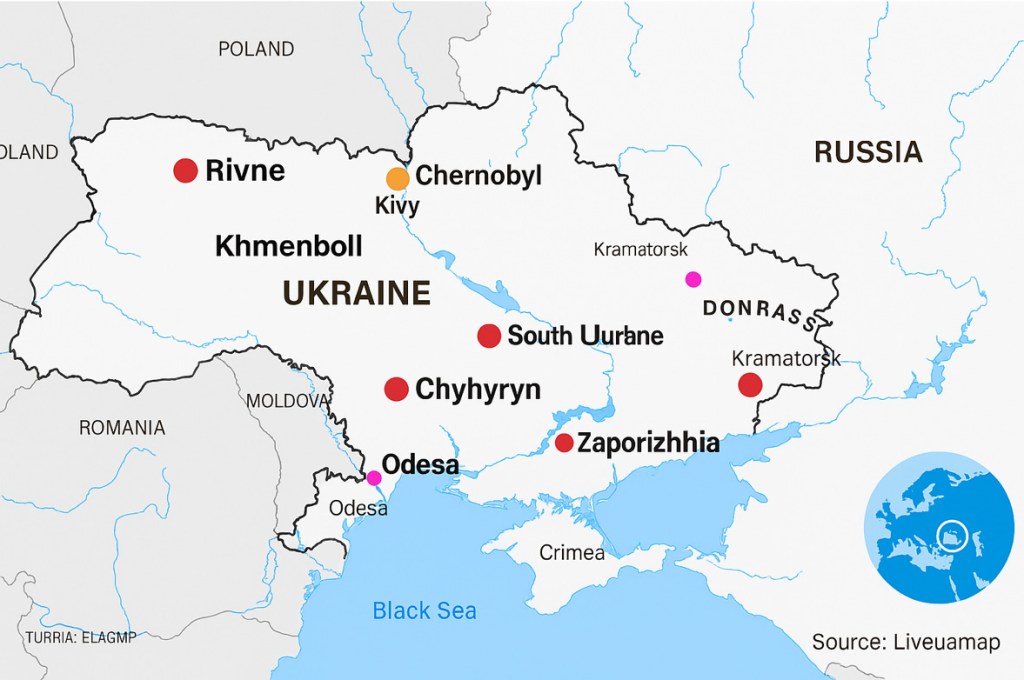
    Seizing the ZNPP was among Russia’s first objectives in its invasion of Ukraine. Russian forces captured the plant on March 4, 2022, just eight days after Putin launched the invasion. It was the first time an operating civil nuclear power plant came under armed attack. As shown above, the plant is located in southern Ukraine, about 360 miles southeast of Kyiv.

    The ZNPP was built by the Soviet Union between 1984 and 1995 near the city of Enerhodar, on the southern shore of the Kakhovka Reservoir. It has six VVER-1000 reactors and has a total generation capacity of 5,700 megawatts. Before the war, Zaporizhzhia was a key electricity provider to the Ukrainian grid. It generated about 40 terawatt-hours of electricity annually, or about 20 percent of the country’s electricity use. The plant was connected to Ukraine’s grid through multiple 750 kV and 330 kV lines. Over the course of the war, those lines have been damaged numerous times. That has forced the plant to run emergency diesel generators to cool the reactors and spent fuel. According to the IAEA and other news outlets, the plant has lost access to external electricity supplies 10 times since the war started.

    The IAEA and industry journals have repeatedly described nuclear safety at Zaporizhzhia as “fragile,” not because of the condition of the reactors, but because its off-site power and cooling water arrangements rely on very thin margins of safety. In late October, the plant was reconnected to the grid after it lost external power for more than a month. After power was restored, IAEA Director General Rafael Mariano Grossi said: “What was once virtually unimaginable – a nuclear power plant regularly losing off-site power – has unfortunately become a common occurrence during this devastating war. However, this was the most challenging loss of power event we have experienced so far. I would especially like to extend my thanks to the technicians – on both sides of the frontline – who have been working hard in recent days to restore power in very difficult circumstances.”

    The power plant has been part of peace discussions since March, when Trump suggested that the US should take control of Ukraine’s nuclear plants. He said, “American ownership of those plants could be the best protection for that infrastructure.” Regardless of who controls ZNPP, it’s unclear when the plant might be able to start producing power again.

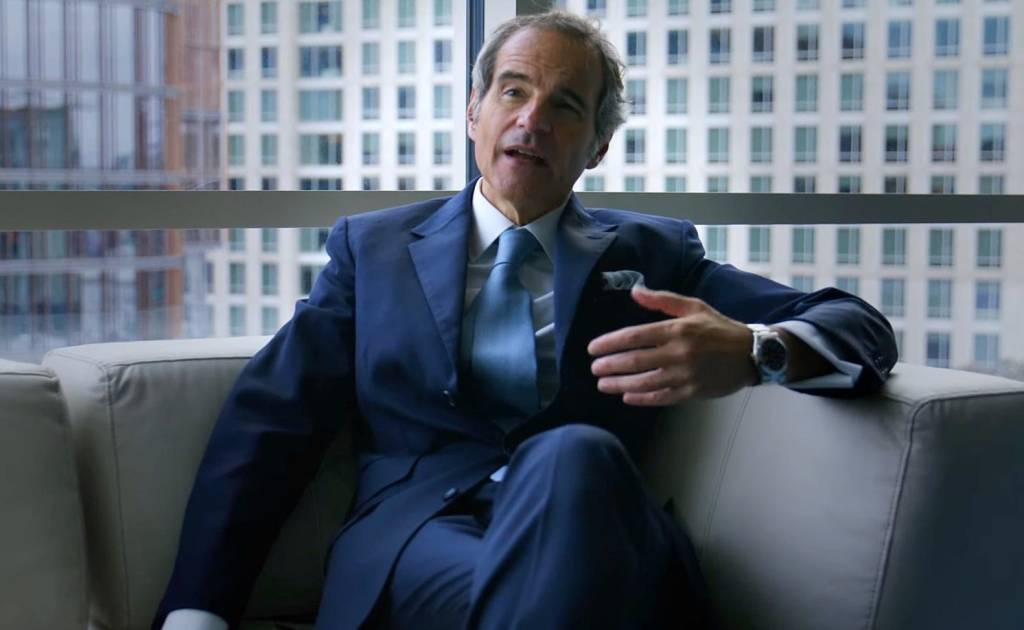
    IAEA Director General Rafael Mariano Grossi, in a still shot from his interview in our 2024 five-part docuseries, Juice: Power, Politics & The Grid

    In June, Grossi declared there was “no way to restart” the plant in the near term, citing insufficient cooling water, an unstable power supply, and the need for extensive inspection after years offline in a war zone. “We are not in a situation of imminent restart of the plant,” he said. “Far from that, it would take quite some time before that can be done.”

    Last month, a Brookings report estimated that Ukraine’s energy infrastructure is “deeply damaged” and is operating at “about a third of its pre-invasion capacity.” It continued saying that Russia’s ongoing bombardment of the Ukrainian power grid is intended to “cripple Ukraine’s economy and undermine its population’s resolve to resist Russian aggression, with the ultimate goal of compelling the Kyiv government to surrender.” It went on to report that rebuilding Ukraine’s tattered energy sector could cost some $90 billion.

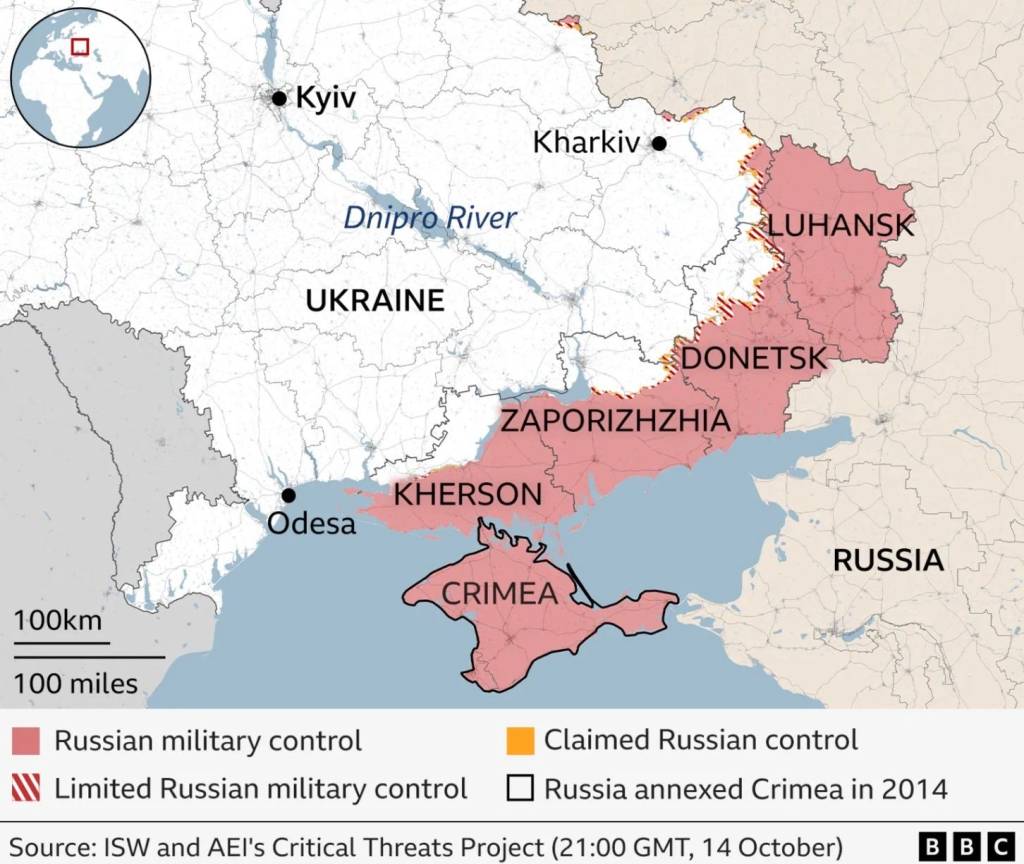
    It’s impossible to know whether a peace deal will actually happen, or if it happens, how long it might last before Russia invades Ukraine again. But it’s also easy to see why Russia wants to control all or part of the ZNPP. As seen in the BBC map above, Russia has seized much of southern Ukraine. To hold that territory and keep the population under control, it will need electricity and lots of it. Building a plant the size of the ZNPP would likely cost about $60 billion. Even if Russia only gets half of the juice from ZNPP, the cost to replace that much nuclear generation capacity would be on the order of $30 billion. And remember, due to sanctions, Russia doesn’t have much extra cash.

    By Monday night, the BBC was reporting that the Ukrainians were ready to accept parts of the 28-point peace plan, but it was unclear whether the ZNPP proposal would be part of the deal. Other news outlets claimed that the Geneva meetings had produced an “updated and refined” agreement. Another reported that the Kremlin has already rejected the updated deal.

    Again, we can’t know how the peace talks will play out. Putin may be content to let the war drag on and to continue pounding Ukraine’s power infrastructure until Kyiv and other major cities are left in the dark as winter approaches. Perhaps he believes by stalling, he can wring more concessions out of the US and Ukraine.

    During World War Two, the Russian dictator Josef Stalin declared the conflict was a “war of engines and octanes.” The Russia-Ukraine conflict has become a war of electrons, substations and power plants – a battle where plunging cities into darkness and weaponizing winter can be as lethal as any drone swarm or missile barrage.

    This article was originally published on Robert Bryce’s Substack.

  • Andrew Mountbatten-Windsor should ignore Congress

    Andrew Mountbatten-Windsor should ignore Congress

    As an American who respects the constitutional role and historical continuity of the British crown, I view the recent congressional request to interview Andrew Mountbatten-Windsor with disgust. In early November, several of the most progressive Democratic members of the US Congress sent a letter asking him to participate in a “transcribed interview” regarding his past association with Jeffrey Epstein, with a response deadline of November 20.

    While Congress is free to seek information, the request carries no compulsory authority over a foreign national residing in the United Kingdom. In this context, the decision to issue such a demand – despite its unenforceability – is less an exercise of legitimate oversight than a symbolic, politically motivated gesture. Its implications extend beyond the individual to the broader relationship between the United States and a cherished ally.

    No congressional body has the power to compel testimony from a British citizen living on British soil. The Democratic signatories are well aware of this limitation. They hold no subpoena authority in this matter, nor any realistic diplomatic leverage to transform their request into an obligation. What they do have is political incentive: Epstein’s network remains a potent source of scandal, and the opportunity to summon a disgraced royal provides ready-made headlines when so many prominent Democratic names are implicated.

    It is not as though Andrew has escaped consequences. Far from it. The King has stripped his brother of the remaining symbols of royal status: the style of His Royal Highness in any official capacity, his leasehold of Royal Lodge, and the last vestiges of public duty. A man who once served his country in wartime now lives in seclusion, his military titles and patronages relinquished, his public life reduced to silence. His 2022 settlement with Virginia Giuffre – substantial in scale, though without admission of liability – closed the civil litigation against him. He has repeatedly denied criminal wrongdoing, and no jurisdiction, British or American, has brought charges against him. The monarchy has taken its course. To pretend he remains unaccountable is to ignore the very real penalties he has absorbed.

    Why, then, must salt be poured on this wound by the US government? The Democratic members leading the request – foremost among them Representatives Robert Garcia and Suhas Subramanyam – frame their interest as part of a wider effort to “uncover the identities of Mr. Epstein’s co-conspirators and enablers.” Yet it strains belief that, five years after Epstein’s death and with Ghislaine Maxwell already serving a lengthy prison sentence, the testimony of Andrew Mountbatten-Windsor is uniquely indispensable – particularly when so many powerful and prominent Americans have escaped scrutiny. The timing is difficult to ignore: rudderless Democrats facing a fresh election cycle appear eager to present themselves as champions of justice.

    More troubling is what such a request implies about the relationship between sovereign states. The Crown has endured invasions, civil wars, religious upheavals and aerial bombardment, yet it has never sought validation by submitting its internal affairs to foreign legislative scrutiny. When Parliament executed Charles I, it did not appeal to European assemblies for absolution. When George III lost the American colonies, he did not send the Prince of Wales to justify himself before the Continental Congress. The constitutional monarchy has survived precisely because it understands its own prerogatives and responsibilities. Its legitimacy arises from the British people and the British constitution – not from congressional committees in Washington.

    Were Andrew to travel to Washington now – stripped of titles and shorn of institutional protection – he would be entering a political theater in which the rules are set entirely by those seeking to question him. There would be no adversarial process, no opportunity for cross-examination, and no safeguards against selective leaking. Congressional interviews are not judicial proceedings; they are political platforms. To expect a private British citizen, however notorious, to submit himself to such a process is to disregard both diplomatic custom and the principle of sovereignty.

    Britain has already acted. The King, exercising constitutional authority, has removed his brother from public life. The United Kingdom has determined the appropriate response to Andrew’s conduct. For American lawmakers to insist on an additional public reckoning – particularly those belonging to a party long eager to downplay the Epstein-related associations of prominent figures among their own ranks, such as Bill Clinton – is less a pursuit of justice than an attempt to distract and obfuscate.

    None of this excuses Epstein’s crimes or the moral failures of those who enabled him. But justice is not advanced by this shameless smokescreen. The Crown is larger than any one man, and it has acted to protect its integrity. The US government should acknowledge that action rather than attempt to supersede it.

    Andrew Mountbatten-Windsor is under no obligation to respond to Congress’s request—and he would be right not to. Sovereign nations must know where their authority ends. It is time certain members of Congress remembered where theirs does.

  • DoGE has had its day

    DoGE has had its day

    DoGE has been DoGE’d. The once fearsome government efficiency office has been shut down eight months before its contract officially ends in July 2026. What was supposed to be an organization that exploded traditional ways of running the federal government has turned into a damp squib. 

    It was established by President Trump on the first day of his second term in office. Headed by Tesla chief Elon Musk and entrepreneur Vivek Ramaswamy (who resigned early on to run for Ohio governor), it struck the kind of fear into government bureaucrats that a visit from the Red Guards might instill during Mao’s Cultural Revolution. Musk’s minions rampaged through government offices, whether it was the US Institute of Peace or the Wilson Center. The idea was that the bastions of the liberal establishment would not simply be purged but permanently abolished. 

    Now, as Reuters reports, the efficiency office has been disbanded. “That doesn’t exist” as a “centralized entity” Office of Personnel Management Director Scott Kupor said. Hasta la vista, in other words. After Musk torched, or appeared to torch, his relationship with Trump in May, DoGE began to sputter. The Trump administration is trying to put the best face possible on its dissolution. On social media Kupor declared, “”DoGE may not have centralized leadership under @USDS,” Kupor said, referring to the United States Digital Service, which was reorganized into DoGE. “But, the principles of DoGE remain alive and well: de-regulation; eliminating fraud, waste and abuse; re-shaping the federal workforce; making efficiency a first-class citizen; etc.”  

    Yeah, right. The truth is that a government-wide freeze on hiring is over and the federal deficit has reached a record $38 trillion in the past month. The Congressional Budget Office estimates that Trump’s One Big Beautiful Bill will add over $3 trillion to the deficit and that the deficit for fiscal year 2025 will run $1.8 trillion. The only mitigating factor has been a de facto tax hike by Trump who has imposed punitive tariffs. 

    If the debt remains, so does the insalubrious legacy of DoGE. One is the agencies that it either denuded or shuttered during its brief but chaotic existence. Take the Kennan Institute, which was formerly housed in the Wilson Center on the Washington Mall. I recently visited its new headquarters on K Street – a one-room office. The institute will make a comeback, but demolishing the Wilson Center was symbolic of DoGE’s march of folly through Washington. 

    Another inadvertent legacy of DoGE is actually diametrically opposed to its mandate – the expansion of big government in the form of National Guard troops stationed in a variety of American cities. When DoGE staffer Edward “Big Balls” Corisine was attacked by ten juveniles near DC’s Dupont Circle in early August, Trump responded by stationing the National Guard in Washington and other cities. But this initiative, too, appears to be ebbing as Trump refrains from sending in troops to New York City and a federal judge blocks his deployment of the National Guard in Washington. 

    As he focuses on becoming the world’s first trillionaire, Musk, who attended the White House dinner for Saudi Crown Prince Mohammed bin Salman, appears to have put the entire episode in the rearview mirror. Once upon a time he called himself the president’s “first buddy.” Then came the feud with Trump. Now the reconciliation? 

  • The global cottage industry gaming America’s culture wars

    The global cottage industry gaming America’s culture wars

    It is the 9/11 of the blue ticks, the Hindenburg of the grifters, the dotcom bubble of the slop-peddlers.

    The influencer industry has been left reeling by a new function on X which allows readers to see the location from which any given account is operating. The latest update makes it possible to establish when and where an X account was set up and whether it has changed its name since then.

    A sensible measure, you might think, but not if X is where you make your living and do so by inserting yourself into other countries’ internal politics. There are no firm figures on how many earn a crust this way but even the most cursory glance through the Hellsite Formerly Known as Twitter will tell you the number isn’t insignificant.

    It’s near impossible to scroll down the “For You” stream without spotting an account with US flags in the profile and header pics and a litany of posts, images and especially videos highlighting the worst of US political, cultural and racial divisions. Yet while this is posed as the output of Americans frustrated by one thing or another, it is sometimes – perhaps often – the work of foreigners who do not live in the United States, never have, have no connection to the country whatsoever, but who have figured out a way to make bank off the need of very online Americans for validation of their pre-existing attitudes.

    This is the result of Elon Musk allowing users to monetize their accounts via a premium subscription. Flipping the blue tick from an imprimatur of an account’s authenticity to a marker of someone on the make ought to have been sufficient warning for users, but on social media as in commerce the emptor seldom heeds the caveat.

    And now everyone can see just how many of those blue ticks aren’t what they seem.

    You’ve got to admire their entrepreneurial pluck. It’s all too easy to sit back and coast at your nine-to-five, but these guys have identified a gap in the market and created a whole new industry serving up rageslop to Westoid midwits who can be roused to anger about anything – race, gender, Jews, chemtrails, White House refurbishment – other than the civilization crumbling around them.

    Farming culture-war engagement is a slog, especially when you work to build an audience for one grievance then events (or impressions data) require you to pivot to another one. It’s more effort than reward in most advanced economies but in poorer climes pandering to prejudices and pathologies can bring in a nice chunk of change. First World problems pay Third World mortgages.

    And is there really all that much harm done?

    If you’ve been following @Zoomer_Rhodesian, who claims to be a twenty-something e-girl from Galveston, for her “Is it them again, Yogi?” memes and her keen interest in Waffle House CCTV footage, does it matter that the account is actually the work of Manjeet, a Gen-X father of eight from Ghaziabad?

    If you’re in the market for a desperate Gazan whose only son is shot dead by the IDF every few weeks, and someone in Romania is happy to play that role for engagement, what have you to complain about? You created a market and the market responded accordingly. Service sought, service rendered, cash collected.

    The follower of such an account is being deceived, of course, but only in the same sense that the subscriber to OnlyFans is deceived when his favorite camgirl confesses with a moan that he gets her so hot.

    Where phony accounts can be a source of harm is when their fictions are amplified without verification by the mainstream media. The greatest risk of this comes with accounts which purport to document issues journalists care most about, from a perspective journalists most strongly agree with, in parts of the world where access for journalists is restricted or financially prohibitive. Which is a long-winded way of saying “Palestine.”

    Even here, though, the substantive harm is not done by the Indonesian random inventing ever more lurid stories about Israeli villainy but by the journalist who fails to do that most basic of diligences: check your sources.

    The origin update isn’t all downsides, though. If you’ve ever been unjustly accused of being a foreign influence op, Elon’s latest innovation brings sweet vindication. I should know from my own X account. Contrary to what I’m sometimes told, I don’t tweet from an air-conditioned basement suite at the Mossad headquarters – more’s the pity – but from across the pond in good old Blighty. Look, I have the certificate to prove it.

    This, however, raises another possibility: that accounts flagged as American or otherwise Western will now become very valuable, valuable enough for Westerners to make a fast buck of our own flogging our log-in details to Indian influencers and Ghanaian grifters. Finally, globalization is working in our favor again.

  • Russia is willing to keep on fighting in Ukraine

    Russia is willing to keep on fighting in Ukraine

    At a time when western commentators are tying themselves in knots trying to parse the ongoing Ukraine peace discussions, the Russian media is suddenly strikingly united in its coverage. There is a common misperception that, like their Soviet forebears, the Russian press simply reproduces some standard party line, day in, day out. In fact, there is often surprising pluralism, with different newspapers having their own interests and angles. However, the Kremlin does impose its will when it comes to especially important or sensitive matters, with editors receiving tyomniki, informal but authoritative guidance from the presidential administration on lines to take and topics to avoid. When the press is speaking in one voice, that voice is Putin’s.

    A day of uncertainty followed when news of the proposed 28-point peace plan for Ukraine first dropped. But now, the Russian media is back in lockstep, providing a useful insight into what the Kremlin wants to communicate to both foreigners and its own subjects.

    In the heavyweight government paper Rossiiskaya Gazeta, Fyodor Lukyanov, one of the most prominent foreign policy scholars often deployed to put a gloss on the official line, contributes a piece under the headline “Realism and the Impossible: Why Ukraine won’t be forced to immediately accept the 28-point peace plan.” In it, he argues that “the primary means, frankly,” for Russia to achieve its goals in the conflict “is military force”: “As long as hostilities continue, leverage remains. As soon as they cease, Russia finds itself alone (we harbor no illusions) in the face of coordinated political and diplomatic pressure.”

    It is hardly coincidental that this comes just as European leaders put forward their own version of the original plan, which keeps NATO membership open and punts key issues such as the exchange of territory to be resolved after negotiations have started, while demanding an end to the fighting as their precondition. The Russian press is united in – not necessarily groundlessly – regarding the European variant as a spoiler: why should Moscow pause its attacks and give Ukraine a chance to regroup, only to risk there being no agreement after months of fruitless filibustering on Kyiv’s part? As the business paper Kommersant puts it, “Kyiv’s European allies are seeking amendments to the Trump plan for Ukraine that will make it unacceptable to Moscow.”

    In which case, the common message is that Russia is perfectly willing to keep fighting. Many papers quote Putin’s words from a televised meeting of the country’s security council on Friday, that while: “Russia is ready for peace negotiations, it is also satisfied with the current dynamics of the [special military operation], which are leading to the achievement of its goals by military means.”

    The implication is that until Putin knows that he is going to get at least his key demands from any agreement, he will continue to unleash his armies, missiles and drones on the Ukrainians. The nationalist Tsargrad news site, which has recently been implicitly critical of Putin, suggesting he should be even more aggressive, put it starkly: “Russia’s position hasn’t changed: if Zelensky doesn’t agree to Moscow’s terms, Russian troops will continue their offensive deep into Ukraine.”

    Just as Ukraine, Europe and the US are being warned that Moscow is not desperate for a deal, Russians are being prepared for disappointment. The newspaper Trud offers up upbeat bombast from Konstantin Kosachev, deputy speaker of the Senate, that the West has “abandoned Ukraine… It can’t withstand continued military action without consolidated western external support, which it no longer has. But it’s also not ready for negotiations, because they’ll have to be conducted from the position of the losing side, not the winner.”

    Most of the commentary is rather more sober, though. The business press may be eyeing up the possibility of sanctions relief, but in the main the papers are trying to strike a balance between caution and optimism. Gazeta.ru’s military observer may argue that “Ukraine should agree to Trump’s plan without conditions,” but there is absolutely no consensus that it will.

    Some commentators suggest that Zelensky cannot risk alienating the nationalist wing at home by making any agreement, others that European leaders – who are undoubtedly being presented as the villains of the peace – will succeed in sabotaging the process. Noting that “senior EU officials have been diligently fanning the flames for the past few years,” Izvestiya nonetheless reassures its readers that “time is currently playing against the Europeans and Kyiv.”

    This, after all, is the Kremlin’s main point: that Russia is winning regardless. To Ukraine and the West, it holds out the threat that if this round of negotiations fails, any future peace terms will be rather harsher. To Russians, it offers a prospect not just of peace, but of victory – so long as they stay the course.

  • ISIS is stirring once more

    ISIS is stirring once more

    Indications that the Islamic State (ISIS) has begun to employ artificial intelligence in its efforts to recruit new fighters should come as no surprise. At the height of its power a decade ago, Isis was characterized by its combination of having mastered the latest methods of communication with an ideology and praxis that seemed to have emerged wholesale from the deserts of 7th century Arabia.

    In 2014 and 2015, ISIS recruitment took place on Twitter and Facebook. YouTube was the favored platform for the dissemination of propaganda. The group’s videoclips of its barbaric prisoner executions, including the beheadings of a series of western journalists and aid workers and the immolation of a captured Jordanian pilot, became the organization’s gruesome trademark.

    When the self-declared ISIS “caliphate” stretched across an area of Iraq and Syria roughly the size of Great Britain, these modes of communication and propaganda drew thousands of young Muslims from across the West and the Arab world to enlist under the terror group’s distinctive black banners. Current indications suggest that in an atmosphere of renewed relevance for political Islam, the organization is stirring.

    Islamic State never really went away, of course, though it has faded from the headlines over the last turbulent half decade. The caliphate’s final holdings were retaken by US-led coalition forces in the Baghuz area of the lower Euphrates river valley in the summer of 2019. ISIS fighters were transferred to the archipelago of prisons maintained by the US-aligned Syrian Democratic Forces (SDF). Their wives and families went to the sprawling al-Hol and Roj encampments, maintained until now by the same organization.

    But far from the centers of power, Islamic State has maintained in the intervening years a kind of “ghost caliphate” on the lands it once held, as well as beyond. Support networks, hiding places, weapons supplies and the relationships with tribes and clans which alone make possible safe passage across the remote areas and deserts of Syria and Iraq have all been maintained.  

    In places with names not widely known or noticed in the West, ISIS has maintained fighters and infrastructure. The Karachok mountain chain in Iraq, with its remote caves ideal for hiding and storing food, water and weapons; the poverty-stricken lower Deir al Zur province in Syria; and the vast Badia desert in central Syria are but a few.  

    In the Roj and especially the al-Hol camps in Syria, meanwhile, a new generation of ISIS fighters is being educated. Many of the residents of these facilities are simply displaced refugees. But a hardcore group of ISIS families dominate. There are 38,000 residents of these camps, along with 9,000 ISIS fighters in the SDF’s jails.

    Visiting al-Hol in mid 2024, I encountered a reality in which the under-resourced, western supported SDF personnel merely guarded the perimeters of the large tent encampments which comprise the camp. Within, Islamic State was in control. The organization was educating and indoctrinating its young. It was maintaining its own system of “justice,” up to and including passing death sentences, which were then carried out, the corpses left for the authorities to collect outside the compound. Escapes were also frequent and often involved bribing the guards.  

    The usual destination of the escapees was of particular note. At that time, Hayat Tahrir al-Sham (HTS), which now rules Syria, was in control of only a small enclave in the northwest of the country. HTS was not an ally of ISIS, and in fact suppressed the organization in its area of control. But it emerged from the same Sunni jihadi origins. ISIS men knew that if they could reach the HTS-controlled enclave, they would be left alone as long as they did not seek to organize against the de facto authorities in the area. Escapees headed in this direction.

    The collapse of the Assad regime late last year left a security vacuum in Syria, at least outside of the 30 percent of the country controlled by the SDF. HTS commanded less than 40,000 fighters when it took Damascus. In the first months of its rule, its grip on the more remote parts of Syria was nonexistent.

    Driving across the Badia in January this year, I found the checkpoints of the former regime deserted. Nothing had come to replace them yet. Lacking manpower, the new government has concentrated on securing the vital urban centers. ISIS has been quick to take advantage of the vacuum. The organization is reckoned to have around 2,500 fighters now in Syria and Iraq. A sharp uptick in attacks has taken place in the course of the year. Weapons have been stockpiled in the vast and still largely unsecured Badia. Recruitment is taking place in the poorest tribal areas where Islamic State and al-Qaeda have traditionally flourished. An ISIS insurgency is now a solid possibility.

    The lingering appeal of ISIS as an idea in the Islamic world should not be dismissed. What exactly is this idea? One of the group’s fighters who I interviewed in the Turkish border town of Cielis in 2014 expressed it to me succinctly: “We want the caliphate, something old and new, from the time of Mohammed. The Europeans created false borders. We want to break these borders.”

    These ideas did not die with the fall of Baghuz in 2019. The last couple of years have been good ones for Sunni Islamism in the Middle East. The Hamas massacres of October 7, 2023 and the subsequent Gaza war returned Islamist insurgency to center stage. The issue of the Palestinians and Israel retains a matchless intensity of appeal for masses of young people across the Islamic world. HTS’s march into Damascus, a byproduct of Israel’s weakening of Hezbollah and Iran, further reinforces the newly returned relevance of Sunni political Islam.  

    ISIS emerged from this milieu. In April, visiting al-Hol again, I was told that the ISIS compounds joyfully celebrated the march of HTS into Damascus. They told their Kurdish jailers that their roles would soon be reversed.

    There is a crucial point here to be borne in mind. The government of HTS and President Ahmed al-Sharaa, following the latter’s recent visit to Washington, are now members of the Global Coalition to Defeat ISIS group. But while they have clashed in the past, ISIS and HTS come from the same root. There has been much migration of fighters between the two groups. Just this week, government-linked fighters who clashed with the SDF in Raqqa province were photographed wearing patches resembling the black ISIS banner.

    Can HTS forces be relied upon to suppress the terror group’s re-emerging strength in Syria? And if the Damascus authorities attempt to move against Islamic State, will the government’s own fighters, many of them Sunni jihadis of a similar mindset to ISIS, remain loyal? These questions remain to be answered.

    ISIS’s revival is not confined to Syria alone. The organization’s Afghan “province” carried out large-scale and deadly operations in Moscow and Iran last year. A series of attempts have been thwarted in Europe. Jihad al-Shamie, who carried out the murderous terror attack at the Heaton Park synagogue in Manchester in October, claimed allegiance to Islamic State in his phone call to police. In short, Islamic State is returning. It is making use of the full variety of recruitment and operational tools available to it. Vigilance at the security level and coherent policymaking at the political level will be equally vital in meeting its challenge.