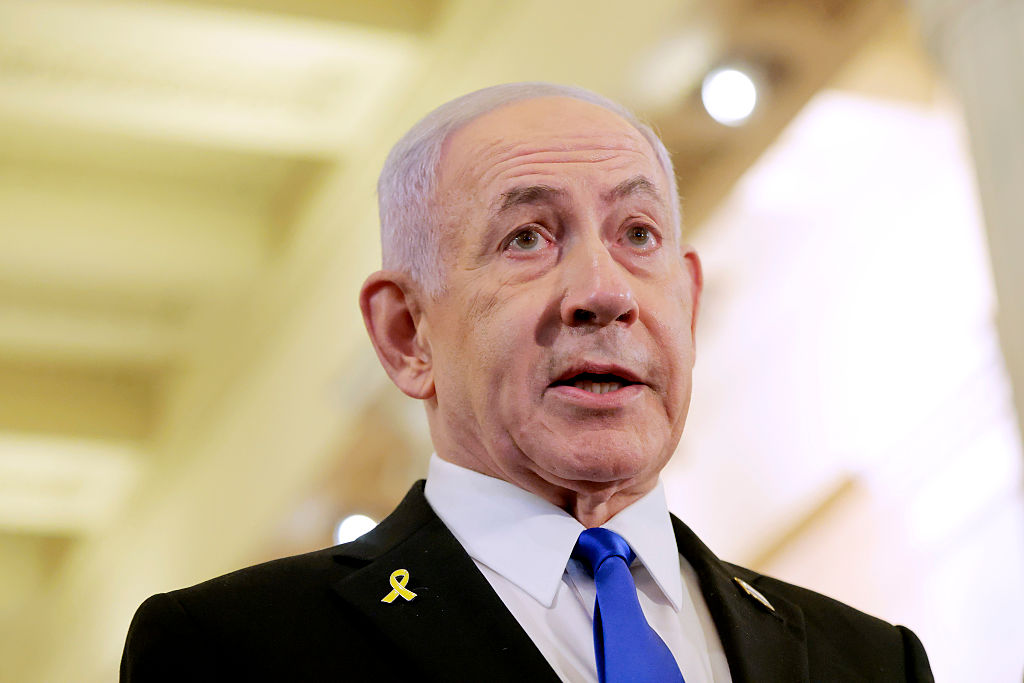
Tag: Benjamin Netanyahu

  • Will Israel bring back the death penalty for terrorists?

    Will Israel bring back the death penalty for terrorists?

    For years, there was a broad consensus in Israel that there was no benefit to reintroducing the death penalty. But now, Prime Minister Benjamin Netanyahu’s government is reportedly considering supporting a bill which would bring back capital punishment for convicted terrorists.

    The bill, which has passed its first reading in the Knesset, would introduce the death penalty for those who murder Jews – specifically, Palestinian terrorists. It would not apply to Jews who commit acts of terrorism and murder Palestinians. And it would not apply if Israeli Arabs, who are full citizens, are murdered.

    The bill is being promoted by Itamar Ben-Gvir, the minister of national security, who in 2007 was convicted of incitement to racism for chanting “Death to Arabs.” Since becoming a minister more than three years ago, he has moderated his language and now urges his supporters to chant “Death to terrorists” instead.

    The bill has also been backed by the Shin Bet, Israel’s security service, which for the first time has said it supports the death penalty in principle. Six weeks ago David Zini, its new chief, was appointed after being nominated by Netanyahu.

    In the death penalty bill’s draft presented by Zvika Fogel (of Ben-Gvir’s Jewish Power party), it states that the death sentence would be carried out within 90 days, with no possibility of appeal, for “anyone who murders a Jew solely because they are Jewish – including those who planned or dispatched the attack.” It also specifies that “the execution will be carried out by the prison service through lethal injection.”

    If passed, it would not be the first time Israel has had the death penalty. From the establishment of the State of Israel in 1948 until 1954, it was in force under the British Mandate’s 1936 Criminal Ordinance. During those six years, courts issued death sentences to several murderers – both Arabs and Jews – and to a Jewish Kapo accused of crimes against humanity during the Holocaust. But state presidents Chaim Weizmann and Yitzhak Ben-Zvi, who opposed the death penalty on moral grounds, pardoned every one of those convicted and commuted their sentences to life imprisonment.

    The only exception was IDF major Meir Tobianski, who, during the war of independence, was hastily and unjustly convicted for treason and spying for Britain and executed by firing squad in the Jerusalem hills. Months later, in 1949, military advocate general Aharon Hoter-Yishai ordered a review of the case and ultimately recommended that the conviction be annulled. Tobianski’s name was cleared, his rank was restored and an apology was made to his widow and son.

    In 1954, the Knesset abolished the death penalty altogether for murder. The debates were not partisan, and the arguments for abolition were rooted in Jewish tradition – that human beings are created in the image of God, and only a divine decree can take away that right to life – as well as universal moral principles and the fact that capital punishment does not deter crime.

    Although the death penalty was abolished for ordinary murder, Israeli law still permits it in rare cases: treason, treason during wartime, crimes against humanity, crimes against the Jewish people (such as Nazis), or extremely severe wartime offenses. In the occupied territories, where military law often applies, there are also provisions that permit death sentences for severe security offenses.

    Over the years, military courts have occasionally handed down death sentences to terrorists, but these were always overturned and commuted to life imprisonment. The only civil death sentence ever carried out in Israel was for Adolf Eichmann, the Nazi official who was responsible for implementing the Final Solution.

    For years, there were occasional calls – mostly from right-wing politicians – to impose the death penalty on terrorists in particularly heinous cases. But most parties in Israel, along with human rights organizations, strongly opposed it on security, moral and practical grounds – as well as concerns about Israel’s international image.

    The Shin Bet also always opposed it. Over the years, various internal discussions took place within the agency, always concluding that the death penalty would not deter potential terrorists. The arguments against the death penalty were particularly well articulated by the late Yitzhak Ilan, former deputy director of the Shin Bet. In conversations I had with him, and in documents he wrote, he explained that the only possible justification for the death penalty would be deterrence. But based on his 31 years of fighting terrorism, “the disadvantages far outweigh any potential deterrent effect.”

    He noted that between sentencing and execution, terrorist organizations would likely attempt to carry out kidnappings or bargaining attacks to prevent executions – just as the Jewish underground groups did under British rule. “In such a case,” Ilan emphasized, “we would suffer a double loss: instead of a terrorist sitting in prison for life, he might be released as part of a deal triggered by the death sentence.”

    Ilan also warned that executions could lead to revenge attacks by terror groups or even by the condemned person’s relatives. In addition, wanted terrorists would refuse to surrender, choosing to fight to the death – putting security forces at greater risk. And perhaps most significantly, those sentenced to death would become martyrs and role models. “Islamic culture glorifies martyrs,” he said, “and those who face execution would quickly become revered cultural heroes.” In Israel today, public streets, parks and institutions are named after members of the underground organizations executed by the British.

    The Shin Bet strongly denies that its change of position is tied to Zini’s appointment, claiming that its stance was formed independently by professional officials over a long period, influenced by the horrendous acts of murder, rape and burning by Hamas on October 7, 2023, and by the fact that Hamas no longer holds any live hostages. The Shin Bet has stated that although it supports the death penalty in principle, it opposes its automatic and blanket application. In other words, it believes each case must be evaluated individually. This approach sharply contrasts with the demands of Ben-Gvir and his allies, who want courts to apply the law automatically, without judicial discretion.

    There is still a long way to go before the bill passes its second and third readings. But given Israel’s security situation and with the 2026 elections approaching, Netanyahu appears more willing to advance the bill than ever before. Some reports suggest he tried to halt the passage of the bill behind the scenes. But the legislation is gaining momentum – and if passed, could reshape Israeli society forever.  

  • Why Trump and Israel differ on Turkey’s involvement in Gaza

    Why Trump and Israel differ on Turkey’s involvement in Gaza

    As the Gaza ceasefire struggles into its second month, a significant difference between the position of Israel and that of its chief ally, the United States, on the way forward is emerging. This difference reflects broader gaps in perception in Jerusalem and Washington regarding the nature and motivations of the current forces engaged in the Middle East. The subject of that difference is Turkey. 

    The Turks have expressed a desire to play a role in the “international stabilization force” (ISF), which, according to President Donald Trump’s 20-point plan, is supposed to take over ground security control of Gaza from the IDF (and Hamas) in the framework of the plan’s implementation. Ankara appears to have played a significant role in securing the 1October 10 ceasefire between Israel and the Gaza Islamists. Now, Turkey wants a major role in future arrangements on the ground in Gaza, in both the military and civilian sectors.  

    Israel is absolutely opposed to any Turkish role in future security arrangements in Gaza. Jerusalem appears to grudgingly accept Turkish civil involvement. Here also, however, given the background and orientation of the Muslim Brotherhood-associated Turkish IHH Humanitarian Relief Foundation, which is currently engaged in relief work in the Strip, there is extreme suspicion in Jerusalem. The IHH was the sponsor of the 2010 “flotilla” to Gaza, in which a number of Islamist activists and their allies sought unsuccessfully to break Israel’s naval blockade on the territory. But while a Turkish civil role is probably unavoidable, Israel draws the line at a Turkish troop presence. 

    This is because Israel identifies Turkey in its current form as something very close to an enemy state. The reasons aren’t mysterious. Jerusalem has alleged that Ankara allows Hamas to maintain a large office in Istanbul, from which they claim the organization has planned both military and terror activities and political and media campaigns.  

    Israel has also claimed that Turkey facilitates the unimpeded travel of Hamas officials across the Middle East by supplying them with Turkish passports. Turkish President Recep Tayipp Erdoğan has never condemned the massacres of October 7, 2023. Rather, the Turkish leader describes Hamas as “not a terrorist organization, it is a liberation group, ‘mujahideen’ waging a battle to protect its lands and people.”

    The Turkish leader is somewhat less complimentary in his view of Israel’s leaders. A few days ago, Ankara issued arrest warrants for alleged “genocide” against Israeli Prime Minister Benjamin Netanyahu and 36 other Israeli officials.  

    In May 2024, against the background of the Gaza war, Erdoğan announced that “relations with Israel have been severed.” Later, it became clear that he had been referring specifically to trade relations. Still, the statement reflected that the state of affairs between Jerusalem and Ankara had reached their lowest ebb.  

    The Israeli system considers that Turkey’s consistent pattern of anti-Israel activities forms part of a larger, assertive and expansive regional strategy. It fits comfortably with Turkey’s military incursions into Iraq and Syria over the last half decade, its deployment of drones and proxy fighters in Azerbaijan and Libya in support of allies’ wars, its efforts to build influence in Lebanon, the West Bank and Jerusalem, its burgeoning alliance with Qatar, and its “mavi vatan” (blue homeland) strategy in the Mediterranean, in which it seeks to lay claim to expanded exclusive economic zones (EEZs) in the eastern Mediterranean, Aegean and Black Seas.  

    In all this, Israel sees a combination of political Islam and Neo-Ottoman revanchism, exemplified by a statement by Erdogan earlier this year that Turkey’s “spiritual geography” extends to “from Syria to Gaza, From Aleppo to Tabriz, From Mosul to Jerusalem.”

    Israel suspects that Turkey wishes to make use of the ISF in Gaza as a platform by which it can reinsert Turkish troops into the Israeli-Palestinian context and use their presence in turn to leverage influence, probably through tacit cooperation with its Hamas ally.  

    The Trump administration shares little or none of Israel’s perception of Turkey. Rather, it sees Ankara as a strong, stable and welcome partner, able and willing to play an important role in securing the region. President Trump describes Erdoğan as a “great leader.” The White House has rushed to embrace the new Sunni Islamist president of Syria. As Trump has noted, the victory of Ahmed al-Sharaa and his rebel group Hayat Tahrir al-Sham in the Syrian civil war was equally an achievement for Turkey, which created the conditions for the Sunni Islamist fighters to prepare before they marched on Damascus late last year.  

    The administration appears to have taken Turkey as a kind of guide on regional matters, accepting the notion that Turkish power can guarantee Syria and continue to prevent an ISIS resurgence. In a recent briefing to the Middle East Forum think tank, Turkish researcher Sinan Ciddi also noted that, during his September visit to the White House, Erdogan committed to giving the US access to Turkey’s deposits of lithium and other critical mineral deposits in the country.  

    The combination of strong, authoritarian rule, an apparent ability to achieve goals and a willingness to make available natural resources appear to have won Trump’s favor. Turkey’s close alliance with Qatar, which similarly backs Sunni political Islam across the region, forms part of the same general orientation.  

    US Middle East envoy Tom Barrack on Thursday paid tribute to the Turkish role in Syria, describing “Turkey’s tireless role… a testament to the quiet, steadfast diplomacy that builds bridges where walls once stood.” In all this, one can detect Trump’s famously transactional view of relations with foreign powers. These are forces with power and money that can get things done. They claim to want stability. They offer potential tempting material inducements. What’s not to like?

    In this, there is a key difference between the US and its allies in Jerusalem. The view of Middle Eastern affairs diplomacy as a real estate deal so prevalent in Trump’s White House is programmed to regard such elements as politicized religion or nationalist revanchism as surely verbiage only, perhaps to be used to fire up the base, but hardly likely to motivate or direct behavior at the state level. Here is the gap in understanding. Prior to October 7, many in Israel also dismissed these elements, convinced that the shared motivation of self-interest would solidly undergird relations and that, therefore, for example, the Hamas leaders in Gaza could be bought off with money and material inducement.

    For now at least, in Israel, no one believes that any more. But that is the principle that appears to be underlying much of the current US orientation in the pivotal Middle East region. The problem is that the Middle East is notably different from the real estate world in a number of key details. Recent experience suggests that those who try to ignore this may eventually learn it through bitter experience.

  • The Israel-Lebanon ceasefire is in danger of shattering

    The Israel-Lebanon ceasefire is in danger of shattering

    It’s been almost a year since Israel and Hezbollah, the Lebanese militia that arguably held more power in Lebanon than the government itself, signed a ceasefire to end a ferocious two-month long war. The deal couldn’t have come at a better time; thousands of Israeli air and artillery strikes had pulverized southern Lebanon, Hezbollah’s traditional base of operations, leading to a displacement crisis and killing close to 4,000 Lebanese. Whole swaths of northern Israel had been vacated due to Hezbollah missile attacks, forcing the Israeli government of Prime Minister Benjamin Netanyahu to spend money on tens of thousands of civilians bunking in hotel rooms. But the agreement is wearing thin. The ceasefire is really a ceasefire in name only. Will it hold?

    Israel continues to strike targets in Lebanon, both in the south and above the Litani River, in what it claims is a self-defense measure to prevent Hezbollah from rearming. Last weekend, four people were killed in the southern Lebanese town of Kfarsir. Before that strike, the UN Human Rights office stated that more than 100 Lebanese civilians have died in Israeli attacks since the November 2024 deal was signed. The situation is getting intolerable for Lebanese politicians. President Joseph Aoun, a former army chief himself, went so far as to order the Lebanese army to confront Israel in the event of similar events in the future. The fact that Lebanon’s military capacity couldn’t possibly match up to the Israel Defense Forces (IDF) is beside the point. The larger issue is that Israel’s military actions are alienating a Lebanese government that is, if not friendly, than at least not adversarial.

    What Hezbollah and Lebanese officials call violations of the ceasefire, Israel calls self-defense. Despite Israeli troops pulling out of the small portions of southern Lebanon they briefly controlled during the war, the IDF still holds five separate points on the Lebanese side of the UN-demarcated Blue Line, which is technically a breach of the terms. The Israelis, however, are tying a full withdrawal from Lebanon to the Lebanese government’s demobilization of Hezbollah. And Israel has no intention of stopping the airstrikes as long as Hezbollah is holding weapons.

    “The Lebanese government’s commitment to disarm Hezbollah and remove it from southern Lebanon must be implemented,” Israeli Defense Minister Israel Katz said on Sunday. “Maximum enforcement will continue and even intensify – we will not allow any threat to the residents of the north.”

    The Trump administration, which inherited the Joe Biden-era ceasefire agreement, finds itself in a vice. Tom Barrack, the US Ambassador to Turkey who doubles as Donald Trump’s special envoy for Syria and Lebanon, warns that Hezbollah still has a stockpile of at least 15,000 rockets and is replacing some of the arms it lost during last year’s war. During a conference last week, Barrack advised the Lebanese government to sit down with Israel and work on a normalization pact, as if establishing normal diplomatic relations would magically fix all the problems between these two states. It also happens to be a recommendation that is borderline pointless, since Lebanese officials will find it hard to rationalize normalization talks as long as Israeli bombs are killing Lebanese citizens on Lebanese territory. To do anything less would be to jeopardize the credibility of the relatively new administration in the eyes of the people it’s supposed to represent.

    It’s difficult to see what Washington can do fix things. Hezbollah has no incentive to part with their small arms, rockets, launchers and explosives if Israel continues to attack. Israel, in turn, has no incentive to stop treating Lebanon as its own personal piñata as long as Hezbollah refuses to disarm and transition strictly into a non-violent political party (and that’s even assuming Israel would support Hezbollah participating in Lebanese politics to begin with). The maelstrom is further complicated by the Gulf states, who would normally be called upon to fundraise Lebanon’s reconstruction but aren’t likely to write any checks if they don’t feel comfortable that the war is truly over.

    This is not to say the situation isn’t entirely negative. The resumption of full-scale war between Israel and Hezbollah, which many observers assumed would occur shortly after the agreement came into force, hasn’t come to pass. Northern Israel has seen a total of one rocket attack from Lebanon. The Israeli population that left for the country’s major cities during hostilities is starting to come back to the farms and small villages that populate Israel’s northern communities. Hezbollah has cooperated far more than previously assessed, and the Lebanese army, constantly strapped for cash and dealing with resource constraints, has proven itself to be a committed enforcer of the deal’s provisions. The writ of the Lebanese state has expanded, and Lebanese troops who previously viewed the southern portion of the country as a no-go zone are now regularly deployed there. Last but not least, the Lebanese government is no longer acting in an interim capacity; its president is a leading promoter of demobilizing Hezbollah and bringing all arms under the state’s control.

    But these glimmers of hope can’t hide the fact that the situation risks spinning out of control. It’s the geopolitical equivalent of the chicken-and-egg problem. Except this time, the answer will determine whether Lebanon stays in a gray zone between war and peace, descends into another cycle of violence or gets the opportunity to rebuild.

  • Did Bibi miscalculate?

    In her new memoirs, 107 Days, Kamala Harris recounts that in July 2024 she had an important meeting about Israel and the Gaza Strip. Harris, who was running for the presidency, hoped to show that she could pressure Israeli prime minister Benjamin Netanyahu into reaching a ceasefire with Hamas. “Netanyahu’s hooded gaze and disengaged demeanors,” she writes, “made it clear to me that he was running out the clock.” His only goal was a temporary ceasefire and to undermine the Biden administration. “He wanted Trump in the seat opposite him,” Harris recalls. “Not Joe, not me. Netanyahu wanted the guy who would acquiesce to his every extreme proposal for the future of Gaza’s inhabitants and add his own plan for a land grab by his developer cronies.”

    But did Bibi miscalculate? Right now, Trump is pressuring him to stop bombing Gaza and to reach an accommodation with Hamas as the two sides negotiate in Egypt. On Truth Social, Trump declared, “I am told that the first phase should be completed this week, and I am asking everyone to move fast.” Trump was right. Speed is of the essence. The longer the negotiations last, the greater the chance of a hiccup.

    But for Netanyahu and his chums, Trump’s pressure could not be more unwelcome. The dream of expelling the Palestinians from the Gaza strip and even annexing the West Bank remains just that. For Netanyahu’s truculent coalition partners it is a cold dose of reality administered by an American president prepared to strong-arm his Israeli counterpart.

    Trump’s sudden embrace of a peace plan shouldn’t come as a big surprise. It is further testament to his unencumbered approach to foreign affairs, whether it’s Ukraine, NATO or the Middle East. “The heart wants what it wants,” Woody Allen once remarked. Something similar could be said about Trump. He wants what he wants. And he often gets it.

    Netanyahu should have been more perceptive. The Middle East was Trump’s proving ground in his first term, the region where he struck the Abraham Accords. Now Trump wants to build on them in the hopes, however evanescent, of securing a Nobel Peace Prize. To accomplish that goal, he has no compunctions about chastening Netanyahu and insisting upon an Israeli withdrawal from the Gaza Strip.

    How successful he will be remains an open question. Hamas is apparently demanding the release of some of its most sinister figures – terror chiefs Marwan Barghouti, Ahmad Saadat and Abdullah Barghouti.

    Will Hamas actually surrender its remaining hostages, not to mention its weaponry? Will it accede to an international board running Gaza? Its sanguinary record provides ample reason for doubts about its intentions, no matter what Trump and his vice president J.D. Vance may aver about the prospects for an agreement.

    Meanwhile, Israel is about to release further members of the Global Sumud Flotilla. Led by the activist Greta Thunberg, the flotilla had hoped to break the Israeli blockade of the Gaza Strip. The convoy of 42 boats was intercepted by Israel and the prisoners are alleging inhuman conditions. They will be able to amplify their claims to a receptive western press when they are deported to Greece today.

    Their self-appointed mission, however, is likely to be overshadowed by the ongoing negotiations in Egypt. Even Iran has welcomed the termination of the conflict, though it was careful to stipulate that any agreement “does not negate the responsibility of governments and competent international institutions to pursue legal and judicial action against the crimes of the Zionist regime.” Zionist regime? Some things never change in the Middle East.

  • Why does Trump want Tony Blair to run Gaza?

    Why does Trump want Tony Blair to run Gaza?

    The former British prime minister Tony Blair is a man for all seasons, a political operator who knows precisely on which side his bread is buttered, the side of the super-rich oil and gas sheikhs and the well-connected elites of the Middle East. It is no coincidence, then, that his name has emerged as a potential candidate for a role envisioned by President Donald Trump’s administration: effectively serving as governor of Gaza if, and when, the ongoing war there comes to an end.

    Driving his candidacy is Jared Kushner, Trump’s son-in-law, who continues to accumulate vast wealth from investments backed by Saudi, Qatari and Emirati funds. Kushner is once again returning to mediation in the Israeli-Palestinian-Arab arena, though unlike during Trump’s first term – when he acted as an official advisor and diplomatic envoy – he now operates largely behind the scenes, wielding influence in a more informal but potent capacity.

    Alongside them, Steve Witkoff serves officially as the Trump administration’s envoy to the Middle East and other global conflicts, including the Ukraine-Russia confrontation. Collectively, this group – Trump, his sons, Kushner, Witkoff and Blair – shares a common thread in their extensive, interwoven networks. They operate in the twilight zone between the formal and the hidden, between the visible and the opaque. Their potential conflicts of interest are glaring.

    Their agenda is ambitious: to end the war in Gaza and establish a regional framework linking Israel with the Arab states, supported by Qatar, the Emirates and Saudi Arabia. Simultaneously, their companies, foundations and investment funds continue to receive vast sums from these very same states.

    In Israel, there is notable support for appointing Blair to head the transitional administration that would govern Gaza’s more than two million residents, 70 percent of whom have lost their homes in Israeli bombings and are displaced, cramped into tented camps. This administration is intended to replace the Hamas government.

    Should Trump succeed in compelling Israeli Prime Minister Benjamin Netanyahu to accept his 25-point plan for ending the Gaza conflict, and Blair – keen for the post – is appointed, the role will undoubtedly extend over many years, until the Gaza Strip is stabilized and rendered liveable.

    “Tony is a worthy candidate,” Danny Ayalon, former Israeli ambassador to Washington and deputy foreign minister, told me. “He knows the Middle East intimately from his time as prime minister and from the other roles he has held since. He is acceptable both to Netanyahu and Trump and to leaders across the Arab world.”

    Even more enthusiastic about the idea of Tony Blair heading a kind of international management and oversight body is Ehud Barak, Israel’s former prime minister and defense minister. “I know him well and remained in contact with him even after our official roles ended. Although I haven’t met with him in the past year,” he told me. “This is a good idea that will allow Arab states, including Egypt, to create a kind of buffer between themselves and Israel. If a year ago Trump’s plan was to save Gaza and its people, now, after the destruction, Trump’s plan is in effect an attempt to save Israel from the quagmire – without the Arabs being criticized at home for essentially coming to Israel’s aid.”

    Barak added: “Tony maintains informal ties with the key players in the Middle East, and he knows how to use them as political and economic levers to promote stability and arrangements.”

    Yet not all in Israel welcome his potential appointment. Far-right circles remember his long-standing support for a two-state solution and fear that Blair will implement Trump’s plan, which envisions the Palestinian Authority – led by Abu Mazen, whom they view as a thorn in their side – as part of Gaza’s transitional administration. Meanwhile, extremist Jewish settlers continue to push for the destruction of the Palestinian Authority, annexation of the West Bank, the expansion of settlements and the displacement of its three million Palestinian residents to Jordan.

    The Palestinian perspective is decidedly cooler still. Many see Blair as a staunch friend of Israel. “Tony is clearly pro-Israel,” a senior Palestinian Authority official told me, “but we have few alternatives. If Trump succeeds in ending the war and channeling Arab funds into the rehabilitation of the Palestinian people, Blair is certainly a reasonable default choice.”

    The central question remains whether Blair is suited to this nearly impossible task. It should not be forgotten that he faced a similar task in the past – and did not succeed.

    Upon leaving Downing Street in 2007, Blair accepted the position of special representative for the Middle East on behalf of the Quartet (US, EU, Russia, UN), a post he held until 2015. His mandate focused primarily on Palestinian economic development and institution-building rather than political negotiations, and his tenure sparked debate over its effectiveness.

    Through the Tony Blair Institute (TBI), Blair has advised Palestinian institutions and Arab governments on governance, public administration and economic reform. TBI’s involvement in Palestinian projects, and its commercial links, have been a recurring source of controversy. Blair consistently emphasized the importance of building Palestinian institutions and economies as prerequisites for progress, at times prioritizing these over a visible push for immediate political settlements.

    In 2010, the Daily Mail published an investigative report connecting Blair to Wataniya, a Palestinian mobile telecommunications company launched in 2009 as a joint venture between the Palestine Investment Fund and Wataniya International (a subsidiary of Qatar Telecom, with JP Morgan involvement). The report suggested that Abu Mazen and his sons benefited financially from the company, and alleged that Blair had used his official position to serve the interests of one of his employers.

    At the time, Blair’s spokesman said: “Tony Blair raised Wataniya at the request of the Palestinian Authority in his role as Quartet Representative. He has no knowledge of any connection between QTel [Qatar Telecom] and JP Morgan and has never discussed the issue with JP Morgan nor have they ever raised it with him. Any suggestion that he raised it for any reason other than the one stated to help the Palestinians or that in some way he has benefited from Wataniya is untrue and defamatory.”

    The longevity of Blair’s mission stands as a stark indicator of the stagnation and bankruptcy of what is commonly referred to as the “peace process”.

    Yet for Blair to assume another complex, long-term role, he must clear the ultimate hurdle. Trump, his son-in-law and Witkoff must bend Netanyahu’s will, as the Israeli prime minister fears that any agreement ending the war could also mark the end of his own time in office.

  • Trump leads tributes to Charlie Kirk

    Trump leads tributes to Charlie Kirk

    Charlie Kirk’s senseless murder on a Utah college campus yesterday led to an instant and disgusting avalanche of celebration from a small minority on the extremely online left. But Kirk’s friends and allies also rallied to pay tribute to the slain conservative activist. They know what we lost.

    President Trump gave a four-minute message from the Resolute Desk and Truth Social, “The Great, and even Legendary, Charlie Kirk, is dead. No one understood or had the Heart of the Youth in the United States of America better than Charlie. He was loved and admired by ALL, especially me, and now, he is no longer with us. Melania and my Sympathies go out to his beautiful wife Erika, and family. Charlie, we love you!”

    In his video address, Trump took a somber, more combative tone, accurately calling this “heinous assassination” a “dark moment for America.” At a 9/11 commemoration this morning, the President announced he would be posthumously awarding Kirk the Presidential Medal of Freedom.

    Kirk also received tributes from world leaders. Javier Milei of Argentina called him a “formidable spreader of the ideas of liberty and staunch defender of the West” and “the victim of an atrocious assassination in the middle of a wave of left-wing political violence.” Israel’s Benjamin Netanyahu referred to him as a warrior for freedom and a “lion-hearted friend of Israel.” “It is heartbreaking that a young family has been robbed of a father and a husband,” said British Prime Minister Keir Starmer. “We must all be free to debate openly and freely without fear – there can be no justification for political violence.”

    Vice President J.D. Vance published a lengthy tribute to Kirk on X. “Charlie had an uncanny ability to know when to push the envelope and when to be more conventional,” the VP wrote. “I’ve seen people attack him for years for being wrong on this or that issue publicly, never realizing that privately he was working to broaden the scope of acceptable debate.”

    Secretary of State Marco Rubio said he was “heartbroken” and called Kirk “an incredible husband and father and a great American.” Donald Trump Jr. called Kirk “a true inspiration,” “like a little brother to me” and “one of the most courageous, principled men I’ve ever known.”

    “Charlie was never a threat to anyone,” Don Jr. wrote. “He was civil, he was kind, he listened and responded with respect. The only ‘threat’ he ever posed was that he was incredibly effective. He was a powerful messenger of truth, and people heard that truth. That’s what made him a target.”

    The Daily Wire’s Ben Shapiro wrote, “It was a privilege to watch this principled man stand up for his beliefs and create the single most important conservative political organization in America.”

    Dave Portnoy of Barstool Sports said, “It doesn’t matter what your opinion is of Charlie or his politics; if you don’t view this as one of the darkest days in American history than you are part of the problem.”

    In a country so deeply divided, it was good to see kindness from Democratic politicians too. Governor Gavin Newsom of California, who hosted Kirk on his podcast, wrote that the “senseless murder is a reminder of how important it is for all of us, across the political spectrum, to foster genuine discourse on issues that deeply affect us all without resorting to political violence.”

    Mayoral candidate Zohran Mamdani, speaking at a New York campaign event, took the opportunity to condemn a “plague” of gun violence, said, “it’s not a question of political agreement or alignment that allows us to mourn. It must be the shared notion of humanity.” Mamdani struck the right tone; there’s a reason why he’s winning.

  • Trump treads a fine line on Qatar and Israel

    Oops. The White House is claiming that President Trump directed the ubiquitous Steve Witkoff to warn Qatar that Israel was going to strike Hamas headquarters in Doha. But Qatari officials denied that they received any such warning.

    “What happened today is state terrorism and an attempt to destabilize regional security and stability, and Israeli Prime Minister Benjamin Netanyahu is leading the region to an irreversible level,” Prime Minister Mohammed bin Abdulrahman Al Thani stated in a televised address. “These missiles were used to attack the negotiating delegation of the other party. By what moral standards is this acceptable?”

    Trump himself has been a study in inconsistency on the Israeli effort to target the Hamas leadership. On the one hand, he declared on social media that “unilaterally bombing inside Qatar, a Sovereign Nation and close Ally of the United States, that is working very hard and bravely taking risks with us to broker Peace, does not advance Israel or America’s goals.” On the other, he averred that “eliminating Hamas, who have profited off the misery of those living in Gaza, is a worthy goal.”

    The reason Trump is trying to spit the difference is, of course, that he wants to placate an aggrieved Qatar without openly denouncing Israeli Prime Minister Benjamin Netanyahu. Trump’s caution may also be ascribed to the fact that there is no evidence that the attack was successful. Hamas is claiming that none of its senior leaders were killed. If so, the move was worse than a crime, to borrow Talleyrand’s famous phrase. It was a blunder.

    Trump has indicated to Al Thani that there will be no second strike, thereby ensuring that Hamas can operate with impunity. White House spokesman Karoline Leavitt says that Trump told Al Thani, “such a thing will not happen again on their soil.” Meanwhile, the fate of the hostages held by Hamas looks even more tenuous.

    Writing in the Washington Post, David Ignatius pointed out that “By undermining diplomatic options for ending the conflict, Israel has narrowed its path forward. Its only choice now might be military reoccupation of most of Gaza – something that Israeli officials say they badly want to avoid.” Some members of Netanyahu’s cabinet may be jonesing to occupy Gaza and extrude its inhabitants into Egypt. But whether Netanyahu himself wants to pursue that path is an open question. He may have reckoned that he could score a big success by blasting the leadership of Hamas into oblivion, then claim a grand victory over the terrorists who have been menacing Israel.

    Instead, he has created a chorus of international obloquy, as France, Germany and Great Britain, among others, denounce the Israeli move. In Trump’s own MAGA base dissatisfaction with Israel is mounting. At the recent National Conservatism conference in Washington, for example, American Conservative editor Curt Mills created something of a furor with his criticisms of the close ties between Israel and America. Mills asked, “Why are these our wars? Why are Israel’s endless problems America’s liabilities? Why are we in the national conservative bloc, broadly speaking, why do we laugh out of the room this argument when it’s advanced by Volodymyr Zelenskyy but are slavish hypocrites for Benjamin Netanyahu? Why should we accept America First – asterisk Israel? And the answer is, we shouldn’t.”

    With his attack on Doha, Netanyahu has ensured that the debate over Israel and America will only intensify. Quo vadis, Donald Trump?

  • Netanyahu is getting desperate

    Netanyahu is getting desperate

    As the IDF announced the imminent mobilization of some 80,000 reservists in preparation for the decisive battle to seize Gaza City, the prospect of a negotiated deal with Hamas – one that could secure the release of the 20 hostages believed to still be alive, along with the remains of 30 others presumed dead – appears to be slipping further out of reach.

    Prime Minister Benjamin Netanyahu, according to political and diplomatic sources within the far-right coalition that has dominated Israel’s government for nearly three years, is “resolute in pursuing the war, even at the grave cost such a course is expected to exact.” For him, the campaign has become not merely a matter of policy but of survival.

    Yet even within the military’s top brass, doubts run deep. The mobilization order was issued by Chief of Staff Lieutenant General Eyal Zamir, despite his opposition to the plan. In a tense cabinet meeting, Zamir warned that entering Gaza City – a densely populated urban labyrinth that is home to nearly 1 million Palestinians, half the Strip’s inhabitants – would be nothing less than a “death trap.” His estimate was that at least 100 soldiers were likely to be killed (adding to the 1,000 who have already been killed since October 7, 2023) and that some, if not all, of the hostages would perish as well, either in IDF bombardments or at the hands of Hamas in revenge.

    Netanyahu, his government, and even the chief of staff are all wagering on one crucial assumption: that most Israelis – including former top IDF and security chiefs who oppose Netanyahu and his rule – will stop short of calling for outright refusal to serve. This stands in stark contrast to the United States during the Vietnam War, or even Israel itself during the First Lebanon War, which dragged on from 1982 until 2000.

    And yet the hypocrisy is glaring. The ultra-Orthodox public – whose parties form an indispensable pillar of Netanyahu’s coalition – continues, under rabbinical edict, to refuse sending their sons into uniform, let alone into the line of fire.

    Where refusal does exist, it is expressed in quieter, grayer forms. Tens of thousands of reservists have simply failed to report for duty, cloaking their absence in explanations that are, in reality, acts of passive resistance: that they have already served 200 to 300 days, that their families are suffering, their businesses collapsing, their lives falling apart. Add to this some 15,000 wounded and traumatized veterans, and the picture becomes even starker. The army is also grappling with a sharp rise in suicides among soldiers.

    The IDF, fully aware of the phenomenon, prefers to turn a blind eye rather than confront it head-on, tacitly accepting these “explanations.” What makes this tolerance possible is money. The government has been compensating reservists generously, sometimes lavishly, to the point where service becomes not only bearable but, for some, financially profitable. The line between patriotic duty and mercenary work grows disturbingly thin.

    Meanwhile, the families of the hostages – and the public that stands with them against Netanyahu – are sinking into despair. On Sunday, nearly a million and a half Israelis once again poured into the streets, paralysing wide swaths of the country, even as the trade unions, tightly controlled by Likud, refused to lend their support. But exhaustion is palpable; the Israeli public is weary.

    Among the anguished voices, Einav Zangauker – whose son Matan is among the captives – delivered perhaps the most searing indictment yet. “If my son and the hostages die, their blood will be on your hands,” she declared to Netanyahu, “and I will haunt you for the rest of your life.” But if her words stung, Netanyahu showed no sign of it. Once again, he displayed an almost clinical indifference to the hostages’ fate, choosing instead to double down on the belief that this time, unlike so many times before, his military gamble will succeed and Hamas will be crushed and expelled from Gaza. His record of broken promises makes such confidence ring hollow, yet he remains undeterred.

    The Gaza war is part of a larger design

    Political analysts across the spectrum – including some who have long been sympathetic to him – increasingly agree: Netanyahu’s overriding motive is not national defense but political survival. For him, the war itself has become a kind of insurance policy, a means of diverting public attention from the crises metastasizing at home: economic strain, deepening social fractures, and Israel’s accelerating international isolation.

    The war will likely grind on for as long as it serves Netanyahu’s political interests – and for as long as Donald Trump continues to give him a free hand. This, despite Trump’s repeated lips service and rhetorical nods to the humanitarian disaster unfolding in Gaza, and despite the fact that his own special envoy, Steve Witkoff, was the one who crafted the framework for a deal: the release of ten hostages and 18 bodies in exchange for hundreds of Palestinian prisoners and a two-month ceasefire.

    But what is happening in Gaza cannot be understood in isolation. It must be seen in the broader context of Netanyahu’s far-right coalition, without whose support he has no government. Ministers in that camp now speak openly of their intention to expel Gaza’s 2 million Palestinians and to plant Jewish settlements in their place – a replay of the West Bank project Israel has pursued since 1967. There, settler violence and terror against Palestinians are on the rise, with the Israeli military largely turning a blind eye.

    The Gaza war, then, is not merely a military campaign; it is part of a larger design. It is inseparable from Netanyahu’s wider effort to engineer a religious-nationalist regime change – a slow-motion coup aimed at dismantling Israel’s liberal-democratic order.

    What began as a justified response to a brutal terrorist attack has become, above all, one man’s desperate crusade for power.

  • What is the aim of Israel’s Gaza City operation?

    What is the aim of Israel’s Gaza City operation?

    Israel’s security cabinet on Thursday approved the Israeli Defense Forces’ plans for a major operation into Gaza City. The cabinet decision comes after the mobilization of 60,000 IDF reservists over the past week. Israeli forces are already operating on the outskirts of the city. Should the operation commence, it appears set to bring five Israeli divisions into areas of Gaza as yet untouched in the course of nearly two years of war.

    At a certain point a decision must be made. Hamas must be either conceded to or destroyed

    Prime Minister Benjamin Netanyahu has described Gaza City as containing Hamas’s “last strongholds.” In a statement made before Thursday’s cabinet meeting, Netanyahu described the war as at its “decisive stage.” He also, however, appeared to hint that he has not abandoned the path of a negotiated settlement to the war, noting that he has ordered a new round of negotiations for the release of all remaining hostages and an end to the war “on terms favorable to Israel.”

    The opposition in Israel, along with representatives of hostages’ families are determinedly opposed to the Gaza City operation. They demand that Israel should agree to the latest proposal put forth by Qatari and Egyptian mediators, according to which Israel should accept a 60-day ceasefire in return for the release of ten hostages.

    More fundamentally, the opposition want an end to the war, in return for the release of all hostages, even if this means that Hamas survives as an organized political and military force in Gaza when the guns cease. Their contention is that Hamas is anyway massively damaged, and that failure to bring home the hostages will cause irreconcilable damage to Israel’s social cohesion and the contract between state and society.

    The internal strains currently apparent in Israel indicate that the contradictions that have been apparent from the outset in Israel’s war aims are now becoming increasingly irreconcilable. This in itself is testimony to the demonic cunning that has lain at the heart of Hamas’s strategy for the conduct of the war since its outset. It remains to be seen if this strategy will yet lead to the group’s survival of, and hence victory in, the struggle now under way.

    Israel’s stated twin aims in the war in Gaza are the bringing home of the Israeli hostages and the destruction of the Hamas authority which has ruled in the Strip since 2007. There is a fundamental contradiction at the heart of these two aims. It is not possible to negotiate with an entity and at the same time determinedly seek its wholesale destruction. Ultimately, logic and reality dictate that you will have to favor one aim over the other.

    The opposition in Israel and the main organizations representing the hostages’ families have a clear eyed solution to this dilemma: namely, prioritizing the former goal and effectively abandoning the latter. A smaller but no less notable population on the hard right of the Israeli political spectrum favor the opposite route – prioritizing the conquest of the entirety of Gaza, to obliterate the organized Hamas presence there, to the detriment of other considerations.

    For nearly two years, the government of Prime Minister Benjamin Netanyahu has tried to juggle these two aims, applying military pressure on Hamas while at the same time negotiating for the release of hostages. Netanyahu has achieved considerable success with this fudge. Hamas has suffered massive damage. A large number of hostages have come home (in return also for the release of large numbers of convicted Palestinian terrorists guilty of the murder of Israelis).

    This attempt to square the circle is also the reason for the sometimes apparently incoherent appearance of Israel’s ground campaign, in which areas of the Strip have been conquered, then abandoned, then conquered again. No effort to conquer the Strip in its entirety was being made. Rather, the intention was to keep Hamas under pressure and reduce its capacities, while negotiating for the return of the hostages. Of course, it is also the case that the prolonged, indecisive campaign which has resulted has led to damage to Israel’s international standing and alliances. There is little evidence, however, that this is of current pressing concern to the prime minister.

    The problem is that the contradiction cannot be glossed over indefinitely. Hamas will not release the final hostages and then consent to its own destruction. It will also not, as must now be apparent, agree to relinquish control of Gaza, release the remaining hostages, disarm and depart, regardless of the amount of pressure applied. Rather, it will end the war and release the remaining hostages only in return for its own guaranteed survival. Which means at a certain point a decision must be made. Hamas must be either conceded to or destroyed.

    As of now, Israel is in control of around 75 percent of the Gaza Strip. Gaza City and its environs account for a considerable part of the remaining area. The city is well fortified, and contains high rise buildings as well as a warren of alleyways. Taking it is likely to be complex and costly.

    If Hamas comes out of the current war battered but intact, which is its current state, and if Israeli forces withdraw from Gaza as part of a deal to end the war, then a historic precedent will have been set. It is one which will be unlikely to escape the attention of Israel’s enemies.

    An Arab military force will, for the first time since 1948, have taken and held territory west of the Jordan River, and then successfully resisted by military means an Israeli attempt to recover that territory. The taking of Israeli civilian hostages will be understood to have been the decisive factor in ensuring this achievement.

    Hamas’s leveraging of Israel’s concerns for its citizens (in stark contrast to Hamas’s evident indifference to the fate of its own civilians) will have the appearance of strategic brilliance about it, albeit brilliance of the most evil and cruel variety. It will then be likely to spawn many repeats and imitations, among the sizable Islamist camp committed to Israel’s destruction.

    This is the matter now under contention. In the days ahead, Netanyahu’s decision (or his preference for continuing to refuse to decide) will become apparent.

  • Israel’s plan to occupy Gaza is a last resort

    Israel’s plan to occupy Gaza is a last resort

    Reports last night from Israeli Channel 12 quoting a senior official in Prime Minister Benjamin Netanyahu’s office have confirmed what has long been rumored, feared and for some, awaited: the decision has been made to occupy the Gaza Strip. This is not yet formal policy, pending cabinet approval, but the trajectory is now unmistakable. The prelude has ended. The war is entering a new, graver phase.

    Western commentary will, as usual, rush to treat this as a moral failure of Israeli restraint, or as the inevitable result of hawkish ideology. Yet that interpretation is not only false, it is profoundly dishonest and the opposite of the truth. The occupation of Gaza is not a first resort. It is, tragically, the last. And it is an outcome born of many missteps by many international actors, including the UK. 

    For 22 months, Israel has pursued every conceivable alternative. When the United States and international community demanded a surge in humanitarian aid, Israel complied. When ceasefire negotiations gained momentum, Israel displayed unprecedented flexibility, including territorial compromises around the Morag axis. When Hamas rejected yet another comprehensive offer mediated by Egypt, Qatar and the US, it was not for lack of effort by Jerusalem or Washington. It was the result of a calculated decision by Hamas to extract political and material gain by prolonging conflict.

    For a while, it looked like it might all go the other way. The timeline speaks for itself: Israeli envoys traveled to Doha in early July; by mid-month, a new draft agreement was on the table. The US special envoy, Steve Witkoff, was scheduled to fly to Doha on July 23 to finalize the deal. But by then, Hamas had already sabotaged the process, following a Western joint statement led by Britain’s Foreign Secretary David Lammy, calling for an unconditional end to the war and an unrestricted flow of aid. From the UK, Hamas recognized that it could secure its objectives without giving up the hostages. It raised new demands, withdrew consent on earlier terms and collapsed the negotiations entirely.

    The hostages remain starving underground. The war grinds on unrelentingly. And the challenging humanitarian situation will not end yet.

    To this, some Western governments have responded with gestures of abstract symbolism. In September, the UK, France, Canada and others are set to recognize a Palestinian state, ostensibly to reinvigorate the peace process. But as Shany Mor, lecturer in political thought at Reichman University, has noted, symbolic actions which incentivize maximalist violence do not break cycles of war, they perpetuate them. The July 21 statement did not bolster diplomacy. It destroyed it.

    Israel is now faced with the consequences of that destruction. The IDF, reportedly reluctant to engage in renewed full-scale combat, has nonetheless been preparing a range of military scenarios, including encirclement strategies and targeted incursions. Yet none offer a quick resolution. The reality is that without a decisive shift on the ground, the hostages will starve to death in captivity, Hamas will not be deterred and Gaza will remain a base for Palestinian jihadist aggression.

    Some argue that occupation will not bring peace. Perhaps not. But what the critics fail to answer is: what will? Not diplomacy – that has been exhausted. Not incentives – those have been lavished. Not restraint – that has only emboldened the most violent actors. Hamas has not surrendered, moderated or compromised. It has neither proposed a viable end-state nor shown any interest in the norms of conflict expected by civilized states. Instead, it has starved its captives and its own civilians for propaganda, hoarded aid and continued to fire into Israeli towns.

    The decision to occupy Gaza is not born of ideology but necessity. It is not an act of vengeance but of grim strategic calculation. And it has been made only after every alternative was tried, and each was thwarted by an opponent committed to endless war. Internally, those who pushed for this outcome all along will now be inclined to argue that they were the realists 20 months ago, and even 20 years ago when they opposed Israeli disengagement from Gaza in the first place.

    It will bring new criticism, especially from the Western press and political class, which has grown adept at condemning outcomes without tracing their causes. But this condemnation cannot erase the facts. As much as Israel is choosing this path, it has also been chosen for it, by a jihadist movement that values leverage over lives, spectacle over peace and whose only reliable negotiating tactic is to demand the rewards of surrender while offering none. And by a coalition of international actors determined to scupper every diplomatic or military step Israel had towards victory over ruthless Palestinian jihadism and maximalism.

    All of this signposting could be performative distraction from a different but no less decisive Israel-American action about to unfold. This would be similar to the elaborate pre-12 Day War playbook used when Netanyahu and Trump put out misleading signals before their coordinated joint actions. 

    If the occupation proceeds, it may be long, costly and fraught with danger. But it may also be the only remaining way to establish the minimal conditions of security and order. The problem of Gaza, tragically, has not left Israel with a choice. It has left it with a burden.