Tag: Europe

  • Yes, Europe’s civilization is being erased

    Yes, Europe’s civilization is being erased

    Last week the Trump administration expressed its fear that Europe faces “civilizational erasure.” Its concern was articulated in a 33-page National Security Strategy that outlined Donald Trump’s world view and how America will respond economically and militarily.

    The sentence that caused the most reaction on the other side of the pond was the assertion that, if current trends continue, Europe will be “unrecognizable in 20 years or less.” Those trends are mass immigration and what conservative French commentators call the “Islamification” of Europe. If Europe doesn’t address these trends, the Trump administration predicts the continent’s “civilizational erasure.”

    Germany’s Foreign Minister Johann Wadephul issued a tetchy response to the Security Strategy report, claiming his country does not need “outside advice.” Is he sure about that? Last year the chief of police in Berlin, Barbara Slowik, warned Jews and gays to hide their identity in the city’s “Arab neighborhoods.” In France, Jews have been leaving the country in large numbers: 60,000 between 2000 and 2020, which is more than ten percent of the French Jewish community. Since 2023, acts of anti-Semitism have soared by 300 percent, including the burning of synagogues and the beatings of rabbis.

    The “civilizational erasure” is also to a large extent self-inflicted, and it is particularly noticeable at this time of year. One of the most famous Christmas markets in Paris is in La Défense, which this year is offering Halal meat in its festive delicacies. For the left, this is celebrating diversity. They take a different view, however, about those right-run towns which have the cheek to display a nativity scene in their town hall. In these cases such overt signs of Christianity are a breach of France’s laïcité or secularism.

    Similarly, the left in France support the wearing of Islamic garments, such as the hijab or the full-length abaya, as liberating. Those who object on the grounds of laïcité are labeled “Islamophobic.”

    Arguably, nothing symbolizes the “Islamification” of Europe more than the hijab. In Iran young women risk their lives for the right not to wear one. In western Europe it is almost de rigueur. The hijab is becoming more and more popular among young French Muslims: in 2003, just 16 percent of under-25s wore the Islamic headscarf, a figure that today is 45 percent. Last week one police force in England proudly displayed its new “quick-release” hijab for female officers.

    For the moment, British people can still question the wisdom of allowing its police officers to wear hijabs, but the Labour government is expected to soon introduce new “Islamophobia” laws that will criminalize criticism of Islam.

    In Brussels, a Muslim city councilor recently declared that Belgians who object to women wearing the hijab should go and live somewhere else. The same city last week unveiled its traditional nativity scene in its historic market square. There is a difference this year: the Holy family have no faces and it’s been suggested this is not to offend followers of Islam where it is not permitted to show the faces of the prophets. Fifty-two percent of Brussels’ schoolchildren are Muslim, 15 percent more than in London.

    The two main drivers of Europe’s Islamification are mass immigration and the Muslim Brotherhood, the nebulous Islamist organization that President Trump intends to ban. One of Europe’s leading experts on the Muslim Brotherhood is the French academic Florence Bergeaud-Blackler, who requires police protection as a result of her research. She explained in a 2023 book that “their goal isn’t to adapt Islam to Europe but to adapt Europe to Islam.” To adapt to Islam, Europe must first erase its own civilization. Which it is doing.

  • Meet the e-girls selling European decline to America

    Meet the e-girls selling European decline to America

    Earlier this year, a striking 28-year-old woman, dressed head to toe in a vivid shade of crimson, stepped up to the podium at a conference in Hungary. “Ladies and gentlemen: hello Budapest. I’m so thrilled to be here again,” she began, adjusting the twin microphones and gently swiping a strand of long blonde hair from her forehead. “As some of you might remember, last year I gave here a speech as well, about the ‘great replacement,’” she continued, confidently glancing around the assembled audience. “I wanted the whole world to know that the ‘great replacement theory’ was, in fact, not a theory, but reality. White people are becoming a minority in their own homelands at an exceptionally fast rate.”

    Everything about this woman – her honeyed tresses, the impeccably tailored suit, the precisely arched brows accentuating a dewy, youthful glow and, of course, the words she was actually saying – might have situated her squarely within the heart of the MAGA playbook. Everything, that is, except the lilting accent and occasional grammatical flub betraying her European origins.

    Far from being the latest addition to Donald Trump’s inner circle, Eva Vlaardingerbroek – who was speaking at the Conservative Political Action Conference, known as CPAC – is a Dutch political commentator who has harnessed social media to broadcast her warnings about the “astronomical cost of mass migration” and the “demise of democracy.”

    She has fashioned herself into a warrior against what she sees as the scourge of the left – particularly across her home continent – and in doing so, she has cultivated celebrity status and more than 900,000 followers on Instagram. She has also emerged as something of a figurehead of a new cohort of young, digitally native women denouncing, or at least criticizing, their homelands and exalting the US as a beacon of hope in a world they believe to be broken.

    Their rise is more than cultural curiosity. It may well signal a subtle but real shift in the center of gravity within American conservatism itself. A political movement once dominated by homegrown men – self-styled patriots steeped in the mythology of the heartland – is evolving to become a stage for young women who arrive not from red-state strongholds, but from overseas.

    These telegenic expat firebrands, fluent in the art of digital influence and polished by the cosmopolitan milieus some of them now shun, have begun to redefine the contours of the right. In their eyes, American conservatism – underpinned by an awesome bureaucracy and a canonical constitution – is a refuge: a battlement against the forces they believe have overtaken their own homes.

    Each woman who belongs to this new class of conservative Americophiles shares a fundamental admiration for the principles and values upon which this country is built – or at least their interpretation of those principles and values. Each also has her own reason for doing so, her own story of what brought her here.

    Jade Warwick, a 28-year-old woman who grew up in Wales, in the United Kingdom, started modeling when she was a teenager – a career that took her to Los Angeles, where she fell in love with the US. Today she lives in Washington, DC and has a more than 300,000-strong – and rapidly growing – Instagram following, to whom she broadcasts her thoughts on immigration and her admiration for the First and Second Amendments of the US Constitution. Her content is delivered with a balanced blend of snark, sarcasm, humor and provocation – a mix that makes it exquisitely shareable.

    In late September, Warwick, a self-described “culture warrior” who counts Florida Representative Anna Paulina Luna among her friends, posted a picture of herself on Instagram, from her American citizenship ceremony. “I am proud to be an American, in the home of the brave,” she wrote in the comments. A month later, at a Halloween party, she appeared dressed as Kristi Noem, replete with ICE baseball cap. She chose the outfit, she wrote in a post accompanying a photograph, because “it upsets the libtards,” who she says were dressing up as the assassinated Charlie Kirk.

    When I ask Warwick what she loves about America, she doesn’t hesitate. “Americans are courageous because they are descended from fearless immigrants who worked hard for their families. They were disappointed with their governments [and they were] yearning for freedom,” she says. “They had the guts to leave at a time when you couldn’t just get on a flight. These people are built differently.”

    But her favorite thing about America “is the American spirit.” And she also really admires the Second Amendment – the right to keep and bear arms – and Americans’ determination to defend it. “They don’t want the government to become so powerful that they can’t defend themselves. That’s incredible,” she says. “And as a Brit who did not grow up with guns whatsoever, I love that.”

    In Europe there’s a lot that needs to be fixed, Warwick says. “Treading water is as good as drowning,” she says. “And in the UK we have been complacent and lived in the past. At some point you have to speak up and take action.” Specifically what she means is that Europe needs to take a tougher stance against illegal immigrants.

    “I’m saying, let’s be proud of where we came from and let’s protect our homeland, protect our women and protect our children. I don’t want Middle Eastern and North African people coming over and – I’m sorry – raping and murdering,” she says. “That’s unacceptable. Men used to go to war over that. And now we sit by and allow the police to protect them and allow the governments to pardon them [the immigrants].” Or said differently, yes, Warwick wants to “make Britain great again.”

    Vlaardingerbroek – who in October posted a picture on Instagram of her and her family in front of the White House, captioned “so glad to be back in the land of the free and home of the brave with my boys” – did not respond to my requests to speak to her. Neither did Naomi Seibt, a 25-year-old German right-wing activist who recently applied for political asylum in the US, citing fears for her safety in her home country.

    Seibt, who has more than 460,000 followers on Twitter and has been dubbed the “Anti-Greta” on climate discourse (perhaps for her slight resemblance to the Swedish eco-warrior), is a supporter of the Alternative for Germany party – the AfD – which German authorities have labeled extremist. In October, she met with Luna, the Republican Representative and Warwick’s friend. Luna posted a picture of her and Seibt on her Twitter account. In the caption she wrote that she is “personally assisting” Seibt’s asylum application. “The very same German government that claims to fight Nazism,” she wrote, “is acting like the secret police.” In one of her own Twitter posts, meanwhile, Seibt is seen at what looks to be a Trump rally. Her caption: “I came all the way from Germany and get to witness American patriotism in action. Supporters of Donald Trump, you give me hope for western civilization. Thank you.”

    However successful each of these individual young women is in her pursuit of justice, liberty or perhaps personal fame and recognition, it’s undeniable that they, as a group, have tapped in to something. Their followings are growing by the day. They’re getting through and resonating. What their ascendance ultimately signals is perhaps still unclear. Are they a fleeting social-media phenomenon? Or are they early ambassadors of a deeper realignment?

    When I ask Warwick whether she thinks she’s starting a movement, she hesitates for a few seconds. Then she admits: “Weirdly, I do think I am.” Friends have called her, she says, and told her she should go into government. She can, she says, imagine running for Senate. “There are a lot of people backing me [and] they want to see me save the West. I’m one person so I don’t know how I’m gonna be doing that,” she says. “But teaming up with other aligned women? I do think that would be a very smart idea.”

  • The world needs more copper, but there’s a catch

    The world needs more copper, but there’s a catch

    Copper has a nickname in the commodities market. It’s known as “Doctor Copper” because it’s so deeply integrated into the physical fabric of our lives and all the technology we depend on that its price reflects the health of the economy. “Gold is money, everything else is credit,” said J.P. Morgan more than a century ago. But copper is more than money. It’s modern human life. It is used in every corner of our technology, from houses to windfarms to warehouses. Which is why I think, while everyone’s still obsessing about gold, it’s worth taking a look at copper.

    Since the global financial crisis in 2008, stock markets may have reached new highs but the physical world of construction, infrastructure and manufacturing has never quite regained its old growth rate. Western consumers borrowed, policymakers stimulated, AI and tech shares soared, but factories, grids and cities grew slowly. And copper demand over the past 15 years (at 1.9 percent) was below the average of 3 percent annual growth seen since 1950.

    At the same time, a wave of new mine supply hit the market. Pre-crash, the West raised money for mines thanks to the low cost of capital. Post-crash, China has led the way with new mines in Ecuador, Peru and the Democratic Republic of Congo. This has resulted in a period where supply consistently ran ahead of demand. As a consequence, copper priced in real money (expressed in units of gold) has been on a long downward trend. Despite all the chatter about battery metals and nominally rising prices, copper has been in a bear market and is 60 percent lower in real terms than it was 25 years ago.

    The most obvious driver for the coming bull market in copper is our insatiable appetite for electricity and all things electrical. The world’s largest mining company, BHP, estimates that as recently as 2021, about 92 percent of copper demand still came from traditional sectors such as construction, old-fashioned power systems and industrial machinery. Only about 7 percent was explicitly tied to energy transition uses (EVs, renewables, grid upgrades), and 1 percent to digital tech and data. This is changing fast – just look around you.

    The world is electrifying at a breakneck pace. In March, the International Energy Agency (IEA) published its “global energy review of 2024” and noted that, although global energy demand grew by 2.2 percent in 2024 (faster than the average rate over the past decade), electricity demand surged by 4.3 percent. And with electricity demand, you can assume copper demand, too.

    EV sales continue to rise globally, and of course each electric vehicle requires three to four times more copper than an internal combustion car: 80-90 kg vs. 23-24 kg. Wind turbines are still popping up. Every single wind turbine uses two to three tons of copper per megawatt of capacity in the turbine itself – but you can double that to include connecting cables for on-shore windfarms, and more again for off-shore installations. Diffuse energy collection systems such as solar panels also require vast amounts of copper cabling. Don’t forget copper use in grid-scale batteries and in high-speed charging infrastructure. And then look at aging grids from the US to Europe to Asia, which need massive upgrades. And then look at your own personal habits and what you have bought recently. Smart devices, automation, the internet of things. The battery in every chargeable device you use is 10 to 15 percent copper by weight. Copper, copper, everywhere.

    As if that isn’t enough, throw in the big one: AI and data centers. The AI boom isn’t just virtual, it’s physical too. Every data center needs transformers, cooling, power-switching equipment and miles of copper cable. The growth has barely started and our future world is being built on electricity – and on copper.

    The IEA now forecasts explosive growth in copper demand from electrification through the 2020s and 2030s. Goldman Sachs, BHP, Wood Mackenzie, UBS and others independently say the same thing: we are entering a structural shortage. The “old copper” market is forecast to shrink to 60 percent of the demand pull, with new sectors likely to comprise 40 percent of the market within 15 years. And remember that “old copper” demand is still growing at 2 percent annually, which in a 24-million-ton annual market is 480,000 tons of new copper demand every year.

    And herein lies the problem. Copper mining is an incredibly large and mature industry. Most of the easy deposits have already been mined and the global mined average grade is now around 0.5 percent Cu. Future deposits are likely to be lower grade, harder to access, deeper and more complex. Water is a major issue. Either there is too much, with mines flooded this year in Indonesia and the DRC; or there is too little, with large deposits above 4,000 meters looking for a water solution in the Andean deserts of Argentina and Chile.

    Now consider much tighter environmental regulation and granting of permits and it is no surprise that the average development timeline for a copper project to advance from discovery to production is 18 years. This is not an industry that can be turned on quickly – unlike an immature or small-tonnage commodity such as lithium. A large copper deposit in the discovery phase today is unlikely to be in production until 2043.

    Furthermore, local opposition is rising. Social license to operate and indigenous rights are increasingly restrictive factors in Australia, Canada, Ecuador and Peru. And apart from a few established mining hot-spots, Europe is essentially off-limits to any meaningful mining venture due to high power costs and a fundamentally anti-mining, eco-socialist mindset. Even the US, with Trump’s tariffs and exhortations to redomicile copper production, is challenged. To produce large quantities of refined copper you need abundant smelting capacity, and America is currently exporting copper minerals for processing abroad.

    Does anyone want to take a wild guess where the newest, most efficient, lowest-cost smelters have been built? Smelters so efficient and with so much capacity that they render most other new smelter proposals unviable. Of course it is China, with its 60 percent coal-fired, low-cost power grid. Fierce competition among smelters and refineries in China has translated into record low margins for smelters and refineries around the world. Two state-run smelters have closed in Chile since 2023, and in Australia, Glencore’s Mount Isa smelter, which has operated in the town for almost 100 years, is being prepared for closure. As Glencore says, “The future of our Mount Isa copper smelter and Townsville refinery is currently under review, as global market shifts and reduced copper volumes challenge the sustainability of these assets.”

    At one point in September, Chinese smelters were actually paying suppliers of copper mineral (concentrate) to deliver material to them, when normally miners pay for the privilege. Essentially the emergence of the Chinese processing capacity is yet another indication of China’s dominance in primary materials and manufacturing.  (When will liberal democracy governments actually notice that economic and industrial activity depends on low-cost energy, which in turn relies on a high proportion of reliable, low-cost spinning generation such as coal, gas, or nuclear?)

    One of the real challenges for the copper industry is that even expanding production from existing mines is proving to be extremely difficult. Mining companies are having to spend large sums of capital on existing mines just to stand still, let alone grow production. Look at Chile, the world’s largest copper producer. The Chilean Copper Commission, Cochilco, estimates that investment of $83 billion will be spent on mining in-country to 2033, mostly in the copper sector and that production will only incrementally rise from 5.3 million tons last year to 5.5 million tons in 2033.

    Separately, BHP runs the world’s largest copper mine, Escondida, in Chile. And in its August presentation, BHP estimated that an investment of about $5 billion in Escondida would take production out to 2031 with only a drop of about 20 percent to one million tons annually. The world needs a new Escondida every other year, and even this huge mine is struggling to keep up. Overall, BHP forecasts no growth in production from its Chilean operations from 2031 to 2040.

    Staying in Chile, one of the most cautionary tales of recent times is Teck’s expansion of the Quebrada Blanca mine in a project called QB2. Originally estimated to cost$4.7 billion (in 2016) the project was updated in 2023 to a forecast of $8.8 billion, and now all bets are off. Ten billion, anyone? Even worse, during Teck’s acquisition by Anglo American, Teck lowered production guidance from the mine. Problems with downtime, throughput limitations and higher unit costs mean that production forecasts of 230,000 to 310,000 tons of copper annually for the next few years have been reduced to 170,000 to 255,000 tons. Do you see the trend? Cost estimates are up, production estimates are down. Copper mines are major infrastructure projects that are increasingly difficult to deliver in a modern world.

    To make matters worse, the fragility of mine supply is currently center stage as several large operations have come unstuck. Flooding in the DRC and Indonesia, seismic activity in Chile, political shutdowns in Panama and social unrest in Peru have removed roughly 800,000 tons of annual supply from the market. And although much of it should come back on stream during 2026 and 2027, it is too little, too late.

    Governments are waking up, but what can they do? The US and EU have added copper to their “critical minerals” lists, which seems more a statement of the obvious than a policy plan. Within five years, the world may need an additional six or seven million tons of copper annually that simply does not exist in any mine plan or construction schedule today.

    The slow-motion capital blow-out of the QB2 mine expansion is causing the large mining companies to baulk at committing to a new mine build. While it may be easier for companies to buy production through mergers and acquisition, copper prices will have to be much, much higher to stimulate the construction decisions on the new big mines that are needed to fill the supply gap.

    In short, the fundamentals of supply and demand dictate that the copper price has to re-rate. The copper industry is so large and so mature, with such long development timelines, that it is relatively price insensitive. Copper supply is capital and time constrained. The nature of copper demand has fundamentally changed: AI and electrification is turbo-charging copper use.

    The copper crunch is coming, prices are going to rise far and fast, maybe two or three times higher than today’s prices. It is going to take a long time to get a meaningful supply response. Hold on tight: copper’s going for a ride.

    Merlin Marr-Johnson is president and chief executive of Fitzroy Minerals.

    This article was originally published in The Spectator’s December 8, 2025 World edition.

  • Why Europe can’t go it alone on Ukraine

    Why Europe can’t go it alone on Ukraine

    Who will pay for Ukraine’s war effort now the Trump administration has turned off the financial taps? European leaders have expressed themselves ready and willing to take up the burden, with European Commission President Ursula von der Leyen affirming that “if we continue to believe that Ukraine is our first line of defense, we need to step up our assistance.”

    Individual countries have come up with generous funding packages – most open-handed of all being Germany, which has recently pledged more than €3 billion in direct funding. But that’s just a drop in the ocean compared to what Ukraine says it needs. With more than 40 percent of GDP destroyed and the tax base completely wrecked by the war, it’s not just Ukraine’s military spending but also its public services which are dependent on international handouts. At present, Kyiv’s war effort is facing not just a crisis in manpower but also a serious funding crunch.

    So far, the financial support of western allies has been Kyiv’s superpower and force multiplier. Without it, Ukraine’s economic collapse at the outset of the war would have quickly translated into military collapse, too. Ukraine also enjoys the goodwill of world financial institutions such as the International Monetary Fund, the World Bank and the European Bank of Reconstruction and Development – as well as of international lenders who have collectively agreed to overlook the fact that Ukraine is effectively in default on its own debt.

    That’s an advantage that Russia, by contrast, absolutely lacks. Cut off from international money markets, Moscow is forced, more or less, to balance its own books, borrow from its own major companies and print more money to fund its war production. But Ukraine’s reliance on outside funding is also a strategic weakness, leaving Kyiv entirely dependent on the goodwill of outsiders to continue the fight. Kyrylo Shevchenko, the former head of Ukraine’s Central Bank, calls the system “donornomics” – defined as “the fragile system where Ukraine’s fiscal survival depends on how far its allies are willing to go.”

    How much cash does Ukraine need to fight Russia and survive as a functioning state? The basic figure that the Verkhovna Rada, Ukraine’s parliament, approved for defense and security this year was 2.2 trillion hryvnias, or $54 billion – equivalent to approximately 26 percent of Ukraine’s GDP. But that sum eats up more than half of Ukraine’s depleted tax take, so Kyiv needs to find additional money to fund everything else from healthcare, pensions and education to government salaries.

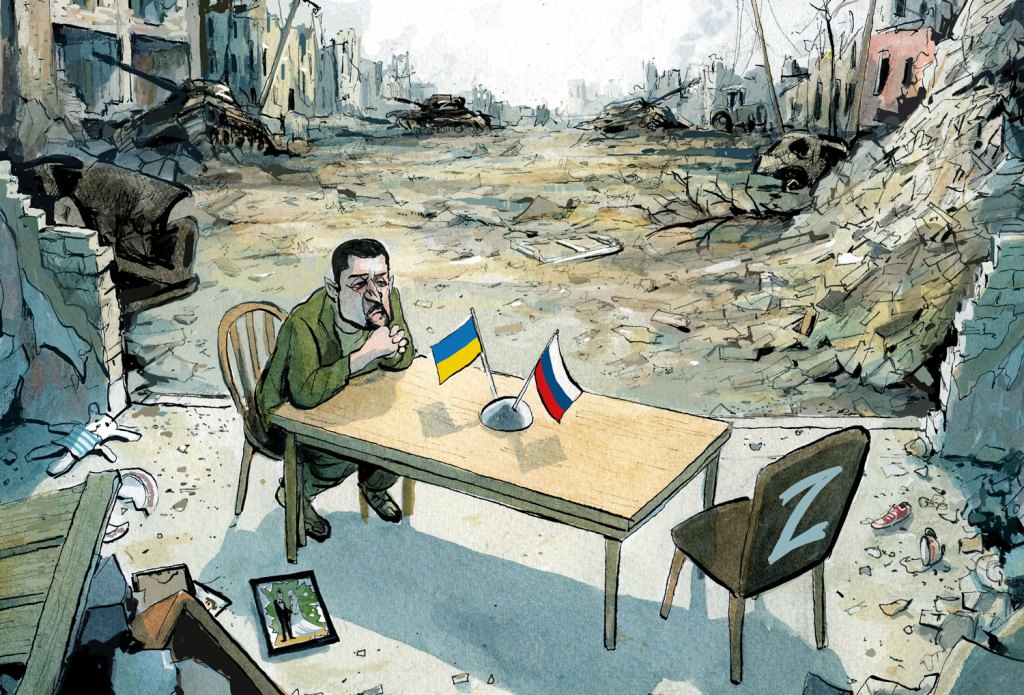
    ‘Come on Donald, amuse me.’

    Ukraine’s 40 percent budget deficit has to be covered in one of three ways – from direct donations from allied countries, from internationally backed debt and, potentially, from Russian state funds currently held in G7 countries. That’s not even counting military expenses directly shouldered by Ukraine’s backers – most expensively the vital air defenses such as Patriot batteries which cost $1 billion dollars each and fire missiles costing around $4 million a shot. With Russian missile and drone attacks now regularly topping 600 projectiles a night, it’s a small wonder that Reuters has estimated the real cost of the war to be up to $150 million a day. Ukrainian eyes are focused on getting hold of Russia’s sovereign wealth funds, which were frozen at the beginning of the war. Estimates vary, but at least $250 billion of the Kremlin’s money is held in various G7 countries. At least €150 billion of that sum is parked in Belgium’s Euroclear, a depository system used by governments and central banks around the world to hold their hard currency assets. There is, as yet, no legal way that Belgium, the European Union, the United Nations or any other national or international body can just confiscate that money.

    Indeed, many European leaders including French President Emmanuel Macron have warned that doing so would seriously jeopardize Europe’s reputation of having respect for the rule of law in the eyes of other sovereign investors such as China, Saudi Arabia and Qatar – and trigger sovereign capital flight that could quickly bankrupt the continent.

    Instead, western finance officials have been dreaming up various legal workarounds that would allow the funds to remain formally the property of the Russian government, while in practice making them available for Ukraine’s use. In October last year, the G7/EU came up with a scheme known as the Extraordinary Revenue Acceleration loans mechanism, which created a $50 billion loan backed by the interest payments from Russian capital without touching the capital itself. But with the war effort burning through that sum annually, this year European leaders have attempted to create a similar loan package involving the whole sum.

    The idea of this Special Purpose Vehicle (SPV) – also known as the Reparations Loan – has been to create a €140 billion loan backed by Russia’s Euroclear capital that would be lent to Ukraine and, notionally, repaid by Ukraine once Ukraine is paid back by Russia for wartime damages. The trouble is, reparations are vanishingly unlikely and are not even a subject of discussion in any iteration of peace talks with the Russians. On the contrary, the Kremlin very much does want its cash back – and it is very likely to make that, along with the lifting of sanctions, a key demand once negotiations begin in earnest. In other words, handing over Russia’s money to Ukraine could become an obstacle to peace.

    On a practical level, too, the small print of the SPV means that Belgium would be on the hook if and when Russia sues for its money back. Bart De Wever, the Belgian Prime Minister, has refused to sign off on the loan unless all European nations share the risk. So far, they have refused – not least because Europe’s national bankers are legally forbidden from issuing or backing loans that have next to no chance of ever being repaid. The practice is known as “bad-faith lending,” and has been much abused by China in recent years as a way to grab strategic real estate across Africa and Asia in lieu of loan repayments. And since seizing Ukrainian assets isn’t the EU’s style, European taxpayers will ultimately be liable for the entire sum of the loan when the Russians inevitably refuse to pay war damages to Ukraine, forcing Kyiv to default.

    Despite the shaky legal and political foundations of the SPV, “Kyiv sees these assets as the main pillar of budget stability for 2026-2027,” says Shevchenko. Indeed, securing a reparations loan from the EU is key to Kyiv’s parallel negotiations with the International Monetary Fund, from which Ukraine is hoping to secure a four-year multibillion-dollar extension of its existing $11 billion credit facility. But Ukraine has no real plan to repay the IMF except out of the SPV – effectively, one loan paying for another. European states do this kind of thing all the time – but they, unlike Ukraine, have predictable revenues and single-figure deficits. “The plan is risky,” says Shevchenko. “Without a deal, Kyiv’s $60 billion [budget] gap could deepen fast.”

    Though using Russian assets to help Ukraine sounds like a panacea, many in Kyiv are also crying foul over Brussels’ suggestion that €45 billion of the SPV money be used right away to repay last year’s G7/EU Extraordinary Revenue Acceleration loan. More egregious still to Ukrainians has been German Chancellor Friedrich Merz’s suggestion that much of the SPV money be spent on arms for Ukraine manufactured by expensive European suppliers such as Germany, cutting Kyiv out of the picture. That is, more or less, what happened to the lion’s share of US aid which was never paid out to Kyiv at all and was instead sent to US defense contractors to replace old military equipment dispatched to Ukraine. And as the SPV-Reparations loan will be disbursed by the European Union, the temptation to buckle to lobbyists and spend the money inside the EU, pork barrel-style, will be high.

    In addition to massive physical destruction, Russia’s invasion has also disrupted two key structural elements of Ukraine’s economy – access to cheap Russian gas, which was the secret to the competitiveness of much of the country’s industry, and cash income from transit of Russian gas to Europe. Remarkably, for the first three years of the war Ukraine continued to quietly move Gazprom gas across its land and into the EU via a network of pipelines to Slovakia. As late as last year, Kyiv was using the $900 million annual transit fees paid by Moscow (via a Swiss subsidiary) to help fund its war effort. Those payments, bizarrely, made Gazprom one of Ukraine’s biggest wartime budget contributors.

    Some of Gazprom’s gas was even re-imported into western Ukraine’s Lviv and Ivano-Frankivsk provinces having looped through Slovakia, creating the legal fiction that the gas was European. It’s the same story with Russian crude oil pumped to Slovakia, the Czech Republic and Hungary via the Druzhba pipeline – which in fact crosses Ukrainian territory and generated precious revenue for Kyiv.

    Under pressure from Brussels, Ukraine shut down most Russian gas transit at the start of this year, and is now moving to close down the Druzhba oil pipeline too. But that leaves Ukraine dependent on liquefied natural gas (LNG) imported from halfway across the world – and which costs up to three times as much as piped Russian gas. Early this month, under the auspices of Europe’s Partnership for Transatlantic Energy Cooperation, Ukraine’s Naftogaz signed agreements on the supply of at least 300 million cubic meters of American LNG with the Polish company ORLEN. Such western-provided supplies will, Kyiv hopes, be enough to keep heating and electricity going over the coming winter. But there’s no way Ukraine’s heavy industries can return to their prewar competitiveness with energy costs tripled.

    The long-term outlook for a postwar Ukraine is as bleak as its current cashflow. A rapid damage and needs assessment, prepared by the Ukrainian government with the World Bank, UN and European Commission, estimates immediate recovery and reconstruction needs to be approximately $524 billion over the next decade – roughly 2.8 times Ukraine’s 2024 GDP. The good news is that official creditors – including holders of Kyiv’s government debt – have agreed to pause Ukraine’s debt service until the end of March 2027 pending restructuring. But with Kyiv already struggling to make ends meet without repaying its debts, that’s as useful as a chocolate teapot.

    Underlying Kyiv’s coming cash crunch is a fundamental disconnect between Europe’s undoubtedly sincere desire to support Ukraine and the reality that the UK, France and Germany are facing serious fiscal crises of their own. Promises to support Ukraine are of a piece with European NATO members’ pledges to commit 5 percent of their GDP to defense spending by the end of the decade – both declarations are, for the most part, unfunded. Yet senior Brussels bureaucrats such as António Costa, President of the European Council, continue to make sweeping pledges – including in person to Ukrainian President Volodymyr Zelensky. “Today we will make the political decision to ensure Ukraine’s financial needs until 2026 and into 2027,” Costa told Zelensky last month. “We are not tired and we are here to continue to support Ukraine diplomatically, politically, militarily and financially.”

    Costa isn’t lying – Europe’s material and political support for Ukraine will undoubtedly continue. The question is at what level – and for how long. The story so far of Europe’s engagement with Ukraine has been one of big pledges followed by considerably smaller deeds – and that was before Trump took away Uncle Sam’s billions. Unfortunately for Kyiv, there’s little to suggest that Europe has the means or the will to actually provide Ukraine as much as it needs, for as long as it needs.

    This article was originally published in The Spectator’s November 24, 2025 World edition.

  • How the Ukrainian far right is preventing peace

    How the Ukrainian far right is preventing peace

    Since the start of the Russian invasion of Ukraine in February 2022, discussion of the Ukrainian far right has been verboten in western media, largely because one of Vladimir Putin’s stated war aims is the “denazification” of Ukraine. Putin’s claim that Ukraine is a Nazi state has been recycled by Russian propagandists and the western party line has consistently been that while the Ukrainian military does have far-right strains, they are marginal and inconsequential. This may have been true in 2022, but things have changed significantly after almost four years of war. Today, far-right figures control some of Ukraine’s strongest military units, and neo-Nazi ideology is displayed openly in the Ukrainian ranks.

    The latest evidence of this came on November 4, when Volodymyr Zelensky handed out military awards to soldiers fending off the Russian offensive in the Donetsk region. As shown in photos published on Zelensky’s official Telegram and X accounts, some of the soldiers receiving the awards had patches with symbols that looked suspiciously like the emblem of Hitler’s SS. The unit flags adorning the walls told a similar story: the Azov brigade’s insignia is a variation of the Nazi Wolfsangel, while the Chervona Kalyna brigade’s ensign emulates the red-and-black flag of the Ukrainian Insurgent Army, a far-right militia that played an instrumental role in the Holocaust in western Ukraine and massacred tens of thousands of Poles in the regions of Volhynia and Eastern Galicia between 1943 and 1945. Zelensky was photographed with these two flags in the background.

    Both the Azov and the Chervona Kalyna brigades form part of Ukraine’s 1st Azov corps, a unit that comprises tens of thousands. The corps is led by Denys Prokopenko, the commander of the Azov regiment that defended Mariupol in 2022 before being captured by the Russians. He and his men were eventually freed from captivity in a prisoner exchange and their “heroic resistance” was praised by the western media. What was often left out of the gushing puff pieces was Prokopenko’s background. In the 2010s, Prokopenko was a member of a far-right Ukrainian soccer-hooligan association called the “White Boys Club.” A quick browse through its Facebook page shows frequent glorification of Nazi units such as the 14th Waffen Division of the SS (also known as the 1st Galician division). In 2014, Prokopenko joined the nascent Azov. His platoon was nicknamed “Borodash” (bearded man) for its insignia, which featured a bearded Nazi Totenkopf. In spite of appearing to like the aesthetics, Prokopenko has denied that he or the men serving under him have far-right sympathies.

    But the 3rd Army Corps, comprising some 40,000 men and widely heralded as Ukraine’s strongest military formation, is commanded by an even more sinister figure, Brigadier General Andriy Biletsky. In 2010, Biletsky publicly stated that Ukraine must “lead the white nations of the world in a final crusade for their survival, a crusade against the Semite-led Untermenschen.” In 2014, after being held as a political prisoner, he founded the Azov volunteer battalion to fight the Russian-backed separatists in the Donbas. From 2014 to 2022, human-rights organizations described widespread use of torture by Azov fighters against civilians in the Donbas and western media routinely reported on how this white-supremacist, fascist and neo-Nazi paramilitary unit served as a model for violent far-right extremists all over the world. In 2016, Biletsky also established the far-right political party National Corps, which the US State Department called a “nationalist hate group” in 2018.

    In those days, contrary to Russian propaganda, the Ukrainian people had little affinity for the extremist ideology of Biletsky and the Azov movement. Although Biletsky managed to get himself elected to the Ukrainian parliament, his party only received 2 percent of the vote in the 2019 elections. In other words, prior to the war, Azov was a fringe phenomenon.

    That changed in 2022. After the Azov’s capture and release by the Russians, figures such as Prokopenko and Biletsky became national and international heroes overnight. From a regiment in 2022, Azov grew to a brigade in 2023 and a full corps this year. Today, its members are among the most admired men in the country.

    There’s a reason Zelensky is so resistant to signing an armistice, especially one involving territorial losses. In promoting such men as Prokopenko and Biletsky, the President has potentially created a monster. If their ideologies are as suspected, Ukraine is now in the position of Germany in 1918. Fighting a war of attrition against an opponent with vastly more resources, manpower and firepower, Ukraine is bound to lose, or at the very least to suffer major losses. After World War One, the Dolchstoßlegende – the stab-in-the-back myth – spread around Germany. It convinced many Germans that the country hadn’t lost the war on the battlefield but had instead been betrayed by citizens on the home front – Jews, mainly. After years of Ukrainian and western media hyping up the Ukrainian army and predicting a Russian collapse, an unfavorable peace risks creating Ukraine’s own version of the Dolchstoßlegende, with Zelensky playing the role of the Jewish scapegoat.

    If a ceasefire is signed, it is far from clear whether Prokopenko and Biletsky, who believe in victory at any cost, will lay down their arms. Between them, they command tens of thousands of Ukraine’s best troops. Well-equipped, well-trained and ideologically motivated, these units have the potential to be Ukraine’s very own Freikorps, and Prokopenko and Biletsky may well lead their own Kapp Putsch or march on Kyiv in the event of an American-mediated diktat.

    While some armies have neo-Nazis, in Ukraine some neo-Nazis have armies. The threat they pose to a democratic and prosperous postwar Ukraine is obvious.

    This article was originally published in The Spectator’s November 24, 2025 World edition.

  • How America fell in love with the G&T

    How America fell in love with the G&T

    The gin and tonic has had quite the journey. From humble beginnings protecting British explorers against malaria, it has become the country’s favorite cocktail. Abroad, Italians grown tired of spritzes now opt for it come aperitivo hour. The Japanese bow before it. The world stumbles after it. Yet there is one land the G&T has been slow to conquer: America, the land of vodka sodas and zero-calorie seltzers.

    In recent years that has begun to change. While overall consumption of spirits is down, sales of gin in the US are on the rise and expected to grow some 6.5 percent a year for the rest of this decade. Craft distilleries are in the vanguard: in California, gin is infused with citrus and coastal herbs. In the South, it might be perfumed with watermelon rind or magnolia blossoms. And while US liquor stores still devote more space to vodka and whiskey than anything else, gin is getting more of a look-in. Whole Foods stocks cans of ready-to-drink Tanqueray gin and tonic. After all, there’s only so many shots of kombucha one can stomach.

    As youngsters turn away from alcohol and toward their smartphones, those still drinking increasingly look for smaller quantities of better-quality alcohol. Slamming shots is out; “mindful drinking,” low-ABV tipples and “savoring the mouthfeel” are in. Bright young things have discovered that the G&T looks chic without adding to the waistline. In a social media age, its “old money” good looks are important. It is certainly more photogenic than a whiskey and Coke.

    It helps that the G&T is so easy to make: during the pandemic, we saw the rise of home bartending. Many Americans discovered they could make a better G&T at home than they’d ever got from a harassed Manhattan bartender. You can dress it up with rosemary sprigs or a cucumber slice – but you don’t have to. All you really need is a highball glass and a slice of lemon or lime, and you’ve got something that looks suitably sophisticated.

    But the G&T’s rise is about culture, not just calories or convenience. Gin has never occupied the same place in the American psyche as other cocktails. Hemingway drank his way across the States, from Michigan trout streams to Florida sunsets, but he was a man of daiquiris, rum and whiskey, rather than the gin and tonic. Meanwhile, Don Draper may have toyed with a G&T while lounging in a well-cut Brooks Brothers suit on a summer afternoon, but Mad Men’s soul was really soaked in martinis and old fashioneds. It is gin’s foreignness that creates the G&T’s appeal today. The biggest-selling gin brands in the US are British – Gordon’s, Tanqueray and Bombay Sapphire. And in an era where everything must be artisanal, sustainable and storied, the G&T arrives pre-packaged with a sense of history and exoticism. Once a form of medicine, soaked in Empire, gin is a drink with a grand story. Gin’s curious-sounding botanicals create a sense of sophistication. “Juniper, coriander seed and angelica root have the reassuring ring of Old World complexity and Continental charm.”

    Americans import European drinks – and drinking rituals. The aperitivo hour was once alien; then suddenly every rooftop bar in New York was a sea of Aperol spritzes. Never mind that Europe today is economically stagnant and politically fractious; culturally, it remains unimpeachable. To sip a G&T on a Brooklyn terrace is to feel oh so suave, to be in touching distance of London.

    Nostalgia for the aristocratic drawing room may have helped leaven the G&T moment. The real-life Downton Abbey – Highclere Castle in Hampshire, England – produces its own gin, which it sells across the US. Adam von Gootkin, who co-founded the brand alongside the 8th Earl of Carnarvon (whose family seat is Highclere), told me: “American palates are rediscovering the elegance of gin. People want story, terroir and craftsmanship. The gin and tonic is the revenge of the classics. For too long, we let neon drinks and novelty shots steal the spotlight. Now, people want authenticity – and you can’t fake that with food coloring.”

    Inevitably, celebrities are getting in on the act. Ryan Reynolds has Aviation Gin. Margot Robbie – who has confessed that she used to stash vanilla rooibos teabags in her handbag to rescue bad G&Ts at London nightclubs – is behind Papa Salt Coastal Gin.

    Perhaps tonic will be the next component to get the celeb treatment: the market for premium bottled mixers is booming. The British brand Fever-Tree is doing spectacularly well in the US. It now holds the pole position for both tonic water and ginger beer. Not bad in a country with a long-standing attachment to soda from a gun.

    America will inevitably make the G&T its own. Espressos were for Italians, then Starbucks came along. Sushi went from Japanese delicacy to everyday LA lunch. The G&T may never dethrone the vodka soda or the bourbon old fashioned but a drink that’s journeyed from the balmy terraces of the British Raj to Brooklyn will take a fair bit of stopping. Downton’s preferred drink is coming downtown.

    This article was originally published in The Spectator’s November 24, 2025 World edition.

  • The sinister rise of Churchill revisionism

    The sinister rise of Churchill revisionism

    Winston Churchill is one of Britain’s enduring symbols. His relentless drive, deep conviction and steadfast leadership means that he remains admired by millions around the globe. Yet for years, the political mainstream has been compelled to defend his memory from spurious attacks from the left, such as the British politician John McDonnell calling him a “villain.” Depressingly that threat – and the same pernicious desire to denigrate one of the West’s greatest heroes – can now be found on the right.

    Spawned from a sinister fringe of the ultra-MAGA movement, these views have been propagated to millions. Tucker Carlson hosted the pseudo-historian Darryl Cooper on his podcast in an episode that has attracted over 33 million downloads. Cooper made a series of absurd and ahistorical claims – including that Churchill was “the chief villain” of World War Two – while actively downplaying Nazi atrocities in eastern Europe.

    Carlson and Cooper are not alone. Major figures of the US online right, from Candace Owens to Dave Smith, have either backed Cooper or engaged in their own rewriting of the history of World War Two. Grokipedia, Elon Musk’s new AI alternative to Wikipedia, has an entry on Sir Oswald Mosley which states that “recent reappraisals” have validated his “policy prescience.” Mosley was the leader of the British Union of Fascists; the clue to his policy ideas are obvious in the name of his organization.

    Sadly, such revisionism is not confined to the United States. A new online fringe in Britain – from former Reform UK party candidate Ian Gribbin and party advisor Jack Anderton, to the popular contrarian podcast Lotus Eaters – have dabbled in revisionism of Churchill’s life, actions and legacy from an ultra-right perspective, essentially arguing that Britain should not have fought in World War Two. Of course, such views have been expressed in the past by Pat Buchanan, Alan Clark, John Charmley, David Irving and even Maurice Cowling, but were always niche. Today they are turbo-charged by tens of millions of people on social media. This new strain of ahistorical US-led Churchill skepticism must not be allowed to establish a bridgehead in British politics.

    As my and Zachary Marsh’s new report for Policy Exchange, “Defender of the West,” argues, these critiques consistently misrepresent or manipulate the historical record to present myths about Churchill as fact, such as that he was behind the decision to offer a guarantee to Poland in April 1939, when in fact he was a backbench MP and in no decision-making role. (Nonetheless it was the correct decision of Neville Chamberlain’s government.) Or that it was Churchill who initiated civilian bombing raids, despite the fact that they had been a central part of Nazi military strategy since Guernica in the Spanish Civil War.

    The repeated assertion by these critics that Churchill’s “warmongering” sustained an unwinnable war – forgetting it seems, that the Allies ultimately triumphed – is intended to suggest that Britain should instead have made peace with Hitler in 1940. Yet Hitler routinely breached every single agreement he ever signed, from the Munich Agreement to the Anglo-Germany Navy Treaty to the Nazi Soviet Pact. That he could be trusted to leave Britain and her empire alone is of the same naïve school of appeasement that Churchill himself rightly fought throughout the 1930s. He understood that a European continent dominated by any power – and particularly by Nazi Germany – was incompatible with Britain’s international interests as much as her values. Lebensraum did not just apply to the east.

    Rebutting Churchill revisionism is not only important for protecting the principles of good scholarship and evidence within the academy, but is also essential because this transatlantic fringe is determined to expand its influence over insurgent right-wing populism both in America and Europe. In doing so, the aim is not simply to manipulate the public’s view of Churchill, but through his denigration to create the intellectual space for their other pernicious ideas to flourish, specifically that isolationism and nativism should triumph over internationalism and interventionism.

    By blackening Churchill’s name (and of course that of President Franklin Roosevelt), the ultra-MAGA ideologues, several of whom have been disavowed by President Trump himself, hope to damage the cause of anti-totalitarianism more widely, to the benefit to Vladimir Putin. The attack on Churchill is not just an ivory tower spat; it is profoundly connected to calls for the West to rip up the postwar international order that Churchill helped build.

    In recent weeks, most notably with the fallout from Tucker Carlson’s interview with the foul Nick Fuentes, fueling civil war in MAGA-land and at the influential Heritage Foundation – where I have given speeches in the past – we have seen how this same fringe has embraced anti-Semitic and white supremacist rhetoric. These views are infused with admiration for the authoritarian strongmen who would thrive in a world where countries like Britain and the United States abrogated their responsibilities towards smaller democracies. Gribbin, whilst standing for Reform UK in 2024, even combined his criticism of Churchill with praise for Putin, saying, “If only the West had politicians of his class.”

    Historical debate and discussion of the merits of western internationalism are necessary and healthy for our discourse. Yet they must be routed in facts, evidence and made in good faith. These attacks on Churchill, the greatest Briton, seek to present the United Kingdom’s sacrifice and achievements in World War Two as an entirely pointless endeavor, which justifies a new isolationism. Rational, decent, conservative-minded people of all parties and movements should be steadfast in rejecting such dangerous ahistorical rubbish. 

    Lord Roberts of Belgravia is the co-author of Policy Exchange’s new report: “Defender of the West: A response to attacks on Churchill’s life and legacy”

  • Macron has declared war on free speech

    Macron has declared war on free speech

    Emmanuel Macron says Europeans should stop relying on social media for their news and turn back to traditional public media. Speaking in Paris on Wednesday, he said people were “completely wrong” to use social networks for information and should instead depend on journalists and established outlets. Social platforms, he argued, are driven by a ‘process of maximum excitement” designed to “maximize advertising revenue,” a system he said is “destroying the foundations of democratic debate.”

    He accused X of being “dominated by far-right content” and added that the platform was no longer neutral because its owner had “decided to take part in the democratic struggle and in the international reactionary movement.” TikTok, he warned, was no less dangerous. Macron called for “a much stronger agenda of protection and regulation in Europe” to rein in what he views as the excesses of social networks.

    Macron is urging Europe to “take back control of our democratic and informational life.” This is not the first time that he has spoken in such terms. France and its allies, he warned, have been “naïve” in allowing their public debate to be shaped by foreign-owned platforms and algorithms that no longer respect neutrality. To counter what he calls “a crisis of information,” he wants a new “European agenda of protection and regulation.” It is, in effect, a plan to bring the digital sphere under far stricter political control.

    Macron’s comments are an attack on how an entire generation gets its news. Over 40 percent of people under 30 and nearly half of 18- to 30-year-olds now rely on social media for news. He appears to believe they should return to the days of reading and watching state-controlled media. The suggestion is astonishing. It’s frightening to even have to write this but democracy depends on access to competing points of view, not on state-managed television and subsidized newspapers. Macron cannot seriously believe that it would be good for democracy if Europeans were driven back to getting their news from government-aligned networks.

    Macron also blamed foreign interference, accusing Russia of being “the biggest buyer of fake accounts’ aiming to destabilize European democracies. “We’re facing interference on steroids,” he said. Macron has previously cited alleged manipulation of online content during recent elections in Eastern Europe, which he called “terrifying.” Yet observers found little evidence of large-scale manipulation in those cases. What really unsettled Paris and Brussels was often the result of those elections and the rejection of EU-backed candidates. His warnings about fake accounts look less like a defense of democracy than an argument for tightening state control over speech.

    The logical consequence of what Macron is proposing is that to abolish “fake accounts” you must abolish anonymity itself. If Macron is serious about ending fake accounts, and he keeps repeating that he is, the only way to do that is through digital identity. His plan leads inevitably to a system where anyone who wants to post or comment online must first prove who they are.

    The architecture for full control of social networks in the Europe already exists. The EU’s eIDAS regulation requires every member state to issue digital identities. There is France Identité, Germany has eID, Italy its SPID. Originally designed for banking, healthcare and tax, these IDs could easily be integrated into online services. Macron’s vision would plug them directly into the Digital Services Act. The result would be an internet where every post is traceable to a verified name. It’s a short step from fighting “fake accounts” to outlawing anonymous speech altogether.

    For years, Macron has argued that the internet must be brought to heel. When he cannot legislate at home, he does it through Brussels. The EU’s Digital Services Act already gives regulators the power to police what they call “systemic risks” online, a term broad enough to cover disinformation, hate speech, or anything judged destabilizing to democracy. Under the Act, platforms can be fined up to 6 per cent of global turnover, a threat that forces them to police themselves long before Brussels intervenes. The result is over-compliance and the quiet erosion of free speech. Add the eIDAS digital-identity framework, and Macron suddenly has the tools to pursue his long-standing ambition of ending online anonymity.

    In France itself, Macron is running out of power. His government has no stable majority, his authority in parliament has evaporated, and his personal ratings have collapsed. A poll in Le Figaro magazine this week puts his confidence level at just 11 per cent, among the lowest scores ever for a president of the Fifth Republic. On the streets he’s booed. Online he’s mocked daily. But in Brussels, the machinery of regulation still answers to him. The Digital Services Act and eIDAS framework move forward regardless of French politics, enforced by bureaucrats rather than parliament. Macron may be paralyzed in Paris, but in Europe he can still act like a statesman. The danger is that he could still in the time that he has left in office shape the rules that define what Europeans can and cannot say.

    Macron insists he’s defending democracy from manipulation and hate. But that’s the excuse. His vision is of a Europe where free speech is tolerated only when it is traceable, and where platforms pre-emptively silence anything that might draw a regulator’s glare. He calls it a “resurgence of democracy.” It’s nothing of the kind. It’s the bureaucratization of thought, and the beginning of a continent where debate survives only on license. If Macron has his way, Europe’s public square will not just be regulated, it will be licensed.

  • Brigitte Macron has run out of sympathy

    Ten people have been on trial this week in Paris, accused of transphobic cyberbullying against Brigitte Macron. France’s first lady, the wife of Emmanuel Macron, pressed charges after a claim that she was in fact a man went global. Some of those in the dock have apologized for spreading the allegations online but others have said that it’s just a bit of harmless fun and that in a free country one should be able to say what one likes.

    This argument was dismissed by Brigitte Macron’s lawyer, Jean Ennochi, who said: “They all talk to you about freedom of expression, defamation, they completely deny cyberbullying [and] mob harassment.” Prosecutors have demanded suspended prison sentences ranging from three to twelve months for the accused. The judges will give their verdict in January.

    Perhaps Madame Macron should have followed the late Queen of England’s maxim of “never complain, never explain.” Had she done so, the claims that she was a man would probably have not been covered across the world, from the BBC to the New York Times.

    But Macron felt compelled to take action after what began as a one-woman smear campaign turned into a global conspiracy theory. The American influencer, Candace Owens, began pushing the theory in 2024 and eventually released an eight-part podcast. She is being sued by the Macrons.

    The originator of the claim that Brigitte is a man who transitioned is a Frenchwoman in her fifties called Natacha Rey. She took a dislike to Brigitte from the moment her husband was elected president in 2017 and began a three-year “investigation” into her background. No one took any notice of Rey’s social media rants at first. That may have been because of the goodwill most people in France felt towards Brigitte Macron. She seemed like a grounded woman who was more in touch with the average citizen than her husband. They were prepared to overlook the “weird” circumstances of how they met; she was a 39-year-old teacher, a married woman with three children, and he was a 15-year-old pupil in her theatre class.

    In an Anglophone country more searching questions might have been asked by journalists but in France the fawning mainstream media depicted the union as an inspiring love story. As one paper wrote: “Two thwarted lovers ready to overcome all obstacles: the story begins like a Molière comedy.”

    In the early days of Macron’s presidency, Brigitte earned the respect of the French by fronting a campaign against bullying in schools and supporting victims of violence. But then stories began emerging that eroded much of the goodwill: the €600,000 ($694,000) that the Élysée Palace spent on flowers in 2020, the year when Macron locked the French in their homes because of Covid.

    In the summer of 2023 it was disclosed that Brigitte had forked out €315,808 ($365,000) on clothes in the past 12 months. “Brigitte Macron has a particular fondness for luxury items,” explained a fashion magazine, listing her favorite designers as Louis Vuitton, Dior and Chanel.

    The following year Brigitte made a guest appearance in Emily in Paris, the spectacularly vacuous Netflix sitcom that depicts the lives of the rich and frivolous in the French capital. It was not well received. France was in political turmoil, the country was ravaged by violence, the cost of living was soaring and here was Brigitte simpering on screen.

    Barely anyone in France takes seriously the claim that Brigitte Macron is a man. But whereas a few years ago many would have sprung to her defence now they just shrug. They have scant sympathy even if, as one of Brigitte’s daughters told the court this week, her mother suffers from the “horrible” things said about her. The view of the majority is “so what?” They have suffered eight years of her husband’s chaotic presidency.

    Brigitte was asked in an interview last December about the fraught relationship between her husband and his people. She replied that they “don’t deserve him.” It was a provocative remark and, judging from the slap Brigitte gave her husband a few weeks later, he can also drive her to distraction. “We are not an ideal couple,” Brigitte said of her marriage in 2019. The French would agree.

  • The Dutch elections are still a victory for Geert Wilders

    The Dutch elections are still a victory for Geert Wilders

    Early coverage of the Dutch elections has inevitably focused on Geert Wilders – still the bogeyman of the country’s political establishment. Wilders lost seats and saw some of his support drift towards other parties on the right and to the liberal center of Democrats 66 (D66). Wilders’s Party for Freedom and D66 are leading in the polls, with both set to take 26 seats.

    Yet the real story lies elsewhere: in the spectacular downfall of former EU Commissioner Frans Timmermans, whose brief and ill-fated return to Dutch politics as leader of the Labour party has ended in a shattering defeat.

    Timmermans was as divisive a figure to the Dutch right as Wilders is to the left. In Brussels, as architect of the European Green Deal – that sprawling climate agenda which has brought headaches across Europe to businesses and households alike – he became synonymous with bureaucratic zeal. His return to the Hague before the 2023 elections was driven by a single ambition: to become prime minister. He has failed. Twice.

    The much-touted merger between his venerable Labour party and the far more radical GreenLeft – itself an alliance of former communists, greens and other assorted leftist fragments – was supposed to revitalize the left. In practice, it was a catastrophic miscalculation. GreenLeft’s informal but loud sympathies for Extinction Rebellion, antifa, rewilding and the pro-Palestine movement only reinforced public unease. Timmermans and his increasingly doctrinaire allies seemed more concerned with Gaza, asylum seekers, or protecting wolves, than with Dutch voters. Yet neither Gazans, wolves nor illegal migrants have the vote in the Netherlands – and that is unlikely to change any time soon.

    As polling day approached, talk of a broad centrist coalition began to dominate. The center-right VVD ruled out any arrangement involving Timmermans, and his party’s polling numbers duly started to erode. After two years of solid support, GreenLeft-Labour slumped on election day, losing a fifth of its seats and tumbling to fourth place. Disillusioned voters flocked instead to the upbeat, reform-minded liberal democrats of D66.

    Almost overnight, Rob Jetten – the young, energetic and impeccably groomed leader of D66 – found himself center stage. With 99 percent of votes counted, he is neck and neck with Wilders. Jetten’s surge has been extraordinary: from laggard to frontrunner in a week, powered by a deft reinvention of his party. Once derided as Europhile, climate-obsessed and tediously woke, D66 has wrapped itself in Dutch flags, quietly shelved talk of net zero and pledged to reduce asylum numbers to manageable levels.

    And that matters. The party has long been the preferred habitat of Dutch public sector workers – dominant in the media, civil service, health and education and, if rumours are to be believed, the judiciary. Yet Jetten’s youthful charm – occasionally reminiscent of a young Mark Rutte – has seduced voters across the spectrum, even prising a few away from Wilders. Should he indeed finish first, he will gain the right to appoint a “scout” on Friday to explore possible coalitions. In case he comes second, any scout sent out by Wilders will no doubt find that all other big parties will refuse to work with him, clearing the way for Jetten to try to form a government.

    Yet, the underlying message of this election is unmistakable: the Dutch electorate continues to nudge the party system rightwards. D66 has shifted to the right, clearly allowing it to win big; Timmermans’s radical experiment on the left has been routed. Other left-wing parties fared no better. The small and once-Maoist Socialist party even lost 60 percent of its support – its tenth consecutive national defeat.

    The right, meanwhile, remains potent, merely redistributed. Wilders, ever the tribune of the disaffected, will carry on in opposition – a role made for him – railing against Islamization, immigration and rising living costs. Many of those abandoned by the left will still find refuge in his rhetoric.

    An Ipsos poll found that 40 percent of Dutch voters favor a right-wing coalition, with smaller minorities leaning left or center. Jetten faces a formidable task assembling a stable majority. A coalition with the VVD and Christian Democrats would form a centrist bloc, but still fall short. The VVD will block any role for GreenLeft-Labour, leaving Jetten to look instead towards JA21, a more polished, immigration-skeptical party on the right that did very well yesterday. Such an alliance would be fragile – yet broad enough to show that D66 intends to take the country’s asylum crisis seriously, and acknowledge that “anywheres” are not the only people in the country.