Tag: Jeffrey Epstein

  • Marjorie Taylor Greene: anti-Trump resistance hero?

    Marjorie Taylor Greene: anti-Trump resistance hero?

    It is always interesting to see who the American left claims are the leaders of the American right.

    There was a time during President Trump’s first term when Steve Bannon fit the role – and relished playing it. Back then most days brought another media profile of the dark genius of the MAGA movement. The GuardianNew York Times and others were obsessed. Vanity Fair would send reporters to follow Bannon as he conquered America and, er, Europe. Documentary crews were perennially in tow. Indeed one documentary following Bannon around included a scene in which they followed him to the showing of another documentary about him from a crew who had similarly followed him around. At which point you felt that we might fall into some kind of vortex.

    The point is that Bannon was useful for the left. And he in turn found the left useful.

    Around the same time there was a less savory figure called Richard Spencer. The self-professed white nationalist was portrayed as being close to the center of power on the right. After he led a motley band of supporters in a farcical “Hail Trump” session, the left became especially obsessed. But Spencer was never important on the American right, let alone anywhere close to power. It merely suited a section of the media to present him as a bigger presence than he was.

    In the recent furore over the avowedly racist and Holocaust-denying podcaster Nick Fuentes, a similar process seems to be taking place. Fuentes does in fact have some purchase on parts of the young American right – mainly, it seems, because of his delight in never seeing a taboo he does not wish to trample on. Still, it was striking that when the New York Times ran a piece about him earlier this month, it led with a black and white photograph that made him look positively James Dean-esque. Needless to say, Fuentes does not in any way resemble the late film heartthrob. But for some reason the Times decided to portray him in this light. While the American right is fighting to keep Fuentes out of their ranks, the Times seems keen on slipping him right in there.

    The latest person to enjoy a similar transmogrification is Congresswoman Marjorie Taylor Greene. Until recently you would have been hard-pushed to find a kind word said on the American left about the blonde MAGA Congresswoman. Even most of the American right found her an embarrassment for her behavior on committees and on the floor of the House, as well as for some of her outlandish past social media posts. The kindest thing I ever heard a MAGA figure say about her was that she had a tendency “to get a little too far over her skis.”

    Now she is suddenly acceptable. She is on all the left-wing talk shows. CNN has interviewed MTG (as she is sometimes known) sympathetically, and listened with sincerity as she has decried the use of “toxic” rhetoric in politics. The fact that “toxic” was practically MTG’s only brand until yesterday would ordinarily lead to an outburst of skepticism on the US left. But MTG has become “acceptable” because of one thing and one thing alone – which is that the American left sees that she might just have become useful in their war to bring down President Trump.

    MTG has recently turned against Trump and the two have traded barbs. Which is quite the turnaround for MTG, who had previously been one of those MAGA loyalists who seemed to discern no clear water between Trump and their Lord and Savior.

    The apparent cause of MTG’s turn on the President is the Jeffrey Epstein case. Far be it from me to accuse MTG of being conspiracy-minded, but she is one of those people who believe that absent the release of every file and email that has ever existed relating to Epstein, we are all being lied to about some very major scandals.

    The whole Epstein thing is murky as hell, but it is a scandal which promises to deliver more than it actually does. The problem at the moment is that the controversy has once again focused on Trump. The President’s own friendship with Epstein pretty clearly ended some 20 years ago – long before Epstein’s criminal activity became fully known about. They mixed in the same circles, not least because Epstein mixed in just about every circle of the rich and famous.

    But ever since Trump returned to office a portion of the left and some Trump-haters on the right seem to have decided that Epstein is the most viable tool to take out the President. You might say that Epstein is for Trump’s second term what fake claims of Russian collusion were to his first.

    Yet in order to believe that the Epstein Files contain some smoking gun against the President, you have to believe a number of things. Not least that the Biden administration sat on the Epstein files for four years but didn’t bother to search the material for compromising material on Trump, or that they did search them, found compromising material and chose not to use it – none of which sounds remotely plausible.

    Facing a backlash from Greene and others, Trump has now turned from dismissing the whole Epstein furor as a “hoax” to urging Republicans to get behind calls for full transparency. Which they duly did: on Tuesday, the House of Representatives voted 427-1 to compel the Justice Department to release the Epstein files. Trump must be pretty confident that there is nothing especially compromising about him, and that other people will come out of the information worse.

    To some extent that is already happening. The latest release of emails include a number between Epstein and the Trump-hating author Michael Wolff. In the run-up to the 2016 election (years after Epstein’s conviction), Wolff offered Epstein PR advice and seemed to be trying to collude with him to take down Trump. Not that Wolff has faced much censure for this. It seems it is OK to offer PR advice to a convicted sex offender so long as the cause is a noble, anti-Trump one.

  • Stacey Plaskett avoids Epstein Files repercussions… for now

    Stacey Plaskett avoids Epstein Files repercussions… for now

    Anyone who hopes that the forthcoming Epstein Files will mean the end of Donald Trump’s political career is sure to experience extreme disappointment in the weeks ahead. But The Files have a life of their own, and we’re still not yet entirely sure what story they’re telling us. Former Treasury secretary and Harvard president Larry Summers has already lost his New York Times column-writing gig, and just about everything else, as the Files revealed he texted Jeffrey Epstein, of all people, for dating advice. No one rushed to Summers’s side, as he’s basically out of active political life. You can’t say the same for Delegate Stacey Plaskett, who represents the US Virgin Islands in the House, who the Files have implicated…in something.  

    Epstein lived in The Virgin Islands, or at least had his primary residence there, so Plaskett was his congressperson. Documents from Epstein’s estate show that he and Plaskett exchanged text messages during a 2019 congressional hearing. Epstein actively coached her on how to question Michael Cohen, even sending the message “good work” when she asked a question he suggested.  

    To be clear: this had nothing to do with sex trafficking. But Republicans still introduced a resolution this week to censure Plaskett, saying she and Epstein had engaged in “inappropriate coordination.” In retaliation, Democrats threatened to censure Republican Cory Mills, currently accused of domestic violence and subject to a restraining order.  

    Republican Ralph Norman said Plaskett’s conduct “reflects discreditably on the House of Representatives,” which feels somewhat hard to do given how little credit people give the House, and that the censure would give the House Ethics Committee authority to investigate “the extent of Plaskett’s ties to Epstein and any potential further improprieties.” The measure failed, with three Republicans voting with Democrats, and three voting “present.”  

    Maryland’s Jamie Raskin, one of Trump’s most fervent opponents, said Plaskett merely “took a phone call from one of her constituents,” somehow neglecting to mention that said constituent was Jeffrey Epstein. But then he invoked the unholy name after all. “I don’t think it is the position of [Norman] that if we find Jeffrey Epstein on the phone with Donald Trump, that he should be impeached for it. That sounds like guilt by association.” 

    For her part, Plaskett said, “I don’t need to get advice on how to question anybody from any individual. I have been a lawyer for 30 years,” which in itself should be grounds for censure.  

    So if Trump isn’t going down with the Epstein Files ship, and Democrats refuse to turn on one of their own, who, exactly, will end up making the sacrifice, other than Larry Summers? Florida’s Anna Paulina Luna, a major backer of the Epstein Files release, asked, on the House floor, “why leadership on both sides, Democrat and Republican, are cutting back-end deals to cover up public corruption in the House of Representatives.” Good question. Colorado’s Lauren Boebert told her fellow Republicans, according to the Wall Street Journal, “This is why America hates us.” That’s not the only reason; there’s a reason why congressional approval is at an all-time low. Still, rats do have an uncommon ability to survive.  

  • Trump bromances MbS as Epstein Files loom

    Trump bromances MbS as Epstein Files loom

    The contrast could hardly have been starker. As Donald Trump palled around with Mohammed bin Salman in the newly gilded Oval Office, Congress was voting on a transparency act that would further expose Jeffrey Epstein’s grave misdeeds. Trump, who had worked overtime to try and quash the vote, was in his element with the Saudi crown prince. Transparency? Not a bit of it. Trump proclaimed that the crown prince “knew nothing” about the death of Jamal Khashoggi who was, after all, “extremely controversial,” the term that he often deploys to describe anyone he dislikes or finds nettlesome. 

    The hero, or, to put it more precisely, heroine, of the day was Marjorie Taylor Greene. Greene is a profile in courage. She stood up for Epstein’s victims in an honorable and upright fashion that underscored the sordid nature of Trump’s attempt to suppress the release of the files in possession of the Justice Department. What those files will reveal is an open question. The likelihood that they will divulge anything incriminating about Trump seems slender – other than the fact that he has battled so ardently to prevent them from seeing the light of day.  

    In seeking to bury the files, Trump has been defending the very establishment that he professes to despise. Greene, in battling to ensure the release of the files, has revealed the rampant corruption in elite America, including the escapades of former Harvard president Larry Summers. Trump has referred to Greene as Marjorie “Traitor” Greene. She hit back today outside the US Capitol in the presence of Epstein’s victims, one of whom eloquently demanded that Trump stop seeking to politicize the brouhaha over the files.  

    According to Greene, “I fought for him for the policies and for America First. And he called me a traitor for standing with these women and refusing to take my name off the discharge petition. Let me tell you what a traitor is. A traitor is an American that serves foreign countries and themselves. A patriot is an American that serves the United States of Americans and Americans like the women standing behind me.” Strong words. 

    If Greene has been on something of a tear lately, she’s not the only one that has administered a shellacking to Trump. He has been suffering a number of defeats in other arenas. The latest arrived this afternoon when a Texas federal court struck down the state’s redistricting map that was designed to ensure an additional five Republican seats in Congress. The worst blow is that Trump originally appointed the judge who wrote the decision, Jeffrey V. Brown.  

    Trump’s remedy has been to retreat to foreign policy, where he effectively enjoys a form of suzerainty, at least for now. He’s been making noises about attacking Nigeria and Venezuela. For the next day or so, he will enjoy his bromance with the crown prince, escorting him to a grand dinner tonight. Meanwhile, he’s planning to sell him F-35 fighter jets, a move that Congress may seek to block, particularly since Israel is opposed to the deal. A lucrative real-estate deal also appears to be in the offing, no matter the public outcry. 

    Trump himself could not appear to be more blasé. MAGA, as Marjorie Taylor Greene put it, is being “ripped apart.” Trump, though, is enjoying hanging out with his new pal from Riyadh. “We talk at night. We can talk, I can call him almost any time,” Trump said. “He goes, ‘Hi, how are you doing.’ It’s like, the craziest times.” It is indeed. 

  • Olivia Nuzzi, teen-pop sensation

    Olivia Nuzzi, teen-pop sensation

    We all know far too much about Olivia Nuzzi. The first excerpts from American Canto, her unwelcome addition to the “spliterature” genre about her affair with Robert F. Kennedy Jr., have been unavoidable for the past few days. Cockburn can’t decide what’s worse: the revelations themselves or the windy prose in which Nuzzi’s editors have allowed her to inflict them on us. Her ex-fiancé Ryan Lizza’s addition to “the Discourse” last night didn’t help matters.

    Rather than envisioning who sent pictures of what to whom, or getting jealous of a brainworm, Cockburn has found himself nostalgic. He’s casting his mind back to 2009, back when Nuzzi sought attention in a more innocent fashion: as an aspiring teen-pop starlet. Her MySpace page showcasing her singing talents as “Livvy” has unfortunately been deleted, but one enthusiast archived it so fans can at least see what it looked like.

    “Livvy is a sixteen year old singer, songwriter and actress,” the page reads. “A former Wilhelmina model, she has appeared in various commercials, films, television programs and print ads since her start in the business at the age of five.” A child star… she never stood a chance.

    The page begins with Nuzzi’s trademark modesty:

    The day that Madonna released “Erotica”
    The day that Andy Warhol made his first film
    The day that Freddie Mercury sang his last note
    The day that Judy Garland conceived Liza Minnelli
    The day that Britney Spears told you to hit it one more time
    The day that Cher first met a sequin
    The day that Candy Darling took her last breath
    The day that Mick Jagger first strut across a stage
    The day that Pamela Anderson was introduced to silicone
    The day that David Bowie sang “Lady Stardust”
    The day that Michael Jackson first slipped on a white glove
    … was the day that Livvy was born

    Lower down, we are treated to a breathy description of Livvy’s vibe:

    LIVVY is a pop chorus.
    LIVVY is a rock ballad.
    LIVVY is a hip hop beat.
    LIVVY is the past.
    LIVVY is the future.
    LIVVY is now… and she’s about to blow your mind.

    Eat your heart out, brainworm…

    Comments on the page suggest Livvy was beloved. “hi pretty Livvy, you radiate beauty,” writes one rather intense young man. “omg i love your music its there a cd i could buy ??” asks another. Sadly not: we’ll have to make do with the looming American Canto audiobook. (Cockburn’s nieces prefer the stylings of Zara Larsson, for what it’s worth.)

    The book itself is out December 2, in time for Christmas and to ruin Secret Santas across the District.


    Fox News deploys Palantir’s AI in digital operation

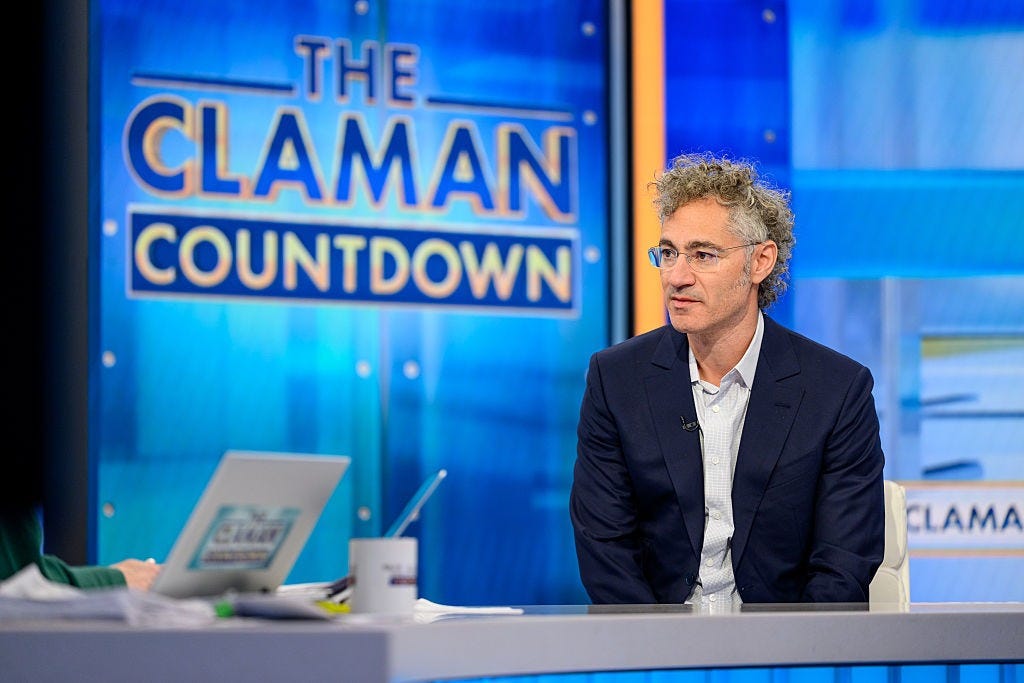
    Palantir CEO Alex Karp appears on Fox Business, October 2025 (Getty)

    Palantir is best known for the AI-powered cutting-edge software it provides to the federal government to give the US military and intelligence communities a leg-up over foreign competitors. Now, Palantir is in the news business as well.

    Over the last six months, with the help of Palantir engineers sitting in on high-level meetings and advising everyone from executives to writers, Fox News has scaled up its use of Palantir’s algorithms in simplifying its workflows. Readers of the nation’s most read right-of-center news outlet are therefore now influenced by the nation’s most ascendant defense contractor for which stories they see and how they’re framed.

    “We are building a first-class platform alongside Palantir engineers that will empower our editorial team to do great journalism and tell important stories,” a Fox News insider told Cockburn. “We are re-imagining and re-building every aspect of our workflow that will help our journalists be more effective and impactful in their jobs.”

    Almost every journalist uses AI in some small way – Cockburn couldn’t live without Sonix, the software that transcribes his interviews. And the use of technology in deciding which stories to elevate up the page isn’t new. For years, media companies have utilized apps such as Chartbeat and Parsely that provide real-time info on which stories are under- or over-performing.

    Fox News’s choice to employ Palantir’s Foundry – a data-integration tool employed by the Department of Homeland Security, Morgan Stanley and Merck, among others – is nonetheless a landmark one. Theoretically, use of the software could free up Fox’s journalists to spend more time on reporting and less on the menial tasks that have taken up a lot of digital-journalist time over the past decade or so.

    When asked if the site is already seeing improvements following the Palantir partnership, a Fox News insider said, “Yes, big time.”

    Not all Fox’s humans are delighted by the new tech, however. Homepage editors have been told that their role is mostly to “just check it [the AI’s suggestions] for factual mistakes,” a source with knowledge told Cockburn. “Everybody has been on edge and stressed as Palantir has essentially taken over Digital, especially the homepage,” another source told Cockburn. “Not only have the AI mandates bogged down writers like myself and others, but it has zapped the creativity out of us and made us lazier and more reliant on this technology.”

    Cockburn has no beef with Palantir pitching their algorithms to willing American buyers. But still – if one of the nation’s most powerful defense contractors is influencing what news you end up seeing, wouldn’t you want to know? And wouldn’t you want that news outlet to disclose it when, say, that company’s CEO pops up on their business channel?


    On our radar

    ARABIAN DAYS President Trump has a full schedule of events with Saudi Prince Mohammed bin Salman today. It’s the prince’s first visit to Washington since the assassination of Jamal Khashoggi. Tuesday’s foreign pooler, Nadia Bilbassy, comes courtesy of Saudi state media; the killing didn’t come up in the briefing that was circulated ahead of time, to the chagrin of several other correspondents…

    TATE WITH DESTINY Disgraced White House official Paul Ingrassia intervened in an official capacity on behalf of his former clients the Tate brothers, to get their cell phones returned when they were seized by Customs and Border Patrol, ProPublica reports.

    VANCE TO THE MUSIC OF TIME A Michigan man called J.D. Vance has been jailed for two years for making online threats against an Ohio man called J.D. Vance (the Vice President) and his boss.


    Summers lovin’, happened so fast

    Former Harvard president and Clinton-era Treasury secretary Larry Summers is “stepping back from public commitments” and is “ashamed” at having asked Jeffrey Epstein for dating advice as recently as 2019 – the year Epstein didn’t kill himself – according to the New York Times. Summers wrote, while pursuing a “love interest” who was seeing another man, “I dint want to be in a gift giving competition while being the friend without benefits.” Oh no he dint! Epstein replied, “shes smart. making you pay for past errors. ignore the daddy im going to go out with the motorcycle guy.”

    As the emails are revealing, Jeffrey Epstein was everyone’s daddy. Perhaps Summers would have been better off asking a different New York billionaire for dating tips…


    Evening Wood

    Cockburn sidled into the cocktail hour at the National Building Museum for the American Enterprise Institute gala a touch after 6:30 last night. Hundreds of guests donned black tie and gathered to see 91-year-old historian Gordon G. Wood receive the Irving Kristol Award. The nonagenarian New Englander drew inspiration from the Founding Fathers in his remarks. Beforehand, AEI president Robert Doar offered a brief tribute to former vice president Dick Cheney, an AEI trustee, whose funeral takes place in DC Thursday. Attendees sipped Cabernet Sauvignon and enjoyed small portions of short rib.

    Spotted: Jonah Goldberg; Joshua Katz; Philip Klein; Katherine Mangu-Ward; Megan McArdle and Peter Suderman; Adam and April O’Neal; Chloe Ross; Robby Soave and Byron York.

    Subscribe to Cockburn’s Diary on Substack to get it in your inbox on Tuesdays and Fridays.

  • How much did Trump really know about Epstein?

    How much did Trump really know about Epstein?

    The main thing that has made the Epstein files seem politically (as opposed to morally) significant is that Donald Trump remains obsessed with preventing them from seeing the light of day. He thus devoted much of Wednesday to importuning Republicans such as Colorado Congresswoman Lauren Boebert not to back their release. “Only a very bad, or stupid, Republican,” Trump declared, “would fall into that trap.”

    But senior Republicans, as Politico reported, are expecting mass vote defections in the coming week as legislators prepare to vote for a disclosure bill sponsored by Representatives Ro Khanna and Thomas Massie. Georgia Congresswoman Marjorie Taylor Greene says that releasing the files is “not only the right thing to do for the victims but it’s also the right thing to do for the country.” While the current batch of emails that are being released comes from Jeffrey Epstein’s estate, the treasure trove rests in the Department of Justice, where Trump already had hundreds of government agents pore over them for mentions of his name.

    For now, the emails that are being released are already further tarring the President. Others are implicated as well. According to former Time magazine correspondent Nina Burleigh: “There is amazing stuff in those emails. Jared Kushner is in there quite a bit. A lot of high profile, powerful people are not having a good night. You can see how enmeshed Jeffrey Epstein is in the power structures here and abroad.”

    If the House overwhelmingly passes the bill to force the release of the Epstein files, then the Senate will face severe pressure to pass it as well. Trump would almost surely veto it. But vetoing the bill would be tantamount to an admission of guilt that might look worse than anything that’s actually in the files. Had Trump simply released the files at the outset of his new presidential term, he wouldn’t be in this predicament.

    So far, the emails that have been released are suggestive but not dispositive. In one email Epstein observes, “I know how dirty Donald is.” Presumably, he was not alluding to Trump’s personal hygiene. In another he wrote, “I have met some very bad people. None as bad as Trump. Not one decent cell in his body.” Worse: “Of course he knew about the girls.”

    The surprising thing, of course, would be if the President had not known about Epstein’s child sex ring. Trump was spending oodles of time with Epstein, who was his best, maybe only, buddy. As late as 2017, he was apparently celebrating Thanksgiving together with Epstein. Put bluntly, the two had a bromance going. To believe that he would have been unaware of Epstein’s principal preoccupation stretches credulity.

    White House press secretary Karoline Leavitt claimed that these stories are all a manufactured attempt to divert attention from the weighty affairs of government that Trump is focused on addressing. “These stories are nothing more than bad-faith efforts to distract from President Trump’s historic accomplishments,” she said, “and any American with common sense sees right through this hoax and clear distraction from the government opening back up again.”

    Trump, a tabloid president, as Sam Tanenhaus once put it, has repeatedly been dogged by sexual scandals. But this one goes beyond mere prurience. Russia and Israel all figure in the files. Whether the documents will do more than further singe the President’s already equivocal reputation is an open question. If nothing else, Trump’s frantic behavior suggests that they will.

  • Will the Andrew formerly known as prince appear before Congress?

    Will the Andrew formerly known as prince appear before Congress?

    Amidst all the ceremony and gravity of Britain’s Remembrance Day service on Sunday, one salient fact could not be ignored. The King has long talked of his desire for a “stripped-down monarchy,” and now he has his wish. The only male figures from the Firm who were out on show alongside him were the Prince of Wales and Prince Edward, who together had the effect of making the royals look a rather paltry selection compared to the grander gatherings of the past.

    We all know about Harry, but although some would like to see him, too, stripped of his royal title, Montecito’s second most famous resident continues to be able to refer to himself as a prince. This is not a luxury that his disgraced uncle enjoys any longer, as he adjusts to life not as Prince Andrew, Duke of York, but plain old Andrew Mountbatten Windsor. As he prepares to leave Royal Lodge for a more modest existence in a grace and favor home tucked in some obscure corner of the Sandringham Estate, he may look around and wonder if his disgrace is yet over. Well, judged by recent events, the bad news for him just keeps on coming.

    During his “heyday,” Andrew liked to present himself as a swashbuckling, entrepreneurial figure, thanks to his Pitch@Palace initiative, which invited would-be moneymakers to come to Buckingham Palace and get their businesses off the ground. Unsurprisingly, given his shame, this is no longer a going concern. Documents seen by the Guardian show that the last remaining part of the business, Pitch@Palace Global, has been wound up after its UK side foundered in 2021.

    Admittedly, after Andrew’s disastrous 2019 Newsnight interview, it is doubtful that even the most desperate would-be businessman would have seen the soon-to-be banned old Duke of York as the answer to their prayers, but the knowledge that this beleaguered endeavor is no more shows how total, and terminal, his disgrace is. (Lest we forget, it was from the Chinese arm of Pitch@Palace that the alleged Chinese spy Yang Tengbo emerged, suggesting that Andrew’s judgment when it comes to those he kept company with has always been terrible.)

    And what of middle England? Well, Andrew has a few supporters who argue doughtily for the presumption of innocence before guilt is proved. Yet the overwhelming majority of the country consider that enough wrongdoing has now been established to regard the former prince as unspeakable, and they are not afraid to make their feelings felt. Residents of Prince Andrew Road and Prince Andrew Close in Maidenhead are hoping that the names of their streets will be changed, to avoid the taint of association. One long-sufferer local, Kelly Pevy, told the Daily Telegraph that: “If you’re giving someone the address, it’s the first thing [they’re] going to say. When I speak to energy companies and they ask for the address, they make a little joke. It’s mentioned more and more, and so then you start thinking about it more.”

    It remains to be seen whether the dwellers of Maidenhead succeed in their petition to the local MP to end this little joke, but if Andrew takes a moment out from a head-down routine of self-pity and video games, he may by now be seeing the enormity of the disgrace he faces. The Democrats on the House Oversight Committee have asked that he be summoned to the United States and Congress to answer questions about the precise nature of his relationship with Jeffrey Epstein. Although they have no legal power to compel him to attend, Andrew knows that to do so would be potentially hazardous. Not only could he be prosecuted for perjury if any part of his testimony is false, but his presence in America would open him up to investigation, even arrest, for his alleged activities with the then-17-year-old Virginia Giuffre.

    Andrew Mountbatten Windsor – there is currently some debate as to whether his last name will be hyphenated or not – is as maligned as anyone in public life today. Yet if he had stopped playing Call of Duty on Sunday and watched his elder brother and nephew remember the fallen, he would have been aware of what real courage and real sacrifice look like. Andrew, by contrast, is an insignificant figure, too sinister and grim to be pathetic and too boring to be laughable. His downfall, in all its embarrassing little details, reflects the man perfectly.

  • Prince Andrew finds refuge in video games

    Prince Andrew finds refuge in video games

    Oh God, not that. That’s all we need, I thought, reading in a long account of Britain’s Prince Andrew’s current travails that “according to visitors to Royal Lodge,” he now “spends much of his time playing video games.” Even before all the unpleasantness with the child-rape allegations against Jeffrey Epstein, one of the Prince’s more embarrassing qualities was his appearing as an “ambassador” for this or that – usually accompanied by a helicopter trip to a golf course.

    Now he’s reduced – no chopper, no putting green; woe is him – to being an ambassador for adults who play video games. As an adult who plays video games, and even writes about them from time to time, I generally welcome news of figures in public life who do the same. Not on this occasion.

    Does it not, after all, play into the worst stereotypes of the hobby? We are invited to picture this paunchy blue-blooded delinquent – a man so gauche he’s said to have rejoiced, lifelong, in demanding his phone extension end in 007 – sitting in his monogrammed underpants and his silk robe, surrounded by old pizza boxes, hammering away at the PlayStation into the small hours of the morning because he has nothing else in his life. Curiously, the exiled Syrian dictator Bashar al-Assad is also said to spend most of his time holed up in his Moscow apartment gaming. Rumor has it that he tends to play World of Tanks, a multiplayer online game in which he prefers using Russian equipment.

    What games is Andrew playing, the likes of me can’t help but wonder? The generic mobile game Royal Match – in which you shuffle gems into rows of the same color to rescue a portly royal personage from drowning, being eaten by a snake or locked in prison – would be a bit on the nose. Is he trash-talking noobs in some Call of Duty multiplayer lobby? Again, unlikely: a man with the prince’s ego wouldn’t stick long at a game in which the hand-eye coordination of a 65-year-old is tested anonymously against that of a teenager. I prefer to imagine that he’s playing through some deep, long, immersive, cartoony, learn-at-your-own-pace one-player game of the sort that bears no relation to reality. Super Mario Galaxy, say, or Zelda: Breath of the Wild.

    In that case, we can say that this situation is decipherable – that if you were watching the only life you have known crashing around your ears, you might like to escape into another world. A defining quality of good video games – which makes them as addictive as other things that share this property – is that they are deeply absorbing. They take you out of yourself and into another place. That is not in and of itself a bad thing. Humankind cannot, as a wise man once said, bear very much reality.

    It strikes me that video games could offer a safe and harmless outlet for the prince’s bruised ego. He is a man, after all, who sets very great store by rank and station. He loves to be called “Sir.” A couple of weeks ago, a bit before the Firm harvested his various titles like Mario running through a cache of power-ups, it was reported that he had emailed Epstein saying “We are in this together” fully three months after he claimed to have ceased all contact. Andrew has always denied any wrongdoing. What struck me most strongly, apart from him contradicting his earlier statement, was that said email was apparently signed: “A., HRH The Duke of York, KG.” Could there be anything more cringe-inducing than following that slightly nauseating just-the-initial signature with a cavalcade of formal titles? Even if this was the work of a standard email footer, it tells you something about the man.

    All those titles and honors he collected, cherish them as he did, arrived by accident of birth. They were imaginary honors – no more substantial than pixels on a screen. Yet there’s something to be learned from that. Even if the wider world disdains him and the titles he hoarded are gone, he can acquire some new ones in the virtual world. Better ones, in fact.

    For any achievements he earns in a video game are ones he will have gained by working for them. My 11-year-old was cock-a-hoop when he cracked platinum ranking in Rocket League (a game where you play soccer with cars, m’lud) – and I don’t blame him. It’s a positively Ruritanian honor as far as the outside world is concerned, but it means that in this small arena, he excels. Same with, say, a purple parse on Ragnaros in Warcraft Logs.

    They don’t hand video game achievements out for free. You have, in the parlance of that world, to grind for them. There’s no shortcut to the muscle memory that allows you to navigate the final level on Bubble Bobble or learn how to snapshot trinket procs for the optimal feral rotation; no way of bypassing the endless matches you need to play to optimize your team on FIFA.

    Just ask Elon Musk. So hungry was he for the approbation of the video game community, the big wally, that he claimed to be in the top 20 Diablo IV players in the world – only to be called out when live-streaming a game which showed that he had only a semi-shaky grasp of the skills involved. It was widely concluded that he had been getting other players to “boost” his character. No great surprise. Reaching that sort of rank in that or any other game would require not only unusual talent but the investment of much, much more time than Musk can reasonably be expected to have devoted to it.

    You can’t rank up in video games, as you can in the royal family, by whining at Mom until she gives you another medal, feathered hat or garter ribbon. You need to work at it. So if Prince Andrew devotes himself to collecting 121 stars in Super Mario Galaxy, we should regard it as the closest thing this wretched creature will get to redemption.

    This article was originally published in The Spectator’s November 10, 2025 World edition.

  • Don’t take Virginia Giuffre’s memoir at face value

    Don’t take Virginia Giuffre’s memoir at face value

    Six months after she took her own life aged 41, Virginia Roberts Giuffre’s “memoir” Nobody’s Girl, written with her professional collaborator Amy Wallace, has been published. It is bound to evoke distinct and intensified feelings in readers because the account of her suffering, coupled with the manner of her death, increases the emotional impact of the narrative. 

    The writing style and tone of the book feel authentic. Giuffre, who was born in 1983, uses words like “rad,” meaning awesome or cool, and “stoner dude,” to describe someone who smokes a lot of weed plus her constant reliance “on music to make the world make sense” seem very “Xennial” as late Generation Xers or early millennials are sometimes called.

    If Giuffre is to be believed, one could not fail, surely, to be moved by her account, which is quite graphic in places, and by the arc of a tragic life that is chronicled in four parts with emotive titles: “Daughter,” “Prisoner,” “Survivor” and “Warrior.” There’s no index, however, so the book could have done with a dramatis personae to help keep track of who’s who in a large cast of characters. Above all, it would have benefited from a detailed timeline of her life and the key events she describes.

    Precision, particularly as to accurately identifying named abusers, when and where the alleged abuse took place and crucially how old she was at the relevant times, is not, however, the author’s strong point when it comes to standing up her narrative version of events. This precision really matters in the sexual abuse accusations Giuffre levels.

    Who cares, you may ask, if she was 16, 17 or 18 when she met Jeffrey Epstein, who she accused of years of abuse? It isn’t a trivial difference, however, when it comes to statutory-rape charges. At my sister Ghislaine’s trial, as Giuffre herself notes, to her manifest disappointment: “Two of [the] accusers testified only after the judge instructed jurors that their description of alleged sexual conduct could not be used to convict [Ghislaine] of the crimes charged… “Kate” was above the age of consent in the [relevant] jurisdiction… and “Annie” [was not considered a minor in New Mexico where the alleged sexual contact had occurred].”

    Giuffre had previously accused Alan Dershowitz, a sometime Epstein lawyer, of abusing her no fewer than six times – including in the Netflix series Filthy Rich – but later admitted she “may have been mistaken.” Yet in her memoir she writes: “Some critics have insinuated that there’s no way I could remember these men… But to them, I say simply this: when a man has been on top of you, his face just inches from your own, you remember him.” But if that’s true, how could she have been mistaken about Dershowitz?

    When it comes to Giuffre’s firsthand account of her time “in Epstein and Maxwell’s orbit,” Amy Wallace in her preface states: “[It] was supported by thousands of pages of public court documents, including sworn depositions… [containing] the full names of many of the men who Virginia alleged she had been trafficked to. Their contents are supported by numerous other sources including… published books on the subject by authors such as the Miami Herald’s Julie K. Brown [and] Virginia’s former attorney Bradley Edwards…” As if the sheer quantity of such material and the implied quality of the names in support are standalone proof of Giuffre’s overall veracity. This is a surprisingly Stalinist approach to corroboration. 

    Giuffre herself states in the introduction to her memoir, “Until now I have never told my whole story. Doing so allows me to fill in gaps, to provide context where it has been sorely lacking, and in key places to set the record straight.” She confirms, however, that she did in fact “complete a 139-page typewritten manuscript entitled The Billionaire’s Playboy Club.” Although unpublished it found its way into the court record. 

    The “context” she then provides about that version of her life is to blame the Mail on Sunday reporter Sharon Churcher for advising her (in 2011/12) to fictionalize parts of the narrative to avoid being sued. This, she says, accounts for why “my third encounter with Prince Andrew… occurred at Zorro Ranch [in New Mexico], not where it actually occurred: the Caribbean.” It wasn’t until 2019 that Giuffre’s own lawyers had to admit in a court document that the manuscript was indeed “fictionalized.” 

    It is from this disclaimed memoir that Julie K. Brown directly quotes Giuffre verbatim or paraphrases her in her 2021 book, Perversion of Justice. The book is dedicated to Giuffre, which might explain why Brown was happy to corroborate her version of events to Wallace. Is it any wonder, therefore, that Giuffre’s credibility issues were one reason she was neither named as a victim nor called as a witness in my sister’s prosecution? She claimed she was not called as a witness because she would have been “a distraction” but that’s a self-serving lie.

    At Ghislaine’s sentencing hearing, despite not featuring in her trial in any capacity, Giuffre – who was never cross-examined under oath in any legal proceeding – was allowed by the judge to provide a victim-impact statement. The statement itself could not be subjected to cross-examination and Giuffre’s most serious and untested allegations added time to Ghislaine’s sentence.

    Giuffre frequently writes lines such as, “I didn’t want money. I wanted justice,” and mentions her charity, SOAR. Yet despite having reportedly received more than $20 million in settlements – including at least $2 million from Prince Andrew – the charity was never fully established, lost its tax-exempt status due to inactivity and has no record of charitable giving.

    Nearly three-quarters of the way through the book, readers are asked if they “can remember America before the #MeToo movement” which reached its apex in late 2017. In the pursuit of “justice,” #MeToo was a wave that Giuffre, guided by her ruthlessly adept advisors, skillfully – and above all, profitably – rode to their mutual benefit.

    While that movement has clearly raised increased public awareness of sexual misconduct, it has also generated an important debate over the erosion of core principles of natural justice. The bully pulpit of social media too often bypasses traditional mechanisms of due process, with allegations leading to devastating reputational consequences before a formal investigation or hearing can occur.

    By May 2020, presidential candidate (as he then was) Joe Biden, facing allegations from a former staffer of sexual harassment 27 years earlier, produced a more nuanced interpretation of the original #MeToo slogan, “Believe women,” when he said: “[There is a] belief that women should be heard… that [they] deserve to be treated with dignity and respect… and that their stories should be subject to appropriate inquiry and scrutiny” (the italics are mine).

    Even if only parts of Giuffre’s account are true, she is still a person who suffered and deserves sympathy. But that cannot excuse the fact that she accused innocent people of serious crimes and destroyed reputations and lives. 

    Her claims – like anyone’s – must be carefully vetted. To approach this book with the assumption that she is telling the truth necessarily means imposing a presumption of guilt on everyone she has accused of sexual assault, placing the burden on them to prove their innocence. This is contrary to all principles of natural justice.

    This article was originally published in The Spectator’s November 10, 2025 World edition.

  • Prince Andrew no more

    It’s all over for Prince Andrew or, as he is now known, Andrew Mountbatten Windsor. The former Duke of York, ex-trade envoy and, for all we know, Grand Pooh-Bah of Kazakhstan, has been stripped of every one of his titles. Andrew has also been ejected from his Windsor mansion by his brother, the King.

    In a terse, angry statement, Buckingham Palace that said that: “His Majesty has today initiated a formal process to remove the style, titles and honors of Prince Andrew. Prince Andrew will now be known as Andrew Mountbatten Windsor. His lease on Royal Lodge has, to date, provided him with legal protection to continue in residence. Formal notice has now been served to surrender the lease and he will move to alternative private accommodation. These censures are deemed necessary, notwithstanding the fact that he continues to deny the allegations against him. Their Majesties wish to make clear that their thoughts and utmost sympathies have been, and will remain with, the victims and survivors of any and all forms of abuse.”

    And, with those 109 words – six more than the original statement that sent this rather tarnished Adam out of his garden of Eden, or at least the Royal Lodge that he had been living in, rent-free for decades – Andrew was removed into banishment.

    The language of the statement is unprecedented. “Censures” is a word that is particularly damning. So, too, is the statement’s sign off: that the Royals’ ‘thoughts and utmost sympathies’ are with abuse survivors.

    No doubt some will still choose to defend Andrew. Seven percent of the public expressed sympathy for Andrew this week, despite the publication of Virginia Giuffre’s memoir. Yes, 93 percent of Brits may have turned their back on Andrew, but it’s still remarkable that anyone is willing to stick up for Andrew.

    Perhaps they are entitled to, just as there are those who believe that Elvis is living in platonic bliss somewhere. But the realists will see that Mr. Andrew Windsor, as we can now, finally, call him, has been served the punishment that his arrogant, selfish actions have merited all along.

    Andrew can skulk in some ignominious corner of the Sandringham Estate in Norfolk, England for the rest of his days. Few would see that as anything other than a fitting judgment on a man who refused to believe, even when confronted with the most damning of evidence, that he had done anything wrong. Posterity, and his public, will contend otherwise.

  • Have the Virginia Giuffre revelations got Prince Andrew sweating?

    Have the Virginia Giuffre revelations got Prince Andrew sweating?

    It is a staple of Gothic fiction that the malefactor is often caught out by a document or apparition that appears from beyond the grave. And so it appeared for Britain’s scandal-riddled Prince Andrew, ever since it was announced that Virginia Giuffre, who the now-former Duke of York allegedly had sexual relations with when he was 41 and she was 17, was posthumously publishing a memoir, entitled Nobody’s Girl, in which she offered candid accounts of what, precisely, happened with Andrew, courtesy of the disgraced sex offender Jeffrey Epstein. Everyone – including the royal family – braced for impact, and the decision to remove Andrew’s title and Order of the Garter must surely have been dictated by this latest humiliation.

    Although Nobody’s Girl is not published until next week, excerpts have now been released to newspapers and magazines on both sides of the Atlantic, and it is a strange mixture of the newsworthy and the unremarkable. Giuffre once again recounts how she had sex with Prince Andrew three times, courtesy of Epstein’s pimp, Ghislaine Maxwell, and how she was paid $15,000 by Epstein to keep the duke happy. She describes the actual sex as being unremarkable, if tending towards the fetishistic – “He was particularly attentive to my feet, caressing my toes and licking my arches” – and the whole thing was over in less than half an hour.

    The picture painted of Andrew is certainly unflattering and aligns closely with that Giuffre had already said in various court depositions – how she was taken to the exclusive London nightclub Tramp, despite being underage, and how the duke “was sort of a bumbling dancer, and I remember he sweated profusely.” (This, of course, led to Andrew’s reputational downfall in his 2019 Newsnight interview, in which he said, straight-faced, that he was medically incapable of perspiring.) The most damning statement is Giuffre’s reflection that “he was friendly enough, but still entitled – as if he believed having sex with me was his birthright.” After all, in her recollection, Andrew was the second son of Elizabeth II, and Giuffre was just one of the innumerable girls that Epstein provided for him, as if on a platter.

    Andrew, of course, denies all claims of wrongdoing and also has suggested that not only did he never have sex with Giuffre, but that he has no recollection of meeting her. Few are convinced. Resurfaced emails suggested that he and Epstein were “in this together” and that when the fuss had died down, “we’ll play some more soon.” These were far more damaging than anything that has so far been released from Nobody’s Girl, because the association with Epstein – which lasted far longer than Andrew had admitted – is so toxic that it will hang over him like a nuclear cloud for the rest of his life.

    With this calumny removing any chance of a public comeback, Andrew will now be grasping at what little comfort he can seize from the situation. It is highly unlikely, on present evidence, that criminal proceedings will be brought against him, and even if they were to be opened in the US, it is highly unlikely that an extradition attempt would succeed. It is widely believed that no member of the royal family would ever be tried in a criminal court in the UK – noblesse oblige dies hard – and so it is likely that Andrew will remain at liberty, even with his reputation shot to naught. Likewise, there is no revelation from Giuffre’s book – so far, at any rate – that dramatically worsens his situation. Yet there is every chance that, as the Epstein emails slowly drip-feed into public view, there is worse to come, and one could hardly blame the banned old Duke of York for lying awake at night awaiting the next revelation – and sweating profusely at the thought of it.