Tag: Tariffs

  • Ann Coulter: On immigration, Trump 2.0 and the Epstein Files

    Ann Coulter: On immigration, Trump 2.0 and the Epstein Files

    Ann Coulter, an American author, lawyer and conservative media pundit, joined Freddy Gray on the Americano podcast last Friday to discuss why she backs the UK’s Reform party, why she supports Trump in his second term, what’s really going on with the Epstein files and more.

    Here are some highlights from their conversation.

    Why don’t politicians follow through on illegal immigration promises?

    Ann Coulter: Americans have been voting not to give illegals benefits, to deport them, to make sure they can’t vote, for now almost half a century, and the politicians will never give it to us. That was what was so striking about Boris Johnson and Donald Trump. Oh my gosh, they really seemed to mean it. At least with Trump, every single rally for 18 months, the chant was, “build the wall,” the signs “build the wall,” their etchings “build the wall” and he gets it (the presidency). And he doesn’t build the wall.

    Freddy Gray: What do you think is the real factor there? Is it the economy? Is it that businesses just have that way of pressuring? I mean, I think with what’s now called the Boris wave of the huge influx of immigration during Boris Johnson’s premiership, really, it was pressure from the Treasury to make sure that wages are suppressed because everyone was worried about Covid and so on. Is that the real driving factor?

    AC: Well, there are at least two driving factors. For the Republicans, it’s the donors. They want the cheap labor, which it’s worth pointing out as the as the cliché goes, cheap labor is only cheap for the employer. It’s the middle class that are subsidizing the rich’s poor labor or cheap labor. They are nannies. They are cooks. They are, you know, farm workers because they accept massive amounts of welfare, which leads to the other special interest group supporting illegal immigration, and that’s the entire Democratic Party, because illegals are accepting so much social welfare. Which party do they vote for and their kids can vote in? I mean, now the number of anchor babies who are of voting age is probably 20 million.

    On the future of the UK

    FG: You’ve been spending some time with Reform. What do you like about them in particular?

    AC: Immigration. Immigration. Immigration.

    FG: You think they will make good on their promises? Because quite often we see these parties, when they get into power, they can’t actually make good on.

    AC: Yeah. To take two little examples, Boris Johnson and first-term Donald Trump. That was stunning. It’s been happening in the US for 20 years. It’s been a bigger issue for us, I think. And states, I mean, this was back in the early 70s. Texas voted to have no free public education for illegals, and the Supreme Court, very left wing, overturned it. And that’s when Justice Brennan, incidentally, made up the concept of anchor babies. The court never ruled on it. No legislature has passed it.

    FG: Please explain what an anchor baby is.

    AC: An illegal pregnant Mexican runs across the border and drops a baby. The baby is allegedly an American citizen. No court has ever found that. No legislature. It was just dropped in a footnote of this Justice Brennan opinion. Maybe that’s a side note, but it’s a big, big problem in some hospitals along the border. 80 percent of the babies born are born to illegal aliens. El Chapo. You’ve heard of him? The big, massive drug lord? When his wife got pregnant, she’d run across to San Diego and drop a baby. They’re all American citizens. I’ll just give you one more. I think it was Sinaloa cartel. The cartels are just monstrous. I don’t want to hear about, you know, Hamas throwing rocks and dropping a few bombs. The cartels are beheading people. They are beheading Americans. They are committing heinous, hideous crimes.

    Ann’s disappointment with the first Trump administration

    FG: I think it is fair to say you were disappointed, even fuming, about about the first Trump administration, which was funny because at one point you were pretty much the only American who supported him.

    AC: Yes! Oh, before he got in, I was worried… I was still yelling at him for some things. I guess, it was like March. He wasn’t hiring the right people during the transition. That was a bad sign. It was February or March. I showed up in the Oval Office, and like I say, I never told anyone this, but he told people. I just stood at the resolute desk, haranguing him, hectoring him. I was not the first one to use the F- word, but once it got used… Well it was about, you’re not keeping your promises; you’re you’re not building the wall; you’ve done nothing on the wall; you’re only pushing for tax cuts. The moment when he got really angry, which I think really speaks in his favor, was when I said, “You’re governing like Jeb Bush.”

    FG: The Big, Beautiful Bill upsets fiscal conservatives, but it does give a lot of money to the border. I think it’s probably a mixed bag for people of a conservative disposition. What would you say?

    AC: Yes. I mean, overall, but I can’t blame Trump alone for this. It’s hard to cut anything. You know, a good motto is, “There are a lot of bad Republicans. There are no good Democrats.” So I kind of hate my party. I’m totally with Elon. If they could cut government by 90 percent, the world would be a better place. They’re mostly useless bureaucrats spending their days trying to make our lives worse. First – and I should say I’m not against tax cuts; I think they’re good and important – it’s just that that’s all we’ve ever gotten from the Republican Party. And what was special and different about Trump was he seemed to care about middle America and working class America. He was going to bring back manufacturing. No more stupid wars. The whole America first and mostly immigration, immigration, immigration. So when he blows off those three unusual and important parts of his campaign and does what a Bush would have done. Yes. It was a little disappointing.

    FG: We’re almost 200 days into Trump’s second term. How many marks out of ten would you give Trump in his second terms?

    AC: I guess nine. He gets one taken away for not releasing the Epstein stuff.

    Epstein, Israel, Saudi Arabia?

    FG: Why won’t he release it? Is it because there is evidence of him?

    AC: I think he has donors who are involved. Yeah. And also a favored country in the US. I’ve been following it since 2006. I spent part of my time in Palm Beach, where the whole story broke and the Palm Beach Police were great. National media did not cover it… We were thinking maybe it was like a concierge operation where he runs the sex shop for for rich guys like the private clubs, but that doesn’t make any sense. He would have done it free. I mean, I’m trying to answer the question of where he got his money. He was getting a lot of money. Coincidentally, all the ones he was getting money from are gigantic Israel supporters. All of them. Some foreign country has to be behind it. So you basically get down to, “Is it Saudi Arabia, or is it Israel?”

    Are tariffs good for the US?

    FG: Are you pro-tariffs?

    AC: Totally pro-tariffs. I’m with Trump on it. It needs to be fair, and we have been giving it away. That’s one thing, just for years and years and years, and I’m sick of the free-traders. We’ve been trying your way for 50 years. Manufacturing has been wiped out. We used to have, like, 20 million people working in manufacturing. I think when I wrote Adios America, or maybe it was in Trump We Trust, I don’t know, we were down to like 11 million. The working class and the middle class has been suffering enormously. And I noticed Wall Street is doing quite well. So how about let’s try not having this – what is called free trade. And I think Trump is right. It’s unfair trade.
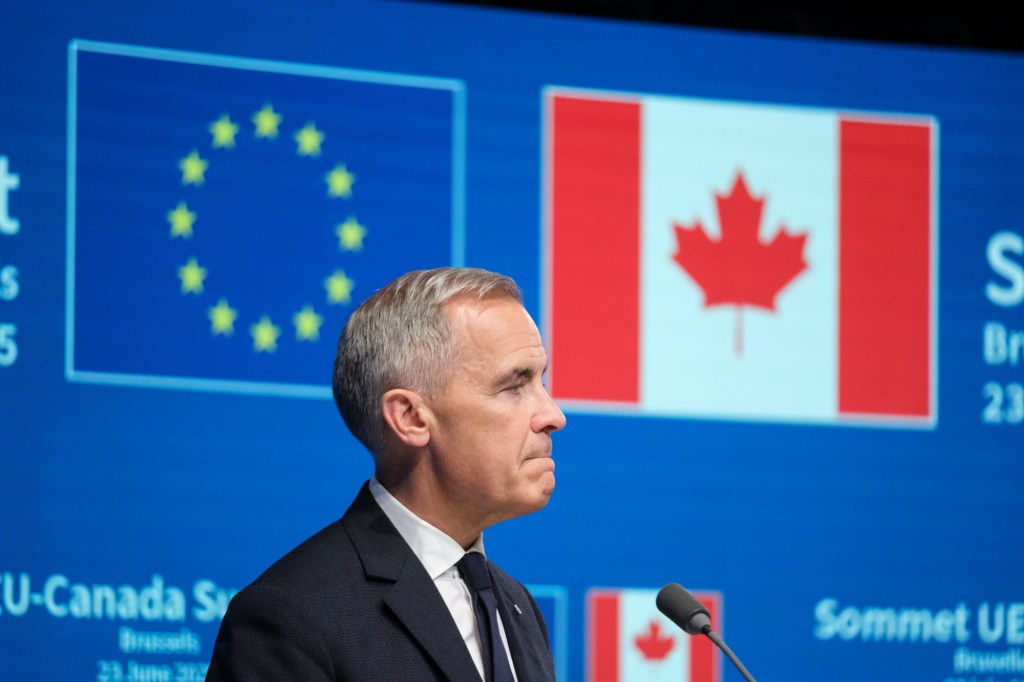
  • Mark Carney was asking for Trump’s tariffs

    Mark Carney was asking for Trump’s tariffs

    Canadian Prime Minister Mark Carney announced on Wednesday that his Liberal government will recognize the state of Palestine at the United Nations in September, following the recent trend set by France and the UK.

    The decision to recognize Palestine at a time when the bloodthirsty terrorist organization Hamas is firmly in control is abhorrent, especially when the Hamas-led October 7 attack on Israel is still so fresh in many people’s minds. Democratic countries like Canada shouldn’t be enhancing the status of a murderous outfit that’s the equivalent of pure evil in our world.

    The Canadian government argues that they have put restrictions in place that must occur before recognition is approved. Carney said the Palestinian Authority must hold an election in 2026 and Hamas cannot be involved. He also insisted that Hamas releases the remaining Israeli hostages, and there must be a demilitarized Palestine. “Preserving a two-state solution means standing with all people who choose peace over violence or terrorism,” the PM said at Wednesday’s press conference, “and honoring their innate desire for the peaceful co-existence of Israeli and Palestinian states as the only roadmap for a secure and prosperous future.”

    Let’s put aside the obvious fact that terrorist groups like Hamas can’t be trusted when it comes to negotiating terms and conditions for just about anything. Does anyone truly believe Hamas’s leadership gives a tinker’s dam about Carney’s demands? Canada is a middle power with virtually no influence or cachet on the international stage since the path of destruction that former Prime Minister Justin Trudeau left in his wake. If Hamas barely pays attention to larger, more influential countries who have come around to their way of thinking, their perception of Canada won’t change. 

    There isn’t a chance in hell that Hamas will drop its political and military influence in Palestine. They’ll be pleased with the UN’s recognition of Palestinian statehood, but their end game hasn’t changed. That is: to destroy democracy, liberty and freedom in the West and beyond. Their enemies, including Israel, the US, France, the UK and yes, Canada, won’t suddenly become bosom buddies and lifelong chums.

    In fairness, Carney’s announcement could be for purely selfish reasons. He may believe it will solidify his political support among Canadian progressives. There’s some validity to this argument. Since he has a minority government, much like Trudeau did on two previous occasions, it could be the best solution to achieving long-term Liberal electoral support. While Carney’s decision will frustrate Canadian Jews, he knows there are many more voters in Canada’s Arab and Muslim community – including young ones.   

    Yet Canada’s relations with the US is another piece of this puzzle. Carney’s timing with this announcement couldn’t have been much worse, unless it was planned in advance to infuriate US President Donald Trump. 

    Canada and the US have been in the midst of a tariff battle. It started during the latter stages of Trudeau’s leadership last year, complete with Trump’s comments about Canada becoming the “51st US state.” A sizeble number of left-leaning Canadians foolishly believed Carney was the best leadership choice to take on Trump. That’s why his Liberals won the April 28 federal election. The working relationship between these two leaders seemed more positive at first blush, which wasn’t difficult to achieve with the bumbling Trudeau out of the picture. Some believed there was faint hope for a resolution before the August 1 deadline. 

    Alas, Carney’s con job with the Canadian electorate has been fully exposed. Early this morning, Trump announced that he was increasing the tariff rate on Canadian products from 25 to 35 percent.

    Even before Canada’s Palestinian recognition statement, it was clear the tariff negotiations weren’t going particularly well. Canada had briefly threatened to double its counter-tariffs on US metals from 25 to 50 percent and Carney’s own tone changed dramatically this month. He went from telling the press that Canada was in “intensive negotiations with the Americans” to resolve the tariff battle to making this eye-raising statement: “we’re working hard to get a deal, but we’ll only accept the right deal with the United States. The right deal is possible, but nothing’s assured.” It also didn’t help matters that Carney began to focus more heavily on a trade and security partnership with the European Union at the same time, even suggesting Canada was the “most European of non-European countries.”

    Carney’s announcement about Palestine was a slap in the face to Trump, who strongly supports Israel and regards Prime Minister Benjamin Netanyahu as a political ally. “Wow! Canada has just announced that it is backing statehood for Palestine,” Trump wrote on his Truth Social account. “That will make it very hard for us to make a Trade Deal with them. Oh Canada!!!”

    A trade deal between the two countries to reduce the 35 percent tariffs now seems highly unlikely. Carney has suggested that the talks may not end today, but he appears to be focusing on “broader discussions” like defense spending and investments. In other words, the tariffs will remain in place and the faith placed in him by far too many Canadian voters will be for naught.

    Is Carney bothered by the mess he’s caused? It sure doesn’t seem like it.    

  • The trade war isn’t over yet

    Maybe Trump doesn’t always chicken out after all. Rapid trade deals with the UK, Japan, the EU and others in recent weeks may have given the impression that the trade war was essentially over. Today, though, comes Trump’s Ardennes offensive, with immediate tariffs of 35 per cent announced for Canada. Other countries have been given a week to prepare for steep increases: India will be subject to 25 per cent tariffs, Taiwan 20 per cent and Switzerland – far from neutral in this particular conflict – 39 per cent.

    Those who insist Trump has a very clever strategy and is winning tend also to be people who, in any other context, are in favor of low taxes

    According to Trump, Canada has been singled out for harsh treatment because it has failed to cooperate on the flow of fentanyl across the border. Trump also hinted that he was punishing Canada for recognizing Palestine, but then he has just done a trade deal with the EU in spite of France taking the same action, and didn’t make any trade threats to Britain in spite of Keir Starmer saying this week that the UK will recognize Palestine in September if Israel does not meet certain conditions.

    It seems rather more likely that Trump is saying: look, other countries have yielded and agreed to one-sided trade deals with the US – I’m going to carry on beating you about the head until you agree to do the same. But will they? So far, the countries which have agreed to Trump’s rather rough and ready trade deals have acted as if the benefits of a trading relationship with the US are one-way – they have more to lose than the US if a deal cannot be struck. But of course that is not always true. Taiwan, for example, produces over 90 per cent of the world’s high-end microchips, which are implanted in just about every device manufactured in the US. What benefit does it bring America if those chips are in future taxed at 20 per cent?

    There is a strange dislocation in attitudes towards Trump’s tariffs. Those who insist he has a very clever strategy and is winning tend also to be people who, in any other context, are in favour of low taxes. But a tariff is just a tax like any other – it adds costs to business and so suppresses economic activity. If tariffs are set at modest levels, it may be worth putting up with tariffs’ depressing effect in return for the revenue they raise. Raise them above a certain level, however, and revenue will start to decline as business activity is discouraged – the classic Laffer effect. US growth may have proved more resilient than many feared it would be after Liberation Day, but it is certain that tariffs on raw materials and components are a negative influence on US manufacturing industry.

    A country does not “win” by taxing its imports more than other countries tax its exports – if it did, the US would be one of the poorest countries in the world while many African countries would be startlingly rich. The US has done brilliantly well out of a regime of low import tariffs – as has Singapore, one of the few countries which, prior to Liberation Day, imposed even lower tariffs than did the US.

    But even if you do think that imposing higher tariffs than your trading partners amounts to “victory,” it is far from clear that Trump will emerge the eventual winner. Some countries may have yielded to him, but others are clearly holding out, and may well make the calculation that the US has more to lose from a trade war than they do. This war has a long way to run yet.

  • The Art of the Dealmaker-in-Chief

    Who really thought Donald Trump’s America was about to join the stampede of first-world powers promising to recognize Palestine at the United Nations? 

    “Wow!” He exclaimed this morning on Truth Social. “Canada has just announced that it is backing statehood for Palestine. That will make it very hard for us to make a Trade Deal with them.” 

    All over the world, commentators convinced themselves that Trump’s expression of concern on Monday about “real starvation” in Gaza meant he was pivoting with global opinion and against Israel. 

    It turns out, however, that Team Trump is not for turning when it comes to the Middle East. Marco Rubio, the US Secretary of State, has accused the countries now embracing Palestinian statehood of falling for “Hamas propaganda”.

    Trump himself would rather focus all his diplomatic energy on trade, a subject about which he has been positively monomaniacal in recent days. He seems very taken with the new title he has given himself – the Dealmaker-In-Chief. 

    “We are very busy in the White House today working on trade deals,” said the President on Truth Social last night. Three hours later, he announced another “full and complete” agreement with South Korea, involving a 15 per cent tariff on them and $350 billion for the US. That’s on the heels of a deal between America and Japan, South Korea’s big rival in manufacturing terms. 

    The real coup for Trump’s trade strategy this week, however, has been the new framework arrangement with the European Union, which he announced on Sunday from his golf course in Turnberry, Scotland. 

    The EU deal is not simply a major breakthrough in and of itself. It’s also, as the US Treasury Secretary Scott Bessent suggested to my colleague Michael Simmons in Stockholm this week, a useful piece of leverage in the even bigger tariff struggle with China. Bessent was in Sweden for another round of negotiations with his Chinese compatriots and, for US officials, pulling Europe more towards a western trading orbit and less towards the east is an essential thing for the future of capitalism and the free world. China and the US appear to have agreed to take another pause from tariff hostilities – the two sides differ over fentanyl chemicals and Beijing’s role in supporting Iran and Russia. 

    It seems that now Russia is playing on Trump’s mind. On Monday, he suggested he would impose tariffs of up to 100 per cent on Russia if the war in Ukraine didn’t end within two weeks. Then yesterday, as he slapped further tariffs on India, he criticized New Delhi for buying up Russian oil and gas. “I don’t care what India does with Russia,” he said. “They can take their dead economies down together, for all I care.”

    Then, in perhaps the most intriguing trade development of the week, Trump declared a brand-spanking-new deal with Pakistan, including an arrangement to invest in Pakistani oil. “Who knows, maybe they’ll be selling Oil to India some day!” he “truthed”. 

    All jokes aside, Trump’s sudden enthusiasm for Pakistan at India’s expense marks a major shift in US policy in the last few years. Under Obama and Biden and Trump, the US state department has tended to prefer Modi’s India.  

    As ever with Trump, his apparent tantrum with India might conceal a subtler move. That’s the art of the Dealmaker-in-Chief. 

    In the last two decades, Beijing has made enormous investments in Pakistan, particularly in infrastructure through its Belt and Road Initiative. In some ways Pakistan has become an extension of China’s empire. 

    But not all Pakistanis relish the idea of being a Chinese satellite-state. And now the thought of Donald Trump suddenly wooing Pakistan’s government – which recently nominated him for the Nobel Peace Prize, funnily enough – will ring loud alarm bells among the highest ranks of the Chinese Communist party. With Trump’s international agenda, scratch beneath the hilariously crazy surface and you find a more serious campaign to isolate China, China, China. 

    This is taken from the latest Americano newsletter. To subscribe click here

  • Trump has gained the upper hand over China

    Stockholm

    This week, the fate of the global economy could have been decided over a Mongolian barbecue in a Stockholm tourist trap. On Tuesday, just 50 yards from Sweden’s seat of government, Rosenbad – where the US Treasury Secretary Scott Bessent and the Chinese Vice Premier He Lifeng had been wrangling over trade negotiations – the Chinese delegation suddenly exited the talks and headed for lunch near the Mongolian buffet place, where they had eaten the day before. Its windows were covered up and a sign announced it would be closed for three days for a “private event.” The Americans stayed behind, making do with salad.

    China, still the factory of the world, remains the biggest test of Donald Trump’s resolve

    The Chinese had left to “report back to the mothership,” as Bessent later put it. But the mothership apparently did not budge. After talks resumed, it soon became clear that no breakthrough agreement had been struck.

    China wanted another extension to its tariff truce with America, which expires on August 12. Bessent said that was a call for his mothership, Donald Trump. The Treasury Secretary seemed to hint that Trump would approve such an extension. “Just to tamp down that rhetoric, the meetings were very constructive. We just haven’t given that sign-off,” he said, diplomatically.

    The problem is that two major issues haven’t been resolved: fentanyl, and the Chinese support for Russia and Iran. On fentanyl, “we seem to have a sequencing problem,” said Bessent, delicately. The Chinese want Trump’s tariffs to be reduced before they take action to prevent the manufacture of the chemicals that make the drug, which killed 50,000 Americans last year. The US side wants things to happen the other way round.

    Moving on to Iran and Russia, Bessent said: “One thing we are not pleased with, I’m sure the President won’t be, but it’s no secret: the Chinese buying 90 percent of Iranian oil. They’ve contributed $15 billion in dual use technology to the Russian war machine.”

    Insiders and Chinese officials kept a nervous eye on Trump’s Truth Social media account for signs of an angry orange eruption. But Trump, returning from Scotland on Tuesday night, sounded sanguine. “They had a very good meeting with China, and it seems that they’re going to brief me tomorrow,” he told reporters on Air Force One. The President appears to be in a better mood than he was in February, when he seemed hellbent on exploding trade relations with the world and especially China.

    On rare earth metals and magnets, Bessent and his Chinese counterparts appear to have made progress, building on previous meetings in London. Other key topics that didn’t make it to the negotiating table were the future of TikTok and a possible meeting between Trump and Xi – “that’s at the leaders’ level”, the Americans said.

    Officials inside the room told me that most of that time was spent playing a civil but pointed game of “My economy’s bigger than yours”. 

    “We had a big exchange – a very long exchange – and briefings on the economies of both countries,” Bessent reported. The Chinese, he added, “believe that their economy is in good shape.”

    America’s aim is to rebalance China’s financial model – which Bessent calls “the most unbalanced economy in modern times,” the likes of which we haven’t “seen since the British Empire” – away from mass manufacturing and toward internal consumerism. This isn’t just about dollar dominance or bringing in an estimated $300 billion to the US economy from tariffs: it’s about changing China. “They believe that they have a robust consumer economy, and they do not believe that they have a manufacturing surplus that is making its way into the rest of the world. Which I disagree with,” said Bessent.

    Outside the nearby Sheraton and Diplomat hotels, bored police officers milled about. Anyone searching for drama had to look to the press corps, which consisted mostly of Chinese journalists. Trade talks are bigger news in Beijing.

    There was some fretting about “optics” from US officials. Representatives of the US Treasury were concerned about the white-walled room the Swedes provided for Bessent’s television appearance – “hostage vibes,” muttered one aide. A spat over the positioning of the Chinese and American flags outside Rosenbad was also rumoured.

    What’s clear is that Trump has gained the upper hand in the trade war. When he unleashed his tariffs on what he called “liberation day,” the global expert consensus was clear: disaster. The tariffs, we were told, would amount to the largest tax hike on Americans since the 1910s. Inflation would soar. Growth would stall. Businesses and capital would flee.

    But the orthodoxy has, so far at least, been proved wrong. The numbers have come in better than expected. Inflation has stayed close to the 2 percent target. Almost 800,000 jobs have been created this year. Second-quarter GDP is expected to grow at a healthy rate of 2.4 percent. The stock market has rebounded sharply and is up nearly 10 percent since Trump’s re-election. The forecasts were pessimistic.

    America has won in Europe too. Europe has agreed to invest some $1.4 trillion into American energy and infrastructure in exchange for a reduced yet still significant tariff rate of 15 percent. The French Prime Minister called it “submission”.

    America has won in Europe too

    America has effectively challenged Europe to pick a side, Washington or Beijing, and for now Europe has chosen Washington. “I don’t know if they have our back,” said Bessent, “but clearly, the European relationship with the Chinese had a substantial deterioration.” As the US put up the tariff wall, the door opened for increased trade flows between Europe and China.

    According to Bessent, however, the EU has decided that being flooded with more cheap Chinese goods – while Beijing continued to protect its manufacturing at every turn – is not an economic blessing.

    “I had told them: this is what’s going to happen,” says Bessent. “There is now much more unity between the US and the allies. They’re now seeing the downside [of China] the US has seen.”

    The tariff regime, then, has frightened the world away from its dependence on a frequently malevolent Chinese superpower. Trump’s madman tactic makes everyone crazy, but it appears to have worked. The fear that Trump really might go all the way with his threat of 100 percent-plus tariffs, never backing down, has enabled him to walk things back toward normality while achieving his objectives.

    China, still the factory of the world, remains the biggest test of Trump’s resolve. But all sides know that, as America settles its trade disagreements with the rest of the world, it is Xi Jinping who now most needs the tariff pause to continue.