Tag: Travel

  • How Trader Joe’s became a way of life

    How Trader Joe’s became a way of life

    A young woman recently approached me as I stood outside Trader Joe’s on the corner of 93rd Street and Columbus Avenue in Manhattan. “Excuse me,” she said, “I’m visiting from the UK and I’m just wondering if there’s anything worth seeing around here.”

    This is not an unusual occurrence. It’s always tourist season in New York. People come for the cherry blossoms in Central Park, for the magic of the Rockefeller Center Christmas tree and for the vague hope of running into Timothée Chalamet at a downtown brunch place. They even come in the sweltering heat of summer when I, personally, would rather be anywhere else – ideally somewhere without the pungent smell of hot garbage and misplaced ambition.

    But what struck me that morning was where this particular encounter took place. The Upper West Side, while perfectly charming in a “has a Duane Reade and emotional stability” kind of way, is not exactly a destination. It’s residential, practical, adult. The public schools are fine. It’s where you move, if you can afford it, once you’ve given up on pretending to enjoy warehouse parties in Bushwick. Sure, the American Museum of Natural History is nearby, but I doubted that a fossil collection and a beautifully preserved taxidermy otter were what this young woman was after.

    “What brings you to this neighborhood?” I asked politely. She smiled, then lifted the object of her pilgrimage: a crisp new Trader Joe’s tote bag, price tag still attached, logo blazing red and proud. “Everyone back home wants one,” she said.

    Let me back up. For the uninitiated, Trader Joe’s, despite what I naively believed when I first moved to New York in 2020, is not merely a grocery store. It’s a way of life. It’s a belief system. It’s a kind of secular religion with frozen orange chicken as communion. New Yorkers generally fall into two camps: those who speak reverently of the $3.49 pork and ginger soup dumplings that have “literally changed their lives” and those who – actually, I have no idea what the second group eats. Probably sadness. And maybe overpriced soup from Whole Foods.

    I’ve long since made peace with the zealotry of local devotees. I’m also not saying I don’t belong to that class of converts. I can neither confirm nor deny that I’ve turned misty-eyed over the return of the butternut squash ravioli. I’ve been more than a spectator in full-blown theological debates over which seasonal candle – or which thick and chunky salsa – is the best.

    There are Facebook groups, with membership numbers exceeding the populations of small nations, in which people exchange freezer-hack recipes as though decoding scripture. I know someone who once stood in line for 40 minutes because they had a premonition that the “everything but the bagel” seasoning might sell out. That’s not shopping; it’s prophecy.But what’s new – and frankly a little alarming even for me – is the globalization of this devotion. The Trader Joe’s tote bag has escaped its natural habitat. It’s gone international. I’ve heard it’s being slung over shoulders in Paris, Milan and Tokyo – worn not as a grocery accessory but as a cultural artifact, like an Andy Warhol print… but you can fill it with pre-washed broccoli florets. I saw one in London’s Knightsbridge this summer. And now I was standing opposite a young woman of maybe 20 who should’ve been taking a selfie in the line for lunch at Balthazar or flirting with a dreamy barista in the East Village, but who was instead basking in the smug glow of having scored the ultimate token of nouveau Americana.

    Dwelling on all of this, I’ve decided I’ve just got to hand it to the California brand that, for all of its countercultural charm, is actually owned by the multinational discount supermarket Aldi. (Womp, womp.) Trader Joe’s has perfected the art of marketing faux frugality: a corporate giant clad in a Hawaiian shirt and the illusion of moral superiority. It’s capitalism’s coziest costume. Only Trader Joe’s could sell you an aesthetic of thrift while quietly printing money off seasonal hummus.

    What really amazes me, though, is the reach of all this. Somehow, a brand with just over 600 stores – and not a single one outside of the United States – has managed to convince people who’ve never set foot in its aisles that its tote bag is the global badge of insider cool. The bag doesn’t just hold groceries, it holds belonging.

    Now, sure, you could call this a pathetic indictment of the human condition and further evidence that consumerism is alive and well, but I take a different view. I’m impressed. In a world of tech companies harvesting our data and pharmaceutical companies leveraging our insecurities for profit, Trader Joe’s has managed to build an empire out of whimsy and frozen fish sticks. It doesn’t manipulate us with fear or addiction, just promises us a good deal and a delicious dinner. And if the price of that illusion is $2.99 and standing in a long (but actually quite fast-moving) line at the check-out, then so be it. Maybe – just maybe – this is the most honest hustle in America.

    This article was originally published in The Spectator’s November 24, 2025 World edition.

  • Franco Zeffirelli’s slice of paradise in Positano

    Franco Zeffirelli’s slice of paradise in Positano

    If you say the name Franco Zeffirelli to anyone under about 40, you’re likely to be met with bemusement. Find any opera or film lover over that age, however, and you will be greeted with a warm exclamation – “Ah!” – followed by a recitation of the Italian director’s greatest achievements.

    From his emergence in international culture in the 1960s with his seminal film of Romeo and Juliet to his legendary work on stage with such operatic titans as Maria Callas and Plácido Domingo, Zeffirelli became synonymous with tasteful, intelligent productions of the classics, all of which made him, for a time, the best-known cultural figure in Italy.

    It is fair to say that Zeffirelli, who died in 2019, didn’t always get it right, personally or politically. As his career went on, some of his films tended towards the self-parodic and as a man, he seemed torn between his right-wing political instincts and his own sexuality. To further the former, he joined Silvio Berlusconi’s Forza Italia party and came out with reactionary, even shocking public statements on such subjects as abortion and, ironically, homosexuality; as regards the latter, a string of young, handsome actors who worked with the director have come forward since his death in 2019 to testify to his distinctly hands-on working process.

    Still, while one would never wish to whitewash Zeffirelli’s actions, there is no doubt that he was a man of exquisite taste, which he extended into both his work and his private residence, Villa Treville, just outside Positano on Italy’s Amalfi Coast. When Zeffirelli’s biographer David Sweetman was summoned to meet the great man there, it was an inauspicious journey. “It took hours. The taxi bill was unreal, but eventually we arrived at the top of this little winding road. And there was just a gate, and I had to go down all these bloody stairs to the villa.”

    However, the destination soon justified the expense and effort. “Eventually, some ancient servant let me in, and I was shown on to this opera set. I’ve never seen anything like it. It seemed, just possibly, the most beautiful place on Earth.”

    Sweetman was not wrong. Zeffirelli lived at Villa Treville for more than 40 years, during which time he saw Positano change from an obscure fishing village and occasional haunt of the glitterati into one of the world’s most celebrated destinations for cultured A-listers. He did more than his share to bring in international icons, musing on his guests as he sold his home in 2007: “Leonard Bernstein, Laurence Olivier, Maria Callas, Elizabeth Taylor – it sounds like a legend, doesn’t it?”

    Now, a decade and a half since it first changed from being a private home of legendary status to what is surely even this ultra-exclusive area’s most impressive boutique hotel Villa Treville is keen both to honor its past and, in particular, its legendary owner, but also to look to the future. Other five-star options are available, in an area filled with opulent accommodations, but none has quite this level of cachet or history.

    The hotel is reached via private transfer from Naples, which takes about an hour and a half. The last part of the journey is comfortably the most spectacular, as the car must negotiate the narrow roads hugging the Lattari Mountains, and peerless views of the Amalfi Coast are on offer to the enraptured passengers: assuming, of course, that the winding, vertiginous journey has not led to carsickness. Yet upon arrival, earthly cares and worries slip away in moments. Not for Villa Treville some grand, attention-seeking entrance. Instead, the car suddenly turns off through a discreet private gate and you walk down a small track into the reception, where the views – the peerless views – of glittering blue sea and the houses of Positano alike are enough to make even the most jaded and weary of travelers pause, slack-jawed in admiration.

    Wandering round Villa Treville is an education both in aesthetics and in history. While the hotel has been carefully and sympathetically expanded from Zeffirelli’s day – it now comprises six houses, rather than the three (or tre ville) that it originally consisted of when the director lived here – it retains his sense of chutzpah and style in every well-furnished nook and cranny. There have, inevitably, been a few nods to the present day, with a useful lift connecting the various floors and, of course, wifi, along with the usual conveniences of a five-star hotel, but what is so refreshing about Villa Treville is that it has been kept as close to Zeffirelli’s own lifestyle and taste as possible.

    To this end, the director’s books, personal possessions and objets d’art are festooned around the hotel, along with countless photographs of him and his famous friends. If you’re an opera lover, you’ll be delighted to find Zeffirelli’s original sketches for many of the set designs of the shows that he staged at the Met, the Royal Opera House and beyond. But this sense of the impresario just having popped out for a few moments extends far beyond simple décor. At breakfast in the appropriately named Maestro’s restaurant, for instance, guests are encouraged to walk into what was Zeffirelli’s kitchen to choose from a comprehensive and generous buffet selection of fresh fruit, locally sourced cheeses and deliciously decadent cakes and pastries, all of which are accompanied by a wider selection of eggs and pancakes from the à la carte menu.

    The views are peerless, the food sublime; it’s enough to make you want to stay here forever. Zeffirelli was nothing if not well-connected: many of the suites bear the names of some of the famous guests at Villa Treville. Many of them have individual quirks that extend far beyond decorative decisions. The Bernstein suite, named after the composer, conductor and regular visitor Leonard Bernstein, contains a shower in the form of a converted bread oven and an outdoor bathtub in its tropical garden, just as the largest and most lavish suite, named after Zeffirelli himself, has been kept largely as it was when it was his bedroom.

    Yet even the humbler accommodations, junior suites named after operas he staged such as Tosca and Carmen, still feature whitewashed tiles on the floors, walk-in showers, wonderfully large and comfortable beds and, of course, those breathtaking views, which manage to enrapture even the most seen-it-all of travelers whether by day or night.

    The whole point of coming to the hotel is to relax and unwind, rather than embark on a hectic program of activities. Which is not to say that there aren’t plenty of things on offer to entertain you. Peerless treatments, complete with Barbara Sturm cosmetics, are conducted in the La Traviata spa, which itself is housed in a greenhouse rescued from one of Zeffirelli’s opera productions. It’s as peaceful and tranquil a place to unwind as you can imagine.

    Then, if you wish to pep things up a bit, slide over to the all-white, appropriately named Bianca Bar, and admire the Moorish decor (again, another Zeffirelli holdover) while sipping one of the beautifully made and deceptively strong cocktails. Whether you fancy a classic espresso martini, a negroni or a twist on an old favorite, there will be something palate-cleansing on offer for a pre-prandial.

    One of the joys of Villa Treville – and presumably the reason why it pays host to A-list celebrities who have recently included Madonna and Jennifer Lopez – is that it sticks firmly to a policy of complete discretion. The only people who are welcome here are guests of the hotel, meaning that dinner at Maestro’s, which is usually held outside on the terrace, is a relaxed and relatively informal affair. Chef Vincenzo Castaldo specializes in the pasta dishes of your dreams – if you want to see how they’re made, private cookery classes can be arranged, along with everything from ceramics decoration to cocktail masterclasses – and they’re served up along with a selection of pescetarian-heavy dishes, accompanied by a finely chosen variety of local Italian wines.

    Yet even here, the maxim is one of pleasing the guests. I remarked in passing how much I’d love an oyster; a few moments later, a pair of beautifully dressed specimens, complete with apple granita, appeared before me, as if by magic. And magic, in its various forms, is what’s to be found in this most blissfully sybaritic corner of the Amalfi Coast. There is something otherworldly about Villa Treville, which clings to the side of the mountain like an especially opulent barnacle. Immersing oneself in this lifestyle for a few days is as enjoyable an experience as it’s possible to imagine.

    Zeffirelli once remarked that, “Now I could start creating my dream world out of the three villas.” Entering into his dream is opulent, extravagant and unique. Just like its famous creator, then.

    From €830 ($950) per night. For more information, visit: www.villatreville.com.

    This article was originally published in The Spectator’s November 24, 2025 World edition.

  • In Cuba, a revolution is over

    In Cuba, a revolution is over

    If you’ve ever thought of visiting the crocodile-shaped island of Cuba, or run into someone recently returned from sultry nights in the country’s salsa halls, there’s a good chance you’ll have heard the phrase “See it before it changes.” And I don’t mean because of Hurricane Melissa.

    The idea is that the centrally planned communist state, one of the last on Earth, will soon morph into America and a balmy Brigadoon full of people unencumbered by money, modern cars or Alexa will evaporate.

    I think most people, if they knew what Cubans have endured, wouldn’t use that phrase, which is up there in its lack of tact with “they’re poor but they’re happy.”

    But shortly after I arrived on the Caribbean island almost eight years ago, the same idea was put to me by a Cuban, although in a different way. She asked: “When does a revolution end?” That’s a question that has stayed with me. I remember my sweaty journey in from Havana’s José Martí International Airport that January 2018 evening. Having visited the island regularly before, on the cusp of turning 50 I’d come for a three-month break. I’m still here, married, with a four-year-old son.

    The roadside billboards advertised nothing other than the government’s answer to my friend’s question: “¡Hasta la victoria siempre!” (An imperfect translation: “Until the eternal victory.”)

    At the time, the country was still enjoying a great burst of hope that had begun in 2016, when then-US president Barack Obama flew in to “bury the last remnant of the Cold War.” The Rolling Stones played and Chanel used Havana as a catwalk.

    Yet, the city still had rebel undercurrents that I remembered from earlier visits, a population of offbeat expats, some on the run from the US authorities. There were fraudsters and rogue CIA agents, Black Panthers and South and Central American liberation fighters – or terrorists, depending on your point of view.

    It was still easy to meet Cubans who, if critical of the day-to-day work of the government, supported the Castro brothers’ grand project. The young intellectuals, the artists and musicians, were often offended by the abuse being thrown across the Florida Straits by the exile community in Miami.

    The older generation were even more bonded to the revolution. Having answered Che Guevara’s call to subsume personal ambition to the common good, they were living on the promised reward of free healthcare and food.

    The government, however, which controlled everything including the importation of food, was low on funds, a situation soon worsened by the Covid pandemic. Shortages cut in, with days-long lines for essentials. Botched economic reforms then saw inflation take hold and pensions and wages reduced, in real terms, to what is now less than $10 a month.

    Soon many people were pondering when a revolution ends. In July 2021, protests erupted and were put down with force. Private entrepreneurs were given permission to import food, sold at prices far beyond what most people could pay. The rations of rice, sugar and beans distributed by state bodegas faltered.

    While there have always been people who go through the street-corner rubbish bins, their numbers blossomed. Older people, their dignity still showing in their neat if frayed clothes, began to ask for money from other Cubans on the street. The fumigators who used to demand access to your house to spray for mosquitoes disappeared.

    A grand exodus began, with estimates of up to 18 percent of the population leaving for the US, Latin America, Spain and oddly – due to a lack of visa restrictions – Serbia. Some fools even went to Russia to fight against Ukraine. The obsolescent electricity grid collapsed, again and again, and the water system with it. Power cuts have become a fact of life.

    I live a far more privileged life than most of my neighbors, but I find the water shortages hard. Nothing spells “¡Hasta la victoria siempre!” like glancing up to see your child pooping on the floor when you haven’t had running water for two days. But, like the frog in boiling water (lucky him), somehow we seem to get used to it.

    It’s not easy. As I write, the awful Hurricane Melissa, which caused chaos in Jamaica, carried on through Cuba’s east, bringing landslides, flooding and misery. Meanwhile, there is an outbreak of chikungunya fever, spread by the mosquitos that the state can no longer afford to spray against. (Chikungunya means “contortion” in Tanzanian Makonde, and is as much fun as it sounds.)

    Yet, to my surprise, I still feel that same thrill as I take the sweaty journey in from the airport, past the increasingly faded slogans on the billboards, through this city of crumbling grandeur, to what’s become my home, looking forward to being among the Cubans once more. This is what I hope to write about in this column as we move forward.

    So, when does a revolution end? I was talking to my Cuban friend again, blathering on about how her question could currently be asked of the American Revolution. But she remained focused on Cuba’s own, saying: “Maybe it’s already over, and we just haven’t noticed it.”

    This article was originally published in The Spectator’s November 10, 2025 World edition.

  • Uzbekistan by high-speed rail

    Uzbekistan by high-speed rail

    I am in Tashkent, the capital of Uzbekistan. I am standing in a historic complex of madrasas and mosques, courtyards and dusty roses and I am staring at the “oldest Quran in the world.” It is a strange and enormous thing: written in bold Kufic script on deerskin parchment; it was supposedly compiled by Uthman ibn Affan, the third Caliph of Islam, who was murdered while reading it. And so it is, as I linger here and reverently regard the Book, while scrolling my phone for more fascinating info, that I discover the world’s oldest Quran is actually in Birmingham.

    Yes, that’s right, Birmingham, England. It’s probably in some obscure library, lodged between a thesis on post-colonial emojis and a flyer for Falafel Night. I can’t help feeling Birmingham should make more of this, maybe to distract tourists from other parts of Birmingham.

    In other words, the Uzbek claim is a fib. Or at least a fabulation, an exaggeration, a concoction. But that, in a way, sums up this remarkable and compelling country, with its history of illusions and cruelties, Islam and Marxism, terrifying materialism and lyrical mysticism. It is a place of dreams and deceptions, all of it alongside some of the most spellbinding, beautiful cities on Earth.

    Tashkent, however, isn’t one of them. Designed as something of a showpiece city for communism in Central Asia, it boasts big wide boulevards, bragging monuments, impressive metro stations and a lot of concrete. Nonetheless, there are raisins of prettiness amid the stodgy architectural plov. (Plov is the national dish around here: a kind of meaty, slow-cooked paella: it’s an acquired taste.)

    One of these occasional gems is Tashkent’s theater, built in Islamo-Uzbek style and designed by the man who did Lenin’s mausoleum in Red Square. It’s as if the Alhambra mated with a coke dealer’s palace. Try to catch a performance, if you can.

    And now, the stomach stirs. You can do a lot of walking in sprawling Tashkent. And when you’re hungry, there is only one place to go: Chorsu Bazaar, with its concrete UFO-ish dome protecting a compelling warren of cafés, pop-ups and fruit shacks, selling pickles and plov and cumin and steaming “Uzbek lasagna.” There are sun god bread-wheels and sliced fresh baklava, warm spicy samosas and fresh pomegranate juice – marvelously tart and refreshing on a hot sunny day, of which there are many.

    There is a sheltered hall right by the market stalls where you can eat your food washed down with Coca-Cola or tamarind cordial, or maybe a cold beer from the nearest booze-friendly corner shop. There’s been a market here since the second century, and it’s likely changed a bit: they no longer trade Circassian slaves with the Tibetans, but it still thunders along, merrily. Uzbeks say a good market is like your mother and father. If so, this family is particularly welcoming, albeit very noisy.

    Onward to Samarkand via, I am not joking, high-speed train. The Uzbeks have linked all their main cities with high-speed rail, including the tourist honeypots of Samarkand and Bukhara, and, very soon, Khiva. The trains are clean, fast, efficient. They are also incredibly cheap, like everything in Uzbekistan, and decidedly popular. Book weeks ahead or get your tour operator to do it.

    What to say of Samarkand that has not been said before? Let me have a go. The historic sites are marvelous, from the extraordinary 15th-century Ulugh Beg Observatory, which includes a huge underground sextant like the buried curving rib of a god-giant, to the 7th-century pre-Islamic murals of Afrasiab, the city under Samarkand.

    These intoxicating murals, now in their own museum, depict a wildly cosmopolitan, almost psychedelic, vision of a lost Silk Road world, where Chinese princesses ride elephants, Koreans in fur hats bring tribute, and Indian dignitaries wave incense at Central Asian deities. Peerlessly strange, brilliantly unforgettable.

    And then there’s central Samarkand. And the Registan. If you’ve ever seen photos of Samarkand, this is what you will have seen, and for good reason. By day, the Registan must be one of the most beautiful public spaces in the world. It rivals St. Mark’s in Venice. Exquisitely harmonious with its echoing arches and minarets, its ochers, cobalts and turquoise, the three madrasas and mosques are decorated with dancing lions and spinning stars, like a trio of wonky Taj Mahals dunked in a tub of Isfahan blue paint and decorated by Van Gogh during his starry night phase.

    By night, the Registan is arguably even lovelier. The Uzbeks have mastered the art of nocturnal lighting. The mighty square becomes a swooning dreamscape, with the Sher-Dor Madrasa softly lit in dusty yellow and pomegranate red, shimmery and sad-sweet, even as kids quietly play beneath the spotlights, overseen by indulgent parents licking purple ice creams.

    Before you leave Samarkand, there is one other must-see: the Tomb of Tamerlane, the fearsome warlord who conquered half of Asia in one hell of a life. Known as the Gur-e-Amir, the gilded, golden-tiled interior rivals anything at the Registan. The great man lies forever under a slab of nephrite jade, beneath a dome of lapis, enamel, vivid calligraphy and dusky starlight. Or so it feels.

    Our last stop is Bukhara, which is only fitting as this is where old Uzbekistan finally fell. The city is like the Central Asian Cambridge to Samarkand’s Oxford. Softer, more delicate, perhaps sadder, more ethereal. In the center, you’ll find a mini-Registan and also some excellent poolside cafés for shish kebabs and tolerable wine. From here, mazy lanes extend into the old Jewish town, full of whispered rumors, all the way to the famous Ark, a brooding citadel that symbolizes the city.

    But my favorite spot, it turns out, is on the outskirts, at the summer palace of Amir al-Mu’minin. The Commander of the Faithful, Khan of the Manghit Dynasty, Shadow of God on Earth, Sultan of the Faithful and Sword of Islam. And the Last Emir of Bukhara.

    In this quixotic palace, half Islamic, half European, the very last emir lived a quite ridiculous life. Born in 1880, he was surrounded by eunuchs, mystics, torturers, gramophones and a harem rumored to number in the hundreds. He believed in djinn, held séances, smoked opium and consulted astrologers before making policy. He also wrote decorous Persian poetry and kept a wind-up automaton that bowed on command. In 1920, the Bolsheviks came for him, and he fled into the deserts of Afghanistan with trunks of gold, carriages of terrified dancers and prayer books coated with poison. It is said that the emir died in Kabul in 1944, writing poignant verses for his lost Bukhara, even as he drank English gin in total silence.

    Like the emir, my time here is almost done. So I retreat to the shady side of the last Emir’s last harem. Once I would have been thrown in the infamous pit of vipers and spiders for my effrontery. These days, it’s a charming café. I recommend the excellent cakes.

    Sean was a guest of Cox & Kings, which offers a 12-day small group tour, Uzbekistan: Heart of Central Asia.

    This article was originally published in The Spectator’s November 10, 2025 World edition.

  • How to survive a Chinese banquet

    When heading to China on a business trip, I was somewhat bemused to be warned about the banquets I would be attending. Do not sit next to the host, I was told. I was to find out why.

    Learning the rituals of banquets is an essential part of doing business in China. I was treated to at least one every day on a ten-day trip around the country – and sometimes two or three. There is no such thing as a casual business lunch. Any meal will turn into a semiformal event held in a private room and hosted by the most senior person in the organization.

    The meal starts slowly, with a few rather unappealing cold dishes laid out on a lazy Susan that sits on a round table, though initially no one sits down. The host will welcome everyone and dominate the conversation, mostly talking in Chinese to his or her colleagues. Then suddenly, without any overt signal, everyone sits down.

    Drinks are offered, usually in the form of a tiny glass and a small jug filled with a transparent liquid. A second warning: go slowly because this is rice wine, which can be as much as 50 proof. The custom is then for all to clink glasses and down the first round.

    Meanwhile, other more appetizing dishes appear, sometimes so numerous that the staff struggle to squeeze them onto the lazy Susan. This gets to be more and more of a problem as no dish seems ever to be finished. That’s partly because there is always far too much food, but also because empty dishes are likely to be instantly refilled.

    No one seems to order the food. It just arrives, either because there is a secret menu or it has been organized beforehand. The dishes are varied but first you need to understand the drinking process, which continues throughout the meal. After the initial drink or so, people get up at random intervals and walk over to another guest, welcome each other and clink glasses. This goes on throughout the meal, with people making sure they have greeted every other guest at least once and usually several times. Being able to hold your drink – and chopsticks – are considered impressive feats.

    The fare ranges from cold meats and plain vegetables to every possible combination of meat, fish, tofu and seafood in sauces from the bland to the burning hot.

    Here’s where the seating advice comes in. If you sit next to the host, they will ply you with portions of every dish, however obscure. It was the sea snails I found the hardest to stomach. I had seen them alive in the restaurant entrance, finger-sized slugs with disconcertingly human-looking mouths, their only organ apart from an anus, struggling to breathe in a bowl of water.

    Away from the host, you can ignore the more exotic dishes and concentrate on the fabulous ones that suit your taste. These seem never to stop coming, so eat slowly and leave room for more. Just as you are flagging, out comes the pièce de résistance, often a whole fish in a lavish sauce. Finally the dumplings arrive, familiar to dim sum diners but tastier. There may then be a small bowl of rice, though not always, and to round off, a small fruity dessert or just pieces of fruit, but desserts do not seem to be a common feature and I never saw a lychee. Nevertheless, no one ever leaves hungry.

    This article was originally published in The Spectator’s November 10, 2025 World edition.

  • My run-in with airport security

    My run-in with airport security

    “Welcome back, signore!” said the woman in uniform at the all-seeing security doorway which passengers must walk through to be allowed on a plane, as if it were the Holy Door of St. Peter.

    I was about to fly from Rimini on the Adriatic coast, not far south of my home in Ravenna, to Gatwick for a church service in remembrance of my father who had died two days short of his 100th birthday in July.

    I was with three of my six children and felt flattered, especially in front of them, to be remembered, proudly and deservedly famous at the Aeroporto Internazionale di Rimini e San Marino Federico Fellini. Two months earlier, I had flown alone from the same airport to be with my father as he died in his sleep. His last words, according to the Polish carer, had been “silly old cow” as he drifted in and out of consciousness. It was not clear which woman in his long life was the target of this parting shot.

    I took off my happy hippie sandals at the airport and placed them with the rest of my stuff in the plastic container on the X-ray machine conveyor belt and strode barefoot through the doorway as if I had nothing to be ashamed of whatsoever.

    When we go through airport security our lives are under the microscope, even our sins, as those too are visible to the expert eyes of the security staff and their machines, which see more than priests. For some odd reason no alarms went off and once through to the other side I gathered up my stuff and sat down to put my sandals back on, feeling quietly pleased with myself.

    But then my eldest son, Francesco Winston, 20, who had gone through before me, came over and said, sotto voce: “Papà, they’ve been talking about you. That woman asked her colleagues: ‘Is the signore ubriaco (drunk)?’”

    As you may know, I am not currently drinking, and so I thought: bloody cheek! But it got worse. “One of them came up to you as if to sniff you,” my son added. “And went back to the others and said with a smirk: ‘Non puzza di alcol, solo di fogne! (He doesn’t stink of alcohol, only of sewers!)’” Nor did it end there. “Then the guy on the computer looked up and said: ‘Solito comunista barbone! (Typical communist tramp!)’”

    Of course, if I had been in drink mode, I would at this point have started a conversation with the security team. But I was not and I thought: one of the great themes in life and literature is the difference between appearance and reality. For what, in fact, had those security guards got right about the reality of me – il solito comunista barbone, ubriaco e puzzolente – from my appearance?

    Yes, alcohol has taken me for long periods to places worse than boredom and despair. But luckily I have somehow so far always been able to come back and give it up – and I had not touched a drop since April. To be fair to them, I suppose, I am a dormant alcoholic. And surely, if they say so, I stink, don’t I? No, not really, no more than they do.

    My wife Carla says: “You do not look normal, you are not normal.” Well, thank God. Normality is not quite yet compulsory and that day at Rimini International my clothes were actually rather snazzy. So “tramp” cannot be the right word to define me, except in the sense that I am always broke. But they would not have known that, would they, from their machines? Communist? Italy had the largest communist party outside the Soviet Bloc in Europe, and the Emilia-Romagna where I live was its citadel, where its heirs continue, just about, to rule the roost to this day. But for many years I had a column in a right-wing Italian newspaper and spent much of my time making fun of the “comunisti” and the left-wing press used to call me “fascista!” So they got that wrong as well.

    But my father would have seen life their way. For him appearance was reality. You avoid scratching the surface. You avoid… emotion.

    He was hostile to all forms of religion, as so many are, but there is nowhere else suitable to hold a memorial gathering, is there, except a church? So about 50 people came to St Andrew’s, Limpsfield Chart – where my brother, who is a KC, gave an exceptional speech in which he told the story mainly of how our father managed to come from nothing to achieve success – and to the village pub afterward.

    A couple of days later, sitting alone in my father’s armchair in the conservatory of his lovely old house in the Surrey Hills with its spectacular views south, down to Ashdown Forest and beyond, I heard a frantic fluttering sound. It was a beautiful peacock butterfly that our presence in the house had awoken from hibernation. I wanted to open the windows to let it out but they were jammed and I could not find the key to the door. And then it disappeared. Which was just as well, I later found out. For if I had got hold of it and put it outside it would have died.

    This article was originally published in The Spectator’s October 27, 2025 World edition.

  • In awe of Fuji-san

    In awe of Fuji-san

    My personal version of hell? Shibuya station, Tokyo. Shibuya Scramble is one thing: the busiest pedestrian intersection on the planet, it sees two million people elbow each other, every day. But the train station that thousands of them are trying to get to? That’s where my hopes go to die. A place where you’ll find me near tears, wondering if I’ll ever see my loved ones again. It’s almost impossible to navigate, spread across a dizzying number of floors and stuffed with throngs of human beings speaking a dozen languages. New platforms spring up all the time, often at the top of an unassuming escalator, or via a tiny hidden exit of the Hikarie shopping mall. There are (one or two) signposts, sure, but my Japanese leaves much to be desired.

    Hopping on a limousine bus from Shibuya Mark City, which is attached to Shibuya Station, to Kawaguchiko had sounded doable, positively luxurious compared to my myriad disastrous transport experiences in the world’s most populous city. Like most wide-eyed first-time travelers to Japan, for reasons I wasn’t quite sure of, I just had to get to Mount Fuji. There’s something intangible, even magical about that volcano, its indelible shape scoring our collective consciousness through pop culture: I must have absorbed it through anime, wall posters and Godzilla movies.

    A friend and I would spend three nights at Hanz Outdoor Retreat, a mini-village of glamping villas and dome tents amid forests and lakes, Fuji (or “Fuji-san” as the locals call it) providing a pretty unforgettable backdrop. It would be the perfect escape from the maelstrom that is Tokyo.

    “Run!” Claire screeched via a voice note. I had seven minutes to follow photos she hurriedly sent through WhatsApp, breadcrumbing essential directions needed to find the series of escalators and narrow staircases hidden behind random doors that would eventually lead to the tiny coach terminal at Shibuya Mark City, found inexplicably on “4F.” Sweating, I found my comrade, and we tracked down the right vehicle by sheer luck. On instinct, I followed a tourist wearing a T-shirt printed with an image I’d associated with Japan as long as I could remember – Mount Fuji peeking out from behind a huge white-crested wave, in a storm-tossed sea. If anyone knew where I was going, it was this guy.

    Like most first-time travelers to Japan, for reasons I wasn’t quite sure of, I just had to get to Mount Fuji

    As the journey wore on, he and the rest of the passengers pressed their noses and phones to the windows, distracted by the mountain’s sheer magnificence, said to have formed over the past 2.6 million years.

    Picked up two hours later by our guide Savvas, we had no difficulty settling into the peaceful hotel complex, stopping in the grounds to stare up at the volcano. Our villa was reminiscent of an old-fashioned nagaya (Japanese row house), laden with heavy fur throws and slouchy bean bags. A cavernous private Jacuzzi bath tempted us for a quick soak before a porter arrived with the ingredients for a tremendously large Sukiyaki hot pot to cook ourselves, on our freezing private terrace. We duly put on our coats.

    “We call it wine beef,” Savvas explained, talking us through the types of Wagyu bubbling in an umami broth as he unwrapped huge plates of pickled butterbur and tuna carpaccio. “The meat is from Kodagu and Koshu,” Savvas explained. After weeks of being spoiled by Japan’s precision flavors, meticulous food rituals and exceptional regional specialities, I’d set impossibly high standards. Yet this meal stood out as the best of our six-week trip, the hot pot loaded with thick noodles and fresh vegetables.

    “Umami is more than a flavor; it’s an essence,” Savvas added, using chopsticks to push slabs of beef deeper into the pot. Stays at the retreat are hands-on; at the breakfast counter we found marshmallows for toasting on a huge outdoor fire. Guests are given camping stoves at each table to heat sausages and cook their eggs any way they choose. Later, Claire took great pleasure in chopping a piece of firewood cleanin half.

    “I feel… powerful!” she yelled, hotel staff erupting in applause. The main building is made with materials purchased from a Samurai’s family home and held up by old wooden rafters. Inside are small, gendered bathing areas – ubiquitous in Japan – with waters heated to a toasty 107°F. One ten-person villa comes with a private chef, for groups who want to live as the Japanese do. Parties gather around the irori – a sunken hearth for feasting and keeping warm – while getting tipsy on chunky regional sake. I prefer a craft peach Chu-hi, a sweet, low-alcohol drink made from potato or wheat.

    “What animals live here?” we asked. “Cows… frogs. Plenty of deer. Look out for flying squirrels, too.”

    Our first morning took us to Fujiyoshida Sengen shrine, a Shinto sanctuary at the volcano’s base. Through relentless rain, we huddled under umbrellas to admire the stone lantern-lined entrance, purify our hands and purchase amulets for fortune and safe travels. The main trail to Fuji’s summit – a six-hour climb – was closed for the season. Instead, we’d tackle a shorter ascent that promised yet another perspective of the mountain’s perfect symmetry.

    After filling our bottles with Fuji water from the retreat’s well and raiding a local bakery for matcha bread and pork cutlet sandwiches, we strapped ice grips to our boots. Ascending Dragon’s Mountain on snow-covered pathways proved challenging – to put it politely – but the view of Motosuko, one of the Fuji Five Lakes, rewarded our efforts. An hour later and just shy of the top, we admitted defeat, stopping to open flasks of coffee. The snow-capped peak of Mount Fuji was starting to feel like a family member.

    “She was worth it,” Claire nodded, pleased with herself.

    “She’s a she?” I pondered.

    “Look at her. How could she be anything else?” said Claire. A quick Google found Claire to be correct: Mount Fuji is often referred to as a woman, or “Onna Fuji” (with a gently sloping ridgeline and a huge crater at the summit, go figure). My internet search informed me somewhat ironically that women were forbidden from climbing mountains in Japan until 1872.

    We felt the guilt for not continuing on, but we had a villa to vacate, a forest to camp in, and charcoal that wasn’t going to light itself.

    Cooking our next meal by lamplight, on an open flame, I prayed to any god who might be listening that I’d cooked the chicken through. I scraped garlicky ajillo sauce from a jar, and warmed vegetables dipped in oil. We skipped beers at the bar stationed next to our tent and passed out under thick blankets.

    The next day, after burning our breakfast sandwiches, we slid our feet into Crocs and crunched across the icy forest floor to an outdoor sauna. There we remained until it was time to bid the retreat, and our girl Onna Fuji, “jaa ne.”

    It was a tough goodbye, one that had us resolving to come back one summer – but she wasn’t done with us just yet.

    Feeling brave, we opted to take the train back to Tokyo, Savvas helpfully translating ticket machine instructions. We waved him and Mount Fuji goodbye, before pulling out laptops and phones to catch up on work. Two hours later, I surfaced from a sea of emails to check on our progress.

    “Um, Claire. Why can I still see her?”

    A gasp.

    “We missed the stop. We were supposed to change trains a while ago. Oh my god, we’ve been going in a circle.”

    We laughed hard, counting exactly how many angles from which she’d now silently judged our navigational prowess.

    A sweet young commuter named Yoshi kindly directed us to the correct train line and the new tickets that would help us finally wave off our sister. Chatting until we reached our stop, I asked him if he might know the name of the artist responsible for the T-shirt print that had helped us find Mount Fuji in the first place.

    He took out his phone, and together we found it to be Katsushika Hokusai, or Hokusai, a painter and printmaker from the Edo period. “It is a woodblock print! It is called ‘The Great Wave off Kanagawa.’” Reading over his shoulder, I started laughing again.

    “Claire. That artwork with the wave. It’s from a series of prints. Guess what they’re called.”

    “Go on.”

    “Thirty-six Views of Mount Fuji.”

    This article was originally published in The Spectator’s October 27, 2025 World edition.

  • Solar panels are a waste of money

    Solar panels are a waste of money

    The house fell silent as the last of the tourists took their oat milk and pretend cheese from the guest fridge.

    Winter came in the nick of time. I’ve bitten my lip for six months while the B&B guests have forced their pro-Palestine, anti-Trump views on me, while refusing to eat normal food or use the dishwasher because, in leftie parlance, dishwashers cause neurological damage.

    “What does the shower cause?” I wanted to ask some of them, who didn’t even use one towel or open one wrapped mini-soap in a week-long stay. Is soap carcinogenic now? Are you staging some sort of Gaza protest by not washing?

    The bookings dried up just before I lost it completely with the next long-haired hipster asking for coconut milk or declaring themselves gluten-free.

    I was ready to start beating my car with a tree branch by the time the last of them checked out, and we were just left with the solar-panel fitter, booked in for two weeks while he fits panels to a house on a large country estate down the road. He works all day in the driving rain and returns at night drenched and exhausted.

    We’ve been in a white-out of squally storms for the past week, and solar guy is unable to explain how his clients will be powering their house off the eye-wateringly expensive equipment he has fitted.

    “It all works beautifully,” he announced, coming back in his day-glo work anorak the other day, and sitting down at the kitchen table to a plate of his favorite jumbo sausage rolls.

    But when I asked whether that meant the millionaire’s house would be powered by solar, he pulled a face. “I mean the system works, as in I’ve wired it all up correctly,” he said, munching. Then he laughed, as though the next bit was obvious: “But it won’t produce any power without direct sunlight, obviously.” And at that moment the wind howled, and we all stared out the kitchen patio door at the driving rain and the thick soup of a turbulent sky.

    The weather comes pounding off the sea here, and while there are sunny days, it’s hard to remember a time when there was a run of them together.

    Rain and sun, rain and sun, rain and sun all summer, that’s Ireland. And in the winter, it’s like living in a bowl of mushroom chowder. There are days when you come out the door and you can’t see a few feet in front of you.

    But despite the almost permanent lack of direct sunlight, Ireland is mad for solar energy. Incentives galore scream at you from advertising hoardings, and roofs everywhere get clad in shiny panels so they can be pounded by the endless rain.

    It’s all because Ireland burns so much fossil fuel and oil to keep itself warm that the government has had to tell its EU masters it’s going to be a good boy and do some green stuff. Nearly all new-build houses aren’t allowed a chimney or an oil boiler. Everyone must go electric. The only problem is, there’s no sun. The solar-panel fitter estimated that his clients might get some electricity from their 50-panel system for four or five months of the year. But that didn’t matter, he said. Because they’ve got a big diesel generator for when there’s no sun. And she’s plugging her washing machine and tumble dryer into an electrical point connected to the grid in a farm outbuilding.

    Also, they have another house down the road they can go to in bad weather and that’s on the grid. Of course they do. What was I thinking? These people aren’t amateurs.

    The solar-panel fitter was still munching philosophically because to him it’s all par for the course. He deals with this nonsense every day. It’s his bread and butter to come up with hair-brained systems that don’t work except in theory. He’s not going to point out the lunacy of trying to make power out of sunlight that isn’t there.

    The solar-panel fitter himself lives in a bus which he powers with solar, but a bus is small enough to do that, and also he uses wood burners.

    Another issue he’s discovered, he said, was that you need somewhere to dump all the excess solar energy you get on sunny days because once you’ve used what you need you can’t store the rest.

    The way he deals with this is by having a big hot tub in his back yard which he heats constantly on sunny days. “That’s nice,” I said. “I bet you and your wife enjoy that.”

    Not really, he said. They didn’t use the hot tub much, because you want it on cold days, not hot ones, and on cold days there isn’t any solar power.

    But at least it meant he was dumping all his free energy back into his own property, rather than selling it back to the grid at an extortionately bad rate.

    I said that all things considered, I didn’t want solar panels. He said I could suit myself, and he shrugged.

    But he nodded to the kitchen light bulbs, tutting, and told me we must at least switch to LEDs. I told him our electricity bill is very low, because we don’t leave lights on. Even with the B&B guests, at the height of summer, in a six-bedroom house full of people, our bill was barely £100 a month. And in winter when the guests are gone it’s half that. The builder boyfriend has this wacky idea, I explained, that if we just use less it will cost less money, and do less environmental damage.

    Solar guy kept sucking air through his teeth and shaking his head and warning us that unless we got warm white LEDs we’d be sorry.

    As it happened, I got up in the middle of the night to get a glass of water and saw that he’d left his bedroom light on, and was snoring away with his room fully lit.

  • The theater of the Galápagos Islands

    The theater of the Galápagos Islands

    It was stiflingly hot in the middle of the Pacific Ocean. I was exploring the eastern Galápagos Islands, living cheek-by-jowl on a former casino ship with a cast of characters plucked straight from a murder mystery novel: a former British supermodel, an Ecuadorian presidential candidate, the ex-drummer of a band who once supported the Who and an influencer couple who looked like they had stumbled off the set of Triangle of Sadness.

    The stars of the show – and boy did they know it –were the sea lions

    While the trip had all the ingredients to cook up an irresistible whodunit, I was not just there to inspect the wildlife on board but to observe the wildlife off it. The Galápagos Islands are a volcanic archipelago of 21 islands 600 miles off the coast of Ecuador, and they are rightly considered to be one of the greatest national parks on our planet. The islands are home to some 4,000 species, around 40 percent of which are found nowhere else on Earth.

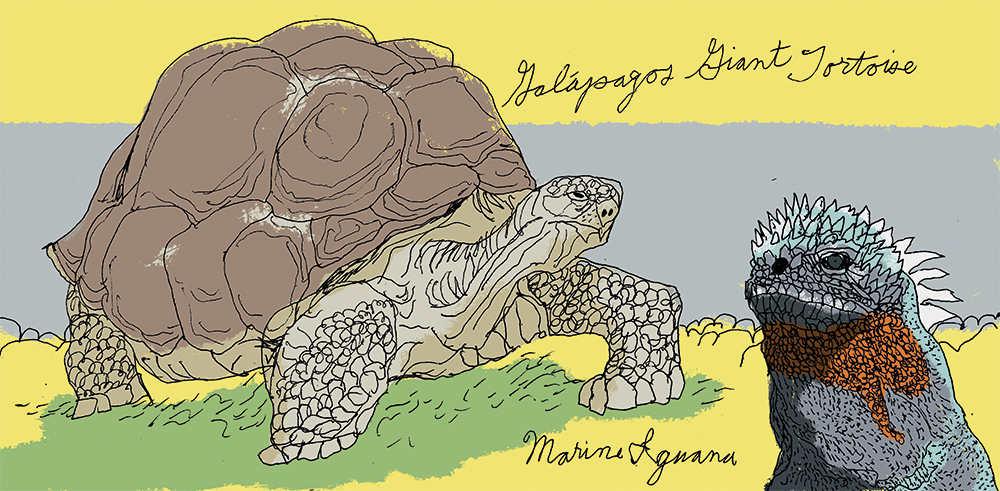
    It is almost 500 years since the accidental discovery of these islands by Tomás de Berlanga in 1535. Berlanga was the bishop of Panama and he was tasked with travelling to Peru to mediate a dispute between Francisco Pizarro and the Spanish Crown. Midway through his journey, wild winds knocked him off course and he drifted towards an unknown island. Berlanga and his crew arrived cotton-mouthed, so parched they began to drink cactus water. Soon, they came across giant tortoises, sea lions and marine iguanas. “Like serpents!” Berlanga wrote to the Spanish king, describing his surreal encounter. “And so silly they don’t know how to flee.”

    Three centuries later, in 1835, a 22-year-old naturalist named Charles Darwin sailed to the islands on HMS Beagle after completing a surveying mission of the South American coast. He was fascinated by the volcanic nature of the islands but, like Berlanga, was hardly enamored. “Nothing could be less inviting than the first appearance,” he recorded. But during his five weeks on the islands, living among fluttering finches and prickly pear cacti, Darwin’s theories of evolution began to take shape. In 1859, On the Origin of Species was published: we know it as the foundation of evolutionary biology.

    I confess that I, too, was guilty of judging the islands too quickly. On first glance, many of them – with their harsh, rugged and sun-scorched terrain – can seem uninviting, even post-apocalyptic. But the magic of these islands is that once you get closer, a whole spectacle begins.

    A trip to the Galápagos is, of course, a far more curated and bureaucratic affair than what would have taken place in Berlanga and Darwin’s day. The archipelago is a UNESCO World Heritage site and national park, so it is subject to strict conservation laws. The Ecuadorian government, along with various international organizations, works tirelessly to protect this fragile ecosystem, particularly as tourism increases.

    Visitors must: obtain a transit control card, travel with an authorized guide, stay on marked trails and never feed or touch the animals. “Please do not touch the sea lions!” the guides – long-suffering but commendably patient – repeated, even as the sea lions, coquettish as ever with their cartoonish eyes, wobbled up to our ankles. It often felt like the wildlife had more freedom on these islands than we did.

    [Eric Hanson]

    Our voyage on yacht La Pinta looped east from Baltra to Santa Fé and San Cristóbal before swerving south to Española and Punta Suárez. As we boarded the dinghy to reach the islands themselves, a fleet of frigatebirds – known as the “pirates” of the sky – heralded our arrival, slicing through the wind with their black plumage and forked tails. A trip to the Galápagos Islands is pure theater. Each island is a different stage; each animal plays a different part. Visitors merely sit back and watch the show.

    The overture began on South Plaza, one of the smallest islands in the archipelago, known for its fiery red carpetweed. It changes to purple, green and orange as the seasons shift. Creeping through the color were dinosaur-like marine iguanas, a remarkable example of natural selection and the only seafaring lizard in the world. South Plaza is also the place to spot the rare marine-land hybrid iguana, a mishmash of species with distinctive black coloring and long yellow stripes believed to be able to survive in both marine and terrestrial environments.

    Next came Santa Fé (or Barrington) Island, one of the oldest in the archipelago. Unlike its neighbors, its formation stems from geological uplift rather than a volcanic eruption, creating a relatively flat terrain punctuated with prickly pear forests and crab-covered rocks. The island teemed with endemic species: the Santa Fé land iguana, Darwin’s finches, Galápagos hawks and swallow-tailed gulls, whose red-rimmed eyes made them look as though they hadn’t slept since 1535.

    The stars of the show – and boy did they know it – were the sea lions, who sprawled across the rocks like Titian’s “Venus of Urbino.” If they weren’t basking in the sun they were lolloping onshore, flapping their fins like quarreling siblings and barking with an emphysemic honk. They showed no fear and were consummate performers. Thespians of the highest pedigree.

    The easternmost island is San Cristóbal, which is composed of extinct volcanoes and lava fields. Darwin noted the remarkable tameness of the animals during his visit – and so did we. As we wound our way up a trail, it felt like the show’s crescendo had begun when we finally glimpsed the comical feet of a blue-footed booby. “Look! Love is in the air,” Pancho, our peppy, silver-haired naturalist exclaimed. A male frigatebird was just ahead of the booby, inflating his bright red throat pouch as if it were a whoopee cushion. Pancho explained that once puffed up – a process that can take half an hour –  the males begin their mating call: shaking their wings, swaying their heads and drumming their bills on the pouch. Females hover above, judging the performance. “It’s a crazy time to be in the Galápagos,” Pancho grinned. “This is one of the best mating rituals to see.” It was 95 degrees and not yet 10 a.m., but for these frigatebirds, the action had begun.

    Our curtain call came on Española Island, the southernmost point in the archipelago and the primary nesting site for the world’s entire population of waved albatrosses. Here we found “Christmas iguanas” – marine iguanas colored festive red and green – and colonies of wheeling, squawking seabirds. On the return from the trail, we paused to look at a Galápagos hawk’s nest: the apex predator of the islands. “Nature is full of surprises!” Pancho beamed once more, explaining that the female hawk mates with multiple males, leaving paternity an open question – the Mamma Mia! of the bird world.

    The trip felt like one big open-air opera. Berlanga and Darwin may have escaped the constraints of modern-day tourism, but the wildness they encountered here remains unchanged by time. This is nature in its purest form: unscripted, unfiltered, unchained.

    Saffron visited Ecuador and the Galápagos lslands with Metropolitan Touring. Yacht La Pinta offers four- and six-night itineraries around the islands with luxury cabins starting from US $5,870.

    This article was originally published in The Spectator’s October 13, 2025 World edition.

  • Why I hate Paris

    Why I hate Paris

    It smells, very badly. And even after decades of complaints, it seems Parisians still consider themselves too chic to pick up after their dogs. Taxis are a nightmare. The traffic makes central London seem like a village in Ireland. Uber drivers park as far away as possible from the designated pick-up point, fail to answer messages or calls, then charge a fortune in waiting time.

    The expense is phenomenal. For three coffees, one mint tea and a croissant that had the texture of a carpet slipper, I was charged more than £30 ($40). And don’t get me started on the coffee: if Paris is the home of café culture, shouldn’t it also be that of good coffee? Wrong! It usually tastes like recycled dishwater, or as if it’s been dredged from the bottom of the Seine. It must be bad if it leaves me hankering after a Nespresso. I asked a Parisian (who I know, and who is less defensive than many of his compatriots) why it is so bad. He replied, “Because Parisians don’t go to cafes to drink coffee, but to socialize, read the paper and watch the world go by.”

    Oh, I see! Because in other capital cities, we go into windowless booths, are served the good stuff, and leave after slugging it back without speaking a word to another soul? This arrogance about the unique, cultured “Parisian experience” drives me mad. Another example of this refusal to take criticism can be found in many travel guides: “When people hate Paris, it’s usually that they want to travel, but they want everything to be just like home at the same time,” goes the excuse.

    When visitors to London say they hate the city, most Londoners will respond with a sympathetic “I don’t blame you” or “I can see why.” I am a huge fan of my city, but this doesn’t blind me to its faults.

    This is more than can be said of Parisians. Mention the rude waiters and bartenders, and you will be told in no uncertain terms that this is “just their style.” Really? When I ask for something very simple, in straightforwardly accurate French – say, a glass of red wine – why do I have to be met with a blank look before the waiter switches to English in an unfriendly and dismissive manner, leaving me feeling embarrassed and reluctant to speak French again?

    Despite being recommended up the wazoo in food guides, and by locals, most of the restaurants are mediocre or bad. They often give the impression that you, the customer, are bothersome, and should be very grateful to have a table, despite the ridiculous prices. If you don’t believe me, try asking for a second napkin – then resist the temptation, following the response from the waiter, to get up, cross the room and find one yourself.

    God knows, Italians can be rude, too. But it seems they do it for their own amusement, and it doesn’t feel malevolent at all. However, even the French hate Parisians – possibly because of how dangerous and scary some of the central areas have become in the past decade or so. As I stepped off the train last week, I felt surrounded by groups and pairs of men, all hanging around looking for tourists, and – given that they weren’t offering cab rides or accommodation – I can only assume they were there for the pickpocketing.

    The streets stink of urine, and the place is absolutely filthy, including the Métro – way worse than anything you’ve seen on the Underground in London, which is an achievement in and of itself. Locals must drop rubbish, because I have never seen as much trash on the pavement, despite the proliferation of rubbish bins in the city. I asked about this at my hotel, only to be told petulantly: “London has trash too!”

    Feted in the movies and in literature, Paris has a reputation for being the most romantic city on the planet. I think this only adds to the bitter disappointment many experience when they visit. It’s high time that reputation, built on sand, was finally demolished.

    Yes, there are some impressive sights, such as Montmartre and the panoramic views from the Sacré-Cœur – but up close many of those tall, impressive-at-a-distance buildings are grubby, held up by decaying cement and stone. Mildew oozes from cracks, there’s rust on the banisters and used condoms everywhere, from all the prostitution sex that happens in grubby alleyways across the city. In short, there are far nicer cities in Europe, where you will very likely get a far better cup of coffee.