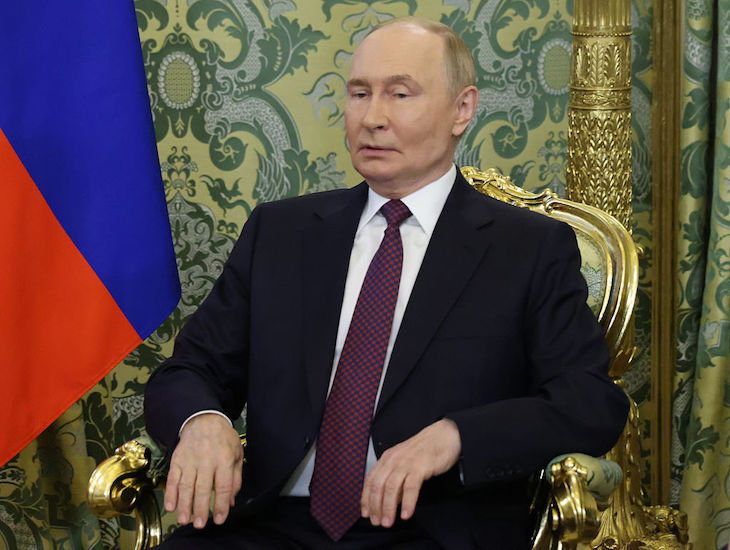
Over 1,265 days of full-scale war, Volodymyr Zelensky has delivered almost as many nightly addresses to the nation. Only a handful have been truly decisive. There was one just hours before the invasion when he asked, “Do the Russians want war?” and vowed that Ukraine would defend itself. The next day, standing outside his office in Kyiv with his top officials, he told the world: “I’m here. We’re all here.” And last weekend, when he declared that Ukraine would not surrender its land to the occupier – and that the war must end with a just peace:
“[Putin’s] only card is the ability to kill, and he is trying to sell the cessation of killings at the highest possible price. It is important that this does not mislead anyone. What is needed is not a pause in the killings, but a real, lasting peace. Not a ceasefire sometime in the future – months from now – but immediately. President Trump told me so, and I fully support it.”
Zelensky has felt blindsided by Donald Trump’s decision to meet Vladimir Putin in Alaska this Friday to discuss Ukraine’s fate without Ukraine present. Putin has reportedly proposed a ceasefire – not an end to the war, but a temporary halt ahead of the next stage of talks – in exchange for Ukrainian territory. Ukrainian forces would have to withdraw from the entirety of the Donetsk region, leaving the 2,500 square miles – about a quarter of the region – that they still hold.
This includes fortress cities such as Pokrovsk, Kramatorsk and Sloviansk, the strongholds Russia can’t seize quickly. The Institute for the Study of War notes that while the Russian push towards Pokrovsk has picked up speed in recent weeks, Moscow has spent the last 18 months fighting for an area of just ten square miles. It took 26 months for Russian forces to advance seven miles from western Bakhmut to western Chasiv Yar. This battle began in April last year and ended only last week, with Russia bearing immense losses. Since January only, Putin has lost 100,000 troops, according to Nato chief Mark Rutte.
Accepting Putin’s offer would strip Ukraine of its main defensive line at the western edge of the Donetsk region, which it has fortified since 2014, leaving only open fields all the way to the Dnipro river. That is why Zelensky insists that any discussion of territory can only happen after the guns fall silent. The idea of Russia pulling back from parts of the Kherson and Zaporizhzhia regions in exchange for Donbas has been floated before, and this land swap could be agreed de facto but not de jure. But even that seems to be a fantasy at the moment, given that Putin will not give up his land corridor to Crimea, and Zelensky will not hand over hundreds of thousands of Ukrainians still living in the part of the Donetsk region under Kyiv’s control – people who oppose their homes being ceded to Russia.
Zelensky insists that any discussion of territory can only happen after the guns fall silent
Kyiv’s stance was backed this week in a joint statement by European leaders, whom Zelensky has been calling to forge a united negotiating position to present to Trump before Alaska. “Meaningful negotiations can only take place in the context of a ceasefire or reduction of hostilities,” it read. “We remain committed to the principle that international borders must not be changed by force. The current line of contact should be the starting point of negotiations.”
With Europe behind him, Zelensky tried to appeal to Trump on Saturday. In his speech, Zelensky reminded the American president that Ukraine had backed all of Trump’s earlier proposals, including an unconditional ceasefire and talks with the Russians in Istanbul, even while Moscow stalled and bombed Ukrainian cities. No one, Zelensky said, doubts America’s power to end the war. The mere threat of secondary sanctions on Russia and its allies had been enough to drag Putin out of his bunker and into negotiations. “The President of the United States has the leverage and the determination,” Zelensky said, leaving hanging the question of why Trump is not using them.
Ukrainians have seen where appeasing an aggressor leads. Putin was allowed to take Crimea, and that led to the occupation of parts of the Donetsk and Luhansk regions. No punishment followed when he massed over 100,000 troops on Ukraine’s borders – and that led to the full-scale war, further occupation and hundreds of thousands of deaths.
“Putin wants to exchange a pause in the war, in the killings, for the legalization of the occupation of our land,” Zelensky warned. “We will not allow this second attempt to partition Ukraine. Knowing Russia, where there is a second, there will be a third. That is why we stand firm on clear Ukrainian positions.”
Finally, Zelensky turned to the Ukrainian people, many of whom were protesting outside his office just two weeks ago after the government attacked anti-corruption agencies, to thank them for standing with him. A new poll from the Kyiv International Institute of Sociology shows 76 per cent strongly oppose Russia’s proposed peace deal. If even half were in favour of peace at any price, Zelensky might have been tempted to respond differently to Putin’s offer. But as Ukrainians are afraid that without cast-iron security guarantees, Russia will start the war again, they expect their president to fight for a lasting peace.
“Independence is built on dignity,” Zelensky said. “Fear and concessions do not make nations safe. Russia’s desire to rule over Ukrainian territory will remain just that – a desire – for as long as Ukrainians stand shoulder to shoulder, helping the army and the state.”
Freddy Gray: Candace is being sued or threatened with legal action by the Macrons, Emmanuel and Brigitte Macron, the President and First Lady of France. Because, Candace, you believe that Brigitte Macron is a man. Why do you think the Macrons are choosing to sue you?
Candace Owens: Because they were trying to stop the story. I think it was an effective PR strategy. They had been suing and harassing the journalists that had initially brought this story forth to the French public for years, and then they lost their defamation suit against the two journalists, Amandine Roy, Natasha Roy. And that was pretty explosive news. So I think that they then filed suit against me and knowing that it would drive potentially the most media traffic to kind of say, “Oh no, but it still isn’t true at all. I know we lost this defamation case in our home turf, but we’re now going to try it in America,” just to kind of signal to the press that they’re not lying.
FG: If you wanted the story to go away, this is not a very sensible strategy.
CO: Yeah, actually if you look at the history of them as a couple, they haven’t been very good at PR… I do think it was poor advice. I think their advisors made the wrong decision, and we saw this even recently, the disaster of their PR when Brigitte was caught assaulting Macron on the plane. I mean, they lied, they forcefully lied, and then they essentially disappeared. The story the very next day from the French press. So they’re used to having that kind of power.
FG: It’s that clip that makes me think you’re wrong, because I’m pretty sure she punches like a girl. I mean, men don’t hit like that.
How did the theory start?
CO: The Daily Mailran a headline, and Emmanuel Macron was on camera saying it’s not true, and freaking out about these rumors and saying how hurtful they were. And I thought that was odd. I said, “What could possibly be going on in France that the President is having to lower himself to respond to such a ridiculous rumor?” And when I was reading this article, I was sort of interested in the dog that wasn’t barking, which is that the Daily Mail didn’t do a good job of instantly debunking it. Obviously, tons of photos could debunk this… It wasn’t a deep internet web conspiracy. It was actually French journalists that were on the left who loved Brigitte Macron and wanted to celebrate her by doing their due diligence and telling the story of Brigitte Macron. These were feminists… They felt that they were being threatened by the Élysée Palace. They were asking basic questions, asking for pictures and feeling like they had done something wrong. And they were essentially being told that the only person that could get them what they were looking for was a woman named Mimi Marchand, who at that moment was running communications for the Macron couple. Mimi Marchand has since been charged with forging documents… So it was very organic how this story took off in France. People just trying to figure out like, hey, can we get some photos of you? There’s 30 years of your life that seem to be missing?
FG: It is definitely strange that nobody seems to be able to find a lot of evidence about Brigitte Macron’s upbringing. But what occurs to me – I’ve watched the series – I know the journalist you speak to, Xavier Poussard. He uses a facial recognition app to say that these images of Brigitte Macron’s brother must be her. There’s a sort of 80 percent likelihood. That strikes me as not necessarily reliable, and also the fact that, you know, siblings can look very, very alike. So the fact that Brigitte Macron’s brother looks a lot like her is not quite that surprising, is it?
CO: No, it’s not surprising at all. And you’re correct. This is not a 100 percent technology… What’s more compelling is that this brother of hers is missing. At this point you would have to have a terrible relationship with your brother if you wouldn’t just come out before you had to sue anyone and say, “Hi, it’s me, I’m Jean Trogneux. I love my sister very much. I’m a private person, but this is getting ridiculous.” Or even her children, right? Her children could release photos of them being raised by her growing up. But I don’t care how angry you are at your parents, at a certain level, you’d go, “Guys, this is getting ridiculous. Here’s me and my mom.” We’re just like, hey, 30 years of your life is missing. It’s getting a little uncomfortable with how many people in your orbit have been arrested for pedophilia. You’ve lied – objective lies – you told the press at the beginning of your relationship. Don’t forget, when he first ran for president, the public told the media he was 17. Now we’ve got them down to 15. And the truth is that he was actually 14 when he was in that play where she says she saw him perform. But it’s not helping the media story that they lie. From the very beginning they presented it as if Brigitte was this really irresistible, sexy teacher, when when they actually got evidence of what she looked like when she was teaching Macron. She looks homely. It’s definitely not a very attractive teacher that was wearing skirts. It looks like a male that’s in the middle of a transition, to be honest with you.
FG: I’ve listened to what Xavier and you said about that. And it does sound a bit like Xavier was sort of just angry at the media for the way that they manicured her image. But that’s what happens with powerful and important people. Their images are always being manicured, and often they manicure themselves.
CO: Which is totally fine. It’s every piece of the Brigitte Macron story that has required so many lies. And yeah, they they did that, perhaps because they didn’t want people to realize that something really strange happened at that school. And it doesn’t help that when Emmanuel Macron entered office, they got to work trying to lower the age of consent to 13. It doesn’t help that Emmanuel Macron’s mother worked in her career assisting transgendered people in getting identities. The person that’s dressing Brigitte Macron that works with LVMH and Louis Vuitton specializes in androgynous dressing, trans people and of getting models that are trans. There’s so many other elements that are just peculiar. I want people to also know that before we published the first episode, we were in touch with Brigitte’s team. We said, “Look, we’re not interested in spreading conspiracies. Answer these basic questions. Could you produce some photos of your living for 30 years? Did you live as Jean-Michel? Have you ever lived as a person named Veronique?” And they forcefully declined to answer any of those questions.
French pedophilia?
FG: I think you’re sort of insinuating that the real scandal behind this is a kind of pedophilic elite in France.
CO: I believe that’s been a problem that’s happened in Paris for a very long time.
Owens mentioned Sigmund Freud, Richard Duhamel, Richard Trumbull, Eric Moretti and André Gide as examples of French pedophilia.
FG: Well, like me, you’re a Catholic. You’re a recent convert to Catholicism. And I know from my French Catholic family that there is this obsessive hatred in France of the French government and the secular French government and the French left, and this assumption that they are satanic somehow or Satanic driven. Is that something you think you’ve latched on to?
CO: Well, no, I was not aware of French politics. I got into this quite organically. I don’t follow French politics. I don’t speak French… The idea that there are is an orbit of people who could commit crimes and then have the audacity to sue people for writing books or sue people that are talking about it. It offends me. It offends my senses as a Christian and as a mother. And I felt that it was very important for the world to kind of look and go, what’s going on in France? … It definitely wasn’t driven by some idea of a satanic panic happening in France.
Trump tells Candace to stop saying Brigitte is a man
FG: The Donald Trump story. He leant on you himself to stop talking about the Brigitte Macron story.
CO: Yeah. Back in February, Macron was in the White House ostensibly to discuss Russia and Ukraine. I was contacted by the White House and told that he took Trump to the side and wanted me to stop talking about Brigitte. And the person who relayed this to me before Trump called me the next day, said that it was a contingency on the Ukraine-Russia conversation, which is ridiculous. When Trump called me the next day. He basically said he was very surprised. But Macron took him aside and asked if he could get me to stop talking about Brigitte. I said to him that I would not speak about Brigitte for a few months while he was looking for a signature on some document pertaining to the EU. But then certainly, of course, I would speak about it months later, which is exactly what I did.
The Candace-Trump fallout
FG: You were a keen supporter. He was a fan of you. And then it seems you’ve completely fallen out and largely over Gaza. Am I correct in saying that?
CO: You are correct in saying that. What’s happening in Gaza, to me is just a moment of are you a human? Are you not a human? And also the Epstein fumble as well – the gaslighting of the Epstein case. To effectively gaslight your supporters and say, why? Why are we still talking about Jeffrey Epstein? What do you mean, why aren’t we still talking about Jeffrey Epstein if there’s been a blackmail ring, and politicians are supporting things because they have been blackmailed. I’ve been very disappointed in him.
FG: The Wall Street Journal is reporting that he’s in the files that he sent this card, this bawdy card, to Jeffrey at birthday card to Jeffrey Epstein.
CO: I don’t buy the birthday card because Trump immediately came out and said, this is not true and sued. In May when Pam Bondi sat down for a meeting and said, you’re actually in these files, he never debunked that. Do I believe that Donald Trump was on Epstein Island? No. Do we know that he parted with Epstein in his youth? Yes, we know that… The bigger point is that he he could have come to his supporters and said, “look, I’m very surprised to hear this. I have nothing to do with anything that happened on that island.” He could have gotten ahead of it. When you choose to gaslight the public, you have become exactly what you knew that we hated when we sent you into DC.
Do you ever think you’re a conspiracy theorist, Candace?
FG: Do you ever feel that you’ve maybe taken crazy pills and you’ve become a conspiracy theorist?
CO: Absolutely not. The Macron story is one of the most fascinating stories ever. And in a sane world, I would be given a Pulitzer.
Owens responds to accusations of being anti-Semitic
FG: There’s a lot of suspicion of you that you have gone from that criticism of Israel into full-on Jew-hatred. How do you respond to that allegation of anti-Semitism?
CO: It’s nonsense to say that I have hatred for Jews. I worked for Prager University. It is a literal Zionist enterprise that is run by an IDF intelligence. I then worked for the Daily Wire, which is run by Ben Shapiro. Prior to that, I worked in private equity for two Jews in New York for four years. And I almost married a Jew, actually, while I was in New York… I’m the same girl who stood up to Black Lives Matter. I don’t care about your identity. I know when people are calling people racist because they are trying to stop the conversation. They said, “You’re a self-hating black.” I know exactly what’s happening when you start using your identity as a shield, and it just doesn’t work with me. What’s happening in Gaza is atrocious.
FG: Well, you married a self-hating Brit instead. Not self-hating, sorry. I meant to say you married a Brit. Let me say that again. I don’t know whether your husband’s self-hating. I’m self-hating.
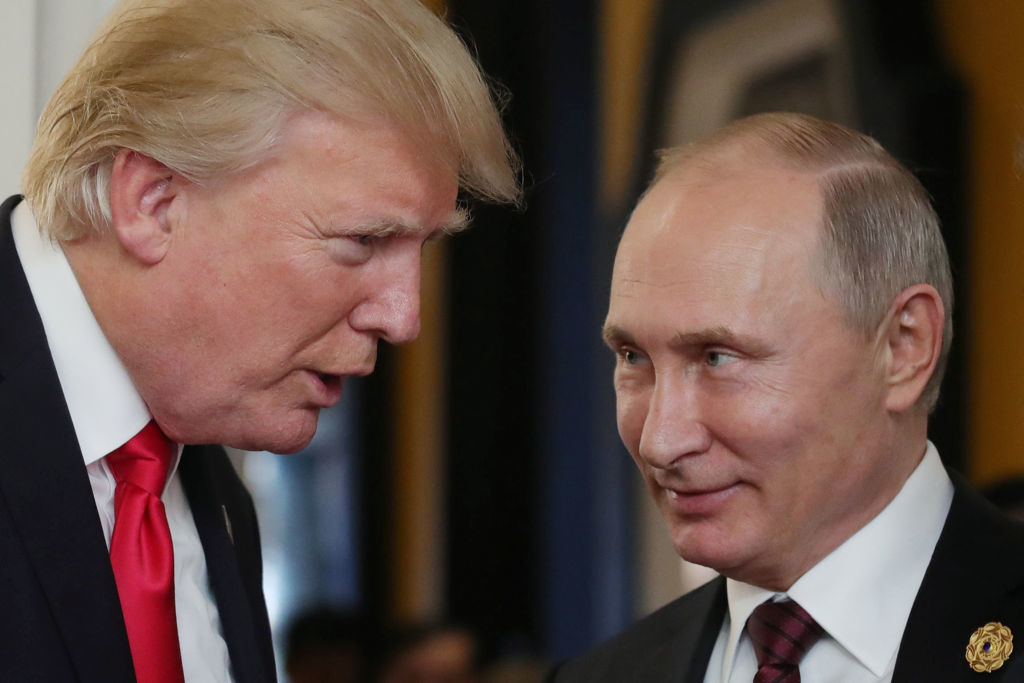
Already the Kremlin is setting the terms of the forthcoming summit between Donald Trump and Vladimir Putin. Steve Witkoff, Trump’s emissary, set the meeting in motion with his mission to Moscow on Wednesday, which Trump called “highly productive.” But productive of what?
Putin’s foreign-policy adviser Yuri Ushakov stated today that it was the White House, not the Kremlin, that wanted the meeting. He went on to dismiss Trump’s proposal that Ukrainian President Volodymyr Zelensky could take part in a tripartite negotiation, noting that “for this to happen, certain conditions must be created. Unfortunately, such conditions are far away yet.” Those conditions remain the complete surrender of Ukraine.
The Kremlin, in other words, has a strategic plan. Trump, as the columnist Christoph von Marschall observes in the Berlin Tagesspiegel, does not. Instead, he is being successfully manipulated by Putin. The dangerous bromance is back.
Trump’s fondness for Putin and antipathy toward Ukraine is longstanding. Trump was vexed by Ukraine during his first presidency, and he continues to be in his second. He became enraged by Zelensky during his first term, when he asked the Ukrainian for a favor that had a disfavorable outcome, namely impeachment proceedings. After Russia invaded Ukraine in February 2022, Trump hailed Putin as a genius and dumped on Zelensky. In his second term, Trump has continued to badger Zelensky and laud Putin, only to exhibit tepid signs of irritation with Putin after he balked at the US’s peace efforts and upped his heinous bombings of Ukrainian cities, launching a very real version of fire and fury. Suddenly Trump, who was warned by Melania that Putin was making a patsy of him, observed that maybe he was being “tapped along.”
After proclaiming that he could end the war in a mere 24 hours, Trump wants to deliver the appearance, if not the substance, of an end to the conflict. Putin has shrewdly refrained from attacking Trump personally or condemning the president’s secondary sanctions on Russia. Putin’s track record in beguiling Trump, who appears to admire the Russian dictator, is a good one. In Helsinki, in July 2018, Trump publicly vouched for Putin’s bona fides, saying that he was sure the Russian had not interfered in the presidential election.
Putin’s aspiration is one that the elite around him has long shared – to be treated as co-equal superpower with America, much as the Soviet Union was during the Cold War, when each side had its sphere of influence and Moscow was free to carve up Central and Eastern Europe. For Trump, who views NATO as more of an encumbrance than an asset, the chance to cut a deal with Putin is an alluring one. But he also cannot completely ignore hawks inside his administration, such as General Keith Kellogg, Trump’s special envoy for Ukraine, as well as a contingent of Senate Republicans, led by Mitch McConnell and Lindsey Graham, who view Putin with alarm. Hence Trump’s Ukraine tergiversations over the past several months.
For now, Trump is breathing optimism about his upcoming meeting, proclaiming in his press conference yesterday that there is a “very good chance that we could be ending…the end of that road.” Zelensky, by contrast, is sounding a more sober note: “The key is to ensure they don’t deceive anyone in the details – neither us nor the United States.” Here’s hoping.
A bleached white conference room, somewhere near Jeddah in Saudi Arabia. On one side sits Volodymyr Zelensky, the Ukrainian leader, in his soldier-boy outfit. On the other, Russian President Vladimir Putin in dark suit and tie. And in the middle, a beaming President Donald J. Trump. “People said this could never happen,” he says, as Zelensky and Putin stare awkwardly at the floor. “But it’s a beautiful thing.” A White House memo lands in inboxes across the world: “THE PEACEMAKER-IN-CHIEF…”
Pure fantasy, perhaps, but Trump does have an almost cosmic ability to get what he wants – and he really wants to end the war in Ukraine.
Last night, having spent weeks telling the world how “disappointed” he was with Putin, Trump abruptly announced “great progress” in US-Russia dialogue. His special envoy, Steve Witkoff, had just spent several hours talking to Putin in Moscow, and it promptly emerged that Trump and Putin could meet as early as next week for a preliminary sit-down ahead of a possible three-way session between Trump, Putin and Zelensky. Putin and Trump have not met since their infamous encounter in Helsinki in 2018 and, then as now, European leaders will be very nervous about the two men getting on. On the other hand, as Trump has always said, he just wants “people to stop dying.” And if he can achieve a meaningful peace deal in Ukraine, he should perhaps be rewarded with the Nobel Peace Prize that everyone says he craves.
Call it the psychodrama – not madman – theory of international relations. The personal is political and, as we’ve seen with Kim Jong-un, Emmanuel Macron, Zelensky and now Putin, Trump likes falling out and making up with world leaders. It makes for great headlines, plus the emotional rollercoaster helps advance his agenda because statesmen have to worry about what’s in the news.
The difficulty is that Putin is an exceptionally cold fish who doesn’t care about being hated outside of Mother Russia. The reason earlier peace initiatives failed is that Putin is not losing the war. Putin could “tap,” as Trump put it, America along because, having largely frozen Russia out of the international community, the West doesn’t have much clout over him.
Trump understands the concept of leverage, which is why last month he agreed to provide new arms to Ukraine. That didn’t seem to intimidate Russia, so Trump also targeted India, the leading buyer of Russian seaborne crude oil, with punishment tariffs. And he ostentatiously dispatched two nuclear submarines towards Russia at the weekend.
The India tariffs, in particular, appear to have brought the Kremlin back towards the peace table. But who is playing whom? It’s possible that Putin believes Trump’s trade aggression is pushing America’s rivals closer together, which is very much in Russia’s interest. The Kremlin has long believed that America’s hegemony is waning and that, while Trump’s theatrics might dazzle the world, in the long run the BRICS (Brazil, Russia, India, China and South Africa) are in the ascendancy. India’s Prime Minister Narendra Modi, for instance, shows no sign of breaking off trade relations with Russia in the face of Trump’s threats.
“IT’S MIDNIGHT!!!” Trump barked on Truth Social at 11:58 p.m. ET last night, as his latest tariff program kicked into effect. “BILLIONS OF DOLLARS IN TARIFFS ARE NOW FLOWING INTO THE UNITED STATES OF AMERICA!”
If only things were that simple. It’s no coincidence that Trump’s most punitive duties are now being imposed on India, Brazil and South Africa (the China and Russia tariff deadlines are upcoming). The White House believes that America still has enough financial muscle to disrupt the BRICS and play them off against each other.
But, similar to Canada and Europe, the BRICS countries regard America as an increasingly unreliable mercantile power. The biggest downside to Trump’s tariffs, then, may turn out to be geo-strategic rather than economic – as a brave, new multipolar world increasingly tries to get along without America. Politics is personal. And the psychodrama is exhausting, after all.
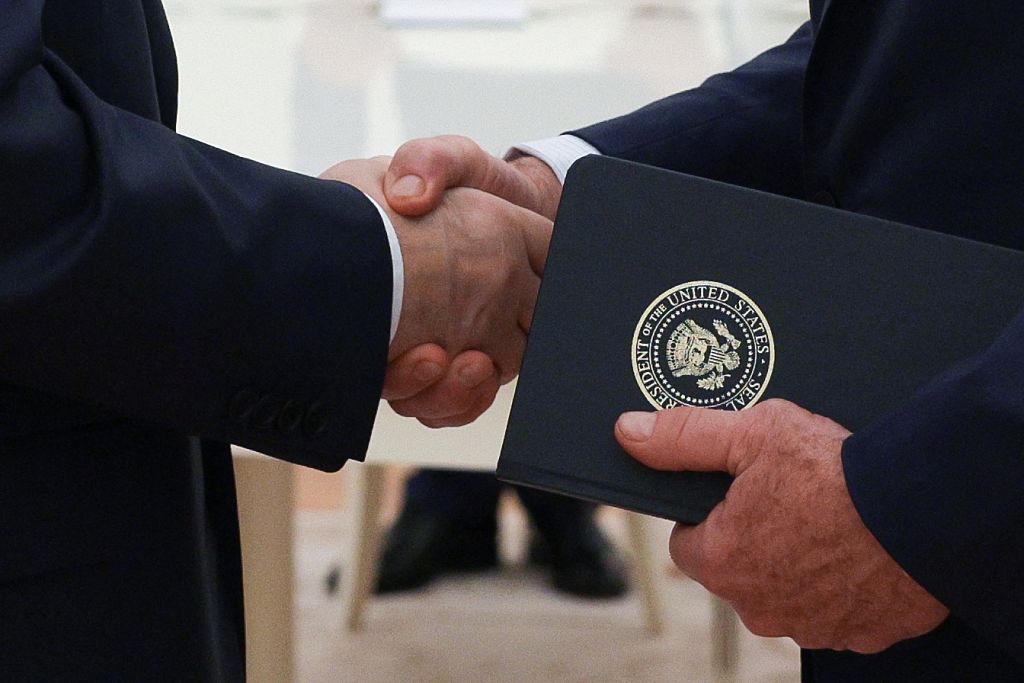
With just a day to go until the expiry of his ultimatum to Vladimir Putin to halt the war on Ukraine or face dire consequences, Donald Trump has once more reset the clock. Trump intends to meet in person with President Vladimir Putin of Russia as soon as next week, the New York Timeshas reported. That summit will be followed by a second, trilateral meeting including Trump, Putin and President Volodymyr Zelensky of Ukraine, Trump reportedly told top European leaders in a conference call on Wednesday night.
The announcement came after Trump’s envoy, real state developer Steve Witkoff, met Putin for three hours of talks at the Kremlin. Trump wrote on social media that he had “updated some of our European Allies” about the Witkoff talks. “Everyone agrees this War must come to a close, and we will work towards that in the days and weeks to come.”
A week before, Trump had professed himself “disappointed” with Putin’s continuous broken promises and moved up a previous 50-day deadline for the Kremlin to cease fire to just eight days – an ultimatum due to expire this Friday. And just hours before he hinted that he was ready for direct talks with Putin, Trump followed through on a threat to impose secondary sanctions on countries which imported Russian oil. “India… doesn’t care how many people in Ukraine are being killed by the Russian War Machine,” Trump said before announcing a 25 per cent tariff on Indian exports to the US due to begin in 21 days. Whether Trump will now actually impose those tariffs in light of his new plan to open talks with Putin is unclear.
Trump has offered a quick route to the end of the war. The bad news is that it’s likely to be on Putin’s terms.
Trump, famously, considers himself a master of the art of the deal. He favours high-profile, face-to-face summit meetings with world leaders, whether friend or foe. In 2018 he met Putin in Helsinki for a long meeting that cosplayed the high-stakes summits between Ronald Reagan and Mikhail Gorbachev that laid the groundwork for the end of the Cold War. But no deals resulted from that Trump-Putin summit, despite the fact that Putin was at the time already illegally occupying Crimea and his proxies controlled parts of eastern Ukraine. Instead, the main soundbite was Trump appearing to side with Putin over his own intelligence establishment on the subject of Russian interference in the 2016 US elections.
“No prior president has ever abased himself more abjectly before a tyrant,” wrote the late Republican Senator John McCain, decrying Trump’s toadying to Putin as a “disgraceful performance”.
This time, the stakes for a Trump-Putin summit will be much higher. People are dying every day, Russian troops are relentlessly advancing, and Ukraine faces critical shortages of air defence missiles and military manpower. Trump has repeatedly vowed to bring an end to the conflict in Ukraine, and has made several threats to impose devastating sanctions on Moscow’s oil and gas clients if Putin does not comply. The pressure will be on for Trump to actually persuade, cajole or force Putin to stop his air and ground offensives in Ukraine.
It’s significant that Europe will be completely sidelined from the proposed talks. Clearly, Trump expects to present whatever he agrees with Putin to the rest of the world as a fait accompli.
But in one important sense, direct talks between Washington and Moscow will break a deadlock. Putin has resisted being seen to bow before US pressure. At the same time, the full-scale sanctions threatened by Trump would wreak chaos on the world economy by removing the 10 per cent of the world’s oil supply provided by Russia from markets, sending energy prices spiralling. The result of this standoff has been a near-farcical game where Putin pretended to negotiate while Trump pretended to assemble a formidable battery of imaginary sanctions.
That phase of phoney negotiations will soon be over. The next question is what incentive Putin will have to end a war that he believes that he is winning. Russian forces appear to be accelerating their encirclement of the strategic railhead of Pokrovsk in Donbas and are advancing towards Kharkiv. At the same time political unrest in Kyiv is growing, both over Zelensky’s disastrously misguided attempt to bring anticorruption agencies under his control as well as the forced conscription of men into Ukraine’s severely depleted army. Desertions of Ukrainian troops from the front line are, reportedly, soaring. Head of Ukrainian Military Intelligence General Kyrylo Budanov has warned that the country could face a military collapse this summer. Putin can be forgiven for believing that time is on his side.
The stark answer to what Putin wants is that he is not fighting for land but rather is fighting to subordinate Ukraine and, as he sees it, prevent it from becoming a threatening Western proxy. That’s importantly different to destroying Ukraine, occupying Ukraine, exterminating all Ukrainians, or other hysterical assessments of the Kremlin’s intentions.
But Putin has been very clear from the start of hostilities that he will not countenance Ukraine as a member of Nato. He also demands limits on the Ukrainian military and the restoration of rights to Russian language speakers and adherents of the Moscow-loyal party of the Ukrainian Orthodox Church. Most importantly, Putin wants regime change in Kyiv, which means the end of Zelensky – who is already six-and-a-half years into a five-year presidential term.
How many of Putin’s demands will Trump concede during their face-to-face negotiations? Many Ukrainians will ask what right Trump has to negotiate over their heads – exactly what President Joe Biden vowed never to do? Many Ukrainians fear that they are about to be sold down the river in a great power stitch-up reminiscent of the 1945 Yalta carve-up of post-war Europe.
“The war must end [but] it must be done honestly,” tweeted Zelensky on Wednesday after a conference call with Trump alongside other European leaders. “We all need a lasting and reliable peace. Russia must end the war that it itself started.”
Trump’s apparent answer to Europeans’ concerns has been to symbolically offer a follow-up trilateral meeting involving himself, Putin and Zelensky to give at least an illusion of Ukrainian participation.
That seems to be a recipe for disaster. Putin hates Zelensky for defying him and turning the short, victorious war he planned into a long and bloody quagmire. Zelensky hates Putin for massacring and abusing thousands of his people – as well as for sending murder squads to Kyiv with orders to murder him in the first days of the war. Zelensky and Trump had a cordial meeting in Rome at Pope Francis’ funeral – but the bad blood after Zelensky’s humiliation in the Oval Office in February persists. Meeting Zelensky would legitimise him as the leader of a sovereign Ukraine, which is anathema to Putin. In short, the meeting is as unlikely as it would be disastrous if it ever happened.
The good news is that in calling for direct talks with Putin, Trump has offered a quick route to the end of the war. The bad news is that it’s likely to be on Putin’s terms.
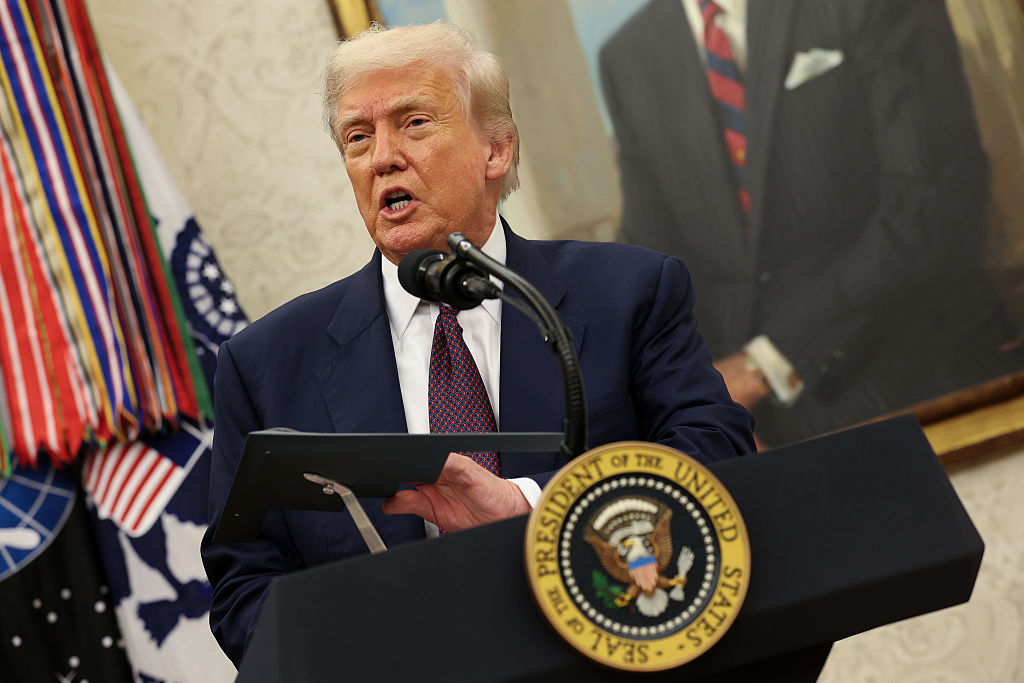
Donald Trump remains the master of political reality 200 days into his second term. His administration drives the headlines, not the other way around. Take the fracas that erupted over last week’s downward adjustment to the previous month’s employment numbers. Any other president would have been put immediately on the defensive, desperate to justify his performance to the whole country. Trump simply fired the chief of the Bureau of Labor Statistics – and all the headlines since then have been about the firing, not the numbers.
Not only is President Trump not a prisoner of the press, he’s not a prisoner to his own legacy. In his first term, Trump involved America in no new wars. Less than six months into his second term, he took America to war with Iran. This was what the non-interventionist wing of MAGA had feared most and had hoped against hope would never happen. And it was what those elements of the neocon-adjacent right that hadn’t abandoned the GOP with the rise of Trump had most ardently desired. Yet Trump defied the expectations of both sides: he started and promptly ended the war.
War with Iran isn’t supposed to be the kind of thing you can finish in two days. Once the conflict begins, its own logic takes over. Look at what happened when George W. Bush took America to war in Afghanistan and Iraq. Look how long it took for America to get out of Afghanistan and what little agency America had as Biden sounded the retreat. Even the mightiest nation doesn’t really run a war – the war runs you. Unless you’re Donald Trump: somehow, he did what couldn’t be done. There were headlines aplenty questioning whether Trump’s June 22 air strikes against Iranian nuclear facilities really accomplished their objective. But the headlines didn’t last long; Trump had moved on to other things, and the press could only follow.
If the ten years since he came down that escalator have been one long fight between Donald Trump and reality as we know it, reality is losing.
The story has been the same with Trump’s acrimonious breakup with the doge of DoGE, Elon Musk. It’s been the same with the Jeffrey Epstein scandal, which is the closest any story has come to capturing Trump in its gravitational pull. Just as the President turned the tables on vocal elements in his own base by bombing Iran, he defied his supporters by refusing to release the Epstein Files, alternately downplaying them entirely or claiming they’re a Democratic hoax concocted to besmirch him. The story hasn’t gone away, but its oxygen is dwindling, not least because influential voices in the elite media have deemed the story too appealing to right-wing populists. It must therefore be a “conspiracy theory,” like “Pizzagate” and QAnon.
The next big story that will test whether Trump is still the biggest story of all will be the economic consequences of his tariffs, which have now gone into effect on much of the world. The Great Recession was a story that dwarfed George W. Bush in his final year in office. Will an economic crash do the same to Trump at the start of his second term? Or will the doom conventional economists confidently predict from the trade war turn out to be as hallucinatory as the long war foreign-policy experts foresaw in Iran? Tariff panic broke out several times during the first 200 days – and every time, Trump prevailed, striking new trade deals advantageous to Americans while the stock market kept bouncing back.
Surely at some point gravity must triumph over the tightrope-walker. How long can reality be kept at bay? The global economy is bigger than any nation, let alone any man, president or not. The world is at war – the carnage in Gaza and Ukraine hasn’t yet stopped for Trump. Five years ago, a pandemic and race riots did dictate headlines Trump couldn’t overcome. This president can be cut down to size, however feeble his opposition presently appears to be. Then again, Trump’s setback five years ago only proved to be the prelude to his victory last year. If the ten years since he came down that escalator have been one long fight between Donald Trump and reality as we know it, reality is losing.
That says something remarkable about Trump, but it also says something about the rules of politics, economics, and foreign affairs as most educated persons understand them. Those rules simply do not exist, at least not in the form that has been taken for granted in respectable circles for the last 35 years. The world is a stranger, richer place than the politicians of the pre-Trump era dared to imagine – or most other Trump-era politicians dare to imagine even now. This doesn’t mean Trump’s next 200 days, or the 1,061 days his administration will have left after that, will be as easily dominated by the President as these first 200 have been. But if the last decade is any indication, the odds are in his favor.
Ann Coulter, an American author, lawyer and conservative media pundit, joined Freddy Gray on the Americano podcast last Friday to discuss why she backs the UK’s Reform party, why she supports Trump in his second term, what’s really going on with the Epstein files and more.
Here are some highlights from their conversation.
Why don’t politicians follow through on illegal immigration promises?
Ann Coulter:Americans have been voting not to give illegals benefits, to deport them, to make sure they can’t vote, for now almost half a century, and the politicians will never give it to us. That was what was so striking about Boris Johnson and Donald Trump. Oh my gosh, they really seemed to mean it. At least with Trump, every single rally for 18 months, the chant was, “build the wall,” the signs “build the wall,” their etchings “build the wall” and he gets it (the presidency). And he doesn’t build the wall.
Freddy Gray: What do you think is the real factor there? Is it the economy? Is it that businesses just have that way of pressuring? I mean, I think with what’s now called the Boris wave of the huge influx of immigration during Boris Johnson’s premiership, really, it was pressure from the Treasury to make sure that wages are suppressed because everyone was worried about Covid and so on. Is that the real driving factor?
AC: Well, there are at least two driving factors. For the Republicans, it’s the donors. They want the cheap labor, which it’s worth pointing out as the as the cliché goes, cheap labor is only cheap for the employer. It’s the middle class that are subsidizing the rich’s poor labor or cheap labor. They are nannies. They are cooks. They are, you know, farm workers because they accept massive amounts of welfare, which leads to the other special interest group supporting illegal immigration, and that’s the entire Democratic Party, because illegals are accepting so much social welfare. Which party do they vote for and their kids can vote in? I mean, now the number of anchor babies who are of voting age is probably 20 million.
On the future of the UK
FG: You’ve been spending some time with Reform. What do you like about them in particular?
FG: You think they will make good on their promises? Because quite often we see these parties, when they get into power, they can’t actually make good on.
AC: Yeah. To take two little examples, Boris Johnson and first-term Donald Trump. That was stunning. It’s been happening in the US for 20 years. It’s been a bigger issue for us, I think. And states, I mean, this was back in the early 70s. Texas voted to have no free public education for illegals, and the Supreme Court, very left wing, overturned it. And that’s when Justice Brennan, incidentally, made up the concept of anchor babies. The court never ruled on it. No legislature has passed it.
FG: Please explain what an anchor baby is.
AC: An illegal pregnant Mexican runs across the border and drops a baby. The baby is allegedly an American citizen. No court has ever found that. No legislature. It was just dropped in a footnote of this Justice Brennan opinion. Maybe that’s a side note, but it’s a big, big problem in some hospitals along the border. 80 percent of the babies born are born to illegal aliens. El Chapo. You’ve heard of him? The big, massive drug lord? When his wife got pregnant, she’d run across to San Diego and drop a baby. They’re all American citizens. I’ll just give you one more. I think it was Sinaloa cartel. The cartels are just monstrous. I don’t want to hear about, you know, Hamas throwing rocks and dropping a few bombs. The cartels are beheading people. They are beheading Americans. They are committing heinous, hideous crimes.
Ann’s disappointment with the first Trump administration
FG: I think it is fair to say you were disappointed, even fuming, about about the first Trump administration, which was funny because at one point you were pretty much the only American who supported him.
AC: Yes! Oh, before he got in, I was worried… I was still yelling at him for some things. I guess, it was like March. He wasn’t hiring the right people during the transition. That was a bad sign. It was February or March. I showed up in the Oval Office, and like I say, I never told anyone this, but he told people. I just stood at the resolute desk, haranguing him, hectoring him. I was not the first one to use the F- word, but once it got used… Well it was about, you’re not keeping your promises; you’re you’re not building the wall; you’ve done nothing on the wall; you’re only pushing for tax cuts. The moment when he got really angry, which I think really speaks in his favor, was when I said, “You’re governing like Jeb Bush.”
FG: The Big, Beautiful Bill upsets fiscal conservatives, but it does give a lot of money to the border. I think it’s probably a mixed bag for people of a conservative disposition. What would you say?
AC: Yes. I mean, overall, but I can’t blame Trump alone for this. It’s hard to cut anything. You know, a good motto is, “There are a lot of bad Republicans. There are no good Democrats.” So I kind of hate my party. I’m totally with Elon. If they could cut government by 90 percent, the world would be a better place. They’re mostly useless bureaucrats spending their days trying to make our lives worse. First – and I should say I’m not against tax cuts; I think they’re good and important – it’s just that that’s all we’ve ever gotten from the Republican Party. And what was special and different about Trump was he seemed to care about middle America and working class America. He was going to bring back manufacturing. No more stupid wars. The whole America first and mostly immigration, immigration, immigration. So when he blows off those three unusual and important parts of his campaign and does what a Bush would have done. Yes. It was a little disappointing.
FG: We’re almost 200 days into Trump’s second term. How many marks out of ten would you give Trump in his second terms?
AC: I guess nine. He gets one taken away for not releasing the Epstein stuff.
Epstein, Israel, Saudi Arabia?
FG: Why won’t he release it? Is it because there is evidence of him?
AC: I think he has donors who are involved. Yeah. And also a favored country in the US. I’ve been following it since 2006. I spent part of my time in Palm Beach, where the whole story broke and the Palm Beach Police were great. National media did not cover it… We were thinking maybe it was like a concierge operation where he runs the sex shop for for rich guys like the private clubs, but that doesn’t make any sense. He would have done it free. I mean, I’m trying to answer the question of where he got his money. He was getting a lot of money. Coincidentally, all the ones he was getting money from are gigantic Israel supporters. All of them. Some foreign country has to be behind it. So you basically get down to, “Is it Saudi Arabia, or is it Israel?”
AC: Totally pro-tariffs. I’m with Trump on it. It needs to be fair, and we have been giving it away. That’s one thing, just for years and years and years, and I’m sick of the free-traders. We’ve been trying your way for 50 years. Manufacturing has been wiped out. We used to have, like, 20 million people working in manufacturing. I think when I wrote Adios America, or maybe it was in Trump We Trust, I don’t know, we were down to like 11 million. The working class and the middle class has been suffering enormously. And I noticed Wall Street is doing quite well. So how about let’s try not having this – what is called free trade. And I think Trump is right. It’s unfair trade.
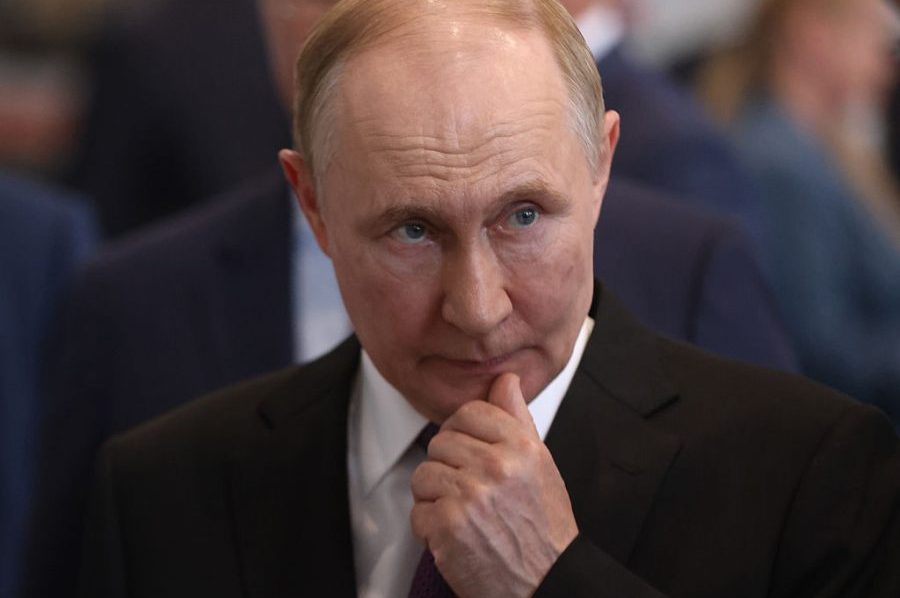
The Kremlin’s accountants are having a problem: Russia’s state budget, once the engine of spectacular growth, is now flashing red. The mathematics are brutal. Russia’s fiscal deficit has ballooned to 3.7 trillion rubles in June – roughly $46 billion – skating perilously close to this year’s legal limit. As a share of GDP, the deficit threatens to breach the 1.7 percent ceiling, a prospect that has Valentina Matviyenko, speaker of the Federation Council, preaching the gospel of “strict savings” with all the enthusiasm of a Victorian governess.
The root of Moscow’s monetary malaise lies in spectacular overoptimism. Last September, officials confidently predicted a 2025 deficit of just 0.5 percent of GDP, banking on Brent crude at $66 per barrel, robust 2.6 percent growth, and a conveniently weak ruble at 100 to the dollar. Instead, they’ve watched their projections crumble fast.
The transformation of a petro-state into a war economy was supposed to demonstrate Russian resilience
In the first half of the year, oil and gas revenues, which fund more than a quarter of the Russian state, have collapsed by 17 percent compared to last year and 25 percent below projections. The market consensus for next year’s Brent prices hovers between $55 and $65 per barrel, below the government’s projections. Meanwhile, an unexpectedly strong ruble means fewer rubles per exported barrel, creating the peculiar problem of being too successful at currency strength.
The broader economy tells an equally grim tale. Growth has plummeted from a respectable 4.3 percent in 2024 to 1.4 percent in the first quarter of this year, with the Central Bank now forecasting sub-1.5 percent growth for 2025. Lower growth translates to reduced VAT and income tax receipts, creating a vicious cycle that would make even Gordon Brown wince. Lower growth also means lower GDP, and with nominal fiscal deficit rising monthly, the 1.7 percent legal threshold for this year’s deficit to GDP ratio has all the chances to be blown.
Putin’s bookkeepers face a difficult problem. The president promised not to raise taxes, ruled out meaningful currency devaluation (which would stoke inflation and increase government costs), and ringfenced defense, security and social spending. What remains is a game of fiscal Jenga where removing the wrong piece brings down the entire structure.
Defense spending alone accounts for roughly $172 billion – 7.7 percent of GDP – with little prospect of meaningful reduction. The stockpiles of Soviet weaponry that initially sustained the Ukraine campaign are running dangerously low, forcing expensive rearmament. The Kremlin has convinced itself that military production must remain the economy’s primary driver, a strategy worthy of Stalin planners’ applause, but expensive for the state finances.
With limited options, the government would be passing the fiscal burden to business and citizens with the subtlety of a Moscow traffic policeman. Companies face the prospect of losing subsidies while shouldering additional costs for security and social programs: hardly conducive to investment or innovation. Citizens, meanwhile, can expect higher duties on vehicle registration, steeper excise taxes on life’s small pleasures, and increased fines. It’s austerity with Russian characteristics: brutal but presented as a patriotic duty.
The regime’s fiscal contortions reveal a deeper vulnerability.
In 2022, when sanctions first bit, Russian businesses and citizens queued cap-in-hand for state assistance, receiving generous help in exchange for war enthusiasm. Now the state coffers are running dry, but the enthusiasm must remain undimmed – dissent being rather more dangerous than bankruptcy in Putin’s Russia.
Two external threats loom large over this precarious balancing act. Should President Donald Trump make good on threats to throttle Russian oil trade, or should Brussels tighten technological sanctions, Moscow’s fiscal gymnastics could collapse entirely. The Kremlin has thus far managed to fund its war without triggering mass protests, but the margin for error is shrinking.
Putin’s great gamble – that Russia could outlast Western resolve while maintaining domestic stability – increasingly depends on economic alchemy. The transformation of a petro-state into a war economy was supposed to demonstrate Russian resilience. Instead, it may prove that even autocrats cannot indefinitely defy the laws of arithmetic.