Author: JP4

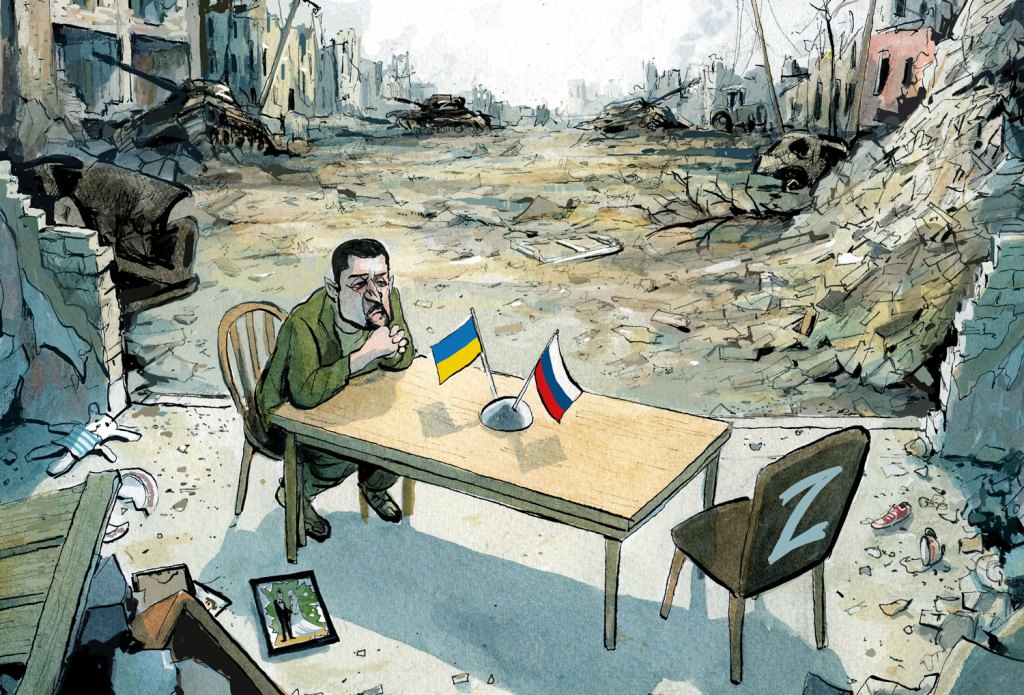
  • Can Zelensky surrender?

    Can Zelensky surrender?

    Kyiv

    The urge to run from danger is only human. It was palpable when air raid sirens sounded as I left the Ukrainian city of Dnipro, which is close to the front line and under relentless attack nightly from Russian drones. Five MiG-31 aircraft were in the air, Telegram channels with access to reliable intelligence reported. The warplanes can be armed with either the Iskander ballistic missile – which travels at up to 5,400mph – or the Kinzhal hypersonic missile, top speed 7,700mph. So fast there wasn’t enough time to find a shelter. We sat in traffic with bated breath, waiting.

    A deep boom resonated through the mini-bus and two colleagues of mine began praying. Was it an intercept or an impact – or a Patriot defense battery firing? We still don’t know. And, more importantly, we wondered where, exactly, the other incoming missiles were heading. As the tension mounted in our stationary vehicle, I glanced out the window: people ambled slowly back from work under yellow streetlights; they smoked, they shopped, they seemed more concerned with the cold than impending death from above.

    For some: flight; for others: fight. Ukrainians succumbing to the understandable desire to run as far away from the war as possible has been a big problem for the country since long before Donald Trump unveiled his plan for a peace deal. Last year, Ukrainian President Volodymyr Zelensky lowered the conscription age from 27 to 25. But nine in every ten conscripts is failing to report for duty, a close advisor of Zelensky told me. It is estimated that the number of fighting-age men who have fled Ukraine is almost equivalent to the size of the 900,000-strong Ukrainian army. Polish border guards have processed 99,000 men aged 18-22 in the past two months alone.

    “If 90 people out of 100 are escaping the army, the nation is not ready to fight anymore,” the advisor said. “The problem with joining the military is that people think it’s forever, until the war is over. So basically you’re going to eventually die on the front line. This is an existential problem for Ukraine now. We have already lost seven million people who have moved out of the country since the war began. If conscription is expanded, it would maybe force out an extra two million. But what’s going to be the future of the country demographically? The best way now is to take the least bad peace deal possible. The Russians still have other moves to go, they can do internal mobilization – they still have reserves.”

    Roman Kostenko, a former military commander and current parliamentary deputy, said “80 percent [of soldiers] are now running away from training centers, and the country is doing nothing to bring them back or create conditions so that they are afraid to run away and do their duty.”

    If the Ukrainian army was twice its current size – as it should be if all who were conscripted had answered the call – perhaps it could have fended off the current Russian advance into the city of Pokrovsk and stopped the Russians pushing forward the front line, thereby bolstering Zelensky’s hand in negotiations with the US.

    Zelensky negotiates from a position of weakness. Battlefield losses are mounting and the front line is moving in the wrong direction. His administration is also engulfed in a corruption scandal centered on the energy industry, which is currently being crippled by Russian attacks. This is his – and his country’s – bleakest moment since the war began in February 2022.

    If Pokrovsk does fall, the next major city in Vladimir Putin’s sights will be Dnipro, 50 miles to the west – which might shortly afterward find itself within shelling distance. Instead of nightly attacks by MiG-31s, Dnipro, which is home to one million Ukrainians, could face 24-hour bombardment. Its resilient residents, swelled already by tens of thousands of people fleeing from the Russian advance, could at that point finally decide to leave en masse.

    Volodymyr Miller, the deputy mayor of Dnipro, called for the conscription age to be lowered even further to help defend his city. “The conscription rules have to change. I would even say that they should have been changed sooner. There are too many people not helping. Either you’re on the front or you’re for the front. And if you don’t have that in society, then the war will be tougher,” he said.

    Some, however, think Ukraine can go it alone and that further conscription is unnecessary. Standing next to the smoldering wreckage of the public broadcaster Suspilne, which was attacked with a barrage of Shahed suicide drones just hours beforehand, Ivanna – a university lecturer in rocket science – said: “We’re not going to stand down. We’ll be here to the very end. I believe in my defenders, I trust they will defend our city.”

    This optimistic assessment of Ukraine’s chances of success prevails across the country. True, this is a view born, perhaps, of necessity while the fighting continues. Failure is not an option: the alternative is death. But to bring the fighting to a close, very few people say they will accept the compromises outlined in Trump’s peace deal – especially ones that involve giving away any land. In a recent poll, 75 percent of Ukrainians said they would reject a plan that forfeited territory, while just 17 percent said they would accept such a deal. Why should they, they argue, when Putin’s aim is to reunite the Russian empire and that a peace deal will, in fact, allow him to regroup before invading again. It has been angrily dismissed by many in the West as a capitulation agreement authored by Russia.

    The counter view to war is fast diminishing in Ukraine. Those who have fled the country in order to avoid being conscripted would, no doubt, account for a big block of those in favor of ending the fighting if Trump’s peace deal is signed. Within 100 days of the deal being agreed, national elections would have to take place, which would effectively act as a referendum on the agreement. However, it is unclear whether these absconding conscripts would be allowed to vote – or if they would even be prepared to put their head above the parapet and give the Ukrainian government their details, for fear of prosecution. The country’s anti-war sentiment is being hollowed out.

    The view from the front line of Trump’s deal – and that of Ukraine’s military and civil leadership – is skeptical. Harry, 27, an American with Ukrainian roots, joined the Ukrainian army almost four years ago. He fought in the infantry, going into Russia as part of a reconnaissance unit, but when his injuries became problematic, he joined a drone team – reasoning that it was better to be the hunter than the hunted.

    “The problem with conscription is a lot of Ukrainians don’t trust the army and I don’t blame them,” he told me. “There have been too many poorly planned missions that lead to unnecessary deaths. You have to ask if this juice is worth the squeeze, as we say in the US. Too many units are trying to be on the offensive and this is 90 percent a defensive war now. We need to be building defenses with pushes here and there to keep the Russians on their toes.

    “With the peace deal that Trump is pushing, there is no incentive for Putin to stop – he’ll just keep going. It’s a Russian wishlist. What’s the point of what we’ve been doing if we give up everything? I don’t see the army accepting it.”

    A fellow serviceman, a drone operator who mounts strike missions deep into Russia, attacking military logistics hubs and fuel depots, believes that further conscription could turn the tide and there is no need to take the US deal. “Russian soldiers are paid much more than our soldiers, but if we paid more than them we could attract a lot of fighters, mercenaries from other countries. With the new sanctions Russia will soon struggle to pay its own troops. We can win if that happens, if we keep our resolve.”

    War is still the most likely outcome of the peace process, not least because Putin hasn’t put his name anywhere near the proposed deal – and may never do so, following reports of a security guarantee that would park NATO troops and warplanes on Poland’s border, ready to be unleashed at a moment’s notice if he steps out of line. The deal is not the point for Putin – the point is the chaos and instability it has uncorked.

    To outsiders, it seems foolhardy to continue a war that is scything down the flower of Ukraine’s youth, especially when the odds of winning oscillate between low and impossible. Since the Ukrainian parliament was frozen in aspic under martial law in 2022, the country has become more militaristic, more steeped in blood, more patriotic. Those who don’t want to fight have left. Peace will be a hard sell. Yet at a time when the majority of young people in the West readily admit they wouldn’t fight for either their country or their way of life, there is something deeply admirable and honorable about the Ukrainians who have stayed to take up arms – and their never-say-die spirit.

  • The steady erosion of academic rigor in German schools

    The steady erosion of academic rigor in German schools

    German teachers are a privileged species. Most of us enjoy the status of a Beamter, a tenured civil servant. We can be dismissed only after a serious criminal conviction, we are exempt from social-insurance contributions and even our mortgage rates are lower. Such comfort discourages dissent. Yet, after more than 25 years as a pampered Beamter, I find myself overwhelmed, not by the teaching load or the students, but by the accelerating erosion of academic standards.

    Having taught English, history and Latin at four different Gymnasien, I have learned that challenging students is now frowned upon by both bureaucrats and politicians. Nearly all my colleagues agree that standards have plummeted. A mathematics teacher tells me that assignments he set 20 years ago for his older students would now be beyond even the brightest. One thing is certain: the children are not to blame.

    The decline began in 1964, when philosopher Georg Picht published The German Education Catastrophe, calling for a drastic expansion in the number of college-eligible high-school graduates. Until then, only those who graduated from a Gymnasium, the equivalent of a selective high school, qualified. Picht’s alarmism found ready ears. In 1960, 7 percent of students left school with college-level results; today, more than half do. The inflation of academic credentials accelerated with the 1999 EU Bologna reforms, which dismantled the traditional and rigorous European degree structure and replaced it with the Anglo-American model. Only medicine and law escaped. The effect has been the slow death of Germany’s once-superb vocational system. Many small- and medium-sized businesses no longer offer apprenticeships but almost anyone who has finished high school can find some comfy course at college. More than 70 German universities now offer degrees in gender studies. It’s dumbing all the way down.

    As college places were massively expanded, the Gymnasien had to lower their entry thresholds to keep pace with the demand for more and more students. Since 2002, in my own state of North Rhine-Westphalia, parents have had the right to choose their child’s secondary school, regardless of their teachers’ recommendations. Children deemed unready for the Gymnasium are admitted and, once enrolled, bureaucratic obstacles prevent them from being moved to a more suitable high school.

    The deterioration has been striking in my subjects. Since 2007, students have been allowed to use dictionaries in English exams, which discourages them from memorizing vocabulary. That same year, the Zentralabitur – a centralized state exam – replaced teacher-written finals. Previously, each school designed its own papers, tailored to what had been taught. Now, vague, homogenized curricula require little factual knowledge. History was replaced by the nebulous goal of “intercultural communicative competence.”

    Objective grading once relied on the Fehlerquotient (number of grammatical errors per hundred words). This was derided as “too rigid,” replaced by an imprecise points system designed to boost marks. Marks are awarded for trivialities, such as “structuring” a text. Students quickly learn the formula: use a few stylistic devices – enumerations, metaphors, repetitions – and you can be seen to analyze anything. Teaching to the test has replaced teaching to think. Real objectivity would require blind marking, external examiners and anonymized papers – none of which exist.

    When I attended a Gymnasium in the 1980s, advanced English students were required to study an entire Shakespeare play. Later, this became selected scenes, then scenes from film versions. In 2023, the Bard was dropped entirely, replaced by the study of “questions of identity and gender.”

    Since 1970, North Rhine-Westphalia has had only eight years of non-leftist control over education. Progressivism now permeates every level. Among teachers, Green sympathies are disproportionately high. Of the 17 newspaper articles used in exams between 2020 and 2025, not one came from a conservative source. The Guardian and the New York Times dominate.

    Behind all this lies the creed of “competence orientation.” Grammar, spelling and factual knowledge are dismissed as obsolete. It is enough to “communicate effectively.” Why, then, read Shakespeare? Why learn a soliloquy by heart? In biology and geography, exams no longer test knowledge but the ability to interpret pre-packaged “material” – charts, graphs and snippets of text. A colleague who marks geography papers believes anyone with common sense and patience has a decent chance of passing.

    Latin, too, has been softened. Translation from German to Latin is banned as it is “too difficult.” Lessons are increasingly padded with Roman culture and history.

    When the state exam was introduced, most teachers welcomed it because it meant less work. I realized something had gone horribly wrong when I graded a history paper by a gifted pupil who provided precise dates, facts and definitions. The new state syllabus allowed only limited marks for such content. I only managed to salvage her grade by awarding her full points elsewhere.

    Across all subjects, measurable trivia has replaced genuine learning. Multiple choice has supplanted multiple perspectives. Today’s “competence orientation” manufactures compliant consumers who consult Wikipedia or ChatGPT for ready answers. To criticize “competence orientation” is near-heresy; every mainstream party endorses it. It was introduced in my state under a Green minister, continued by a Liberal and remains untouched under a Christian Democrat. For the left, it serves egalitarianism; for Liberals, it produces plentiful but pliant employees. The Christian Democrats’ acquiescence is harder to fathom. But the result of all this is clear enough. In 2011, a student of mine wrote at the end of a Shakespeare exam: “Students don’t have to learn any more facts. Studying in this way is boring. Students will die of boredom.” If only I could have given her full marks.

    This article was originally published in The Spectator’s December 8, 2025 World edition.

  • The dismantling of Lambda School

    The dismantling of Lambda School

    In 2017, Zoom finally achieved what Skype never could: hosting video calls that didn’t freeze. It was a golden moment to take education online. Enter Lambda School, a Silicon Valley startup founded by Austen Allred with the aim of disrupting higher education.

    Allred’s idea was simple: people wanted to learn to code but often couldn’t pay $20,000 upfront. His solution? You’d pay nothing until you landed a job earning more than $50,000 a year. At that point, a share of your income would go back to Lambda. But never more than $30,000, and never with interest. The technical term for this is an income share agreement, or ISA, an equity-like stake in a few years of a person’s future income. If you got a good job, the school was repaid. If you didn’t, the school took the loss. The incentives were perfectly aligned.

    The idea should have been a rare bipartisan win. Republicans distrust academia and like the idea of having “skin in the game.” Democrats want to protect students from debt. Everyone agrees the current student loan system is broken. Betsy DeVos, then Donald Trump’s education secretary, was enthusiastic. She suggested that income-share agreements could replace the student loan system entirely. In a rational world, that would have been a blessing. In 2017 Washington, it was a curse. DeVos endorsed the model; the resistance inevitably went to work. Elizabeth Warren, Nancy Pelosi and their allies began churning out what Allred calls “a white paper a week” denouncing income-share agreements as predatory. It didn’t matter that the contracts expired after five years if the graduate never earned enough. The narrative was set: income shares were “student debt by another name.”

    Once Democrats set a target, the media follows like hunting hounds. Article after article appeared – some identifying genuine complaints about Lambda School, such as underqualified instructors and inflated claims about post-employment prospects. But none of Lambda’s critics could explain how its core business model – the ISA – was worse than the traditional model of interest-fueled student debt, interest that accumulates regardless of whether graduates obtain employment. In fact, Lambda was losing money. Leaked internal documents revealed the company was spending around $13,000 per student but receiving, on average, around $5,750 back. But investors were happy to support the company as it expanded, in the hope that this model would one day prove profitable while benefiting students.

    The Consumer Financial Protection Bureau (CFBP) joined the critics, determined to prove that if something looked like a loan, it must be one. It launched investigations into every company using ISAs, “bankrupting everyone but us,” as Allred later put it. Lambda asked for clarity. Tell us how to comply, it said. We don’t care how you regulate the ISA, just regulate it. The Bureau refused. Instead, it came up with a theory: because Lambda offered two options – those who could pay were charged $20,000 upfront; those who couldn’t were offered the $30,000 income share – so the $10,000 difference must be “interest.” It made no sense. That difference is far closer to a “finance charge” – you promise to pay a flat fee for deferring repayment. The mark-up compensated Lambda for taking on the risk in case students couldn’t repay the tutoring charges. Income shares don’t tick up each month by a certain percentage of the principal, so clearly this wasn’t interest. But reason rarely survives contact with regulation.

    The first formal inquiry came in 2020. Then silence. Finally, last year, the CFPB returned, demanding a settlement. The statute of limitations had run out, but that didn’t matter. It wouldn’t say what laws Lambda had broken, only that it needed to admit wrongdoing. When Lambda refused, the CFPB named Allred personally. If the company went bankrupt, they could pursue him directly. “They basically said: we can bankrupt your company, or we can bankrupt your family,” he recalls. To end the standoff, Lambda agreed to a token fine and to “admit” to several false statements, including that instructors had volunteered their time. The Bureau also forced the company to forgive income-share agreements that were already about to expire. “A refund of nothing,” Allred says.

    Lambda was also banned from student lending unless a regulated third party was involved, effectively killing its business. To stay alive, the company switched to conventional loans. The loans carried interest of 15 percent and were far worse for students than ISAs – but unlike ISAs, standard loans didn’t have a political target on their back. A business set up to save students from predatory interest rates was forced to implement interest rates.

    The company had sold or borrowed against some of its outstanding student loans to recoup its losses. Investors then got the right to collect a slice of a student’s future income instead, while Lambda turned uncertain repayment contracts into cash that could be reinvested. The CFPB decided that, too, was improper. “They said the incentives weren’t aligned,” says Allred, “which makes no sense… the income shares have to be worth something to borrow against them.”

    By then, the company was bleeding. Every month the investigation dragged on, Lambda stopped enrolling students and cut staff. A model that once promised to democratize education – risk-free for students, performance-based for schools – was strangled by the very agency meant to protect consumers. The irony is that the Bureau was required to create a regulatory framework for income share agreements, something Allred had asked for back in 2017. Eight years later, it still hasn’t done so.

    Allred says he began the project with a naive faith in government. “I wasn’t right-wing at the time,” he says. “I thought the people I was dealing with had good intentions and wanted to do the right thing. It took me way too long to realize that wasn’t the case. It was my team versus yours.”

    Lambda set out to solve a problem Washington claims to care about: how to educate people without burying them in debt. It made great strides towards doing so, until the federal bureaucracy decided that aligning incentives was, somehow, the real crime.

    This article was originally published in The Spectator’s December 8, 2025 World edition.

  • Trump was right to snub Johannesburg’s G20 summit

    Trump was right to snub Johannesburg’s G20 summit

    The rule of the African National Congress (ANC) in South Africa since 1994 has been marked by a widening chasm between poor black people, the majority and a tiny black elite, who get richer and richer. A quarter of our children are so badly malnourished that their brains are stunted for life. Amid this terrible hunger, President Cyril Ramaphosa lives in fabulous splendor. He is said to be worth 6 billion rand (around $350 million). He has mansions in the rich parts of South Africa. He has a fleet of luxury cars. He owns a game farm of 11,120 acres. Yet before the G20 meeting of international leaders in Johannesburg, he wrote in his newsletter, “Inequality is one of the most pressing global issues of our time.” 

    This G20, purported to promote international cooperation and economic growth, was rescued from being the usual instantly forgettable fest of posture and pontification by President Trump, who by snubbing it turned it into a resounding success. This gave Ramaphosa a huge boost within the mainstream media, who made it seem as if he had told Trump to go to hell – when all he actually said was that Trump’s absence was “regrettable.”

    Trump has done good, bad and mad things; he acts on impulse, without thinking. He is profoundly ignorant about South Africa. He boycotted G20 because he says “bad things” are happening here, which is true but they are not the things he cites. There is no “white genocide” in South Africa. White farmers are murdered at a higher rate than the population at large, often horribly, and Ramaphosa did lie outright in 2018 when he told Bloomberg media, “There are no killings of farmers or white farmers in South Africa” – at the time, the South African police had reported 1,700 such murders. But this is not genocide. 

    No doubt Joseph Stiglitz, who attended G20, nodded his head in agreement with Ramaphosa’s condemnation of inequality. But Ramaphosa’s record and the state of South Africa under his presidency reveal that he is not as concerned with inequality as he proclaims, and has in fact expanded the gulf between the rich and the poor.

    Ramaphosa has passed laws that have stifled the economy and caused massive inequality. Like the rest of the ANC, he hates the West and cheers its enemies but still expects its favors. Posing as a moderate, he has promoted the “National Democratic Revolution”: the foundation of ANC ideology, which wants to turn South Africa into a communist state. He passed the Expropriation Act, which allows the state to confiscate without compensation any property provided that it “is in the public interest.” He has presided over the country’s highest unemployment and lowest economic growth. But he is admired by many world leaders. He is charming and personable; he has a beaming smile, and speaks with soft reasonableness.

    A central plank of ANC policy is BEE, which in name is “Black Economic Empowerment” but in practice is “Black Elite Enrichment.” BEE has done great harm to poor black people. Ramaphosa, himself enormously enriched by BEE, states, “BEE is here to stay!” The Rooiwal Wastewater Treatment plant, north of Pretoria, was failing, sending contaminated water to black residents. In the past, a competent contractor would have repaired the plant at the lowest cost. Instead, in 2019, a BEE contractor, Edwin Sodi, was appointed for 295 million rand. Sodi had no competence for this but was an “ANC benefactor.” He didn’t try to repair the plant. He donated some of the money to the ANC and spent the rest on luxuries for himself, Ferraris, mansion improvements, gifts for girlfriends and so on. Contamination worsened. Over 20 black people died of cholera.  

    The record of all ANC presidents except Mandela on international human rights is deplorable. They applaud African tyrants such as Mnangagwa in Zimbabwe who slaughter black people. Ramaphosa is the worst. After the atrocity in Israel on October 7, 2023, many in the ANC cheered loudly for Hamas. When Israel finally retaliated, the ANC charged her with “genocide” at the International Court of Justice, with Ramaphosa posing as a brave hero. Whatever you think of Israel’s action in Gaza, it is not genocide – no more than what Trump calls South Africa’s “white genocide.” But real genocide against black Africans is happening right now, in Sudan, with the full approval of Ramaphosa and the ANC. 

    In 2015, Omar al-Bashir, then Sudanese leader, visited South Africa. He had presided over the genocide of about 300,000 black Africans by Jihadist Arabs. It was the world’s worse humanitarian crisis – and still is. Bashir was warmly welcomed by the ANC. The International Criminal Court asked the ANC to arrest him. They declined. Bashir was later overthrown by other Jihadist Arabs, who broke out in civil war against each other, laying waste to the country, starving millions, continuing the genocide. The worst killer was Mohamed Dagalo, leader of the Rapid Support Forces. In January 2024, he visited President Ramaphosa at his official residence in Pretoria. Ramaphosa greeted him warmly, gave him his big smile, practically groveled before him and called him “Your Excellency,” even though he had not taken power. He posed for a happy picture with him, holding his hand. 

    The once great city of Johannesburg is disintegrating under ANC misrule. Water, sanitation, electricity and roads are crumbling away. Those parts that the G20 leaders would see were hastily spruced up. Now the leaders have departed, celebrating a marvelous G20 and saluting Cyril Ramaphosa as a great African hero who defied Donald Trump.

  • Are J.D. Vance and Marco Rubio heading for a clash?

    Thanksgiving weekend ends on Sunday, and still there’s no peace in Ukraine. Donald Trump’s latest attempt to end the war – his 28-point plan – began to fall apart from the moment it mysteriously leaked to various international news outfits last week.

    As that story landed, Reuters broke some other news: Keith Kellogg, Trump’s special envoy to Ukraine, would stand down in January. Kellogg, who represents the more ardently pro-Ukrainian faction of the administration, had clashed repeatedly with Trump’s peace envoy Steve Witkoff, who has been engaging in friendly dialogue with Moscow for most of the year. His departure seemed linked to the fact that Dan Driscoll, the Secretary of the US Army and an ally of J.D. Vance, had been despatched to Geneva to tell the Ukrainians to accept the latest deal or forget about America’s continued support.

    All that triggered an all-too-predictable chorus of Trump denunciation. In his desperation to strike a deal and declare peace, countless pundits said, the President was selling Ukraine out and blindsiding his European allies. Trump was, once again, accused of being a Kremlin stooge. The Independent claimed that the his plan had been “entirely dictated by [Vladimir] Putin.”

    Witkoff, for his part, was roundly criticized for “coaching” Russian officials in emails which leaked (again) to Bloomberg. “It would probably be surprising if he cursed us with obscenities in his conversations with Ushakov,” came the caustic response from Putin.

    Trump’s plan was gravely flawed, of course. The idea that he could be anointed as a “peace czar” who would ensure that America shared the “profits” of any postwar reconstruction seems classic MAGA unrealpolitik. Even if such an arrangement could be struck, neither Volodymyr Zelensky nor Putin were ever likely to accept the proposed land partitions or the compromise of a “buffer” zone. And Britain and the European Union dismissed the plan out of hand. “We have not heard of any concessions from Russia,” said the EU’s foreign affairs chief, Kaja Kallas. “If Russia really wanted peace, it could have agreed to an unconditional ceasefire a long time ago.’’ And so the tragedy goes on.

    But the latest imbroglio did reveal some interesting tensions with the Trump administration’s approach. Vance, representing the anti-war paleoconservative faction, appears to be angry with his fellow Republicans for, as he sees it, scuppering the White House’s ceasefire efforts. On Monday, the Vice President posted a furious message on social media. It’s worth quoting in full:

    After four years of house prices doubling (and in some areas, tripling) many young people feel priced out of the American Dream of homeownership. A welfare fraud scandal in Minnesota reveals that large numbers of new arrivals aren’t assimilating and are funneling our tax dollars to literal terrorist groups. An innocent woman was set on fire in Chicago as the mayor resists federal law enforcement resources to bring peace to one of our great cities. The Obamacare insurance system is buckling under its own weight. And the country is $38 trillion in debt. Our administration is working hard on addressing all of these problems. But you know what really fires up the beltway GOP? Not any of the above. Instead, the political class is really angry that the Trump administration may finally bring a four-year conflict in Eastern Europe to a close. I’m not even talking about the substance of their views. Much of what these people have said about the Ukraine war has been proven wrong, but whatever. We can agree to disagree. But the level of passion over this one issue when your own country has serious problems is bonkers. It disgusts me. Show some passion for your own country.

    In attacking “the beltway GOP,” Vance aimed his ire chiefly at Senator Mitch McConnell, who had said that Putin was playing Trump for a fool. Vance branded his comments “a ridiculous attack on the President’s team, which has worked tirelessly to clean up the mess.”

    But some of Vance’s allies, if not necessarily the Vice President himself, also feel some bitterness towards Secretary of State Marco Rubio. Despite his apparent conversion to the America First agenda, Rubio remains on the more hawkish end of the Trump foreign-policy spectrum. It was Rubio who flew to Geneva last week and appeared to soften up Trump’s hard deadline with the Europeans and Ukrainians. “We believe that Marco Rubio’s engagement in the continuation of talks is important,” an official from a Nato country told Politico. Rubio’s changed the pace of negotiations, he added: “After yesterday, it has slowed down, and that’s good.”

    The White House insists, of course, that the entire cabinet is “working in lockstep” towards the shared goal of ending the war: Witkoff, Rubio, and Trump’s son-in-law, Jared Kushner, put on at least the appearance of a united front in Switzerland. Rubio remains on friendly terms with Vance, despite their seemingly inevitable rivalry for the 2028 Republican presidential nomination.

    But it is also evident that Rubio and Vance have very different approaches when it comes to dealing with Europe and Ukraine. That could set them on course towards a more public clash in the coming months, as Team Trump becomes increasingly frustrated with its failure to end the most difficult war of our time.

  • Zelensky risks coup or civil war

    Zelensky risks coup or civil war

    Kyiv

    When is the price of peace ever fair? War does not determine who is right, only who is left, Bertrand Russell wisely observed. Very often conflicts come down to a numbers game – and on the numbers Ukraine is losing. Despite losing more soldiers, Russia is winning on the battlefield and unlike Ukraine hasn’t even begun mass mobilization. 

    Donald Trump’s proposed peace deal won’t turn the clock back on Ukraine’s borders, or compensate Ukraine for Russian aggression and war crimes, or even punish Putin personally for starting a horrific and needless war that has claimed as many as 500,000 lives. If anything, the deal rewards him. 

    But Trump hopes his proposal will draw a line in the sand to stop the relentless bloodshed.  

    That is not a redline that Volodymyr Zelensky appears prepared to sign up to, though. In an urgent address to the nation on Friday night, Zelensky said this was “one of the most difficult moments in our history.” The choice was, “a life without freedom, dignity and justice, while being expected to trust someone who has already attacked us.” The current price of peace, on the terms of the 28-point plan, is too high for him. 

    Zelensky is at least engaging with the peace process and will talk with Trump later this week. Yet however tough his talks with Trump are, they will be far easier than the conversations he will have with his own countrymen and within his own parliament. It is hard if not impossible to find a single voice in Ukraine that backs the peace plan in the current form, or even in a diluted form.

    A source close to Zelensky, from his ruling Servant of the People party, said the existing plan risks fracturing the country. “It’s a stupid decision. If he doesn’t change it, he will lose the party. 

    “Local governments might say this deal is a betrayal, this is not a good deal and we do not recognize it. They could declare themselves as separate entities, while other parts might respect the deal. There will be a lot of violence during the process.”

    Others in the parliament agree.  “The lives of the people who live in the areas that we have to give away will be ruined, their culture, their religion, they face torture and deportation to Russia where they will be forced to join the military and fight against Ukraine,” Ivanna Klympush-Tsintsadze, a deputy in the opposition European Solidarity party, told me. “This deal shows that might is right. It will be impossible to ratify.”

    Chief among concerns is how the military might react to a bad deal. It is feared that soldiers who have lost friends in hard-fought battles over land they are being told to hand back might take matters into their own hands – and could even be prepared to stage a military coup.

    “If Zelensky agrees to this deal or one like it, he’d have to worry about the more nationalistic and patriotic units,” Harry, 27, from the American Midwest, who is serving with the Ukrainian infantry told me. “I’ve served with these guys, they are elite, big dudes full of steroids who love their country. Units like Azov, the 3rd assault, they would take exception. I don’t know how far it would go, but it could be anything from a demonstration to a full coup.”

    The displeasure of soldiers and veterans could be expressed in snap elections that the peace plan states must happen within 100 days of an agreement being reached. This would effectively be a referendum on Zelensky and the deal that he has struck. It is at this moment that the entire power dynamics of the country will likely change and could see veterans enter the parliamentary system in a significant way.

    The thorniest issue of all is the proposal to surrender land, as yet unconquered by Russia, to Russia. The plan calls for Ukraine to cede the eastern Donbas region and accept Russia’s de facto control of other parts of Ukraine where the frontline would be frozen. In reality, it would mean an evacuation of these areas and be the bitterest of pills for a proud country to swallow.  

    A proposed security guarantee might be a marginally easier sell. The US has presented the Ukrainians with a draft agreement of a security guarantee modeled on NATO’s Article 5, which would commit the US and European allies to treat an attack on Ukraine as an attack on the “transatlantic community.” If formalized, the agreement would mean that if Russia were to try to repeat its attempted capture of Kyiv in 2022, this time it would be met by the armies of the US and Europe. Under the plan, Ukraine would have to give up aspirations to join NATO, but in reality they would become a de facto member. 

    NATO troops would be banned from Ukrainian soil under the plan, but they could be based on the border in Poland, armed to the teeth with modern weapons and war planes and ready to roll at a moment’s notice if Russia attacks Ukraine. An arrangement that will also help to sharpen European militaries that are rusty and reduced since the end of the Cold War. 

    And while Ukraine would have to accept a significant reduction in its army from 900,000 to 600,000, most members of society are now military trained – every citizen is supposed to be either in the military or for the military – and, like Israel, could mobilize large numbers of civilians very quickly.    

    The negative reaction to the proposal within Ukraine could, of course, just be the first stage of grief and eventually Ukrainians will come to terms with Trump’s offer, or an offer modeled on it. But if they don’t agree to his timeline, Trump has threatened to cut the supply of weapons and intelligence.  

    And in typical fashion, he also offered a financial inducement. Ukraine will get $100 billion from frozen Russian assets to help rebuild the shattered country. This will be invested in a joint fund with the US; both will share the profits. Peace is profitable.

    The biggest obstacle to this deal progressing any further is not really Zelensky but the people of Ukraine. By and large, they believe that in practice the deal would offer only a temporary ceasefire, and allow Russia to regroup before launching another effort to reunite the Russian Empire. History would tend to agree with them.  

    The staunch patriotism of Ukrainians should command the respect of the world. Ukraine is a proud nation that prioritizes nothing more than dignity. There can be defeat, they say, as long as it comes with dignity. This deal is short on dignity; it is fair to say it is dishonorable. But Ukrainians must also be aware that they are losing the war. Are they also going to lose this opportunity to at least explore peace?

  • Will Mamdani and Trump turn the volume up?

    Will Mamdani and Trump turn the volume up?

    Donald Trump is famous for being willing to meet anyone – Russia’s Putin, North Korea’s Kim Jong-un, Syria’s al-Jolani – and even New York’s Zohran Mamdani. 

    The mayor-elect of the city of Trump’s birth will travel to Washington today for an audience with the Commander in Chief, and America’s journalists are furiously tapping away in anticipation of a big “showdown.”

    The two men have spent months insulting each other. Trump calls Mamdani a “communist” (which the New York Times factchecks as false, naturally, because Zohran identifies as a “democratic socialist”) and has suggested, to much liberal apoplexy, that he “may not be here legally.” Trump also says that he is “much better looking,” which is funny, and has proposed sending in the National Guard in to Mamdani’s New York and withholding more billions in federal funding for the city. When asked about Mamdani’s defiant rhetoric against his policies on immigration, Trump replied: “Well, then, we’ll have to arrest him.”

    Mamdani, for his part, presented his successful election campaign as an explicit rebuke of Trumpism. In a belligerent victory speech on November 4, he declared: “Donald Trump, since I know you are watching, I have four words for you: turn the volume up.”

    “If anyone can show a nation betrayed by Donald Trump how to defeat him,” he added, “it is the city that gave rise to him.” He’s also suggested making New York a “sanctuary city” for an “LGBTQ community” that loathes Trump and has proposed hiring 200 lawyers to stand up to “presidential excess.”

    White House officials have not clarified whether reporters and cameras will be invited in to see the two men interact, so we won’t know until later if the world is about to witness another Oval Office bust-up, similar to the now infamous scenes with Zelensky and Cyril Ramaphosa. Trump, with his penchant for ratings, may well be keen to engineer one. 

    That said, Trump has a strange habit of playing nice when expected to be nasty, and he has reportedly said in private that he admires Zohran’s political talents. He’s winner, after all. On Wednesday, apparently at the behest of some of his closest New York friends, Trump said he would be “willing to help him a little bit maybe.”

    Mamdani has this week been doing his best to sound civil, too. “I will work with the President if he wants to work together on his campaign promises of cheaper groceries or a lower cost of living,” he said this week. Mamdani also this week pointed out that tens of thousands of Trump voters also supported him because they both pledged to tackle “affordability.” And that’s the point about voters in this so-called age of populism: many are quite happy to switch from a so-called “fascist” to a so-called “communist” if they think it might make life less expensive.

    Mamdani should want to find some accommodation with Trump over federal funding, of course. But he may want to give his fans the exciting public clash which everyone seems so eager for. As Mamdani said yesterday, “If the president looks to come after the people of this city, then I will be there standing up for them every step of the way.” He appears to have a talent for turning up the volume, as well as muddled metaphors.

  • Will the Russia peace deal backfire on Trump?

    Will the Russia peace deal backfire on Trump?

    Kyiv

    The rumor reverberating around Kyiv is that the FBI has been leaning on Ukrainian anti-corruption police to investigate Zelensky’s inner circle in order to force him to swallow the bitter US peace deal. Trump, as they say, has put the screws, or the feds, on Zelensky.

    The National Anti-Corruption Bureau – which is unravelling a $100 million war-profiteering scandal that has implicated many of Zelensky’s closest political allies – has denied the accusation point blank, and there’s not a single shred of evidence that it is true.

    Nevertheless, Mykola Kniazhytskyi, a member of the opposition in the Ukrainian parliament and hardly a friend of Zelensky, told me, “A lot of people are saying anti-corruption bodies are taking orders from the United States to undermine Zelensky, to make him do the deal.”

    That the rumor exists and has gained currency within the country crystallizes how Ukrainians have come to view their relationship with America: where once they looked east to find a belligerent state using its secret police to try to control their country, now they look west. 

    The rumor also reveals how Ukrainians regard democracy and its guardian institutions: they don’t much care for them right now. In a time of war, the fight against corruption is subordinate to survival. It’s heretical in Ukraine to suggest that the country might benefit from elections to give its leader a democratic mandate and a stronger arm to bargain with. Elections would be complicated to stage during, no doubt, but they were managed during the US Civil War in 1864, so why not now? Ukrainians – even those who despise Zelensky – shrug at the suggestion and say, first, defeat the existential threat.    

    However, the rumor does convey one probable truth: that Trump is desperate to make a peace deal happen at almost any cost, as he has been promising the world he would end the war for years. 

    The proposed deal, which in its current state would codify Putin’s maximalist demands, would be a political death sentence if Zelensky were to accept it. Russian would become an official state language, the Ukrainian army (already too small to fend off Russian aggression) would be slashed by 60 percent, land in the Donbas – as yet unconquered – would be given away and many foreign weapons and all foreign troops would be banned from holding the peace. 

    “It is a plan for the capitulation of Ukraine, agreed by the US,” a Ukrainian party leader told me. There is neither a majority in the parliament for the deal, nor in the country.  

    Yet there are some who are cautiously optimistic. They dare to think that politics is back. First, the anti-corruption investigation has applied defibrillator paddles to the moribund parliament, shocking it back into life. Deputies are demanding the head of Andriy Yermak – Zelensky’s chief of staff who is accused of siphoning off funds earmarked for building defenses to protect Ukraine’s energy infrastructure. If he goes, it is hoped a full-scale clean-out of dead wood will follow. Not exactly a general election, but at least a political change. So far Zelensky is refusing to bow to pressure and fire Yermak. This has only increased speculation that Zelensky himself may have something to hide. 

    There would be necessary compromises on both sides, but the 28-point plan might actually work. It is a starting point for serious negotiations.

    A senior source close to Zelensky, who worked on the failed Russian-Ukraine peace deal in 2022 told me, “Trump is the only person in the world right now who wants to end the war. We choose to fight rather than surrender. Putin has his own plans to continue. China wants to supply both sides. Europe wants us to fight the Russians so they don’t have to. Only Trump is serious about peace.”

    But how much is the famously conciliatory Vladimir Putin really willing to compromise on? He has the whip hand. His troops are on the march, slowly taking land in the Donbas and the southern flank Zaporizhzhia. He is paralyzing the Ukrainian energy grid with strikes, plunging the country into cold and darkness as winter bites. (As I write this, my Kyiv hotel is briefly hit by a blackout before the backup generator kicks in. Across the city people access an app to find out their daily allowance of electricity, usually three hours in the morning, three at lunch and three in the evening.)

    Trump hopes that his new sanctions will help bring Putin to heel, even though the old ones didn’t really bite and history tells us that Russians are no strangers to suffering and dying for their country – and now they have state propaganda telling them they are fighting a just war against a Nazi threat.

    Zelensky has cautiously welcomed the plan, saying he is ready for “honest work” with the US to “bring about a just end to the war.” He said he will speak to Trump soon to discuss it. 

    The devil, as always, is in the detail. The document states that Ukraine will be given “reliable security guarantees,” but some commentators have questioned if that is possible if NATO troops are banned from Ukrainian soil, certain classifications of weapons are forfeited and the Ukrainian army is effectively neutered. Sources close to the president’s office, however, believe this issue can be circumvented by having rapid reaction NATO forces stationed in Poland and also by building large arms warehouse in Poland with vast stores of weapons that can be accessed in an emergency. If similar creative solutions can be found for other issues there is a glimmer of hope.

    However, if a good deal cannot be struck there may be danger for Trump. So far, many Americans have ignored the media’s attempts to characterize his high-risk strategy of engaging with both sides as appeasement, or that he is in the pocket of Putin. They understand that you don’t make peace with your enemies – and that sometimes heads need to be knocked together. The process is infinitesimally less important than the outcome. Yet the benefit of the doubt they have afforded Trump may be withdrawn if it appears that he is trying to ram a capitulation deal down the neck of the plucky Ukrainian nation standing up to the world’s number one bully.

    Zelensky can’t sell the current proposal to his nation, nor can Trump sell it to his. Of course, Trump can always simply walk away if it falls apart and blame everyone else, which is possibly the most likely outcome at this stage. Yet it may yet turn out that in even brokering this proposed pact, Trump has become party to a Faustian bargain.

  • The bonfire of the New Right’s vanities

    The bonfire of the New Right’s vanities

    The American right has a problem: it can’t stop talking about itself. Commentators, academics and journalists of what used to be called a “conservative” persuasion all tend to think that their ideas are tremendously interesting. And, in the way a difficult child becomes argumentative when he or she isn’t getting attention, they fight. They fear irrelevance and so they fall out with each other and take sides in order to prove to themselves that they have something worth saying. Things become messy and nasty and everybody gets carried away – usually in the hope of grabbing their own slice of an all-too easily distracted online audience. (Why else am I writing this?)

    Today we see the quarrelsome tendency of the so-called “New Right” at work in the squabbles over Tucker Carlson, Ben Shapiro, Kevin Roberts, Nick Fuentes and whether it’s OK to praise Hitler.

    But we also saw it six years ago, in the so-famous-it’s-now-largely-forgotten debate between David French and Sohrab Ahmari in 2019. This was a curious clash between two highly intelligent men which took place in the months before a global pandemic shook the world. The French vs Ahmari argument was over big ideas: the First Amendment and the culture wars, jurisprudence and liberty, the free market and nationalism, technocracy, Catholicism and family values. The title of the actual debate, hosted at the Catholic University of America and moderated by the New York Times’s Ross Douthat, was “What is Integralism now?” (Put that question in your Chestertonian pipe and smoke it, you beta cuck.)

    It was also about manners. Should conservatives keep upholding the importance of civility and lose? Or be as vicious as the left and win? Ahmari, representing the emergent “post-liberal” consensus, was on Team Rude. There could be “no polite, David French-ian third way around the cultural civil war,” he said. “The only way is through.” And at the time that seemed to be a clinching argument. French, a NeverTrumper, represented the tired and failed politics of the George W. Bush era. Few wanted to hear his equivocations when #MeToo was still empowering a particularly virulent form of feminism and controversies over “drag-queen story hour” were being were lost.

    But, boy oh boy, what a boreathon did Sohrab cause! For weeks, right-of-center pundits continued to weigh in on whether they were Frenchist or Ahmarite. Most commentators waffled out a third-way of saying there is no third-way: French was wrong, yes, but conservatives should not necessarily embrace the Jacobite tendencies of the MAGA fringe. Ergo, facto, propter, hoc.

    Then came 2020 – Covid, Black Lives Matter, peak woke, a contested election – and conservatives became increasingly radical. The left really was evil and needed to be smashed. Right-wingers started talking confidently about a “reverse march through in the institutions.” By the time of Trump’s reelection last year, and in the dizzying first months of his second administration, the New Right’s triumph seemed complete. J.D. Vance, who espoused the “paleo” or “post-liberal” worldview so eloquently, became Vice President. From day one, the Trump-Vance administration went to war with DEI and Harvard and anybody else who stood in the way. And on Liberation Day, Trump ignored the bleating of the free marketeers and upended the global financial status quo in favour of protection.

    But the David Frenches of this world never quite went away. They merely licked their wounds. And now, amid the agonized infighting over Tucker Carlson’s decision to interview the Groyper-in-Chief Nick Fuentes, they are attempting to exact their oh-so-civilized revenge.

    At the think-tanks, with all those nervous donors, the knives are out. Kevin Roberts, the president of the Heritage Foundation, at first defended Carlson. Then, under pressure, he performed a spectacular reverse-ferret and groveled.

    On Friday, Christopher Long and Thomas Lynch, the former president and chairman of the Intercollegiate Studies Institute, resigned from the board in disgust at what they called the “post-liberal hijacking” of their influential non-profit. In an “Open Letter to the Conservative Movement,” Long and Lynch denounced ISI’s current president, Johnny Burtka, for his “no enemies to the right” leadership, for indulging the “media crank Tucker Carlson,” the “postliberal icon Patrick Deneen,” the “neoreactionary Curtis Yarvin” and “others who seek to undermine the liberal ideas of the American Founding.” They denounced ISI’s Project Cosmos podcast for pandering to the “Yarvin-Fuentes-Carlson echo chamber”.

    What Long and Lynch conveniently ignored is that Nick Fuentes in fact loathes Curtis Yarvin, whom he regards as a sort of controlled-opposition agent for organized Jewry. But who cares about logic when you’ve decided that you are defending America’s founding?

    David French isn’t failing to seize the moment. “Once you’ve demolished respect for liberal democracy and demolished real value in rectitude and character in public life, it’s a short trip nihilism and fascism,” he declared on X, displaying something of a Cassandra complex.

    Again, several barrages of other conservative media voices have taken to social media to clarify the position of their own bright minds in this celestial constellation of 21st century intellectualism. “No, the post-liberals aren’t solely responsible for the Groyper moment,” intoned the former National Review columnist Jonah Goldberg. “But the claim that they didn’t help… to get us to this point is such obvious contrafactual nonsense.”

    In reply, various new-right influencers, who’ve been carefully building their large and “based” audiences for a long time, have taken to bemoaning all the fractiousness while pining for that recently lost voice of reason, the murder victim Charlie Kirk. As the Daily Wire’s Matt Walsh put it, “everything that’s happened over the past two months has signalled to the left that assassinations work. Take out one of our leaders ands we’ll start eating each other.”

    As ever in American conservatism, there’s masses of grandstanding and sentimentality covering over the more instinctive vanity and self-preservation. It’s exhausting. I love American conservatives, and it’s a sign of a vigorous culture, I suppose, to treat ideas and principles as worth fighting for. But is it really necessary for everyone to take themselves so seriously? Surely the most conservative insight of all came from that limey Prime Minister Arthur Balfour, who said: “Nothing matters very much and few things matter at all.”

  • How scientists misled the world about faith

    How scientists misled the world about faith

    Sometime in 1953, Dorothy Martin was contacted by aliens. They had bad news and they had good news. The bad: Earth was about to be swallowed up by floodwaters. The good: as the leader of a chosen few, Martin would be saved by flying saucers. Mankind had brought this calamity on itself by following Lucifer’s agents – scientists – and abandoning Christ. Over the next year or so, Martin assembled a little flock of disciples who believed their salvation, and the world’s end, would come on December 21, 1954.

    A team of psychologists caught wind of Martin’s prediction. Leon Festinger, Henry Riecken and Stanley Schachter saw in Martin an opportunity to test a hypothesis: when people with strong convictions are faced with incontrovertible evidence that their beliefs are wrong, those believers will increase their proselytizing efforts rather than admit they’re wrong. Festinger and his little flock of scientists covertly infiltrated the religion and had their hypothesis confirmed when neither the flood nor the saucers materialized: faced with dissonance between faith and reality, Martin and her closest followers doubled down on the former. Festinger and his co-authors wrote up the nutty experience in When Prophecy Fails (1956), which became the basis of the theory of cognitive dissonance and scripture in the field of psychology.

    One nitpick: they lied. As the political scientist Thomas Kelly recently discovered, Festinger’s researchers distorted key findings, misrepresented their actions and betrayed basic scientific standards.

    Kelly first read When Prophecy Fails a couple of years ago. The whole thing seemed too neat. He noticed strange inconsistencies. Festinger, for example, claimed that Martin had only around eight true-believing disciples – and even among those eight there were wafflers. A year later, in his seminal A Theory of Cognitive Dissonance he claimed there were “25 to 30 persons” who “believed completely in the validity” of Martin’s messages. So Kelly went looking for the psychologists’ notes. The firsthand accounts of the researchers’ time among Martin’s followers are held at the University of Michigan’s Bentley Historical Library. Festinger’s family donated the box but ordered that it be sealed for 70 years. That decree expired this year. And Kelly has cracked the box open.

    In poring over hundreds of pages of notes, Kelly noticed the researchers had left key observations out of the book. For example, they knew that Martin had engaged in serious evangelizing for months – writing to magazines, teaching neighbors and children – prior to the failure of her prophecies. But they leave nearly all of this out of the book to make their hypothesis appear stronger. Toward the end, the authors write that the core of the group emerged from their reality check with “faith, firm, unshaken, and lasting.” There is simply no evidence of this. In fact, Martin spoke to the UFO magazine Saucerian in 1955 – a year before When Prophecy Fails was published – recanting her belief in the UFO rescues. Kelly calls this fact check “trivial” – yet no one had performed it, apparently. “Maybe snobbery,” he says, explains why no other academic has bothered to look this stuff up.

    But these slip-ups look minor compared to the other offenses Kelly uncovered. Any high schooler can tell you that a scientist isn’t supposed to influence his subject’s thinking. The authors of When Prophecy Fails acknowledge that their presence in the group may have had some influence, but they insist that it was passive and minimal – they were little more than flies on the wall.

    It would be a problem then if, say, one of the lead researchers somehow became a de facto leader within the religion. But, whoopsie, that’s exactly what co-author Henry Riecken did. As “the favorite son” of those higher beings, Riecken earned the special title Brother Henry and was called upon to aid the faithful in moments of spiritual crisis. After one of Martin’s key prophecies failed, Brother Henry issued cryptic words to the group that reinvigorated their faith and, as he put it in his notes, “precipitated” their renewed evangelism.

    But that was not even the researchers’ most disturbing act. Just before the world was set to end, a social worker appeared at the household of the Laugheads, some of Martin’s most dedicated followers. Charles Laughead’s sister had called the worker to check on her nieces and nephews, whom she feared were being neglected by the UFO-obsessed parents. A research assistant answered the door and saw the threat this intruder posed to the study’s continuation; she rebuffed the worker and then urged her higher-ups to delay the case. In a particularly twisted note, the researcher claims she’d also done this because she’d grown affectionate toward the Laugheads’ youngest child and wanted to “protect” her.

    Look through these files – which Kelly has put online as open-source – and one thing you’ll notice is the contempt in which the researchers hold their subjects. Martin’s followers are called “idiots” and “pigs.” These are not the words of neutral observers.

    The irony in all this would be funny, if it weren’t so sad. For decades, When Prophecy Fails has been used to bludgeon religion. In New Testament studies, for example, many academics take it for granted that Christ’s resurrection did not occur, and they’ve used the book’s analysis to explain why evangelism took off even after this anticlimax. These scholars have showered condescension on those they believe hold unexamined – which is to say, non-atheistic – convictions. Never mind that these same intellectuals have fallen victim to the false prophets Festinger, Riecken and Schachter for the past 70 years, or that When Prophecy Fails is just one of a spate of major social-science studies to be debunked in recent years. The prophets of this reigning pseudo-religion – psychology – seem to be failing. Will their followers see the light? Or double down on their delusions?

    This article was originally published in The Spectator’s November 24, 2025 World edition.