Author: JP4

  • Snowshoeing with septuagenarians

    Snowshoeing with septuagenarians

    Wading through breakup grief, I’d hit the haziest stage of recovery, somewhere between lying horizontal in dark rooms, and shaving my head. Short of purchasing clippers, I’d resolved to write about wellness travel.

    Clad in regulation white cotton pajamas in the Western Ghats of India, my lifestyle habits had been judged (hard) and my thoughts about aging, recalibrated. A vigorous wellbeing regimen had revealed my 34-year-old body to be pushing 40, metabolically. Confronting? Yes. Salvageable? Also yes. (More mindfulness, fewer cigarettes, and – my addition – no men). Next stop: I’d pull on my hiking boots for a flight out of sweltering Mumbai, to icy Tokyo. 

    Post-Covid, Japan dominates algorithms and bucket lists. Perhaps it’s looming mortality, but the world is taken with this nation that makes good living (and long living) seem effortless. I’d explore their ancient concept of “ikigai,” which loosely translates to finding a daily reason for being, and unlocking longevity through quiet purpose.

    I connected to Hokkaido, the second-largest island of Japan, to begin eight days of snowshoeing past remote farmsteads and along clifftops. Something about strapping foreign objects to my shoes was appealing – an arbitrary challenge in tough conditions, that’s what satisfied people did, wasn’t it? Perhaps the mineral-rich hot springs awaiting me each evening would smooth my wrinkles.

    Bopping around convenience shops had the immediate effect of an SSRI – in-store blenders whizz pre-chopped fruit, vending machines dispense hot tea, and strawberry sandwiches decorate the shelves. I stomped to the Kushiro Prince Hotel with armfuls of fresh mochi, steeled to shake hands with a group of strangers.

    The lobby revealed my adventitious new family, twice my age. Rick the surgeon, George the calisthenics enthusiast, and Karen – “the least ‘Karen’ Karen,” she assured me. There were Andy and Andy, an Aussie couple celebrating 40 years of marital bliss, and Jean, continuing a tradition of adventures once shared with her late husband. “I wanted to see if I could still do it,” she shared.

    Philip, just turned 80, established himself as my favorite, challenging group leader Yuta on trek lengths and hill gradients. “Have you heard of ‘tech neck’?” pressed Rick, interrupting my note-taking with medical concerns.
    The initiation was characteristically direct: snow coverage would be unpredictable, even patchy in places. Climate change was happening. Aided by trains and coaches, we’d cover ground from Kushiro’s vast wetlands to Utoro, a hot-spring town on the western coast of the Shiretoko Peninsula. “These experiences won’t be available in the future. How do we go forward?” The same question I’d asked myself, raiding Mumbai sports shops for walking poles with snow baskets. “Remember, your center of gravity will be different. Make sure you relax. Widen your stance.”

    We spied rare tancho red-crowned cranes before catching a local train to Ochiishi, slipping on ice between moored ships in an eerily remote fishing village. Days of snow crunching underfoot were punctuated by casually outstanding fish lunches, and long drives to new walking locations. Traipsing along a slippery boardwalk through Nemuro’s wintry landscape, I fell flat on my back, victim of a rotten plank. Stepping down into the snow-covered wetlands, ducking through gnarled trees, I discovered my friend Phil on all fours. “Don’t help me up! You have to keep me young!” A mutual-preservation society was forming fast.

    “One nice thing is that this group has gelled in one day,” Yuta quipped, as I faced the wind, and held out my hand.

    We shuffled single-file as deer, eagles and the odd fox provided the only company. Yuta shouted above the din: “Can I interest anyone in a hot beverage?!” Crouching behind a lighthouse, he dispensed cocoa and chocolate biscuits while our teeth chattered, and we blinked away spray from Pacific waves. 

    That night’s accommodation, a traditional Japanese inn with folded bedding on tatami floors, cozy yukatas (bathrobes), and communal onsen baths (strictly nude), lifted the spirits. “I could sit here all day,” Jean sighed, melting into 107-degree waters. Discovering Japan’s heated toilet seats, I’d thought the same. Strategic flannel placement for modesty brought the laughs. “I think there’s an art to it,” nodded Andy, matter-of-factly tackling nipple coverage.

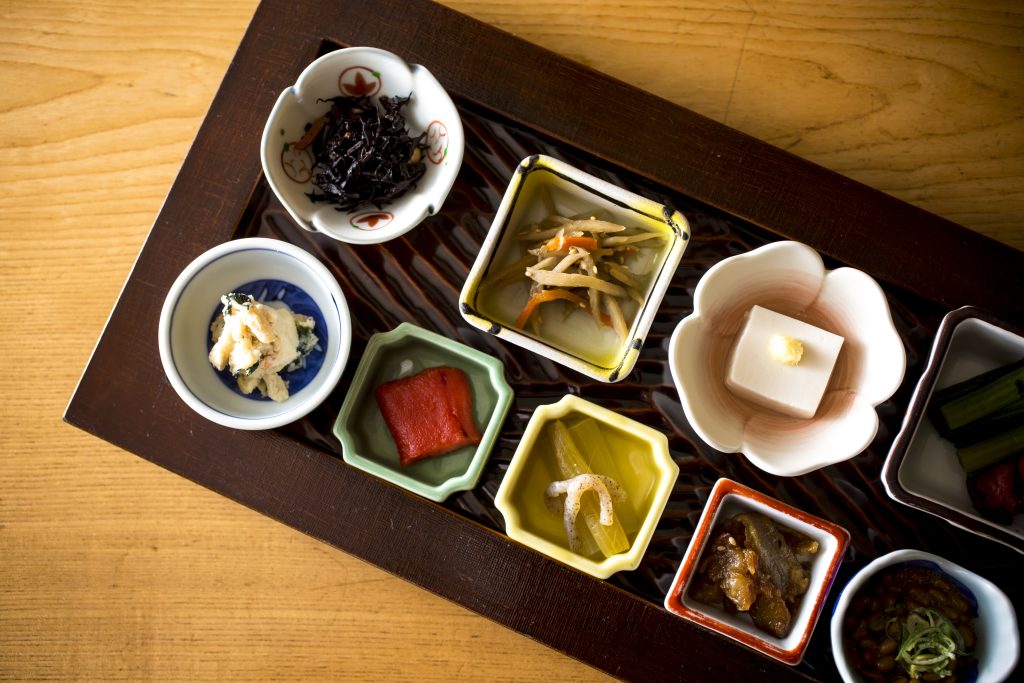
    A ceremonial dinner featured spiky, scarlet Hanasaki crab from southeastern Hokkaido. Hot pot, local fish and miso soup smoothed tired frowns while sake flowed. “This is ‘Shabu shabu’ – it’s an onomatopoeia,” Yuta explained, miming broth splashing. When Nick, our second guide, kindly entertained us with his bamboo flute, I feared my healing journey had overcorrected.

    Philip cemented our friendship during a secluded forest walk. “Right now, we’re where bears fart,” he announced, surveying the vast emptiness. I loved him already. We rubbed 3,000-year-old volcanic ash between our fingers, surveying trees lying uprooted from poor soil. When Yuta showed us ‘Old man’s beard’ moss, the translation proved entertaining: “Men must drink this when they cheat on their wives.” “For… virility?” someone ventured. “No – the opposite.”

    I asked Yuta about ikigai, and whether he’d found his telling Japan’s stories. “I love my job. You find something you enjoy, and become the best you can. It’s better if it helps other people. Plus I get to explore, sit in the onsen… and eat good food.”

    “Have you been to the onsen?” I asked Phil on a long walk home, towards warmth. “Have I been to the Johnson?” he misheard, and I didn’t correct him.

    Later in the week, unseasonable temperatures thawed saltwater Lake Furen-ko, canceling plans of ice-fishing. The disappointment was palpable – it can’t be avoided, a warmer world is already reshaping traditional experiences. Yuyado-Daiichi Inn, our penultimate accommodation set within mountains and streams, helped matters. Surrounded by outdoor thermal baths worthy of Snow White, guests spot martens, squirrels and birds scampering past sparkling waters as snowflakes land on their noses. Though the rare Blakiston’s fish owl remained elusive, each animal sighting felt restorative.

    Rock fish dinners were devoured entirely except for bones and eyes, served with scallop rice. Spirits couldn’t be dampened by a snowstorm canceling a walk around Lake Mashu-ko; too many fireside sakes inspired an impromptu yukata photoshoot. My inner Brit inevitably surfacing – blame the rice wine – I found myself joining a chant aimed at Rick “the Doc” to take his off completely. Yuta’s mortified shushing restored order in this land of quiet refinement.

    More drinking awaited at Kitakobushi Shiretoko Hotel in Utoro, on the edge of the Sea of Okhotsk. Nobody complained about the sleek, bottomless lobby bar, nor the saunas facing the ocean for sunset. I found myself hitting the gym with Rick, George and Phil – not before Phil had rushed upstairs for his “emergency shorts.” “I want to live long and explore like him,” George nodded. So did I, I realized.

    Post-treadmill, one of Phil’s better discoveries was the self-service booze counter, where he uncovered a whiskey his grandfather had worked on in Kentucky. “I can’t believe they have this. This is incredible.” I advised perhaps swerving the shots, after he spoke Spanish to the man frying tempura (“Si señor!”) and commanded the robotic tray collector whizzing around the concourse to “sit.”

    Morning “jammies” (yukata) encounters starting to feel convivial, I realized I’d miss my new friends. Promising to attend Phil’s 81st birthday celebrations, I understood that ikigai isn’t found, it’s lived: putting one foot in front of the other. It’s really that simple.

    For further information on Hokkaido Snow Tour please visit walkjapan.com. Priced from £3,252 (JPY 638,000) per person based on double occupancy. 
  • Tariffs and the psychodrama of Trump diplomacy

    Tariffs and the psychodrama of Trump diplomacy

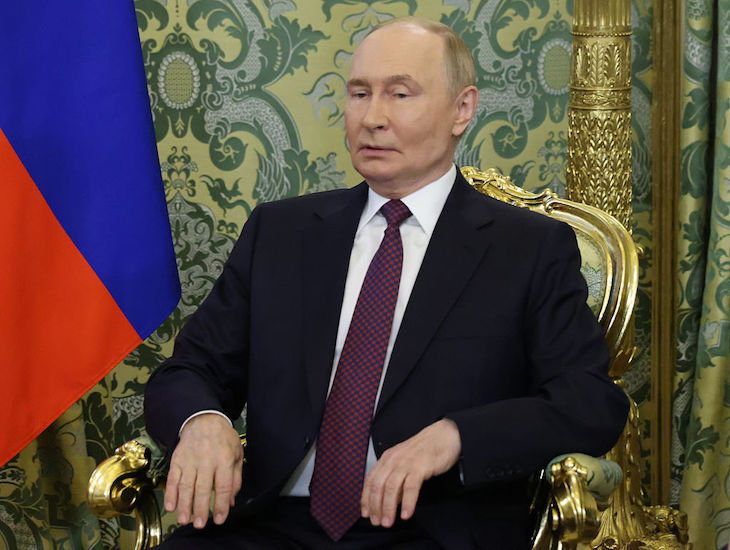
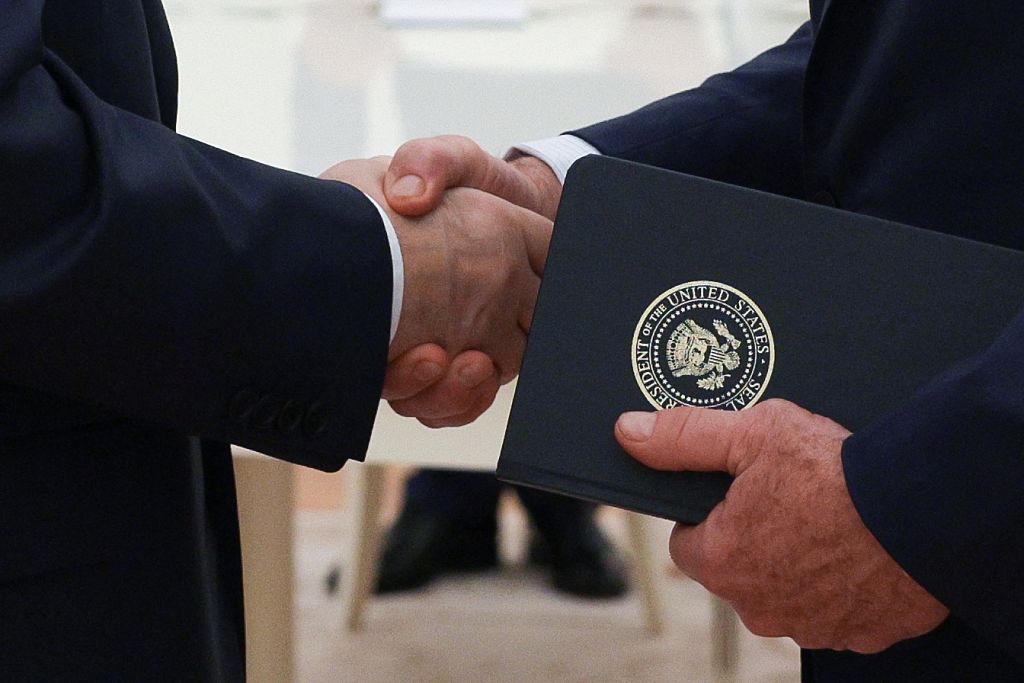
    A bleached white conference room, somewhere near Jeddah in Saudi Arabia. On one side sits Volodymyr Zelensky, the Ukrainian leader, in his soldier-boy outfit. On the other, Russian President Vladimir Putin in dark suit and tie. And in the middle, a beaming President Donald J. Trump. “People said this could never happen,” he says, as Zelensky and Putin stare awkwardly at the floor. “But it’s a beautiful thing.” A White House memo lands in inboxes across the world: “THE PEACEMAKER-IN-CHIEF…”

    Pure fantasy, perhaps, but Trump does have an almost cosmic ability to get what he wants – and he really wants to end the war in Ukraine.

    Last night, having spent weeks telling the world how “disappointed” he was with Putin, Trump abruptly announced “great progress” in US-Russia dialogue. His special envoy, Steve Witkoff, had just spent several hours talking to Putin in Moscow, and it promptly emerged that Trump and Putin could meet as early as next week for a preliminary sit-down ahead of a possible three-way session between Trump, Putin and Zelensky. Putin and Trump have not met since their infamous encounter in Helsinki in 2018 and, then as now, European leaders will be very nervous about the two men getting on. On the other hand, as Trump has always said, he just wants “people to stop dying.” And if he can achieve a meaningful peace deal in Ukraine, he should perhaps be rewarded with the Nobel Peace Prize that everyone says he craves.

    Call it the psychodrama – not madman – theory of international relations. The personal is political and, as we’ve seen with Kim Jong-un, Emmanuel Macron, Zelensky and now Putin, Trump likes falling out and making up with world leaders. It makes for great headlines, plus the emotional rollercoaster helps advance his agenda because statesmen have to worry about what’s in the news.

    The difficulty is that Putin is an exceptionally cold fish who doesn’t care about being hated outside of Mother Russia. The reason earlier peace initiatives failed is that Putin is not losing the war. Putin could “tap,” as Trump put it, America along because, having largely frozen Russia out of the international community, the West doesn’t have much clout over him.

    Trump understands the concept of leverage, which is why last month he agreed to provide new arms to Ukraine. That didn’t seem to intimidate Russia, so Trump also targeted India, the leading buyer of Russian seaborne crude oil, with punishment tariffs. And he ostentatiously dispatched two nuclear submarines towards Russia at the weekend.

    The India tariffs, in particular, appear to have brought the Kremlin back towards the peace table. But who is playing whom? It’s possible that Putin believes Trump’s trade aggression is pushing America’s rivals closer together, which is very much in Russia’s interest. The Kremlin has long believed that America’s hegemony is waning and that, while Trump’s theatrics might dazzle the world, in the long run the BRICS (Brazil, Russia, India, China and South Africa) are in the ascendancy. India’s Prime Minister Narendra Modi, for instance, shows no sign of breaking off trade relations with Russia in the face of Trump’s threats.

    “IT’S MIDNIGHT!!!” Trump barked on Truth Social at 11:58 p.m. ET last night, as his latest tariff program kicked into effect. “BILLIONS OF DOLLARS IN TARIFFS ARE NOW FLOWING INTO THE UNITED STATES OF AMERICA!”

    If only things were that simple. It’s no coincidence that Trump’s most punitive duties are now being imposed on India, Brazil and South Africa (the China and Russia tariff deadlines are upcoming). The White House believes that America still has enough financial muscle to disrupt the BRICS and play them off against each other.

    But, similar to Canada and Europe, the BRICS countries regard America as an increasingly unreliable mercantile power. The biggest downside to Trump’s tariffs, then, may turn out to be geo-strategic rather than economic – as a brave, new multipolar world increasingly tries to get along without America. Politics is personal. And the psychodrama is exhausting, after all.

  • There’s no escape from Russiagate

    In June, Tulsi Gabbard found herself in a difficult position. As a dovish Iraq war veteran who happens to be Donald Trump’s Director of National Intelligence, she’d spent weeks trying to stop America launching air strikes against Iran. She’d cited intelligence reports which contradicted Israeli suggestions that Tehran was just days away from having a nuclear bomb. Trump didn’t want to know. “I don’t care what she says,” he told reporters, before ordering the strikes on Iran. Gabbard had been humiliated. Surely she had to resign?

    Nothing is sure in Trumpworld, however, and humiliation is half the fun. Rather than falling out with the Donald, Gabbard instead redoubled her efforts to please him. She set her agencies to work harder digging up evidence about the “Russia hoax” – arguably the political project closest to Trump’s heart.

    She positioned herself at the forefront of a campaign to go after the creepy network of senior Democrats and deep-state operators who in 2016 engaged in what Gabbard calls a “treasonous conspiracy” to smear Trump as a Kremlin asset.

    Gabbard has published a number of previously classified documents suggesting that President Barack Obama, the Hillary Clinton campaign and the Democratic establishment did collude and conspire with the intelligence community as part of a “years-long coup” against a legitimately elected Republican president. This has delighted the Donald. “Where’s Tulsi?” he called out at a White House event. “She’s, like, hotter than everybody. She’s the hottest one in the room.”

    Gabbard’s findings were then passed on to Pam Bondi, another Trump-appointed hottie who has found herself in a tricky spot. As Attorney General, Bondi had talked up the release of the US government’s files on the late child rapist Jeffrey Epstein. But then her Justice Department and the FBI suddenly felt compelled to release a statement insisting there was no “client list” of powerful blackmailed men and Epstein had abused girls purely for his own sick gratification.

    Bondi’s volte-face aroused suspicion worldwide, partly because Donald Trump once had a sort of friendship with Epstein and partly because Team Trump – especially the new FBI director Kash Patel – had spent years suggesting that the real Epstein story was a giant cover-up to protect the pedophilic liberal elite.

    Now, however, Bondi finds herself back on the legal offensive thanks to Tulsi’s efforts on Trump-Russia. This week she ordered a grand jury investigation into the conspiracy to tie Trump to the Kremlin. In other words, Trump’s long-promised “retribution” for the eight years of legal torment he suffered at the hands of the fiercely Democratic establishment in Washington, DC, has formally begun. “Half the lawyers in Washington just went under retainer,” said the legal scholar Jonathan Turley on Monday. “And it seems like the other half are retaining them.”

    Trumpists are celebrating the exposure of what they refer to as “the greatest political crime in American history” – even if the depth of the conspiracy remains hard for most mere mortals to fathom. Trump’s opponents, meanwhile, suggest that the President, Bondi, Gabbard, Patel and others are engaged in a blatant attempt to distract from the Epstein saga. (In a curious twist this week, the Republican House Oversight Committee issued subpoenas to various Department of Justice figures as well as to Bill and Hillary Clinton as part of their Epstein investigation.)

    It is amusing to watch Trump’s appointees bend over backwards in order to keep Daddy happy. But the revival of Russiagate is much more than a mere smokescreen. It has always been a key part of Trump’s plan for his second term. Indeed, Trump appointed Bondi precisely because he trusted her to be more aggressive than his previous attorney generals when it came to the Russia accusations.

    Trump’s inner circle have long believed that revealing the truth about Operation Crossfire Hurricane – the FBI’s investigation into Russian interference in the 2016 election – will in turn expose the whole secret history of the Democratic party’s eight-year lawfare campaign to destroy Trump. It’s all about the weaponization of justice and the Democratic party’s co-opting of intelligence agencies and the media in subsequent scandals. It’s about the Hunter Biden laptop story and the “stolen election” in 2020, as well as the contorted campaign to put Donald Trump behind bars during Joe Biden’s presidency.

    Sources close to Trump suggest that he has softened toward his enemies since he barely dodged an assassin’s bullet last year. His supporters may be crying out for Obama and Hillary Clinton to be criminally prosecuted but Trump seems unlikely to pursue such a path, even if he enjoys posting memes of Barack and Hillary behind bars.

    Yet the legal hounding of Trump did result in several of his associates and advisers serving time in prison. Naturally, then, Trump’s allies are now salivating at the possible indictment and conviction of figures such as John Brennan, the former head of the CIA under Obama, or James Comey, the former FBI director, or James Clapper, the former director of National Intelligence.

    “We’re going to be a banana republic unless we take care of business now,” says Steve Bannon, who also went to jail over a Trump-related charge last year. Bannon has called for “rough, Roman justice” and this week he urged Bondi’s department to “stick the landing” or risk further disgruntlement within the Make America Great Again movement.

    The use of a gymnastics metaphor is apt, since Bondi will have to pull off some impressive legal acrobatics in order to prosecute leading anti-Trump figures without being exposed herself at some point for weaponizing the justice system. Whichever prosecutor she chooses must prove beyond reasonable doubt that Trump’s opponents knowingly attempted to commit treason or some other serious crimes. Her Republican backers, meanwhile, will have to keep saying that the Democrats derailed Trump’s first term with all their judicial wrangling at the same time as the Trump administration sets in motion a course of legal activities that seem certain to clog up his second term. There’s no escape from Russiagate.

  • Ann Coulter: On immigration, Trump 2.0 and the Epstein Files

    Ann Coulter: On immigration, Trump 2.0 and the Epstein Files

    Ann Coulter, an American author, lawyer and conservative media pundit, joined Freddy Gray on the Americano podcast last Friday to discuss why she backs the UK’s Reform party, why she supports Trump in his second term, what’s really going on with the Epstein files and more.

    Here are some highlights from their conversation.

    Why don’t politicians follow through on illegal immigration promises?

    Ann Coulter: Americans have been voting not to give illegals benefits, to deport them, to make sure they can’t vote, for now almost half a century, and the politicians will never give it to us. That was what was so striking about Boris Johnson and Donald Trump. Oh my gosh, they really seemed to mean it. At least with Trump, every single rally for 18 months, the chant was, “build the wall,” the signs “build the wall,” their etchings “build the wall” and he gets it (the presidency). And he doesn’t build the wall.

    Freddy Gray: What do you think is the real factor there? Is it the economy? Is it that businesses just have that way of pressuring? I mean, I think with what’s now called the Boris wave of the huge influx of immigration during Boris Johnson’s premiership, really, it was pressure from the Treasury to make sure that wages are suppressed because everyone was worried about Covid and so on. Is that the real driving factor?

    AC: Well, there are at least two driving factors. For the Republicans, it’s the donors. They want the cheap labor, which it’s worth pointing out as the as the cliché goes, cheap labor is only cheap for the employer. It’s the middle class that are subsidizing the rich’s poor labor or cheap labor. They are nannies. They are cooks. They are, you know, farm workers because they accept massive amounts of welfare, which leads to the other special interest group supporting illegal immigration, and that’s the entire Democratic Party, because illegals are accepting so much social welfare. Which party do they vote for and their kids can vote in? I mean, now the number of anchor babies who are of voting age is probably 20 million.

    On the future of the UK

    FG: You’ve been spending some time with Reform. What do you like about them in particular?

    AC: Immigration. Immigration. Immigration.

    FG: You think they will make good on their promises? Because quite often we see these parties, when they get into power, they can’t actually make good on.

    AC: Yeah. To take two little examples, Boris Johnson and first-term Donald Trump. That was stunning. It’s been happening in the US for 20 years. It’s been a bigger issue for us, I think. And states, I mean, this was back in the early 70s. Texas voted to have no free public education for illegals, and the Supreme Court, very left wing, overturned it. And that’s when Justice Brennan, incidentally, made up the concept of anchor babies. The court never ruled on it. No legislature has passed it.

    FG: Please explain what an anchor baby is.

    AC: An illegal pregnant Mexican runs across the border and drops a baby. The baby is allegedly an American citizen. No court has ever found that. No legislature. It was just dropped in a footnote of this Justice Brennan opinion. Maybe that’s a side note, but it’s a big, big problem in some hospitals along the border. 80 percent of the babies born are born to illegal aliens. El Chapo. You’ve heard of him? The big, massive drug lord? When his wife got pregnant, she’d run across to San Diego and drop a baby. They’re all American citizens. I’ll just give you one more. I think it was Sinaloa cartel. The cartels are just monstrous. I don’t want to hear about, you know, Hamas throwing rocks and dropping a few bombs. The cartels are beheading people. They are beheading Americans. They are committing heinous, hideous crimes.

    Ann’s disappointment with the first Trump administration

    FG: I think it is fair to say you were disappointed, even fuming, about about the first Trump administration, which was funny because at one point you were pretty much the only American who supported him.

    AC: Yes! Oh, before he got in, I was worried… I was still yelling at him for some things. I guess, it was like March. He wasn’t hiring the right people during the transition. That was a bad sign. It was February or March. I showed up in the Oval Office, and like I say, I never told anyone this, but he told people. I just stood at the resolute desk, haranguing him, hectoring him. I was not the first one to use the F- word, but once it got used… Well it was about, you’re not keeping your promises; you’re you’re not building the wall; you’ve done nothing on the wall; you’re only pushing for tax cuts. The moment when he got really angry, which I think really speaks in his favor, was when I said, “You’re governing like Jeb Bush.”

    FG: The Big, Beautiful Bill upsets fiscal conservatives, but it does give a lot of money to the border. I think it’s probably a mixed bag for people of a conservative disposition. What would you say?

    AC: Yes. I mean, overall, but I can’t blame Trump alone for this. It’s hard to cut anything. You know, a good motto is, “There are a lot of bad Republicans. There are no good Democrats.” So I kind of hate my party. I’m totally with Elon. If they could cut government by 90 percent, the world would be a better place. They’re mostly useless bureaucrats spending their days trying to make our lives worse. First – and I should say I’m not against tax cuts; I think they’re good and important – it’s just that that’s all we’ve ever gotten from the Republican Party. And what was special and different about Trump was he seemed to care about middle America and working class America. He was going to bring back manufacturing. No more stupid wars. The whole America first and mostly immigration, immigration, immigration. So when he blows off those three unusual and important parts of his campaign and does what a Bush would have done. Yes. It was a little disappointing.

    FG: We’re almost 200 days into Trump’s second term. How many marks out of ten would you give Trump in his second terms?

    AC: I guess nine. He gets one taken away for not releasing the Epstein stuff.

    Epstein, Israel, Saudi Arabia?

    FG: Why won’t he release it? Is it because there is evidence of him?

    AC: I think he has donors who are involved. Yeah. And also a favored country in the US. I’ve been following it since 2006. I spent part of my time in Palm Beach, where the whole story broke and the Palm Beach Police were great. National media did not cover it… We were thinking maybe it was like a concierge operation where he runs the sex shop for for rich guys like the private clubs, but that doesn’t make any sense. He would have done it free. I mean, I’m trying to answer the question of where he got his money. He was getting a lot of money. Coincidentally, all the ones he was getting money from are gigantic Israel supporters. All of them. Some foreign country has to be behind it. So you basically get down to, “Is it Saudi Arabia, or is it Israel?”

    Are tariffs good for the US?

    FG: Are you pro-tariffs?

    AC: Totally pro-tariffs. I’m with Trump on it. It needs to be fair, and we have been giving it away. That’s one thing, just for years and years and years, and I’m sick of the free-traders. We’ve been trying your way for 50 years. Manufacturing has been wiped out. We used to have, like, 20 million people working in manufacturing. I think when I wrote Adios America, or maybe it was in Trump We Trust, I don’t know, we were down to like 11 million. The working class and the middle class has been suffering enormously. And I noticed Wall Street is doing quite well. So how about let’s try not having this – what is called free trade. And I think Trump is right. It’s unfair trade.

  • Putin’s economic alchemy begins to tarnish

    Putin’s economic alchemy begins to tarnish

    The Kremlin’s accountants are having a problem: Russia’s state budget, once the engine of spectacular growth, is now flashing red. The mathematics are brutal. Russia’s fiscal deficit has ballooned to 3.7 trillion rubles in June – roughly $46 billion – skating perilously close to this year’s legal limit. As a share of GDP, the deficit threatens to breach the 1.7 percent ceiling, a prospect that has Valentina Matviyenko, speaker of the Federation Council, preaching the gospel of “strict savings” with all the enthusiasm of a Victorian governess.

    The root of Moscow’s monetary malaise lies in spectacular overoptimism. Last September, officials confidently predicted a 2025 deficit of just 0.5 percent of GDP, banking on Brent crude at $66 per barrel, robust 2.6 percent growth, and a conveniently weak ruble at 100 to the dollar. Instead, they’ve watched their projections crumble fast.

    The transformation of a petro-state into a war economy was supposed to demonstrate Russian resilience

    In the first half of the year, oil and gas revenues, which fund more than a quarter of the Russian state, have collapsed by 17 percent compared to last year and 25 percent below projections. The market consensus for next year’s Brent prices hovers between $55 and $65 per barrel, below the government’s projections. Meanwhile, an unexpectedly strong ruble means fewer rubles per exported barrel, creating the peculiar problem of being too successful at currency strength.

    The broader economy tells an equally grim tale. Growth has plummeted from a respectable 4.3 percent in 2024 to 1.4 percent in the first quarter of this year, with the Central Bank now forecasting sub-1.5 percent growth for 2025. Lower growth translates to reduced VAT and income tax receipts, creating a vicious cycle that would make even Gordon Brown wince. Lower growth also means lower GDP, and with nominal fiscal deficit rising monthly, the 1.7 percent legal threshold for this year’s deficit to GDP ratio has all the chances to be blown.

    Putin’s bookkeepers face a difficult problem. The president promised not to raise taxes, ruled out meaningful currency devaluation (which would stoke inflation and increase government costs), and ringfenced defense, security and social spending. What remains is a game of fiscal Jenga where removing the wrong piece brings down the entire structure.

    Defense spending alone accounts for roughly $172 billion – 7.7 percent of GDP – with little prospect of meaningful reduction. The stockpiles of Soviet weaponry that initially sustained the Ukraine campaign are running dangerously low, forcing expensive rearmament. The Kremlin has convinced itself that military production must remain the economy’s primary driver, a strategy worthy of Stalin planners’ applause, but expensive for the state finances.

    With limited options, the government would be passing the fiscal burden to business and citizens with the subtlety of a Moscow traffic policeman. Companies face the prospect of losing subsidies while shouldering additional costs for security and social programs: hardly conducive to investment or innovation. Citizens, meanwhile, can expect higher duties on vehicle registration, steeper excise taxes on life’s small pleasures, and increased fines. It’s austerity with Russian characteristics: brutal but presented as a patriotic duty.

    The regime’s fiscal contortions reveal a deeper vulnerability.

    In 2022, when sanctions first bit, Russian businesses and citizens queued cap-in-hand for state assistance, receiving generous help in exchange for war enthusiasm. Now the state coffers are running dry, but the enthusiasm must remain undimmed – dissent being rather more dangerous than bankruptcy in Putin’s Russia.

    Two external threats loom large over this precarious balancing act. Should President Donald Trump make good on threats to throttle Russian oil trade, or should Brussels tighten technological sanctions, Moscow’s fiscal gymnastics could collapse entirely. The Kremlin has thus far managed to fund its war without triggering mass protests, but the margin for error is shrinking.

    Putin’s great gamble – that Russia could outlast Western resolve while maintaining domestic stability – increasingly depends on economic alchemy. The transformation of a petro-state into a war economy was supposed to demonstrate Russian resilience. Instead, it may prove that even autocrats cannot indefinitely defy the laws of arithmetic.

  • Lunch with Thomas Straker, the chef vilified by the restaurant world

    Lunch with Thomas Straker, the chef vilified by the restaurant world

    “It was a heavy week,” sighs Thomas Straker, explaining why he recently ended up on a drip in New York. He’s been nicknamed Britain’s “bad boy chef,” and his fans love him. He owns two restaurants in Notting Hill and has 2.6 million Instagram followers: not far off Nigella. Another restaurant is coming in Manhattan, so he has been spending a lot of time there. “Post-service, out late, every night” he says.

    Straker Industries has many divisions: he runs a YouTube channel, has a butter range and is about to launch his own olive oil. On the day we meet, I spot him sauntering down Golborne Road towards his restaurant Acre for our interview. He’s wearing a “Game Eater” cap and a T-shirt with his own name on it, tucked into his Adidas tracksuit pants. He’s a mere 40 minutes late. “I dragged myself to Pilates this morning,” he tells me. He likes to get his top off in his videos.

    He has an air of Withnail – lazy hair, hazy eyes, serrated cheekbones – and he stalks similar parts of London. Straker is that evergreen currency: Notting Hill swank, updated for 2025, and it still has much going for it. He stops to say “hey” to a babe a couple of times during the interview.

    Straker has a completely normal background for a Notting Hill celebrity but an abnormal one for a popular chef these days. He grew up shooting and foraging in Herefordshire, and his father was the second-in-command of the SAS and deputy director of NATO Special Forces in Afghanistan.

    A misspent youth did not land him at Sandhurst, but at cookery school. He worked afterwards at the Dorchester and Heston Blumenthal’s Dinner, and then became the private chef to Sir Leonard Blavatnik, the third richest man in the UK. “When Covid came around,” he says, “I saw more food videos come up and thought I should try to do that. I was working in the States for a family of five. It didn’t take me all day to make breakfast, lunch and dinner, so I made good use of my afternoons.” Two years later, he had become so popular on social media that he was able to open his first restaurant, Straker’s.

    Straker’s kitchen burnt down earlier this year. On the first weekend of May he woke up to 200 missed calls. It’s “not been particularly fun the past few months,” he says. “You suddenly go from a very comfortable, high-turnover business to a zero-turnover business… It’s been incredibly stressful financially.” The restaurant reopened at the end of June. It is difficult to book a table, given how busy it is.

    We eat in Acre, his new brunch and lunch restaurant. He orders an iced matcha with agave honey for himself, and some pan con tomate ($8) for both of us –”I literally had this twice yesterday,” he says. Acre is meant to be more casual, more affordable, more in keeping with the post-Covid desire for expediency and comfort than Straker’s. “You want to make it affordable as possible for your customers, but we’re ultimately running a business,” he says. “But this is definitely an accessible way to come and have some good food. It’s not dirt cheap because we’re not using shit products, but we’ll be doing cod here instead of sea bass over there.”

    A teenage girl having brunch with her father comes over to our table. She’s doing her GCSE art project, and they’ve been asked to paint a building. She painted Straker’s because she loves his videos so much, and she shows it to him. He smiles: “Top grades for you! Let’s buy it off you!”

    He then tells me about the olive oil he’s got coming out: “So I was in Soho at 3 a.m. the day before I ran the London marathon… I got carried away.” That evening, he met a man from Puglia who insisted he made the best olive oil around, and that he would send Straker a bottle. “I was amazed it arrived,” Straker said. It was good, and now you’ll be able to buy Thomas Straker’s “Donna Franca” olive oil this autumn.

    Po-faced restaurant industry types are suspicious of him. A couple of chefs have bad-mouthed him to me over the past few months. The popular Instagram page “SluttyCheff” went viral with a satirical account of working as a woman in Straker’s kitchen: “Thank you guys… for welcoming me with such massive muscle-y open arms.” In 2023, he posted a picture of himself with the chefs at his restaurant: all eight were white men, and he got in trouble for it in the papers. I ask him if he thinks he’s been unfairly treated. There’s a long pause. “I’m thinking about what I want to say and what I should say.”

    At the time, he expressed some regret over it and says now that he was “scapegoated for an industry-wide thing. But that’s in the past… I’m having a good run. That is only down to how hard I work with my team, how hard they work. Everyone has an equal opportunity in the business.”

    He’s often accused of just riding the coattails of online hype. “If people want to be like ‘Oh he’s not a chef, he’s an Instagram chef,’ they can fucking say what they want,” he says. “Open your fucking restaurant, whatever. I’m doing my own thing. It did piss me off for a bit, but now I’m just level. I know what I’m doing… I don’t feel unfairly treated. It always comes around in the end.”

    You get a sense that the world might be bending towards Thomas Straker. Jonathan Nunn, who edits the left-wing food magazine Vittles, recently posted about how he respects Straker for not trying to hide how posh he is. “Thomas Straker is just repeatedly posting pics hanging out with David Cameron or cradling Boris Johnson’s baby.” When Straker isn’t in London, he spends time at Carole Bamford’s Daylesford estate, producing online content from the Cotswolds.

    America now beckons. He is taking over a site formerly overseen by Keith McNally (another enfant terrible of the restaurant world) and they’re “just about to go into building work.” I wonder what America will make of him. They tend to love posh Brits, less so gobby ones. Oasis didn’t travel well across the Atlantic; Hugh Grant did. It will be interesting to see how Straker lands. In spirit, he is both Grant and the Gallaghers.

    When I ask what he gets up to in New York, he shows me a tattoo of a naked lady on his shoulder, done for him by a guy called “Bang Bang.” He grins like a teenager. Being Thomas Straker looks like fun.

  • The Art of the Dealmaker-in-Chief

    Who really thought Donald Trump’s America was about to join the stampede of first-world powers promising to recognize Palestine at the United Nations? 

    “Wow!” He exclaimed this morning on Truth Social. “Canada has just announced that it is backing statehood for Palestine. That will make it very hard for us to make a Trade Deal with them.” 

    All over the world, commentators convinced themselves that Trump’s expression of concern on Monday about “real starvation” in Gaza meant he was pivoting with global opinion and against Israel. 

    It turns out, however, that Team Trump is not for turning when it comes to the Middle East. Marco Rubio, the US Secretary of State, has accused the countries now embracing Palestinian statehood of falling for “Hamas propaganda”.

    Trump himself would rather focus all his diplomatic energy on trade, a subject about which he has been positively monomaniacal in recent days. He seems very taken with the new title he has given himself – the Dealmaker-In-Chief. 

    “We are very busy in the White House today working on trade deals,” said the President on Truth Social last night. Three hours later, he announced another “full and complete” agreement with South Korea, involving a 15 per cent tariff on them and $350 billion for the US. That’s on the heels of a deal between America and Japan, South Korea’s big rival in manufacturing terms. 

    The real coup for Trump’s trade strategy this week, however, has been the new framework arrangement with the European Union, which he announced on Sunday from his golf course in Turnberry, Scotland. 

    The EU deal is not simply a major breakthrough in and of itself. It’s also, as the US Treasury Secretary Scott Bessent suggested to my colleague Michael Simmons in Stockholm this week, a useful piece of leverage in the even bigger tariff struggle with China. Bessent was in Sweden for another round of negotiations with his Chinese compatriots and, for US officials, pulling Europe more towards a western trading orbit and less towards the east is an essential thing for the future of capitalism and the free world. China and the US appear to have agreed to take another pause from tariff hostilities – the two sides differ over fentanyl chemicals and Beijing’s role in supporting Iran and Russia. 

    It seems that now Russia is playing on Trump’s mind. On Monday, he suggested he would impose tariffs of up to 100 per cent on Russia if the war in Ukraine didn’t end within two weeks. Then yesterday, as he slapped further tariffs on India, he criticized New Delhi for buying up Russian oil and gas. “I don’t care what India does with Russia,” he said. “They can take their dead economies down together, for all I care.”

    Then, in perhaps the most intriguing trade development of the week, Trump declared a brand-spanking-new deal with Pakistan, including an arrangement to invest in Pakistani oil. “Who knows, maybe they’ll be selling Oil to India some day!” he “truthed”. 

    All jokes aside, Trump’s sudden enthusiasm for Pakistan at India’s expense marks a major shift in US policy in the last few years. Under Obama and Biden and Trump, the US state department has tended to prefer Modi’s India.  

    As ever with Trump, his apparent tantrum with India might conceal a subtler move. That’s the art of the Dealmaker-in-Chief. 

    In the last two decades, Beijing has made enormous investments in Pakistan, particularly in infrastructure through its Belt and Road Initiative. In some ways Pakistan has become an extension of China’s empire. 

    But not all Pakistanis relish the idea of being a Chinese satellite-state. And now the thought of Donald Trump suddenly wooing Pakistan’s government – which recently nominated him for the Nobel Peace Prize, funnily enough – will ring loud alarm bells among the highest ranks of the Chinese Communist party. With Trump’s international agenda, scratch beneath the hilariously crazy surface and you find a more serious campaign to isolate China, China, China. 

    This is taken from the latest Americano newsletter. To subscribe click here

  • A chat with the Princess of Iran

    A chat with the Princess of Iran

    The Princess of Iran is casual over email. Noor Pahlavi, the 33-year-old eldest daughter of Iran’s Crown Prince in exile, Reza Pahlavi, is American-born, a potential heir to the Iranian throne and ready for regime change in the Middle East.

    “Hi it’s been a crazy couple of weeks,” she wrote me a few days after the US plopped some 400,000 pounds of bombs on the Islamic Republic’s nuclear sites. That same week, Reza began to appear across Western media, calling for rebellion within Iran and support from without: “This is our Berlin Wall moment.”

    Reza is the son of the last Shah of Iran. His family has become a symbol of a Persian, pre-Islamist Iran, and Reza casts himself as the transitory figure to lead the country into a more liberal post-regime future. Whether that future involves a republic or a restoration of the constitutional monarchy must be left up to the people, he consistently says. Should they choose the latter, he has self-effacingly suggested he would accept the responsibility.

    This means that Noor, an impeccably styled New Yorker who works in venture capital, has a shot at the throne. In fact, following Reza’s reign, she may be the most viable successor. This raises a question: is she simply an American businesswoman, or is she a future empress?

    The rules for the Persian line of succession are messy. The most detailed potential source of guidance comes from Iran’s pre-Revolution constitution, which declared that the Shah must be succeeded by his closest male heir. But Reza has only three daughters. The closest thing he has to a male heir is his nephew, Keykhosrow Jahanbani – a man about whom zero public information seems to exist. But Keykhosrow is partially descended from the family that the Pahlavis toppled to take the throne, the Qajar, and a caveat in the constitution forbids a Qajar from ever holding power again. So this 50-something-year-old dispossessed royal, wherever he is, doesn’t have a chance. That leaves us with the Pahlavi daughters. The old constitution, according to some Iranians, could permit Reza to nominate one of these three as heir.

    As for Noor: the State Department couldn’t dream up a more ideal Iranian royal. She was born in DC, raised in Maryland’s suburbs, graduated from Georgetown University (magna cum laude) in psychology and is involved in a variety of human-rights philanthropy networks. The Pahlavi dynasty’s lineage is Muslim, but the women are certainly not the hijab-wearing type. On the contrary: Noor is one of New York’s more glamorous denizens; She pops up at the Hamptons and galas in designer gowns and runs in a designer crowd, and the Arabian editions of Vogue and Harper’s Bazaar play up her blending of Persian fashion with Western styles at events in New York and Paris. Her allure has become a symbol to Iranians in exile of the banished Persian empire’s wealth and luster.

    Noor’s idea of post-regime Iran combines that fragrant vision of Persia with something that sounds an awful lot like liberalism. She wants an Iran “where Persian culture is celebrated rather than washed away” and one “where citizens can love who they want, practice whatever religion they want.” She says the regime is “weaker than it’s ever been” and bemoans “outside forces” keeping it on life support.

    But whether she sees herself leading that nation is a trickier question. Should the regime fall, I ask her, would she return to Iran?

    “I personally would love to spend time in Iran and help see the Iran Prosperity Project, which my dad and many others have been working on, come to fruition,” she tells me. The answer doesn’t exactly betray ambitions for lifelong dominion, and at no point in our correspondence did she indicate plans to remain in Iran long-term. If she were harboring regal ambitions, you’d expect her to take on a more public-facing political role than she has – the jump from venture-capital principal to princess isn’t small.

    What about her siblings, then? The second daughter, Iman, works in finance as well. She maintains a lower public profile than her older sister, but she brought Reza his first son-in-law, Bradley Sherman, a Chicago-born, Jewish New Yorker. This marriage may have inquisitive minds asking an intriguing question: could an American Jew be the future leader of Iran?

    No, probably not. But Dick Cheney can dream. Historically, Iranians haven’t accepted rulers of non-Iranian lineage. But the marriage – a glitzy Parisian party earlier this year – shows just how starkly the family contrasts with the Islamic Republic. If the wedding had taken place in Tehran, it’d be a death sentence for the couple.

    The connections with the Jewish people are political as well as familial: in 2023, Reza accepted an invitation from Benjamin Netanyahu to visit Israel, where he prayed at the Western Wall. Add to this the fact that he saw Israel’s bombardment of Iran as a springboard for regime change in the country, and it certainly appears that he and Bibi are at least tenuous allies.

    Iman, however, rarely appears at such political events and is less visibly involved in her father’s campaigning. She appears basically Americanized and does not play up her royalty in any public way – Iranians familiar with the family say she was raised as an American, not a Persian queen in the wings.

    Same goes for the youngest daughter, Farah, who attends the University of Michigan and seems to be living an essentially American youth, complete with summer internships and UMich vs. Ohio State football games. (If she were handed the throne, you have to wonder whether Buckeye fans would side with ousted ayatollah.) But, as with Iman, Farah’s upbringing doesn’t seem designed to prepare her for monarchy.

    All of this poses a problem for Reza, should the Iranian people choose to restore his dynasty. He and his wife, now empty-nesters, recently sold their Maryland home (listed for $3 million), and they seem to spend much of their time in Paris, where Reza’s elderly mother lives. Within Iran, there’s definite nostalgia for the Pahlavis and hope for their return: Reza’s face appears at protests across the country. But even the Iranians yearning for his family’s return must recognize its improbability. And it’s unclear how this royal line – absent from its homeland for nearly 50 years and thoroughly Americanized – can survive its patriotic patriarch’s death. This explains in part why some in the Iranian dissident movement look to leaders other than Reza, such as the journalist Masih Alinejad and the lawyer Nasrin Sotudeh, who still lives in Iran. Homesick, patriotic, glamorous – the Pahlavis may one day return to Iran. But their exile from the life their family once lived may not.