Author: JP4

  • Why the Army needs the cavalry

    Why the Army needs the cavalry

    A generation ago, I was an officer in the US Army National Guard and later in the Army Reserve. I did absolutely nothing important, and never saw any places more exotic than Fort McCoy, Wisconsin, and Camp Atterbury, Indiana. I then spent a dozen years working for the Army as a civilian employee.

    I had already decided before these events to devote my academic career to the study of the Army. I loved (and still do love) it in an abstract and historical sense. However, only after my personal association with it did I realize how profoundly shortsighted it was. I observed this myopia daily and marveled at its immensity. Veterans may remember the adage that there is “the right way, the wrong way and the Army way.” The Army way is usually just plain dumb.

    Veterans may remember ‘the right way, the wrong way and the Army way.’ The Army way is usually plain dumb

    Where am I going with all this? You may have seen the Army’s recent decision to eliminate all its horse-mounted ceremonial units in a cost-saving measure. Many will immediately attribute this decision exclusively to President Trump and the Department of Government Deficiency (DoGE). I know better, and so does anybody who served in the Army but retained a healthy sense of skepticism. While there has certainly been an emphasis on cost-cutting and savings, this decision was made by someone much lower in the food chain. Some one- or two-star general or some Deputy Assistant Undersecretary of the Army for God Knows What decided that for a mere $2,000,000 of savings (the Department of the Army’s total annual budget for 2024 was $165.6 billion), the Army would eliminate one of its few historical vestiges and an example for relatively cheap positive public relations.

    Every other branch of the armed forces has its quirks. The Air Force has been described as an organization staffed with businessmen in flight suits. The Navy is an organization that will sacrifice anyone to save face (do a Google search on how often ship commanders are relieved because of a “loss of confidence.”) The Marine Corps not only takes pride in being the physically toughest branch of service but also seems to enjoy suffering in an almost strangely masochistic way. The Army, however, owing to its status as the first American armed force and almost always the largest, doesn’t seem to have a true ethos of its own.

    Its advertising campaign could almost be (paraphrasing the internet) “Not smart enough for the Air Force? Don’t want to be trapped on a ship with 1,000 other people? Not tough enough for the Marines? Well then, what about the Army, you don’t have any other choices…”

    When it comes to history and public relations, the Army’s incompetence truly shines. There is scarcely a ground combat situation in our history where it was not present. Yet it seems unable to inform the American public about this storied history. Even among people who know scarcely any US history, I would be shocked to find those who do not know about the Marine Corps and its role in World War Two. Why? The Marine Corps treats history more like hagiography, and they have lovingly wrapped their history and public relations together.

    The Air Force maintains the Thunderbirds ($35 million annual budget), and the Navy maintains the Blue Angels ($40 million), both of which go around the country providing examples of aerobatic excellence, which enthrall crowds and entice young people to join their services.

    We have already mentioned the Marine Corps’s brilliance in merging history and public relations. Where does that leave the Army? Ironically, the mounted units, which it has now decided to get rid of, are one of the few examples of effective public relations without explicitly recruiting – generating goodwill and positive feelings among the public. Yes, the horses were a throwback to a bygone era, but isn’t the Army proud of its history?

    So, here it stands, shooting itself in the proverbial foot for the savings of 0.00001 percent of its annual budget. Unlike the Navy and the Air Force, the Army is an institution whose backbone is people, not aircraft or ships. The Marine Corps is organized similarly to the Army, but it seems to understand what it is and how to relate that information to the public.

    There was a memoir written back in the 1980s by a man who served in the cavalry during its final years. He told the story of how an Army officer and a sergeant violated regulations to allow an old cavalry horse to live out its final days in a pasture rather than be sold off for dog food. He then contrasted that behavior with what he saw when he later served in the Air Force in the 1950s.

    For him, the distinction demonstrated the different service cultures and why he preferred the Army’s. Unfortunately, I think that culture no longer exists in the Army. Can it be revived? I certainly hope so, but this latest decision gives me very little hope.

    This article was originally published in The Spectator’s October 27, 2025 World edition.

  • Laura Loomer is in the crosshairs

    Laura Loomer is in the crosshairs

    “I get death threats every day,” Laura Loomer says matter-of-factly, as if discussing her junk mail. “I get death threats from Muslims, radical leftists, trannies, you name it.”

    ‘After what happened to Charlie Kirk, you have to wonder if people are hiding on a roof planning to kill you’

    An alligator skull, a bullhorn, a red MAGA hat and a grinning pumpkin sit on a shelf behind Loomer in her pink-lit Florida studio – otherwise known as the spare bedroom of her Gulf Coast rental. This is the headquarters of Loomer Unleashed, the notorious podcast from which she has single-handedly ended the careers of dozens of members of the Trump administration by revealing their alleged treachery. Yet it is very much her future under discussion right now.

    “Just this morning I had to have a conversation with state law enforcement because they’re monitoring an individual who they believe had a plot to take my life for being Jewish and conservative,” she says.

    Since we spoke, the man Loomer referred to has been arrested by police in Texas for making death threats against her and other Jewish conservative members of the media. Nicholas Ray is in custody awaiting extradition to Florida to face charges.

    Death is increasingly an occupational hazard in the polarized world that Loomer inhabits. What makes her even more of a target than other online provocateurs is the sheer number of enemies she has made – numerous groups from across the political spectrum could feasibly have her in their crosshairs. “After what happened to Charlie Kirk, you have to wonder if people are hiding in a tree or hiding on a roof planning to kill you. It’s at the back of my mind every day. There are Nazis out there, there are jihadis, there are radical leftists. There are all types of crazy people who believe crazy conspiracy theories or hold radical views on the left, and unfortunately on the right as well.”

    Living anything approaching a normal life under such conditions is impossible, Loomer says. This is why she has few friends and rarely leaves her home. And when she does, she makes sure her boyfriend, or whoever she is with, has a gun.  “When you go out, one of you has to be armed. I keep an eye out when people are staring at me in restaurants. Do they recognize me? Are they friendly? Are they hostile? It’s a lot of stress, which is why I don’t really like going out. It’s dangerous.”

    There are few things in life more certain than death, taxes and Loomer’s steadfast support for Donald J. Trump. They spoke just a week ago. She won’t reveal what about, but says with a flash of menace: “I like to serve as an extra set of eyes and ears on the outside to tell the President the truth about who’s being loyal, who’s being disloyal, who’s undermining him and his administration.”

    It is in this role that she has been his most effective servant. Her stock in trade is “Loomering” – professionally kneecapping – apparent fifth columnists in his administration. She first identifies them – often via a digital deep-dive that uncovers an old Democratic alliance – and then blasts their treachery to her 1.8 million followers on X and 130,000 podcast subscribers.

    In reality, however, the public demonstration is for an audience of just one: the President. Her scalps are racking up quickly. The biggest – and bloodiest – came when she dropped a dossier on the Resolute Desk during a meeting with Trump in April that led to six National Security Council staffers being fired. The President is appreciative and calls her “a patriot” and a “fantastic woman.” The love is mutual. Loomer says with palpable enthusiasm, “I’m very passionate about supporting President Trump and his agenda so that we can truly make America great again instead of just having it be some pipe dream and a slogan on a red hat.”

    But a glimmer of daylight is now emerging between them over the issue that Loomer believes is the biggest threat to America at the moment: Islam. She goes so far as to admit that she is “disappointed” with the man she clearly otherwise reveres.

    “I don’t know why his administration is playing footsy with Muslims right now. If you look at the Trump that ran for president in 2015 and 2016, he literally said Islam hates us and we have a Muslim problem in our country. There should be a complete Islamic travel ban. I have a lot of questions about this. I’m a bit disappointed. I don’t know what the reason is. Maybe he’s trying to normalize relations with Qatar. But normalizing relations does nothing for us if our country is conquered from within.”

    Her advice for the President is typically radical. “Deport all non-citizen Muslims. We need to have an immigration moratorium on all Islamic immigration from every single Muslim country. We need to make it illegal to serve in Congress if you are a Muslim. It needs to be illegal to take your oath of office on the Qur’an as well. There is more Jew hatred and incitement to violence against Jews in the Qur’an than there is in Hitler’s Mein Kampf.”

    The implications of not acting, to Loomer’s mind, are terrifying and impossible for America to recover from. “We’re going to become a Muslim country. We’re going to wake up one day and Muhammad is going to replace John as the most popular male baby name here in the United States, the same way that it has in the UK and France and Germany. Every single Muslim who’s ever been elected to office in the United States of America is a hostile force. Every single one of them has anti-Semitic and anti-Christian views, anti-American views and pro-Islamic terror views. I haven’t met a single Muslim candidate for office in this country that passes the bar, not a single one.”

    If there is bleakness creeping into her worldview under Trump, how much worse will it be when he leaves office in 2028? Is there anyone she trusts to carry the MAGA torch forward? “J.D. Vance and Marco Rubio are definitely frontrunners,” is all she would say on the matter. “I need the GOP to actually pull their weight if I’m going to even cast a ballot. I have no love for or loyalty to the Republican party. In fact, I think that we live in a country where we have a uniparty that serves the interests of the political elites.”

    What of her own future after Trump leaves office? Loomer has stood twice for Congress – but when asked about standing again, she says: “I can’t think of anything I’d like to do more aside from gouging my eyes out than running for office. Perhaps I’ll just pivot full-time into doing political consulting or political research. Maybe I’ll continue doing my show. Maybe I’ll be asked to come work on a presidential campaign in 2028. I’m very passionate about animals as well. Maybe I would get into animal rescue. I have no idea.”

    Unusually for a 32-year-old, she is determined that when she dies, the world will remember her name. “Everybody dies someday and your friends are sad and your family’s sad and maybe your co-workers are sad, but then everybody forgets. You have to build a legacy while you’re alive.

    Is Laura Loomer a sociopath? She’s variously called a conspiracy theorist, Islamophobe and a white nationalist

    “It’s kind of like a taboo thing to talk about because it’s not really one of those socially acceptable things to have a conversation about, but everybody can get married and everybody can have kids, but not everybody can have a lasting impact. And maybe it sounds sociopathic. Maybe it is a little sociopathic. Some people will say, ‘Oh my God, she’s a sociopath.’ I don’t really care. I’ve had some people say, ‘Well, that’s a really terrible way to look at life.’

    “But everybody has their own unique talent and it’s up to us, while we’re alive on this planet, to find out what our talents are and how we can utilize our talents. Not just to have a personal life but also how we can help our communities and help our country.”

    Is Laura Loomer a sociopath? She’s variously branded a conspiracy theorist, an Islamophobe, a white nationalist and, horror of horrors, a body-shamer after tweeting: “Yikes AOC has gained at least 50 pounds since getting into Congress.”

    Or is her dark secret that she’s content – and optimistic about the future? “I don’t know if I would ever run for president, but who knows?” she smirks. “William Shakespeare once said that expectation is the root of all unhappiness. They used to play that Rolling Stones song ‘You Can’t Always Get What You Want’ at every single Trump rally – but if you try, you might just get what you need. So maybe in the end I’ll just end up with what I need, but not with what I want.”

    This article was originally published in The Spectator’s October 27, 2025 World edition.

  • Can American restaurants thrive in Britain?

    Can American restaurants thrive in Britain?

    To mark the arrival of Carbone in London and the imminent opening of Straker’s in New York, The Spectator’s Angus Colwell spoke with writer Gage Klipper about the differences between British and American restaurants, whether bad-boy chefs are back in – and which eateries couldn’t exist anywhere else.

    ANGUS COLWELL: Shall we talk about Carbone, which has just arrived in London?

    GAGE KLIPPER: For sure. I’m a certified Carbone hater: New Yorker, born and raised, but for me, Carbone just never really fit the New York vibe. It’s the Instagram person’s idea of what New York fine dining should be. Of course, they cater to this old-school, showy New York sensibility, but it’s not really New York in any real sense. It’s what the expat coming in from the Middle East, or the Russian oligarch’s daughter, thinks is exclusive New York or it’s where celebrities go to because their publicists tell them. That’s just not New York in any traditional sense. Carbone does pretty well in Miami and they’re all over the Middle East, which makes sense. It caters to this rootless, global, striving, wealthy elite. They have this glamorized, if foreign, vision of what elite American tastes are because, at its core, Carbone is red sauce, Italian-American food, which I grew up with. My grandma served it in Queens and Carbone elevates it and charges out the ass for it. And it’s overall fine. But that’s really all you could say about it: it’s fine. It’s not about the food; it’s about being able to take a picture of yourself there.

    AC: I spoke to some people who were at Carbone in London on Friday night, and they said that it was all ridiculous and that the food gradually got worse. The appetizers were kind of all right; the starters were fine. As the evening went on, the guests got more drunk. Victoria Beckham was there. Then the veal parm arrived and it was inedible. All the reviews have gone like, “Oh, this is a show.” But I find this to be a bit of a shame because over the past two years, particularly in London, we’ve had this strange thing where everyone’s gone Italian American. Some places have done that well. There’s a place called the Dover, which is gorgeous. It looks like a great martini bar in Mayfair. The cooking is good. Then we’ve also got Grasso, and I really wouldn’t be surprised if it closed soon. It tries to do red-sauce Italian, but charges £30 for a plate of “Nonna’s meatballs.” And it just looks disgusting, and the reviews are bad. In London, we’re told this is all “authentic New York” because London has always been obsessed with New York. But it’s clearly not New York. There probably aren’t many places like the Dover that New Yorkers choose to eat at. In the eyes of Londoners, the three main New York restaurants are Carbone, Balthazar and Katz’s. I’m sure New Yorkers would feel differently.

    GK: Well, I think Balthazar deserves to be considered an authentic New York restaurant. But Carbone? You could walk 15 minutes over into Little Italy and have a million times better meal than at Carbone at half the price or less.

    AC: The thing that strikes me about the Carbone menu is how safe it is. They’re catering for celebrities. It’s intriguing to me that you can choose a route through the menu like you’re ten years old. The same is true at the River Café in London, which is our premier celebrity restaurant: it’s unbelievably expensive. You have a pizza, a pasta, then ice cream, and you can do that as a 60-year-old man. These restaurants retain some kind of allure for the wealthy: they allow you to act like a child.

    GK: That’s interesting. The service at Carbone is pampering, too. But at the same time, it’s lost any of the elegant charm of real fine dining. The waiters are in tuxedos and they bring over the amuse-bouche and you’ll have a whole team coming over asking consistently if you need something, replacing silverware, replacing plates. So, although it does cater to the ultrarich, it’s the nouveau riche, the baby rich, who have a very gauche taste. The fact that Carbone could even be seen as elevated cooking speaks to how shitty everything else is. It’s common to not be able to get a decent plate of pasta or pizza in divey Italian spots. That’s not how it should be. It’s crazy. I’m based in Baltimore. There are all these Italian restaurants that have been here for 50 or 100 years – and there’s not one place you can get a decent bolognese.

    AC: What’s worked well from London coming over to the States? The steakhouse Hawksmoor?

    GK: Oh yeah, Hawksmoor. That’s been on my list for ever. I’ve always heard great things. Novikov: that’s come to Miami. I think it works well there because it fits the seedy vibe. It sticks to the model; it knows what works. Restaurants hit the wall when they try to cater too hard to a demographic or a city they don’t know anything about.

    AC: I don’t know if you’ve ever read Jay Rayner’s review of Novikov in London. He said, “You don’t have to hate Novikov on principle. There’s more than enough about the place for you to hate it on its own terms.” This is a classic thing that British restaurant critics do, which is pull their punches for a lot of the small places or where industry darlings work. And then they go after a place like Novikov or Carbone. I’m expecting to see a savage Carbone review soon.

    GK: I’m a lot more optimistic about Straker’s coming to New York. The Novikov-Carbone model: people are just tired of it. I think Straker’s is set to do well, if he follows Keith McNally’s footsteps, which is interesting because he is opening on the site of Lucky Strike: a classic McNally restaurant. McNally viewed the restaurant industry as an artist might, with that cinematic nostalgia. At his restaurants, when you walked in, no matter who you were, no matter what time of day it was, you felt like you were walking into a suspension of reality. Thomas Straker seems to follow that approach.

    AC: He actually doesn’t. In fact, the closest we have to McNally in London would be Jeremy King, who used to own the Wolseley and Zédel and these big brasseries. But I agree about Straker’s opportunity. There are several reasons why this move is genuinely interesting. First, I think it’s the first British restaurant that has opened in New York. Hawksmoor is as much of an American steakhouse as a British restaurant. Even in the London branches, there’s a “mac and cheese.” Straker’s menu is very British: he’s into game. Say I went to Straker’s tonight, there’d probably be pigeon on the menu. There might even be grouse. Recently I had pork belly, lamb sweetbreads, radicchio, that kind of thing. It’s a genuinely very British and seasonal menu, which I’m sure Straker will want to do in New York, too. The second point is that he really is public enemy number one in the London restaurant scene.

    GK: I know he had that scandal with the all-white cooking staff.

    AC: Basically, if you talk to a lot of chefs, they’ll just say, “Oh, Straker’s a wanker.” He’s a proper posh Richard E. Grant lookalike, sharp cheekbones, cocky guy. He’s quite right-wing coded: he likes shooting and all that. He’s become so easy to hate, and I think a lot of the hate is lazy. New York may just not care about any of this. How evergreen is the supposed charm and appeal of a posh Englishman in New York?

    GK: McNally has a famous line about that: he said he only succeeded because you can never lose the charm of a British accent in New York. But the bad-boy edginess of it all, bucking the status quo, rebelling against sustainability and vegan options and all of that; I think New Yorkers are tired of that. That said, I hop between New York, the DC area and Miami and of all those places, downtown New York is where being right-wing coded is becoming cooler and edgier.

    AC: If there were three restaurants in New York that you think can only exist in New York, that you’d recommend, what would you go for?

    Even when EMP went vegan, it had an extremism that’s hard to understand unless you’re in New York

    GK: Smith & Wollensky, right off the bat. It’s just so quintessentially New York. It has that old-school steakhouse vibe. It only goes back to the 1970s, but it feels like it’s been there since the 1920s. You get all the prime US cuts. They dry age, which is not something I know you Brits are a huge fan of typically. And you just can’t beat the service. The food is fantastic. It’s always the same. I grew up going there. They’ve had the same bartender since I was born. You really do have to have an Italian one. Il Cortile is one of my favorites. It’s also very old. Not really red sauce: it’s elevated. They’ll do a whole selection of meat and fish and, of course, you can get some pasta to go with it, but it’s the full Italian-American experience. It’s very family oriented and casual in a way that the WASPs could never really wrap their minds around. I don’t think that would transplant to the UK. And then I’m trying to think of a real fine dining scene that feels quintessentially New York. Something like Eleven Madison Park: it’s arguably overrated now and maybe always was, but it took everything to the utter extreme with its tasting menu. Even when they went vegan, it was always just this New York extremism that it’s hard to understand unless you’re in the constant whir of New York City. How about London’s quintessential places?

    AC: I’ll give three, too. St. John is probably the classic, but that’s too obvious. I would say a “caff,” or a greasy spoon, is very London, not very New York. I’d have recommended the Regency Café, but they’ve had a change of ownership, so no one knows how that’s going yet. Instead, I’d recommend the café across the road, the Astral. They’re rude to you in there. Taxi drivers love it. And it does a great breakfast. There’s another good place in north London, in Finsbury Park, called Tollington’s Fish Bar. It was a fish and chip shop that has been turned into a Spanish pintxos bar. It captures what I like about London: strange things popping up in strange places. The third one would be Black Axe Mangal, which has a menu that I don’t think could exist anywhere else in the world. It’s run by the former head chef of St. John Bread and Wine, Lee Tiernan. About ten years ago he just set up a restaurant and no one could describe the cuisine. They still can’t. But to give an idea: I recently had a jellied Szechuan pig’s head, then a lamb offal flatbread, then a deep-fried calf’s brain bao. Then crispy rabbit. They brought a whole gilthead bream covered in squid ink and Morteau sausage, and then a pina colada dessert. It’s wild. That mixture of Turkish, Szechuan, offal. It somehow feels very British. Would that work in New York?

    GK: That sounds amazing, but I think it’s a tougher sell for sure. New Yorkers aren’t used to that elevated, modern twist on Turkish/Middle Eastern food. I’m also not sure New York is ready for offal.

    This article was originally published in The Spectator’s October 27, 2025 World edition.

  • In awe of Fuji-san

    In awe of Fuji-san

    My personal version of hell? Shibuya station, Tokyo. Shibuya Scramble is one thing: the busiest pedestrian intersection on the planet, it sees two million people elbow each other, every day. But the train station that thousands of them are trying to get to? That’s where my hopes go to die. A place where you’ll find me near tears, wondering if I’ll ever see my loved ones again. It’s almost impossible to navigate, spread across a dizzying number of floors and stuffed with throngs of human beings speaking a dozen languages. New platforms spring up all the time, often at the top of an unassuming escalator, or via a tiny hidden exit of the Hikarie shopping mall. There are (one or two) signposts, sure, but my Japanese leaves much to be desired.

    Hopping on a limousine bus from Shibuya Mark City, which is attached to Shibuya Station, to Kawaguchiko had sounded doable, positively luxurious compared to my myriad disastrous transport experiences in the world’s most populous city. Like most wide-eyed first-time travelers to Japan, for reasons I wasn’t quite sure of, I just had to get to Mount Fuji. There’s something intangible, even magical about that volcano, its indelible shape scoring our collective consciousness through pop culture: I must have absorbed it through anime, wall posters and Godzilla movies.

    A friend and I would spend three nights at Hanz Outdoor Retreat, a mini-village of glamping villas and dome tents amid forests and lakes, Fuji (or “Fuji-san” as the locals call it) providing a pretty unforgettable backdrop. It would be the perfect escape from the maelstrom that is Tokyo.

    “Run!” Claire screeched via a voice note. I had seven minutes to follow photos she hurriedly sent through WhatsApp, breadcrumbing essential directions needed to find the series of escalators and narrow staircases hidden behind random doors that would eventually lead to the tiny coach terminal at Shibuya Mark City, found inexplicably on “4F.” Sweating, I found my comrade, and we tracked down the right vehicle by sheer luck. On instinct, I followed a tourist wearing a T-shirt printed with an image I’d associated with Japan as long as I could remember – Mount Fuji peeking out from behind a huge white-crested wave, in a storm-tossed sea. If anyone knew where I was going, it was this guy.

    Like most first-time travelers to Japan, for reasons I wasn’t quite sure of, I just had to get to Mount Fuji

    As the journey wore on, he and the rest of the passengers pressed their noses and phones to the windows, distracted by the mountain’s sheer magnificence, said to have formed over the past 2.6 million years.

    Picked up two hours later by our guide Savvas, we had no difficulty settling into the peaceful hotel complex, stopping in the grounds to stare up at the volcano. Our villa was reminiscent of an old-fashioned nagaya (Japanese row house), laden with heavy fur throws and slouchy bean bags. A cavernous private Jacuzzi bath tempted us for a quick soak before a porter arrived with the ingredients for a tremendously large Sukiyaki hot pot to cook ourselves, on our freezing private terrace. We duly put on our coats.

    “We call it wine beef,” Savvas explained, talking us through the types of Wagyu bubbling in an umami broth as he unwrapped huge plates of pickled butterbur and tuna carpaccio. “The meat is from Kodagu and Koshu,” Savvas explained. After weeks of being spoiled by Japan’s precision flavors, meticulous food rituals and exceptional regional specialities, I’d set impossibly high standards. Yet this meal stood out as the best of our six-week trip, the hot pot loaded with thick noodles and fresh vegetables.

    “Umami is more than a flavor; it’s an essence,” Savvas added, using chopsticks to push slabs of beef deeper into the pot. Stays at the retreat are hands-on; at the breakfast counter we found marshmallows for toasting on a huge outdoor fire. Guests are given camping stoves at each table to heat sausages and cook their eggs any way they choose. Later, Claire took great pleasure in chopping a piece of firewood cleanin half.

    “I feel… powerful!” she yelled, hotel staff erupting in applause. The main building is made with materials purchased from a Samurai’s family home and held up by old wooden rafters. Inside are small, gendered bathing areas – ubiquitous in Japan – with waters heated to a toasty 107°F. One ten-person villa comes with a private chef, for groups who want to live as the Japanese do. Parties gather around the irori – a sunken hearth for feasting and keeping warm – while getting tipsy on chunky regional sake. I prefer a craft peach Chu-hi, a sweet, low-alcohol drink made from potato or wheat.

    “What animals live here?” we asked. “Cows… frogs. Plenty of deer. Look out for flying squirrels, too.”

    Our first morning took us to Fujiyoshida Sengen shrine, a Shinto sanctuary at the volcano’s base. Through relentless rain, we huddled under umbrellas to admire the stone lantern-lined entrance, purify our hands and purchase amulets for fortune and safe travels. The main trail to Fuji’s summit – a six-hour climb – was closed for the season. Instead, we’d tackle a shorter ascent that promised yet another perspective of the mountain’s perfect symmetry.

    After filling our bottles with Fuji water from the retreat’s well and raiding a local bakery for matcha bread and pork cutlet sandwiches, we strapped ice grips to our boots. Ascending Dragon’s Mountain on snow-covered pathways proved challenging – to put it politely – but the view of Motosuko, one of the Fuji Five Lakes, rewarded our efforts. An hour later and just shy of the top, we admitted defeat, stopping to open flasks of coffee. The snow-capped peak of Mount Fuji was starting to feel like a family member.

    “She was worth it,” Claire nodded, pleased with herself.

    “She’s a she?” I pondered.

    “Look at her. How could she be anything else?” said Claire. A quick Google found Claire to be correct: Mount Fuji is often referred to as a woman, or “Onna Fuji” (with a gently sloping ridgeline and a huge crater at the summit, go figure). My internet search informed me somewhat ironically that women were forbidden from climbing mountains in Japan until 1872.

    We felt the guilt for not continuing on, but we had a villa to vacate, a forest to camp in, and charcoal that wasn’t going to light itself.

    Cooking our next meal by lamplight, on an open flame, I prayed to any god who might be listening that I’d cooked the chicken through. I scraped garlicky ajillo sauce from a jar, and warmed vegetables dipped in oil. We skipped beers at the bar stationed next to our tent and passed out under thick blankets.

    The next day, after burning our breakfast sandwiches, we slid our feet into Crocs and crunched across the icy forest floor to an outdoor sauna. There we remained until it was time to bid the retreat, and our girl Onna Fuji, “jaa ne.”

    It was a tough goodbye, one that had us resolving to come back one summer – but she wasn’t done with us just yet.

    Feeling brave, we opted to take the train back to Tokyo, Savvas helpfully translating ticket machine instructions. We waved him and Mount Fuji goodbye, before pulling out laptops and phones to catch up on work. Two hours later, I surfaced from a sea of emails to check on our progress.

    “Um, Claire. Why can I still see her?”

    A gasp.

    “We missed the stop. We were supposed to change trains a while ago. Oh my god, we’ve been going in a circle.”

    We laughed hard, counting exactly how many angles from which she’d now silently judged our navigational prowess.

    A sweet young commuter named Yoshi kindly directed us to the correct train line and the new tickets that would help us finally wave off our sister. Chatting until we reached our stop, I asked him if he might know the name of the artist responsible for the T-shirt print that had helped us find Mount Fuji in the first place.

    He took out his phone, and together we found it to be Katsushika Hokusai, or Hokusai, a painter and printmaker from the Edo period. “It is a woodblock print! It is called ‘The Great Wave off Kanagawa.’” Reading over his shoulder, I started laughing again.

    “Claire. That artwork with the wave. It’s from a series of prints. Guess what they’re called.”

    “Go on.”

    “Thirty-six Views of Mount Fuji.”

    This article was originally published in The Spectator’s October 27, 2025 World edition.

  • Is the Virginia election a referendum on Trump?

    Is the Virginia election a referendum on Trump?

    The Virginia state elections had looked predictable. Nearly every poll showed the Democrats poised to win all three executive offices of governor, lieutenant governor and attorney general. Then, a series of violent texts from the Democratic candidate for attorney general surfaced.

    In 2022, then-delegate Jay Jones had texted his Republican colleague Carrie Coyner saying that if he had a gun and two bullets, in a room with Adolf Hitler, Pol Pot and then-Virginia House Speaker Todd Gilbert, he’d shoot Gilbert twice. Then he called Coyner to say he wanted Gilbert’s wife to watch their children die in her arms. 

    Coyner expressed her horror over text. But Jones kept going: “Yes, I’ve told you this before. Only when people feel pain personally do they move on policy”. Coyner replied, “It really bothers me when you talk about hurting people or wishing death on them.”

    The texts are two years old but correspond to a present fear that extremism is on the rise, and that it’s becoming mainstream to believe violence can and should be used to effect change. 

    The scandal has clearly given the Republicans a chance to claw back a victory. The three GOP candidates struggled to display unity after months of internal disputes, following allegations that their candidate for lieutenant governor John Reid had been posting gay porn on Tumblr, which he denies. In April, the Republican Governor Glenn Youngkin was calling for Reid to stand down. On top of this, having a Republican President and Governor makes the race a tricky defensive battle, particularly when it comes to addressing voters’ economic pain. Nor does it help that campaign spending by the Democrat candidate for governor, Abigail Spanberger, is more than double that of her Republican counterpart, Winsome Earle-Sears.

    Up until now, the tactic on both sides has been to bring back the 2021 playbook. Virginia Democrats presented the election that year as a vote against Trump by tying the state’s Republicans to him. The Republicans campaigned on small-scale, mainly school-level iterations of culture war issues. Youngkin wanted single-sex bathrooms and locker rooms, parental approval for pronoun changes and boys out of girls’ sports. He won.

    Covid was still a fresh wound then. Lockdowns, school closures and the threat of an overreaching state were firmly in the minds of voters. Remote learning had exposed many parents to the bizarre propaganda which students were actually being taught in schools. Critical race theory and transgender ideology weren’t just knotty issues to be debated at the federal level, but ideas being taught to Virginia’s children.

    But four years later, it’s not clear that Virginia’s Republicans can win on these issues anymore. Winsome Earle-Sears knows how to rally a pro-MAGA crowd already inclined to listen, but she doesn’t know how to convince suburban moms that she’s not as unhinged as social media clips make her out to be. The former Marine and self-made immigrant from Jamaica (and author of a book called Stop Being a Christian Wimp!) has fighting spirit, but sometimes to her disadvantage.

    During the gubernatorial debate, Earle-Sears went on the offensive. She talked over the ex-CIA, three-term congresswoman Abigail Spanberger dozens of times, as she attempted to wrench answers out of an opponent unwilling to give them. Spanberger refused to answer Earle-Sears and received her barrage of questions with only a smug, blank smile. 

    Why was Spanberger allowing nude, biological males in girls’ changing rooms? Nothing. Why couldn’t she call for Jay Jones to be disqualified as a candidate? Nothing. “Would it take him pulling the trigger,” Earle-Sears asked, “is that what would do it? And then you would say he needs to get out of the race, Abigail? You have nothing to say? Abigail!” Abigail stared off into the distance, mute and apparently deaf.

    It was illustrative of the way the Democrats are approaching the Virginia election: stand back and hope your opponent makes a fool of himself or herself first. Perhaps it’s a lesson learned from the previous Democrat candidate for governor, Terry McAuliffe, who lost his lead after a debate gaffe, saying “I don’t think parents should be telling schools what they should teach”. 

    Spanberger and her running mates are for the most part letting the President do the talking, and as in 2021 are portraying the state election a mini-referendum on Trump’s leadership in the run-up to next year’s midterms. As northern Virginia is home to a large number of federal workers, the government shutdown could boost votes in the Democrats’ favor if they can pin the missed paychecks and federal layoffs on the President.

    Like most of her party, Spanberger struggles to distinguish herself without using Trump as a foil. After the debate, she wrote in a statement that Winsome Earle-Sears’ “loyalty to Donald Trump will always come first, no matter the cost to Virginians and their families” because she refused to call on Trump to end the shutdown. (Of course, neither did Spanberger call on her party to budge.) Jay Jones, still somehow in the race, wrote on X after the debate that this election is a decision between a governor “who defends our freedoms, protects our democracy, and prioritizes the needs of Virginians – or one who takes directives from Donald Trump.” He has promised he would use his power as AG to go after the President, saying that he “can’t wait to see Trump in court”. Trump responded, calling Jones “a third-rate intellect” who “should not be allowed to be running for that office”.

    Spanberger’s number two, Ghazala Hashmi, cites Trump – Trump’s hate, specifically – as the impetus to a career in politics. “I know the fear of being attacked. Trump’s hate pushed me to run and flip the State Senate”, she says in a campaign ad. “I’ve taken on Trump before, and I’ll do it again as our lieutenant governor.” It’s a wonder that words like “fear”, “attack” and “hate” still hold water when used so casually, but the hope is that they’ll resonate with enough voters in this unusually fraught political climate.

    Jones’s texts might have woken some voters up to the hypocrisy of cheap campaign statements like Hashmi’s. Still more, Spanberger’s refusal to say anything more than that Jones’s texts were “absolutely abhorrent” and that “we should always be focused and forceful in our denouncement of violence and violent rhetoric” – despite being asked three times by debate moderators whether she still endorsed him – might turn some voters off her. 

    By comparison, when the Democratic party of Virginia released a press statement calling on Earle-Sears to tell the Young Republicans implicated in the group chat scandal to stand down, there was no word salad. She wrote on X: “Easy, they absolutely must step down. Now it’s your turn, Abigail.” Despite Spanberger’s refusal to call for Jones to stand down, he announced during the AG debate that he was “held accountable” for his texts (as well as for a reckless driving conviction in 2022). Rather, as his Republican opponent Jason Miyares pointed out, he was caught. “You had three years to say you’re sorry, Jay, and you didn’t.”

    Miyares, the incumbent AG, has overtaken Jones in some polls since the texting scandal. But even if Miyares ends up winning, the surge will look like something of a fluke, a stroke of luck that his opponent happened to be outed as a psychopath. Spanberger and Hashmi are still the favorites to win. The “us or Trump” strategy might have worked this time after all. If that’s the lesson for midterms, the rhetoric of animosity doesn’t look like it will be toned down anytime soon. Let’s just hope it stays rhetorical.

  • The Le Carré exhibition reversing America’s monopoly on British archives

    The Le Carré exhibition reversing America’s monopoly on British archives

    When Richard Ovenden of the University of Oxford’s Bodleian Library wrote to John le Carré asking if the writer would leave it his papers, he got more than he could ever have bargained for. Le Carré not only responded with enthusiasm, explaining that “Oxford was Smiley’s spiritual home, as it is mine”, but also sent along 85 boxes of neatly arranged papers and memorabilia. After le Carré’s death in 2020 came a second larger tranche; the total archive consisted of more than 1,200 boxes. This was a writer who threw nothing out.

    Selected fruits of this vast haul can be seen in a new and impressive exhibition in the Bodleian’s Weston Library (formerly the New Bodleian).

    It is organized partly by title and partly by theme, and includes samples of the writer’s annotated typescripts, outlines and notes, flow charts of plots, photos of family members (including his reprobate father), research notes about locations used in his books, original pen and ink sketches and caricatures, and letters both to and from le Carré. It is a remarkable treasure trove, yet constitutes only a very small selection of the holdings now catalogued and available for consultation in the Bodleian.

    What the exhibition shows most clearly are le Carré’s working methods. He wrote by hand (except for “one-finger email”) and relied on his wife Jane to type the multiple drafts of his novels as well as all his business correspondence (letters to friends were handwritten). Jane was much more than an amanuensis, however, for she had strong publishing credentials as well as secretarial skills, having worked as a publicist and then foreign rights manager for Hodder & Stoughton.

    Le Carré tinkered endlessly with the drafts of his books, even rewriting substantially in proof, an indulgence granted by his publishers that other writers can only envy. Tinker Tailor alone went through 30 drafts between 1972 and its publication in 1974 (and for a time had the intriguing title of  The Reluctant Autumn of George Smiley). The papers on display do not always tell us much about the finished novels, but they are, at least for le Carré fans, deeply interesting in their own right.

    There are also insights into le Carré’s insights, as it were, showing the keen authorial intelligence he brought to bear on his creation of character. When Alec Guinness expresses doubts about playing the role of Smiley, worried that he wasn’t round enough or double-chinned, le Carré responds subtly: “You have a mildness of manner, stretched taut… In the best sense, you are uncomfortable company, as I suspect Smiley is.” Not all the items on display involve writing: there is the touching inclusion of a suitcase that belonged to le Carré’s mother, virtually the only thing she left behind when she abandoned both her marriage and her two little boys (le Carré was then five years old). It conveys more than any words could our poignant sense of a wound that never healed.

    For those who find le Carré’s best work in the Karla trilogy, The Spy Who Came in from the Cold (1963), and the heavily autobiographical A Perfect Spy (1986), the exhibition will seem lopsided, slanted towards the more recent novels, which required more research as they were often set in exotic locations. For a writer of such marvelous fictions, le Carré became increasingly obsessive about facts. His preoccupation with the accuracy of his scene-setting begins with The Honourable Schoolboy (1977), which required two trips to Hong Kong; it intensified when, in the post-Glasnost era, he set many of his books in faraway places. “Countries are characters too,” le Carré declared, and he proved an intrepid traveler, visiting Asia, Africa and the Middle East in search of stories reflecting post-Cold War themes – including the rapacity of pharmaceutical multinationals and the venality of the international arms trade. “A non-political novel,” he declared, “accepts the status quo. I happen to think the status quo spells political disaster.” Yet ultimately it is the world he invented rather than the real one he reported on that represents his best work.

    The exhibition is accompanied by a book, Tradecraft, edited by Federico Varese, a longstanding associate of the writer and the co-curator of the exhibition. It will be of greatest interest to aficionados, though it includes a helpful timeline of the writer’s life, and a perceptive and fond recollection of his father by his son Nicholas, author of the recent (and excellent) Smiley successor novel, Karla’s Choice (2024). The exhibition itself is a landmark in two respects. It represents a major collection of materials by an indisputably major writer. But equally important, it reverses the near-monopoly of British archives exercised by American institutions (especially the University of Texas at Austin), and makes the collection of le Carré accessible in the country in which it was so carefully created.

    This article was originally published in The Spectator’s UK edition.

  • The Nobel ‘snub’ suits Trump just fine

    The Nobel ‘snub’ suits Trump just fine

    Of course, Donald Trump has not won the Nobel Peace Prize. The Scandinavian grandees on the committee wouldn’t dream of honoring him. It was silly to think that they would.

    The award has gone instead to María Corina Machado, the Venezuelan opposition figure, so well done to her.

    Still, it speaks to the fundamental vanity of our age that the Nobel is today’s big story, as if the complexity of world affairs can be boiled down to a yearly episode of Peace Has Got Talent.

    The headlines chirp that Trump has “failed in his bid” to secure the prize. And no doubt America’s Commander-in-Chief would have been thrilled at the honor, just as he was by the royal welcome he received from King Charles in Britain last month.

    But Trump and his team are not fools. The Nobel “snub” fits perfectly with the story MAGA wants to tell: Trump is busy stopping conflicts, from Nagorno-Karabakh to Kashmir, Ethiopia and Cambodia. His administration may also be on the brink of pulling off the seemingly impossible and resolving the conflict in Gaza. As if by magic – or careful PR orchestration – Israel declared the Trump-brokered ceasefire. It came into effect moments after the Nobel Committee announced the prize winner.

    And yet the old liberal world order still refuses to acknowledge Trump’s good work. The stuffy global elite is simply too self-congratulatory and prejudiced to recognize that their time is over and a new world order is being born, based not on “international norms” but on national interests.

    This Trumpian narrative has the advantage of containing more than a kernel of truth. Trump’s visit to the Middle East this week will also show the contrast between his effective action and all the liberal warbling about protecting democracy. The fact that the Nobel committee chose Machado, a Venezuelan, also looks a lot like a pointed dig at Trump’s military assertiveness (i.e., not peace) in the Western Hemisphere. Trump’s Defense Department, now referred to as the Department of War, has been conducting military strikes on the drug cartels in and around Venezuela.

    But the Nobel is a joke and has been for some time. The late Tom Lehrer was right to say: “Political satire became obsolete when Henry Kissinger was awarded the Nobel Peace Prize” in 1973, after Kissinger had, among other things, bombed Cambodia to smithereens. The Nobel honored Barack Obama just for winning a presidential election – a particular annoyance for Trump, as is widely noted.

    We are indeed now in a time beyond satire, a world of AI-reality, in which realpolitik plays second fiddle to the comedy of news. Trump will be quite happy to ham up the role of sore loser in the coming days. Because he knows he’s winning.

  • Loud luxury in London

    Loud luxury in London

    If you count among the Anglophiles emerging from Downton Abbey: The Grand Finale misty-eyed, you might be interested to hear that London’s cultural calendar is having a maximalist moment. Harking back to eras of pomp, excess and pouffy outfits, two exhibitions showcase icons who made extravagance an art form: David Bowie and Marie Antoinette.

    In South Kensington, the Victoria and Albert Museum is hosting Marie Antoinette Style, dedicated to the most fashionable teen queen in history. Across town, the David Bowie Centre in the brand-new V&A East Storehouse space (bigger than 30 basketball courts) reveals over 90,000 items from the singer’s archive.

    The David Bowie Centre (David Parry, PA Media Assignments via Victoria and Albert Museum, London)

    Using style as cultural storytelling, these are two meditations on color, sumptuousness and experimentation. “Men’s dresses” that led the peacock revolution and slippers sexy enough to cause court scandals are a welcome antidote to my increasingly homogenous algorithm. After being constantly targeted with beige activewear, biohacking tips and minimalist wellness hotels, I’ve found myself craving true escape. Don’t we all want to shut off the news cycle and get dolled up somewhere nice, now and again? London’s a great place to embrace good, old-fashioned glam – here’s where to live your royal (or rock star) fantasy.

    The Milestone Hotel

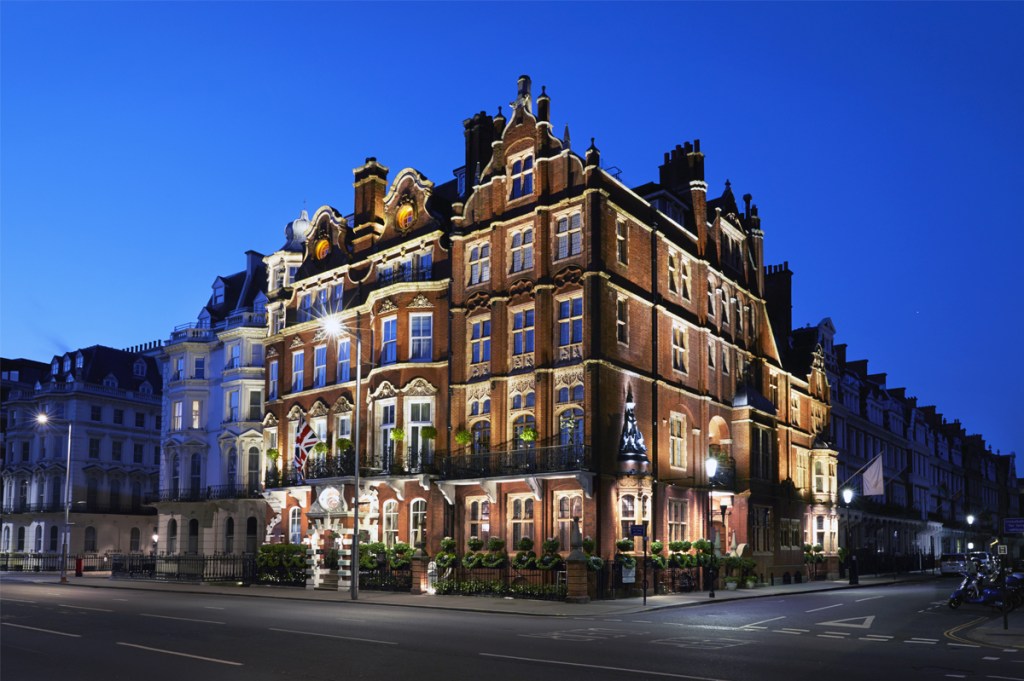
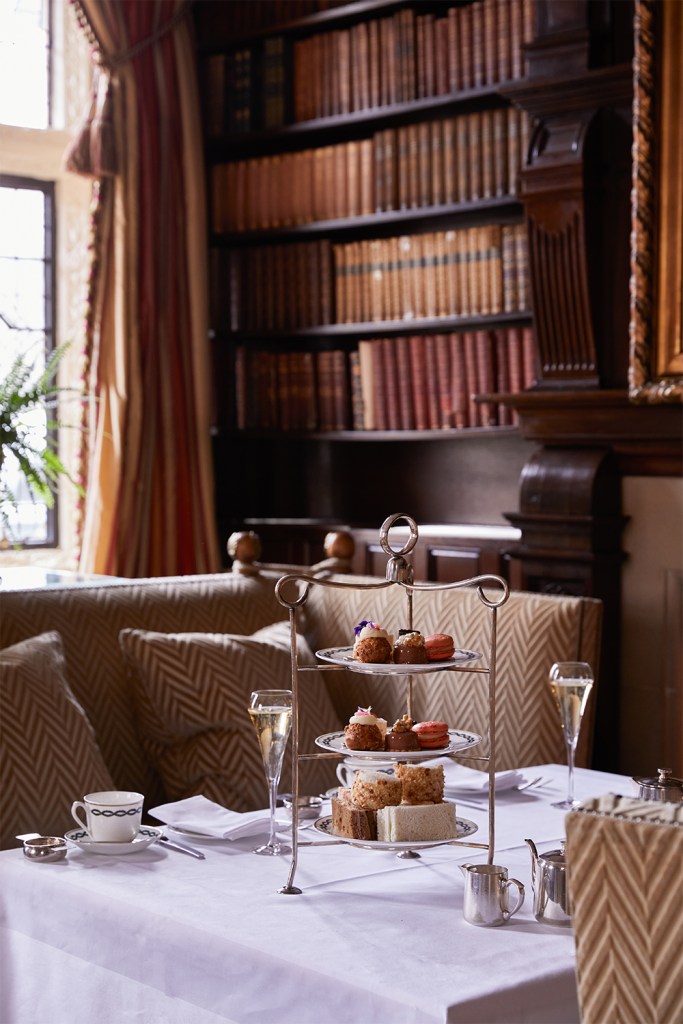
    Afternoon tea at The Milestone Hotel, a Victorian building next to the Royal Albert Hall, invites your best Antoinette impression (resist “let them eat cake” quips; a quick Google confirms the quote is widely misattributed). Festive visits have become a ritual in my family, a somewhat nostalgic constant. Doorman Steve remains at his post in emerald coat tails, guiding us through the Park Lounge swathed in rich fabrics, to our favorite couches in front of the fireplace. On the bottom cake stand tier sit finger sandwiches with the crusts dutifully removed (smoked salmon with dill and lemon crème fraîche, chicken mayo studded with toasted almonds, sharp mature Cheddar and pickle). Ask for more, and they’ll arrive without question. 

    Middle tier: warm scones with all the accoutrements (I spread the Cornish clotted cream first, which is technically the Devon way). On top, hand-crafted French pastries, tartlets and cakes to complement loose-leaf Earl Grey steaming in silver teapots, or a glass of Lanson. Today’s Marie Antoinette is pastiche, shorthand for the evils of excess, but I’ll admit it’s fun to be this spoiled.

    The Other House

    Perhaps a wider reaction to the state of the world, the fashion set confirmed the death of “quiet luxury” in 2025 – understated elegance is out, dramatic prints and theatrical silhouettes are back in, confirmed Spring/Summer shows from Valentino to Ganni. Interior designers are following suit, introducing outrageous color clashes and boisterous patterns. Sumptuous, art-stuffed hotel openings like Marrakech’s Jnane Rumi and Jakarta’s 25hours Hotel The Oddbird were among the buzziest this year, as anticipation builds for Italy’s Airelles Venezia, opening spring 2026.

    The Other House was ahead of the curve, emerging as London’s first hybrid hotel-residence concept in 2022, a dense mishmash of jungle print wallpaper, zebra hide seating and gilded picture frames. A chi chi pied-à-terre, it’s a fifteen-minute walk from the V&A, transforming 11 period townhouses into something between apartments and a private members’ club. I checked into a Greater Club Flat sleeping up to four people, traveling with some trusted companions (old school friends) primed not for a state-of-the-art sleep retreat, nor a digital detox, but the radical act of having a good time. We duly experimented with lengthy toilette routines (read: bothering to moisturize beyond our faces) and lavish lunches, newly-opened café The Lavery offering elevated post-museum power-ups.

    The Other House’s wellness studio would have served a French queen quite nicely – Antoinette’s own regime centering around daily aromatic baths, natural skincare and nightly conditioning rituals. What she’d have made of the modern program of exercise classes, hypnotherapy and sound healing is anyone’s guess, but the holistic massage blending deep tissue and Swedish techniques with natural oils would no doubt have been well-received. I emerged feeling restored, chasing a proper hour of relaxation in the sauna’s rich, dark woods. The cozy indoor pool was pleasingly quiet on a rainy Saturday afternoon; flopping onto the small fleet of loungers, we felt we had our own private residence.

    One thing I can guarantee against AI-generated destinations and reviews is my own experience. Growing up, exploring high-class London was a rare treat, bookended by long train journeys. Stepping out of bed to soak up South Kensington’s grandeur will never lose its sparkle. The Other House sits fifteen minutes away from Buckingham Palace by black cab (delete Uber if you want the real London experience). You’ll pass by Ciné Lumière, hosting daily screenings of French and world cinema, and Librairie La Page on Harrington Road, stocking the capital’s largest selection of French language books.

    Our digs’ private kitchenettes encouraged casual cooking, but sans private chef, I was pleased to discover an app offering room service. Had I the budget of a royal, I’d stuff the fridge with eye-wateringly expensive kumquats from Bens of Kensington greengrocer, gourmet sweets and organic meats from Kensington Farmer’s Market, and bubbles from where else but Jeroboams, its local branch housing a wine merchant.

    The Other House

    A plentiful breakfast spread is served in the French brasserie, artisanal cheeses and cured meats arranged with a bit of Parisian flair. Evenings are for sampling cocktails at the Owl & Monkey bar to the tune of a live DJ, or if you get the right night, some jazz. Stay on theme with a French Kiss, mixing Veuve Clicquot Brut with Apros Black Forest rosé, plum & rhubarb elixir, and Franklin & Son’s grapefruit soda.

    True locals would probably kick off their shoes and hold court over the British furniture dotted around the quiet Club Lounge, tending to some business or finishing off that book they’ve been meaning to. Perhaps they’d mosey over to the Body Lab for a casual spot of flotation therapy, acupuncture or red-light therapy, before browsing art at Christie’s, picking out homewares in the Conran Shop or donning sunglasses to pose on Sloane Avenue. They’d certainly have already visited two talked-about dinner spots I’d recommend to really take things over the top. 

    The first is Jacuzzi, a riotous palazzo-style restaurant on Kensington High Street. Opening to fanfare in 2023, you still can’t open Instagram without seeing its foliage-stuffed mezzanine, retractable roof and white tablecloths. The place was designed to ooze the luxury of a Venetian villa, crammed with Murano glass and lemon trees. The ground floor’s cozy circular banquettes invite salacious gossip as guests sip silky-smooth cocktails of home-made bergamot sorbet spiked with liqueur and limoncello, and spaghetti is mixed tableside in a hollow cheese round.

    Dishes are designed to wow: go for homemade ravioli stuffed with slow-cooked chicken and Parmigiano Reggiano, crumbled with dried Taggiasche olives. I love the Piedmontese Vittello tonnato (thinly sliced veal) swirled with a creamy tuna sauce, and the Neapolitan pizzas that fight for table space. A homemade profiterole arrives with gelato al pistachio, doused in thick dark chocolate sauce on request, but the Tiramisu is their unbeatable classic, infused with marsala, and flamboyantly dolloped onto plates. 

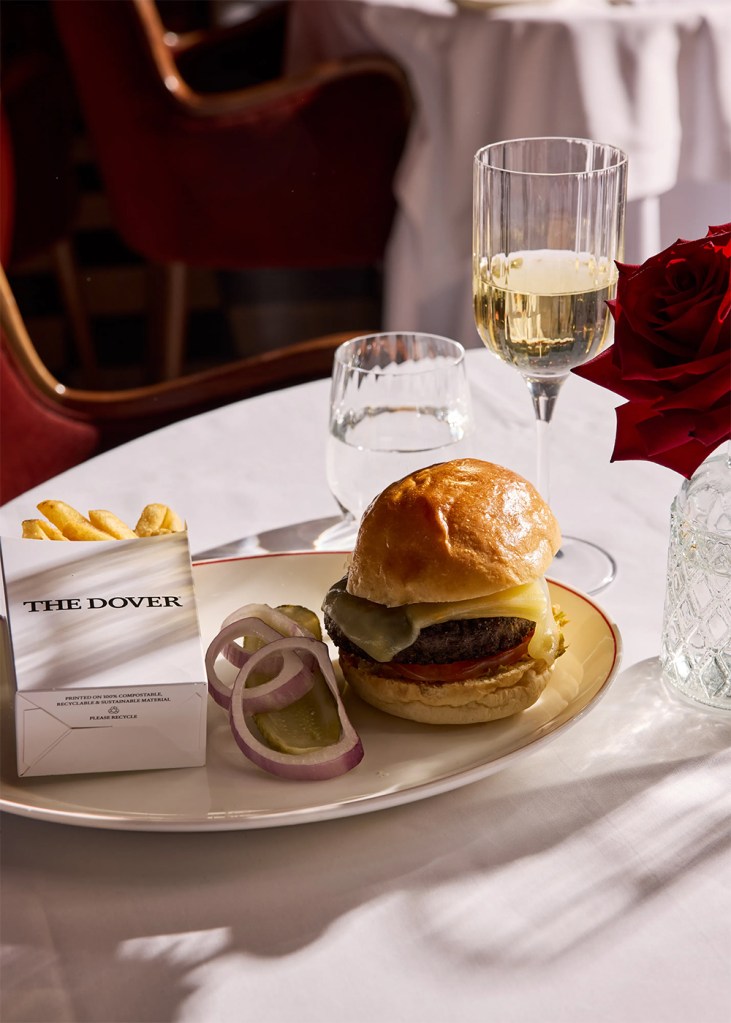
    Any trip devoted to shameless indulgence demands a finale in London’s most expensive post code. Twenty minutes in a taxi from “South Ken” delivers you to Mayfair’s the Dover, ex Soho House COO Martin Kuczmarski’s New York Italian. An unassuming entrance gives way to a lot of wood paneling; pull back the velvet curtain and you half expect to find David Bowie in full 1970s NoLita getup, lit just so by a chandelier. No nightclub-esque playlists to shout over, nor cacophonous menus to divide attention. This type of luxury trades on whispers – excited ones – proof that “quiet luxury” hasn’t altogether disappeared. 

    The Dover

    Start with a drink. The New York Sour mixes Maker’s Mark, tawny port, citrus, and aquafaba as sharp as the outfit Bowie would have pulled up in. They’re smartly blending high and low culture here; mini hot dogs are a cute surprise on the bar menu, tempting with pulled pork, würstel and fried onion, while seated guests fork smoked salmon onto dinky blinis. The joy is in the little details: perfectly crunchy French fries are funneled into paper cartons, “The Dover” sole (clever) is zesty, flavored with chili, lime and samphire sauce. A plate of Peruvian dark chocolate and Piemonte hazelnuts sounds simple enough, but spooning the rich praline into your mouth to cap off the meal feels whoppingly decadent. As it should – sometimes life’s about eating the damn cake.

    Marie Antoinette Style is on view at the V&A Museum until March 22, 2026.  The David Bowie Centre is a permanent display at V&A East Storehouse with free, ticketed access and new ticket drops every six weeks.

  • The Bride Stone offers excellent escapism

    The Bride Stone offers excellent escapism

    The Bride Stone begins. It’s 1796, and an idealistic young English doctor, Duval Harlington, just released from La Force prison in revolutionary Paris, learns that his father is dead. He is now Lord Harlington, heir to a fortune and the idyllic estate of Muchmore. But in order to gain possession of his heritage – and, as importantly, foil the aspirations of his unpleasant cousin Ralph Carson – Duval must marry within two days and seven hours. No suitable partner is available, so he buys a woman in a Norfolk wife sale for ten guineas.

    Money, its acquisition and loss, is woven through this hugely enjoyable novel. The French refugees trying to make their way in Georgian England are very different to those in The Scarlet Pimpernel, and one character is saved from death in a freezing, damp, broken-down cottage only by the liberal application of lucre. Duval’s country estate is not valued simply as a birthright, but because “in prison, the memory of Muchmore’s tranquillity had kept him alive… an oasis from the outside world.” What is described is the kind of healing, enchanted space all damaged people dream of, and tend to find only in fiction.

    It is not only Duval who needs healing. His new wife, Edmée, is French, the widow of a brutish, drunken parson; and once her bruised face has healed, she turns out to be a woman of refinement, beauty and mystery. The gentlemanly Duval expects to be able to give them both their freedom after the wedding ceremony, but there is a codicil to his father’s will: within a year, the new Lord and Lady Harlington must be in love. The wicked Carson will stop at nothing to prevent this happening, and when Duval and Edmée do indeed become lovers, she promptly vanishes. Our hero must go in pursuit of his wife, discovering both her secrets and that of a priceless jewel lost in the Terror.

    All this is fun, but what lifts The Bride Stone above the level of pure entertainment is the author’s engagement with her characters. Duval left home “as a young man, with a head full of dreams” and returned “ancient, with a head full of nightmares.” Edmée has suffered rape and torture; she is seriously ill after Duval buys her, and it transpires that this was not the first time she had been sold or abused. The novel owes as much to the fury at injustice of A Tale of Two Cities as it does to Georgette Heyer’s These Old Shades.

    A Carnegie and Costa-winning author of children’s fiction such as I, Coriander, The Red Necklace and Maggot Moon, Sally Gardner is one of those rare authors, like Joan Aiken and Eva Ibbotson, who can write equally well for adults and children. The tropes of the genre are infused with wit, imagination and maturity. Where her previous adult novels, such as The Weather Woman, needed better editing and less magic, The Bride Stone is leaner and more propulsive. Each chapter is short and absorbing, much like a first-rate children’s novel but with indirect intimations of sex. The book abounds with vivid minor characters, from the detective (or Bow Street officer) Mr. Quinn searching for Edmée to Duval’s wise, motherly aunt and the viciously snobbish Carson.

    We all crave escapism at present, and it is surely no coincidence that the two best entertainments this summer – Laura Shepherd-Robinson’s The Art of a Lie being the other – are both set in the turbulent 18th century. Just be warned. I stayed up very late to finish this book.

  • Why does Pope Leo think immigration is a pro-life issue?

    Why does Pope Leo think immigration is a pro-life issue?

    On Tuesday evening, the Illinois pope weighed in on Illinois politics. A reporter from the Catholic news outlet EWTN asked Pope Leo XIV about the Archdiocese of Chicago’s decision to award Senator Dick Durbin with a “lifetime achievement award” for his work advocating for immigrants coming to America. “Some people of faith are having a hard time with understanding this because [Durbin] is for legalized abortion,” the reporter said. How should Catholics feel about that?

    “I am not terribly familiar with the particular case,” the Pope conceded, speaking in English. Then he spoke more broadly, and vaguely, about what it means to be “pro-life”. “Someone who says ‘I am against abortion’ but says ‘I am in favor of the death penalty’ is not really pro-life,” he said. “Someone who says ‘I am against abortion, but I am in agreement with the inhuman treatment of immigrants in the United States,’ – I don’t know if that’s pro-life.”

    The new Pope is proving he’s consistent. From the Catholic Church’s perspective, being pro-life means standing up for the dignity of human life from conception until natural death. And there are growing examples of undeniably disturbing, gleeful responses to deportations and family separations (one only needs to look at the Department of Homeland Security’s X account). But to characterize support for a strong border and stricter enforcement of immigration law as “[agreeing] with the inhuman treatment of immigrants in the United States” is a caricature of the complex feelings many Americans, particularly Catholic Americans (of which there are many in the Trump administration), have about the issue.

    After the Pope’s comments (though not clearly because of them) Senator Durbin declined to accept the award for his immigration advocacy, according to a letter issued last night by Cardinal Blase Cupich, who named him the recipient of the “Keep Hope Alive” award. Last month, Cupich defended his decision by saying that he was acting in accordance with Church instructions “advising bishops to ‘reach out to and engage in dialogue with Catholic politicians within their jurisdictions… as a means of understanding the nature of their positions and their comprehension of Catholic teaching’.”

    Cupich’s interpretation of “dialogue” misses the very clear point of those instructions given in 2021 by the Vatican’s Prefect for the Congregation for the Doctrine of the Faith, Cardinal Luis Ladaria. They ask US bishops to attempt to change the minds of pro-abortion politicians through civil debate, and to dispel the characterization that pro-life teaching is only about abortion and euthanasia, rather than a set of teachings about respecting human dignity throughout a person’s full life.

    The decision to interpret those instructions as a directive to give politicians awards seems bizarre, even deliberately ignorant. But it’s not surprising. Many US bishops and cardinals have been vocal in their criticisms of immigration policy under the Trump administration (more vocal than they were over, say, the last administration’s stance on gender ideology or the church closures during Covid). Some have written letters to Congress to reject bills funding immigration enforcement, or have turned up at ICE hearings to show solidarity with immigrants.

    The tension between Rome and the Trump administration on immigration came to a head during the previous papacy, and it is not going to disappear anytime soon. Pope Francis criticised Trump’s mass deportations, and in a letter to US bishops made a pointed reference to J.D. Vance’s interpretation of ordo amoris – that the “hierarchy of love” gives one a moral obligation to family and community first, and then the rest of the world. It’s an argument not dissimilar from the more secular one for America First. Francis wrote in that letter that the true ordo amoris is something we discover by “meditating on the love that builds a fraternity open to all, without exception.”

    Francis’s approach to America’s border crisis struck many Americans as distant and hectoring, ignoring the realities of illegal migration – gang violence, murder, drug and sex trafficking – and choosing to remind us of what we learned in Sunday school: that Jesus, Mary and Joseph were immigrants. Pope Leo has tried to avoid that tone so far. “They are very complex issues,” he told the EWTN reporter. “I don’t know if anyone has all the truth on them.” It’s a most honest interpretation on Christianity’s offerings: not to say that Church teaching is muddled on these issues, but that there are no precise instructions from a universal Christian faith on how, for example, to deal with a specifically American border crisis.

    The Pope ended his answer by stating that “the Church teaching on each one of those issues is very clear”. In the eyes of the Catholic Church, all human beings must be treated with dignity and respect, the state should not have the power to end a life, and abortion is a moral evil. Even if immigration is considered the most urgent pro-life issue at the moment, that should have no bearing for American bishops and cardinals on the Church’s unnegotiable stance on the right to life.